
Château de Foix
Three Towers Above the Ariège
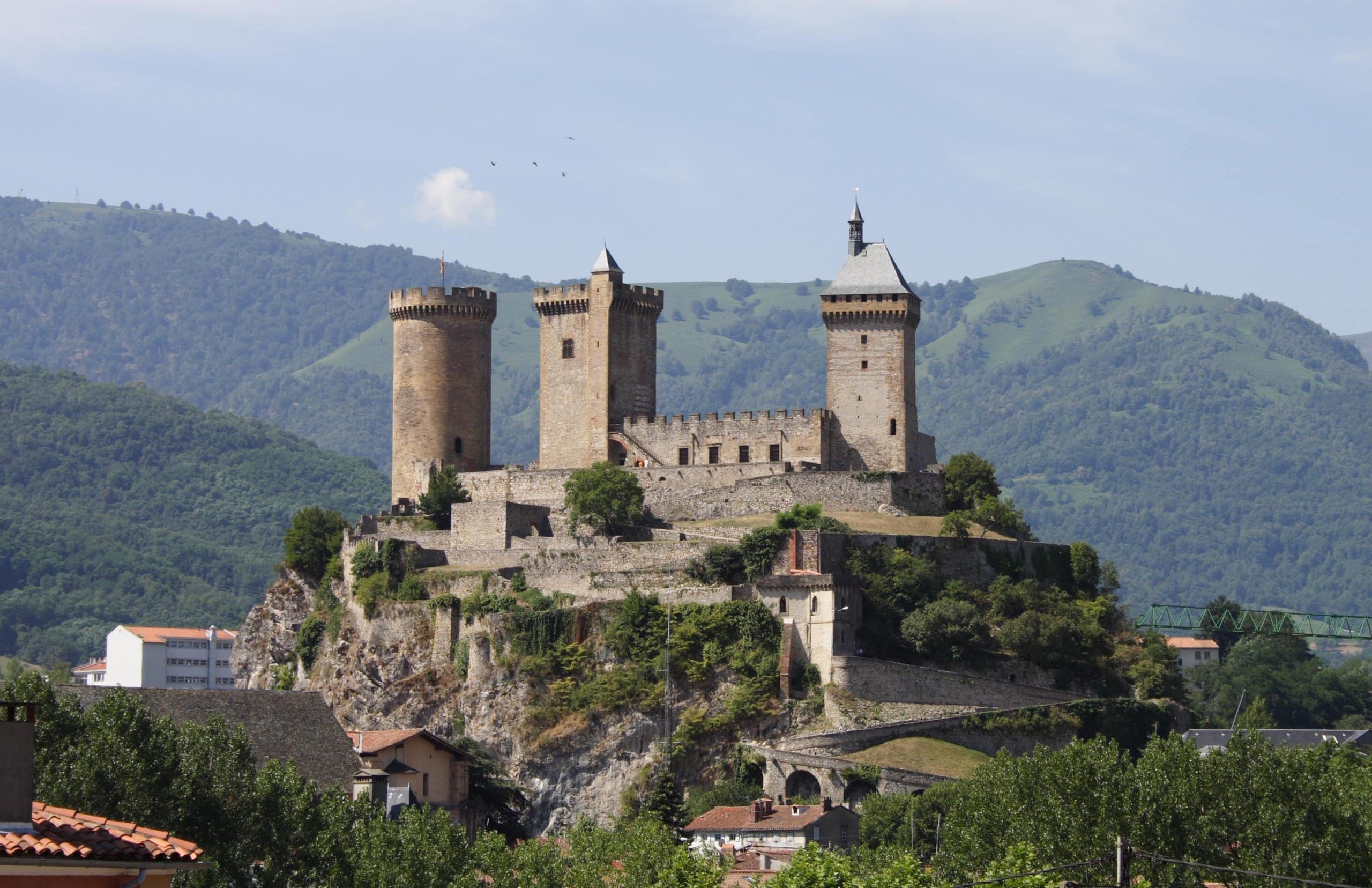
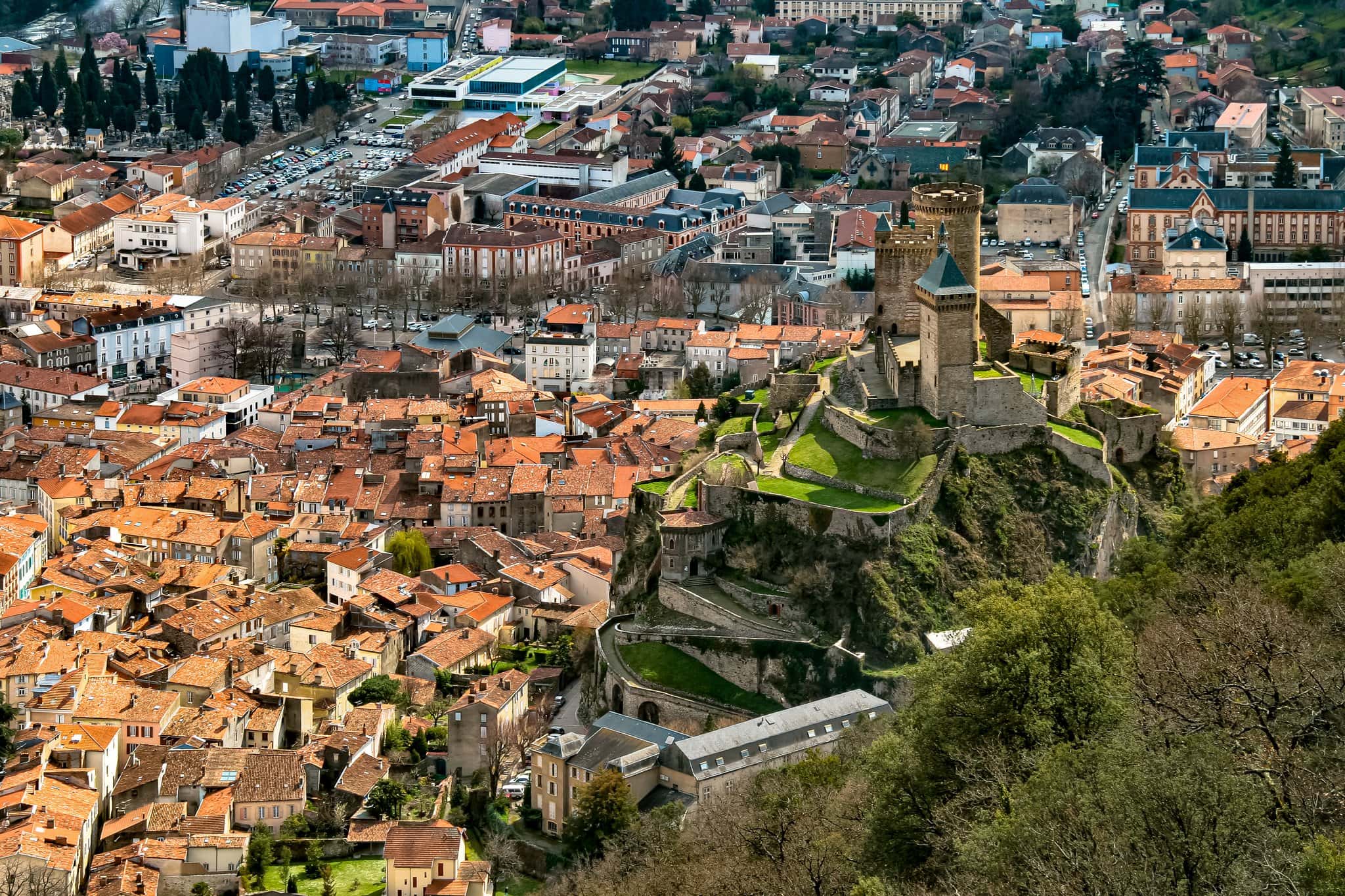
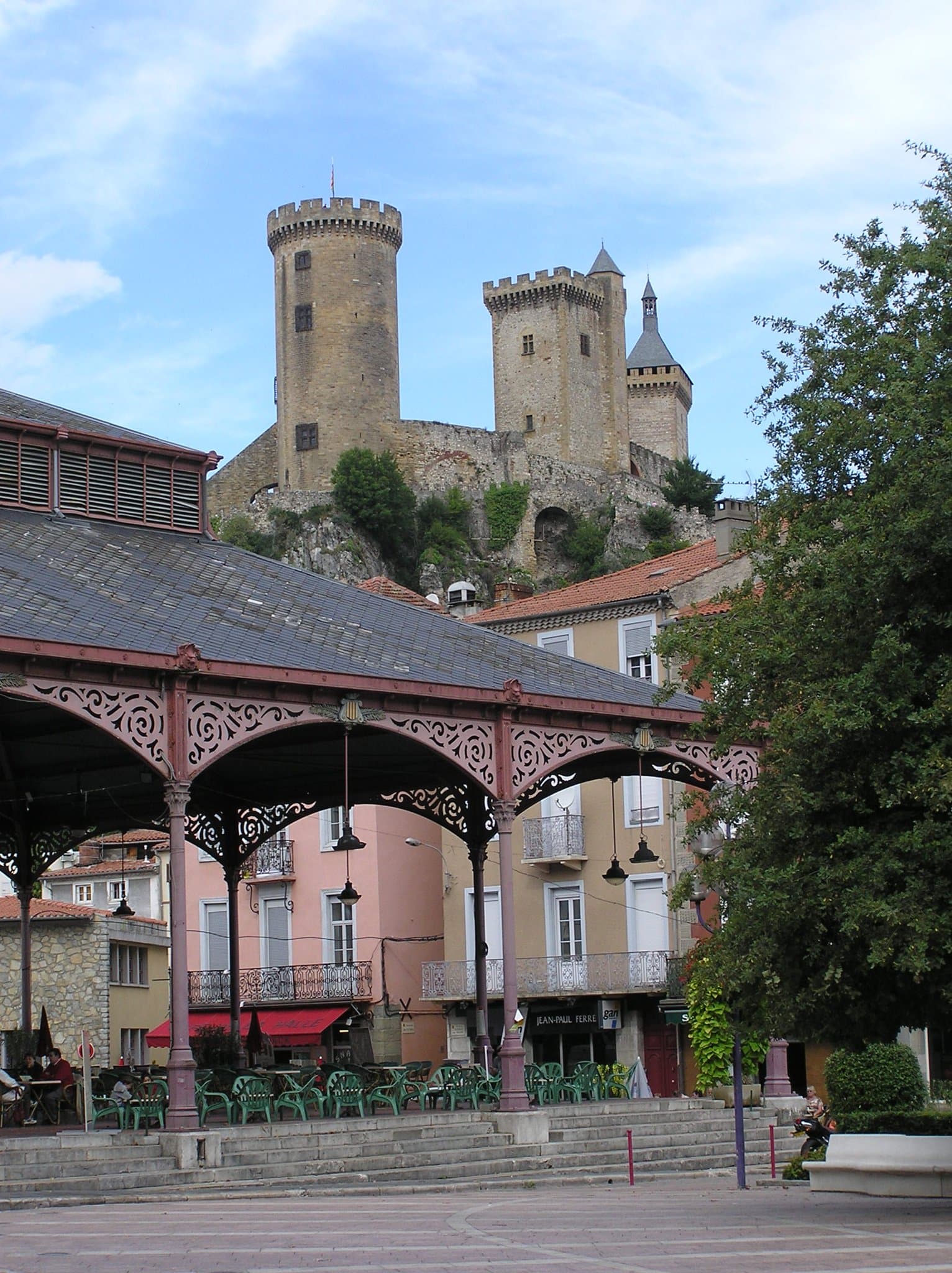
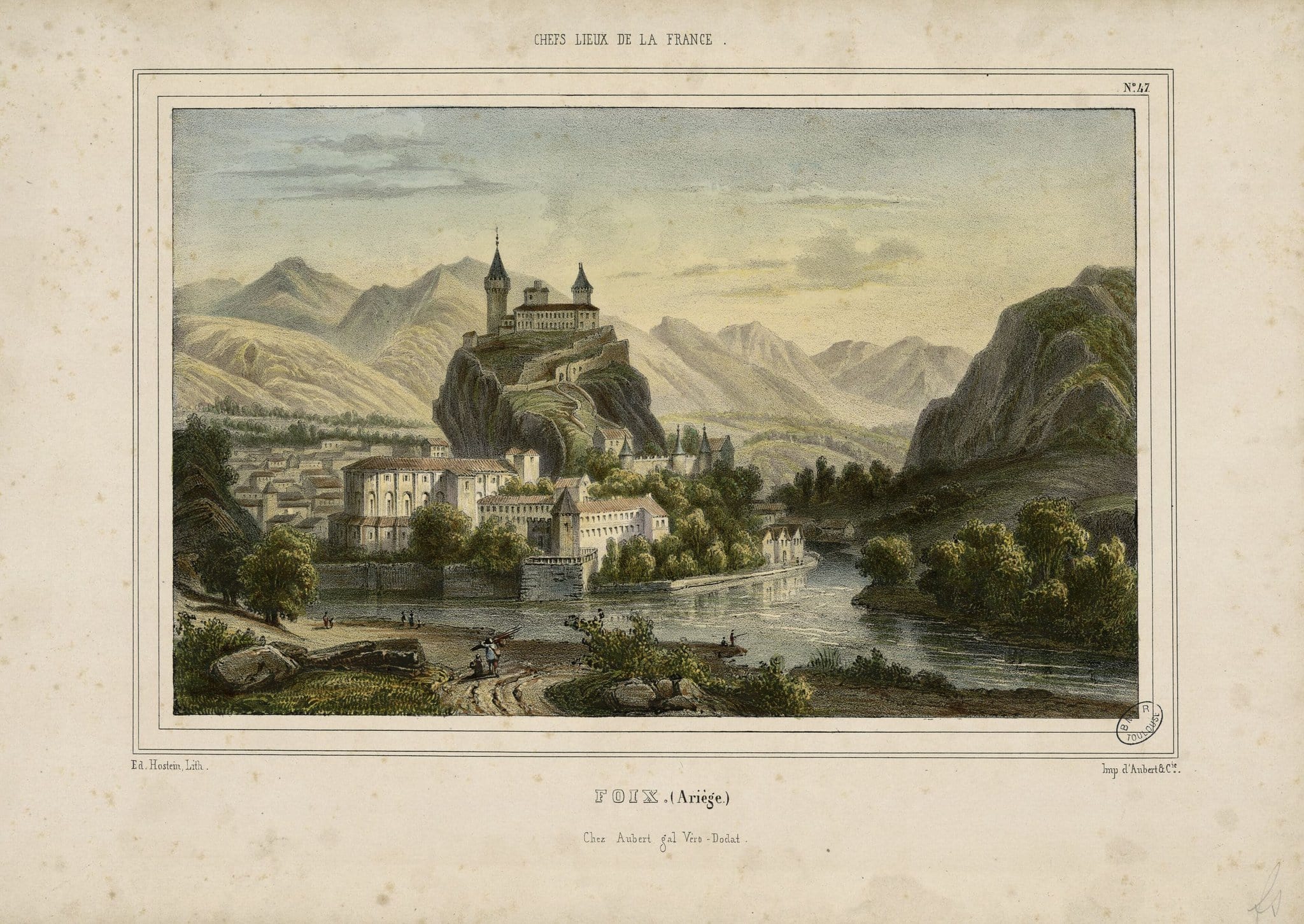
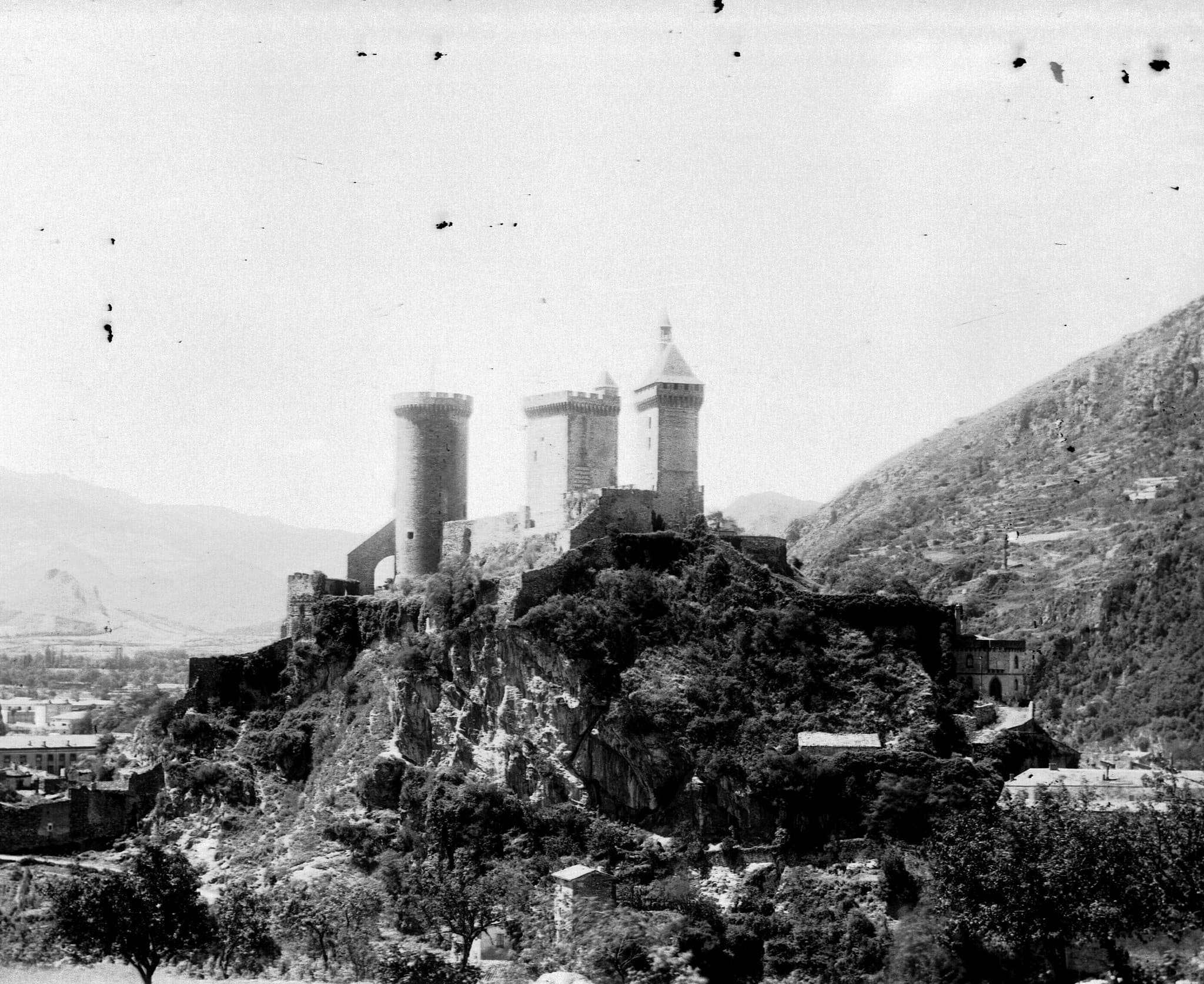
Château de Foix stands where the Arget meets the Ariège, three towers on a limestone spur that has watched over the town of Foix for more than a thousand years. From the valley floor it reads as a single silhouette, blunt and unmistakable, the kind of outline a child draws when asked to draw a castle. Climb the paved ramp and that simple shape resolves into a chronology in stone: two square towers from the medieval county and a taller round tower added in the fifteenth century, each one a different century of ambition.
What sets Foix apart from the cliff-top fortresses of nearby Cathar country is that it was never a frontier outpost or a last refuge. It was a seat of power, the command center of the counts of Foix, lived in, fought over, and continuously used for so long that it never had the chance to fall into ruin. Today it is the Ariège’s most-visited monument, a departmental museum wrapped around a castle that was besieged many times but never taken by storm.
Quick Facts
| Location | Foix, Ariège, Occitanie, France |
| Type | Comtal castle and departmental museum |
| First recorded | Around the year 1000; round tower added around 1450 |
| Elevation | About 450 meters (1,480 feet) above sea level |
| Condition | Well preserved (restored in the 19th century and 2016–2025) |
| Managed by | Conseil départemental de l’Ariège |
| Protection | Monument historique (1840) |
| UNESCO | Candidate in the “Co-Principality of Andorra” nomination; examination expected 2027 |
| Admission (2026) | Adults €13 (€13.50 in July and August); concessions and family rates available |
| Official site | sites-touristiques-ariege.fr |
A Rock, a Will, and the Birth of a County
It began with the rock. The limestone outcrop that carries the castle is honeycombed with prehistoric caves, some bearing traces of ancient human use, though the spur itself was not truly settled until the Iron Age. A fortification is thought to have crowned the spur even earlier, in the centuries after Rome, before the medieval castle rose in its place. A town had grown at Foix by the early Middle Ages, and a castle is first mentioned here around the year 1000, when the site held a single tower and its enclosing wall. Within a generation it became something larger. In his will of the early eleventh century, Roger I “the Old,” count of Carcassonne, left the lands of Foix to his son Bernard, who took the title of first count of Foix. By the 1030s the castle was the capital of a new county, and its position did the rest.
 CC BY-SA 3.0" srcset="https://stonekeepatlas.com/wp-content/uploads/2026/06/chateau-de-foix-from-halle-aux-grains.jpg 2048w, https://stonekeepatlas.com/wp-content/uploads/2026/06/chateau-de-foix-from-halle-aux-grains-300x178.jpg 300w, https://stonekeepatlas.com/wp-content/uploads/2026/06/chateau-de-foix-from-halle-aux-grains-1024x608.jpg 1024w, https://stonekeepatlas.com/wp-content/uploads/2026/06/chateau-de-foix-from-halle-aux-grains-768x456.jpg 768w, https://stonekeepatlas.com/wp-content/uploads/2026/06/chateau-de-foix-from-halle-aux-grains-1536x911.jpg 1536w" sizes="auto, (max-width: 2048px) 100vw, 2048px" />
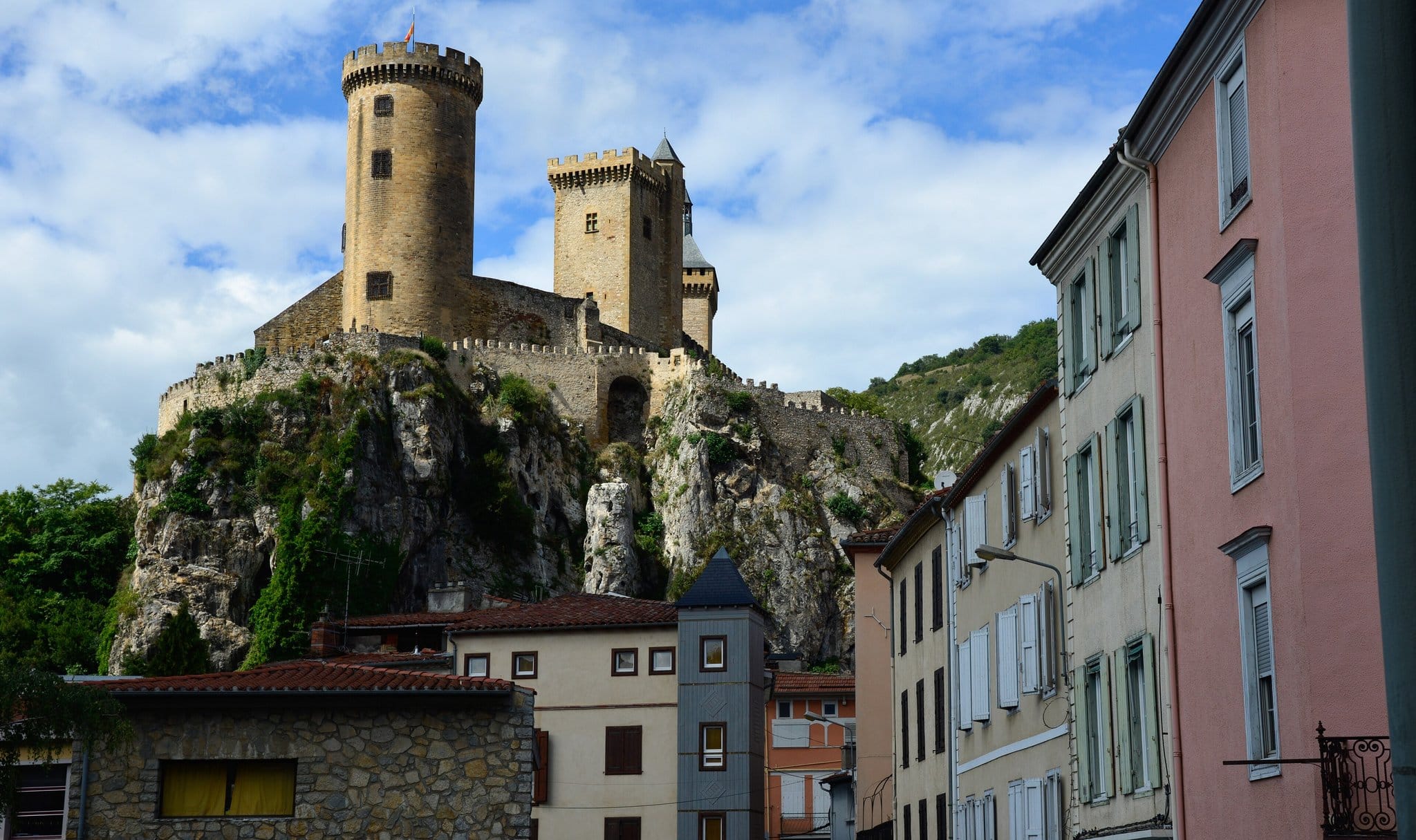
From this spur, roughly sixty meters above the streets, the counts controlled the upper Ariège valley and the road south toward the Pyrenees. This early castle grew by addition rather than grand design. Seals of the counts from the late twelfth century show a primitive tower already joined by a second square tower and a building linking the two. Its architecture is documented only in fragments, but the logic is plain enough: a working stronghold for a dynasty on the rise, expanding as its fortunes did. For more than five centuries the line of Foix, twenty-two lords in all, would push its borders outward through marriage, inheritance, and the occasional victorious war.
The Soul of Occitan Resistance
In the thirteenth century the Albigensian Crusade tore through Languedoc, and the counts of Foix were pulled into the center of it. Preached from 1209 against the Cathar heresy, the crusade was led on the ground by Simon de Montfort, whose forces fell on the towns, castles, and lordships of the south. Two counts of Foix, Raymond-Roger and his son Roger-Bernard, became the soul of the southern resistance. Their wives, sisters, and daughters numbered among the known heretics, their administrators too, and the counts themselves fell under suspicion.
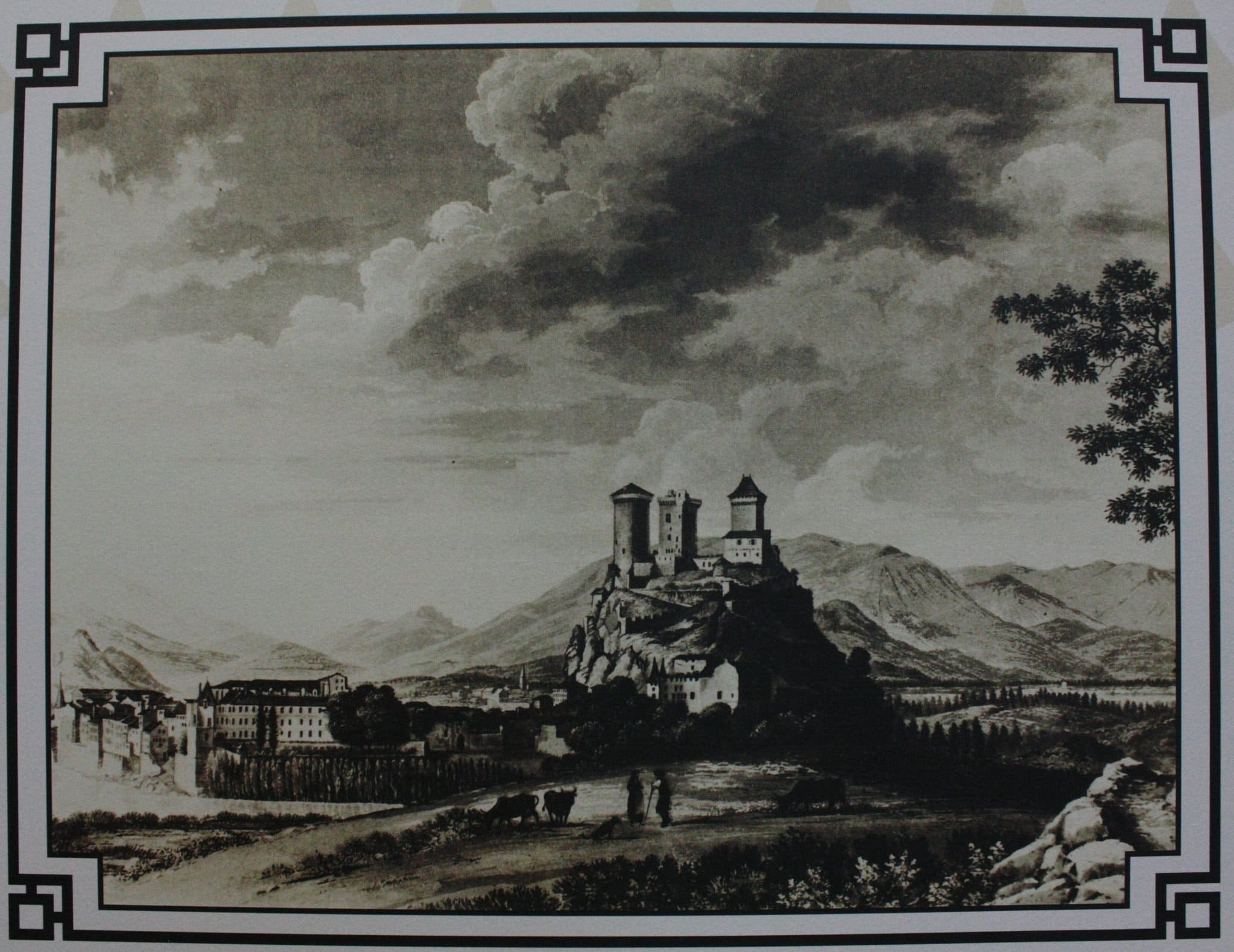
Here the story turns on a distinction worth keeping straight. For all that Foix sits at the heart of what tourism now brands as Cathar country, the castle was, in the words of the site itself, not a Cathar castle. Its counts grasped early that the crusade was as much a pretext for northern lords to seize southern land as a war of faith. They sheltered sympathizers in their county while keeping heretics out of the castle, at least officially, and so preserved both their territory and their fortress. When Montfort tried to take the castle in the 1210s, the rock defeated him. Twice the stronghold was surrendered to the Church as a pledge of peace, then returned to Raymond-Roger in 1218.
A reckoning came from the crown, not the crusade. In 1272 Count Roger-Bernard III refused to recognize the sovereignty of the king of France, and Philip III marched south in person to besiege Foix. This time the count capitulated. The castle had withstood assault, but it bowed to a king. Its “impregnable” reputation is real in a narrow sense, the walls were never stormed, yet the place changed hands more than once, and it would be captured outright in 1486 through treachery during a feud between two branches of the Foix family.
Fébus and the Princely Century
Foix’s most famous lord never made the castle his main home. Gaston III, who styled himself Fébus after the sun-god Phoebus, ruled from 1343 to 1391 over a sprawl of Pyrenean lands that by then included Béarn far to the northwest. From his court at Orthez he governed a near-independent principality, steering a careful neutrality between the English and French crowns through the Hundred Years’ War. After his victory at the Battle of Launac in 1362 he captured a host of rival lords and ransomed them, and the gold poured into Foix-Béarn, funding a court famous across Europe for its brilliance.
 CC BY-SA 4.0" style="width:465px" srcset="https://stonekeepatlas.com/wp-content/uploads/2026/06/chateau-de-foix-round-tower-from-walls.jpg 768w, https://stonekeepatlas.com/wp-content/uploads/2026/06/chateau-de-foix-round-tower-from-walls-225x300.jpg 225w" sizes="auto, (max-width: 768px) 100vw, 768px" />
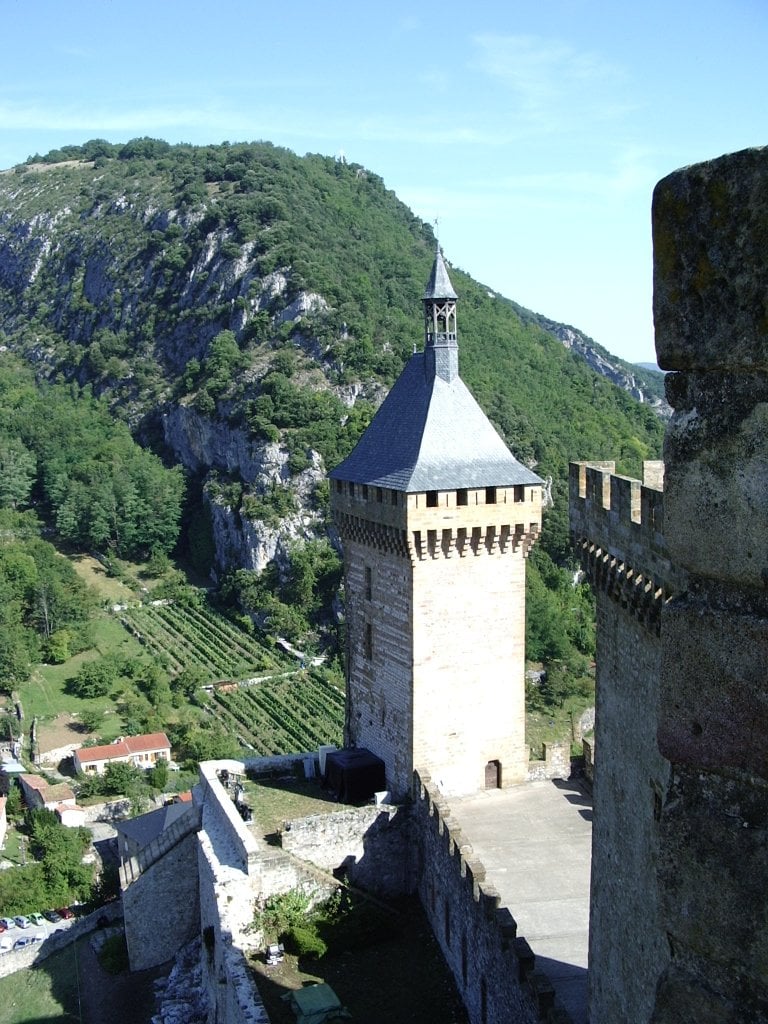
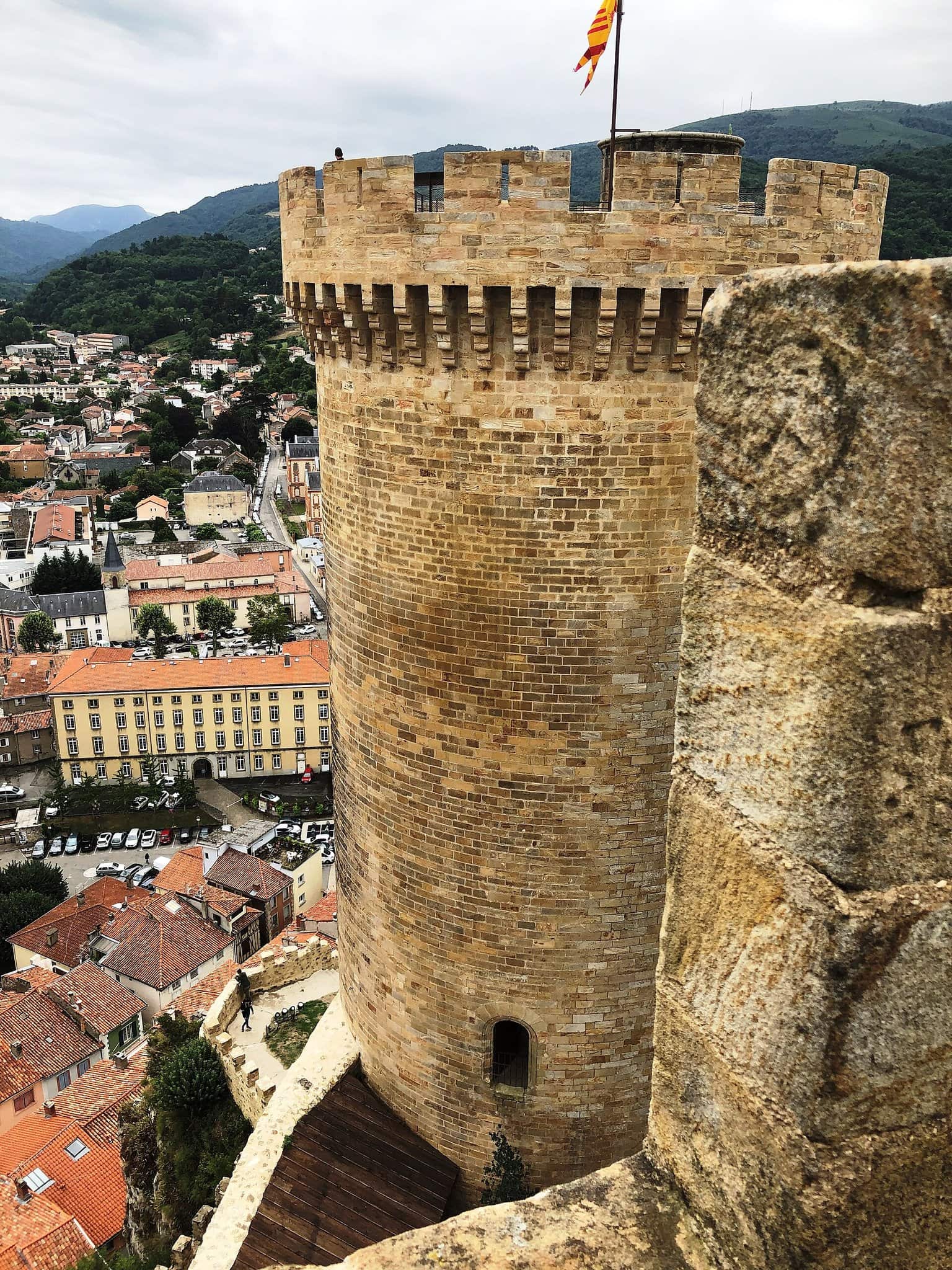
Fébus is remembered as much for his pen as his sword. His treatise on hunting, the Livre de la chasse, became the most celebrated work of its kind in the Middle Ages, copied and illuminated for centuries, and it remains bound to his memory; the modern museum gives it an immersive room of its own. Yet the count’s body and court belonged to Béarn, and by his century the castle of Foix had already begun to slide from residence toward symbol. A round tower now dominates the skyline, and it came later still, raised around 1450 under Gaston IV. Built less for defense than for display, it announced comtal power with a chapel, fine chambers, and walls four meters thick, its four vaulted storeys rising thirty-two meters above the two older square towers like a latecomer outshining its elders.
From Navarre to a Royal Prison
The dynasty kept climbing. Through marriage and inheritance the counts gathered Béarn, Navarre, and great estates in Catalonia, until in 1479 the line reached the throne of Navarre. Its last count, Henri III of Navarre, was crowned king of France and became the beloved Henri IV; in 1607 the county was formally annexed to the crown. A castle that had been the cradle of the house passed quietly into royal administration.
 CC BY-SA 4.0" style="width:413px" srcset="https://stonekeepatlas.com/wp-content/uploads/2026/06/chateau-de-foix-cachot.jpg 1365w, https://stonekeepatlas.com/wp-content/uploads/2026/06/chateau-de-foix-cachot-200x300.jpg 200w, https://stonekeepatlas.com/wp-content/uploads/2026/06/chateau-de-foix-cachot-683x1024.jpg 683w, https://stonekeepatlas.com/wp-content/uploads/2026/06/chateau-de-foix-cachot-768x1152.jpg 768w, https://stonekeepatlas.com/wp-content/uploads/2026/06/chateau-de-foix-cachot-1024x1536.jpg 1024w" sizes="auto, (max-width: 1365px) 100vw, 1365px" />
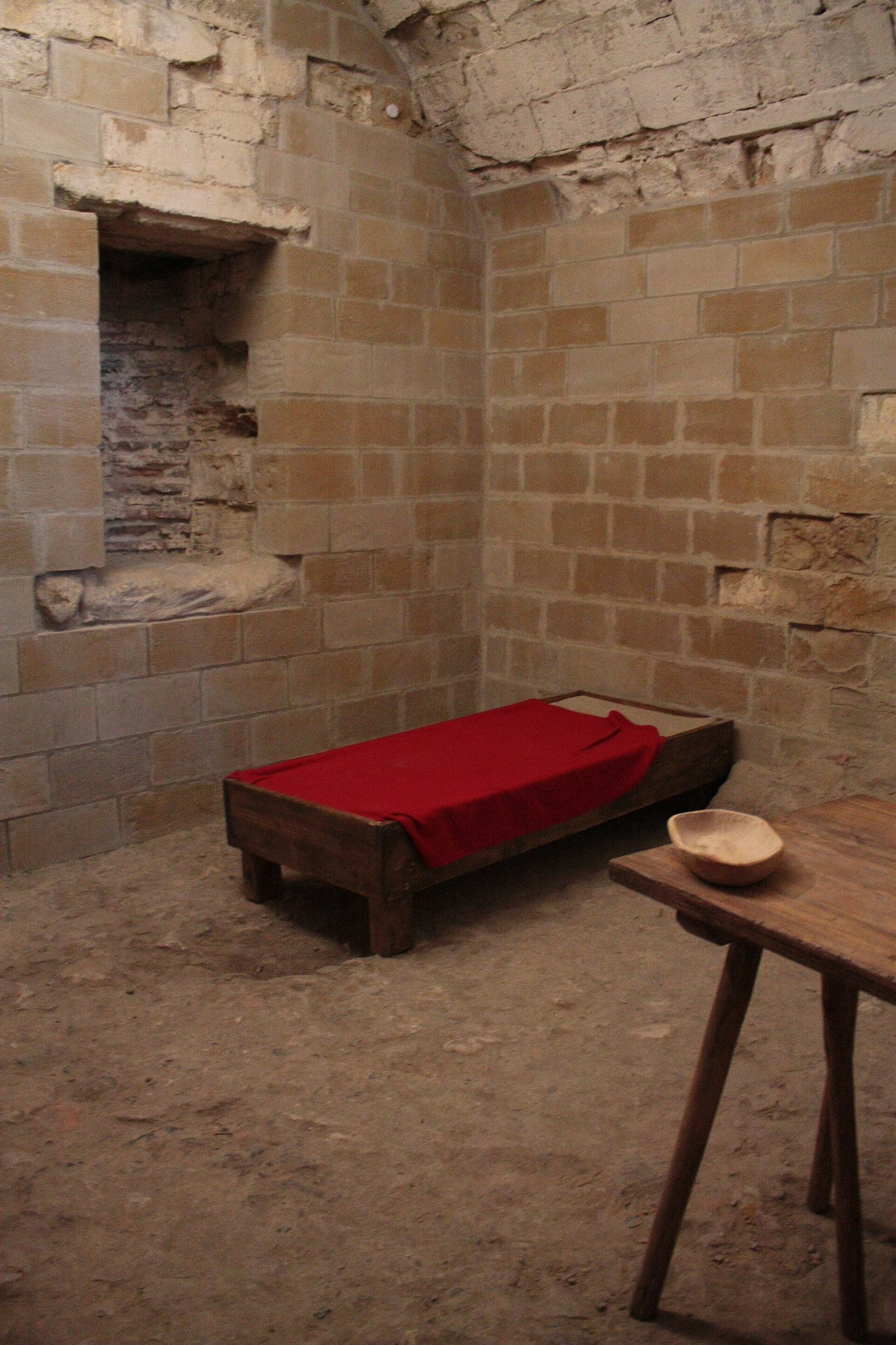
It survived the next century by being useful. When Cardinal Richelieu ordered the systematic demolition of the region’s castles in the 1630s, Foix alone among them was spared, kept standing for its position near the Spanish frontier during the Thirty Years’ War. From the fifteenth century it served as the seat of the region’s governor, and over the following centuries it became a garrison, then a prison. As a jail it held as many as two hundred inmates in grim conditions, and their graffiti can still be read on the walls. That prison did not leave until the mid-nineteenth century. Classified a monument historique on the founding 1840 list, the castle was then restored under Paul Boeswillwald, a pupil of Viollet-le-Duc who had worked on the walls of Carcassonne, and who pulled down the prison accretions in pursuit of the medieval monument underneath. Continuous use, ironically, is what saved Foix from the ruin that claimed so many of its contemporaries.
Co-Princes of Andorra
One thread of the Foix inheritance runs all the way to the present, and it has nothing to do with the Cathars. In 1278 a settlement known as the paréage gave the counts of Foix and the bishop of Urgell joint lordship over the high valleys of Andorra. That shared sovereignty, a co-principality, never lapsed. The Foix title descended through Béarn and Navarre to Henri IV, and from him to the crown of France, so that the office passed from medieval counts to French kings and, after the Revolution, to the French head of state. To this day the president of France serves as co-prince of Andorra alongside the bishop of Urgell, an unusual feudal inheritance still carried by a modern head of state.
 CC BY-SA 4.0" style="width:465px" srcset="https://stonekeepatlas.com/wp-content/uploads/2026/06/chateau-de-foix-round-tower-flag.jpg 1536w, https://stonekeepatlas.com/wp-content/uploads/2026/06/chateau-de-foix-round-tower-flag-225x300.jpg 225w, https://stonekeepatlas.com/wp-content/uploads/2026/06/chateau-de-foix-round-tower-flag-768x1024.jpg 768w, https://stonekeepatlas.com/wp-content/uploads/2026/06/chateau-de-foix-round-tower-flag-1152x1536.jpg 1152w" sizes="auto, (max-width: 1536px) 100vw, 1536px" />
That deep institutional thread is why Foix now carries a heritage claim entirely its own. The castle is one of twelve monuments in a France-Spain-Andorra bid for UNESCO World Heritage status, submitted in early 2025 under the title “The Material Testimonies of the Construction of the State of the Pyrenees: The Co-Principality of Andorra,” which gathers sites across Andorra together with the cathedral complex of La Seu d’Urgell in Spain and the Château de Foix in France. Its nomination remains under review and is not without obstacles, but the premise is striking: that a small mountain co-principality has endured from the Middle Ages into a written constitution, and that the castle of Foix is one of its material witnesses. It is a very different distinction from the one held by Foix’s cliff-top neighbors, and a more fitting one.
Visiting Château de Foix
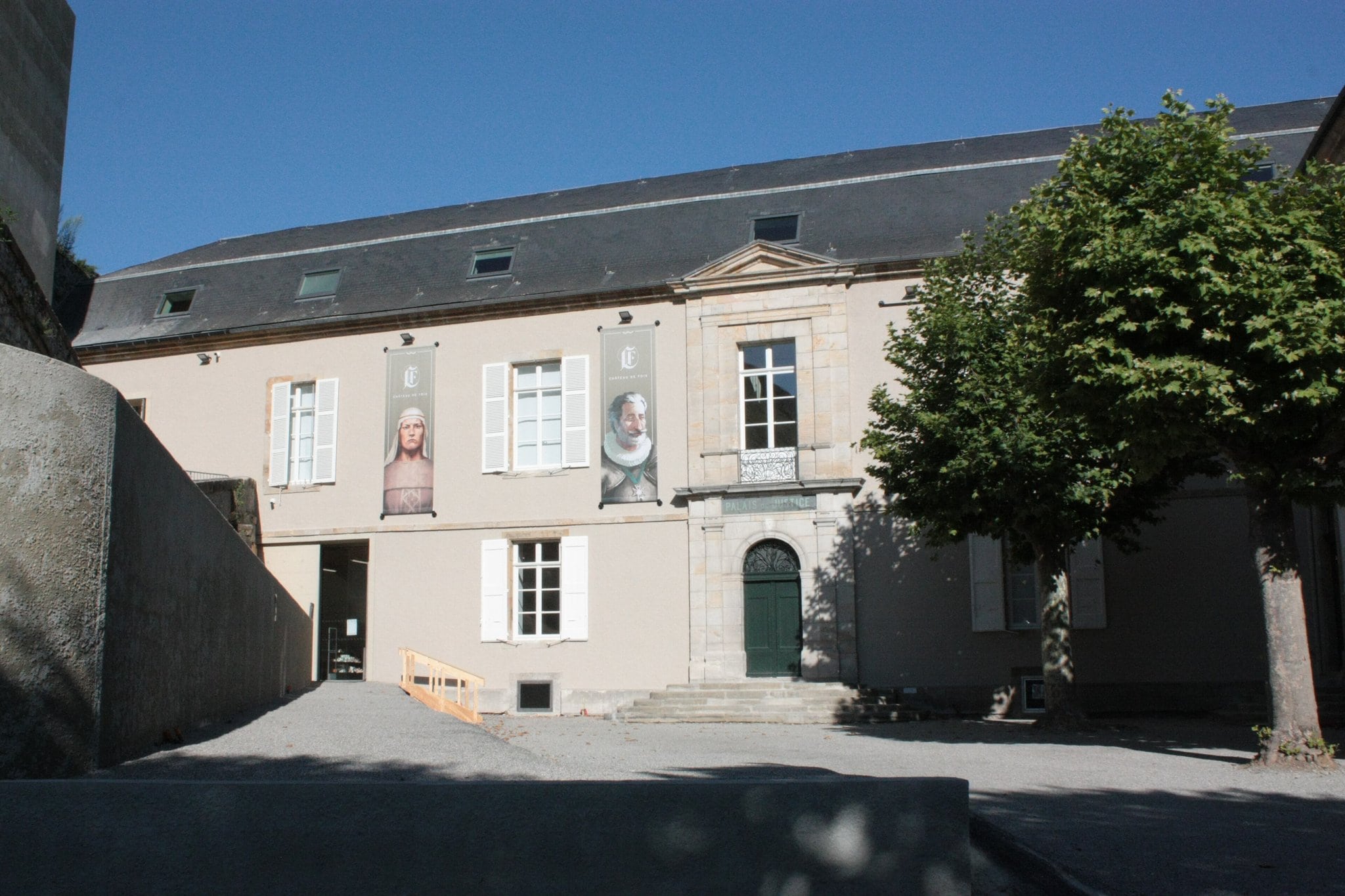
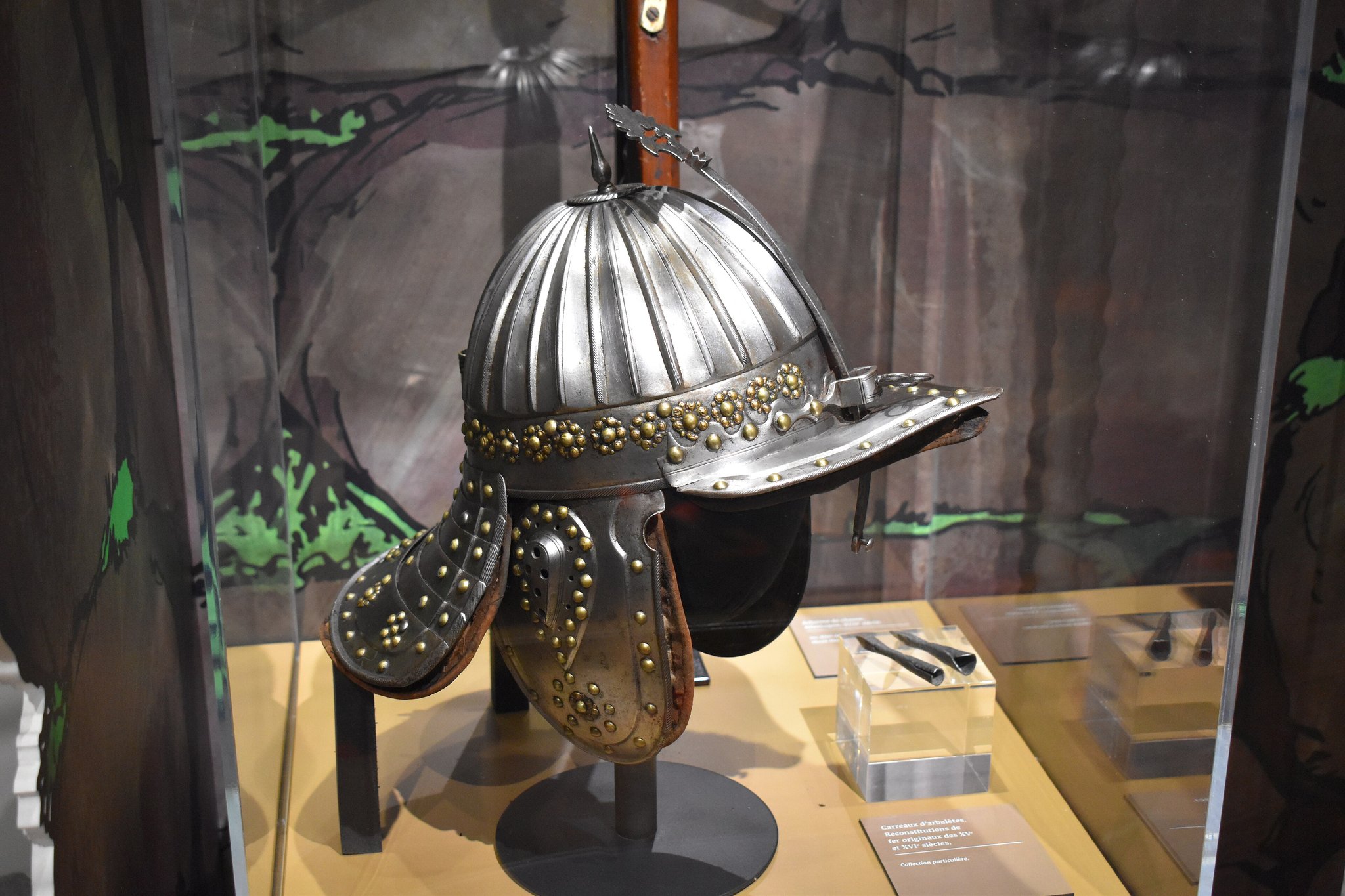
A visit to Château de Foix unfolds in two stages, and you should budget a good half-day for both. Its lower stage occupies the former Palais des Gouverneurs, the Governors’ Palace at the foot of the castle, which housed the local law court until 2015 before its return to the department turned it into a museum, opened in 2019 to display collections the Ariège has gathered since the early twentieth century. Across seven sequences the departmental museum tells the saga of the counts of Foix, their conquests and marriages and beliefs, threaded with interactive screens, tactile models, and augmented reality, with a free smartphone companion available in several languages. Among its set pieces are a room devoted to Fébus’s Livre de la chasse and four hand-made suits of armor shown alongside genuine weapons on loan from the Musée de l’Armée in Paris. At the heart of the museum stands a large model of the castle beneath a cupola, lit to show the site in every season and readable both from the floor below and from the gallery above. A second model, triggered through the visit companion, unfolds in augmented reality to trace the fortress from its first wooden tower to the three towers of cut stone that crown it today.
 CC BY-SA 4.0" srcset="https://stonekeepatlas.com/wp-content/uploads/2026/06/chateau-de-foix-visitor-entrance.jpg 2048w, https://stonekeepatlas.com/wp-content/uploads/2026/06/chateau-de-foix-visitor-entrance-300x200.jpg 300w, https://stonekeepatlas.com/wp-content/uploads/2026/06/chateau-de-foix-visitor-entrance-1024x683.jpg 1024w, https://stonekeepatlas.com/wp-content/uploads/2026/06/chateau-de-foix-visitor-entrance-768x512.jpg 768w, https://stonekeepatlas.com/wp-content/uploads/2026/06/chateau-de-foix-visitor-entrance-1536x1024.jpg 1536w" sizes="auto, (max-width: 2048px) 100vw, 2048px" />
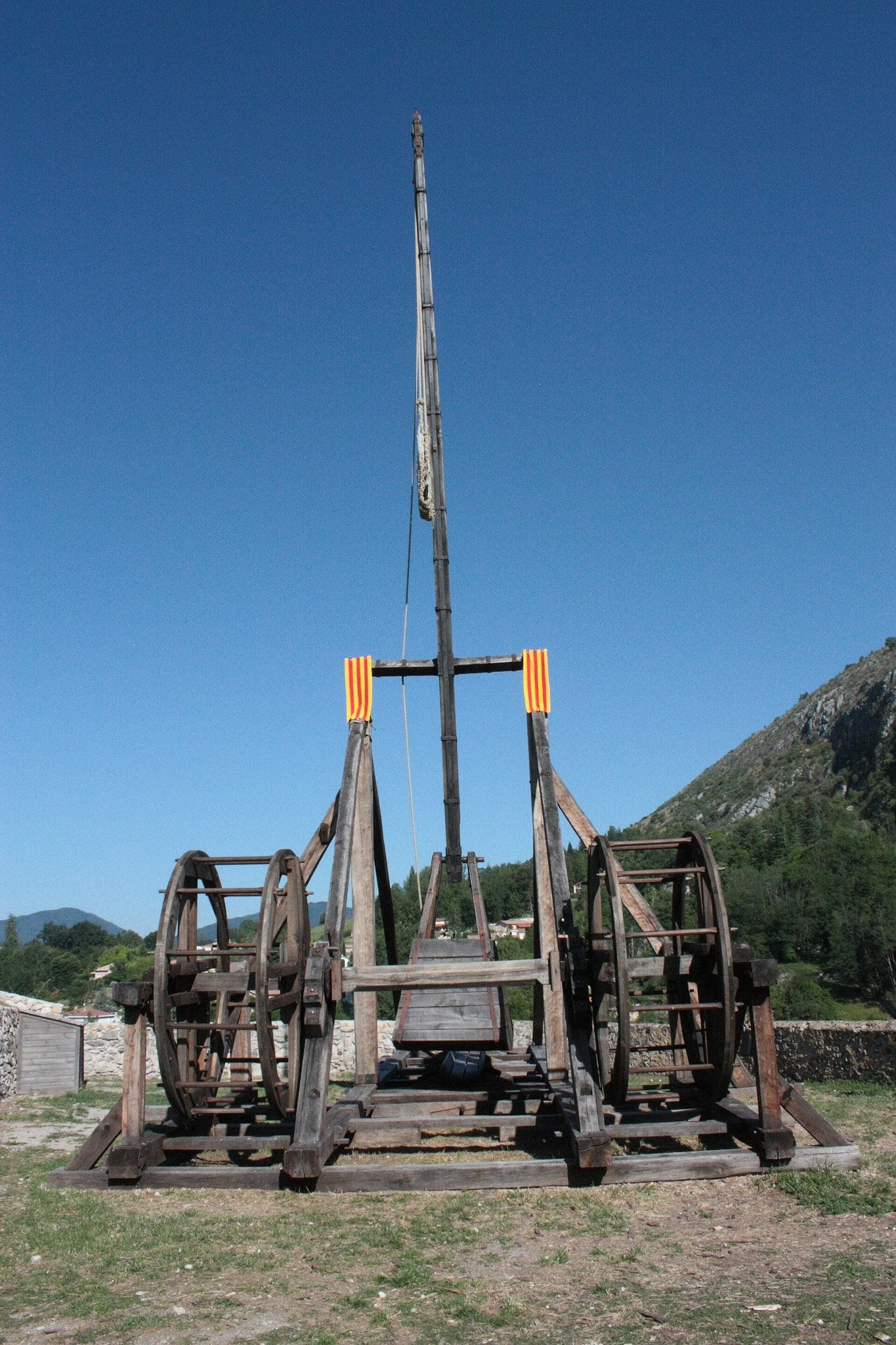
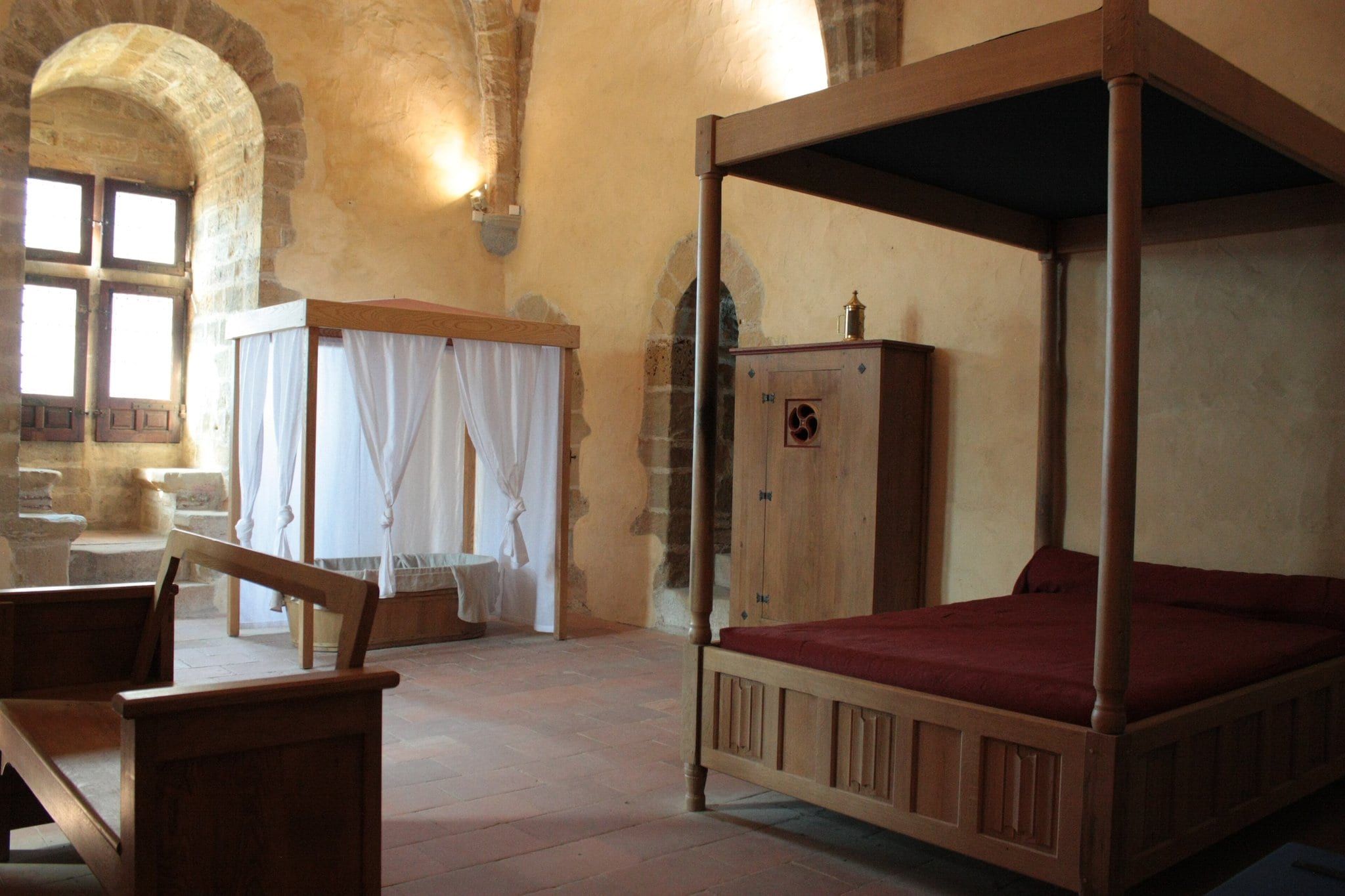
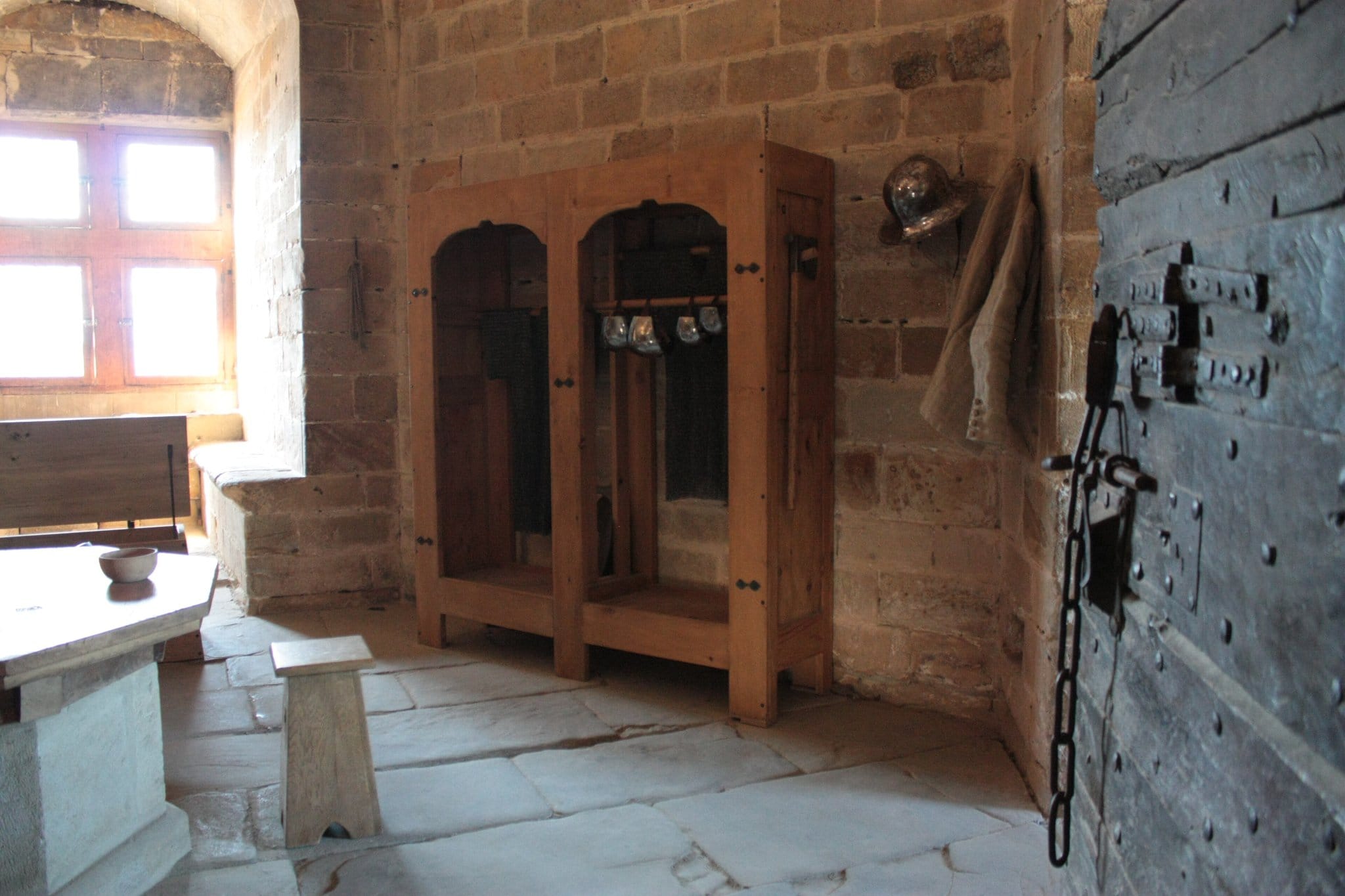
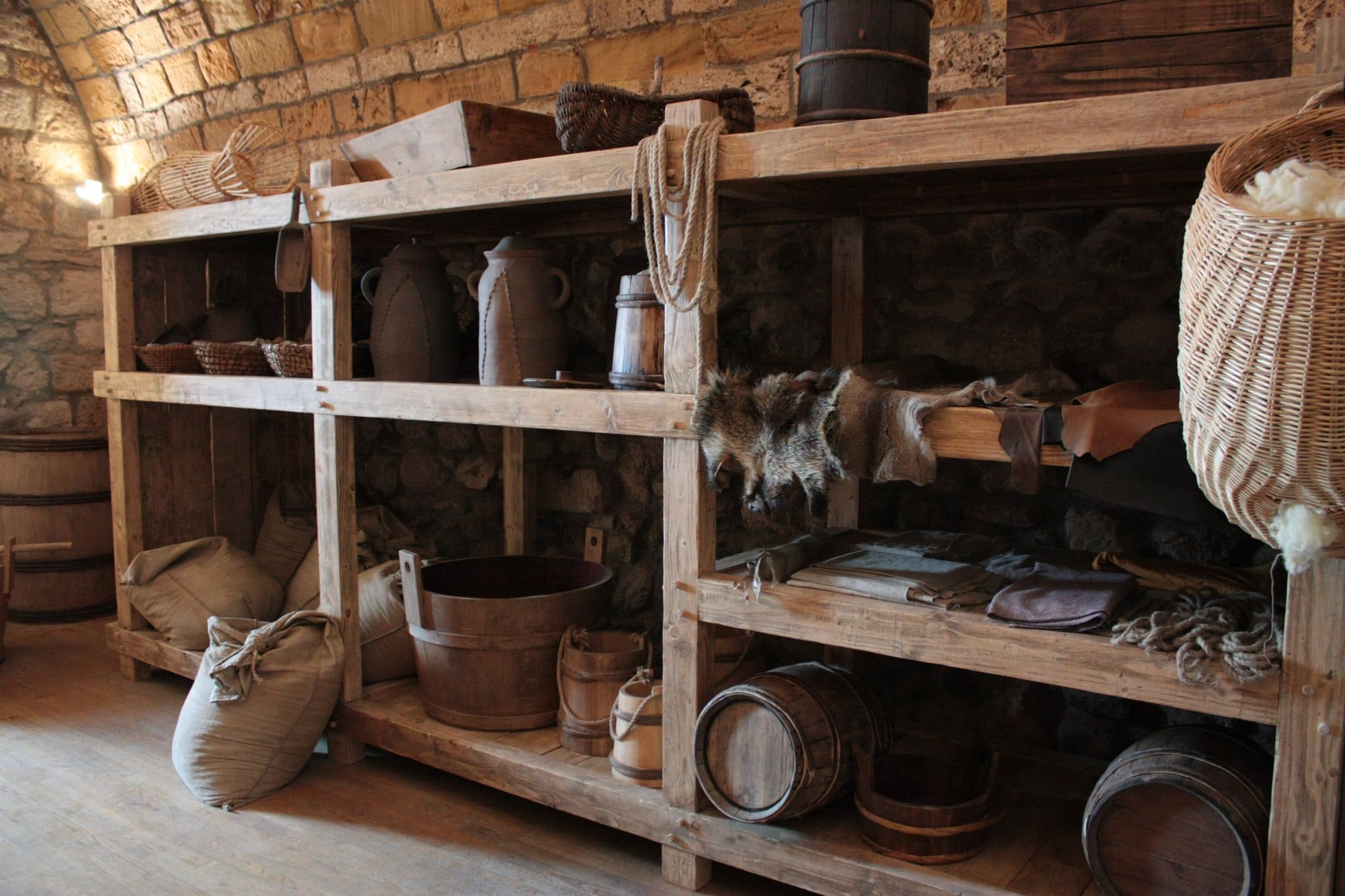
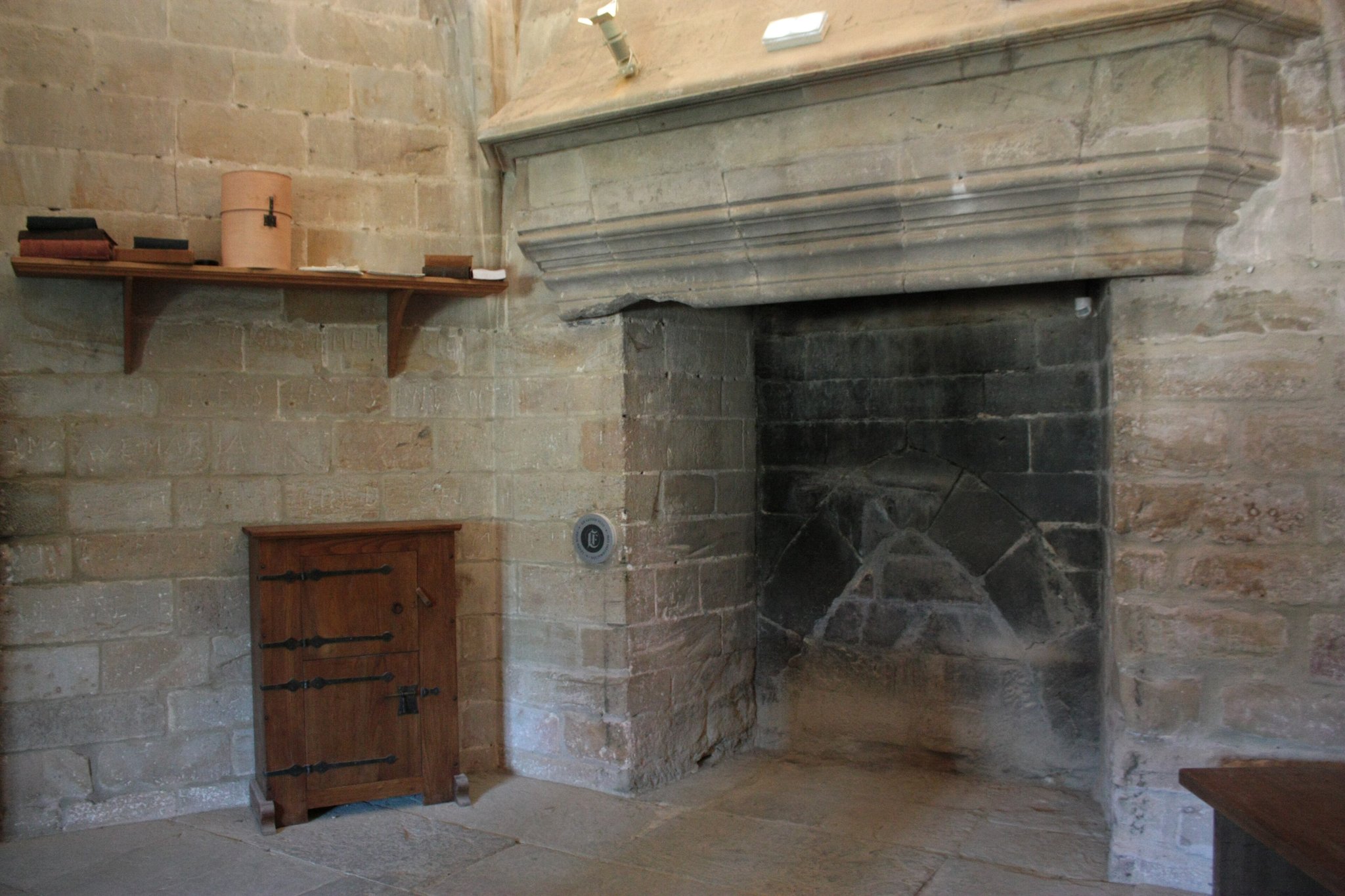
Then comes the climb to the castle itself, where each room has been furnished as a vivid reconstruction of comtal life: a great hall, the count’s chamber, an armory, a scriptorium, a dungeon. On the terraces between the towers stand full-scale siege engines, a sixteen-meter trebuchet among them, built on site in 2018 with period tools and demonstrated daily alongside workshops in forging, archery, and stonecutting. A great drum winch, a “squirrel cage” set between two towers, shows how stone blocks weighing as much as a ton were once hoisted into place. Families can book an escape game, “The Cathars’ Treasure,” set within the museum. Its rock is steep, sixty meters of ascent on a paved path, though two lifts added during a recent restoration now ease part of the route; the museum is fully accessible, but the castle interior and towers are not. The decade-long campaign, finished in 2025 at a cost of nearly twelve million euros, helped draw more than 112,000 visitors a year, making Foix the busiest site in the department.
 CC BY-SA 4.0" style="width:413px" srcset="https://stonekeepatlas.com/wp-content/uploads/2026/06/chateau-de-foix-trebuchet.jpg 1365w, https://stonekeepatlas.com/wp-content/uploads/2026/06/chateau-de-foix-trebuchet-200x300.jpg 200w, https://stonekeepatlas.com/wp-content/uploads/2026/06/chateau-de-foix-trebuchet-683x1024.jpg 683w, https://stonekeepatlas.com/wp-content/uploads/2026/06/chateau-de-foix-trebuchet-768x1152.jpg 768w, https://stonekeepatlas.com/wp-content/uploads/2026/06/chateau-de-foix-trebuchet-1024x1536.jpg 1024w" sizes="auto, (max-width: 1365px) 100vw, 1365px" />
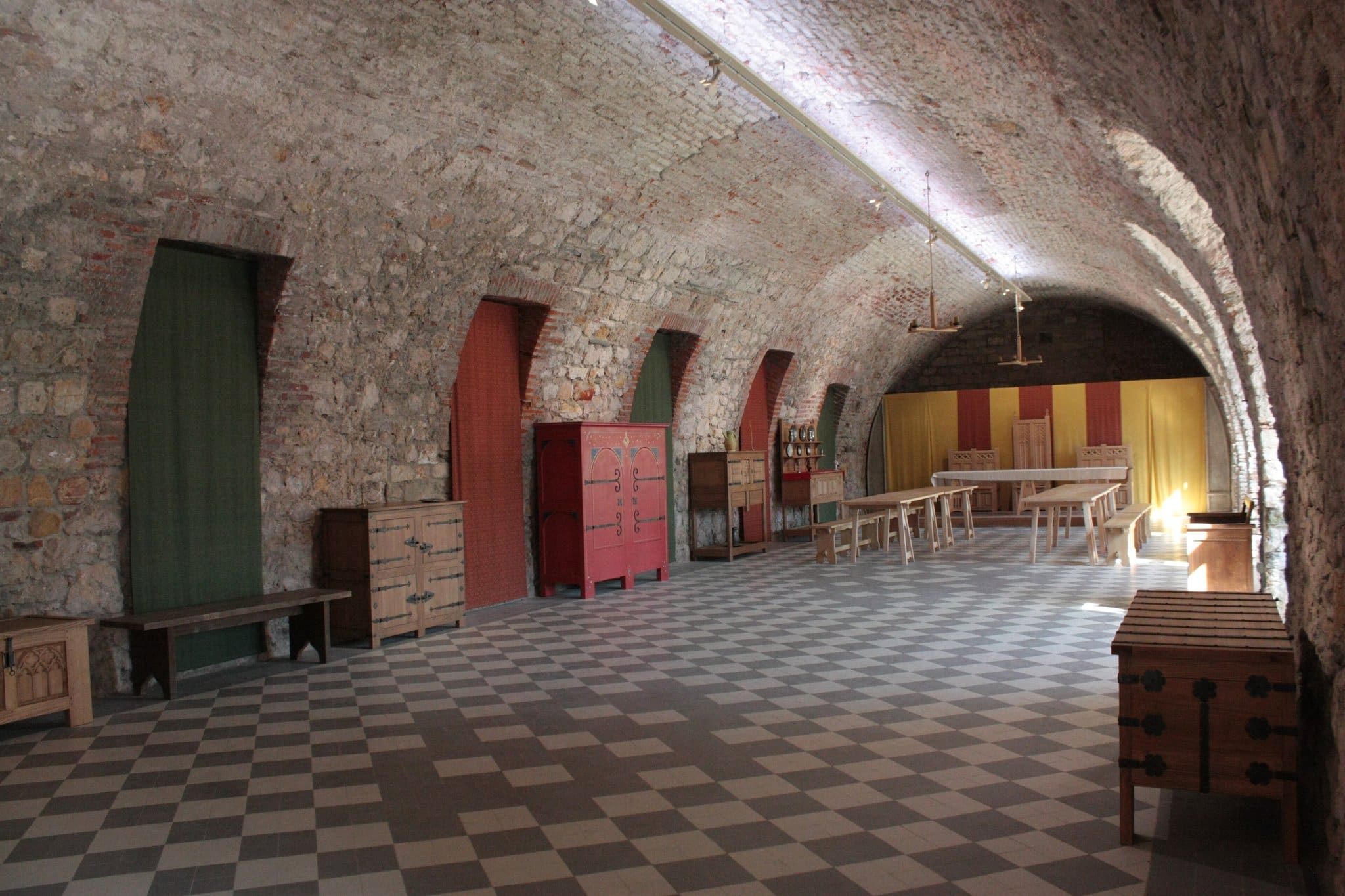 CC BY-SA 4.0" srcset="https://stonekeepatlas.com/wp-content/uploads/2026/06/chateau-de-foix-great-hall.jpg 2048w, https://stonekeepatlas.com/wp-content/uploads/2026/06/chateau-de-foix-great-hall-300x200.jpg 300w, https://stonekeepatlas.com/wp-content/uploads/2026/06/chateau-de-foix-great-hall-1024x683.jpg 1024w, https://stonekeepatlas.com/wp-content/uploads/2026/06/chateau-de-foix-great-hall-768x512.jpg 768w, https://stonekeepatlas.com/wp-content/uploads/2026/06/chateau-de-foix-great-hall-1536x1024.jpg 1536w" sizes="auto, (max-width: 2048px) 100vw, 2048px" />
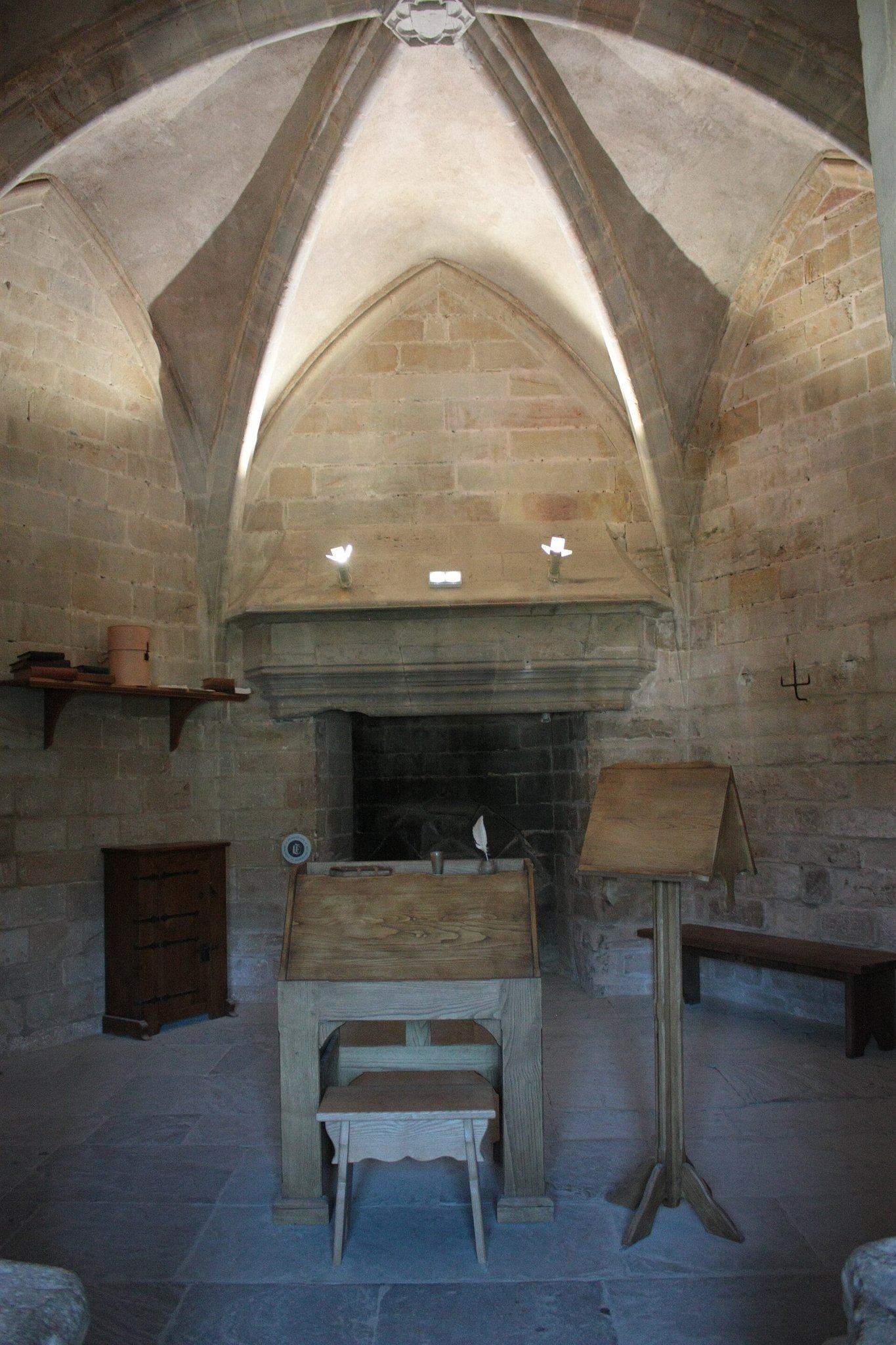 CC BY-SA 4.0" style="width:413px" srcset="https://stonekeepatlas.com/wp-content/uploads/2026/06/chateau-de-foix-scriptorium.jpg 1365w, https://stonekeepatlas.com/wp-content/uploads/2026/06/chateau-de-foix-scriptorium-200x300.jpg 200w, https://stonekeepatlas.com/wp-content/uploads/2026/06/chateau-de-foix-scriptorium-683x1024.jpg 683w, https://stonekeepatlas.com/wp-content/uploads/2026/06/chateau-de-foix-scriptorium-768x1152.jpg 768w, https://stonekeepatlas.com/wp-content/uploads/2026/06/chateau-de-foix-scriptorium-1024x1536.jpg 1024w" sizes="auto, (max-width: 1365px) 100vw, 1365px" />
The castle is open most of the year. For 2026 the operator, the Conseil départemental de l’Ariège, charges 13 euros for adults across most of the year, with students under 26 at 10.50 euros and children aged 5 to 17 at 9.50 euros; in the July and August peak each rate rises by half a euro or so, the adult ticket reaching 13.50 euros. Family tickets start at 42 euros, children under 5 enter free, and the castle closes thirty minutes before the museum. Opening hours shift with the season, so it is worth checking the official site before you travel.
Planning a trip to the Ariège? You can browse guided tours and Cathar-country experiences around Foix, and compare places to stay in the town below the castle. We may earn a commission from bookings made through these links, at no extra cost to you. It never affects which sites we cover or what we say about them.
Some links on this page are affiliate links, which means StoneKeep Atlas may earn a small commission, at no extra cost to you, if you book through them.
More Views of Château de Foix
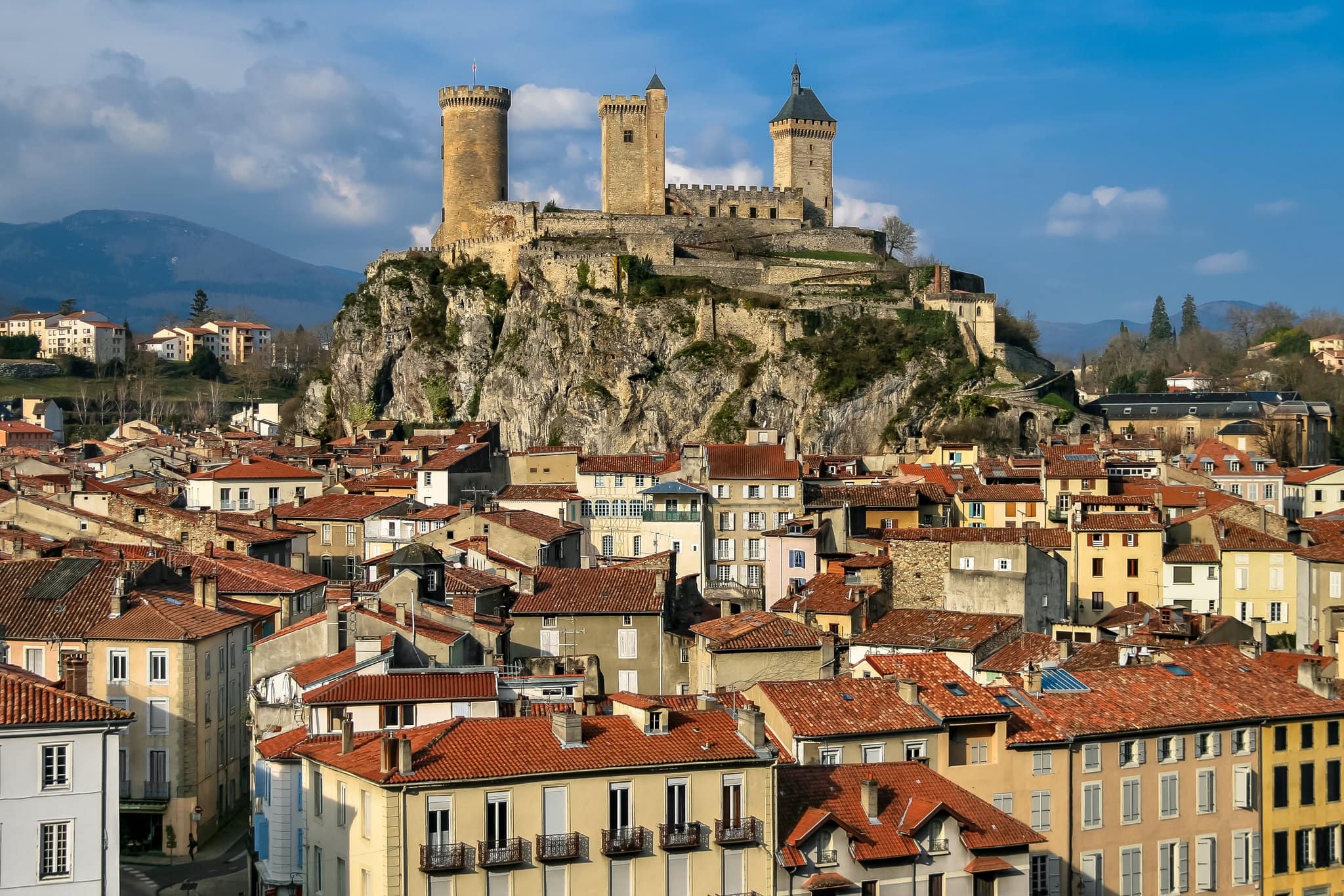
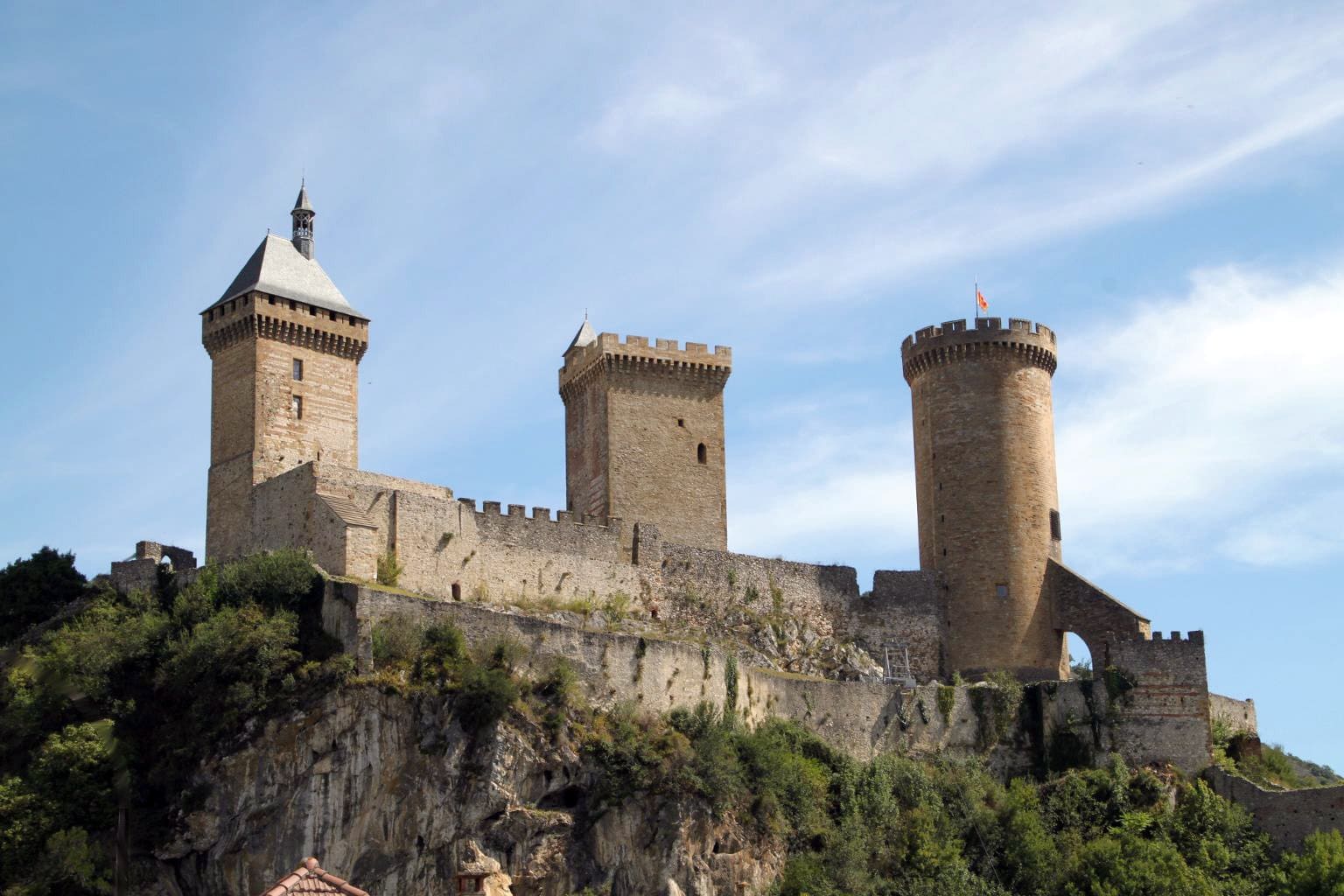
Beyond Foix: Cathar Country and the Counts
Foix makes most sense as the political heart of a wider landscape. Eighty kilometers to the northeast, the walled city of Carcassonne anchors Cathar country and even shares Foix’s restorer, Paul Boeswillwald having learned his trade on its ramparts before he came to the Ariège. Carcassonne also leads a separate heritage story, the eight-site UNESCO serial property, inscribed on 26 July 2026, of the Royal Fortresses of Languedoc, which includes the dizzying cliff strongholds of Peyrepertuse and Quéribus. Those were royal frontier fortresses, rebuilt by the crown after the crusade to seal the border with Aragon. Foix belongs to neither that serial nor that type. It is the seat the counts actually held, the castle from which the resistance was led, and it stands intact while the sentinels stand in ruins. Read together, the comtal capital and the frontier fortresses tell the two halves of one southern century.
For the faith at the heart of this landscape, see our guide to the Cathar Castles of Languedoc.
Conclusion
Château de Foix endures because it was never allowed to die. Where Peyrepertuse and Quéribus were abandoned to the wind once the frontier moved, Foix was always wanted, by counts, by kings, by governors, by jailers, and that unbroken usefulness carried its three towers across a thousand years to us. It is a castle that withstood Simon de Montfort, bowed to Philip III, fathered a king of France, and still answers, through its old co-princely title, to a president. Few European castles wear their history so legibly, and fewer still let you climb it, room by furnished room, into the heart of a Pyrenean dynasty.
Principal Sources
- Conseil départemental de l’Ariège. Visitor information for the castle, which it manages.
- Ministère de la Culture. Base Mérimée listing (reference PA00093793) and the Muséofile museum register.
- Pailhès, Claudine. Scholarship on the counts of Foix, the Albigensian Crusade, and Gaston Fébus.
- UNESCO World Heritage Centre. Tentative-list file for the Co-Principality of Andorra nomination.
Admission and opening details are taken from the operator’s 2026 schedule and should be confirmed before travel.
Image credits. Three towers above the valley: ignis, CC BY-SA 3.0, via Wikimedia Commons; the castle from the Halle aux Grains: Frédéric Scalliet, CC BY-SA 3.0, via Wikimedia Commons; the Melling engraving: Antoine Ignace Melling, Public domain, via Wikimedia Commons; the round tower from the curtain wall: Selmoval, CC BY-SA 4.0, via Wikimedia Commons; the round tower flying the arms of Foix-Béarn: Carlos Pino Andújar, CC BY-SA 4.0, via Wikimedia Commons; the cachot, visitor entrance, trébuchet, great hall, scriptorium, count’s chamber, guards’ room, capeline helmet, storeroom and scriptorium hearth: Tylwyth Eldar, CC BY-SA 4.0, via Wikimedia Commons; the towers above the rooftops and the aerial view: Jorge Franganillo, CC BY 2.0, via Wikimedia Commons; the castle on its rock: Totor-22, CC BY-SA 3.0, via Wikimedia Commons; the castle above the market hall: Conxa Roda, CC BY-SA 3.0, via Wikimedia Commons; the colored lithograph of Foix: Édouard Hostein and Aubert, Public domain, via Wikimedia Commons; the early photograph: Bibliothèque de Toulouse, no known copyright restrictions. Freely licensed images are resized to fit; otherwise unaltered.