
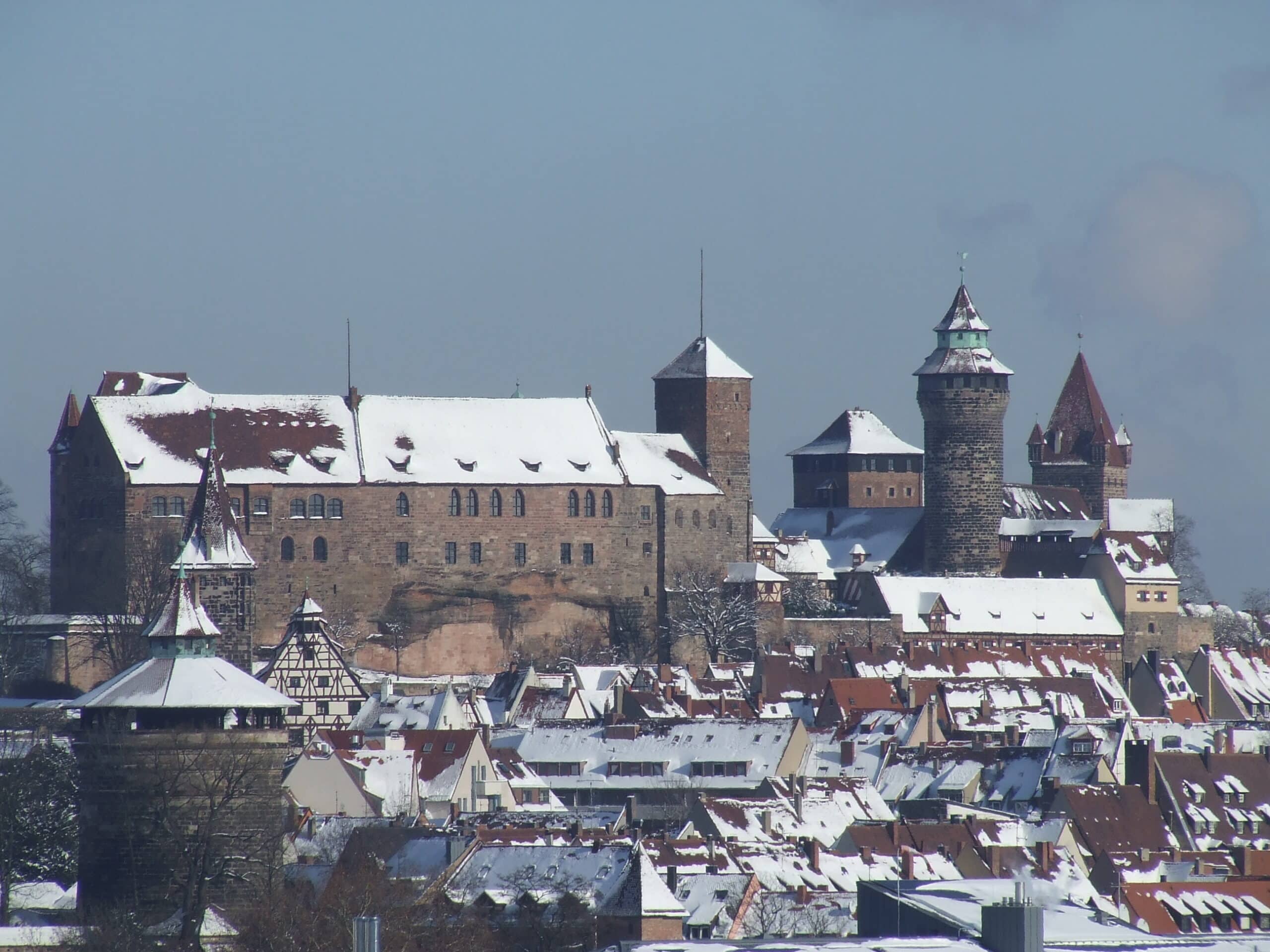
Nuremberg Castle
For nearly four centuries (from 1424 to 1796), the symbols by which Holy Roman Emperors claimed their legitimacy lived in Nuremberg. The imperial crown, the orb, the sword, the so-called Holy Lance: kept in a wall-cabinet at the Heilig-Geist-Spital chapel down in the city, under a 1423 decree from Sigismund of Luxembourg promising they would stay “for all eternity, irrevocably and unchallengeably.” The Kaiserburg, on its sandstone ridge above the Old Town, was where the emperor came to inspect them. It was where he stayed when he convened a Reichstag. It was where, on the upper floor of the Doppelkapelle, his Habsburg house-treasure later sat under the same vaults that had once received Hohenstaufen masses. Nuremberg’s castle did not hold the regalia. It held the emperor.
What rises above the Sebald half of Nuremberg’s Old Town is not one castle but three. Burggrafenburg, eastern precinct, was held by burgraves of the Hohenzollern family from 1191 to 1427, the same Hohenzollerns who would become electors of Brandenburg, kings in Prussia, and emperors of Germany. Kaiserburg, the western precinct, was the emperor’s residence: Palas, Doppelkapelle, the round Sinwellturm. Stadtburg, between them, belonged to the city: granaries, bastions, the looming Luginsland tower of 1377. Three jurisdictions, one fortified outcrop, sharing a single sandstone spine. Most of what visitors see today was rebuilt after January 1945.
Quick Facts
| Country | Germany |
| Region / State | Bavaria (Mittelfranken / Middle Franconia) |
| Nearest Town | Nuremberg |
| Construction Period | 11th–13th c. core (Hohenstaufen Palas + Doppelkapelle 1190–1197); reconstructed 1946–1981 |
| Founder | Hohenstaufen emperors Konrad III and Heinrich VI; Hohenzollern burgraves from 1191/92; Reichsstadt Nürnberg from 1427 |
| Architectural Style | Romanesque core (Doppelkapelle, Sinwellturm, Heidenturm); late-Gothic Kaiserstallung (1494–95); 16th-c. Italianate Burgbasteien (1538–45); postwar reconstruction |
| Building Type | Burg — composite Hohenstaufen Reichsburg with Burggrafenburg, Kaiserburg, and Stadtburg precincts |
| Current Condition | Reconstructed (principal phase 1946–1981; subsequent campaigns through the 2010s); fully restored |
| Open to Visitors | Yes — daily, with seasonal hours; closed January 1, Shrove Tuesday, 24, 25, and December 31 |
| UNESCO Status | Not inscribed |
| Official Website | kaiserburg-nuernberg.de |
Origins on the sandstone outcrop
Earliest documentary trace of Nuorenberc (the rocky place) comes from a charter Heinrich III issued to a noblewoman named Sigena on July 16, 1050. Archaeologists believe a tenth-century palisade had already stood on the Burgsandstein outcrop, perhaps under the Markgrafen von Schweinfurt. By 1105 the imperial castle was substantial enough for Heinrich V to besiege his father here; by 1130 Lothar III was assaulting it.
It was Konrad III, the first Hohenstaufen king, who built up the castle that mattered. Between his coronation in 1138 and his death in 1152 he raised the early Palas, an irregular residential tower, and the predecessor of the chapel that would become the Doppelkapelle. For decades, scholarship attributed the major Hohenstaufen building campaign to Friedrich Barbarossa, who visited Nuremberg twelve times and held a famous reception for Byzantine envoys here in 1156. Current research reverses that attribution. No new construction can be proved under Barbarossa. His son was the decisive Hohenstaufen builder.
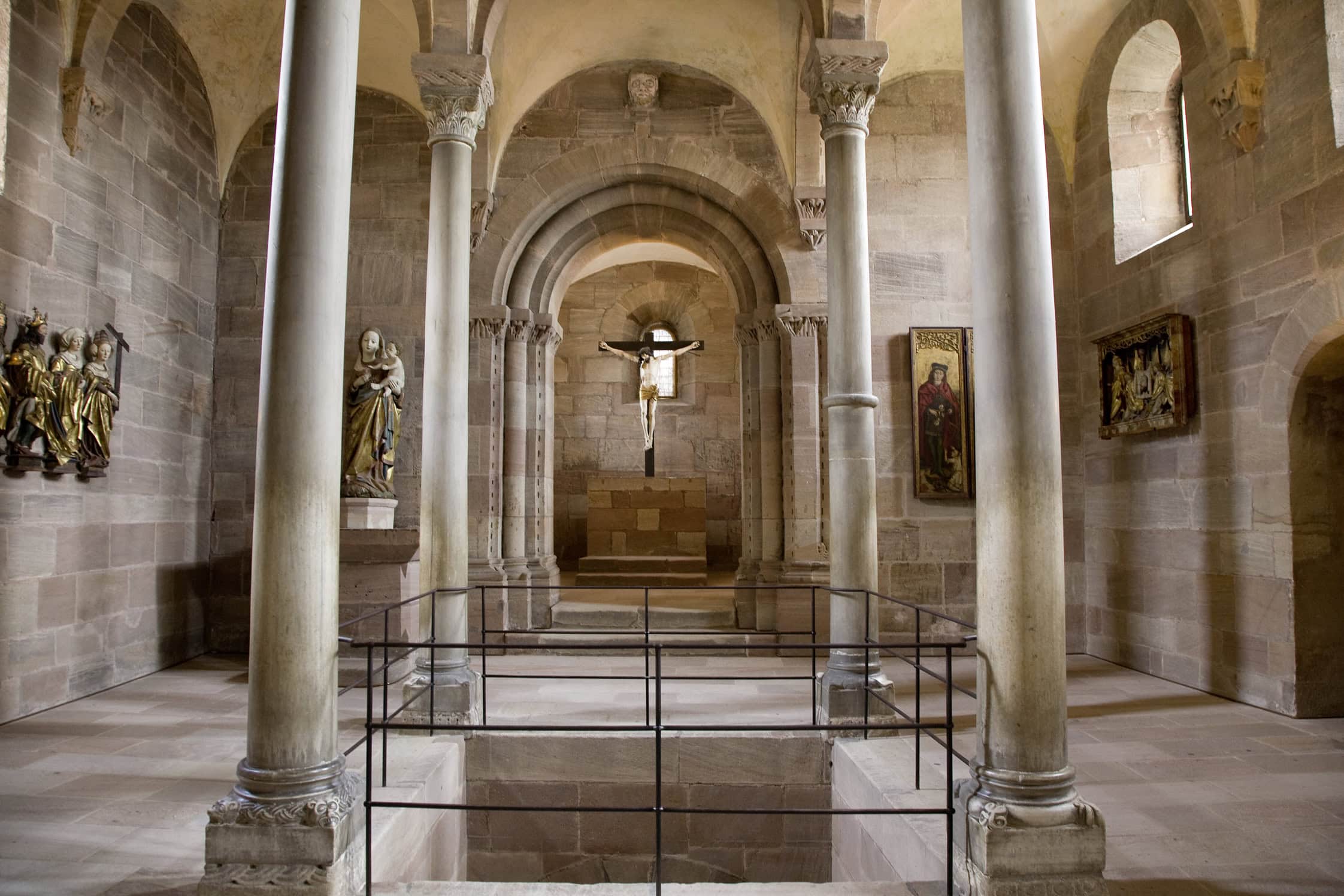
Between 1190 and 1197, in the seven years before he died at Messina, Heinrich VI raised the surviving two-story Palas and the Doppelkapelle, the imperial chapel that remains the most architecturally important structure on the rock. Its chapel works as a vertical hierarchy of three spaces. A lower chapel for the Hofstaat opens only from outside. The upper Kaiserkapelle, with four slender limestone columns rising to capitals carved in low Romanesque foliage, has a square central opening cut through its floor so the lower congregation could see and hear the Mass. Above that, a Herrscherempore communicated directly with the emperor’s apartments. By 1216, when Friedrich II handed the chapel to the Teutonic Order, the structure was complete enough to be described in legal documents. Comparable two-story palace chapels survive at Eger and Goslar; the Eger chapel is the closest typological parallel.
Eight decades later, on the day after his election in October 1273, Rudolf von Habsburg confirmed the burgrave’s rights from this castle and began to live in it for what would amount to two hundred sixty-nine days of his reign. He raised the round Sinwellturm in the outer courtyard and added a brick upper stage to the older square Heidenturm. Rudolf was the first emperor in two centuries to treat Nuremberg as a working capital; he would not be the last.
Hohenzollern burgraves and the city’s rise (1191–1427)
Hohenzollern story begins, in a precise sense, on this rock. In 1191 or 1192, Heinrich VI enfeoffed a Swabian count named Friedrich III von Zollern with the Burggrafschaft, the right to administer the eastern half of the castle as an imperial appointee. The first charter signed Fridricus prefectus de Nuremberg dates to 1192. From that act runs an unbroken line: Brandenburg by 1415, secular Prussia by 1525, Kingdom in Prussia by 1701, the German Empire from 1871. What ended in Berlin in 1918 began in a granted office on this outcrop. Hohenzollern Castle in the Swabian hills was the family’s mythologized ancestral seat, but the family’s first significant holding (and its first imperial title) was the burgraviate of Nuremberg.
For two centuries, the burgraves and the emperor lived on the same hill in different precincts. Burggrafenburg occupied the eastern end: the five-cornered Fünfeckturm from around 1150 (the oldest standing structure on the rock), the thirteenth-century Walburgiskapelle, and the burgrave’s residence behind them. The Kaiserburg sat on the western end. Between them, the city kept growing wealthier, and from the late thirteenth century it began to take a third position. In 1313 Heinrich VII transferred general castle responsibility to the city’s care. By 1367 the Reichsstadt had walled off direct burgrave access and built its own gate, the Vestnertor. In 1377 it added the Luginsland, a forty-seven-meter tower rising above the burgrave’s precinct, square in plan, with the explicit purpose of looking down into the Hohenzollerns’ courtyard.
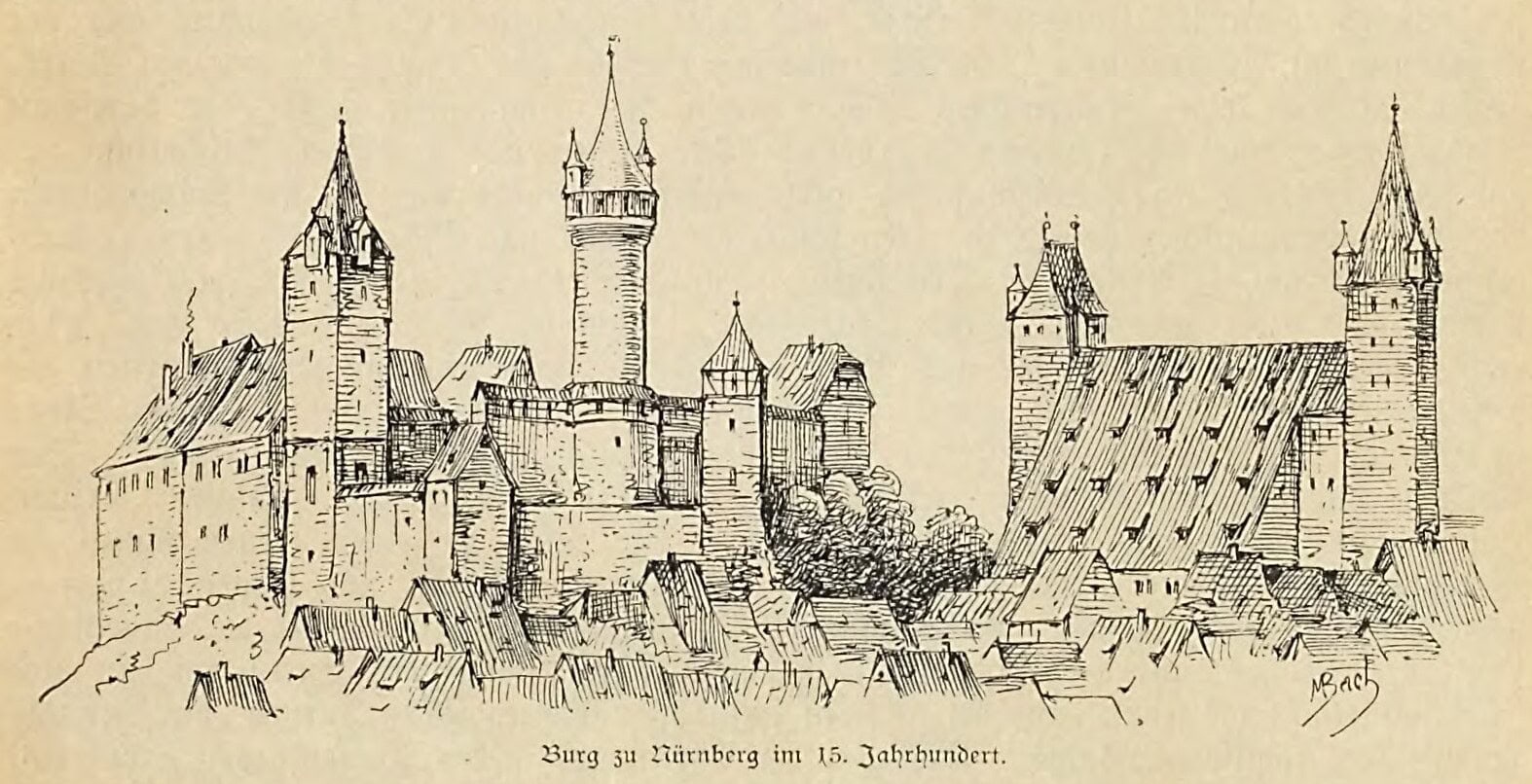
The relationship ended badly. In October 1420 a Wittelsbach commander acting in a dynastic feud burned the Burggrafenburg. Sigismund, by then king of the Romans, transferred the rest of the castle to the city’s keeping in 1422 and reserved only the Imperial Suite for himself. Five years later, in 1427, Friedrich VI of Hohenzollern (already Friedrich I, Elector of Brandenburg, since 1415) sold the ruined Burggrafenburg to the Reichsstadt for around 120,000 Gulden and removed his line northward. Karl IV had already specified, in the Golden Bull of 1356, that every newly elected Roman king must hold his first Reichstag at Nuremberg. After 1427 the city had the castle to match the responsibility.
The Reichskleinodien era — 1424 and Nuremberg as imperial city (1424–1796)
On September 29, 1423, Sigismund of Luxembourg issued a decree at Ofen (modern Budapest), entrusting the Reichskleinodien to the Reichsstadt of Nuremberg “for all eternity, irrevocably and unchallengeably.” A delegation under the patrician Niklas Muffel collected the imperial crown, the orb and sword, the Holy Lance and a long list of relics from Plintenburg in Hungary and brought them up the Danube. They reached Nuremberg on March 22, 1424.
Regalia did not enter this castle. They were lodged in the Heilig-Geist-Spital chapel down in the city, under the supervision of the city council, in a wall-cabinet built into the upper sacristy. Relics (particles of the Holy Cross, the Holy Lance, and an inventory that grew over the centuries) hung in a Heiltumsschrein suspended from the choir vault. Once a year, on the second Friday after Easter, the city took them out. The procession crossed the Pegnitz, climbed to a temporary three-story wooden Heiltumsstuhl opposite the Frauenkirche on the Hauptmarkt, and showed each piece to the assembled crowd. The Heiltumsweisung ran from 1424 to about 1523, until Nuremberg’s adoption of the Reformation in 1525 ended the relic-veneration culture that sustained it.
Through that century the castle was the imperial face of the city. Friedrich III, the long-reigning Habsburg emperor, deposited his dynasty’s house-treasure in the upper Doppelkapelle in 1485, not the regalia, which never lodged on the hill, but his working valuables, under the same vaults that had once received Hohenstaufen masses. In 1494 the master mason Hans Beheim raised the Kaiserstallung, a six-story granary above stables for the emperor’s horses, its eastern façade more than two hundred meters long. Between 1538 and 1545, as gunpowder warfare made medieval curtain walls obsolete, the city built bastions on the north and west sides; for a brief moment Nuremberg led southern German fortification engineering. In 1543 the last imperial diet at Nuremberg met, and by 1663 the Reichstag had moved permanently to Regensburg.
The end came as quickly as the beginning. On July 23, 1796, with French troops under Jean-Baptiste Jourdan advancing on Franconia, Colonel Haller von Hallerstein loaded the regalia into wagons and carried them to Regensburg. Four years later, in October 1800, Franz II (already aware that his title was provisional) moved them on to the Vienna Schatzkammer. They have not returned. The decree of 1423 had specified eternity, and was kept for three hundred seventy-two years.
Decline, Bavarian acquisition, and 19th-century restoration (1796–1939)
The same political settlement that ended the Holy Roman Empire ended the imperial castle. On July 12, 1806 the Rheinbundakte ceded Nuremberg to the Kingdom of Bavaria; the Empire itself dissolved less than a month later, on August 6. Castle Bavaria inherited was a ruin held together by neglect: the Burggrafenburg destroyed in 1420, the Reichsstadt’s once-glittering Kaiserburg disused, the Reichskleinodien gone to Vienna.
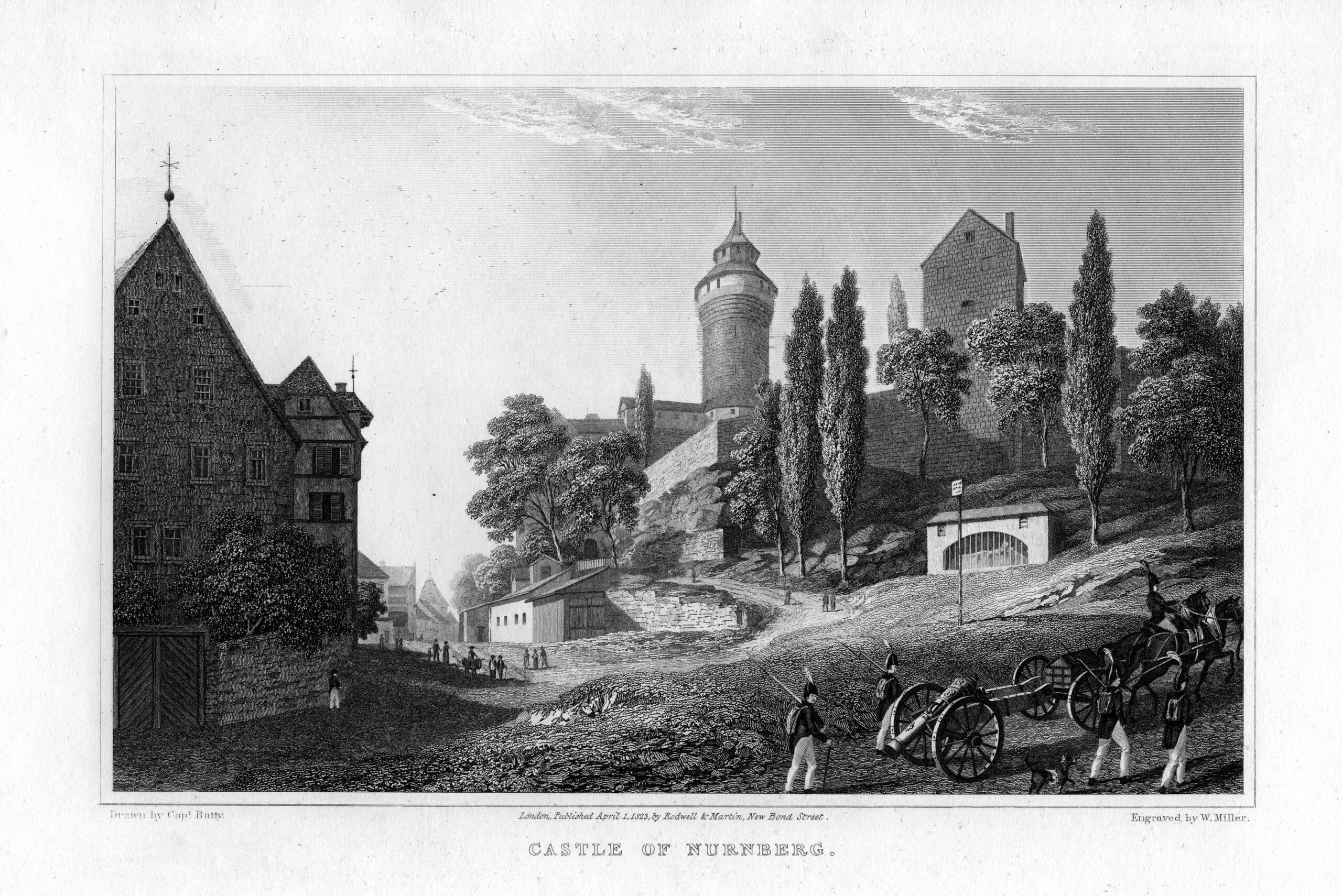
Nineteenth-century Bavaria reframed it. In 1833 Ludwig I commissioned Carl Alexander von Heideloff to restore the Palas in a neo-Gothic medievalist key, work that introduced the modern visitor to a “medieval” Nuremberg that had never existed. Heideloff stopped at the first floor. Between 1851 and 1858, August von Voit took over for Maximilian II and built a royal apartment on the upper level; that work too halted, in 1864, when the king died. In 1856 Bavaria and the city signed a treaty consolidating ownership in the crown, a settlement that, with adjustments, still governs the castle. In 1866, Ludwig II granted Wilhelm I of Prussia the right to share the use of what Wilhelm called “the castle of his fathers”, a piece of Hohenzollern reclamation that ran four hundred thirty-nine years after Friedrich VI sold the ruined Burggrafenburg to the city. Wilhelm II would later style himself Burggraf von Nürnberg. In 1891 August Essenwein restored the Doppelkapelle, reopening the central well between the floors that had been blocked. Outside the castle, Wagner’s Die Meistersinger von Nürnberg premiered in Munich in 1868. The city had become a stage on which a romanticized German past was performed.
World War II destruction and reconstruction (1944–present)
The castle’s twentieth century begins with appropriation. From April 1934 the Bayerische Schlösserverwaltung, founded that month, took over administration; its first conservator, Rudolf Esterer, stripped the nineteenth-century render and the Heideloff–Voit interiors and rebuilt key elements in what he called schöpferische Denkmalpflege, creative monument-care, a phrase that combined real conservation with the Nazi state’s instrumental view of the medieval past. The Reichskleinodien came back in 1938, after the Anschluss with Austria, and were displayed in the city as propaganda for the Reich’s medieval pedigree. From 1939 the city’s most important art was hidden in the Historischer Kunstbunker, a network of tunnels cut into the sandstone directly under the castle hill.
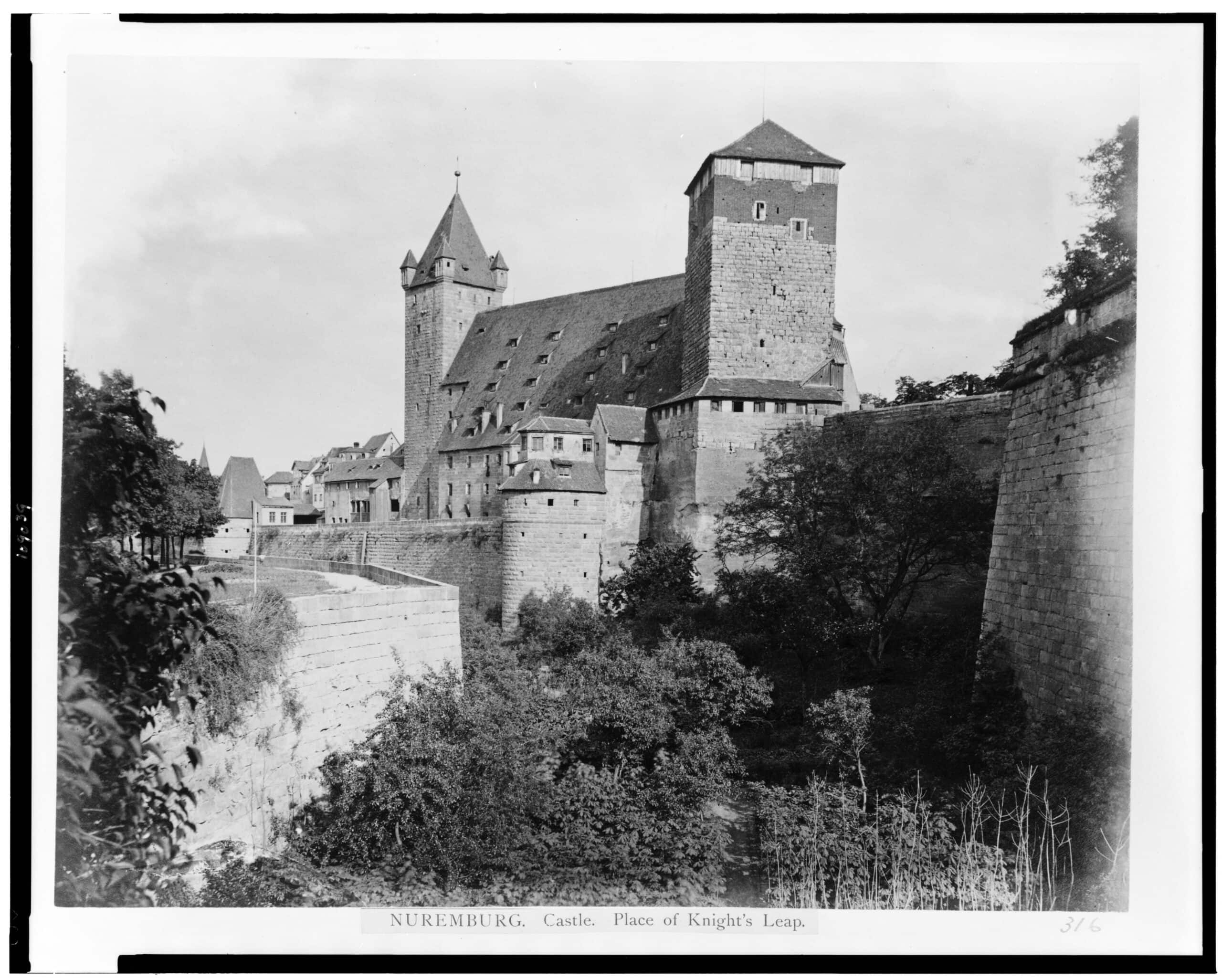
On January 2, 1945, 514 RAF Lancasters and seven Mosquitos struck Nuremberg. Ninety percent of the medieval Old Town was destroyed. The castle lost roughly seventy to eighty percent of its built fabric. The Sinwellturm survived. So did the Heidenturm and the Doppelkapelle, sheltered by their massive Romanesque masonry. Palas, Kemenate, Luginsland, and southern walls: all collapsed.
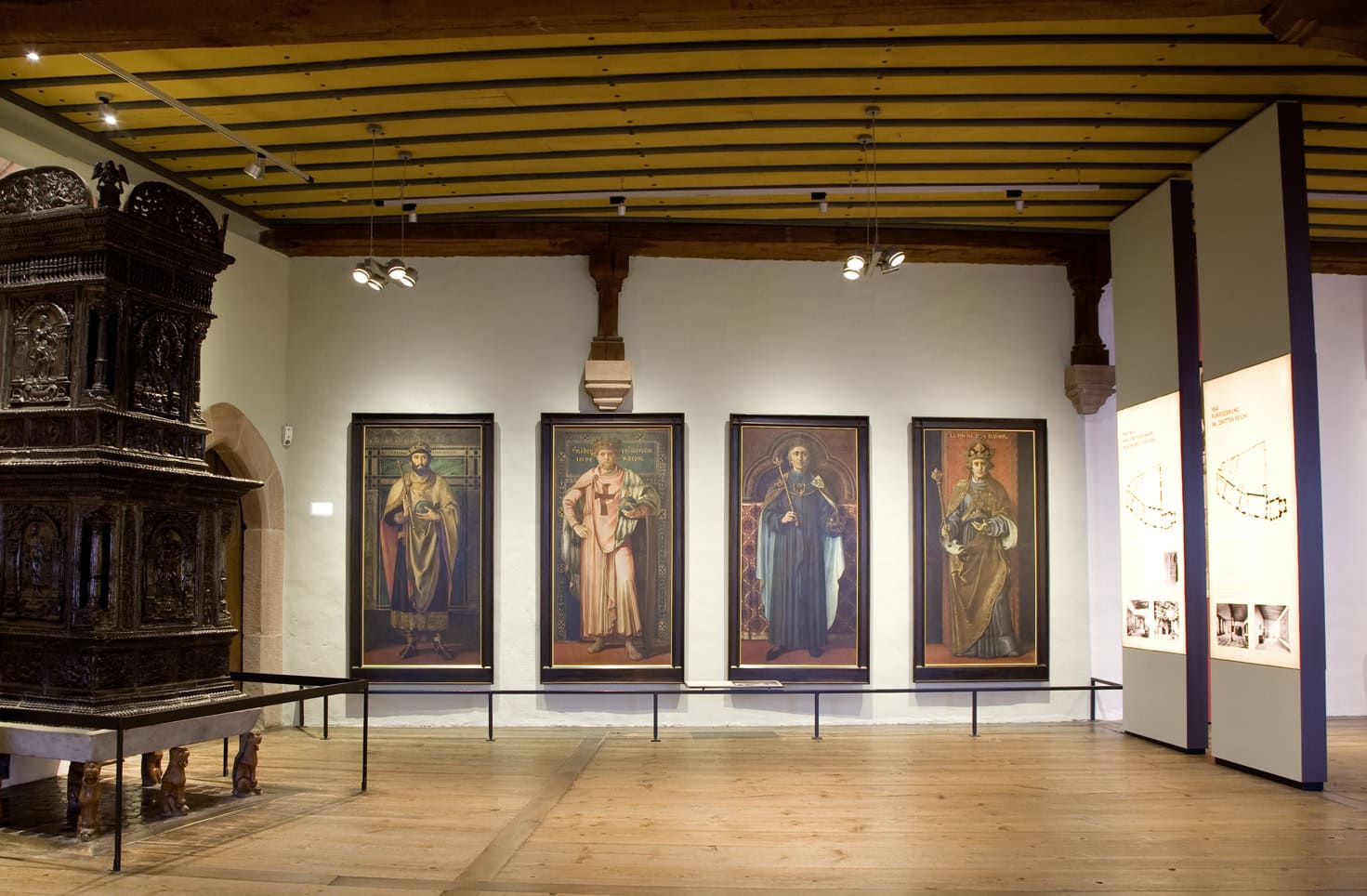
Reconstruction began in 1946 and continued in stages until 1981. Esterer remained in charge into the 1950s. The Doppelkapelle was reopened. Palas’s upper hall was rebuilt with two structural pillars where one had stood before the war, a deliberate departure from the original. In 2013 the BSV reopened the Palas with a permanent exhibition titled Kaiser – Reich – Stadt that reads the castle’s history through the lens this article keeps: emperor, empire, city. Nuremberg the name now also carries the Reichsparteitagsgelände on the city’s south edge and the Justizpalast where the postwar trials were held in 1945–46; neither stands at the castle, but both shape what the word means.
Visiting in 2026
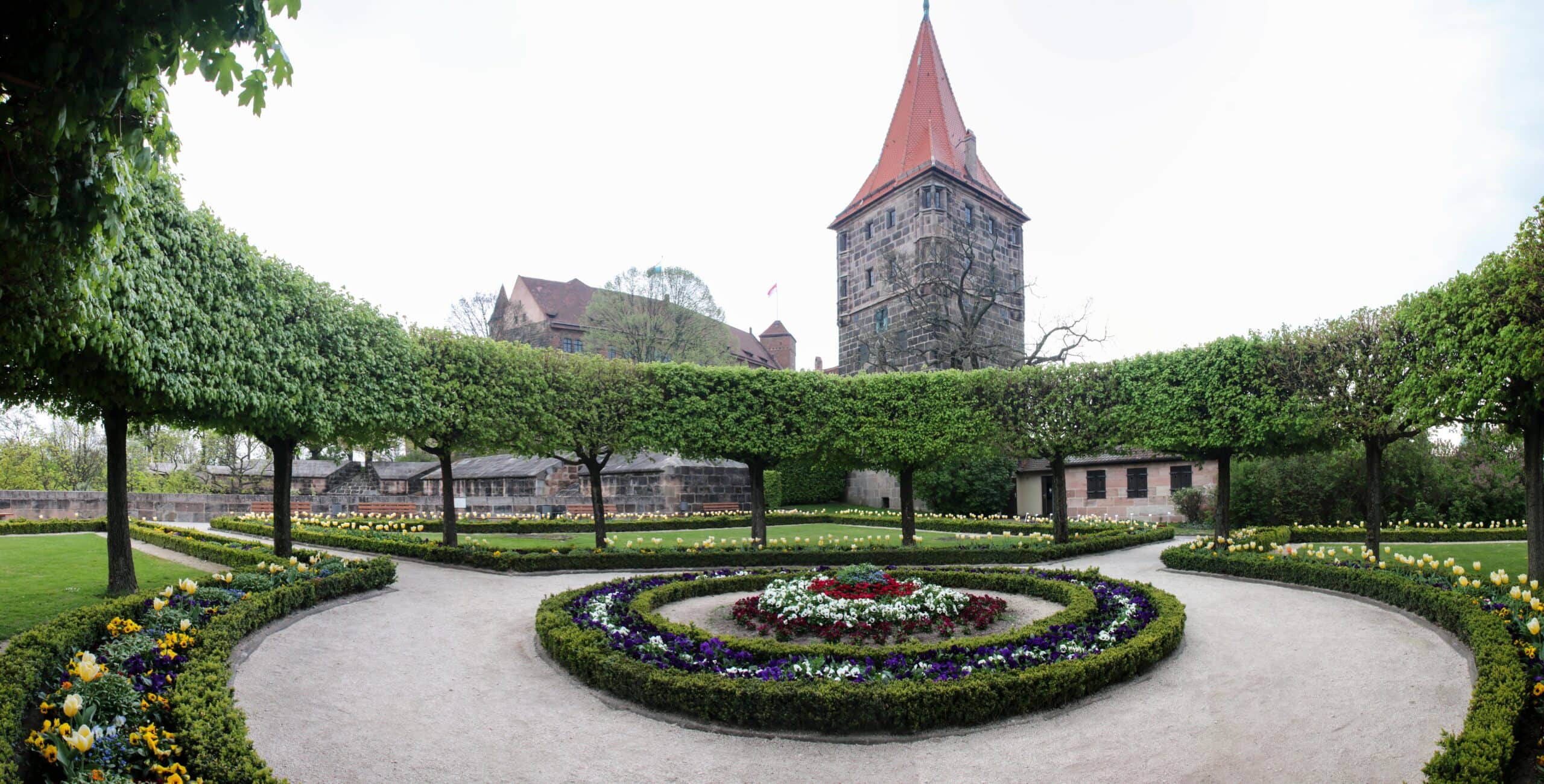
Today the Bayerische Schlösserverwaltung operates the castle as a museum. The Palas houses the permanent exhibition Kaiser – Reich – Stadt, walking visitors through the medieval imperial role, the regalia transfer, the Heiltumsweisung, and the Reformation that ended it. The Doppelkapelle is open. Sinwellturm can be climbed (a hundred thirteen steps to the platform), and the Tiefer Brunnen, the deep well cut more than fifty meters into the sandstone, is demonstrated by candle and camera approximately every half hour. The Burggarten, laid out on top of the sixteenth-century bastions, opens between April and October. The Kemenate now houses the Kaiserburg-Museum, a branch of the Germanisches Nationalmuseum with a strong collection of late-medieval armor. Entry tickets and local tours can also be booked in advance through GetYourGuide.
Castle is open daily: from nine to six between April and September, and from ten to four between October and March, with closures on January 1, Shrove Tuesday, and 24, 25, and December 31. Last admission falls roughly an hour before closing. Tickets are sold at the cash desk in the outer courtyard, and BSV annual passes are valid. Audio guides in seven languages cost two euros. In 2025 the Palas and Imperial Castle Museum drew approximately 190,000 visitors and the Sinwell Tower and Deep Well a further 174,000.
Admission to the Imperial Castle (BSV pricing 2026):
| Ticket | Price |
|---|---|
| Combination ticket (Palas with Doppelkapelle, Imperial Castle Museum, Sinwellturm, Tiefer Brunnen) — adult | €10.00 |
| Combination ticket — reduced | €9.00 |
| Palas with Doppelkapelle and Imperial Castle Museum — adult | €7.00 |
| Palas with Doppelkapelle and Imperial Castle Museum — reduced | €6.00 |
| Sinwellturm and Tiefer Brunnen — adult | €4.00 |
| Sinwellturm and Tiefer Brunnen — reduced | €3.00 |
| Combination Kaiserburg + Burg Cadolzburg — adult | €16.00 |
| Combination Kaiserburg + Burg Cadolzburg — reduced | €14.00 |
| Audio guide (seven languages, per person) | €2.00 |
| Children and young people under 18 | Free |
| BSV 14-day multi-castle ticket (Mehrtagesticket) | €40.00 |
| BSV annual ticket (Jahreskarte) | €55.00 |
For visitors planning a Franconian itinerary, the Kaiserburg combination ticket is paired with one for Burg Cadolzburg, the Franconian Hohenzollern seat thirty kilometers west. Other Bavarian properties under the same operator (the Würzburg Residenz, Schloss Johannisburg in Aschaffenburg, and Festung Marienberg) sit within a half day’s drive. Anyone staying overnight can compare hotels in and around Nuremberg.
Some links on this page are affiliate links, which means StoneKeep Atlas may earn a small commission, at no extra cost to you, if you book through them.
Beyond Nuremberg Castle
For a Bavarian itinerary, Best Castles in Bavaria places the Kaiserburg in context with the operator’s other holdings, from Ludwig II’s Neuschwanstein to the Würzburg prince-bishops’ seat. Natural local pairing is Burg Cadolzburg, the Franconian Hohenzollern seat thirty kilometers west, the same dynasty that began on this rock. For the wider medieval-imperial story, the Wartburg in Thuringia carries a parallel role: another great Hohenstaufen ridge castle, and another stage on which the Holy Roman Empire conducted itself.
Conclusion
For nearly four centuries this castle held the symbols of the Holy Roman Empire by reflection rather than by storage: the regalia lived in the city below, but the emperor lived here. What that arrangement preserved was less an object than a relationship: between the Reichsstadt and the imperial idea, between three jurisdictions sharing one outcrop, between a German past and the institutions that kept claiming it. The 1945 raid undid most of the stones. The reconstruction undertook to restore the relationship. Whether it succeeded is something each visitor still asks at the courtyard gate.
Nuremberg’s 1525 adoption of the Reformation (the first free imperial city to do so) and the Imperial Castle’s status as a Habsburg institution within a now-Lutheran city are examined in The Reformation and the Castle: Wartburg, Luther, and the Protestant Princes, which reads the imperial city as a Reformation actor.
Principal Sources
- Bayerische Schlösserverwaltung. Kaiserburg Nürnberg. Operator information published at kaiserburg-nuernberg.de and schloesser.bayern.de.
- Dehio Vereinigung, ed. Handbuch der Deutschen Kunstdenkmäler. Bayern Bd. 1: Franken — Die Regierungsbezirke Oberfranken, Mittelfranken und Unterfranken. 2nd ed. München: Deutscher Kunstverlag, 1999. ISBN 978-3-422-03051-0.
- Friedel, Birgit. Die Nürnberger Burg. Geschichte, Baugeschichte und Archäologie. Schriften des Deutschen Burgenmuseums, vol. 1. Petersberg: Imhof Verlag, 2007. ISBN 978-3-86568-145-7.
- Friedel, Birgit. “Nürnberger Burg.” Historisches Lexikon Bayerns, 2010. historisches-lexikon-bayerns.de. The standard German-language scholarly entry, drawing on the most recent archaeological and dendrochronological evidence and reversing the older Barbarossa attribution in favor of Heinrich VI.
- Großmann, G. Ulrich, and Birgit Friedel. Die Kaiserpfalz Nürnberg. 2nd ed. Regensburg: Schnell & Steiner, 2013. ISBN 978-3-7954-2660-4.
- Whaley, Joachim. Germany and the Holy Roman Empire. 2 vols. Oxford: Oxford University Press, 2012. ISBN 978-0-19-873101-6 / 978-0-19-873102-3. The standard recent English-language synthesis on the Empire across both volumes; volume I covers the medieval imperial-city role of Nuremberg, volume II the long decline through 1806.
- Britannica, T. Editors of Encyclopaedia. “Nürnberg.” Encyclopædia Britannica. britannica.com.
Image credits. Featured image — Nürnberger Burg im Winter von Südwest: DALIBRI, CC BY-SA 2.0 DE, via Wikimedia Commons. Doppelkapelle (Kaiserkapelle interior): © Bayerische Schlösserverwaltung. Photo: Maria Scherf / Andrea Gruber. www.kaiserburg-nuernberg.de. Burg zu Nürnberg im 15. Jahrhundert: Max Bach, public domain, via Wikimedia Commons. Permanent exhibition Kaiser – Reich – Stadt: © Bayerische Schlösserverwaltung. Photo: Rainer Herrmann. www.kaiserburg-nuernberg.de. Castle of Nurnberg, 1823 engraving: William Miller after a drawing by Captain Robert Batty, public domain, via Wikimedia Commons. Pre-war photograph “Place of Knight’s Leap”: Library of Congress, PPOC, public domain, via Wikimedia Commons. Burggarten: via Pixabay. Freely licensed images are resized to fit; otherwise unaltered.