
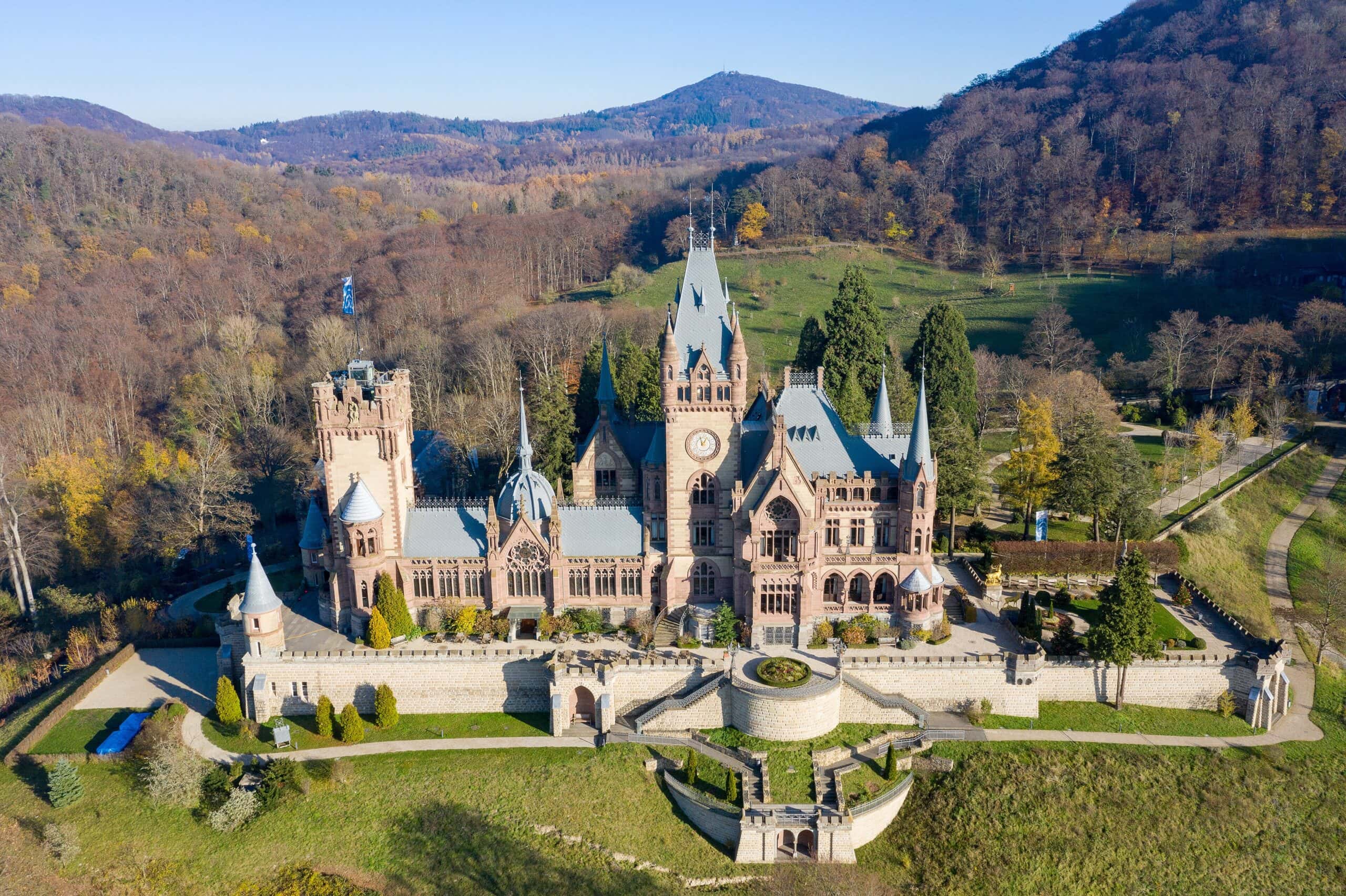
Drachenburg Castle
Drachenburg Castle (Schloss Drachenburg) was built in two years, 1882 to 1884, by a Bonn-born stockbroker named Stephan Sarter, who had made his fortune in the Suez Canal Company and bought himself a baronial title from a minor German duke six months before the foundation stone was laid. Drachenburg is an eclectic Historicism on a Burgenromantik scaffold: Neo-Gothic silhouette, Rhenish-Romanesque towers, Neo-Renaissance interiors painted by a Munich-school cohort. It cost 1.7 million Mark and quoted everything it could afford from the visual languages of medieval, royal, and ecclesiastical Germany. Sarter never moved in. He died in a rented Paris apartment twenty years later, a bachelor and intestate, and the castle has been the home of nobody ever since.
The site is the slope of the Drachenfels above the Rhine, midway between a medieval ruin at the summit and a cog railway at the foot. Burg Drachenfels (the twelfth-century fortress raised at the top by the archbishops of Cologne) had stood ruined since the Thirty Years’ War; the Drachenfelsbahn, still operating today, opened the year before Drachenburg was finished. Sarter’s land sat halfway up that slope, inside an already-curated Romantic picture and built to be read against everything around it. The Schloss has since been a tourist attraction, a Catholic boys’ school, an Adolf-Hitler-Schule, an artillery target, an empty wreck, and finally the centerpiece of a thirty-one-million-euro restoration completed in 2011.
Quick Facts
| Country | Germany |
| Region / State | Siebengebirge, North Rhine-Westphalia |
| Nearest Town | Königswinter |
| Construction Period | 1882–1884 (foundation stone late 1881) |
| Founder | Stephan Sarter, Freiherr von Sarter (1833–1902) |
| Architectural Style | Eclectic Historicism (Neo-Gothic and Burgenromantik exterior; Neo-Renaissance interiors) |
| Building Type | Schloss — private villa-castle |
| Current Condition | Restored (major restoration 1989–2011) |
| Open to Visitors | Yes — museum and event venue, year-round |
| UNESCO Status | Not inscribed |
| Official Website | schloss-drachenburg.de |
A castle on a slope already crowded with stories
Drachenfelsen (the basalt outcrop from which the Siebengebirge takes its name) was already a famous place when Stephan Sarter bought building land beneath it. Burg Drachenfels, the medieval fortress raised above the summit by the archbishops of Cologne in the twelfth century, had stood as a romantic ruin since soldiers of the Thirty Years’ War destroyed it in 1634. Below the ruin, the rock face itself was the legendary site where the Nibelungenlied placed Siegfried’s killing of the dragon. Lord Byron had already given the ruin its English-language anchor in Childe Harold: The castled crag of Drachenfels / Frowns o’er the wide and winding Rhine. By the 1830s, English watercolorists were arriving by river steamer to sketch the ruin from below.
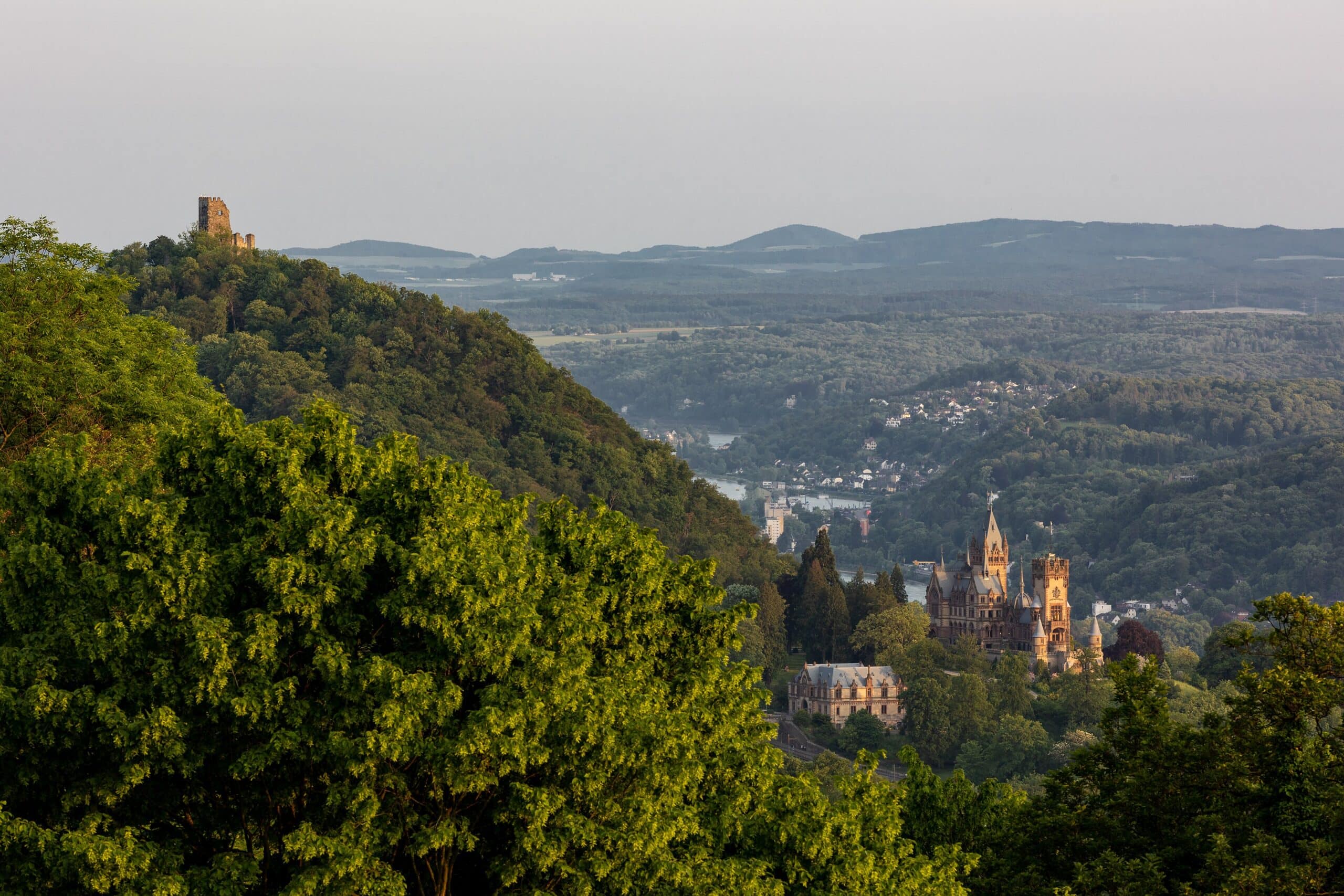
In 1883 the Drachenfelsbahn (the oldest cog railway in Germany, still in operation) opened a new line straight up the slope, depositing day-trippers from Bonn at the foot of the medieval ruin in eight minutes. Sarter’s site, halfway up the same slope, sat between three layers at once: the mythic landscape of Siegfried, the medieval ruin above, and the new railway running below. Drachenburg was not placed in a wilderness. It was placed inside an already-curated picture, and built to be read against everything around it.
The Bonn innkeeper’s son who bought himself a barony
Cornelius Stephan Sarter was born in Bonn on December 20, 1833, the fifth child of a local innkeeper. At sixteen he was apprenticed to the Cologne banking house Leopold Seligmann, and at twenty-three he moved to Sal. Oppenheim jr. & Cie., which posted him first to Paris and then to London. By 1862 he had set himself up in Paris on his own account, publishing a stock-market newsletter and trading securities for his own book.
His fortune came principally from his early position in the shares of Ferdinand de Lesseps’s Suez Canal Company, which made him wealthy when the canal opened on November 17, 1869. He was an honored guest at the inauguration. He sold his Panama Canal holdings, by his own later account, before that second scheme collapsed. Wealth alone, in the new German Reich, was not enough. On May 22, 1881, Duke Georg II of Saxe-Meiningen-Hildburghausen raised Sarter to the rank of Freiherr (baron) in exchange for a donation of 40,000 Mark, with diplomatic support from the German ambassador in Paris. A further 25,000 Mark went to a Meiningen almshouse named the Sarter-Stift. The new coat of arms displayed a balance; the motto read Wäge und wage: weigh and dare. Within months the foundation stone was laid for a private castle on the Rhine that would announce the new Baron’s standing to the empire he had financed himself into.
Three architects and two years of construction
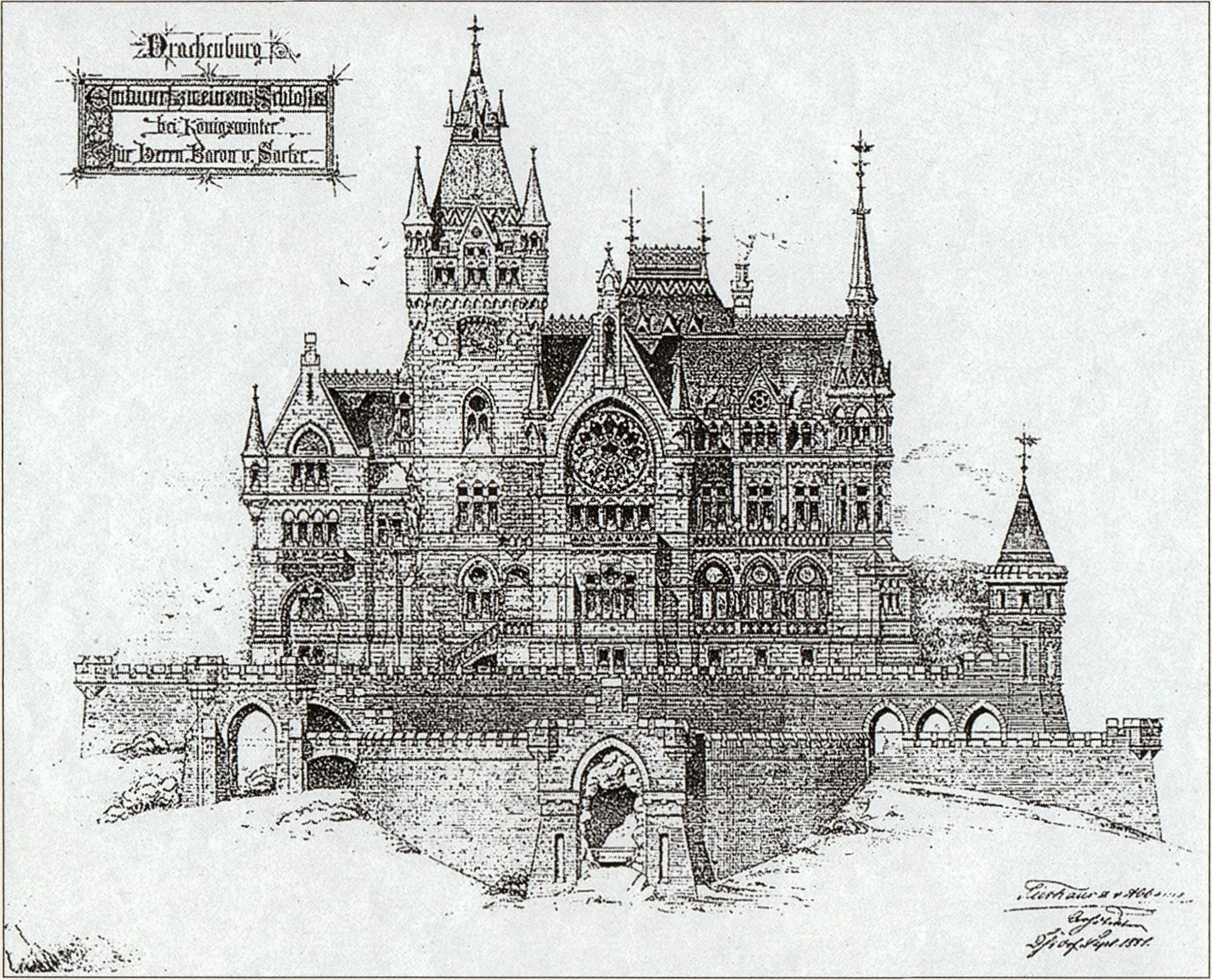
The design that survives is the work of three hands. The original drawings were made in Düsseldorf by Bernhard Tüshaus and Leo von Abbema, who signed and dated their elevation in September 1881. Wilhelm Hoffmann (Paris-based, formerly a pupil of the Cologne dombaumeister Ernst Friedrich Zwirner) revised the plans and contributed the Kunsthalle and the North Tower. Site supervision fell to the young Bonn architect Franz Langenberg, who oversaw the rapid construction between 1882 and 1884 and contributed to the interior fittings. The final cost was 1.7 million Mark.
The vocabulary is eclectic Historicism on a Burgenromantik scaffold: Neo-Gothic in the silhouette, Rhenish-Romanesque in the towers, Neo-Renaissance in the grand interiors, with Baroque and Pompeian flourishes room by room. Angelika Schyma, in her authoritative entry in the Denkmaltopographie of Königswinter, judged that palace, fortress and villa architecture combine here in a picturesqueness impossible to surpass.
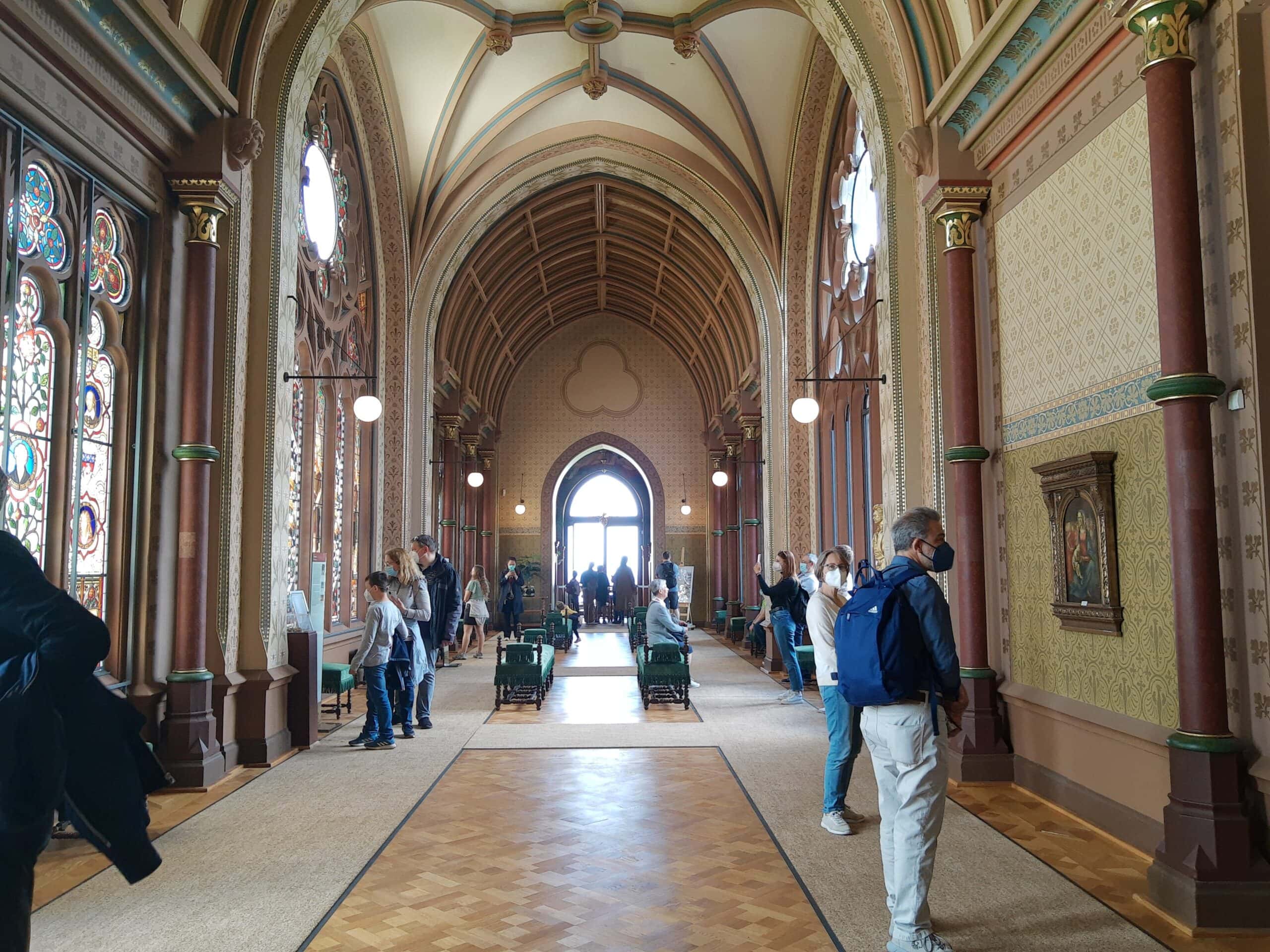
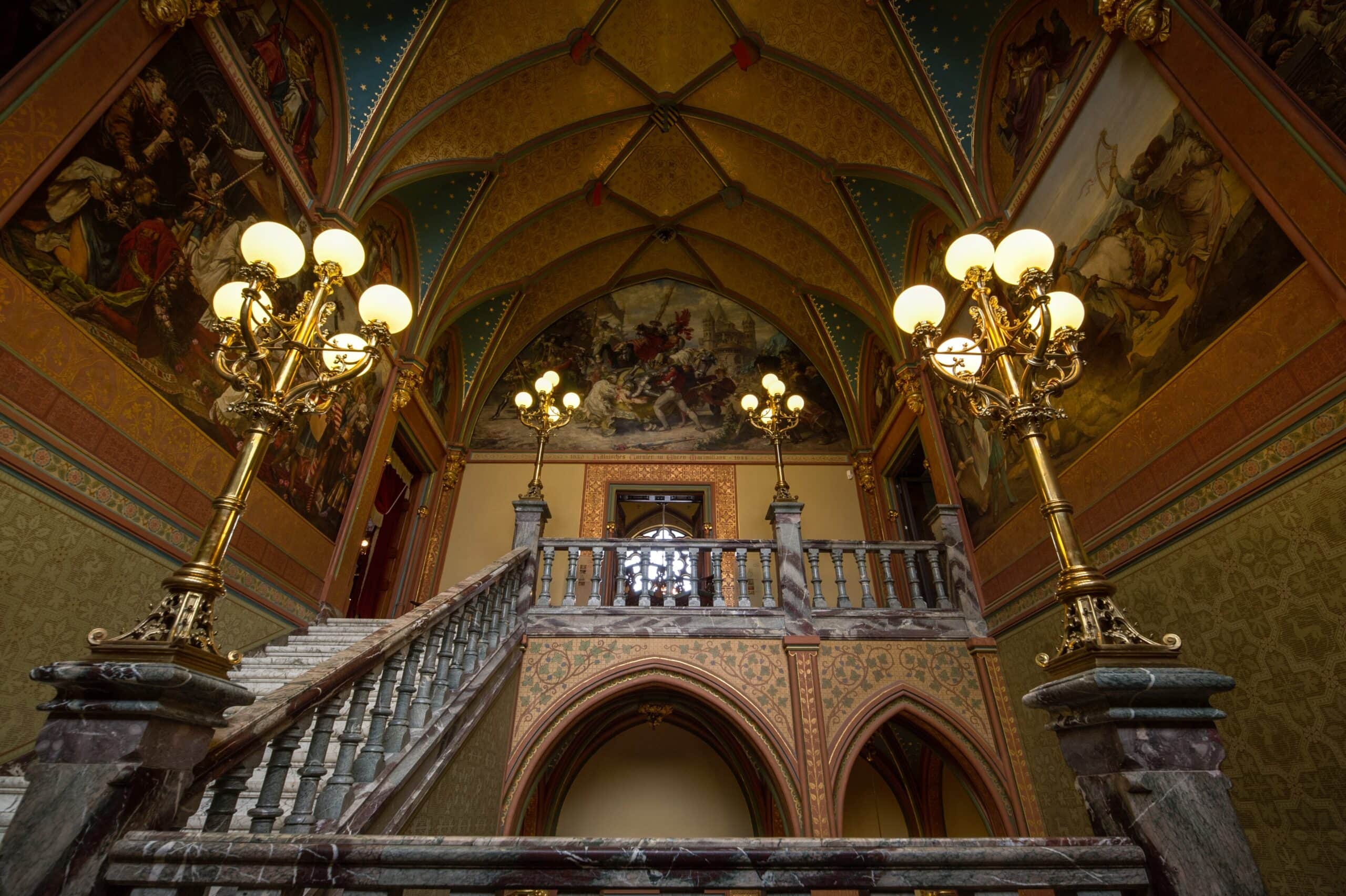
The decorative program was contracted to a Munich-school cohort. Frank Kirchbach painted a Nibelungen cycle in the central rooms, including a Streit der Königinnen over one of the principal mantels. Josef Flüggen painted scenes from the history of Cologne above the grand staircase. Friedrich von Keller produced a five-part hunting cycle for the dining room. Ferdinand Wagner the Younger designed cartoons for the stained glass, executed in Munich by F. X. Zettler and the Mayer’sche Hofkunstanstalt; among the Kunsthalle’s surviving panels is a procession of musicians and composers (Bach, Wagner, Brahms) set behind columns of magnolia and peacocks. Almost everything visible inside the building is a quotation of something else.
A speculation that never moved in
Sarter never lived in the building he had built. Paris remained his home; he applied for French citizenship from 1876 and obtained it in 1890. A steward in Königswinter reported to him by post. In 1888 he tried to sell the unused castle to the Prussian state for use as a Kaiser-Wilhelm-Burg; the offer was declined. He died of pneumonia in his rented Paris apartment on March 30, 1902, a bachelor and intestate. The body was returned to Königswinter; he is buried at Friedhof Am Palastweiher under a stone inscribed Baron Stephan von Sarter.
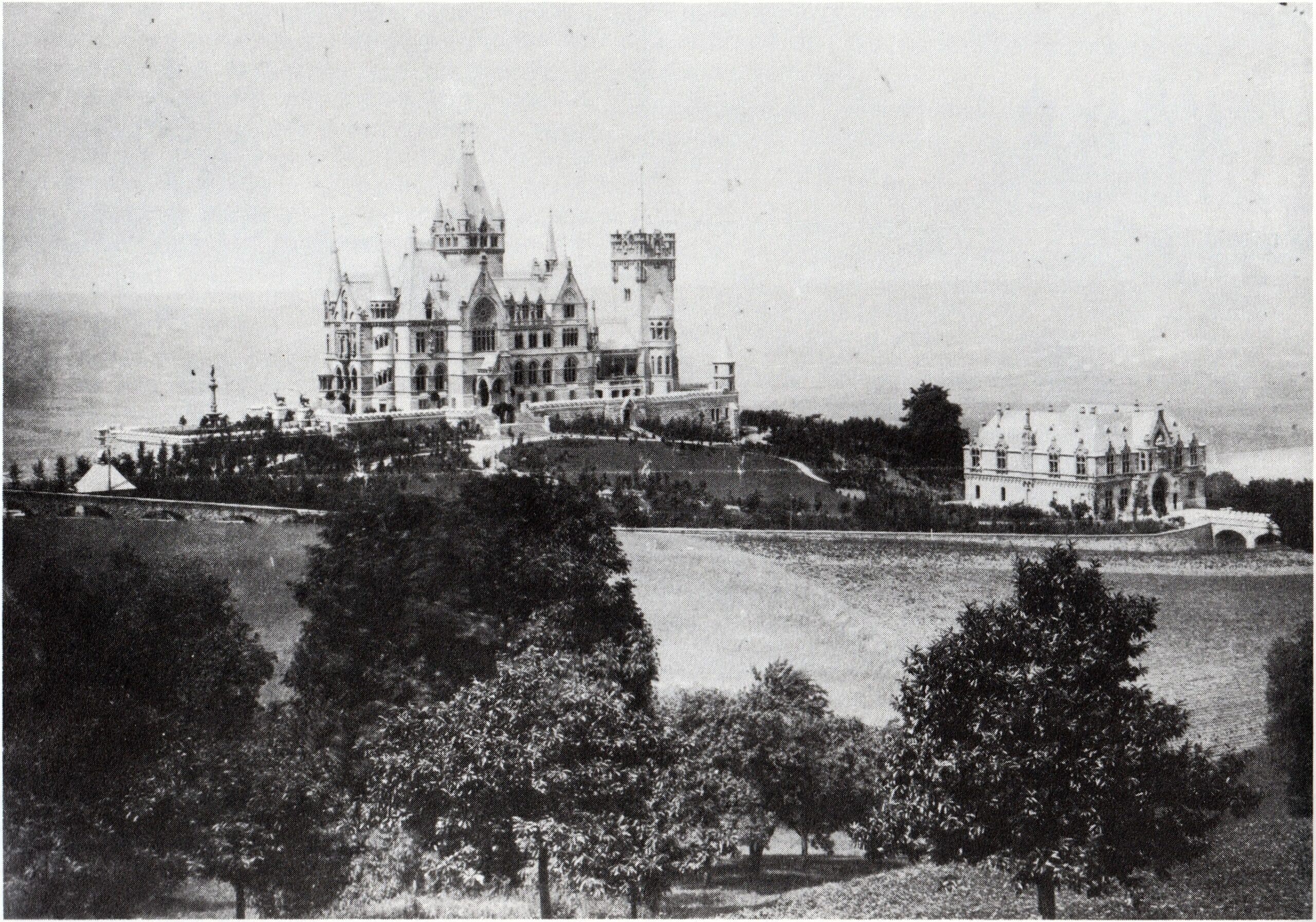
The building then passed through a sequence of owners in sixty years. Sarter’s nephew Jakob Hubert Biesenbach, a Bonn lawyer, bought it from the estate in 1903 for 390,000 Mark and opened it as a tourist attraction, putting up thirteen “Nordic” timber chalets in the park as upmarket holiday lets named for figures from the Nibelungenlied. Egbert von Simon, a retired cavalry captain, acquired it in 1910, planned an unbuilt leisure park with festival hall and airship hangar, and was killed in the First World War. The Cologne merchant Hermann Flohr bought the property in 1921, used it as a weekend retreat, and in 1930 transferred it to the De La Salle Brothers, a Catholic teaching order from Wadersloh in Westphalia.
From Catholic boys’ school to Adolf-Hitler-Schule
The De La Salle Brothers opened the Heimschule St. Michael in 1931. The Kunsthalle was used as a chapel; the Kneipzimmer became a sacristy; nude statuary was draped or removed. The school operated for seven years before closing in 1938 under sustained pressure from the regime. Deutsche Arbeitsfront (the Nazi labor organization that had absorbed Germany’s confiscated trade-union assets) purchased the property on September 19, 1940.
In 1942, the building reopened as an Adolf-Hitler-Schule, the AHS-3 for the Gau Köln-Aachen. The Adolf-Hitler-Schulen were not Napolas and not SS-Reichsschulen. They were a separate institutional category, run jointly by the NSDAP under Robert Ley, the Hitler Youth under Baldur von Schirach, and the Deutsche Arbeitsfront, and intended to train future party leadership cadre as feeder schools to the NS-Ordensburgen. Pupils followed a six-year curriculum, later reduced to five, with the diploma formally equated to the Abitur. The park was used for paramilitary drill; flak positions and combat trenches were installed on the slope below. From the summer of 1944, AHS-4 (evacuated from Ordensburg Vogelsang as the front collapsed westward) is reported to have relocated to Drachenburg as well.
The school was still in operation when American troops reached the Rhine in March 1945. Drachenburg was taken without combat, but the building had already absorbed severe damage from artillery fire in the war’s final days. The west façade was hit. The Kunsthalle’s central dome was so badly compromised that what remained of it was simply dismantled in the postwar years rather than rebuilt. Almost all the stained glass was destroyed. Shell holes remained visible in the entrance-hall ceiling for decades. The building had served the regime, and the war had reduced it to a wreck.
Forty years of decay, then a foundation buys a wreck
Between 1947 and 1960 the German Federal Railway used Drachenburg as a training school for the Reichsbahndirektion Wuppertal. Only emergency repairs were undertaken: a Notdach over the roofless Kunsthalle, the eastern window front bricked up, the dome remnants cleared away. After 1960 the school left, and for the next decade the building stood empty. Vandals stripped what they could carry. Carved oak paneling was burned for firewood; murals were defaced or chiseled out. In 1963, the Land of Nordrhein-Westfalen (the formal owner since 1953) authorized demolition. Demolition was prevented only by a citizens’ association, the Interessengemeinschaft Schloss Drachenburg, founded the same year by residents of Königswinter who refused to let the building come down.
In 1971 a Bonn-Godesberg textile merchant named Paul Spinat bought the building from Land NRW for half a million Marks, financed through a savings-and-loan, with an obligation to open it to the public. Spinat reopened the building in 1973. He drove a gold-painted Rolls-Royce. He styled himself Graf Spinat. He installed a non-functional pipe organ in the music room, and commissioned young artists to repaint the missing murals as best they could. Chagall, Dalí, and Andy Warhol all came to visit. Up to 200,000 visitors a year came with them. By the mid-1980s, his finances had collapsed.
In January 1989, Land NRW exercised its right of first refusal and acquired the ensemble for 8 million Marks, transferring it to the Nordrhein-Westfalen-Stiftung Naturschutz, Heimat- und Kulturpflege. As the foundation later put it, half-derelict, the jewel of Rhine Romanticism built 1881–1884 looked down on Königswinter for decades. The restoration ran in phases over the next two decades. Between 1989 and 1994 the foundation surveyed the damage and stabilized what was about to fall. The Vorburg was rebuilt between 1995 and 2000, partly funded out of the Bonn-Berlin-Ausgleich, the federal compensation package that softened Bonn’s loss of capital status. The Kunsthalle was the centerpiece of the work that followed; its dome and viewing platform were reconstructed from Hoffmann’s drawings and completed in 2004. Interior rooms were finished sequentially through 2010. The Hauptburg reopened to the public in July 2010; the landscape park was completed in 2011. The total cost ran to roughly 31.5 million euros.
Visiting Drachenburg in 2026
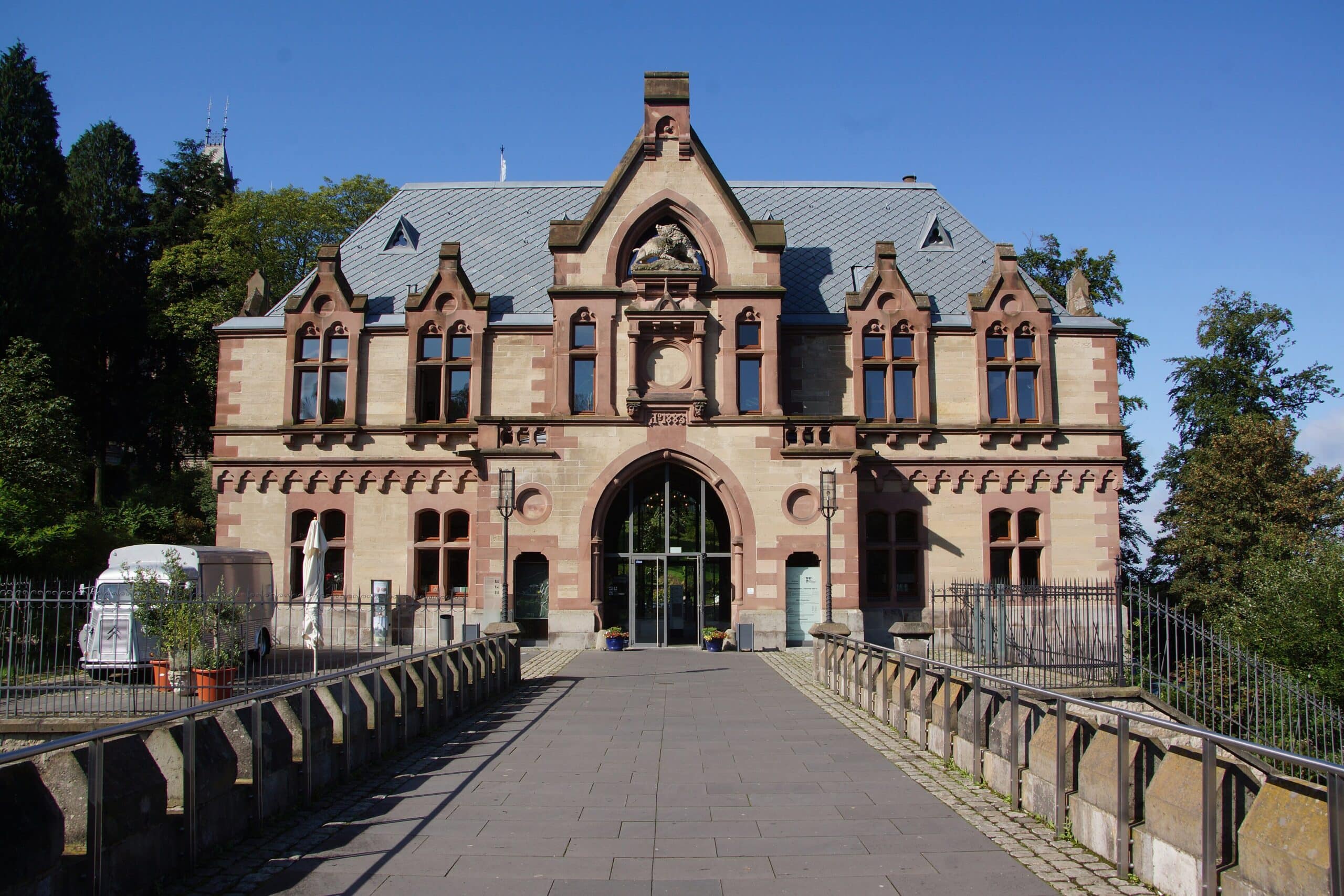
Most visitors arrive on the Drachenfelsbahn (Germany’s oldest still-operating cog railway, opened in 1883, the year before Drachenburg itself was completed), which leaves from the riverfront in Königswinter and stops at a station just below the castle. From there a short uphill path leads to the Vorburg, the gatehouse completed in 1883 and now home to the Museum zur Geschichte des Naturschutzes in Deutschland, which has occupied the building since August 2000. Entry tickets and local tours can also be booked in advance through GetYourGuide.
The Schloss itself is open year-round, with reduced hours in winter. A self-guided route leads through the entrance hall, the dining room with its von Keller hunting cycle and green-marble fireplace, the Kunsthalle, the formal staircase under Flüggen’s Cologne cycle, and the Nibelungen rooms in the central block. The Nordturm is open to climb in season; the platform at the top reaches above the slope’s tree line and gives a long view down the Rhine toward Bonn.
A note worth carrying in. The permanent exhibition concentrates on Sarter, the architecture, and the bourgeois Gründerzeit interior; the Adolf-Hitler-Schule period is acknowledged on a wall panel and in the printed material, but the museum does not interpret it at length. Visitors who want context for that chapter should bring it with them.
In late autumn the Schlossleuchten (an evening illumination program with projections on the towers) runs for several weeks, and the building can be hired for weddings and corporate events through the operator. The walk from the lower Drachenfelsbahn station to the Schloss is short but steep; sturdy shoes are advised. Address: Drachenfelsstraße 118, 53639 Königswinter. Operator: Schloss Drachenburg gGmbH on behalf of the NRW-Stiftung. Current ticket prices and opening hours are on the official website. Anyone staying overnight can compare hotels in and around Königswinter.
Some links on this page are affiliate links, which means StoneKeep Atlas may earn a small commission, at no extra cost to you, if you book through them.
Beyond Drachenburg
Drachenburg sits at the late end of the nineteenth-century Romantic revival of the German castle, and reads best in conversation with the buildings it answers. Neuschwanstein, completed in the same decade, is the canonical comparison: a royal patron rather than a private financier, but the same impulse to compress an imagined Middle Ages into stage-set form. Neuschwanstein in turn answers Hohenschwangau Castle across the valley, the crown prince’s rebuild of 1832 onward in which Ludwig spent his childhood, and which had made the same gesture half a century before Sarter made his. Schloss Lichtenstein, built fifty years earlier on the inspiration of a popular novel, is the precedent both buildings rest on. Upstream on the Rhine, the Prussian state’s mid-century restoration of Schloss Stolzenfels and Schloss Rheinstein established the visual idiom (restored medieval silhouette, romantic landscape, royal sponsorship) that Sarter inverted and privatized. The Wartburg, restored across the same decades as a national symbol of German cultural memory, supplied the medievalizing iconography on which the Drachenburg interiors quietly draw.
Drachenburg itself takes a natural place among the fairytale castles in Germany, the survey of the buildings that share its storybook ambitions.
Two further comparisons clarify what Drachenburg is. Burg Hohenzollern, completed in 1867, is the dynastic-imperial parallel: the same gesture made by the ruling house. Schloss Herrenchiemsee, begun the same year as Drachenburg, is its maximalist royal counterpart: a Bavarian king’s private fantasy of Versailles, undertaken as a stockbroker’s fantasy of Renaissance princehood was being raised at the other end of the country. And Schloss Johannisburg, the Renaissance-revival residence whose silhouette Drachenburg’s exterior most directly cites, completes the lineage that Sarter and his architects were drawing on.
What sets Drachenburg apart from all of them is the social fact of who built it. Hohenzollern, Neuschwanstein, Linderhof, Herrenchiemsee: royal commissions. Wartburg: a national-state restoration. Stolzenfels and Rheinstein: Prussian crown projects. Drachenburg is the bourgeois exception: a private fortune borrowing the visual language of monarchy, in the second decade of the empire that licensed it.
Conclusion
Drachenburg was built as a stage set for a life its founder never lived, and that condition has shaped every chapter of its history since. Owners and institutions who followed staged different performances on the same stage: tourist attraction, Catholic boarding school, party leadership school, eccentric private museum, public cultural monument. The building has been many things and the home of nobody. That is what makes it, finally, the most Wilhelmine castle in our catalog: a magnificent declaration with nothing private behind it.
Principal Sources
- Dehio, Georg. Handbuch der deutschen Kunstdenkmäler. Nordrhein-Westfalen I: Rheinland. Bearbeitet von Claudia Euskirchen, Olaf Gisbertz, Ulrich Schäfer u. a. Deutscher Kunstverlag, 2005.
- Klein, Ansgar Sebastian. “Stephan von Sarter.” rheinische-geschichte.lvr.de.
- Nordrhein-Westfalen-Stiftung Naturschutz, Heimat- und Kulturpflege, ed. Schloss Drachenburg. Historistische Burgenromantik am Rhein. Deutscher Kunstverlag, 2010.
- Nordrhein-Westfalen-Stiftung Naturschutz, Heimat- und Kulturpflege. “Schloss Drachenburg bei Königswinter.” nrw-stiftung.de.
- Schloss Drachenburg gGmbH. “Geschichte.” schloss-drachenburg.de.
- Schyma, Angelika. Stadt Königswinter (Denkmaltopographie Bundesrepublik Deutschland, Denkmäler im Rheinland 23.5). Rheinland-Verlag, 1992.
The ensemble is owned by the Nordrhein-Westfalen-Stiftung Naturschutz, Heimat- und Kulturpflege and operated by Schloss Drachenburg gGmbH (schloss-drachenburg.de); the Vorburg additionally houses the Museum zur Geschichte des Naturschutzes in Deutschland, run by the Stiftung Naturschutzgeschichte (nrw-stiftung.de).
Image credits. Featured image — Schloss Drachenburg from the south: dronepicr, CC BY 2.0, via Wikimedia Commons. Blick vom Petersberg auf Drachenfels und Drachenburg: Christian Feldmar, CC BY-SA 4.0, via Wikimedia Commons. Schloss Drachenburg, Entwurf 1881: Tüshaus & von Abbema, public domain, via Wikimedia Commons. The Kunsthalle interior: OnwardToThePast, CC BY 4.0, via Wikimedia Commons. Schloss Drachenburg ca. 1900: unknown photographer, public domain, via Wikimedia Commons. The grand staircase: GZagatta, CC BY-SA 4.0, via Wikimedia Commons. Vorburg Schloss Drachenburg: Tohma, CC BY-SA 4.0, via Wikimedia Commons. Freely licensed images are resized to fit; otherwise unaltered.