
Moritzburg Castle
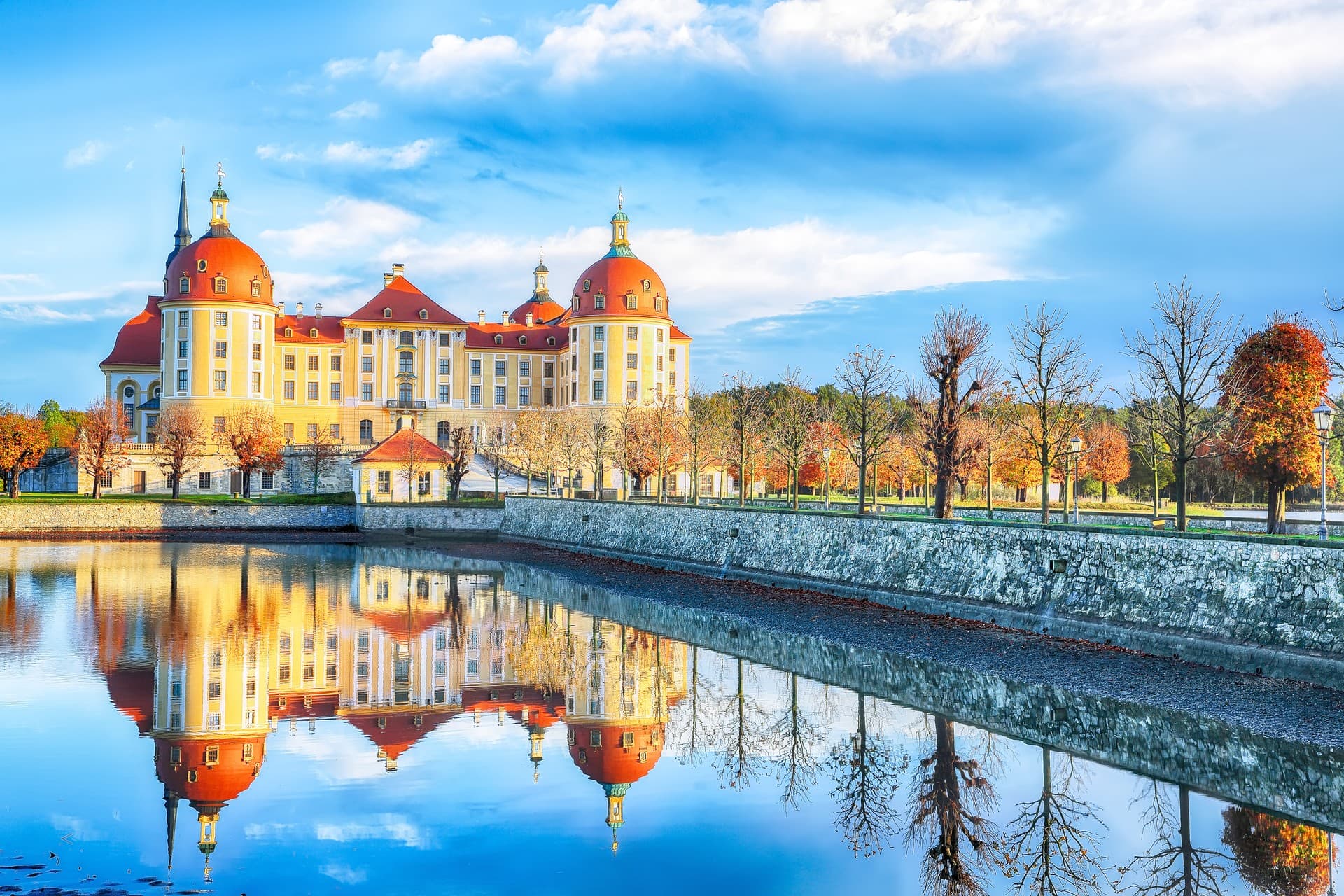
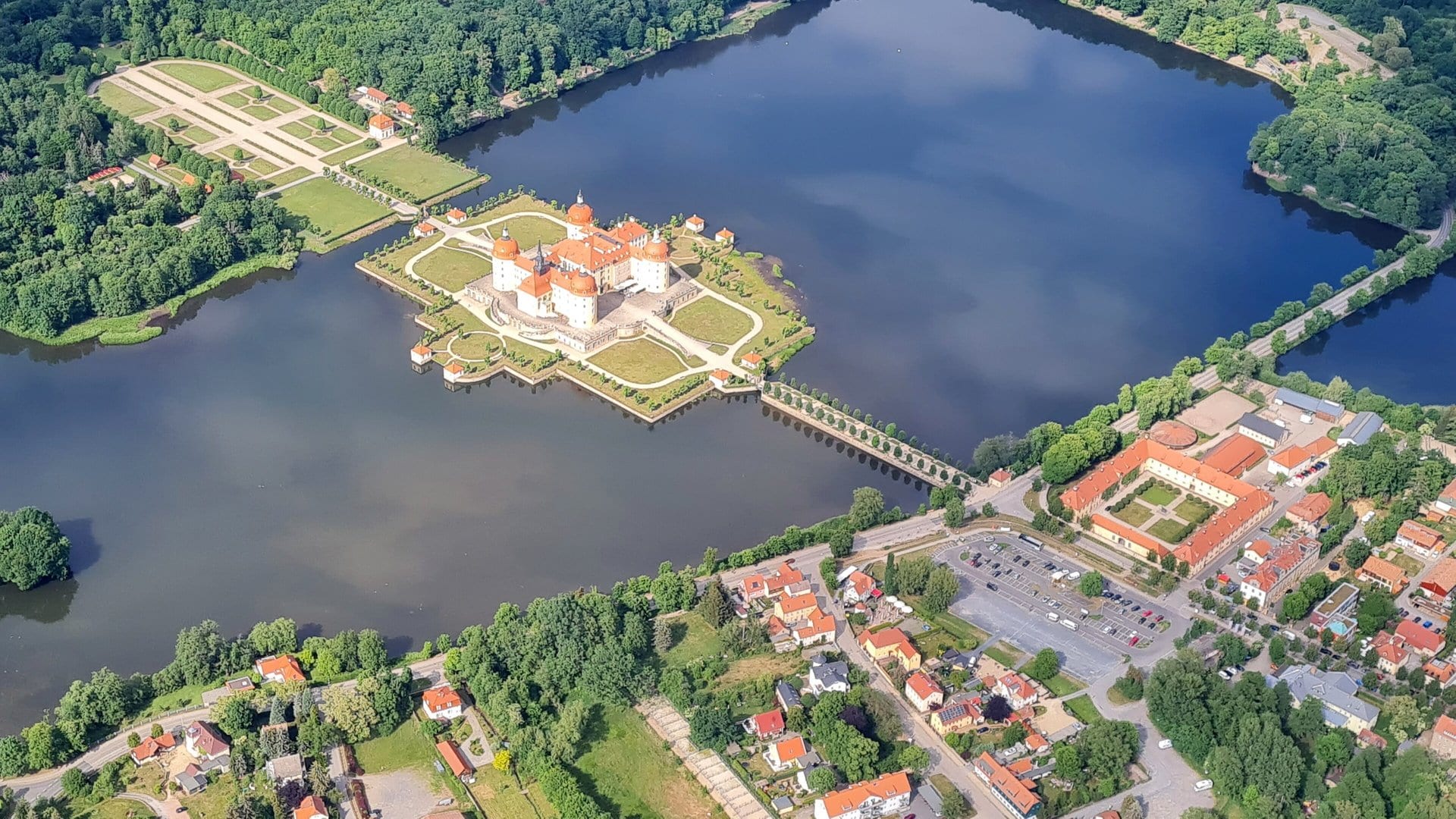
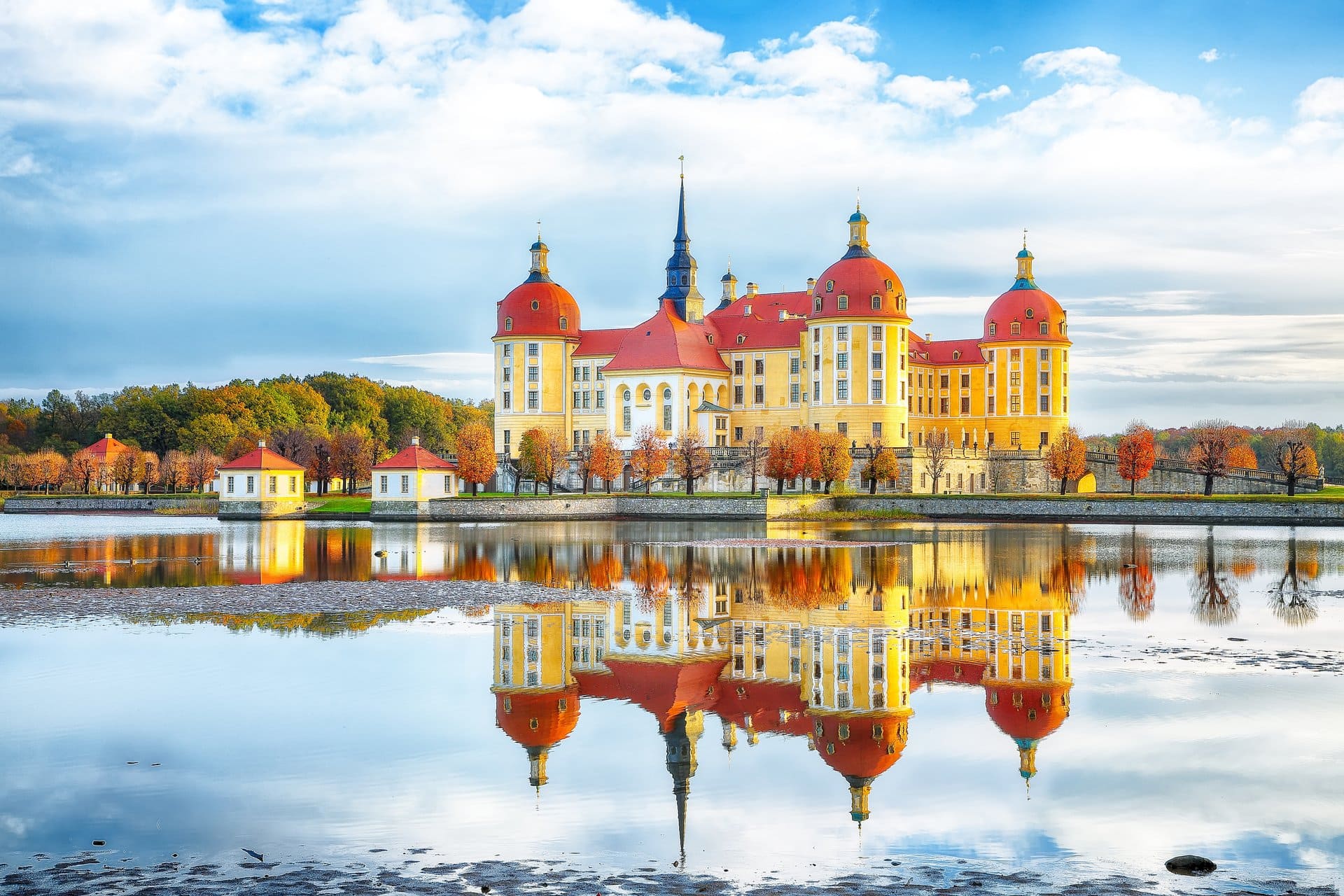
On a granite knoll in the Friedewald, fifteen kilometers north-west of Dresden, a four-towered Wasserschloss stands at the center of an artificial lake that reflects almost the whole of it back. Duke Moritz of Saxony first hunted from this spot in the 1540s, and for nearly two centuries his lodge wore the name Dianenburg, for the goddess of the chase. Two centuries later the same site became something Saxony had not yet quite built: a Baroque country pendant to the Dresden Zwinger, drafted by the architect of the Zwinger himself, and completed by the man who finished his unfinished work.
This is the article’s particular subject: how Moritzburg Castle (Schloss Moritzburg) became, between roughly 1722 and 1733, the country face of Augustan Saxony, and what happened to it in the three centuries since the work stopped.
Quick Facts
| Country | Germany |
| Region / State | Saxony |
| Town | Moritzburg, about 15 km north-west of Dresden |
| Coordinates | 51.167° N, 13.682° E |
| Building Type | Schloss — Baroque Jagd- and Wasserschloss |
| Construction | Renaissance hunting lodge 1542–1546; chapel 1661–1672; Baroque conversion 1722/23–1733; Fasanenschlösschen 1769/70–1776 |
| Original Builder | Duke Moritz of Saxony (Elector 1547) |
| Baroque Architects | Matthäus Daniel Pöppelmann and Zacharias Longuelune for Augustus the Strong |
| Current Use | Museum — Baroque exhibition with Feather Room; winter Drei Haselnüsse für Aschenbrödel exhibition |
| UNESCO Status | No |
| Open to the Public | Yes (seasonal — see Visiting section) |
| Operator | Schlösserland Sachsen / Staatliche Schlösser, Burgen und Gärten Sachsen gGmbH (SBG) |
| Official site | schloss-moritzburg.de |
Duke Moritz and the Dianenburg, 1542–1660
The Friedewald, a stretch of mixed woodland north-west of Dresden, was Wettin hunting ground long before it carried a building of any consequence. In 1542 the young Albertine duke Moritz of Saxony (five years away from the electoral dignity he would seize at the Battle of Mühlberg) commissioned a Renaissance hunting lodge on a granite knoll above the Friedewald ponds. The lodge was the work of Hans Dehn-Rothfelser, the court building intendant, and Caspar Voigt von Wierandt, the Dresden fortress master mason; it was finished by 1546. Square in plan with four round corner towers, it was first known as the Dianenburg, a reference to the goddess of the chase rather than to the duke whose name it would shortly inherit. By 1549 the documents call it Moritzburch, and the older name fell out of use.
For more than a century the lodge served the function it was built for: a working Jagdschloss, a base for the deer drives and falcon hunts that defined Saxon court ritual. Each tower had a domestic role within the hunting establishment (one for the kitchen, one for the bakery, one for administration, one for the master huntsman), a zoning that the later Baroque rebuild would inherit and preserve. What the original lodge did not have was a chapel.
A Lutheran chapel turned Catholic court, 1661–1699
On November 1, 1661 (his wife Magdalena Sibylle’s birthday), Elector Johann Georg II laid the cornerstone for a new chapel attached to the south face of the castle. Wolf Caspar von Klengel was the court architect on the project, just returned from study in Italy and one of the earliest practitioners of high Baroque in Protestant Saxony. Completed in 1672, the chapel was consecrated in the Lutheran rite.
It would not stay Lutheran for long. In 1697 Elector Friedrich August I (soon Augustus the Strong) converted to Catholicism in order to qualify for the Polish crown, an extraordinary confessional somersault for the prince of the country that had launched the Reformation. Two years later, at Christmas 1699, his confessor Carlo Maurizio Vota re-consecrated the Moritzburg chapel as a Catholic court chapel, the first such re-consecration in Saxony since 1539. Pope Innocent XII sent a letter of welcome. The chapel has been continuously Catholic since, and remains an active parish today.
Augustus the Strong draws his castle, 1703–1722
Augustus the Strong was, among other things, an amateur architect. Sometime around 1703 he sketched, in his own hand, a scheme for converting Moritzburg from a Renaissance hunting box into a Baroque country residence. His sketch survives in the Saxon archives, captioned in his own writing. It is one of the few extant cases of a European ruler functioning as his own initial designer for a major palace project.
Work did not begin. The Great Northern War, the Swedish invasion of Saxony, the loss and recovery of the Polish crown; for nearly two decades there was no money and no peace to build with. Drawings sat. By 1722, the war over and Saxony’s finances reorganized, the project was ready to move. Augustus turned to his senior court architect, the man who had already given Dresden its definitive Baroque monument.
Pöppelmann and Longuelune in the country, 1723–1733
Matthäus Daniel Pöppelmann was sixty when he began at Moritzburg. He had been Augustus’s senior state architect since 1718, and the Zwinger (his masterpiece) was substantially complete. Moritzburg was the country pendant: same patron, overlapping decade, the same Saxon Baroque vocabulary applied to a country rather than a court setting. Construction proper began in 1723 on the basis of Pöppelmann’s plans, which translated the Elector’s sketches into a coherent architectural program.
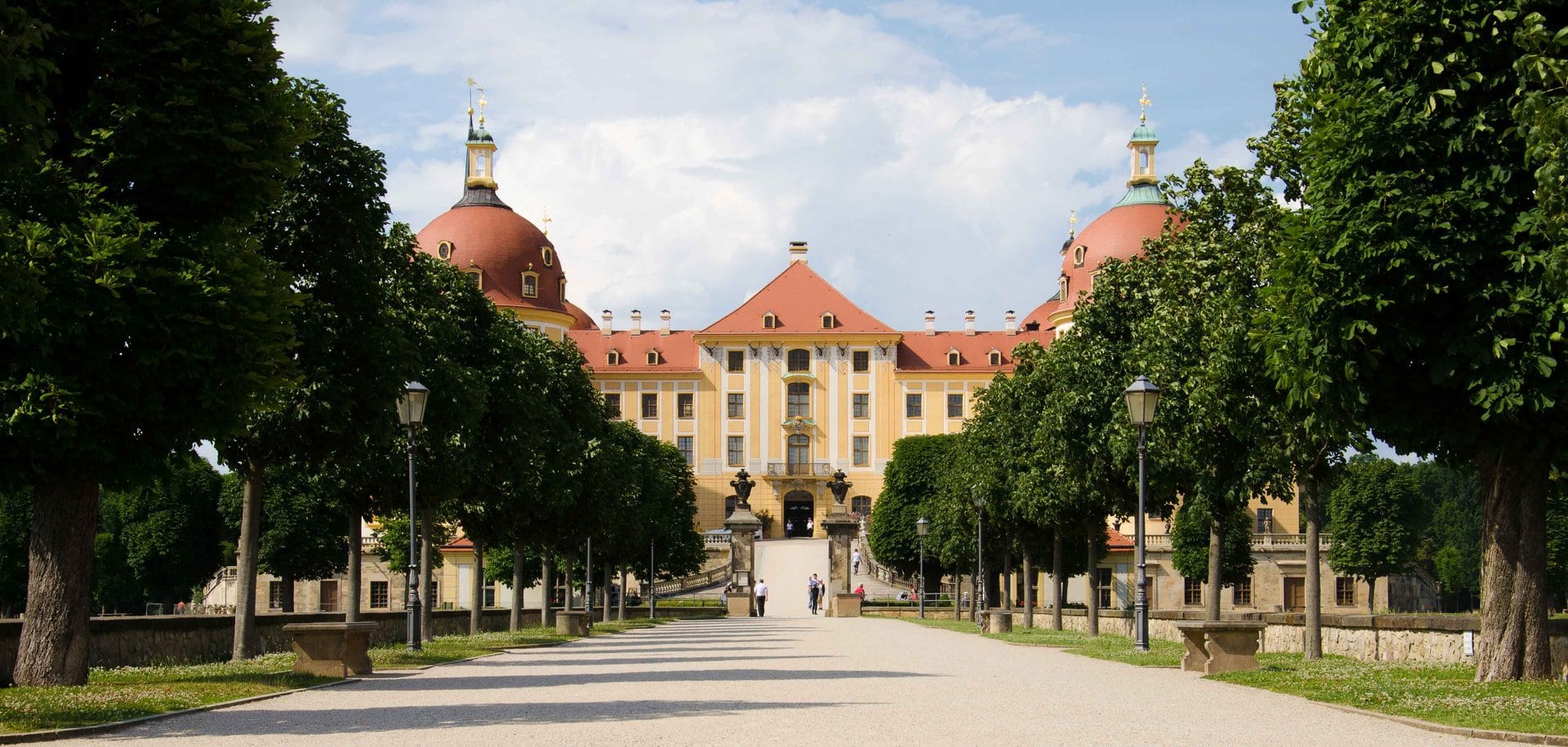
Old defensive walls came down; the central block was raised and widened. Heightened, re-faced in the pink-orange Saxon Baroque render that still defines the silhouette, and crowned with bell-curved cupolas, the four corner towers established the present skyline. Symmetrical wing-bridges connected the towers to the central block, and a system of terraces, ramps, and balustrades cascaded down to the surrounding water. The defining gesture was the water itself: the ponds, dammed and shaped into a single reflective sheet, made the castle into architecture-on-a-mirror, a design move that asks to be read against the Zwinger’s reflective courtyard, with the country lake substituted for the urban parade ground.
From 1726 onward Pöppelmann shared the project with Zacharias Longuelune, the French-born architect who became second Oberlandbaumeister in 1731. Longuelune designed the four state rooms of the interior (the Steinsaal, Billardsaal, Speisesaal, and Monströsensaal), then continued the work after Pöppelmann’s death in January 1736. The sculpture program belonged to the trio of Saxon court sculptors who also worked at the Zwinger: Balthasar Permoser, who executed the chapel’s Christus an der Geißelsäule; Johann Christian Kirchner; and Benjamin Thomae, who together carved the terrace balustrade figures and the wall-mounted stag-head supports in the Speisesaal. Augustus the Strong died in 1733 at Warsaw with the work unfinished. Longuelune carried it as far as the budget allowed; the most elaborate planned interiors were never completed, and the castle still wears that incompleteness honestly.
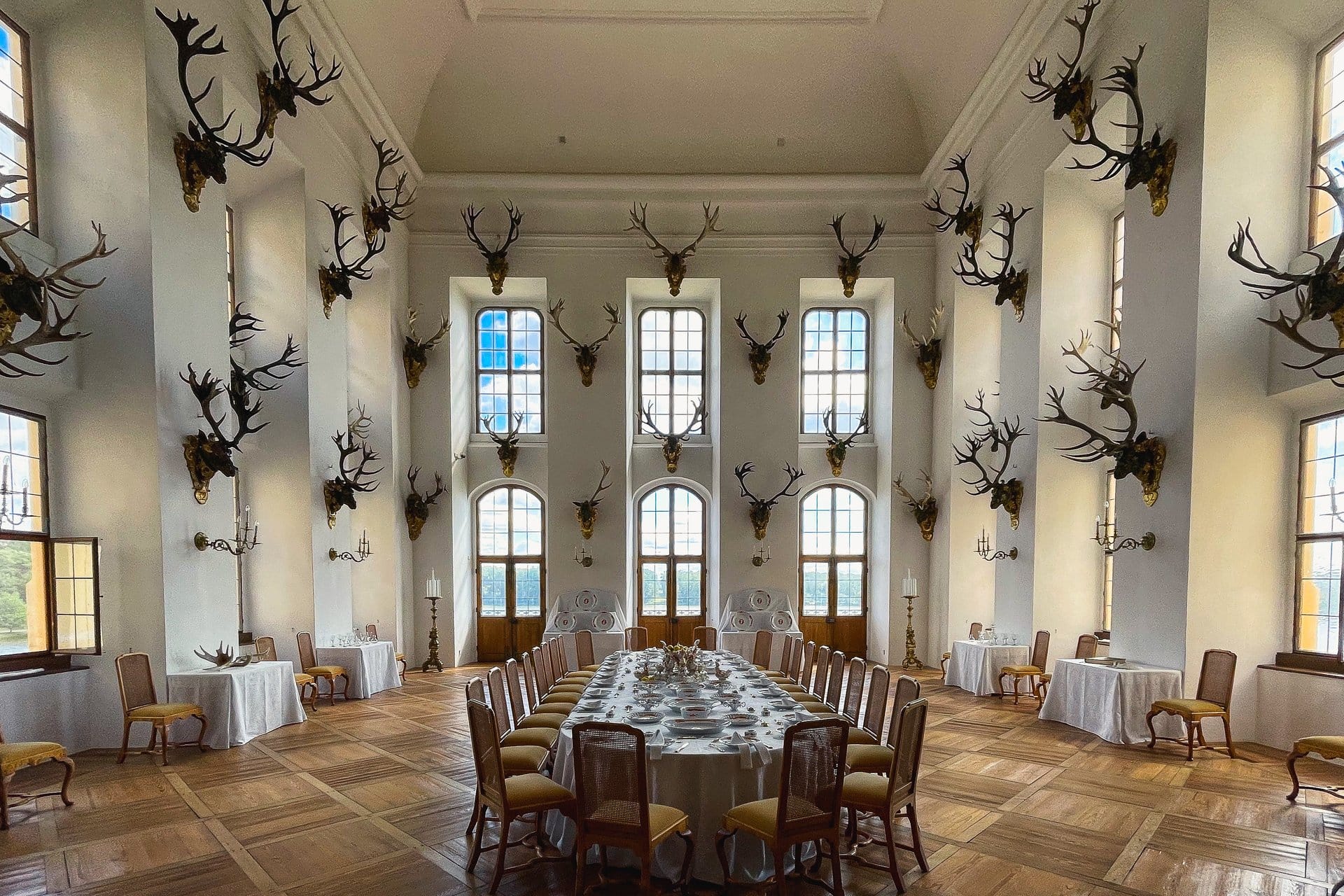
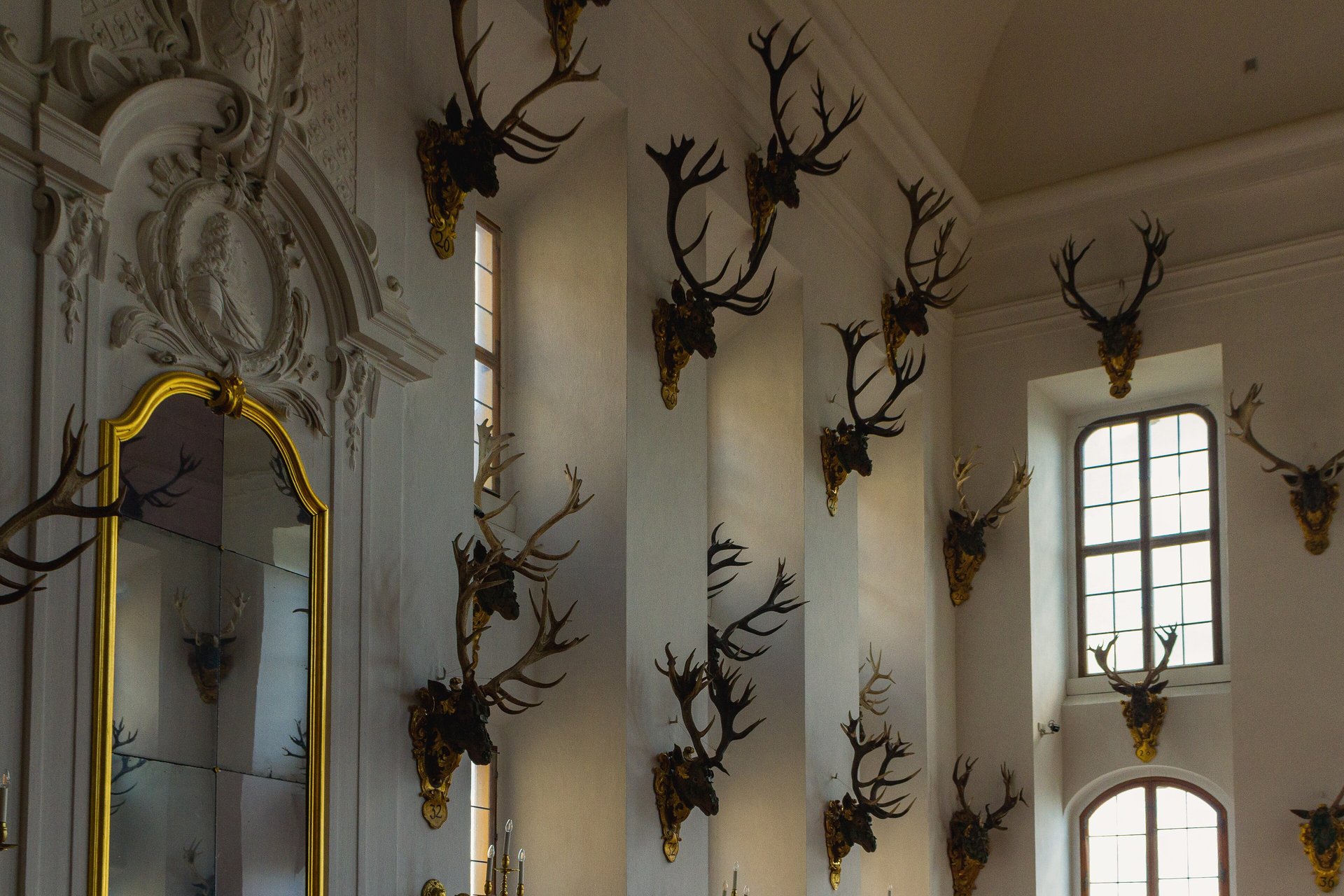
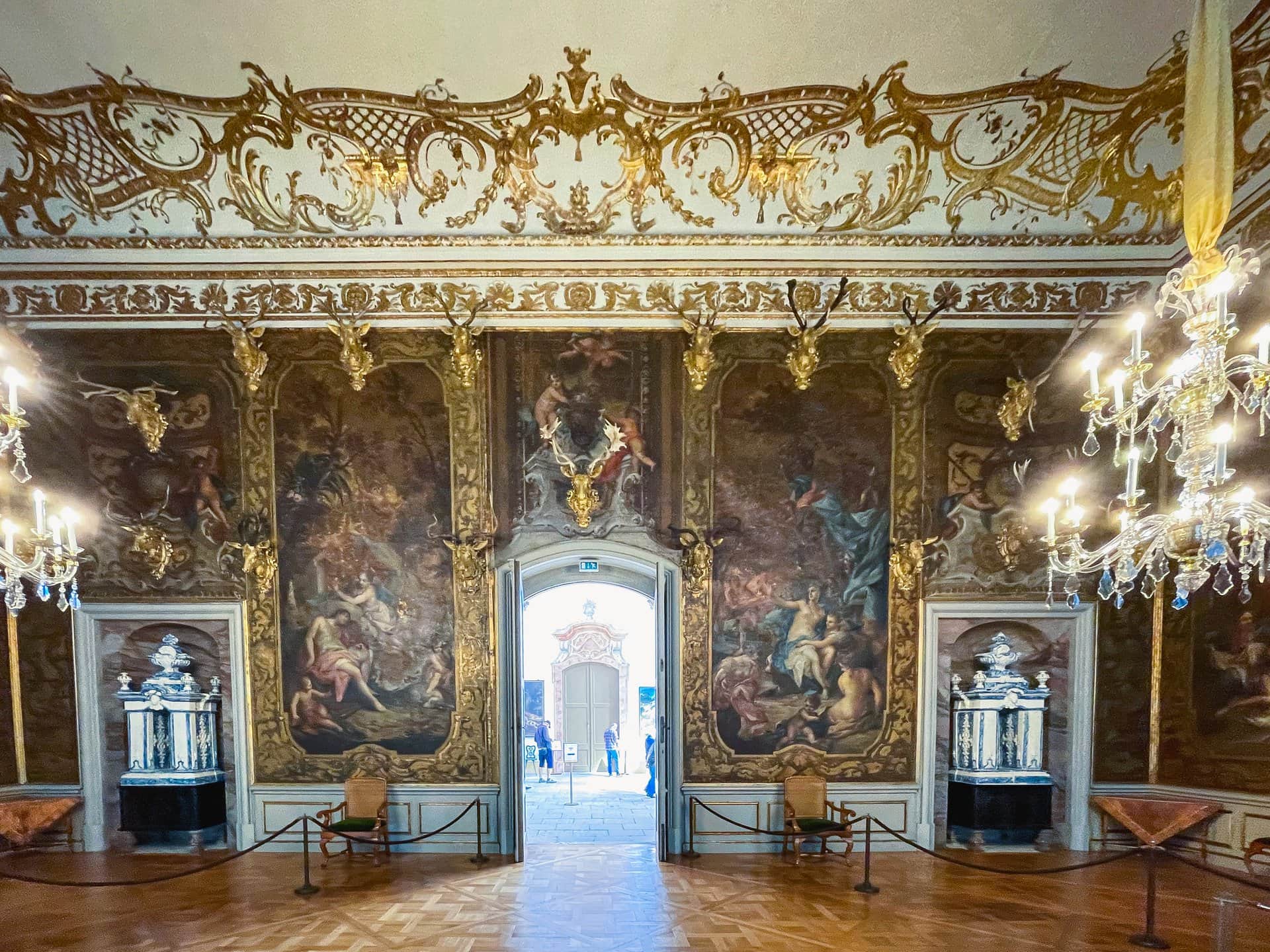
Its interior program survives at extraordinary density. The Speisesaal (dining hall) holds 71 red-deer antler trophies, the largest historic ensemble of its kind in Europe; among them is the world’s heaviest red-deer trophy, an irregular 24-pointer weighing 19.8 kilograms and scoring 298.25 CIC points on its 1991 re-measurement, a figure that still exceeds modern world records by some twenty points. The trophy’s provenance is unknown. The neighboring Monströsensaal displays thirty-nine abnormal antlers, the most spectacular a 66-pointer killed by Elector Friedrich III of Brandenburg on September 18, 1696. The Steinsaal presents an Ice Age giant-deer skull more than ten thousand years old, traditionally a gift from Tsar Peter the Great to Augustus the Strong.
Most singular is the Federzimmer, the Feather Room. Acquired by Augustus the Strong in 1723 from a Paris plumassier for his Japanisches Palais in Dresden, the wall hangings consist of more than one million peacock, pheasant, guinea-hen, and duck feathers woven as weft into canvas across roughly forty square meters. Transferred to Moritzburg in 1830, conserved between 1984 and 2003 by the Stadtmuseum Dresden, the Federzimmer received the Europa Nostra Award in June 2004 and is now displayed in a custom climate-controlled gallery on the upper floor. Moritzburg also holds the world’s largest surviving inventory of Goldledertapeten (embossed and painted gilt-leather wall hangings), with eleven rooms still hung in their original early-18th-century coverings.
The Fasanenschlösschen, the lighthouse, and the naval battle, 1769–1782
Augustus’s great-grandson, Elector Friedrich August III, was the next Wettin to leave a mark at Moritzburg. In 1769, one year after taking power, he commissioned a new pleasure pavilion a kilometer east of the main castle, on the Niederer Großteich at Bärnsdorf. The architect was the court designer Johann Daniel Schade, with Johann Gottlieb Hauptmann attributed as probable collaborator; an earlier 1738–39 single-story pavilion by Johann Christoph Knöffel formed the foundation. Between 1770 and 1776, the new Fasanenschlösschen or “Little Pheasant Castle” was completed in Saxon Rococo, with chinoiserie wall coverings of feathers, straw, pearls, and silk embroidery that survive as the most intact mid-Rococo interior in Saxony.
The pavilion was the centerpiece of an elaborate court entertainment landscape. Friedrich August’s chamberlain and boyhood friend, Camillo Graf Marcolini, leased the Fasanengarten and drove the expansion: the Venusbrunnen, his own residence (the Marcolinihaus), a wheat barn, stables, and coach houses. Most spectacularly, in 1775–76 the pier, harbor, and lighthouse were built at the Großteich, Saxony’s only historic lighthouse, twenty-one meters tall, with a seventy-four-step spiral stair and a pagoda silhouette. A frigate was launched on the lake the same year, and two artificial islands were built. On September 10, 1776 Marcolini staged a mock naval battle on the Großteich for Electress Amalie Auguste, a documented court spectacle that captures the Augustan country palace at its theatrical peak. Pheasant breeding was wound down after 1815; the last ornamental birds left in 1945.
From royal residence to expropriation, 1815–1947
Through the long nineteenth century the castle served the Saxon royal house intermittently, never the primary residence, always the rural retreat. In 1830 the Federzimmer was moved up from the Japanisches Palais. In 1918 the kingdom became the Free State of Saxony; the Wettins lost their political role but retained the castle as private property. From 1933 to 1945 the family-head Prince Ernst Heinrich of Saxony made Moritzburg his principal residence. On February 10, 1945, anticipating Soviet advance, his sons Princes Dedo and Gero buried the Wettin family treasure (forty-three crates of silver, gold, and jewels) in the Moritzburg forest, helped by the forester Mandel and French prisoners of war. Most of the crates were recovered by Soviet forces in 1947 after the forester revealed the location under interrogation, and large parts of the hoard remain in the Hermitage in St Petersburg.
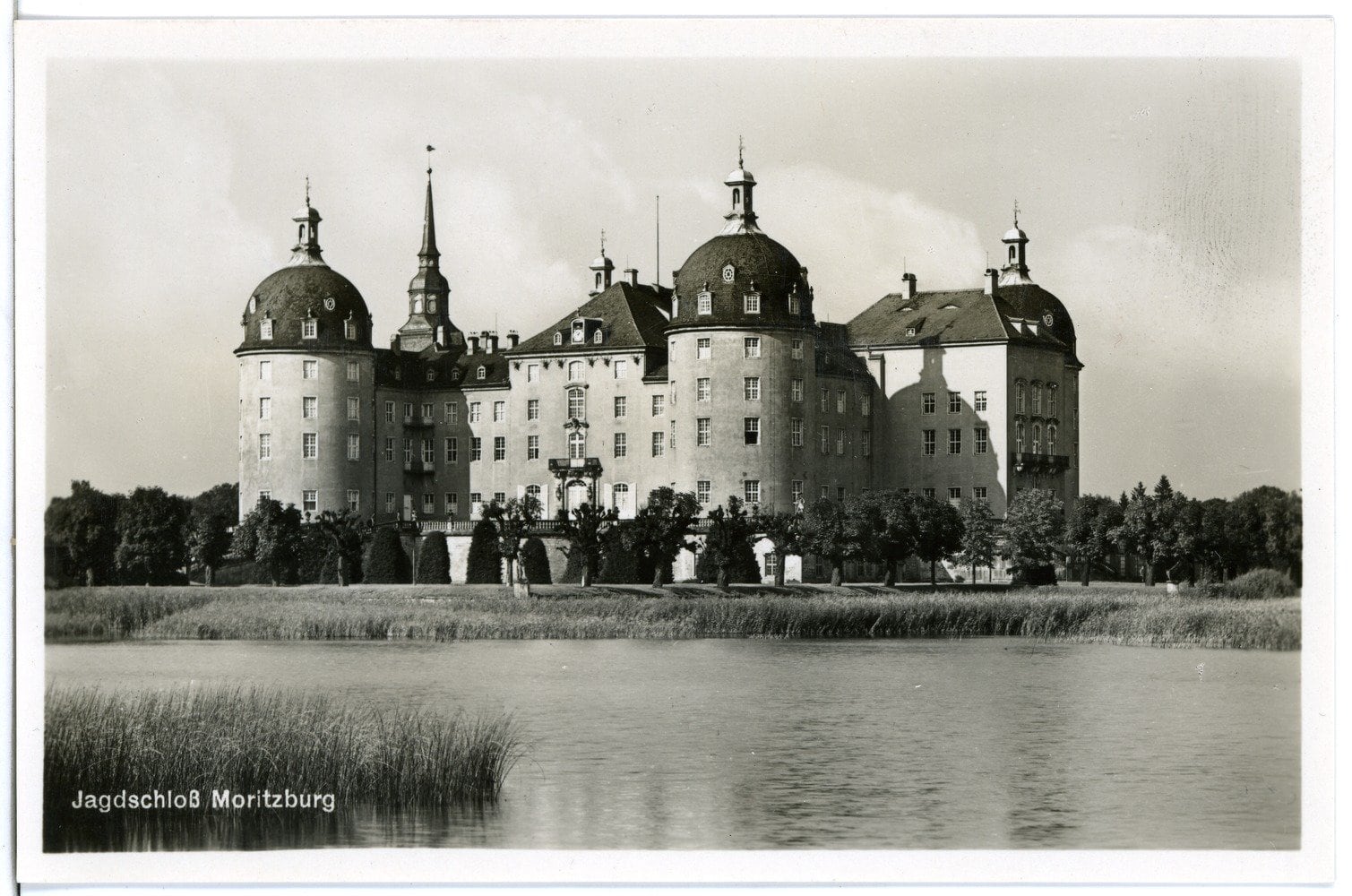
Ernst Heinrich fled in March 1945 to Sigmaringen, later to Ireland, where he died in 1971. Under the Soviet-zone land-reform decree of September 1945, the Wettins were expropriated. Moritzburg opened as a Baroque museum in autumn 1947 under the new Saxon administration, was managed under successive East German museum bureaus until reunification, and from 2003 came under the unified state operator that in 2013 reorganized as the gemeinnützige GmbH Staatliche Schlösser, Burgen und Gärten Sachsen, trading publicly as Schlösserland Sachsen.
Two coda events deserve mention. In April 1945 the artist Käthe Kollwitz, evacuated from Berlin the previous summer at the invitation of Prince Ernst Heinrich, died at age 77 in the Rüdenhof, an outbuilding of the former electoral menagerie on the castle pond. On April 22, 1995 the house opened as the Käthe Kollwitz Haus museum, fifty years to the day after her death; it is operated by the independent Stiftung Käthe Kollwitz Haus Moritzburg, not by Schlösserland Sachsen, and is reachable from the castle on foot in a few minutes. And on October 4, 1996 two amateur archaeologists, Hanno Vollsack and Claudia Marschner, located three of the original forty-three crates in the Moritzburg forest with a metal detector, roughly eighty kilograms of silver and gilt objects, including the Mohrenkopf-Pokal of Christoph Jamnitzer, c. 1600, since 1999 in the Bayerisches Nationalmuseum. Since 2016, the recovered treasure has been shown in the castle’s permanent exhibition Ein Förster, drei Prinzen, 43 Kisten.
Visiting Schloss Moritzburg in 2026
Main-castle’s Baroque exhibition (with the Federzimmer, the trophy halls, the porcelain quarter in the Jägerturm, and the Wettiner-Schatz display) opens for the 2026 season on March 20 and runs daily 10:00–18:00 (last admission 16:45) through November 1. The Fasanenschlösschen is open by guided tour only from April 30 to November 1, Thursday through Sunday at 11:00, 12:15, 14:00, and 15:15, with a strict ten-person limit per tour. The castle park is open year-round, dawn to dusk. The Baroque exhibition closes 2–November 19 for the changeover to the winter exhibition Drei Haselnüsse für Aschenbrödel, which runs November 20, 2026 through February 28, 2027 (daily 09:30–17:30; last admission 16:15). Closed days: 24 and December 31, 2026. Entry tickets and local tours can also be booked in advance through GetYourGuide.
The 2026 summer special exhibition is Dünnes Eis — Inuit zur Schau gestellt (May 15 – November 1, 2026, included with standard admission), which marks the bicentenary of the 1825 visit of the young Inuit George Niakungitok and his companion Mary, brought to Saxony from Labrador by the American captain Samuel Hadlock and shown to the Saxon court; George performed an Eskimo-roll in his kayak on the Schlossteich. The display combines period ethnographic objects, Schadow graphics, Inuit drawings, and contemporary interviews.
Pricing for 2026 includes the interactive HistoPad tablet guide as standard. The combined ticket for the main castle plus the Fasanenschlösschen is the better value if time permits both sites.
| Ticket | Price (2026) |
|---|---|
| Adult (Schloss + HistoPad) | €12.00 |
| Reduced | €10.00 |
| Children 6–16 | €4.50 |
| Groups 15+ per person | €10.00 |
| Combined: Schloss + Fasanenschlösschen (adult) | €15.00 |
| Combined: Schloss + Käthe Kollwitz Haus (adult) | €16.00 |
Reaching Moritzburg from Dresden is straightforward. The simplest public-transport route is S-Bahn to Dresden-Neustadt followed by VVO bus 477 toward Radeburg, stop “Schloss Moritzburg.” The most evocative option is the Lößnitzgrundbahn narrow-gauge steam railway (the “Lößnitzdackel”) from Radebeul-Ost (S-Bahn from Dresden Hauptbahnhof) through Moritzburg to Radeburg. By car, take the A4 to the Dresden-Wilder Mann exit or the A13 to the Radeburg exit; the main visitor lot is the Parkplatz Schlossallee. Anyone staying overnight can compare hotels in and around Moritzburg.
Some links on this page are affiliate links, which means StoneKeep Atlas may earn a small commission, at no extra cost to you, if you book through them.
Beyond Schloss Moritzburg
Moritzburg sits at one end of a useful comparative arc through the German Baroque on StoneKeep Atlas. The most direct counterpart is the Würzburg Residence, the Franconian prince-bishopric’s contemporary princely seat, another Baroque culmination, but urban and ecclesiastical where Moritzburg is rural and dynastic. The closest formal sibling is Schwerin Castle, another four-towered island residence on a reflective lake, although Schwerin’s present shape is a nineteenth-century historicist re-imagining and Moritzburg’s is the genuine Baroque article. For an unreconstructed German Wasserschloss at smaller scale, see Mespelbrunn and Burg Eltz. Within the Saxon-Bavarian Baroque axis the obvious pairing is Herrenchiemsee New Palace, Ludwig II’s pendant to Versailles, royal and grandiose where Moritzburg is electoral and intimate. For the dynastic root, the Albertine Wettins’ sister castle in Thuringia is the Wartburg.
The Cinderella association gives Moritzburg its place among the fairytale castles in Germany as well.For visitors building a Dresden itinerary, Moritzburg works well as a half-day or full-day pairing with the Zwinger and Pillnitz in the city. The SchlösserlandKarte annual pass gives free admission across the Schlösserland Sachsen network if you plan to take in several Saxon sites.
Conclusion
Schloss Moritzburg is, in the end, the country half of Augustan Saxony, the Dresden Zwinger’s pendant in stone and water, drafted by the same architect and finished by the same hand that finished the Zwinger. It is also a Renaissance hunting lodge that never quite disappeared, a Catholic chapel in a Lutheran heartland, and the rural seat of a dynasty that lost everything in 1945 and then, in 1996, watched a metal detector return a piece of it. From across the Schlossteich on a still morning, the silhouette doubles itself in the water and looks much as Pöppelmann left it.
Principal Sources
- Donath, Matthias and Margitta Hensel. Schloss Moritzburg und Fasanenschlösschen. Edition Leipzig, 2015.
- Giermann, Ralf. Die Moritzburger Geweihsammlung. Dresden, 1998.
- Kretschmann, Iris and Dirk Syndram. Der Schatz der Wettiner. Der Sensationsfund in Sachsen. Seemann Verlag, Leipzig, 1997.
- Magirius, Heinrich. Dehio-Handbuch der deutschen Kunstdenkmäler. Sachsen II: Regierungsbezirke Leipzig und Dresden. Deutscher Kunstverlag, 1998.
- Staatliche Schlösser, Burgen und Gärten Sachsen gGmbH. “Schloss Moritzburg — Geschichte.” schloss-moritzburg.de; “Moritzburg-Geschichte in fünf Episoden,” wissen.schloesserland-sachsen.de; and “Öffnungszeiten und Eintrittspreise,” schloss-moritzburg.de. Fetched May 2026.
- Stiftung Käthe Kollwitz Haus Moritzburg. “Käthe Kollwitz in Moritzburg.” kollwitz-moritzburg.de.
Image credits. Hero (autumn aerial) and winter sunset: Adobe Stock. Pöppelmann façade: tonic-pics via Pixabay. Schlosskapelle interior, Speisesaal trophies, and Monströsensaal: ftrc, CC BY-SA 2.0, via Wikimedia Commons. Aerial Baroque garden: Derbrauni, CC BY 4.0, via Wikimedia Commons. 1931 archival postcard: Brück & Sohn Kunstverlag Meißen, CC BY-SA 3.0, via Wikimedia Commons. Freely licensed images are resized to fit; otherwise unaltered.