
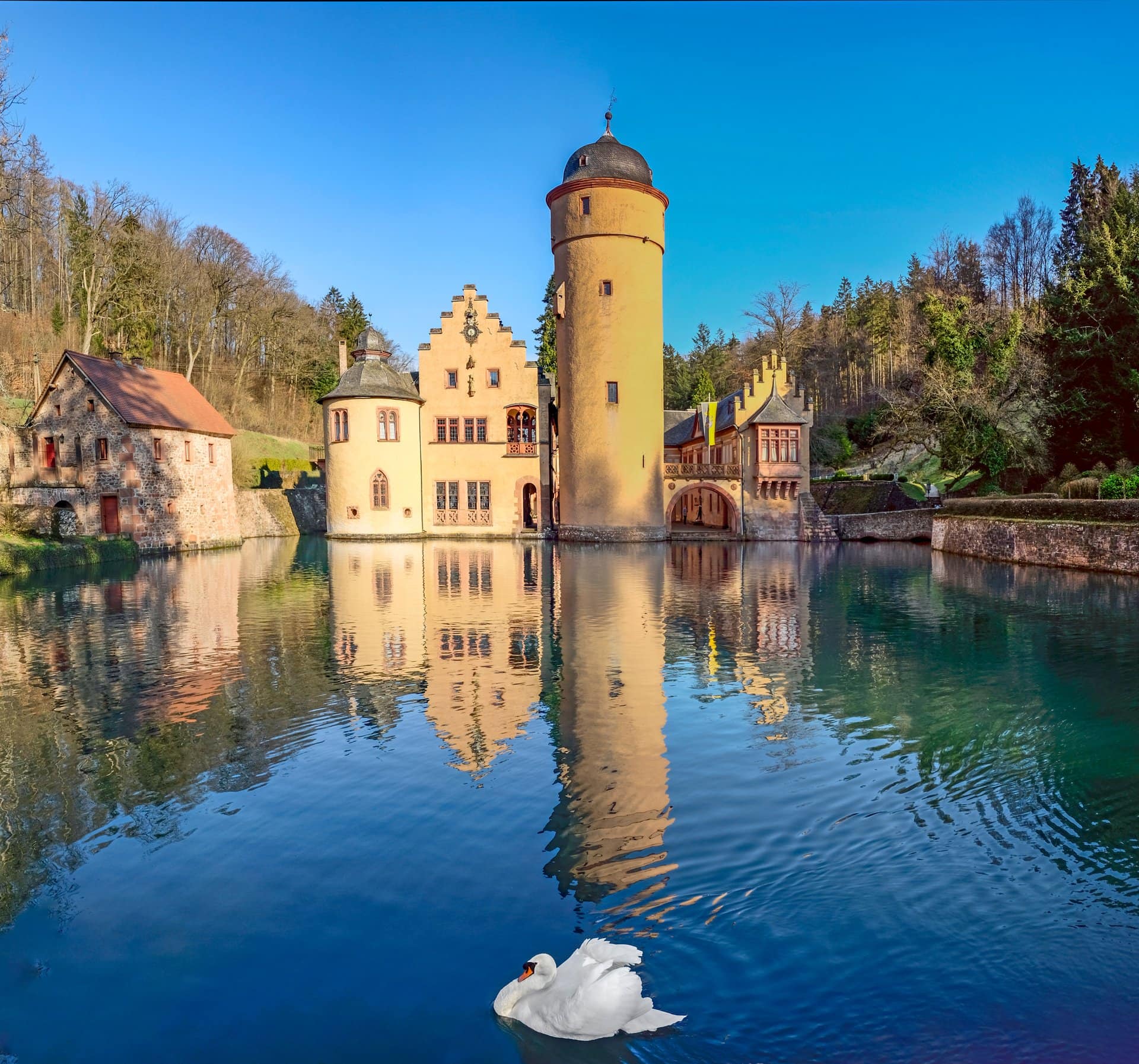
Mespelbrunn Castle
On March 18, 1545, at Mespelbrunn Castle (a moated Renaissance house in a side-valley of the Spessart forest), a son was born to Peter Echter and Gertraud von Adelsheim. They named him Julius. Twenty-eight years later the cathedral chapter of Würzburg elected him Prince-Bishop. Across forty-four years on the cathedra, Julius Echter laid the cornerstone of the Juliusspital, refounded the University of Würzburg, and commissioned or rebuilt over six hundred parish churches in the high-spired Counter-Reformation style now called Julius-Echter-Gotik. He died at the Festung Marienberg on September 13, 1617, having recast Counter-Reformation Franconia almost single-handedly. None of it begins anywhere except here, at this small Wasserschloss in a forest that nobody passing through would otherwise notice.
Mespelbrunn Castle is the German storybook Wasserschloss made literal: a stair-stepped Renaissance gable, a single round Bergfried rising clear of the slate roofs, a swan-pond of a moat reflecting all of it back. The Echter-built core is Renaissance: 1551 to 1584, the work of Peter Echter (Julius’s father) and his eldest son Adolf. Behind the Renaissance work, the medieval Burg dates to the 1420s and 1430s, a fortified retreat raised by Hamann II Echter against the Hussite raids, of which the Bergfried alone survives in its lower courses. The family carrying the keys today (Reichsgräfin Marie Antoinette von Ingelheim genannt Echterin von und zu Mespelbrunn, in residence in the Südflügel) descends in unbroken line from the Hamann who took possession of the site in 1412. That makes 614 years on the same forty meters of moated platform: among the longest unbroken family-castle tenures in Germany.
Quick Facts
| Country | Germany |
| Region / State | Bavaria (Unterfranken / Lower Franconia, in the Spessart) |
| Nearest Town | Mespelbrunn village; Aschaffenburg approximately twenty-two kilometers west |
| Construction Period | Phase 1 fortified Burg 1427–1434 (Bergfried surviving in lower courses); Phase 2 Renaissance Großausbau 1551–1584; Baroque restoration 1713–1717; Romanesque-Revival burial chapel 1875; Historicist refurbishing 1904 |
| Founder | Hamann I Echter (Espelborn enfeoffment by Mainz, May 1, 1412); fortified Burg raised by his son Hamann II Echter, 1427–1434; Renaissance core by Peter III Echter and Gertraud von Adelsheim, 1551–1569 |
| Architectural Style | Late-medieval Wasserburg with Renaissance Großausbau; surviving Schlosskapelle stained glass dated 1440; Historicist roofline (1904, architect Friedrich von Thiersch) |
| Building Type | Wasserschloss — moated Renaissance country residence on a fifteenth-century Burg footing |
| Current Condition | Intact, continuously inhabited since the fifteenth century, never destroyed; ongoing DSD-funded conservation |
| Open to Visitors | Yes — late March to early November, daily 09:30–17:00; guided tour only, German with English pamphlet on request |
| UNESCO Status | Not inscribed |
| Official Website | schloss-mespelbrunn.de |
Foundation in the Spessart (1412–1434)
On May 1, 1412 the site enters the documentary record. On that day, Archbishop-Elector Johann II of Mainz granted the property called Espelborn (a remote stretch of forest along the upper Elsava brook) to a minor Mainz official named Hamann Echter, in allodial right rather than as a fief. That grant rewarded service. The land itself was unprepossessing: a steep wooded valley off the route between Aschaffenburg and Würzburg, on the Mainz side of the political border, with no village of consequence and no economic resource beyond timber. Five years later, in 1417, Hamann I raised an unfortified house (a Weiherhaus, a pond-house) on the valley floor where a small dam impounded the brook. There was no tower, no curtain wall, and no defensive ambition.
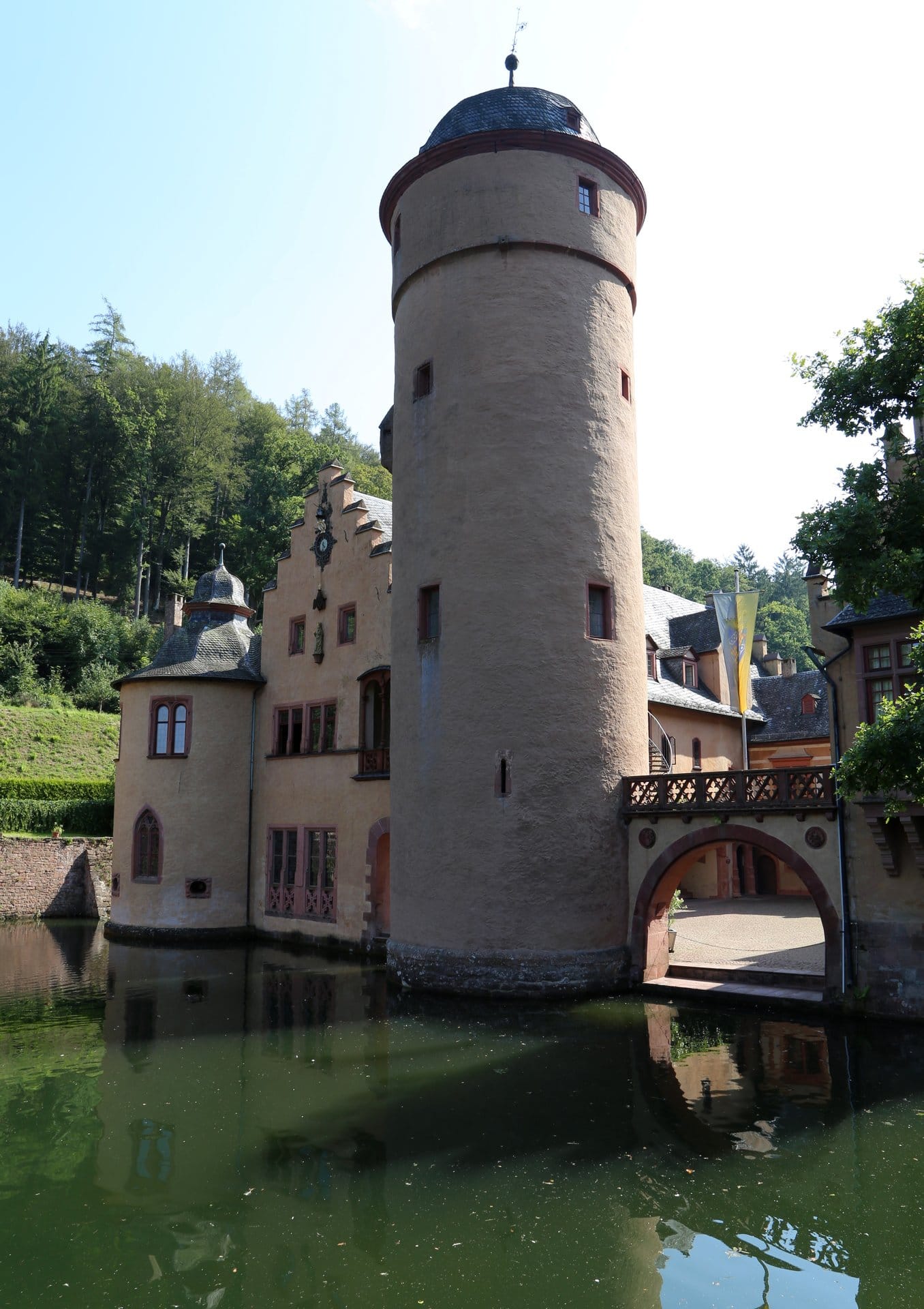
That changed in the 1420s. Hussite Wars sent armed columns deep into central Germany, and the Spessart was on a route Hussite raiders are documented to have used. Hamann I’s son, Hamann II Echter, replaced the unfortified pond-house with a true Burg between 1427 and 1434: a fortified main block with a round Bergfried (the present tower, in its lower courses) and a defensive ring rising directly from the moat. The chapel built into this phase preserves stained glass dated 1440, the oldest glass in the ensemble. In 1435 Hamann II pledged the castle to the archbishopric of Mainz as both Lehen and Offenhaus: a feudal tenure under which the lord of Mainz could quarter troops here in wartime, in exchange for the Echters’ continuing tenure as imperial knights.
The Renaissance Großausbau (1551–1584)
Transformation from Burg to Schloss belongs to a single generation. Peter III Echter (1520–1576), Hamann II’s great-grandson, married Gertraud von Adelsheim (1525–1583) of an old Franconian knightly family in the late 1540s. Between 1551 and 1569 (the productive middle of their long partnership), they doubled the building’s volume, redirected its purpose from defense to residence, and gave it the Renaissance silhouette it still carries.
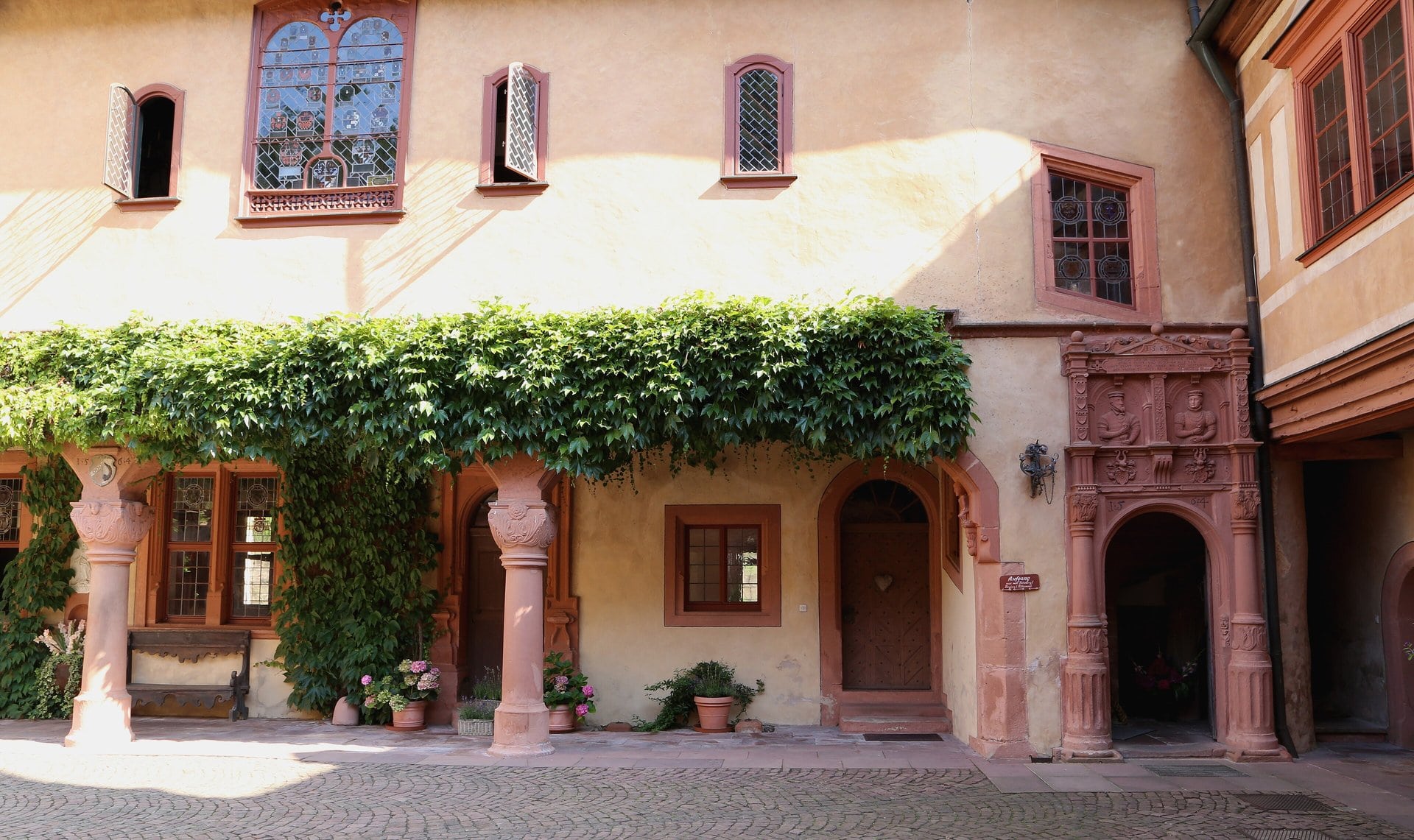
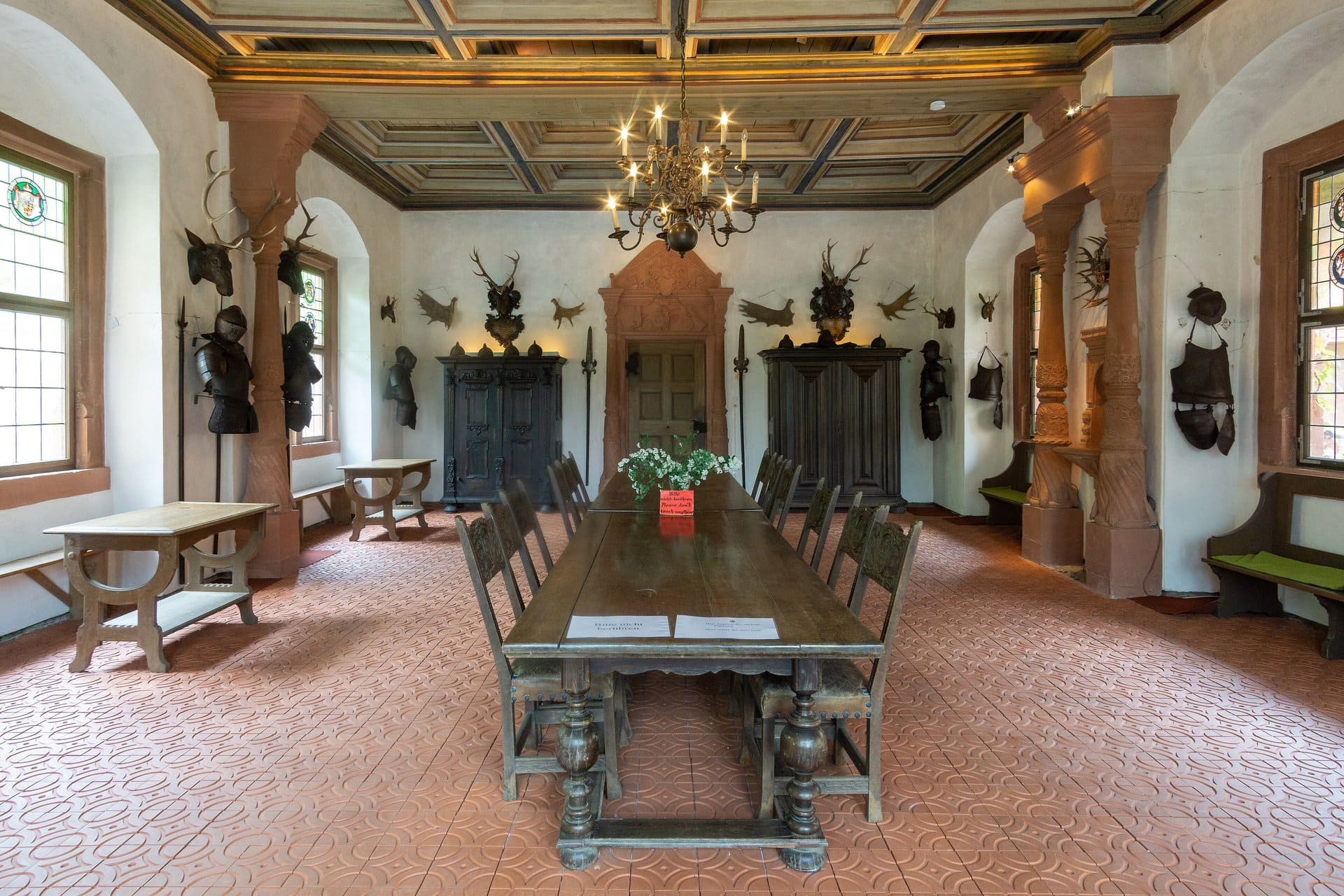
The Ostflügel (the east range, with the great hall now called the Rittersaal) went up between 1551 and 1553. In 1564 the Nordflügel was renewed, with a sandstone portal carved into its courtyard face dated to that year and bearing the joint armorials of Peter and Gertraud. The free-standing stair turret in the inner courtyard, the Treppenturm, was raised between 1564 and 1569 and given a sculpted Renaissance portal whose date inscription, 1569, names the couple again. After Peter’s death in 1576, his eldest son Adolf Echter completed the program. From 1581 the Westflügel went up. The medieval Bergfried received its present upper stage and slate-domed roof in the same campaign, raising it clear of the rebuilt rooflines. By 1584, in less than thirty-five years, a fifteenth-century frontier Burg had become one of the more accomplished Renaissance country houses in the Mainz orbit.
Julius Echter — the cradle of a Counter-Reformation prince (1545–1617)
Julius Echter von Mespelbrunn was born in this house on March 18, 1545, a son of Peter and Gertraud. Educated at Mainz, then sent to Leuven, Douai, Paris, Pavia, and Rome between 1559 and 1569 (a Tridentine itinerary in the years immediately after the Council of Trent closed in 1563), he returned to Würzburg in 1570 as a cathedral canon. On December 1, 1573 the chapter elected him Prince-Bishop, at the age of twenty-eight. His tenure ran forty-four years.
Three projects defined the tenure. He laid the cornerstone of the Juliusspital (a charitable hospital and almshouse on a scale Franconia had not seen, still operating today) on March 12, 1576. Sixteen days later a papal bull from Gregory XIII authorized him to refound the University of Würzburg, which had failed in the fifteenth century; the new institution opened on January 2, 1582. And across his diocese he commissioned, rebuilt, or restored more than three hundred parish churches in a distinctive late-Gothic vocabulary (narrow, tall, with steeply pitched octagonal spires) that historians now label Julius-Echter-Gotik: a deliberate Counter-Reformation rebuke, in the visual language of high medieval orthodoxy, to the Reformed congregations across the Main.
The shadow on the tenure is the Würzburg witch trials. Older historiography assigned Julius Echter responsibility for the executions of two to three hundred persons during his episcopate. Recent scholarship (Meier, Flurschütz da Cruz, Weiß’s 2017 four-hundredth-anniversary collection) has materially revised the picture. The Hochstift Würzburg was process-poor in witchcraft prosecutions for most of his reign; the first known case, at Schwebenried in August 1593, ended in banishment. The catastrophic mass executions later associated with the Hochstift (the Gerolzhofen process of some two hundred and sixty in 1616 and 1617) erupted only in the final months of Julius’s life and reached their height under his successor and nephew Philipp Adolf von Ehrenberg. Counter-Reformation kinship cluster raised in this house produced both the rebuilder of Würzburg and the prosecutor who burned its women.
Marriage transfer and the Ingelheim continuity (1648–present)
The male Echter line ran out within two generations of Julius’s death. In 1648 (the year of the Peace of Westphalia, by which the Thirty Years War ended without ever having reached Mespelbrunn’s hidden valley), Julius’s grandniece Maria Ottilia Echterin married Philipp Ludwig von Ingelheim, of a Rheingau family ennobled by the Mainz electors. That marriage settled the eventual succession. On March 16, 1665, Johann Philipp Echter, the last male of the senior line, died at Mespelbrunn. Echter in the masculine was extinct after two hundred and fifty-three years on this estate.
An imperial diploma from Leopold I in 1698 addressed the discontinuity, authorizing the Ingelheim heirs to bear jointly the surname of the family they had married into as Ingelheim genannt Echter von und zu Mespelbrunn; the comital rank in the family’s present style, Grafen von Ingelheim genannt Echter von und zu Mespelbrunn, by which they are still legally known, came later, granted by Emperor Charles VI in 1737. Their grandson Franz Adolf Dietrich von Ingelheim undertook a Baroque restoration between 1713 and 1717, repointing the Bergfried, replacing roofs, and refurnishing the principal apartments.
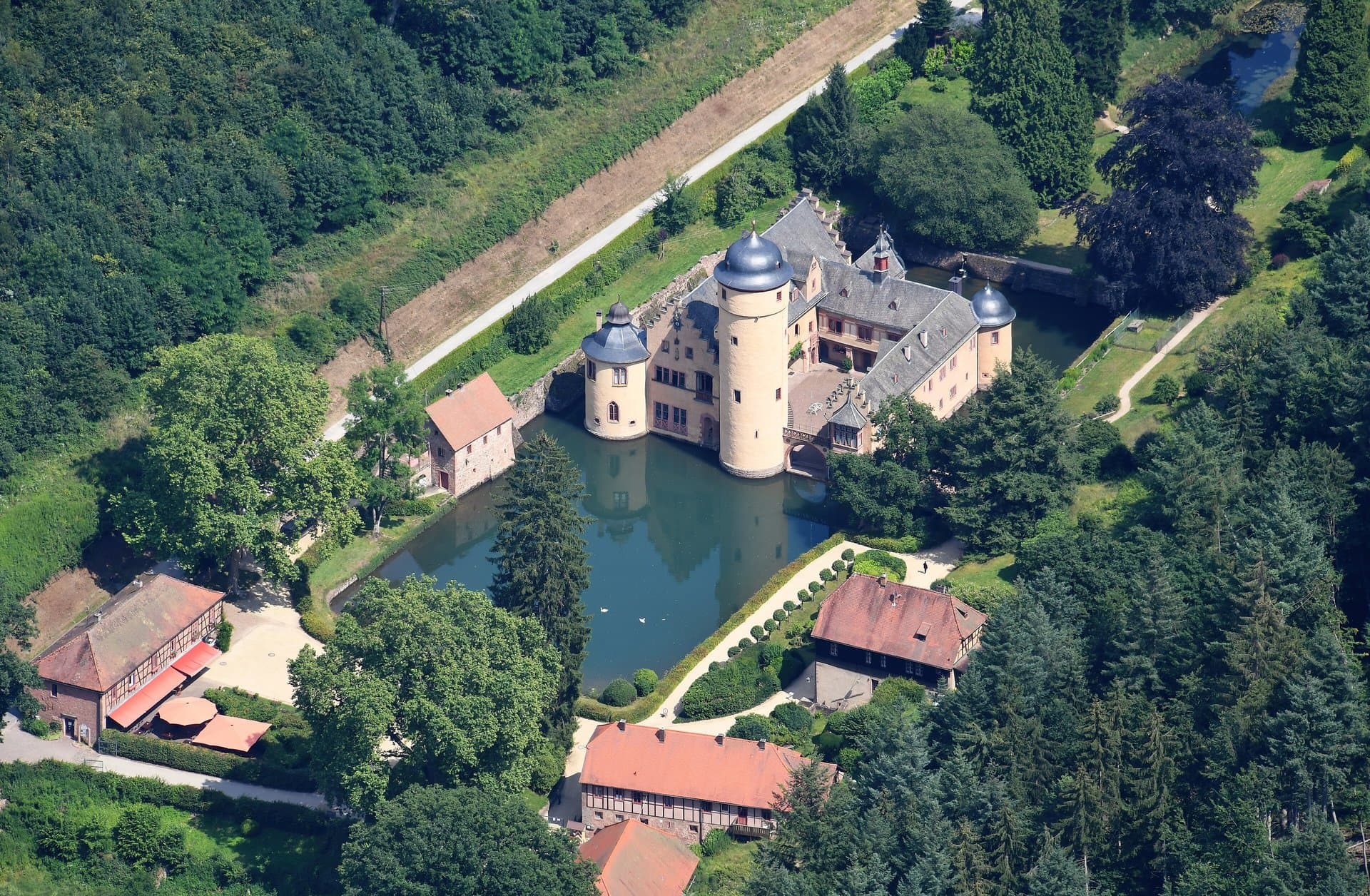
Two later interventions mark the silhouette as it stands today. A small Romanesque-Revival burial chapel was added beside the moat in 1875. In 1904 the Munich architect Friedrich von Thiersch directed a Historicist refurbishing that gave the dormers and the principal interiors their present form. The current owner, Reichsgräfin Marie Antoinette von Ingelheim genannt Echterin von und zu Mespelbrunn (born 1973), inherited the estate in 2006 from her father Albrecht. From the 1412 grant to her tenure today is six hundred and fourteen years of family possession on the same site.
The Wirtshaus im Spessart and the modern image (1958–present)
Mespelbrunn entered the German popular imagination through a single film. Das Wirtshaus im Spessart, directed by Kurt Hoffmann and released in 1958, used the castle as the seat of Graf Sandau, with Liselotte Pulver as his daughter. The moated Renaissance silhouette in the opening titles became, for a generation of West German viewers, the visual definition of the word Schloss. Wilhelm Hauff’s 1827 novella from which the title was taken does not in fact feature the castle, and the 1960 sequel Das Spukschloss im Spessart was filmed not here but at Schloss Oelber. The association nonetheless stuck: Mespelbrunn has received roughly one hundred thousand visitors a year since the 1960s, on the strength of an opening sequence.
Mass tourism has not damaged the family’s continuing custodianship. Conservation campaigns co-funded by the Deutsche Stiftung Denkmalschutz have addressed exposed fabric in stages: thirty thousand euros toward the moat retaining wall in 2020, a further thirty thousand for the chapel roof in 2022, and twenty thousand in 2025 for east-wing slate, the Chinese Salon wallpaper, and the carved sandstone gargoyles of the Soldatenbrunnen in the entry court, the halberd-bearing Echter retainer atop a 1604 fountain, restored in time for the 2026 season.
Visiting in 2026
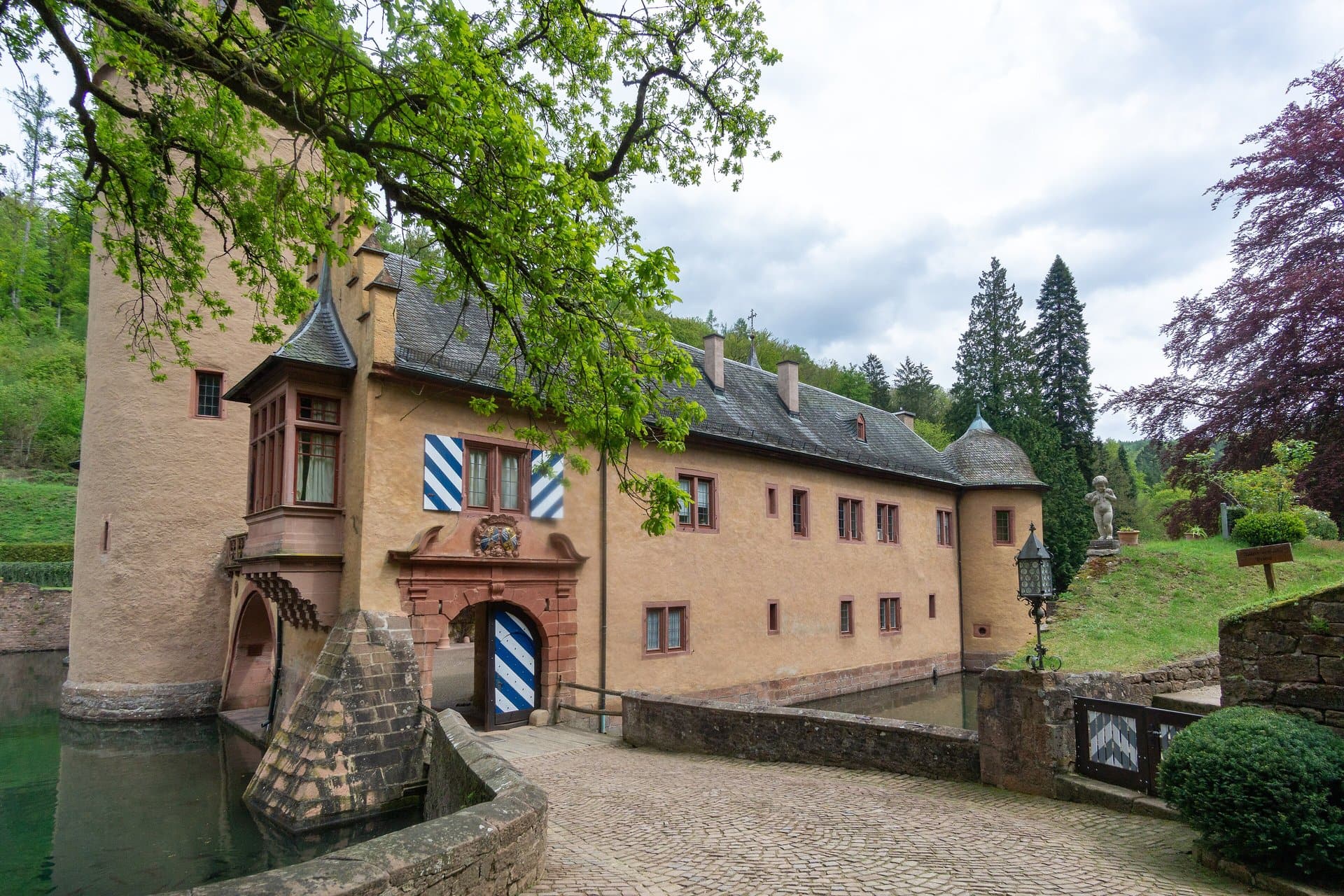
The Schlossverwaltung (the family’s own administrative office, not a state heritage agency) operates Mespelbrunn as a private museum within an inhabited family seat. The 2026 season runs from Saturday March 28 to Sunday November 9, daily, 09:30 to 17:00, with last admission approximately thirty minutes before closing. Access to the interiors is by guided tour only; tours run continuously, last thirty-five to forty minutes, and are conducted in German, with an English-language pamphlet on request. The Nordflügel houses the museum rooms (the Rittersaal, the Chinese Salon, the chapel) while the Südflügel is the family’s private residence and is not on the route. The Café Pferdestall in the courtyard serves coffee, regional cake, and Spessart trout from the Schlossweiher; it is closed on Tuesdays. Entry tickets and local tours can also be booked in advance through GetYourGuide.
Tickets are sold at the gatehouse and are cash only. Parking is in the village lot, also cash only, and closes at 18:00.
| Ticket | Price |
|---|---|
| Adult | €7.00 |
| Group rate (twenty or more, per person) | €6.50 |
| Pupils, students, wheelchair users | €3.50 |
| Children under six | Free |
| School class (flat fee) | €90.00 |
| Parking — passenger car | €3.00 |
| Parking — coach or bus | €5.00 |
Mespelbrunn village sits in the Naturpark Spessart, the first Bavarian nature park designated in 1960. There is no rail station; visitors arrive by car or by bus from Aschaffenburg Hauptbahnhof, approximately twenty-two kilometers and a thirty-minute drive west. Frankfurt am Main is sixty kilometers further, Würzburg seventy-five kilometers east. For travelers building a Lower Franconian itinerary, the great prince-bishop’s seats Julius Echter served sit within an hour’s drive: the Würzburg Residence at the heart of the city, and the Marienberg Fortress on the hill across the Main where Julius died. Anyone staying overnight can compare hotels in and around Mespelbrunn.
Some links on this page are affiliate links, which means StoneKeep Atlas may earn a small commission, at no extra cost to you, if you book through them.
Beyond Mespelbrunn
For a Bavarian itinerary, Best Castles in Bavaria places Mespelbrunn alongside the great Wittelsbach palaces of the south and the imperial seats of Nuremberg. Closest Franconian peers are Schloss Johannisburg in Aschaffenburg, the contemporary Renaissance palace of the Mainz electors twenty-five kilometers north; the Würzburg Residence, commissioned by Julius Echter’s eighteenth-century successors; and the Marienberg Fortress, the bishops’ working stronghold above the city. Outside Franconia, the closest typological peer is Eltz Castle on the Mosel: another late-medieval German castle continuously held by one family from the high Middle Ages to the present, never destroyed, never alienated, never empty. By contrast, across the Main to the west in the wooded Odenwald, Frankenstein Castle is the gaunt hilltop ruin to Mespelbrunn’s intact moated manor, and it carries the most famous castle name of all.
Mespelbrunn’s own forest-moat setting, meanwhile, earns it a place among the fairytale castles in Germany.Conclusion
Mespelbrunn matters out of all proportion to its small valley. From these stair-stepped Renaissance gables came a Counter-Reformation prince who refounded a university, built a charitable hospital still in use, and rebuilt half the parish churches of Franconia in his own architectural signature. Four hundred and seventy-five years later, the family his sister married into is still in residence in the Südflügel. The Spessart hid this castle from every army that mattered, and the sister-line carried it through every century. Few German histories are this continuous. Mespelbrunn’s quiet survival is its argument.
Mespelbrunn’s survival of the Thirty Years’ War (spared by terrain and its position off the great armies’ lines of march) is noted in The Reformation and the Castle: Wartburg, Luther, and the Protestant Princes, which contrasts the castles geography protected with those the confessional wars destroyed.
Principal Sources
- Schlossverwaltung Mespelbrunn. Schloss Mespelbrunn. Operator information published at schloss-mespelbrunn.de.
- Breuer, Tilmann. Handbuch der Deutschen Kunstdenkmäler. Bayern Bd. 1: Franken — Die Regierungsbezirke Oberfranken, Mittelfranken und Unterfranken. 2nd ed. München: Deutscher Kunstverlag, 1999. ISBN 978-3-422-03051-0.
- Flurschütz da Cruz, Andreas. Hexenbrenner, Seelenretter: Fürstbischof Philipp Adolf von Ehrenberg (1623–1631) und die Hexenverfolgungen im Hochstift Würzburg. Bielefeld: Verlag für Regionalgeschichte, 2018. ISBN 978-3-7395-1145-3. The standard recent monograph reassigning the major Würzburg witch-trial phase from Julius Echter’s tenure to his successor’s.
- Friedhoff, Jens. “Schloss Mespelbrunn.” Burgen und Schlösser: Zeitschrift für Burgenforschung und Denkmalpflege, 1/2019. The standard recent scholarly building history.
- Pölnitz, Götz Freiherr von. Julius Echter von Mespelbrunn, Fürstbischof von Würzburg und Herzog von Franken (1573–1617). München: R. Oldenbourg, 1934; reprinted 1959. The standard biography, still the starting point for any work on the Prince-Bishop.
- Weiß, Wolfgang, ed. Fürstbischof Julius Echter und seine Zeit. Beiträge des Symposions zum 400. Todestag. Würzburg: Echter Verlag, 2017. ISBN 978-3-429-04437-0. The four-hundredth-anniversary collection containing the most current revisionist scholarship on the witch-trial question, the Counter-Reformation building program, and Echter’s diocesan administration.
- Zeune, Joachim. “Burgschloss Mespelbrunn.” Haus der Bayerischen Geschichte — Burgen in Bayern, entry no. 140. hdbg.eu. The Bavarian state heritage agency’s scholarly entry, with building chronology and ownership succession.
Image credits. Featured image — Schloss Mespelbrunn from across the moat: via Adobe Stock. The Bergfried from the moat: Rufus46, CC BY-SA 3.0, via Wikimedia Commons. Inner courtyard with the 1569 Renaissance portal: Rufus46, CC BY-SA 3.0, via Wikimedia Commons. Rittersaal with the 1564 sandstone portal and Echter armaments: Rainer Halama, CC BY-SA 4.0, via Wikimedia Commons. Aerial view of Schloss Mespelbrunn in its Spessart side valley: Carsten Steger, CC BY-SA 4.0, via Wikimedia Commons. The entrance bridge with the Ingelheim arms: Rainer Halama, CC BY-SA 4.0, via Wikimedia Commons. Freely licensed images are resized to fit; otherwise unaltered.