
The Prussian Royal Castles
In 1815 the Congress of Vienna handed the Rhineland to Prussia. It was an awkward inheritance: culturally distinct, majority-Catholic, French-influenced after two decades of Napoleonic rule, its medieval past tied to the prince-bishoprics of Trier, Mainz, and Cologne, not the Protestant Hohenzollerns of Berlin. The Rhine Province was formally constituted in 1822. These new rulers owned the river; they did not yet belong to it.
What followed over the next half-century is one of the most deliberate acts of political self-presentation in nineteenth-century Europe, and it was carried out almost entirely in stone. Rather than build new palaces, the Prussian royal family bought the Rhine’s ruined medieval castles and rebuilt them as inhabited residences in the old style. The choice of ruins was the message: a ruin already had a medieval past, and rebuilding one let the dynasty appear to inherit it instead of importing one. Defense was not the point, and barely even residence. The point was to look like the river’s natural heirs, not its latest occupiers. This is what produced the Prussian royal castles: not a single state policy issued from Berlin, but a tight family cluster of personal commissions across Friedrich Wilhelm III’s sons that worked, in stone, as one sustained argument for a belonging the dynasty did not yet have.
A Dynasty Without a Rhine
Its protagonist is Friedrich Wilhelm IV, who became King of Prussia in 1840. As a young crown prince he was already collecting ruins. The City of Koblenz, looking for a way to court its new royal masters, gifted him the burned-out shell of Stolzenfels in 1823; the same year his cousin, Prince Friedrich Wilhelm Ludwig of Prussia, bought the ruin that would become Rheinstein. A decade later the crown prince and his brothers (the princes Wilhelm, Carl, and Albrecht) acquired the wrecked Sooneck. Three Rhine ruins, one royal house, one idea.
That idea had a fourth, older anchor that was not on the Rhine at all. Far to the south, on an isolated hill of the Swabian Jura escarpment, stood the decayed remains of the ancestral seat from which the dynasty took its name. Friedrich Wilhelm climbed that desolate peak in 1819 and was moved by it; as king he began rebuilding it in 1850, last and grandest, and his brother Wilhelm I saw it completed in 1867. Hohenzollern Castle is the same gesture performed on the family’s own origin myth: a manufactured ancient home for a dynasty that needed one. Read together, these four buildings are the Prussian Royal Castles: not a tour but an argument, a family-driven cluster of royal commissions, emergent, not centrally decreed, that nonetheless functioned as one deliberate effort to make recently acquired and barely held territory look like land the dynasty had always belonged to.
The four at a glance
| Castle | Where / Rhine km | Rebuilt | Prussian patron | Register |
|---|---|---|---|---|
| Hohenzollern | Swabian Jura (Hechingen) | 1850–1867 | Friedrich Wilhelm IV | The ancestral claim |
| Rheinstein | Middle Rhine, km 533 | 1825–1844 | Prince Friedrich Wilhelm Ludwig | The first move |
| Stolzenfels | Middle Rhine, km 585 | 1836–1842 | Friedrich Wilhelm IV | The royal statement |
| Sooneck | Middle Rhine, km 538 | 1834–1861 | The crown prince and his brothers | The plain register |
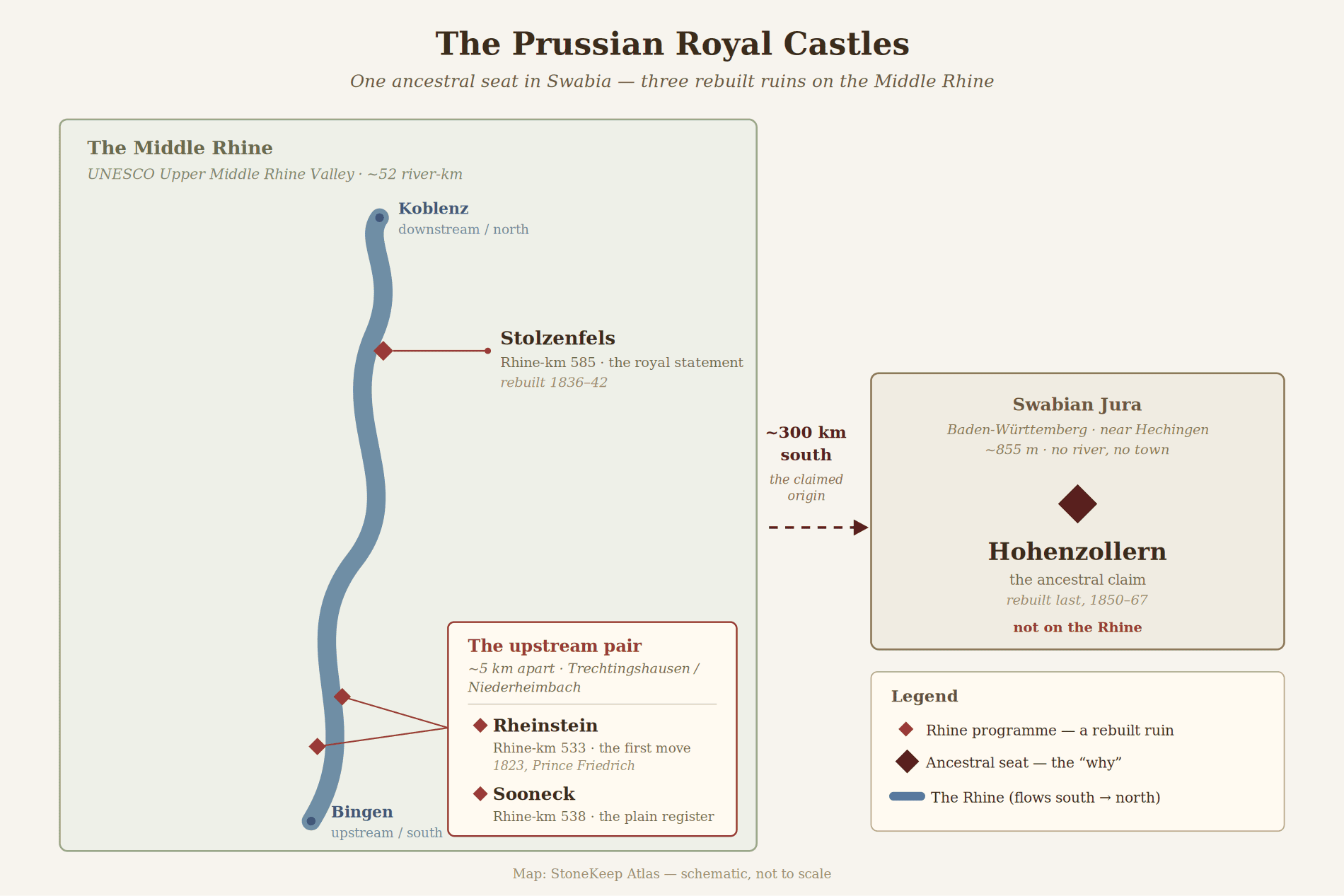
Geography is itself part of the argument. Three of the four sit within a single short stretch of the Middle Rhine; the fourth stands roughly three hundred kilometers south, in a different landscape entirely. The map below shows why the split matters.
Hohenzollern Castle — the ancestral claim
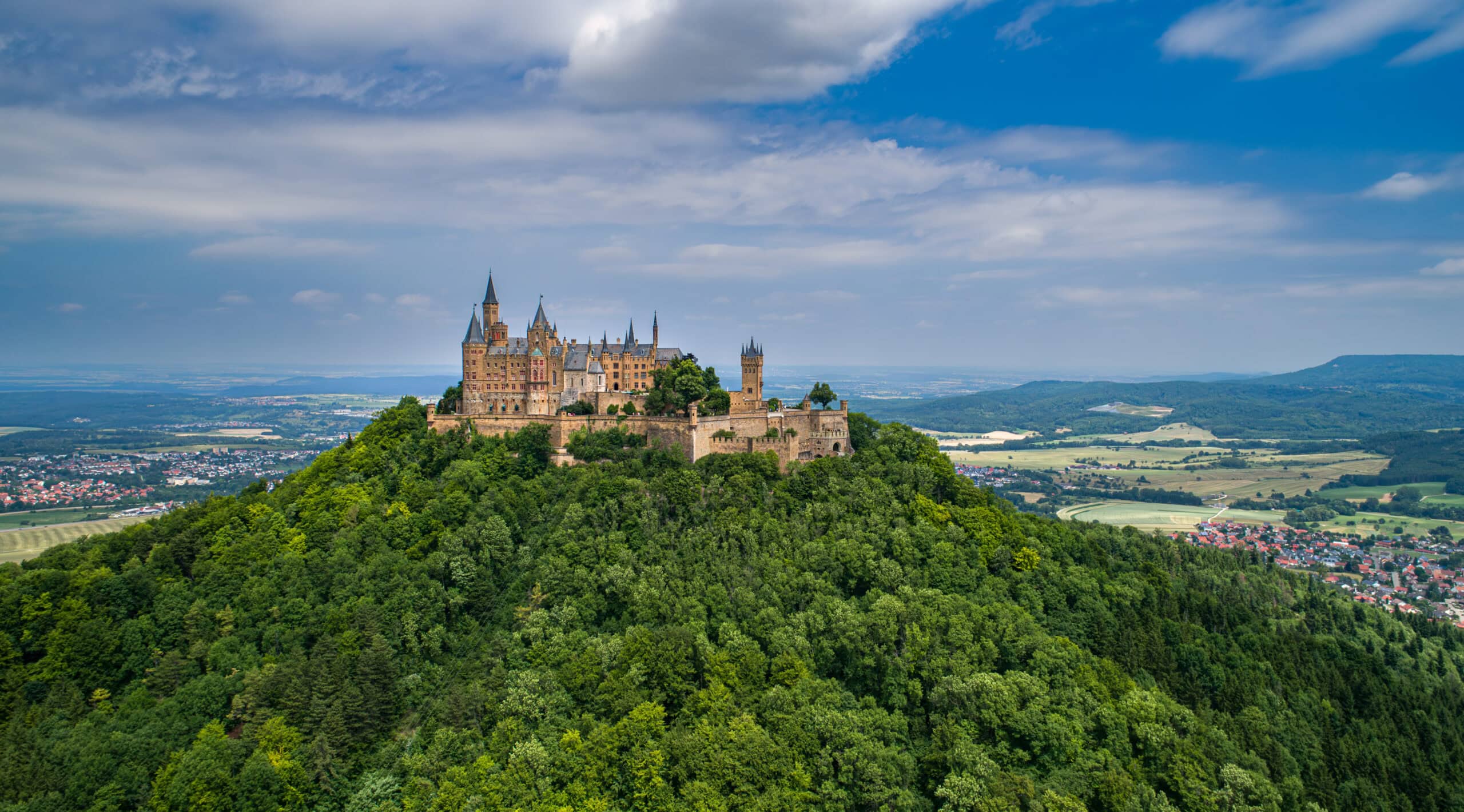
Hohenzollern Castle is the keystone of the program even though it was built last. It rises from an isolated Zeugenberg (an outlier hill of the Swabian Jura escarpment) in Baden-Württemberg, around 855 meters above a plain it commands in every direction: no town at its feet, no river below it. A fortification stood here from about 1040, when the Counts of Zollern established a stronghold and took their name from the mountain; from that name the dynasty’s whole subsequent history descends. The first castle was destroyed in 1423 after a ten-month siege by an alliance of Swabia’s free imperial cities. A second, built between 1454 and 1461, had fallen to ruin by the eighteenth century, by which time the Hohenzollern line was occupying the Prussian throne and had little use for a derelict hill in the south.
What stands today is the third castle: a Neo-Gothic creation commissioned in the 1840s by Friedrich Wilhelm IV, designed by the Berlin architect Friedrich August Stüler chiefly on English Gothic Revival models (with a secondary echo of the Loire châteaux). The foundation stone was laid on September 23, 1850; the castle was inaugurated on October 3, 1867 under the king’s brother and successor, Wilhelm I. It was never a working residence: no Hohenzollern lived there permanently, and none of the three German emperors kept a court there. It was built to represent something: a dynasty with roots nine centuries deep. Its interior makes the point explicitly, from a Hall of the Emperors lined with statues of Hohenzollern rulers to a treasury holding Kaiser Wilhelm II’s imperial crown and Frederick the Great’s uniform. Only the fifteenth-century Chapel of St. Michael survives from the earlier castle, the single physical thread connecting the monument to the medieval family it commemorates.
Hohenzollern is candid about what it is. Its stonework is too regular, its silhouette too coherent, to be the product of centuries of accumulation; it is architecture as statement. It belongs to the same current that produced Neuschwanstein in Bavaria and Lichtenstein on the Swabian Alb, but where those were a king’s private fantasy and a count’s literary passion, Hohenzollern is overtly institutional: built to celebrate a dynasty, not to indulge one man. The claim it makes is still being tended: the castle was jointly held by the Prussian and Swabian branches of the family until December 31, 2025, and from January 1, 2026 the Prussian line became its sole owner, consolidating in the present century the lineage the building was raised to assert. That self-awareness is exactly what makes it the right place to begin. Before the Prussian kings argued their legitimacy on the Rhine, they argued it here, on their own mountain, by inventing the ancestral home the dynasty had never quite had.
Rheinstein Castle — the first move
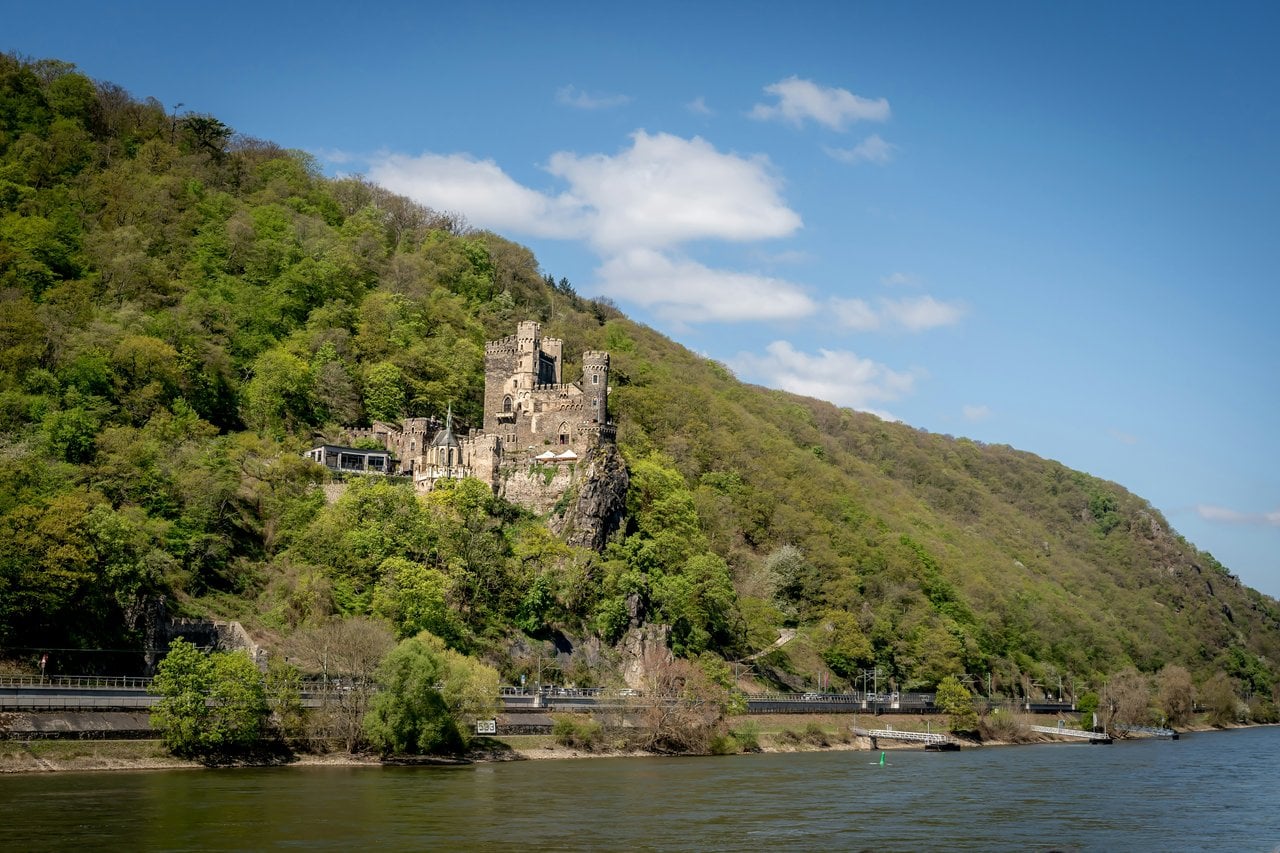
On the river itself, the first move was made by a collateral prince, not the king. Rheinstein Castle stands roughly ninety meters above the Rhine on a slate spur near Trechtingshausen, at the southern gateway to the gorge UNESCO would later inscribe as the Upper Middle Rhine Valley. Built around 1316–1317 as a Mainz toll castle called Vautsberg, it had decayed so quietly that by 1524 it was already documented as dilapidated; the French armies that blew up castle after castle along the Rhine in 1689 passed it by as not worth the powder. In 1822 a Prussian Regierungsrat, Freiherr von Coll, bought the empty shell for four talers.
On March 31, 1823, Prince Friedrich Wilhelm Ludwig of Prussia (1794–1863), a nephew of King Frederick William III and a cousin of the future Friedrich Wilhelm IV, purchased the ruin. He was twenty-eight, a serving Prussian officer, and a committed antiquarian. The Berlin architect Karl Friedrich Schinkel had sketched conceptual plans for a Rhine castle restoration as early as 1816; the acquisition gave the prince a site to realize them. Work ran from 1825 to 1844: Johann Claudius von Lassaulx leading the rebuild, his pupil Wilhelm Kuhn completing the main structure by 1829, and the Wiesbaden architect Philipp Hoffmann adding the chapel and royal crypt between 1839 and 1844. He renamed it Rheinstein after the cliff it stood on. That transformation was total. When Victor Hugo traveled the Rhine in 1842 he looked up at the crag and counted three castles, one of which he called Vaugtsberg, “restored today by Prince Frederick of Prussia”, not realizing that two of his three were the same building. The medieval ruin and the romantic castle occupied one cliff, and the rebuild had so remade the ruin that even the century’s most attentive observer of the river could not connect them. That confusion was, in a sense, the entire purpose.
Rheinstein matters because it was first. It was the first major Rhine castle rebuilt in the romantic spirit and a founding site of Rhineland Burgenromantik: the place where the modern image of the German castle, turreted and atmospheric and defiantly medieval, was largely invented on this river, and the template that Stolzenfels and Sooneck would follow. (Bavaria’s own revival, at Hohenschwangau from the 1830s, ran in parallel, not in imitation.) Its chapel holds what regional scholarship calls the only Prussian crypt on the Middle Rhine: three Hohenzollern coffins beneath the altar, including the prince’s own. For the royal family this was, in the words of the catalog’s own account, a program as much as a fashion. The castle is no longer in Hohenzollern hands (the Austrian opera tenor Hermann Hecher bought it in 1975, and his family runs it as a private museum today), but its founding role is permanent.
Stolzenfels Castle — the royal statement
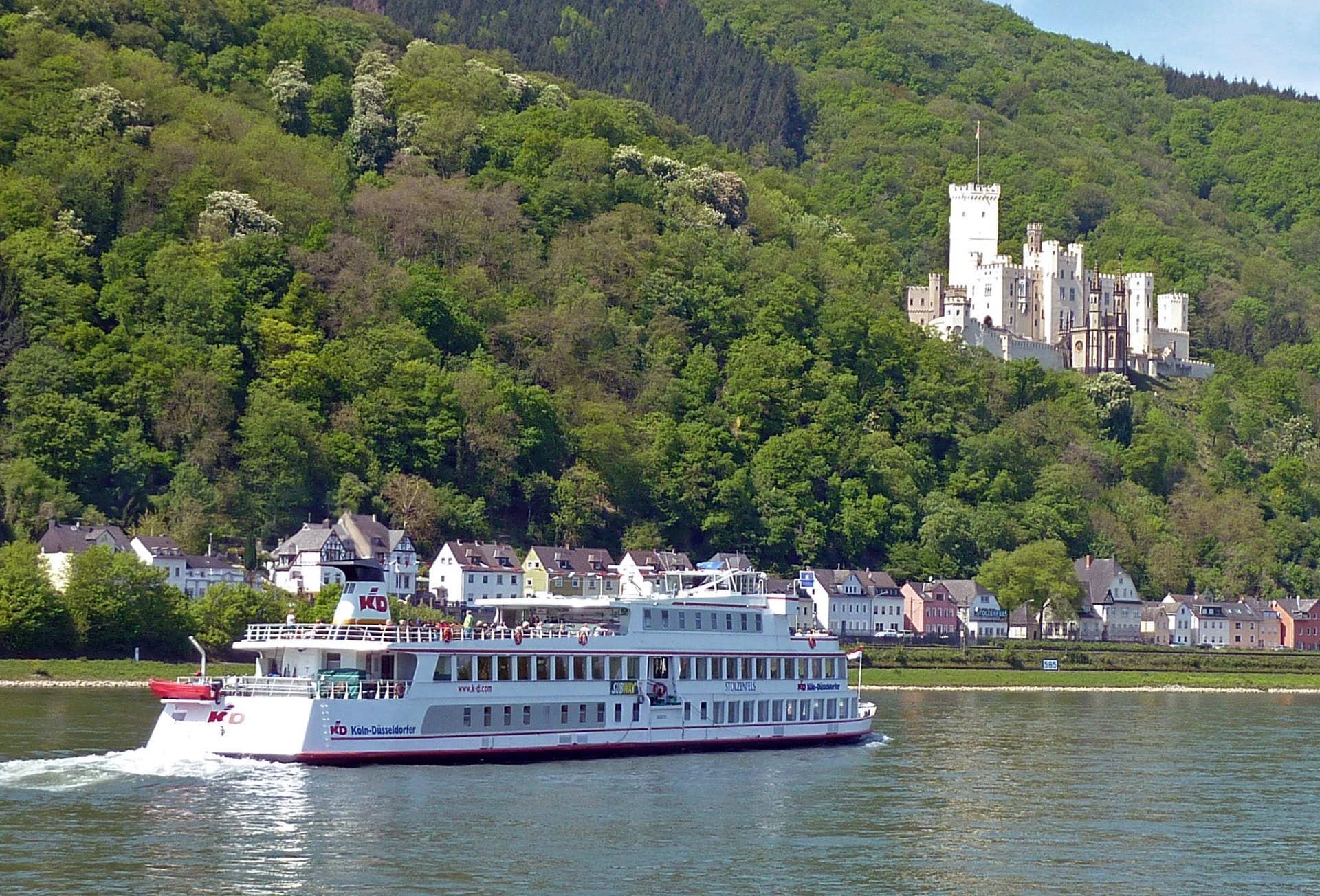
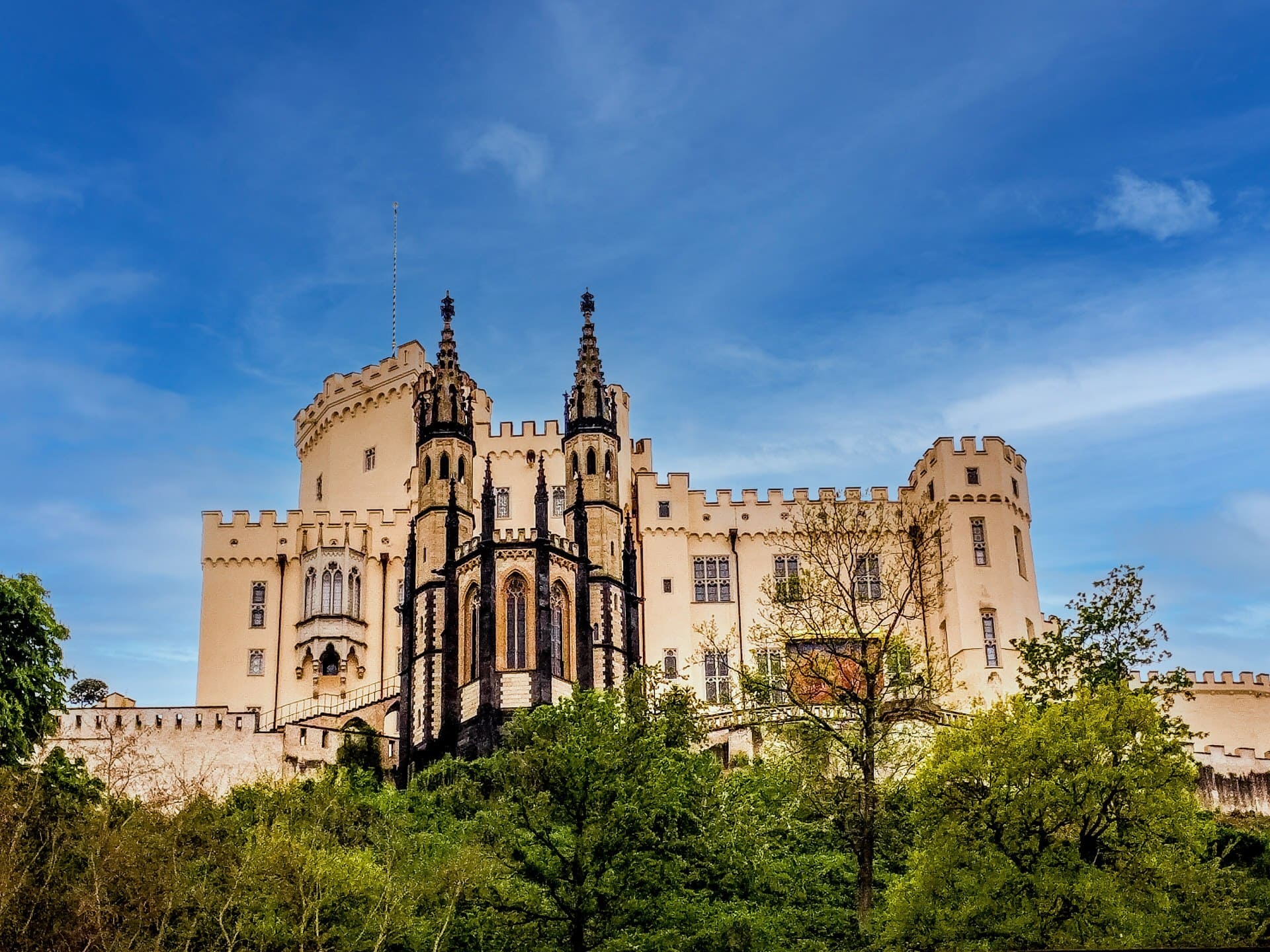
If Rheinstein was the experiment, Stolzenfels Castle was the statement. The pale-yellow castle on a wooded ridge south of Koblenz is the architectural showpiece of the whole program: the largest and most ambitious of the family’s Rhine projects, and one of the most completely preserved Romantic-era princely interiors anywhere in Germany. Its medieval core, raised by the Archbishops of Trier between 1242 and 1259, was burned by Louis XIV’s troops in 1689 and left an open ruin for some 130 years. After the secularization of the Trier electorate in 1802 the shell passed to the City of Koblenz, which in 1823 gifted it to the crown prince. It then sat fallow for thirteen years while he decided what to do with it.
An answer came in June 1836, when Friedrich Wilhelm approved Karl Friedrich Schinkel’s Generalplan: a complete Gothic-Romantic vision that absorbed the medieval fabric into a unified summer residence. Schinkel never directed the work on site, supplying drawings and instructions from his Berlin studio; he died in October 1841 with the building two-thirds complete, and his pupil Friedrich August Stüler finished and substantially co-authored it: the chapel, the arcaded Pergolagarten, the park viaduct, and the expansion of the royal apartments after the king’s 1840 accession. The earliest phase had in fact been the Koblenz architect Johann Claudius von Lassaulx’s, whose modest first restoration plan and the parish church at the foot of the hill were the empirical seedbed of everything that followed; Stolzenfels is best read as a collaborative Romantic project rather than the work of a single hand. The smooth pale-ochre render that unifies every facade (popularly called Schinkelgelb, though conservators reserve Schinkelgrün for the dark-green cast-iron details in the courtyards) makes the castle legible for miles up and down the river.
Its political grammar was deliberate, and it was stated openly at the time. By restoring a Trier ruin and living in it himself, Friedrich Wilhelm cast the new Prussian dynasty not as foreign occupiers but as continuators of the Rhineland’s medieval past: the same logic that produced his parallel sponsorship of the resumed construction of Cologne Cathedral, whose foundation stone was laid on September 4, 1842, ten days before Stolzenfels was inaugurated. On September 14, 1842 the inauguration was governance staged as theater: several thousand guests in medieval costume, a torchlight procession up the hillside, tournaments and tableaux performing dynastic continuity for an audience of foreign royals and journalists. The Anglo-Prussian dimension was not incidental: three years before Victoria’s visit, Friedrich Wilhelm had crossed the Channel to stand as godfather to her eldest son, the future Edward VII. Three years later, on August 14, 1845, Queen Victoria and Prince Albert arrived by Rhine steamer for a celebrated illumination of the river: from ten in the evening the villages and castles around Koblenz were lit up, bonfires burned along the banks, and rockets rose into a clear night sky, the spectacle that fixed Stolzenfels in the European imagination as a royal stage. It served as a Hohenzollern summer residence until the abdication of 1918, and today, within the UNESCO World Heritage Site, it is run as a living museum by the regional heritage directorate.
Sooneck Castle — the plain register
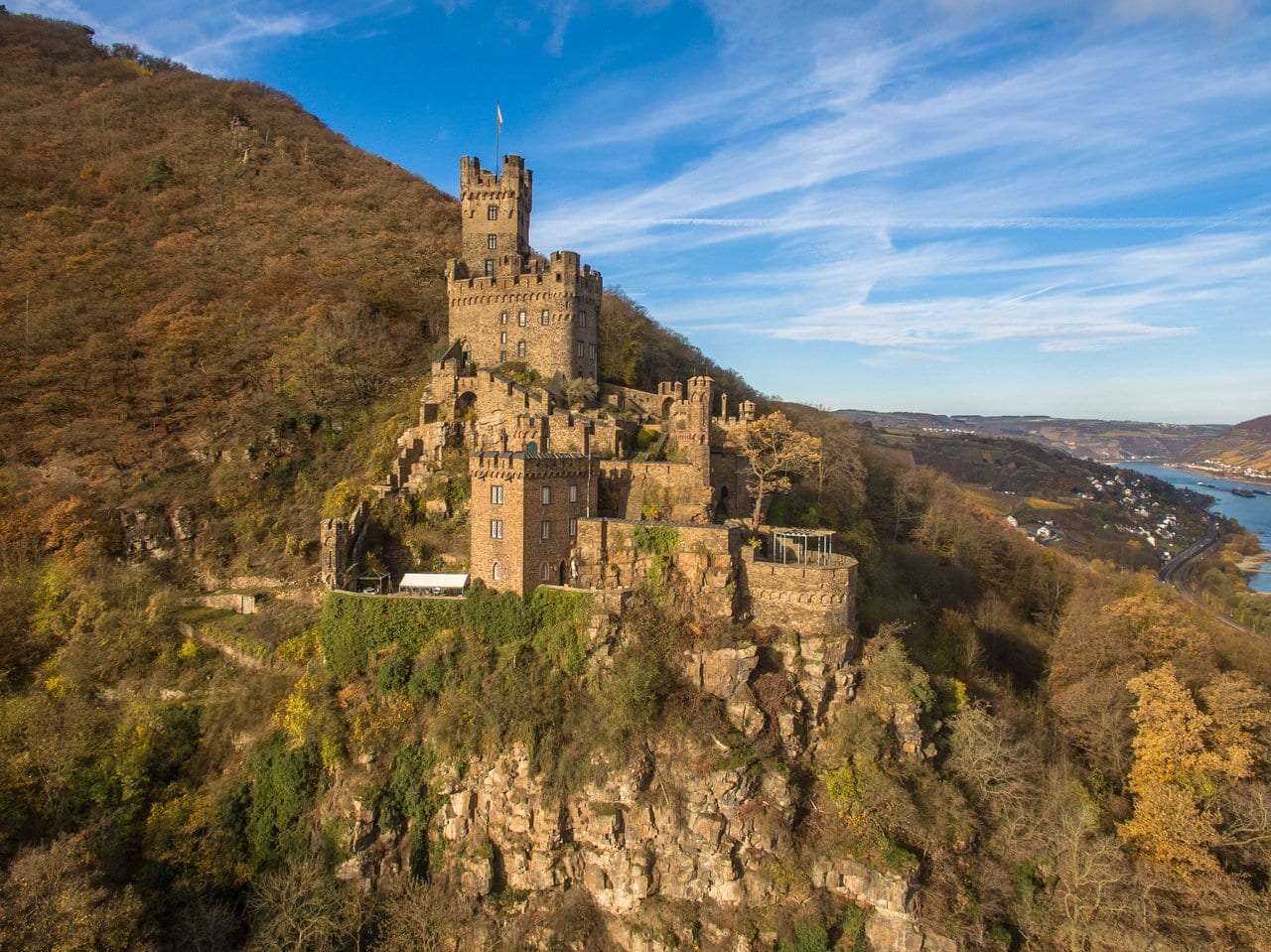
Sooneck Castle, five kilometers downstream of Rheinstein near Niederheimbach, is the program in its quietest key. Its history before Prussia is the opposite of stately: it had been a robber-knights’ eyrie above the river’s worst bottleneck, stormed and outlawed by King Rudolf I of Habsburg in 1282, who not only destroyed it but forbade it to be rebuilt and restated the ban in 1290. It was, in effect, legally abolished (not merely slighted but forbidden to exist), and a later French army flattened what had crept back. Restoring order on the imperial rivers had been one of Rudolf’s signature projects; the robber castles of the Bingen reach were a tax problem serious enough to draw the Crown. Five and a half centuries later the same outlaw nest was exactly the kind of medieval object the new rulers of the Rhine wanted to wear like a costume.
By the early nineteenth century a derelict Rhine castle was no longer a liability but a desirable object, and the most enthusiastic collectors of them were the Hohenzollerns. In April 1834 the crown prince and his brothers bought the wholly ruined Sooneck, the third Rhine ruin the royal house took in hand, after the cousin’s Rheinstein and the crown prince’s own Stolzenfels. Its assignment was the most modest of the three: not a palace but a hunting seat where the king could meet his brothers away from the court. The builder’s instruction is famous and revealing: everything was to be very simple, in the sense of a royal hunting lodge. Reconstruction ran in phases from 1843 (some sources date the start to 1834) and was finished by the early 1860s, to designs by the Koblenz fortress architect Carl Schnitzler, who kept the fourteenth-century fabric where it stood and filled the gaps with romantic-historicist work. The Prussian royal crest set over the north gate is the rebuild quietly signing its own work.
That daydream then stalled. Revolutions of 1848, disagreements within the royal family, and finally the king’s illness and death meant the hunting lodge was almost never used as one; later Hohenzollerns rarely stayed. The accidental result is its real value to a visitor: a Rhine-Romantic interior that was furnished and then largely left alone, and, after wartime looting, partly re-dressed with furniture brought from Stolzenfels, quietly reuniting two halves of the same royal project. Sooneck is the program admitting that not every statement has to be loud. Its plainness is not an absence of ambition; it is the same ambition in a hunting coat.
Beyond the four
The clearest proof that this was a program, not a habit, is a castle the same dynasty owned at the same moment and deliberately did not rebuild. Rheinfels Castle, the great Hesse artillery fortress above St. Goar, was demolished by French Revolutionary forces in the 1790s and auctioned off as French state property; between 1817 and 1828 its masonry was quarried to help build the Prussian fortress of Ehrenbreitstein at Koblenz, and what finally halted the scavenging was the purchase of the medieval core in 1843 by Prince Wilhelm of Prussia (the future Wilhelm I), then stationed in the city. It was, by the catalog’s own account, the same Hohenzollern moment that produced Stolzenfels, Rheinstein, and the acquisition of Sooneck. And yet Rheinfels was never turned into a romantic residence. It was rescued as a ruin and left one. That choice is the program’s fourth register: a Prussia confident enough not to rebuild everything it bought, because the argument was about meaning, not masonry.
One boundary is worth marking clearly. The Prussian royal castles are a subset of the broader nineteenth-century movement that rebuilt the German Middle Ages, a movement that also swept up Bavarian kings, a Württemberg duke, a Mecklenburg court, and self-made financiers like the builder of Drachenburg, a Bonn innkeeper’s son who made a Suez Canal fortune and bought himself a barony before raising Schloss Drachenburg near the river in the 1880s. That wider story, and Drachenburg’s place in it, belongs to the survey of the 19th-Century Romantic Revival of German Castles. What sets the four castles here apart is not their style but their author: a single royal house, acting with intent, on a specific political problem. Readers who want the Rhine castles as a place to visit rather than an argument will find the geographic companion in the Castles of the Rhine Gorge; those drawn to the parallel case of a different dynasty building its way out of a political bind should see the Castles of King Ludwig II. The dynasty’s grander royal seats around the capital, from Charlottenburg in Berlin to Frederick the Great’s palaces at Potsdam, form the other half of the same story and have their own guide in the royal palaces of Berlin and Brandenburg; the smaller Potsdam landscape projects (Glienicke, Charlottenhof, Babelsberg) now have their own guide in the garden palaces of Potsdam.
Planning a Prussian royal castle visit
That same geography also makes the itinerary. Three Rhine castles cluster within roughly fifty river-kilometers and combine into a one- or two-day trip. Rheinstein and Sooneck sit only about five kilometers apart near the southern, upstream end of the gorge; both are private museums, reached on foot by short uphill paths, and the same family operates the two of them, so a combined visit is the natural plan. Stolzenfels is the third stop, downstream toward Koblenz; its interior is accessible by guided tour only, conducted in German with an English handout, with felt overshoes provided to protect the original parquet and no photography indoors. As of 2026 the castle had reopened after extended roof works, with gardens partly open and conservation continuing; checking the operator’s current hours before traveling is sensible.
Hohenzollern is not part of the Rhine itinerary, and that is the point. It lies roughly three hundred kilometers south, in the Swabian Jura near Hechingen, and is best treated as a separate trip. The interior is self-guided, with staff in each room and a free smartphone audio guide; tickets include the shuttle from the lower car park, and the castle’s restaurant pours the family’s own Prussian beer. That distance is not an inconvenience but a fact to be read: the dynasty’s claimed origin was deliberately nowhere near the river it was adopting. Anyone staying overnight can compare hotels in and around Koblenz.
Some links on this page are affiliate links, which means StoneKeep Atlas may earn a small commission, at no extra cost to you, if you book through them.
Conclusion
The Prussian royal castles are best understood not as four destinations but as one continuous act of persuasion. A dynasty that had been handed the Rhineland in 1815, and that had no medieval roots there, spent the following half-century buying the river’s ruins and rebuilding them so that the new authority would read as the old one. Rheinstein proved it could be done; Stolzenfels did it on the grandest scale; Sooneck did it quietly; Rheinfels showed the program was selective enough to leave a ruin a ruin; and Hohenzollern, far to the south, performed the same move on the dynasty’s own beginnings. Seen from any one of them, the others come into focus: the surest sign they were always one project, written across two regions in the same medievalist hand.
Common Questions
Which castles does this guide cover?
Four: Hohenzollern Castle, Burg Rheinstein, Schloss Stolzenfels, and Burg Sooneck.
Why did Prussian kings build castles on the Rhine?
In 1815 the Congress of Vienna handed the Rhineland to Prussia, an awkward inheritance with no Hohenzollern medieval claim to the river. The royal family rebuilt Rhine ruins to root the dynasty in the region’s past.
Can you visit them?
Yes. All four are open to visitors, and the guide includes a section on planning a Prussian royal castle visit.
Principal Sources
- Burg Hohenzollern. “Geschichte der Burg.” burg-hohenzollern.com.
- Burg Rheinstein. “Geschichte.” burg-rheinstein.de.
- Generaldirektion Kulturelles Erbe Rheinland-Pfalz. “Schloss Stolzenfels.” tor-zum-welterbe.de.
- Hugo, Victor. Le Rhin, Lettres à un ami. 1842.
- Graeff, Jan-Peter, and Michael Leukel. Burg Rheinstein. PeWe-Verlag, 2021.
- StoneKeep Atlas. Castle directory entries for Hohenzollern, Rheinstein, Stolzenfels, Sooneck, and Rheinfels — the canonical record for the facts assembled here.
Image credits. Hero — Stolzenfels Castle on its wooded ridge above the Rhine: Johnnytuch13, CC BY-SA 4.0, via Wikimedia Commons. Map: StoneKeep Atlas (own work, rendered from coordinates). Hohenzollern Castle from the approach ridge: via Adobe Stock. Rheinstein Castle in autumn: Tamal Mukhopadhyay, via Unsplash. The Rhine-traveler’s view of Stolzenfels with a passenger ship at Lahnstein: Wolfgang Fricke, CC BY 3.0, via Wikimedia Commons. Sooneck Castle on its rocky spur: Phantom3Pix, CC BY-SA 4.0, via Wikimedia Commons. Freely licensed images are resized to fit; otherwise unaltered.