
Linderhof Palace
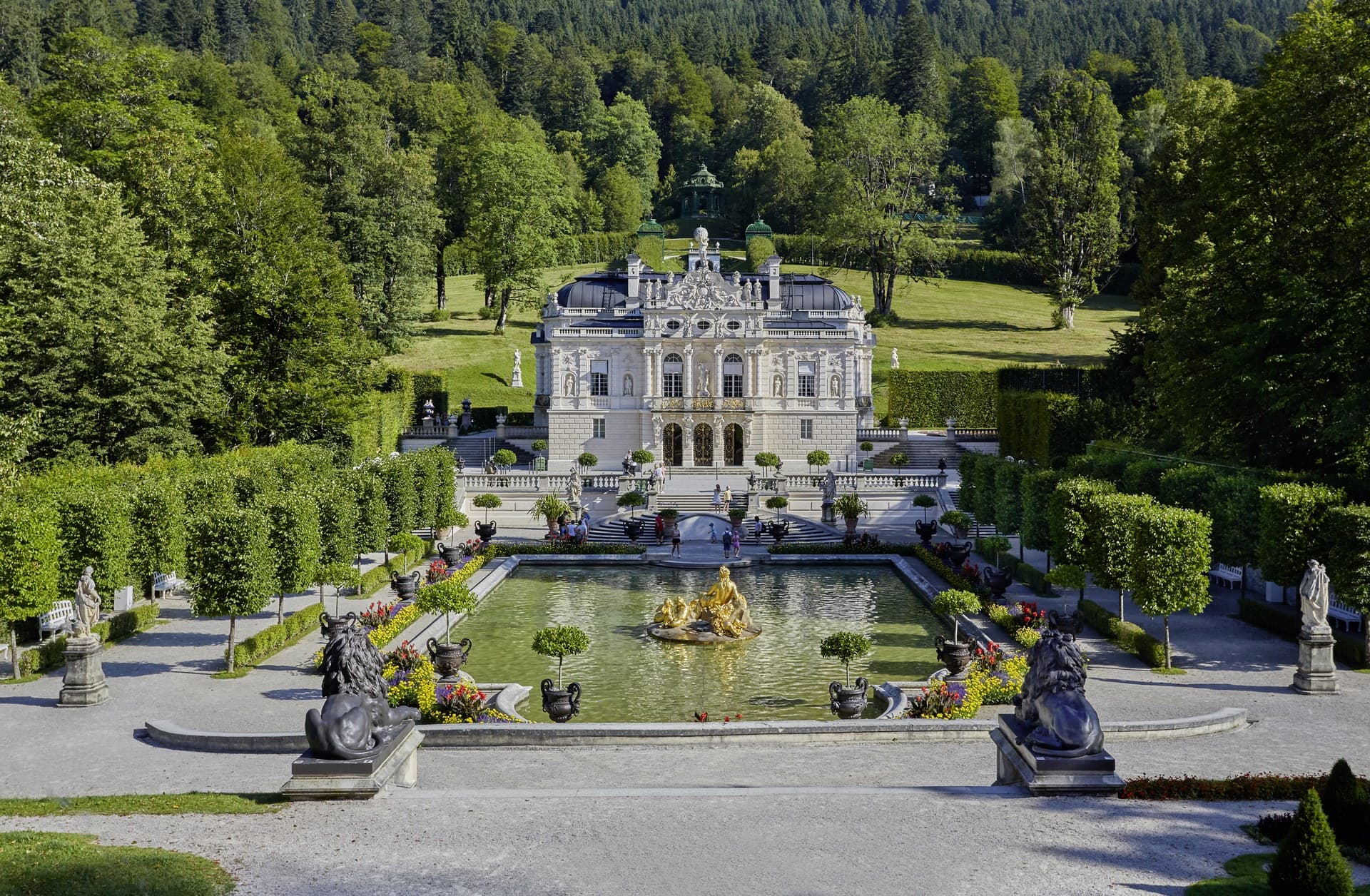
Linderhof Palace (Schloss Linderhof) is the only large palace King Ludwig II of Bavaria lived to see finished. Tucked into the Graswang Valley of the Ammergau Alps, it is the smallest of his three great building projects: a Neo-Rococo pavilion set within a staged landscape of terraces, cascades, an artificial grotto, and a scatter of Oriental and Wagnerian follies. Neuschwanstein Castle, his most famous creation, and Herrenchiemsee Palace, his answer to Versailles, both stood unfinished at his death in 1886. Linderhof alone achieved the completeness of its conception, and it is here that he spent more of his later life than in any other royal residence.
Quick Facts
| Country | Germany |
| Region / State | Bavaria (Oberbayern), Landkreis Garmisch-Partenkirchen |
| Nearest Town | Ettal |
| Construction Period | 19th Century Romantic (1869–1886; main building 1869–1880) |
| Founder | King Ludwig II of Bavaria |
| Architect | Georg von Dollmann (lead); Julius Hofmann (later works) |
| Architectural Style | Neo-Rococo interior behind a late-Baroque façade |
| Building Type | Royal villa / pleasure palace |
| German Term | Schloss (originally a Königshäuschen) |
| Current Condition | Fully preserved; operating museum |
| Open to Visitors | Yes (guided tours only) |
| UNESCO Status | World Heritage Site (inscribed 2025, ref. 1726) |
| Official website | schlosslinderhof.de |
Overview
In July 2025 the palace and its park were inscribed on the UNESCO World Heritage List as part of the serial property The Palaces of King Ludwig II of Bavaria, recognizing at last what visitors have long understood: that Linderhof is not merely a country retreat but one of the most carefully realized royal stage sets of the nineteenth century. The palace itself is compact (a single Neo-Rococo pavilion of a dozen or so rooms), but the park around it carries a distributed architectural program that extends the building into its alpine setting. Interior and exterior operate together as a single composition, and it is this doubled conception, as much as the palace on its own, that the UNESCO inscription recognizes.
Location and Setting
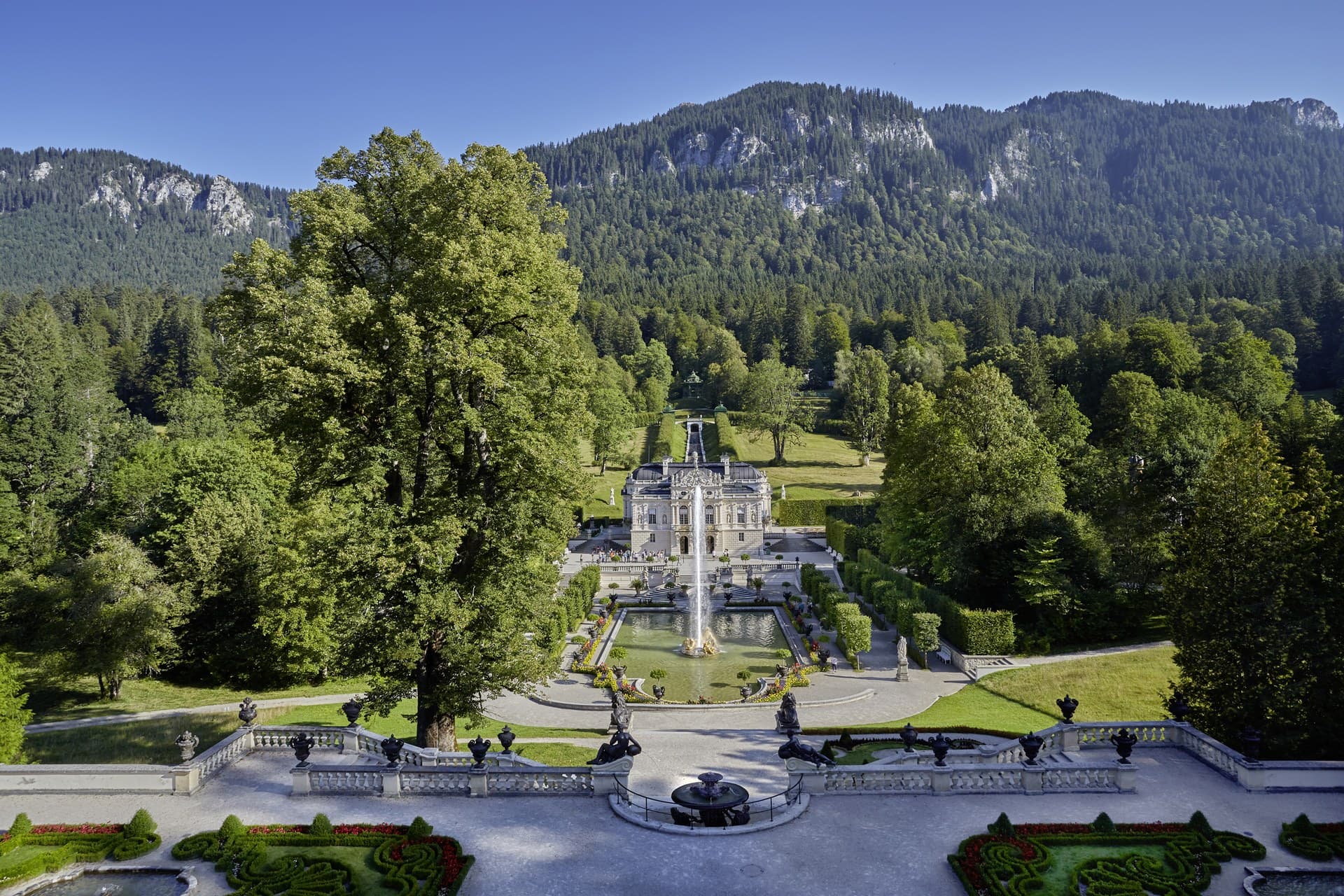
Linderhof lies deep within the Graswangtal, a narrow east–west valley on the Bavarian flank of the Ammergau Alps, roughly ten kilometers west of Ettal Abbey and about thirteen kilometers south-west of Oberammergau. Linderhof stands at approximately 1,000 meters above sea level within the Ammergebirge nature reserve, ringed by spruce-clad peaks that rise on every side. This seclusion was part of the appeal: Ludwig wanted to be out of sight of Munich, beyond the reach of ministers and protocol, and the valley’s single road gave him a kind of natural privacy that no urban residence could match.
Its grounds unfold along a strict north–south axis. On the south front, a broad water parterre terminates in a gilt sculptural group of Flora and Puttos, from which a fountain jet rises around twenty-five meters into the mountain air; beyond it, three terraced gardens climb the Linderbichl hillside to a circular Temple of Venus. On the north side, a thirty-step marble cascade descends from a Music Pavilion to the Neptune Fountain at its foot. Side parterres carry Baroque fountains and busts of Louis XIV and Louis XVI. It is a French formal plan transplanted into alpine topography, and the geometric discipline of the parterres set against the wild geology behind them is the first thing most visitors notice.
Historical Background
From farmhouse to royal hunting lodge
Its name derives from the Linder family, whose mountain farm is documented at this site as early as 1479 under the ownership of Ettal Abbey. Farmed for over three centuries, the property passed to the Bavarian state in 1815 and served as a foal farm for the Schwaiganger royal stud. King Maximilian II of Bavaria first visited the valley in 1841 as a young hiker, and after his accession in 1848 he converted the eighteenth-century farmhouse into a simple hunting lodge (the Königshäuschen), which his son, the young Crown Prince Ludwig, came to know well on hunting expeditions with his father.
Ludwig’s transformation
On May 19, 1869, four years after his accession to the Bavarian throne, Ludwig II purchased the estate and large tracts of the surrounding Graswangtal as private property. He commissioned the court architect Georg von Dollmann, a pupil of Leo von Klenze, to enlarge the existing lodge, and the earliest wing of the present palace was complete by late 1870. Over the following years he repeatedly revised the design. His initial ambition had been a full-scale Versailles-style residence on the Linderhof site, but in 1873 he acquired the island of Herreninsel on the Chiemsee and moved the Versailles project there, leaving Linderhof to evolve in a more intimate direction.
By 1874 the original Königshäuschen was physically dismantled and re-erected around a hundred meters to the west, clearing the site for the stone-clad Neo-Rococo palace that stands today. The Hall of Mirrors and the full southern suite were finished by 1877; the body of the palace reached its essential form by 1880. A final enlargement of the King’s Bedroom began in 1884 and was structurally complete when Ludwig died in 1886. Interior collaborators included Julius Hofmann, who would succeed Dollmann on Ludwig’s final commissions, and the decorator Joseph de la Paix, who worked with Dollmann on the Hall of Mirrors in 1874.
After 1886
Ludwig was deposed on June 9, 1886, transferred to Berg Castle on Lake Starnberg, and found dead in the shallows of the lake on the evening of June 13 under circumstances that remain disputed. Just seven weeks later, on August 1, 1886, Linderhof opened to the public as a museum, the earliest step in what would become more than a century of continuous visitor access, driven initially by the new government’s need to repay the late king’s considerable personal debts. The palace has remained in Bavarian state custody since 1918, administered by the Bavarian Palace Administration in its current form since its reorganisation in 1932, and has never closed.
Architectural Highlights
A French interior in a Bavarian body
Linderhof’s architectural logic is doubled. Behind a late-Baroque exterior inspired by French maisons de plaisance (and above all by the Petit Trianon at Versailles) unfolds an interior program of Neo-Rococo, or Neurokoko. Dollmann and his collaborators drew less from France than from the Wittelsbach inheritance on Ludwig’s doorstep: the Amalienburg at Nymphenburg and the Rich Rooms of the Munich Residence, both designed in the 1730s by François de Cuvilliés the Elder. Its plasterwork is denser, more three-dimensional, and more theatrical than any French eighteenth-century original would permit.
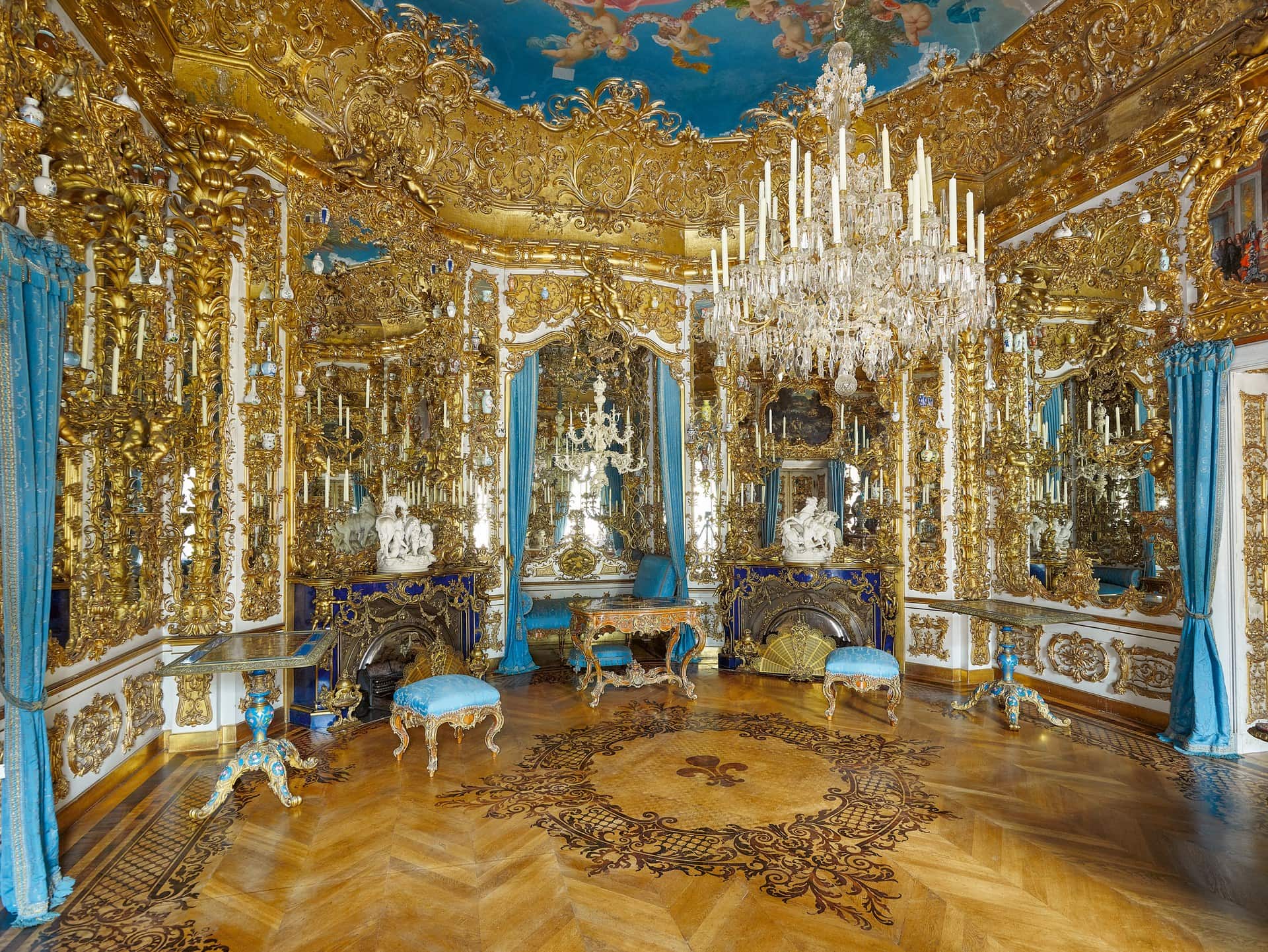
The principal rooms unfold as an enfilade around the central Hall of Mirrors (Spiegelsaal), with the oval King’s Bedroom on the north front and the oval Dining Room to the east. Its Spiegelsaal is modeled on the Mirror Cabinet of the Munich Residence rather than on Versailles, as is often assumed; parallel mirrors multiply its space into an infinite corridor of candlelit gilding, and it was here that Ludwig spent long nocturnal hours reading.
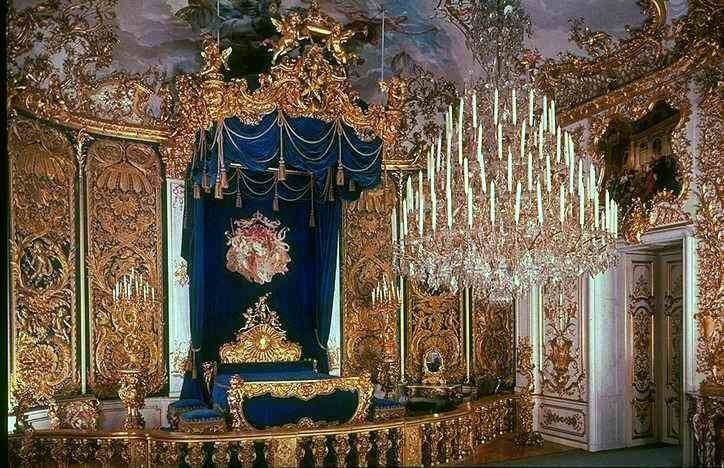
The King’s Bedroom, the largest chamber in the palace, is arranged like a Baroque altar, with the bed raised on a stepped platform within an alcove closed by a gilded balustrade. A crystal candelabrum of one hundred and eight candles hangs above it. That room was enlarged in 1884 to create the palace’s pronounced north risalit, and its scale signals the liturgical weight it carries within the building’s program.
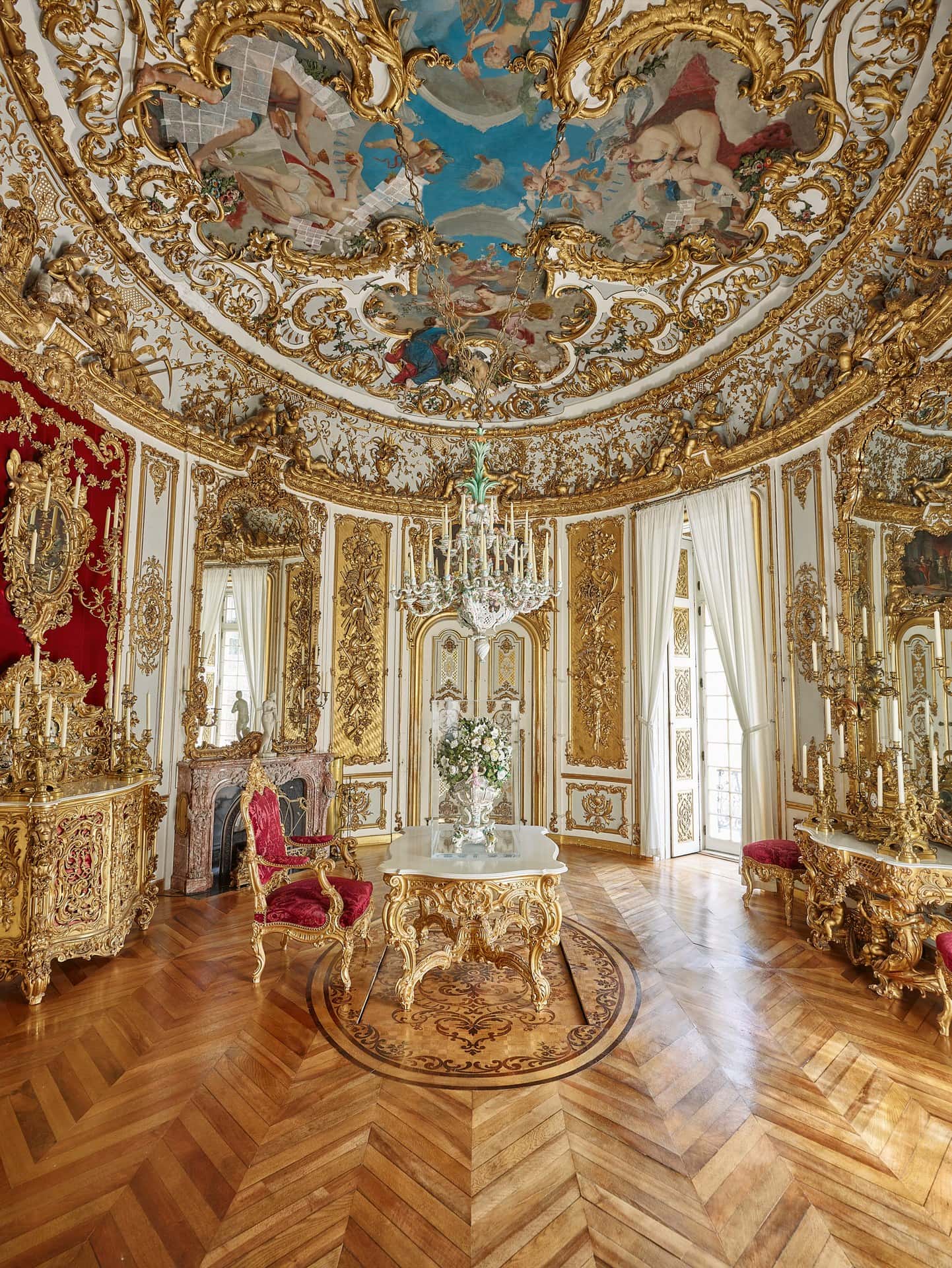
The Dining Room houses the mechanical dining table known as the Tischlein-deck-dich, named for the Grimm fairy tale: the table descended on a lift to the kitchen below, was laid for the next course, and rose again, allowing the king to dine entirely alone. The mechanism revives an eighteenth-century French tradition of the table volante, used at Choisy under Louis XV and in several other Bourbon residences, another expression of Ludwig’s lifelong identification with the old French monarchy.
The Wagnerian landscape
Beyond the palace, the park reveals Linderhof’s defining ambition. Scattered across its grounds are a sequence of built fantasies drawn from Richard Wagner’s operas: the Venus Grotto (Venusgrotte) evoking the Venusberg of Tannhäuser; Hunding’s Hut (Hundinghütte), the rough timber dwelling of Act 1 of Die Walküre; and the Gurnemanz Hermitage (Einsiedelei des Gurnemanz) from Parsifal, alongside two Oriental pavilions, the Moorish Kiosk (Maurischer Kiosk) acquired from Bethel Henry Strousberg’s bankruptcy sale in 1876, and the Moroccan House (Marokkanisches Haus) purchased from the 1873 Vienna World Exhibition.
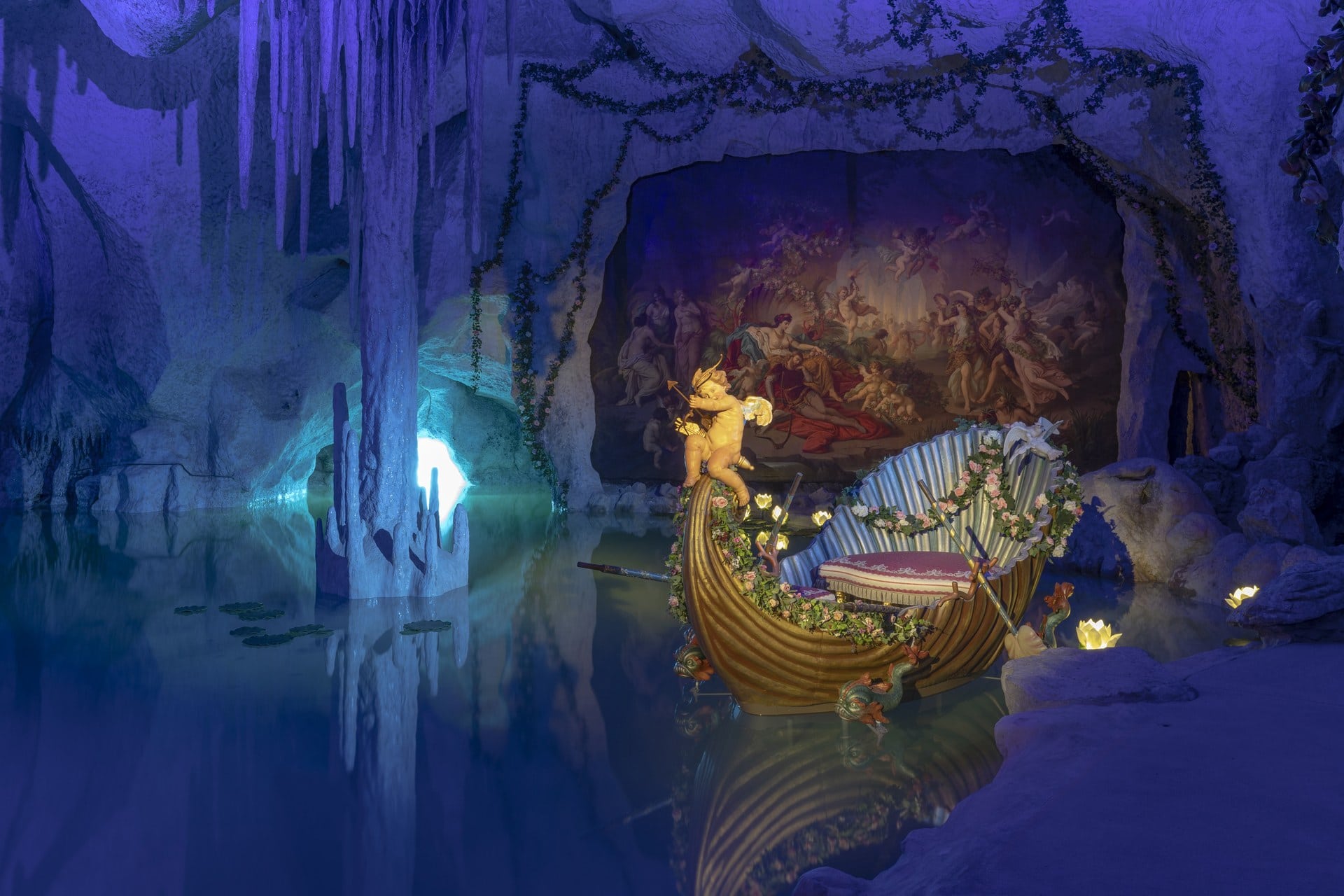
The Venus Grotto is the most ambitious of them. Its iron armature supports a shell of canvas and sprayed cement shaped into some thirty thousand stalactites; it contains an artificial lake with a gilded shell boat, a wave machine, and a painted Tannhäuser backdrop by August von Heckel. Among them, the Venus Grotto was one of the earliest electrical installations in Bavaria, illuminated by dynamos driven by one of the region’s first permanent electric-power stations, built on site in 1878 under the direction of Johann Sigmund Schuckert. Colored glass discs shifted the light from the blue of Capri to the red of the Venusberg.
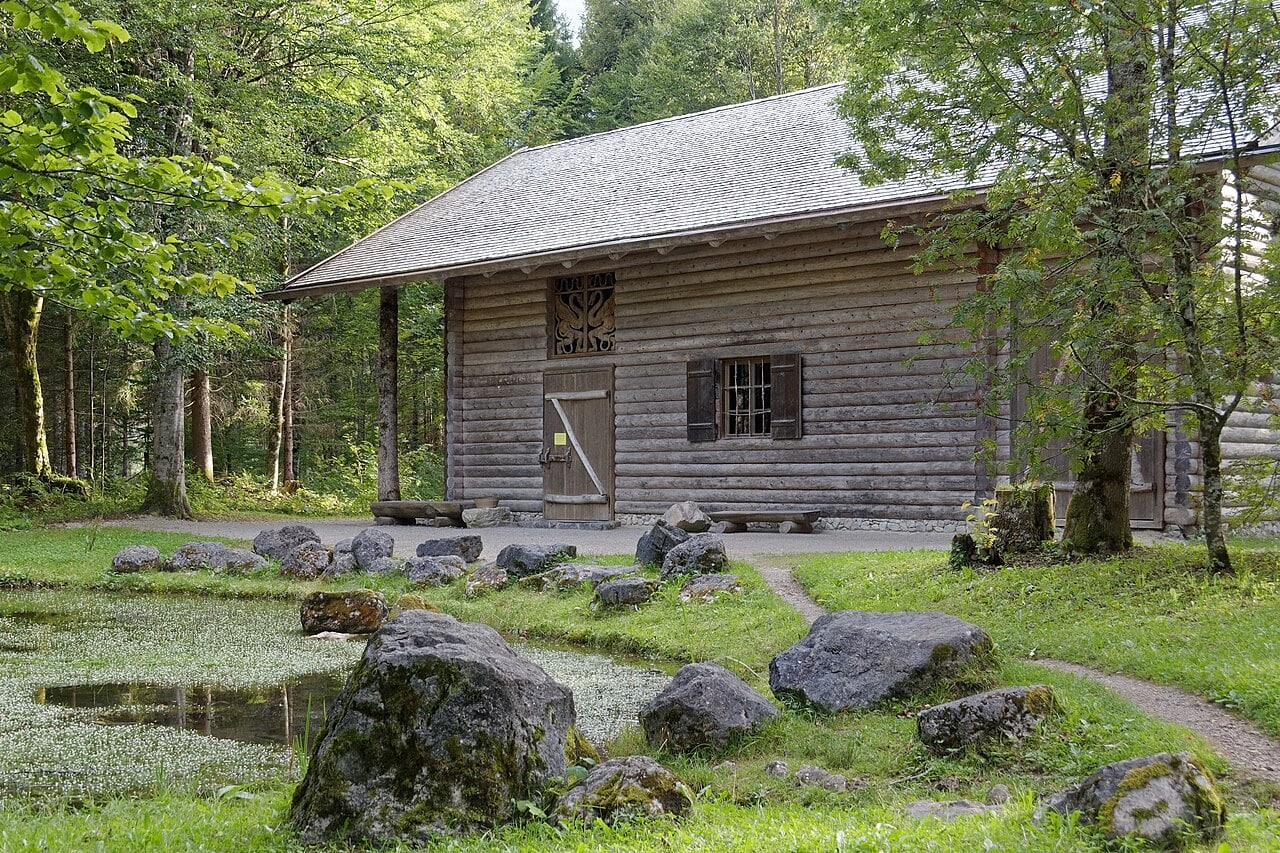
Hunding’s Hut, originally built at the foot of the Kreuzspitze in 1876, was reconstructed inside the park in 1990 after earlier fires and wartime arson; the Gurnemanz Hermitage, lost to decay in the 1960s, was rebuilt from private donations in 2000.
Read together, the park buildings compose a Wagnerian landscape distributed across the valley, interlocked with the French interior of the palace. Interior and exterior become two acts of a single Gesamtkunstwerk: the total artwork Wagner theorised, here realized in stone, water, canvas, and electricity.
Visiting the Castle
Its interior can be seen only on a guided tour, led by a live guide in German or English, lasting around twenty-five minutes and capped at forty people per departure. Tours leave every five to ten minutes during opening hours. Photography is prohibited inside the palace and inside the Venus Grotto. Entry tickets and local tours can also be booked in advance through GetYourGuide.
Closed for almost ten years of restoration, the Venus Grotto reopened on April 10, 2025 and is once again accessible on a dedicated guided visit. Tickets for the grotto (and the combined palace-and-grotto ticket) are sold only at the on-site cash desk; they cannot be booked online. Palace-only tickets can now be reserved through the Bavarian Palace Administration’s online shop, bypassing the queue. The Moorish Kiosk is currently closed for its own major restoration and is expected to reopen for the 2028 season.
Linderhof is open year-round, closing only on January 1, Shrove Tuesday, and 24, 25 and December 31. The park buildings operate on a shorter calendar: the Venusgrotte and the Marokkanisches Haus are accessible from April 15 to October 15, and the Hundinghütte and Einsiedelei des Gurnemanz open on the same seasonal window with slightly later daily hours. The Königsschlösser combination ticket (which pairs Linderhof with Neuschwanstein and Herrenchiemsee over a six-month window) is no longer offered in the operator’s ticket range; the Bavarian Palace Administration’s multi-day and annual passes remain valid here.
Prices above are the operator’s 2026 tariff; opening dates and access rules should be re-checked on the official Schloss Linderhof website (schlosslinderhof.de), since the palace publishes annual admissions, tour times, and seasonal closures there, and reduced-price or online tickets may differ by season. Anyone staying overnight can compare hotels in and around Oberammergau.
Admission
| Ticket | Price |
|---|---|
| Palace | 11.00 euros / 10.00 reduced |
| Venus Grotto | 9.00 euros / 8.00 reduced, sold only in the summer season |
| Combined palace and Venus Grotto | 18.00 euros / 16.00 reduced, summer season only |
| Königshäuschen | 2.00 euros / 1.00 reduced, sold only at the Königshäuschen itself |
| Moorish Kiosk, Moroccan House, Hunding’s Hut, Gurnemanz Hermitage | No ticket needed; closed in winter |
| Children and young people under 18 | Free |
| Group reservation, 15+ people | 1.50 euros per person |
Some links on this page are affiliate links, which means StoneKeep Atlas may earn a small commission, at no extra cost to you, if you book through them.
Nearby Attractions
Ettal Abbey, about ten kilometers east along the valley road, offers a Baroque counterpoint to Linderhof’s Neo-Rococo: its circular abbey church is one of the great monastic churches of southern Bavaria. A further short drive brings visitors to Oberammergau, famous for the Passion Play staged by its residents every ten years since 1634. South-east of Oberammergau, Hohenschwangau Castle (the castle of Ludwig’s childhood) and Neuschwanstein form the other half of any Ludwig II itinerary, reachable on a scenic alpine drive of around an hour and a half. The King’s House on Schachen, Ludwig’s high-altitude Swiss-chalet retreat above Garmisch-Partenkirchen, is a fellow component of the 2025 UNESCO inscription and a more remote experience for walkers. Around it, the Ammergau Alps nature reserve offers an extensive network of hiking trails directly from the palace car park.
Travel Tips
- Visit between mid-April and mid-October to see the park buildings at their full program; the palace is worth a winter visit, but most of the Wagnerian follies and the Venusgrotte itself are closed in the off-season.
- Arrive early: tours depart on a timed, capacity-capped rota, and the Venus Grotto’s on-site-only ticketing means queuing in person is unavoidable.
- Expect a strict photography ban inside the palace and the grotto; pack for note-taking rather than camera work.
- Consider pairing Linderhof with Neuschwanstein on the same trip via the Alpine road through the Ammergau: the two palaces are under two hours apart and tell contrasting chapters of the Ludwig II story.
- In winter, come for the palace interior and the valley atmosphere, but plan for closed park buildings and shorter daylight.
- Access by car is simplest; a seasonal bus service connects Oberammergau to the palace car park for those arriving by train.
- The reopened Venusgrotte now includes an induction loop for hard-of-hearing visitors, alongside its restored lighting scheme and full wheelchair accessibility.
Linderhof’s place in Ludwig II’s larger architectural argument (the Rococo counterpart to Neuschwanstein’s Wagnerian medievalism, citing not the grand axial Versailles but Louis XV’s chamber palaces at the Petit Trianon and Marly) is explored in Ludwig II and the Architecture of Dreams.
Conclusion
Linderhof rewards a slower visit than its modest footprint suggests. The palace itself can be seen in under half an hour, but the valley and its scatter of follies (the grotto, the hermitages, the Oriental pavilions, the terraced gardens) together compose something larger and stranger than any single building. It is here, more than at any of the three palaces built by King Ludwig II, that his imaginative project reached completion: a private world of opera and Bourbon memory laid out across an alpine valley, and now recognized by UNESCO as a landscape of its own kind.
For the broader regional context, see Best Castles in Bavaria, a survey of nine castles across four castle traditions, including the three Wittelsbach palaces of Ludwig’s Königswinkel triangle.
For the broader regional context, see Best Castles in Bavaria, the seven-castle survey across the Wittelsbach south and the Franconian north.
Principal Sources
- Bayerische Schlösserverwaltung. “Linderhof Palace.” schloesser.bayern.de/englisch/palace/objects/li_schl.htm
- Schatz, Uwe Gerd. “Linderhof Palace.” Historisches Lexikon Bayerns, February 26, 2025. historisches-lexikon-bayerns.de/Lexikon/EN:Linderhof_Palace
- UNESCO World Heritage Centre. “The Palaces of King Ludwig II of Bavaria: Neuschwanstein, Linderhof, Schachen and Herrenchiemsee.” Inscribed July 12, 2025. whc.unesco.org/en/list/1726/
Image credits. Featured image — The south façade of Linderhof Palace, seen across the Flora water parterre: © Bayerische Schlösserverwaltung. Photo: Maria Scherf / Andrea Gruber. www.schlosslinderhof.de. The palace viewed from the terrace gardens, with the Ammergau Alps rising behind the cascade: © Bayerische Schlösserverwaltung. Photo: Maria Scherf / Andrea Gruber. www.schlosslinderhof.de. The Hall of Mirrors (Spiegelsaal), modeled on the Mirror Cabinet of the Munich Residence rather than on Versailles: © Bayerische Schlösserverwaltung. Photo: Maria Scherf / Andrea Gruber. www.schlosslinderhof.de. The King’s Bedroom, arranged like a Baroque altar, with the canopy bed raised within an alcove and lit by a crystal candelabrum of 108 candles: Daniel71953, CC BY-SA 3.0, via Wikimedia Commons. The oval Dining Room, with the mechanical dining table (Tischlein-deck-dich) that rose from the kitchen below: © Bayerische Schlösserverwaltung. Photo: Maria Scherf / Andrea Gruber. www.schlosslinderhof.de. The Venus Grotto with its gilded shell boat and August von Heckel’s Tannhäuser backdrop: © Bayerische Schlösserverwaltung. Photo: Maria Scherf / Veronika Freudling. www.schlosslinderhof.de. Hunding’s Hut (Hundinghütte), rebuilt in 1990; its staging recalls Act 1 of Wagner’s Die Walküre: Bjs, CC0, via Wikimedia Commons. Freely licensed images are resized to fit; otherwise unaltered.