
Marienberg Fortress
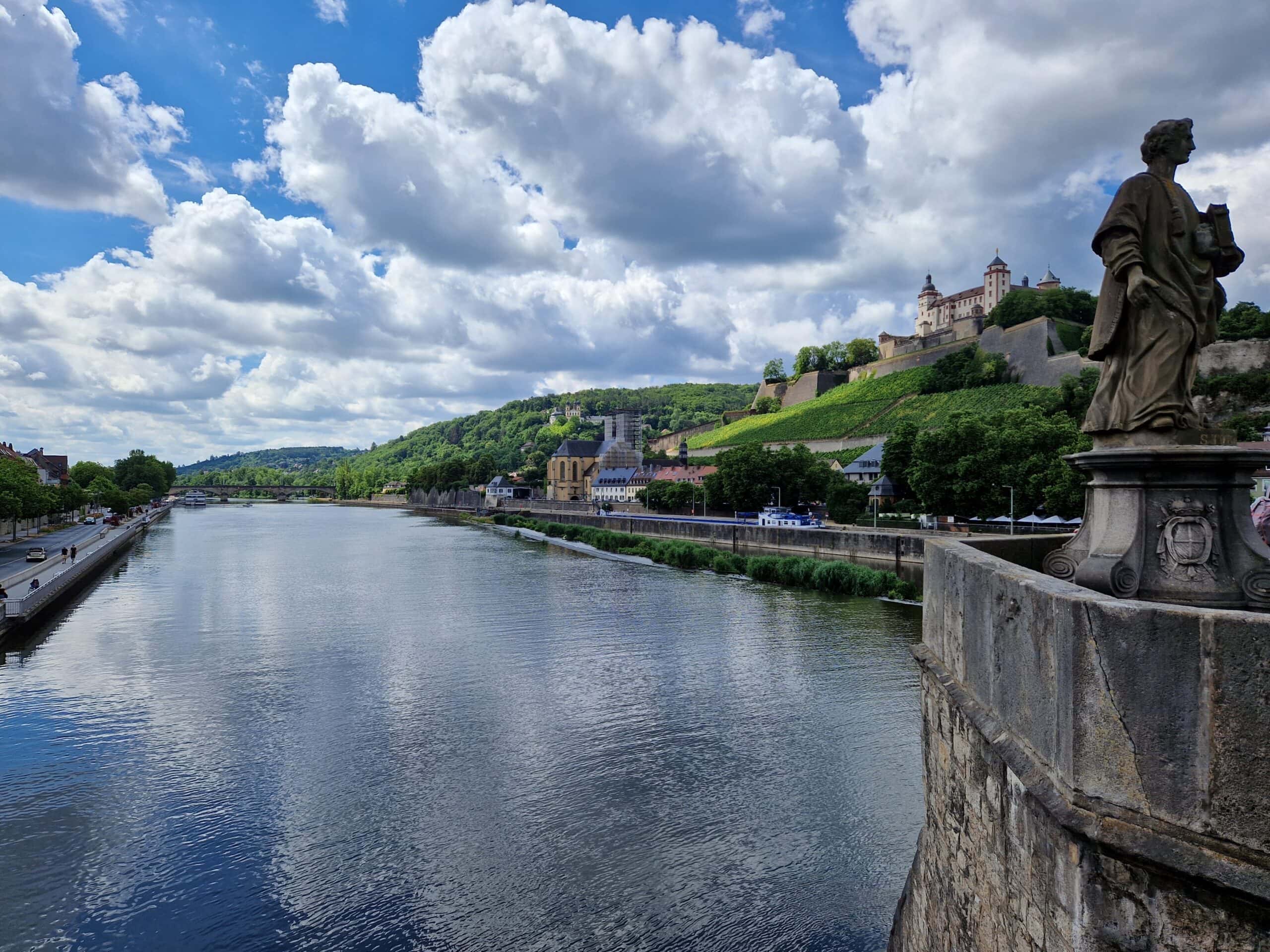
For 466 years, the prince-bishops of Würzburg ruled their city from the wrong side of the Main. From the wooded hill above the river’s left bank, the Festung Marienberg watched, weighed, and occasionally sent troops down the slope. The cathedral, the markets, and the burghers’ houses all stood across the water. Power lived on the hill.
That arrangement (fortress facing city, prelate facing burgher) defined Würzburg from 1253 until 1719. The Marienberg is the architectural record of that long balance: a Romanesque round church older than the bishops’ tenancy, a medieval keep at its core, a Renaissance princely range from the Counter-Reformation, an Italian-school bastion ring thrown up after a Swedish army stormed the place in 1631, and a crowning Baroque artillery tower from the 1720s. All of it still rises some hundred meters above the Main, immediately recognizable from the Alte Mainbrücke. As of 2026, much of the inner fortress is closed for individual visitors during a major restoration; what remains accessible (the outer Echterhof, the Museum für Franken, a BSV guided tour that still threads through the inner courtyard, and the Maschikuliturm via its new Schwedenschanze entrance) still rewards a half-day visit.
Quick Facts
| Name | Marienberg Fortress |
| German name | Festung Marienberg |
| Location | Würzburg, Lower Franconia (Unterfranken), Bavaria, Germany |
| Type | Hilltop fortress (bastioned Festung) |
| First built | Round church c. 1000; Höhenburg from 1201 |
| Significant rebuilding | Renaissance reconstruction 1573–1617; Italian-school bastion ring 1649–1656; Maschikuliturm 1724–1729 |
| Architectural period | Multiple periods (Romanesque, Gothic, Renaissance, Baroque) |
| Notable features | Hilltop, museum, partly open to visitors, intact (restored) |
| Current use | Museum (Museum für Franken) and state-managed monument |
| Operator | Bayerische Schlösserverwaltung (fortress); Museum für Franken (museum) |
| UNESCO World Heritage | No (the Würzburg Residence is listed separately) |
| Open to visitors | Partially — general restoration ongoing 2023 to early 2030s |
| Official site | schloesser.bayern.de |
From Höhenburg to bishop’s seat (c. 1000 – 1525)
Long before the bishops took it, the hill was used. Iron Age finds suggest a Celtic refuge on the summit, and post-Roman occupation is attested by stray archaeology. The round Marienkirche at the heart of the modern complex was built in the early eleventh century, although local tradition long dated its consecration to 706 and credited Saint Boniface, an attribution chronology rules out, since Boniface entered Franconia only after 719. By around 1000 the hilltop carried both a church and a noble residence. In 1201 Bishop Konrad I von Querfurt fortified the site as a Höhenburg: a hilltop castle. His successors raised the round keep, the Bergfried, that still anchors the inner courtyard.
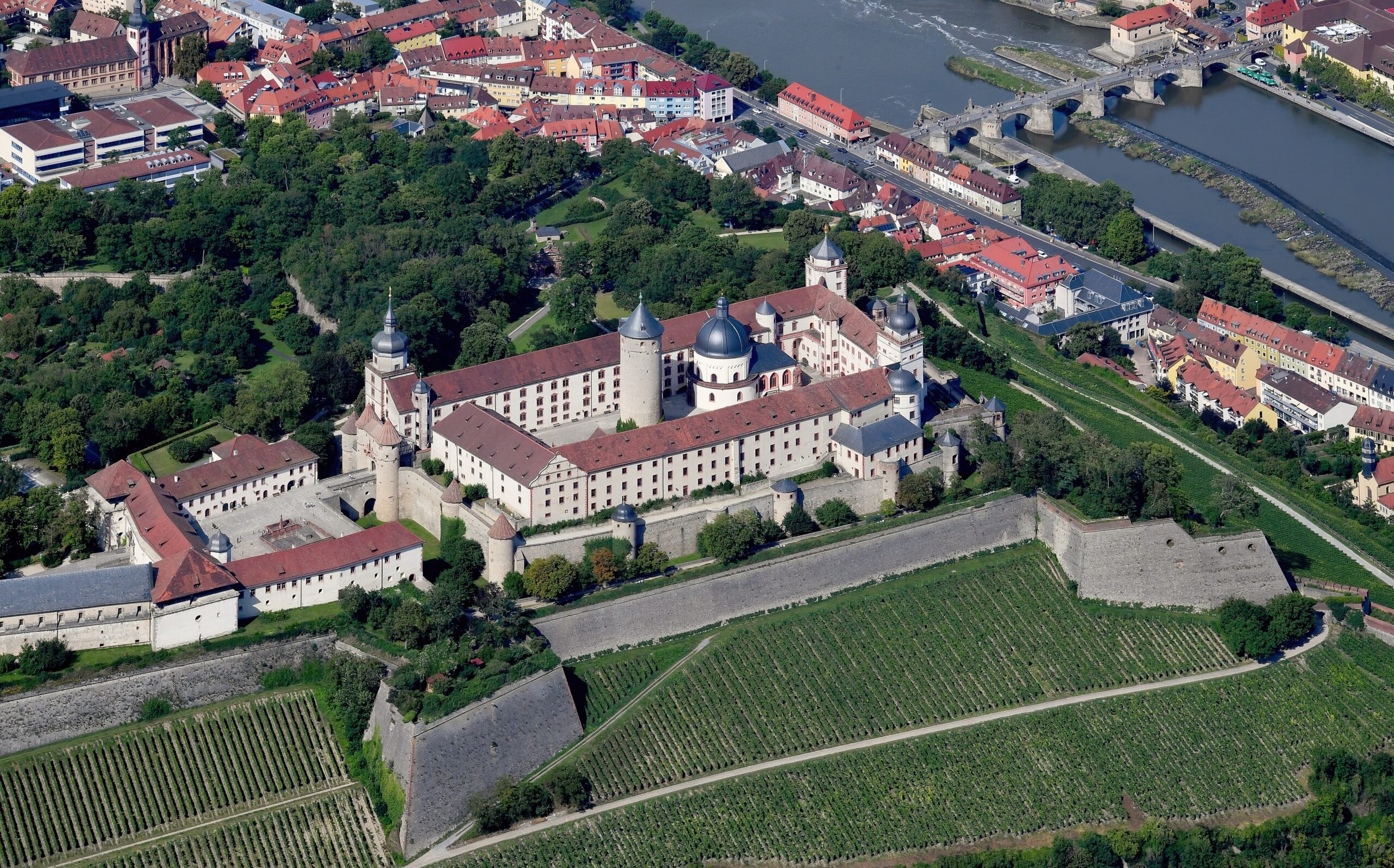
By 1253 the bishops had moved their permanent residence from the cathedral close in the city up to the Marienberg, and the hill became the seat of the prince-bishopric of Würzburg, the political, military, and judicial center of a sovereign state ruled by a prelate. Arrangement was not always comfortable. In 1525, during the German Peasants’ War, peasant armies and Würzburg townspeople laid siege to the Marienberg with field artillery, demanding the abolition of feudal dues. The garrison held; the rising was crushed within weeks; and Bishop Konrad III von Thüngen used the victory to consolidate his power over the city, a power Würzburg’s burghers would never fully recover.
Renaissance and Counter-Reformation: Julius Echter’s Marienberg (1573–1617)
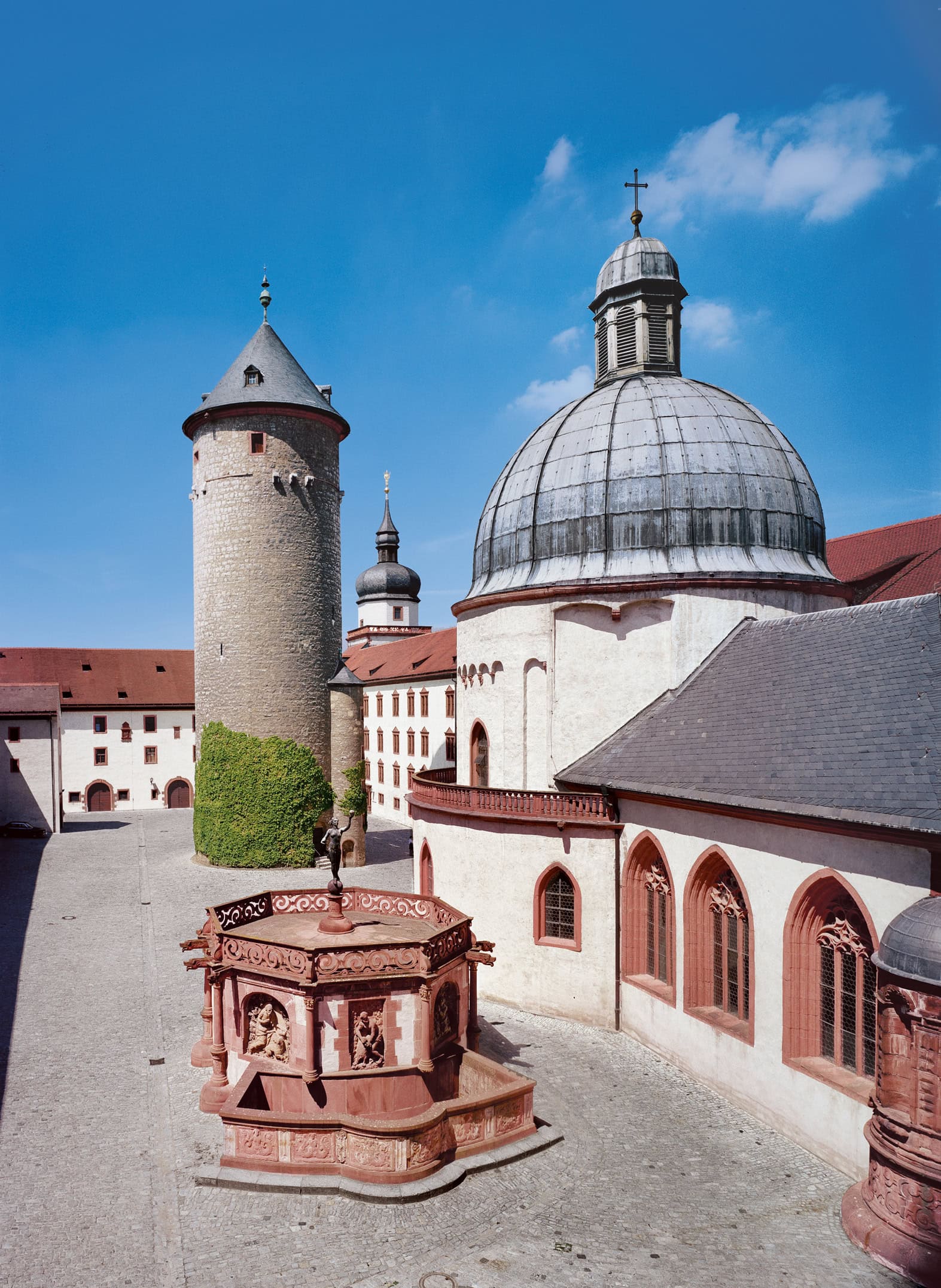
Two fires (in 1572 and 1600) gave Bishop Julius Echter von Mespelbrunn the chance to remake the fortress. Echter is one of the most consequential figures in Franconian history: a re-Catholicizing prince-bishop who founded the University of Würzburg, established the Juliusspital, and rebuilt or recased some three hundred churches across his territory in a distinctive Gothic-Renaissance hybrid since called the Juliusstil. On the Marienberg, between 1573 and 1617, his architects transformed a medieval Burg into an early-modern princely Schloss.
The rebuild added the Fürstenbau residential range with its red-sandstone window frames, the slender Marienturm, and a major intervention in the round Marienkirche: a baroque cupola raised over the medieval nave around 1605. The same campaign produced the Brunnenhaus, the well-house over the Tiefer Brunnen, a fortified well sunk over a hundred meters through the limestone of the hill. From Echter’s time on, the Marienberg was both fortress and bishop’s palace, a fortified residence for a clerical sovereign at war with his Lutheran neighbors.
The 1631 storm and the Schönborn fortress (1631–1719)
That confidence broke on October 18, 1631. As the Thirty Years’ War swung north, a Swedish-Protestant army under King Gustavus Adolphus stormed the Marienberg after a brief assault. The garrison surrendered, Bishop Franz von Hatzfeld fled, and the Swedes occupied Würzburg for four years. The fortress, never previously taken, was returned to the prince-bishopric in 1635 only by negotiation, not reconquest.
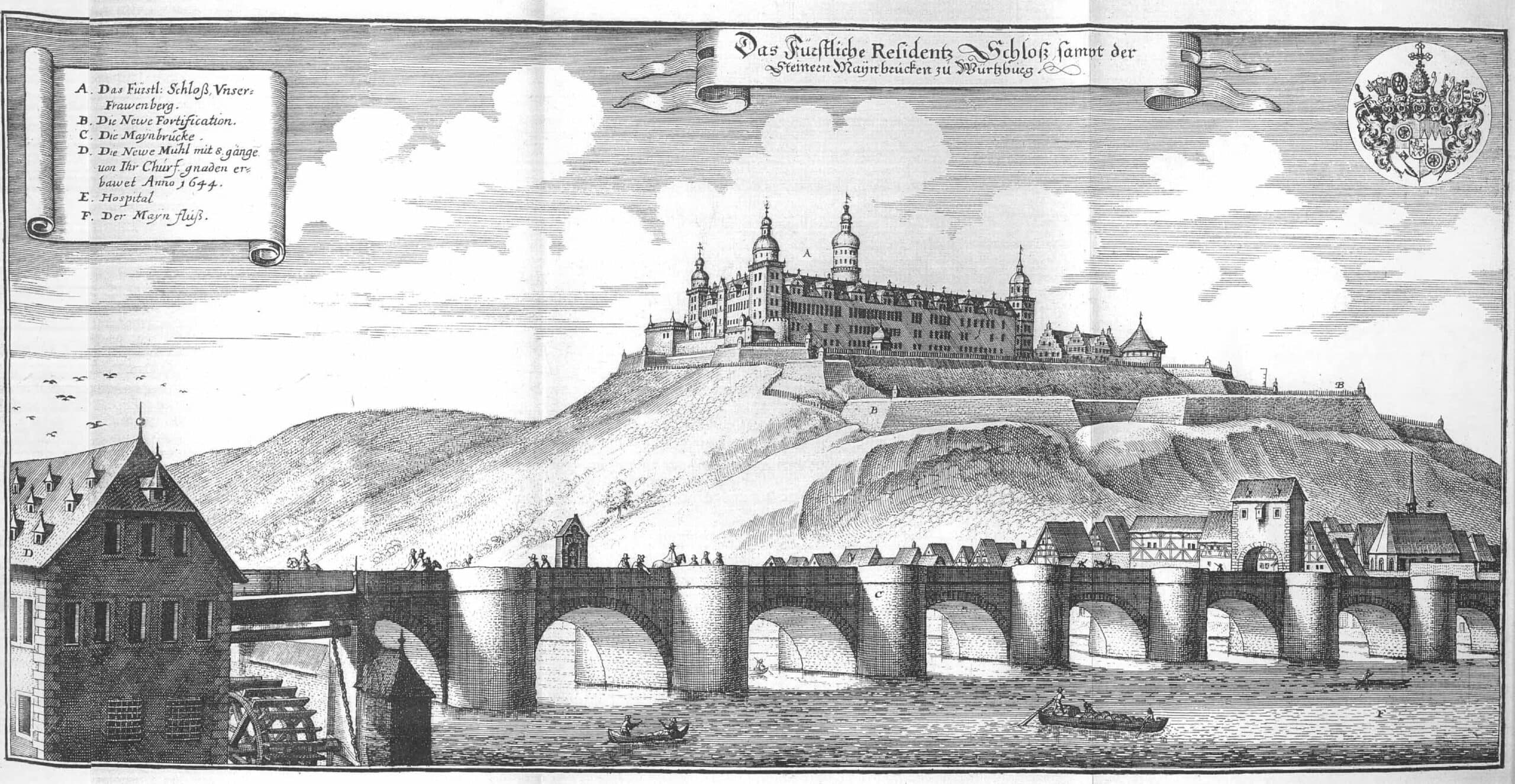
Shock changed everything. From 1649 to 1656, under Bishop Johann Philipp von Schönborn, an entirely new outer fortification was thrown around the Renaissance core: an Italian-school bastion ring designed in succession by Italian-trained engineers, with Antonio Petrini completing the work. Bastions were low, angled, and built for cannon, the geometry that Italian engineers had refined over the previous century, contemporary with but independent of Vauban’s later work in France. Merian’s Topographia Franconiae records the new ring under construction; the line it traced still defines the fortress’s outer footprint today.
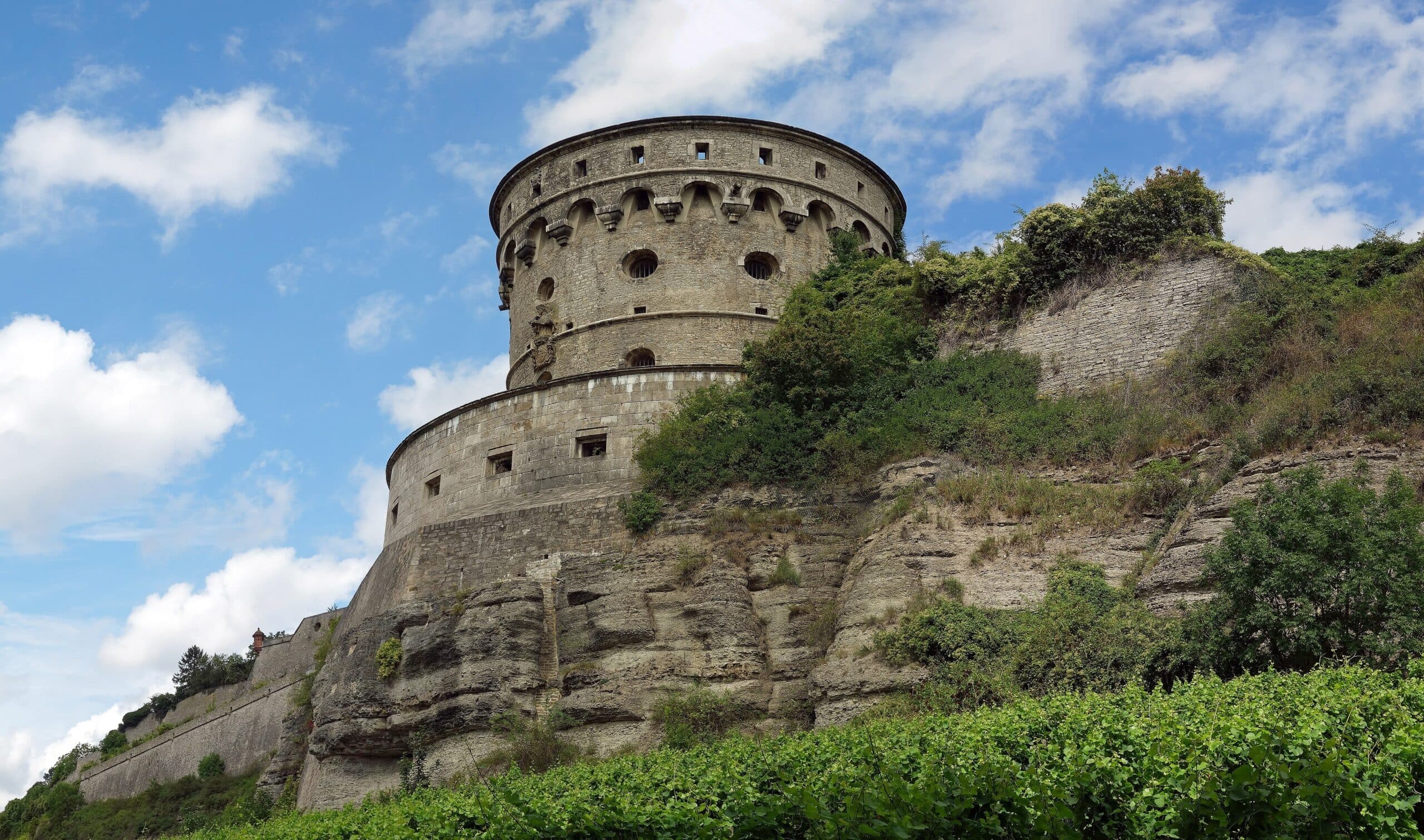
In the 1720s the bastioned identity was sealed. Maximilian von Welsch and Balthasar Neumann (the same Neumann then beginning the new Würzburg Residence in the city below) designed the Maschikuliturm, completed between 1724 and 1729: a massive round artillery tower with a corbelled gallery and tiers of embrasures, perched on the southwest cliff edge. It gave the fortress its final military silhouette, and, as it turned out, its last serious martial purpose.
Twilight: secularization to ruin (1719–1945)
From 1719 the Schönborn dynasty began moving the court down to the city. In 1720 the foundation stone of the new Würzburg Residence was laid, and Neumann’s Baroque palace was largely complete by 1744. The court left the hill; the prince-bishop now ruled from below.
Fortress remained a state arsenal and a state prison, but its political function ended in 1802 with the secularization of the prince-bishopric. Bavaria absorbed Würzburg in 1814, and the Marienberg became a Bavarian state fortress: garrisoned, slowly emptied, gradually neglected. A serious fire in 1840 gutted parts of the inner buildings; in 1866, during the Austro-Prussian War, the fortress took artillery fire from Prussian batteries on the right bank. By the 1920s the buildings were partly empty, partly given over to the Bavarian state archives, and visibly in decline. Pressure to put the decaying buildings back in order came from the Nazi regime from 1933; the Bayerische Schlösserverwaltung took over the property in 1935, and a careful historicizing restoration under the architect Rudolf Esterer followed, aiming to return the Kernburg to its Echter-era state.
On March 16, 1945 came the most catastrophic moment. In a seventeen-minute Royal Air Force raid that destroyed most of central Würzburg, incendiaries gutted the Marienberg as well. The Renaissance roofs collapsed, the Marienkirche’s cupola fell in, and the Fürstenbau interiors burned through. Photographs from the spring of 1945 show the fortress as an empty shell on the hill above a flattened city.
Reconstruction and Museum für Franken (1945–today)
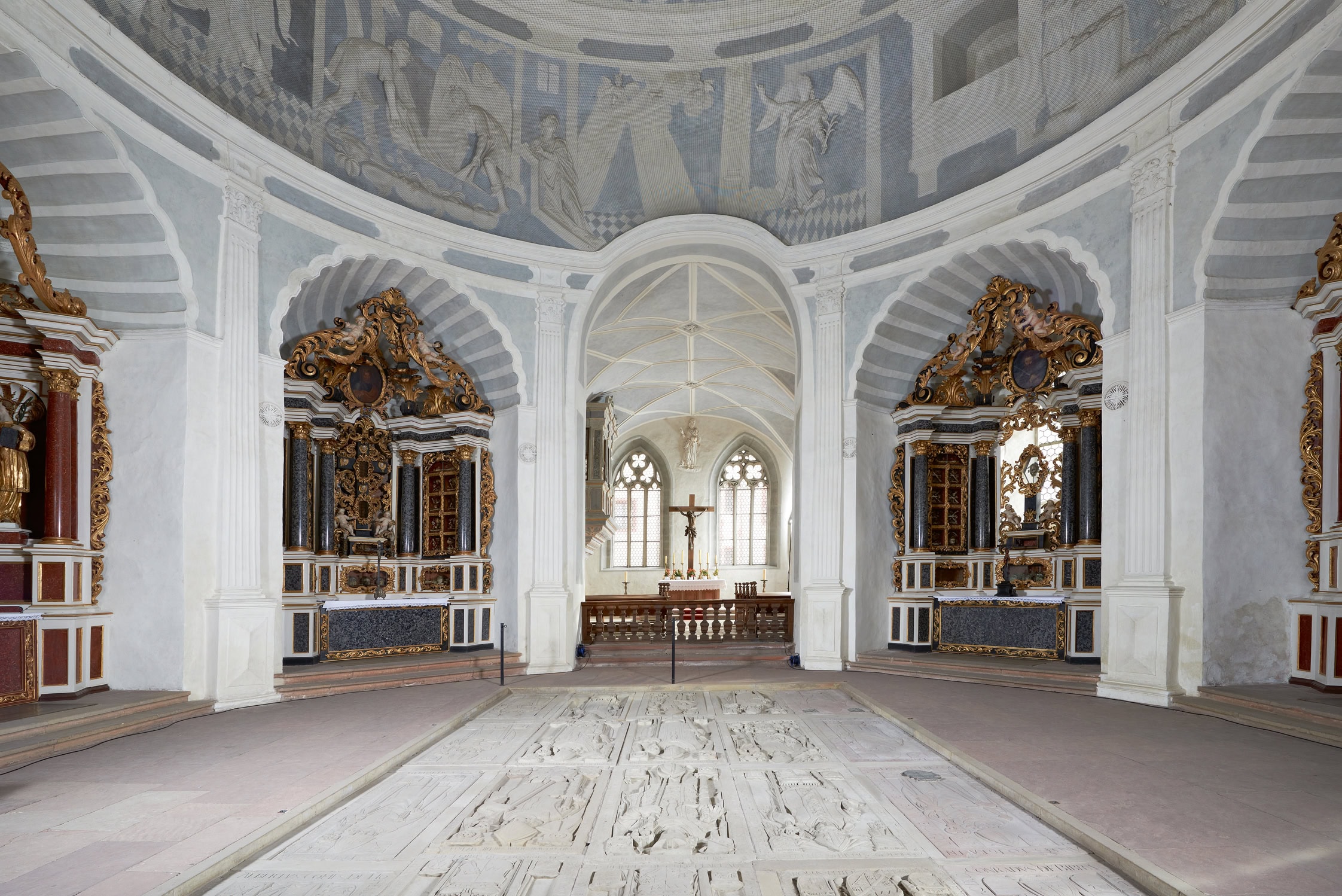
The post-war reconstruction was unusually disciplined. From 1946 to 1982 the Schlösserverwaltung rebuilt the fortress almost stone-for-stone in its pre-war form rather than experimenting with modernization, and the result is today’s Marienberg: not a romantic recreation but a careful, evidence-based reassembly. Marienkirche reopened in stages, its round nave, baroque side altars, and medieval bishops’ tomb-slabs once again accessible.
In 1947 the Mainfränkisches Museum, founded earlier in the twentieth century in the city, moved into the restored Zeughaus and Echterbastei wings. In 2017 it was renamed the Museum für Franken when its operating body changed from the district of Lower Franconia to the Free State of Bavaria; in October 2025 it was placed administratively under the Haus der Bayerischen Geschichte, the Bavarian state history institution. Its collection is the leading repository of Franconian art, with the world’s largest collection of works by Tilman Riemenschneider, over eighty pieces by the late-Gothic sculptor whose career was based in Würzburg.
A second museum, the Fürstenbaumuseum, opened in 1990 in the restored princely apartments and was integrated into the Museum für Franken in 2019; it closed again in 2021 ahead of the current restoration. Generalsanierung (a building-wide structural restoration begun in November 2023) has progressively closed the inner courtyard, the Bergfried, the Marienkirche, the Brunnenhaus, and the Fürstengarten. Reopening of the inner fortress is targeted for the early 2030s.
Visiting in 2026
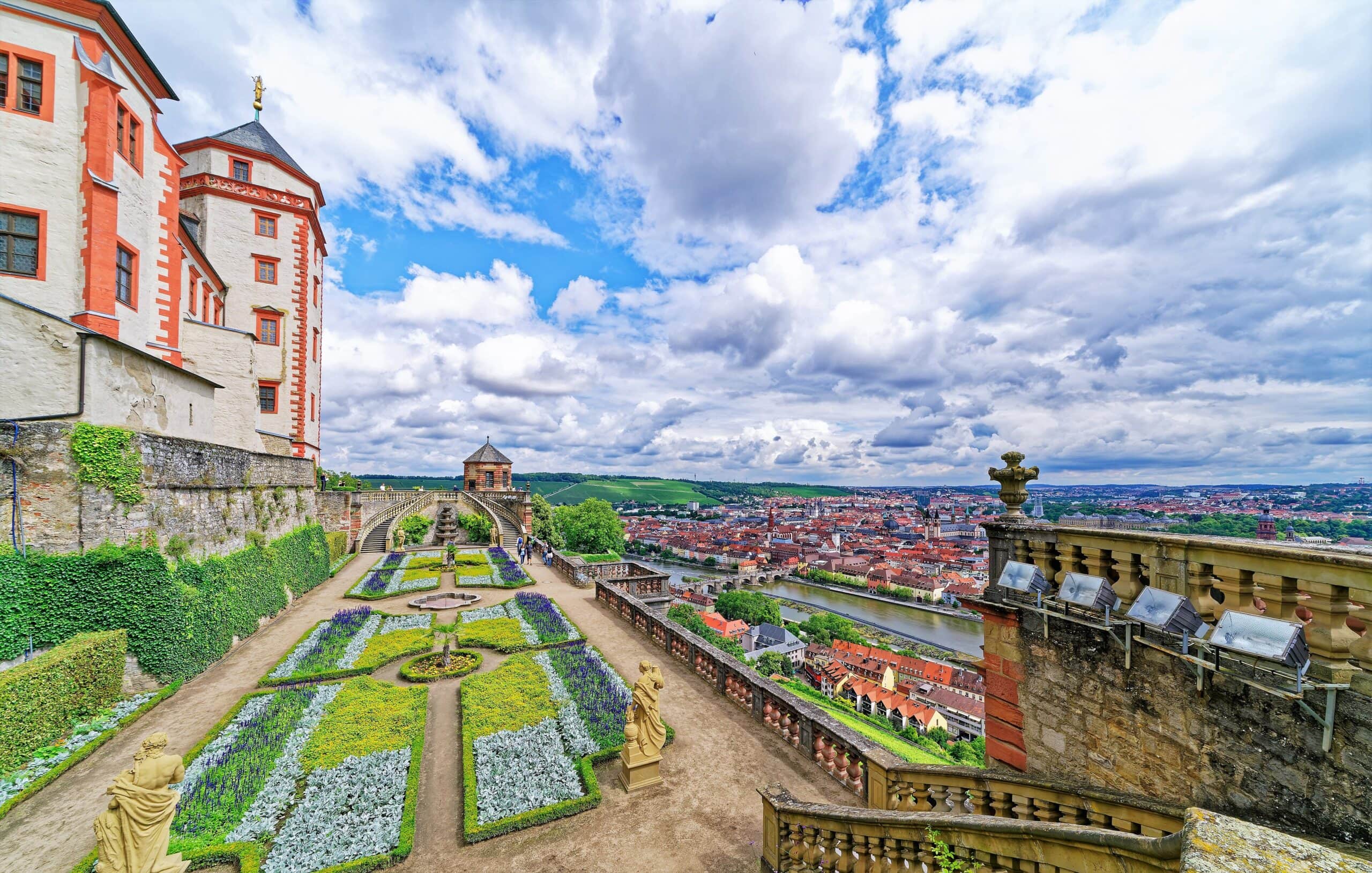
Plan around the closures. As of 2026, what is open is the outer Echterhof courtyard, the Museum für Franken in the Zeughaus and Echterbastei, and the Maschikuliturm via the Schwedenschanze entrance with tickets sold at the museum shop in the Echtertor. The Bayerische Schlösserverwaltung also runs a guided fortress tour that still threads through the inner courtyard, including the Bergfried and the Marienkirche, even though the inner fortress is closed to individual visitors. The operator asks visitors to note that the tour route may have to be adjusted at short notice while the building work continues. The Fürstenbaumuseum has been permanently closed since 2021, and the Fürstengarten is closed for the duration of the restoration. The on-site Burggaststätten are closed; the kiosk at the Echterhof remains open for refreshments. Entry tickets and local tours can also be booked in advance through GetYourGuide.
The two operators charge separately. The Museum für Franken is a Free State of Bavaria museum; its admission does not cover the BSV’s guided fortress tour, and the BSV’s combination tickets do not cover the Museum für Franken. Plan to buy two if you want to see both.
Adult ticket prices for the 2026 season, drawn from the operators’ own pages at museum-franken.de and schloesser.bayern.de:
| Ticket | Price |
|---|---|
| Museum für Franken — adult | €5.00 |
| Museum für Franken — reduced | €4.00 |
| Museum für Franken — Sundays (any visitor) | €1.00 |
| Museum für Franken — visitors under 18 | Free |
| BSV guided fortress tour — adult | €5.00 |
| BSV guided fortress tour — reduced | €4.00 |
| Maschikuliturm — adult | €4.00 |
| Maschikuliturm — reduced | €3.00 |
| BSV 14-day multi-castle ticket (Mehrtagesticket) | €40.00 |
| BSV annual ticket (Jahreskarte) | €55.00 |
Getting there is easy. From the Alte Mainbrücke, a roughly twenty-minute uphill walk through the vineyards leads to the main gate; the seasonal Kulturlinie 9 bus from the city center stops at the fortress between late March and early November; and a paid car park sits at the western Vorburg. The standard route enters through the Scherenbergtor (completed in the mid-fifteenth century under Bishop Gottfried IV von Limpurg, despite the name) passes the Echtertor into the Echterhof, and continues into the Vorburg toward the Maschikuliturm walk. Anyone staying overnight can compare hotels in and around Würzburg.
Some links on this page are affiliate links, which means StoneKeep Atlas may earn a small commission, at no extra cost to you, if you book through them.
Beyond Marienberg
Würzburg’s other major landmark is the Marienberg’s successor: the Würzburg Residence, a UNESCO World Heritage palace begun in 1720 and largely completed by 1744, the building that finally pulled the prince-bishops down from the hill. We’ll likely cover it in its own article.
For other Franconian fortresses on the same architectural family tree, the Plassenburg above Kulmbach and the Veste Coburg are the natural pairings, both bastioned-fortress hybrids, both major operator-managed sites, the Plassenburg and the Veste both now stand at the links above.
For comparative reading on prince-bishop residences and church-state fortresses elsewhere in Germany, Heidelberg Castle shows a parallel arc: Renaissance princely seat devastated in war, now part-ruin and part-museum. Wartburg Castle is the Counter-Reformation’s mirror image, the hill where Luther sheltered, while Echter on the Marienberg pursued the inverse program. Eltz Castle and Marksburg Castle are the Mosel and Rhine never-destroyed counterpoints, what survives when there is no 1631 and no 1945.
For the regional context, see Best Castles in Bavaria, the seven-castle survey across the Wittelsbach south and Franconian north.
Conclusion
Marienberg is, in the end, a building that has been more than itself for a thousand years, bishop’s seat for 466 of them, military problem in 1631 and 1945, romantic ruin in between, and now a state-managed monument mid-restoration. From across the Main, the silhouette is still doing what it has always done: telling the city below who tells its story. In another decade, when the Museum für Franken extends into the inner fortress as a full Bayerisches Landesmuseum, the hill will be once more what it has always been, a fortress that ruled a city, and an idea of the city that the fortress ruled.
The Marienberg’s development as the bastioned stronghold of the Counter-Reformation Prince-Bishops of Würzburg, and its fall to Gustavus Adolphus in 1631, is set within the wider confessional century in The Reformation and the Castle: Wartburg, Luther, and the Protestant Princes, where the fortress serves as the article’s principal Catholic mirror to the Wartburg.
The Swedish storming of the Marienberg in 1631 was one of the rare cases of a fortified German hill taken by direct assault, a story we place in context in The Castle as Refuge: Sieges That Defined Germany.
Principal Sources
- Dehio Vereinigung. Handbuch der Deutschen Kunstdenkmäler. Bayern I: Franken. 2nd edition. Deutscher Kunstverlag, 1999. Marienberg pp. 1190–1196; Marienkirche pp. 1194–1195.
- Flachenecker, Helmut, Hans-Peter Baum and Reinhard Helm, eds. Burg – Schloss – Festung. Der Marienberg im Wandel. Mainfränkische Studien 78. Würzburg: Echter Verlag, 2009.
- Flachenecker, Helmut, Hans-Peter Baum and Reinhard Helm, eds. Fürstensitz, Landesfestung, Kulturdenkmal. Neuere Forschungen zur Würzburger Festung Marienberg. Mainfränkische Studien 88. Würzburg: Spurbuchverlag, 2016.
- Helmberger, Werner et al. Festung Marienberg Würzburg mit Fürstenbaumuseum. Amtlicher Führer. Munich: Bayerische Schlösserverwaltung, 2013.
- Leo, Christian. “Würzburg, Festung Marienberg.” Historisches Lexikon Bayerns, August 25, 2020. historisches-lexikon-bayerns.de.
Operator pages: Bayerische Schlösserverwaltung, “Schloss und Festung Marienberg,” schloesser.bayern.de; Museum für Franken, Würzburg, museum-franken.de.
Image credits. Strubbl, CC BY-SA 4.0; Carsten Steger, CC BY-SA 4.0; Markus Tretter, © Bayerische Schlösserverwaltung; Elmar Hahn, © Bayerische Schlösserverwaltung; Matthäus Merian, public domain; Rainer Lippert, CC0; Holger Uwe Schmitt, CC BY-SA 4.0 — all via Wikimedia Commons except as noted. Freely licensed images are resized to fit; otherwise unaltered.