
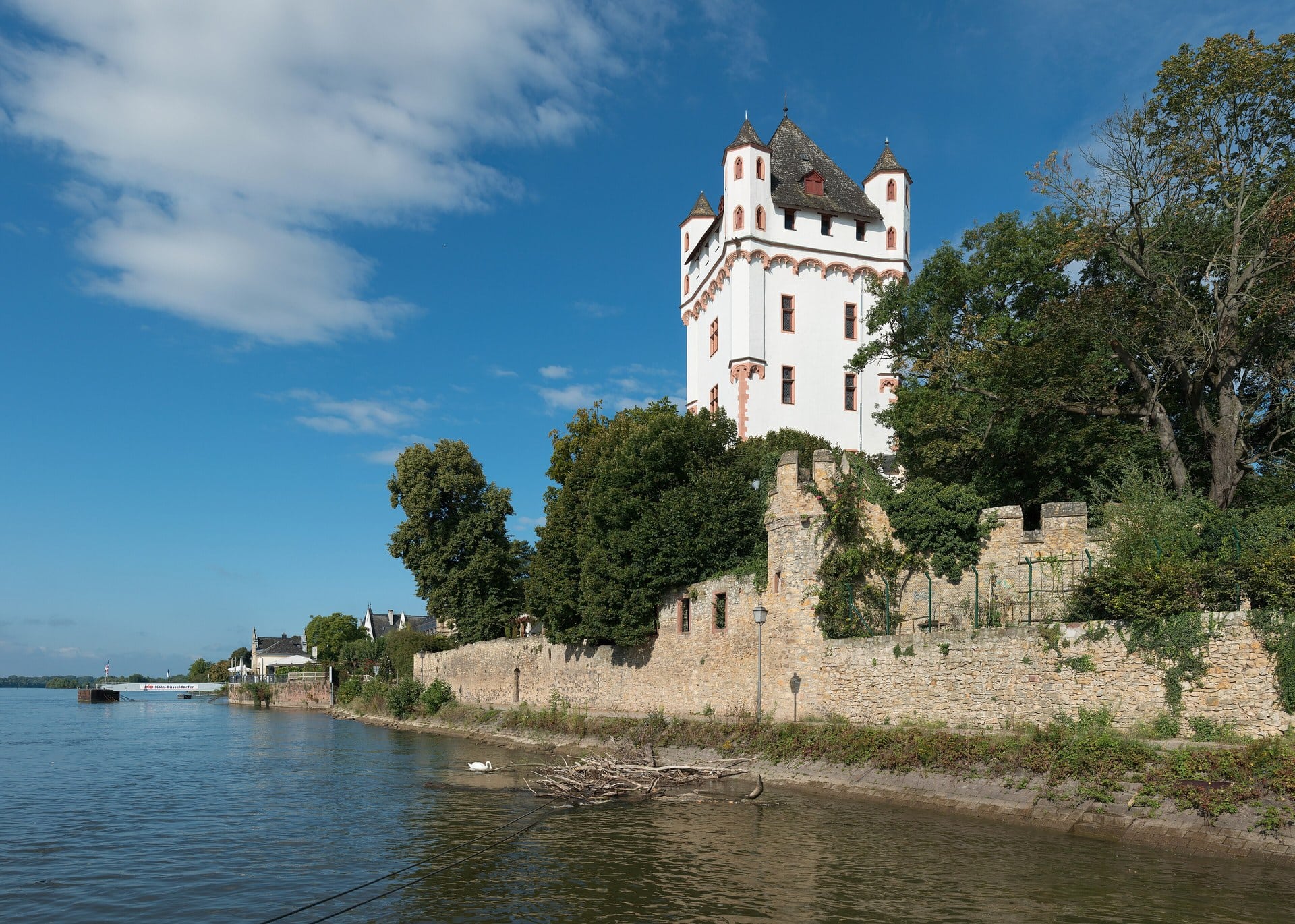
Eltville Castle
The Rhine bends north at Eltville, and on a quiet morning the town looks like nothing so much as a wine village: half-timbered houses leaning into the Burgstraße, the Rhine promenade running flat past the moored excursion boats, a single square tower visible from the river. The tower belongs to Eltville Castle (Burg Eltville, or by its archaic operator-style title Kurfürstliche Burg, the Electoral Castle), the partially-ruined fortified residence that grew, in stages, into the south-east corner of the medieval town wall. For most of its working life it was exactly what its archaic title still calls it: the principal Rhine-bank residence of the Archbishops and Electors of Mainz for roughly 150 years, from the 1330s to around 1480.
But the tower draws visitors today for a second reason, one the wine-village setting almost conceals. In a chamber on its first floor, on St. Anthony’s Day 1465, Johannes Gutenberg received the only public honor of his lifetime. Two years later, two streets away, a workshop running a press cast from Gutenberg’s own letterforms produced the first printed Latin–German dictionary. Eltville became the fifth printing town in the German-speaking lands.
Quick Facts
| Country | Germany |
| Region / State | Hessen, in the Rheingau on the right bank of the Rhine |
| Nearest Town | Eltville am Rhein, twelve kilometers west of Wiesbaden and thirty east of Frankfurt |
| Building Type | Burg — medieval Stadtburg with Wohnturm, in the French tour-résidence tradition |
| Construction Period | Town wall and round tower from 1330 under Archbishop Baldwin of Luxembourg; surviving keep 1337–1345 under Heinrich von Virneburg; interior fit-out continued to 1419; East Wing rebuilt 1682 |
| Founder | Archbishop Baldwin of Luxembourg (town walls and round tower); Archbishop Heinrich III von Virneburg, by the Eltville master mason Merkelin (keep) |
| Architectural Style | Gothic medieval (keep and curtain walls); early-Baroque East Wing (1682, architect Giovanni Angelo Barella) |
| Setting | Urban — south-east corner of the medieval town wall, directly on the Rhine bank |
| Current Condition | Partially ruined; Wohnturm and East Wing preserved; Palas and most outbuildings ruined since 1635 |
| Operator / Ownership | City of Eltville am Rhein (since December 1, 1936); Gutenberg memorial curated by the Burg- und Gutenberg-Verein Eltville e.V. |
| UNESCO Status | Not a UNESCO site — the Rheingau lies just upstream of the Upper Middle Rhine Valley World Heritage Site |
| Visitor Access | Castle grounds, courtyard, and rose garden free year-round; tower museum (Museum im Burgturm) ticketed; East Wing under active restoration in 2026 |
| Official site | eltville.de |
Predecessor, Baldwin’s wall, and the Mainz schism (pre-1300–1338)
Eltville’s Rhine bend carried fortifications before reliable documentation. A predecessor tower castle stood on the site by the late 13th century, strong enough to interest both Mainz and the imperial chancery, weak enough to fall in 1301 during the Zollkrieg, a conflict over Rhine river-tolls that pitted Adolf of Nassau against several Rhineland archbishops. That tower came down; the strategic riverbank position did not.
Eltville’s renewed commission came out of a peculiar twenty-year stalemate at Mainz. In 1328, the cathedral chapter elected Baldwin of Luxembourg (already Archbishop of Trier, already one of the most powerful Imperial Electors) as Archbishop of Mainz. Pope John XXII, who disliked Baldwin politically, refused to confirm him and provided Heinrich III von Virneburg instead. Both men claimed the seat. Baldwin, with the chapter and most of the Mainz nobility behind him, set about consolidating his position by walling Eltville as his Rheingau power base. In 1332 he obtained from Emperor Louis IV a grant of fortification privileges modeled on Frankfurt’s: the right to build town walls and moats, with the dignity of borough status. Eltville’s operator notes that into the mid-19th century the town remained the only chartered Stadt in the Rheingau.
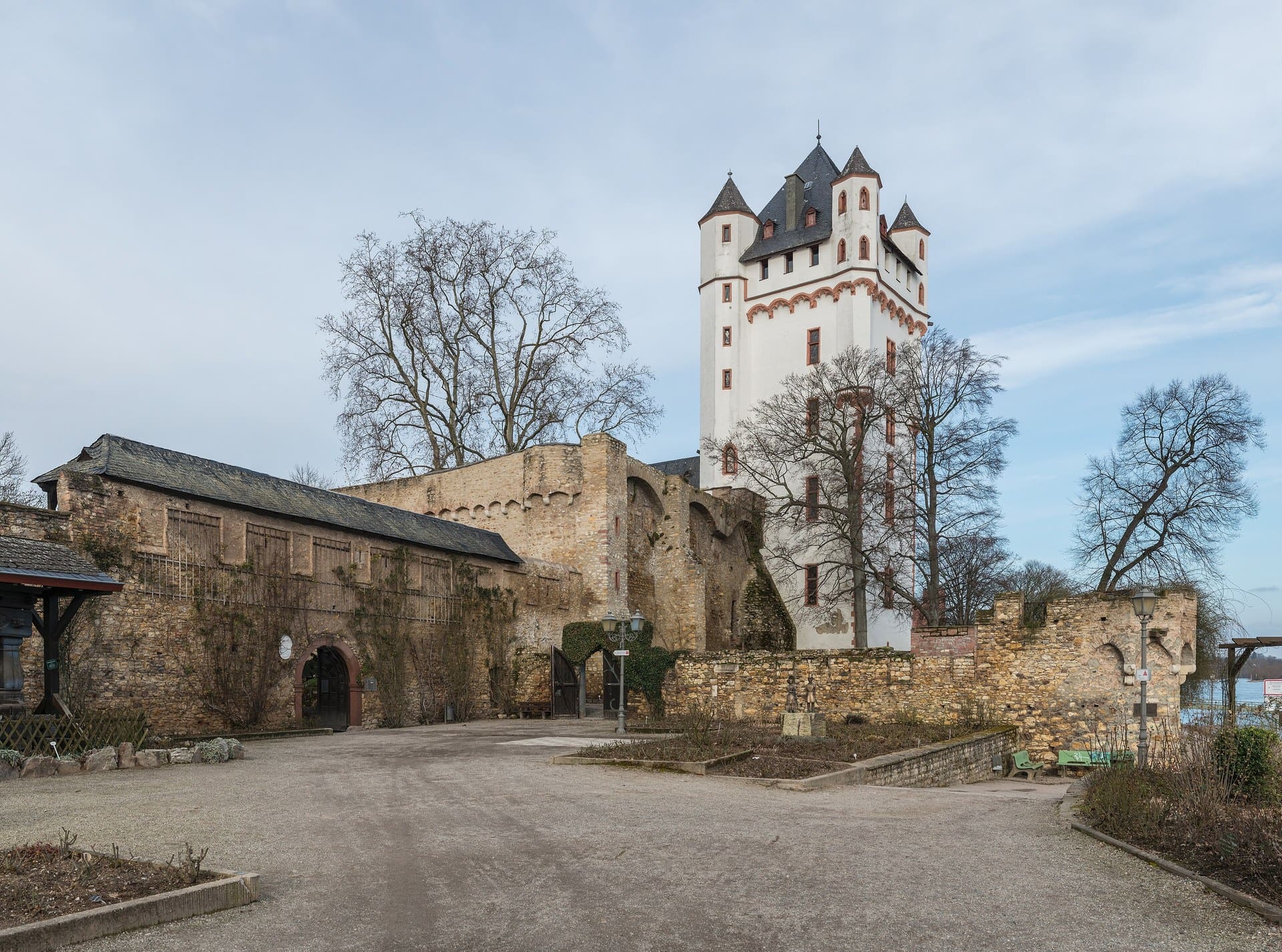
Construction Baldwin began was a layered defensive program. First, the town wall went up; a round tower marked the south-east corner where the wall met the Rhine. Remains of that round tower are still visible in the southern section between the standing keep and the palace wall, the only surviving fabric from Baldwin’s hand. But the building visitors actually climb today is not his. On November 12, 1336, Baldwin formally ceded his claim on Mainz to Heinrich von Virneburg (a delayed return of episcopal insignia followed in 1338, the date the operator brochures conventionally use). It fell to Heinrich to finish what Baldwin had begun.
Heinrich’s keep and 150 years of electoral residence (1337–1462)
Most of the surviving castle is Heinrich von Virneburg’s. Between 1337 and 1345 he commissioned the fortified residential tower (the Wohnturm) that gives Eltville its silhouette, built by the Eltville master mason Merkelin. European Castles Institute classifies the site as a Ringmauerburg with Wohnturm: a ring-walled enclosure on an irregular quadrilateral plan, anchored by a four-story residential tower in the French tour-résidence manner. Its closest typological cousins are the Archbishop of Trier’s Rhine-bank keeps at Boppard, Oberlahnstein and Andernach.
Its tower stands 24 meters at the parapet, 27 meters including the roof crown. Its basement walls measure 2.45 meters thick, dropping to 2.06 meters at first floor. A spiral stair tower attached to the south-west corner climbs through 118 steps (recounted as 123 in the 2024 brochure following recent access changes) to the Wehrplatte, the defensive platform at the top, which served as both fighting deck and observation post. Forty steps below the entrance, a dungeon cut into the rock reminded visitors that this was a functioning ecclesiastical lordship as well as a residence.
Interior matters more than exterior, and interior continued to be fitted out long after the fabric was up. The third floor holds the Domherrenkammer (the Capitular Chamber), vaulted in the 14th century and bearing a Virneburg keystone. The first floor holds the Grafenkammer, the Count’s Chamber, with its 14th-century mural fragments and, above the fireplace, a heraldic program installed by Archbishop Konrad III von Dhaun displaying the arms of Konrad, his parents and his grandparents. Konrad reigned from 1419 to 1434, and the brochure dates this hearth installation to the very start of his archiepiscopate: the 1419 date that closes the operator’s standard chronology of medieval interventions.
For roughly a century and a half (from Heinrich’s completion of the keep to the reconstruction of the Mainz Martinsburg in 1478–80 under Diether of Isenburg), the castle functioned as the Mainz Electors’ principal Rhine-bank residence. Eight successive electors used it as a working seat, traveling between Eltville, Aschaffenburg, Mainz proper, and the smaller Rheingau properties as politics required, but treating Eltville as the natural Rhineland fixed point. Documents were issued from the Grafenkammer; meetings of the cathedral chapter took place in the Domherrenkammer when the cathedral itself was disturbed; the household of an Imperial Elector (chancellor, marshal, almoner, chaplains) moved with the prince through these chambers.
The reason the period ended is the same reason it produced no Renaissance overlay: in mid-15th-century Mainz a dynastic war over the archiepiscopal seat unsettled everything the building had stood for, and within a generation the principal residence drifted back to the city proper.
The Stiftsfehde and Gutenberg’s only honor (1462–1465)
Mainz electoral seat fell vacant in 1459, and the cathedral chapter elected Diether von Isenburg. Diether refused to pay the annates Pope Pius II demanded, and Pius (citing Diether’s contumacia) provided Adolf II of Nassau in his place on August 21, 1461. That contest is now called the Mainzer Stiftsfehde, the Mainz See Feud. Diether had Wittelsbach Palatinate backing; Adolf had the Pope and, eventually, most of the chapter. On 27–October 28, 1462 the decisive event came overnight. Adolf’s troops, about 500 strong, were admitted through Mainz’s Gautor by treachery and stormed the city. Fighting lasted 12 hours and killed roughly 400 people. Adolf sacked the city, expelled some 800 burghers (about half were later readmitted), and on October 30 stripped Mainz of every civic liberty it had won over the preceding two centuries, reducing it from Freie Stadt to landsässige Stadt. On October 5, 1463 the Treaty of Zeilsheim settled the feud in Adolf’s favor.
The sack dispersed the Mainz printing trade. Johannes Fust and Peter Schöffer kept the original Mainz workshop going, but most of the trade’s journeymen scattered: to Cologne, Strasbourg, Bamberg, Basel, and across the Alps. Gutenberg himself, by then in his sixties, returned to the Rheingau, where his elder brother Friele Gensfleisch had a house. He lodged with relatives next to (not inside) the castle.
Three years later, on Thursday January 17, 1465 (St. Anthony’s Day, donrstag sant Anthonij tag in the surviving charter language), Adolf II ennobled him. The charter is preserved in the Mainz chancery registers as MIB 30, fol. 196, today in the Staatsarchiv Würzburg; a facsimile is on display in the Eltville keep. By its terms, Gutenberg became a Hofmann, a gentleman of the Mainz court, in exchange for a bodily oath of loyalty. That stipend was specific: 20 Malter of grain each year (approximately 2,180 liters in Mainz measure), 2 Fuder of wine (approximately 2,000 liters), an annual court livery, exemption from the Mainz excise, staple-duty and road-tolls when bringing goods into the city, and exemption from civic watch-duty, militia and taxes. The grain and wine were to be reserved for his household. Gutenberg could not resell them. It is the only public honor he is known to have received in his lifetime.
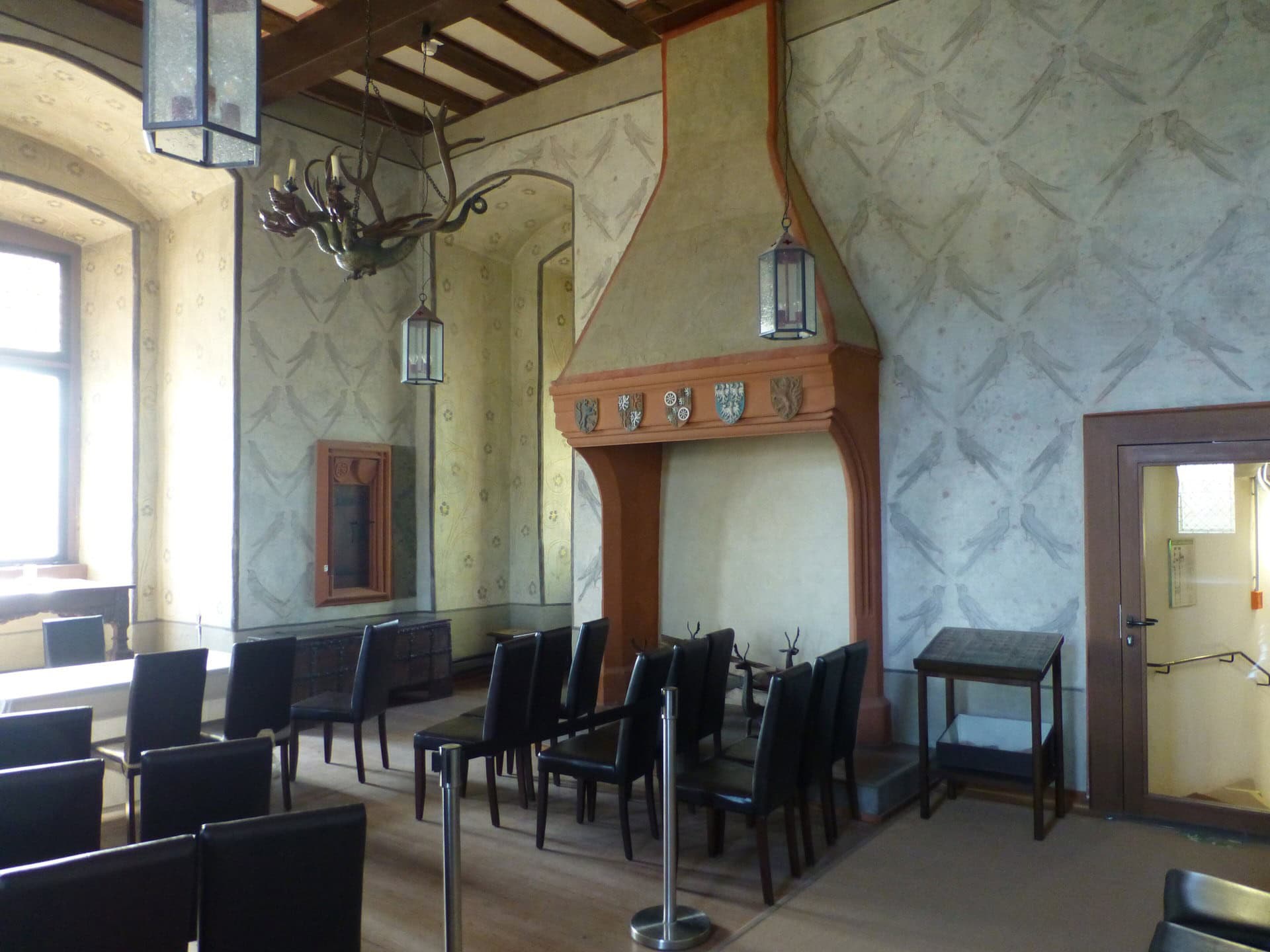
The room where the ennoblement took place is the Grafenkammer in the keep, the same chamber that Konrad III had decorated with his family arms four decades earlier. Visitors to the tower museum stand in it today.
The Bechtermünze press and Eltville incunabula (1467–1481)
Bechtermünze brothers were Mainz patricians. Their father Johannes had been a councillor; their family was joined to the Gensfleisch (Gutenberg’s family) by marriage in 1464, when Heinrich Bechtermünze’s daughter Elsbeth married Jakob Gensfleisch von Sorgenloch. By 1467 Heinrich and his younger brother Nikolaus were running a printing workshop in their Eltville town house at Kirchgasse 5 (the Hof Bechtermünz), two streets west of the castle.
Their first known imprint is the Vocabularius ex quo, a Latin–German dictionary compiled in the early 15th century for pauperes scolares: poor students who lacked Latin and needed translation help with the Scriptures and standard school texts. The work had circulated in manuscript for half a century before the Bechtermünzes printed it. The colophon dates the volume “ipso die leonardi confessoris, qui fuit quarta die mensis nouembris”: November 4, 1467, St. Leonard the Confessor’s Day. Heinrich Bechtermünze had died in July of that year, mid-print; Nikolaus completed the book together with a third partner named in the colophon, Wygandus Spyesz de Orthenberg, Wiegand Spieß von Ortenberg.
What makes the Vocabularius important to the Eltville story is not only that it is the first printed Latin–German bilingual dictionary anywhere, the foundational specimen of a bibliographic genre. It is that the type the Bechtermünzes used was Gutenberg’s own. The 1467 Eltville imprint was set in the same fount that Gutenberg had cut for the 1460 Catholicon in Mainz; the colophon deliberately echoes the Catholicon’s famous formula: “presens hoc opusculum non stili aut penne suffragio sed nova artificiosaque inventione”, “this little work [is produced] not by aid of stylus or pen but by a new and artistic invention.” Whether Gutenberg personally supervised the workshop cannot be confirmed from the documentary record. Stephan Füssel, the standard modern biographer and contributor to the Eltville operator brochure, writes that close contact “must have existed” but that direct supervision “cannot be verified by historical sources.” The type itself (the most material kind of evidence) argues for continuity, the kind of continuity that travels with hands and equipment more than with formal partnership.
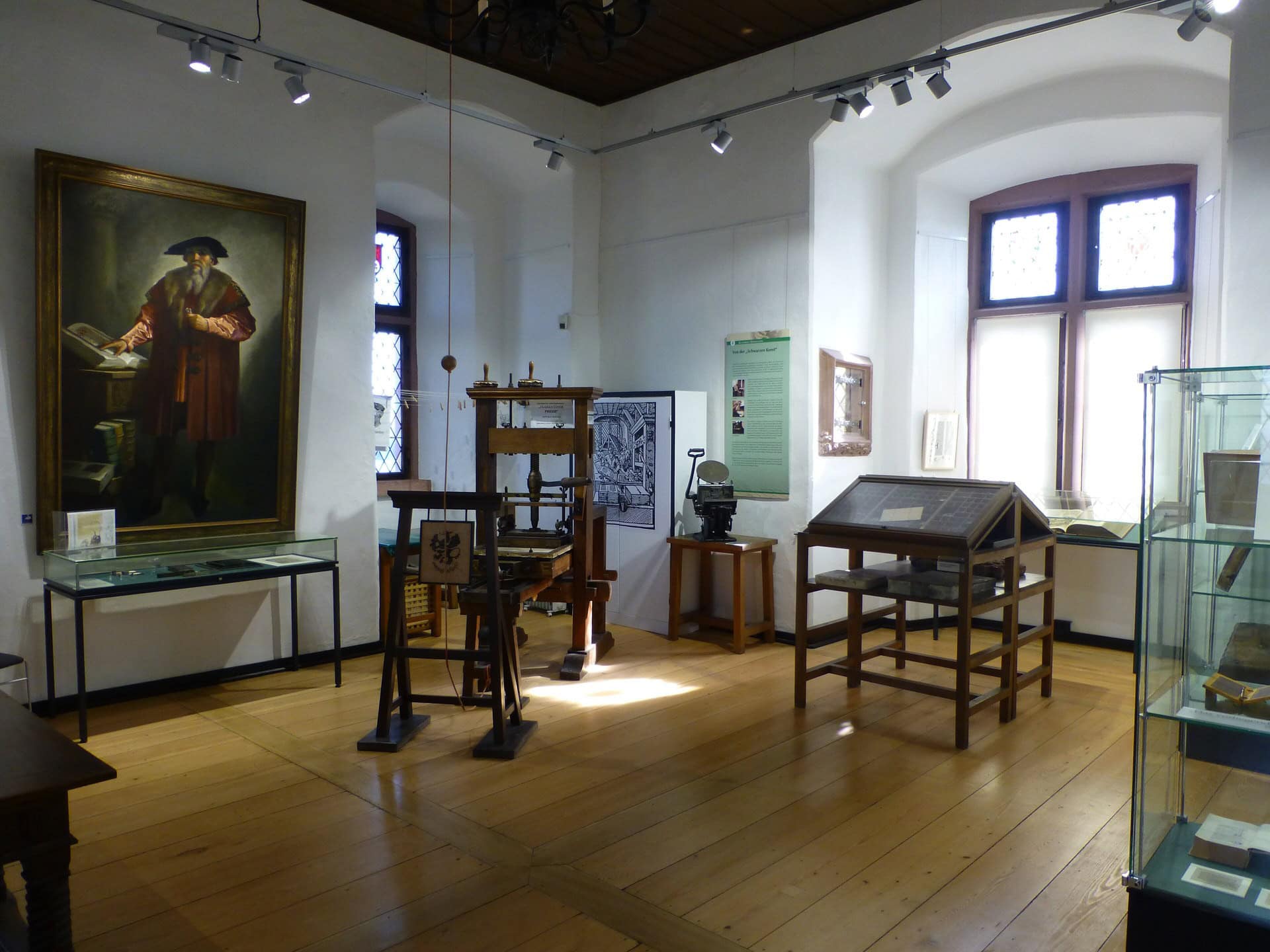
That press kept running for fifteen years after the first imprint. Nikolaus issued further Vocabularius editions in 1469, 1472, 1476 and 1477; a Thomas Aquinas (Summa de articulis fidei et ecclesiae sacramentis) in 1472; indulgences for Johannes de Cardona on behalf of the war against the Turks and the defense of Rhodes in 1480 and 1481; and a single-sheet broadside, issued by the mayor and council of Eltville on May 26, 1480, summoning the Cologne crossbow guild to a shoot the following August. The shop closed soon after 1481. Nikolaus’s son Johannes served briefly as mayor of Eltville and died there in August 1483. The unique complete copy of the 1467 Vocabularius survives at the Bibliothèque nationale de France in Paris; the 1472, 1476 and 1477 editions have been digitized by the Bayerische Staatsbibliothek and the Badische Landesbibliothek.
Eltville therefore takes its place as the fifth printing town in the German-speaking lands (after Mainz, Gutenberg c. 1454–55; Strasbourg, Mentelin c. 1459–60; Bamberg, Pfister c. 1459–61; and Cologne, Zell 1464–66), and the sixth in the world if Subiaco (Sweynheym and Pannartz, 1464–65) is counted. Bechtermünze press is the one direct documentary link between a German castle town and the diffusion of incunabula.
Swedish destruction and civic ownership (1475–1936)
Adolf II of Nassau died at the Kurfürstliche Burg on September 6, 1475, the last Archbishop and Elector of Mainz to use Eltville as his principal seat. His successor Diether von Isenburg, now reconciled to the chapter on his second tenure, began constructing a new Martinsburg in Mainz in 1478, completing it in 1480/81 and shifting the electoral household decisively back to the cathedral city. Eltville’s working role wound down; the town remained a Mainz electoral possession and the keep continued to be inhabited, but the great chambers fell into administrative routine rather than ceremony.
A blow came in the Thirty Years’ War. Mainz fell to Gustav II Adolf in December 1631 after Breitenfeld, and the Swedish occupation extended through the Rheingau in the following months. Town survived; the castle did not. On their withdrawal in 1635, retreating Swedish troops set the complex on fire and threw down the curtain walls. Only the Wohnturm survived in habitable form. The Palas, the outbuildings and the inner courts were left as broken masonry, and remained so for nearly half a century.
Reconstruction came at one point only, and on a limited scale. In 1682, under Elector Anselm Franz von Ingelheim, the Italian-trained architect Giovanni Angelo Barella rebuilt the East Wing in a reduced two-story form, extending it northward. The hall on its upper floor (the present Kurfürstensaal) is the Baroque chamber that today hosts civil weddings. The Palas and the rest of the complex stayed as ruin.
The castle remained Mainz electoral property until the Reichsdeputationshauptschluss of 1803 secularized the archbishopric. It passed to the Duchy of Nassau (formally constituted in 1806), to Prussia after the 1866 Austro-Prussian War, and finally, on December 1, 1936, to the City of Eltville. Restoration campaigns followed in 1938, again across the 1980s, and most recently from 2008 onward. The Burgturm restoration begun in 2008 was completed in autumn 2021; work in 2026 has shifted to the East Wing.
Visiting Eltville Castle in 2026
Eltville Castle sits at the river end of the Burgstraße in the old town. The grounds (the courtyard, the Zwinger between the outer and inner walls, and the rose garden in the moat) are open year-round at no charge. The tower museum (Museum im Burgturm) operates on a two-season schedule. In summer, from April 1 to October 30, 2026, it opens daily from 10:30 to 17:00, with last admission to the Wehrplatte at 16:30. In winter (November 1, 2025 to March 31, 2026, then again from November 1, 2026), the museum operates from 11:00 to 15:30, last admission at 15:00. Entry tickets and local tours can also be booked in advance through GetYourGuide.
| Ticket | Price |
|---|---|
| Adult | €3.50 |
| Students, apprentices, severely disabled (age twelve and over) | €2.50 |
| Groups (ten or more, per person) | €2.50 |
| Children’s groups (age twelve and over, ten or more children) | €1.50 |
| Children under eleven | Free |
The visitor’s path runs through the Tourist Information at ground level, up the spiral stair into the Grafenkammer with its 14th-century mural fragments and Konrad III’s heraldic hearth, up again into the Gutenberg memorial on the second floor (curated by the Burg- und Gutenberg-Verein, with the historic Florentine printing press installed in 2012), through the Domherrenkammer with its Sammlung Alta Villa of town-history artifacts, and out onto the Wehrplatte at the top. The view from the parapet is the standard payoff: the old town and the Rhine to the south, the vineyards rising to the Taunus foothills to the north, the river bending east toward Wiesbaden.
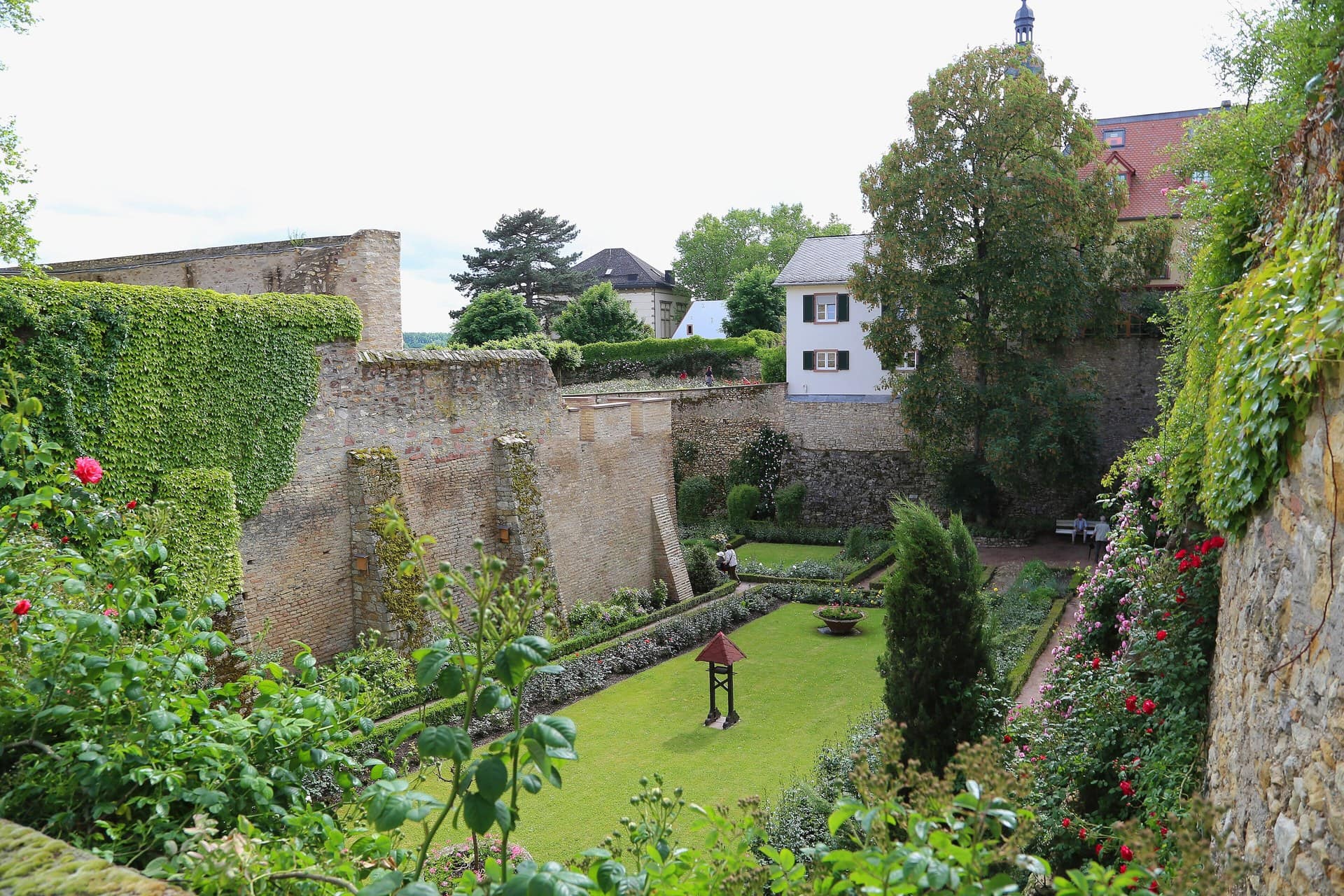
From early June through autumn, the rose garden in the moat below the keep fills with color: more than 20,000 bushes in over 350 varieties, laid out from 1979. Eltville’s annual Rosentage festival is held on the first weekend of June (6–June 7 in 2026).
A practical note for 2026: with the East Wing under active renovation, the Baroque courtyard is partially fenced and the Kurfürstensaal is closed to casual visitors, although it remains in use for booked civil weddings. The keep, the museum collections and the rose garden are unaffected. The Tourist Information building is historic and not barrier-free; staff will bring brochures to the door on request. Eltville town sits on the Frankfurt Hauptbahnhof–Koblenz regional rail line; Eltville station is a twelve-minute walk from the castle. Wiesbaden is 12 km east, Frankfurt 30 km. Anyone staying overnight can compare hotels in and around Eltville.
Some links on this page are affiliate links, which means StoneKeep Atlas may earn a small commission, at no extra cost to you, if you book through them.
Beyond Eltville Castle
For readers following the Mainz electoral story, the natural next stop is Schloss Johannisburg in Aschaffenburg, which became the Mainz Electors’ principal residence in the 17th century, rebuilt by Georg Ridinger in red sandstone between 1605 and 1614. These two articles work as a single narrative: Eltville’s electoral century closes as Johannisburg’s begins.
For the parallel ecclesiastical-princely tradition further east, the Würzburg Residence and its earlier defensive sibling Marienberg Fortress tell the Prince-Bishop story at a different and grander scale. For Rhine-corridor readers, Marksburg (the only Middle Rhine fortress never destroyed) sits forty kilometers downstream, and Rheinstein Castle just beyond it in the Rhine Gorge. For readers drawn to the Spessart side of Mainz territory, Schloss Mespelbrunn preserves the moated Renaissance setting of a Mainz Reichsritter household; and for the rival electoral tradition to the south, Heidelberg Castle offers the contrast of the Wittelsbach Electors Palatine, partially ruined on a different scale and for different reasons.
This article is one chapter in StoneKeep Atlas’s wider treatment of German prince-bishop and electoral residences. Readers can continue the Rhine thread at Castles of the Rhine Gorge, Eltville’s nearest neighbor-cluster downstream.
Closer to home in Hesse, the hilltop ruin of Frankenstein Castle crowns the northern Odenwald above the Rhine plain south of Darmstadt, a genuine thirteenth-century knights’ seat whose documented history has nothing to do with the monster legend later attached to its name.
Far to the north of the state, in the forests above the Edersee, Waldeck Castle offers a very different Hessian story: the hilltop cradle of the Counts of Waldeck, a small princely house whose seat became in turn a fortress, a prison, and a hotel.
Conclusion
Eltville is, in the end, an electoral residence that happens also to be the cradle of a printed dictionary, and the conjunction is what makes it unlike any other Rhine-bank castle. Adolf II of Nassau ruled the archbishopric from this tower; Gutenberg, by his patronage, was made Hofmann in the Grafenkammer; and two streets away, the Bechtermünze press set the Vocabularius in the type of the Catholicon. By the time the Swedes set fire to the complex in 1635, the electoral function had long since drifted back to Mainz, but the print runs from Eltville’s workshops had already gone to libraries from Paris to Stuttgart. What remains today is half an electoral seat and the memory of a small revolution, the tower still rising at the south-east corner of the town wall, the Rhine still sliding past below, and the rose garden growing in the place where the moat used to be.
For the broader confessional history of the German castle between 1521 and 1648, see The Reformation and the Castle.
Principal Sources
- Cremer, Folkhard, et al. Dehio Handbuch der Deutschen Kunstdenkmäler, Hessen II: Regierungsbezirk Darmstadt. Berlin: Deutscher Kunstverlag, 2008.
- Frank, Lorenz, and Natalie Mielke. Die Burg Eltville am Rhein. Rheinische Kunststätten 590. Köln: Rheinischer Verein für Denkmalpflege und Landschaftsschutz, 2023.
- Füssel, Stephan. Johannes Gutenberg. Reinbek: Rowohlt, multiple editions.
- Grubmüller, Klaus, ed. Vocabularius Ex quo: Überlieferungsgeschichtliche Ausgabe. 6 vols. Tübingen: Niemeyer, 1988–2001.
- Kapr, Albert. Johann Gutenberg: The Man and His Invention. Translated by Douglas Martin. Aldershot: Scolar, 1996.
- Müller, Rolf, ed. Schlösser, Burgen, alte Mauern. Wiesbaden: Hessendienst der Staatskanzlei, 1990, pp. 99–100.
Operator and institutional resources used for visitor information and primary sourcing: Stadt Eltville am Rhein, official castle page at eltville.de, including the “Burgrundgang” English brochure and “On Gutenberg’s Footsteps / 2023” brochure with technical contributions from Prof. Dr. Stephan Füssel, Director of the Institute for Book Studies, Johannes Gutenberg University Mainz; Burg- und Gutenberg-Verein Eltville e.V. at burgverein-eltville.de; European Castles Institute, EBIDAT object 1968 at ms-visucom.de; Incunabula Short Title Catalogue iv00361700 at the British Library; Institut für Mainzer Kirchengeschichte, Bistum Mainz, vitae of Heinrich III von Virneburg and Adolf II von Nassau.
Image credits. Featured image (tower from the Rhine, East view): photo by DXR, CC BY-SA 3.0, via Wikimedia Commons. Inline images credited in their captions: southwest view of the complex by DXR (CC BY-SA 4.0); Grafenkammer interior and Gutenberg memorial room by Muck (CC BY-SA 4.0); rose garden by J.-H. Janßen (CC BY-SA 3.0). All images sourced from Wikimedia Commons. Freely licensed images are resized to fit; otherwise unaltered.