
Ludwig II and the Architecture of Dreams
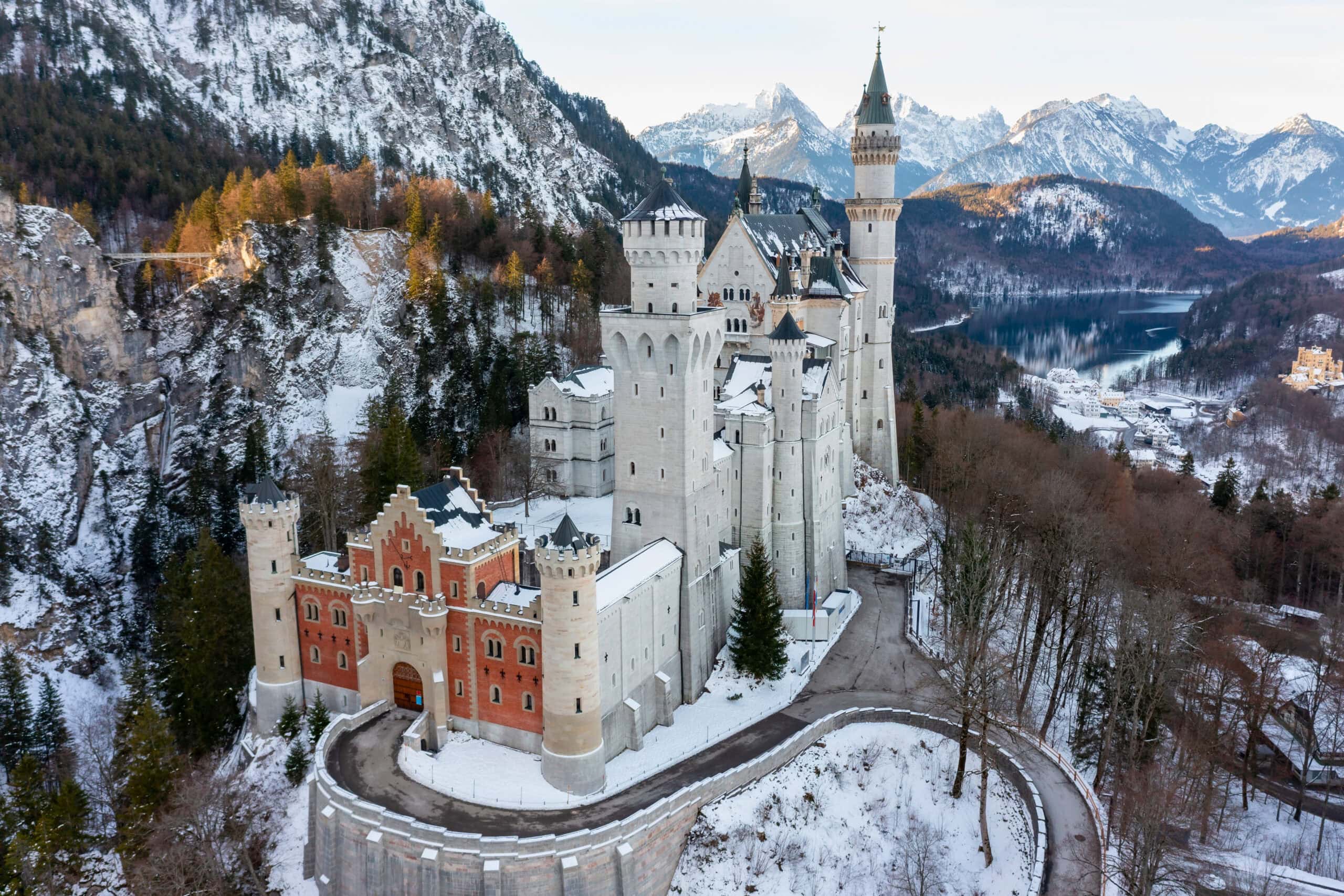
On September 5, 1869, three years and two months after Bavaria’s army lost the Austro-Prussian War in seven weeks, King Ludwig II of Bavaria signed the foundation deed of a castle that would never be finished. The site sat 200 meters above his father’s medievalist palace at Hohenschwangau; eight meters of rock had been blasted from the summit to make room; the surveyed plan was Eduard Riedel’s, the picturesque silhouette Christian Jank’s, the iconographic program the literary historian Hyazinth Holland’s. A small metal capsule containing construction drawings, porcelain portraits of the king, and contemporary Bavarian coinage was placed under the stone. Ludwig was 24 years old. He had been king of Bavaria for five years.
By the time the stone went down, the conditions under which a Bavarian king could express ambition in public architecture had already collapsed. The 1866 Treaty of Berlin had imposed a 30-million-gulden indemnity and a parallel secret defensive-offensive alliance that transferred command of the Bavarian army to Prussia in the event of war. Sixteen months after the foundation stone was set, on November 30, 1870, Ludwig would sign the so-called Kaiserbrief inviting Wilhelm I of Prussia to assume the imperial crown of a unified Germany: a letter drafted by Bismarck and copied out by Ludwig in his own hand in exchange for a secret cash flow that would underwrite the very castle whose first stone he had just laid. Neuschwanstein, in this sense, is not an aesthetic decision insulated from politics. It is an architectural fact made possible by a specific political bargain, and legible as a statement only against the political position it implicitly reframes. Ludwig II and the architecture of dreams (the subject of what follows) begins not with fantasy but with a specific political bargain that made the fantasy financially possible.
The Hohenschwangau formation
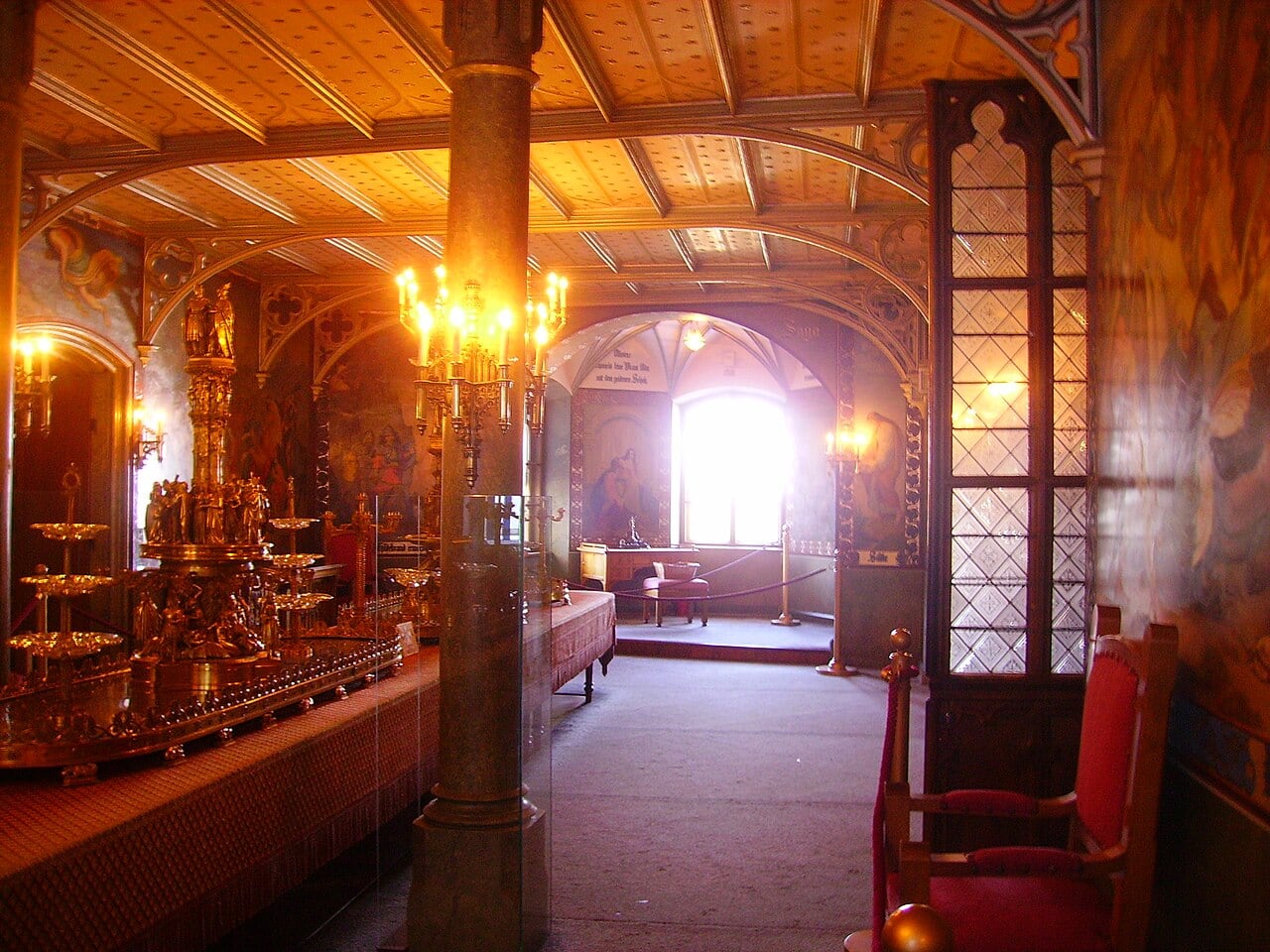
Ludwig II’s medievalist visual program, later imposed on Neuschwanstein, was not invented in response to political reverses. It was the architectural language of his upbringing. Between 1832 and 1837, his father (then Crown Prince Maximilian, later King Maximilian II) rebuilt the ruined medieval Schwanstein into the four-towered Romantic-revival schloss of Hohenschwangau, to designs by Domenico Quaglio. Its interior was painted over the next decade with fresco cycles by Moritz von Schwind, Lorenzo Quaglio, and Wilhelm Lindenschmit: scenes from the Lohengrin legend, the Tannhäuser saga, the Wartburg song contest, and the Nibelungen. Ludwig, born August 25, 1845, grew up inside this iconographic program. Figures he would later commission for Neuschwanstein’s wall paintings were already on the walls of the rooms where he slept.
His encounter with Wagner himself was layered, not the single transformative moment that popular biographies often describe. By his early teens, around 1858, Ludwig had received Wagner’s prose work Oper und Drama as a gift; he saw his first staged Lohengrin at the Munich Hof- und Nationaltheater on February 2, 1861, at the age of 15, and his first staged Tannhäuser on December 22 of the same year. Hohenschwangau’s frescoes had given him the iconography. Wagner’s writings supplied the theoretical frame. Munich’s 1861 performances offered the music in performance. By the time Ludwig succeeded his father on March 10, 1864 (at the age of 18, after Maximilian II’s sudden death) the architectural and operatic vocabulary that would define his reign was already in place.
This sequence matters for what came next. The Wagnerian-medievalist imagination did not emerge from the trauma of 1866 or the federal absorption of 1871. It preceded both. What changed after those events was not the imagination but its political horizon. The castle projects of the late 1860s and 1870s redirect an inherited program onto private terrain after the public terrain closed.
The Wagner patronage and the public-cultural program (1864–1866)
Ludwig’s first phase as king treated Wagner and the medievalist cultural program as projects of the Bavarian state. On May 4, 1864 (within eight weeks of his accession) Ludwig dispatched his cabinet secretary Franz von Pfistermeister to find the composer, then in flight from creditors. By the end of the month Wagner was installed at a royal villa near Starnberger See; his debts had been settled at roughly 21,000 gulden; an annual salary of 4,000 gulden had been arranged, publicly disclosed as 1,200. In 1864 alone, payments from Ludwig’s cabinet treasury to Wagner totaled 42,333 gulden; lifetime Wagner-related expenditures would, by Sven Friedrich’s reckoning, consume under a seventh of the royal civil list.
These were public acts. They had public results. Tristan und Isolde, the work Wagner had been unable to mount anywhere else, premiered at the Munich Hof- und Nationaltheater under Hans von Bülow on June 10, 1865. Die Meistersinger von Nürnberg followed on June 21, 1868. In the same period, Ludwig commissioned Gottfried Semper to design a monumental Festival Theatre on the Isar (a public Munich Festspielhaus large enough to mount the unfinished Ring cycle) for which Semper produced detailed drawings between 1864 and 1866. Architecture in this phase was civic. The opera was public. The cultural argument was state-sponsored.
Munich’s political class did not accept this program quietly. In December 1865, a cabinet ultimatum citing both fiscal scandal and the parallel scandal of Cosima von Bülow’s pregnancy by Wagner forced the composer’s removal from Munich. That Festival Theatre never broke ground. By 1872 Wagner had committed to Bayreuth, where Ludwig’s separate 1874 loan of 100,000 Thaler (300,000 marks) would underwrite the Festspielhaus actually built. The 1869 and 1870 Munich premieres of Das Rheingold and Die Walküre (the latter two over Wagner’s protest that the Ring should premiere only at Bayreuth) were the surviving public residue of a program that had already begun to retreat. By the time Neuschwanstein’s foundation stone was laid in September 1869, the Munich civic ambitions had collapsed and the architectural ambitions had migrated upward into the Alps.
Political defeat and the closing of the public sphere
Fought across June and July 1866, the Austro-Prussian War lasted seven weeks. Bavaria, allied with Austria, was defeated in a series of small engagements along the Main and at Kissingen, and signed the Treaty of Berlin on August 22. The published terms were severe (a 30-million-gulden indemnity and the cession of three small districts including Gersfeld and Orb), but the parallel terms were the structurally decisive ones. A secret defensive-offensive alliance signed the same day transferred command of the Bavarian army to the King of Prussia in the event of war. Bavaria’s military sovereignty effectively ended on August 22, 1866. Its diplomatic sovereignty would last four more years.
Bavaria’s transition of 1870–71 left an unusually clean paper trail. On November 19, 1870, the Prussian ambassador to Bavaria, Count Georg von Werthern, telegraphed Bismarck from Munich: King Ludwig was in cash difficulties from his castle projects, and “six million gulden would be very agreeable to him, provided the ministers did not know. For this sum, he would also make up his mind on the Imperial Proclamation.” The Bavarian negotiator was Maximilian, Count von Holnstein, the king’s chief equerry. The source of funds proposed was the Welfenfonds: the seized private fortune of the deposed King George V of Hanover, re-sequestered by Prussian royal decree on March 2, 1868 and administered outside Reichstag oversight.
Ludwig signed the Kaiserbrief at Hohenschwangau on November 30, 1870, three days after Bismarck completed the draft. Prince Luitpold delivered it to Wilhelm I at Versailles on December 3. On January 18, 1871, the Imperial Proclamation followed; Ludwig was absent.
That financial side delivered as promised. An annuity of 300,000 gold marks per year was paid to Ludwig personally from 1871 to 1886; reputable sources disagree on the total, which is variously given as roughly 4.7 to 5.2 million gold marks across the period. Holnstein took ten percent of every transfer as commission. Funds were channeled through Swiss banks to settle construction accounts at Neuschwanstein, Linderhof, and from 1878 Herrenchiemsee. Late Ludwig’s architecture was, in this strict sense, the architecture of the sovereignty that had just been surrendered. The Prussian apotheosis was happening on a different mountain: Friedrich Wilhelm IV’s reconstruction of Hohenzollern was completed in 1867, a year after Königgrätz, under Friedrich August Stüler. Both events belong to the same compositional logic. They were registered, on Ludwig’s side of the new arrangement, with very different consequences.
Neuschwanstein as Wagnerian Gesamtkunstwerk
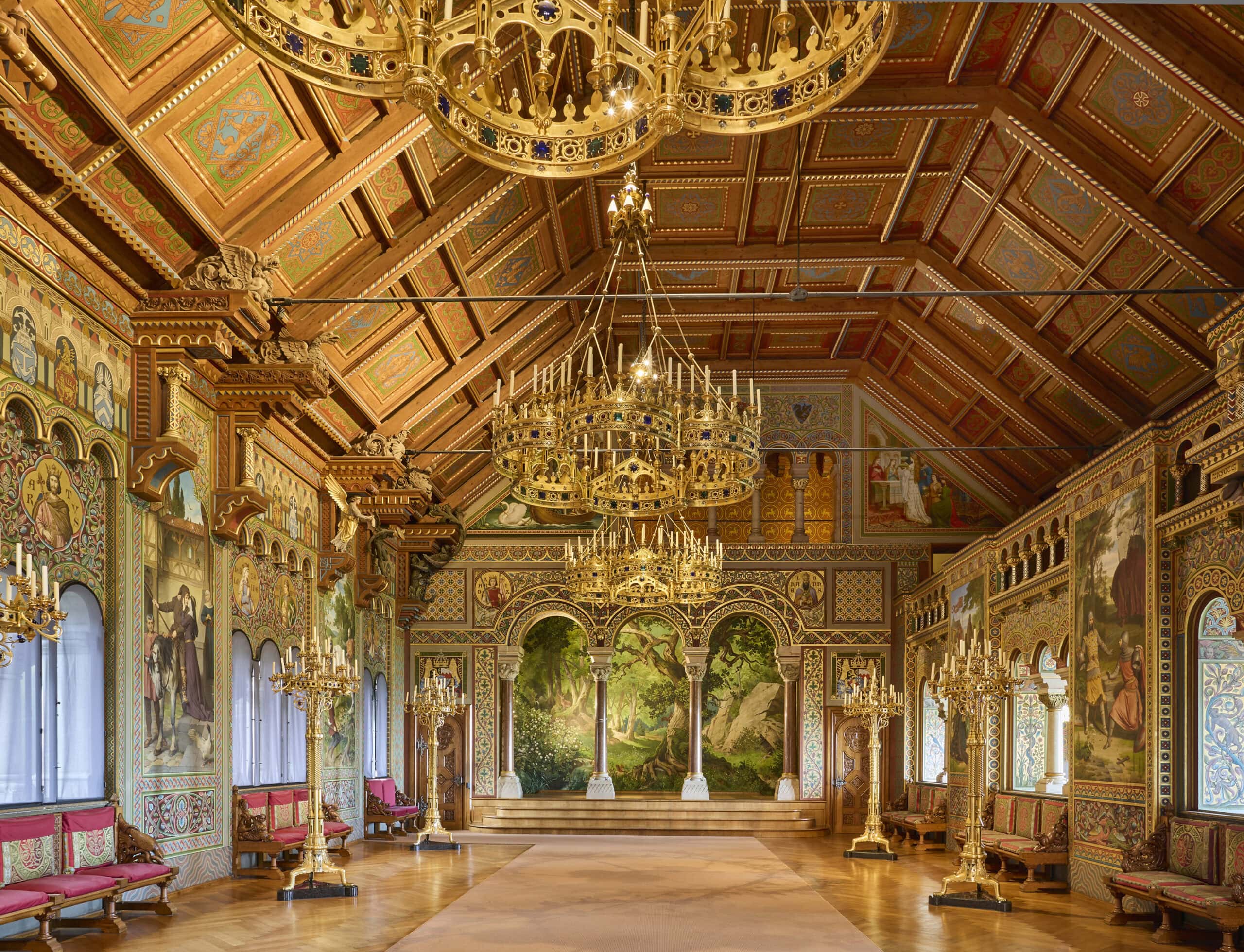
Neuschwanstein’s iconographic argument is unusually explicit. It is not a generic medieval-revival pastiche but a sequence of specifically Wagnerian operatic citations, rendered in architecture rather than performed on a stage. The Sängersaal on the fourth floor reproduces, in plan and decorative scheme, the Festsaal of the Wartburg (the medieval seat where the song contest of Tannhäuser was traditionally located), and its mural cycle depicts Tannhäuser and Parsifal episodes. Its royal bedroom is decorated with a Tristan und Isolde fresco cycle. Its Throne Hall is a Byzantine pastiche modeled on the Hagia Sophia, with a planned throne that was ordered but never delivered. The bedroom, the throne room, the singers’ hall: each is a stage set for a Wagner work, with no audience.
Personnel of the project carry the same argument in the design history. Three principals shaped the surviving castle, and only one was a working architect in the conventional sense. Eduard Riedel, the BSV architect of record from 1869 to 1874, translated the king’s intentions into structurally sound plans. The picturesque silhouette that produced the recognizable Neuschwanstein image was the work of Christian Jank, a Munich stage painter who had designed scenery for Wagner’s Lohengrin in 1867 and for the 1862 Munich Fairytale Maskenfest, and who supplied the project with what the Bavarian palace administration’s own architectural history calls Idealansichten: idealized perspective views, not buildable drawings. The interior decorative program after 1884 was the work of Julius Hofmann, working from iconographic schemes developed by the literary historian Hyazinth Holland. Georg von Dollmann replaced Riedel in 1874 and progressively simplified Jank’s pictorial elaborations as the cost overruns mounted. The chain runs theater scenery → idealized view → structural plan → executed building, with the theatrical source at the top of the sequence and the building at the bottom.
Execution registered the same logic. The castle was conceived in 1868 as a rebuilt medieval Burg above Hohenschwangau, evolved over the next decade into a much larger Romanesque-revival palace, and by Ludwig’s death in 1886 had completed only roughly fifteen of approximately two hundred planned rooms. Disbursed expenditure had reached 6.18 million marks against an original estimate of 3.2 million. Ludwig occupied Neuschwanstein for fewer than two hundred days in total across the seventeen years of its construction. It was not, in any practical sense, a residence. It was an architectural performance designed to be witnessed by an audience of one.
Linderhof and Herrenchiemsee as Bourbon counter-monuments
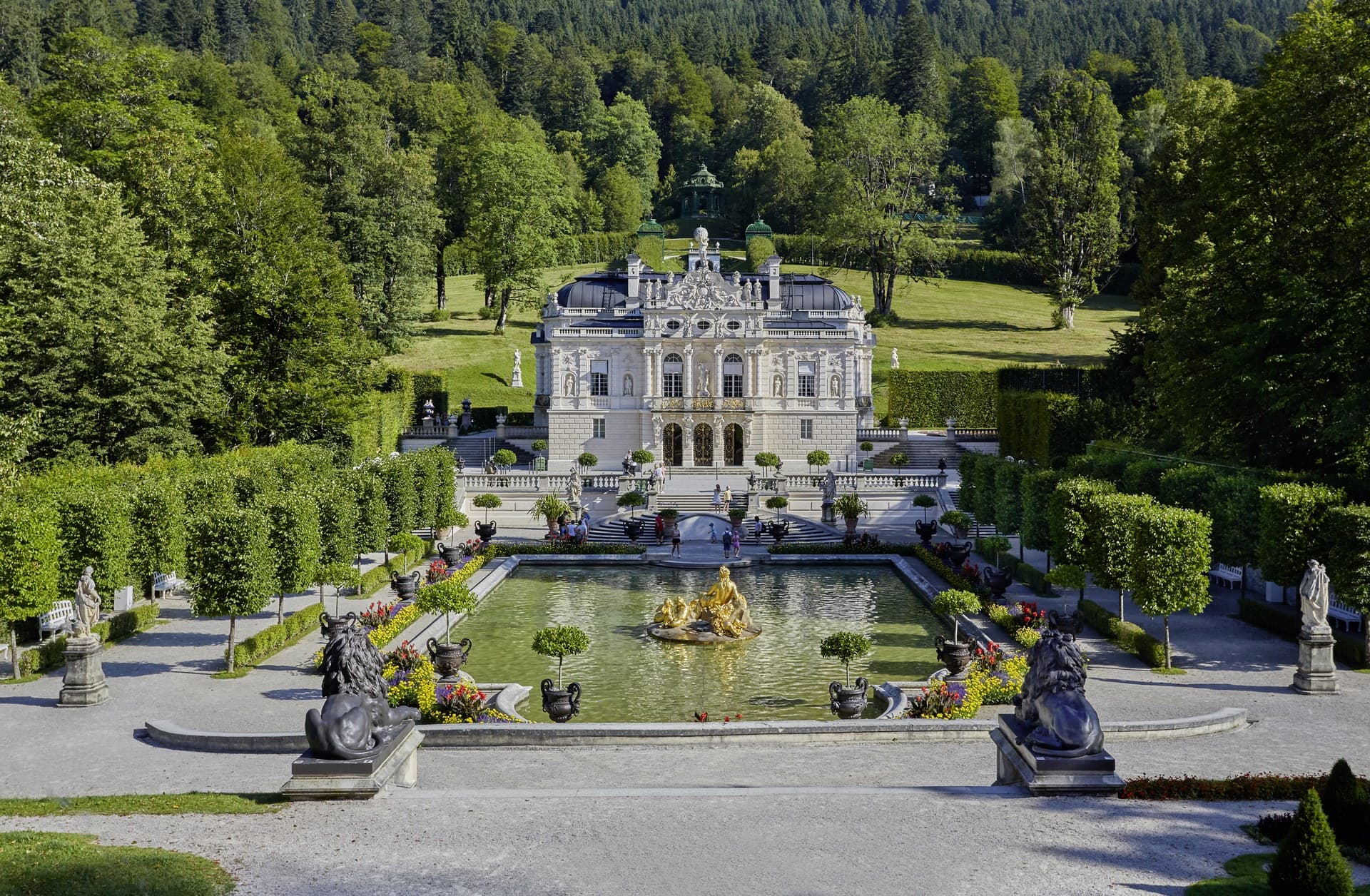
Ludwig’s second architectural branch took its citations not from medieval Germany but from Bourbon France. Linderhof, begun in 1869 as a remodeling of his father’s 1790 hunting lodge (the Königshäuschen) and evolving over six documented construction phases to its final form by 1879, was the only one of the three royal palaces Ludwig completed and inhabited. Its idiom is not the grand axial Versailles but the more intimate Rococo of Louis XV’s chamber palaces: the Petit Trianon and Marly. Georg von Dollmann was the principal architect; Carl von Effner laid out the gardens. The Hall of Mirrors is small; the Hundinghütte in the grounds is a faithful architectural replica of the stage set Wagner specified for Hunding’s hut in the first act of Die Walküre; the Venus Grotto, an artificial cavern with a swan boat and electric stage lighting, dramatizes the opening of Tannhäuser. Total disbursed cost at Ludwig’s death was 8.46 million marks. Ludwig occupied Linderhof for substantial periods over a decade.
Herrenchiemsee, by contrast, is the explicit Versailles citation. Ludwig purchased the island of Herreninsel in the Chiemsee in 1873 for 350,000 gulden, specifically to build a copy of the Sun King’s palace; the foundation stone was laid on May 21, 1878 to designs by Dollmann, replaced by Julius Hofmann in 1884. The garden facade reproduces the western front of Versailles in nearly 1:1 dimensions; the Hall of Mirrors, completed before Ludwig’s death, is slightly longer than its original. The interior program (the Grand Apartment, the State Bedchamber, the Ambassadors’ Staircase) translates Louis XIV’s ceremonial vocabulary into the late nineteenth century with little modification. The original construction estimate ran to approximately 5.7 million marks; by 1886, with only twenty of the planned seventy rooms completed, disbursed expenditure had reached 16.58 million marks, roughly three times the initial figure. Ludwig occupied Herrenchiemsee for nine days in September 1885. He never returned.
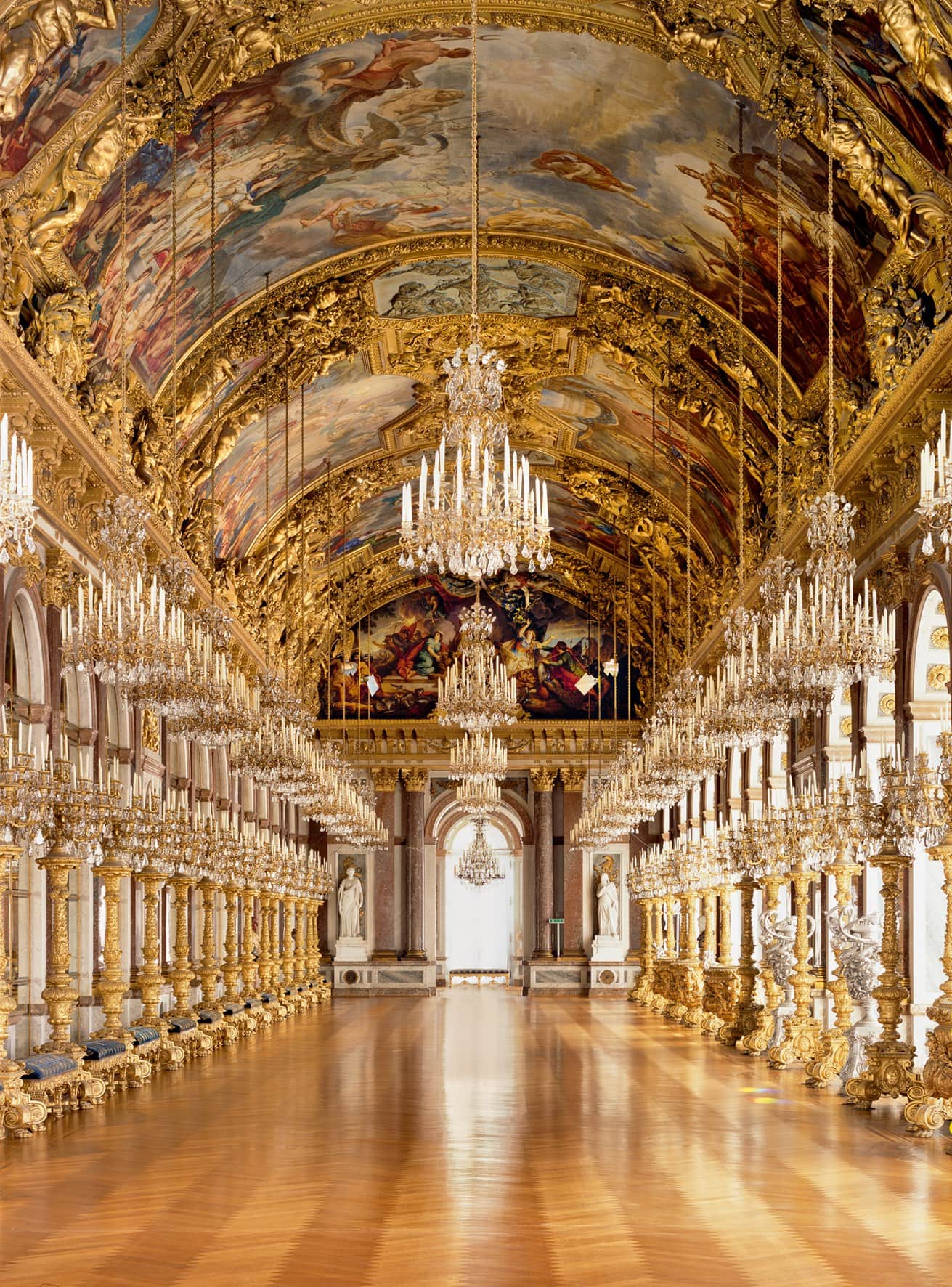
This Bourbon citation does the political work the Wagnerian medievalism could not. Where Neuschwanstein invokes a German imperial tradition that was being captured by Prussia, Herrenchiemsee invokes an absolutist French monarchy that had ended in 1789 and could no longer be co-opted by anyone. That vanished absolutism, and the palace built to embody it, is the subject of our companion history, Versailles and the Architecture of Absolutism. Linderhof’s smaller intimate-chamber idiom belongs to the same logic at a different register: not the public ceremonial Versailles but the private retreat at the Petit Trianon, where Louis XV had withdrawn from the formal court. Both palaces situate Ludwig within an alternative sovereign tradition, one that, by the late nineteenth century, was unambiguously historical. He could be its custodian without anyone contesting the claim.
The collapse and the legend (1886)
On June 8, 1886, a four-physician commission (Bernhard von Gudden, Friedrich Wilhelm Hagen, Hubert Grashey, and Max Hubrich) signed a psychiatric report declaring Ludwig II permanently incapacitated by paranoia. Legally, the verdict the report sought was constitutional: Bavarian law required incapacity demonstrably lasting more than one year to justify a regency. None of the four physicians had examined the king in person. Their diagnosis was reconstructed from selected servant testimony and ministerial correspondence. Modern psychiatric historiography is divided: Reinhard Steinberg and Peter Falkai argued in 2021 that Gudden’s reasoning was at least defensible by 1880s nosology, while others read the evidence as a schizotypal personality with compulsive building and severe social phobia: impairment of some kind, but not the paranoia the report certified. The Council of Ministers ratified the report on June 9; Prince Luitpold was proclaimed regent on June 10.
A first deposition commission was turned back at Neuschwanstein by Ludwig’s gendarmerie on the morning of June 10; several commissioners were briefly held in the castle gate. A second commission arrived overnight on 11–June 12 with sufficient force, and Gudden personally informed Ludwig of the verdict. At four o’clock in the morning of June 12, the king was transported by closed carriage from Neuschwanstein to Schloss Berg on the Lake Starnberg. On the evening of June 13, Ludwig asked Gudden to accompany him on a walk along the lakeshore without other attendants. Their bodies were recovered from the shallow water before midnight; the king’s watch had stopped at 6:54, Gudden bore marks consistent with a struggle, and the partially released autopsy recorded no water in Ludwig’s lungs. Gudden was the only other person to die. The official verdict was suicide by drowning, but it has never been the only reading: Heinz Häfner’s archival reconstruction, the most widely cited in German scholarship, leans toward a cardiovascular collapse during a struggle rather than a committed suicide, and with the Wittelsbach archive still partly closed the cause of death remains formally unresolved. The question of whether the precipitating diagnosis was clinically defensible or politically expedient (which Häfner has shifted decisively toward the latter) does not bear directly on what came next.
What came next was the program’s completion. On August 1, 1886, seven weeks after Ludwig’s death, the Bavarian state opened Neuschwanstein and Linderhof to paid public visits. The administrative justification was financial: Ludwig’s personal building debts at his death exceeded fourteen million marks, and ticket revenue from castle tourism was the available instrument. Culturally, the effect was more consequential than the fiscal one. The castles that had been built to be inhabited alone and seen by no one were, within two months of his death, converted into objects of viewing. Neuschwanstein passed almost immediately into the standard visual repertory of European royal architecture. This dream-king program succeeded only after Ludwig was no longer present to witness its succession. What had been built as private monument became, under his uncle’s regency, the most legible public artifact in nineteenth-century European royal building.
Anchors of the Argument
Hohenschwangau Castle provided the iconographic vocabulary Ludwig inherited as a child. Crown Prince Maximilian’s 1832–37 reconstruction replaced the medieval ruin with a four-towered Romantic-revival schloss by Domenico Quaglio, decorated over the following decade with fresco cycles by Moritz von Schwind, Lorenzo Quaglio, and Wilhelm Lindenschmit. The murals depict Lohengrin, Tannhäuser, the Wartburg song contest, and the Nibelungen: the same iconographic field Ludwig would later impose, at much larger scale, on Neuschwanstein. That medievalist program he commanded as king of Bavaria was not invented; it was the language of the rooms where he grew up.
Neuschwanstein Castle is the argumentative center of the program. Begun in September 1869 above Hohenschwangau, the castle translates Wagner’s operatic iconography into permanent architecture: the Sängersaal as Tannhäuser–Parsifal stage; the bedroom as Tristan tableau; the Throne Hall as Byzantine ceremonial space with a throne that was ordered but never delivered. The supervising architect was Eduard Riedel, replaced from 1874 by Georg von Dollmann; the picturesque silhouette was the work of the stage painter Christian Jank; the interior decorative program after 1884 was Julius Hofmann’s, working from iconographic schemes by Hyazinth Holland. Only about fifteen of the planned rooms were completed by Ludwig’s death in 1886. Disbursed expenditure had reached 6.18 million marks against an original estimate of 3.2 million.
Linderhof Palace is the Rococo private chamber. Begun in 1869 as a remodel of his father’s 1790 hunting lodge and evolving over six construction phases to its final form by 1879, Linderhof is the only Ludwig palace completed and inhabited during his lifetime. Its idiom is not the grand axial Versailles but the chamber palaces of Louis XV: the Petit Trianon and Marly. The grounds incorporate the Venus Grotto (a Tannhäuser-themed artificial cavern with electric stage lighting and a swan boat) and the Hundinghütte (an architectural replica of Hunding’s hut in Die Walküre, Act I). Here the Wagner and French citations operate in parallel, not in opposition. Disbursed cost at Ludwig’s death: 8.46 million marks.
Herrenchiemsee New Palace is the explicit Versailles citation. Begun on Herreninsel on May 21, 1878 with Georg von Dollmann as architect (replaced by Julius Hofmann in 1884), Herrenchiemsee reproduces the garden facade and Hall of Mirrors of Louis XIV’s Versailles in nearly 1:1 dimensions. The Bourbon citation provides the political alternative that the Wagnerian medievalism could not: Louis XIV’s absolutism had ended in 1789, was unambiguously historical, and could no longer be claimed by anyone except as architecture. Original construction estimate: approximately 5.7 million marks. Disbursed expenditure at Ludwig’s death: 16.58 million marks. Only twenty of approximately seventy planned rooms had been completed. Ludwig occupied Herrenchiemsee for nine days in September 1885.
Falkenstein (never built) is the counter-evidence. In 1883, Ludwig commissioned a fourth castle to crown the medieval ruin at Pfronten on the Austrian border. Christian Jank’s first design, an idealized neo-Gothic eyrie, was architecturally unfeasible on the small summit plateau; Georg von Dollmann’s 1884 scaled-down version displeased the king; Max Schultze of the Regensburg Oberbauamt then developed the project from June 1884 to September 1885 with the painter August Spieß, shifting the interior schemes from Gothic to a Byzantine-domed bedroom, before resigning. Julius Hofmann, working with Eugen Drollinger on the bedroom plan, had not finalized the design when Ludwig died on June 13, 1886. Only an access road and a water pipeline to the summit had been constructed. The surviving sixteen drawings, an 1885 oil painting of the planned royal bedroom, and a Byzantine-style architectural model are held by the Bavarian Palace Administration and displayed at the König-Ludwig-II.-Museum on Herreninsel. Falkenstein is structurally important to any account of Ludwig’s program because it demonstrates that the program had not exhausted itself by 1886. Had Ludwig lived another decade, the architecture would have continued; the three completed palaces are not the program’s full extent but its first chapter.
Conclusion
What changed for European royal architecture after Ludwig was that the language of monarchical legitimacy (the language Maximilian II had used at Hohenschwangau, Friedrich Wilhelm IV at Stolzenfels and Hohenzollern, Carl Alexander of Saxe-Weimar at the Wartburg) had decoupled from political power. By 1886, the federal constitutional state had absorbed the formal sovereignties of the German princes; the Romantic-medievalist and Bourbon-absolutist citations these princes had built into stone could no longer index the powers they had once metaphorized. What Ludwig made visible, by pursuing those citations to architectural completeness on private terrain, was the gap between the architectural language and what it had once meant. His castles became, almost immediately after his death, the most-photographed objects in European royal building history. That visibility was the new public meaning, distinct from the private meaning they had been built to express.
For readers planning to visit, the companion hub The Castles of King Ludwig II covers logistics, ticketing, and pacing across the four open sites. The broader nineteenth-century context (the parallel projects of Friedrich Wilhelm IV, Carl Alexander, Demmler at Schwerin, and Frühling at Wernigerode) is surveyed at The 19th-Century Romantic Revival of German Castles.
Principal Sources
- Sources
- Bayerische Schlösserverwaltung. Schloss Neuschwanstein, Schloss Linderhof, and Schloss Herrenchiemsee: official building histories and biographical pages. neuschwanstein.de, schlosslinderhof.de, herrenchiemsee.de.
- Eger, Manfred. Königsfreundschaft: Ludwig II. und Richard Wagner. Munich: Nymphenburger, 1980 (reissued 1987).
- Friedrich, Sven. “King Ludwig II.” In Wagner in Context, edited by David Trippett, chapter 23. Cambridge: Cambridge University Press, 2024.
- Häfner, Heinz. Ein König wird beseitigt: Ludwig II. von Bayern. Munich: C.H. Beck, 2008.
- Historisches Lexikon Bayerns. Online encyclopedia of the Bayerische Staatsbibliothek and Generaldirektion der Staatlichen Archive Bayerns. Articles on Ludwig II., Schloss Neuschwanstein, Schloss Linderhof, Schloss Herrenchiemsee, Kaiserbrief.
- Petzet, Michael, ed. König Ludwig II. und die Kunst. Munich: Prestel, 1968. Exhibition catalog, Festsaalbau der Münchner Residenz.
- Petzet, Michael, and Achim Bunz. Gebaute Träume: Die Schlösser Ludwigs II. von Bayern. Munich: Hirmer, 1995.
- Pflanze, Otto. Bismarck and the Development of Germany. 3 vols. Princeton: Princeton University Press, 1990.
- Schatz, Uwe Gerd. “Falkenstein — Ein Projekt Ludwigs II.” Blog der Bayerischen Schlösserverwaltung, May 13, 2019.
- Schatz, Uwe Gerd, and Kathrin Jung. Schloss Neuschwanstein: Amtlicher Führer. Munich: Bayerische Verwaltung der staatlichen Schlösser, Gärten und Seen, current edition.
- Schmid, Elmar D., and Gerhard Hojer. Schloss Linderhof: Amtlicher Führer. Munich: Bayerische Schlösserverwaltung, 2006.
- Schmid, Elmar D., and Kerstin Knirr. Herrenchiemsee: Museum im Augustiner-Chorherrenstift, Königsschloss, König-Ludwig-II.-Museum. Amtlicher Führer. Munich: Bayerische Schlösserverwaltung, 2005.
- Spotts, Frederic. Bayreuth: A History of the Wagner Festival. New Haven: Yale University Press, 1994.
- Strobel, Otto, ed. König Ludwig II. und Richard Wagner: Briefwechsel. 5 vols. Karlsruhe: Braun, 1936–39.
- Further Reading
- Blunt, Wilfrid. The Dream King: Ludwig II of Bavaria. London: Hamish Hamilton, 1970. The classic English-language study of the period; less analytically current than later works but richly observed on the architectural side.
- Häfner, Heinz. Ein König wird beseitigt: Ludwig II. von Bayern. Munich: C.H. Beck, 2008. The decisive modern medical-historical reassessment of the 1886 deposition; the case that the diagnosis was constitutionally driven rather than clinically grounded. Available in German only.
- King, Greg. The Mad King: The Life and Times of Ludwig II of Bavaria. Secaucus, NJ: Birch Lane Press, 1996. An evidence-based popular biography that documents the king’s reign without indulging the deposition-era stereotype its title invokes.
- McIntosh, Christopher. The Swan King: Ludwig II of Bavaria. London: Allen Lane, 1982; revised edition London: Tauris Parke, 2003. The standard English-language analytical biography; particularly strong on the cultural-political context of the Wagner patronage.
- Petzet, Michael, and Achim Bunz. Gebaute Träume: Die Schlösser Ludwigs II. von Bayern. Munich: Hirmer, 1995. The definitive architectural monograph on the three palaces, with extensive plans and construction-phase documentation. In German.
- Spotts, Frederic. Bayreuth: A History of the Wagner Festival. New Haven: Yale University Press, 1994. The most thorough treatment in English of the Festival’s funding, including Ludwig’s role in the Festspielhaus loan and Wagner’s Munich-to-Bayreuth shift.
Image credits. Featured: Neuschwanstein Castle in winter above the Alpsee, image via Adobe Stock. §1: Heroes’ Hall at Hohenschwangau, Zairon, CC BY-SA 3.0, via Wikimedia Commons. §4: Singers’ Hall at Neuschwanstein Castle, © Bayerische Schlösserverwaltung / Maria Scherf. §5: South façade of Linderhof Palace, © Bayerische Schlösserverwaltung (Photo: Maria Scherf / Andrea Gruber); Great Hall of Mirrors at Herrenchiemsee, © Bayerische Schlösserverwaltung. Freely licensed images are resized to fit; otherwise unaltered.