
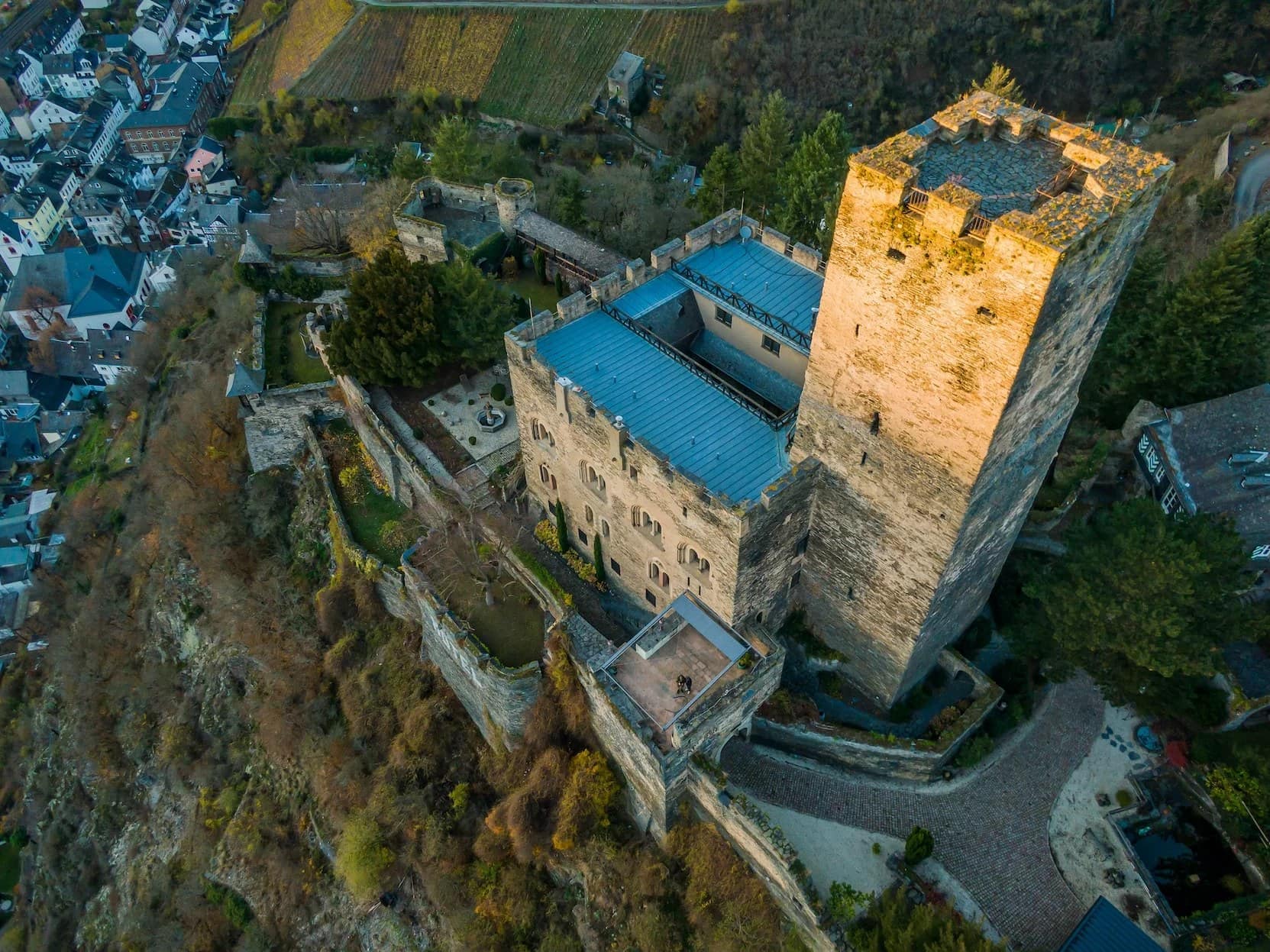
Gutenfels Castle
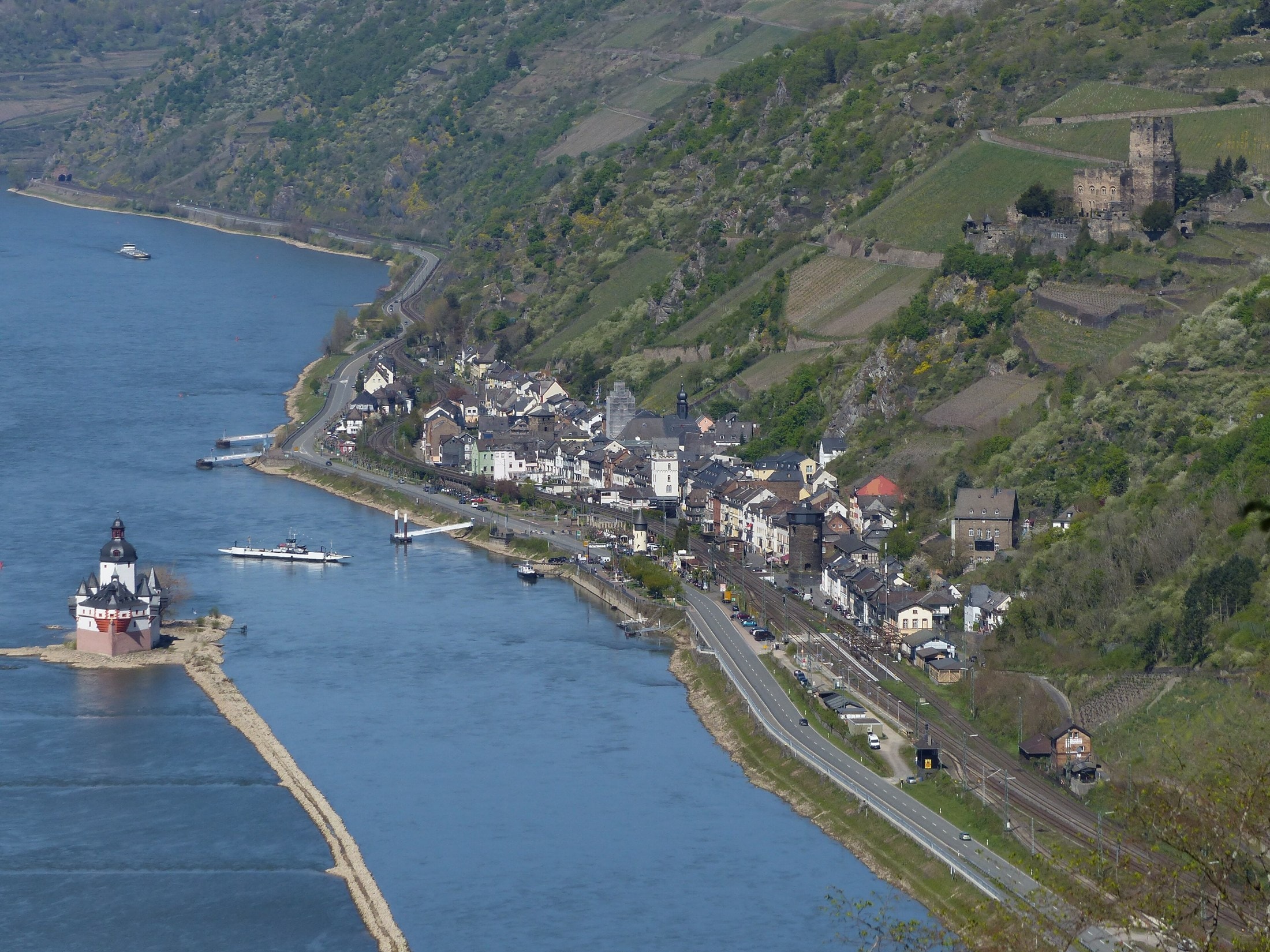
High on a vine-terraced shoulder of rock above the little Rhine town of Kaub stands a castle that makes no sense by itself. Gutenfels Castle was never a frontier outpost or a robber-baron’s lair; it was one half of a machine. The other half sat in the river below it: Pfalzgrafenstein, the toll castle moored midstream like a stone ship, and between them ran the third component, the walled town of Kaub itself.
From the bank, Gutenfels guarded; from the water, Pfalzgrafenstein collected; behind the walls, Kaub administered. For nearly six centuries the three worked as a single fiscal-defensive system, and the moment that welded them into one was a purchase, not a battle. Read that way, Gutenfels stops being a scenic afterthought above a pretty town and becomes the land anchor of one of the clearest toll machines the medieval Rhine ever produced.
Quick Facts
| Country | Germany |
| Region / State | Rhineland-Palatinate (Rheinland-Pfalz), western Germany — Upper Middle Rhine Valley |
| Nearest Town | Kaub (right bank; car ferry to the left bank; rail on the right-bank line) |
| Construction Period | Core castle c. 1220–1230 (first documented 1261); upper-bailey ring wall 1338–1341; historicist reconstruction 1889–1892 |
| Founder | The Lords of Bolanden-Falkenstein, imperial Reichsministerialen, on their own allodial land |
| Architectural Style | Late-Hohenstaufen (spätstaufisch) hill castle with post-1504 firearm defenses and a 19th-century historicist rebuild |
| Building Type | Burg — a Höhenburg (hilltop castle); residential and defensive |
| Current Condition | Well preserved — reconstructed 1889–1892, original outer fabric and ruin silhouette largely kept |
| Open to Visitors | No general admission — a private boutique hotel; public access by room booking or occasional ticketed events |
| UNESCO Status | Within the Upper Middle Rhine Valley World Heritage Site (inscribed 2002) |
| Official website | burg-gutenfels.de |
A castle built on allodial rock (c. 1220–1261)
The Lords of Bolanden-Falkenstein built Gutenfels around 1220 to 1230. They were Reichsministerialen (administrative knights of the Empire), but the rock they built on was their own allodial property, owned outright rather than held in fief, a distinction that would matter enormously to what came later. The castle first appears in the written record in 1261, under the name castrum cube: Castle Kaub. The name “Gutenfels” lay almost two and a half centuries in the future. By 1257 the Falkenstein lords also held the town of Kaub and, with it, the right to levy a toll on the Rhine: the single most valuable asset on this stretch of river.
A castle of the same family was besieged here in 1252 by William of Holland, the anti-king fighting the Hohenstaufen cause the Bolanden-Falkensteins supported. The siege of Kaub is documented; the castle’s specific part in it is inferred from the politics rather than named in the surviving sources.
The bank half of a toll machine (1277–1342)
Between 1277 and 1289 the Rhenish Count Palatine Ludwig II of the House of Wittelsbach bought the entire Kaub complex (castle, town, and Rhine toll right) from Philipp II of Falkenstein, in stages, beginning with a transaction valued at 2,300 marks. The trigger was political: King Rudolf of Habsburg was campaigning against the swarm of unauthorized tolls strangling Rhine traffic, and a toll in secure Wittelsbach hands was a toll likelier to survive. It did. Kaub became the principal customs station of the Electoral Palatinate, the seat of the kurpfälzisches Unteramt Kaub, and it stayed Palatine until the Holy Roman Empire itself was dissolved in 1803.
The river half of the system came later. King Ludwig the Bavarian raised the Pfalzgrafenstein toll tower in the Rhine in 1326–1327; Gutenfels answered it with a new upper-bailey ring wall dated, on the latest evidence, to 1338–1341. Only then was the trio complete: a tower in the water that stopped the boats, a fortified town that processed them, and a castle on the height that could neither be bypassed nor easily taken. This is the Rhine as the medieval Empire worked it (not a frontier but a tollgate), the same logic traced across the gorge in The Rhine as Contested Territory.
The siege that gave the castle its name (1504)
In 1504, during the War of the Succession of Landshut, Landgrave William II of Hesse laid siege to Kaub and its castle for thirty-nine days. He failed. Town and fortress held, and the Electoral Palatinate kept its toll. Tradition holds that it was this stubborn survival that earned the castle the new, programmatic name it still carries: Gutenfels, “good rock,” meaning solid, reliable, unbroken. The rename is sometimes credited to Elector Palatine Ludwig V; no founding charter for the act survives, so the attribution, like the date, is traditional rather than documented. The siege left harder evidence: firearm loopholes punched through the south ring wall, gun-ports broken into the keep, a round tower added at the southwest corner, and a small chapel building with two turrets at the northwest.
There is also a legend, and it should be read as one. In Wilhelm Ruland’s 19th-century Legends of the Rhine, the castle is renamed for Guta von Falkenstein, who loved an unknown knight later revealed as Richard of Cornwall, the elected King of the Romans. It is a fine Rhine-Romantic tale and historically impossible: the real Guda von Falkenstein married Konrad von Bickenbach, and Richard of Cornwall’s wives were three other women entirely. The story belongs to the age of Burgenromantik, not the Middle Ages.
Surrender, auction, and the army that passed below (1648–1814)
After the Thirty Years’ War (through which Kaub changed hands repeatedly but Gutenfels survived largely intact), the castle’s importance drained away. By 1787 it was nothing but a billet for a company of military invalids. In 1793 it was surrendered without a fight to advancing French Revolutionary forces. With the Empire’s dissolution it passed to Nassau, and the Duchy of Nassau, having no use for an obsolete fortress, liquidated it: the inventory was auctioned in 1805, the timber in 1807, the masonry in 1813. The popular story that Napoleon personally ordered the castle destroyed is a later misremembering; the demolition was a Nassau accounting decision, not an imperial decree.
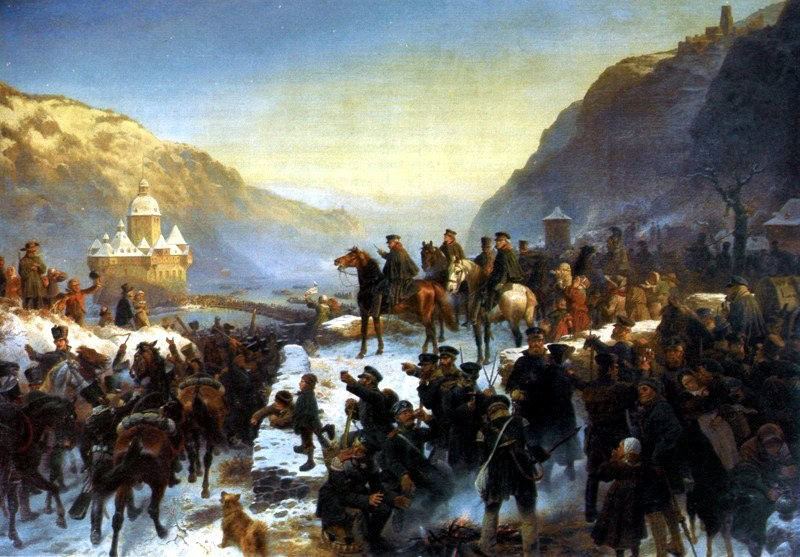
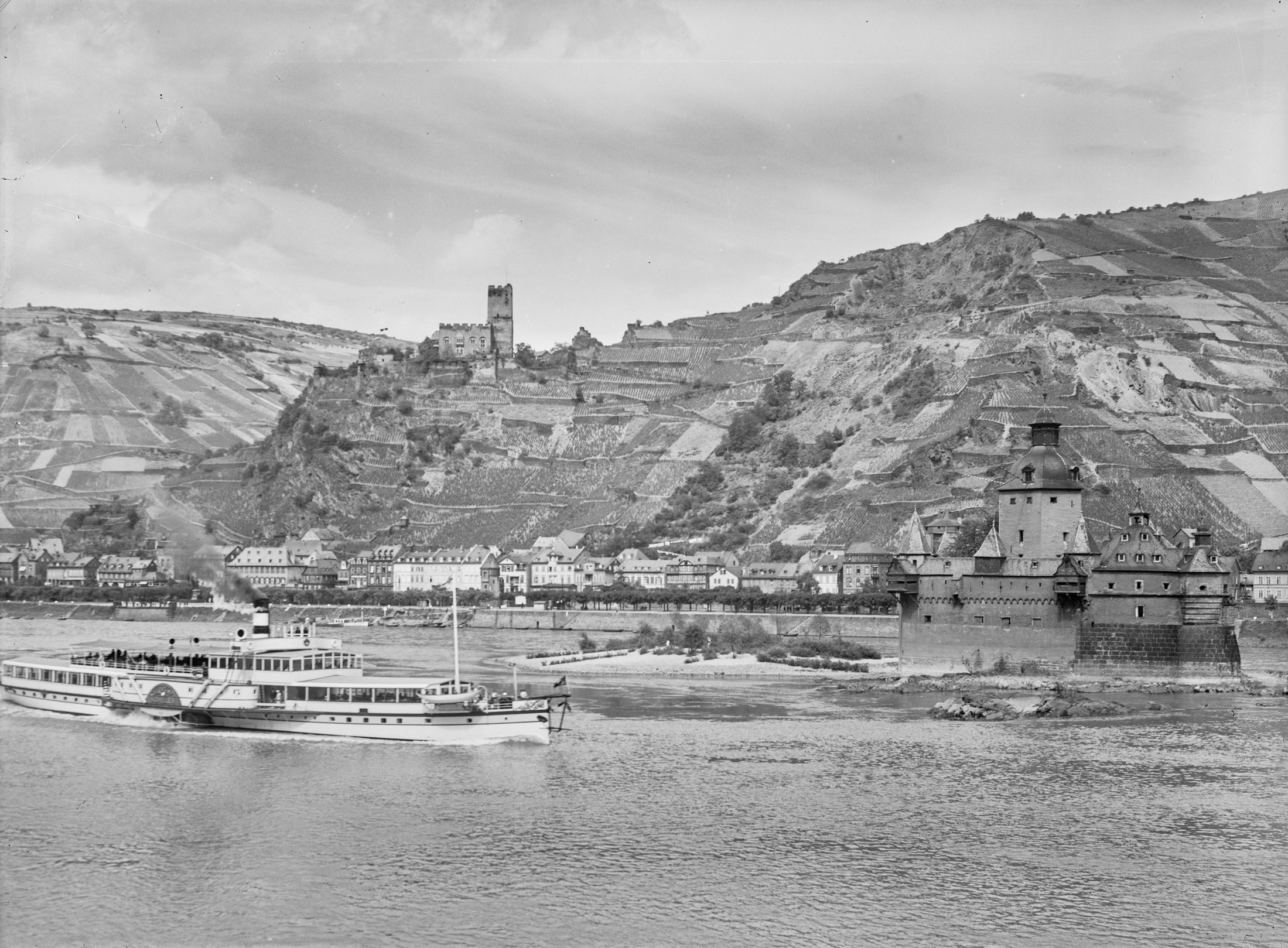
It was while the castle was dying that its most famous hour passed beneath it. On the night of December 31, 1813, Field Marshal Blücher began moving the Silesian Army across the Rhine at Kaub, using a Russian-built pontoon bridge that took Pfalzgrafenstein’s island as its midpoint. Roughly 50,000 troops and their guns had crossed by January 8, 1814, opening the road to Paris. The dismantled hulk of Gutenfels looked down on the whole operation: the bank fortress and the river tower together, a final tableau of the pair that later filled Wilhelm Camphausen’s much-reproduced 1860 painting of the crossing. Kaub keeps the memory deliberately: a Blücher monument of 1894 and a Blücher museum since 1913.
Habel’s rescue and Walter’s rebuild (1833–1892)
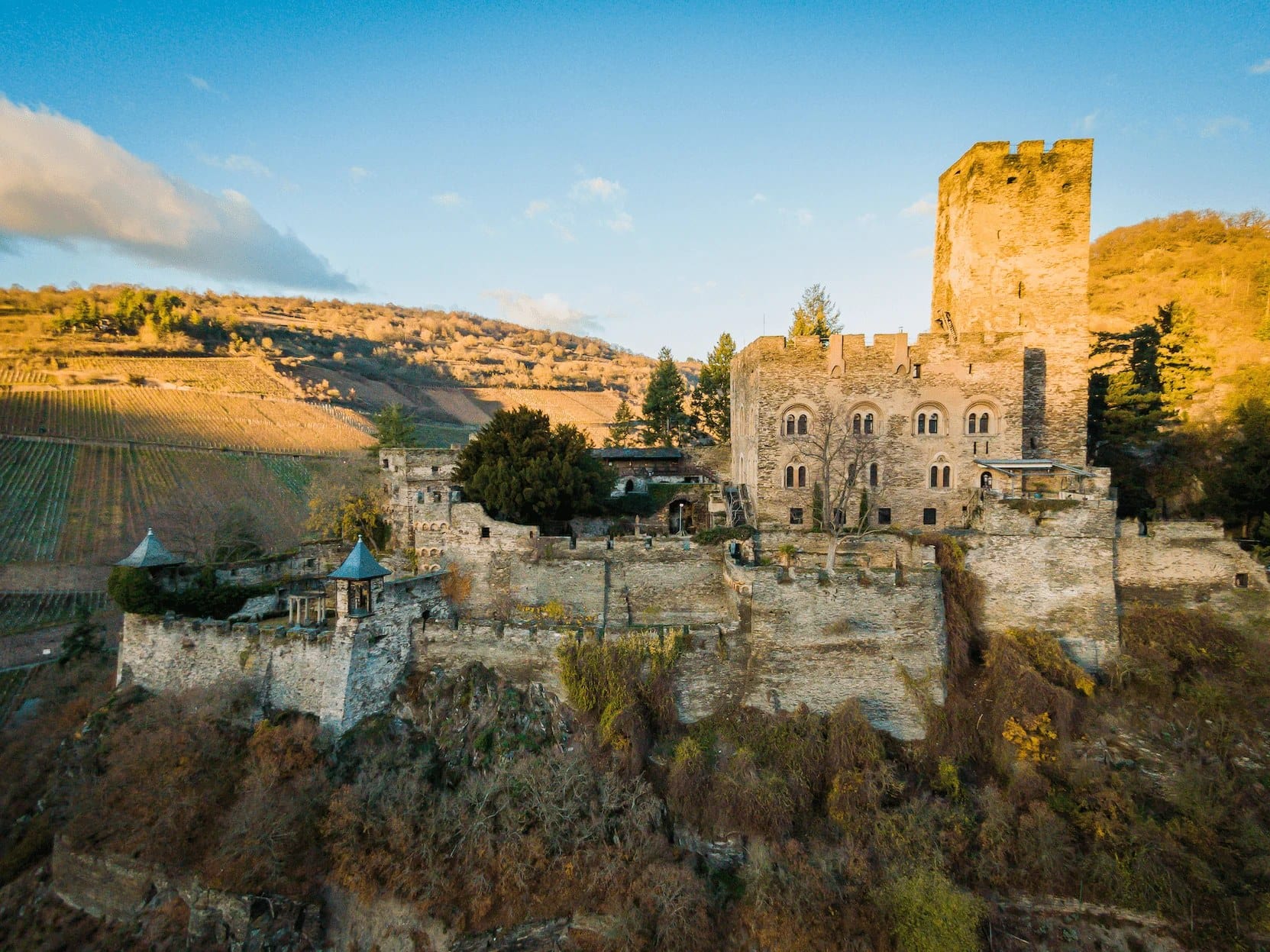
In 1833 the Nassau archivist and pioneering antiquarian Friedrich Gustav Habel bought the ruin for the express purpose of saving it. He did the same for several other Middle Rhine castles, which places him among the earliest private monument conservators on the river, acting at the same time as, and in spirit ahead of, the better-known Prussian royal projects. After a chain of owners, the Cologne architect Gustav Walter bought the ruin in 1888 and rebuilt it between 1889 and 1892 to his own plans, in the historicizing manner of the Burgenrenaissance, keeping the surviving outer fabric and the ruin’s silhouette while restoring the interior. The Rhine-facing show façade (two rows of round-, pointed-, and trefoil-arched windows picked out in white limestone) is largely his renewal over older remains, and should be read as 19th-century work, not 13th.
What survives is one of the most regular examples of late-Hohenstaufen castle building on the Rhine: a near-square core block, 21.6 by 21.1 meters, split lengthwise into a courtyard between a late-Romanesque Palas (about 22 by 8 meters, its lower hall keeping two fireplaces) and a northern utility range whose outer wall doubles as a Schildmauer: a shield wall thrust forward of the core. A near-square keep roughly 35 meters tall stands squarely on the vulnerable hill side, entered high from the courtyard, with a round dungeon at its base and light-slit stories above. It is, in plan, almost diagrammatic: a textbook of how a 13th-century Rhine garrison castle was meant to be laid out.
Visiting in 2026
Gutenfels is not a museum, and there is no ticket desk. It is a privately owned, heritage-listed boutique hotel with five suites (Nassau, Falkenstein, Stein, Liebenstein, and Wachenheim, ranging from about 30 to 60 square meters), plus a library with a fireplace and a small sauna, all with views over the Rhine and the wooded slopes. General admission does not exist: the castle is open to the public only to guests who book a room, or through occasional ticketed events such as the moonlight tours with wine tasting run via Loreley tourism. Anyone who wants to see Gutenfels, not stay in it, gets the best view from the water or the opposite bank, and from the deck of the little ferry out to Pfalzgrafenstein, which leaves the Kaub shore directly below the castle.
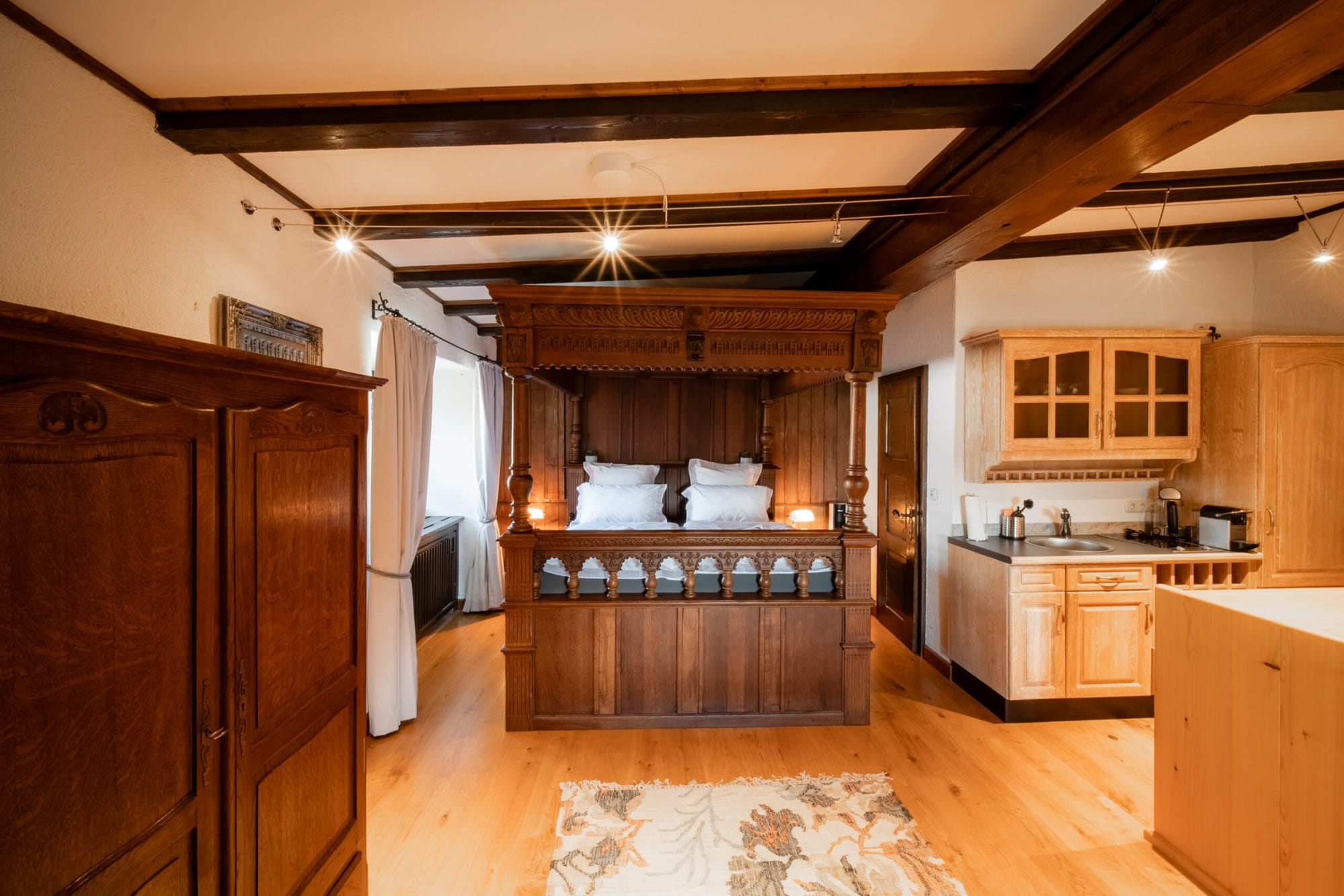
Kaub sits on the right bank, on the B42. A car ferry crosses between Kaub and the left bank, the Rheinsteig long-distance trail passes directly through, and the RheinBurgenWeg runs the opposite side. One material caution for 2026: the right-bank railway through Kaub is fully closed for corridor renovation from July 10 to December 12, 2026, with trains replaced by buses over that period; arrive by car, by ferry from a left-bank station, or outside that window. Anyone staying overnight can compare hotels in and around Kaub.
Some links on this page are affiliate links, which means StoneKeep Atlas may earn a small commission, at no extra cost to you, if you book through them.
Beyond Gutenfels
Gutenfels only fully makes sense beside its partner. Pfalzgrafenstein is the other half of the same toll machine, and the contrast is the point: the bank castle was dismantled and rebuilt; the river tower was never destroyed at all. For a castle that, like Pfalzgrafenstein, came through history physically unbroken (and was never romantically reconstructed either), Marksburg is the control case. For Gutenfels’s true cohort, look to the wave of Rhine castles rebuilt in the 19th-century historicist taste: Stolzenfels, Reichenstein, Rheinstein, and Sooneck all belong to the same Burgenromantik moment. The wider cluster is mapped in Castles of the Rhine Gorge.
Conclusion
Gutenfels is easy to underrate. It has no decisive battle, no famous prisoner, no founding saint. What it has is a function, and that function explains the whole Kaub landscape. The castle on the hill, the tower in the river, and the wall around the town were a single instrument for converting a bend in the Rhine into revenue, and the act that built that instrument was a Wittelsbach purchase in 1277, not a conquest. The system died only when Prussia abolished the toll in 1867; the castle survived only because one antiquarian thought a ruin was worth buying. Stand on the Kaub bank today and the logic is still legible: a fortress above, a tollhouse afloat below, and the river they were built to tax running quietly between them.
Principal Sources
- Friedrich, Reinhard. “Burg Gutenfels (Kaub).” EBIDAT — Burgendatenbank des Europäischen Burgeninstituts (Deutsche Burgenvereinigung).
- Rau, Nathalie. “Die Burg Gutenfels in Kaub.” Regionalgeschichte.net, Institut für Geschichtliche Landeskunde an der Universität Mainz, regionalgeschichte.net.
- Dehio-Handbuch der deutschen Kunstdenkmäler: Rheinland-Pfalz, Saarland. Deutscher Kunstverlag (Baubeschreibung as cited by regionalgeschichte.net).
- Ruland, Wilhelm. Legends of the Rhine. Cologne: Hoursch & Bechstedt (cited as legend only).
- “Upper Middle Rhine Valley.” UNESCO World Heritage Centre, inscription 1066 (2002).
Visitor information, the suite roster, and 2026 access are drawn from the operator, Burg Gutenfels boutique hotel, burg-gutenfels.de, retrieved May 17, 2026.
Image credits. Featured image and the exterior and suite photographs of the castle: © Burg Gutenfels Boutique Hotel, used by permission, via burg-gutenfels.de. Combined view of Pfalzgrafenstein, Kaub, and Gutenfels: Whgler, CC BY-SA 4.0. Wilhelm Camphausen, Blüchers Rheinübergang bei Kaub (1860), public domain. Historical river view: Joseph Knippenberg, Rheinisches Bildarchiv (rba_225518_kni), CC BY-SA 3.0 — the Camphausen, panorama, and river view all via Wikimedia Commons. Freely licensed images are resized to fit; otherwise unaltered.