
Würzburg Residence
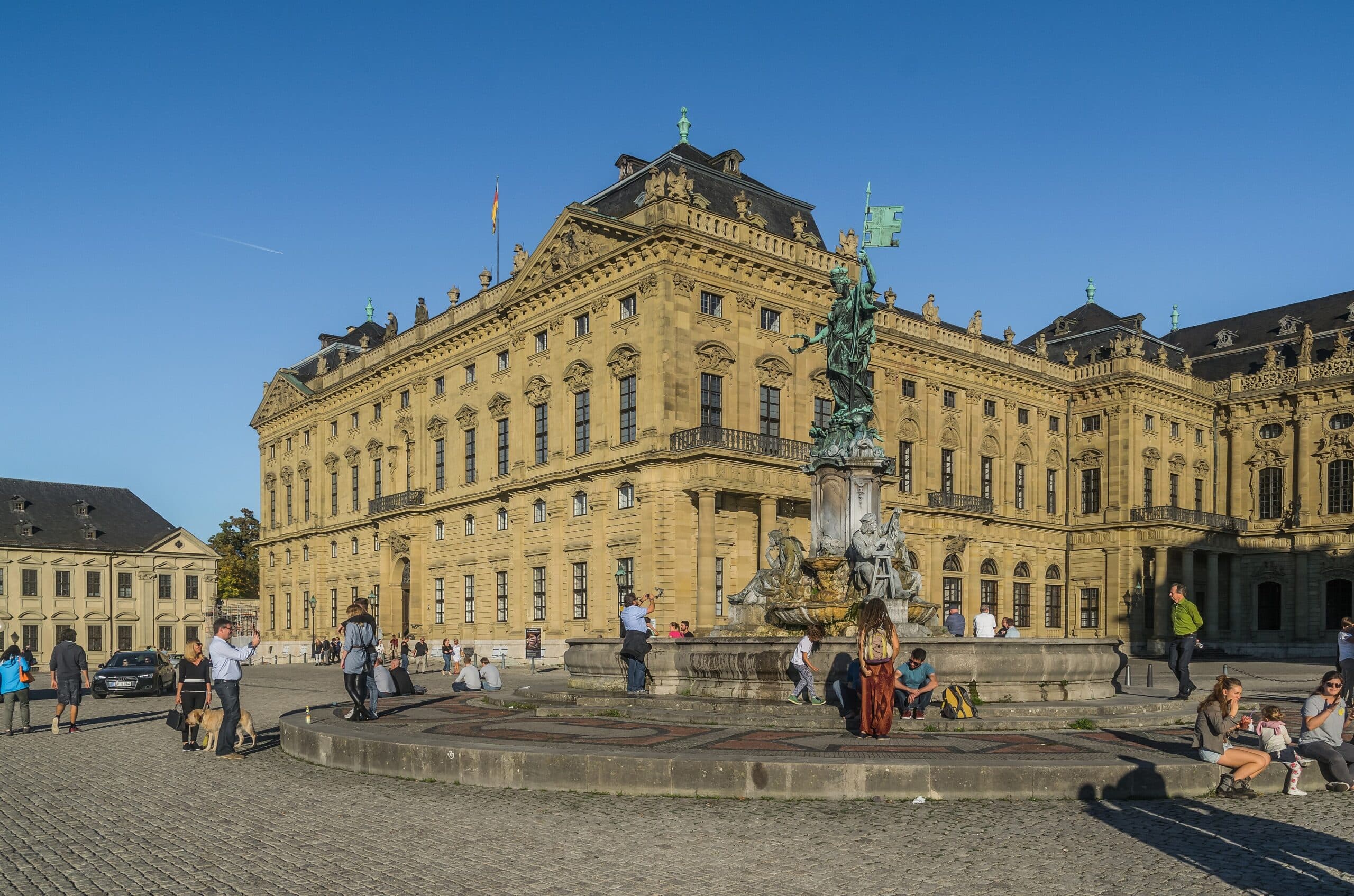
The Würzburg Residence (Würzburger Residenz) stretches the eastern flank of the Residenzplatz, almost 170 meters of pale sandstone fronting a cour d’honneur large enough to drill a regiment in. Construction began in 1720 under Prince-Bishop Johann Philipp Franz von Schönborn, who had decided on his accession the previous September to abandon the medieval bishop’s seat at Marienberg Fortress on the opposite bank of the Main. By the time the Residence was substantially finished in the mid-1740s, it had drawn together an international workshop: Balthasar Neumann as principal architect, Lucas von Hildebrandt and Maximilian von Welsch and the Parisian architects Robert de Cotte and Germain Boffrand all consulting on the plan, and a generation later Giovanni Battista Tiepolo on the great vaulted ceilings. UNESCO inscribed the Residence and its Hofgarten as a World Heritage Site in 1981.
Quick Facts
| Country | Germany |
| Region / State | Bavaria (Unterfranken / Lower Franconia) |
| Nearest Town | Würzburg |
| Construction Period | 1720–1744 (interiors and Hofgarten to ~1781) |
| Founder | Prince-Bishop Johann Philipp Franz von Schönborn (foundation, 1720); continued under Friedrich Carl von Schönborn (1729–1746) and Carl Philipp von Greiffenclau zu Vollrads (1749–1754) |
| Architectural Style | Late Baroque shell; Rococo and Frühklassizismus interiors |
| Building Type | Residenz — prince-bishop’s palace and seat of the Würzburg court |
| Current Condition | Restored; central block (Vestibül, Gartensaal, Treppenhaus, Weißer Saal, Kaisersaal) substantially intact through the 1945 firestorm; remainder reconstructed 1945–1987 |
| Open to Visitors | Yes — daily, with seasonal hours; English guided tours included in admission |
| UNESCO Status | Würzburg Residence with the Court Gardens and Residence Square (inscribed 1981, criteria i and iv) |
| Official Website | residenz-wuerzburg.de |
The Schönborn vision (1719–1746)
Johann Philipp Franz von Schönborn was elected Prince-Bishop of Würzburg in September 1719, at a moment when his family had become the most ambitious building patrons of the imperial church. His uncle Lothar Franz was Elector and Archbishop of Mainz; his elder brother Friedrich Carl held the office of Reichsvizekanzler at the imperial court in Vienna. A Schönborn network across the Empire meant that a building begun in Würzburg could draw on architects, sculptors, stuccoists, and painters from the German lands and beyond.
Almost immediately, the new prince-bishop announced that he intended to leave the Höhenburg on the Marienberg, where his predecessors had ruled the city since the late thirteenth century, and build a freestanding palace on the right bank of the Main. Workers laid the foundation stone on May 22, 1720, on the predecessor Rosenbachhof site adjacent to the city’s Baroque bastion. Construction began on the Nordblock under the direction of a young architect named Balthasar Neumann, whom Johann Philipp Franz had brought into his building commission and who would shortly travel to Paris to consult Robert de Cotte and Germain Boffrand on the design; Neumann’s last surviving letter from Paris is dated April 14, 1723. Hildebrandt was already supplying counter-proposals from Vienna; Welsch, the Mainz court architect, was consulting from Lothar Franz’s establishment. The scholarly consensus on Neumann’s role (most clearly stated by the Bayerische Schlösserverwaltung and reinforced by Reuther, Otto, and Stefan Kummer) is that he was the synthesizer of these often-divergent voices, reconciling French ceremonial planning, Viennese spatial drama, and German engineering into a single coherent design.
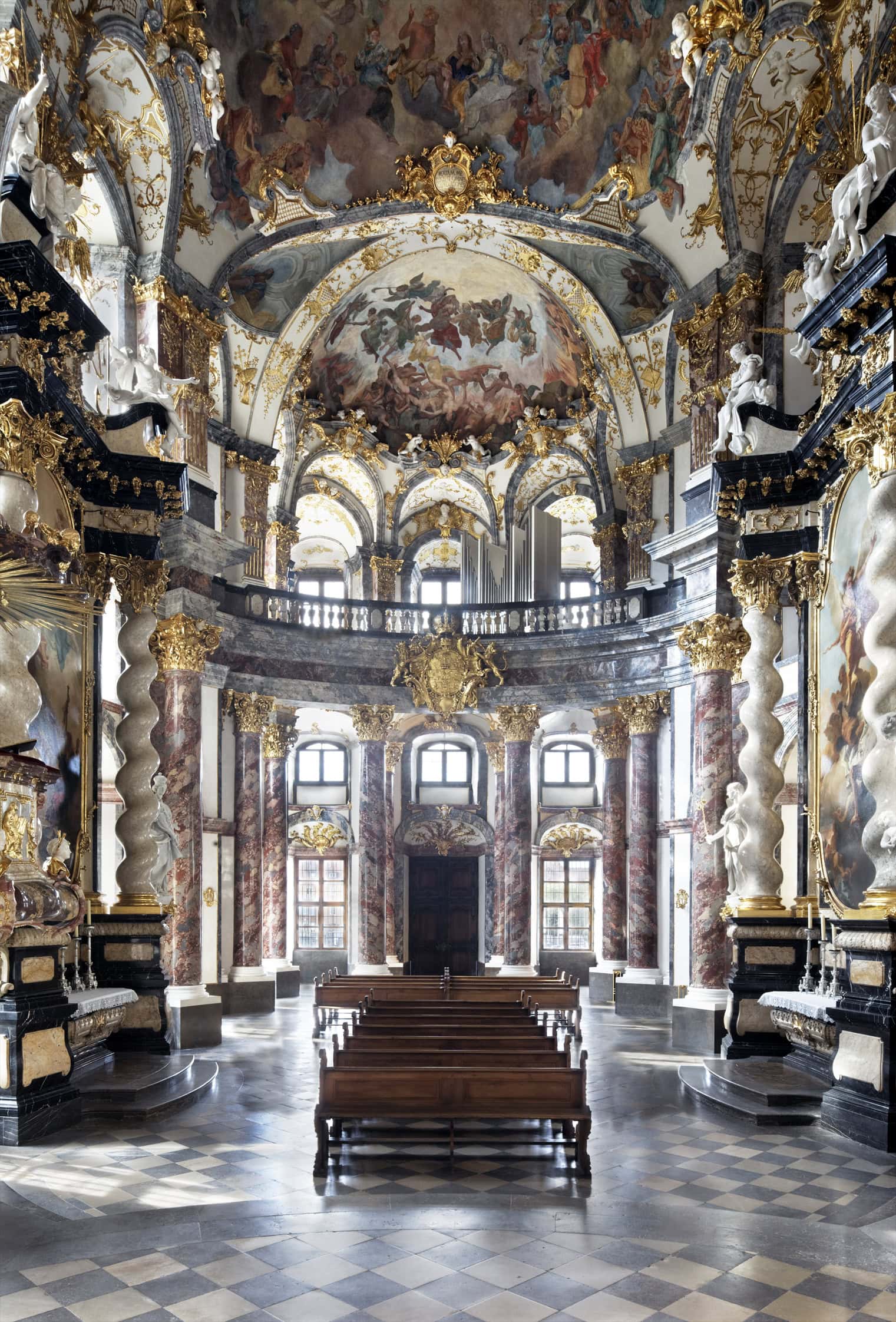
By 1729 the Nordblock was complete under Johann Philipp Franz’s frugal successor Christoph Franz von Hutten. Friedrich Carl von Schönborn, who succeeded Hutten in 1729 and held the see until 1746, returned the project to its original ambition. Work on the Südblock began in 1730. Between 1732 and 1733 the Hofkirche was raised in shell, decorated to designs partly by Hildebrandt with ceiling frescoes by Johann Rudolf Byss in 1735–36, and consecrated on September 15, 1743. The Treppenhaus (an 18 by 30 meter rectangular room rising 23 meters to a single unsupported flat trough vault, stützenfreies Muldengewölbe in BSV’s verbatim) was vaulted in 1743. By December 1744 the structural shell of the entire palace, its Rohbau, was complete. It had cost roughly 1.5 million Gulden.
Tiepolo and the heaven on earth (1749–1753)
Friedrich Carl was succeeded in 1746 by Anselm Franz von Ingelheim, who halted the works and briefly disgraced Neumann; the Tiepolo episode belongs to Friedrich Carl’s nephew Carl Philipp von Greiffenclau zu Vollrads, elected in 1749. Greiffenclau resumed the interior decoration. Antonio Giuseppe Bossi was already at work on the Gartensaal stucco; Johann Zick painted the Gartensaal ceiling in 1750. On May 29, 1750 the Würzburg court banker Lorenz Jacob Mehling received instructions in Venice to engage Giovanni Battista Tiepolo, then at the height of his European reputation, for the principal decoration of the Kaisersaal and the Treppenhaus.
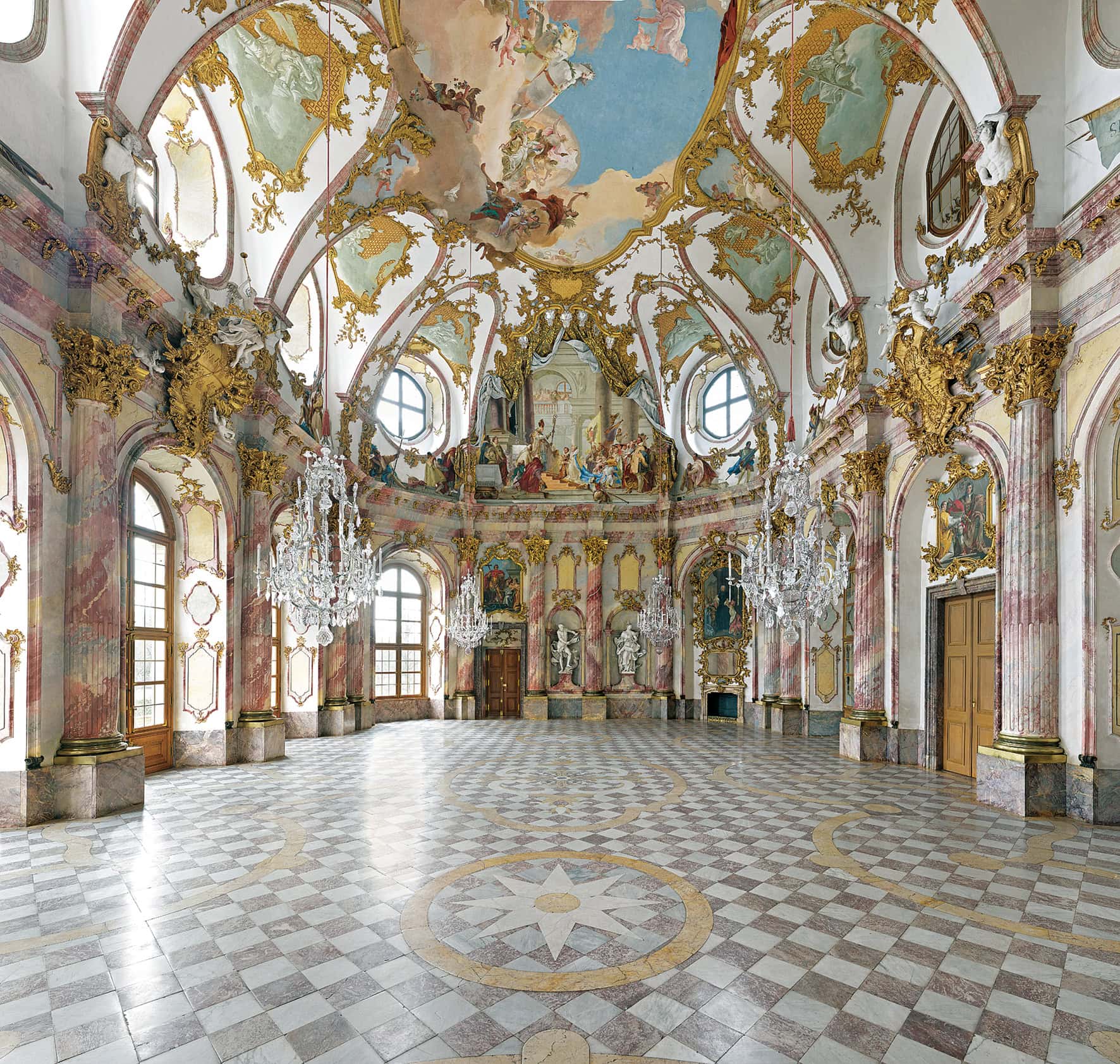
Tiepolo arrived in Würzburg on December 12, 1750 with his sons Giandomenico and Lorenzo. The central ceiling of the Kaisersaal (Apollo conducting the medieval empress Beatrix of Burgundy in his solar quadriga toward the Genius Imperii) was unveiled on July 8, 1751. Two side-wall frescoes followed in 1752: the marriage of Frederick Barbarossa and Beatrix at Würzburg in 1156, with the officiating bishop given the features of patron Greiffenclau rather than the historical Gebhard von Henneberg; and the 1168 investiture of Bishop Herold von Höchheim as Duke of Franconia, which is the legal moment from which the Würzburg prince-bishops claimed the Güldene Freiheit of Franconian ducal title.
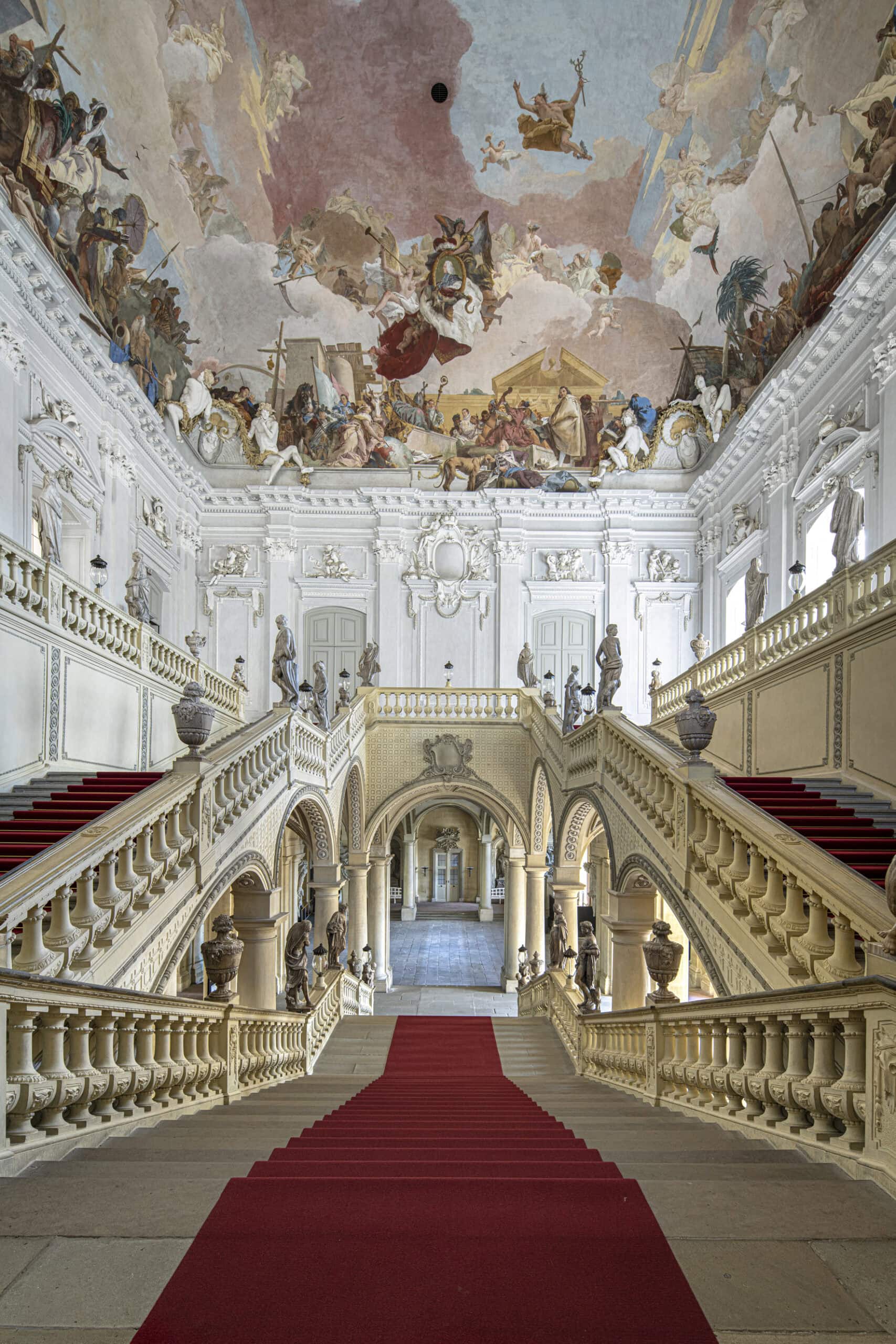
Tiepolo’s Treppenhaus fresco followed in 1752–53. Apollo and the Four Continents covers approximately 600 square meters of the unsupported vault, in BSV’s formulation, the world’s largest contiguous unframed ceiling fresco. Tiepolo painted it across 218 giornate with the assistance of his sons, in mixed fresco and secco, for a fee of 15,000 Gulden, roughly thirteen times Neumann’s annual salary. Apollo ascends over allegories of the four known continents; the Europe panel includes a portrait medallion of Greiffenclau himself, set among the seat of the European arts. Neumann died on August 19, 1753, the year the fresco was completed; Tiepolo and his sons left for Venice on November 8.
Rococo, gardens, and the end of the Hochstift (1755–1814)
After Greiffenclau’s death in 1754 and a brief vacancy, Adam Friedrich von Seinsheim took the see and held it until 1779. The interior register shifted under Seinsheim and his successor Franz Ludwig von Erthal: from Greiffenclau’s high Baroque to Frühklassizismus, and from Antonio Bossi to his nephews Materno and Ludovico Bossi. In 1765–67 the northern Imperial Apartments received early-classicist stuccowork, completed–67. The Grünlackiertes Zimmer (Green Lacquered Cabinet) was finished 1769–72; the Fürstensaal in 1772; the Ingelheimzimmer, the most extensive of the late-Baroque rooms, was completed under Erthal in 1781. Johann Peter Wagner carved the marble balustrade sculptures of the Treppenhaus in 1776.
Seinsheim also built the Hofgarten. He appointed Johann Prokop Mayer, a Bohemian, as court gardener in 1770. Mayer’s perspective plan for the Ostgarten dates from 1774; Johann Michael Fischer’s Orangerie was added in 1778–79. The eastern boundary of the garden runs along the surviving Baroque city bastion, which Mayer integrated into the design with symmetric framing ramps and stairs. Wagner’s Der Raub der Europa and Der Raub der Proserpina date from this period, alongside vases, kanapees, and putti for the Ostgarten arbours; the originals are now mostly stored, with cast replacements in situ. UNESCO’s inscription gives the gardens the formula “landscaped from 1765 to 1780.”
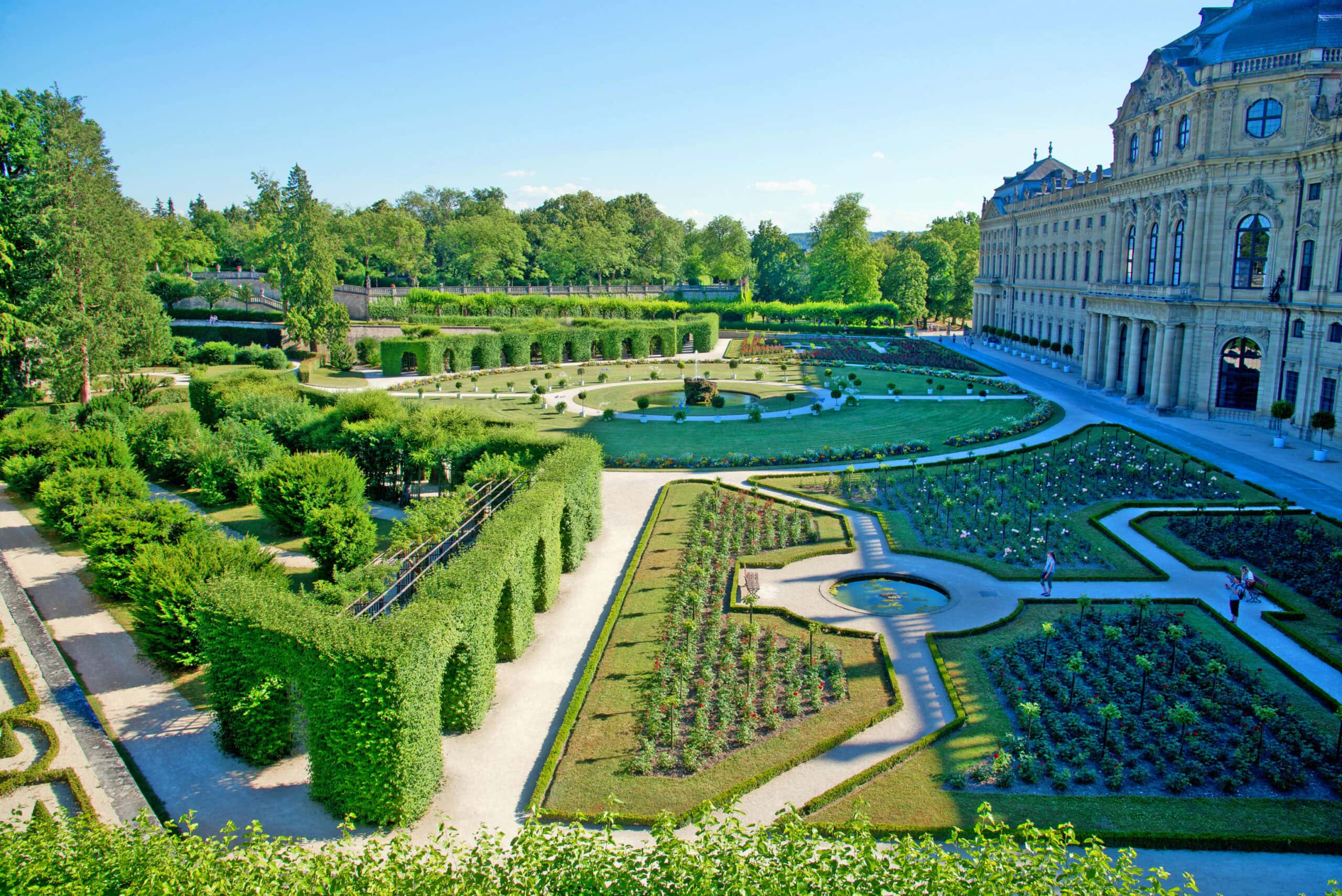
The Hochstift Würzburg was secularized by the Reichsdeputationshauptschluss of 1803 and absorbed into the Electorate of Bavaria. A Würzburg mason, Käs, was paid 171 Gulden to chisel off 114 cathedral-canon coats of arms from the Residence. From 1806 to 1814 the building briefly served as the residence of Archduke Ferdinand III of Tuscany, Grand Duke of Würzburg under the terms of the Treaty of Pressburg; the Toskanawohnung in the south wing dates from this period. The Residence passed definitively to the Kingdom of Bavaria in 1814 and became a Nebensitz of the Wittelsbach kings. It was opened to the public in 1921.
Seventeen minutes (1945)
On the night of March 16, 1945, RAF No. 5 Group dispatched 225 Avro Lancaster bombers and eleven De Havilland Mosquito Pathfinders against Würzburg. RAF Bomber Command’s Campaign Diary records that 1,127 tons of bombs were dropped with great accuracy in seventeen minutes. Roughly 370,000 incendiaries fell on a city center with no significant air defense. That firestorm reached temperatures near 1,500 degrees Celsius; about ninety per cent of the historic Altstadt was destroyed; civilian casualties were near 5,000.
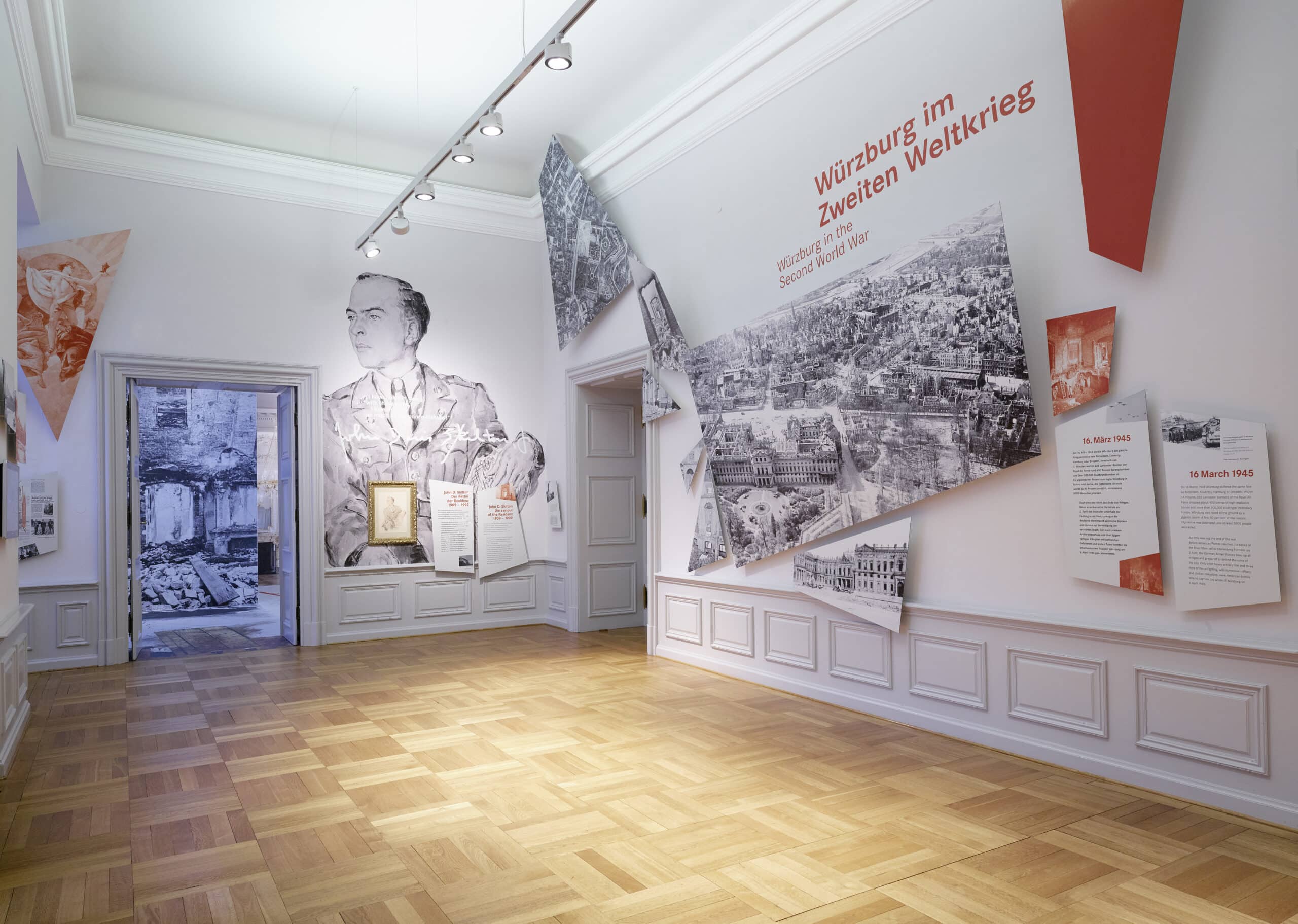
It burned with the rest of the city. According to BSV’s own account, the Residence burned out almost entirely; only the central block (Vestibül, Gartensaal, Treppenhaus, Weißer Saal, and Kaisersaal) was largely spared apart from the destroyed roofs above. Neumann’s stone vaults held under the falling, burning roof timbers. Tiepolo’s frescoes in the Treppenhaus and Kaisersaal survived. The Spiegelkabinett in the Southern Imperial Apartments (its mirrors fixed to the walls, impossible to evacuate) melted in the heat. Most movable furnishings, evacuated earlier, were saved.
The American officer who first reached the still-burning Residence was Lieutenant John Davis Skilton Jr. of the U.S. Army’s Monuments, Fine Arts and Archives section. Skilton scavenged tarpaulins from quartermasters, floated logs from Ochsenfurt down the Main to a Heidingsfeld sawmill he paid from his own pocket, and supervised a German team in roofing the central block before the spring rains arrived. A temporary roof spared the Tiepolo frescoes a second loss. Skilton was awarded the West German Verdienstkreuz, First Class.
From rubble to UNESCO (1945–today)
Reconstruction of the Residence proceeded in stages over more than four decades. Iron roof trusses were installed over the central block in 1947–49. In 1948–49 the Tiepolo Treppenhaus fresco received its first post-war restoration–49. Reinforced-concrete ceilings replaced the former wooden joist construction in the period 1951–62. The Hofkirche reopened in 1963, though its Byss frescoes, badly damaged by water and soot, had been more than seventy per cent over-painted by the restorer Karl Körner. In 1970 the southern Imperial Apartments reopened, the northern in 1974.
Its longest single project was the Spiegelkabinett. In 1978 the Würzburg painter Wolfgang Lenz was commissioned to reconstruct the room from a single surviving glass fragment, period photographs, and a c. 1870 watercolor by Georg Dehn. Roughly 600 mirror plates were re-decorated in Hinterglasmalerei (reverse-glass painting) using approximately 2.5 kilograms of gold leaf. The room was reopened on October 1, 1987, and BSV records this date as the formal end of the Wiederaufbau. UNESCO had inscribed the Residence in 1981, while the Spiegelkabinett project was still in progress, under criteria (i) and (iv), the latter explicitly recognizing the Residence as a joint achievement of the leading European architects, sculptors, and painters of the eighteenth century.
In 2003–06 the Treppenhaus Tiepolo fresco was campaigned again–06 to address damp damage from the still-saturated post-war masonry. From September 2006 to October 2008 the Kaisersaal closed for conservation, reopening on April 29, 2009. Between 2008 and 2012 the Hofkirche received a second major restoration. A permanent display on the Toskana apartments opened in 2014; the Gedenkraum on John Davis Skilton and the 1945 destruction opened in 2015. The Residence’s reconstruction reads against more reluctant choices made elsewhere, Heidelberg Castle, also a princely seat burned out by an earlier war, has been left in ruin since the late seventeenth century, and against quicker post-war revivals such as the Wartburg, which suffered far less in the same year.
Visiting in 2026
The Residence is open daily. From April through October hours are 9:00 to 18:00, with last entry at 17:15; from November through March, 10:00 to 16:30, with last entry at 16:00. It is closed on January 1, on Faschingsdienstag (Shrove Tuesday), and on 24, 25, and December 31. The Hofgarten is open separately to dusk and is free year-round; the Hofkirche is also free, accessible during opening hours when no service or wedding is in progress. Entry tickets and local tours can also be booked in advance through GetYourGuide.
A standard ticket admits the visitor to all rooms on the public route, including the Treppenhaus, the Weißer Saal, the Kaisersaal, the Imperial Apartments and the Spiegelkabinett, and the Staatsgalerie of Venetian painting in the north wing. A thirty-minute guided tour is included in admission, in German on the full and half hour and in English daily at 11:00 and 15:00.
Pricing for 2026, from the official admission page at residenz-wuerzburg.de:
| Ticket | Price |
|---|---|
| Adult | €10 |
| Reduced (students, seniors, etc.) | €9 |
| Children & youth under 18 | Free |
| Group (15+, booked 6 working days ahead) | €9 per person |
| BSV Mehrtagesticket (14-day, single visitor) | €40 |
| BSV Jahreskarte (annual, single visitor) | €55 |
| Hofkirche — on its own | Free |
| Hofgarten — on its own | Free |
The BSV multi-site passes (“Mehrtagesticket” and “Jahreskarte”) cover the Residence alongside Marienberg Fortress and the wider portfolio of forty-plus state castles and palaces. Two events in 2026 alter visitor access: from midday on May 13 to midday on May 14 the Residence, Hofgarten, and Hofkirche close fully for the 104. Deutscher Katholikentag (12–May 17), and during the Katholikentag week the regular guided tours are not run. The 106. Mozartfest Würzburg gives concerts in the Residence’s state rooms from May 23 to June 28, 2026; festival tickets are sold separately. Anyone staying overnight can compare hotels in and around Würzburg.
Some links on this page are affiliate links, which means StoneKeep Atlas may earn a small commission, at no extra cost to you, if you book through them.
Beyond the Würzburg Residence
The Residence is one face of a broader Baroque project the Schönborn family conducted across the imperial church, alongside Schloss Bruchsal, Schloss Pommersfelden, and Schloss Augustusburg in Brühl, the latter two by Lothar Franz von Schönborn and his nephew Clemens August. For visitors with a day in Würzburg, the natural pairing is with Marienberg Fortress across the Main; the BSV multi-site pass covers both. Within the broader catalog of Bavarian castles, the Residence sits alongside Linderhof Palace, Herrenchiemsee New Palace, Neuschwanstein Castle, and Hohenschwangau Castle, all operated by the Bayerische Schlösserverwaltung, the latter four inscribed by UNESCO in 2025 as the Royal Castles of Ludwig II. Within the wider catalog of Germany’s great castles, the Prince-Bishop Residences, including Schloss Johannisburg at Aschaffenburg, with Bamberg and Mainz still to come, extend the Schönborn–Neumann thread.
Conclusion
The Würzburg Residence is, in the end, a building that earned its eighteenth-century international workshop because its patrons could afford to ask for one, and that survived the firestorm of 1945 because Balthasar Neumann had built its central block to bear weight no architect of his generation would have foreseen. Over the four decades after the war, the Bavarian state and its restorers gave the Residence back its Spiegelkabinett, its Hofkirche, and its Tiepolo. From across the Main, in 2026, what looks back is not a Baroque palace exactly but the answer it has been giving since 1981: a building that has earned the European workshop, lost it, and earned it again.
Principal Sources
- Helmberger, Werner; Staschull, Matthias. Tiepolos Welt. Das Deckenfresko im Treppenhaus der Residenz Würzburg. München: Bayerische Schlösserverwaltung, 2010.
- Krückmann, Peter O. (ed.). Der Himmel auf Erden — Tiepolo in Würzburg. 2 vols. München: Prestel, 1996.
- Stephan, Peter. “Im Glanz der Majestät des Reiches”. Tiepolo und die Würzburger Residenz. 2 vols. Weißenhorn: Konrad, 2002–2003.
Operator and institutional sources for this article include the Bayerische Schlösserverwaltung portal at residenz-wuerzburg.de; the UNESCO World Heritage entry for “Würzburg Residence with the Court Gardens and Residence Square (Reference 169bis)” at whc.unesco.org/en/list/169; and the Haus der Bayerischen Geschichte’s Wiederaufbauatlas entry for the Residence at hdbg.eu.
Image credits. Hero photo: Krzysztof Golik, CC BY-SA 4.0, via Wikimedia Commons. Treppenhaus: © Bildarchiv Foto Marburg / Bayerische Schlösserverwaltung / Achim Bunz (CbDD), residenz-wuerzburg.de. Kaisersaal, Hofkirche, Gedenkraum, and Hofgarten: © Bayerische Schlösserverwaltung (photographers: Achim Bunz; Uwe Gaasch; Maria Scherf and Andrea Gruber; Veronika Freudling), residenz-wuerzburg.de. Freely licensed images are resized to fit; otherwise unaltered.