
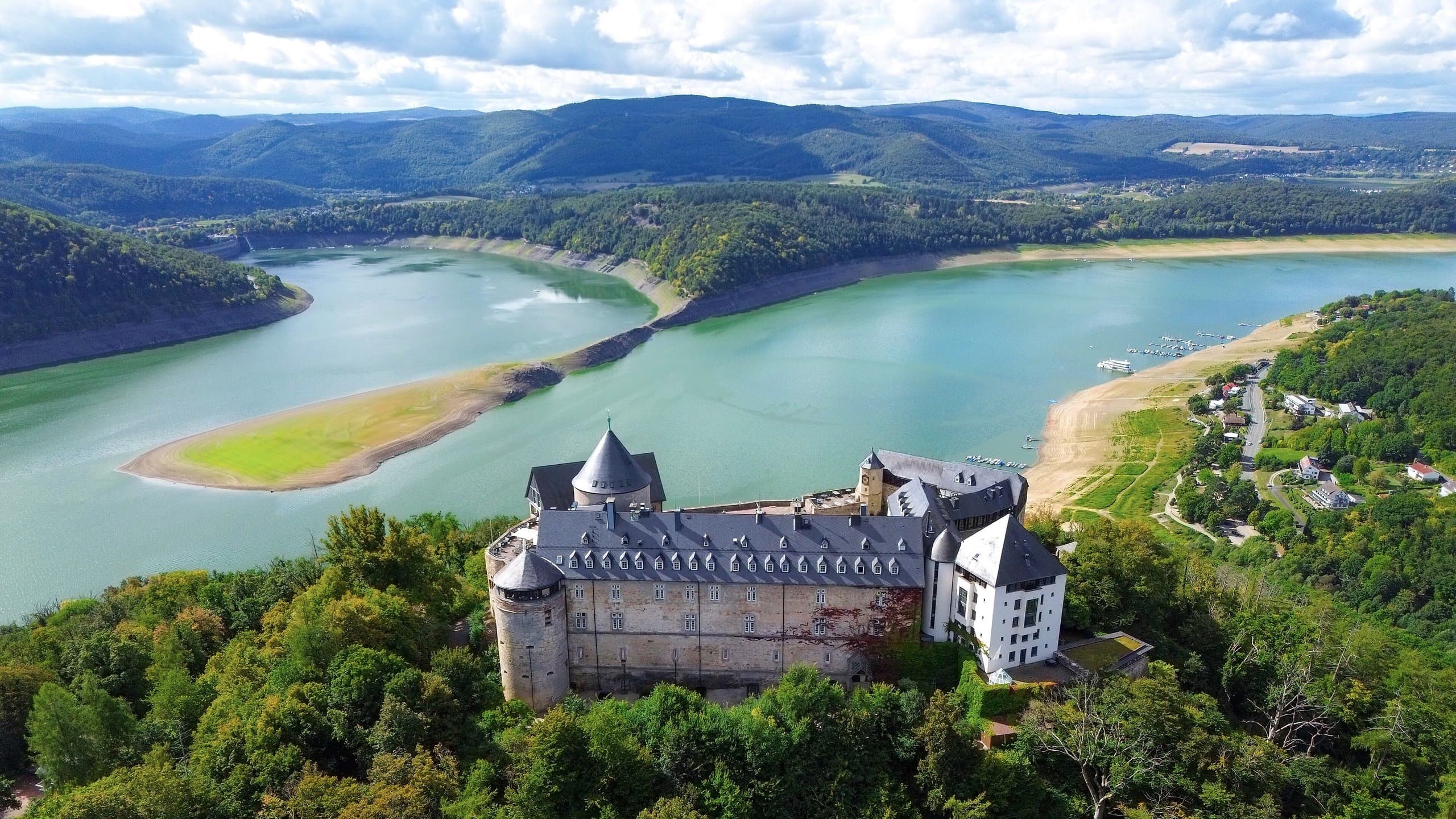
Waldeck Castle
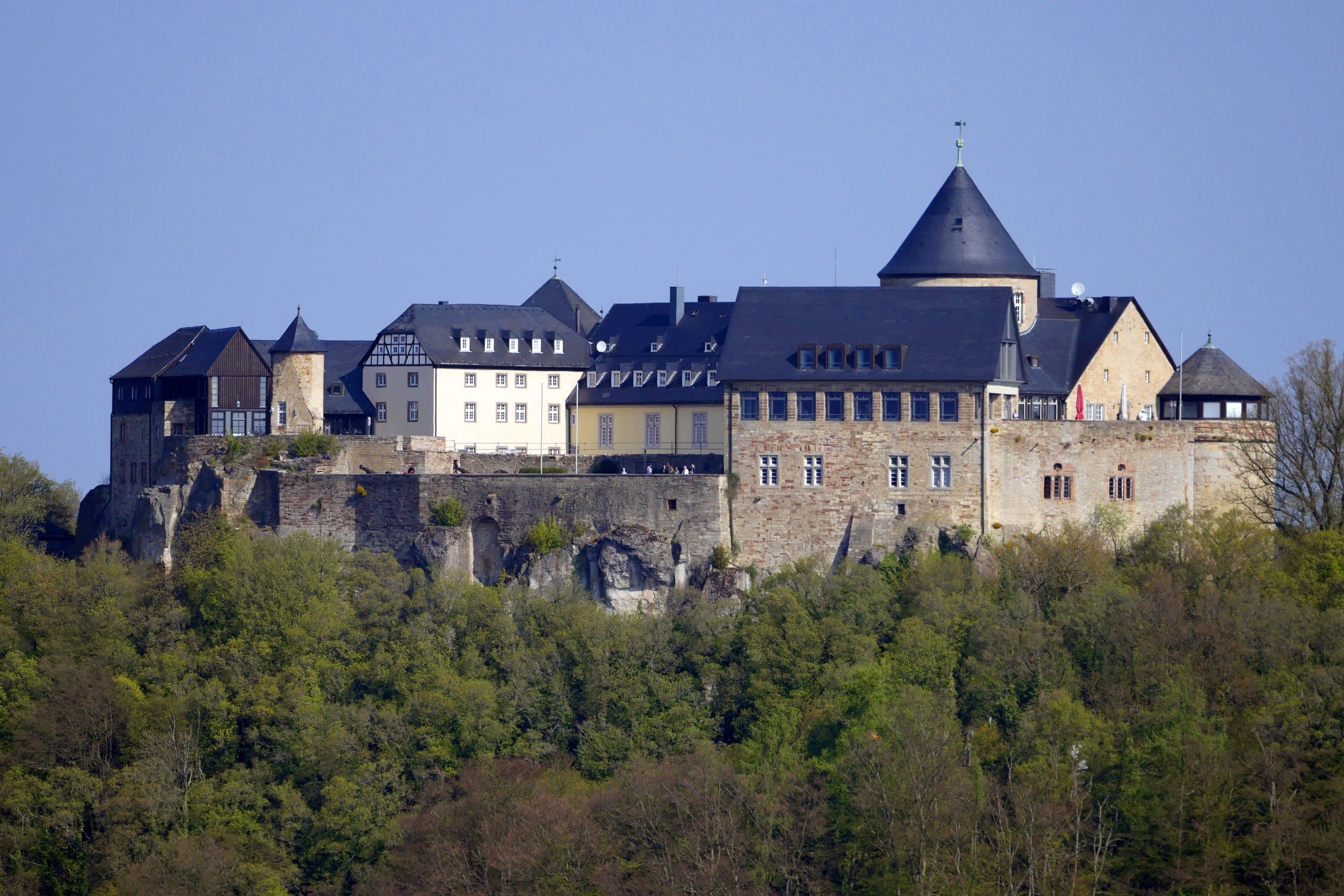
Waldeck Castle crowns a steep, wooded spur about 120 meters above the north shore of the Edersee, on the western edge of the small town of Waldeck in northwestern Hesse. The lake below is barely a century old, but the castle above it has watched over the valley of the Eder since the early twelfth century. It gave its name to a dynasty that ruled a small state of its own for the better part of eight hundred years, and its walls have since served almost every purpose a building can: fortress, garrison, penitentiary, archive, and finally a hotel and museum. Few German castles wear their changes of fortune as plainly. The result is a hilltop complex where a medieval keep, a Renaissance residential wing, and a baroque powder gate stand a short walk from a modern restaurant terrace with one of the widest views in the region.
Quick Facts
| English name | Waldeck Castle |
| German name | Schloss Waldeck (also Burg Waldeck) |
| Location | Waldeck, Waldeck-Frankenberg district, Hesse, Germany |
| Setting | Hilltop spur, about 120 m above the Edersee |
| Type | Hill castle, later expanded into a residential Schloss |
| First documented | 1120 |
| Principal periods | Medieval core (13th–14th c.); Renaissance wings (c. 1500–1577); baroque defenses (1637) |
| Condition | Well preserved; in continuous use |
| Owner | Waldeckische Domanialverwaltung (public property since 1920) |
| Current use | Hotel, museum, restaurants, and events |
| Open to public | Yes (museum, terraces, restaurants; hotel for guests) |
| Access | Road up from the town; seasonal Schlossbahn road train from the lakeshore (the former Bergbahn cable car has not run since 2024) |
| Nearest towns | Bad Wildungen and Korbach |
| Official site | hotel-schloss-waldeck.de |
A House on the Rock
The castle enters history in 1120, when a “Bernhard de Waldekke” appears in a Westphalian charter. The hill itself was probably fortified a little earlier, most likely by the Counts of Ziegenhain, who held this stretch of the upper Eder. Through marriage the site passed to the Counts of Schwalenberg, and around 1180 one branch of that house began to call itself after the rock it held. From that point the name and the place belong together. By the early thirteenth century Waldeck was the family’s principal seat, and for more than four hundred years the counts governed their growing territory from this courtyard.
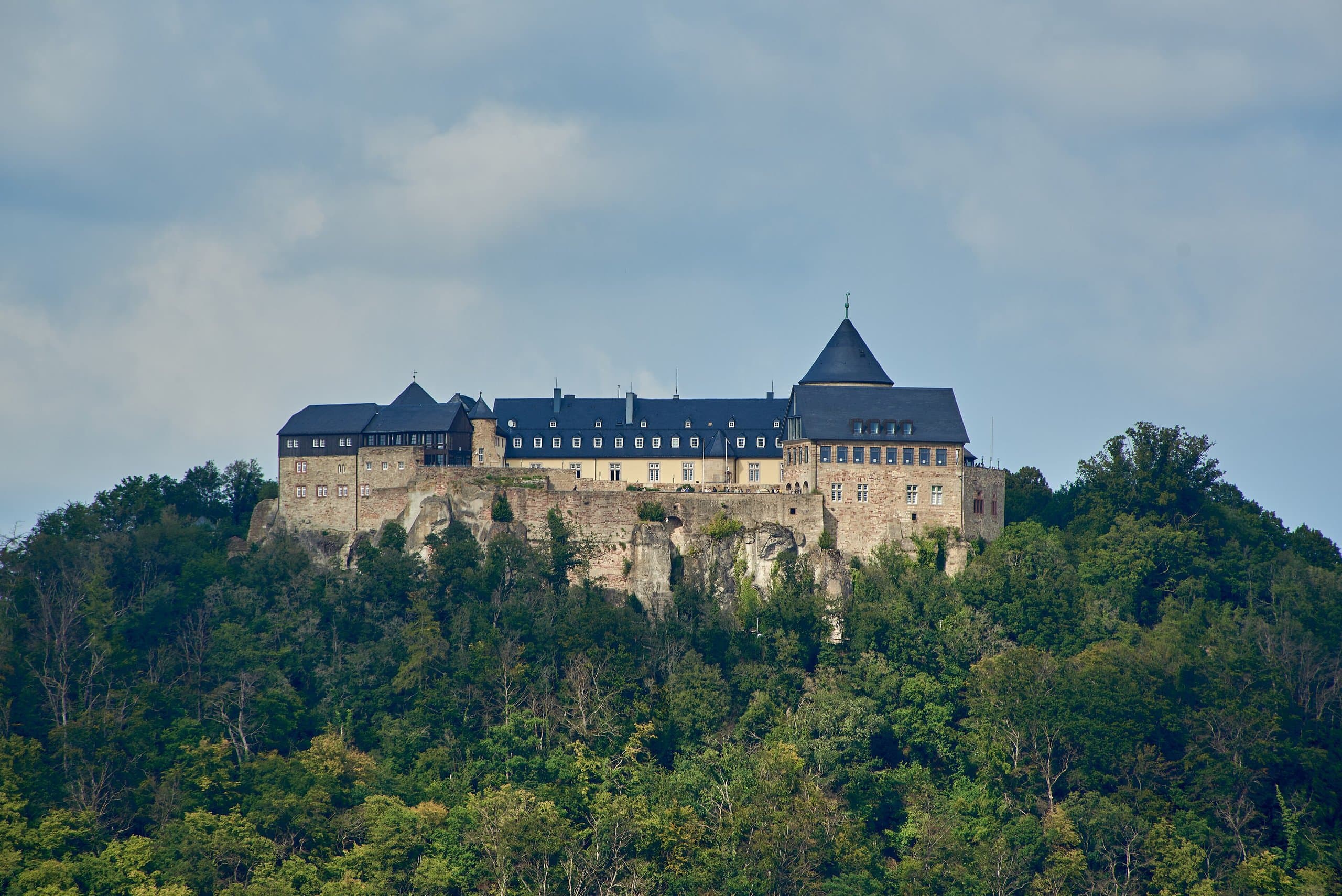
Their realm was never large, but it was tenacious. In 1349 the county gained imperial immediacy, which placed it directly under the Holy Roman Emperor rather than any intervening lord. The family also had a habit of dividing. Inheritance partitions split the house into lines named for their other castles, chiefly Waldeck-Eisenberg and Waldeck-Wildungen, and for long stretches two branches shared the hill at once. The arrangement is written into the buildings. One line took the south wing, the other the north, and the two halves of the courtyard grew at different rhythms according to the fortunes of their owners. A castle that looks unified from the lake was in practice a divided household for much of its history.
The Castle and Its Towers
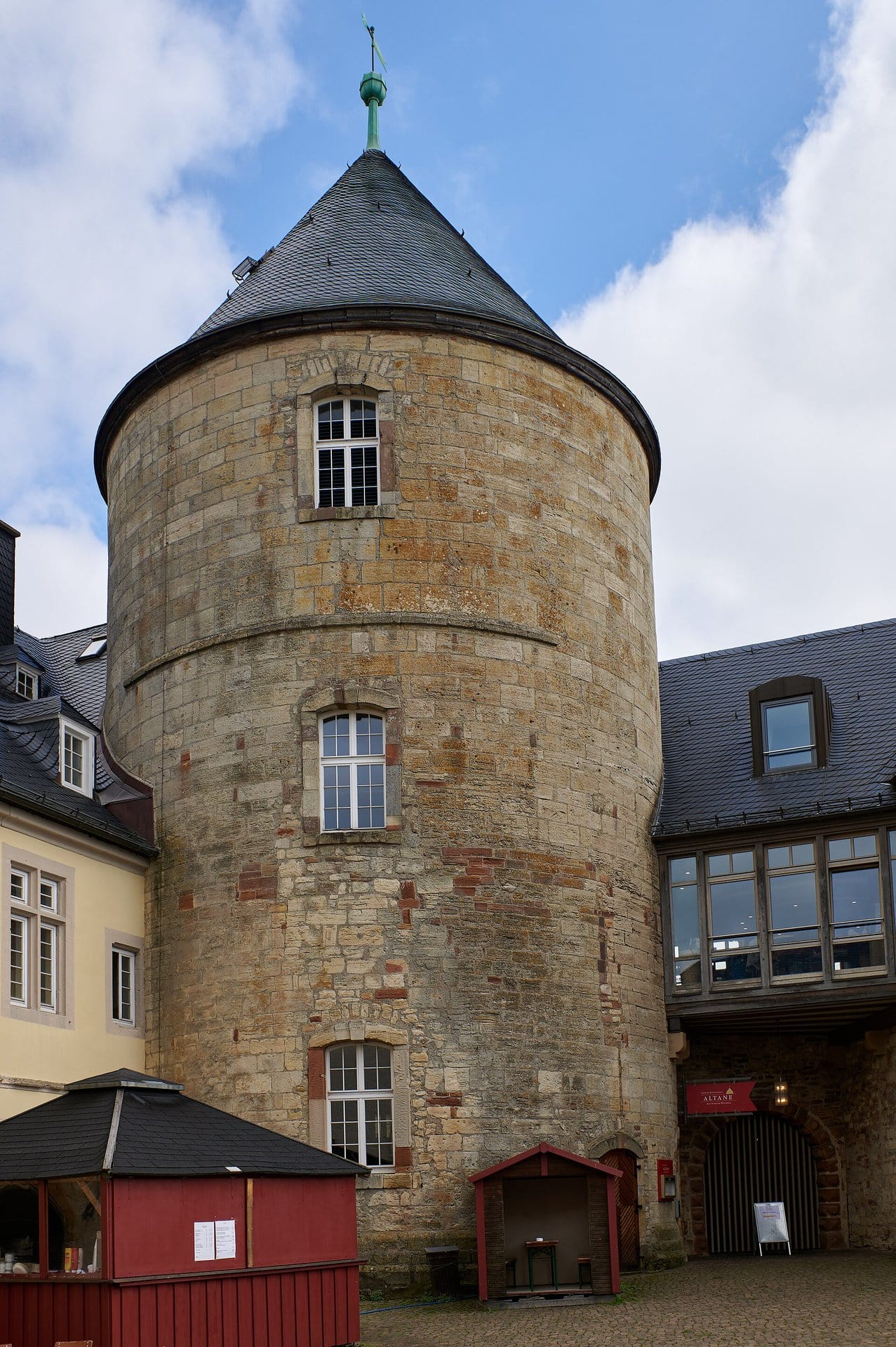
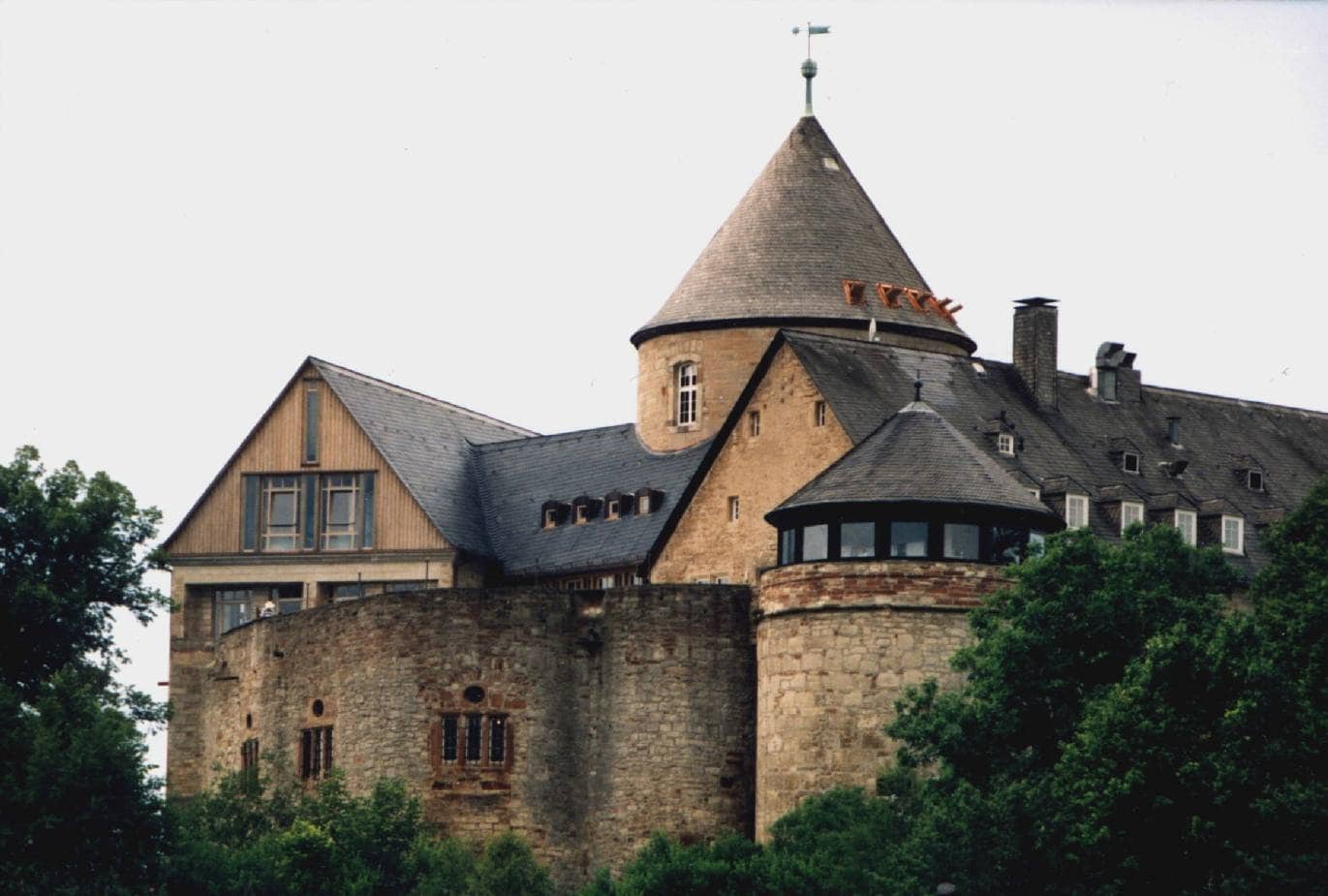
The oldest standing fabric is the round bergfried, the great keep that rises on the eastern side of the complex. Built of local Edersee greywacke at the end of the thirteenth or the start of the fourteenth century, it is a three-story tower with walls more than three meters thick. It later earned the nickname Archivturm because the counts kept their archive inside it between 1745 and 1761, and in the twentieth century it was pressed into service once more as a water tower, a role it held from 1952 until 1997. Today a glass staircase and a lift thread its hollowed interior, and its platform gives the best view on the hill.
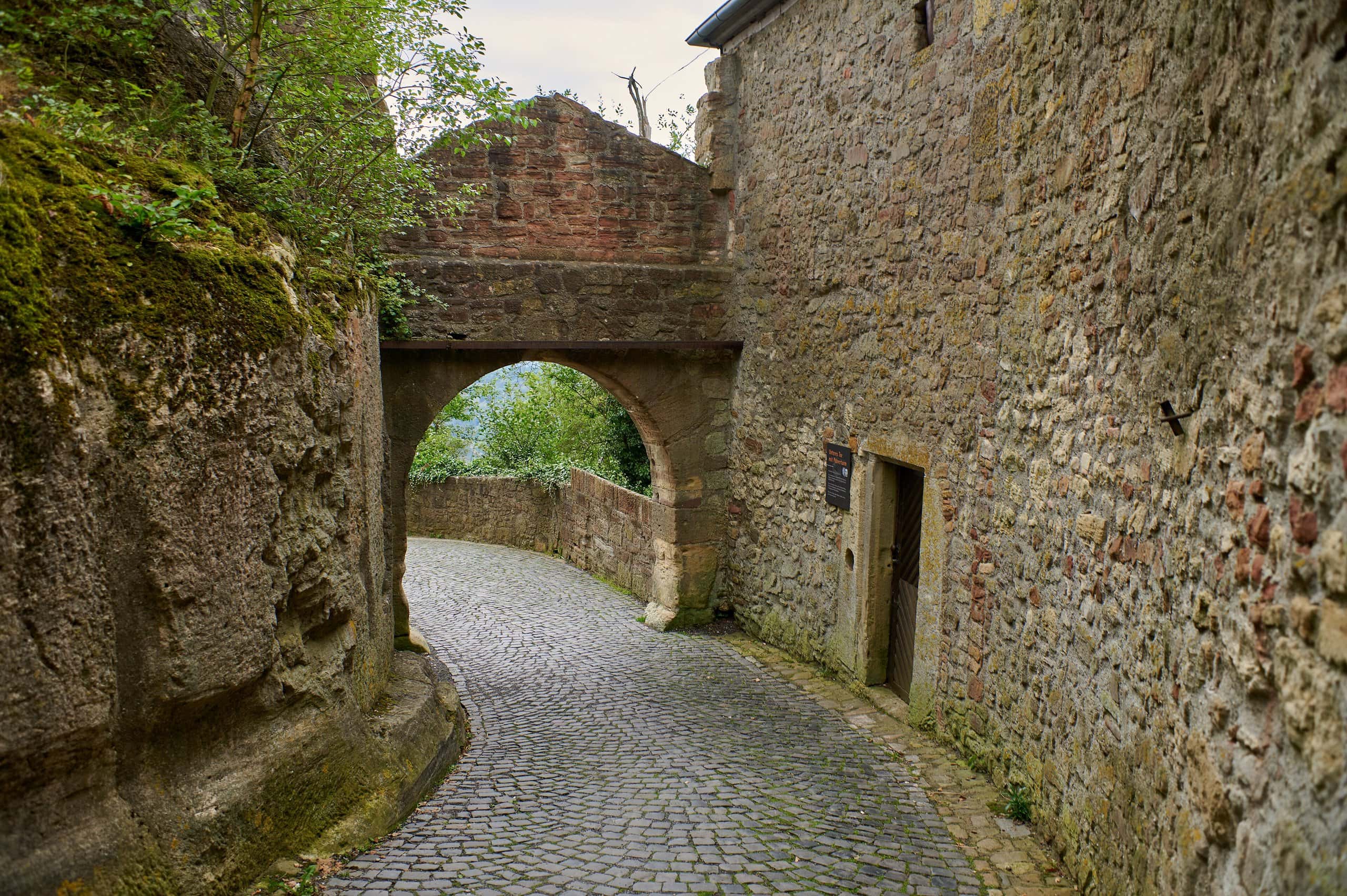
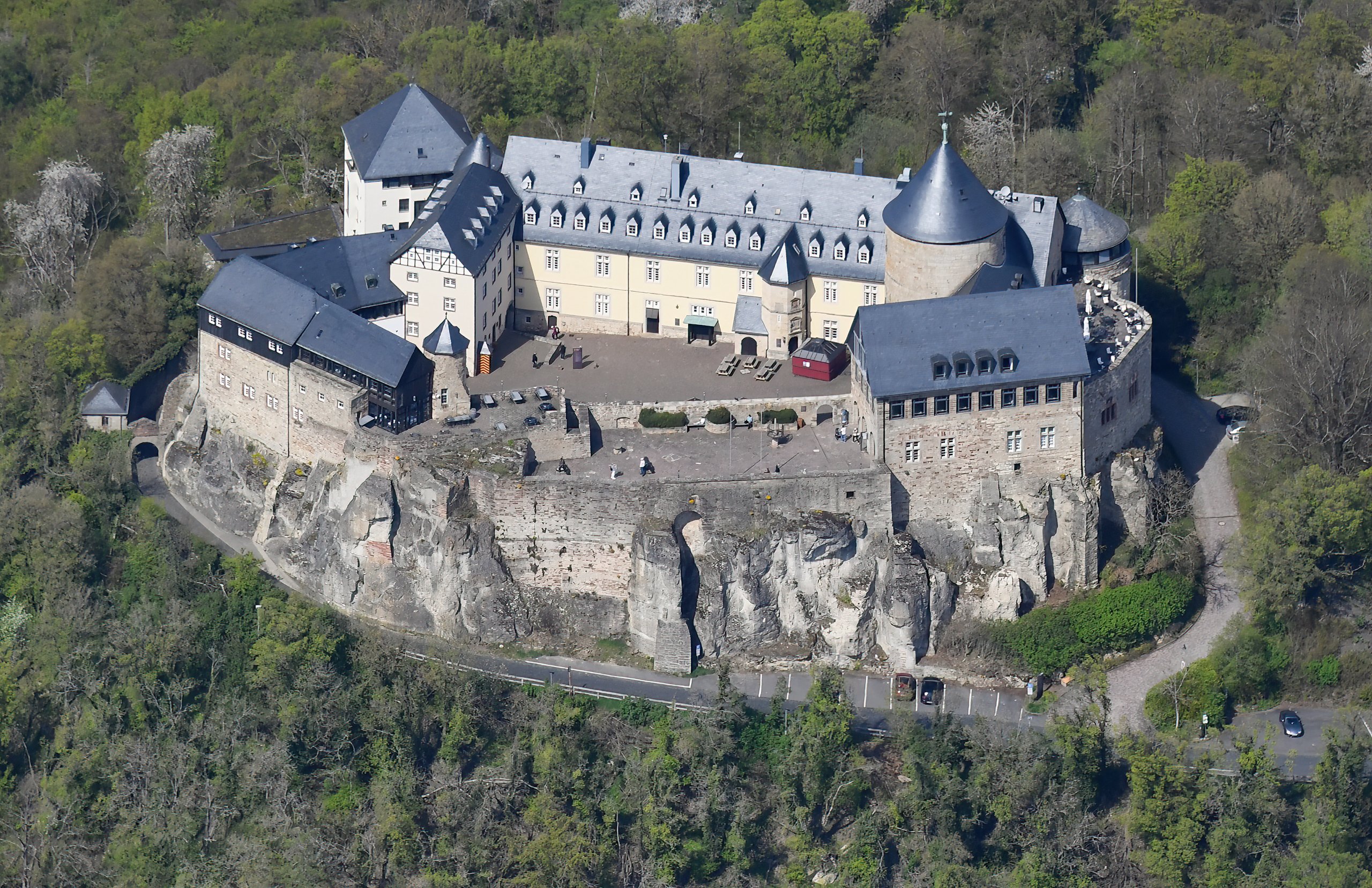
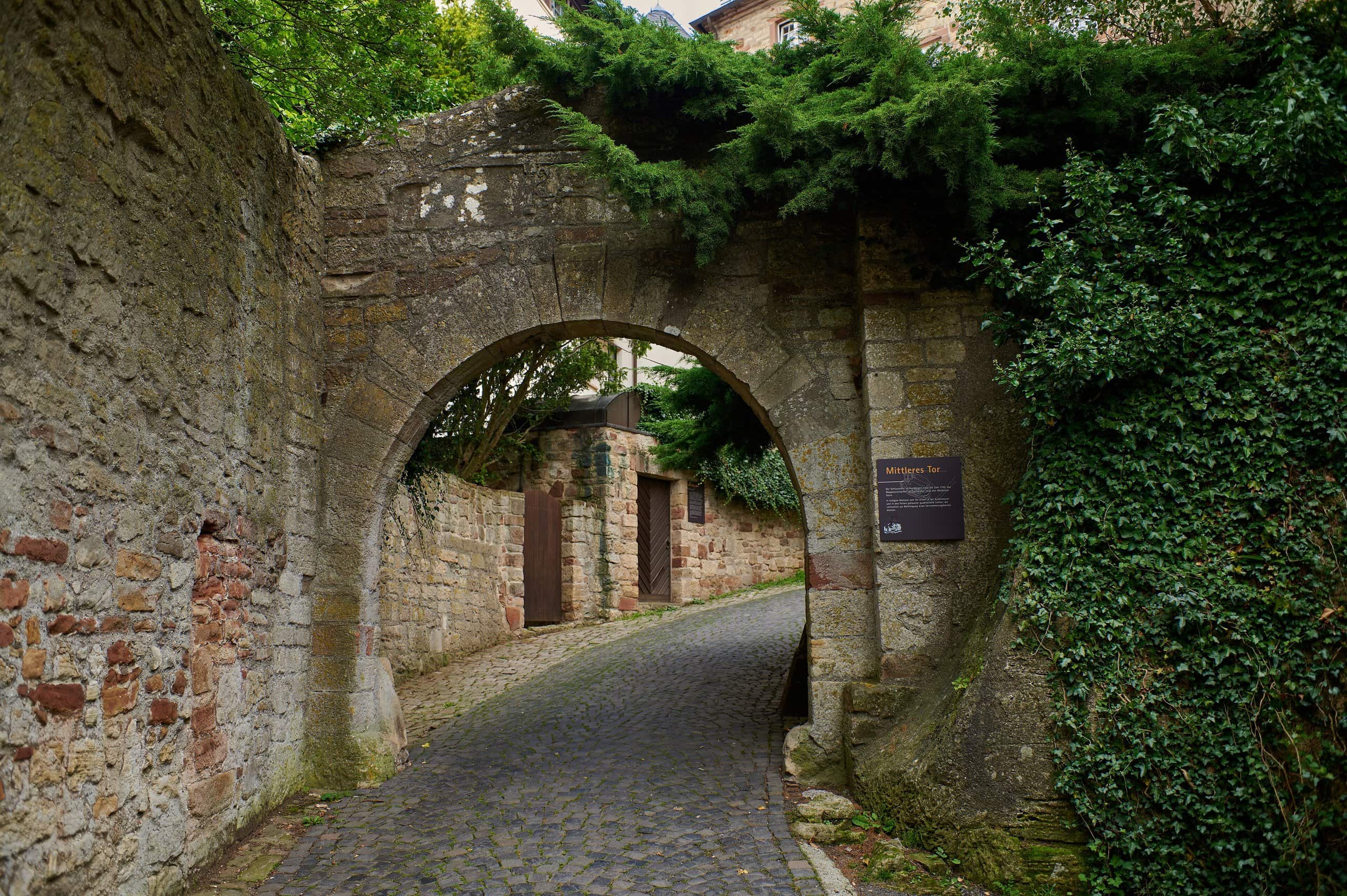
The approach climbs from the west through a sequence of gates. The lower gate was rebuilt in 1637, in the middle of the Thirty Years’ War, and its gatehouse doubled as a powder magazine, which is why it is still called the Pulverturm. Gun-loops from that period survive beside the arch, and an inscription on the gable records further work around 1830, when the old drawbridge was removed. Beyond it the path passes the deep castle well, dug in the sixteenth century to a depth of about 120 meters, before reaching the upper gate of 1756. The north range, the Wildunger Flügel, was raised between roughly 1500 and 1577 and still holds the old knights’ hall behind much-altered walls. The south range told a harder story: a medieval wing whose origins reached back to the thirteenth century, it was pulled down in 1734, and the broad terrace called the Altane now occupies its place. Only the vaulted cellars beneath survive from the older building.
The complex did not escape the wars of the eighteenth century. During the Seven Years’ War French troops occupied the castle, and in July 1762 a two-day bombardment left it badly damaged; the Waldeck court architect Friedrich Franz Rothweil rebuilt it the following year.
Seat of a Small State
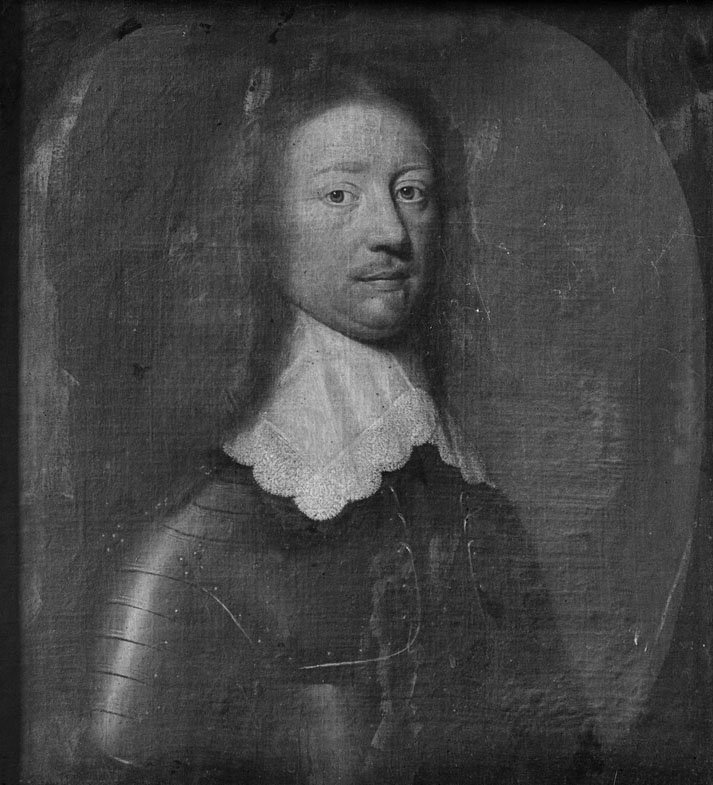
For all its remodeling, the castle’s role as a residence had a clear end date. In 1655 the counts moved their seat down to Arolsen, settling on the site of a former convent that they would later rebuild into a baroque residence. Waldeck kept its strategic value and its symbolism, but the household and the business of government went elsewhere. When the house reached its highest rank, the elevation of the Count of Waldeck and Pyrmont to a prince by Emperor Charles VI in 1712, the new princes ruled from Arolsen, not from the rock that carried their name.
The state itself proved remarkably durable. Through the collapse of the Holy Roman Empire and the wars and confederations of the nineteenth century, the small principality kept a thread of sovereignty, even after 1868, when it handed most of its administration to Prussia while retaining its own legislature. It outlasted the monarchy, became the Free State of Waldeck-Pyrmont in 1918, and survived as a separate German state until April 1, 1929, when its finances finally forced a merger into Prussia. The castle on the Edersee was the cradle of all of it, the place where a county began that would cling to its own name and its own borders for almost eight centuries.
Behind Lock and Bolt
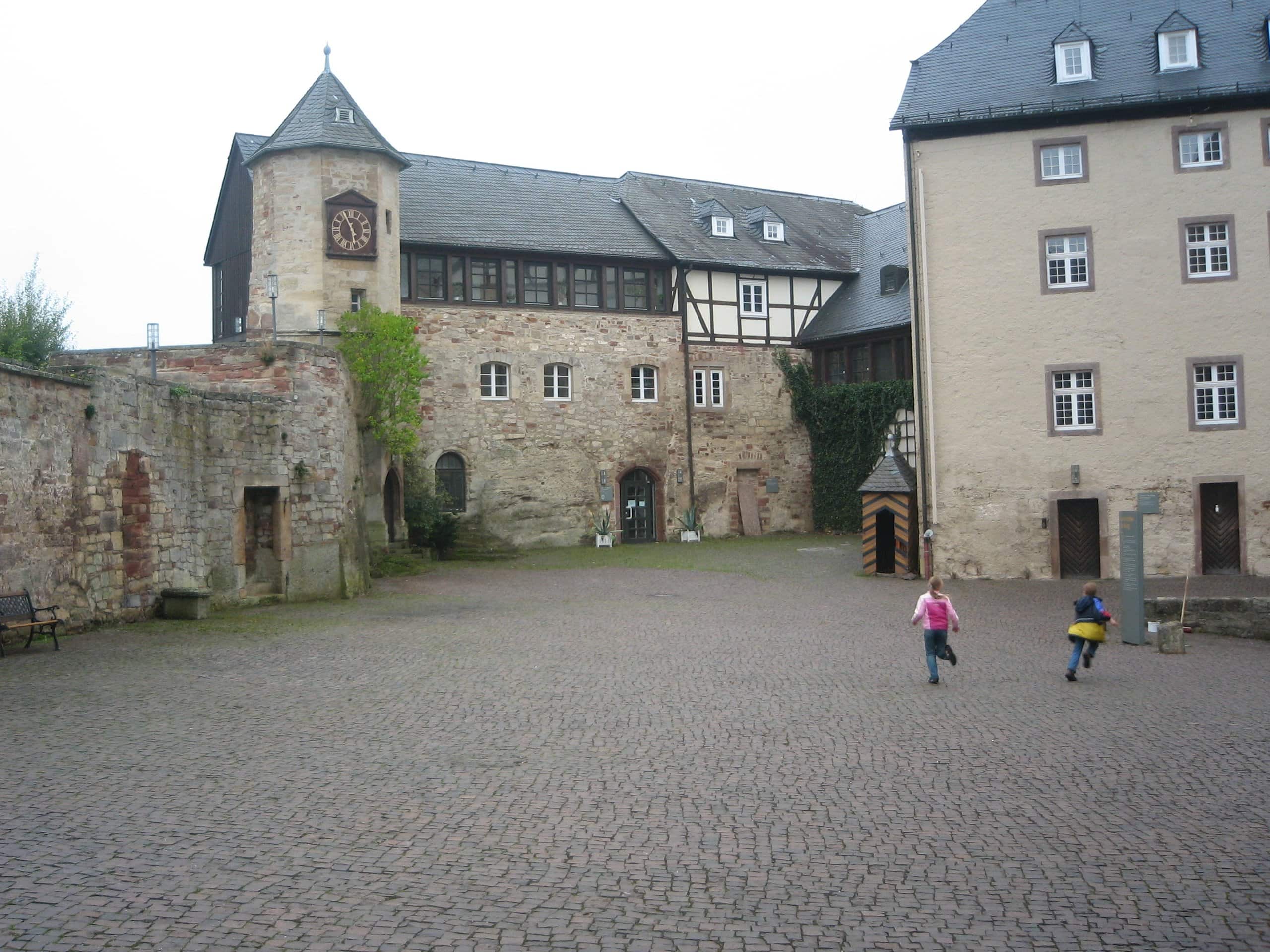
Once the court left in 1655, Waldeck began the strangest chapter of its long life. The fortress became a garrison under a castle commander, then a barracks, with soldiers detached from the garrison town of Arolsen. In 1734 the counts turned part of the complex into a penitentiary, a Zuchthaus, and a women’s prison, and for well over a century the castle that had housed a ruling family housed prisoners instead.
The records of that period are vivid and grim. Male inmates were set to work at marble saws installed in a great hall below the guardroom, cutting and grinding stone hauled in from quarries at Giebringhausen. The women spun, wove, and plaited. The jailer lived in the bergfried, the very tower that had once guarded the family’s archive. The penitentiary was dissolved in 1868; the buildings stayed in penal and administrative use into the early twentieth century before the castle found gentler work. That long custodial history, not the witch-trial legends sometimes attached loosely to old German towers, is the genuine dark thread here, and it is the subject the castle museum chooses to tell. Its permanent exhibition, Hinter Schloss und Riegel, which translates roughly as “behind lock and bolt,” draws mainly on the eighteenth and nineteenth-century prison years.
The Drowned Valley
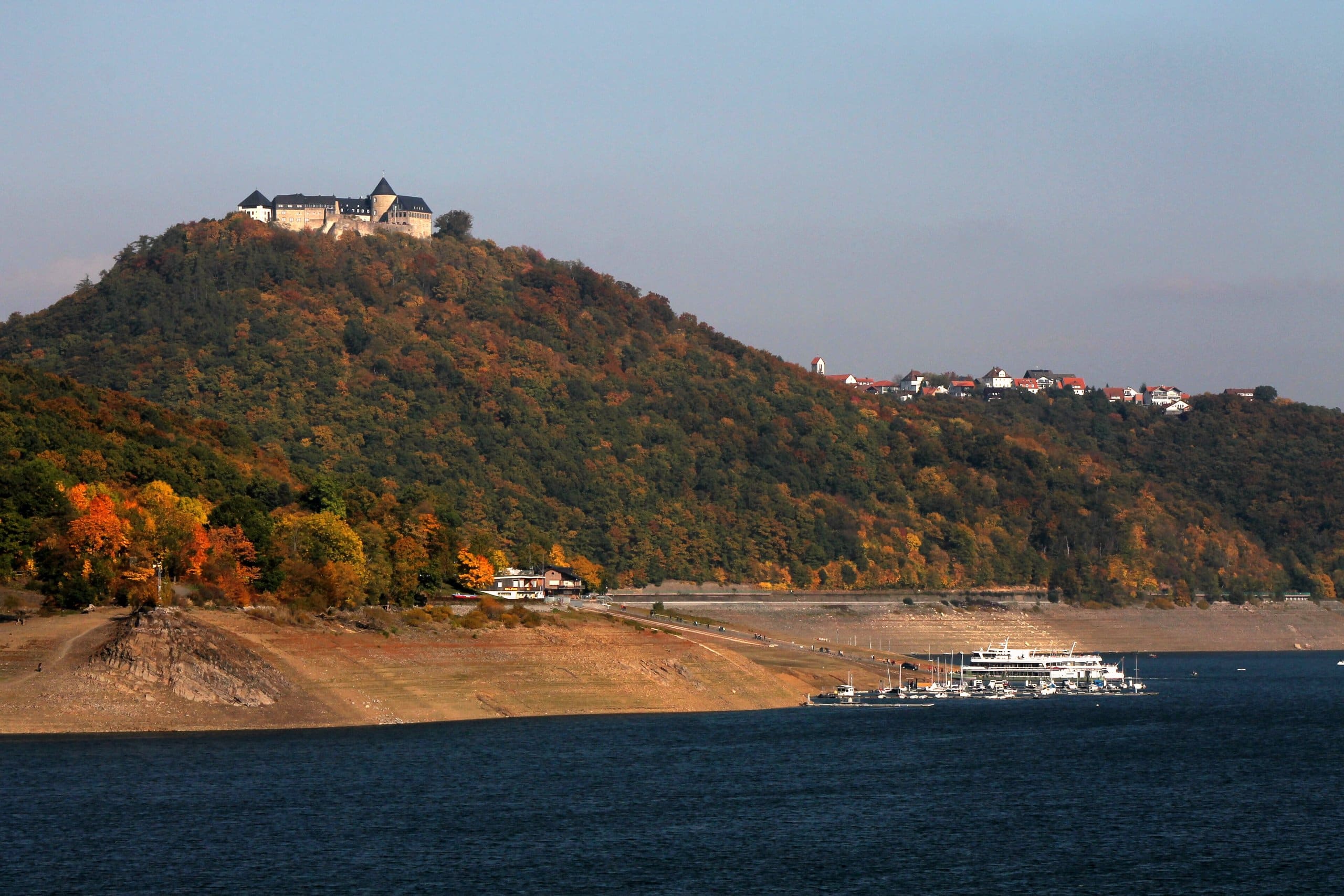
The view that now defines Waldeck did not exist when the counts lived here. Below the castle, the Eder ran through a narrow farming valley dotted with villages. Between 1908 and 1914 engineers closed that valley with the Eder dam, creating the Edersee, today the third-largest reservoir in Germany by volume. Its purpose was practical: stored water released in summer keeps the Weser and the Mittelland Canal navigable, and the dam generates electricity. Three villages, Asel, Bringhausen, and Berich, vanished beneath the new lake along with an old bridge, and in dry late summers, when the water drops, their foundations still surface from the mud.
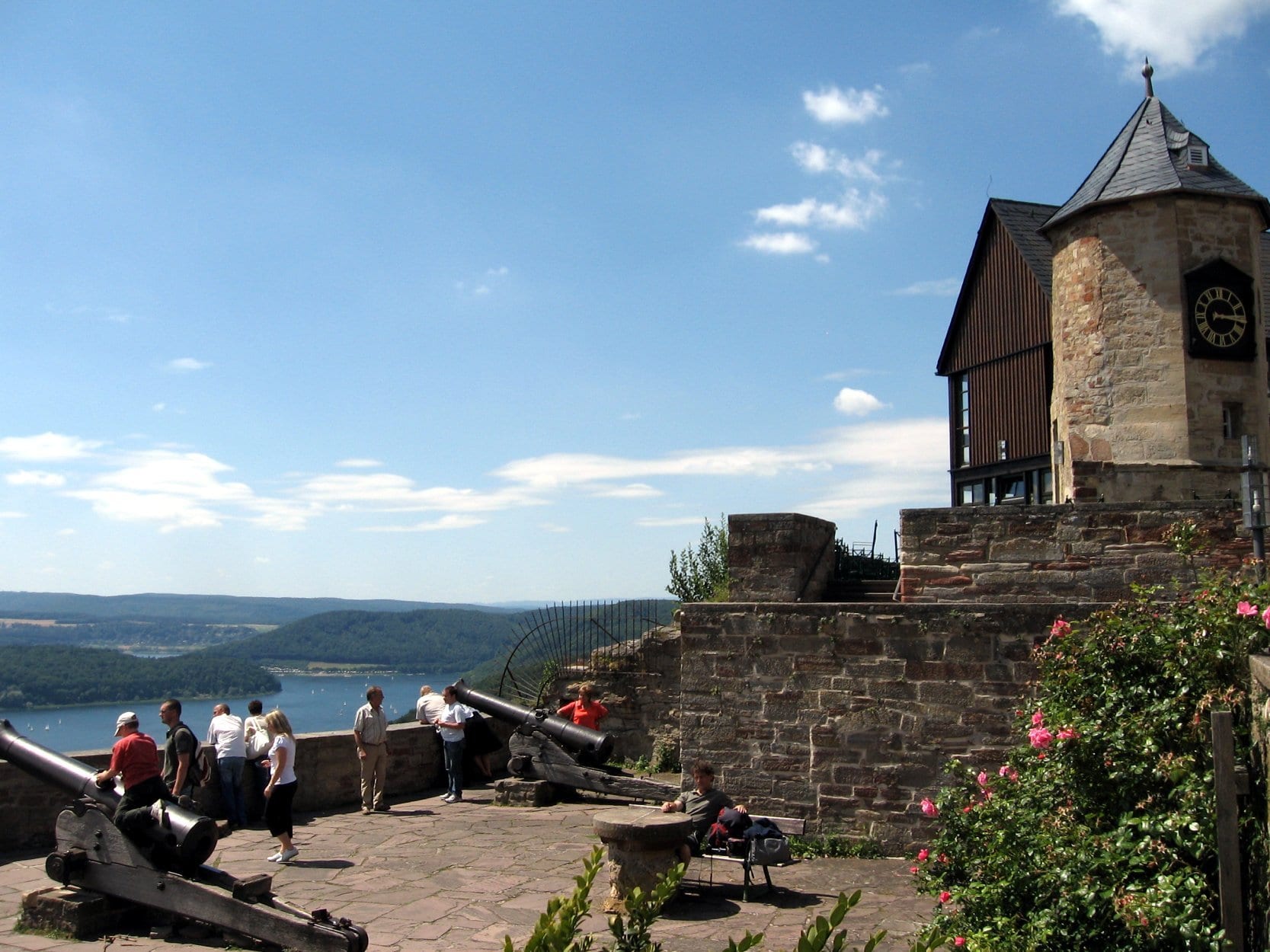
The valley was transformed a second time in a single night. On the night of May 16–17, 1943, No. 617 Squadron of the Royal Air Force, soon famous as the Dam Busters, attacked the Eder dam with Barnes Wallis’s bouncing bomb as part of Operation Chastise. The Eder was a difficult, undefended secondary target, ringed by hills and shrouded in mist, and several runs failed before the Australian pilot Les Knight made the attack that broke the wall, tearing a breach about seventy meters wide and twenty-two deep. The reservoir emptied in a torrent down the Eder valley. The flood killed around seventy people in the valley below, far fewer than at the Möhne dam to the west, and it had largely spent itself by the time it reached Kassel, some thirty-five kilometers away. German crews rebuilt the dam within months, using forced labor. From the castle’s terrace the whole stage is laid out below: the lake to the west, the rebuilt dam wall to the south, and the wooded ridges of the Kellerwald beyond.
Waldeck Castle Today
The castle’s latest role began surprisingly early. Parts of it were let as a hotel as far back as 1906, and since 1920 the whole complex has been public property, held by the Waldeckische Domanialverwaltung, the administration that manages the former Waldeck state domains. The present hotel wing was built over the entrance bastion in the late 1980s, when a new museum building also rose partly on the footprint of the demolished south range. The blend is frank rather than seamless: medieval masonry on the outside, sleek rooms within, and a terrace café where the prison’s marble saws once turned.
Visitors come for several things at once. The four-star Hotel Schloss Waldeck offers forty-two rooms, two restaurants, the more formal Alte Turmuhr and the Altane café on the terrace, and a small wellness area. The museum tells the prison story under the keep. The old knights’ hall and the castle’s historic rooms host weddings and events, with the local registry office holding ceremonies here too, which has made the castle a popular setting for celebrations above the lake.
Getting up the hill has its own small history. A cable car, the Waldecker Bergbahn, carried visitors and their bicycles up from the lakeshore from 1961 onward, but it has not run since early 2024. For the 2026 season a road train, the Schlossbahn, makes the climb in its place.
Visiting Waldeck Castle
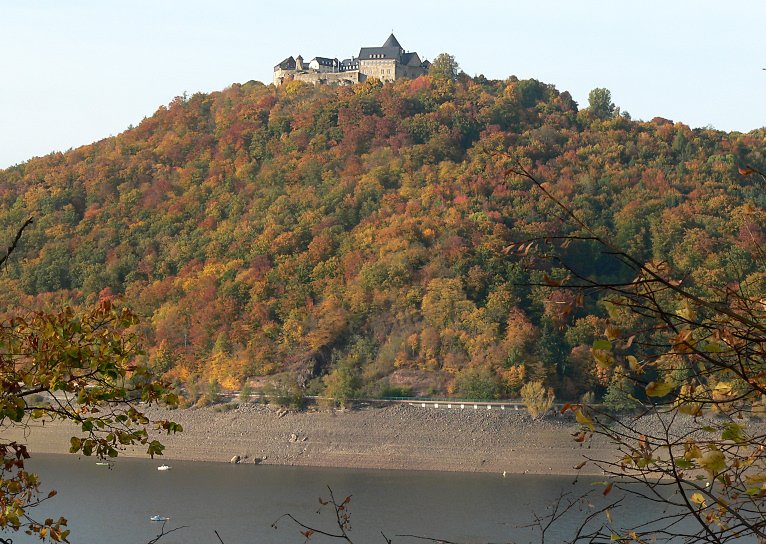
Waldeck sits in the Kellerwald-Edersee region of northern Hesse, between Korbach and Bad Wildungen, with the Edersee at its feet. Drivers reach the castle by a signed road that winds up from the town; free parking sits just below the entrance, which is useful, since space in the town center is tight. From the Edersee shore, a road train called the Schlossbahn runs up to the castle in season; it has replaced the old Waldecker Bergbahn cable car, which has not operated since 2024. On foot, the climb from the town takes about twenty minutes.
The terraces, the museum, and the restaurants are open to all; the hotel rooms, naturally, are for guests. The museum and hotel keep seasonal hours that are heaviest from spring through October, so it is worth checking current times before a special trip, particularly in winter. Allow time simply to stand on the Altane: on a clear day the view reaches south to the dam and west across the entire lake, and it explains in a glance why a medieval family chose this rock. The surrounding Kellerwald-Edersee National Park, whose ancient beech forests carry a UNESCO natural-heritage listing, makes the castle an easy anchor for a longer day of walking, cycling, or a boat trip on the lake.
If you would like to make a night of it, you can check rooms and rates at the castle hotel, or browse boat trips and guided experiences around the Edersee.
Some links on this page are affiliate links, which means StoneKeep Atlas may earn a small commission, at no extra cost to you, if you book through them.
More Views of Waldeck Castle
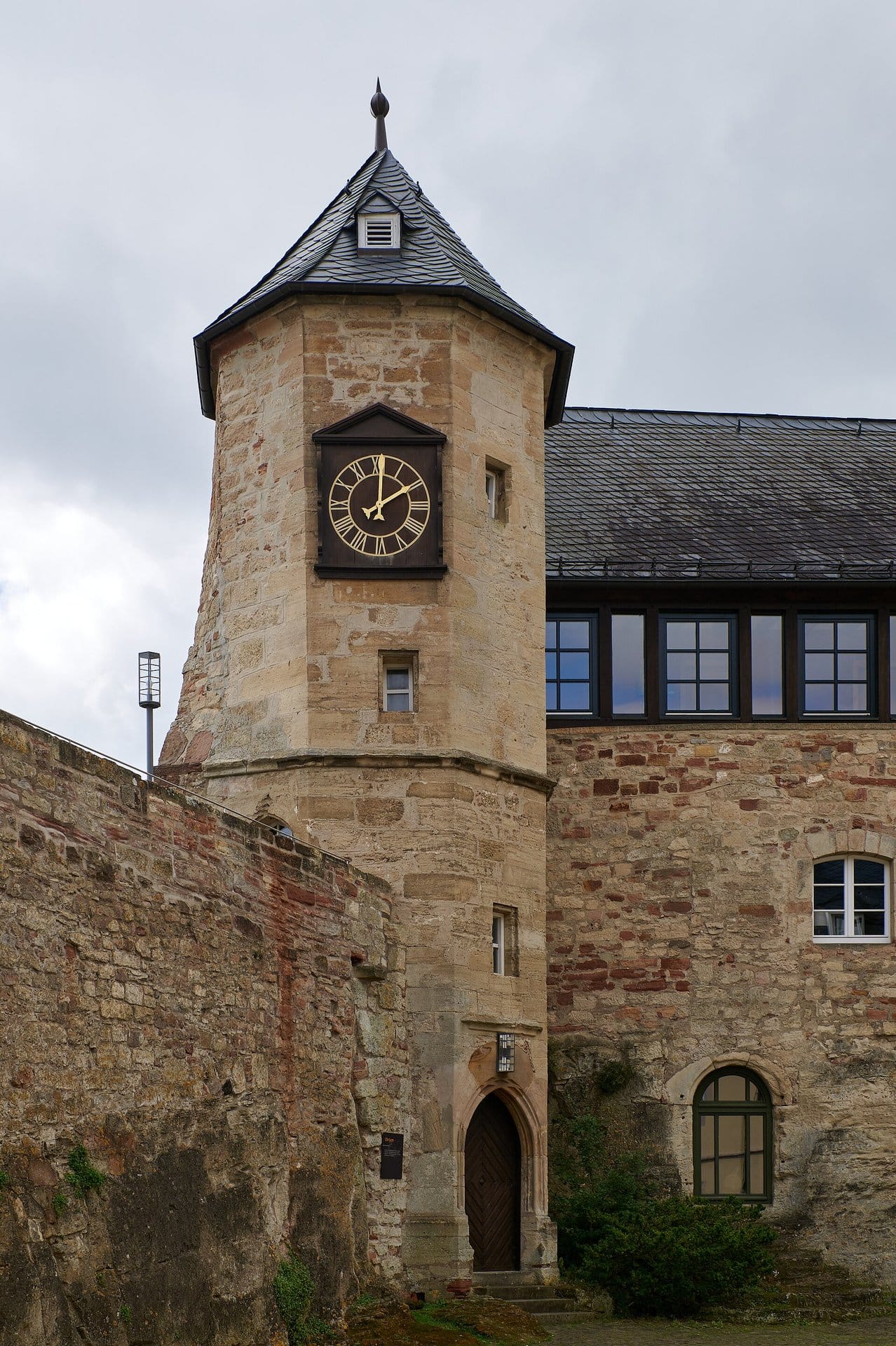
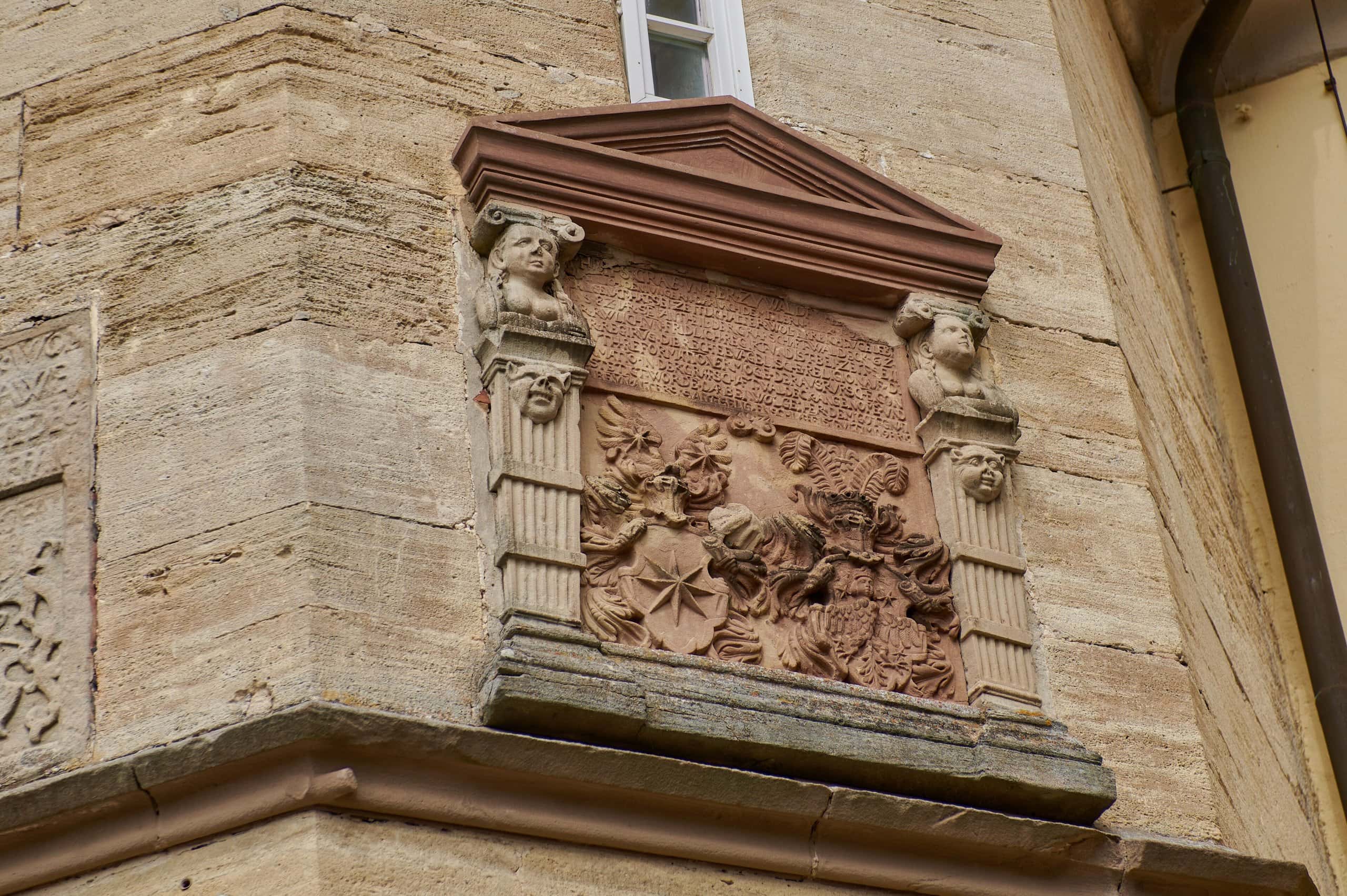
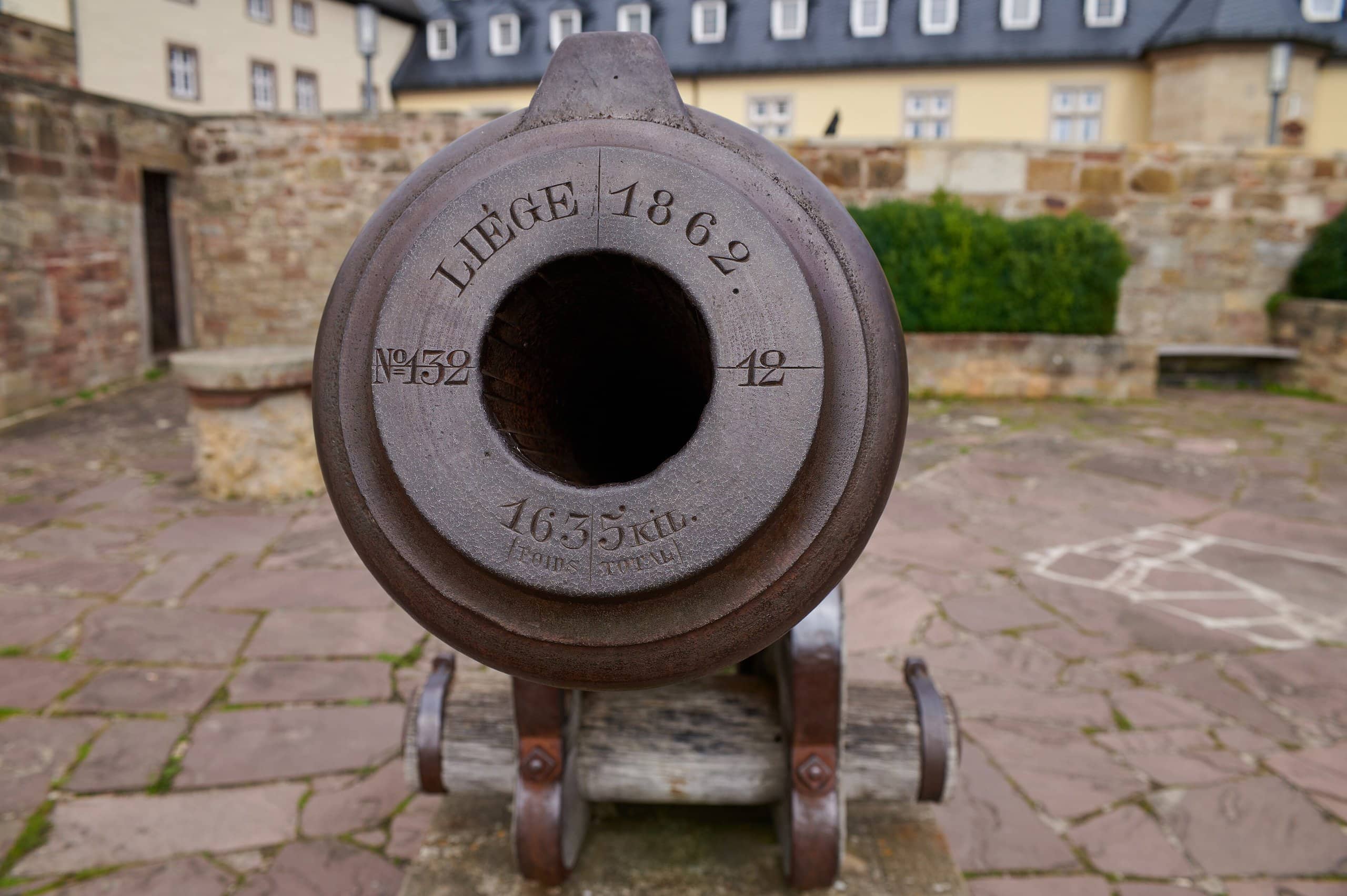
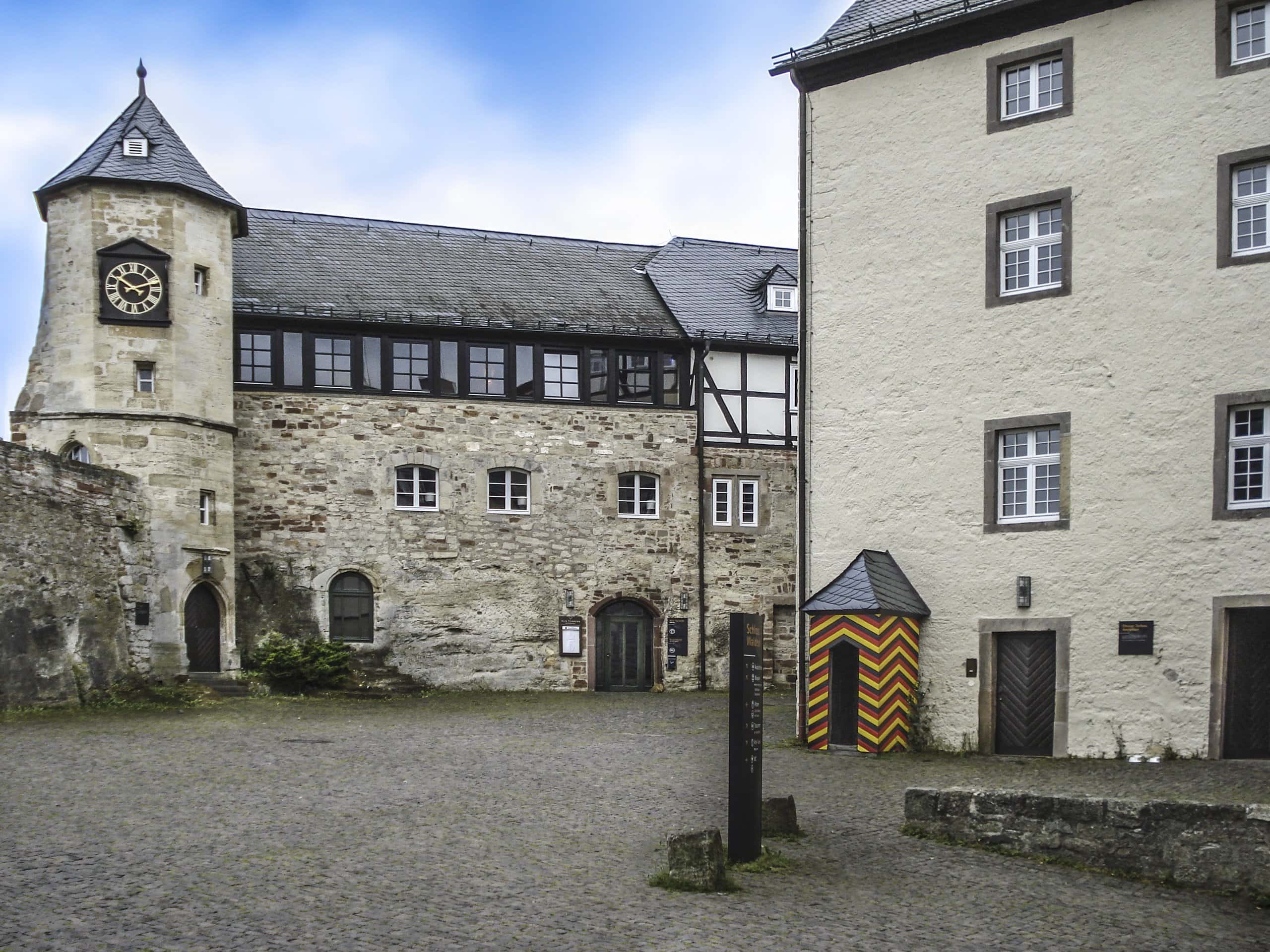
A few more views of the castle, its towers and gates, and the lake it commands.
Beyond Waldeck Castle
Waldeck lies far to the north of Hesse’s better-known castle country, but it has clear company elsewhere in the state. On the Rhine’s edge of Hesse, Eltville Castle preserves the riverside seat of the archbishops of Mainz, while the ruined Frankenstein Castle broods above the Bergstraße south of Darmstadt, trailing its tangle of legend. Further south again, Heidelberg Castle shows on a grand scale the same long arc Waldeck shows in miniature: a fortified residence rebuilt across centuries, then handed down to a later age as a monument. Read together, the three Hessian castles and the great Palatine ruin trace how the region’s strongholds passed from working seats of power to the heritage sites they are today.
Conclusion
Waldeck Castle is easy to enjoy for its view alone, but its real interest lies in how legible its history is. The keep that guarded an archive, the gate that stored gunpowder, the wing that became a prison, the terrace that replaced a demolished hall: each layer answers a different need from a different century, and almost all of them are still there to be read. The dynasty that began here is long gone, its little state folded into Prussia and then into modern Hesse, and the valley it once overlooked is now a lake. The castle endures by doing what it has always done, which is to find a new use for old stone.
Principal Sources
- The architectural and dynastic account here follows the Hessian state historical information system (LAGIS Hessen), which draws on the Dehio Handbuch der deutschen Kunstdenkmäler and Rudolf Knappe’s Mittelalterliche Burgen in Hessen, together with the German-language reference literature on Schloss Waldeck and the documentation of the castle hotel. The history of the County and Principality of Waldeck-Pyrmont and its 1929 dissolution follows standard reference accounts. The Edersee dam and Operation Chastise draw on published histories of the 1943 raid and the dam’s construction. Visitor details reflect current published information and should be confirmed against the operator before travel.
- German sources differ on a few dates: the move to Arolsen is usually given as 1655 (some say 1665); imperial immediacy as 1349 (some, 1379); and the castle penitentiary’s founding as 1734 (some, 1738 or 1743). This article follows the most widely cited figures and notes the alternatives here.
Image credits. Banner and aerial above the Edersee: Sleeptoken15, CC BY-SA 4.0, via Wikimedia Commons; aerial from the south: Carsten Steger, CC BY-SA 4.0, via Wikimedia Commons; the castle from the south, the bergfried, the lower gate, the clock tower, the stair-tower reliefs, the middle gate, and the trophy cannon: Tilman2007, CC BY-SA 4.0, via Wikimedia Commons; the courtyard: Chattus, CC BY-SA 4.0, via Wikimedia Commons; the castle above the autumn Edersee at low water: Huntsman76, CC BY-SA 4.0, via Wikimedia Commons; the viewing terrace: Celsius (Wikivoyage), CC BY-SA 3.0, via Wikimedia Commons; the excursion boat below the castle: Axel Hindemith, public domain, via Wikimedia Commons; the keep and glass bay: Günter Steiner / Waldeckische Domanialverwaltung, CC BY 2.0 DE, via Wikimedia Commons; the inner courtyard: Fornax, CC BY-SA 3.0, via Wikimedia Commons; the castle from the Kanzel viewpoint at low water: Membeth, CC0, via Wikimedia Commons; portrait of Count Philipp Theodor von Waldeck: unidentified artist, public domain, via Wikimedia Commons. Freely licensed images are resized to fit; otherwise unaltered.