
Château de Peyrepertuse
The Ship on the Rock
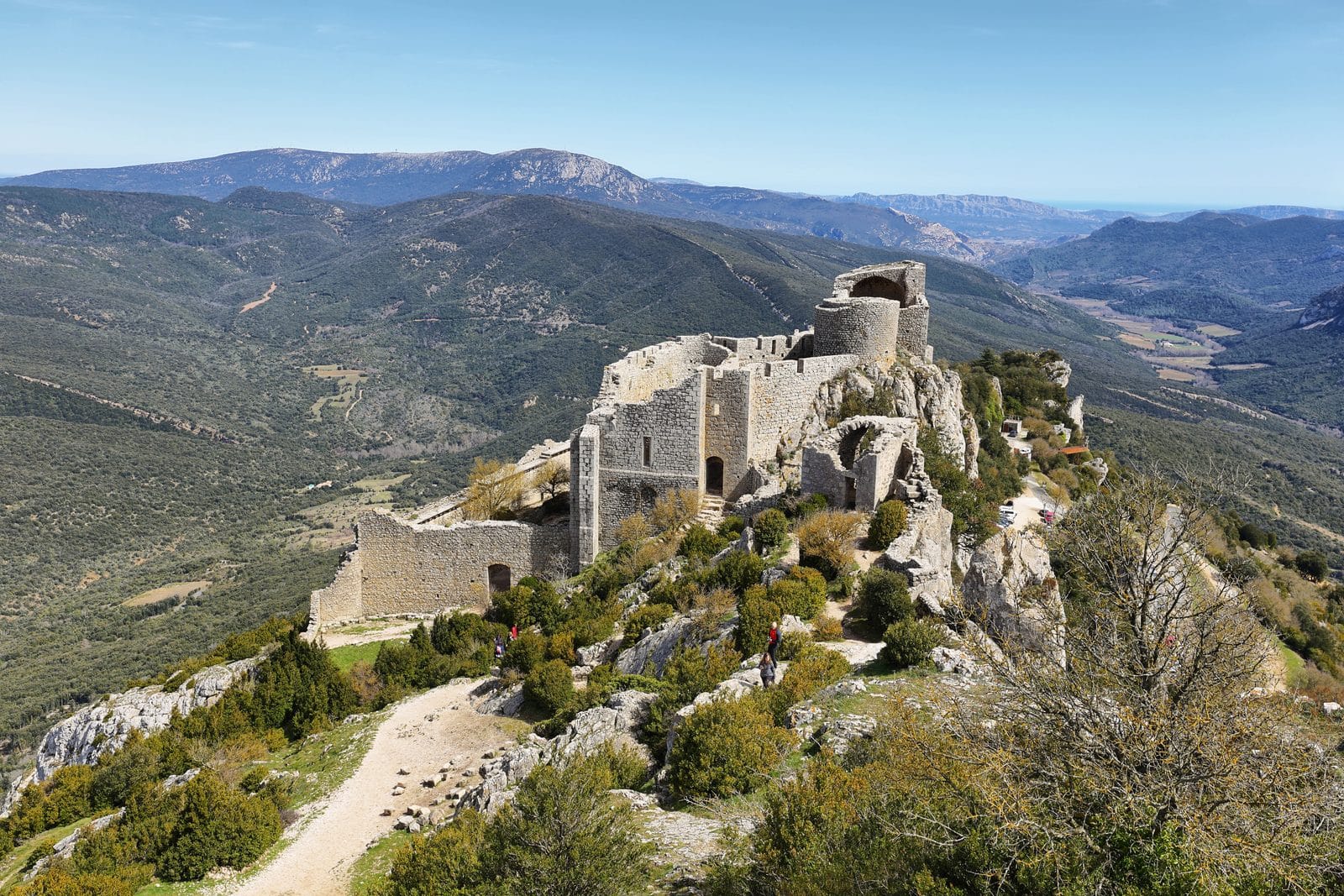
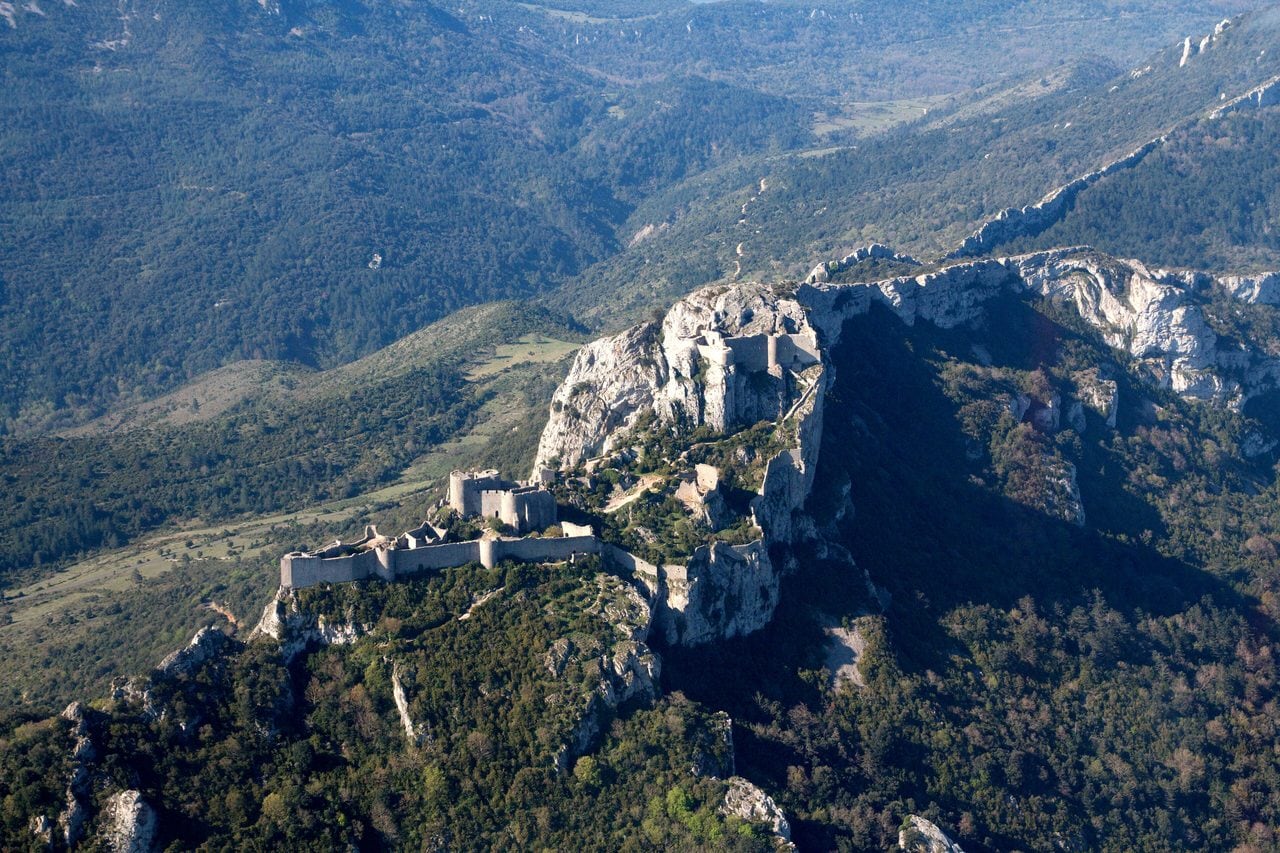
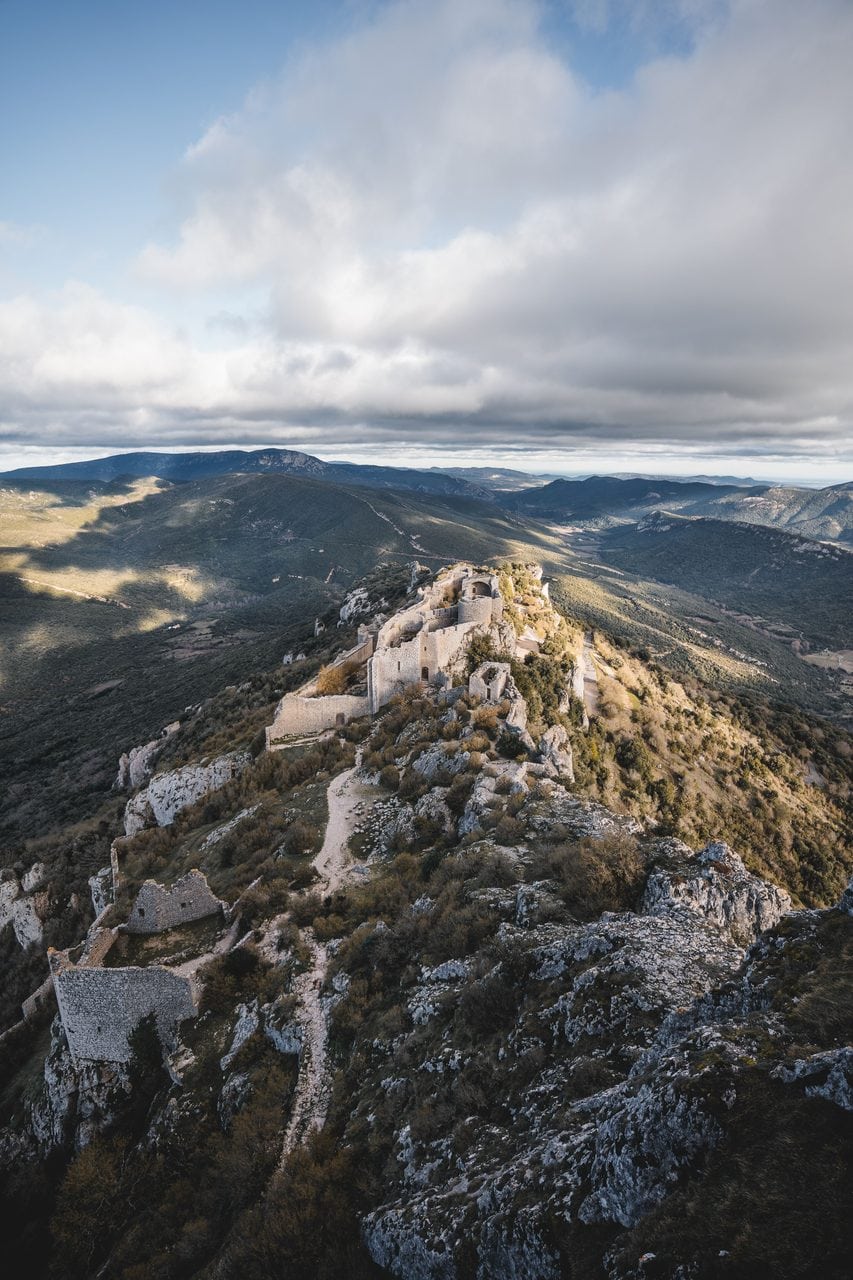
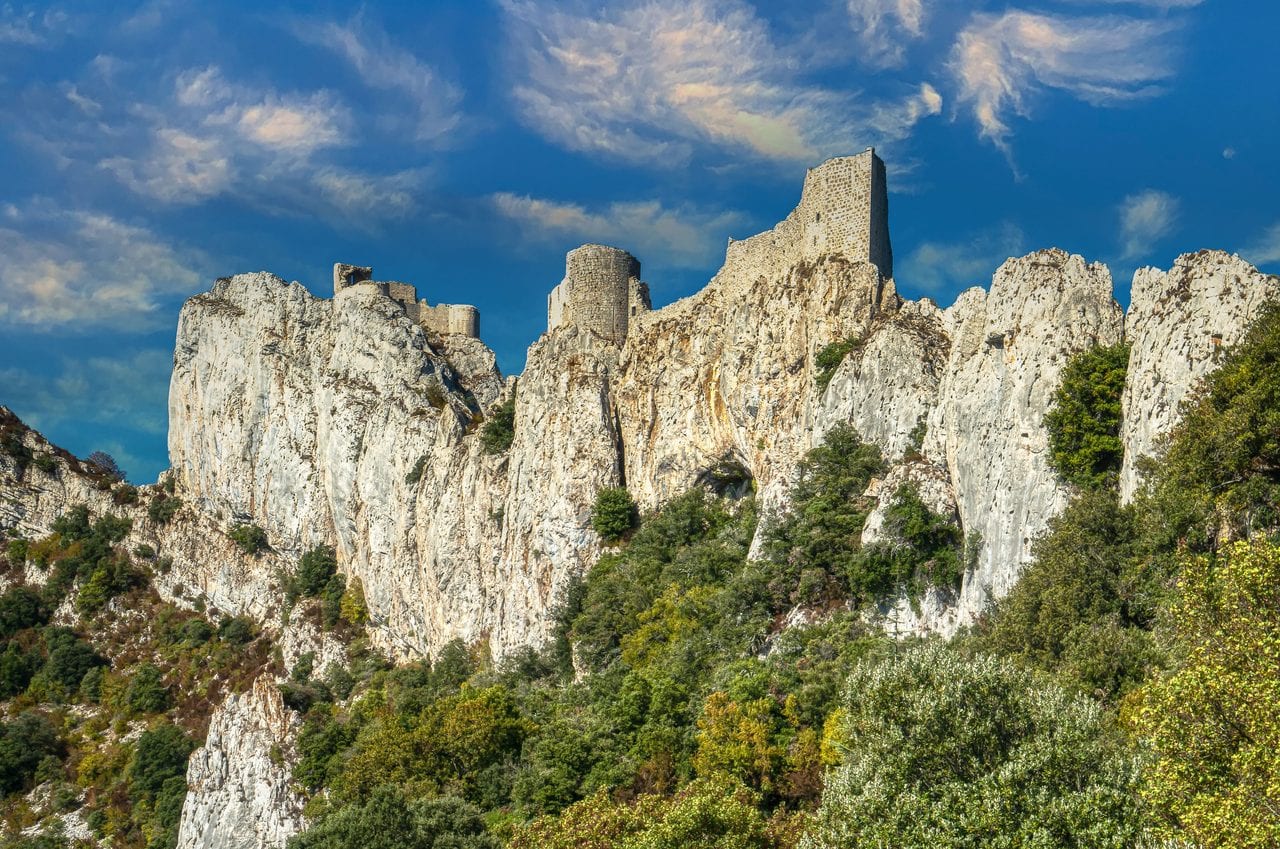
From the village of Duilhac, the first sight of the Château de Peyrepertuse is hard to credit. A wall of pale limestone climbs out of the garrigue, and along its summit, fused to the rock so completely that stone and masonry blur together, runs a fortress nearly three hundred meters long. Locals call it the stone ship. Set on a ridge roughly eight hundred meters above sea level, above cliffs that fall thirty to forty meters on the southern side, it is the largest of the mountain strongholds known as the five sons of Carcassonne, and it sprawls along its ridge on a scale that tradition likes to compare to the walled city of Carcassonne itself. That reputation for sheer extent earned it a nickname: the Celestial Carcassonne. The ridge sits at the heart of a natural amphitheater of peaks, walled in by the roc de Sagnes, the Sarrat Pounchu, and the summit of La Quille, with the high Corbières falling away to the north and the Fenouillèdes to the south.
 CC BY-SA 4.0" srcset="https://stonekeepatlas.com/wp-content/uploads/2026/06/peyrepertuse-castle-aerial.jpg 1280w, https://stonekeepatlas.com/wp-content/uploads/2026/06/peyrepertuse-castle-aerial-300x200.jpg 300w, https://stonekeepatlas.com/wp-content/uploads/2026/06/peyrepertuse-castle-aerial-1024x682.jpg 1024w, https://stonekeepatlas.com/wp-content/uploads/2026/06/peyrepertuse-castle-aerial-768x512.jpg 768w" sizes="auto, (max-width: 1280px) 100vw, 1280px" />
The name carries its own clue. Peyrepertuse comes from the Latin *Petra Pertusa*, the pierced stone, the old name of the rock itself. Travel writing reaches for the label “Cathar castle,” and the phrase has stuck to the whole chain of fortresses that ring the old county of Carcassonne. It is a romantic half-truth. The lords who held this rock did shelter Cathars, and the early castle served as a refuge during the crusade that tore through Languedoc. Yet the vast fortress a visitor climbs today is something else entirely: a royal border stronghold, raised by the French crown after the heresy had already been broken. The real story is stranger and more revealing than the legend.
Quick Facts
| Location | Duilhac-sous-Peyrepertuse, Aude, Occitanie, France |
| Type | Royal frontier fortress (ruined) |
| Built | Lower castle 11th–12th centuries; Sant Jòrdi keep 1250–51 under Louis IX |
| Condition | Ruined |
| Elevation | About 800 meters above sea level |
| First recorded | 842 (the place); 1020 (the castle) |
| Protection | Monument historique (1908) |
| UNESCO | Component of the Royal Capetian Fortresses of Languedoc, inscribed 26 July 2026 |
| Open | Year-round, daily (closed December 24, 25, and 31, and January 1) |
| Admission 2026 | Adults €8; reduced €7; children 6–12 €4.50; under 6 free |
| Official site | peyrepertuse.com |
A Catalan Castle in Cathar Country
People were on this ridge long before any castle. Excavations have turned up amphora fragments and basalt millstones below the summit plateau, evidence of a Gallo-Roman presence in the first century before our era. The place enters written history in 842, when a text names the *pagus Petrepertuse*, a small administrative district that took its name from the rock. At that point Peyrepertuse belonged to the county of Razès, a Carolingian holding far from any French king. In 874 the territory broke away from Razès and drifted into the orbit of the Pyrenean counts, where it would remain until the thirteenth century.
A castle, as opposed to a place-name, first appears in 1020, in the time of Bernard Taillefer, count of Besalú. The Catalan lordship of Peyrepertuse, which then took in the neighboring stronghold of Quéribus, belonged to his house. The ridge sat in the Catalan orbit, and it stayed there for generations. From Besalú the lordship passed to the counts of Barcelona in 1111, then into the viscounty of Narbonne, while a local family, the lords of Peyrepertuse, governed the rock and the country around it. By 1155 Béranger de Peyrepertuse held the castle as a vassal of the count of Barcelona, who was also prince of Aragon.
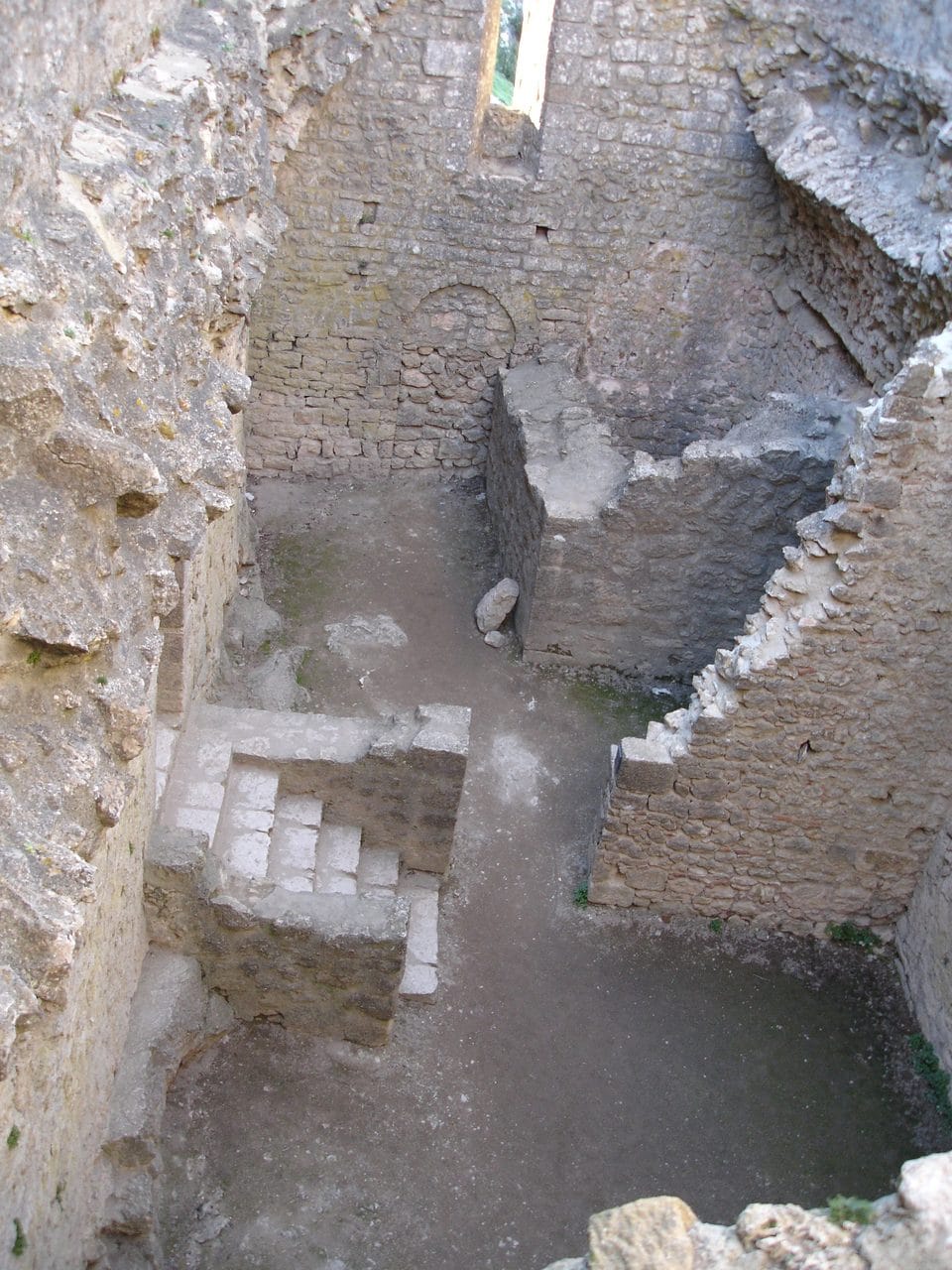
The oldest surviving fabric belongs to this Catalan castle. On the eastern terrace stand the remains of the primitive stronghold of the counts of Besalú, and beside it the Romanesque church of Sainte-Marie, which predates the royal fortress by a century or more. Church and adjoining hall together form what later builders would call the Donjon Vieux, the old keep. This was the castle that knew the Cathars. The Peyrepertuse family was bound up in the heresy, giving refuge to dispossessed knights and to the Cathar perfects, and the eagle’s-nest position made the rock a natural sanctuary when the crusaders came.
 CC BY 2.5" width="960" height="1280" style="width:440px;max-width:100%;height:auto;display:block;margin:0 auto;" />
The Crusade and the Crown
By the late twelfth century Languedoc had become the heartland of the Cathars, a Christian movement that Rome branded as heresy, and in 1209 Pope Innocent III launched a crusade to stamp it out. A northern army swept down the Aude, broke the great lords of the south, the Trencavel viscounts of Carcassonne chief among them, and turned the region into a patchwork of confiscated fiefs and dispossessed knights, the faidits, who kept up a guerrilla resistance from the high rocks. The Albigensian Crusade reached the Corbières in force after 1209. Guillaume de Peyrepertuse, who held the fief, read the situation early: on May 22, 1217 he submitted to Simon de Montfort without a fight. The peace did not hold. Seven years later, in 1224, the archbishop of Narbonne excommunicated him for breaking the commitments he had made to the king, and he drifted back into the regional revolt led by Raymond Trencavel.
 CC BY-SA 4.0" srcset="https://stonekeepatlas.com/wp-content/uploads/2026/06/peyrepertuse-keep-on-cliff.jpg 1280w, https://stonekeepatlas.com/wp-content/uploads/2026/06/peyrepertuse-keep-on-cliff-300x225.jpg 300w, https://stonekeepatlas.com/wp-content/uploads/2026/06/peyrepertuse-keep-on-cliff-1024x769.jpg 1024w, https://stonekeepatlas.com/wp-content/uploads/2026/06/peyrepertuse-keep-on-cliff-768x577.jpg 768w" sizes="auto, (max-width: 1280px) 100vw, 1280px" />
By then the crown was closing in. In 1239 Louis IX bought the castle outright from Nunyo Sanche, count of Roussillon, who had held it in fief from the French crown since 1226, and Peyrepertuse passed for the first time into French royal hands. Guillaume held out a little longer with the rebels, then submitted for good on November 16, 1240, after the failed siege of Carcassonne ended any hope of resistance. The rock that had guarded the southern edge of Catalan country now belonged to the king of France, and its purpose was about to be turned inside out.
Saint Louis Builds the Sky Fortress
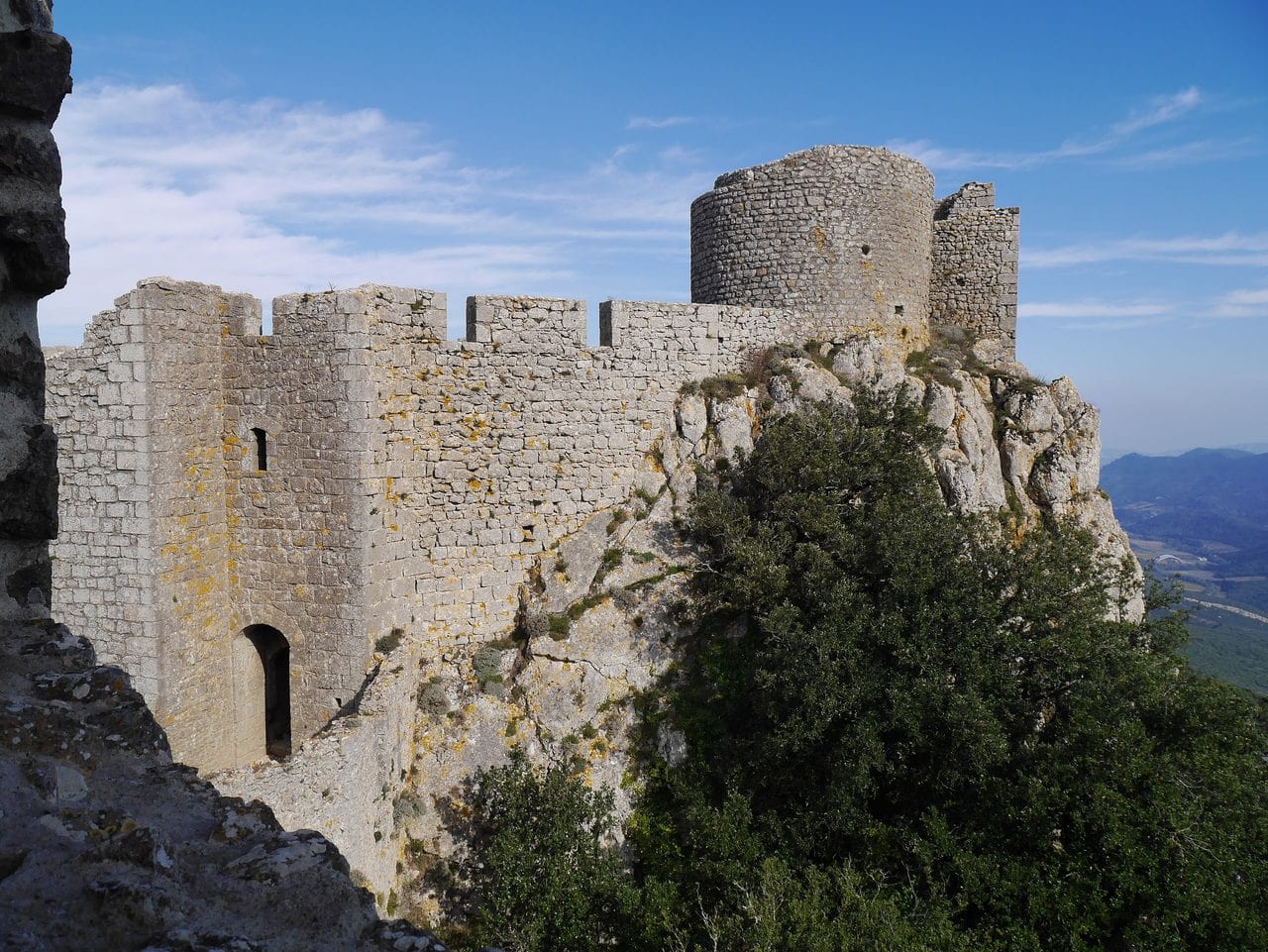
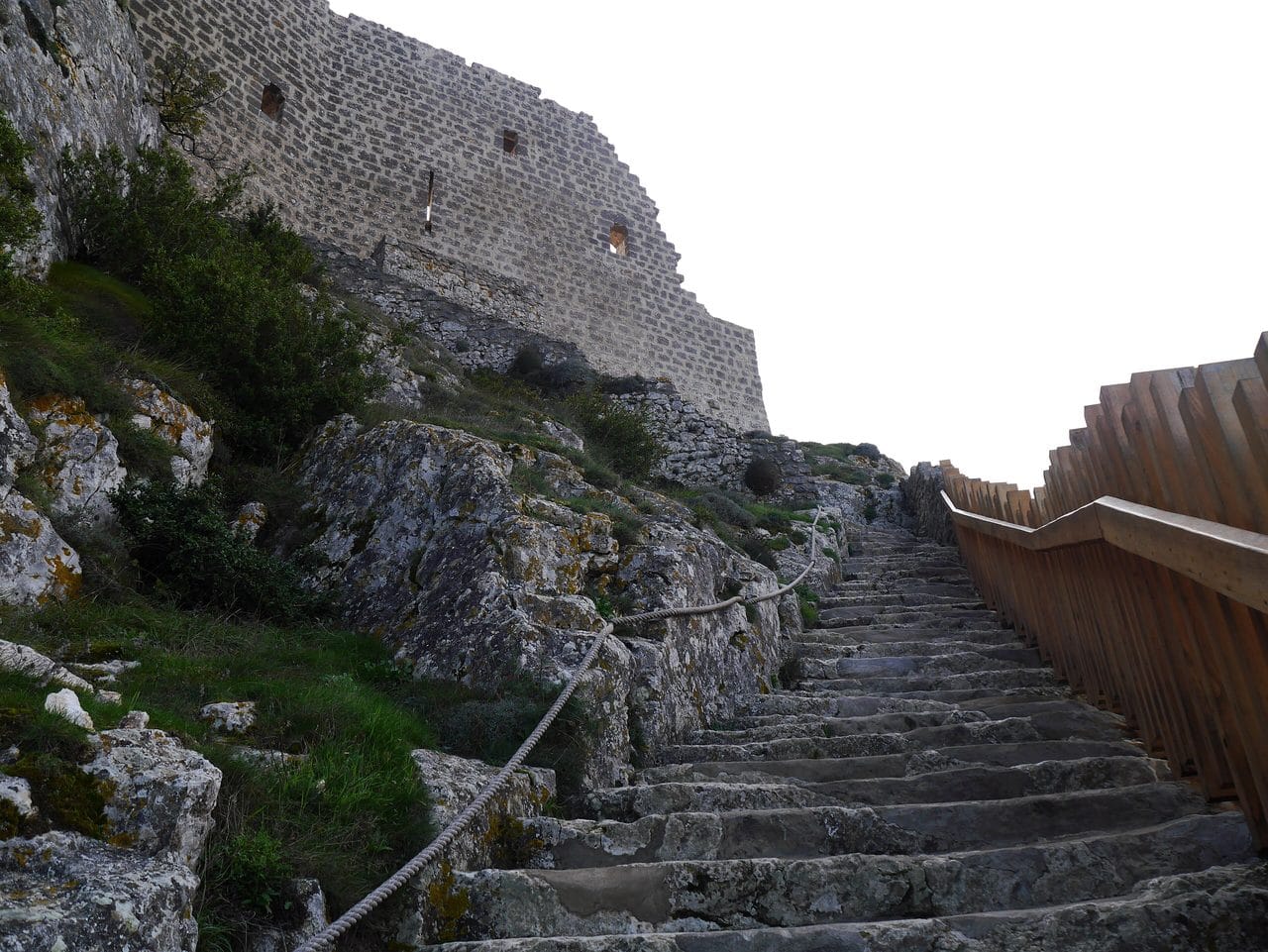
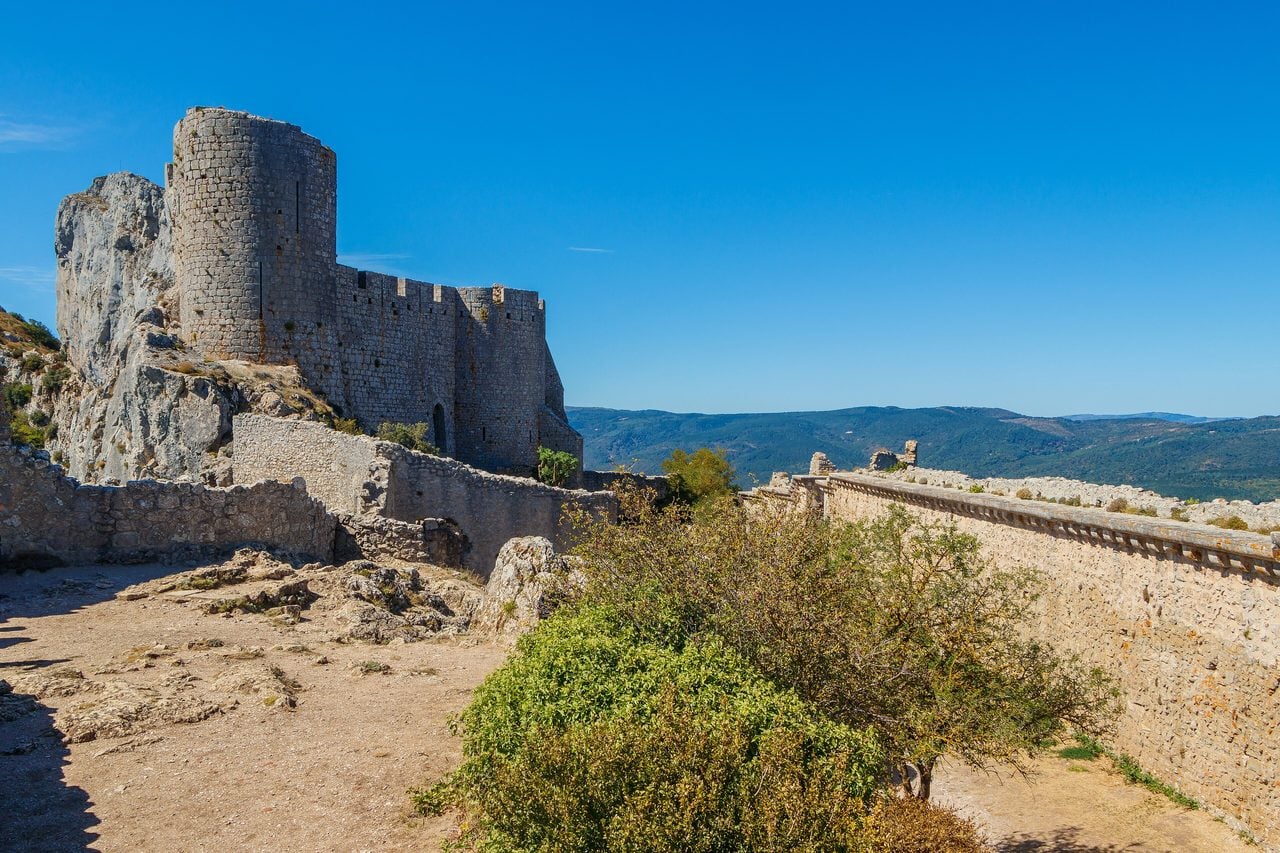
What Louis IX inherited was a modest feudal castle on a spectacular site. What he built was one of the most ambitious mountain fortresses in the kingdom. From 1242 the king ordered a staircase cut directly into the north face of the rock, a corniche of steps climbing the cliff to reach the highest point of the ridge. It still bears his name, the escalier de Saint-Louis. At the summit, in the years 1250 and 1251, his masons raised an entirely new keep, the donjon Sant Jòrdi, named for Saint George in the language of the country. At the same time the older works below were brought up to standard, the Donjon Vieux reinforced and the church of Sainte-Marie reworked.
 CC BY-SA 4.0" srcset="https://stonekeepatlas.com/wp-content/uploads/2026/06/peyrepertuse-saint-louis-staircase.jpg 1280w, https://stonekeepatlas.com/wp-content/uploads/2026/06/peyrepertuse-saint-louis-staircase-300x225.jpg 300w, https://stonekeepatlas.com/wp-content/uploads/2026/06/peyrepertuse-saint-louis-staircase-1024x769.jpg 1024w, https://stonekeepatlas.com/wp-content/uploads/2026/06/peyrepertuse-saint-louis-staircase-768x577.jpg 768w" sizes="auto, (max-width: 1280px) 100vw, 1280px" />
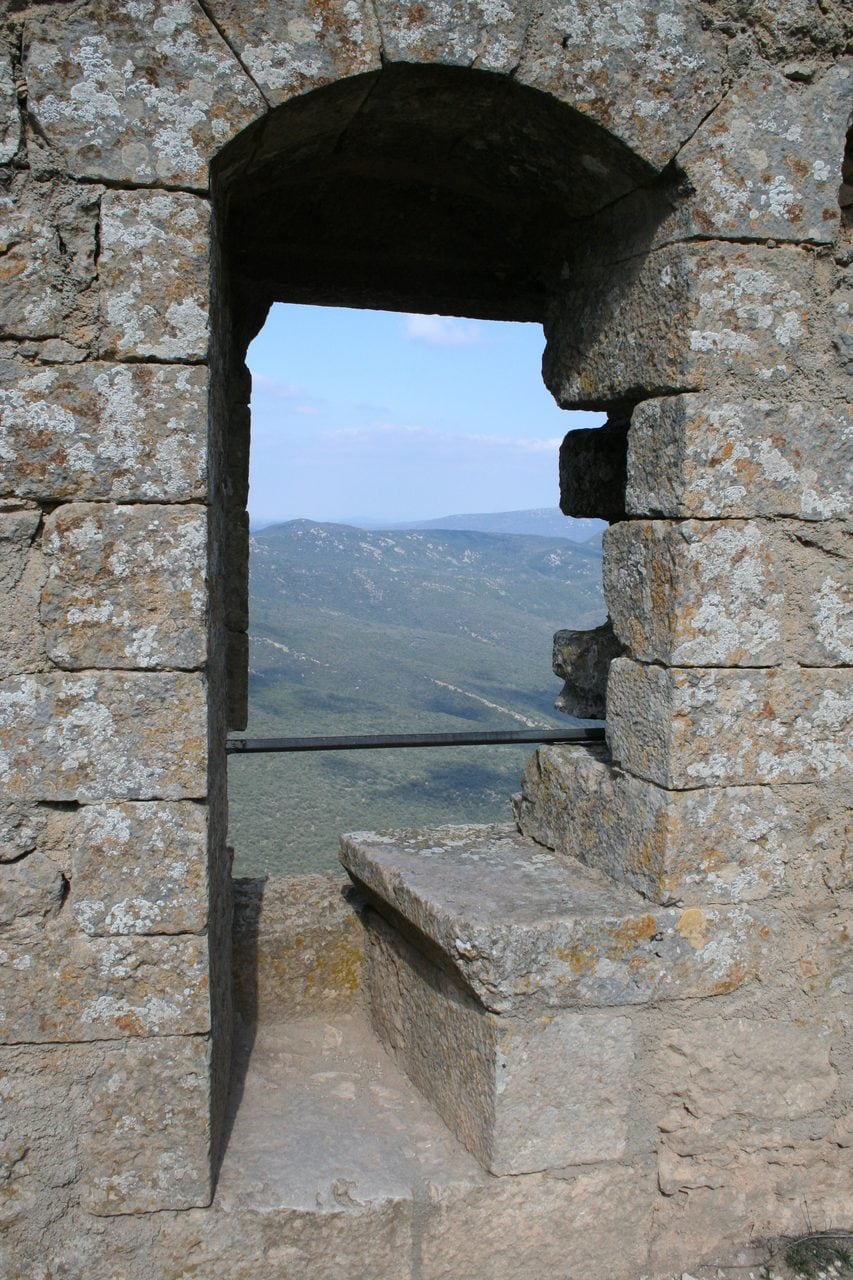
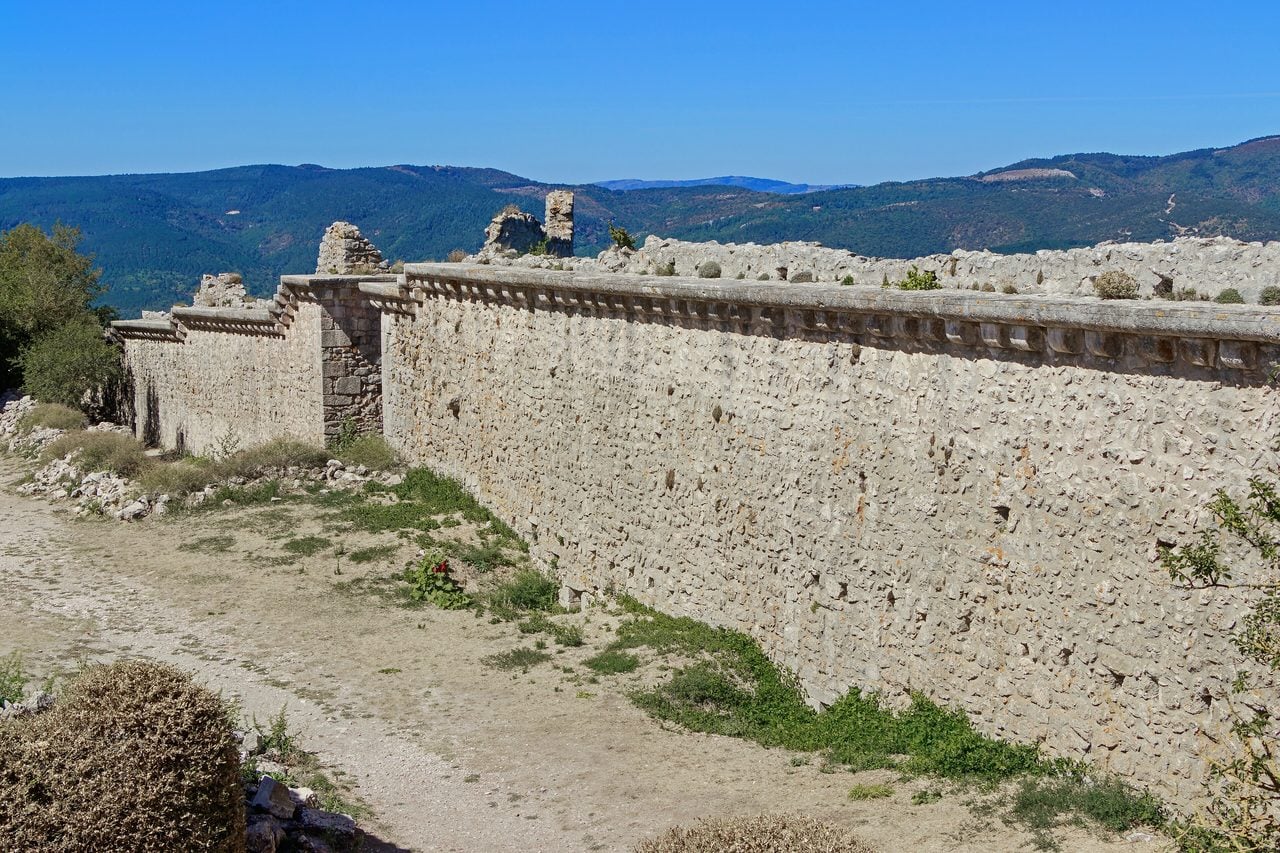
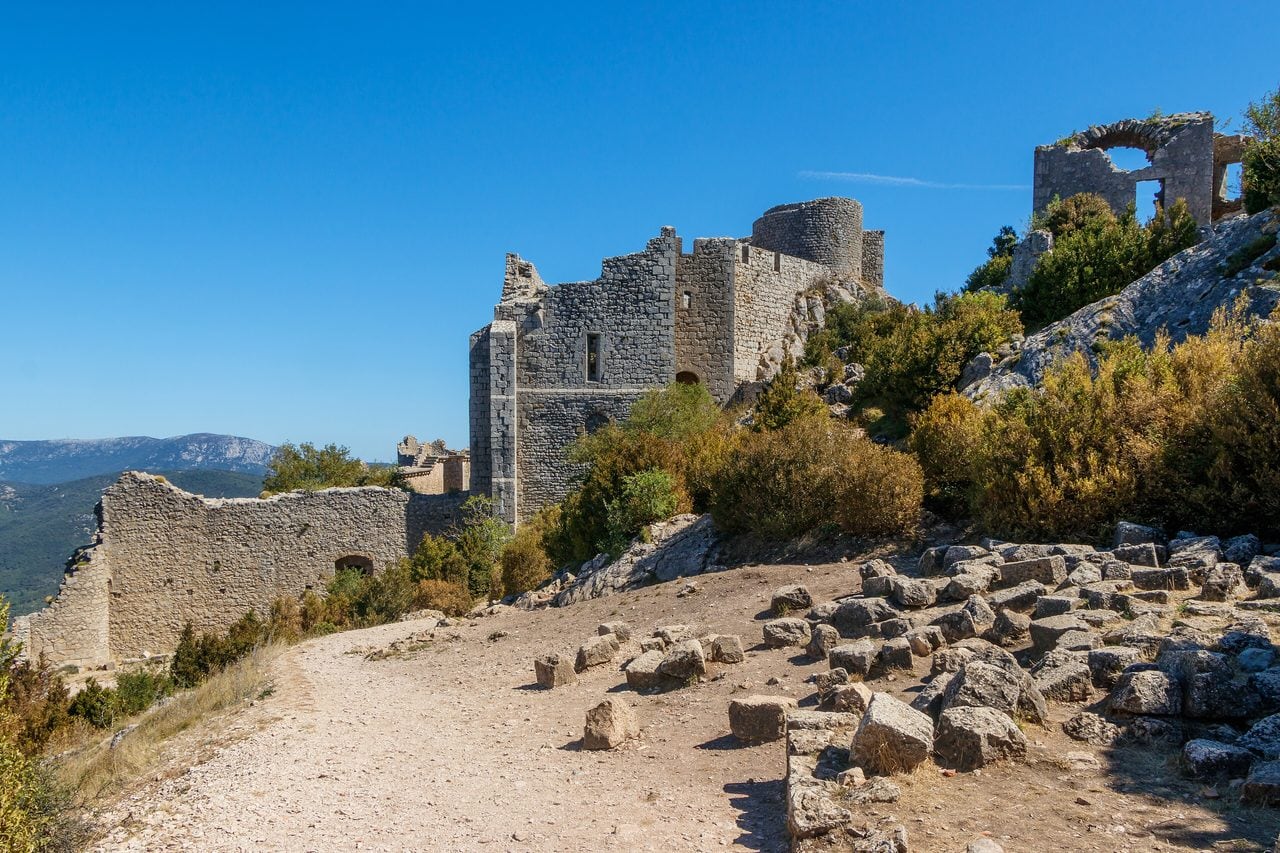
The result is really two castles joined along a single crest. The eastern esplanade holds the lower enclosure, a triangular ward closed on the north by a curtain wall some hundred and twenty meters long and flanked by two semicircular towers, with the old Besalú castle and the Sainte-Marie church inside it. From there the rock-cut stair climbs west and up to the Sant Jòrdi keep, perched alone at the top of the ridge with its own small chapel. The whole composition is textbook Capetian military engineering, the fortification model promoted under Philip Augustus, here bent to the impossible geometry of a knife-edge of limestone. Up close, the detail rewards a slow walk. The lower enclosure keeps its wall-walk, a chemin de ronde of stone slabs resting on corbels, and its towers are pierced with arrow-slits at ground level. At the eastern tip the rampart rises into a pentagonal tower, a sharp spur of stone. Reached at the head of the staircase, the upper castle was guarded by a twin-towered gatehouse fronted by a barbican and a ditch, and four cisterns gathered the rainwater the garrison relied on.
 CC BY-SA 3.0" srcset="https://stonekeepatlas.com/wp-content/uploads/2026/06/peyrepertuse-sant-jordi-keep.jpg 1280w, https://stonekeepatlas.com/wp-content/uploads/2026/06/peyrepertuse-sant-jordi-keep-300x200.jpg 300w, https://stonekeepatlas.com/wp-content/uploads/2026/06/peyrepertuse-sant-jordi-keep-1024x682.jpg 1024w, https://stonekeepatlas.com/wp-content/uploads/2026/06/peyrepertuse-sant-jordi-keep-768x512.jpg 768w" sizes="auto, (max-width: 1280px) 100vw, 1280px" />
A working garrison brought the stones to life. Royal accounts from the years around 1258 list a castellan, nine sergeants-at-arms, and a chaplain. By 1302 the establishment had grown to a castellan, a chaplain, twenty-one sergeants, a porter, a watchman, and a pack of large mastiffs, loosed at night to raise the alarm if anyone tried the cliffs in the dark.
Frontier, Treaty, and Abandonment
The fortress had one job: to watch a border. The Treaty of Corbeil, signed in 1258, untangled the competing claims of France and Aragon and fixed the frontier just south of Peyrepertuse. From that moment the castle anchored a line of royal mountain fortresses, run from the seneschalsy of Carcassonne, that the popular imagination later christened the five sons of Carcassonne: Peyrepertuse with Aguilar, Puilaurens, Quéribus, and Termes. Each clung to a rock reputed to be unassailable, and together they sealed the kingdom’s southern flank against Aragon and, later, Spain. They were never meant to fight pitched battles so much as to make the frontier visible and permanent, a chain of royal stone announcing whose country this now was.
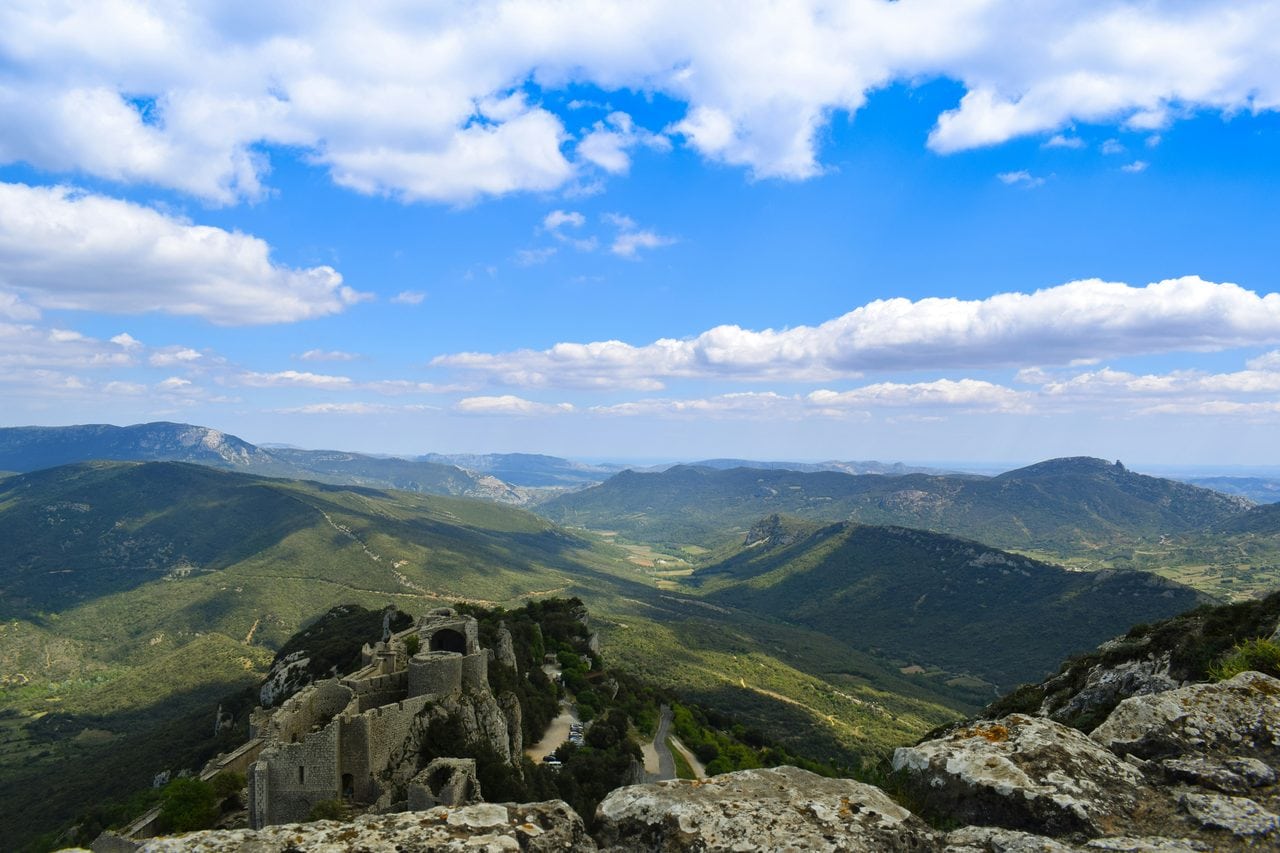
For four centuries the rock kept its watch, with only brief moments of drama. In 1285, during a war with Aragon, it sheltered notables fleeing Perpignan. In 1542 a Protestant captain, Jean de Graves, lord of Sérignan, seized the castle in the name of the Reformation, but he was quickly dislodged and executed for it. Then, in a single stroke of diplomacy, the whole frontier moved. The Treaty of the Pyrenees in 1659 carried the border south to the crest of the mountains, annexing Roussillon and stranding the five sons deep inside France. Overnight they had nothing left to guard.
Peyrepertuse declined slowly. A token garrison of pensioned-off soldiers held the rock under a junior officer until the first years of the French Revolution, when it was abandoned for good. The state sold it as a *bien national* in 1820, and the walls began their long weathering. Recognition followed only later: the ruins were classified as a *monument historique* by decree of March 19, 1908, and the first campaign to consolidate the crumbling fabric began in 1950. What survives is remarkably complete for an abandoned mountain fortress, the great enceintes, the two keeps, the staircase, and the little chapel all still legible against the sky.
Visiting Peyrepertuse in 2026
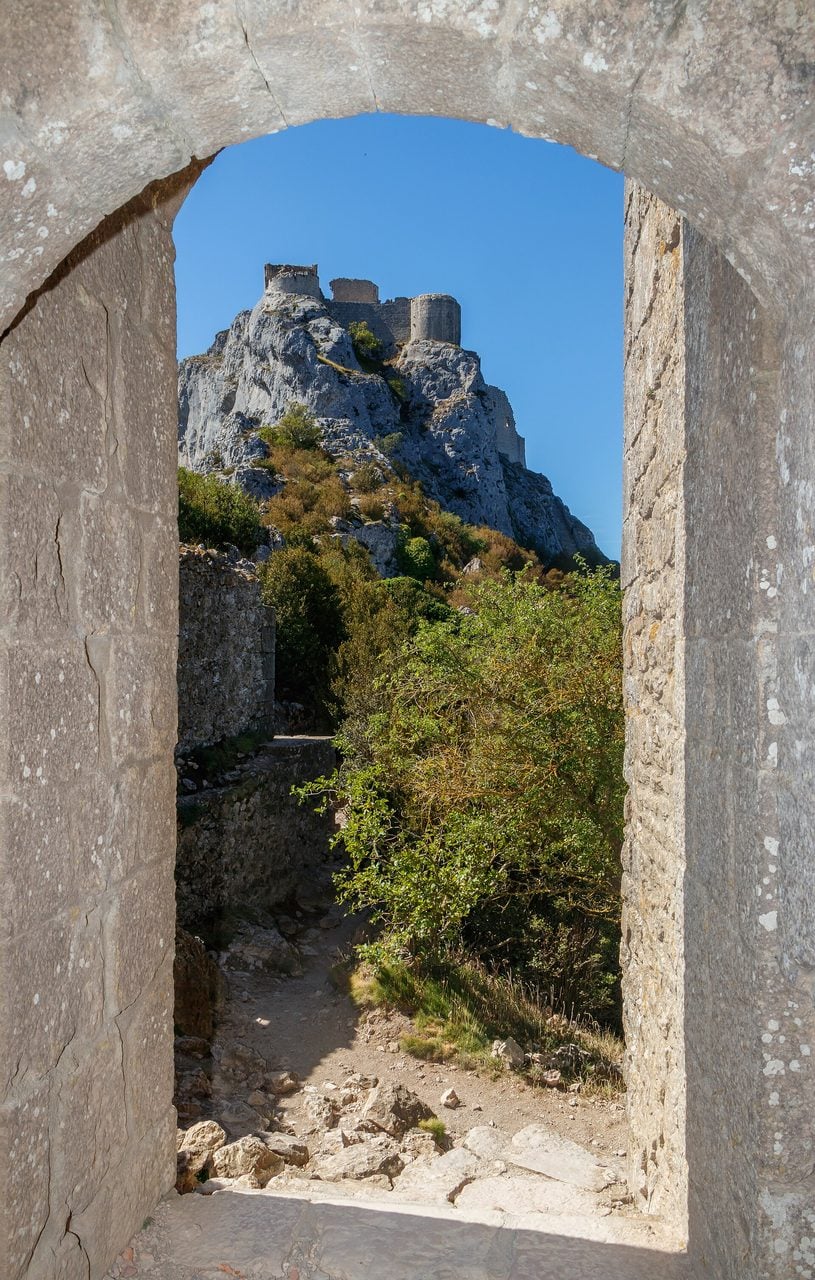
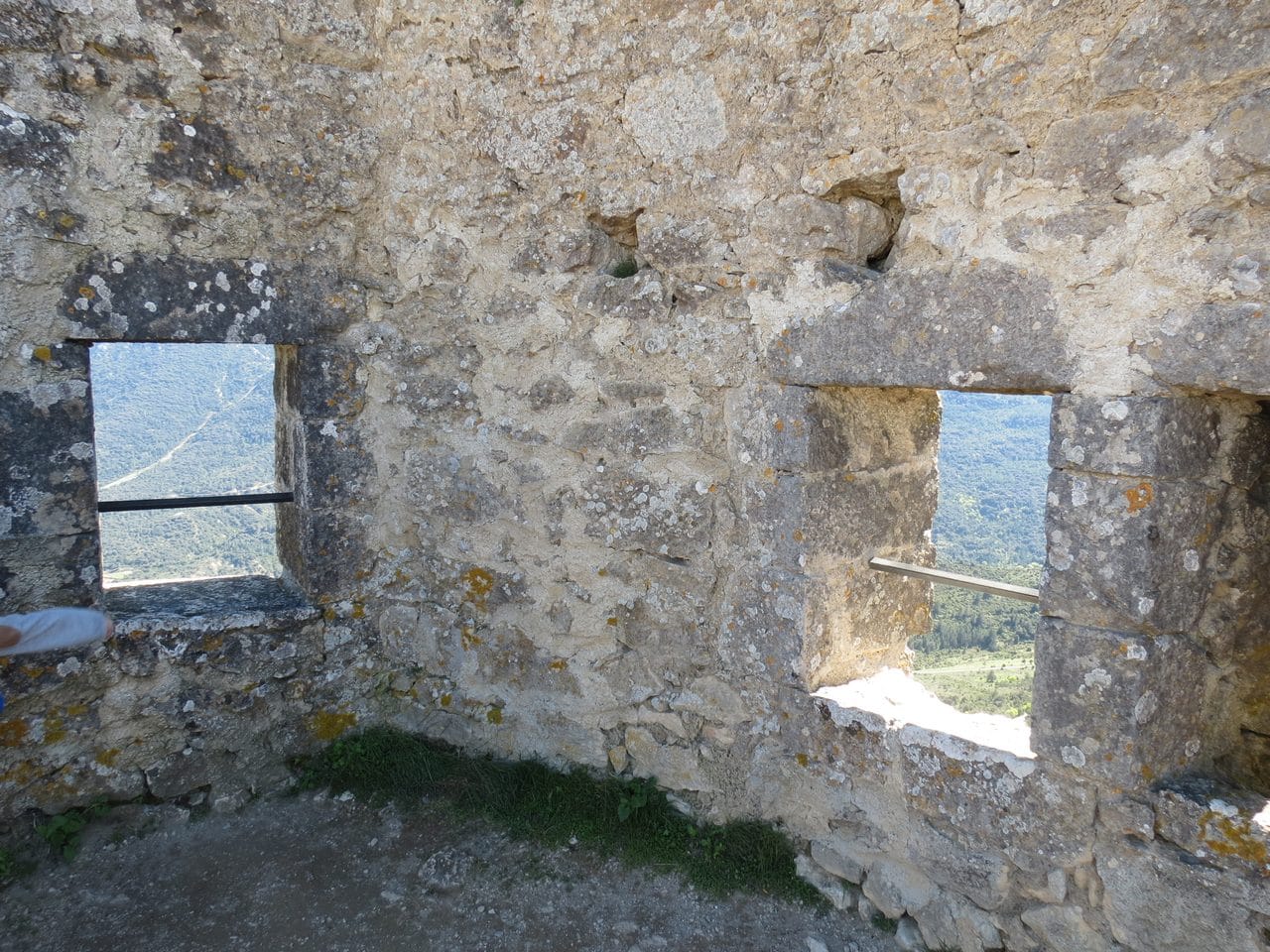
Reaching Peyrepertuse takes some effort, which is part of the appeal. The approach is by car along a steep, winding road that ends at a car park below the cliff; public transport into this corner of the Corbières is scarce, so a vehicle is close to essential. From the car park a footpath winds around to the north side of the rock, a climb of fifteen to twenty minutes to the entrance. Inside, the route keeps rising, up the Saint-Louis staircase and on to the Sant Jòrdi keep at the summit. There is almost no shade anywhere on the site. Good shoes, a hat, and water are not optional in summer, and the terrain is too rough for wheelchairs or for visitors with serious mobility limits.
 CC BY-SA 3.0" width="815" height="1280" style="width:440px;max-width:100%;height:auto;display:block;margin:0 auto;" />
The fortress is run by a local operator and is open seven days a week, all year, closing only on December 24, 25, and 31 and January 1. Hours follow the season, from 10 a.m. to 4:30 p.m. in the depths of winter out to 9 a.m. to 8 p.m. in July and August. Admission in 2026 is €8 for adults, with a reduced rate of €7 for students, job-seekers, and large families on proof, €4.50 for children aged six to twelve, and free entry for children under six; an audio-guide rents for €4. Dogs are welcome on a leash. Allow about an hour and a half on the rock itself, and time on top to take in the view, which on a clear day reaches the neighboring fortress of Quéribus, the peak of Bugarach, and the Mediterranean some forty kilometers off. Close to a hundred thousand people make the climb each year. Walkers can also reach the rock the hard way, on the long-distance Cathar trail, the GR 367, which threads the perched castles of the Corbières; and each August the village stages a medieval festival within and below the walls, with shows, a banquet, and a costumed market.
One long campaign has now closed. On 26 July 2026 the World Heritage Committee inscribed Peyrepertuse on the World Heritage List under criteria (ii) and (iv), as one of eight components of the Royal Capetian Fortresses of Languedoc, better known as the Royal Fortresses of Languedoc, alongside Carcassonne itself and the castles of Aguilar, Lastours, Montségur, Puilaurens, Quéribus, and Termes. The inscription makes Peyrepertuse part of a World Heritage property for the first time.
Where to stay
StoneKeep Atlas keeps its recommendations independent. The booking links below are affiliate links, which means we may earn a small commission if you book through them, at no extra cost to you.
There is no accommodation on the rock itself. The nearest beds are in the valley villages of Duilhac-sous-Peyrepertuse and Cucugnan, with a far wider choice in Carcassonne about ninety minutes north, a sensible base for pairing the fortress with the walled city and the other mountain castles. Search places to stay near Peyrepertuse. To explore the wider Cathar country, guided day trips from Carcassonne take in several of the perched castles in a single outing.
Some links on this page are affiliate links, which means StoneKeep Atlas may earn a small commission, at no extra cost to you, if you book through them.
More Views of Peyrepertuse
Beyond Peyrepertuse
Peyrepertuse makes most sense alongside its sibling on the plain. Carcassonne Castle is the administrative heart of this whole story, the restored citadel-town from which the mountain fortresses were governed, and the two reward a visit together: the intact city below, the raw ruin above. The nearest of the other sons is Quéribus, visible to the south from the summit and often paired with Peyrepertuse in a single day; Aguilar, Puilaurens, and Termes complete the chain. Together they form the heart of what tourism still markets as Cathar country, a landscape of perched ruins and limestone gorges across the southern Aude. As more of these fortresses join our catalog, they will gather into a single guide to the royal castles of the Languedoc frontier.
For the wider story these fortresses belong to, see our guide to the Cathar Castles of Languedoc.
Conclusion
Peyrepertuse is best understood not as a Cathar castle but as the answer the French crown gave to a problem of geography. A Catalan lordship that had sheltered heretics became, within a generation, the grandest link in a chain of royal fortresses watching a contested border. Louis IX poured stone and ingenuity into a rock that was already half a fortress by nature, and for four hundred years it earned the effort. Then a single treaty moved the frontier south and left the great ship of stone with nothing to do but weather on its ridge, which is exactly what makes it so moving to climb today.
Principal Sources
- Le Château de Peyrepertuse. Official site. peyrepertuse.com.
- Ministère de la Culture. “Ruines du château de Peyrepertuse.” Notice no. PA00102673, base Mérimée. pop.culture.gouv.fr.
- Forteresses Royales du Languedoc. “Peyrepertuse.” UNESCO World Heritage serial property. forteressesroyalesdulanguedoc.fr.
- UNESCO World Heritage Centre and the Forteresses royales capétiennes du Languedoc, inscribed 26 July 2026 (the serial property earlier listed as “Cité de Carcassonne et ses châteaux sentinelles de montagne”). whc.unesco.org; forteressesroyalesdulanguedoc.fr.
- Eydoux, Henri-Paul. *Châteaux fantastiques.* Vol. 1. Flammarion, 1969.
Image credits. Peyrepertuse from the southwest: licensed via Adobe Stock; Aerial view of the whole fortress: Rémi Guillot, CC BY-SA 4.0, via Wikimedia Commons; Church of Sainte-Marie: Guillaume Paumier, CC BY 2.5, via Wikimedia Commons; Sant Jòrdi keep on the cliff: Valeriejeanbiographe, CC BY-SA 4.0, via Wikimedia Commons; Sant Jòrdi keep: H. Zell, CC BY-SA 3.0, via Wikimedia Commons; Saint-Louis staircase: Valeriejeanbiographe, CC BY-SA 4.0, via Wikimedia Commons; View south toward the frontier: Fred Passat / Unsplash, via Unsplash; Gateway to the upper castle: H. Zell, CC BY-SA 3.0, via Wikimedia Commons; Great-hall window seat: Binche, CC BY-SA 3.0, via Wikimedia Commons; Wall-walk of the lower enclosure: H. Zell, CC BY-SA 3.0, via Wikimedia Commons; Down the ridge from the air: Clément Proust / Pexels, via Pexels; Path through the lower enclosure: H. Zell, CC BY-SA 3.0, via Wikimedia Commons; Valley windows in the upper castle: Romain Bréget, CC BY-SA 3.0, via Wikimedia Commons; Cliffs of the Peyrepertuse cirque: Juv / Pexels, via Pexels. Freely licensed images are resized to fit; otherwise unaltered.