
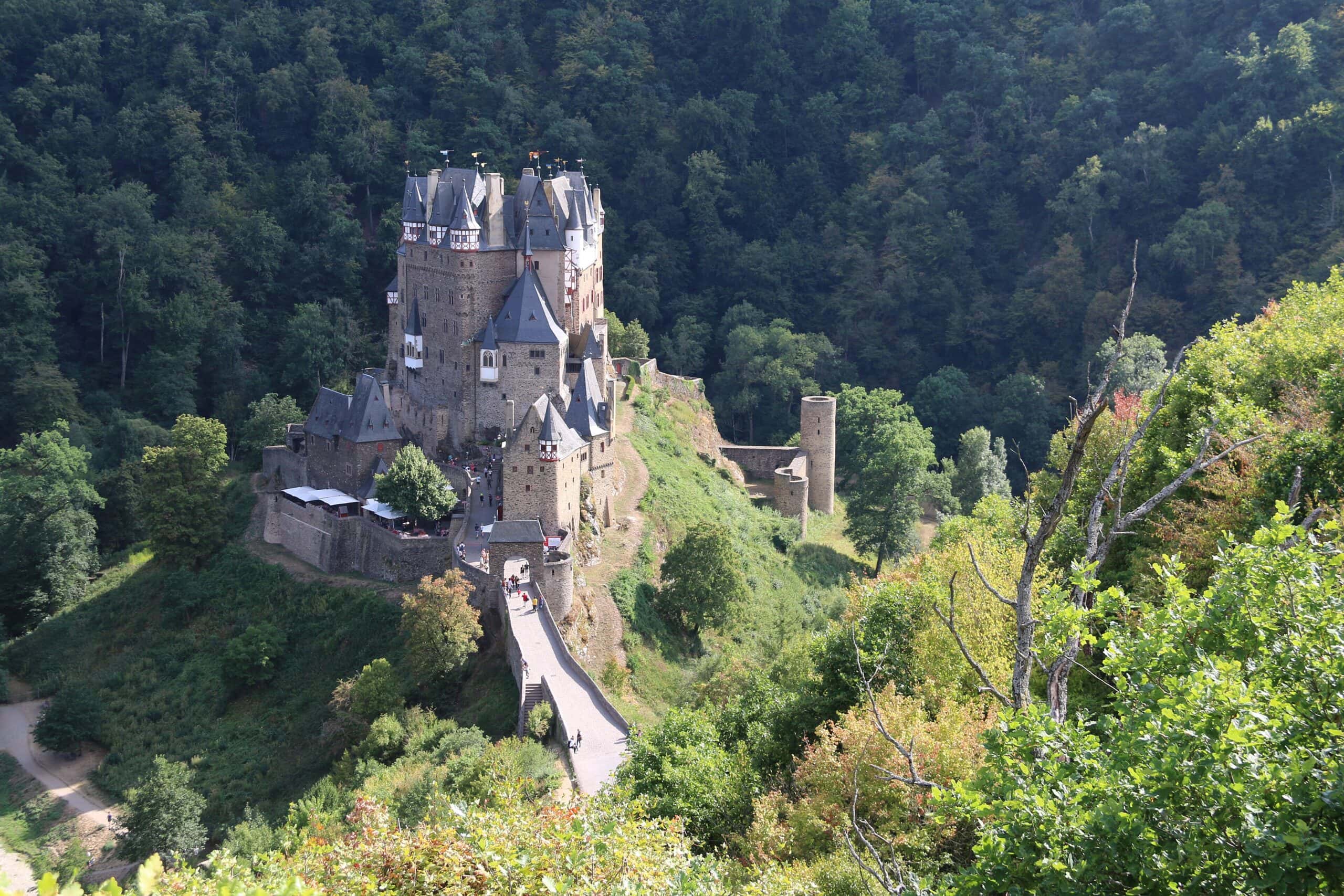
Eltz Castle
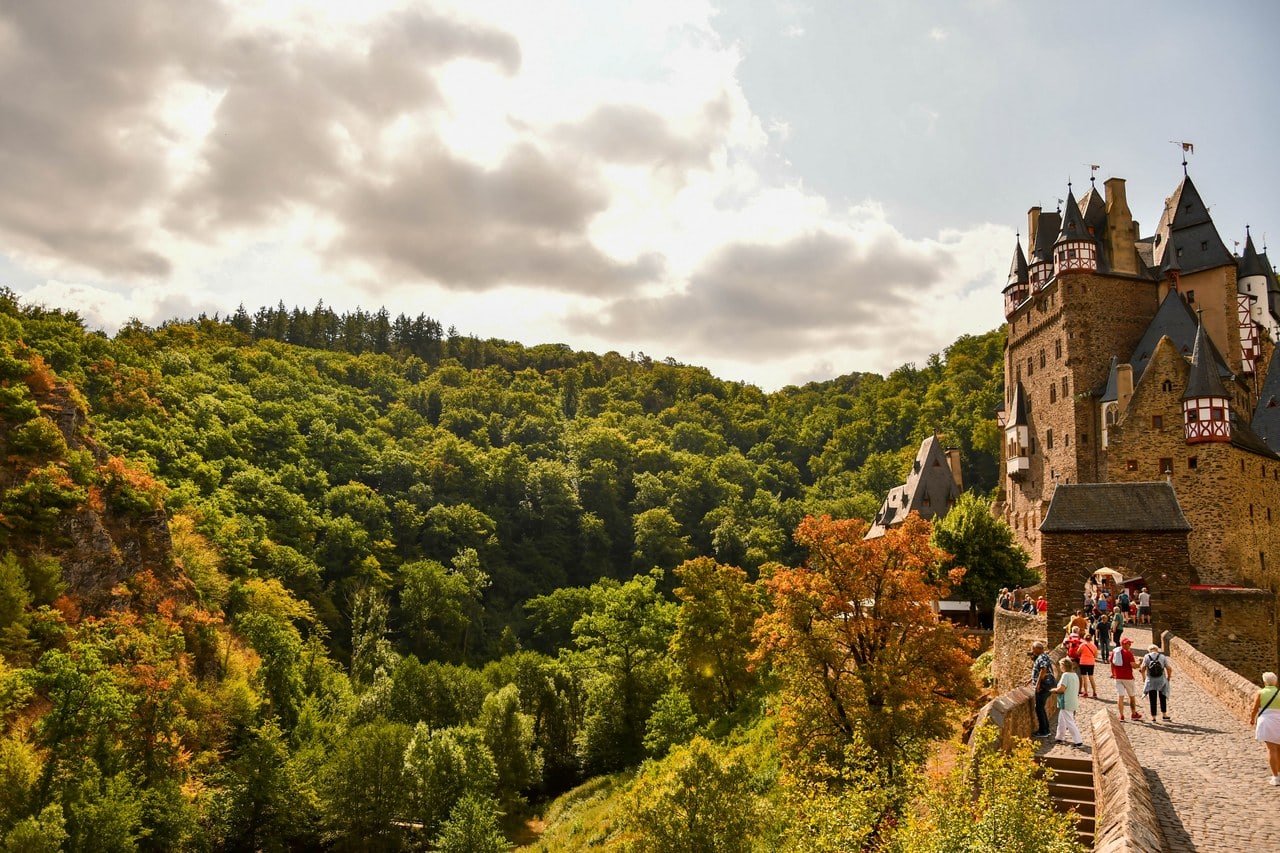
Eltz Castle (Burg Eltz) is a vertical archive of five centuries of family construction packed onto one rock. An inheritance contract shaped it throughout, setting three branches of one family to build side by side, and a nineteenth-century restoration that set out to preserve rather than to improve brought it to its present visibly-medieval condition. On its museum portal, the Museumsverband Rheinland-Pfalz calls it the only undestroyed medieval Ganerbenburg in the state still in the hands of the family that built it. From the trail vantage above the castle the first impression is of something impossibly intact: eight tower-houses crowded onto a forested rock spur, gables and oriels rising above the canopy of the Elzbach valley with the look of a castle that escaped seven centuries of disturbance. That first impression is broadly correct. The castle’s owners date unbroken family possession to the middle of the twelfth century, and the regional heritage register has the castle passing to the Eltz in 1157 as an imperial fief and never leaving their hands since. Historian Alexander Thon places the documentary floor for the family as hereditary holders at 1268. Burg Eltz was never sacked after the Middle Ages, and it survived the episodes of regional destruction (the Eltzer Fehde of the fourteenth century, the French wars of the seventeenth, the wider attrition of the twentieth) that leveled most of its neighbors.
It is also, in one consequential respect, misleading. What gives Burg Eltz its unmediated feel is not pure preservation but the discipline of its nineteenth-century steward. Between 1845 and 1888, Count Karl zu Eltz spent 184,000 Mark restoring his family’s ancestral seat, and did so by corresponding with the Germanisches Nationalmuseum in Nuremberg about how to leave the substance of the building alone. Where the Romantic era remade its castles at Stolzenfels, at the Hohkönigsburg, at Neuschwanstein, Karl’s restoration kept the plan and the masonry it inherited. That restraint is the quiet center of what makes Eltz unusual.
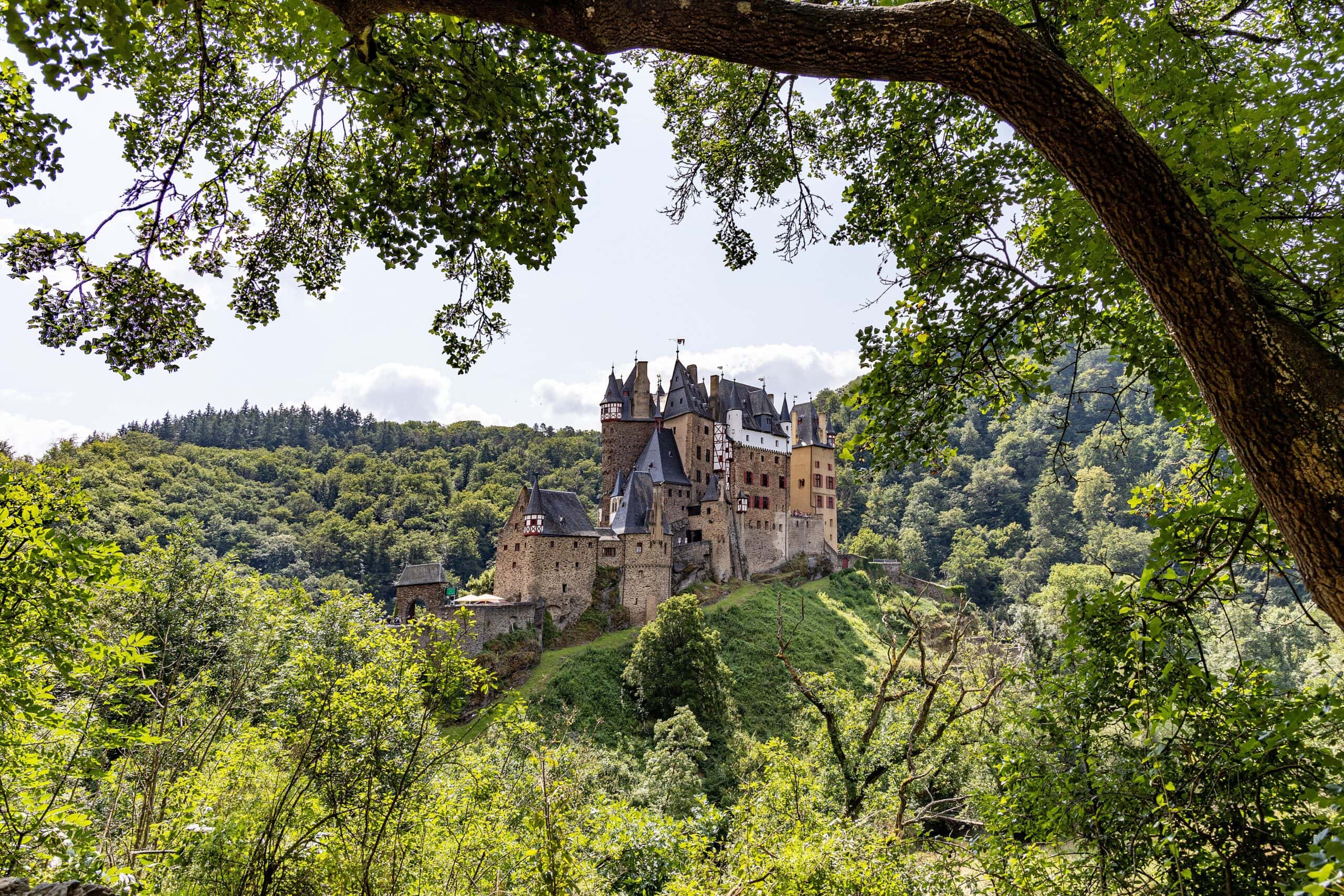
Quick Facts
| Location | Wierschem, Rhineland-Palatinate (Rheinland-Pfalz), Germany |
|---|---|
| Built | Mid-12th century to 1661; first documented 1157 |
| Built for | House of Eltz (Rudolf von Eltz, first documented 1157) |
| Architectural style | Romanesque, Gothic, Late Gothic, Early Baroque |
| Castle type | Burg (medieval fortified residence); Ganerbenburg (joint-heirs castle); Randhausburg (no encircling curtain wall) |
| Condition | Well preserved; continuous conservation program since 2009 |
| Owner / managed by | House of Eltz, Kempenich line; Gräflich Eltz’sche Kastellanei |
| UNESCO status | Not inscribed |
| Nearest town & station | Wierschem; Moselkern station on the Koblenz to Trier line, about 4.5 km on foot |
| Open to public | Yes, seasonally; interior by guided tour only |
| Official website | burg-eltz.de |
History
The Rock Above the Elzbach, 1157
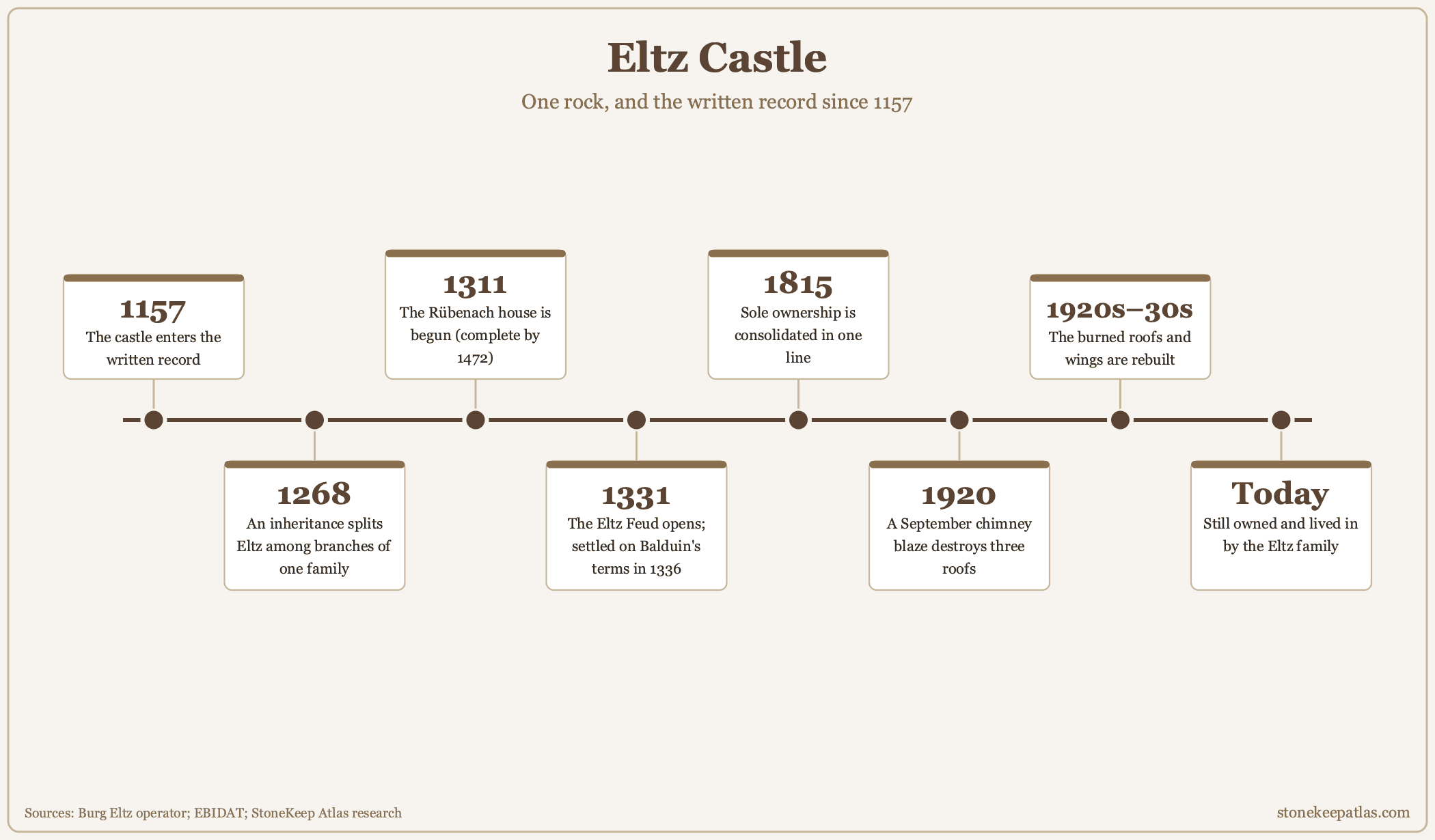
A first securely dated reference to a lord of Eltz appears in a deed of donation issued by Emperor Frederick I Barbarossa in 1157, witnessed by one Rudolfus de Eltz. A settlement on the rock spur is almost certainly older than the document. Romanesque stonework in the lower five stories of the original keep, Platteltz, is consistent with construction in the first half of the twelfth century, and the spur itself is an elliptical rock head up to some seventy meters high, encircled by the Elzbach on three sides. Rudolf’s family appear to have served the Hohenstaufen emperors as ministeriales, the unfree imperial knights whose loyalty kept the king’s writ running where territorial princes might have preferred to subordinate them. Historian Alexander Thon describes Eltz as staying in the king’s direct gift through the thirteenth century, held by unfree imperial ministerials rather than granted away to a territorial lord. Eltz controlled the medieval feeder route between the Moselle valley and the agricultural Maifeld plateau toward the Eifel uplands, and guarding that side road was the office the family held. Fortified sites stand thickly along this reach of the Moselle and in its side valleys.
How far back that continuity can be documented is itself contested. Thon’s point about those imperial ministerials carries a sting: they bore the name Eltz from the place of their service rather than as a family name in the modern sense, so a non-noble Eltz ministerial line is demonstrable, on his reading, only from 1268, the point at which it appears to have received Eltz from the Roman-German kings as a hereditary fief. The castle’s owners date unbroken possession from the middle of the twelfth century and the regional heritage register has the castle in Eltz hands from 1157 without a break; Thon dates the documentary floor for the family as a family a century later. Nothing in either account has the rock changing hands, and the difference is one of what the surviving charters can be made to prove.
What turned the castle from a single fortified manor into the structure visible today was an inheritance arrangement made in 1268. Three brothers (Elias II “with the Golden Lion,” Wilhelm II “with the Silver Lion,” and Theoderich “with the Buffalo Horns”) divided castle and estate alike into three equal shares, but kept the fortified enclosure on the rock as common ground and built independently inside it. Each branch took a distinct heraldic identity and would, over the next two and a half centuries, raise its own residential tower-house upward on the same rock. This arrangement was codified in writing as a Burgfriedensbrief (a “castle peace deed”) first set down in 1323 and amended successively in 1430, 1481, and 1556. It governed relations between the branches until the death of the last Buffalo Horns line in 1786 and the consolidation of sole ownership in 1815.
This kind of joint-heirs castle (a Ganerbenburg in medieval German legal usage) was a recognized form, and F.-W. Krahe’s standard survey of German medieval castles calls Burg Eltz its prototype: legible as such because the Burgfriedensbrief of 1323 went on serving as the castle’s constitution until 1815. What resulted at Eltz is a building whose entire shape was determined by an inheritance contract: every wing rose because three families had to live on the same rock without quarrelling.
The Eltz Feud and What Came After
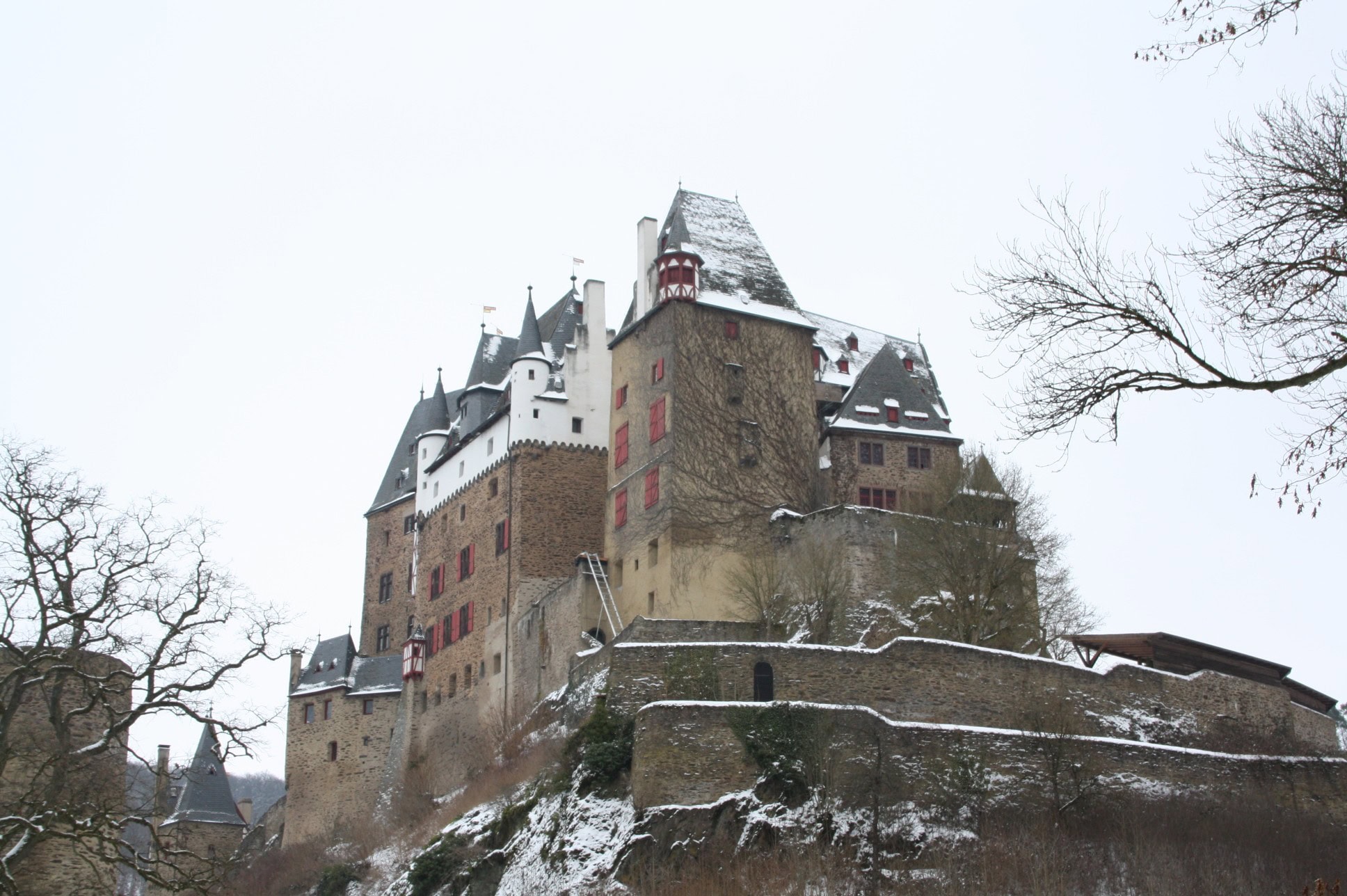
The castle’s medieval history turns on a five-year confrontation with Balduin of Luxembourg, the Archbishop-Elector of Trier and one of the most formidable territorial princes of the fourteenth-century Empire. Balduin was working to bring under Trier’s overlordship those castle-lords of his electorate who held directly of the Empire. Twenty-one nobles formed a protective league against him, Johann von Eltz among them, alongside the brothers of Ehrenberg and the lords of Schöneck and Waldeck. Fighting seems to have begun in the summer of 1331; the allies’ settlement was sealed on 9 January 1336. The siege of the castle itself was shorter than the feud: KuLaDig, the Landschaftsverband Rheinland’s cultural-landscape information system, gives it two years, in which Balduin’s men cut the supply routes and bombarded the castle again and again with stone-throwing engines.
Direct assault failed, and what eventually made the castle vulnerable was terrain rather than gunpowder. Valley slopes around the knoll overtop the castle platform by almost a hundred meters at a distance of some two hundred, which had been a protection for as long as siege engines were weak. Arrival of the counterweight trebuchet in the German lands, able to throw stones of more than a hundredweight over several hundred meters, turned that same overlooking ground into a liability. Balduin built a counter-castle on the ridge immediately north of Eltz, just under forty meters above it. Contemporaries called it Baldeneltz, or simply the new castle; Trutzeltz, defiance of Eltz, is a coinage of later historians that first appears in print in 1862.
One claim often repeated about the siege deserves more care than it usually gets. The castle’s own history states that the first secured cannon attack north of the Alps took place here in 1331, a claim resting on a group of gun-arrows, partly of wood, long kept at Eltz. When Olaf Wagener and Achim Schmidt published their building-archaeological study of the siege castle in the Trierer Zeitschrift in 2010 and 2011, they examined that evidence and concluded it will not carry the weight placed on it. None of the arrows was recovered during the clearance of the west zwinger, and all were already at the castle by the early twentieth century with their origin unrecorded. One is a modern replica made by a former castellan, and a nineteenth-century purchase cannot be ruled out. We follow the specialists and leave the superlative alone, which is the kind of judgment we set out in our note on where our sources disagree.
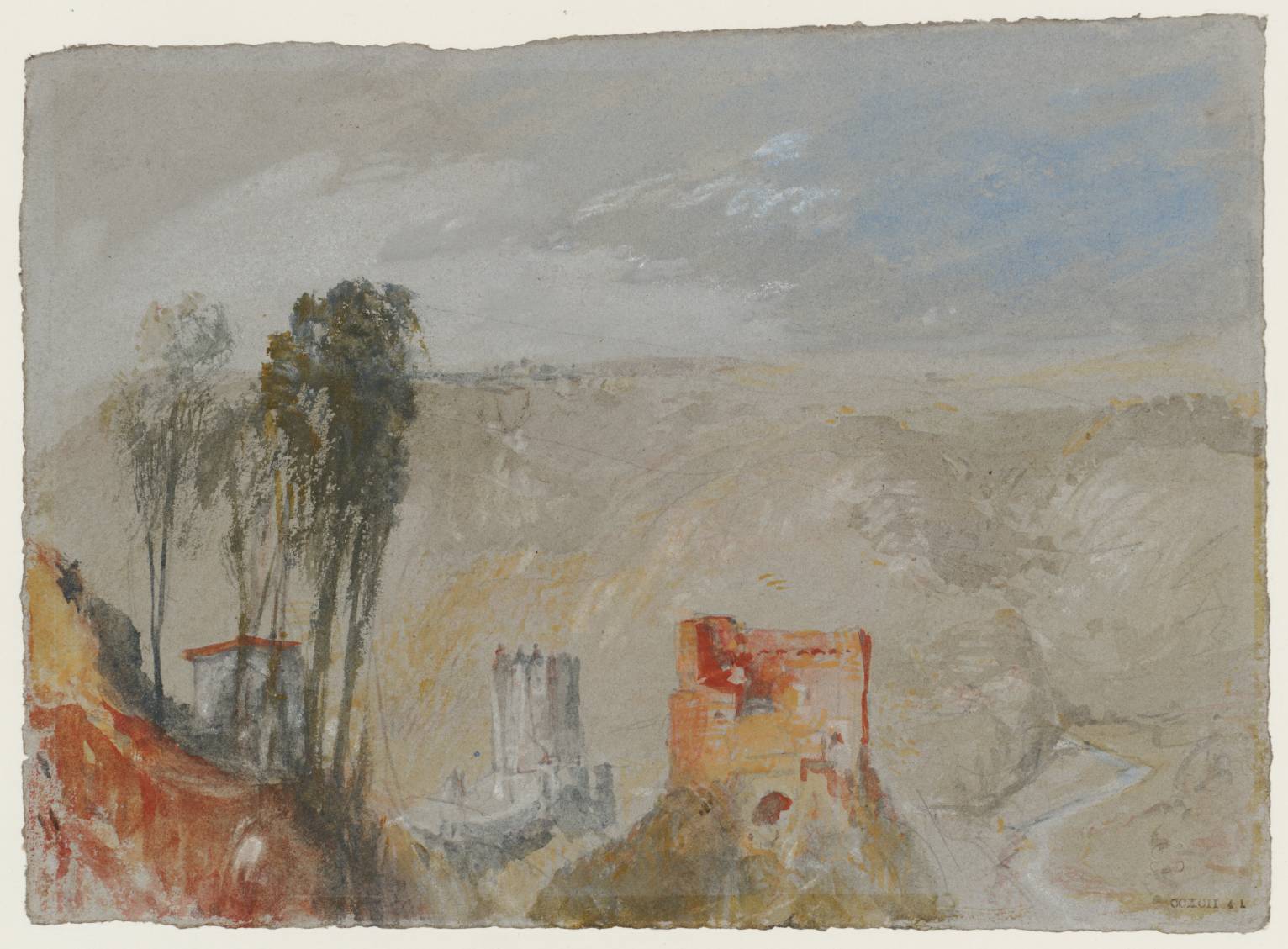
Eltz and its allies conceded in 1333; the allies settled on Balduin’s terms on 9 January 1336, and Johann von Eltz not until 16 December 1337. Most of the outer fortifications were slighted, leaving what the castle’s own account calls no more than a fortified residence, and the family acknowledged Trier’s overlordship. The last term was the sharpest: the counter-castle raised to break them was handed to them as a Trier fief, so that Johann von Eltz held from the archbishop the very work built to reduce him. Keep, wings and chapel came through intact. Completing the legal transfer took another eighteen years, until 9 January 1354, when King Charles IV enfeoffed his great-uncle Balduin with Burg Eltz and released the Eltz from their oaths to the king and the Empire. That absorption of imperial castle-lords into an archbishop’s territory is the wider process traced in The Rhine as Contested Territory. Trutzeltz survives as a ruin on the ridge above the castle, and its afterlife is its own small irony: the work built to reduce Eltz became Eltz property, decayed, and was the subject Turner chose when he came down the Mosel in 1840, with the castle itself faint behind it. In October 2024 the state Interior Ministry granted 133,000 euros toward securing the ruin against further collapse.
The “never destroyed” reputation that the castle has carried since the nineteenth century needs to be qualified by this episode. Burg Eltz was never razed and never seized by storm in any age, but it was besieged from 1331, saw its outer works slighted, and its allies came to terms in January 1336; Johann von Eltz himself settled with the archbishop only in December 1337. Never destroyed in war and never sacked after the Middle Ages is the precise claim, and it is a distinction the castle shares with only a handful of medieval German Burgen; Marksburg Castle makes the same claim for the Middle Rhine, and Bürresheim in the Eifel for its own district.
What came afterwards is a more comfortable story. Through the Church, the family rebuilt its position. Jakob III von Eltz served as Archbishop-Elector of Trier from 1567 to 1581 and was a significant Counter-Reformation figure in the Rhineland; in 1580 he granted his nephew Anton the hereditary office of Trier Erbmarschall. A century and a half later, Philipp Karl von Eltz-Kempenich held the archbishopric of Mainz from 1732 to 1743, a position that made him Reichserzkanzler: Imperial Archchancellor and, in protocol terms, the highest-ranking Catholic prince of the Empire. In 1733 Emperor Charles VI elevated three Eltz brothers of the Golden Lion line to Reichsgrafen in Vienna. Three years later Philipp Karl acquired the lordship of Vukovar in Slavonia, an estate that would serve as the family’s principal residence from 1850 until it was lost, most of it to interwar land reform and the remainder confiscated in 1945.
Fragmented ownership resolved itself over the same two centuries. In 1786 the Buffalo Horns line of Rodendorf died out, its share passing to Eltz-Kempenich; the Rübenach branch sold its share to the same line in 1815, ending the Ganerbenschaft that had defined the castle’s internal life since 1268. During the Palatinate War of Succession, the French campaign of 1688 and 1689 leveled the great Rhineland fortresses, among them the once-imposing Heidelberg Castle and Cochem Castle. Eltz was spared only because Hans Anton zu Eltz-Üttingen, then a senior officer in Louis XIV’s army, had the castle removed from the demolition list.
Romantic-era Discovery and the 500-Mark Afterlife
Burg Eltz was a difficult castle to reach until the building of the Mosel railway in the 1870s, and its emergence into the wider European cultural imagination came in the early decades of the nineteenth century with the Rhine and Mosel travelers of the Romantic period. Domenico Quaglio painted the castle in oil in 1812; Anton Diezler painted it in 1838; Caspar Johann Nepomuk Scheuren produced his pen-and-watercolor view in 1856. The most consequential of them was J. M. W. Turner, who traveled the Mosel in 1840 and produced a sequence of pencil-and-watercolor studies, including the view The Ruins of Trutz Eltz above the Eltz Valley near the River Mosel, with Burg Eltz beyond to the South (Tate, Turner Bequest CCXCII 41). Victor Hugo’s later visit produced what the official castle history describes as “an enthusiastic report.”
The castle’s widest twentieth-century audience came from the reverse of the 500-Deutschmark note of the Bundesbank’s first series, announced in the Bundesanzeiger of 3 December 1964 and issued from the spring of 1965, where it served as the symbolic representation of deutsche Ritterlichkeit. The obverse of the same note carried a male portrait by the early-sixteenth-century painter Hans Maler von Schwaz, not the female figure sometimes attributed to it. A replacement note appeared in 1992, though the old one stayed legal tender until 1995. Burg Eltz routinely appears in any list of the best castles in Germany, not for invented royal connections (the persistent claim that it inspired Walt Disney’s Cinderella Castle has no documented basis) but for what its survival actually tells. Germany has no national count of its castles at all, a gap set out in our survey of what each country actually counts.
Still in the Family
Burg Eltz remains the property of the Kempenich line, the only one of the three medieval branches still extant. The current title-holder is Dr. Karl Graf und Edler Herr von und zu Eltz-Kempenich, gen. Faust von Stromberg (the long form preserves a condition attached to a dowry in 1738, when Anselm Kasimir zu Eltz married the last Faust von Stromberg heiress), who succeeded his father in 2006 and lives with his wife Sophie, née Countess Schaffgotsch, at the Eltzer Hof in Eltville on the Rhine. Day-to-day management of the estate has rested since 2018 with their son, Johann-Jakob (“Jakob”) Graf zu Eltz, the thirty-fourth generation by the family’s own count. That continuity puts even Hohenzollern Castle, reconstructed by the Prussian dynasty in the nineteenth century as a monument to its own descent, in a different category. Year-round castellans live in one of the residential towers; the Kempenicher Häuser are used by the family on private occasions. In April 2024, in the Kaisersaal of the Kurfürstliches Schloss at Koblenz, the Stiftung der Deutschen Burgenvereinigung awarded the Eltz family its Großer Denkmalpreis, one of the highest privately funded awards for the protection of German cultural property, in recognition of the family’s stewardship. National Geographic Deutschland, reporting with the castle’s cooperation, puts the number of visitors at about two hundred thousand a year; the estate publishes no figure of its own.
Architecture
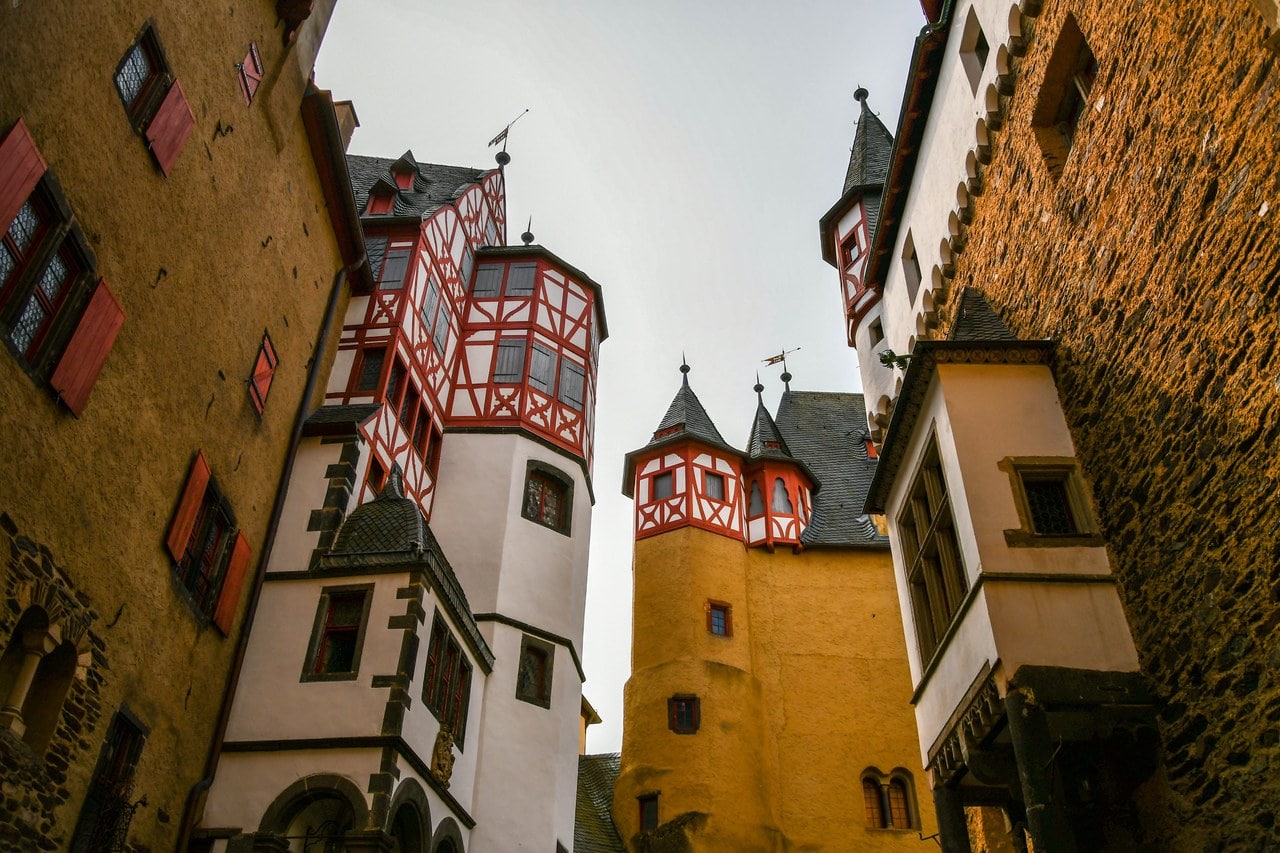
Burg Eltz’s architecture is most legible as a vertical archive of the family’s circumstances over five centuries. Because the rock summit allowed no horizontal expansion, each new generation of each branch built upward; because the Burgfrieden bound all three, no branch could break the silhouette without the others’ consent. Eltz is a Randhausburg, a castle with no encircling curtain wall at all: the outer walls of the houses themselves do that work. What resulted is a single compact ensemble of eight residential towers, rising as much as thirty-five meters, and up to forty on the field side where the rock falls away. A clockwise turn around the small inner courtyard moves through Romanesque, Gothic, Late Gothic, and Early Baroque construction inside about thirty paces.
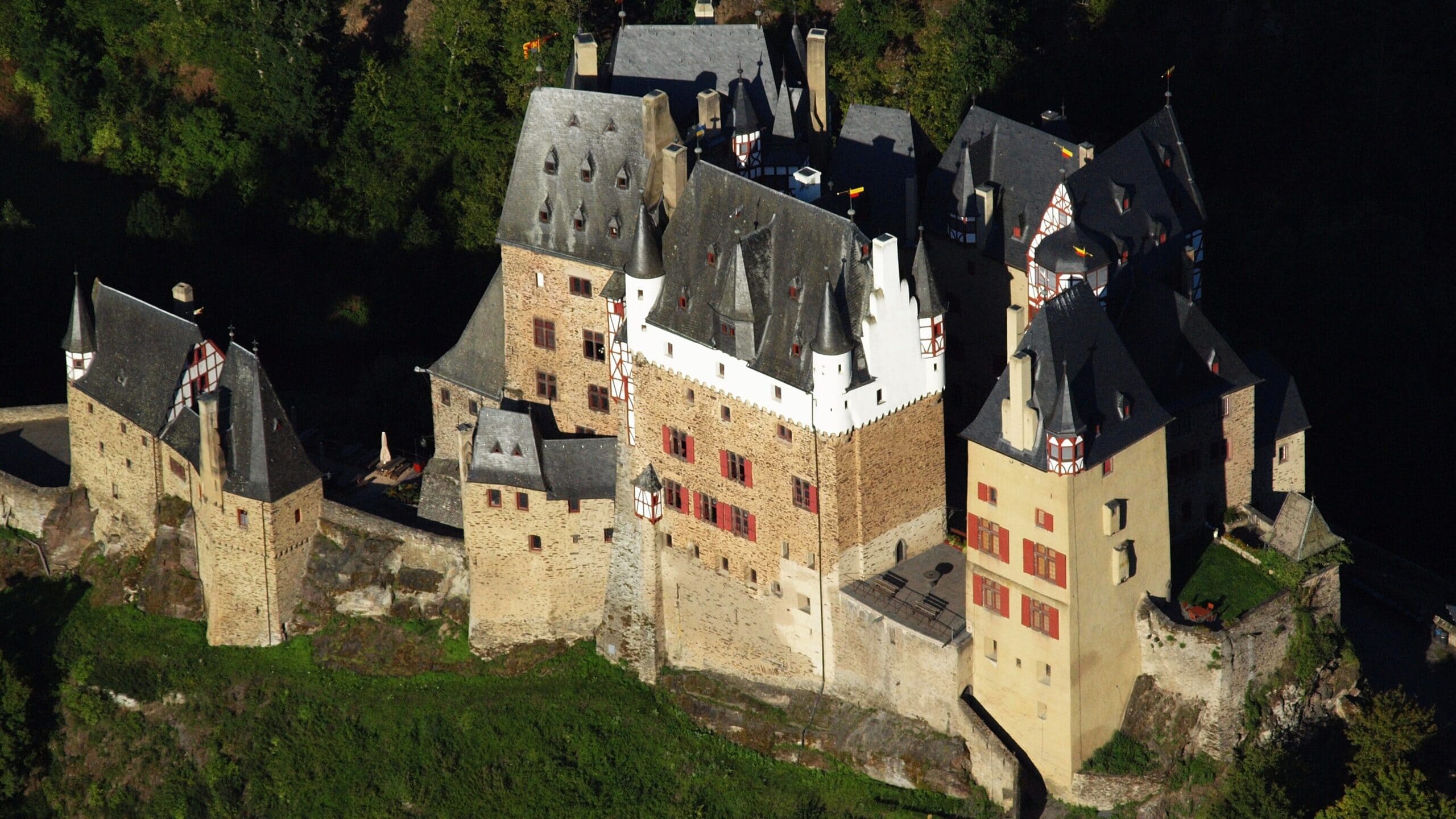
At the center stands the oldest fabric. Platteltz, the original keep, retains its lower five stories from the mid-twelfth century: heavy Romanesque masonry that survives because, after the 1268 division, the keep was held in equal thirds by all three branches and could not be altered unilaterally. A crenellated upper story was added in 1266, and a further Gothic floor in the late thirteenth century, bringing the keep to its present seven stories. Conservation work has newly uncovered a painted Romanesque window arch; from the same first, twelfth-century phase survives what the castle calls probably the oldest painted chimney in Germany.
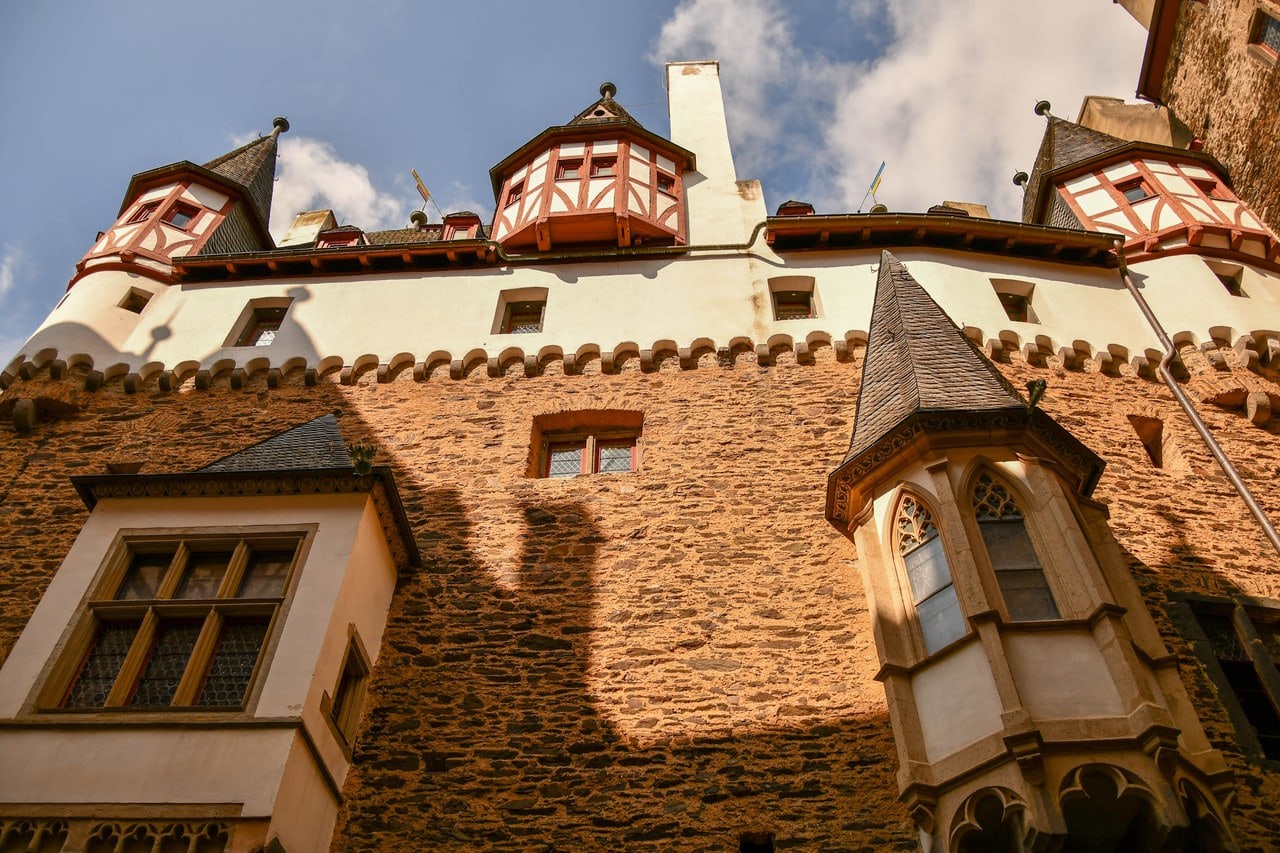
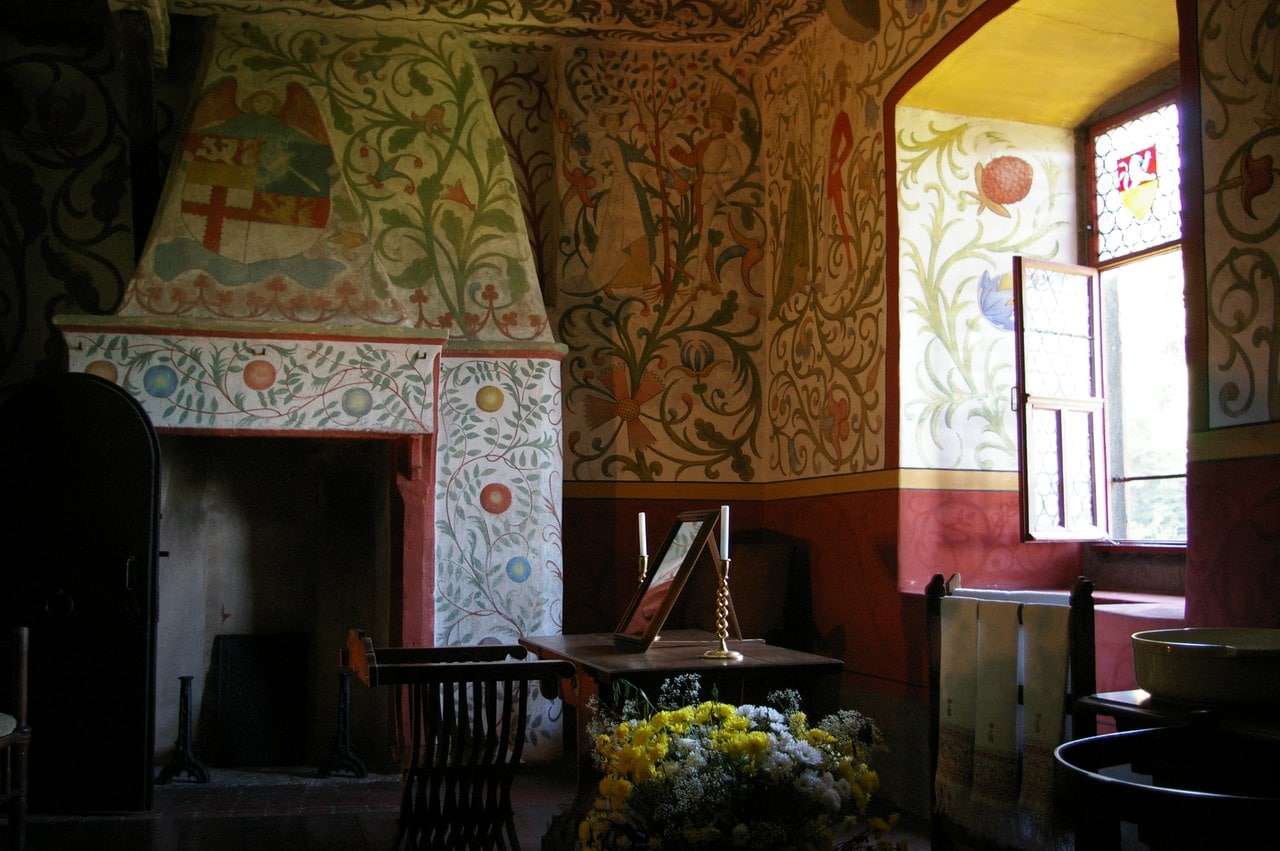
Rübenacher Haus, the residence of the Silver Lion line, was begun in 1311 and reached its final form in 1472. Its wall paintings carry the dates 1450 in the upper hall and 1451 in the dressing room, and the castle attributes them to a Burgundian hand. What a visitor actually sees, GDKE’s conservators established, is largely a nineteenth-century overpainting following the late-medieval work beneath it closely enough to have passed for the original. The lower hall holds a Madonna and Child with Grapes attributed to Lucas Cranach the Elder. Projecting into the courtyard from the wing’s east face, the chapel oriel answers a rule of canon law that forbade living rooms above an altar: it let the family hear mass without sleeping over it.
Across the courtyard, the Rodendorfer Häuser of the Buffalo Horns line span the late thirteenth to the early sixteenth centuries. An eight-story Groß-Rodendorf was completed between 1490 and 1515, the second campaign deliberately built in the retro idiom of the early fourteenth century; the castle calls the result unique of its kind: a house raised in the early Renaissance in the deliberate retro idiom of the High Gothic of about 1330, its courtyard elevation left unrendered. Two of the most consequential rooms in the castle are inside this wing: the Fahnensaal, or Banner Hall, of about 1470 to 1480, probably built as the chapel and carrying an opulent late-Gothic net vault, and the Rittersaal, the Knight’s Hall of about 1520 in which all three branches met to negotiate. Above the doorway of the Knight’s Hall is the Schweige-Rose, the Rose of Silence, signaling that nothing said beneath it could be repeated outside; on the same walls are the Narrenköpfe, the fools’ heads that licensed the free speech the rose then bound.
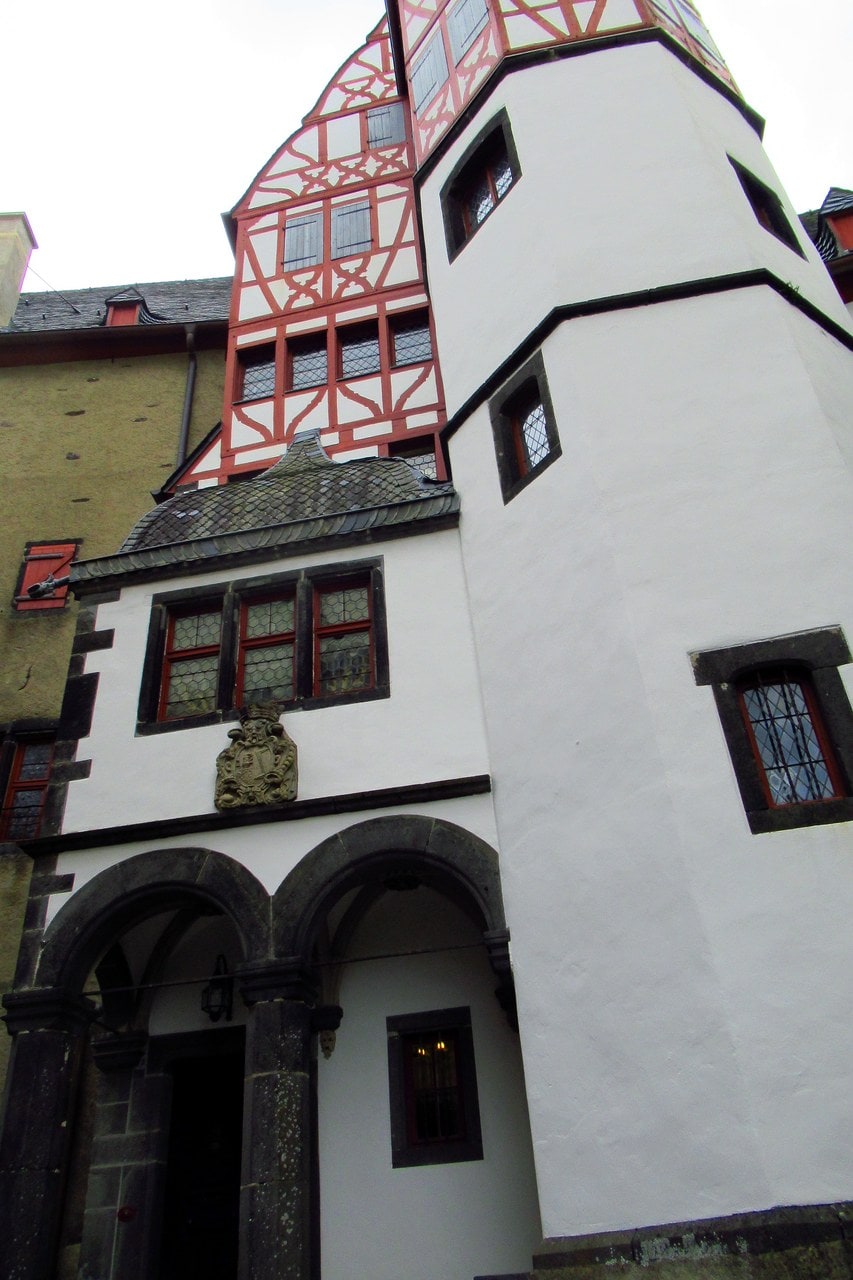
The youngest substantial work is the timber-framed heightening of the Kempenicher Häuser of the Golden Lion line between 1604 and 1661, raised, as it happens, over the Romanesque hall block whose four lower stories still stand inside it. Keystones in the gatehouse vault, dated 1651, carry the arms of Eltz and Metzenhausen; a separate early-Baroque alliance coat of arms of 1661, in yellowish sandstone, sits beneath the center windows of the oriel. Today those rooms remain in family use and are not part of the public tour.
By the early nineteenth century, the castle that had absorbed five centuries of additions was beginning to weather visibly. Lower-bailey buildings had partly collapsed, slate roofs leaked, and timber framing on the upper stories was structurally compromised. A rescue campaign began in 1845 under Count Karl zu Eltz (1823–1900) and continued through 1888, ultimately costing 184,000 Mark, which the castle puts at about fifteen million euros in present-day purchasing power. What distinguishes Karl’s work from almost every other German castle restoration of his era is its restraint. He corresponded extensively with the Germanisches Nationalmuseum in Nuremberg about the principles of conservation and “particularly avoid[ed] altering the substance of the castle, unlike most other restoration projects in the nineteenth century,” the official site’s careful phrasing. By contrast, when set against Friedrich Wilhelm IV’s reinvention of Stolzenfels to Schinkel’s designs, continued after his death by Friedrich August Stüler, or Bodo Ebhardt’s reimagining of the Hohkönigsburg in Alsace for Wilhelm II, or the entirely new Romanesque-Revival spectacle of Neuschwanstein in Bavaria, Karl’s restraint looks unusually disciplined. The nearest contemporary parallel is Hugo von Ritgen’s work at the Wartburg, though Ritgen rebuilt far more freely, new Bergfried included. Karl preserved what was there; he did not invent what he wished had been there. Burg Eltz takes its place in the small register of intact medieval castles of the Rhineland, where intact means the plan and the masonry rather than every surface above them.
Eltz’s twentieth century brought one near-catastrophe. In September 1920, a chimney fire spread to the timber framing of the Kempenich, Rodendorf, and Platteltz roofs and destroyed all of them. Rübenach House interiors were spared; reconstruction was carried out in stages; Friedhoff’s study of the fire and the rebuilding puts its completion in 1930, while the castle’s own account runs it into the mid-1930s. From 2009 onward, the family and the Generaldirektion Kulturelles Erbe of Rhineland-Palatinate have run a continuous structural-stabilization program, drawing forty-five stainless-steel anchor rods of as much as twenty-five meters through the walls. That work also stabilized the Fahnensaal, whose outer walls had begun to tip outward and whose cracking had closed the room to visitors in 2008. Nearly all the slate roofs were redecked in 2011 with Mayen slate, because the repair after the 1920 fire had used machine-made nails rather than hand-forged ones, and ninety years on every one of them had rusted through. That work continues: in 2025 the federal government and the State of Rhineland-Palatinate together provided about 407,000 euros toward the next phase of repair, funding work on the estate’s coach house (the Remise) and the stucco ceiling of the Blue Hall in the Rodendorf wing.
Visiting Eltz Castle
List the 5 castles on this map
- Eltz Castle — Rhineland-Palatinate, Germany
- Cochem Castle — Rhineland-Palatinate, Germany
- Marksburg Castle — Rhineland-Palatinate, Germany
- Stolzenfels Castle — Rhineland-Palatinate, Germany
- Rheinstein Castle — Rhineland-Palatinate (Rheinland-Pfalz), Germany
Getting there
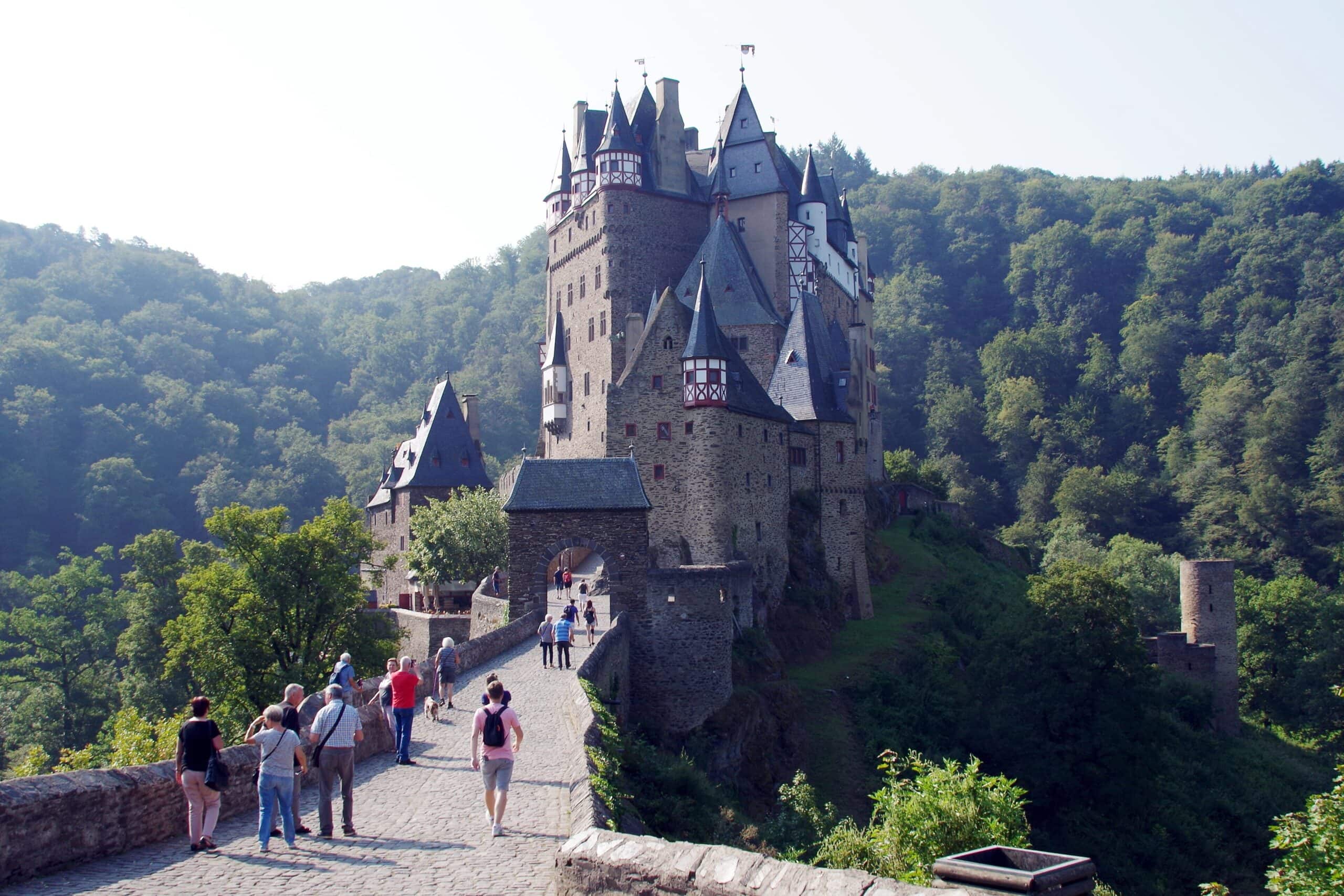
No public road runs to the castle gate, and the approach is part of the visit. From Moselkern station on the Koblenz to Trier line, a footpath follows the Elzbach upstream for about four and a half kilometers: two kilometers up the valley to the Hotel Ringelsteiner Mühle, then a final two and a half kilometers through the forest that the castle times at forty-five minutes. Almost nothing modern is visible along the way, and the towers come into view only at the last bend.
Drivers use the Burg-Eltz-Parkplätze above the valley, signed from Wierschem and Münstermaifeld. From Parkplatz 1 a shuttle bus runs down to the castle every ten minutes, cash only; walkers can take either the drive, which passes a viewing platform, or the parallel footpath, which passes the vantage the castle calls the “500-DM view” after the banknote. Neither the castle nor the town publishes operating hours for that shuttle, so plan the climb back on foot whatever time you come out: the shuttle road is 800 meters and about ten minutes uphill, the footpath 1.3 kilometers and about fifteen. Coming by rail and bus, RegioBus 365 links Hatzenport station to Parkplatz 1 twice an hour, daily from early April to the start of November, which leaves the first days of the castle season without a bus. Its last departure from the castle is comfortably after the last guided tour and the Treasury both finish, so an afternoon visit does not strand you; the time is in the Admission table below.
Walkers have more than the approach path to work with. A circular Traumpfad, the “Eltzer Burgpanorama,” runs 12.6 kilometers through the Elzbach valley from Wierschem and won Deutschlands Schönster Wanderweg in 2013, the first year that poll was decided by readers, taking 3,838 of about 13,800 votes cast. The Moselsteig, certified a Qualitätsweg Wanderbares Deutschland in 2014, passes within easy reach, its Section 20 ending at Moselkern, and a marked route of about ten kilometers links Burg Eltz with Burg Pyrmont in the eastern Eifel.
Admission
| Adult | €14.00 |
|---|---|
| Reduced (school pupils, students, visitors with disabilities) | €7.00 |
| School pupils in class groups | €6.00 per person |
| Children under 6 | Free |
| Family (2 adults with at least one child under 18) | €34.00 |
| Groups of 20 or more | €13.00 per person |
| Ticket covers | Guided tour of the castle, the inner courtyard, and the Treasury |
| 2026 season | 29 March to 1 November, daily, no weekly closing day |
| Hours | 09:30 to 17:00 (last admission at the castle gate) |
| Last guided tour | 17:30 |
| Treasury | Self-guided on the same ticket, 09:30 to 18:15 |
| Tour languages | German as standard; English and French on request. International visitors can ask for a free flyer carrying the text of the tour in nine languages |
| Booking | No individual online sale; walk-up at the ticket office. Groups of 20 or more book with the castellan’s office |
| Parking | €4 car or motorbike, €8 camper van or coach, cash only |
| RegioBus 365 season | 1 April to 1 November, so the first three days of the castle season have no bus |
| Last bus from Burg Eltz | 19:22, every day the line runs (VRM line 365; timetable valid from 1 April 2026, checked 9 August 2026) |
| Shuttle bus | €2 per person each way from Parkplatz 1, every 10 minutes, cash only |
| Prices and hours verified | 26 July 2026, burg-eltz.de |
What the tour shows
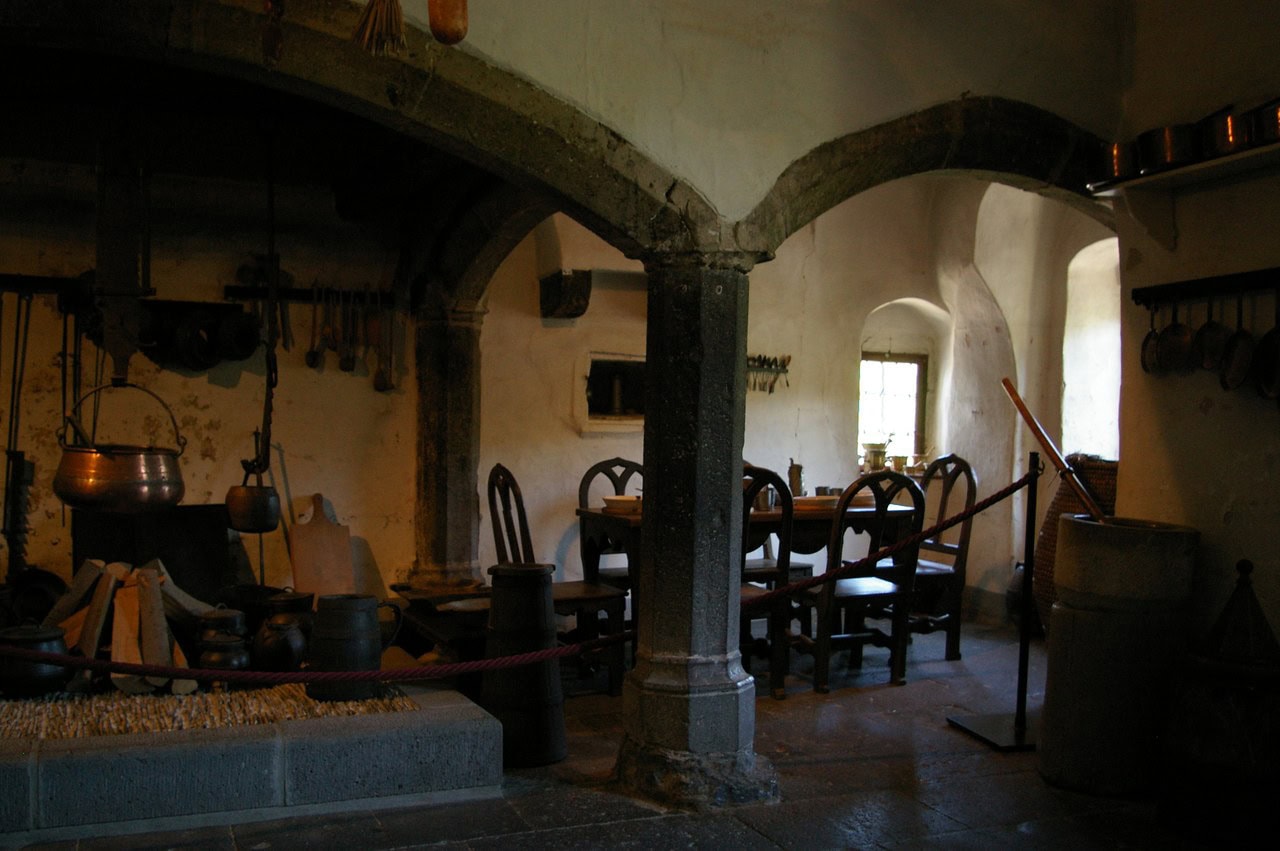
Twelve rooms make up the guided route, all of them in the Rübenach and Rodendorf wings. Highlights track the building’s own chronology: the Rübenach lower hall with its Cranach Madonna and Child with Grapes; the upper hall with its wall paintings of about 1450 and its four-poster bed; the Comtessenzimmer, whose painted bridal bed of about 1520 is among the oldest surviving painted Renaissance beds in Germany. Also on the route are the late-Gothic Fahnensaal, the Rittersaal with its Rose of Silence, and the fifteenth-century Rodendorf kitchen. Family quarters in the Kempenich wing are not on the route.
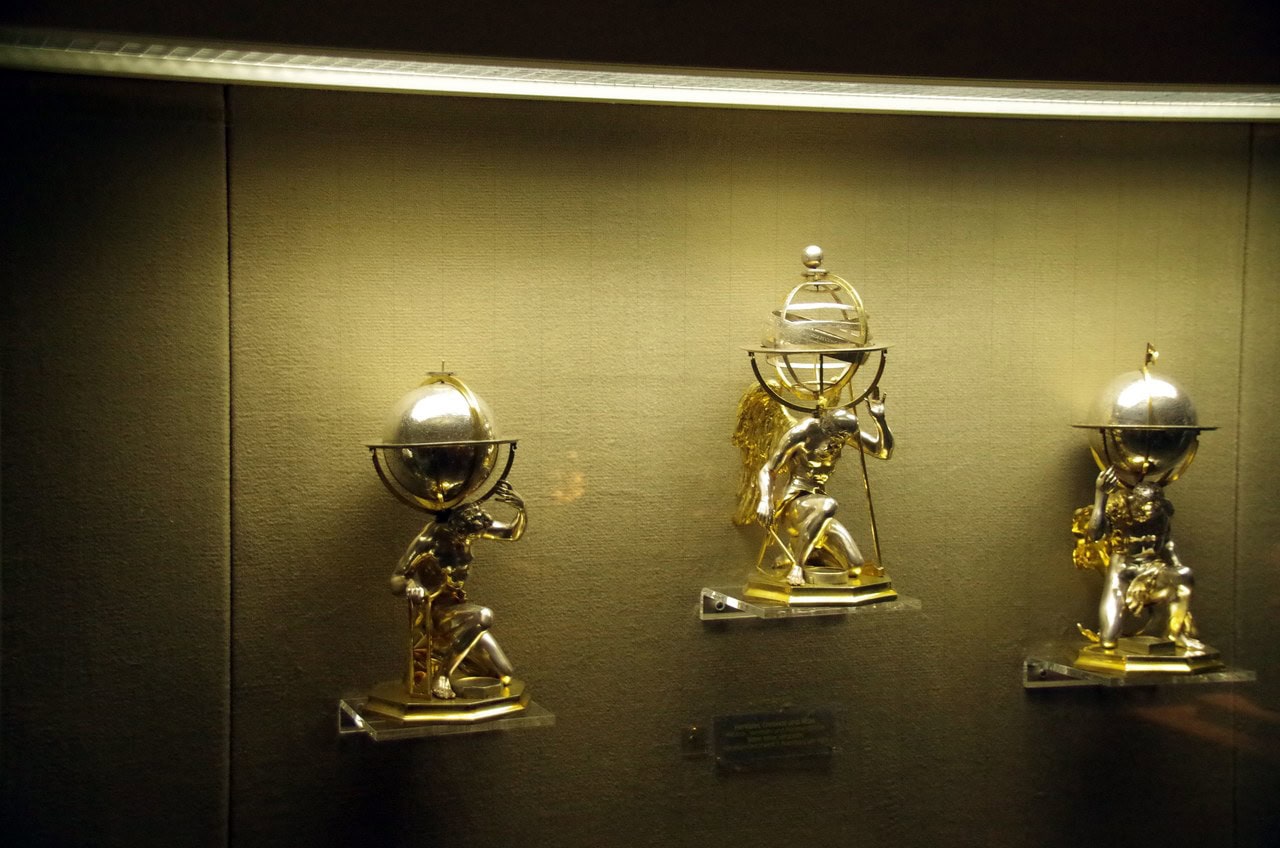
Cellar vaults under the Rübenach wing hold the Treasury, visited independently on the same ticket. More than five hundred objects span roughly nine centuries: Augsburg and Nuremberg goldsmithwork, glass and porcelain, ceremonial weapons, ivory and jewelry, and three parcel-gilt silver figures bearing the terrestrial, celestial and planetary globes, three of twelve planned for a great clock by Abraham Drentwett II that was never finished. Labels are in German, with a free English explanation sheet at the entrance.
How long you need
Burg Eltz asks visitors to allow “2,5, or even better 3 hours from where you park your car.” That covers the walk down from Parkplatz 1, a guided tour of thirty-five to forty minutes, and the Treasury, which is self-guided and takes another twenty-five to thirty. Tours leave the upper courtyard every ten to fifteen minutes, so the wait is usually short. Arriving on foot from Moselkern adds the four-and-a-half-kilometer approach in each direction, which makes the castle most of a day rather than an afternoon. In the outer bailey a self-service restaurant serves snacks, cakes and drinks to ticket-holders; it is reached by stairs.
Best time to visit
Burg Eltz keeps a season rather than a year: it opens daily through spring, summer and autumn, with no weekly closing day, and shuts completely over the winter, when the castle is a private house again and the approach through the Eltzer Wald leads to a closed gate. Season dates and the day’s timings are in the Admission table above, and they matter more here than at most castles, because the last tour of the day leaves after the gate has already stopped admitting.
One present-state caveat applies to the 2026 season. Restoration is under way on the half-timbering of the Kempenich House in the inner courtyard and on the Remise, the carriage house in the outer bailey, and parts of both are scaffolded. Photographers who want the courtyard clear of scaffolding should check the castle news page before traveling.
Photography
Two vantage points on the approach are named by the castle itself: a viewing platform on the drive down from Parkplatz 1, and, on the parallel footpath, the “500-DM view,” the angle that appeared on the reverse of the five-hundred-mark note. Both sit on the walk in, so neither costs extra time.
Indoors the rules are strict and worth knowing before arrival. Photography and filming are permitted outside, in the courtyard and in the Treasury, and are not permitted in the castle’s interior rooms; flash and any supplementary lighting are banned indoors because, in the castle’s own words, this “causes the sensitive historic colours to fade.” Drones are prohibited across the whole estate and across the Naturschutzgebiet Eltzer Wald, which surrounds the castle for about a kilometer and a half. One further restriction catches photographers out. Photography for private use is permitted. Beyond that, the castle states flatly that images may not be used for any commercial or political purpose, and it claims the copyright in any picture taken on the estate that is not purely private. Germany’s freedom-of-panorama exception cannot apply, the castle argues, because that exception covers works visible from public ground and Burg Eltz can be seen only from the family’s own forest.
Accessibility
Burg Eltz is not barrier-free, and the castle is direct about what that means. As a medieval defensive and residential complex it is full of steps and staircases which, in its own words, make visiting the inner courtyard, the guided tour and the Treasury difficult or impossible for people with physical limitations; the taverns in the outer bailey are reached only by stairs. Anyone planning a visit with limited mobility should contact the castellan’s office first rather than assume the shuttle bus solves the problem, because it does not.
Guide dogs are admitted; other animals are not allowed in the castle’s interior rooms. Backpacks and child carriers have to be left at the office before the tour, and the castle recommends the guided tour only for children of preschool age and older.
Guided day trips to Burg Eltz from Cochem, Koblenz and the Moselle towns are sold through GetYourGuide; admission itself is bought at the ticket office on arrival, since the castle sells no individual tickets online. Anyone staying overnight can compare hotels in and around Cochem.
Some links on this page are affiliate links, which means StoneKeep Atlas may earn a small commission, at no extra cost to you, if you book through them.
More Views of Eltz Castle
Common Questions
Does the Eltz family still live in the castle?
Not as a main home. The family began moving to town houses in Trier, Koblenz, Mainz and Eltville around 1600, and the castle’s German pages state plainly that Burg Eltz has long since stopped being its principal residence. Filling that gap are the castellans, Angelika Nelius and Stefan Ritzenhofen, who live on site as the family’s representatives and the castle’s managers. The number of castellans once tracked the joint inheritance exactly, three while three branches held shares, one after 1815.
Can you go inside, and is there a throne room?
Twelve rooms are shown, and there is no throne room. The word appears nowhere on the castle’s own site, and it would be out of place: Eltz was a knights’ castle held of the Empire, never a royal palace. Its grand room is the Rittersaal, where all three branches met to negotiate. On the total the castle contradicts itself, its German pages giving up to eighty rooms and its English pages more than a hundred.
What is a Ganerbenburg, and what did the three families actually share?
A Ganerbenburg is a castle held jointly by co-heirs who build and live separately inside it. At Eltz the common property was substantial: the keep in equal thirds, the Rittersaal as the shared hall, a shared cistern, two jointly paid gatekeepers, and a common master builder funded by a tariff on visiting nobility, who had to leave two crossbows behind. Kill a man inside the Burgfrieden and the deed stripped killer and heirs of every right there, unless he paid the dead man’s heirs a penalty they judged fitting.
How is the castle paid for?
No reliable figure for the family’s wealth exists. What is documented is how the castle runs. The Gräflich Eltz’sche Kastellanei is a registered family estate office rather than a foundation or trust, and conservation is co-funded: the castle names the federal culture ministry, the state heritage authority GDKE and the Deutsche Stiftung Denkmalschutz among its backers, with public donations a fourth leg. The family’s Slavonian estates at Vukovar went in two waves, most to interwar land reform and the remainder confiscated in 1945.
Has Eltz Castle been used in films?
Barely, and there is a legal reason. Germany’s Panoramafreiheit, which permits photographs of buildings visible from public ground, does not apply here: Burg Eltz can be seen only from the family’s own private forest, so any non-private use of an image needs the owner’s permission. One film often placed here was shot elsewhere. Where Eagles Dare was filmed at Hohenwerfen in Austria, where the fortress now exhibits material about the production.
Was Eltz Castle ever badly damaged?
Never in war, but once by accident and severely. Fire broke out in September 1920 and destroyed more than eighty percent of the buildings, by the attending brigade’s own account, taking the roofs and timber framing of the Kempenich, Rodendorf and Platteltz ranges. Only the Rübenach house came through. Friedhoff dates the rebuilding’s completion to 1930; the castle’s own account runs it into the mid-1930s. The castle’s reputation for survival therefore rests on sieges and demolition lists, not on never having burned.
Beyond Eltz Castle
Burg Eltz belongs to the cluster of Rhine and Moselle strongholds in the StoneKeep Atlas. Nearest is Cochem Castle, a short way up the Moselle, whose hilltop Reichsburg was rebuilt in the nineteenth-century Romantic taste that Eltz never needed. Eltz shares its rarest distinction, never destroyed in war and never taken by storm, with Marksburg, which its owners call the only hilltop castle on the Middle Rhine never destroyed. The wider run of crag-top fortresses along the river is gathered in the Castles of the Rhine Gorge guide. Eltz also serves as the medieval anchor of our tour of the fairytale castles in Germany.
We have filmed Eltz as well; the episode sits with the rest of our castle documentaries.
Conclusion
Burg Eltz endures because the right things were done at the right times: the 1688 demolition list was redrawn, the 1845–88 restoration declined to invent what was not there, and the 2009 stabilization program is treating the building’s masonry like an archaeological context. What survives in consequence is unusual at four points at once: a textbook Ganerbenburg whose form was settled by an inheritance contract; a medieval siege case study unusually well documented in stone and document alike; a nineteenth-century restoration whose discipline preserved the medieval substance instead of reimagining it; and a thirty-fourth-generation continuity that makes the building a still-occupied ancestral house rather than a state-administered monument. Set against the broader history and architecture of the German castle landscape, what makes Eltz feel medieval is not only its age but the steady refusal of its stewards, in any century, to make it look more medieval than it was.
The siege that the lords of Eltz outlasted in the 1330s was an early chapter in a much longer history of how German castles withstood or fell to siege.
Principal Sources
- Burgenwelt. “Burg Eltz.” burgenwelt.org. The castle-survey database, and the carrier for the typological attribution the guide makes in the History section: “Burg Eltz ist der Prototyp einer Ganerbenburg (nach F.-W. Krahe)”, citing F.-W. Krahe, Burgen des deutschen Mittelalters (Augsburg, 1996).
- Deutsche Bundesbank. Die Noten der Deutschen Bundesbank. Frankfurt am Main, 1964. bundesbank.de. The central bank’s own account of its first banknote series: Burg Eltz as the main motif of the 500-DM reverse, the note issued from spring 1965 after the announcement in the Bundesanzeiger of 3 December 1964.
- Deutsche Burgenvereinigung, Europäisches Burgeninstitut. EBIDAT Burgendatenbank: Eltz. Classification and preservation are on the Hauptdaten tab, not the record page. ebidat.de. Record compiled by Jens Friedhoff; the source for the dendrochronological dating of the Rübenach House to 1311/12, the story counts and floor dimensions of the family houses, and the 2008 to 2012 building-archaeology campaign.
- Deutsches Wanderinstitut. “Eltzer Burgpanorama.” wanderinstitut.de. The certifying body for German premium hiking trails; carries the trail’s certification, its 12.6-kilometer length, and its 2013 Wandermagazin award.
- Eulenstein, Julia. “Rebellion der ‘Übermütigen’? Die Eltzer Fehde Balduins von Trier, 1331-1337.” Kurtrierisches Jahrbuch 46 (2006), pp. 79-115. The political analysis of the feud: what the allied castle-lords were defending and what Balduin was building.
- Freiwillige Feuerwehr der Stadt Münstermaifeld. “Einsätze: Historie.” muenstermaifeld-112.de. The attending brigade’s own record of the fire, which fixes it to the night of 26 to 27 September 1920 and describes the saving of the Rübenach House.
- Friedhoff, Jens. “Burg Eltz bei Moselkern. Anmerkungen zu Brandzerstörung und Wiederaufbau der Burg 1920 bis 1930.” Jahrbuch für westdeutsche Landesgeschichte 41 (2015), pp. 443-464. The standard scholarly account of the 1920 fire and the interwar reconstruction; volume contents at the Landesarchivverwaltung Rheinland-Pfalz.
- Generaldirektion Kulturelles Erbe Rheinland-Pfalz. “Land und Bund fördern Burg Eltz mit 407.000 Euro.” gdke.rlp.de, 30 June 2025. The state heritage authority on the current grant: 175,000 euros from the Land and 232,000 from the federal government, for the Remise and the stucco ceiling of the Blauer Saal in the Rodendorf House.
- Gräflich Eltz’sche Kastellanei. “History from Castle & Family Eltz.” burg-eltz.de. The owning family’s own chronology, and the authority for the 1157 first mention, the 1268 division into three lines, the building campaigns of 1490 to 1515 and 1604 to 1661, and the 1845 to 1888 restoration.
- Gräflich Eltz’sche Kastellanei. “Fragen und Antworten.” burg-eltz.de. The operator’s German FAQ, and the only published source for the castle’s accessibility statement, its photography and drone rules, and the point that panorama freedom does not apply because the castle is visible only from private forest. The same answers are published in English at burg-eltz.de/en/faq.
- Gräflich Eltz’sche Kastellanei. “Historie.” burg-eltz.de. The German building chronicle, which carries the dated keystones and alliance arms, the Fahnensaal of 1470, the Burgfriedensbrief provisions, and the 1738 dowry condition behind the Faust von Stromberg name.
- Heinrich + Steinhardt Architekten und Ingenieure. “Generalsanierung Burg Eltz.” heinrich-steinhardt.de. The practice carrying out the works, and the source for the continuous program of structural and conservation measures running since 2009.
- LVR-Institut für Landeskunde und Regionalgeschichte. “Burg Eltz.” KuLaDig: Kultur.Landschaft.Digital, object O-54170, with “Burgruine Trutzeltz”, object KLD-287710, which is the record that carries the Eltz Feud passage. kuladig.de. The regional heritage register: the extent of the 1920 fire damage, the survival of the Rübenach House alone, and its siting of Trutzeltz about 170 meters north of the castle’s approach, a measurement taken from a different point than the 200 to 240 meters Wagener and Schmidt give from the castle itself.
- Ministerium des Innern und für Sport des Landes Rheinland-Pfalz. “294.000 Euro für Denkmalpflege von Burg Eltz und Ruine Trutzeltz.” mdi.rlp.de, 11 October 2024. The state grant of 161,000 euros for masonry and windows at the castle and 133,000 euros for the structural securing of the Trutzeltz ruin.
- Mosellandtouristik. “Moselsteig Stage 20: Treis-Karden to Moselkern.” visitmosel.de. The official long-distance trail operator; the stage that reaches Burg Eltz, and the source for the Five Hundred Mark View above the valley.
- Museumsverband Rheinland-Pfalz. “Burg Eltz.” Museumsportal Rheinland-Pfalz, museumsportal-rlp.de. The museum portal of the Museumsverband Rheinland-Pfalz e.V., a registered association, and the carrier for the scoped claim in the opening paragraph: “die einzige unzerstörte mittelalterliche Ganerbenburg […] des Landes, die sich seit ihrer Erbauung bis heute im Familienbesitz befindet.”
- Rhein-Mosel-Eifel-Touristik. “Mosel-Traumpfad Eltzer Burgpanorama.” traumpfade.info. The network operator’s route data: 12.6 kilometers, 397 meters of ascent, about four hours, starting from Wierschem.
- Stadt Münstermaifeld. “Busverbindung zur Burg Eltz.” muenstermaifeld.de. The Burgenbus line 365 from Hatzenport by way of Metternich, Münstermaifeld and Wierschem, running daily at half-hourly intervals from 1 April to 1 November.
- Stadt Münstermaifeld. “Der Traumpfad Eltzer Burgpanorama ist Deutschlands Schönster Wanderweg 2013.” muenstermaifeld.de. The full result of the 2013 reader vote, the first year the award was decided by the public: 3,838 votes of about 13,800 cast, 27.8 percent, ahead of the Traumschleife Kupfer-Jaspis-Pfad and the Genießerpfad Wasserfallsteig.
- Stiftung der Deutschen Burgenvereinigung. “Großer Denkmalpreis 2024.” deutsche-burgen.org. The award of 27 April 2024 in the Kaisersaal of the Kurfürstliches Schloss zu Koblenz, and its citation for the securing and preservation of Burg Eltz.
- Tate. Imms, Matthew. “Joseph Mallord William Turner, The Ruins of Trutz Eltz above the Eltz Valley near the River Mosel, with Burg Eltz beyond to the South, 1840.” Catalogue entry, September 2018, in J.M.W. Turner: Sketchbooks, Drawings and Watercolors. tate.org.uk. Turner Bequest CCXCII 41 (D28988); pencil, watercolor and gouache on gray wove paper, 141 by 190 millimeters.
- Thon, Alexander. “Burgen an der Mosel.” Portal Rheinische Geschichte, Landschaftsverband Rheinland. rheinische-geschichte.lvr.de. On Eltz as an imperial castle held by unfree imperial ministeriales, on the hereditary imperial fief, and on Baldeneltz as the historical name of the counter-castle now called Trutzeltz.
- Thon, Alexander, and Stefan Ulrich. “Von den Schauern der Vorwelt umweht…” Burgen und Schlösser an der Mosel. Schnell & Steiner, 2007. ISBN 978-3-7954-1926-4.
- Wagener, Olaf, and Achim Schmidt. “… et Baldeneltz a fundamento constructum …: Die Belagerung der Burg Eltz durch Erzbischof Balduin von Trier während der Eltzer Fehde (1331-1336); Bauarchäologische Untersuchungen zur Trutz-Eltz.” Trierer Zeitschrift 73/74 (2010/2011), pp. 215-235. The peer-reviewed building-archaeology study of the siege castle, open access.
Image credits. Hero: Burg Eltz on its rock spur, seen from the elevated trail vantage above the Elzbach valley. Photo: FrDr, CC BY-SA 4.0. Source: Burg Eltz 145, Wikimedia Commons; Across the valley: Photo: Matthias Süßen, CC BY-SA 4.0. Source linked in the caption; Aerial of the named houses: Photo: Wolkenkratzer, CC BY-SA 4.0. Source linked in the caption; Winter from the southwest: Photo: Michamel, public domain; Turner watercolor of Trutz Eltz and Burg Eltz, 1840: Tate, Turner Bequest CCXCII 41 (D28988), public domain; History timeline: Diagram: StoneKeep Atlas; Cobblestone approach to the gate: Photo: Balou46, CC BY-SA 4.0. Source linked in the caption; Gallery, courtyard oriels and chapel bay: Photo: Asif Masimov, CC BY-SA 3.0. Source: Eltz Innenhof, Wikimedia Commons; Gallery, named houses over the inner court: Photo: Asif Masimov, CC BY-SA 3.0. Source: Eltz 2, Wikimedia Commons; Gallery, autumn over the Elz valley approach: Photo: Asif Masimov, CC BY-SA 3.0. Source: Castle Eltz and forest, Wikimedia Commons; Gallery, frescoed chamber: Photo: Daniel71953, CC BY-SA 4.0. Source: Allemagne07 08 0392 Burg Eltz, Wikimedia Commons; Gallery, vaulted kitchen: Photo: Daniel71953, CC BY-SA 4.0. Source: Allemagne07 08 0406 Burg Eltz, Wikimedia Commons; Gallery, treasury gilt-silver: Photo: Balou46, CC BY-SA 4.0. Source: DE-burg-eltz-schatzkammer, Wikimedia Commons; Gallery, tournament harness: Photo: Gun Powder Ma, CC BY-SA 3.0. Source: Burg Eltz 04, Wikimedia Commons; Gallery, named-house loggia and stair tower: Photo: Dkvtig, CC BY-SA 4.0. Source: 2019-Burg Eltz (19), Wikimedia Commons. Freely licensed images are resized to fit; otherwise unaltered.