
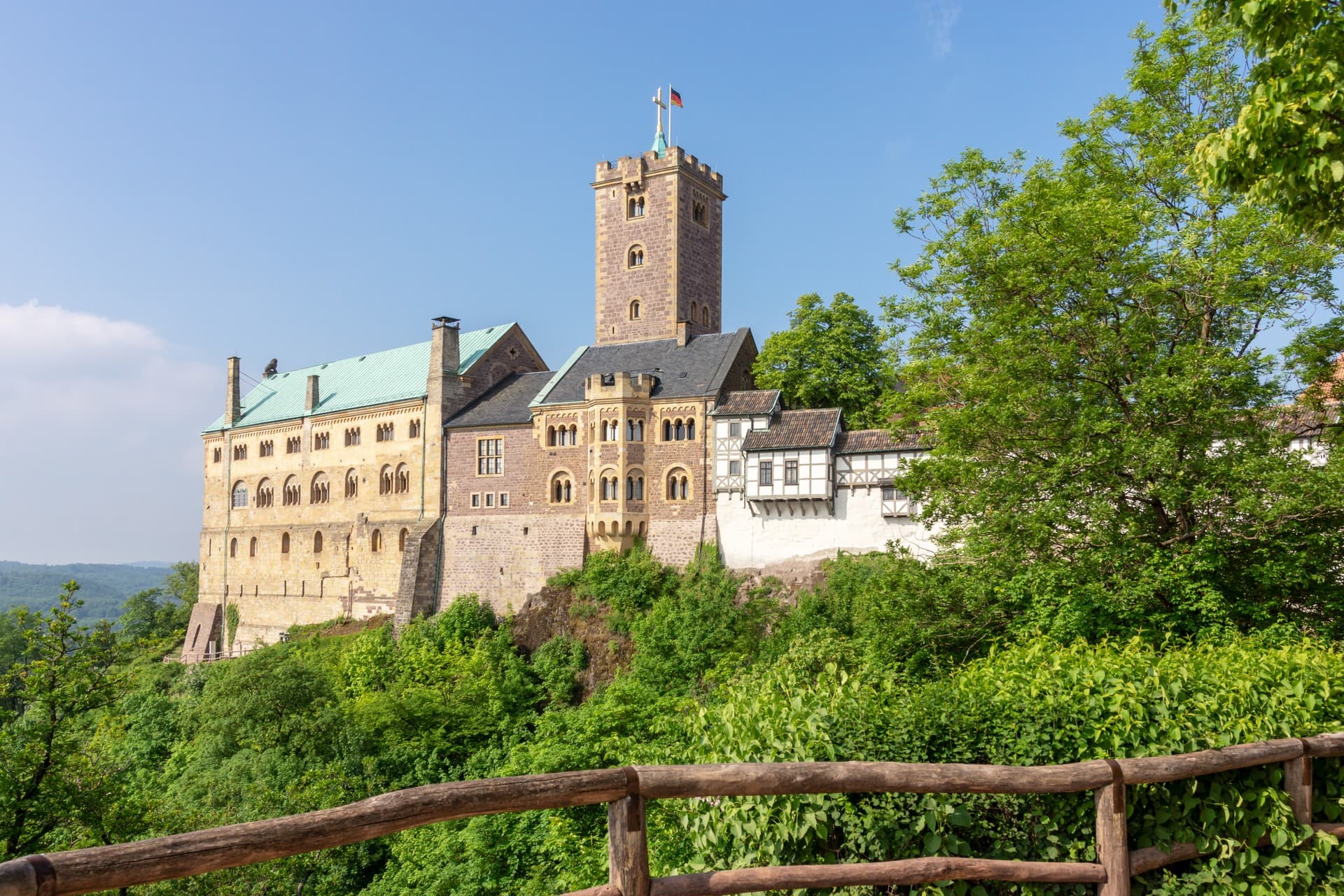
Wartburg Castle
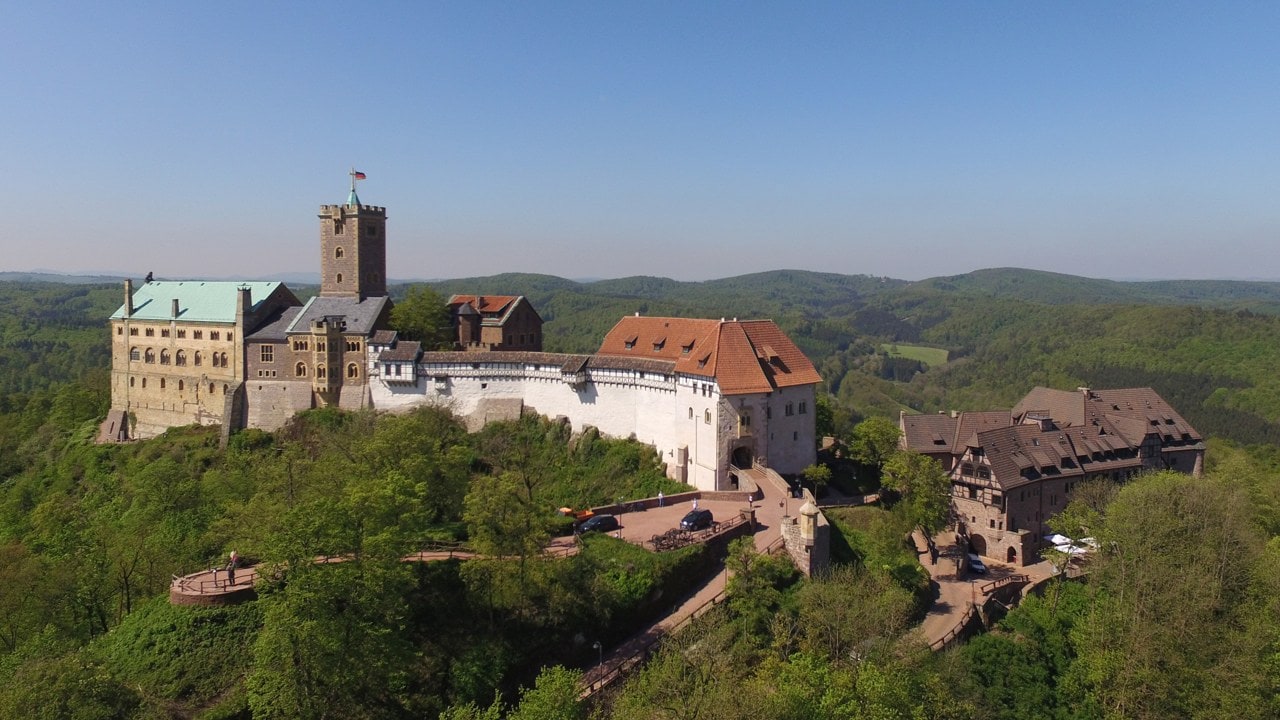
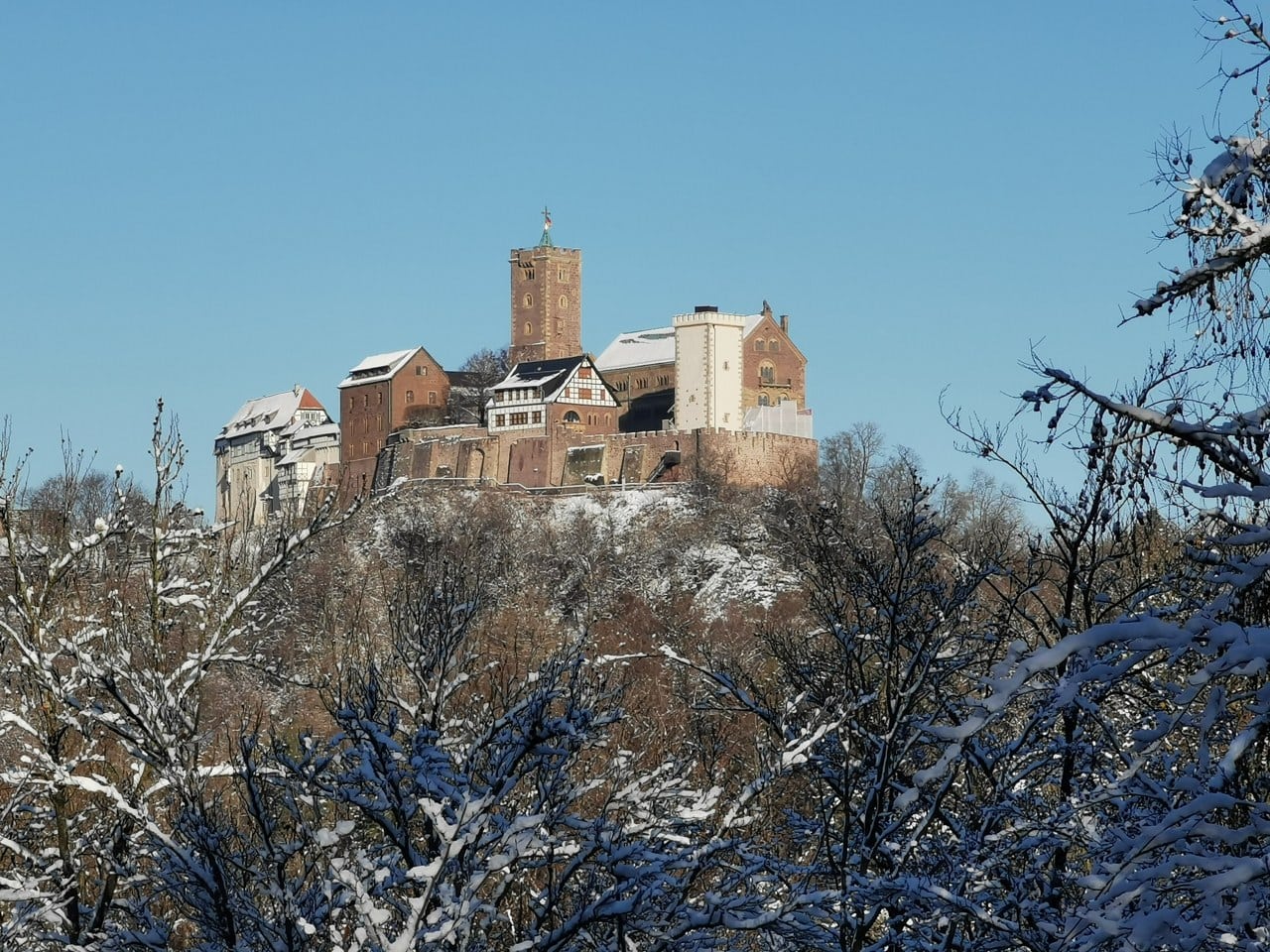
Wartburg Castle (die Wartburg) is the most mythologized castle in Germany and one of the hardest to see clearly. It crowns a sandstone ridge above Eisenach in Thuringia, and it is at once a genuine twelfth-century Ludowingian monument and a nineteenth-century argument about what Germans wanted the Middle Ages to have been. Visitors come for three things that happened here: St. Elisabeth’s brief sainthood-in-the-making, Martin Luther’s ten months translating the New Testament in disguise, and the 1817 student festival that helped invent German nationalism. They walk through rooms built to make all three unforgettable. The first impression, that this is one of the great surviving medieval castles of the Holy Roman Empire, is broadly correct: the Romanesque Palas is real, dendro-dated to the 1150s, and among the best-preserved secular buildings of its age north of the Alps.
The first impression is also, in one consequential respect, misleading. Most of what visitors photograph (the towering keep, the painted halls, the very room where Luther is said to have hurled an inkpot at the devil) is the work of a Romantic-nationalist reconstruction carried out between 1838 and 1890, and even the castle’s Reformation memory is partly a constructed memory, anchored on a famous ink stain, a seventeenth-century devotional fiction that was renewed again and again and has not been on the wall since the early twentieth century. None of this makes the Wartburg a fake. It makes it something more interesting: a building whose whole power comes from how completely its real medieval substance and its nineteenth-century reinvention have been fused. The most rewarding way to understand it is to learn to see those layers separately.
Quick Facts
| Location | Eisenach, Thuringia, Germany |
| Built | Romanesque Palas c. 1156-1170 (timbers dendro-dated 1157/58); first documented 1080 |
| Builder | Ludowingian landgraves of Thuringia, principally Ludwig II “the Iron” |
| Castle type | Spur castle (Spornburg / Höhenburg) on a sandstone ridge ~411 m above sea level |
| Famous for | Luther’s New Testament translation (1521-22); St. Elisabeth of Thuringia; the 1817 Wartburgfest |
| UNESCO | World Heritage Site since 1999 (criteria iii and vi) |
| Owner / operator | Wartburg-Stiftung |
| Open | 365 days a year; interior by guided tour or self-guided app |
| 2026 adult admission | €13 (concession €9; ages 7-18 €5; under 6 free) |
| Official site | wartburg.de |
A Ridge, a Legend, and a Documented Castle
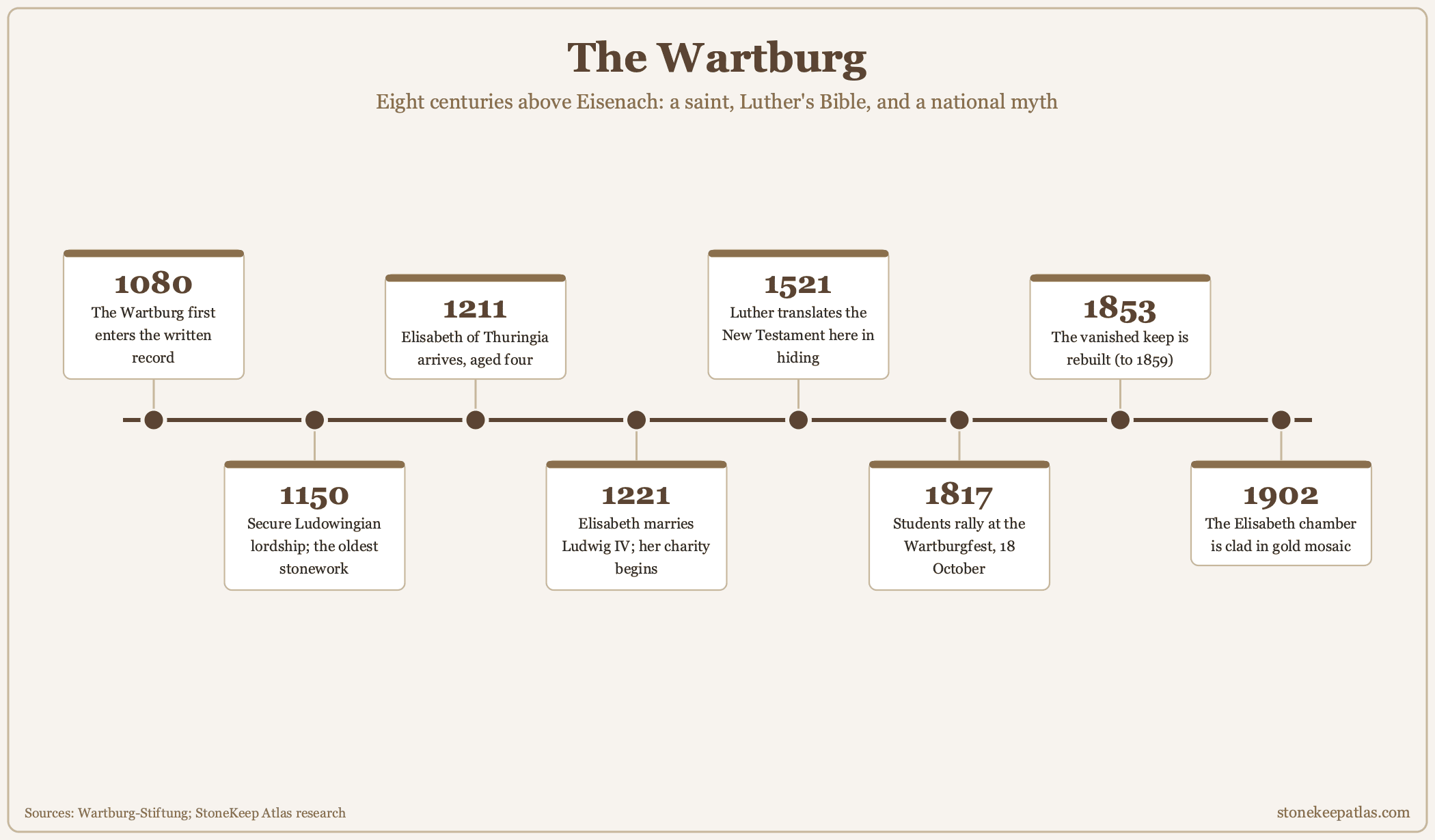
Its founding story is the first layer, and the least reliable. Tradition has Count Ludwig the Jumper standing on the ridge in 1067, exclaiming “Wait, mountain — you shall become a castle for me,” and having loyal knights carry Thuringian soil up to the rock so he could claim it as his own land. That tale is charming and almost entirely literary. It comes from the late and unreliable Reinhardsbrunn chronicle and was popularized only in 1835 by Ludwig Bechstein’s Sagenbuch der Wartburg; the iron “oath-swords” supposedly unearthed in 1845 to prove the story are now regarded as a nineteenth-century fabrication. Wartburg enters documented history in 1080, when Bruno of Merseburg’s account of the Saxon war records Ludwig the Jumper’s men using the Wartburg as a base. Secure Ludowingian lordship of the ridge dates only from the middle of the twelfth century, and no stone fabric from before about 1150 has ever been identified on the site.
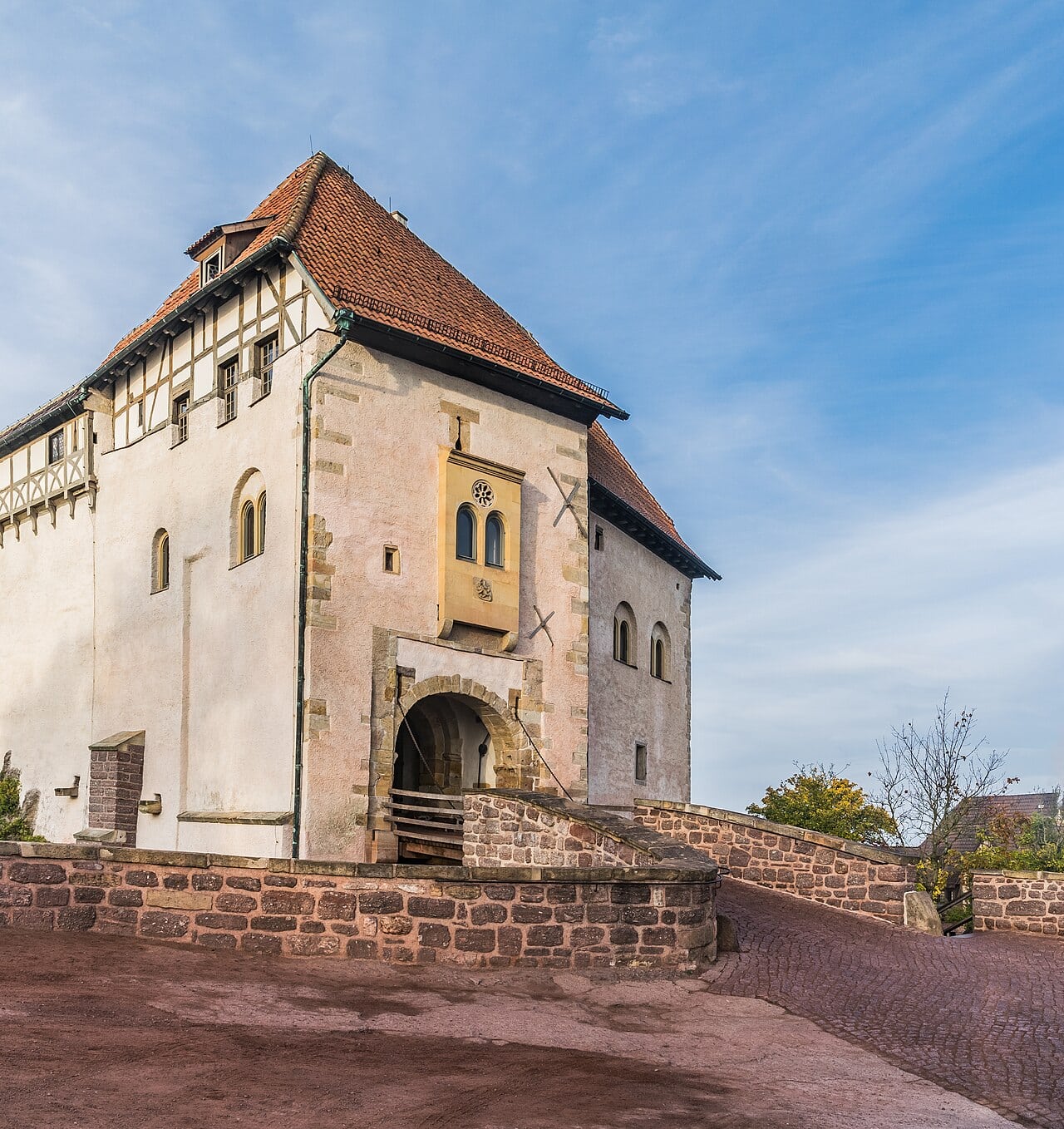
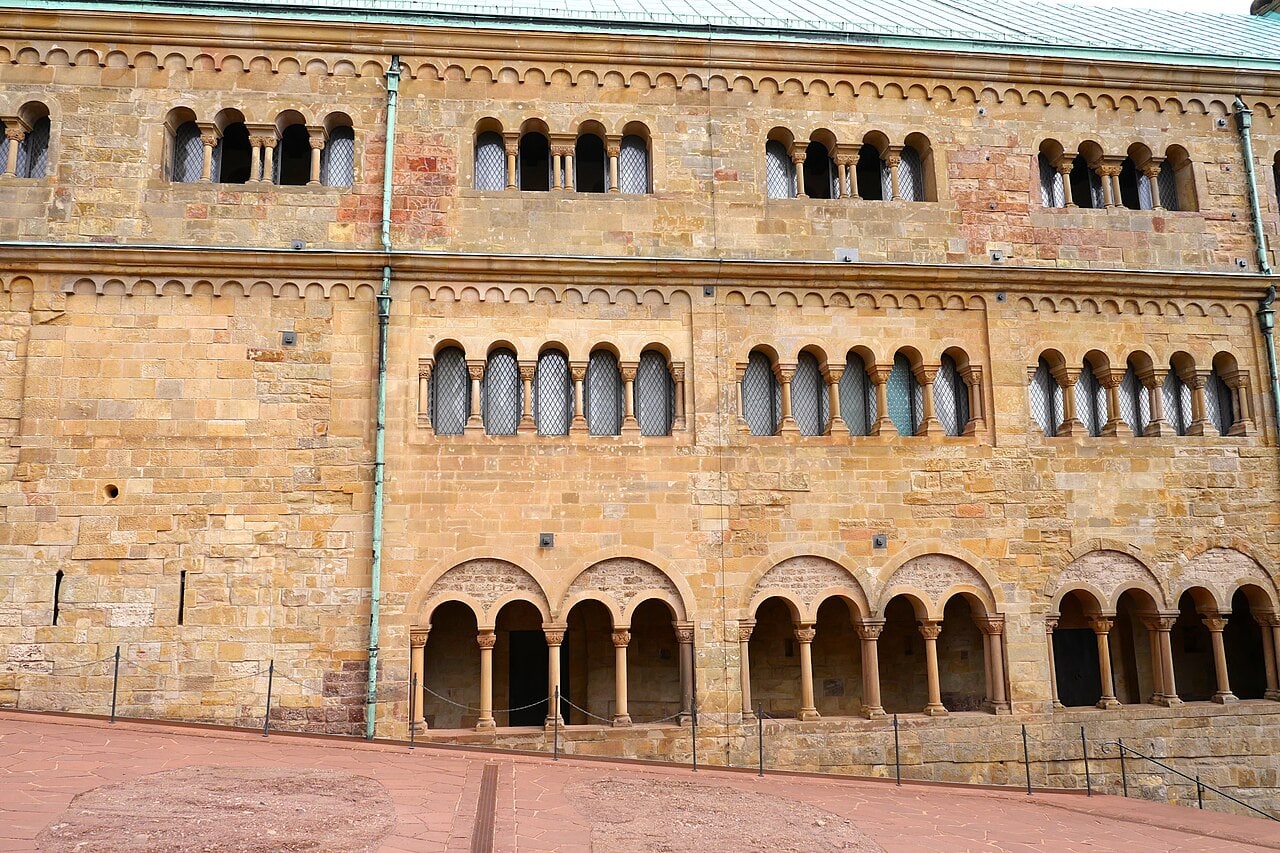
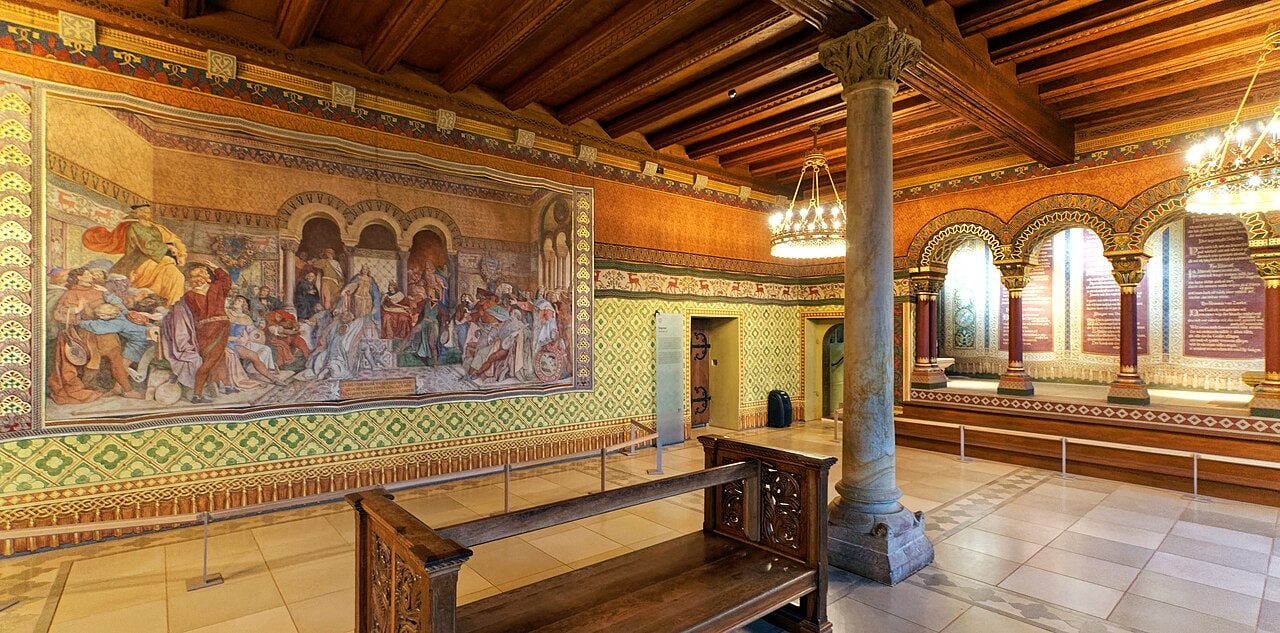
What does survive in stone is extraordinary, and it belongs to the Wartburg’s high-medieval moment. In 1131 Ludwig I was raised to Landgrave of Thuringia; his successor Ludwig II “the Iron” married Jutta of Hohenstaufen, sister of Frederick Barbarossa, and built the great residential hall whose timbers have been dendrochronologically dated to 1157/58. This is the Palas, the Landgrafenhaus, and it is the reason the Wartburg matters to architectural history independently of anything Luther did three and a half centuries later. Under Hermann I, landgrave from 1190 to 1217, the castle became one of the most brilliant literary courts in the Empire: Walther von der Vogelweide sang here, and Wolfram von Eschenbach dedicated parts of Parzival and Willehalm to its patron. That brilliance also generated the Wartburg’s second great legend, the Sängerkrieg or contest of minstrels of around 1206, a thirteenth-century literary invention (never documented as an event) that nonetheless became one of the castle’s defining images and, through Wagner, one of its global exports. Scholarly consensus is unambiguous: the singers’ contest never happened, and it has shaped how the Wartburg is seen ever since.
Elisabeth of Thuringia
A third layer is a saint, and unlike the Jumper and the minstrels she is firmly historical. Elisabeth, daughter of the King of Hungary, arrived at the Wartburg in 1211 at the age of four as the betrothed of the future Ludwig IV. She married him in 1221, bore a daughter on the castle in 1224, and after Ludwig died of fever at Otranto in 1227 on his way to crusade, she left the Wartburg the following year. Older accounts say she was driven out by her brother-in-law Heinrich Raspe; the current scholarly consensus, following Matthias Werner, is that she left voluntarily under the harsh ascetic direction of her confessor Konrad of Marburg, and that the expulsion story is a later hagiographic motif. She died at Marburg in 1231, aged twenty-four, and was canonized by Gregory IX at Pentecost 1235. Her cult made the Wartburg a place of pilgrimage centuries before Luther, and it is no accident that the nineteenth-century rebuilders devoted some of their most lavish work to her memory.
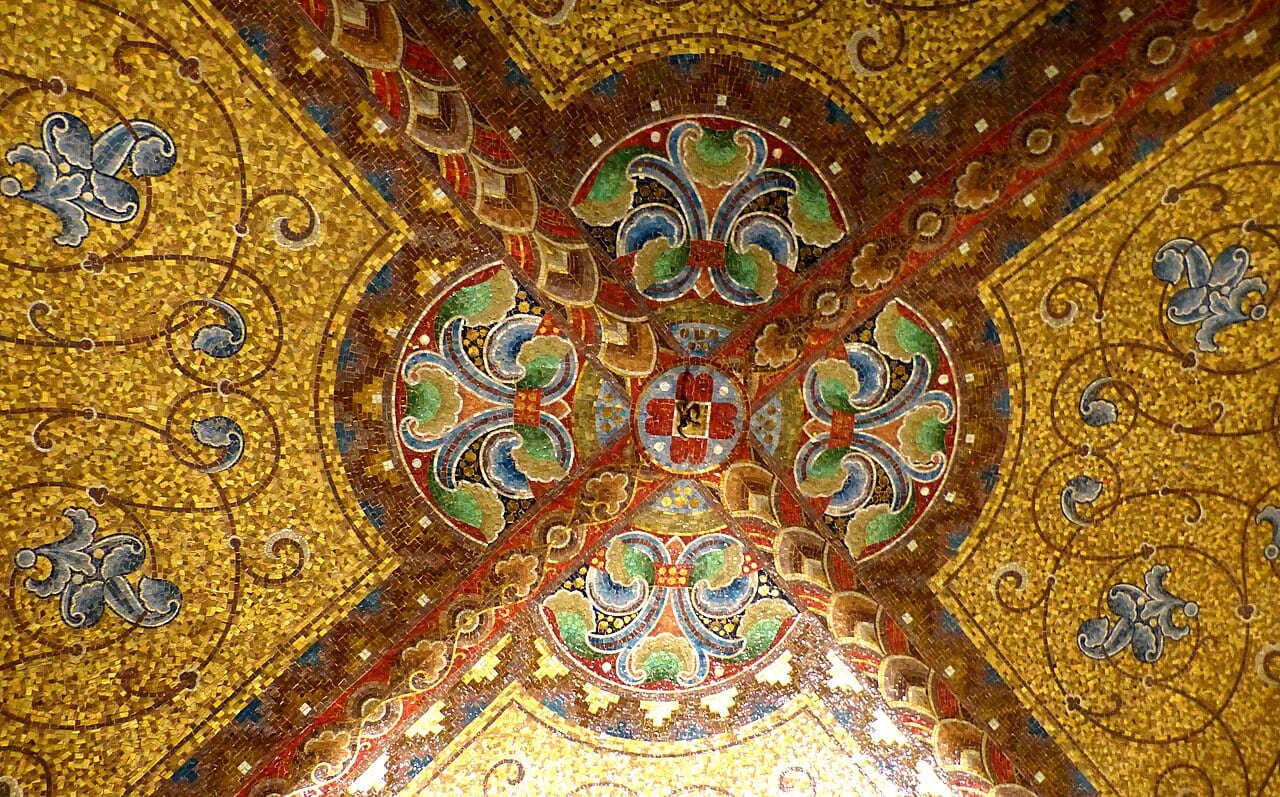
What happened to Elisabeth’s memory afterward is itself a lesson in how the Wartburg works. Matthias Werner’s research traces how each later century recruited her for its own purposes: medieval Hungary claimed her as a national saint, the Teutonic Order built its identity partly on her, and nineteenth-century Germany turned her into a sentimental emblem of charitable womanhood. Wartburg’s rebuilders leaned hard into that last version. The story everyone is told in the castle, the “miracle of the roses” (bread she was secretly carrying to the poor transformed into roses when her husband demanded to see what was under her cloak) is not in the earliest accounts of her life; it accrued to her over the medieval centuries and was then made unforgettable on the Wartburg’s own walls by Moritz von Schwind’s fresco of 1854-55, which fixed the legend in the form most visitors now carry in their heads. Half a century later Kaiser Wilhelm II went further still, having her chamber sheathed between 1902 and 1906 in more than a million pieces of glass and gold mosaic by August Oetken, a shimmering neo-Byzantine shrine wrapped around a Romanesque shell. The Elisabeth a visitor meets today is real history seen through two successive Romantic re-tellings, which is exactly the pattern the rest of the castle repeats. The Wartburg’s identity as a German shrine has always rested on two figures, a medieval saint and a Reformation outlaw, and it learned early how to hold both at once, and how to keep re-framing each for the age doing the looking.
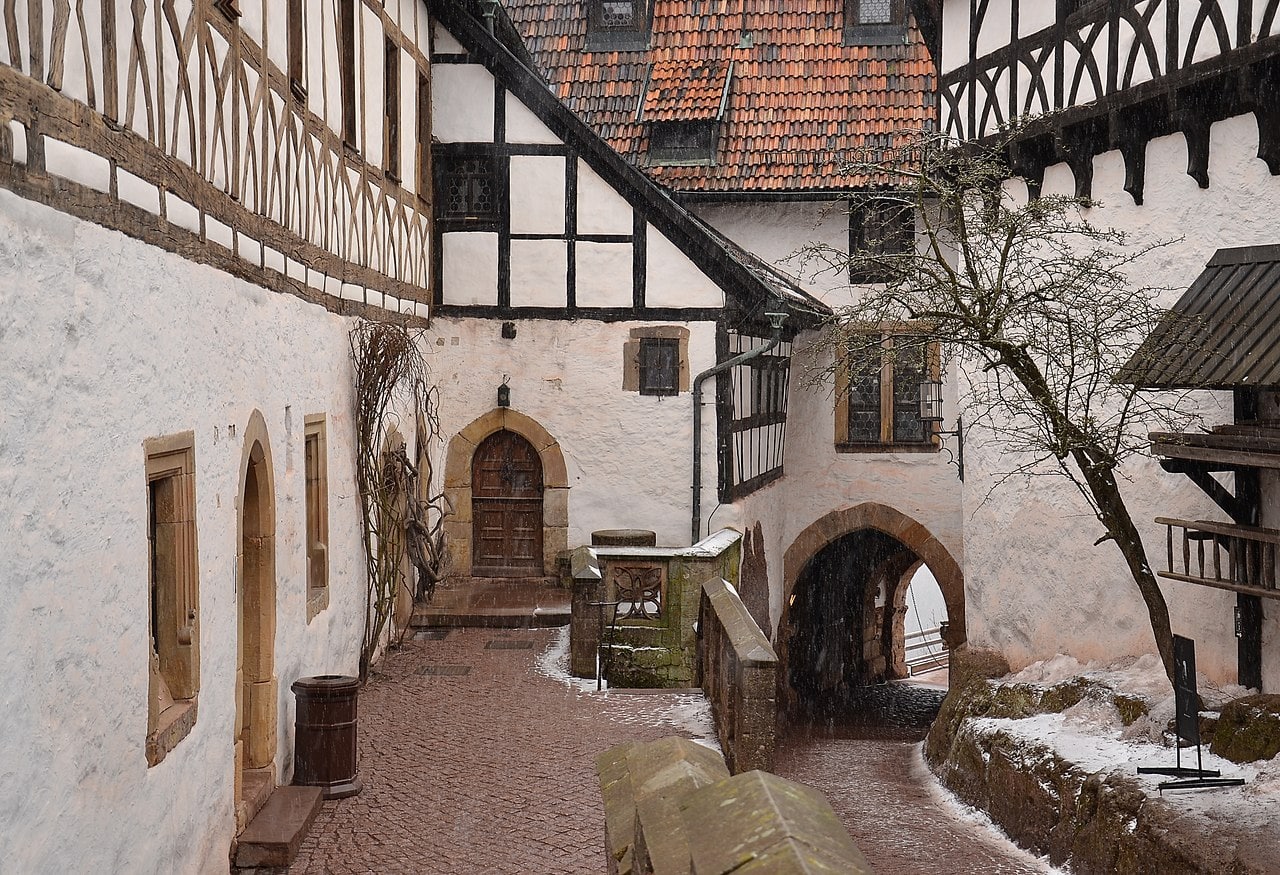
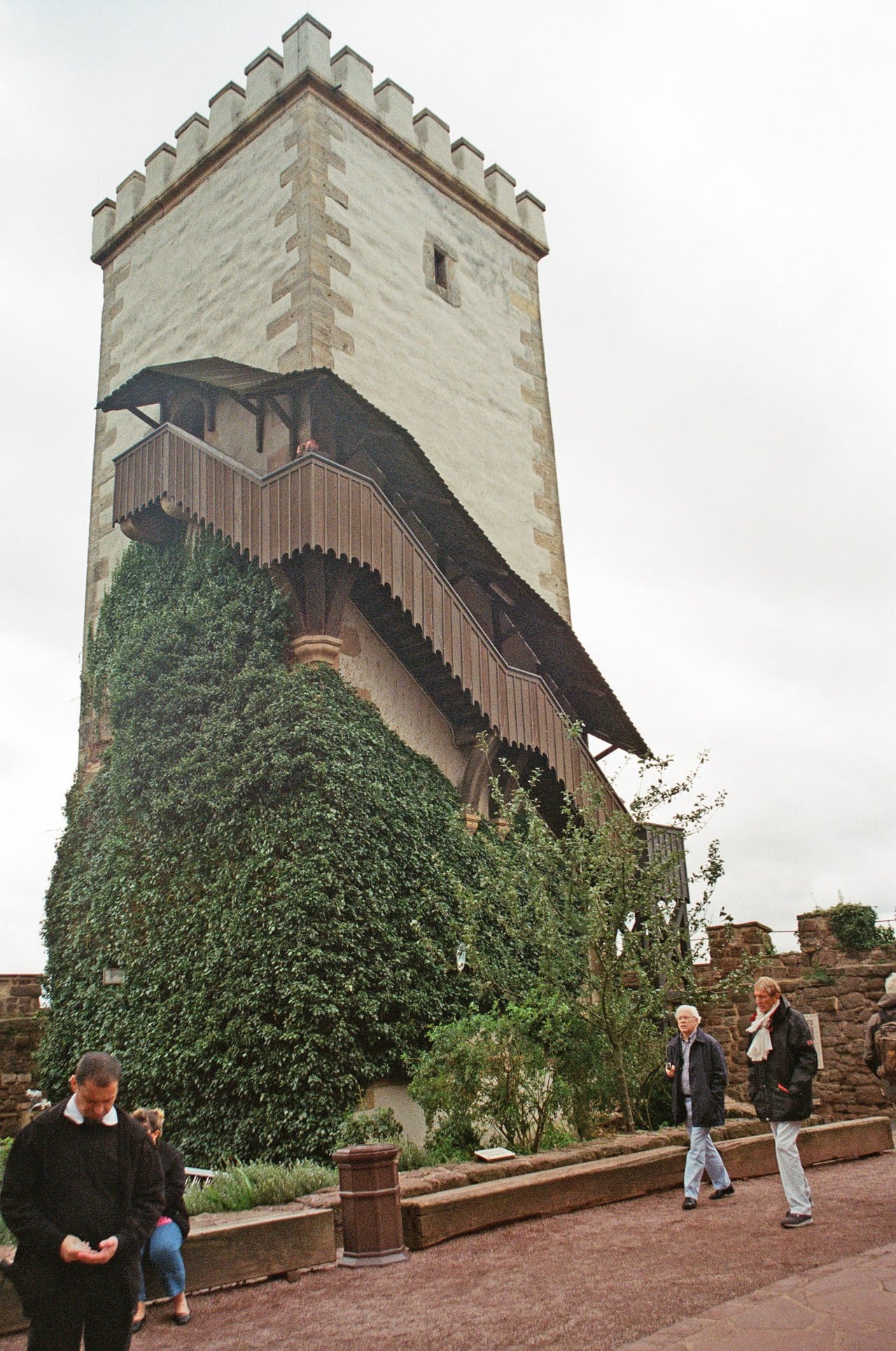
Ludowingian rule ended abruptly. Heinrich Raspe died childless at the Wartburg on February 16, 1247, and after a war of succession the castle passed by 1264 to the Wettins of Saxony. A failed Habsburg siege in 1306 left the castle untaken; a lightning fire in 1317/18 gutted the keep, the hall, and the women’s quarters, and the reconstruction that followed inserted a chapel into the Palas and rebuilt the south tower in the form it still keeps. Through the later Middle Ages the Wartburg slid into the role of a secondary residence, picking up the half-timbered ranges (the Vogtei begun in 1480, the timber galleries on the curtain walls) that still give the outer bailey its character. By the time the castle’s most famous resident arrived, the Wartburg was already old, already declining, and already a place where the past was more vivid than the present. That long decline into picturesque ruin is the condition the German Romantics would later fall in love with (the same spell that would settle over Heidelberg Castle, the age’s archetypal beautiful ruin), and it is what made the Wartburg available, three centuries on, to be reinvented.
Junker Jörg and the Eleven Weeks That Made a Language
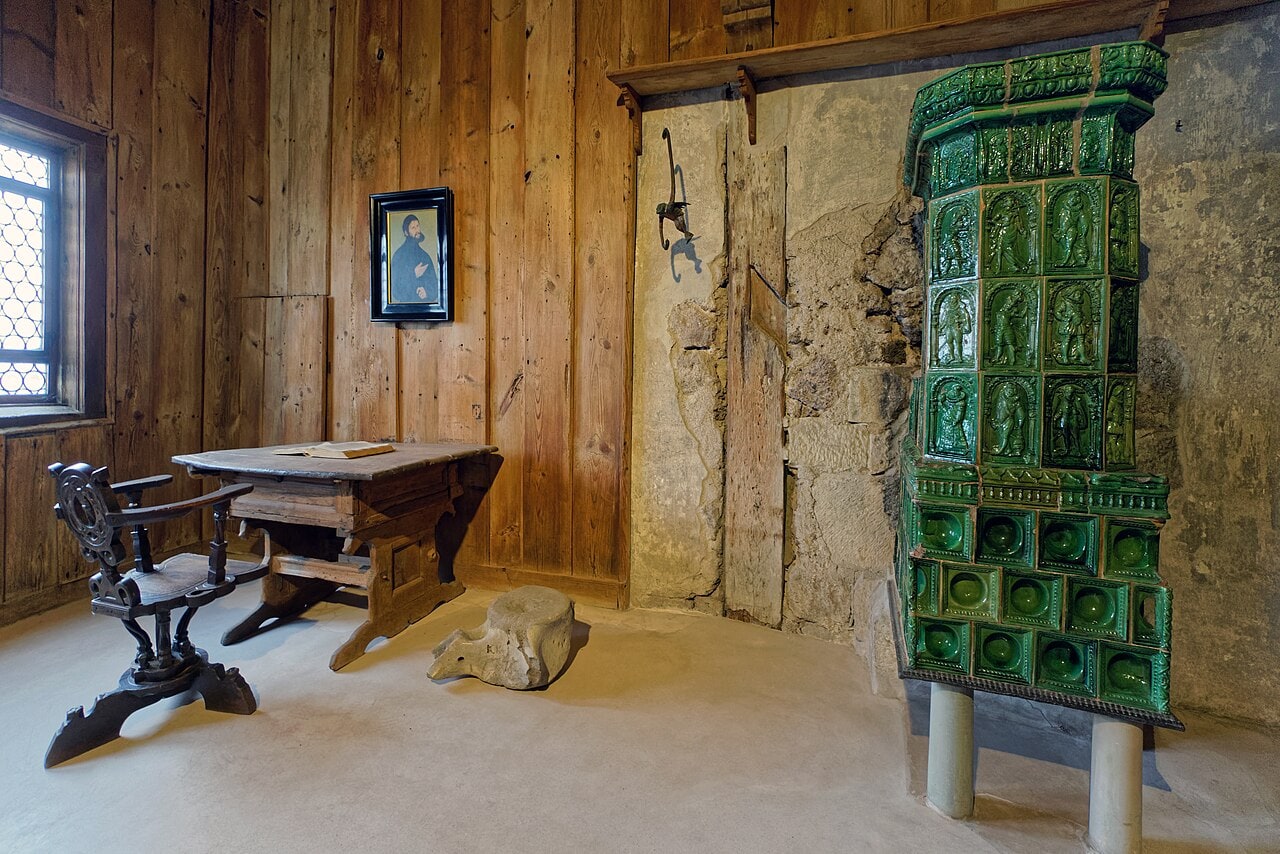
On May 4, 1521, returning from the Diet of Worms under imperial ban, Martin Luther was seized in a staged ambush near Burg Altenstein arranged by his own protector, the Elector Frederick the Wise, and brought the same evening to the Wartburg. For roughly ten months he lived there in disguise as a minor nobleman, “Junker Jörg,” letting his hair and beard grow, hunting with the garrison, and reading the castle’s isolation as both a prison and what he called his Patmos. A popular image gives him a single small room. The Wartburg-Stiftung’s own research corrects this: Luther occupied a three-chamber suite on the first floor of the Vogtei (the room shown today as the Lutherstube, an adjoining bedchamber, and the connecting Luthergang), not a monastic cell but a working apartment with space to think.
What he did there changed German. Between roughly mid-December 1521 and the first days of March 1522, in about eleven weeks, Luther translated the entire New Testament from Erasmus’s 1519 Greek edition into a German deliberately pitched to be understood from the Rhine to Saxony. The draft was finished at the Wartburg and polished in Wittenberg with Melanchthon’s help; in September 1522 it appeared as Das Newe Testament Deutzsch, the September Testament, printed for Lucas Cranach and Christian Döring and sold out within weeks. It is not an exaggeration, and it is not only a confessional claim, to say that the standardizing force of that translation on the German language is one of the most consequential cultural acts ever performed inside a castle, the act that anchors our wider account of the Reformation and the castle. Luther himself left on March 6, 1522, against Frederick’s wishes, to confront the radicalism breaking out in Wittenberg. Eight years later, the same Wettin protection would shelter him again, this time at the Coburg Fortress on the southern edge of Ernestine Saxony, while he watched the 1530 Diet of Augsburg unfold from a safe distance.
And then there is the ink stain. From the late seventeenth century, visitors were shown a mark on the wall of the Lutherstube, behind the stove, and told that Luther threw his inkpot at the devil. That story is a devotional fiction. It is not attested in any contemporary source; it surfaces only in tourist accounts from the seventeenth century, after Luther’s death, growing out of his own metaphor about fighting the devil “with ink,” that is, with Scripture and writing. The mark had to be renewed again and again, because visitors scraped the inked plaster off the wall to take home, and it was not always there: in 1817 one visitor was shown only bare stone. Its most revealing comment comes from the nineteenth-century painter Moritz von Schwind, who told the Grand Duke that he would formally protest the abolition of the ink stain, classing it cheerfully with the gilded halo he had given Elisabeth: both, he understood, were necessary fictions in a building whose job was to make memory visible. By the early twentieth century the stain had gone, and apart from a temporary renewal for an art project in 2009 it has not come back. Wartburg does not hide this. It is, properly understood, the most honest thing the castle has to teach.
The Festival That Burned Books and the Architect Who Rebuilt the Past
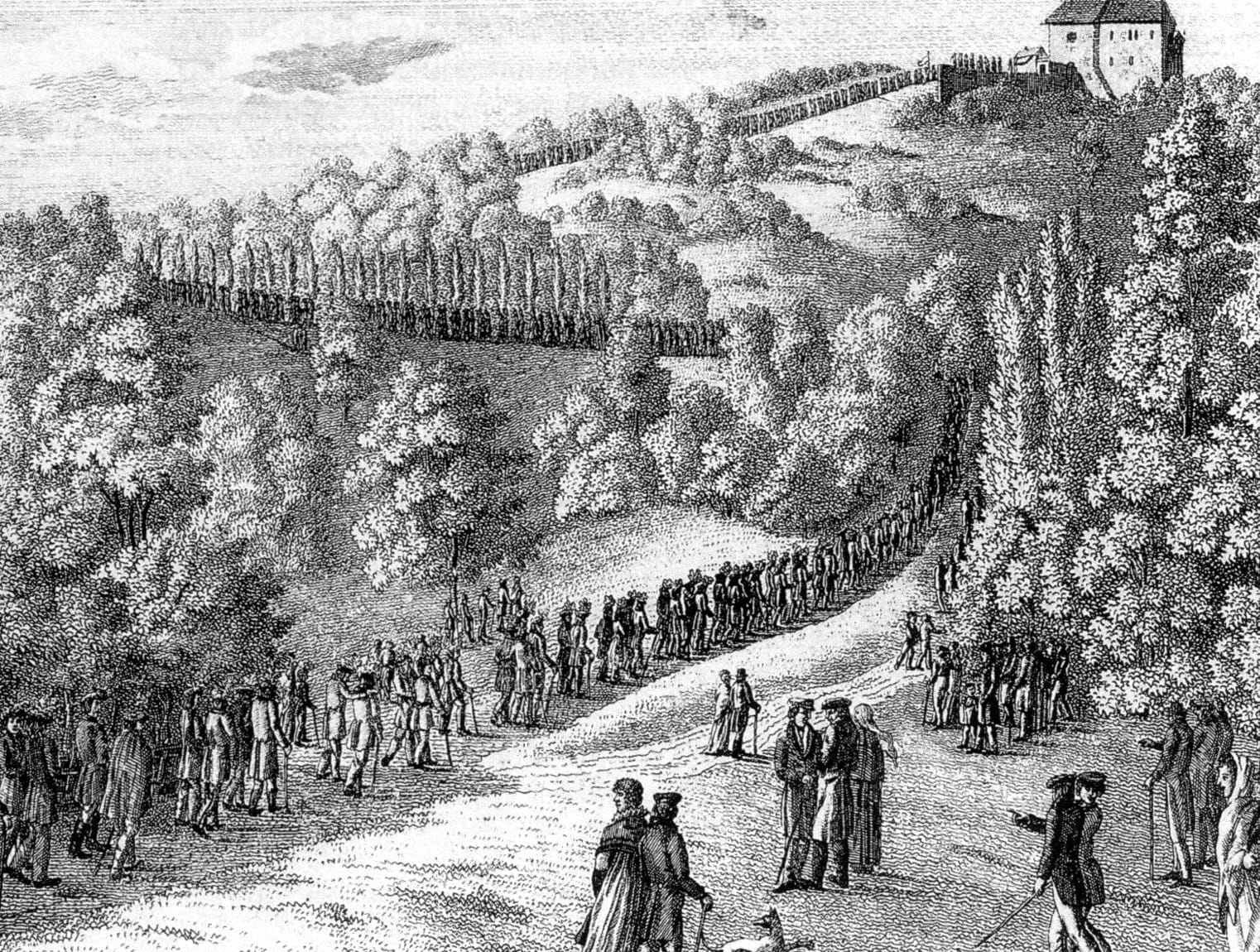
By the eighteenth century the Wartburg was a romantic ruin. Goethe climbed to it in September 1777, stayed several weeks, sketched its decay, and called it “Luther’s Patmos”; his interest in turning the place into a collection planted an idea that would take a century to mature. A decisive moment came on October 18, 1817, when about five hundred students from at least eleven universities, organized by the Jena student fraternity, gathered at the Wartburg for what became the founding rally of German liberal nationalism. That date was chosen with care: it fused the fourth anniversary of the Battle of the Nations at Leipzig with the symbolic three-hundredth anniversary of Luther’s Ninety-Five Theses, welding patriotism and Reformation into a single political theology. The students carried black, red, and gold: the colors of the Lützow Free Corps, and later of the German flag. That evening, on a hill near the castle rather than in it, some of them burned bundles of waste paper labeled with the titles of reactionary books, together with a few symbolic objects; one title, Saul Ascher’s Germanomanie, was burned with antisemitic chants, a precedent the National Socialists would explicitly invoke when they burned books in 1933. The Wartburgfest alarmed the German governments into closer surveillance of the universities, and when the fraternity student Karl Ludwig Sand murdered the playwright August von Kotzebue in March 1819 (his history of the German Empire had been among the titles burned that night), they answered that September with the repressive Carlsbad Decrees. It is the reason the Wartburg belongs as much to the history of German democracy as to the history of German faith.
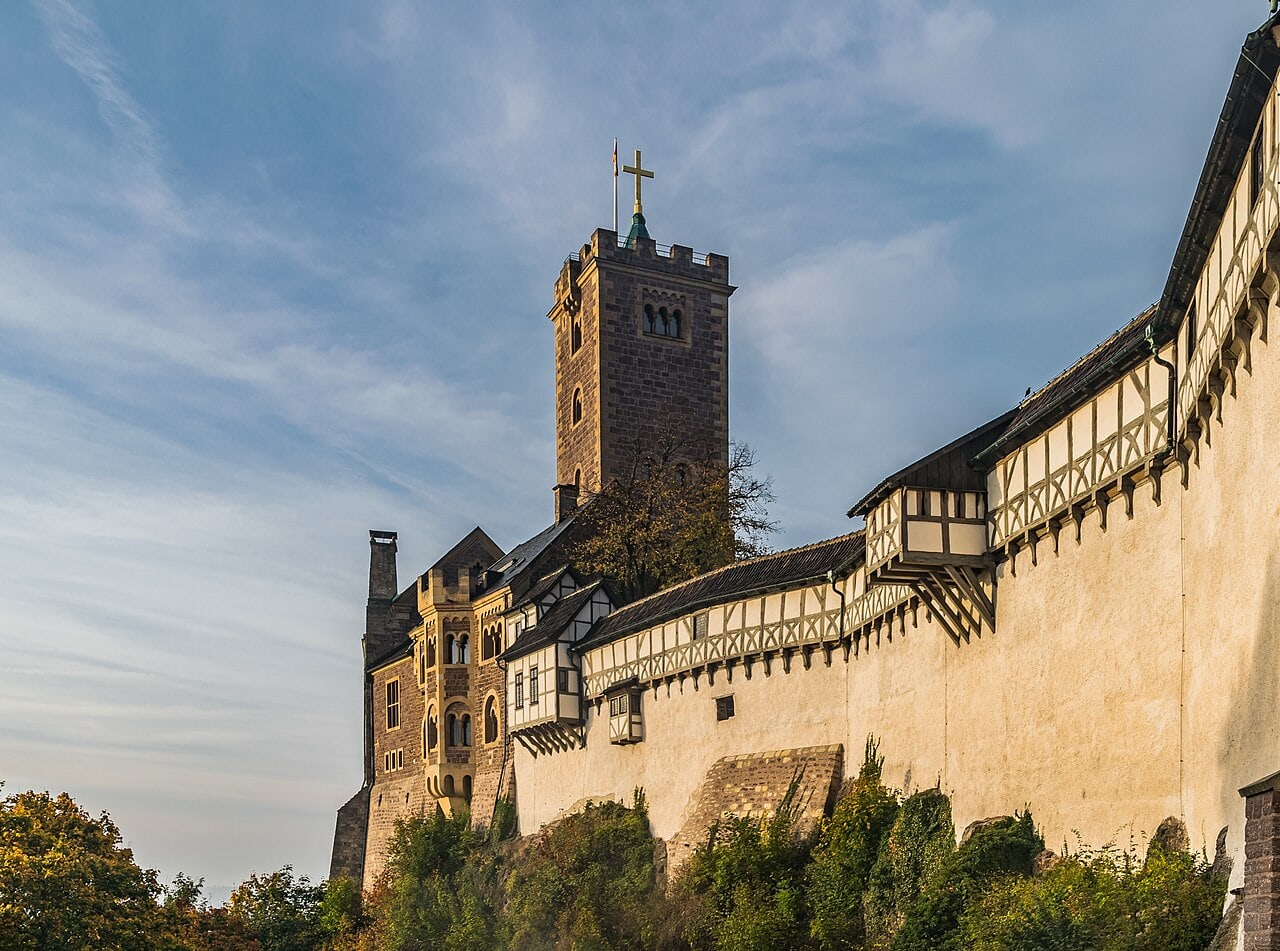
What visitors walk through today is largely the answer the nineteenth century gave to that charged history. From 1838 the future Grand Duke Carl Alexander of Saxe-Weimar-Eisenach set out to rebuild the Wartburg as a German national monument, and from the late 1840s the work was directed by the Giessen architect Hugo von Ritgen, who left more than eleven hundred drawings and a programmatic text on how the castle should have looked. Ritgen restored the Palas and built its great Festsaal, on whose acoustics Franz Liszt advised; between 1853 and 1859 he built the Bergfried (the tall keep that everyone photographs) as an entirely new structure on the footprint of a vanished medieval one, crowning it in 1859 with a gilded cross about three meters high. In 1854-55 Moritz von Schwind painted his fresco cycles on Elisabeth, the Landgraves, and the Sängerkrieg, and decades later Kaiser Wilhelm II had the Elisabeth chamber sheathed in glittering neo-Byzantine glass mosaic. None of this is fake in the sense of fraud. It is, in the language modern conservation now uses for the Wartburg, a monument in its own right (a Romantic-era act of memory, of the kind we trace across the whole Romantic revival of German castles, laid so skillfully over the medieval substance that most visitors never notice the seam). Richard Wagner had already drawn on the Wartburg for Tannhäuser in 1845; Ludwig II of Bavaria, in turn, rebuilt its remade interiors at Neuschwanstein – not copied room for room, but recombined: his Singers’ Hall fuses the Wartburg’s Sängersaal and its banqueting hall into one new room, and the loop of imitation closed: a real castle, reinvented as an idea, copied back into stone. The Wartburg was the prototype of an entire German century of reinvention, and its siblings are everywhere in our coverage: the dynastic rebuild at Hohenzollern Castle, the picturesque historicism of Wernigerode Castle, the early Rhine restoration at Rheinstein Castle, the neo-Gothic re-roofing of a ruin at Cochem Castle, the fairy-tale invention of Lichtenstein Castle, and the Gründerzeit villa-castle Drachenburg Castle, each a different answer to the same nineteenth-century question the Wartburg asked first.
Reading the Building Itself
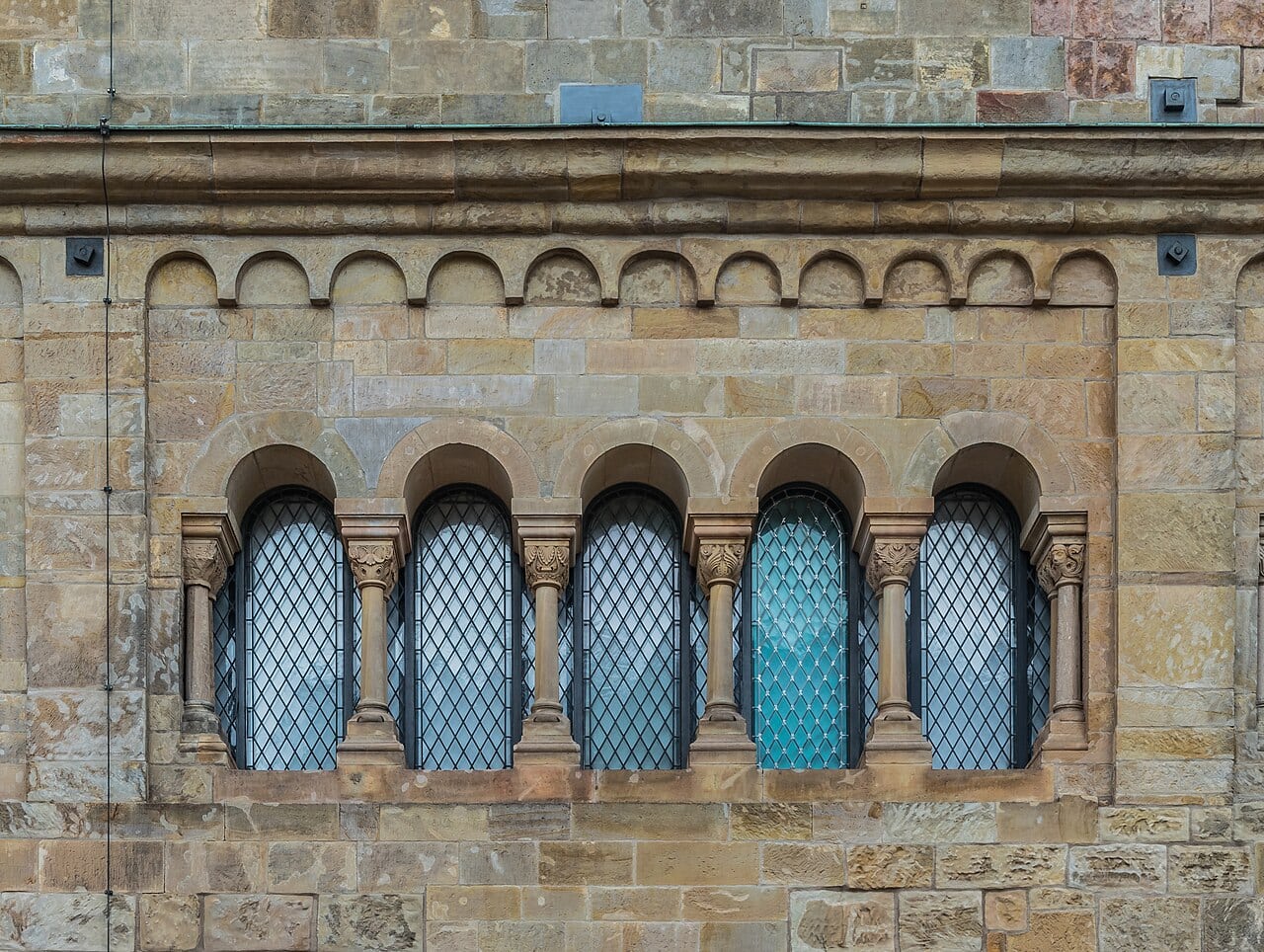
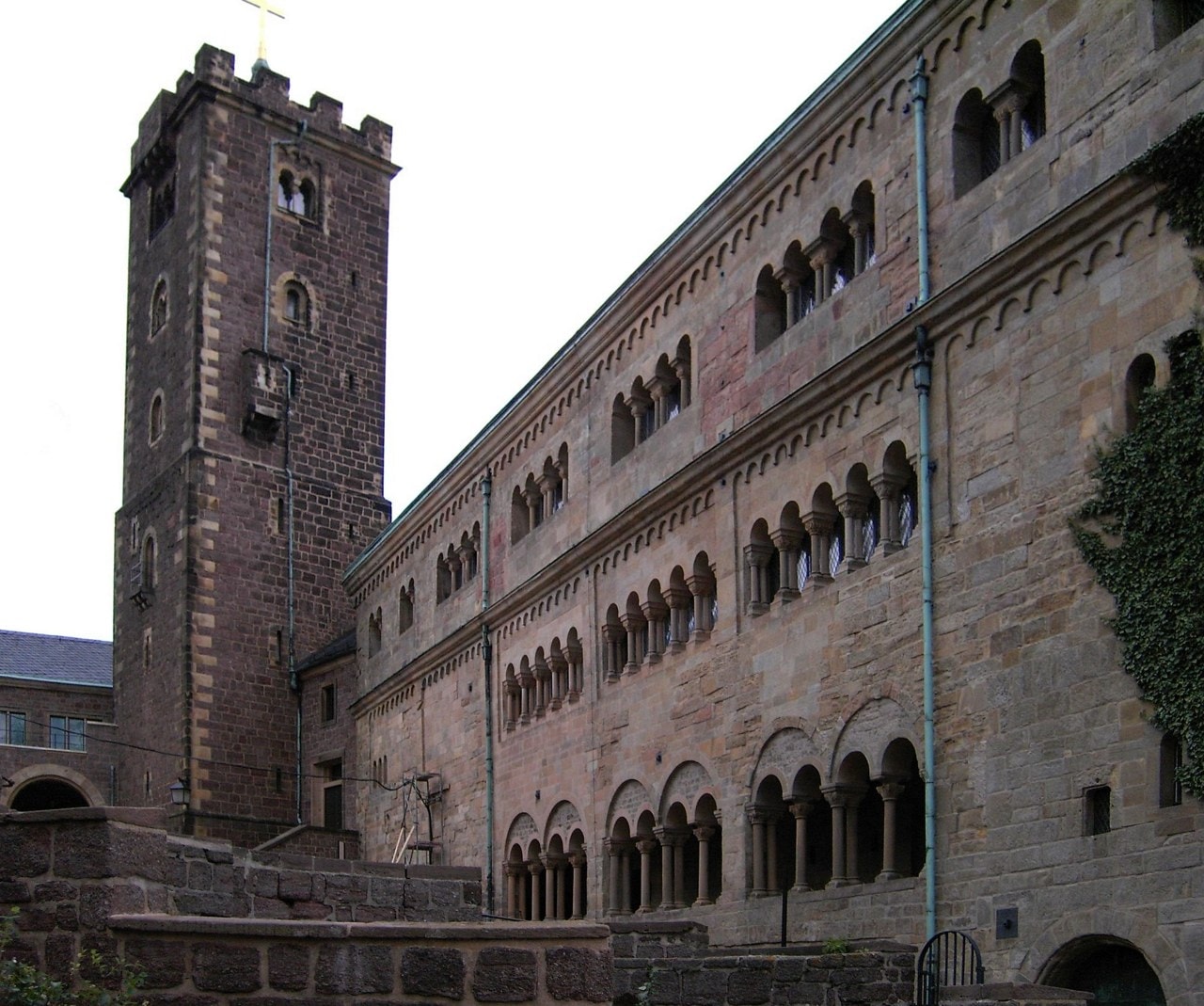
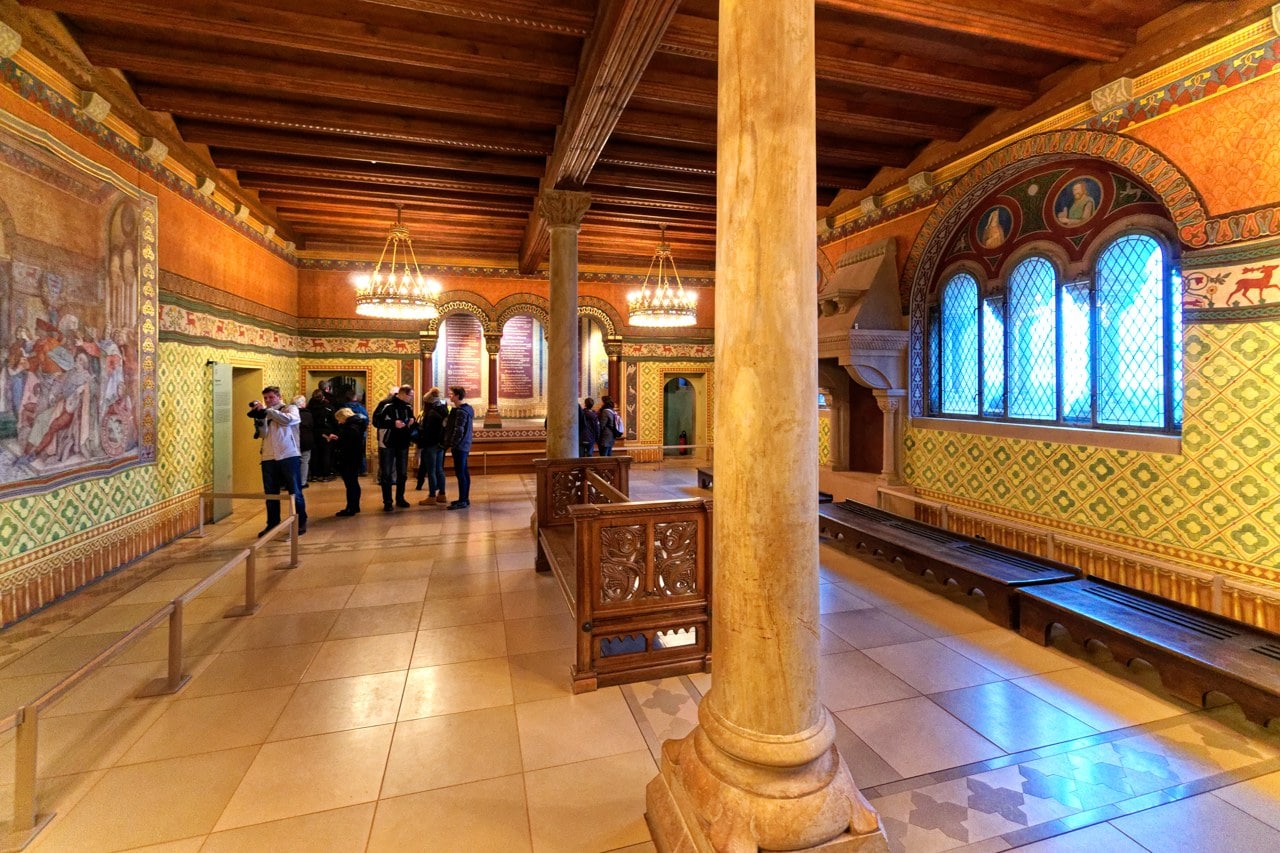
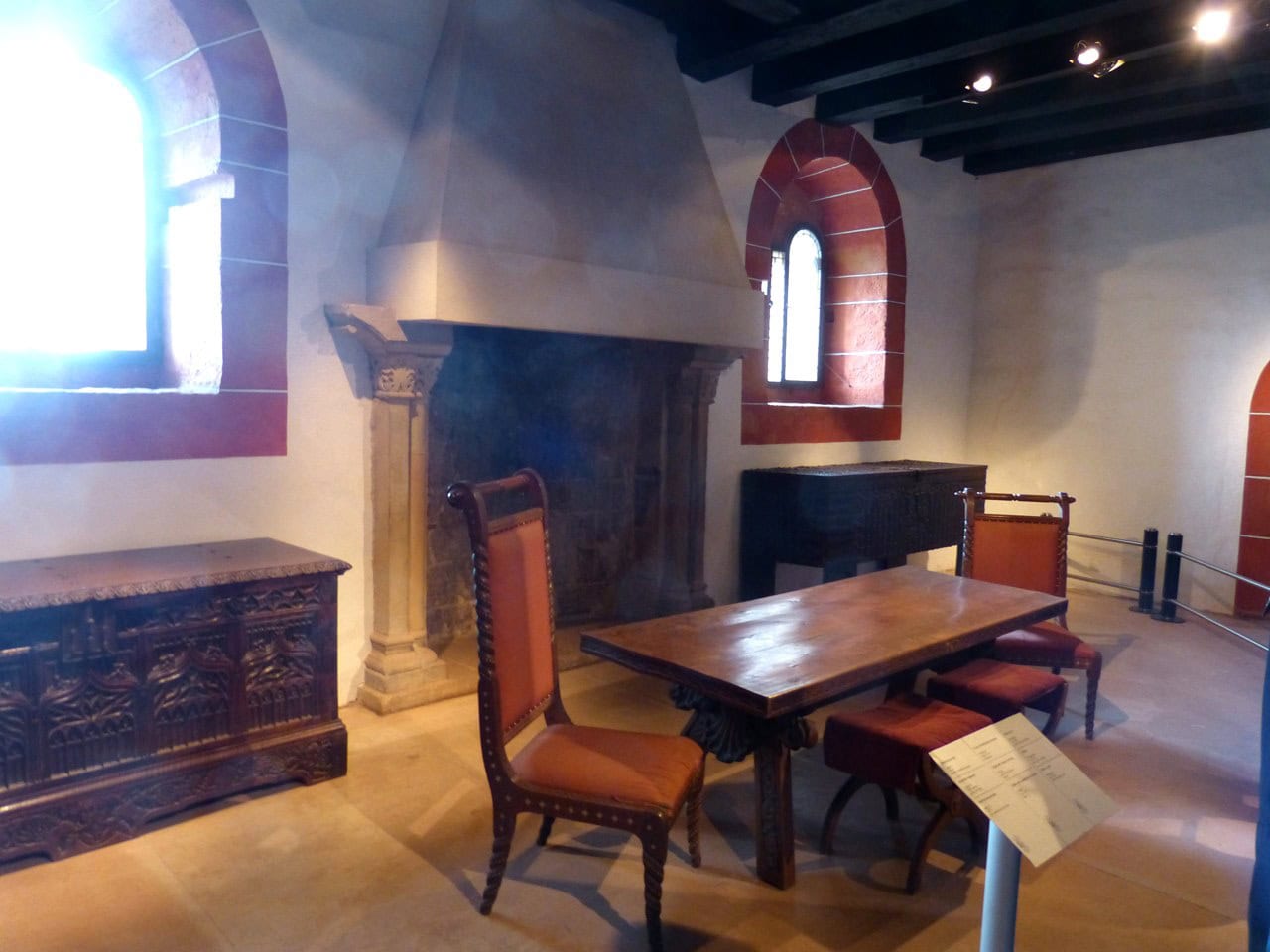
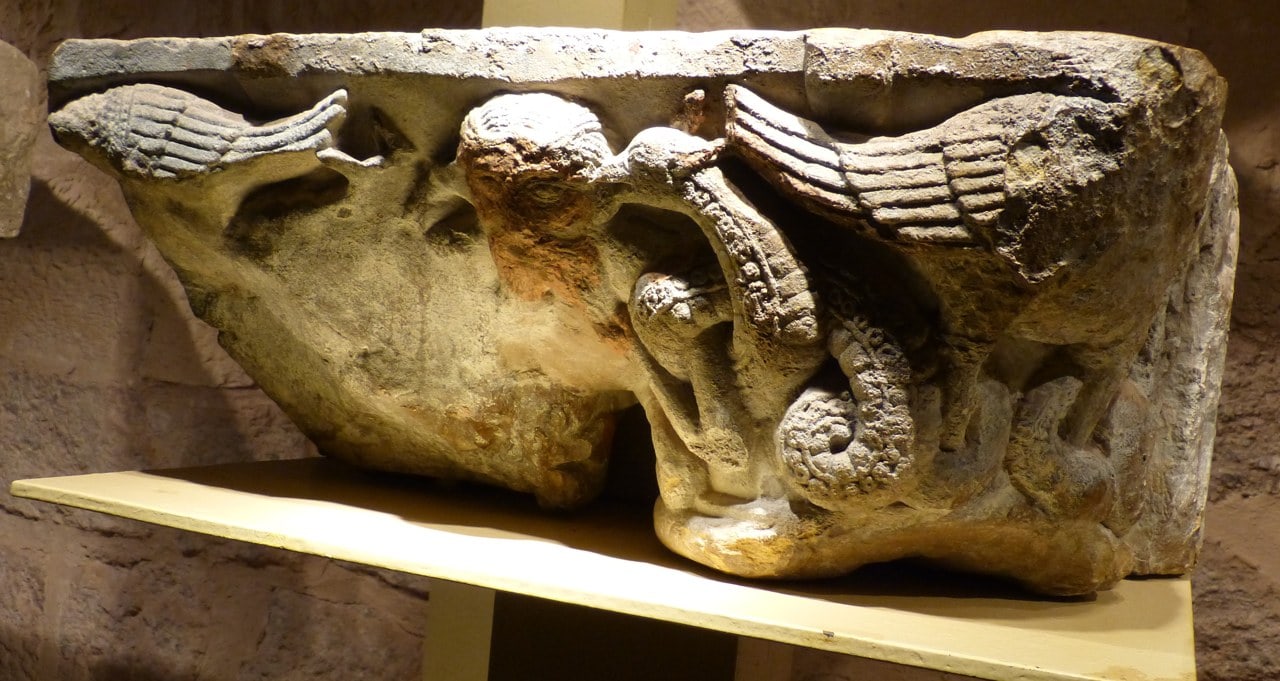
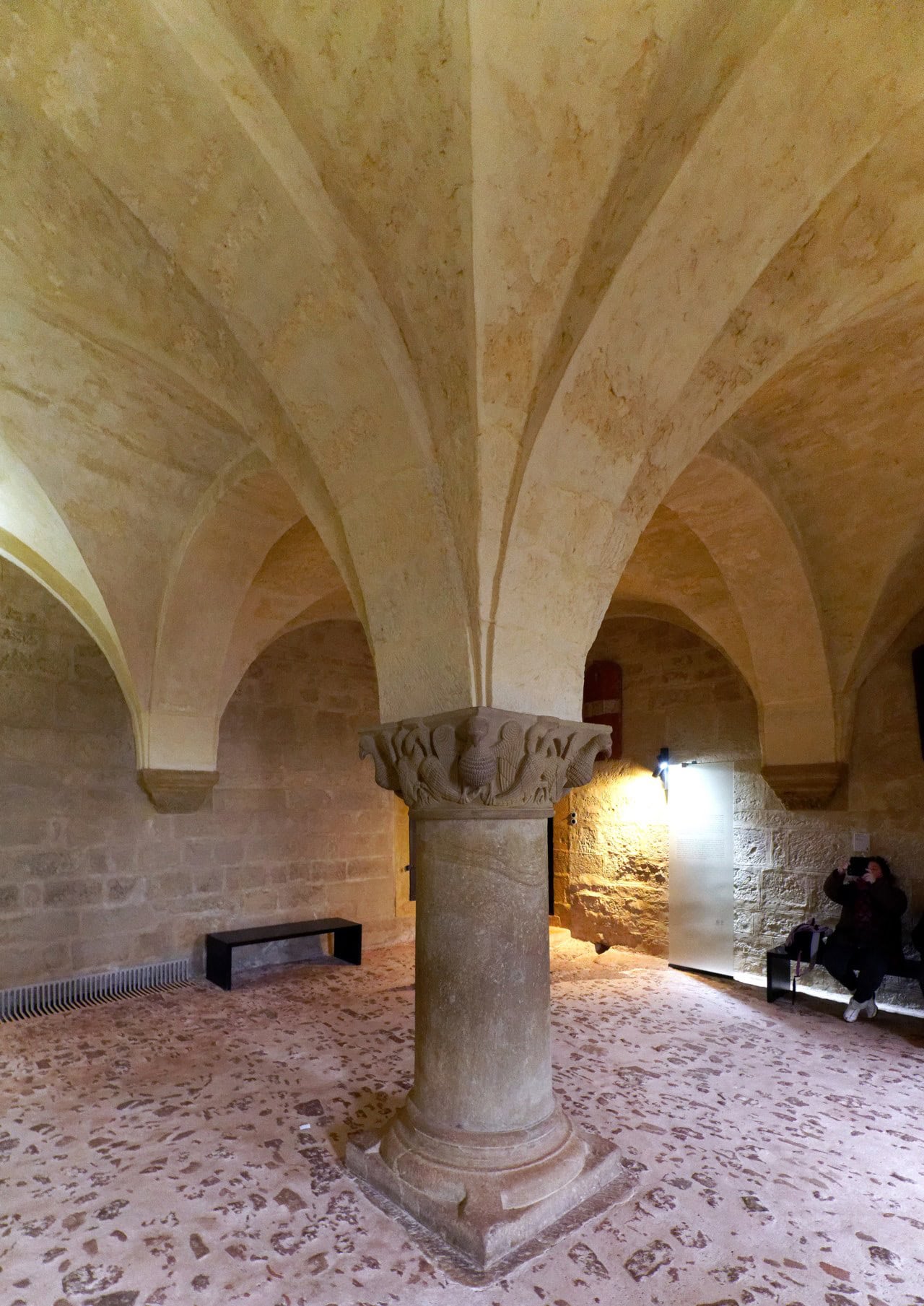
Once the layers are named, the architecture becomes legible. Wartburg is a spur castle, elongated north to south along a narrow sandstone ridge of the Thuringian Forest, divided into an outer bailey of half-timbered ranges and a main bailey of stone. Its single genuinely indispensable building is the Palas. Its courtyard façade carries roughly two hundred carved capitals, of which about a third are original Romanesque work bearing imperial-eagle motifs that advertised the Ludowingians’ Hohenstaufen alliance; it is routinely, and defensibly, called one of the best-preserved late-Romanesque secular buildings north of the Alps, though the heritage authorities who say so are careful not to put a figure on how much is original. Inside, the layering is vertical: the ground floor keeps the most medieval fabric, the middle floor mixes a 1320 chapel with nineteenth-century fitting, and the Festsaal on top is almost wholly Ritgen’s. By contrast, the Bergfried is honestly modern (1850s neo-Romanesque on a medieval site), and the south tower, raised after the 1318 fire, is the one fully medieval tower of the inner castle. Even the “old” interiors deceive: the Vogtei’s medieval atmosphere includes a Nuremberg oriel transplanted in 1872 and a panelled chamber relocated from Nuremberg in 1867. Wartburg rewards a visitor who keeps asking, of every surface, which century is speaking.
Its Palas repays that question more than any other part of the castle. Günter Schuchardt’s building research on the hall (the work that produced the 1157/58 dendrochronological date) reads it as a two-story Staufer-era residence later raised by a floor, its arcaded courtyard front one of the rare surviving statements of how a great twelfth-century secular lord wanted to be seen. The ground-floor rooms, the knights’ hall and the dining hall and the Elisabeth chamber, keep the densest medieval substance; the chapel on the middle floor is an insertion of about 1320, after the fire, not part of the original scheme; and almost everything above (the painted Landgraves’ room, the Hall of the Minstrels, the great Festsaal) is the nineteenth century speaking in a medieval accent. Dehio’s Thuringia handbook is careful about exactly this, listing only the Palas, parts of the Vogtei and Ritterhaus, the eastern curtain wall, the outer gatehouse, the south tower, and a cellar as substantively medieval, and treating the rest of the standing castle as historicist work on medieval ground. The capitals are the clearest tell: run your eye along the arcade and the carving shifts between weathered Romanesque originals and crisp 1850s copies cut to match them, the seam deliberately softened. The Wartburg was rebuilt by people who understood that the most persuasive restoration is the one whose joins you cannot find.
Its stone is Seeberg sandstone from near Gotha, the same pale material used across nine centuries of building, ruin, and rebuilding, part of why the seams are so hard to see, since medieval and historicist masonry share a complexion. UNESCO recognized exactly this layered character in 1999, inscribing the Wartburg under both the criterion for an outstanding medieval monument and the criterion for its cultural associations: Luther’s exile, the singers’ contest, the 1817 festival, and the castle’s long career as a symbol of German unity. Its UNESCO listing does not treat the nineteenth-century reinvention as a flaw to be subtracted. It treats it as part of what makes the Wartburg matter.
Visiting Wartburg Castle
The Wartburg is open every day of the year, run by the Wartburg-Stiftung. From April 1 to November 1, 2026 interior tickets are sold from 10:00 to 17:00 and the grounds are open 08:00 to 20:00; from November 2 the interior closes at 15:00 and the grounds at 16:30. The castle’s outdoor courtyards, the ramparts, and the Thüringer Erlebnisportal at the car park are free to enter; you pay only for the interior, which is normally seen on a guided tour leaving every twenty minutes, with an English-language tour daily in the early afternoon and an app-based self-guided option after the last guided slot. Admission in 2026 is €13 for adults, €9 concession, €5 for ages seven to eighteen, and free under six, with family tickets at €31; a photo permit is €2 and the south tower a further €1. Entry tickets and local tours can also be booked in advance through GetYourGuide.
| 2026 admission | Price |
| Adult | €13 |
| Concession (students, disabled, apprentices) | €9 |
| Ages 7-18 | €5 |
| Under 6 | Free |
| Family (2 adults + up to 5 children) | €31 |
| Photo permit / South tower | €2 / €1 |
| Burg-Shuttle, car park to castle | €4 per trip / €7 up and down |
Eisenach is on the ICE line, about half an hour from Erfurt, under two hours from Frankfurt, and roughly two and a half hours from Berlin by way of Erfurt; from the station, Bus Line 3 runs to the Wartburg car park, from which it is a ten-minute uphill walk to the gate or the paid Burg-Shuttle minibus. The signposted Luther footpath from the market square takes about thirty-five minutes on foot and is the more atmospheric approach. One persistent expectation should be set aside: the donkey rides that operated for over a century were permanently ended in 2022 after animal-welfare objections, and the path is now an interpretation trail rather than a ride. The interior is reached by spiral staircases over three floors and is largely not barrier-free, though the outdoor Erlebnisportal is fully accessible and a tactile model with Braille stands in the inner courtyard; visitors with mobility, hearing, or visual needs should call the visitor service in advance. In 2026 two special exhibitions run alongside the standard circuit (one on Grand Duchess Sophie, who funded the Ritgen rebuilding, and one built around the castle’s continuing restoration sites), so active conservation is itself part of what a 2026 visit shows, which is, for this building above all, entirely appropriate.
Wartburg sits within easy reach of the other great Thuringian and central German sites in our coverage, and it rewards being read alongside them rather than alone. It is the hinge between our account of the Reformation and the castle and the wider Romantic revival of German castles, and it belongs to both more completely than any other building. Anyone staying overnight can compare hotels in and around Eisenach.
Some links on this page are affiliate links, which means StoneKeep Atlas may earn a small commission, at no extra cost to you, if you book through them.
More Views of Wartburg Castle
Beyond Wartburg Castle
The Wartburg stands at the head of the StoneKeep Atlas’s Thuringian castles. Along the same uplands lie the ducal Schloss Friedenstein at Gotha, the cliff-set Leuchtenburg above the Saale, and the Veste Heldburg, long called the “Franconian Wartburg.” All of them, with the Wartburg itself, are gathered in the Castles of Thuringia guide. The Wartburg’s widest fame, though, belongs to the Reformation: it was here, in hiding as “Junker Jörg,” that Martin Luther translated the New Testament into German.
The Wartburg is one of the castles we have filmed; the episode sits alongside the others in our documentary series.
Common Questions
How much is admission to the Wartburg?
Admission in 2026 is 13 euros for adults, 9 concession, 5 for ages seven to eighteen, and free under six, with family tickets at 31 euros. A photo permit is a further 2 euros and the south tower 1 euro.
When is it open, and do I have to join a guided tour?
The Wartburg is open every day of the year. From 1 April to 1 November 2026 interior tickets are sold 10:00 to 17:00 and the grounds are open 08:00 to 20:00; from 2 November the interior closes at 15:00 and the grounds at 16:30. The outdoor courtyards, the ramparts and the Erlebnisportal at the car park are free; you pay only for the interior, normally seen on a guided tour leaving every twenty minutes, with an English tour daily in the early afternoon and an app-based self-guided option after the last slot.
How do I get to the Wartburg?
Eisenach is on the ICE high-speed rail line, roughly half an hour from Erfurt, under two hours from Frankfurt, and about two and a half hours from Berlin via Erfurt. The castle rises on the wooded ridge directly above the town.
Conclusion
The Wartburg is not a fraud and not quite a relic. It is a building that has been telling Germans who they are for nine hundred years, and it has done so by absorbing every age that used it: the Ludowingians who built the hall, the saint who prayed there, the outlaw who translated the New Testament in eleven weeks, the students who burned books on the hill below, and the nineteenth-century prince and architect who rebuilt the whole into a monument and, in doing so, made the older layers more visible by making them part of an argument. The honest way to visit is not to ask which parts are “real.” It is to learn to hear which century is speaking, and to understand that the fusion of all of them (saint and reformer, ruin and reinvention, ink stain and gilded halo) is precisely the thing the Wartburg was built, and rebuilt, to be. The contrast is sharpest against a castle that took a different road: Eltz Castle was never taken by force, and although most of its fortifications were slighted after its defeat in a fourteenth-century feud, the residence that remained was never destroyed. Standing in it, one sees exactly what the Wartburg traded away, and what it gained, when it agreed to become a monument.
The Wartburg’s role as a place of refuge runs through the longer history of the German castle as a stronghold under siege.
Principal Sources
- Badstübner, Ernst. Die Wartburg. Schnell & Steiner (Große Kunstführer 196), 2001.
- Brecht, Martin. Martin Luther. Vol. 2: Shaping and Defining the Reformation, 1521-1532. Fortress Press, 1990.
- Dehio, Georg. Handbuch der Deutschen Kunstdenkmäler: Thüringen. Deutscher Kunstverlag, 2nd ed. 2003.
- Herzog August Bibliothek Wolfenbüttel. Luthermania: “Katalog Nr. 1.” luthermania.de.
- Jacobs, Grit. “Ein treues Bild aus früher Zeit”: Das Werk des Architekten Hugo von Ritgen auf der Wartburg. Dissertation, Friedrich-Schiller-Universität Jena, 2017.
- Luther 2017. “Der Wurf mit dem Tintenfass.” luther2017.de.
- Schuchardt, Günter, ed. Der romanische Palas der Wartburg. Bauforschung an einer Welterbestätte. Schnell & Steiner, 2001.
- Steiger, Günter. Aufbruch — Urburschenschaft und Wartburgfest. Urania-Verlag, 1967.
- Wachinger, Burghart. Der Sängerstreit auf der Wartburg. De Gruyter, 2004.
- Werner, Matthias, ed. Heinrich Raspe — Landgraf von Thüringen und römischer König (1227-1247). Peter Lang, 2003.
- Wartburg-Stiftung. “Burg entdecken,” “Öffnungszeiten,” and “Eintritt.” wartburg.de.
- UNESCO World Heritage Centre. “Wartburg Castle.” whc.unesco.org.
Image credits. Featured image: the Wartburg on its wooded ridge. Photo: sehbaer_nrw / Adobe Stock. Gatehouse and drawbridge: Krzysztof Golik (CC BY-SA 4.0). Palas façade: Vera Belka (CC BY-SA 4.0). Sängerstreit fresco, Lutherstube: Holger Uwe Schmitt (CC BY-SA 4.0). Elisabethkemenate mosaic: Wolfgang Sauber (CC BY-SA 4.0). Festsaal: Krzysztof Golik (CC BY-SA 4.0). Bergfried: Krzysztof Golik (CC BY-SA 4.0). Vogtei and main gate: Pudelek / Marcin Szala (CC BY-SA 3.0). Wartburgfest engraving of 1817: public domain. Gallery: aerial by Moritz Grenke (CC BY-SA 3.0); inner courtyard by Ingersoll (public domain); Sängersaal and Knights’ Hall by Holger Uwe Schmitt (CC BY-SA 4.0); dining hall and Romanesque capital by Wolfgang Sauber (CC BY-SA 4.0); winter view by Chattus (CC BY-SA 4.0); south tower by Herbert wie (CC BY-SA 4.0). All Wikimedia Commons images used under their stated licenses. Freely licensed images are resized to fit; otherwise unaltered.