
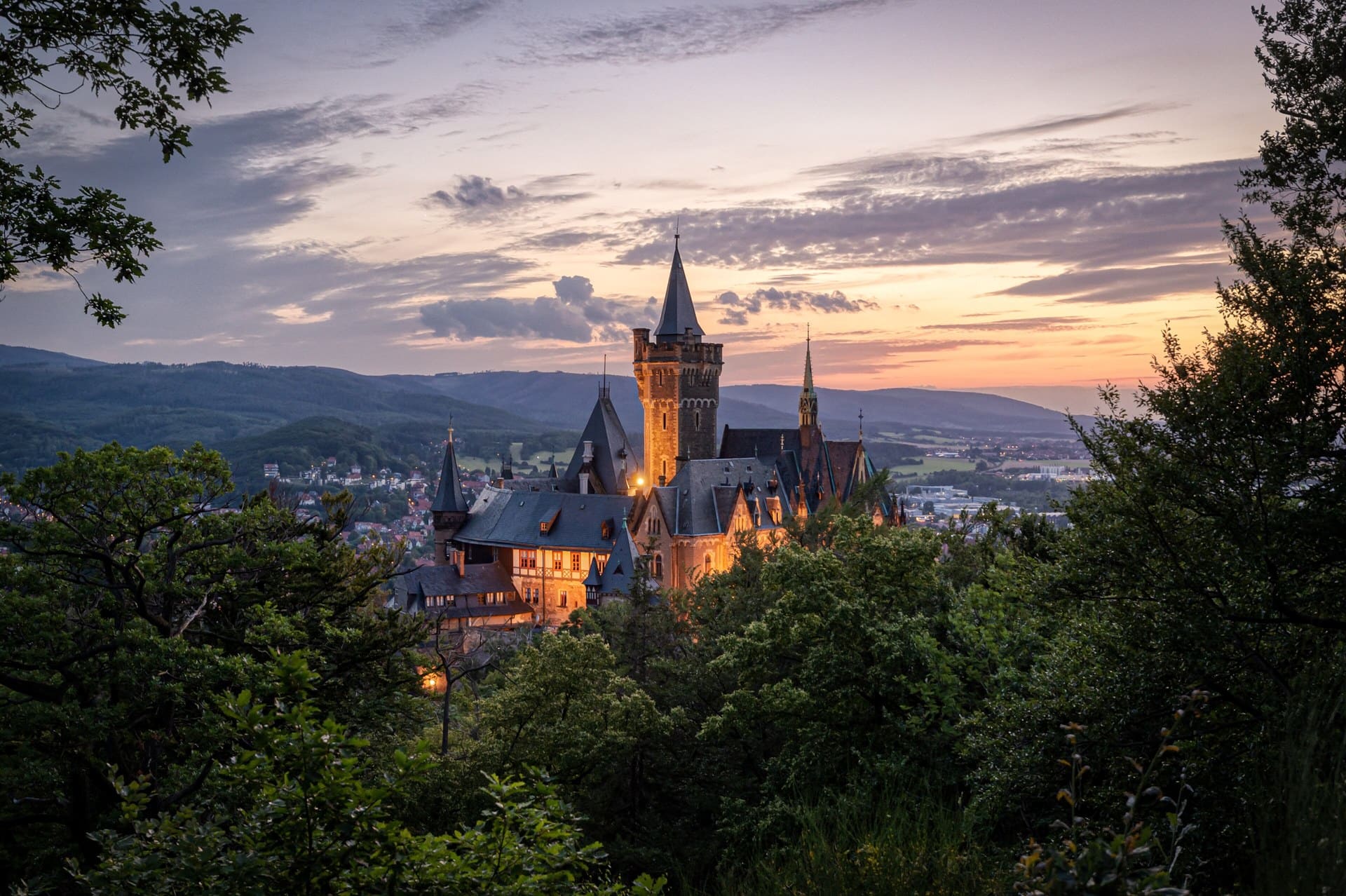
Wernigerode Castle
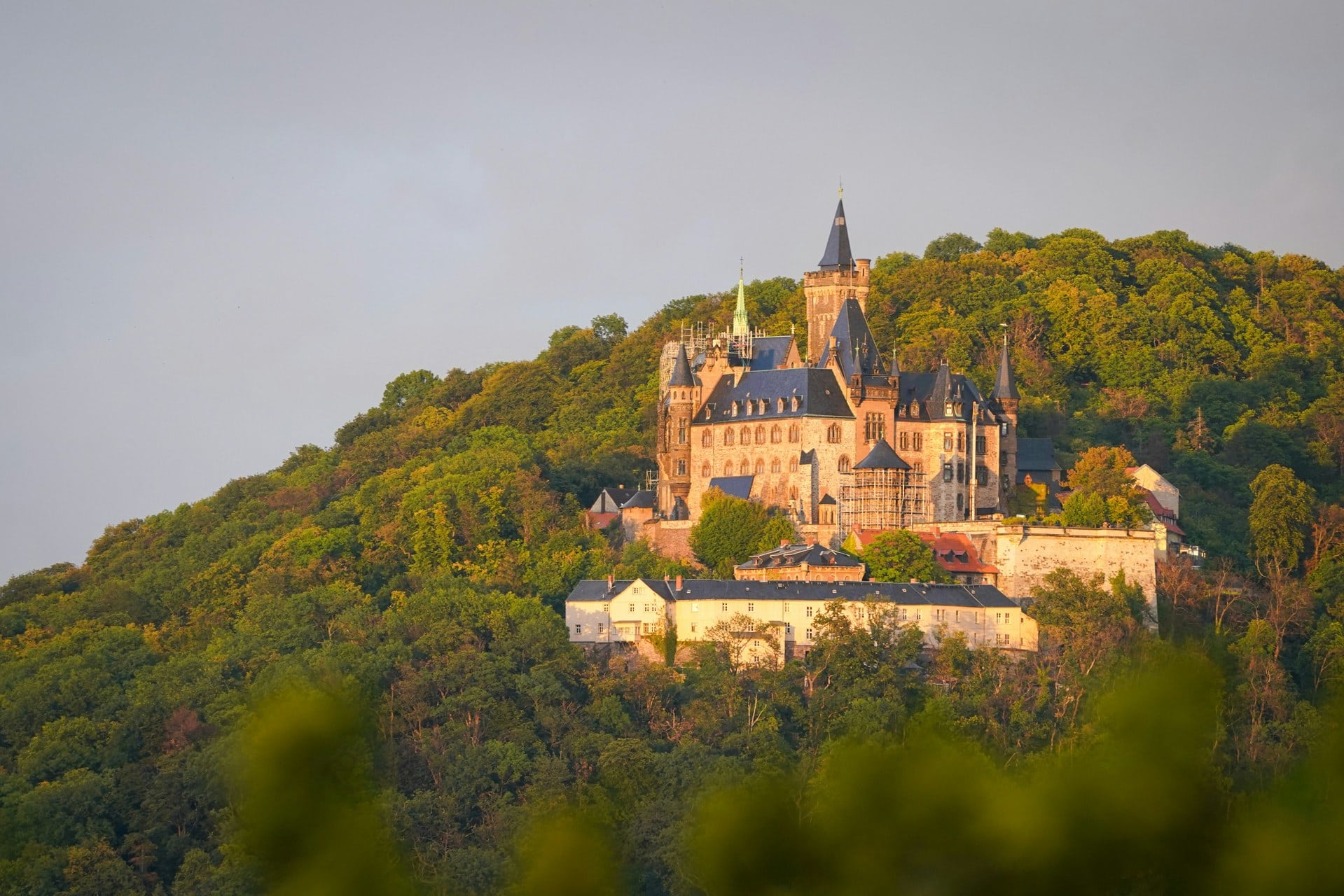
Stand in Wernigerode’s half-timbered market square and look south, and the castle appears not as a building but as a deliberate silhouette: a ridge-line of towers, gables, oriels, and stone, engineered so that every forty-five degrees of approach produces a new view. That theatrical effect was the work of one architect, Carl Frühling of Blankenburg, between 1862 and 1885. But beneath his historicist work lie the ring walls of the medieval Burg, late-Gothic walls, a Renaissance staircase tower, and a Baroque round-castle, all folded into a single composition. Wernigerode Castle is what happens when nine centuries of fabric are reshaped by a Vice-Chancellor of the German Empire with the means to make a statement.
Quick Facts
| Country | Germany |
| Region / State | Saxony-Anhalt (Sachsen-Anhalt, Landkreis Harz) |
| Nearest Town | Wernigerode itself, with the castle rising on the Agnesberg directly above the old town; the Brocken, the highest peak of Northern Germany at 1,141 meters, lies roughly twelve kilometers south |
| Construction Period | First Romanesque Burg built between approximately 1110 and 1120; castle first named in the sources 1213 (the operating company dates its first mention to 1121); late-Gothic enlargement late fifteenth century; Renaissance phase sixteenth century; Baroque rebuild 1671–1676 and 1710; historicist transformation 1862–1885 by architect Carl Frühling |
| Founder | Count Adalbert of Haimar, c. 1110–1120; County of Wernigerode passed in 1429 to the related Counts of Stolberg, who from then styled themselves Counts of Stolberg-Wernigerode |
| Architectural Style | Multiple periods (medieval core, late-Gothic, Renaissance, Baroque overlays); predominantly neo-Gothic and neo-Renaissance historicism in the present visible fabric — described in art-historical literature as a Leitbau of North-German Historicism |
| Building Type | Schloss — medieval hilltop Burg transformed into a princely historicist residence |
| Number of Rooms | Approximately 250 in total; about forty to fifty shown on the museum tour |
| Current Condition | Intact; principal museum and cultural center of Saxony-Anhalt, with active conservation work under way through 2026 |
| UNESCO Status | No (designated a national precious cultural monument of Saxony-Anhalt since 1999) |
| Heritage designation | Denkmalverzeichnis Sachsen-Anhalt (Landkreis Harz): Schloss Wernigerode, Am Schloss 1-16, Baudenkmal, Erfassungsnummer 094 03227 |
| Visitor Status | Open to visitors as a museum since 1930; Germany’s first Center for Nineteenth-Century Art and Cultural History since 1998 |
| Official site | schloss-wernigerode.de |
A Medieval Imperial Stronghold on the Agnesberg
Between roughly 1110 and 1120 the first Burg at Wernigerode was built on the Agnesberg, a projecting ridge above the valley floor. Its founder was Count Adalbert, a Saxon noble settled in the region by the Salian emperors to secure imperial influence at the northern edge of the Harz. He appears in a deed of Halberstadt Bishop Reinhard von Blankenburg dated October 18, 1121 as comes de Wernigerothe, the first written reference to both the count and the settlement clustered at the foot of his hill. The castle itself is mentioned by name only later, in 1213, when a Latin charter records it as Castrum Wernigerode, the date the Göttingen Academy’s handbook of residences gives for its first appearance in the sources; the castle’s operating company counts the 1121 deed as the castle’s first mention too. This site was no ornament. Two important trade and military roads crossed at the foot of the ridge, and within a century the Counts of Wernigerode had grown wealthy enough to grant their town Goslar-style civic rights on April 17, 1229.
What survives in stone from that early period is fragmentary. A coat-of-arms stone in the inner courtyard, dated 1494, marks the last great late-Gothic enlargement, when arched windows and a more ambitious residential program were grafted onto the medieval walls. Two arched curtain-wall windows of that campaign still face the inner courtyard. The Burg passed in 1429, on the extinction of the male Wernigerode line, to the related Counts of Stolberg, who from that point styled themselves Counts of Stolberg-Wernigerode and made the castle one of their principal seats.
Renaissance Refinement and Thirty Years’ War Ruination
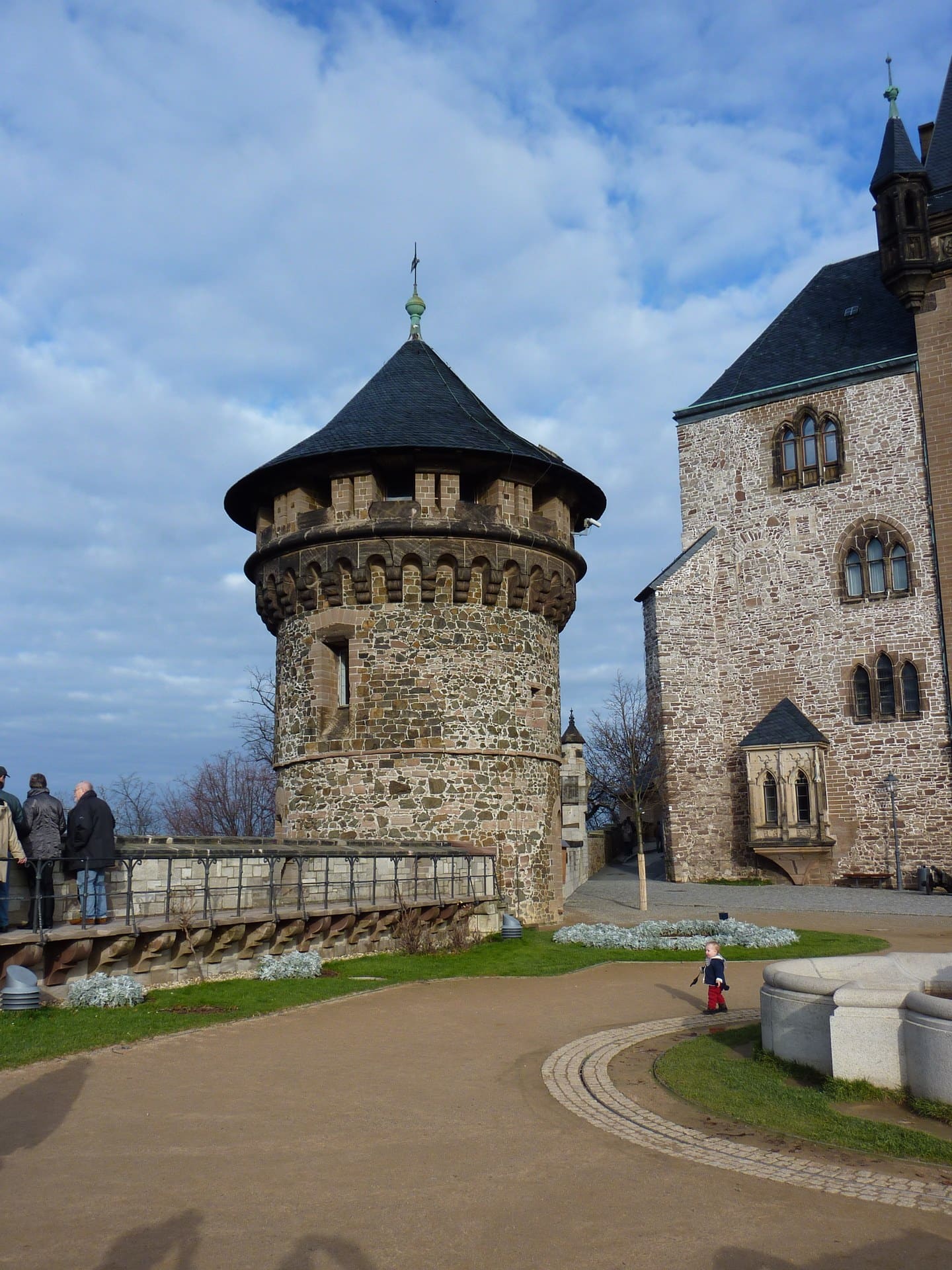
The sixteenth century saw the Burg rebuilt as a fortified Renaissance residence. A spiral staircase tower from that campaign survives intact, the most legible Renaissance element in the present fabric. On May 31, 1645, the House of Stolberg formally divided into two lines: the senior Stolberg-Wernigerode line, which retained the castle and the surrounding county, and the junior Stolberg-Stolberg line. That division came in the closing years of the Thirty Years’ War, during which the castle, long considered impregnable, was severely damaged. After bitter disputes with the burghers of the town below, the Stolberg-Wernigerode counts abandoned the Agnesberg as their seat and moved their residence down the valley to Ilsenburg. Wernigerode stood empty for years. Passing troops plundered the interior; walls and roofs decayed without occupation to maintain them.
The Baroque Return Under Christian Ernst
Between 1671 and 1676 the counts began a Baroque rebuild of what remained. The work centered on a new half-timbered structure on the south side, the Sommerbau or summer wing, which gave the castle its first real post-medieval residential block. The decisive return came in 1710, when the young Count Christian Ernst zu Stolberg-Wernigerode (1691–1771) moved his court back to Wernigerode and completed the conversion into a Baroque Wohnschloss, a domestic palace shaped roughly as a round castle. At the same time the political context shifted: in 1714 the County of Wernigerode was placed under Prussian sovereignty, with Christian Ernst acknowledging King Frederick William I as suzerain. By now the military function of the old Burg was formally dead. What remained on the Agnesberg was an aristocratic country house in the provincial Baroque manner, comfortable, modestly grand, and entirely unsuited to the ambitions of the count who would inherit it a century and a half later.
Count Otto and the Vice-Chancellor’s Castle
Otto zu Stolberg-Wernigerode was born on October 30, 1837 at Schloss Gedern. His father had died in 1841, so in 1854 Otto inherited the county from his grandfather, Count Henrich; his uncle Botho governed it as guardian until 1858, and from 1862 Otto ran it himself, a man already bound for the highest offices of the Prussian state. In 1867 he became the first Oberpräsident, or upper president, of the newly created Prussian Province of Hanover. In 1872 he was elected president of the Prussian House of Lords. From March 1876 to spring 1878 he served as German ambassador in Vienna. And from the spring of 1878 until his resignation on June 20, 1881, Otto zu Stolberg-Wernigerode was Vice-Chancellor of the German Empire and Vice-President of the Prussian Council of Ministers, Bismarck’s deputy in both the imperial and the Prussian governments. He was succeeded as Vice-Chancellor by Karl Heinrich von Boetticher.
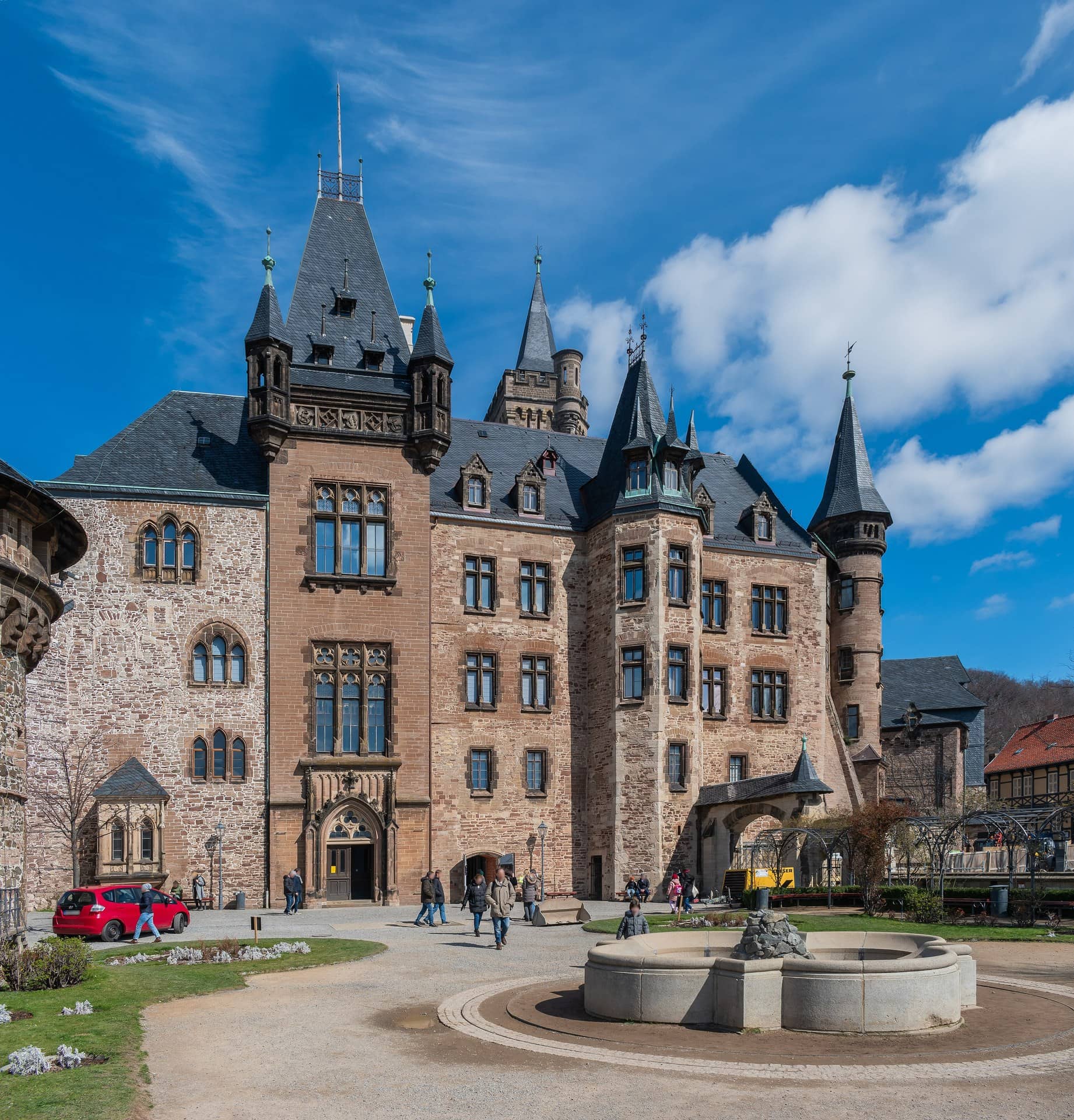
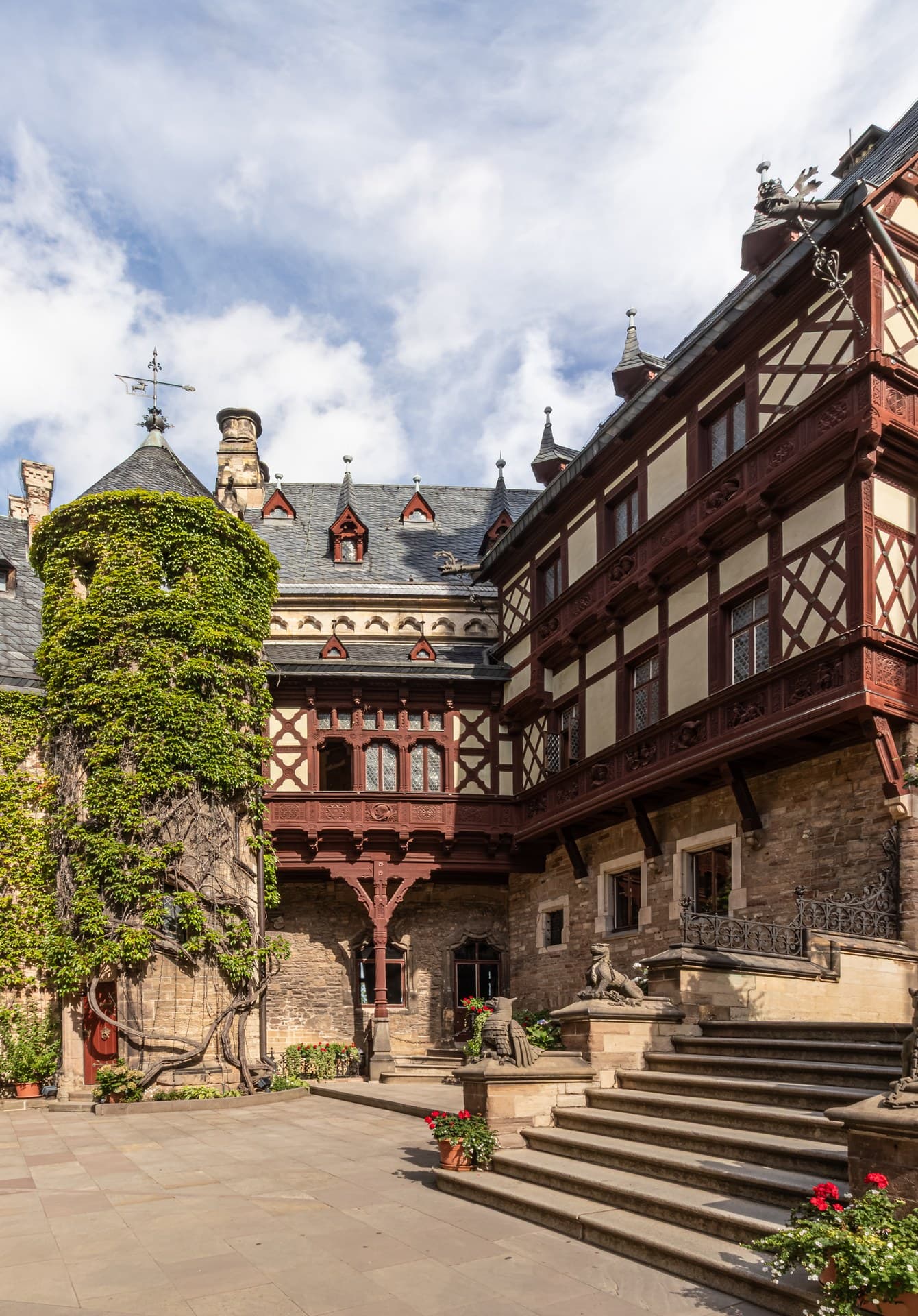
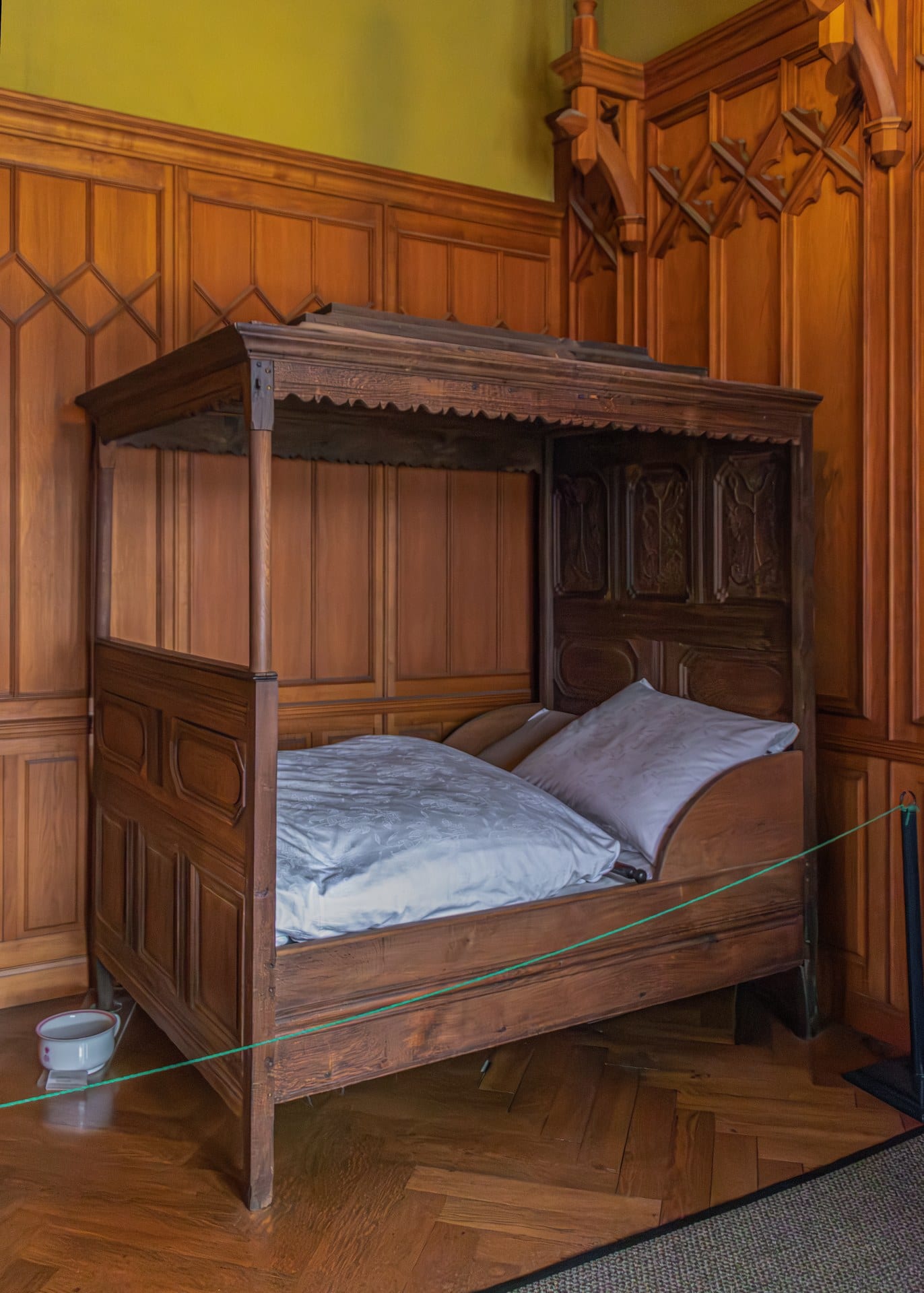
That Baroque castle did not match the man. From 1858 Otto began commissioning modest improvements, but the real transformation began in 1862, the year before his marriage on August 22, 1863 to Princess Anna Reuß zu Köstritz at Schloss Stonsdorf. Its architect was a Blankenburg master builder, Carl Frühling (1839–1912). Between 1862 and 1885, Frühling reshaped the entire complex into a unified work of historicist architecture, predominantly neo-Gothic in profile with neo-Renaissance half-timbered detail in the courtyards and on the upper stories. His design principles, as the family later recorded them, were three: to disclose a new exterior view at every forty-five degrees of approach around the building; to integrate the surviving medieval, Gothic, Renaissance, and Baroque fabric rather than demolishing it; and to subordinate everything to a picturesque silhouette legible from the town and the valley below. The result was a castle that announced its owner’s standing without overstating it, theatrical but never frivolous, expensive but never showy.
The Schlosskirche St. Pantaleon und Anna, built between 1870 and 1880 in the inner court, was the project’s sacred set piece. It was built to a design by Frühling and Friedrich von Schmidt, the celebrated Viennese architect of the Vienna Rathaus and Dombaumeister of St Stephen’s Cathedral. The chapel was consecrated in the spring of 1880. It remains, with the castle’s state rooms, one of the most coherent surviving statements of nineteenth-century North-German Historicism, the architectural language scholarly literature still cites Wernigerode as a Leitbau, or leading example, of that movement.
Frühling himself remained in Stolberg-Wernigerode service for the rest of his career. In gratitude for his work on the castle, Count Otto financed a private villa for the architect on the Schlossberg, completed in 1875, which Frühling occupied as his official residence. He also designed the count’s stables, the Stolberg-Wernigerode family crypt, and the Prince Otto monument that stands on the Schlossberg. According to the castle’s own archives, no portrait of him survives except a small keystone carving inside the building. Frühling died on March 26, 1912 and was buried at the Hauptfriedhof in Braunschweig.
The Twentieth Century: Expropriation and Feudalmuseum
The princely family ceased to use the castle as a permanent residence in 1929. Parts of it opened to paying visitors in April 1930, and through to the end of December 1943 the rooms drew roughly forty thousand visitors a year. From 1944 most of the building was requisitioned by the armaments holding company Rüstungskontor GmbH for residential use. The last princely owner, Botho Fürst zu Stolberg-Wernigerode, was expropriated in 1945 under the Soviet zone’s land reform. In mid-December 1946 Soviet military personnel staged an uncontrolled destruction of the castle’s historical weapons, armor, and any painting depicting figures in uniform. Wernigerode passed into public ownership.
On April 16, 1949 the East German state opened a Feudalmuseum Schloss Wernigerode, a museum of feudal grandeur and exploitation framed to suit the ideology of the new republic. A torture chamber was constructed in the cellars to dramatize the case. Through the 1950s it was described, with some justification, as the largest social-science museum of the German Democratic Republic. Restoration of the original historicist interiors began only in the 1980s; many rooms had been crudely painted over without regard to the lost wall decoration beneath. After reunification the building continued under municipal stewardship as a castle museum, and in 1998 it was designated Germany’s first Zentrum für Kunst- und Kulturgeschichte des 19. Jahrhunderts, the Center for Nineteenth-Century Art and Cultural History. In 1999 the castle, with its three gardens (the Lustgarten, the Tiergarten, and the terraced Terrassengärten), was listed as a nationally significant cultural monument of Saxony-Anhalt. Since April 2007 it has been owned by the Stiftung Schloss Wernigerode, a non-profit foundation that holds the operating company in turn.
Wernigerode Among the Romantic Revival Castles
Set beside the main sites of the nineteenth-century Romantic Revival of German castles, Wernigerode differs in how much older fabric it keeps. Ludwig’s Neuschwanstein in Bavaria (1869–1886) and the stockbroker Stephan von Sarter’s Drachenburg on the Rhine (1882–1884) are essentially new buildings dressed in medieval costume, raised on sites with little or no real fortified history. The reconstructions of Hohenzollern in Swabia (1850–1867) by Friedrich August Stüler and of Schloss Schwerin (1845–1857) by Stüler and Demmler were more substantial inheritances, but their medieval cores were largely lost before reconstruction began. Its closest parallel is the Wartburg, rebuilt between 1838 and 1890, with Hugo von Ritgen directing the work from the late 1840s, on a genuinely medieval site of high symbolic charge.
Wernigerode sits closer to the Wartburg than to Neuschwanstein. Beneath Frühling’s historicist outer layer there are the real ring walls of the medieval Burg, a real late-Gothic enlargement of the 1490s, a real Renaissance staircase tower, and a real Baroque Wohnschloss. Frühling did not invent the silhouette; he revealed and amplified it. The building’s political meaning comes from its patron. When Otto entertained foreign dignitaries at Wernigerode in the late 1870s and early 1880s, he was Bismarck’s deputy.
Visiting Wernigerode Castle
Wernigerode Castle is the most-visited museum in Saxony-Anhalt. After a record 236,000 guests in 2023, the castle drew approximately 250,000 in 2024 and 281,000 in 2025, the current attendance record. Today the museum tour passes through about fifty rooms presenting original noble interiors from the years before 1918, together with thematic galleries on the cultural history of the nineteenth century, the Stolberg-Wernigerode family, and the Second German Empire. Special exhibitions complement the permanent display. The 2026 season’s headline exhibition paired print cycles by Francisco de Goya and Salvador Dalí (May 6 to November 1). For third-party tours of the area, you can search GetYourGuide.
Admission
| Wernigerode Castle | Price or hours |
|---|---|
| Museum admission, self-guided | €9 (reduced €8 for school pupils, students and trainees) |
| Children 6 to 14 | €4.50 |
| Children under 6 | Free |
| Family card (parents and their own children up to 14) | €23 |
| Classic guided tour in German, about 1 hour, castle admission included (booked groups from 10 people, or a €140 minimum) | €14 (reduced €13; children €9.50) |
| The same tour in English, French or Russian | €2 surcharge on the tour prices |
| Hours, November 2 to December 20, 2026 | Tuesday to Friday 10:00-17:00; Saturday and Sunday 10:00-18:00; closed Mondays |
| Hours, December 21, 2026 to January 6, 2027 | Daily 10:00-18:00; closed December 24; December 31 10:00-16:00 |
| Hours, January 7 to March 21, 2027 | Tuesday to Friday 10:00-17:00; Saturday and Sunday 10:00-18:00; closed Mondays except February 1 to 21 |
| Hours, March 22 to October 31, 2027 | Daily 10:00-18:00 |
| Last admission | 30 minutes before closing |
Practical notes for 2026. The castle complex is on a hill, reached by a steep walk of about twenty minutes from the old town or by the Wernigeröder Schlossbahn and Bimmelbahn, the two small tourist trains that climb the Schlossberg. A major structural restoration of the Schloßinnenring, the castle’s inner ring, is in progress throughout 2026 alongside the installation of new elevators in the Hausmannsturm and the Frühlingsbau; year-round access to the castle is maintained, but with some limitations for visitors using wheelchairs, walkers, or strollers, and the access road experiences months-long partial closures. Wernigerode’s Castle Festival (Schlossfestspiele) was held in August 2026. Anyone staying overnight can compare hotels in and around Wernigerode.
Some links on this page are affiliate links, which means StoneKeep Atlas may earn a small commission, at no extra cost to you, if you book through them.
Common Questions
How do you get up to Wernigerode Castle?
Walk, or take one of the two small tourist trains; the last stretch is a climb either way. The Wernigeröder Schlossbahn, a hop-on, hop-off loop through town, calls at the castle from stops including the Alte Kapelle and the Krummelsches Haus on Breite Straße, with tickets sold on board. The Bimmelbahn leaves from the flower clock behind the historic town hall. Both stop below the castle grounds, leaving a walk to the entrance at gradients of up to 23 percent. Cyclists can ride right up.
Can you park at Wernigerode Castle?
Not at the castle: there is no parking up there, and the access road may be used only with a special permit. Drivers leave the A 36 at the Wernigerode-Zentrum exit and follow the signs to the Altstadt/Schloss visitor car park, which is also laid out for coaches and has public toilets. Coaches cannot drive up to the castle either. On its accessibility page, the operator says a private car may go up only in exceptional cases, arranged with its staff in advance.
Do you need a guided tour to visit Wernigerode Castle?
No. You can visit the castle freely on your own, and a ticket covers one visit during opening hours on the day it is bought. Public guided tours run on dates in the operator’s online calendar, and their tickets are sold online only, with no reservations by phone or email. Admission is included in the tour price, so on the day of your tour you can also see the museum during regular opening hours. Requests for a group’s own tour are accepted from ten people, at least 14 days ahead.
Which guided tours does Wernigerode Castle offer?
Alongside the classic tour of the living and state rooms of the counts and princes of Stolberg-Wernigerode, the program includes a tour that starts in the oldest accessible parts of the castle and climbs through its winding attic. “Countess Anna” leads a costume tour in a gown modeled on a nineteenth-century original, and an evening tour walks the lit-up castle, with the lights of the town visible from its windows. In the colder months, a flashlight tour can be arranged outside opening hours; bring your own flashlight.
Which films were shot at Wernigerode Castle?
Several. Since the second film, the castle has played the Wintersteinschule in the films of Margit Auer’s Die Schule der magischen Tiere, and its courtyard, Festsaal and Schlosskirche were filming locations for the 2013 cinema film of Otfried Preußler’s Das kleine Gespenst. Older credits include the DEFA fairy-tale film Schneeweißchen und Rosenrot and the Soviet television film Genau dieser Münchhausen, both from 1979. The operator offers a tour of the Schule der magischen Tiere filming locations and props, and a little-ghost tour mainly for children aged four to eight.
Can you take photos inside Wernigerode Castle?
No. Photography and filming are strictly forbidden throughout the museum area, with one exception: the inner courtyard. That rule also stands in the visitor regulations, and media productions filming in the rooms or on the exterior of the monument need the approval of the managing director of Schloß Wernigerode GmbH. For more on selected rooms and objects, the operator offers a digital tour that opens from a link on your own smartphone or computer, with nothing to download or install, and works inside the castle or at home.
Can you bring a dog to Wernigerode Castle?
Not into the museum. The visitor regulations do not allow animals in the exhibition rooms, and the staff at the ticket desk answer questions about it. Those rules also keep bulky items and sticks out of the historic rooms, although walking aids are allowed if they have no metal tips, and they bar eating and drinking in the exhibition rooms. Expect uneven paths, stairs and sudden steps on the way round, and floors that are regularly waxed and therefore slippery.
Who owns Wernigerode Castle?
It belongs to the Stiftung Schloss Wernigerode, a non-profit foundation under private law with its seat in Wernigerode. Its statute allows the foundation to give up ownership of the castle only if it is dissolved, and in that case its land would pass to the town of Wernigerode, to be used for the foundation’s charitable purposes. A seven-member volunteer board runs the foundation, including the Landrat, or district administrator, of the Harz district and the lord mayor of Wernigerode, and under the statute the town administration oversees building work.
Beyond Wernigerode Castle
Wernigerode is the first castle from Saxony-Anhalt in the StoneKeep Atlas catalog. For wider context, the 19th-Century Romantic Revival of German Castles hub sets the architectural and political moment in which Frühling worked. Among the canonical Romantic Revival siblings, Wartburg Castle in Thuringia is the closest parallel (another medieval site reshaped by nineteenth-century historicism for symbolic ends), while Hohenzollern and Drachenburg demonstrate how thinly grounded the same architectural language could be when applied to sites without genuine medieval substance. Neuschwanstein remains the most famous comparator, and Schloss Schwerin the closest North-German equivalent in scale and ambition. For visitors planning a Harz itinerary, the Imperial Castle of Nuremberg and the Saxon Baroque Moritzburg sit within a few hours’ drive and broaden the regional picture.
Wernigerode’s engineered skyline also places it among the fairytale castles in Germany.Conclusion
Wernigerode Castle condenses nine centuries of German history into a single silhouette. The Romanesque imperial outpost, the late-Gothic comital seat, the Renaissance and Baroque country palace, the historicist Gesamtkunstwerk, the GDR’s ideological feudal museum, and the present scholarly center for nineteenth-century cultural history are all the same building, viewed through six different sets of priorities. Between 1862 and 1885 Carl Frühling gave the exterior a single historicist character while keeping much of the older fabric. Its patron was Bismarck’s Vice-Chancellor, which sets it apart from the more dreamlike Romantic Revival projects of the same decade further south.
The architectural consequences of the Reformation and the confessional century are traced in The Reformation and the Castle.
Principal Sources
- Breitenborn, Konrad. Im Dienste Bismarcks. Die politische Karriere des Grafen Otto zu Stolberg-Wernigerode. 4th edition. Berlin: Verlag der Nation, 1990.
- Breitenborn, Konrad. Schwarzer Hirsch im goldnen Feld. Geschichten um Schloss Wernigerode aus neun Jahrhunderten. 2nd edition. Berlin: Der Kinderbuchverlag, 1990.
- Breitenborn, Konrad. “Die Restitution von Kunst- und Kulturgut nach dem Ausgleichsleistungsgesetz durch die Stiftung Dome und Schlösser in Sachsen-Anhalt: Bilanz und Ausblick.” Lecture manuscript, note xi. Deutsches Zentrum Kulturgutverluste. kulturgutverluste.de.
- Höh, Marc von der. “Wernigerode.” In Höfe und Residenzen im spätmittelalterlichen Reich. Grafen und Herren. Residenzenforschung 15.IV. Ostfildern: Thorbecke, 2012, pp. 1645-1649. adw-goe.de.
- Jacobs, Eduard. “Stolberg-Wernigerode, Otto.” Allgemeine Deutsche Biographie 54 (1908), pp. 551-564. deutsche-biographie.de.
- Juranek, Christian, and Janos Stekovics. Schloss Wernigerode — Märchenschloss im Harz. Edition Schloß Wernigerode. Dößel: Verlag Janos Stekovics, 2022.
- Juranek, Christian, ed. Zeitmaschine Museum. 20 Jahre Schloß Wernigerode GmbH. Edition Schloß Wernigerode. Dößel: Verlag Janos Stekovics, 2013.
- Landesamt für Denkmalpflege und Archäologie Sachsen-Anhalt. Denkmalverzeichnis Sachsen-Anhalt, Landkreis Harz, as of February 25, 2015: Wernigerode, Am Schloss 1-16, “Schloss Wernigerode,” Baudenkmal, Erfassungsnummer 094 03227. Published as Landtag von Sachsen-Anhalt, Drucksache 6/3905, March 19, 2015.
- Schloß Wernigerode GmbH. “Anreise,” “Barrierefreiheit,” “Besucherordnung,” “Film & Medien,” “Führungen und Angebote,” “Photographieren und Filmen” and “Rundgang Digital.” schloss-wernigerode.de.
- Schlösser, Gärten und Parks in Deutschland. “Schloss Wernigerode.” schloesser-gaerten-deutschland.de.
- Schmuhl, Boje, and Konrad Breitenborn, eds. Eigentum des Volkes. Schloss Wernigerode — Depot für enteignetes Kunst- und Kulturgut. Halle: Verlag Janos Stekovics, 1999.
- Sobotka, Bruno J., ed. Burgen, Schlösser und Gutshäuser in Sachsen-Anhalt. Stuttgart: Theiss Verlag, 1994.
- Stiftung Schloss Wernigerode. “Satzung der Stiftung Schloss Wernigerode,” with the list of board members. schloss-wernigerode.de.
- Wendlik, Steffen. “Stolberg-Wernigerode, Otto Fürst zu (bis 1890 Graf).” Neue Deutsche Biographie 25 (2013), pp. 409-410. deutsche-biographie.de.
- Wernigeröder Bimmelbahnen. “Start.” wernigeroeder-bimmelbahnen.de.
- Wernigeröder Schlossbahn. “Schlossbahnfahrten.” schlossbahn.de.
The operating company, Schloß Wernigerode GmbH, and the Stiftung Schloss Wernigerode publish the castle’s history, the Schlosskirche pages and current opening hours and prices at schloss-wernigerode.de; the Magdeburg regional daily Volksstimme reports visitor figures and restoration progress.
Image credits. Featured image — Wernigerode Castle silhouetted on the Agnesberg at sunset: GZagatta, CC BY-SA 4.0, via Wikimedia Commons. The round Wasserturm with the historicist palace behind: Timur Y, CC BY 3.0, via Wikimedia Commons. Carl Frühling’s historicist west front of 1862–1885 from the inner courtyard: Tournasol7, CC BY-SA 4.0, via Wikimedia Commons. The inner Schlosshof with ivy-clad tower and half-timber bay: H. Zell, CC BY-SA 3.0, via Wikimedia Commons. Historicist bedroom with Gothic-revival four-poster bed: H. Zell, CC BY-SA 3.0, via Wikimedia Commons. The castle on its Agnesberg ridge at golden hour: Zosia Szopka, via Unsplash. Freely licensed images are resized to fit; any other change, such as a crop, is named in the credit.