
Fairytale Castles in Germany: 11 Castles That Look Like the Storybook
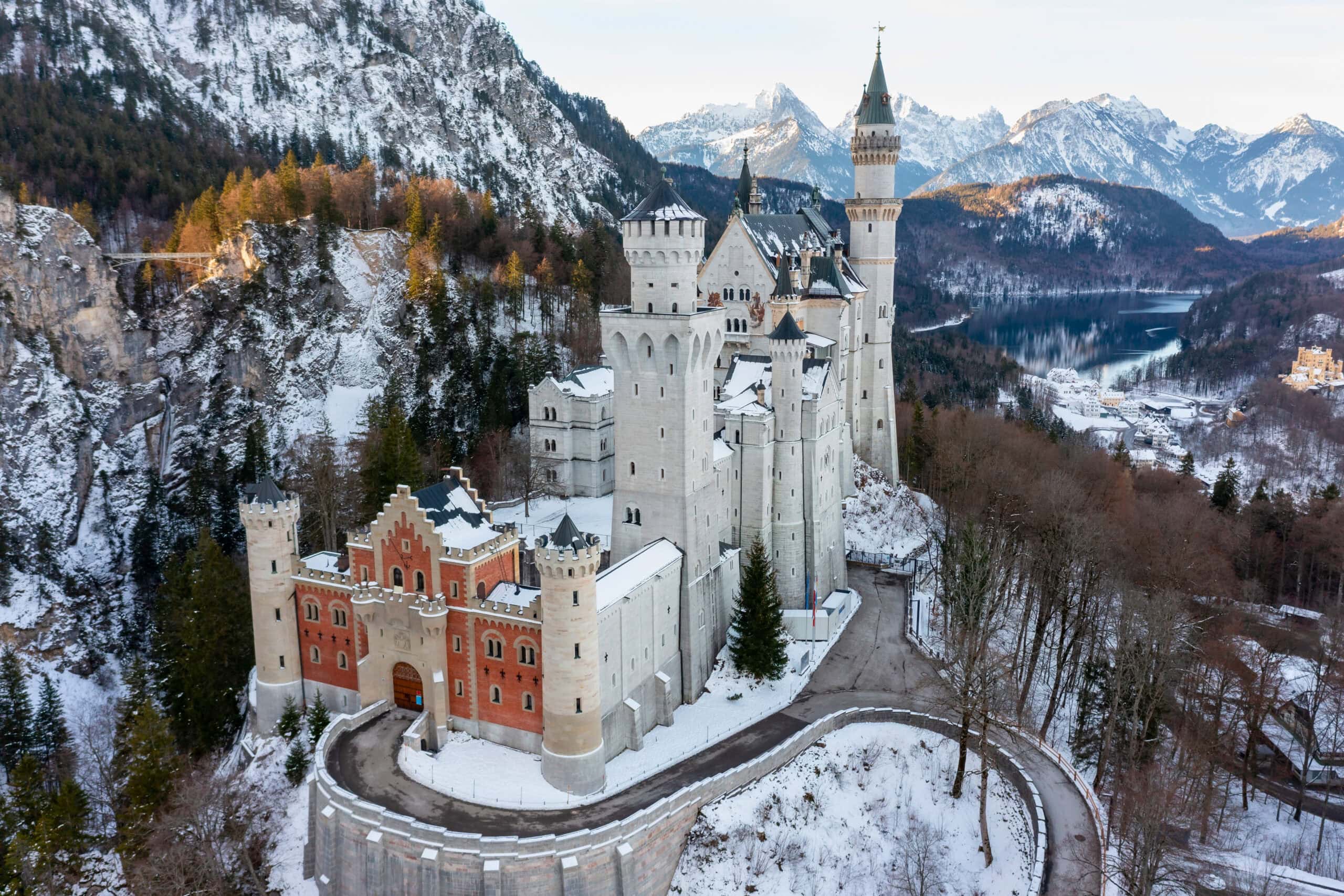
Fairytale castles in Germany are not a metaphor. The turreted silhouette that illustrators reach for when a story needs a castle, the cluster of pointed roofs on a wooded height, the white tower against mountains, was drawn from real German buildings, and most of them can be visited between breakfast and dinner. This guide gathers the eleven that carry the storybook look most completely, from the Alps to the Baltic lake country.
One rule governs the selection: the criterion is visual. These are the castles that look like the illustration, whatever their real age or history. Some of them are genuine medieval survivors that happen to wear the right silhouette. Most are creations of the nineteenth century, when Romantic patrons rebuilt ruins and raised new towers to match an image that painting and fiction had already put into circulation. The distinction matters to historians; it makes no difference to the eye at the bottom of the valley. Readers who want the story of how that century remade Germany’s castles should read our history of the 19th-century Romantic Revival, which follows the movement itself.
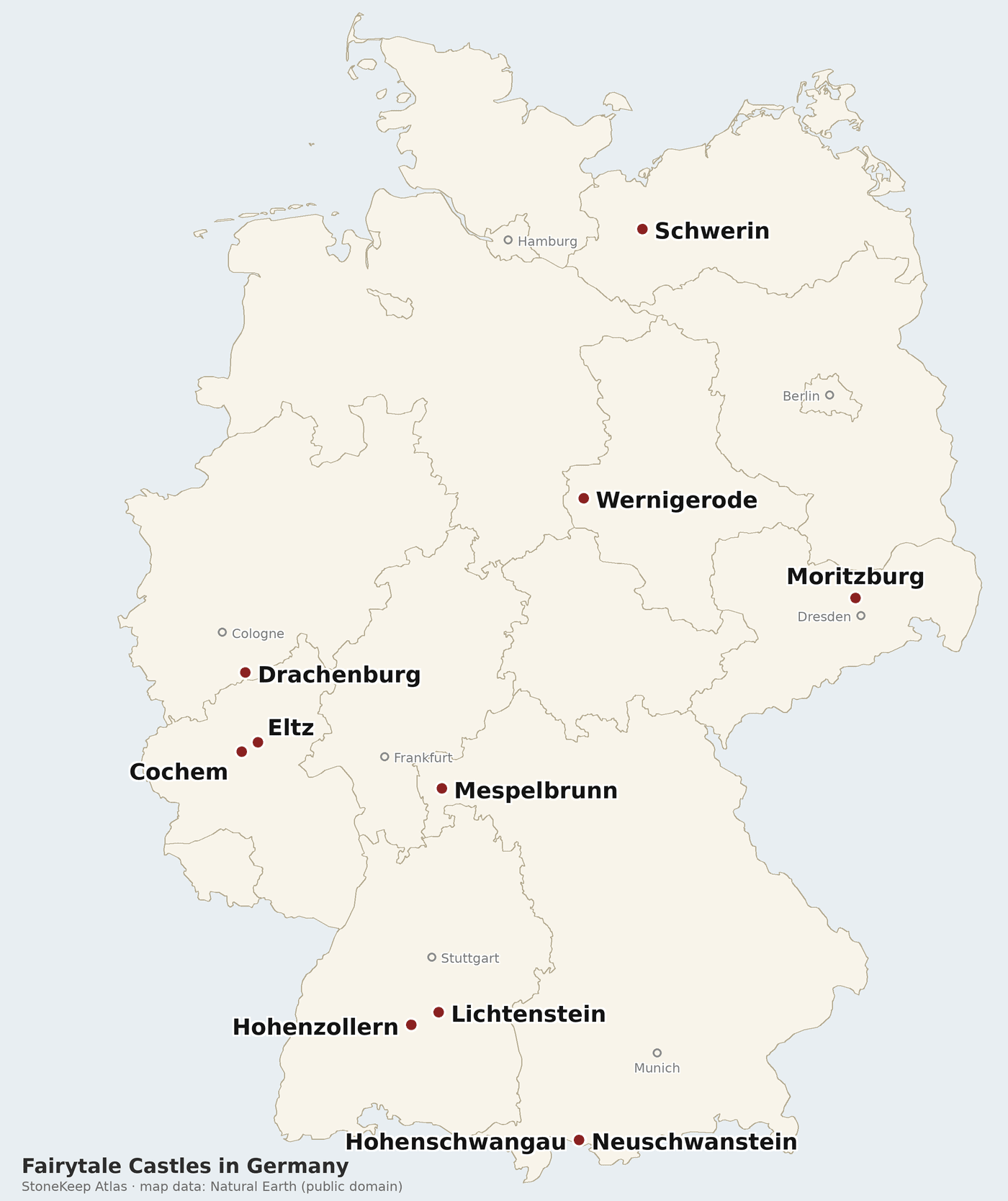
This is a gallery, not a ranking. Our separate guide to the best castles in Germany weighs history, architecture, and visitor experience across the whole country; this page asks a narrower question: which castles deliver the picture? Here are the eleven, arranged as a route that runs south to north.
The Eleven at a Glance
| Castle | Region | Built | Storybook signature | Getting there |
|---|---|---|---|---|
| Neuschwanstein | Bavaria (Allgäu) | 1869–1892, unfinished | The archetype: Ludwig II’s white tower against the Alps | Schwangau, ~120 km southwest of Munich; base in Füssen |
| Hohenschwangau | Bavaria (Allgäu) | Rebuilt 1833–1837 | The yellow original next door, where the imagery began | Same valley; walk up from the village |
| Hohenzollern | Baden-Württemberg | 1850–1867 | A crown of towers on an isolated mountain cone | Near Hechingen, between Stuttgart and Lake Constance |
| Lichtenstein | Baden-Württemberg | 1840–1842 | A novel made real on a cliff edge | ~45 km south of Stuttgart via Reutlingen |
| Mespelbrunn | Bavaria (Spessart) | 1427–1434; 1551–1584 | A moated Renaissance house deep in the forest | In the Spessart near Aschaffenburg, off the A3 |
| Eltz | Rhineland-Palatinate | c. 1100–1661 | Eight medieval tower-houses hidden in a side valley | ~5 km forest trail from Moselkern on the Moselle |
| Cochem | Rhineland-Palatinate | Reconstructed 1874–1877 | One coherent silhouette above town, river, and vineyards | In Cochem on the Moselle rail line |
| Drachenburg | North Rhine-Westphalia | 1882–1884 | A stockbroker’s storybook palace above the Rhine | Königswinter; the Drachenfelsbahn stops at the castle |
| Wernigerode | Saxony-Anhalt | Historicist 1862–1885 | An engineered silhouette above a half-timbered town | Directly above Wernigerode’s old town, in the Harz |
| Moritzburg | Saxony | Baroque 1723–1733 | The water castle where Cinderella lost her shoe on film | ~15 km northwest of Dresden |
| Schwerin | Mecklenburg-Vorpommern | 1843–1857 | A crown of towers and a gilded dome on a lake island | Island in Schwerin’s center; direct trains from Hamburg and Berlin |
Neuschwanstein Castle: The Archetype
Every storybook castle is, knowingly or not, a variation on Neuschwanstein Castle. King Ludwig II of Bavaria commissioned it in 1869 not as a fortress or a working residence but as a piece of theater in stone, conceived from sketches by a Munich stage designer and left unfinished at the king’s death in 1886. Walt Disney is widely said to have drawn on it for the Sleeping Beauty Castle at Disneyland, and the silhouette has been copied in theme parks and logos around the world ever since. The original still outperforms the copies. Seen from the Marienbrücke footbridge over the Pöllat gorge, the white limestone walls and slender towers stand against the Alps exactly as the illustrators promise. It remains Germany’s most visited castle, with over a million visitors in 2025 according to the Bavarian Palace Administration, and in July 2025 it was inscribed as a UNESCO World Heritage Site as part of the serial listing of Ludwig II’s palaces.
Hohenschwangau Castle: Where the Image Began
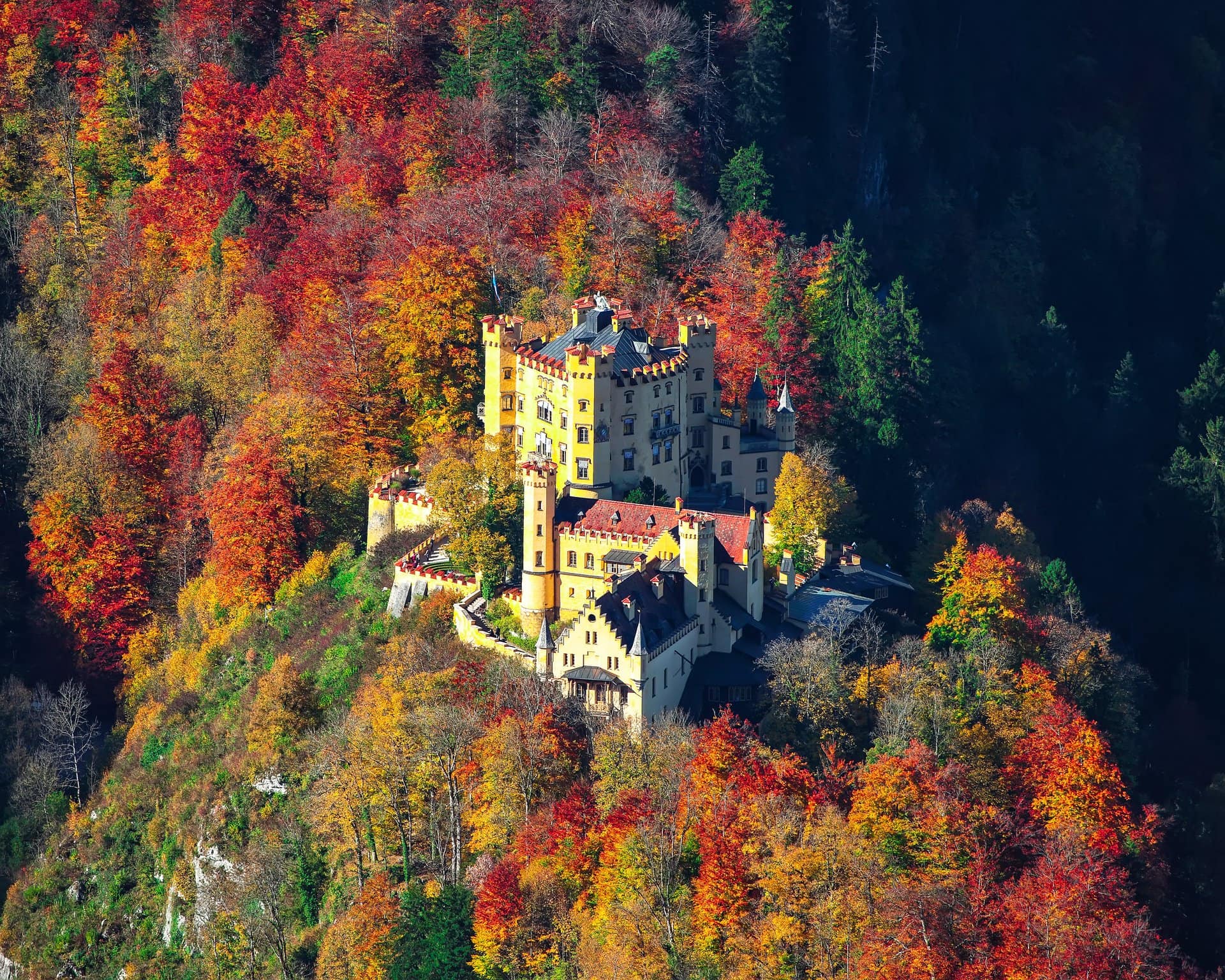
Five hundred meters from Neuschwanstein’s ticket lines stands the quieter half of Europe’s most photographed castle pair, and in one important sense the more consequential one. Hohenschwangau Castle is where the imagery of Romantic Bavaria was first assembled, decades before its famous neighbor existed. Crown Prince Maximilian found a battered medieval ruin above the Alpsee in 1829 and rebuilt it between 1833 and 1837 as a golden-yellow Gothic Revival residence, its dining hall painted with the saga of Lohengrin, the knight who arrives in a boat drawn by a swan. His son Ludwig II grew up inside those murals and spent his adult life trying to rebuild their world on a grander scale across the valley. Visit both and the storybook genealogy reads in the correct order: the yellow castle is the source, the white one the escalation.
Hohenzollern Castle: The Crown on the Mountain
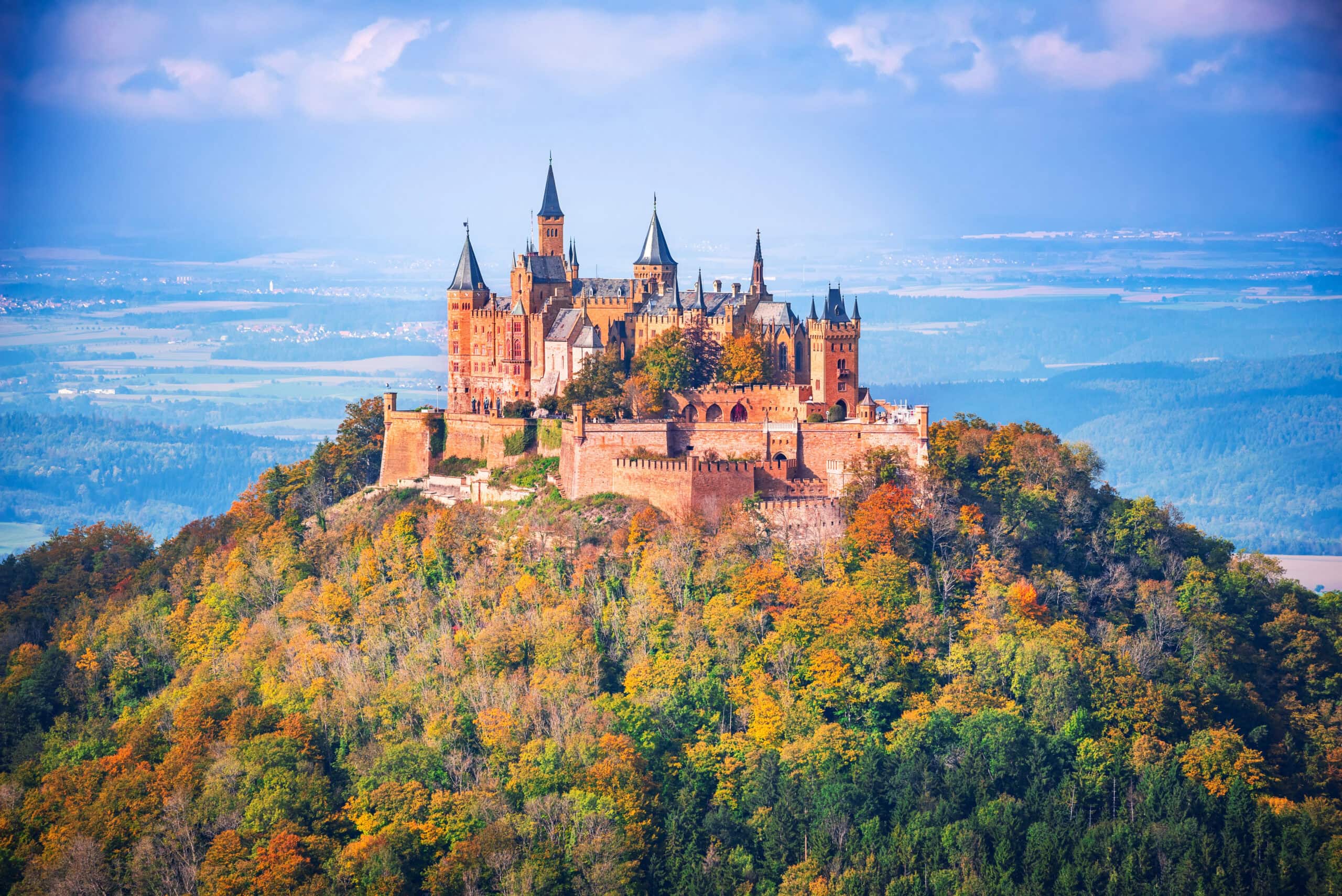
A medieval chronicler called the first castle on this mountain the crown of all castles in Swabia, and the phrase still fits the third one. Hohenzollern Castle stands at 855 meters on an isolated cone of the Swabian Jura with no town at its feet and no higher ground competing with its ring of towers, so the castle appears to float above the plain from every direction. What stands today was built between 1850 and 1867 for King Frederick William IV of Prussia as a monument to his family’s origins, to designs by Friedrich August Stüler that drew on English Gothic Revival models and the massed towers of the Loire. It is a dynastic memorial wearing the costume of a medieval stronghold, and from the approach ridge the costume is flawless.
Lichtenstein Castle: A Novel Made Real
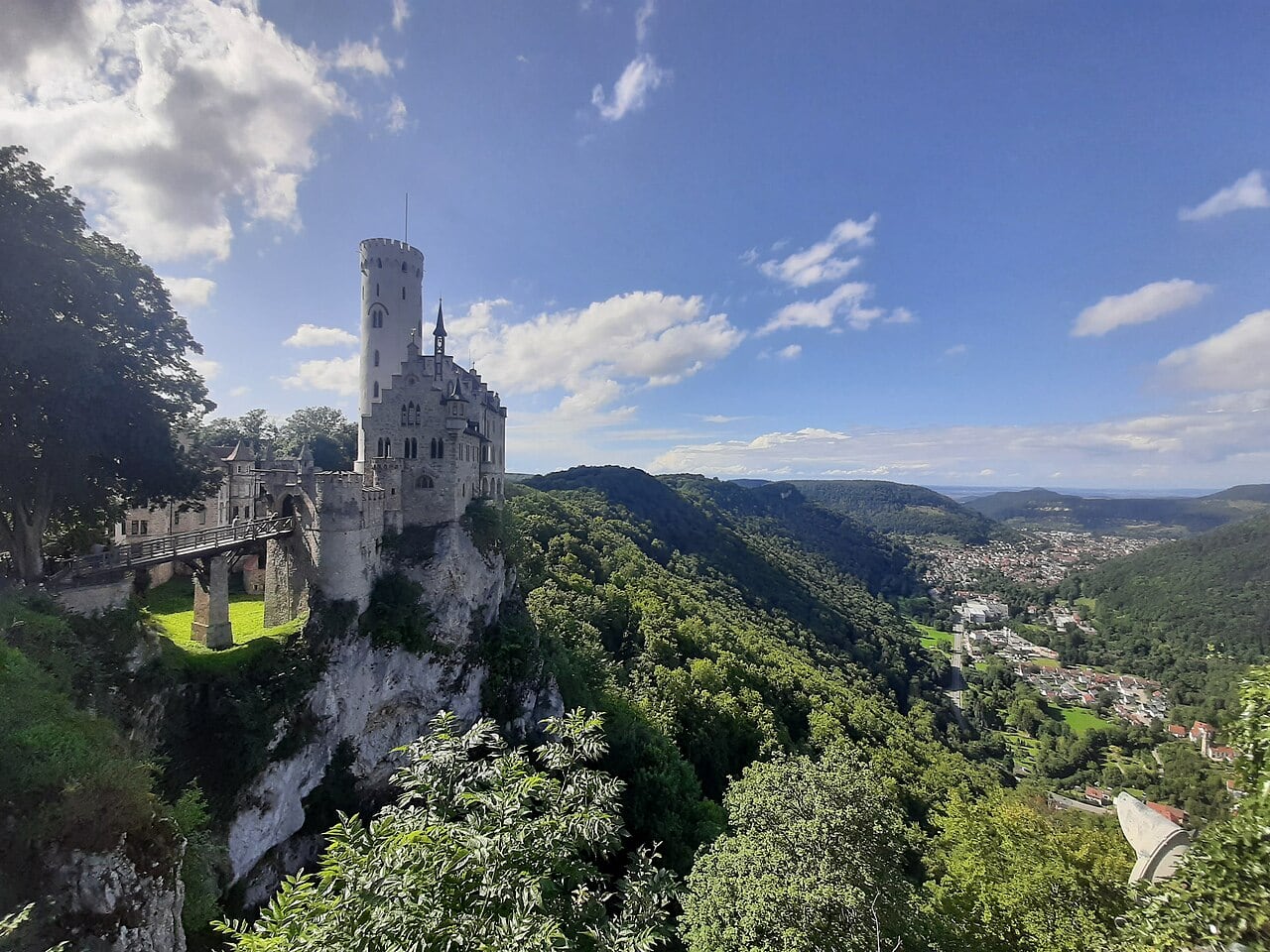
German guidebooks call Lichtenstein Castle the fairytale castle of Württemberg, and its origin is as storybook as its profile. In 1826 Wilhelm Hauff published Lichtenstein, a Romantic novel centered on an imaginary knightly seat on the Swabian Jura. Count Wilhelm of Württemberg read it as an instruction: between 1840 and 1842 he built the castle the novel had described, on medieval foundations at the cliff edge, at 817 meters above sea level and roughly 250 meters above the Echaz valley, on a footprint so narrow that an iron bridge spans a natural chasm to reach the gate. It predates Neuschwanstein by nearly thirty years, a reminder that Bavaria did not invent the German storybook castle; it perfected a Swabian idea.
Mespelbrunn Castle: The Forest Original
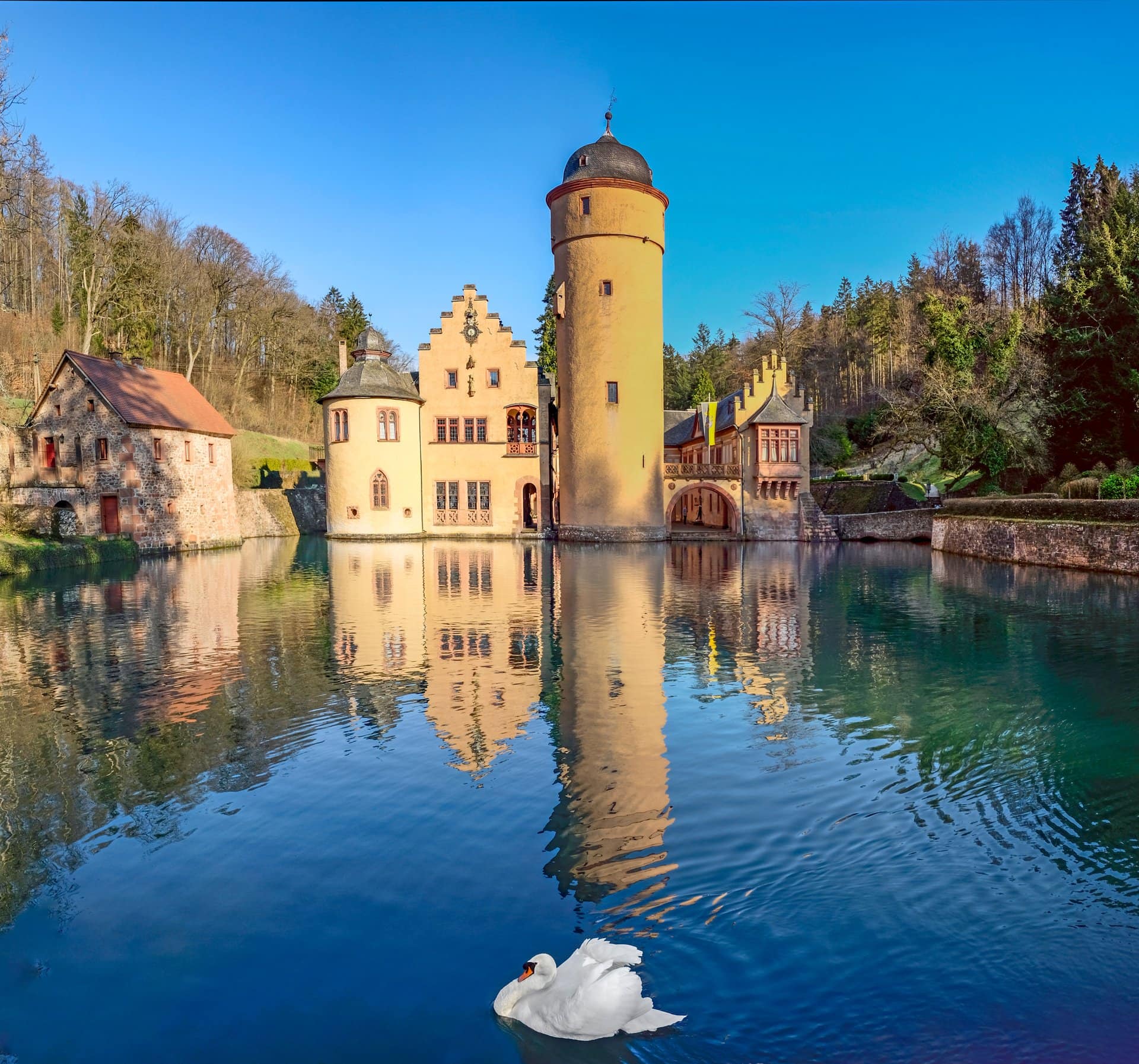
Mespelbrunn Castle proves the storybook look is not always a nineteenth-century invention. This moated Renaissance house sits at the head of a pond in a side valley of the Spessart forest, its round white Bergfried of the 1420s rising between gabled wings added by the Echter family between 1551 and 1584. The same family’s descendants have held it since 1412 and still live in the south wing, and the castle was never destroyed in six centuries of wars that leveled its neighbors. Germany discovered it through a movie screen: Das Wirtshaus im Spessart, the 1958 comedy with Liselotte Pulver, was filmed here and fixed the castle in the national imagination as the house in the fairytale forest.
Eltz Castle: The Medieval Survivor
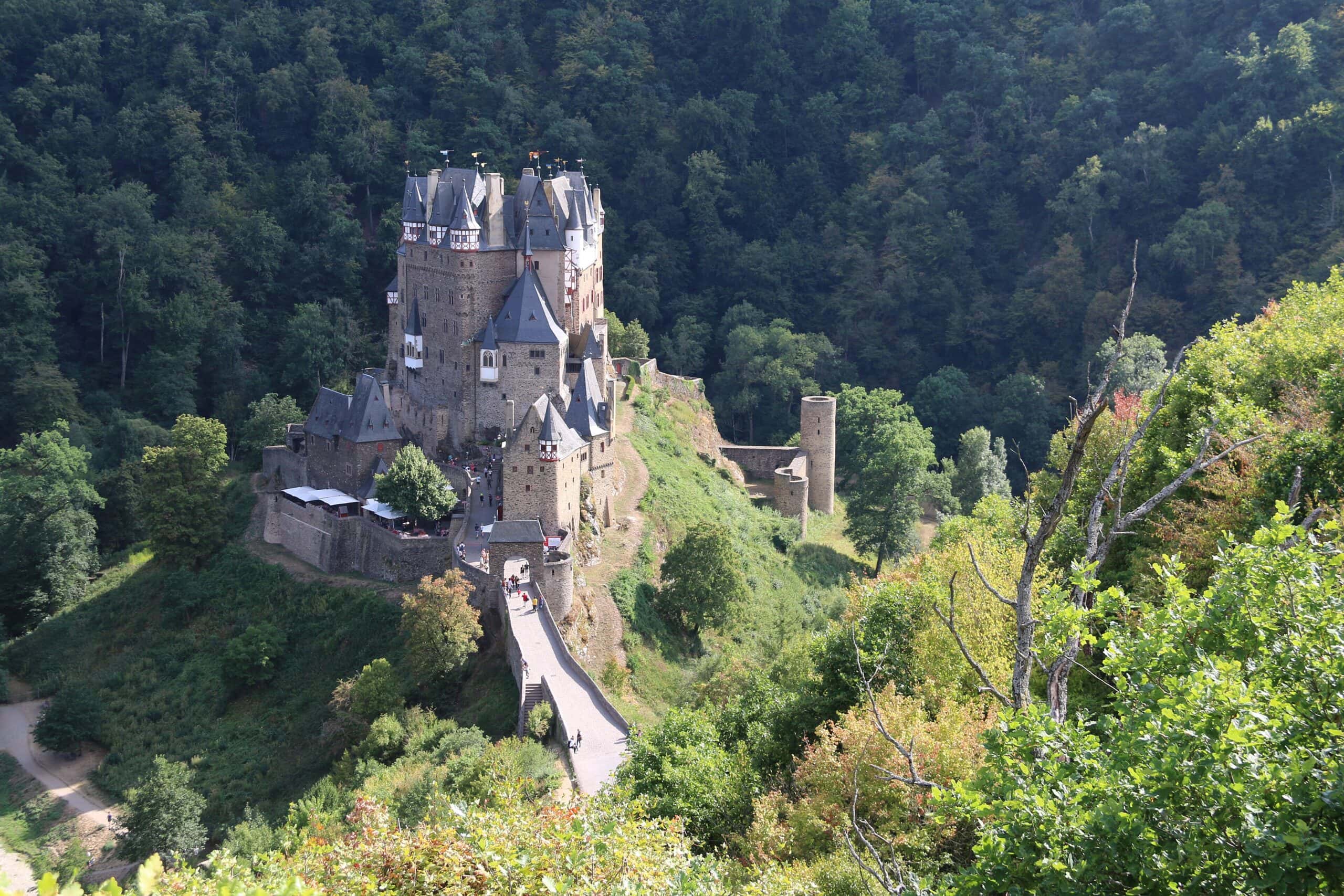
If the storybook castle is usually a Romantic reconstruction, Eltz Castle is the exception that shows what the Romantics were copying. Eight tower-houses crowd onto a rock spur in a forested side valley of the Moselle, built by branches of a single family between the twelfth and seventeenth centuries and held by that family continuously since at least 1157. The castle was never sacked after the Middle Ages, so the gables, oriels, and half-timbered upper stories that rise above the treetops are largely original fabric rather than revival guesswork. Germans of a certain age know the view from the reverse of the 500-Deutschmark note issued in 1965. The five-kilometer forest walk in from Moselkern is part of the effect: the castle appears suddenly, exactly where a story would put it.
Cochem Castle: The Silhouette Above the River
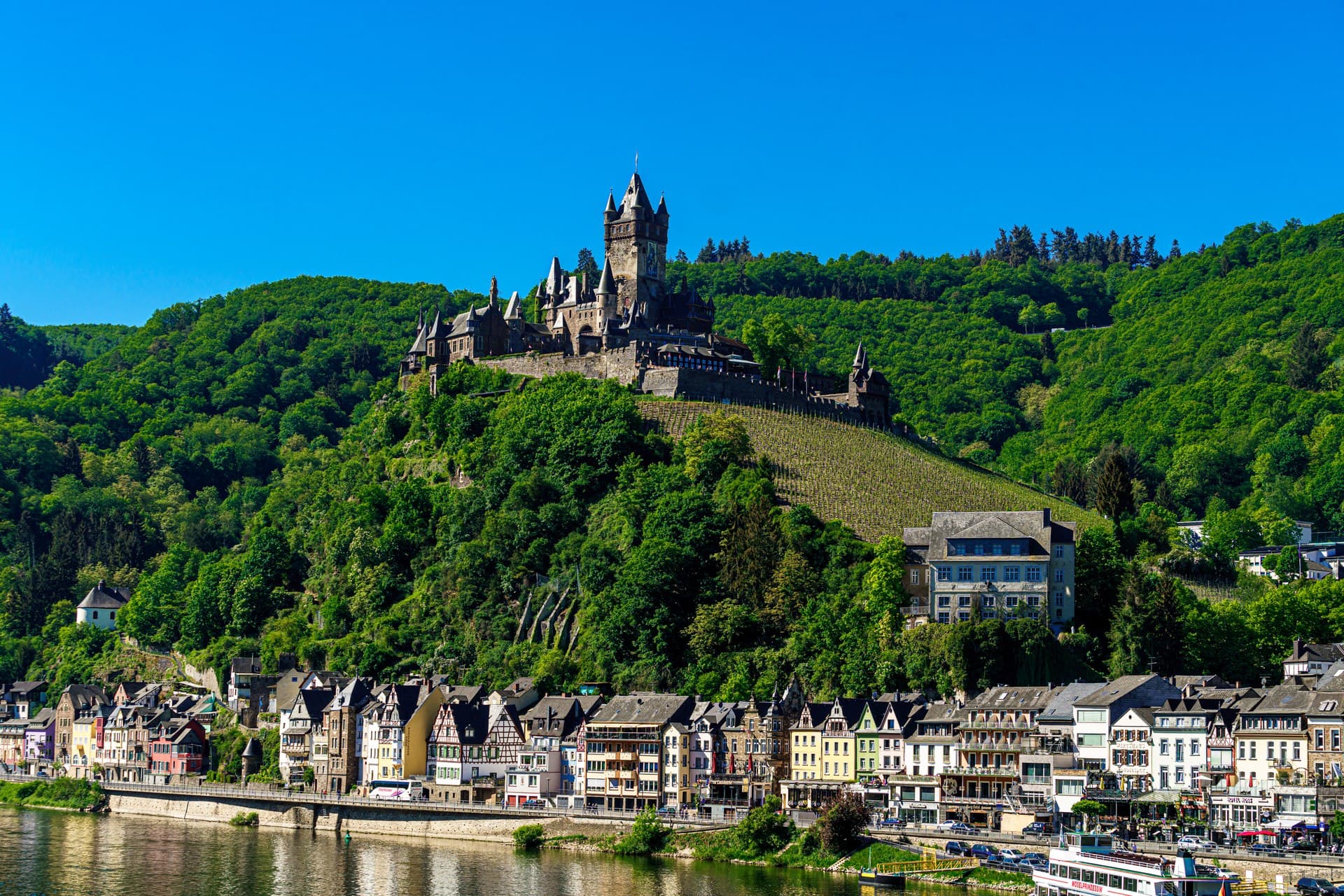
From the far bank of the Moselle, Cochem Castle composes the single most legible castle-town-river picture in the valley: slate rooftops, a bend of water, vineyard slopes, and a spired castle stacked above it all on a conical hill. The composition is a nineteenth-century one. The medieval imperial castle was blown up by French troops in 1689 and stood ruined for 179 years until Louis Ravené, a Berlin iron merchant, bought the ruin in 1868 and rebuilt it between 1874 and 1877 as a Gothic Revival summer residence. Purists note that almost everything above the lower masonry is nineteenth-century work. The eye does not care, and neither did the generation of Rhine and Moselle travelers who made this view one of the defining images of the German river landscape.
Drachenburg Castle: The Stockbroker’s Palace
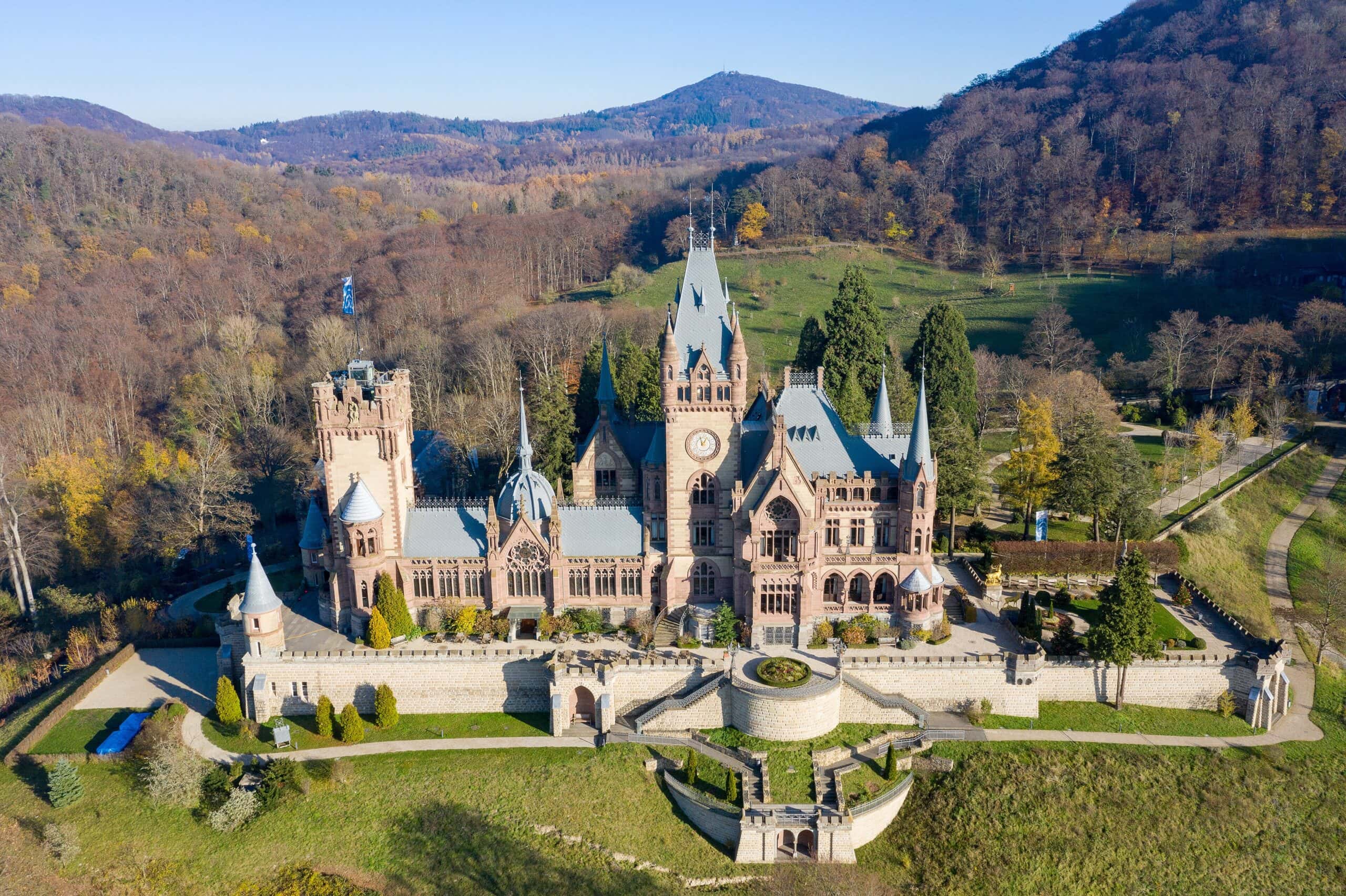
Drachenburg Castle is what happens when new money buys the storybook outright. Stephan Sarter, a Bonn innkeeper’s son who made a fortune in Suez Canal shares, purchased a barony in 1881 and raised this palace of spires and pinnacles on the Drachenfels above the Rhine in just two years, 1882 to 1884, then never moved in. The interiors quote the Nibelungen saga in wall paintings and stained glass, placing the parvenu villa directly into the oldest German legend of them all, on the very hill where Siegfried was said to have slain the dragon. Reaching it is part of the theater: the Drachenfelsbahn, Germany’s oldest rack railway, has hauled visitors up from the Königswinter riverbank since 1883 and stops at the castle gate.
Wernigerode Castle: The Engineered Silhouette
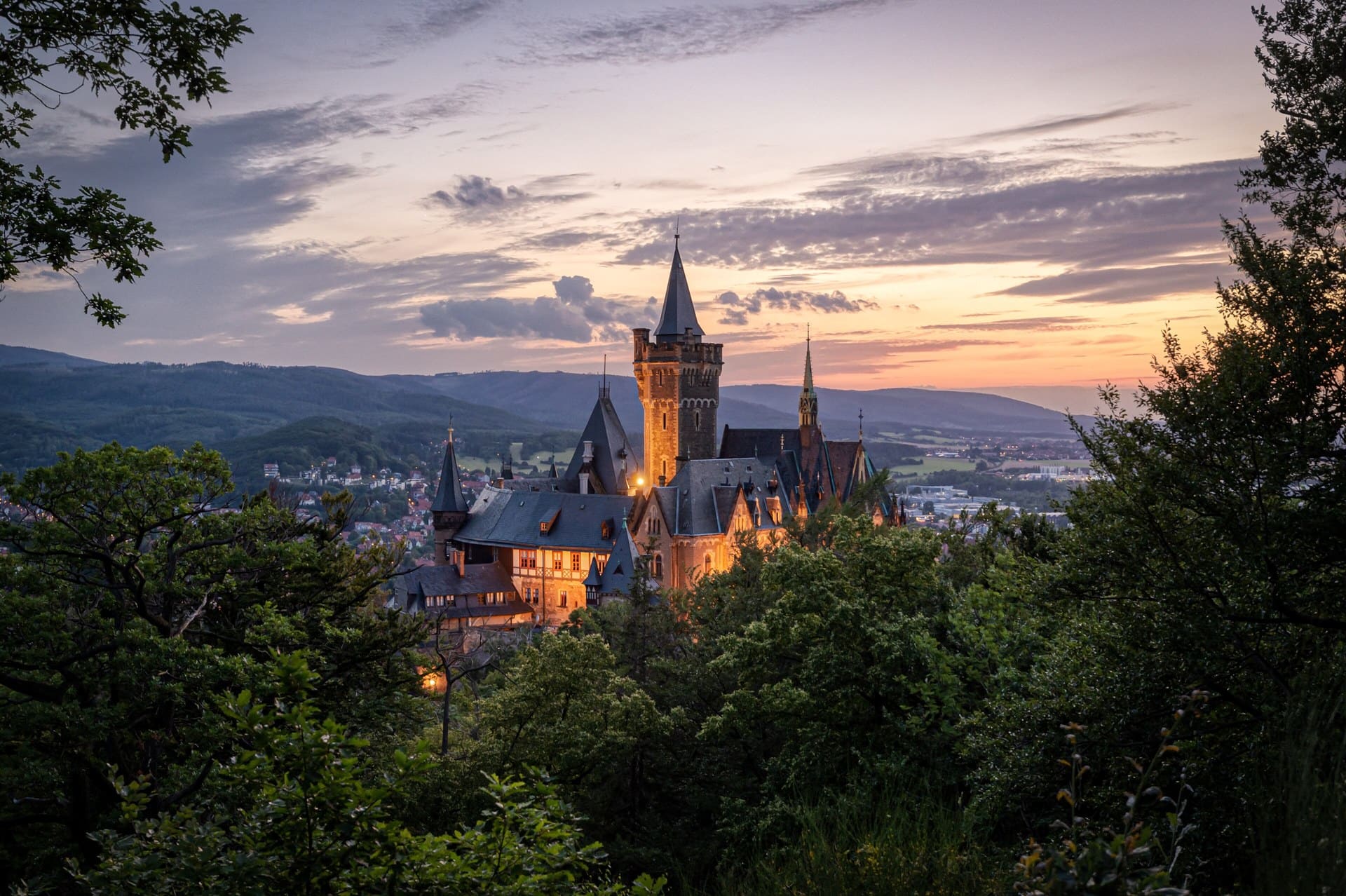
Stand in Wernigerode’s half-timbered market square, look south, and Wernigerode Castle appears not as a building but as a deliberate composition: a ridge line of towers, gables, and oriels above the Harz town. The effect was engineered. Between 1862 and 1885 the architect Carl Frühling transformed a genuinely medieval, Gothic, Renaissance, and Baroque castle for Count Otto zu Stolberg-Wernigerode, working to a stated principle that every forty-five degrees of approach should disclose a new exterior view, and that everything should serve a picturesque silhouette legible from the valley. Few buildings condense nine centuries of German history into a single skyline so effectively, and none states the storybook aesthetic as an explicit design brief quite so plainly.
Moritzburg Castle: The Cinderella Castle
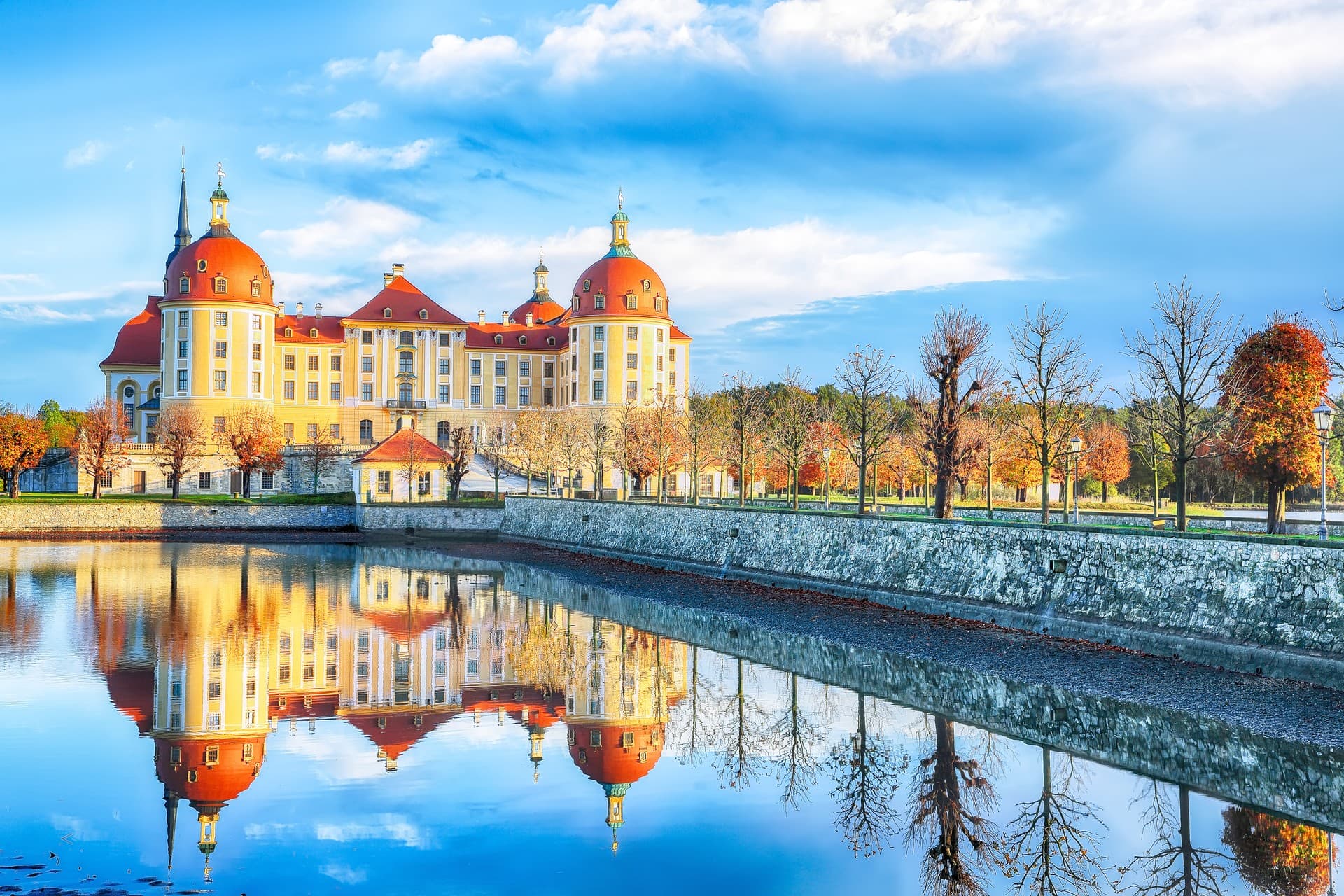
For audiences across Central Europe, the definitive screen fairytale castle is not Neuschwanstein but Moritzburg Castle. The exterior scenes of Drei Haselnüsse für Aschenbrödel (Three Wishes for Cinderella), the 1973 Czech-German film that remains a Christmas television ritual in half a dozen countries, were shot at this Baroque water castle outside Dresden, and a bronze shoe on the exterior staircase commemorates the scene in which the heroine loses hers. The building itself is Augustus the Strong’s doing: between 1723 and 1733 his architect Matthäus Daniel Pöppelmann converted a Renaissance hunting lodge into a four-towered palace on an artificial island, a symmetrical apparition that seems to float on its pond. Every winter the castle hosts an exhibition devoted to the film, and it belongs to a wider landscape of Saxon castles within an easy radius of Dresden.
Schwerin Castle: The Northern Finale
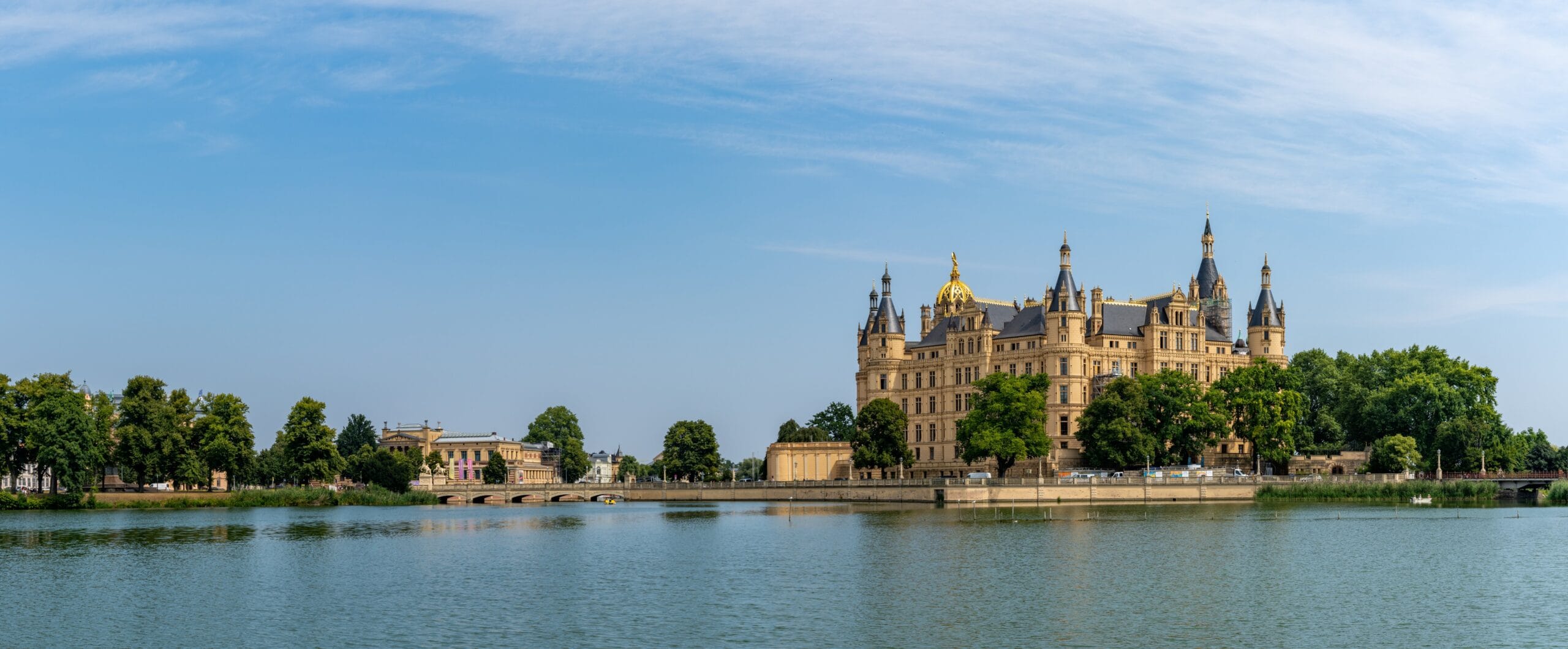
The route ends on an island in a north German lake, at the castle German heritage bodies and tourism boards alike call the Neuschwanstein of the North. Schwerin Castle earns the comparison and complicates it: its crown of towers and gilded dome was finished in 1857, more than a decade before Ludwig laid his foundation stone. Architects Georg Adolf Demmler and Friedrich August Stüler rebuilt the exhausted Renaissance seat of the dukes of Mecklenburg between 1843 and 1857 as a Loire-inspired palace rising straight from the water of the Schweriner See. The same island has carried the region’s seat of power for more than a thousand years, and it still does: the state parliament of Mecklenburg-Vorpommern sits inside. In July 2024 UNESCO inscribed the Schwerin Residence Ensemble on the World Heritage List, the storybook castle that also happens to be a working capitol.
Beyond the Storybook: What Did Not Make the List
Because the criterion here is the picture, several of Germany’s most important castles are deliberately absent, and it is worth saying why. The Wartburg above Eisenach carries more historical weight than any castle on this page; Luther translated the New Testament there. But its long, low fortress profile is Romanesque gravity, not storybook fantasy. Heidelberg Castle is Germany’s most celebrated ruin, and a ruin is a different genre: it moves the visitor with loss rather than enchantment. Marksburg, the only Middle Rhine hill castle never destroyed, is the real medieval article, and looks it, all defensive muscle and no ornament. All three are essential visits, and all three rank high in our guide to the best castles in Germany; they simply answer a different question than the one this page asks.
The eleven above skew heavily to the nineteenth century, and that is the honest shape of the subject. The storybook castle is largely a Romantic invention, built by kings, counts, and one stockbroker who had read the same poems and looked at the same paintings. How that happened, from ruin cults to Rhine tourism to the dynastic image-making of the Hohenzollerns and Wittelsbachs, is the subject of our companion history of the 19th-century Romantic Revival of German castles. And travelers concentrating on the south will find the Bavarian members of this list placed in their fuller regional context in our guide to the best castles in Bavaria.
Planning a Fairytale Castles Trip
The fairytale castles in Germany sort naturally into clusters. Neuschwanstein and Hohenschwangau share one valley and one ticket center in Schwangau, an easy day from Munich with an overnight in Füssen. Hohenzollern and Lichtenstein pair into a single Swabian Jura day from Stuttgart. Eltz and Cochem sit twenty river-kilometers apart on the Moselle, and Drachenburg is a short train ride from Bonn or Cologne, so the three combine into a relaxed Rhine-Moselle circuit. The northern trio takes more commitment: Wernigerode anchors a Harz stay, Moritzburg is a half-day from Dresden, and Schwerin rewards a stop on any route between Hamburg and Berlin. Mespelbrunn, the outlier in the Spessart, slots neatly into a drive between Frankfurt and Würzburg.
Skip-the-line tickets and day tours for the castles on this page, including the popular Neuschwanstein day trips from Munich, are on GetYourGuide’s Germany page. For overnight bases in Füssen, Cochem, Wernigerode, or Schwerin, compare hotels and guesthouses on Booking.com.
Some links on this page are affiliate links, which means StoneKeep Atlas may earn a small commission, at no extra cost to you, if you book through them.
Conclusion
The fairytale castles in Germany are real places with real histories, and the histories are stranger than the stories: a king who built a stage set and never finished it, a count who built a novel, a stockbroker who built a legend, a film crew that turned a Baroque hunting palace into every Central European child’s image of Cinderella’s castle. Seen together, the eleven trace how Germany manufactured the world’s shared picture of what a castle should be. Start with the country’s best castles if you want the full sweep, or with the Romantic Revival if you want the why. If you just want the picture, this page is the itinerary.
Principal Sources
- Bayerische Schlösserverwaltung, Schlösserbilanz 2025 press release and Schloss Neuschwanstein official site (neuschwanstein.de), visitor figures and UNESCO inscription of the Palaces of King Ludwig II, July 2025.
- Official castle sites consulted for current facts: Burg Hohenzollern (burg-hohenzollern.com); Burg Eltz (burg-eltz.de); Schloss Lichtenstein (schloss-lichtenstein.de); Hohenschwangau / Wittelsbacher Ausgleichsfonds (hohenschwangau.de); Schloss Drachenburg / NRW-Stiftung (schloss-drachenburg.de); Reichsburg Cochem (reichsburg-cochem.de); Schloss Mespelbrunn (schloss-mespelbrunn.de); Schloss Wernigerode (schloss-wernigerode.de); Schloss Schwerin / Staatliche Schlösser und Gärten M-V (mv-schloesser.de).
- Staatliche Schlösser, Burgen und Gärten Sachsen, Schloss Moritzburg official site (schloss-moritzburg.de), on the 1973 exterior filming of Drei Haselnüsse für Aschenbrödel and the annual winter exhibition.
- Deutsche Stiftung Denkmalschutz (denkmalschutz.de) and Mecklenburg-Vorpommern tourism publications for the “Neuschwanstein of the North” usage; UNESCO World Heritage Centre for the Schwerin Residence Ensemble inscription, July 27, 2024.
- Wilhelm Hauff, Lichtenstein (1826), the novel that prompted the 1840–1842 construction of Schloss Lichtenstein.
- StoneKeep Atlas castle guides for all eleven members, each with its own Principal Sources drawing on state palace administrations, monument records, and the castles’ own research pages.
Image credits. Featured image and Neuschwanstein in winter above the Alpsee: via Adobe Stock. Hohenschwangau on its wooded hillside in autumn: via Adobe Stock. Hohenzollern Castle on its cone above the Swabian plain: via Adobe Stock. Lichtenstein Castle on the Albtrauf: Melchmi, CC BY-SA 4.0, via Wikimedia Commons. Schloss Mespelbrunn across the moat: via Adobe Stock. Burg Eltz from the trail vantage: FrDr, CC BY-SA 4.0, via Wikimedia Commons. Reichsburg Cochem above the Moselle: via Adobe Stock. Schloss Drachenburg from the south: dronepicr, CC BY 2.0, via Wikimedia Commons. Wernigerode Castle at sunset: GZagatta, CC BY-SA 4.0, via Wikimedia Commons. Schloss Moritzburg autumn aerial: via Adobe Stock. Schwerin Castle on its island: via Adobe Stock. Map: StoneKeep Atlas (own work); state outlines from Natural Earth, public domain.