
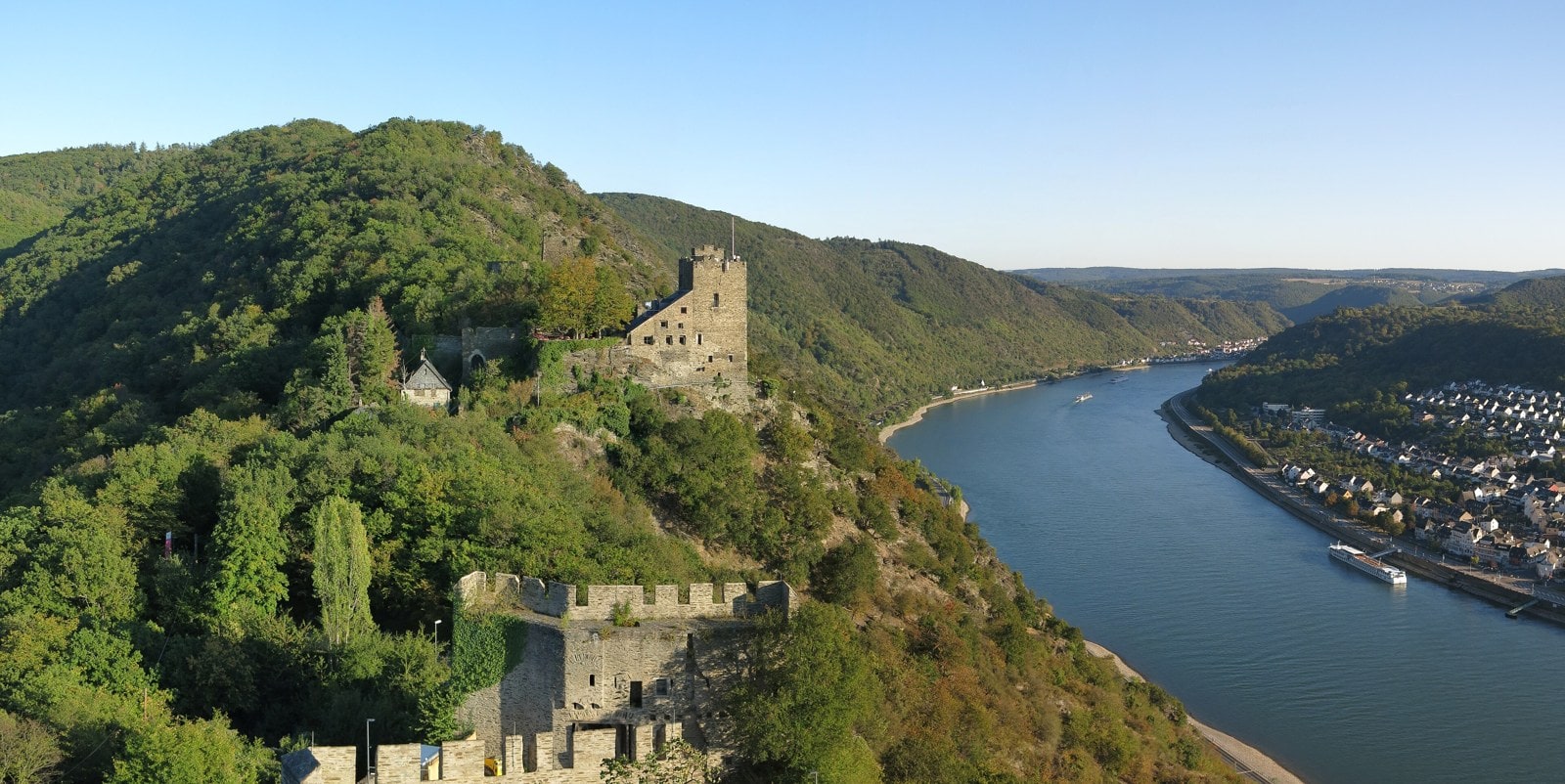
Liebenstein Castle
Liebenstein Castle sits at roughly 237 meters above the Middle Rhine, the highest castle in the inscribed UNESCO landscape, perched on the upper ridge directly above its more famous sibling, Burg Sterrenberg. For most visitors the two are bound together by the tourist-board nickname die feindlichen Brüder, the hostile brothers; a few hundred years of bad poetry and worse postcards have ensured that no one quite sees Liebenstein on its own terms. Which is a shame, because its own terms are interesting.
Liebenstein was built in the second half of the 1280s by an unlikely founder: the eldest illegitimate son of King Rudolf I. von Habsburg. It first appears in writing in a Lehenbrief of 1294, which is not the deed of sale popular accounts describe but a more complex feudal arrangement. It was held for the next two and a half centuries by a Ganerbenburg consortium of up to ten resident families, who quietly preserved its imperial-Lehen status while the Archbishop of Trier swallowed Sterrenberg next door. Most consequentially, it was the one Middle Rhine castle the Rhine Romantics did not get to. Nineteenth century reinvented Stolzenfels, Rheinstein, Drachenburg, and a dozen other ruins as neo-medieval stage sets; Liebenstein stayed in continuous private hands from 1783, sat partly ruinous through the entire age of historicism, and was converted to a hotel only in the late 20th century. What survives, including the working restaurant in the 14th-century gothic Wohnturm, is closer to the medieval fabric than anything its glamorous neighbors can show. Liebenstein Castle is the un-restored sibling.
Quick Facts
| Location | Above Kamp-Bornhofen, Rhein-Lahn district, Rhineland-Palatinate, Germany |
| Coordinates | 50.21285° N, 7.63636° E |
| Elevation | ~237 m above sea level — the highest castle on the Middle Rhine |
| Built | c. 1284–1290, by Albrecht von Lewenstein; first documented as a built castle in the Lehenbrief of 1294 |
| Type | Spur castle (Höhenburg); medieval Ganerbenburg with up to ten resident families (1340) |
| Current use | Privately owned, operated as Hotel Burg Liebenstein |
| Hours (2026) | Hotel open seasonally through the end of October; restaurant closed Mondays; phone to confirm |
| Admission | Day visitors welcome to the courtyard, Burgterrasse, and through-trail; hotel and restaurant by reservation |
| Operator | Nickenig family (operating tenants since 1995) |
| Owner | Freiherren von Preuschen von und zu Liebenstein (continuous private ownership since 1783) |
| Official website | burghotel-liebenstein.de |
| UNESCO status | Inside Upper Middle Rhine Valley WHS 1066 (inscribed 2002); explicitly named in the nomination dossier |
Albrecht’s marriage castle (1284–1290)
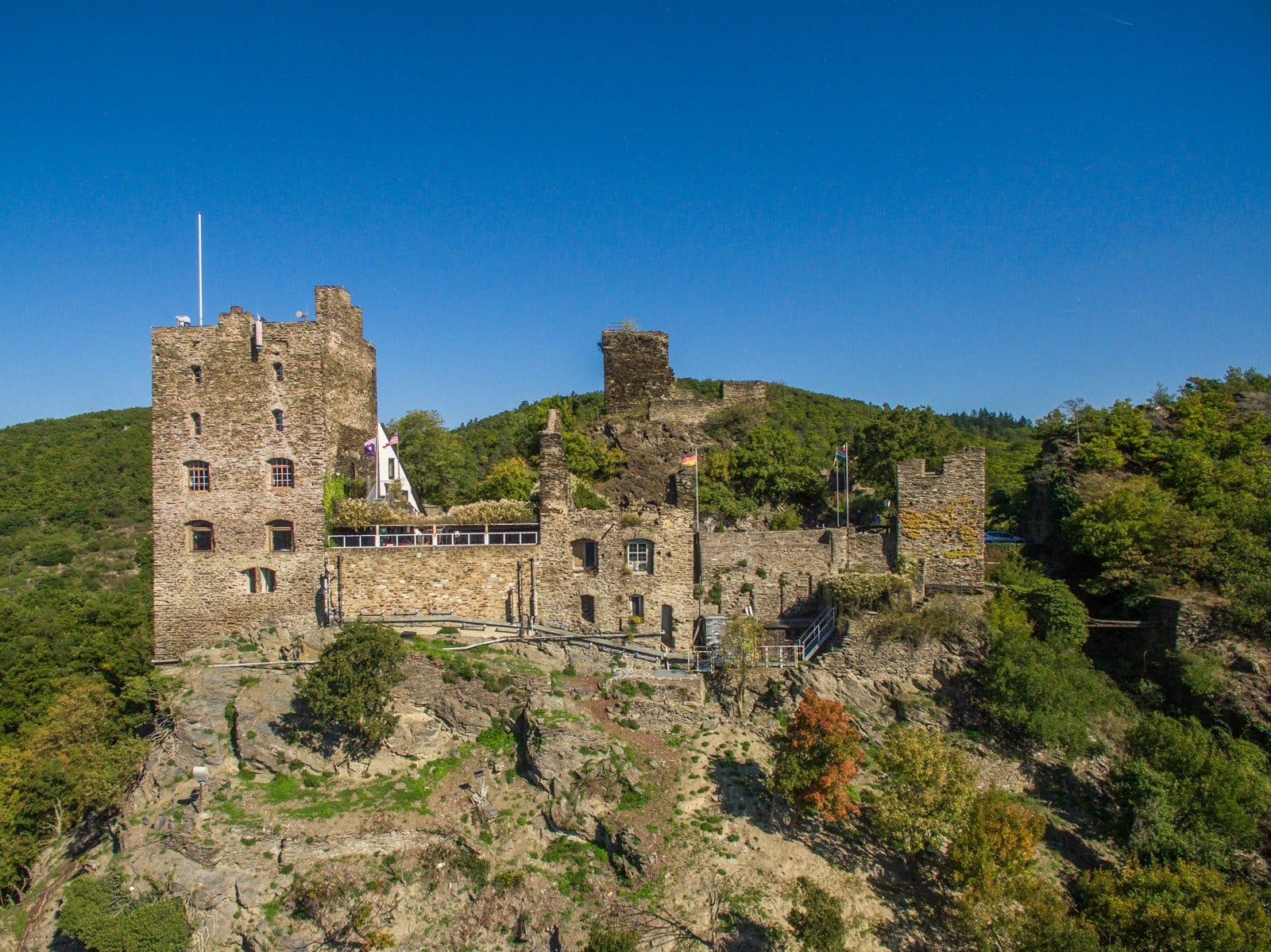
Liebenstein Castle begins with a wedding in Basel in the summer of 1284. On the 24th of July of that year, Albrecht von Lewenstein (Graf von Löwenstein-Schenkenberg since the previous year, and the eldest illegitimate son of King Rudolf I. von Habsburg) married Luckarda von Bolanden, daughter of the late Philipp V. von Bolanden and a niece of the Werner VI. who held the senior castle of Sterrenberg as a Reichspfand. That marriage gave a Habsburg cadet a foothold in the Middle Rhine; the construction of Liebenstein on the ridge directly above Sterrenberg gave that foothold a building.
Albrecht was a substantial figure in his own right. Born around 1250 to Rudolf and a mother probably drawn from the Schenken von Schenkenberg in the Aargau, he had been raised to comital status in 1283 after the Calwer line of Löwenstein died out with Gottfried. On April 26, 1288 his father granted him further imperial estates, and the European Castle Institute’s database reads the Liebenstein project as the architectural expression of an inheritance protection strategy: “zur Sicherung des Erbes seiner Gattin Luckarda von Bolanden gegen deren Onkel Werner von Bolanden, der im Besitz eines Pfandanteils der Sterrenberg war.” Building a new castle on the higher rock above the senior castle was, in those terms, both an assertion of presence and a hedge against the older Bolanden generation losing control of what was held on the lower ridge.
Construction itself ran through the second half of the 1280s. No construction charter survives, and the standard scholarly window (preferred by Reinhard Friedrich’s EBIDAT entry and by the operator’s own historical timeline) runs from the marriage of 1284 to a substantive completion around 1289. By 1294 the castle was demonstrably standing, appearing in the first surviving document that names it. Albrecht himself outlived the construction by more than a decade; he died on June 11, 1304 in Murrhardt and is buried in the Stadtkirche there, where his grave was rediscovered by the local historian Rolf Schweizer in 1973. Luckarda survived him until March 18, 1324, by which time she had remarried Markgraf Rudolf IV. von Baden. By then Liebenstein had passed out of Habsburg hands altogether, into the strange and durable arrangement that gives this article its center of gravity.
A higher, tighter castle
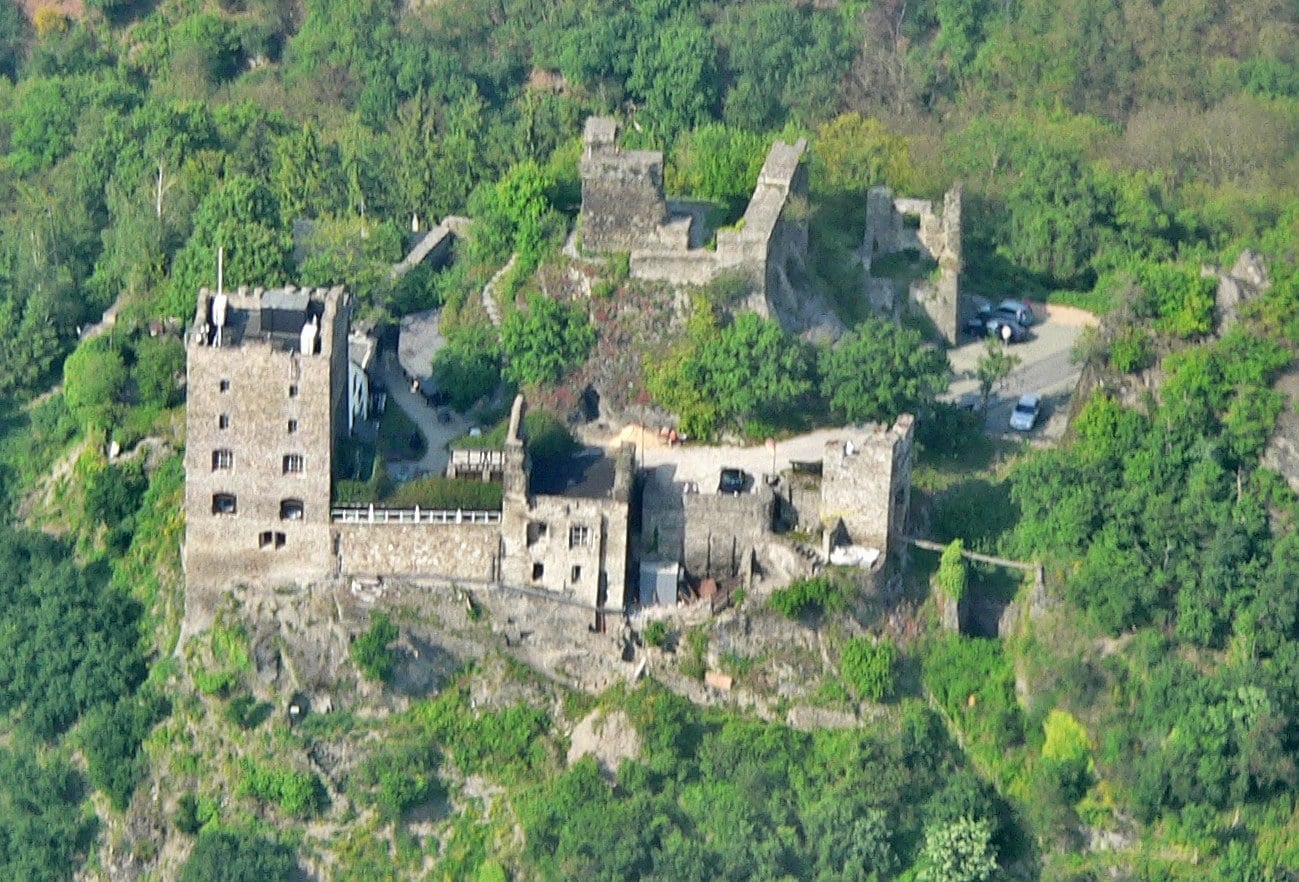
Liebenstein is smaller and tighter than Sterrenberg, and it sits about twenty meters higher. Elevation differential is often given as thirteen meters in older guides; the figure goes back to Klingelschmitt’s early-20th-century survey. But modern digital terrain modeling (used by KuLaDig in 2023) puts Liebenstein at around 237 meters above sea level against Sterrenberg’s 216.8 meters. Newer measurements make the architectural logic clearer: this is a senior overlooking position, not a junior coexistence.
The Bergfried is rectangular, 9.20 by 10.30 meters at its base, raised on a steeply worked rock outcrop and surviving today as a corner stub. Some older sources give a 15-meter dimension; that figure refers to the larger and later gothic Wohnturm, the tall block on the south-west corner that now houses the restaurant. Wohnturm went up in the mid-14th century when the resident Herren von Liebenstein needed a substantial Sitz inside a complex they were now sharing with cadet branches. The Schenkenturm on the Rhine-facing flank (named for the Schenken von Liebenstein-Sterrenberg, the cadet branch that took its name from this tower) is wedged into the slope so dramatically that two of its lower stories sit below the courtyard level. Pressed against the Wohnturm, the Hofhaus dates substantially from the 17th century but contains older fabric.
Defensive logic here is worth pausing on. Principal Schildmauer at Liebenstein sits at the southern, ridge-facing end of the complex, screening the bergseitig attack axis, the direction from which any serious land attack would have to advance along the saddle. Its Sterrenberg-facing flank carries only a secondary curtain wall and ditch. This asymmetry is the architectural counter-evidence to the popular hostile-brothers story: Liebenstein was not built primarily to defend itself against the senior castle next door. Whatever institutional contention developed across the saddle in the 14th century (and there was contention, of an electoral-political sort), it never produced an arms race between the two castles. The dramatic outer Schildmauer that visitors photograph at Sterrenberg, looking up toward Liebenstein, was a defensive build raised by Trier in the 1320s; the senior castle’s article covers it in detail. Liebenstein never built an answering wall on its Sterrenberg face.
The 1294 Lehenbrief

That transaction, which fixes Liebenstein’s name in the documentary record, is sometimes called a sale, sometimes a pledge, and frequently misattributed to the wrong men. Cleanest reading is this. In 1294, Graf Heinrich I. von Sponheim (Albrecht’s brother-in-law, married to Kunigunde von Bolanden, and through her the senior Bolanden heir) issued a Lehenbrief enfeoffing three ministerials with one half of Liebenstein for six hundred and thirty-six Mark. A second Urkunde the following year covered the remaining half. The package was substantial: Liebenstein in two equal portions, the Vogtei Hirzenach, the village of Osterspai with its vineyards, and a quarter of the town beneath Sterrenberg.
Named beneficiaries, recovered from the surviving regestum tradition, are not the “Siegfried Schenk and Ludwig” of popular accounts. They are Enolph von Sterrenberg, his brother Ludwig von Sterrenberg, and Sifrid, the son of Sifrid Schenk von Sterrenberg. Three men, all currently styled von Sterrenberg, all known from earlier acts as Burgmannen at the senior castle. After 1294 they begin to appear in the records as von Liebenstein. Toponymic shift is small in transcription but consequential in fact: a junior castle had just absorbed three of its senior neighbor’s ministerial men in a single year, and they would carry the new name as a lineage marker for the next three centuries.
What this single transaction tells us about cadet mobility in the late-13th-century Empire is the most interesting question Liebenstein puts on the table. A Lehenbrief was neither a sale outright nor a simple feudal grant. The 636-Mark price suggests a financial transaction layered onto a feudal form, closer to what later jurists would call a Kauflehen, a fief acquired for cash. For three Burgmannen who had served at Sterrenberg under successive Bolanden, Sponheim, and ultimately Katzenelnbogen overlords, it offered a single instrument to convert long service into landed identity. They moved, in effect, from being men attached to a castle to being men whose castle defined them. No original deed has yet been located in the available web indexes; it is most plausibly held in the Landeshauptarchiv Koblenz (Best. 33, Grafschaft Sponheim), the Hessisches Hauptstaatsarchiv Wiesbaden, or the Preuschen family archive at Osterspai, and Adam Goerz’s Mittelrheinische Regesten Band IV (1886) is the printed reference to check first.
The Ganerbenburg that Trier could not take
What happened next is the structural fact that distinguishes Liebenstein from every other Middle Rhine castle. Sterrenberg, on the lower ridge, passed to Archbishop Balduin of Trier in stages between 1310 and 1320 and became a Kurtrier outpost. Liebenstein took the opposite trajectory. It remained an imperial Lehen, held under Sponheim suzerainty, and within a generation it had been formally partitioned into a Ganerbenburg, a co-heirs’ castle jointly held by multiple resident families. By 1340 a formal Ganerbenteilung was in force between the senior Herren von Liebenstein and the cadet branch styling itself Schenken von Liebenstein-Sterrenberg, with up to ten resident families noted at the high-water mark. The European Castle Institute’s database is blunt on the consequence: “Burg Liebenstein, die als Ganerbenburg von Kurtrier nie eingenommen wurde.” Trier never took it.
Ganerben built. A square Torturm went up around 1356; a Wehrturm followed around 1380; the gothic Wohnturm, the dominant block today, took shape in the same period and was the principal Sitz of the senior Herren by the middle of the 14th century. The Schenkenturm on the Rhine flank carried the name of one of the resident branches. Liebenstein in this phase was not a single seat but a layered apartment block, with each family group holding rooms, towers, and rights of way under detailed Burgfrieden agreements. The mode of life it represented (communal aristocratic occupancy of a fortified rock) was reasonably common in the late-medieval Empire but is rarely so well-preserved as it is here in its 14th-century stratigraphy.
A legend of hostile brothers grew up in this period, or at least the conditions for one were laid then. Earliest written trace, as the Sterrenberg article sets out, is Arnoldus Buchelius’s Iter Germanicum of 1587, a Dutch traveler’s notebook entry recording two castles, a feud, and a foundation by a sister. What Buchelius did not realize, because no surviving document records it, is that in 1587 Liebenstein was still inhabited. Ganerben had thinned out; by 1510 Philipp von Liebenstein had united all the shares in a single hand. But the castle was still occupied when Buchelius wrote the legend down. EBIDAT places the first “unbewohnbar” descriptor in 1592, five years after Buchelius. The widely repeated 1529 abandonment date appears to be a Wikipedia conflation with Sterrenberg’s separate 1568 Verschreibung and should be set aside in favor of the cleaner EBIDAT chronology. The story Buchelius recorded was, in other words, a story being told about Liebenstein at the very moment Liebenstein’s last residents were preparing to leave.
The un-restored sibling (1590–1977)

In 1590 the Liebensteiner family moved down to the more comfortable Schloss Liebeneck above Osterspai, where the lifestyle was easier and the heating worked. Six years later Franz Friedrich von Liebenstein, who had risen to Hofmeister and Oberamtmann of Saarbrücken, was buried in St. Arnual with a tomb monument shared with his wife Margarete von Enschringen, the subject of a 2024 essay by Claudius Engelhardt in the Rhein-Lahn Heimatjahrbuch. The main line died out in 1637; the imperial Lehen fell back to Emperor Ferdinand II., who reinvested the Kurmainz chancellor Gerhard Freiherr von Waldenburg, beating off the heirs’ counter-claims. In 1648 the Peace of Westphalia confirmed Ferdinand von Waldenburg. A brief interlude with the Brömser von Rüdesheim followed in the later 17th century. Then in 1783, when Karl Freiherr von Waldenburg called Schenkern died without children, the princely house of Nassau enfeoffed Georg Ernst Ludwig von Preuschen of Liebenstein, an Oranien-Nassau Regierungspräsident at Dillenburg. Preuschen family has held Liebenstein ever since.
This is the point at which Liebenstein’s history diverges most sharply from its Middle Rhine neighbors, and the divergence is what makes the castle interesting today. The early 19th century brought the Romantic rediscovery of the Rhine. Stolzenfels, the Kurtrier residence ruined in 1689, was rebuilt between 1836 and 1842 by Karl Friedrich Schinkel and Friedrich August Stüler for the Prussian crown prince Friedrich Wilhelm, a full neo-Gothic reconstruction that turned a ruin into a working royal summer palace. Rheinstein, six kilometers upstream, was rebuilt between 1825 and 1829 by Johann Claudius von Lassaulx for Prince Friedrich of Prussia. Drachenburg, further north, was built from scratch as a historicist fantasy between 1882 and 1884. Even smaller castles (Sooneck for one) received Prussian-era romantic-restoration treatment.
Liebenstein, in continuous private hands and not in the line of sight of any royal commission, received none of it. The Hofhaus stayed inhabitable through the 18th and 19th centuries; the rest of the complex sat much as Luthmer drew it in 1914, with the gothic Wohnturm intact, the Bergfried as a stub, the Torturm reduced, and the Schenkenturm wedged into its slope. There was no historicist completion, no neo-Gothic crenellation campaign, no painted stage-set great hall. The 19th century (which had so much to say about Liebenstein in poetry, from Heinrich Heine’s “Zwei Brüder” in the 1827 Buch der Lieder through Pröhle’s 1886 saga collection) left the building itself alone.
The decisive modern phase came late. Rudolf Freiherr von Preuschen von und zu Liebenstein undertook a major restoration campaign in 1977–1978, consolidating the gothic Wohnturm, securing the Hofhaus against weather, and adapting the principal rooms for use as a hotel and restaurant. The hotel conversion is broadly framed by the operator as a 1967–2000 project; the 1977 campaign was its structural centrepiece. The Nickenig family took over operating tenancy in 1995 and has run the hotel and restaurant ever since under continuous Preuschen ownership.
Visiting and staying at Burg Liebenstein in 2026
You can sleep inside Liebenstein itself, in rooms within the highest castle on the Middle Rhine. See our guide to Castle Hotels on the Rhine for the stay and how to book it direct.
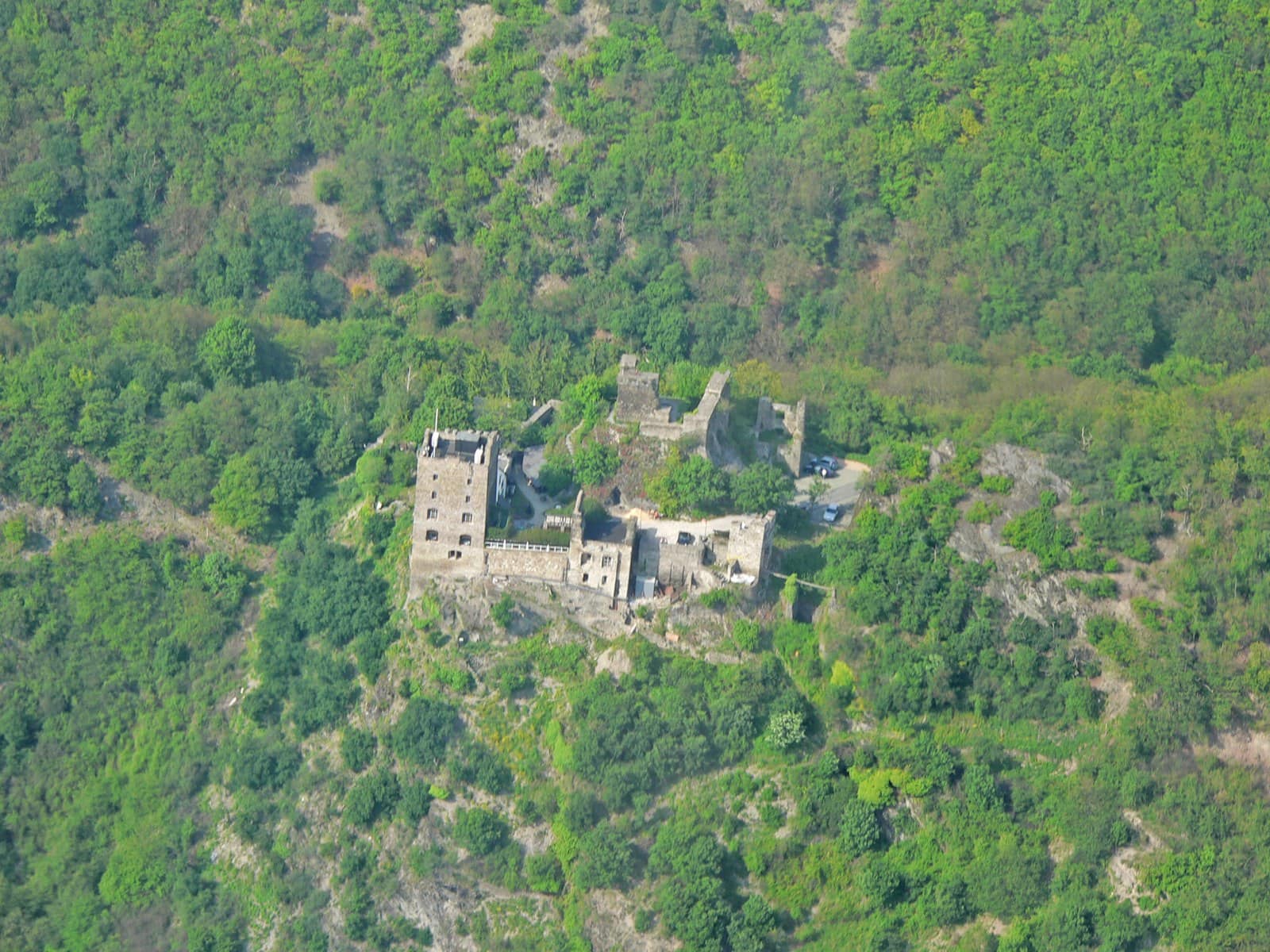
Hotel Burg Liebenstein operates seasonally and closes annually at the end of October. The restaurant takes a Monday Ruhetag, with hotel check-in from 15:00 on most days and from 18:00 on Mondays. Reservations are taken by phone (+49 6773 308) or through the booking form at burghotel-liebenstein.de. Room rates run in the mid-three-figure euros per double room including breakfast, with discrete winter promotions in November and December. The hotel’s evening kitchen is a set-menu five-course format rather than à la carte; dinner reservations are taken from outside guests subject to seating. The Burggarten and terrace are accessible to day visitors during opening hours without a reservation. Entry tickets and local tours can also be booked in advance through GetYourGuide.
The Rheinsteig long-distance trail (Etappe 9, Kestert to Osterspai) runs literally through the castle courtyard, descending from the Hindenburghöhe and continuing past Sterrenberg toward Filsen. Hikers in walking gear are part of the daily traffic; the Burgterrasse serves refreshments. Liebenstein and Sterrenberg can be combined as a short loop walk: fifteen minutes between the two castle gates if you take the direct path. Beyond the courtyard, Liebenstein does not offer a developed exhibition trail of the kind Sterrenberg’s state-managed Bergfried-exhibition provides. This remains a working hotel rather than a public monument, and visitors should calibrate expectations accordingly.
One travel constraint for 2026 deserves attention. The right-bank Rhine railway between Wiesbaden and Neuwied (the line that serves Kamp-Bornhofen, the stop for both castles) is closed from July 10 to December 12, 2026 for the Deutsche Bahn InfraGO Korridorsanierung. During the closure the regional VIAS RB 10 is suspended and replaced with substitute buses (SEV); long-distance services reroute to the left bank. Travelers in this window should plan via SEV from Koblenz or via the left-bank rail line (alighting at Boppard or Bad Salzig and crossing on the Kamp-Bornhofen passenger ferry). Schedules are at bahn.de and on the DB InfraGO project portal. Anyone staying overnight can compare hotels in and around Kamp-Bornhofen.
Some links on this page are affiliate links, which means StoneKeep Atlas may earn a small commission, at no extra cost to you, if you book through them.
Beyond Liebenstein
Liebenstein’s closest companion in every sense is Burg Sterrenberg across the saddle: the senior castle, the Kurtrier outpost from 1310, the one with the famous outer wall and the well-documented twelfth-century foundation. Reading the two together is the natural way to understand either. A second pairing worth a long look is Marksburg at Braubach, the only Middle Rhine castle that was never destroyed and has been in continuous occupation since the 13th century; Marksburg’s preservation arc, like Liebenstein’s, runs through continuous private (then institutional) ownership rather than 19th-century reinvention. The Kaub paired duo (Pfalzgrafenstein in the river and Gutenfels on the hill above) show the same Mittelrhein pattern of a working toll and an overlooking residence, though Gutenfels is closer in scale to Liebenstein than to Sterrenberg. Across the Loreley reach, Burg Katz and Burg Maus face each other in another paired duo; Maus is the castle whose construction in the 1350s ended Sterrenberg’s strategic life and reset the Middle Rhine’s military geography around new positions further north. Burg Rheinfels at St. Goar, the largest ruin in the gorge, is the regional anchor for any deeper Middle Rhine visit. And across the river and a few kilometers north stands Stolzenfels, the Kurtrier residence whose 1836–1842 rebuild by Schinkel and Stüler became the canonical Rhine Romantic restoration, and the case Liebenstein most clearly is not.
For the wider Middle Rhine landscape (the twelve canonical castles of the inscribed UNESCO valley, traced downstream from Bingen to Koblenz), see Castles of the Middle Rhine.
Conclusion
Liebenstein’s claim on attention is not the legend the tourist boards still print. It is the particular shape of its survival: a castle founded by a Habsburg cadet’s wedding, transferred by a Lehenbrief that turned three Sterrenberg ministerials into the new lineage of a Ganerbenburg, held jointly by up to ten families through two centuries that delivered Kurtrier to its sibling next door but never to it, and quietly preserved through the long ages (including the loud 19th century) by a private owner family that had no reason to remake it as a stage set. The Nickenig family’s kitchen and the Burgterrasse the Rheinsteig walks across are the latest, but not the most consequential, chapters of the same continuous arrangement. Legend is a story attached to two ruins. The castle itself is a story about the value of being left alone. Where the brothers came from is a separate question: our reference on castle ghost stories and their first written records traces the pair to a travel diary of 1587 that describes both ruins and contains no ghost at all.
Principal Sources
- Engelhardt, Claudius. “Das Grabdenkmal von Franz von Liebenstein und Margarete von Enschringen.” Heimatjahrbuch des Rhein-Lahn-Kreises (2024): 177–183. Höhr-Grenzhausen: Linus Wittich Medien, 2023.
- Friedrich, Reinhard. “Liebenstein.” EBIDAT — Burgendatenbank des Europäischen Burgeninstituts. Deutsche Burgenvereinigung, record 75. ebidat.de.
- Goerz, Adam. Mittelrheinische Regesten. Bd. IV, 1281–1300. Koblenz: Hölscher, 1886.
- Ketterer-Senger, Iris, Philipp Siemens, and Florian Weber. “Burg Sterrenberg südöstlich von Kamp-Bornhofen.” KuLaDig — Kultur.Landschaft.Digital. Landschaftsverband Rheinland, 2023; updated 2026. kuladig.de.
- Monschauer, Winfried. Burg Liebenstein über Kamp-Bornhofen. Rheinische Kunststätten Heft 506. Köln: Rheinischer Verein für Denkmalpflege und Landschaftsschutz, 2008.
- Pröhle, Heinrich. Rheinlands schönste Sagen und Geschichten. Berlin: Tonger & Greven, 1886.
- Rau, [author]. “Die Burg Liebenstein in Kamp-Bornhofen.” regionalgeschichte.net. 2004. regionalgeschichte.net.
Image credits. Featured: Burg Liebenstein and the Rhine, Jörg Braukmann, CC BY-SA 4.0. Wohnturm and Bergfried exterior: Phantom3Pix, CC BY-SA 4.0. Winter aerial: Roland Todt, edited by Sir Gawain, CC BY-SA 3.0. Sterrenberg and Liebenstein longitudinal section and ground plan: Ferdinand Luthmer (1914), public domain. Liebenstein from the south-west, Rhine front: Ferdinand Luthmer (1914), public domain. Burgterrasse and Wohnturm today: Roland Todt, CC BY-SA 3.0. All images via Wikimedia Commons. Freely licensed images are resized to fit; otherwise unaltered.