
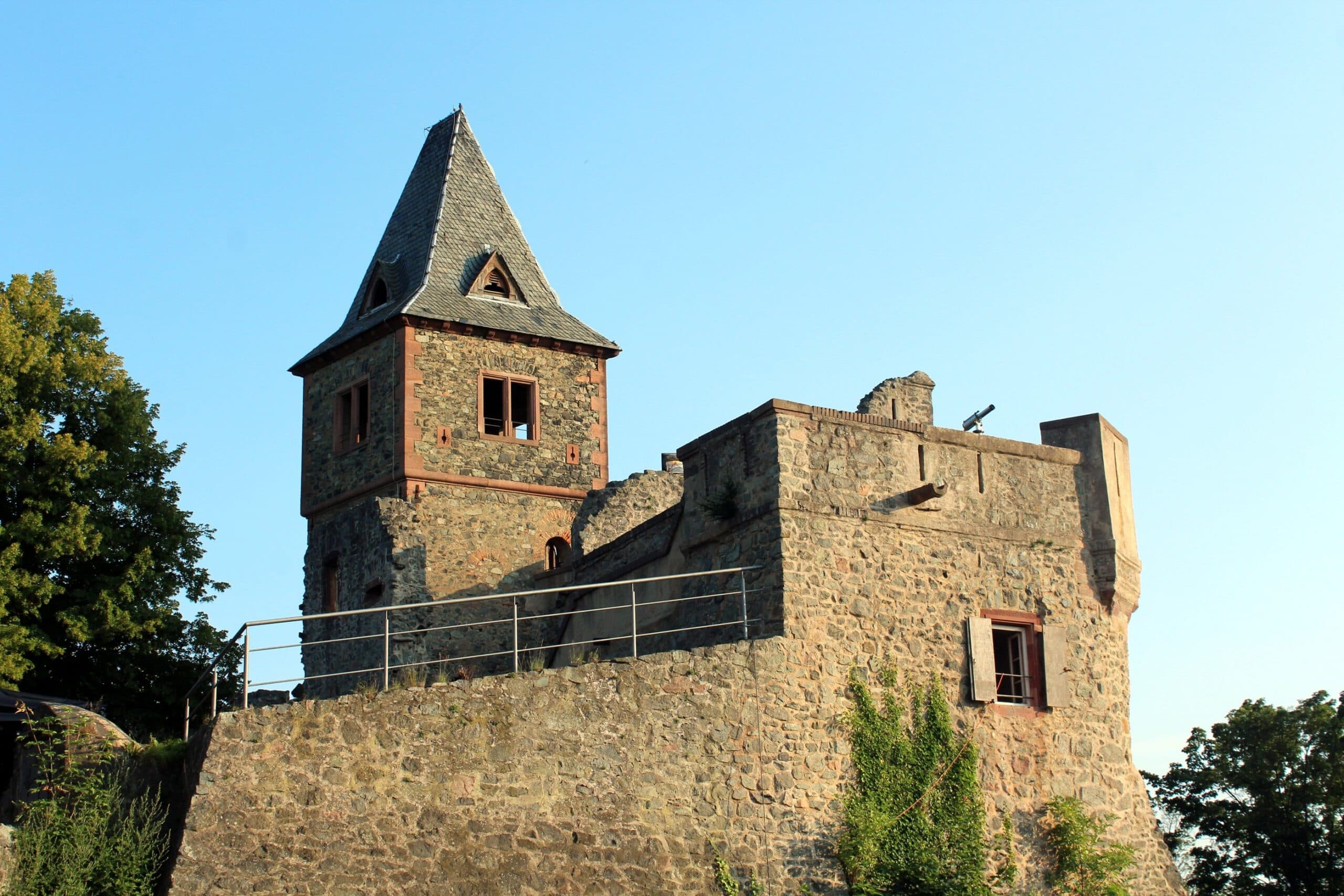
Frankenstein Castle
Frankenstein Castle is a medieval ruin on the wooded northern edge of the Odenwald, a few kilometers south of Darmstadt in the German state of Hesse. It is one of the most visited castle names in the world and one of the least understood. Most people arrive expecting the laboratory of a mad scientist and the birthplace of a famous monster. What stands on the hill is older and quieter than that: a genuine thirteenth-century knights’ castle, founded by a real family who took its name, fought its feuds, and sold it to a landgrave long before an English teenager published the novel that made the word Frankenstein a household horror.
This guide keeps the history and the legend in separate rooms. Its documented history has a clear story, from a first mention in 1252 to the restoration that began in 2023. The legend, the part most visitors come for, is mostly a modern invention, and the honest version is more interesting than the marketing one. Both are worth telling, so long as nobody confuses them.
Quick Facts
| Location | Mühltal (Nieder-Beerbach), south of Darmstadt |
| Region | Hesse, Germany |
| Setting | Hilltop, 370 m above sea level, on a spur of the Langenberg |
| Built | Around 1240 |
| First documented | June 2, 1252 |
| Founder | Konrad II Reiz von Breuberg and Elisabeth von Weiterstadt |
| Type | Hill castle (Burg), now a ruin |
| Condition | Partially ruined; chapel and two towers stand |
| Sold to Hesse | 1662, to Landgrave Ludwig VI of Hesse-Darmstadt |
| Current use | Events venue and former restaurant; under renovation since 2023 |
| Owner | State of Hesse (Staatliche Schlösser und Gärten Hessen) |
| Famous for | Its name’s link to Mary Shelley’s novel (disputed) |
| Nearest town | Darmstadt |
| Coordinates | 49.7933° N, 8.6682° E |
| Official site | schloesser-hessen.de |
The medieval origins of Frankenstein Castle
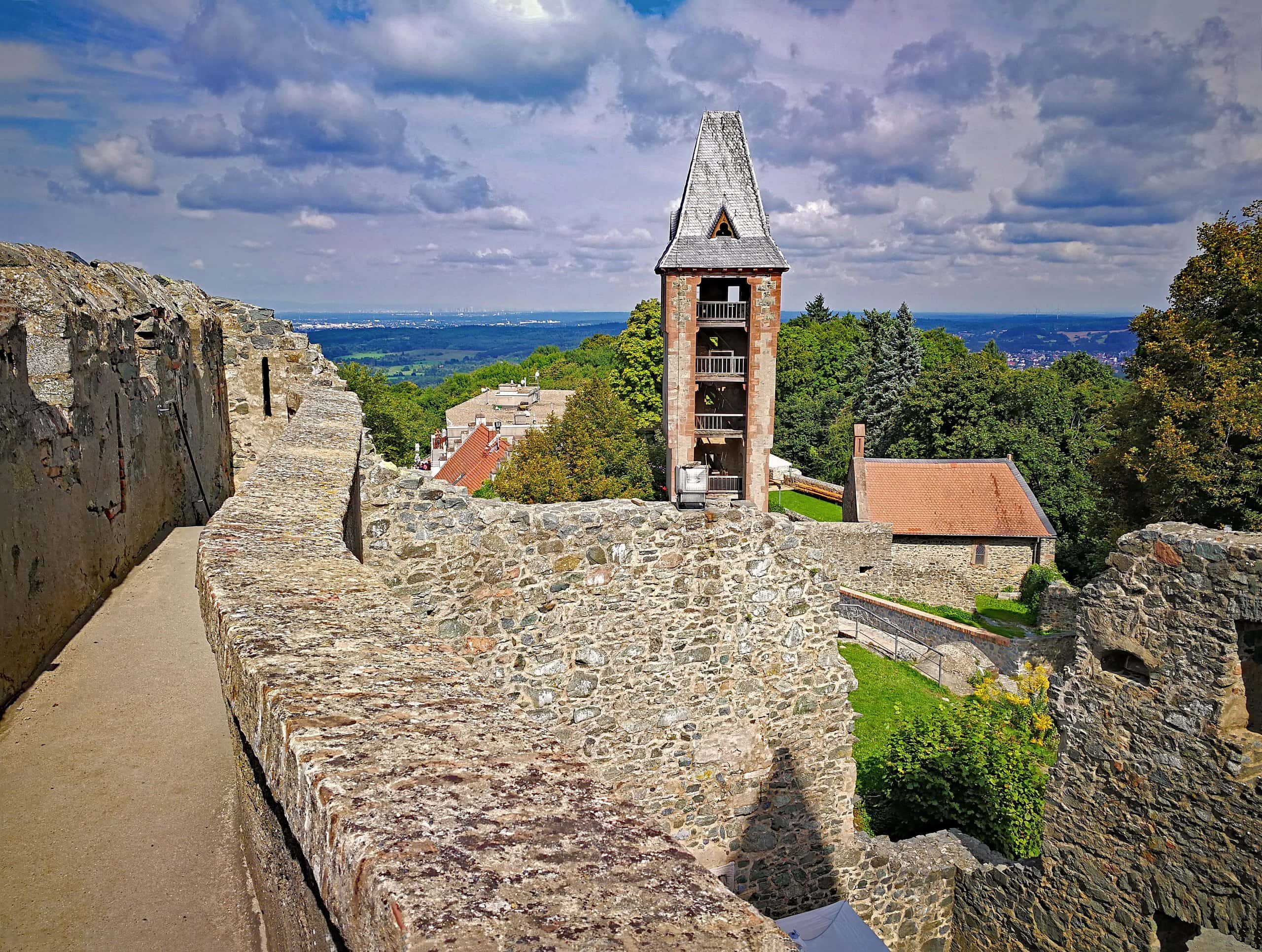
Frankenstein Castle stands on a spur of the Langenberg at 370 meters above sea level, the northernmost in a chain of strongholds that runs along the western rim of the Odenwald and looks out over the Rhine plain. Below it runs the old Bergstraße, the mild wine road that hugs the foot of the hills, about a kilometer and a half to the west and some 225 meters lower. From the towers the view reaches far across the flat land toward the river, which is exactly why a knight chose to build here.
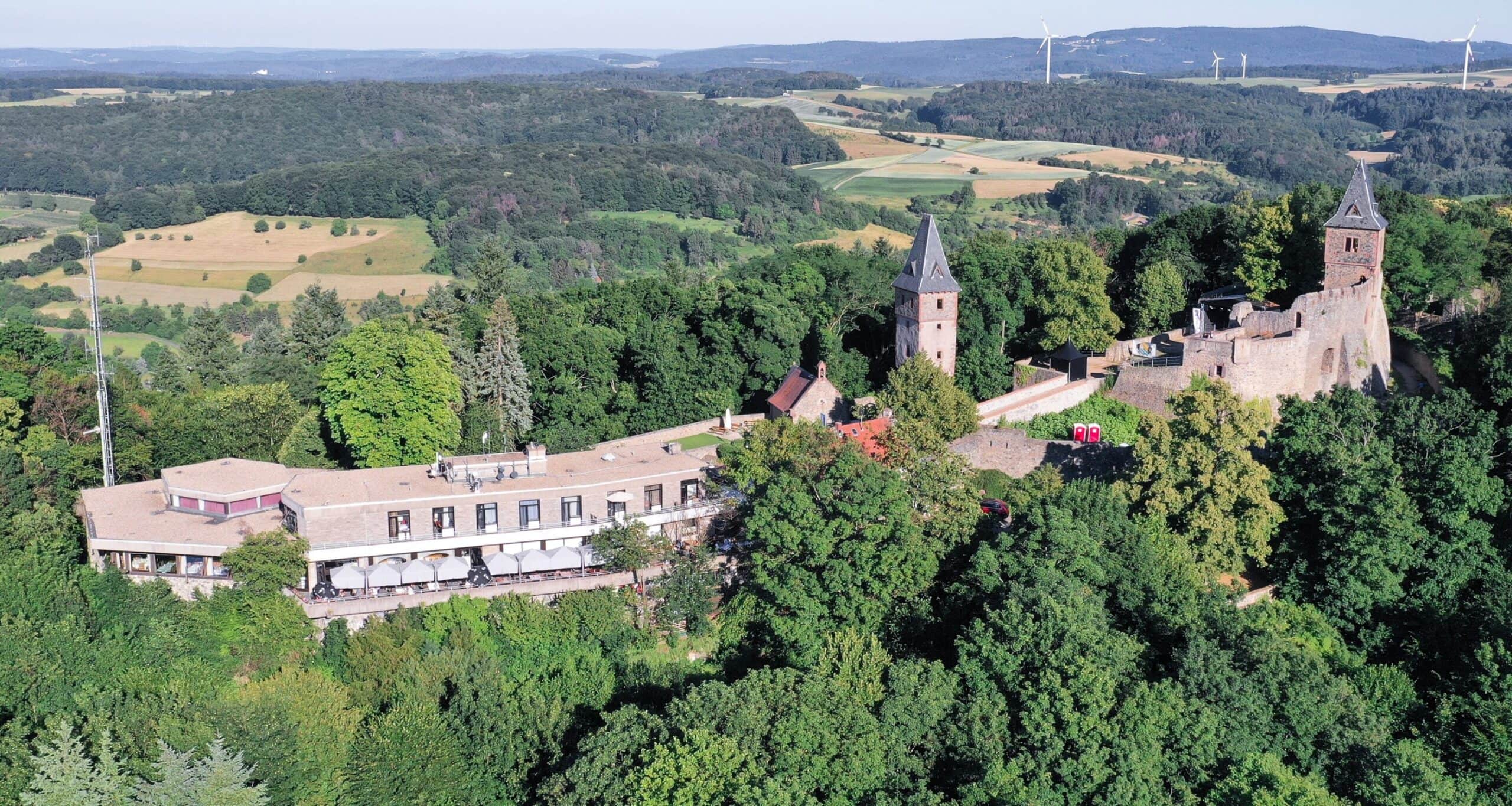
Most historians put that building around 1240. The first hard evidence comes a little later, in a charter dated June 2, 1252, in which Konrad II Reiz von Breuberg and his wife Elisabeth von Weiterstadt are named at a place recorded in Latin as super castro in frangenstein, “on the castle at Frankenstein.” The wording matters: it shows the castle already stood and was in use by 1252, so the document marks a first mention, not a founding. Konrad came from the lords of Breuberg, an old dynasty seated deeper in the Odenwald. Through his marriage to Elisabeth he gained lands along the Bergstraße, built or took over the hilltop seat, and began to call himself Konrad I von Frankenstein. His descendants styled themselves “von und zu Frankenstein” for the next four centuries.
Stories of a much older fortress on the hill, including a tenth-century stronghold won by a knight named Arbogast in a game of arms, circulate widely and rest on nothing. An earlier residence on or near the site is plausible, but no record supports a date before the thirteenth century. The name itself is plainer than the legends suggest. Franken are the Franks, a Germanic people, and Stein means stone or rock; the name points to the crag the castle sits on, not to any monster.
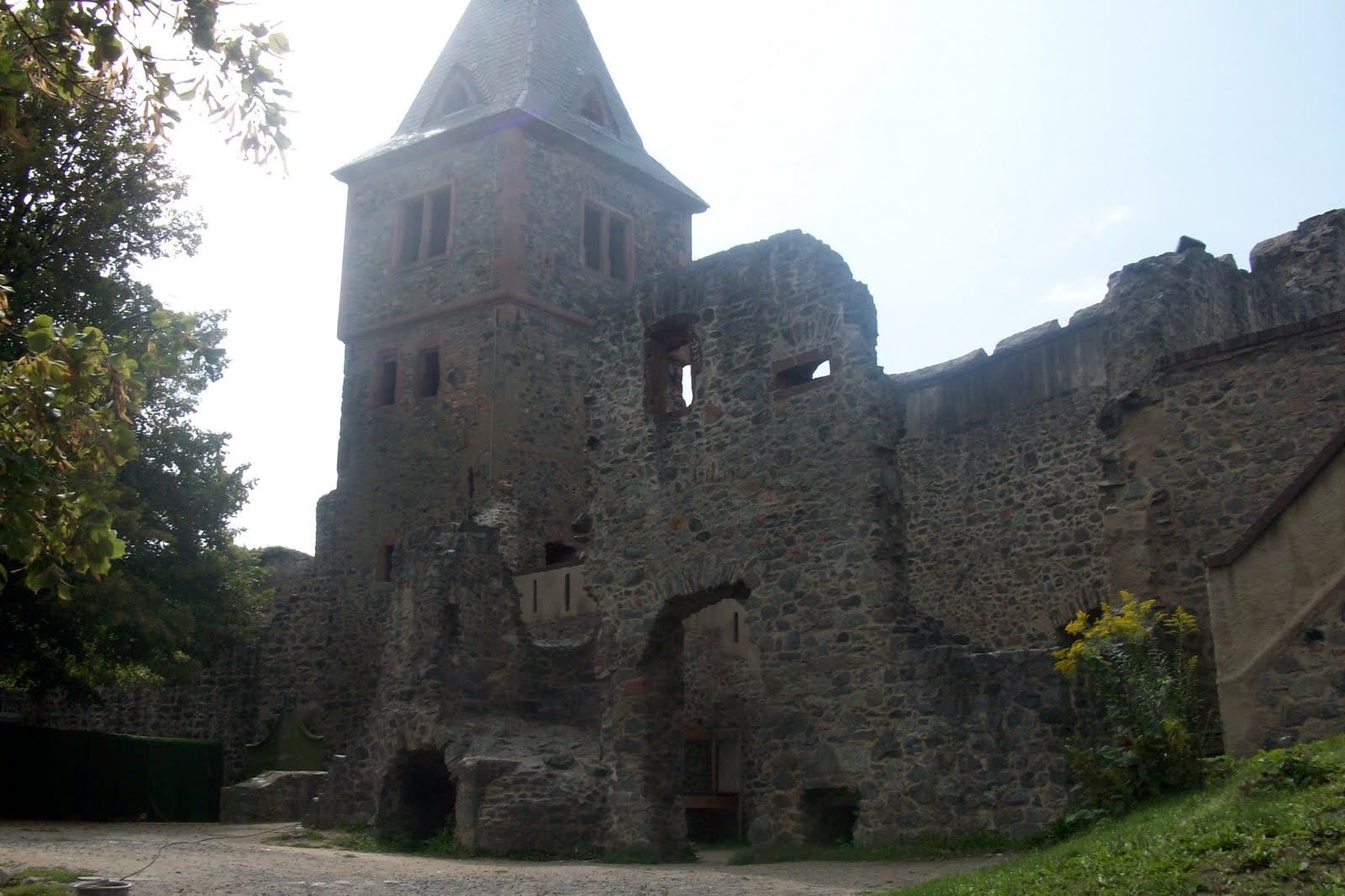
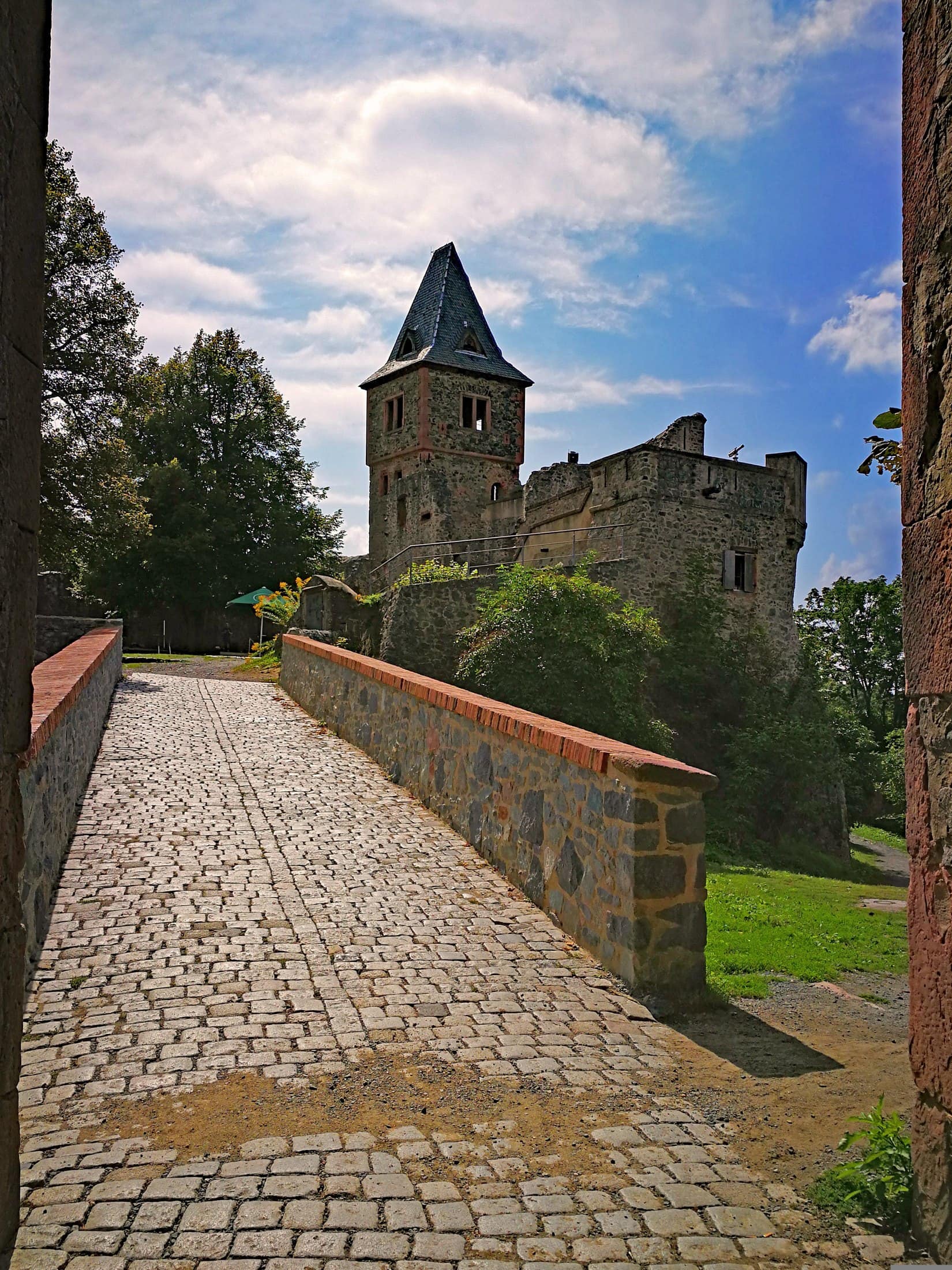
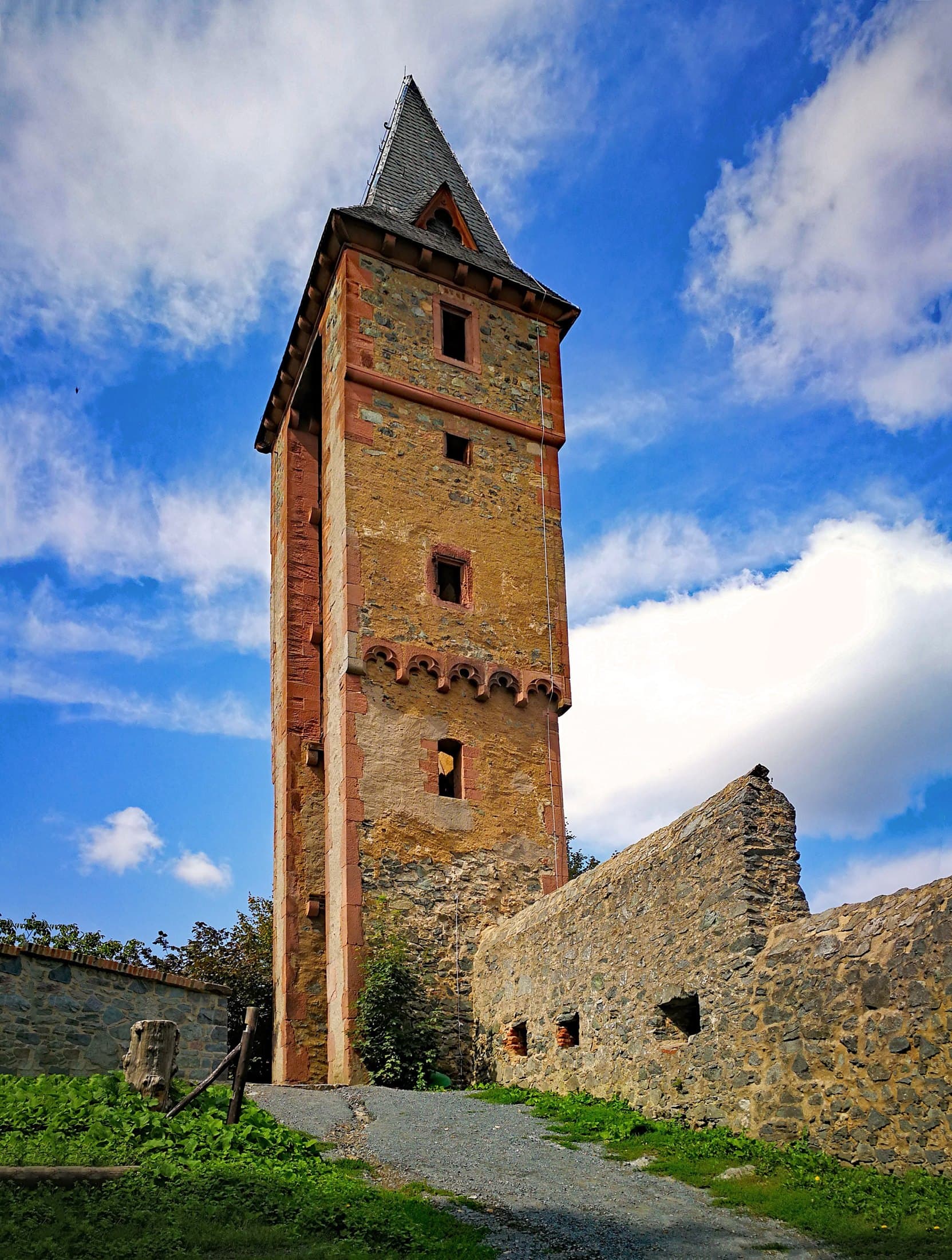
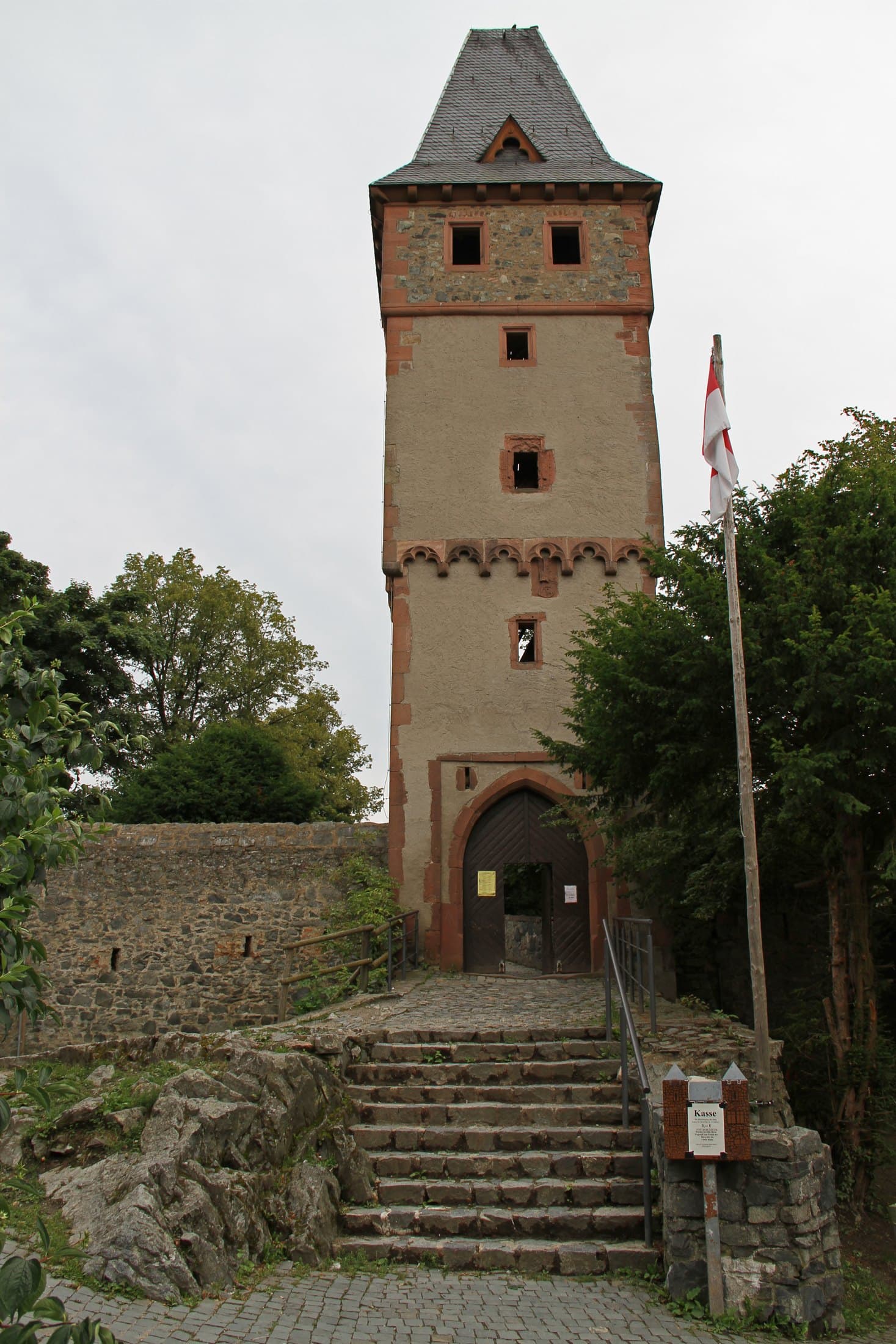
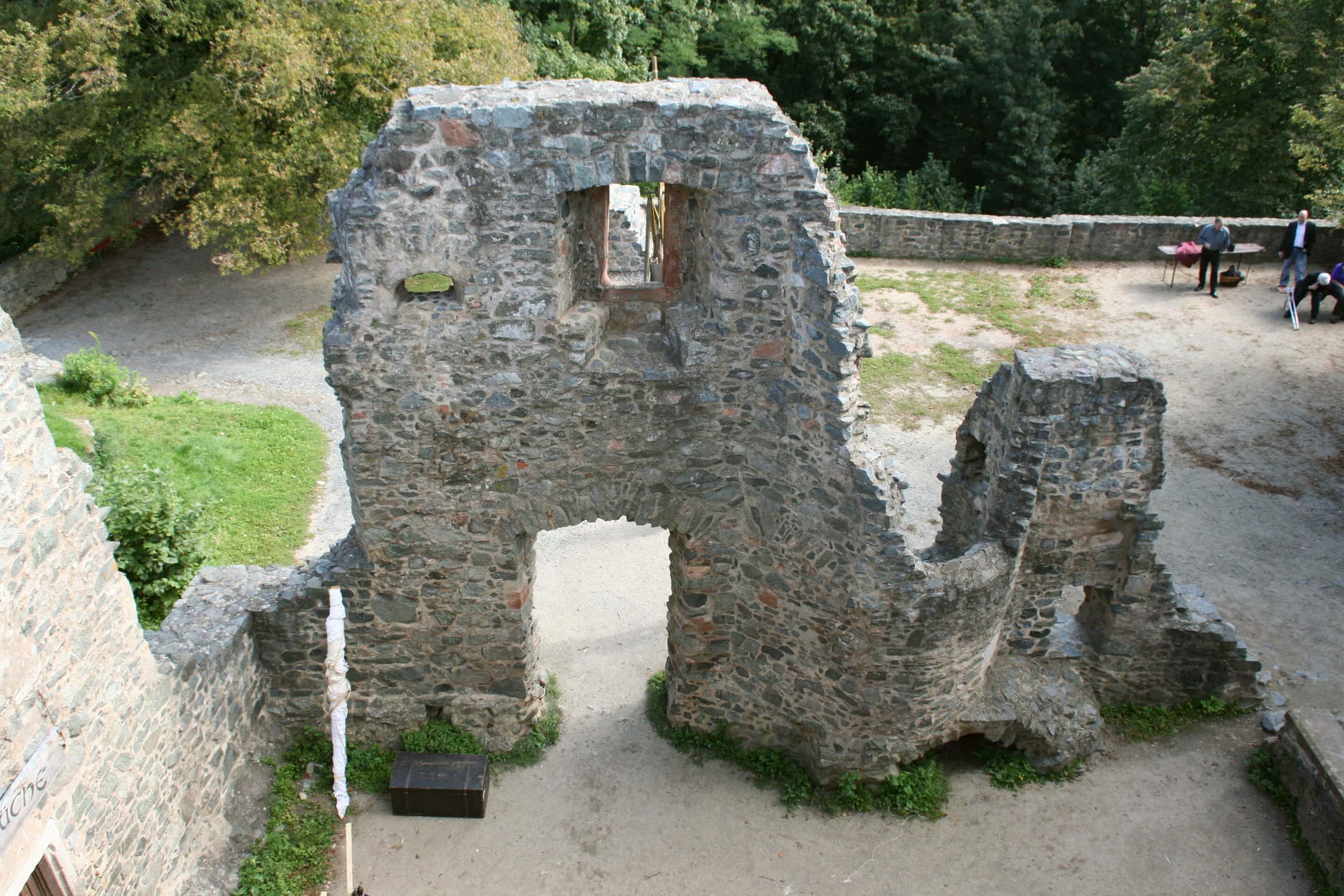
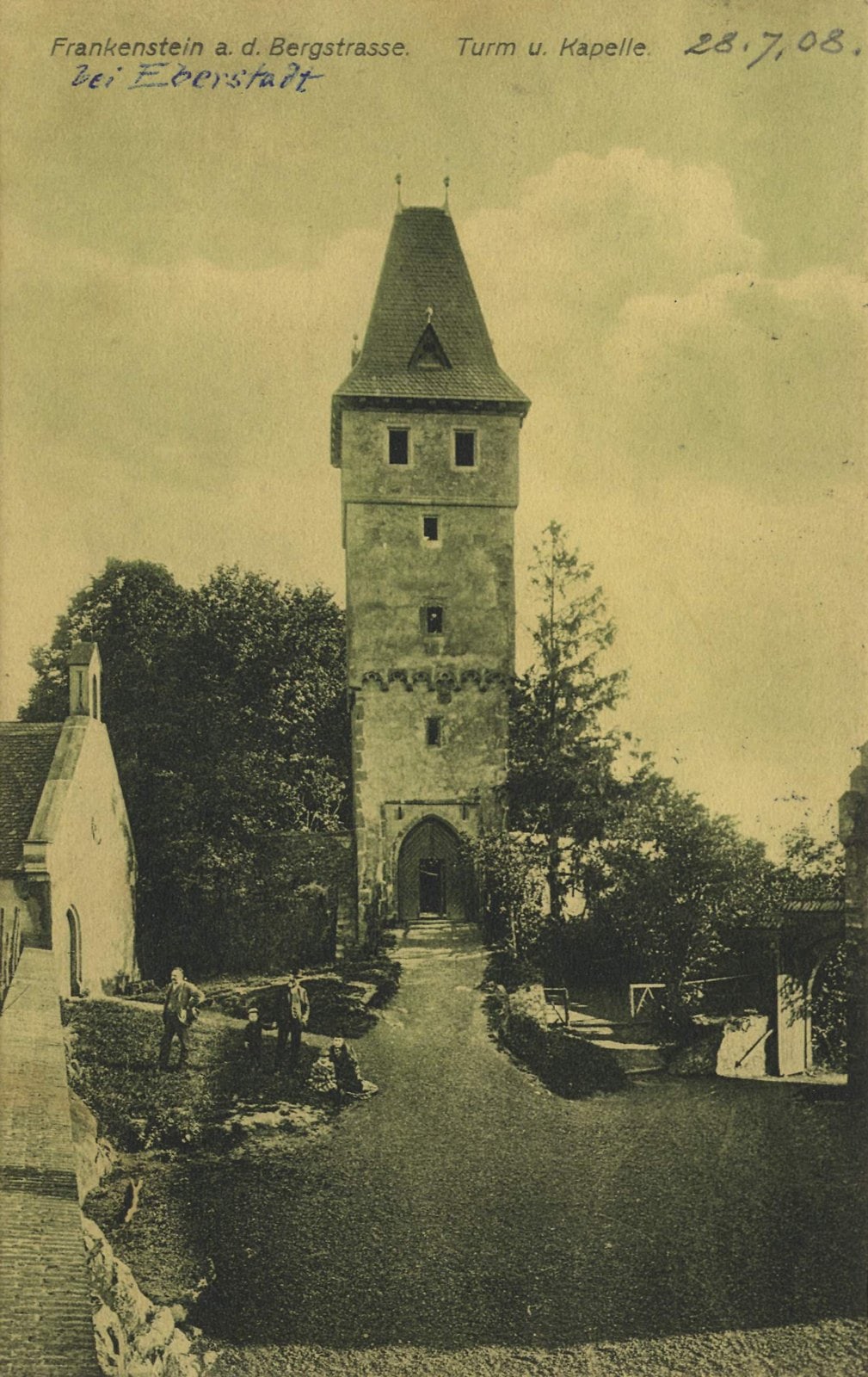
What survives from this earliest phase is the southern core, the inner bailey to the right of the west gate. Thick walls with battlements and a wall-walk enclosed a narrow courtyard, a well house, a kitchen building, and the residential hall. Outer walls of the timber-framed buildings doubled as the castle’s curtain, which is why they were built so heavily. The tall gate tower that guards the approach came later, in the late fourteenth century, reached by a path that was once a drawbridge. It was deliberately left open at the back, so that if an enemy ever seized it the defenders in the core could keep firing on the captured tower and deny them cover. None ever did.
A divided castle and the height of the lordship
The Frankensteiners were never as independent as the romance implies. The castle began as a fief held from the powerful Counts of Katzenelnbogen, and a second charter from a few years after 1252 stresses that dependence plainly. As castellans they held rights in Zwingenberg, Darmstadt, Groß-Gerau, Bensheim, and Frankfurt, and in 1433 Konrad von Frankenstein traveled all the way to the Holy Land in the company of his lord, Count Philipp von Katzenelnbogen.
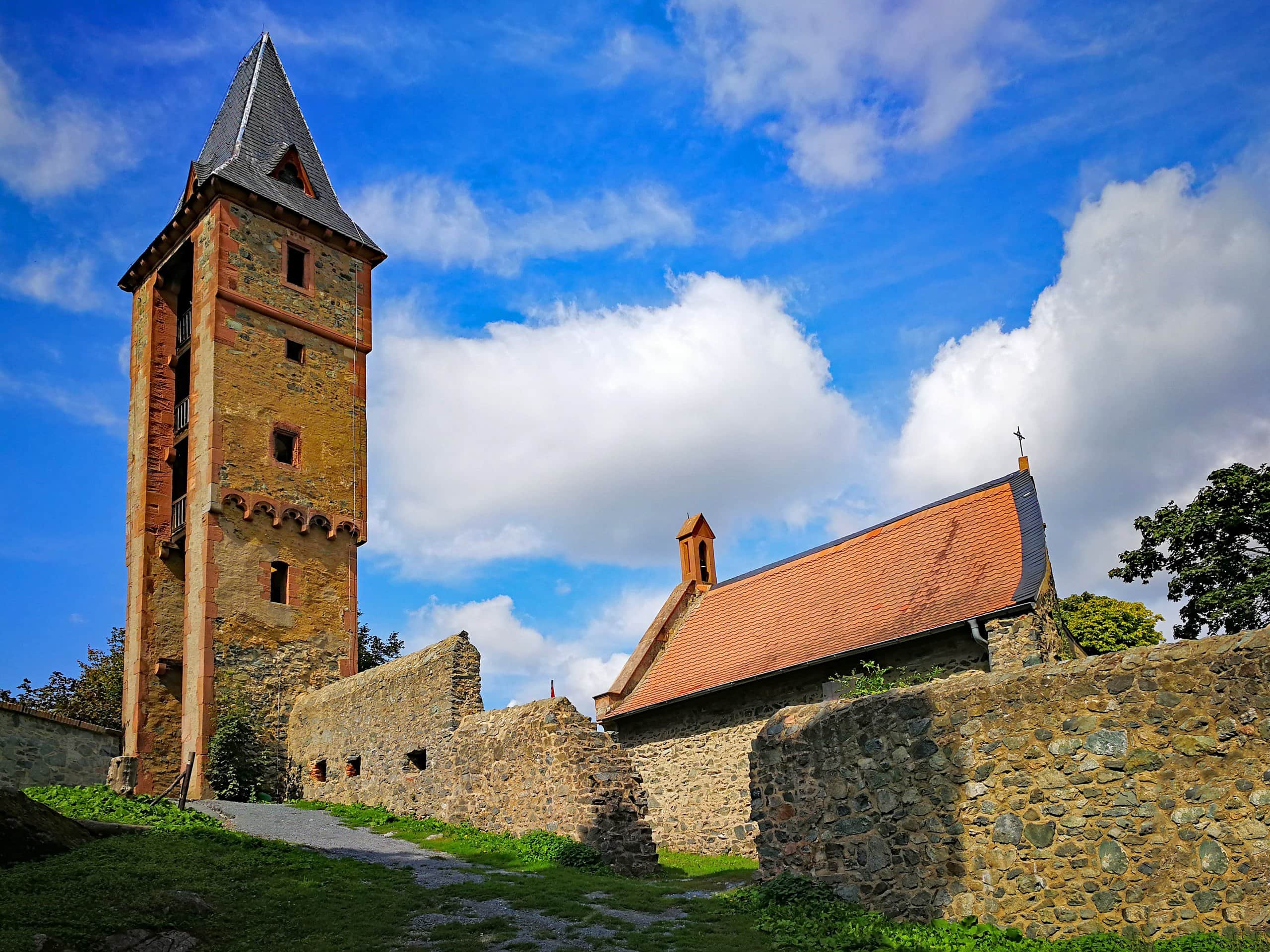
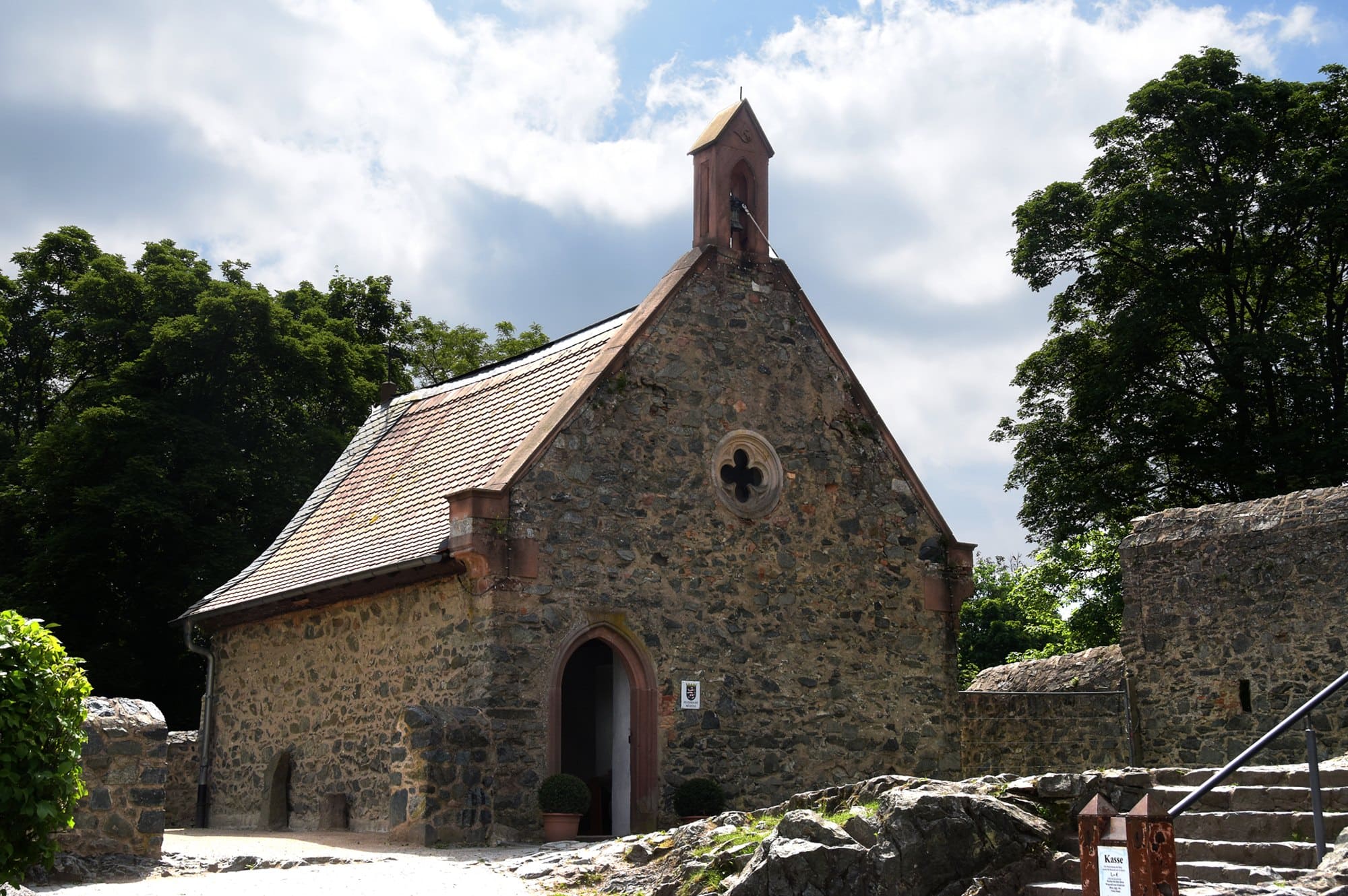
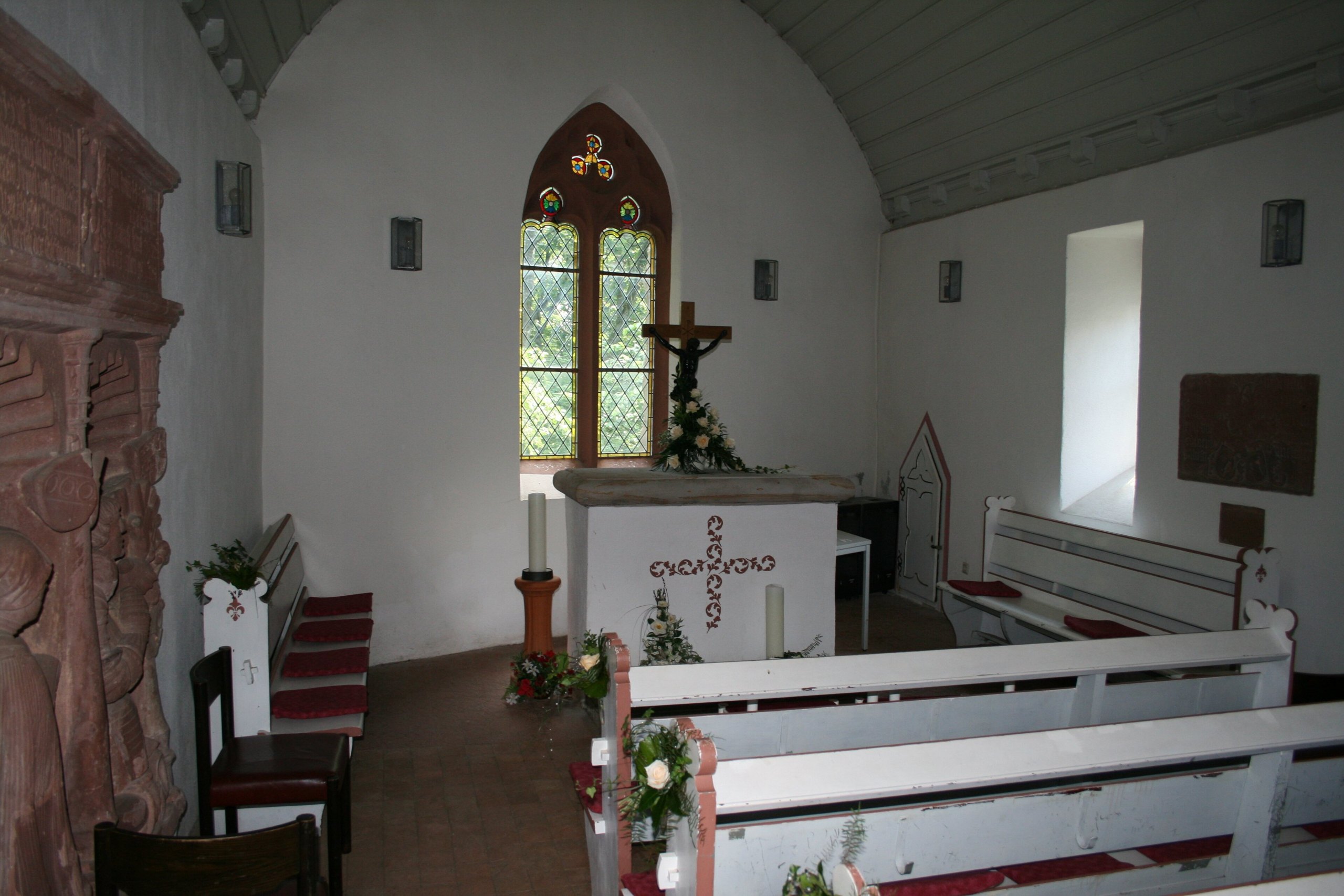
During the fourteenth century the line split in two. The relatives divided the castle itself under a minutely worded peace agreement, the Burgfrieden of 1363, an arrangement that produced steady legal quarrels for generations instead of harmony. Around 1400 the family’s fortunes rose. Its cramped hilltop seat was enlarged with an outer bailey to the north and thoroughly modernized, and in 1402 the castle, together with the village of Nieder-Beerbach, was finally recognized as an imperial fief, free at last of the Katzenelnbogen counts. Of everything raised in that outer bailey, only one building still stands today: the chapel, completed in 1474, which now serves a much gentler purpose than defense.
Prosperity continued into the sixteenth century, the family’s economic high point, when further building brought the castle to the full extent whose footprint can still be read in the ruins. After that, the long descent began.
The sale to Hesse and the long decline
In 1662 the lords of Frankenstein sold the castle and its lordship to Landgrave Ludwig VI of Hesse-Darmstadt and left the Odenwald for good. They bought a new seat at Ullstadt in Middle Franconia, where their descendants live to this day, and in 1670 Emperor Leopold I raised them to imperial barons, a title the family still carries. Later generations rose high: one became Prince-Bishop of Bamberg in 1746, and a nineteenth-century baron drafted an important imperial finance law that bore the family name.
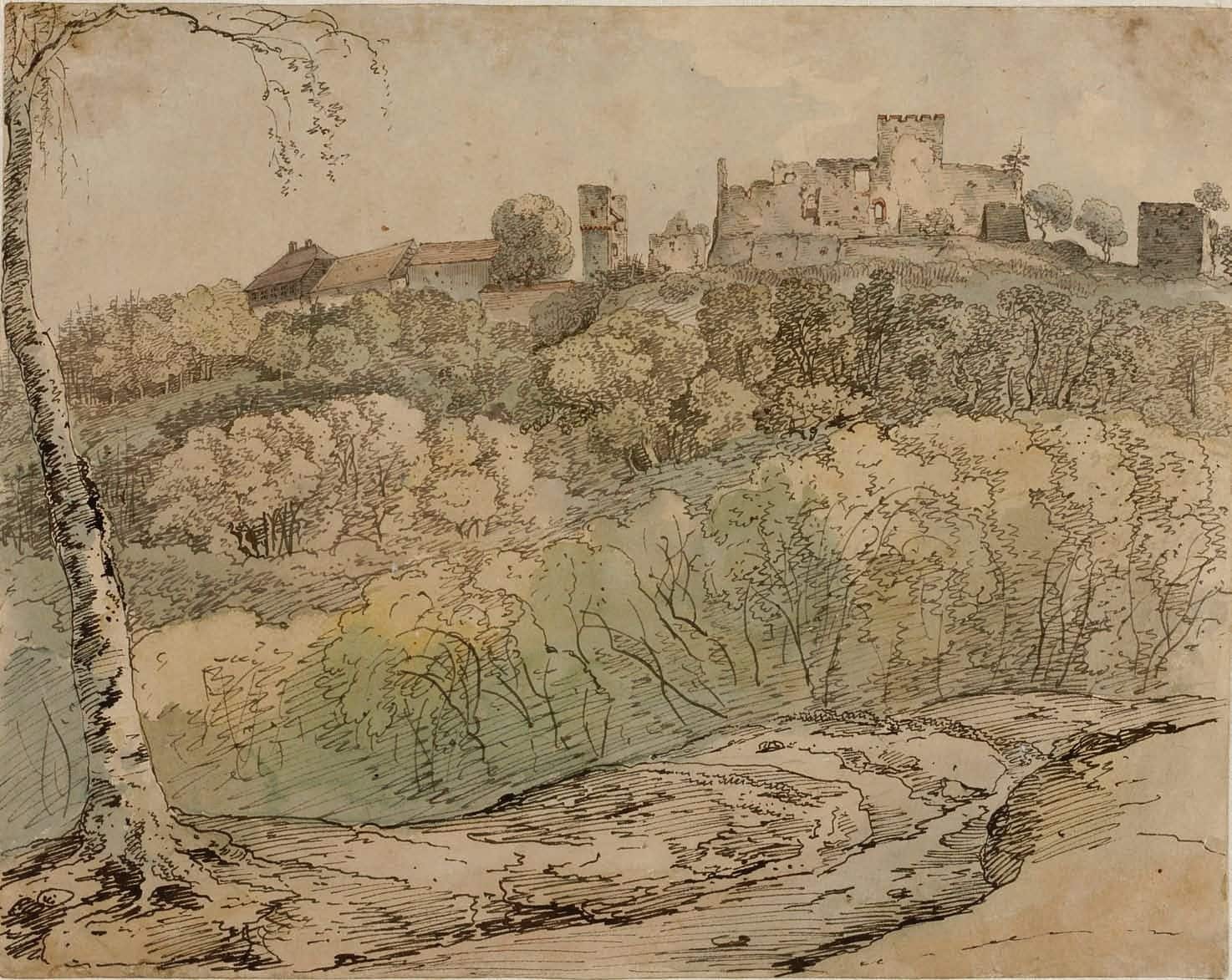
The castle they left behind had a rare distinction. In four centuries it had never been besieged, stormed, or destroyed by war. What ruined Frankenstein was neglect. Its new owner cared more for the territory than for the old stronghold on the hill, and the building was put to humbler use, housing military invalids and serving as a refuge during the wars of Louis XIV of France. Treasure hunters chasing rumors of hidden gold tore down walls and broke open cellars. Lead from the roofs, tiles, timber stairs, and the contents were stripped and sold. Farmers from the valley villages quarried the abandoned walls for cheap building stone until, in the worst stretches, scarcely one block sat on another. The castle that no army could take was dismantled, slowly, for parts.
The Romantic ruin and a nineteenth-century rebuild
By the early nineteenth century the overgrown, forest-wrapped ruin had become something new: a destination. Romantic taste prized exactly this kind of place, a moss-covered shell above a wide view, freighted with the imagined glamour of knighthood. Hikers and day-trippers climbed the hill to feel the past, and writers gave the stones their legends.
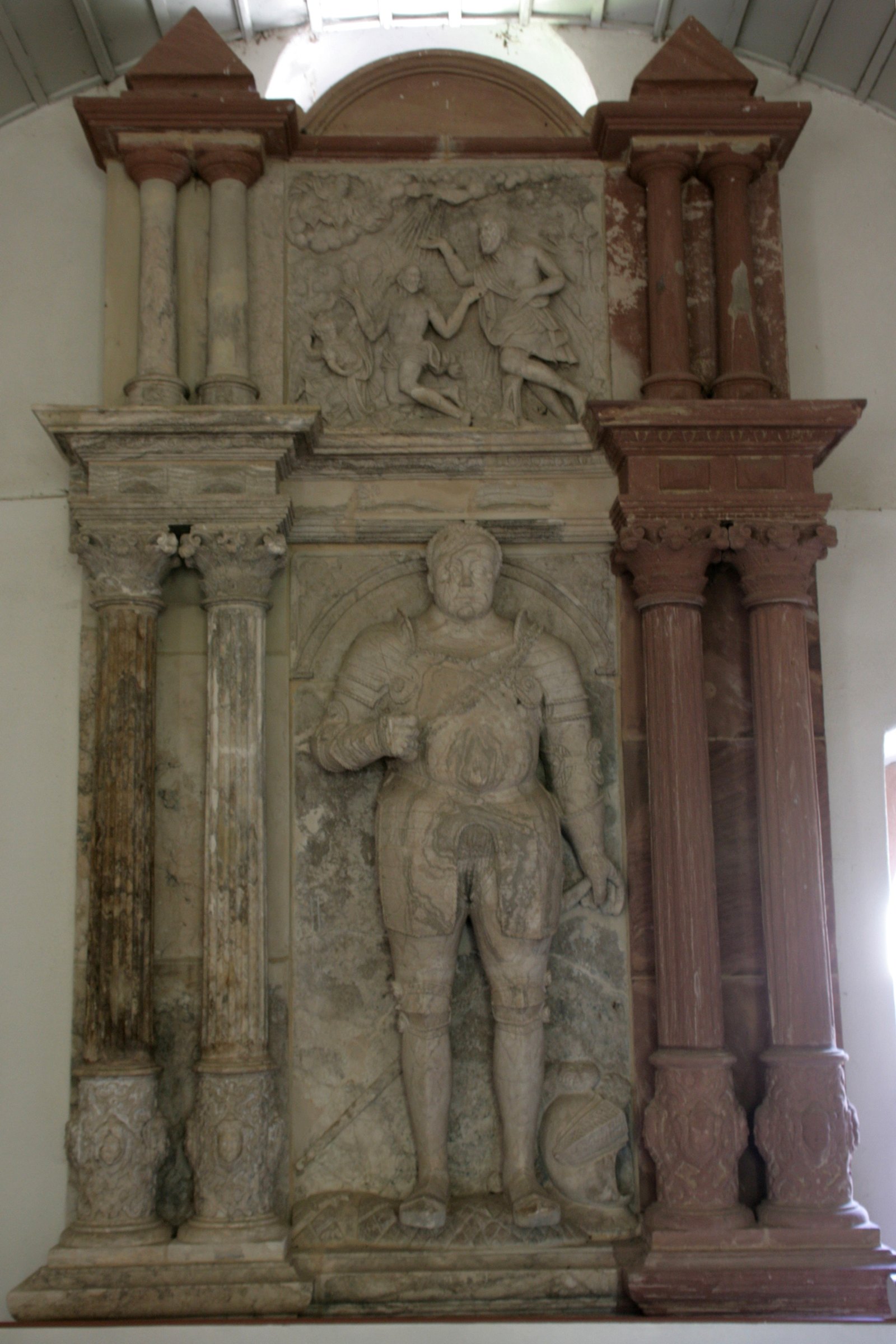
Grand Duke Ludwig III tried to halt the decay around the middle of the century. His restoration secured the ruin but was guided by Romantic taste rather than archaeology, and it was carried out inaccurately, in places adding floors and features the castle had never had. It was also Ludwig III who, in 1851, gathered the family’s Renaissance grave monuments from the parish churches of Eberstadt and Nieder-Beerbach and installed them in the castle chapel, where they still stand. A tower of the inner castle was given extra storeys in 1892, so its upper part is nineteenth-century work. The result is a ruin that wears a little nineteenth-century fiction along with its genuine medieval fabric, which is oddly fitting for a place whose fame would rest on a story.
The twentieth century added the most-used building of all. With the ruin drawing steady streams of walkers and excursionists, a panorama restaurant with a viewing terrace was built in the outer bailey in 1965. Weddings, company parties, and public festivals followed, and for more than two decades the medieval chapel has served the municipality of Mühltal as a registry office for civil weddings. For half a century the castle earned its keep as a view, a venue, and a name.
Johann Konrad Dippel, the alchemist of Frankenstein
Every version of the legend runs through one real person. Johann Konrad Dippel was born at the castle in 1673, the son of a Lutheran pastor, and he grew into one of the stranger figures of the German Enlightenment: a theologian, alchemist, and self-styled physician who quarreled with nearly everyone. He is best remembered for Dippel’s Oil, a foul-smelling animal oil distilled from bones and offal that he marketed as a near-universal medicine and an elixir of life. By one account he even offered the formula to the landgrave in exchange for the castle of his birth, and was turned down. His real life was eventful enough without the monsters. Trained in theology at Gießen, he feuded with the orthodox Lutherans of his day, drifted toward radical Pietism, wandered between Germany, the Netherlands, and Scandinavia, and spent years imprisoned for his heretical pamphlets. His animal oil outlived him by more than a century, used as a medicine, an insect repellent, and, during the Second World War, a way to spoil well water so retreating armies could not drink it.
That is roughly where the documented Dippel ends and the legend begins. Tales of body-snatching, of corpses dragged up the hill and stitched together, of experiments behind the chapel walls, have no basis in the record. Historians point out that nothing shows Dippel ever returned to the castle after he finished his studies at Gießen in 1693. One frequently repeated claim, that he experimented with nitroglycerin at Frankenstein, collapses on contact with a calendar, since nitroglycerin was not discovered until more than a century after his death. Even Radu Florescu, the historian who proposed the link to Shelley in 1975, could only guess that any experiments happened at the castle or at a family inn nearby. The man was real, his oil was real, and his reputation for ghoulish science was largely assembled long after he was gone.
The Frankenstein legend: what is documented and what is not
The claim that draws most visitors is that this castle inspired Mary Shelley’s Frankenstein; or, The Modern Prometheus. It is a wonderful idea, and the evidence for it is thin.
Shelley did travel through the Rhineland in 1814, a few days after her seventeenth birthday, on the way home from Switzerland with Percy Shelley. Their boat tied up for a night at Gernsheim, a Rhine town about sixteen kilometers from the castle. From there, in clear weather, a traveler might just make out towers on the distant hills. That is the whole of the geographic connection. There is no mention of the castle in Shelley’s journals, no record that she climbed the hill, and no castle on this stretch of the Rhine in her novel, which sends Victor and Clerval past it from Mannheim to Mainz and finds its Rhine castles only below Mainz; its Victor Frankenstein is a Swiss student from Geneva who does his work at the University of Ingolstadt. The lightning that famously animates the creature belongs to the 1931 film, not the book.
Where, then, does the legend come from? Largely from recent decades. A historian floated the Dippel connection in 1975, and a 1999 book by the castle’s own resident author popularized it in Germany, recasting the alchemist as Shelley’s model and the castle as the place she caught the story. German scholarship has since treated the link as a constructed myth, not a discovery. A favorite supporting thread holds that the Brothers Grimm passed the tale to Shelley’s stepmother, who translated their fairy stories into English; it is suggestive and unproven. The same recent vintage applies to the other “ancient” lore: the magnetic stones of the nearby Ilbes-Berg, said to be a witches’ mountain second only to the Brocken, do not appear in the region’s actual witch-trial records. The oldest genuine local tale is gentler and has nothing to do with the monster, a knight named Georg who kills a dragon menacing the valley below, a homegrown cousin of Saint George. It grew up around the tomb of a real Georg von Frankenstein, whose carved effigy treads on a coiled dragon, and reached its familiar form in the nineteenth century. Our reference on haunted castles records the same verdict from the state body that runs the castle, which assigns the Shelley story to the Reich der Fantasie on the castle’s own page.
None of this makes the legend worthless. A story believed by millions is a real thing in the world, and a castle that lends its name to the first science-fiction novel has earned its fame even if it never housed the laboratory. An honest position says which parts are history and which are folklore, and enjoys the folklore as folklore. It is not alone in that: off Marseille, Château d’If is a real fortress-prison the world knows above all as the cell of Dumas’s wholly invented Edmond Dantès.
The Halloween tradition
For nearly half a century the legend had a season. From 1977 to 2023, American servicemen stationed in and around Darmstadt ran a Halloween festival at the castle that grew, by stages, into one of the largest in Germany. Costumed actors and stage effects filled the ruins across three weekends each fall, and the postwar nickname pinned on the place by Armed Forces broadcasts, “the home of the monster,” did the marketing. A separate Frankenstein Castle Run, a punishing thirteen-kilometer race up the forest trails, started in 1977 as well and continued until the American garrison left Darmstadt in 2008.
The festival outlived the garrison but not the building’s needs. When the lease on the whole complex ended in 2023, the state and the event’s organizers could not agree on terms to continue, and from 2024 the Halloween event moved permanently to Burg Königstein in the Taunus, a larger ruin northwest of Frankfurt. The monsters, in other words, have a new home, on a different hill, under a different name.
Visiting Frankenstein Castle
The most important thing to know before planning a visit is that access to the grounds is restricted while the castle is renovated. Since 2023 the State of Hesse, through its building authority, has been carrying out an extensive renovation: the restaurant building is being stripped back almost to its shell and rebuilt, and the historic walls are being strengthened and repaired. The whole site may close from time to time during the work, and restaurant operations are suspended. Staatliche Schlösser und Gärten Hessen posts the planned end of the works on its page for the castle, and that page is the one to check for the current status before you travel, because access has been changing year to year.
Frankenstein sits about five kilometers south of Darmstadt, on the Eberstadt side of the hills, signposted from the A5 autobahn at the Darmstadt-Eberstadt exit. In normal times there is free parking at the foot of the climb, and the wooded slopes around the ruin are laced with easy walking trails that make a fine half-day even when the gates are shut. The Halloween festival that many travelers come looking for is no longer held here; it now runs each October at Burg Königstein in the Taunus and is ticketed separately.
For travelers building a trip around the area, Darmstadt makes the natural base, with the Bergstraße wine road, the Mathildenhöhe art-nouveau colony, and the wider Odenwald all within easy reach. Plan a stay in Darmstadt or the Bergstraße, the natural bases for a visit to the castle.
Some links on this page are affiliate links, which means StoneKeep Atlas may earn a small commission, at no extra cost to you, if you book through them.
More Views of Frankenstein Castle
A few more views of the ruin, its towers, and the surviving chapel.
Beyond Frankenstein Castle
Frankenstein is the northern anchor of the line of castles that edges the Odenwald and the Bergstraße, and it pairs naturally with a few others already in the atlas. Heidelberg Castle, the great red-sandstone ruin above the Neckar an hour to the south, is the definitive German Romantic ruin and the place this one most resembles in spirit, a half-broken stronghold that the nineteenth century learned to love. Eltville Castle, across in the Rheingau, is another Hessian entry in the catalog, an electoral castle on the Rhine with its own riverside character, while far to the north, in the forests above the Edersee, Waldeck Castle completes the Hessian trio as the long-held seat of the Counts of Waldeck. And just east across the Main, the moated Mespelbrunn Castle hides in a Spessart valley, the storybook counterpart to Frankenstein’s gaunt hilltop. Together they trace the arc of Germany’s castle country, from fairy-tale water castle to Romantic ruin to the most famous name of them all.
We have also made a film about Frankenstein Castle; it is listed with the rest of our castle films.
Conclusion
Strip away the monster and Frankenstein Castle is still worth the climb. It is a real knights’ castle with a documented family, a clear architectural story written in its surviving walls, and the rare distinction of never having fallen to an enemy, only to neglect. The legend that made its name is younger and shakier than the souvenirs suggest, built up in the last few decades around a long-dead alchemist and a teenage novelist who probably never came nearer than a Rhine harbor sixteen kilometers away. Knowing that does not spoil the place. It sharpens it. The hill keeps its view, the chapel keeps its quiet, and the name keeps its strange afterlife, and once the scaffolding comes down it will be a fine thing to stand on the spur of the Langenberg and tell the true story for a change.
Principal Sources
- Staatliche Schlösser und Gärten Hessen, the official site of the state heritage authority that owns and is now restoring the castle, for ownership, architecture, and current status.
- German Wikipedia and the regional histories published by the Geschichtsverein Eberstadt-Frankenstein and the Heimatgeschichte Mühltal project, for the documented chronology of the lordship, the 1252 charter, the 1363 Burgfrieden, and the 1662 sale.
- Walter Scheele, Burg Frankenstein: Mythen, Märchen und das Monster (1999), as the book that popularized the modern Shelley thesis, read alongside Jörg Heléne’s critical study of how that myth was constructed, for the legend’s actual provenance.
- Landesbetrieb Bau und Immobilien Hessen, for the 2023 renovation and the closure of the complex.
Image credits. Hero, the castle at golden hour: alicja, via Pixabay; aerial view: Twine333, CC BY-SA 4.0, via Wikimedia Commons; the inner bailey: Yamy, CC BY-SA 3.0, via Wikimedia Commons; gate tower and chapel: lapping, via Pixabay; the chapel: Hewiha, CC BY-SA 4.0, via Wikimedia Commons; Frankenstein family epitaph: Frank Vincentz, CC BY-SA 3.0, via Wikimedia Commons; the ruin drawn by Carl Philipp Fohr: Carl Philipp Fohr, public domain, via Wikimedia Commons; wall-walk and view: lapping, via Pixabay; the cobbled approach: lapping, via Pixabay; the gate tower: lapping, via Pixabay; gate tower and steps: Peter Stehlik, CC BY 3.0, via Wikimedia Commons; inside the chapel: Pascal Rehfeldt, CC BY-SA 3.0, via Wikimedia Commons; a ruined arch in the inner bailey: Frank Vincentz, CC BY-SA 3.0, via Wikimedia Commons; the castle in 1908: Vereinigte Kunstdruckereien Metz & Lautz, Darmstadt, public domain, via Wikimedia Commons. Freely licensed images are resized to fit; otherwise unaltered.