
Waldeck Castle
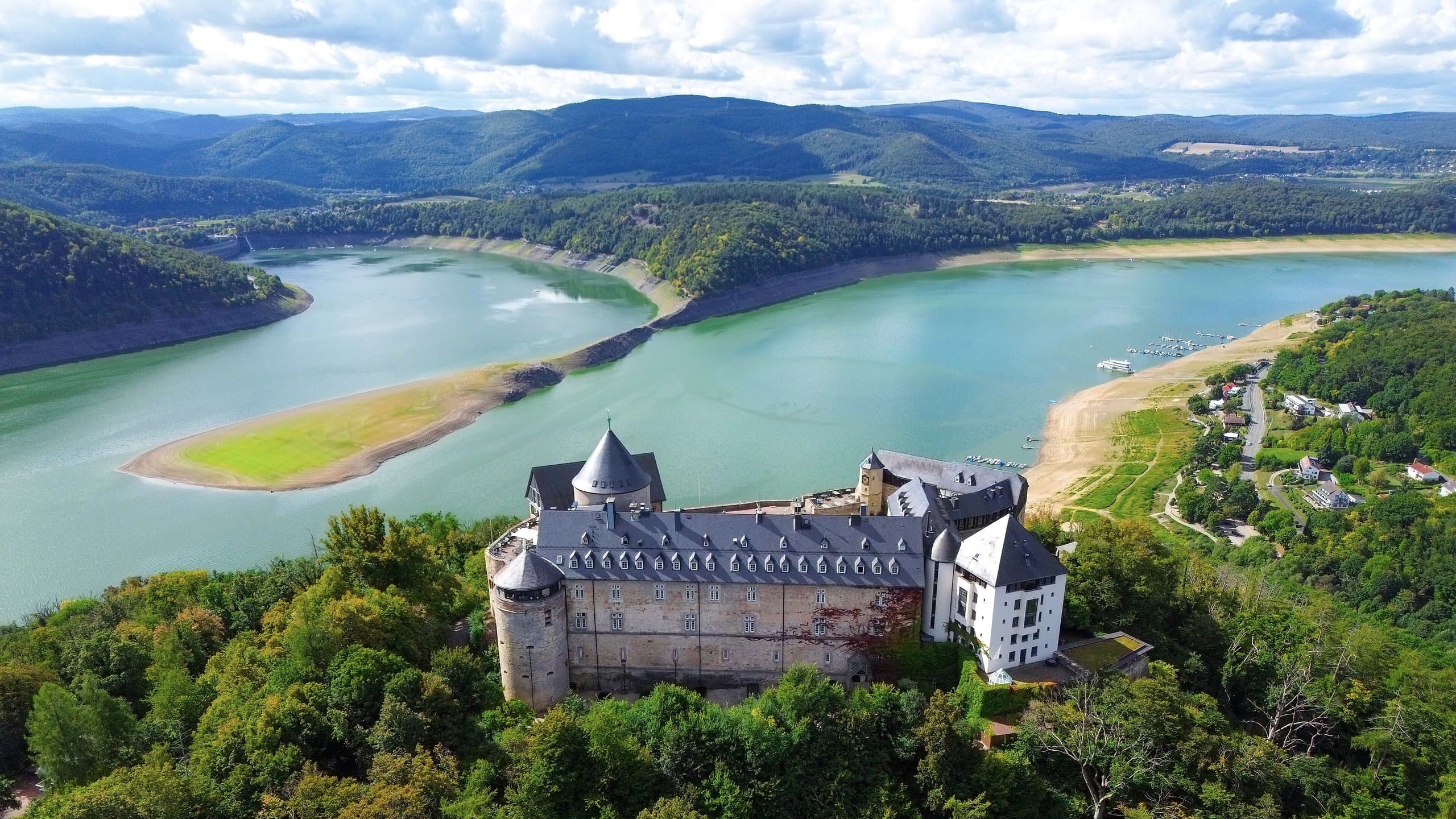
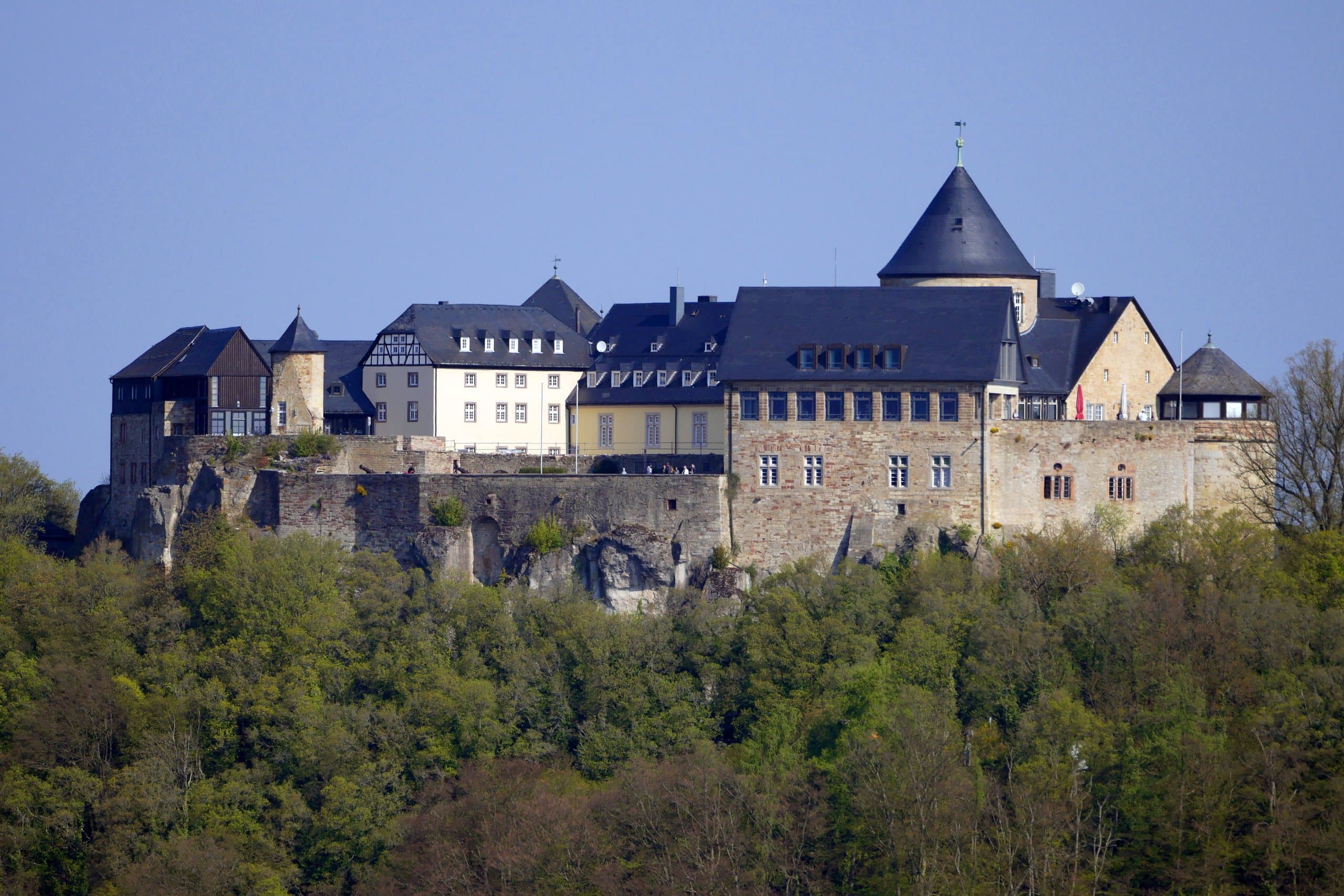
Waldeck Castle crowns a steep, wooded spur above the north shore of the Edersee, on the western edge of the small town of Waldeck in northwestern Hesse. The lake below is barely a century old, but the castle above it has watched over the valley of the Eder since the early twelfth century. It gave its name to a dynasty that ruled a small state of its own for the better part of eight hundred years, and its walls have since served as a fortress, a garrison, a penitentiary and an archive, and now house a hotel and museum. The result is a hilltop complex where a medieval keep, a Renaissance residential wing, and a baroque powder gate stand a short walk from a modern restaurant terrace with one of the widest views in the region.
Quick Facts
| English name | Waldeck Castle |
| German name | Schloss Waldeck (also Burg Waldeck) |
| Location | Waldeck, Waldeck-Frankenberg district, Hesse, Germany |
| Setting | Hilltop spur above the north shore of the Edersee |
| Type | Hill castle, later expanded into a residential Schloss |
| First documented | 1120 |
| Principal periods | Medieval core (13th–14th c.); Renaissance wings (c. 1500–1577); baroque defenses (1637) |
| Condition | Well preserved; in continuous use |
| Heritage designation | Kulturdenkmal (Einzelkulturdenkmal, § 2 (1) Hessian Monument Protection Act) in DenkXweb, the monument database of the Landesamt für Denkmalpflege Hessen: Waldeck, Schloß Waldeck 1, “Schloss Waldeck, Befestigungsanlagen, Freifläche” (DenkXweb ID 168179); the inventory for this area is still provisional |
| Owner | Waldeckische Domanialverwaltung (public property under a Waldeck-Pyrmont law of 8 April 1921) |
| Current use | Hotel, museum, restaurants, and events |
| Open to public | Yes (museum, terraces, restaurants; hotel for guests) |
| Access | Road up from the town; seasonal Schlossbahn road train from the lakeshore (the former Bergbahn cable car has not run since 2024) |
| Nearest towns | Bad Wildungen and Korbach |
| Official site | hotel-schloss-waldeck.de |
A House on the Rock
The castle enters history in 1120, when a “Bernhard de Waldekke” appears in a Westphalian charter. The hill itself was probably fortified a little earlier, most likely by the Counts of Ziegenhain, who held this stretch of the upper Eder. Through marriage the site passed to the Counts of Schwalenberg, and around 1180 one branch of that house began to call itself after the rock it held. From that point the name and the place belong together. By the early thirteenth century Waldeck was the family’s principal seat, and for more than four hundred years the counts governed their growing territory from this courtyard.
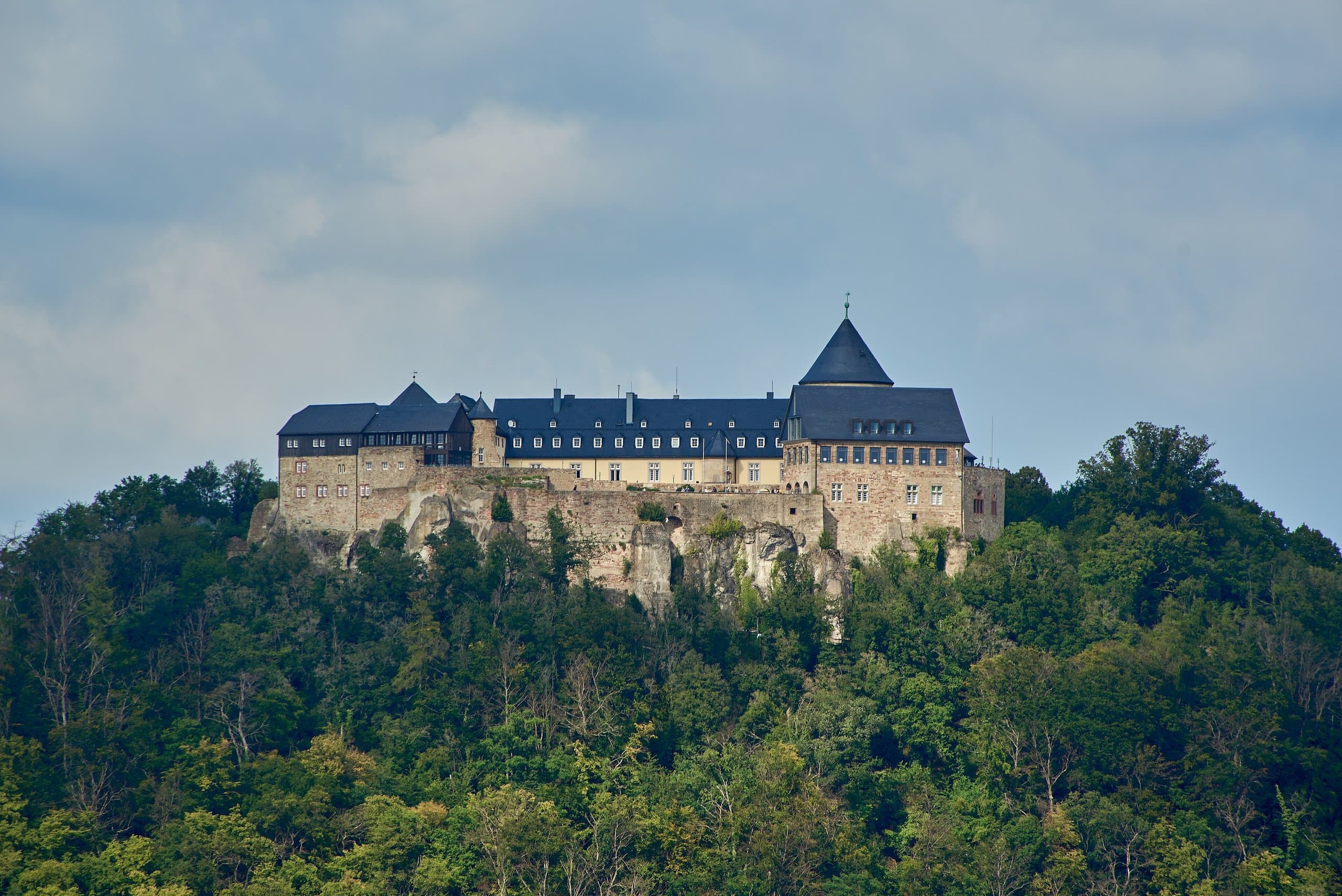
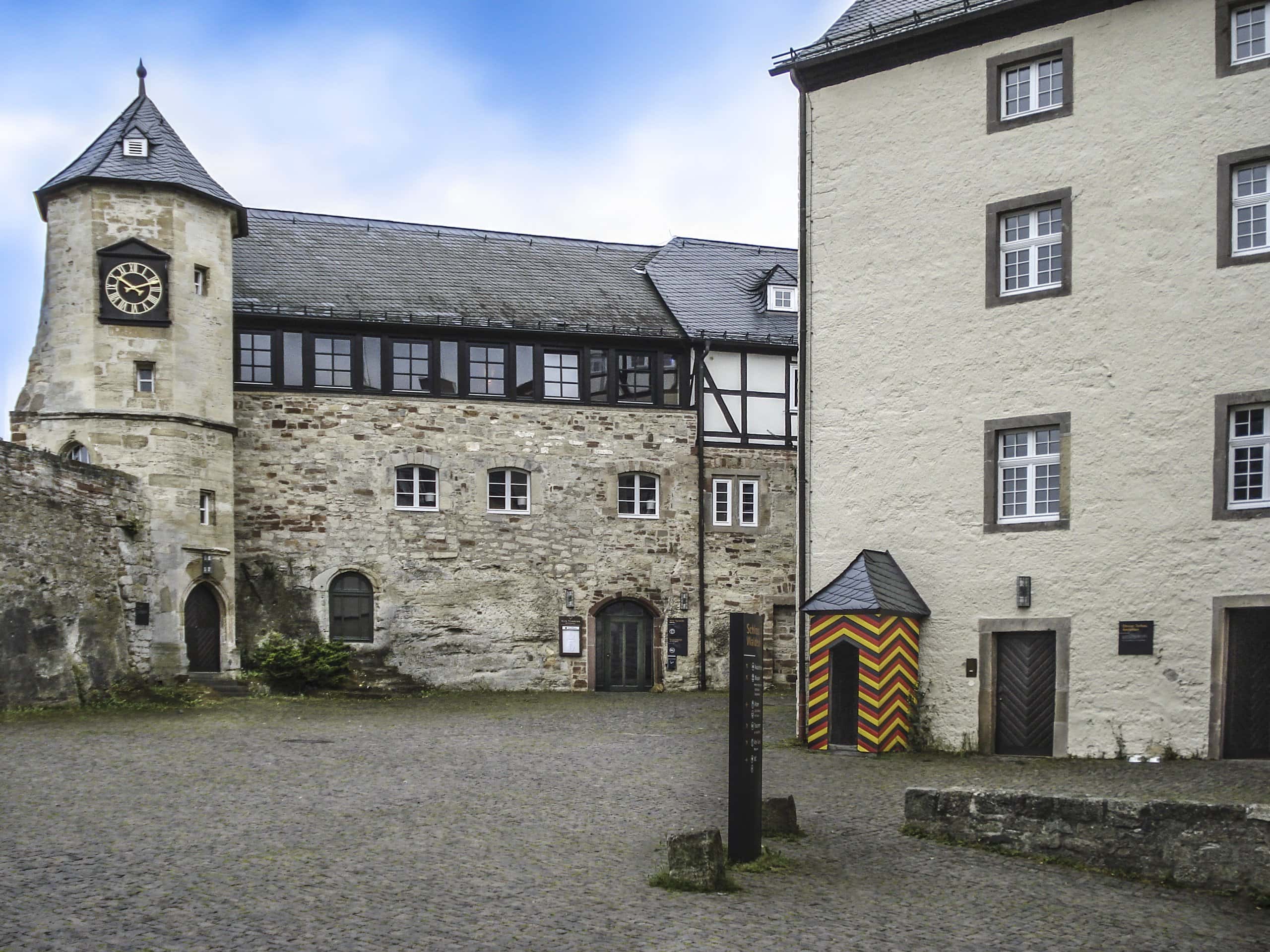
Their county was small, and it lasted. In 1349 the county gained imperial immediacy, which placed it directly under the Holy Roman Emperor rather than any intervening lord. The family also had a habit of dividing. Inheritance partitions split the house into lines named for their other castles, chiefly Waldeck-Eisenberg and Waldeck-Wildungen, and for long stretches two branches shared the hill at once. The arrangement is written into the buildings. One line took the south wing, the other the north, and the two halves of the courtyard grew at different rhythms according to the fortunes of their owners. A castle that looks unified from the lake was in practice a divided household for much of its history.
The Castle and Its Towers
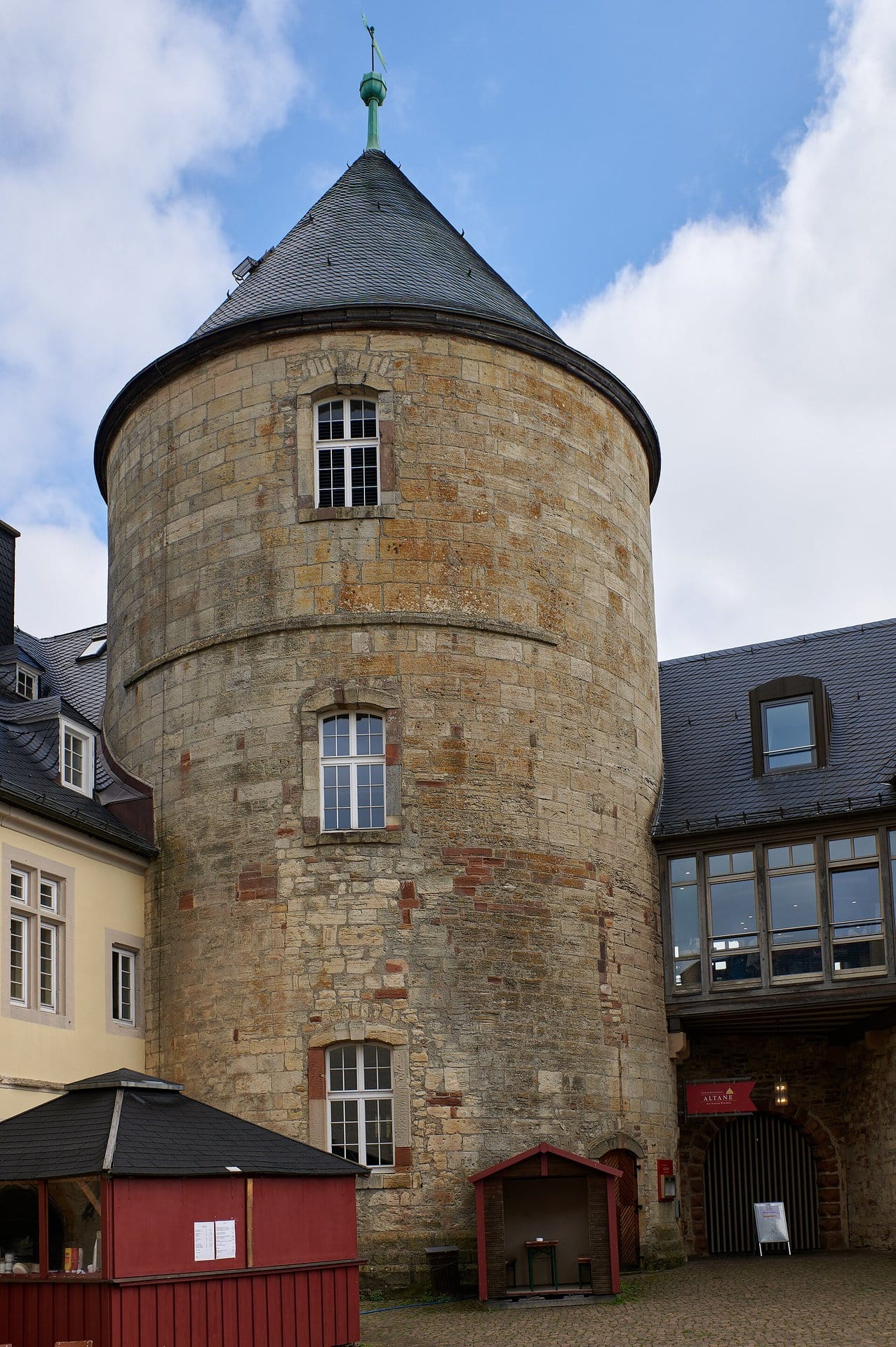
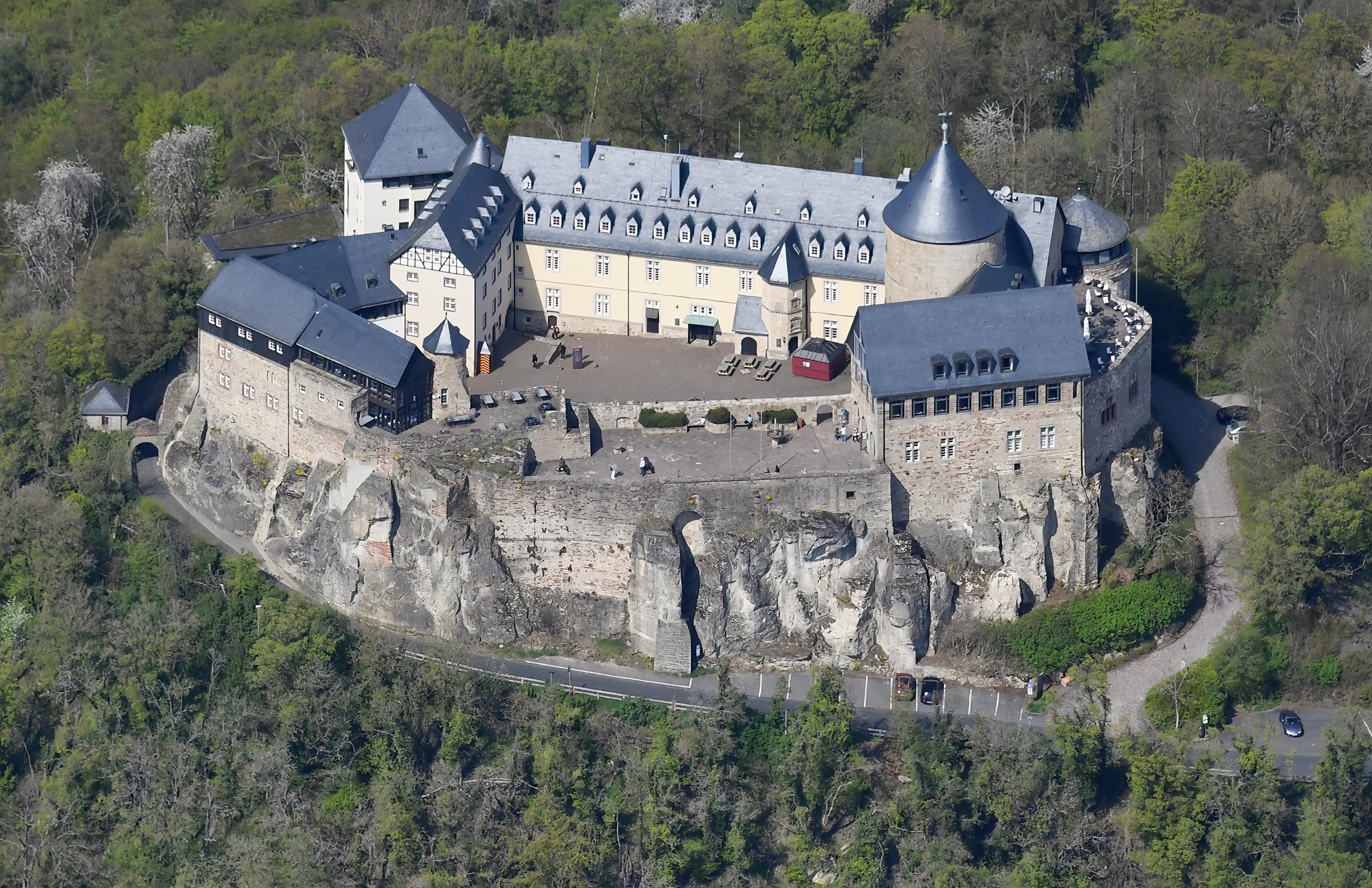
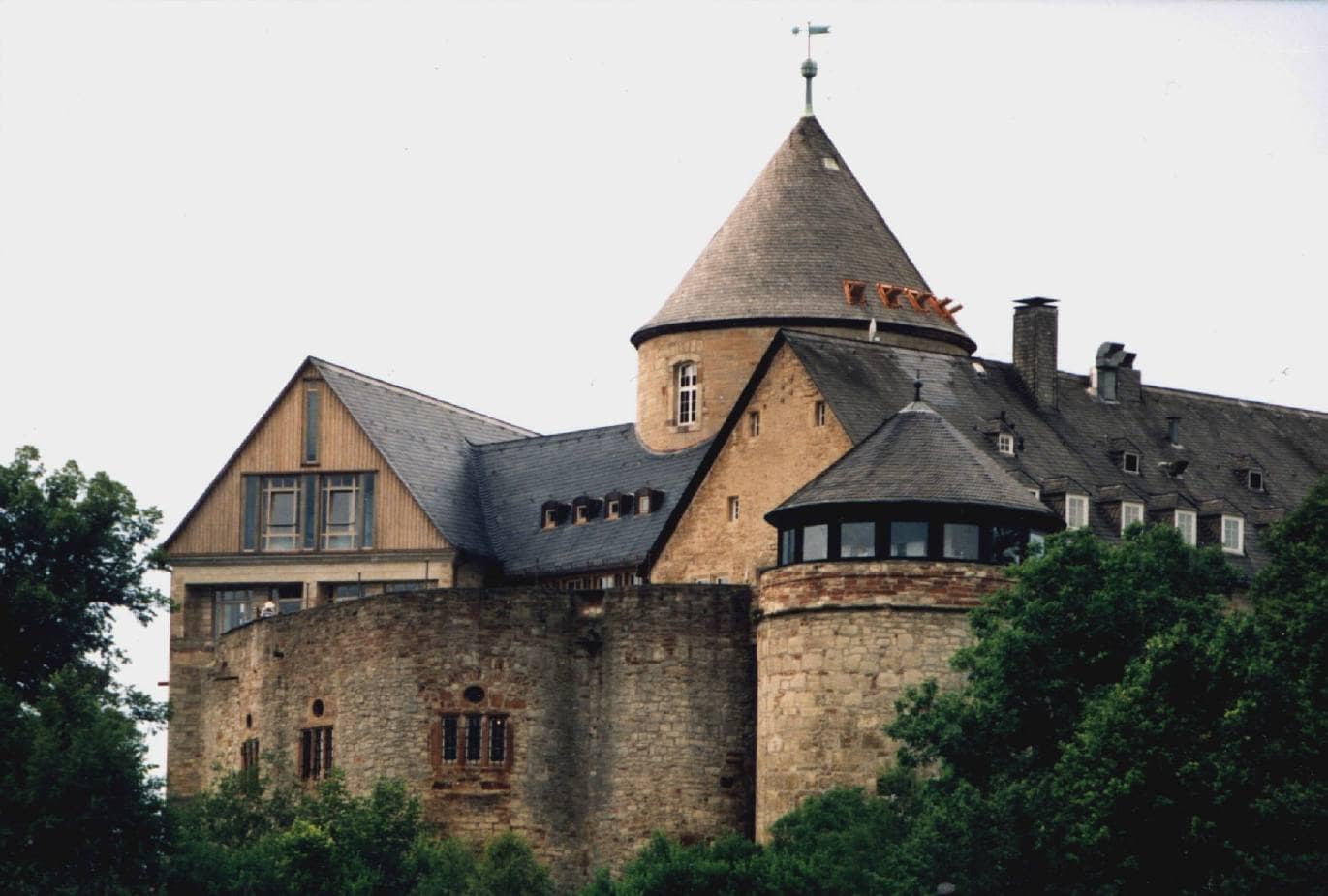
The oldest standing fabric is the round bergfried, the great keep that rises on the eastern side of the complex. Built of local Edersee greywacke, it dates from the thirteenth century by the Göttingen Academy’s handbook of late medieval residences, while the operator places it in the castle’s expansion between the fourteenth and sixteenth centuries. It is a three-story tower with walls more than three meters thick. It later earned the nickname Archivturm because the counts kept their archive inside it between 1745 and 1761, and in the twentieth century it was pressed into service once more as a water tower, a role it held from 1952 until 1997. Today a glass staircase and a lift thread its hollowed interior, and its platform gives the best view on the hill.
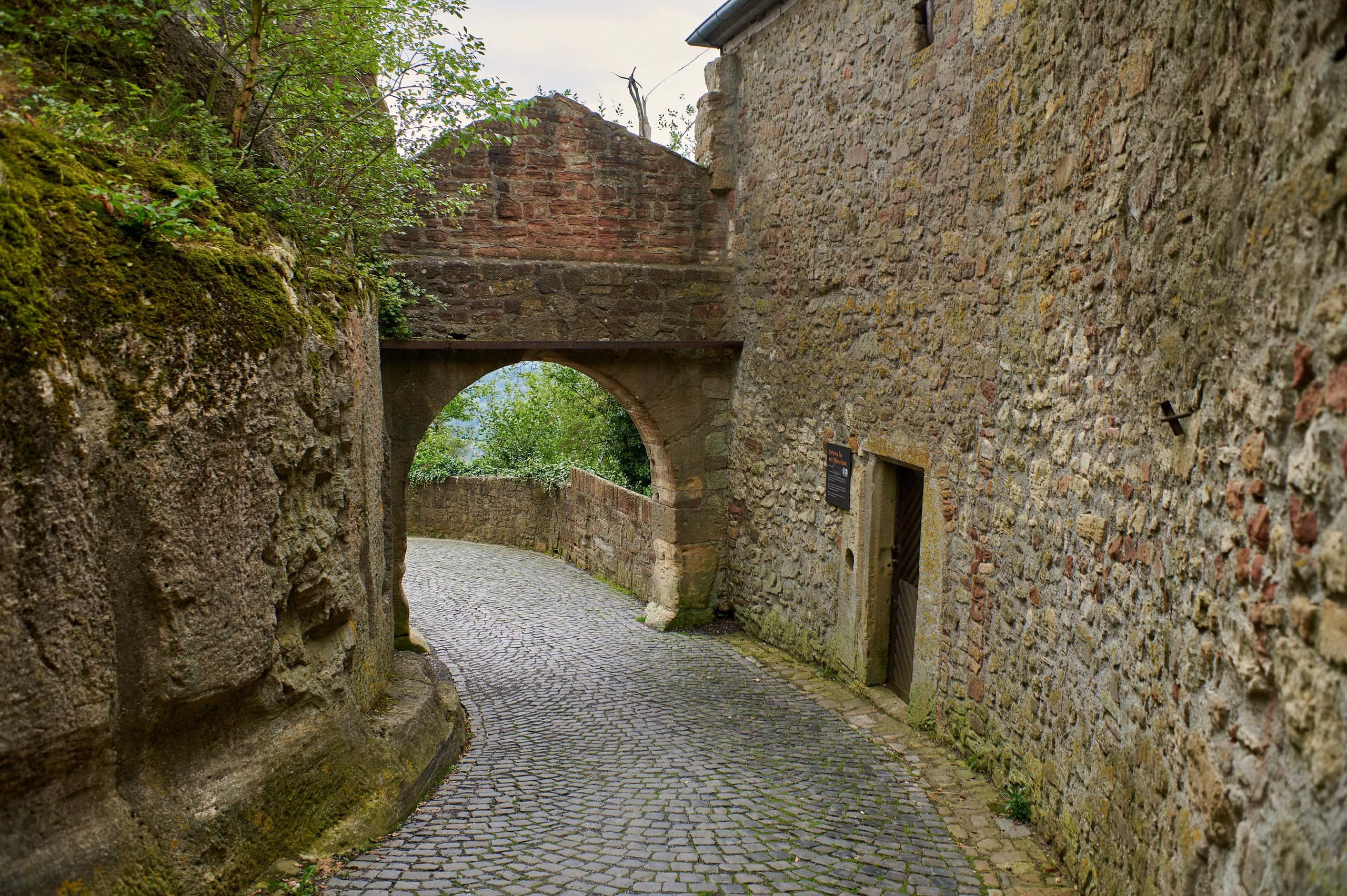
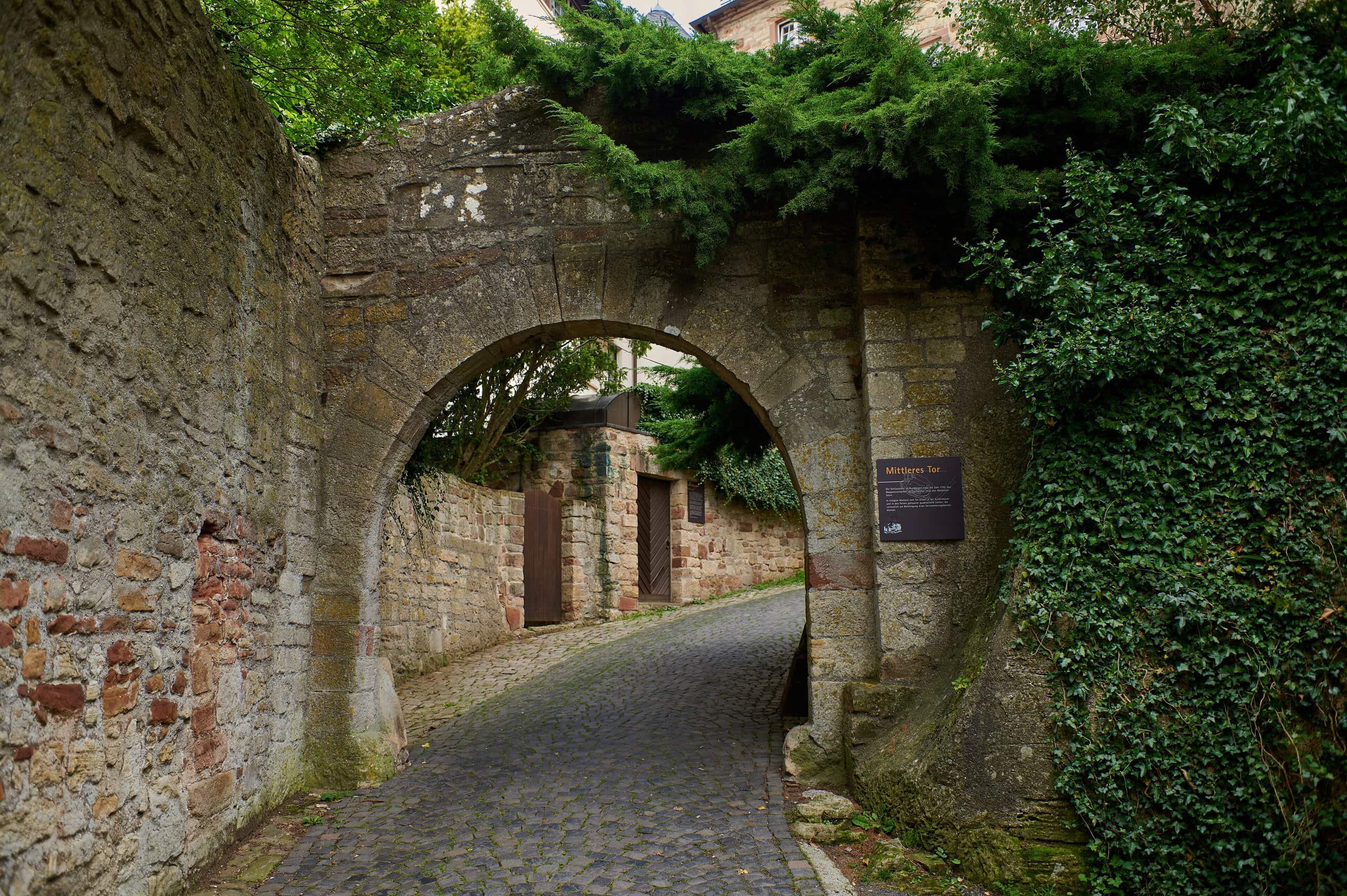
The approach climbs from the west through a sequence of gates. The lower gate was rebuilt in 1637, in the middle of the Thirty Years’ War, and its gatehouse doubled as a powder magazine, which is why it is still called the Pulverturm. Gun-loops from that period survive beside the arch, and an inscription on the gable records further work around 1830, when the old drawbridge was removed. Beyond it the path passes the deep castle well, dug in the sixteenth century to a depth of about 120 meters, before reaching the upper gate of 1756. The north range, the Wildunger Flügel, was raised between roughly 1500 and 1577 and still holds the old knights’ hall behind much-altered walls. The south range, a medieval wing whose origins reached back to the thirteenth century, was pulled down in 1734, and the broad terrace called the Altane now occupies its place. Only the vaulted cellars beneath survive from the older building.
The complex did not escape the wars of the eighteenth century. During the Seven Years’ War French troops occupied the castle, and in July 1762 a two-day bombardment left it badly damaged; the Waldeck court architect Friedrich Franz Rothweil rebuilt it the following year.
Seat of a Small State
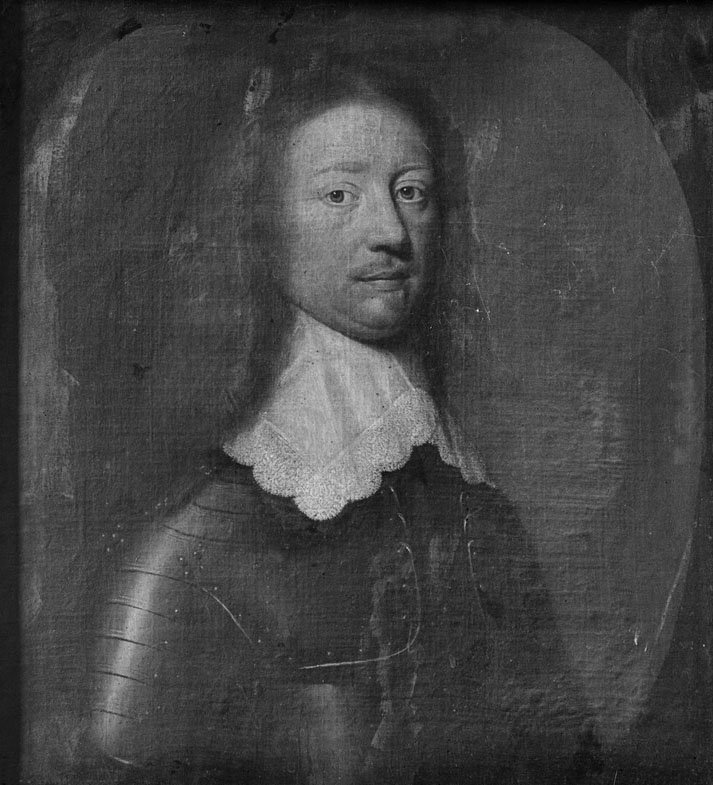
For all its remodeling, the castle’s role as a residence had a clear end date. In 1655 the counts moved their seat down to Arolsen, settling on the site of a former convent that they would later rebuild into a baroque residence. Waldeck kept its strategic value and its symbolism, but the household and the business of government went elsewhere. When the house reached its highest rank, the elevation of the Count of Waldeck and Pyrmont to a prince by Emperor Charles VI in 1712, the new princes ruled from Arolsen, not from the rock that carried their name.
Through the collapse of the Holy Roman Empire and the wars and confederations of the nineteenth century, the small principality kept a thread of sovereignty, even after 1868, when it handed most of its administration to Prussia while retaining its own legislature. It outlasted the monarchy, became the Free State of Waldeck-Pyrmont in 1918, and survived as a separate German state until April 1, 1929, when its finances finally forced a merger into Prussia. The castle on the Edersee was the cradle of all of it, the place where a county began that would cling to its own name and its own borders for almost eight centuries.
Behind Lock and Bolt
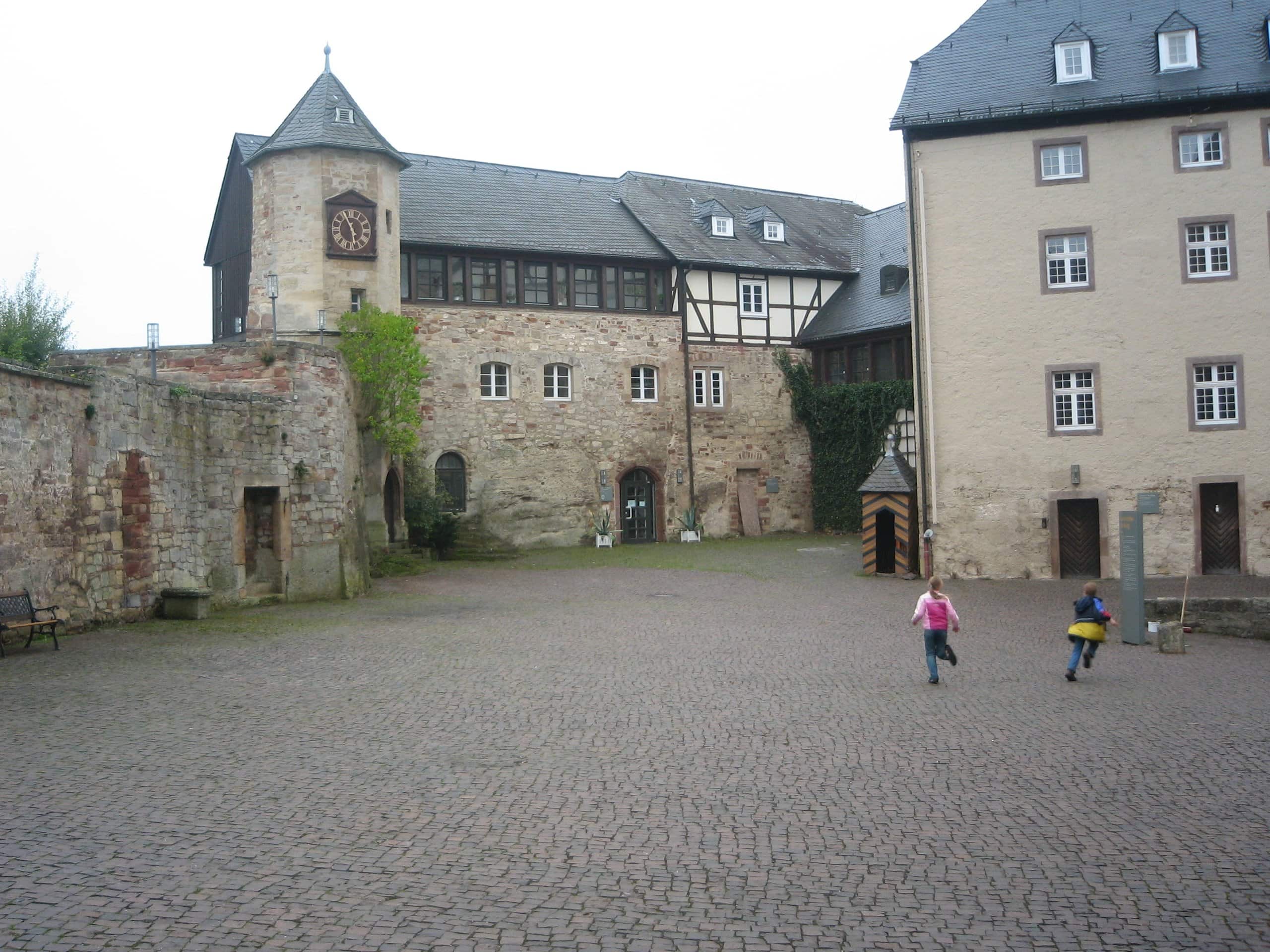
After the court left in 1655, the castle was put to other uses. The fortress became a garrison under a castle commander, then a barracks, with soldiers detached from the garrison town of Arolsen. In 1734 the counts turned part of the complex into a penitentiary, a Zuchthaus, and a women’s prison, and for well over a century the castle that had housed a ruling family housed prisoners instead.
Male inmates were set to work at marble saws installed in a great hall below the guardroom, cutting and grinding stone hauled in from quarries at Giebringhausen. Women inmates spun, wove, and plaited. The jailer lived in the bergfried, the very tower that had once guarded the family’s archive. The penitentiary was dissolved in 1868; the buildings stayed in penal and administrative use into the early twentieth century before the castle found gentler work. That long custodial history, not the witch-trial legends sometimes attached loosely to old German towers, is the genuine dark thread here, and it is the subject the castle museum chooses to tell. Its permanent exhibition, Hinter Schloss und Riegel, which translates roughly as “behind lock and bolt,” draws mainly on the eighteenth and nineteenth-century prison years.
The Drowned Valley
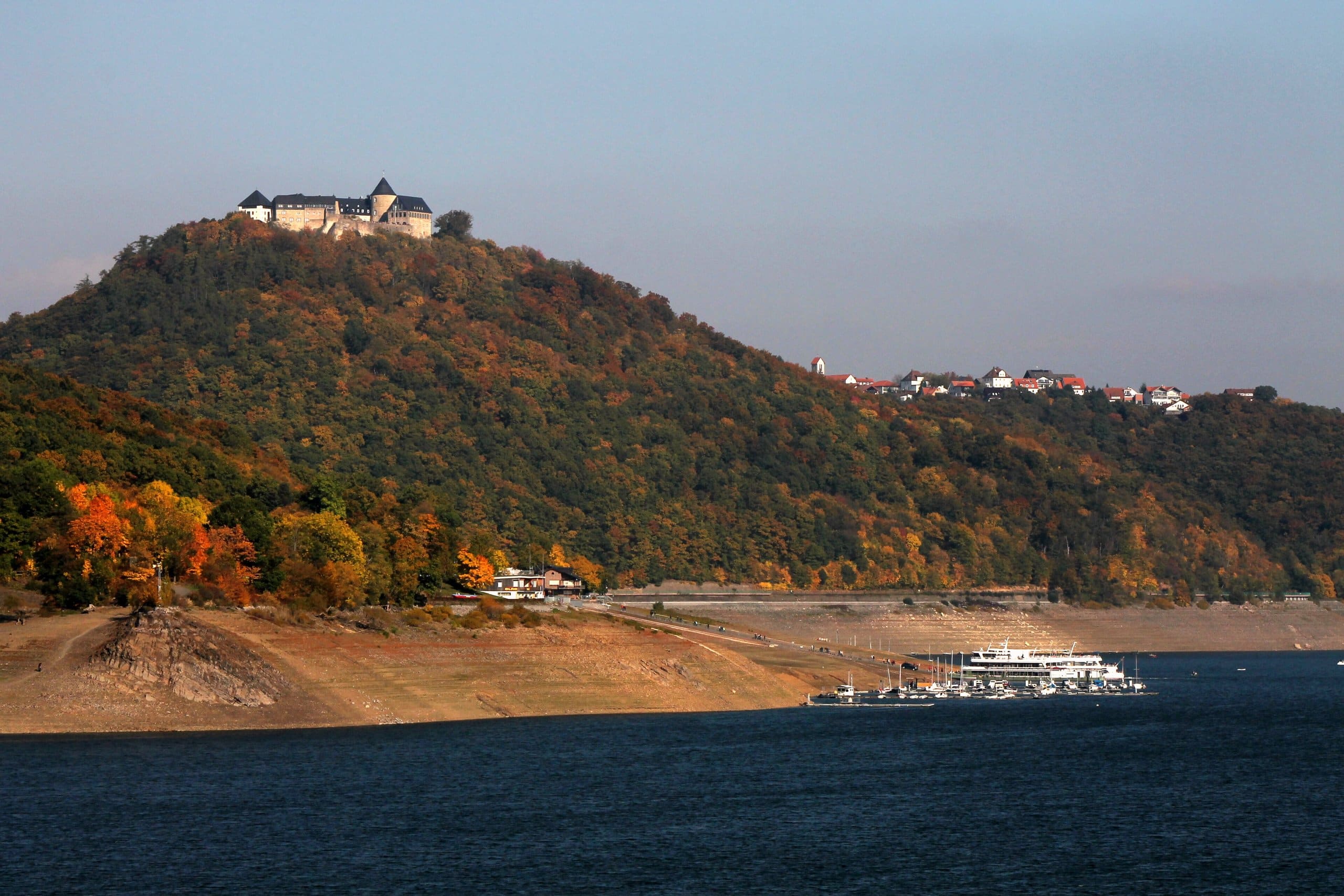
The view that now defines Waldeck did not exist when the counts lived here. Below the castle, the Eder ran through a narrow farming valley dotted with villages. Between 1908 and 1914 engineers closed that valley with the Eder dam, creating the Edersee, today the third-largest reservoir in Germany by volume. Its purpose was practical: stored water released in summer keeps the Weser and the Mittelland Canal navigable, and the dam generates electricity. Three villages, Asel, Bringhausen, and Berich, vanished beneath the new lake along with an old bridge, and in dry late summers, when the water drops, their foundations still surface from the mud.
The valley was transformed a second time in a single night. On the night of May 16–17, 1943, No. 617 Squadron of the Royal Air Force, soon famous as the Dam Busters, attacked the Eder dam with Barnes Wallis’s bouncing bomb as part of Operation Chastise. The Eder was a difficult, undefended secondary target, ringed by hills and shrouded in mist, and several runs failed before the Australian pilot Les Knight made the attack that broke the wall, tearing a breach about seventy meters wide and twenty-two deep. Its reservoir emptied in a torrent down the Eder valley. The flood killed around seventy people in the valley below, far fewer than at the Möhne dam to the west, and it had largely spent itself by the time it reached Kassel, some thirty-five kilometers away. German crews rebuilt the dam within months, using forced labor. From the castle’s terrace the whole stage is laid out below: the lake to the west, the rebuilt dam wall to the south, and the wooded ridges of the Kellerwald beyond.
Waldeck Castle Today
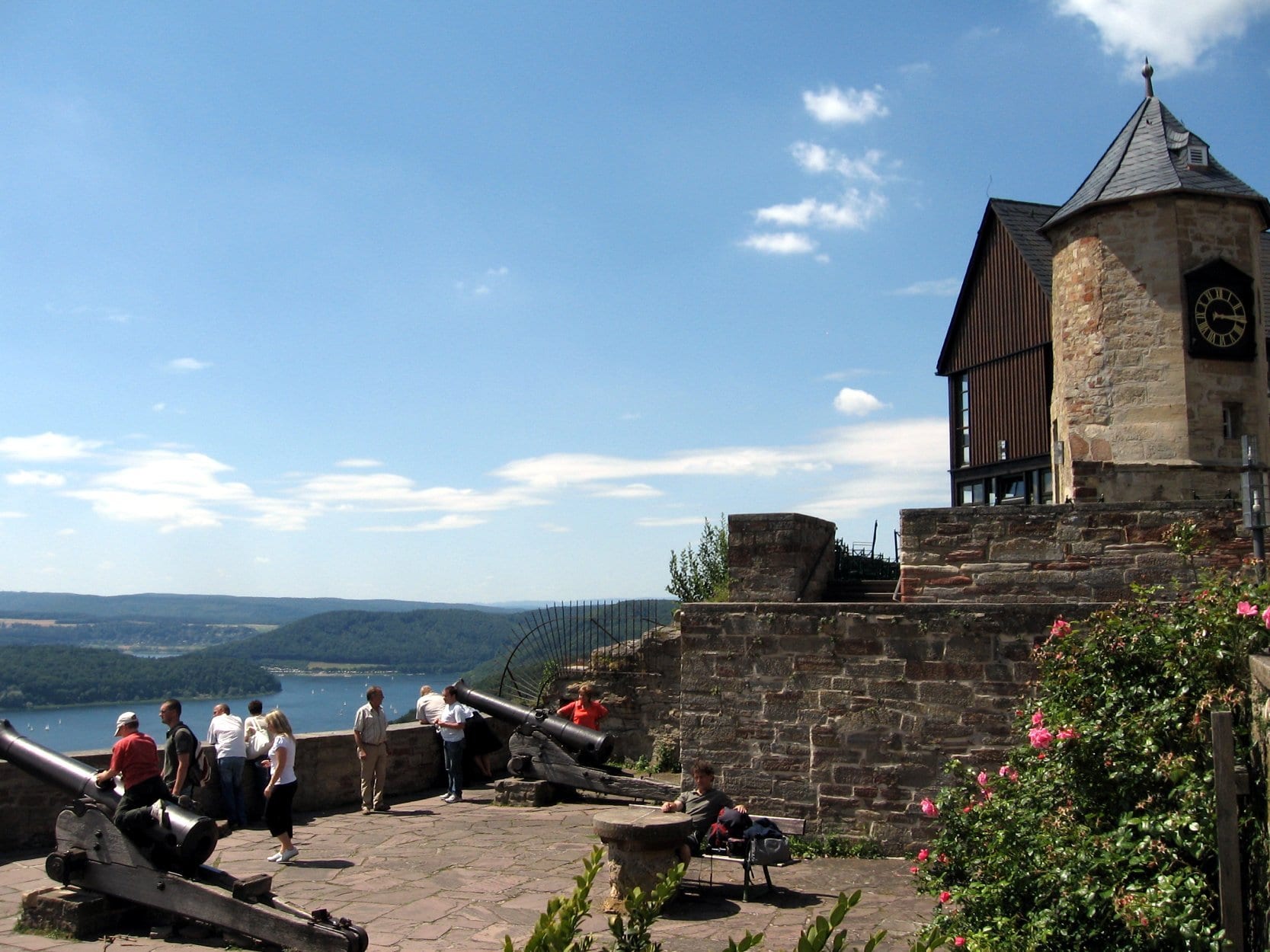
The castle’s latest role began surprisingly early. Parts of it were let as a hotel as far back as 1906, and since the property settlement with the former princely house, fixed by a Waldeck-Pyrmont law of 8 April 1921, the whole complex has been public property, held by the Waldeckische Domanialverwaltung, the administration that manages the former Waldeck state domains. The present hotel wing was built over the entrance bastion in the late 1980s, when a new museum building also rose partly on the footprint of the demolished south range. The blend is frank rather than seamless: medieval masonry on the outside, sleek rooms within, and a terrace café where the prison’s marble saws once turned.
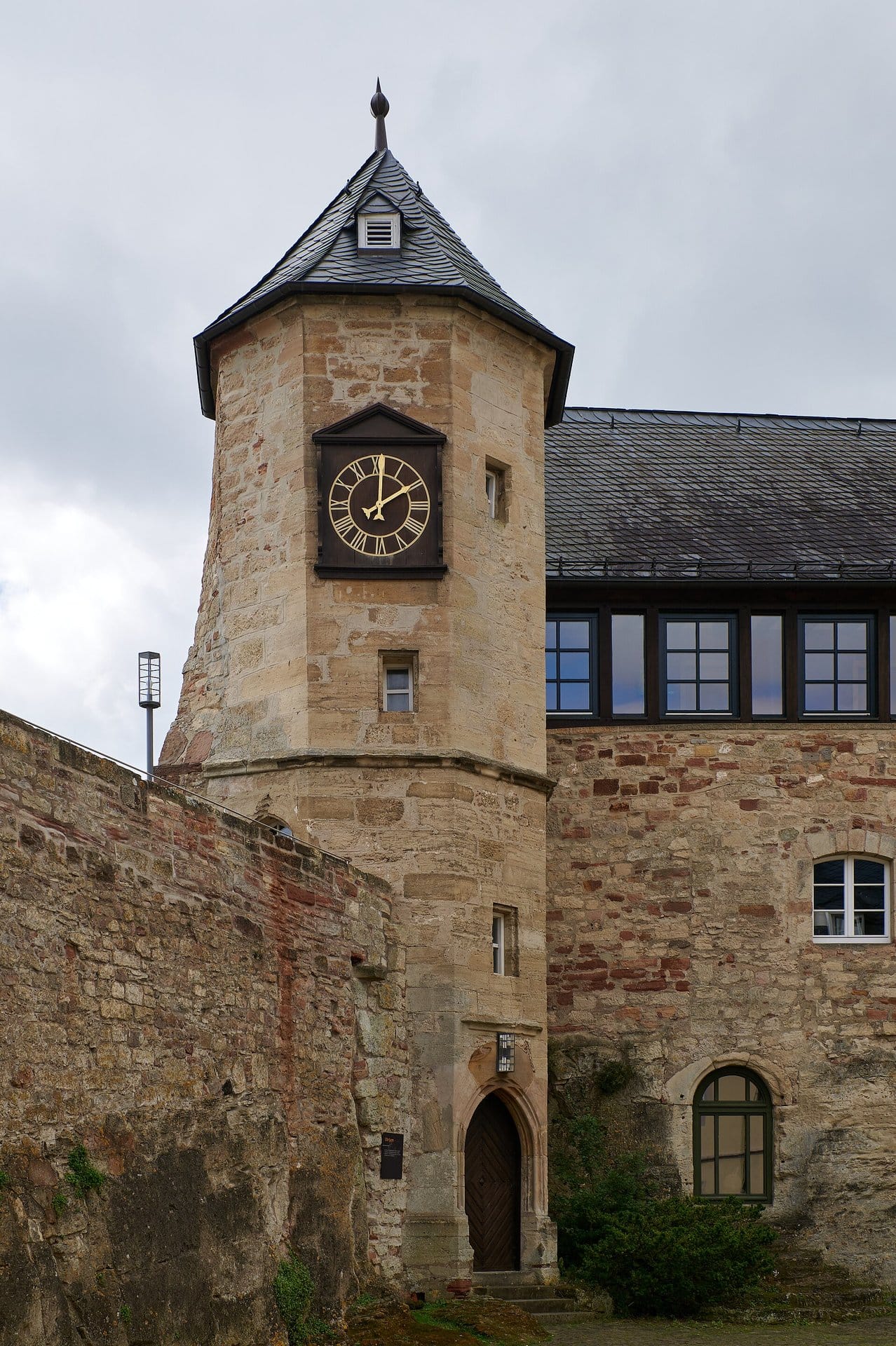
Visitors come for several things at once. The four-star Hotel Schloss Waldeck offers forty-two rooms, two restaurants, the more formal Alte Turmuhr and the Altane café on the terrace, and a small wellness area. A museum under the keep tells the prison story. The old knights’ hall and the castle’s historic rooms host weddings and events, with the local registry office holding ceremonies here too, which has made the castle a popular setting for celebrations above the lake.
Getting up the hill has its own small history. A cable car, the Waldecker Bergbahn, carried visitors and their bicycles up from the lakeshore from 1961 onward, but it has not run since early 2024. For the 2026 season a road train, the Schlossbahn, makes the climb in its place.
Visiting Waldeck Castle
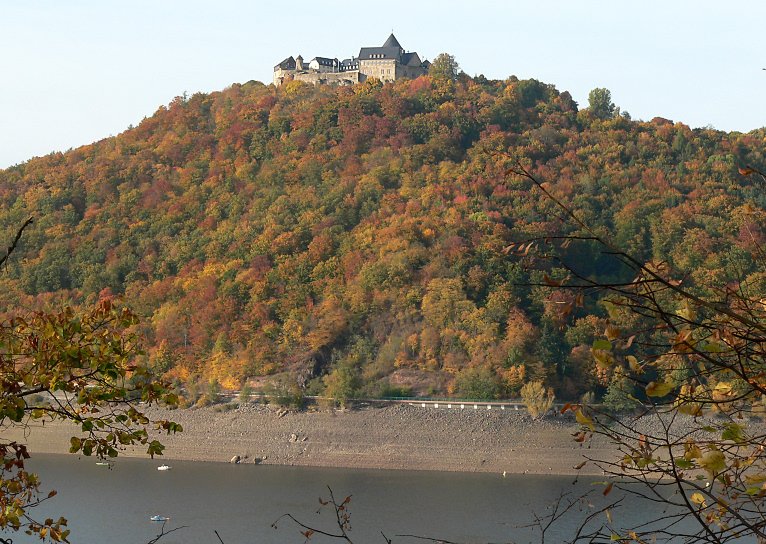
Waldeck sits in the Kellerwald-Edersee region of northern Hesse, between Korbach and Bad Wildungen, with the Edersee at its feet. Drivers reach the castle by a signed road that winds up from the town; free parking sits just below the entrance, which is useful, since space in the town center is tight. From the Edersee shore, a road train called the Schlossbahn runs up to the castle in season; it has replaced the old Waldecker Bergbahn cable car, which has not operated since 2024. On foot, the climb from the town takes about twenty minutes.
The terraces, the museum, and the restaurants are open to all; the hotel rooms, naturally, are for guests. The museum and hotel keep seasonal hours that are heaviest from spring through October, so it is worth checking current times before a special trip, particularly in winter. Allow time simply to stand on the Altane: on a clear day the view reaches south to the dam and west across the entire lake, and it explains in a glance why a medieval family chose this rock. The surrounding Kellerwald-Edersee National Park, whose ancient beech forests carry a UNESCO natural-heritage listing, makes the castle an easy anchor for a longer day of walking, cycling, or a boat trip on the lake.
Admission
| Museum at Schloss Waldeck | Price or hours (2026) |
|---|---|
| Adult, with audio guide (German, English, French or Dutch) | €6.50 |
| Children and young people 6-16 | €4.00 |
| Group with a personal guide, per adult (reservation required) | €8.00 |
| Hours, March 14 to October 31, 2026 | Daily 10:00-18:00 (season ended) |
| Hours, winter (from November 1) | Saturdays 11:00-16:00, Sundays 10:00-16:00, as in each of the last three winters; the end date for 2026-27 is not yet published. Closures at short notice in bad weather are possible, and the hotel asks visitors to phone ahead |
If you would like to make a night of it, you can check rooms and rates at the castle hotel, or browse boat trips and guided experiences around the Edersee.
Some links on this page are affiliate links, which means StoneKeep Atlas may earn a small commission, at no extra cost to you, if you book through them.
More Views of Waldeck Castle
A few more views of the castle, its towers and gates, and the lake it commands.
Common Questions
Can you visit Waldeck Castle without staying at the hotel?
Yes: the museum takes day visitors as well as hotel guests, and admission includes an audio tour in English, French, Dutch or German. Groups can book a tour with a personal guide instead; the hotel asks for a reservation in advance and says the guided visit lasts about an hour. It also offers special opening times on request.
What is in the Waldeck Castle museum?
Prison life and punishment, mostly. According to the hotel, a museum was set up in 1950 in the castle’s former service rooms, showing daily life in the Middle Ages. Since 1998, on the initiative of the Waldeckischer Geschichtsverein, the regional history society, it has presented the workings of the former penitentiary alongside medieval methods of upbringing and punishment. The hotel recommends it from age 10; younger children come with their parents, and some themes are then left out.
Who owns Waldeck Castle, and can you stay there?
The castle is public property, held by the Waldeckische Domanialverwaltung, an enterprise that the Waldeck-Frankenberg district runs for the benefit of the municipalities entitled to its profits; its estate also includes historic palace buildings in Bad Arolsen and Diemelstadt-Rhoden. A separate company, Schloss Waldeck Hotelbetriebs GmbH & Co. KG, is named in the hotel’s imprint. Staying is possible: all 42 rooms were refitted in 2009, and each looks out over the countryside, the old walls or the lake.
How do you get up to Waldeck Castle?
By car, by bus or on foot. Edersee Marketing, the regional tourist board, directs drivers onto the B485 and then the bypass, which has several turnoffs into Waldeck. By bus, line 510, which the North Hesse transport association (NVV) describes as the link between Bad Wildungen and Korbach, connects the town, and the board gives Waldeck Marktplatz as the stop nearest the castle. From the market square, the rest of the way is on foot.
Can you walk from Waldeck Castle to the Edersee dam?
Yes. The Waldeck-Hemfurth stage of the Urwaldsteig Edersee trail starts at the castle car park and runs 6.66 kilometers along the steep slopes above the lake to Edertal-Hemfurth. Edersee Marketing rates it easy and allows about two hours and ten minutes. Beyond the Kanzel viewpoint, a lookout faces the 400-meter dam wall, and from there a detour leads to the dam itself. Passenger boats call at Waldeck-Strandbad, their main landing, and at the dam, though how much of the lake they can sail depends on the water level.
Is this the Burg Waldeck of the 1960s folk festivals?
No, although this castle is also known as Burg Waldeck. That festival site is Burg Waldeck at Dorweiler, where a nonprofit association runs a conference center on grounds bordered by a castle ruin; the site became widely known through the international chanson and folk festivals held there in the 1960s. Two more ruins share the name: one overlooks the Nagold valley near Calw, in the northern Black Forest, and another stands on the Schlossberg at Waldeck, in the town of Kemnath in the Upper Palatinate.
Beyond Waldeck Castle
Waldeck lies far to the north of Hesse’s better-known castle country, but it has clear company elsewhere in the state. On the Rhine’s edge of Hesse, Eltville Castle preserves the riverside seat of the archbishops of Mainz, while the ruined Frankenstein Castle broods above the Bergstraße south of Darmstadt, trailing its tangle of legend. Further south again, Heidelberg Castle shows on a grand scale the same long arc Waldeck shows in miniature: a fortified residence rebuilt across centuries, then handed down to a later age as a monument. Read together, the three Hessian castles and the great Palatine ruin trace how the region’s strongholds passed from working seats of power to the heritage sites they are today.
Conclusion
Waldeck Castle is easy to enjoy for its view alone, and its history can still be read in its fabric. Its keep once guarded the family archive, a gate stored gunpowder, part of the complex became a prison, and a terrace now stands where a medieval range was demolished. Almost all of these layers survive. The dynasty that began here is long gone, its little state folded into Prussia and then into modern Hesse, and the valley it once overlooked is now a lake.
Principal Sources
- Arbeitsgemeinschaft Burg Waldeck. “Burg Waldeck.” burg-waldeck.de.
- Bayerisches Landesamt für Denkmalpflege. “Denkmalliste Kemnath.” geodaten.bayern.de.
- Edersee Marketing. “Staumauer.” edersee.com.
- Edersee Marketing. “Personenschifffahrt Edersee, Anleger Waldeck-Strandbad.” edersee.com.
- Edersee Marketing. “Schloss Waldeck.” edersee.com.
- Edersee Marketing. “Urwaldsteig Edersee, Etappe Waldeck-Hemfurth.” edersee.com.
- Hotel Schloss Waldeck. “Impressum.” hotel-schloss-waldeck.de.
- Hotel Schloss Waldeck. “Museum.” hotel-schloss-waldeck.de.
- Hotel Schloss Waldeck. “Museum (English).” hotel-schloss-waldeck.de.
- Hotel Schloss Waldeck. “Zimmer.” hotel-schloss-waldeck.de.
- Landesamt für Denkmalpflege Hessen. “DenkXweb“: Waldeck-Frankenberg, Waldeck, Schloß Waldeck 1, “Schloss Waldeck, Befestigungsanlagen, Freifläche,” Einzelkulturdenkmal, DenkXweb ID 168179. denkxweb.denkmalpflege-hessen.de.
- Landkreis Waldeck-Frankenberg. “Waldeckische Domanialverwaltung.” landkreis-waldeck-frankenberg.de.
- Nordhessischer VerkehrsVerbund (NVV). “Tender notice for the Edersee and Waldeck bus lines.” 2023. ted.europa.eu.
- Verlag für Neue Medien. “The Ruins of Castle Waldeck.” schwarzwald.de.
- Waldeck-Pyrmont. “Gesetz über die Gestaltung der Rechtsverhältnisse des Waldeck-Pyrmonter Domanialvermögens bei einer staatsrechtlichen Trennung der im Staate Waldeck-Pyrmont vereinigten ehemaligen Fürstentümer Waldeck und Pyrmont.” 8 April 1921, Wald. RegBl. S. 49; Nds. GVBl. Sb. II S. 563. § 1 cites the Gesetz betreffend die Vermögens-Auseinandersetzung zwischen dem Staate Waldeck-Pyrmont und dem Fürstlichen Hause of 8 April 1921, Wald. RegBl. 1921 S. 135. lexaris.de.
- Zunker, Diana. “Waldeck.” In Höfe und Residenzen im spätmittelalterlichen Reich: Grafen und Herren. Residenzenforschung 15.IV. Thorbecke, 2012, pp. 1630-1631. adw-goe.de.
German sources differ on a few dates: the move to Arolsen is usually given as 1655 (some say 1665); imperial immediacy as 1349 (some, 1379); and the castle penitentiary’s founding as 1734 (some, 1738 or 1743).
Image credits. Banner and aerial above the Edersee: Sleeptoken15, CC BY-SA 4.0, via Wikimedia Commons; aerial from the south: Carsten Steger, CC BY-SA 4.0, via Wikimedia Commons; the castle from the south, the bergfried, the lower gate, the clock tower, the stair-tower reliefs, the middle gate, and the trophy cannon: Tilman2007, CC BY-SA 4.0, via Wikimedia Commons; the courtyard: Chattus, CC BY-SA 4.0, via Wikimedia Commons; the castle above the autumn Edersee at low water: Huntsman76, CC BY-SA 4.0, via Wikimedia Commons; the viewing terrace: Celsius (Wikivoyage), CC BY-SA 3.0, via Wikimedia Commons; the excursion boat below the castle: Axel Hindemith, public domain, via Wikimedia Commons; the keep and glass bay: Günter Steiner / Waldeckische Domanialverwaltung, CC BY 2.0 DE, via Wikimedia Commons; the inner courtyard: Fornax, CC BY-SA 3.0, via Wikimedia Commons; the castle from the Kanzel viewpoint at low water: Membeth, CC0, via Wikimedia Commons; portrait of Count Philipp Theodor von Waldeck: unidentified artist, public domain, via Wikimedia Commons. Freely licensed images are resized to fit; any other change, such as a crop, is named in the credit.