
The 9 Best Castles in Bavaria
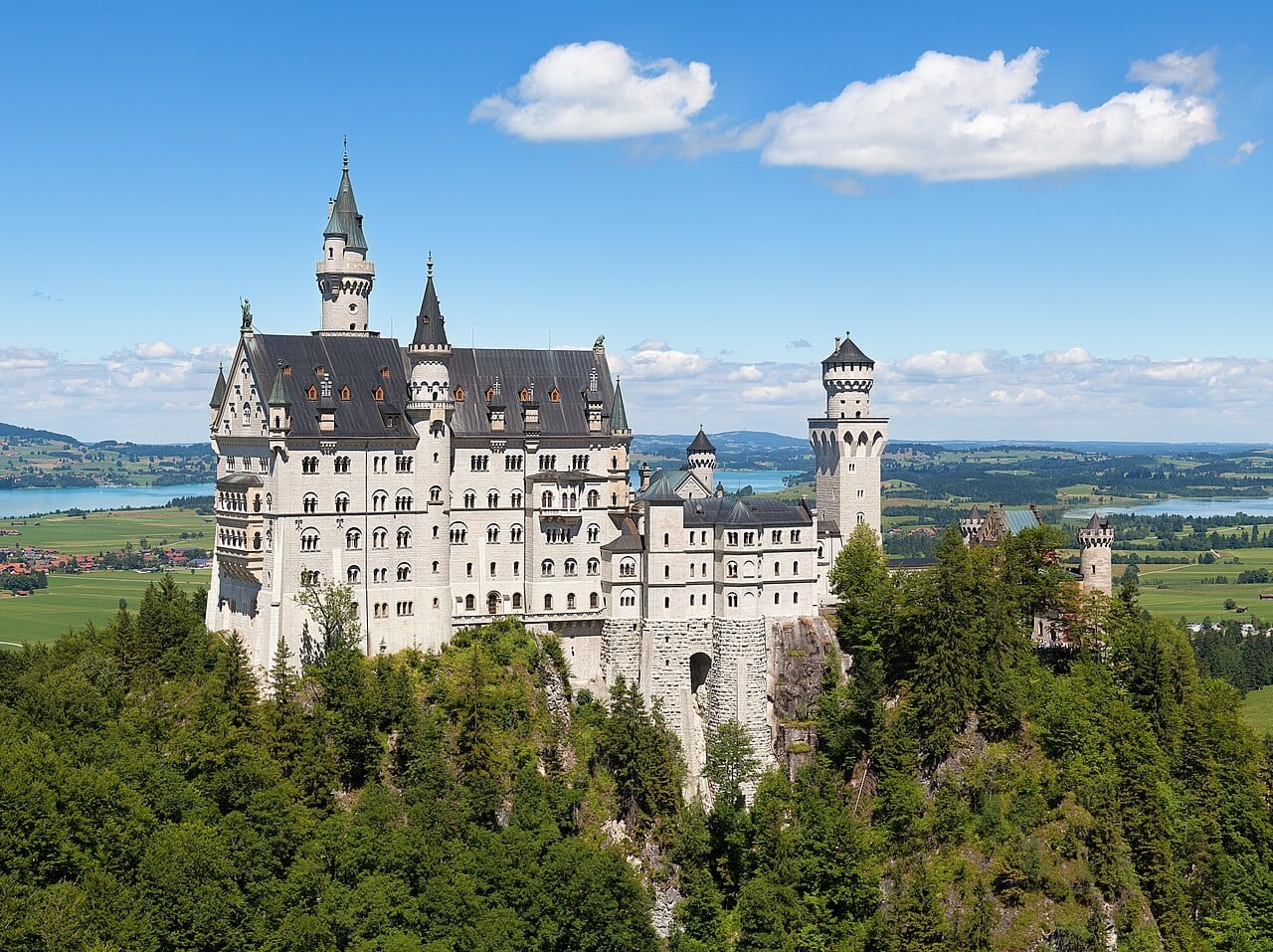
In 2025, UNESCO inscribed the palaces of King Ludwig II, Neuschwanstein, Linderhof, Herrenchiemsee, and the King’s House on Schachen, as a single World Heritage property. Three of those four fall inside this guide. Added to the Würzburg Residence, inscribed in 1981, that puts four UNESCO-listed palaces among the nine castles here. They also include five more whose stories explain how Bavaria came to have them in the first place: Hohenschwangau, where Romanticism caught the Bavarian throne; Marienberg, the medieval fortress the prince-bishops ruled Würzburg from for nearly five centuries before they built the Residence; Schloss Johannisburg, the Mainz late-Renaissance palace at Aschaffenburg that joined Bavaria only in 1814; Nuremberg Castle, the imperial Burg of the Holy Roman Empire that passed into the city’s custody in 1313; and Mespelbrunn, the Spessart Wasserschloss that has stayed in one family’s hands since 1412.
Two Bavarias, mostly under one operator
Modern Bavaria is a political composite. The Wittelsbach dukes (and after 1806, kings) ruled from Munich and the Alpine south for over seven centuries. Four Franconian jurisdictions to the north were sovereign in their own right until secularization and mediatization pulled them in one at a time, and not on one date: Würzburg in 1803, lost again in 1805 to a grand duchy under Ferdinand III, the former Grand Duke of Tuscany and returned by the Paris Convention of June 3, 1814; Nuremberg and the Reichsritter estates in 1806; Aschaffenburg, held by the Mainz electors as an exclave, on June 26, 1814, after changing hands three times in eleven years: from the secularized electorate to Karl Theodor von Dalberg, then Elector of Mainz and from 1806 Prince-Primate of the Confederation of the Rhine, then to the Grand Duchy of Frankfurt under the same man in 1810. What Bavaria inherited was a state with four distinct castle traditions inside its lines: the Wittelsbach royal-residential tradition centered in Munich and the Alps; the prince-bishop tradition that had ruled Franconia from the Marienberg, the Würzburger Residenz, and (for the Mainz electors) Schloss Johannisburg; the imperial-Reichsstadt tradition embodied by Nuremberg; and the Reichsritter knightly tradition of the Spessart, where families like the Echter of Mespelbrunn belonged to the imperial knighthood’s Kanton Odenwald, and in the seventeenth century the Steigerwald too, while holding their lands in fief from as many as seven separate lordships.
Of those four, the Reichsstadt tradition is the one with no equivalent elsewhere in Bavaria, and Nuremberg’s standing rested on two moments a century apart. In 1356, the Golden Bull of Charles IV decreed that every newly elected king must hold the first Hoftag of his reign at Nuremberg, which made the Burg a fixed destination of the imperial court. In 1424, Sigismund of Luxembourg sent the Reichskleinodien, the crown jewels of the Empire, to the city’s keeping, and Nuremberg was their permanent home for nearly four centuries, from 1424 to 1796, when they were evacuated ahead of French troops to Regensburg and on to Vienna in 1800. Ownership of the rock itself arrived in two stages, also a century apart: the Kaiserburg passed into the city’s custody in 1313 under Heinrich VII, and in 1427 the city bought the remains of the burgraves’ castle, burnt out seven years earlier, from Friedrich, by then Margrave of Brandenburg. Custody of the regalia and ownership of the hill together made the Free City a kind of co-resident of the Empire.
Seven of these nine castles share an operator that no other German state can match: the Bayerische Schlösserverwaltung (BSV), Bavaria’s state palace administration. Its holdings reached the Bavarian state in stages, and reached it long before the administration carried its present name. Secularization brought the dissolved prince-bishopric residences in 1803; the Reichsstadt’s mediatization brought the imperial Burg of Nuremberg in 1806; and the Wittelsbach royal palaces followed in 1918. Every one of those transfers was made by the Bavarian state, through the predecessor administrations of today’s BSV, which describes itself as having grown out of the court administration of the Electors and Kings and has held its present name only since 1932.
What happened in 1918 is usually told wrong. Ludwig III never renounced his throne. On November 12, 1918 he released Bavaria’s officials, officers, and soldiers from their oath to him, and Kurt Eisner’s revolutionary government published that declaration the following day as an abdication, having already begun treating the palaces the dynasty had used as state property. Bavaria was one of five German states whose rulers refused a formal renunciation. The settlement that followed, a private agreement of January 24, 1923 and a state law of March 9, 1923, then divided house property from state property rather than creating either.
Two of the nine sit outside the BSV portfolio, and both exceptions are documentary rather than sentimental. Hohenschwangau went into the new Wittelsbacher Ausgleichsfonds in 1923 out of King Otto’s estate, which is exactly what a family house rather than a state seat looks like on paper. Mespelbrunn was never a state seat and has never been in state ownership, though it was not free of a prince either: the Echter held it from 1412, and as a Mainz fief from 1426. The Ingelheim family, who married into them, have held it since 1665, and it is administered today by the family’s own Schlossverwaltung. Emperor Leopold I authorized them to bear the name Ingelheim genannt Echter von und zu Mespelbrunn in 1698, and Emperor Charles VI raised them to imperial counts in 1737, which is how an imperial-knight estate kept its standing without ever becoming anyone’s state property.
The nine at a glance
Nine castles, four architectural periods, four political traditions, nearly 700 years of building. Three of them (Neuschwanstein, Hohenschwangau, and Mespelbrunn) also carry the storybook silhouette that anchors our country-wide tour of the fairytale castles in Germany.
| Castle | Region | Built | Tradition | UNESCO |
|---|---|---|---|---|
| Hohenschwangau | Königswinkel (Schwangau) | 1833–1837 | Wittelsbach (royal family) | — |
| Neuschwanstein | Königswinkel (Schwangau) | 1869–1892 | Wittelsbach (royal) | 2025 (Ludwig II ensemble) |
| Linderhof | Ammergau Alps | 1869–1886 | Wittelsbach (royal) | 2025 (Ludwig II ensemble) |
| Herrenchiemsee | Chiemgau (Lake Chiemsee) | 1878–1886 | Wittelsbach (royal) | 2025 (Ludwig II ensemble) |
| Nuremberg Castle | Nuremberg (Middle Franconia) | medieval; partly rebuilt after 1945 | Reichsstadt / imperial | — |
| Marienberg | Würzburg (Lower Franconia) | medieval; Echter rebuilding concentrated around 1600 | Würzburg prince-bishopric | — |
| Würzburg Residence | Würzburg (Lower Franconia) | 1720–1744 | Würzburg prince-bishopric | 1981 |
| Johannisburg | Aschaffenburg (Bayerischer Untermain) | 1605–1614 | Mainz prince-archbishopric | — |
| Mespelbrunn | Spessart (Lower Franconia) | from about 1427; 1551–1569 | Reichsritter (Echter / Ingelheim family) | — |
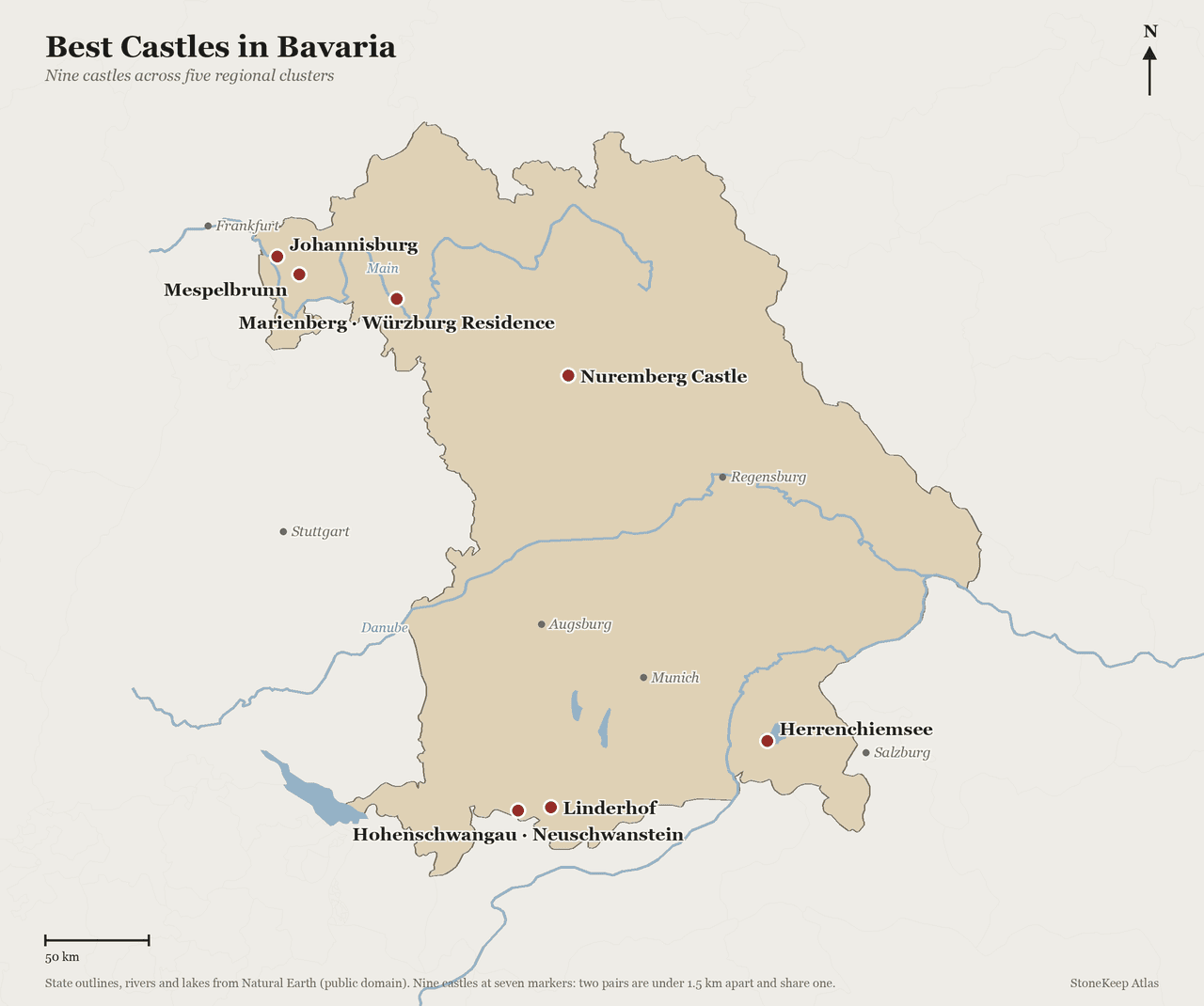
Four Wittelsbach castles cluster in the Alpine south, all within an hour or two of Munich. To the north, the five Franconian castles cluster, anchored on Nuremberg, Würzburg, Aschaffenburg, and the Spessart between them. Nuremberg sits roughly between Würzburg and Munich, and Mespelbrunn lies in the Spessart forest southeast of Aschaffenburg.
List the 9 castles on this map
- Neuschwanstein Castle — Swabia, Bavaria, Germany
- Hohenschwangau Castle — Swabia, Bavaria, Germany
- Linderhof Palace — Bavaria (Oberbayern), Germany
- Herrenchiemsee New Palace — Chiemgau, Upper Bavaria, Germany
- Marienberg Fortress — Würzburg, Lower Franconia (Unterfranken), Bavaria, Germany
- Würzburg Residence — Bavaria, Germany
- Johannisburg Palace — Bavaria, Germany
- Nuremberg Castle — Bavaria, Germany
- Mespelbrunn Castle — Bavaria, Germany
Hohenschwangau — where Romanticism caught Bavaria
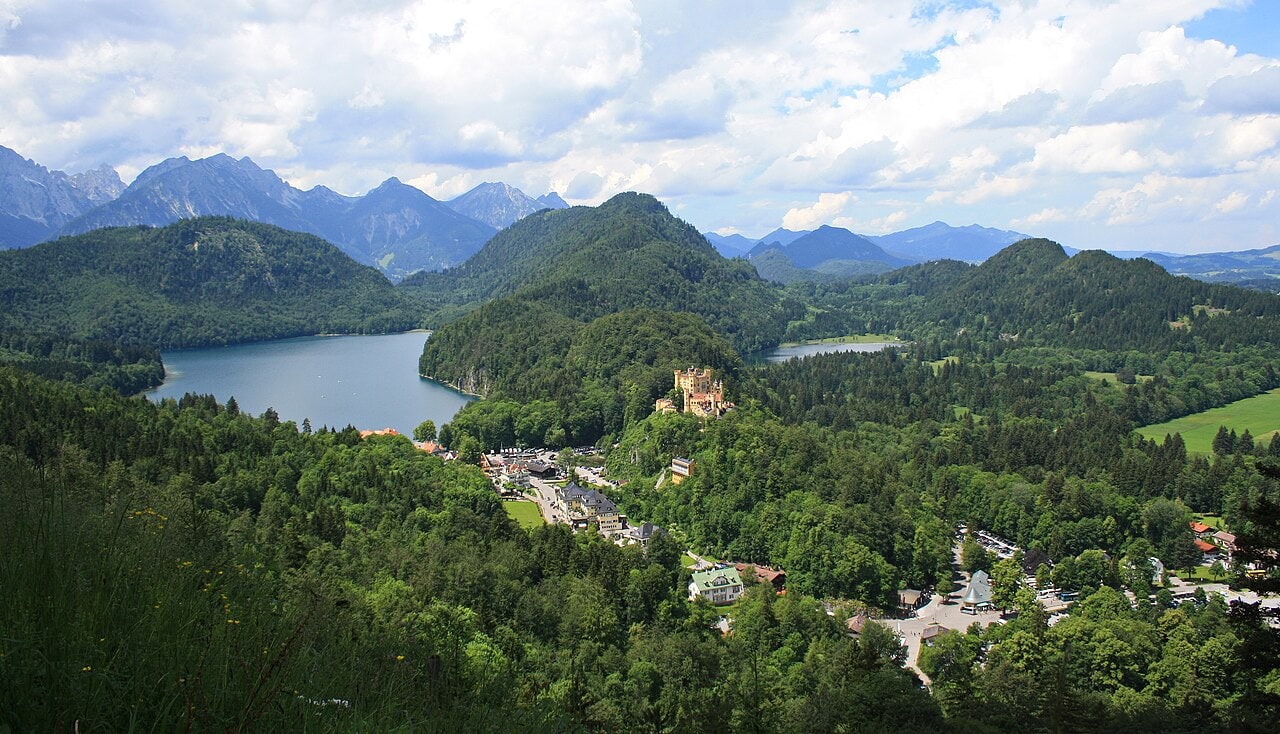
Long before Neuschwanstein rose on the opposing crag, the Wittelsbach family already had a Schwangau castle. Crown Prince Maximilian (later King Maximilian II of Bavaria) bought the medieval ruin of Burg Schwanstein in 1832 and rebuilt it between 1833 and 1837 in the yellow neo-Gothic still visible today. The painter Domenico Quaglio II designed the neo-Gothic rebuild, giving the schloss its distinctive ochre walls and crenellated towers; after his death in 1837 the architects Joseph Daniel Ohlmüller and Georg Friedrich Ziebland saw the work to completion. It became the family’s summer residence for the next eighty years.
Maximilian’s son, the future King Ludwig II, spent his childhood summers here, looking up at the ruined Vorderhohenschwangau and Hinterhohenschwangau on the cliffs across the valley. Those ruins became the site he chose, decades later, for Neuschwanstein. Hohenschwangau’s frescoes, more than ninety wall paintings among them the Heldensaal cycle designed in 1835 and 1836 by Moritz von Schwind, set out the Germanic legend cycle (Lohengrin and the Swan Knight saga, the Wilkina saga of Dietrich von Bern) that Ludwig II later commissioned Wagner to set to music and Christian Jank to translate into stone above the valley. That dream came from this house. For why Ludwig built as he did, see Ludwig II and the Architecture of Dreams. Tickets are issued not by the BSV but by the Ticket Center Hohenschwangau in the village below, usually as a same-day pairing with Neuschwanstein.
For the full account, see the Hohenschwangau Castle guide.
Neuschwanstein — the Wittelsbach apex
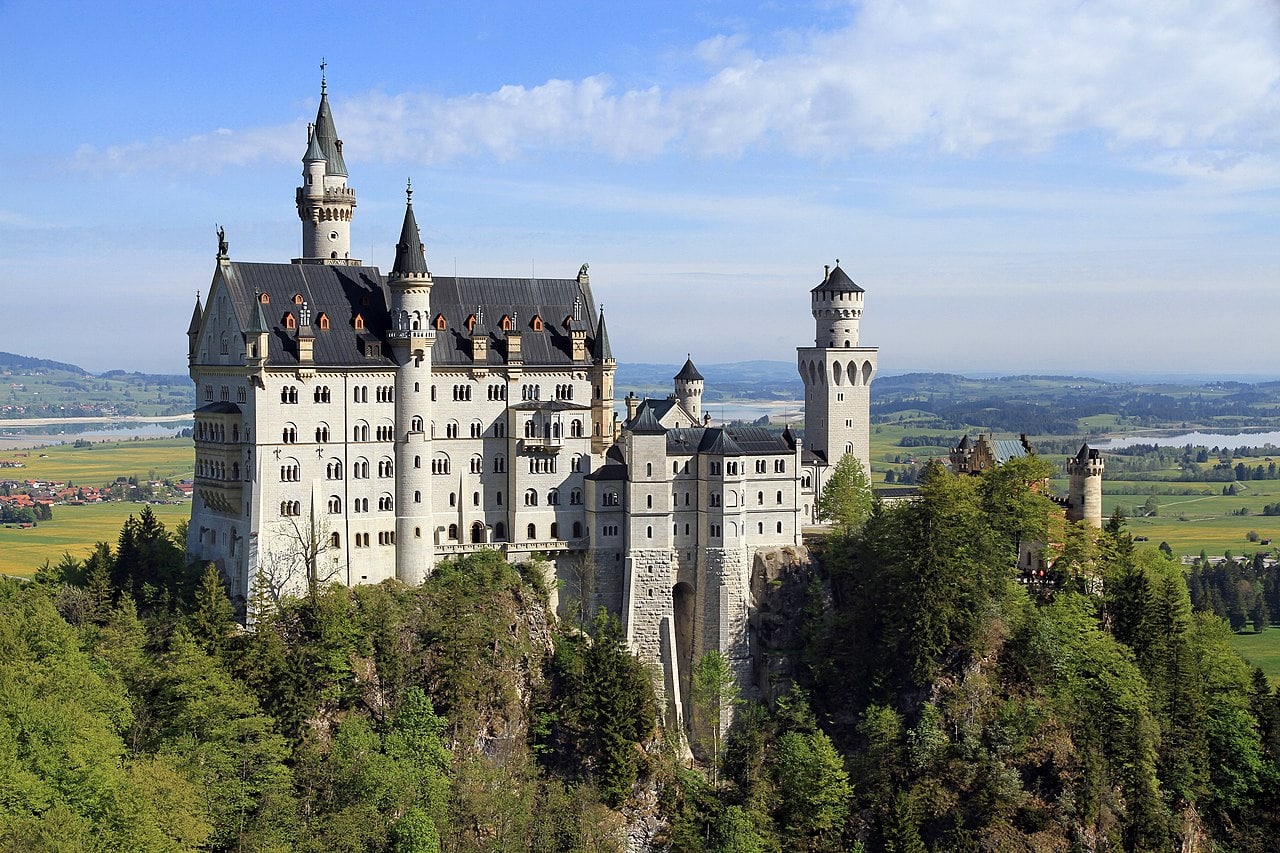
What started as a private retreat for one melancholic king became, after his death, one of the best-known, most-visited, and most-photographed buildings in the world, in the state palace administration’s own phrase. Ludwig II commissioned Neuschwanstein in 1869, with stage designer Christian Jank drawing the elevations and architects Eduard Riedel, Georg von Dollmann, and Julius Hofmann translating them into a buildable structure on the rock above the Pöllat gorge. Construction continued for the rest of his life and was halted, unfinished, when he was deposed in June 1886 and found dead in the Starnberger See days later. What was finished afterward was completed after his death in simplified form, the Kemenate and the Viereckturm in 1892, and the castle’s almost sober character owes a good deal to those parts.
Its interiors are a Wagnerian iconographic program: the Singers’ Hall references the medieval poetry contest in Tannhäuser at the Wartburg, and the Throne Hall channels Byzantine sacred architecture in service of a hall the king never lived to use. Between the bedroom and the study sits a small artificial stalactite grotto, which could be lit in colors and originally had a waterfall, an interior fantasy landscape that prefigures the larger Venus Grotto at Linderhof. Within months of Ludwig’s death the Bavarian government opened the castle to the public to recoup costs. In 2025, UNESCO inscribed it as part of the Ludwig II ensemble.
Today the BSV counts about 1.1 million visitors a year (1.08 million in 2025, per the BSV Schlösserbilanz) on guided tours of roughly 30 minutes.
For the full account, see the Neuschwanstein Castle guide.
Linderhof — the only larger palace Ludwig II saw completed
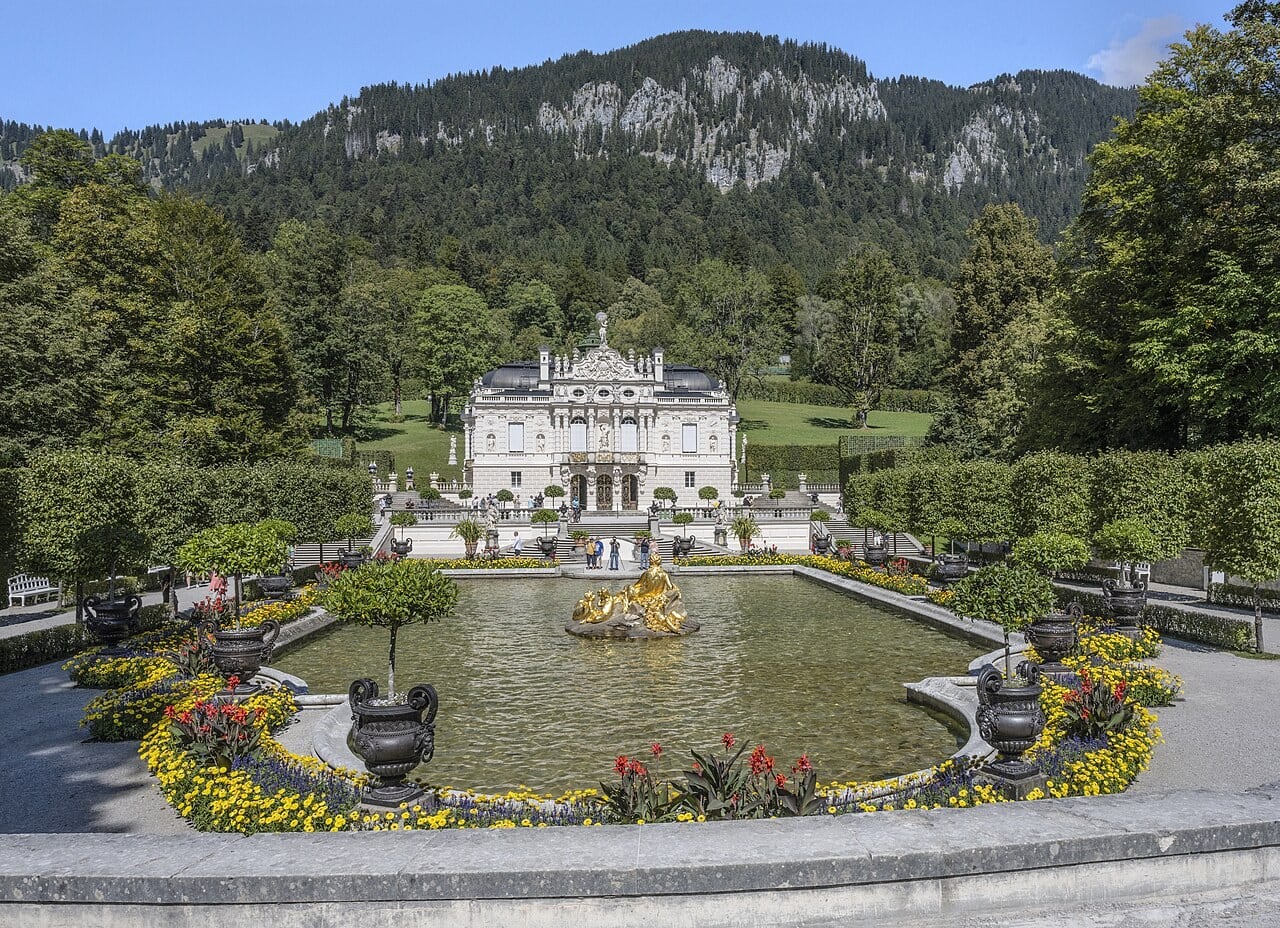
Linderhof is the smallest of Ludwig II’s three great projects and, in the operator’s own careful phrase, the only larger palace Ludwig II saw completed. It began in 1869 as an extension of a forester’s house in the Graswang valley above Ettal Abbey and grew through six building phases, with Georg von Dollmann involved from 1870. In February 1873 the king approved the design that fixed the palace’s appearance for good, and what reads today as stone is a masonry casing over a timber-framed core, applied in the same phase. A last campaign in 1885/86 widened the bedroom and lengthened the building northward, which meant a new center to the north façade and new roofing over it. Building ended in 1886 with the king’s death, and he left the new bedroom unfinished.
The interior is the densest French eighteenth-century quotation Ludwig produced, and it is sized for a single occupant rather than a court: a Hall of Mirrors for one, a Royal Bedroom facing an audience chamber barred to visitors. Yet Linderhof drew less from France than from the Wittelsbach inheritance on the king’s doorstep, the Amalienburg at Nymphenburg and the Rich Rooms of the Munich Residence, both designed in the 1730s by François de Cuvilliés the Elder. Work on the park (terraces, the artificial Grotto of Venus, the Hunding’s Hut after Die Walküre) continued until his death. Two of its best-known buildings he did not build at all: the Moroccan House and the Moorish Kiosk are exhibition pavilions he bought secondhand, the Kiosk made for the Paris world’s fair of 1867 and bought in 1876, the House for the Vienna exhibition of 1873 and bought in 1878, and they are among very few nineteenth-century fair buildings surviving anywhere.
For the full account, see the Linderhof Palace guide.
Herrenchiemsee — Versailles on a Bavarian lake
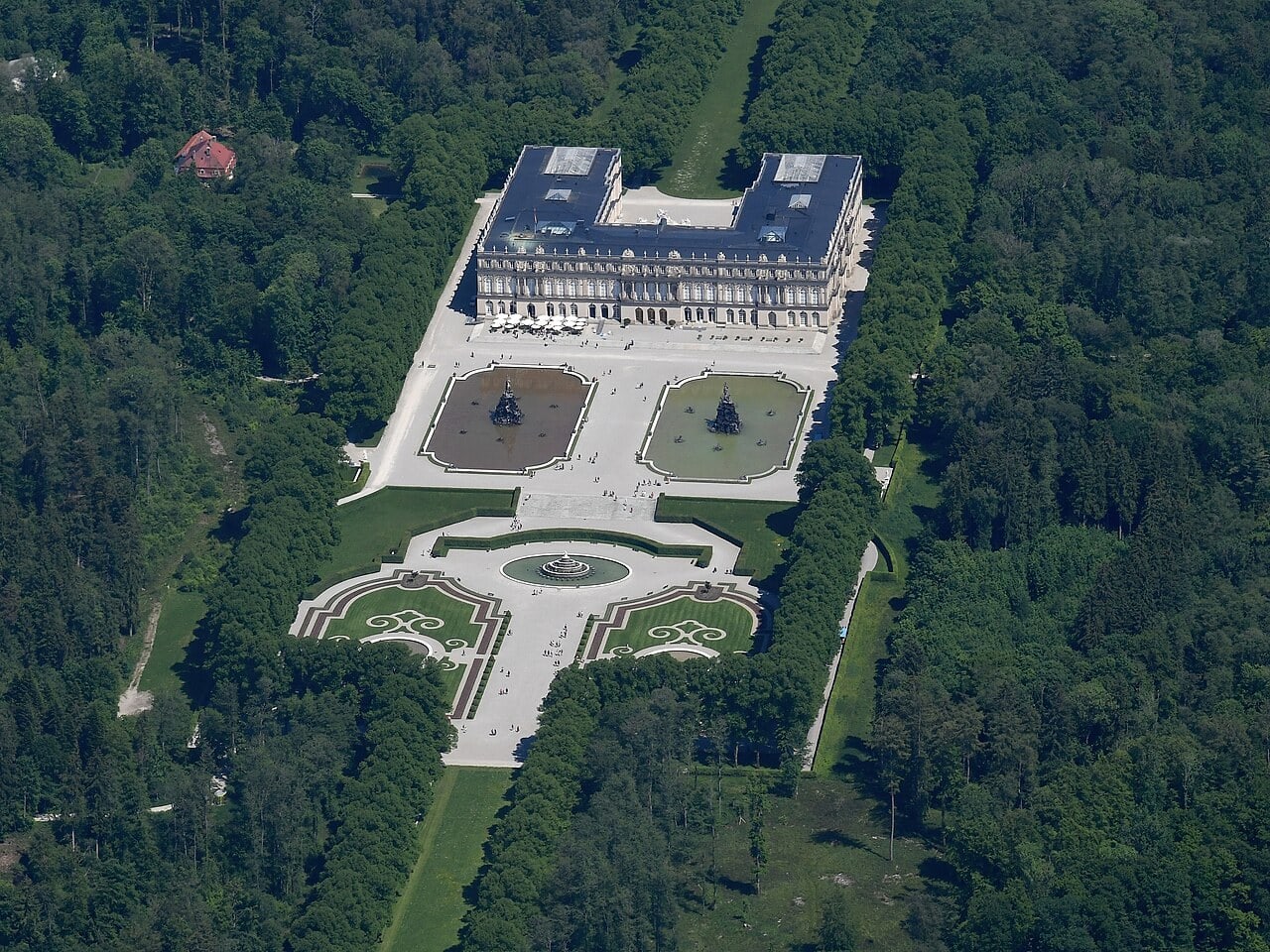
Ludwig II bought the largest island in the Chiemsee, the Herreninsel, in 1873 and began construction of his most ambitious palace there in 1878. His brief was an architectural homage to Louis XIV, conceived as a monument to absolute monarchy at exactly the moment Bavaria had stopped being one. Georg von Dollmann designed the three-winged neo-Baroque building, whose interiors include a Hall of Mirrors that exceeds its French model in length, a State Bedroom modeled on Louis XIV’s, and a vast unfinished north wing that was never roofed.
What Dollmann built was not a copy, and the operator is unusually direct about it. He worked from an idealized Versailles that the king had composed for himself out of literature and historical illustrations, and he had to reconstruct rooms that had long since ceased to exist in France. The BSV’s own chief conservator puts it flatly: no single room is an exact copy of its model. Resemblance is another matter, and between the parks, the state bedrooms, and the two galleries of mirrors it is striking: the Große Spiegelgalerie runs to roughly 98 meters against the 73-meter Hall of Mirrors at Versailles. The whole exercise cost more than Neuschwanstein and Linderhof together.
He visited the building site only once during construction, in September 1885, less than a year before his death. Only the central axis and its waterworks were complete when he died, with the entire south wing and most of the north wing roofless, and the palace remains a torso, which is the operator’s own word for it. Herrenchiemsee is reached from Prien am Chiemsee by boat. UNESCO inscribed it in 2025 as a component of the Ludwig II ensemble.
For the full account, see the Herrenchiemsee New Palace guide.
Nuremberg Castle — the Reichsstadt’s imperial seat
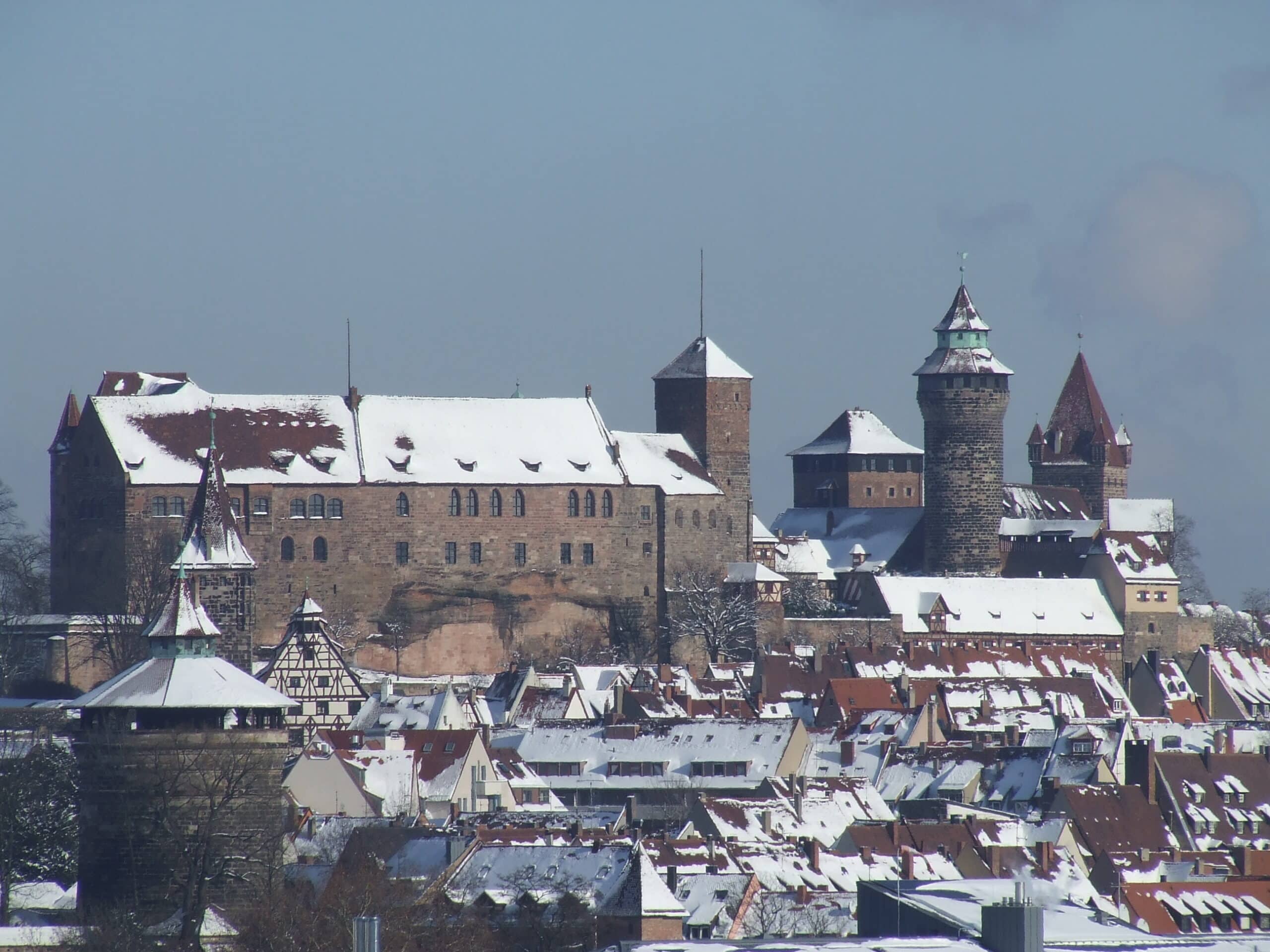
Nuremberg Castle belonged neither to the Wittelsbachs nor to a prince-bishop. It was a Reichsburg, owned by the Holy Roman Empire itself rather than by any territorial prince, and from the eleventh century onward it served as a working residence for the elected German kings and emperors when they came to the Franconian heartland for imperial diets and court days. The Doppelkapelle beside the gate was probably begun under Heinrich VI in the 1190s, and it is really a triple arrangement rather than a double one: a lower chapel, an upper chapel, and above them the Herrscherempore, a ruler’s gallery reached directly from the upper hall and the imperial chambers, which let the emperor attend while keeping his distance from his own court. Finishing work on the chapel was still incomplete in 1216. The Sinwellturm, the round tower on the rock, is later than it looks beside that work: the operator dates it to the second half of the thirteenth century and explains its massive walls and half-height door as a secure store, a strongroom or a dungeon, while its considerable height also let defenders pick out attackers early.
On the night of January 2, 1945, RAF Bomber Command’s area raid destroyed the Old Town, and the Burg was left 70 to 80 percent destroyed, chiefly but not solely in that raid; it was restored by 1981. Two qualifications belong with that figure. Significant Romanesque and late-Gothic components survived almost undamaged, which is what the table’s “partly rebuilt after 1945” is registering. And the bare stonework a visitor reads as medieval is partly a decision rather than a survival: photographs from the end of the nineteenth century show most of the buildings rendered, and the complex was stripped of its render in the 1930s, when the Third Reich’s picture of the Middle Ages required bare walls.
For the full account, see the Nuremberg Castle guide.
Marienberg — the prince-bishop’s hill
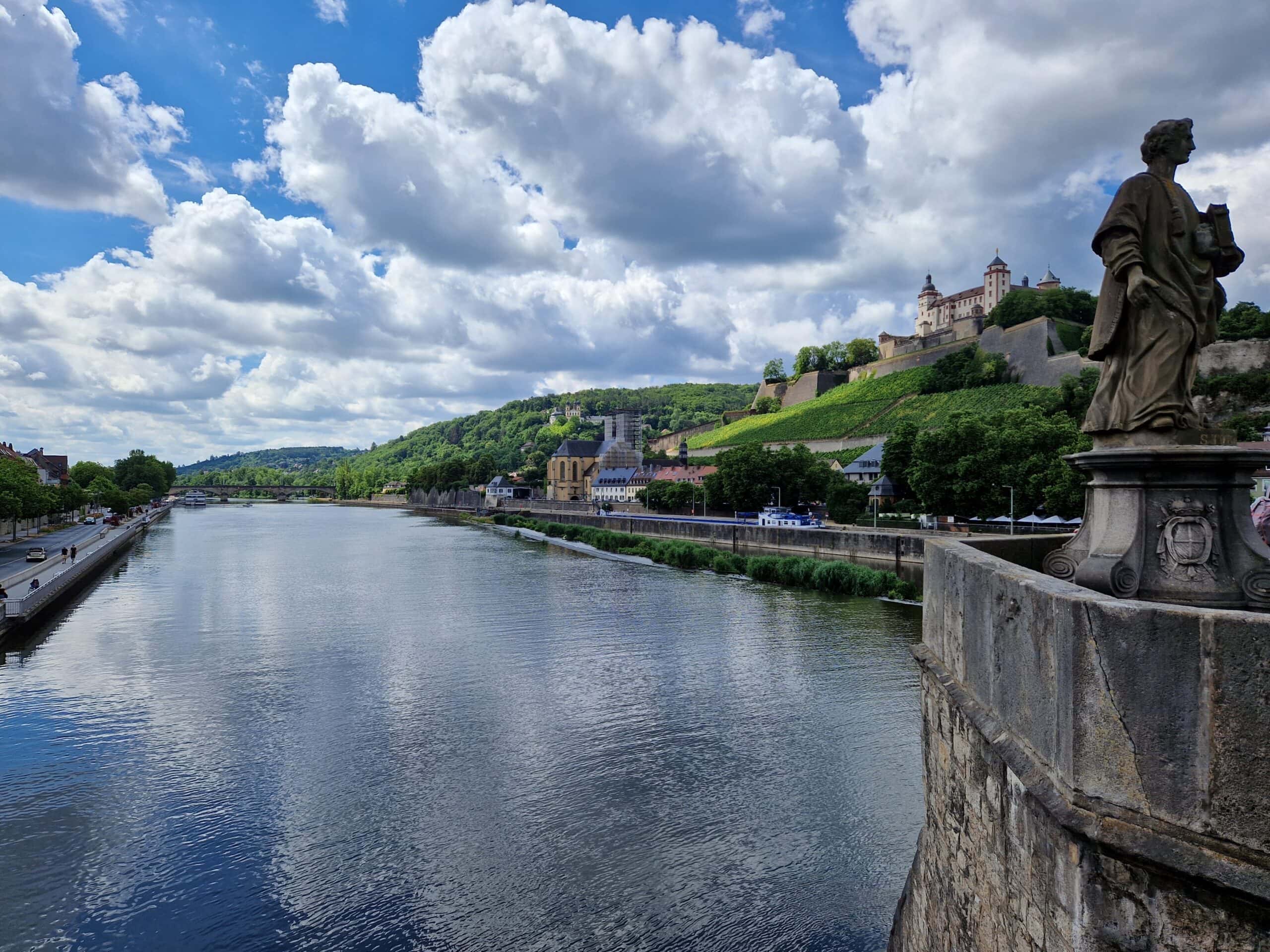
For nearly five centuries, the prince-bishops of Würzburg ruled their city from the wrong side of the Main. The cathedral, the markets, and the burghers’ houses stood across the water; power lived on the wooded hill above the left bank, in the Festung Marienberg, from the thirteenth century until 1719.
This fortress is older than its tenure as a bishop’s seat. Its round Marienkirche dates from around 1000 and is the oldest recorded building on the hill, though what stands is not purely of that date: the state record describes an early Romanesque rotunda with a rectangular choir of around 1600, from the campaign in which Julius Echter gave the church its present appearance. Building of the large hill castle around it began about 1200 under Konrad von Querfurt. Julius Echter von Mespelbrunn (1573–1617) converted that castle into a bishop’s residential palace, work concentrated around 1600 rather than spread across his reign, and the largest single architectural intervention in the castle’s history. On October 18, 1631, a Swedish army stormed the fortress in the Thirty Years’ War (the first time it had been taken) and held it for four years; it was returned to the prince-bishopric in 1635 by negotiation, not reconquest.
The Schönborn prince-bishops then threw a bastioned enceinte around the hill from 1649 to 1656, taking up the Swedes’ own plans and keeping on their master builder Michael Kaut, whom Johann Georg Fernauer replaced in 1649, and the works continued into the 1720s and beyond, with Balthasar Neumann among the eight engineers the state record names and a Maschikuliturm of about 1728 at the outer edge. Würzburg lost its status as a fortress town in the 1860s; the city’s enceinte was cleared after 1866, while the ring around the Marienberg itself largely stands. The fortress burned out almost entirely in 1945, in the same March raid that gutted the Residence across the river, and the rebuilding took the following four decades. The Bayerische Schlösserverwaltung took the property over in 1935, and Rudolf Esterer’s historicizing restoration of the core followed.
For the full account, see the Marienberg Fortress guide.
Würzburg Residence — Tiepolo’s heaven on earth
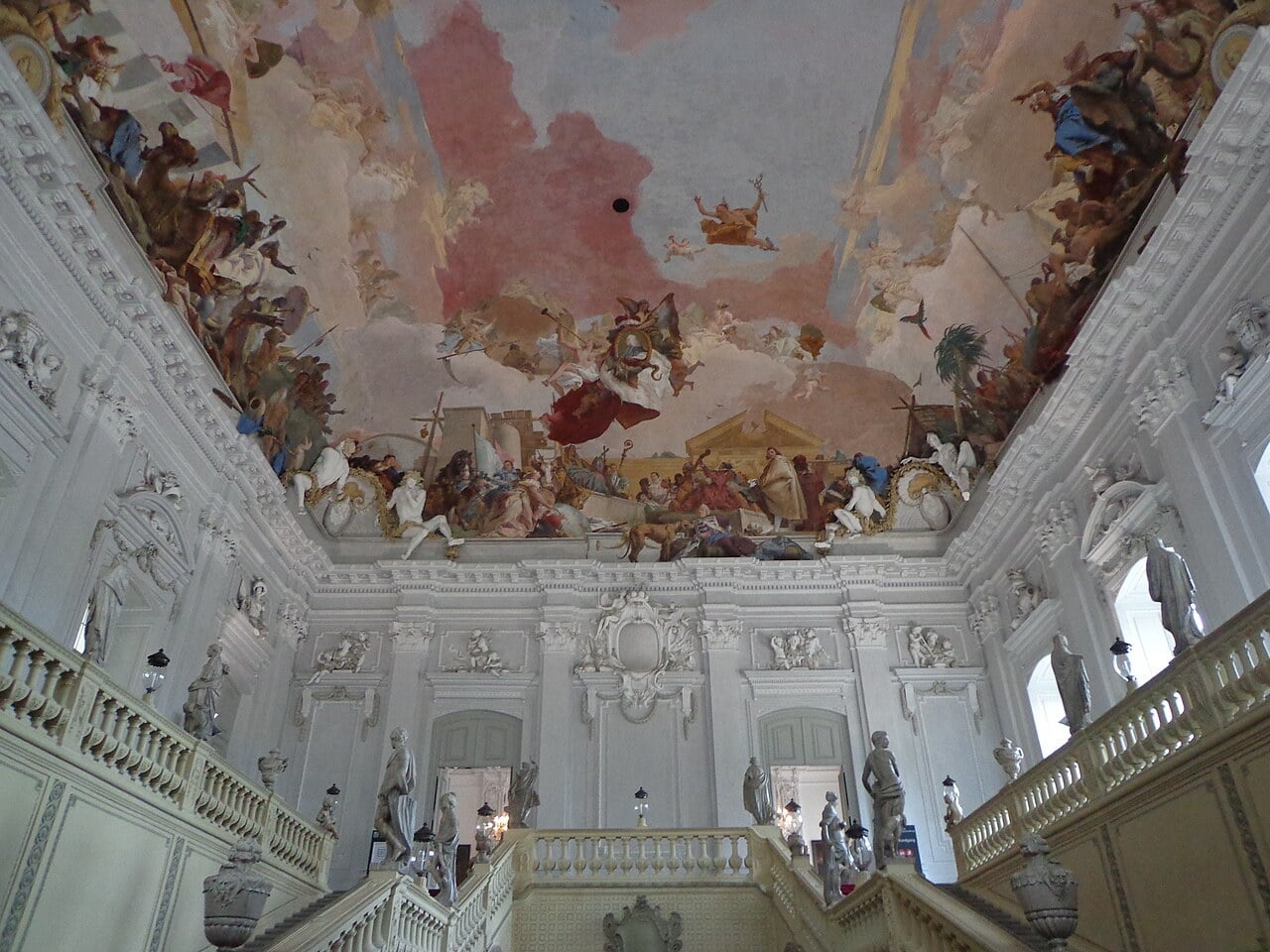
Johann Philipp Franz von Schönborn, elected Prince-Bishop in September 1719, wanted what the fortress on the hill could not give a Baroque court: a palace in the city, fronting a square large enough to drill a regiment in, designed by the best architect Germany then had. He had one. Balthasar Neumann, an artillery officer turned architect from a family of Bohemian gunfounders, drew the plans and executed them over the next two decades; the foundation stone went down on May 22, 1720. Designs were also commissioned from the leading architects of the day (Maximilian von Welsch, Johann Lucas von Hildebrandt, Germain Boffrand, and Robert de Cotte) as stimulus, competition, and correction, and Neumann worked them into the planning in part.
That result, structurally complete by 1744 and decoratively by 1780, is the canonical statement of South German late Baroque: a 167-meter sandstone façade, a staircase hall the operator calls one of the greatest spatial creations ever achieved in secular architecture, and a ceiling fresco by Giovanni Battista Tiepolo over the column-free Treppenhaus vault. Apollo and the Four Continents is, in the BSV catalogue’s phrasing, one of the largest single-piece frescoes ever painted, at roughly 600 square meters of painted surface; the palace’s own guide goes further and calls it the largest ceiling fresco ever painted. The Hofkirche, the Spiegelkabinett, the Weißer Saal, and the Kaisersaal complete the central block, though not all in the same sense: the Spiegelkabinett was reconstructed and reopened in 1987 in its particular reverse-glass technique, while the Kaiserzimmer keep furnishings that were evacuated and survived. UNESCO inscribed the Residence with its court gardens and the Residenzplatz in 1981, one of the earliest German entries on the list.
The Residence was hit on the night of March 16, 1945 by RAF No. 5 Group (225 Avro Lancaster bombers and eleven Mosquito Pathfinders) in a raid that delivered 1,127 tons of bombs in seventeen minutes, and it almost completely burned out. Only the Vestibül, Gartensaal, Weißer Saal, Treppenhaus, and Kaisersaal were largely spared, and even those lost their roof surfaces; Neumann’s stone vaults held under the burning roof structure as it came down. The rebuilding ran from 1945 to 1987, and restoration continues in detail.
For the full account, see the Würzburg Residence guide.
Schloss Johannisburg — the Mainz castle that joined Bavaria
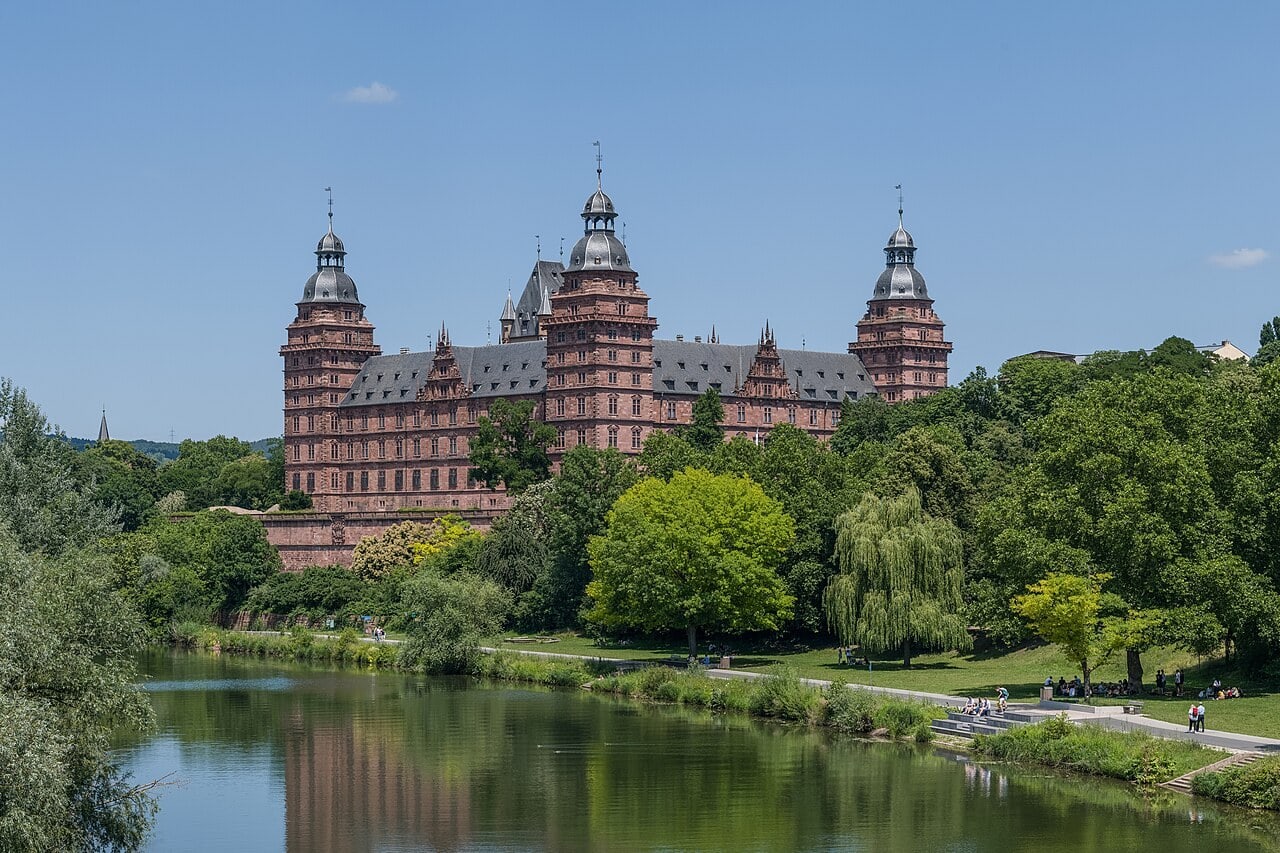
Aschaffenburg was a Mainz town until 1814. Schloss Johannisburg, the four-towered red sandstone palace on the right bank of the Main, was built between 1605 and 1614 by Prince-Archbishop-Elector Johann Schweikard von Kronberg as a Mainz Zweitresidenz, a second residence for the electors when affairs called them away from Mainz itself. Georg Ridinger of Strasbourg designed it as a strict Vierflügelanlage, four equal wings around a square inner court, keeping only the thirteenth-century Bergfried of the medieval predecessor castle as a fifth tower. It is one of the most important residential buildings of the German late Renaissance.
Bavaria’s crown made the Schloss a Wittelsbach Nebensitz. King Ludwig I added the Pompejanum, his idiosyncratic reconstruction of the Roman House of the Dioscuri, on the bluff just upstream, the kind of cross-cultural quotation his grandson Ludwig II would later take to far stranger places. Inside, the Schlosskapelle by Hans Juncker, its high altar dated 1609–1613, is the building’s most important art-historical interior, restored after severe war damage, and the Staatsgalerie holds a major group of Lucas Cranach the Elder paintings.
American shells nearly erased the Schloss in the Battle of Aschaffenburg in March and April 1945. Reconstruction under the BSV ran from 1954 to 1964, and the two halves of that job were not the same: the exterior went back faithfully, while the internal room layout was changed to suit a building now used as museum, administration, and library. That sat on top of an earlier recasting, when Emanuel Joseph von Herigoyen pulled down the courtyard arcade at the end of the eighteenth century and renewed the interiors in Neoclassical form. Restoration has run in phases since 2016, with the Main wing reopening in 2023. Johannisburg is jointly run today by the BSV and the Stadt Aschaffenburg under separate ticketing.
For the full account, see the Schloss Johannisburg guide.
Mespelbrunn — the Echter cradle in the Spessart
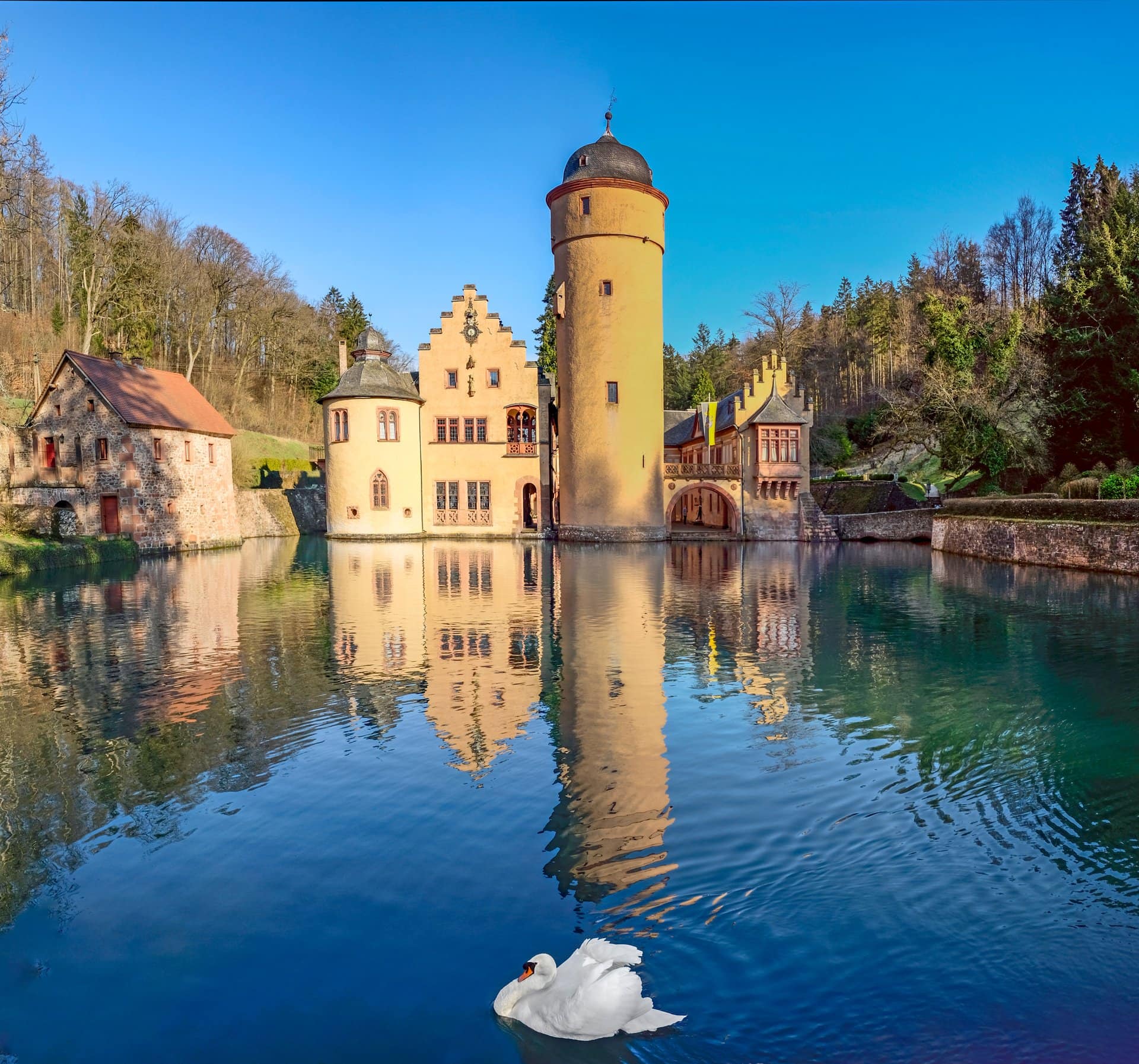
Mespelbrunn is the only one of the nine that was never a state seat and has never been in state ownership. On May 1, 1412, Archbishop-Elector Johann II of Mainz granted a remote stretch of forest in the upper Spessart to the knight Hamann Echter, the elector’s forest master, in reward for his service. His son Hamann II Echter converted his father’s unfortified Weiherhaus on the dammed Elsava brook into a fortified house from about 1427, against the Hussite raids documented in the Spessart in those years; the round Bergfried rising from the moat dates from about 1430. The most consequential generation was Peter III Echter and Gertraud von Adelsheim, who between 1551 and 1569 transformed the medieval Burg into the Renaissance Wasserschloss still standing, with its stair-stepped gables, the inner courtyard portal dated 1569, and the great hall finished by 1553. Their son Julius, born here on March 18, 1545, left this house to become Prince-Bishop of Würzburg and to rebuild a good deal of Franconia.
Echter’s male line ran out with Johann Philipp Echter in 1665, and the estate passed by the marriage of the last Echter heiress, Maria Ottilia, to Philipp Ludwig von Ingelheim. When the 1806 mediatization swept up the Reichsritter estates of the Spessart, Mespelbrunn went under Bavarian sovereignty with them as a privately held country seat rather than a state property. The Ingelheim family lives in the Südflügel today. From the 1412 grant to their tenure is more than six centuries of unbroken family possession on the same moated platform, which is a claim about ownership and not about fabric: the building a visitor sees was restored in 1904 by Friedrich von Thiersch, and the state record classifies the standing house as early modern with the medieval castle beneath it as buried archaeology.
Mespelbrunn entered the wider German imagination through Kurt Hoffmann’s 1958 film Das Wirtshaus im Spessart, which used the castle as the seat of Graf Sandau. That moated Renaissance silhouette in the opening titles became, for a generation of West German viewers, the visual definition of the word Schloss. The family operates the castle as a private museum from late March to early November, with conservation campaigns co-funded by the Deutsche Stiftung Denkmalschutz in 2020, 2022, and 2025.
For the full account, see the Mespelbrunn Castle guide.
Why Bavaria, and not somewhere else
What these nine castles share is not architectural language. The Marienberg’s bastion ring and Hohenschwangau’s neo-Gothic crenellations are separated by 250 years and by entirely different conceptions of what a castle is for; the imperial Burg of Nuremberg and the Spessart Wasserschloss of Mespelbrunn answer to different constitutional logics again. What they share is the institutional history that made them all, in the early twenty-first century, sit inside the same state and mostly under the same operator.
The traditions were never sealed off from one another, and one career shows how porous they were. Julius Echter von Mespelbrunn was born in the knightly Wasserschloss on March 18, 1545 and became Prince-Bishop of Würzburg in 1573; over forty-four years on the cathedra he refounded the university, built the Juliusspital, converted the Marienberg into a bishop’s residential palace, and rebuilt or commissioned about three hundred parish churches in the post-Gothic manner the state record calls Echtergotik. He came out of one castle on this list and remade another. A single Reichsritter family produced the man who gave the prince-bishopric its architectural face.
The same tradition supplies the only case here of one castle replacing another, and it is why two Würzburg entries sit on this list rather than one. What ended five centuries on the Marienberg was a death rather than a decision: on the death of Johann Philipp von Greiffenclau in 1719 the court went down into the valley for good, and his successor Johann Philipp Franz von Schönborn began the Residenz the following spring. Even then the move went step by step, and the fortress was still lodging state guests as late as 1725 while the new palace took over its functions, and its furniture, by degrees. A reader who visits both in a day is walking the distance a Baroque court took six years to cross.
Secularization in 1803 dissolved the Würzburg prince-bishopric and, in the same round, the Mainz electorate, though their buildings reached Bavaria on different dates and by different instruments. The 1806 mediatization assigned the imperial Reichsstadt of Nuremberg, with its Burg, to the new Kingdom of Bavaria, and absorbed the Reichsritter knightly estates of the Spessart along with it. Hohenzollern Franconia came separately again, Ansbach in 1806 and Bayreuth in 1810. The Paris Convention of June 3, 1814 settled Würzburg and Aschaffenburg, and the Congress of Vienna and its follow-on treaties, running through the Territorialrezess of 1816 and the Frankfurter Generalrezess of 1819, closed what remained. In 1918 the revolutionary government treated the palaces the dynasty had used as state property, and the two 1923 instruments divided house property from state property. Linderhof, Herrenchiemsee, Neuschwanstein, the Munich Residence, the Würzburg Residence (already public since 1814), the Marienberg (in 1935), and the Nuremberg Burg (Bavarian since 1806) are all administered through what is now the Bayerische Schlösserverwaltung, with more than forty sites under one umbrella.
Two visible exceptions reveal the rule. Hohenschwangau, as the Wittelsbach family’s actual childhood home rather than a state residence, stayed with the family and has been held since 1923 by the Wittelsbacher Ausgleichsfonds. Mespelbrunn was never a state seat and has never been in state ownership: the Echter held it from 1412, as a Mainz fief from 1426, and the Ingelheim who married into them hold it still. State-functional palaces went public; the family’s own house stayed private; and the imperial-knight estate that was never a state seat in the first place stayed where it had always been.
Planning a Bavarian castle itinerary
Bavaria is large. Würzburg is roughly 270 km north of Munich; Aschaffenburg is another 75 km west of Würzburg; Nuremberg sits 170 km north of Munich and 100 km east of Würzburg, roughly between them. Three of those four sit close together southwest of Munich; Herrenchiemsee lies southeast of the city, far enough that it does not share a base with them. Distance is not the binding constraint, though. Transfers are: a boat crossing and a walk of at least 45 minutes from the pier at Herrenchiemsee, a 260 m walk to the ticket office at Linderhof and 400 m more to the palace, for which the operator asks visitors to allow 30 minutes, and an operator instruction to be in the village at Schwangau ninety minutes to two hours before a Neuschwanstein slot. Built around those numbers, a loop covering all nine runs to roughly eight or nine days rather than a straight week.
Season shapes a Bavarian castle trip more than it does in most German states. Late spring through early autumn is when everything runs together, and it is also when the operator warns about queues, at Neuschwanstein, Linderhof, Herrenchiemsee, and the Würzburg Residence. Deep winter thins those crowds at the year-round state palaces but closes the family-run Mespelbrunn entirely, and it thins the connections too: the Chiemseebahn that links Prien’s station to the Herrenchiemsee boats runs daily on the summer timetable, drops to Saturdays, Sundays and holidays on the winter one, and stops altogether from late autumn to spring, with the 1887 steam locomotive working mostly at weekends and a diesel on weekdays. Boats from Prien/Stock cross to the islands year-round. Two of the nine close every Monday. Marienberg and Johannisburg close on Mondays, both of them on the Franconian leg, so a Monday there costs a reader two of the nine at once.
The single most useful instrument is the BSV’s Mehrtagesticket, a 14-day combination pass valid at all seven BSV-operated sites in this guide and across the rest of the BSV portfolio, sold at a single and a family or partner rate; an annual Jahreskarte follows the same two-rate structure and makes sense for travelers spending more than two weeks in the state. The Bayerische Schlösserverwaltung withdrew the three-palace Kombiticket that once bundled Neuschwanstein, Linderhof, and Herrenchiemsee, and the 14-day and annual tickets are now the only combination passes it sells. Hohenschwangau is ticketed separately through the Ticket Center Hohenschwangau and is covered by neither, and Mespelbrunn sits outside the BSV system altogether and is cash-only at the gatehouse. Neuschwanstein has changed how it sells entry, and the change catches people out: tickets are sold online in advance through the Ticket Center and the option to reserve without paying has been withdrawn, so the desk sells only what is left, for the same day, which can be gone by late morning. Day tours from Munich to the royal castles can be booked in advance through GetYourGuide.
If a week-plus is the budget, the natural shape is two nights in Munich (day trips to Linderhof or Herrenchiemsee), two nights at Füssen for the Schwangau pair, one night in Nuremberg for the Burg and the Old Town, and two nights at Würzburg for the Residence and Marienberg, with Johannisburg as a half-day stop on the train back through Aschaffenburg and Mespelbrunn as a side-trip into the Spessart from there. If only a long weekend is available, the Schwangau pair plus one Munich-side palace is the most rewarding compression, and saves the Franconian five for a second trip, where they are properly the focus rather than the addendum. Munich, Nuremberg, Würzburg, and Aschaffenburg are linked by fast trains; the Schwangau pair, Linderhof, and the Spessart side-trip are a different proposition, and without a car the organized day tours from Munich are the simplest way to reach the Alpine palaces.
Two current closures are worth planning around. At Linderhof, the Moorish Kiosk is closed for restoration until further notice, with no reopening date published. At the Marienberg, the Kernburg and the inner courtyard beyond the Scherenbergbrücke are shut to individual visitors until further notice for a major restoration, and the important qualification is that the guided tour still runs over the whole site including the Kernburg, so the tour is the way in rather than a consolation, though the operator warns that the tour route may have to be adjusted at short notice while the work continues. English-language tours run only on summer weekends and public holidays, once a day, which for an English-speaking visitor is the real constraint on that hill. The Museum für Franken, occupying the Zeughaus and the Fürstenbau on the same hill, stays open throughout, but it is a separate operator and is not covered by any BSV pass. Anyone staying overnight can compare hotels in and around Munich.
Some links on this page are affiliate links, which means StoneKeep Atlas may earn a small commission, at no extra cost to you, if you book through them.
Two of the nine publish a refusal on accessibility, and both are worth reading in the operator’s own terms rather than a softened summary. At Hohenschwangau, the tour route involves roughly 180 steps, ninety up and ninety down, which cannot be avoided, and the Ticket Center states that people with limited mobility or who depend on a wheelchair cannot visit Hohenschwangau Castle; the lakeside approach itself is step-free, and the Museum of the Bavarian Kings below is barrier-free. At the Marienberg, taking part in the castle tours is not possible for wheelchair users, though the Echterhof, the viewpoints, and the Museum für Franken remain reachable. Neuschwanstein has a lift, but it comes with enough conditions (advance email request, one visitor and one companion, once an hour, within a fixed window, a disability certificate) that the operator says even many visitors in wheelchairs cannot always be accommodated.
One last durable point, because a reader planning nine interiors will assume the opposite. Across the BSV portfolio, private photography is tolerated only in a small way and without flash, tripods, and selfie sticks, and in houses that run a guided-tour operation it is as a rule not possible at all. In this guide that reaches Neuschwanstein, Linderhof, and Herrenchiemsee. Anything beyond a private snapshot needs a paid permit applied for at least ten working days ahead.
Common Questions
Which of the nine can you reach from Munich without a car?
All but one. The Bayerische Schlösserverwaltung publishes a railhead and a local connection for eight of them: Nuremberg, Würzburg, and Aschaffenburg on the fast rail axis, with city buses to Burgstraße, Residenz, and Stadthalle respectively; Füssen and an RVA bus for the Schwangau pair; Oberau or Oberammergau for Linderhof; Prien for Herrenchiemsee. Mespelbrunn is the exception, and instructively so: its own directions page lists motorway exits and nothing else.
Which Bavarian castles draw the biggest crowds?
The operator names four of them in its own warning about long summer waits: Neuschwanstein, Linderhof, Herrenchiemsee, and the Würzburg Residence. Three are Ludwig palaces and the fourth is Franconian, which matters if you had the northern half down as the quiet leg of a trip. Note also what that list leaves out. Nuremberg, Marienberg, Johannisburg, Hohenschwangau, and Mespelbrunn are all absent from it.
Which of the nine can you visit in winter?
Eight of the nine. Only Mespelbrunn closes outright, from early November to late March, because it is a family home first and a museum second. Elsewhere winter changes access rather than opening hours: Linderhof’s park buildings, the Grotto of Venus among them, shut from mid-October to mid-April, and the bus up to the Marienberg runs April to October only, which leaves a walk up from the Alte Mainbrücke for anyone without a car.
Does one ticket cover all nine?
No, and two of the nine sit outside the system entirely. The BSV’s combination passes cover its seven sites in this guide; Hohenschwangau is ticketed by the Wittelsbacher Ausgleichsfonds and Mespelbrunn by the family’s own Schlossverwaltung, and neither honors a BSV pass. A pass buys admission rather than priority, since a free ticket still has to be issued at the desk. Under-18s enter every BSV building free, and the Chiemsee boat is in no BSV ticket at all.
How long do you need to see all nine?
Longer than a map of Bavaria suggests, because the transfers rather than the tours set the pace. Herrenchiemsee alone is a train to a regional station, a seasonal link to the harbor, a boat, and then at least 45 minutes on foot from the pier. Linderhof’s car park is 660 m from the palace, and the operator asks for 30 minutes for that walk, because a missed tour slot cannot be rejoined. Fold in two Monday closures on the Franconian leg and a single week is tight.
Beyond the nine
This hub is one regional chapter in a wider survey. Readers working nationally can go up a level to the best castles in Germany; readers who want the northern half on its own terms will find it in our guide to the princely seats of Franconia, which covers Nuremberg, Würzburg, and Aschaffenburg alongside castles this roster excludes. For the dynasty rather than the region, seven centuries of Wittelsbach building takes the story from the Munich court palaces outward, and the four palaces Ludwig II left behind treats the royal quartet as a single project. And because this guide uses Burg, Schloss, and Festung throughout without stopping to define them, readers who want that distinction drawn properly can read what separates a castle from a palace and a fortress. Hohenschwangau and Neuschwanstein also belong to a wider stylistic moment, traced in The 19th-Century Romantic Revival of German Castles.
Bavaria has further substantial castles in the StoneKeep directory that are not among the nine, and the reasons are worth stating. Burghausen Castle, the world’s longest castle, sits on the Salzach; Coburg Fortress (Veste Coburg) is the Lutheran Franconian Stammburg of the Saxe-Coburg dukes. Coburg joined Bavaria only by 1920 plebiscite and belongs to the state’s castle landscape by a different mechanism than the nine above: an Ernestine-Saxon dynastic past brought in as a fifth political tradition alongside Wittelsbach, prince-bishop, Reichsstadt, and Reichsritter. The Plassenburg above Kulmbach and Nymphenburg Palace, the Wittelsbach summer residence in Munich, each have their own guide; Nymphenburg is excluded here because the Munich court palaces are the one tradition the composite-state argument needs no help explaining.
Conclusion
Nine castles, four architectural periods, four political traditions, one mostly unifying operator. Bavaria is the only German state where a single multi-day pass takes you from a twelfth-century Hohenstaufen Reichsburg to an 1886 Versailles homage on a lake, and the only place where the institutional shape of that itinerary is itself part of the story being told. Read the roster as a political map and it stops being a list of pretty buildings: a prince-bishop’s fortress facing the city it taxed, a Free City’s imperial burg holding the crown jewels of the Empire, a knight’s moated house held by one family since 1412, and three royal palaces built by a king who had already lost the sovereignty they were meant to express. Secularization, mediatization, and a revolution put most of them in the same hands within a single century. That is the through-line worth carrying up the hill.
Principal Sources
- Bayerische Schlösserverwaltung. “Allgemeine Informationen: Öffnungszeiten und Tarifbestimmungen.” schloesser.bayern.de.
- Bayerische Schlösserverwaltung. “Festung Marienberg – Würzburg.” schloesser.bayern.de.
- Bayerische Schlösserverwaltung. “Fotogenehmigungen.” schloesser.bayern.de.
- Bayerische Schlösserverwaltung. “Jahreskarten und Mehrtagestickets.” schloesser.bayern.de.
- Bayerische Schlösserverwaltung. “Kaiserburg Nürnberg.” schloesser.bayern.de.
- Bayerische Schlösserverwaltung. “Kaiserburg Nürnberg: Tiefer Brunnen und Sinwellturm.” kaiserburg-nuernberg.de.
- Bayerische Schlösserverwaltung. “Neues Schloss Herrenchiemsee.” schloesser.bayern.de.
- Bayerische Schlösserverwaltung. “Parkbauten im Schlosspark Linderhof.” schloesser.bayern.de.
- Bayerische Schlösserverwaltung. “Residenz Würzburg: Baugeschichte.” residenz-wuerzburg.de.
- Bayerische Schlösserverwaltung. “Residenz Würzburg: Rundgang, Treppenhaus.” residenz-wuerzburg.de.
- Bayerische Schlösserverwaltung. “Residenz Würzburg” (Objektbeschreibung). schloesser.bayern.de.
- Bayerische Schlösserverwaltung. “Die Residenz Würzburg und die Welterbeliste der UNESCO.” residenz-wuerzburg.de.
- Bayerische Schlösserverwaltung. “Schloss Linderhof: Bauphasen.” schlosslinderhof.de.
- Bayerische Schlösserverwaltung. “Schloss Linderhof: Entstehungsgeschichte.” schlosslinderhof.de.
- Bayerische Schlösserverwaltung. “Schloss Linderhof: Service für Menschen mit Behinderung.” schlosslinderhof.de.
- Bayerische Schlösserverwaltung. “Schloss Neuschwanstein.” schloesser.bayern.de.
- Bayerische Schlösserverwaltung. “Ticketshop Schloss Linderhof.” ticketshop-schlosslinderhof.de.
- Bayerisches Landesamt für Denkmalpflege. Denkmalliste: Gemeinde Mespelbrunn, Baudenkmäler (Aktennummer D-6-71-141-7). geodaten.bayern.de.
- Bayerisches Landesamt für Denkmalpflege. Denkmalliste: Kreisfreie Stadt Würzburg, Baudenkmäler (Aktennummern D-6-63-000-317 und D-6-63-000-429). geodaten.bayern.de.
- Chiemsee-Schifffahrt Ludwig Feßler KG. Sommerfahrplan (14. Mai bis 20. September 2026), incl. Chiemsee-Bahn. chiemsee-schifffahrt.de.
- Chiemsee-Schifffahrt Ludwig Feßler KG. Winterfahrplan (21. September 2026 bis 14. Mai 2027), incl. Chiemsee-Bahn. chiemsee-schifffahrt.de.
- Dehio, Georg. Handbuch der deutschen Kunstdenkmäler – Bayern III: Franken and Bayern IV: München und Oberbayern. Berlin: Deutscher Kunstverlag.
- Deutsche UNESCO-Kommission. “Die Schlösser König Ludwigs II. von Bayern: Neuschwanstein, Linderhof, Schachen und Herrenchiemsee.” unesco.de.
- Fillitz, Hermann. “Reichskleinodien.” Historisches Lexikon Bayerns. historisches-lexikon-bayerns.de.
- Friedel, Birgit. Die Nürnberger Burg: Geschichte, Baugeschichte und Archäologie. Petersberg: Michael Imhof, 2007.
- Friedel, Birgit. “Nürnberger Burg.” Historisches Lexikon Bayerns. historisches-lexikon-bayerns.de.
- Hemmeter, Karlheinz. Bayerische Baudenkmäler im Zweiten Weltkrieg: Verluste, Schäden, Wiederaufbau. Munich: Bayerisches Landesamt für Denkmalpflege, 1995.
- Historisches Lexikon Bayerns. “Staatsgebiet (19./20. Jahrhundert).” historisches-lexikon-bayerns.de.
- Hubala, Erich, and Otto Mayer. Die Würzburger Residenz: Bau und Bilderfindung. Regensburg: Schnell & Steiner, 1984.
- Immler, Gerhard. “Wittelsbacher Ausgleichsfonds.” Historisches Lexikon Bayerns. historisches-lexikon-bayerns.de.
- Kemper, Joachim. “Fürstentum Aschaffenburg / Großherzogtum Frankfurt.” Historisches Lexikon Bayerns. historisches-lexikon-bayerns.de.
- Leng, Rainer. “Echter von Mespelbrunn, Adelsfamilie.” Historisches Lexikon Bayerns. historisches-lexikon-bayerns.de.
- Leo, Christian. “Würzburg, Festung Marienberg.” Historisches Lexikon Bayerns. historisches-lexikon-bayerns.de.
- Petzet, Michael. König Ludwig II. und die Kunst. Munich: Hirmer, 1968.
- Schlösser- und Gartenverwaltung Aschaffenburg. “Schloss Johannisburg: Baugeschichte.” schloesser-aschaffenburg.de.
- Schlösser- und Gartenverwaltung Aschaffenburg. “Schloss Johannisburg: Schlosskapelle.” schloesser-aschaffenburg.de.
- Schlossverwaltung Mespelbrunn. “Geschichte.” schloss-mespelbrunn.de.
- Sepp, Florian. “Anifer Erklärung, 12./13. November 1918.” Historisches Lexikon Bayerns. historisches-lexikon-bayerns.de.
- Ticket Center Hohenschwangau. “For visitors with reduced mobility.” hohenschwangau.de.
- Ticket Center Hohenschwangau. “Official Tickets: Neuschwanstein and Hohenschwangau.” hohenschwangau.de.
- UNESCO World Heritage Centre. “Würzburg Residence with the Court Gardens and Residence Square” (Ref. 169, inscribed 1981) and “The Palaces of King Ludwig II of Bavaria” (Ref. 1726, inscribed 2025). whc.unesco.org.
Image credits. Hero, Neuschwanstein from the Marienbrücke: Thomas Wolf, www.foto-tw.de, CC BY-SA 3.0 DE, via Wikimedia Commons. Source: Schloss Neuschwanstein 2013, Wikimedia Commons. Map of the nine Bavarian castles: StoneKeep Atlas, own work; state outlines, rivers and lakes from Natural Earth, public domain. Hohenschwangau from the Neuschwanstein ridge: Kora27, CC BY-SA 4.0. Neuschwanstein from the Marienbrücke: Ximonic, Simo Räsänen (post-processing) and Tauno Räsänen (photograph), CC BY-SA 3.0. Linderhof above its water parterre: Cayambe, CC BY-SA 4.0. Herrenchiemsee New Palace from the air: Carsten Steger, CC BY-SA 4.0. Nuremberg Castle from the southwest in winter: DALIBRI, CC BY-SA 2.0 DE. Marienberg Fortress from the Alte Mainbrücke: Strubbl, CC BY-SA 4.0. Würzburg Residence Treppenhaus with Tiepolo’s Apollo and the Four Continents: Edelseider, CC BY-SA 4.0. Schloss Johannisburg from the south across the Main: DXR, CC BY-SA 4.0. Schloss Mespelbrunn from across the moat: via Adobe Stock. Source links for the inline photographs are given in their own captions. Freely licensed images are resized to fit; otherwise unaltered.