
Rheinfels Castle
In the last weeks of December 1692, a French detachment that had wintered at the Mosel fortress of Mont Royal climbed onto the heights above St. Goar and looked up at Burg Rheinfels. The Hessian garrison looked back. Frozen ground, a fortress carved into the spur of a Rhine bend, eighteen thousand French infantry against four thousand Hessian foot and dragoons; the question of whether the worst army Louis XIV had ever sent down the Rhineland could break the largest fortress on the Middle Rhine.
It could not. Rheinfels Castle held. A century later, in November 1794, the same fortress fell to Revolutionary France without a shot fired, abandoned overnight by an elderly commandant who fled across the river before dawn. In 1796 and 1797, French engineers blew up the bastions and the keep using the castle’s own counter-mine tunnels: a destruction ordered by the French Directory, three years before Bonaparte became First Consul.
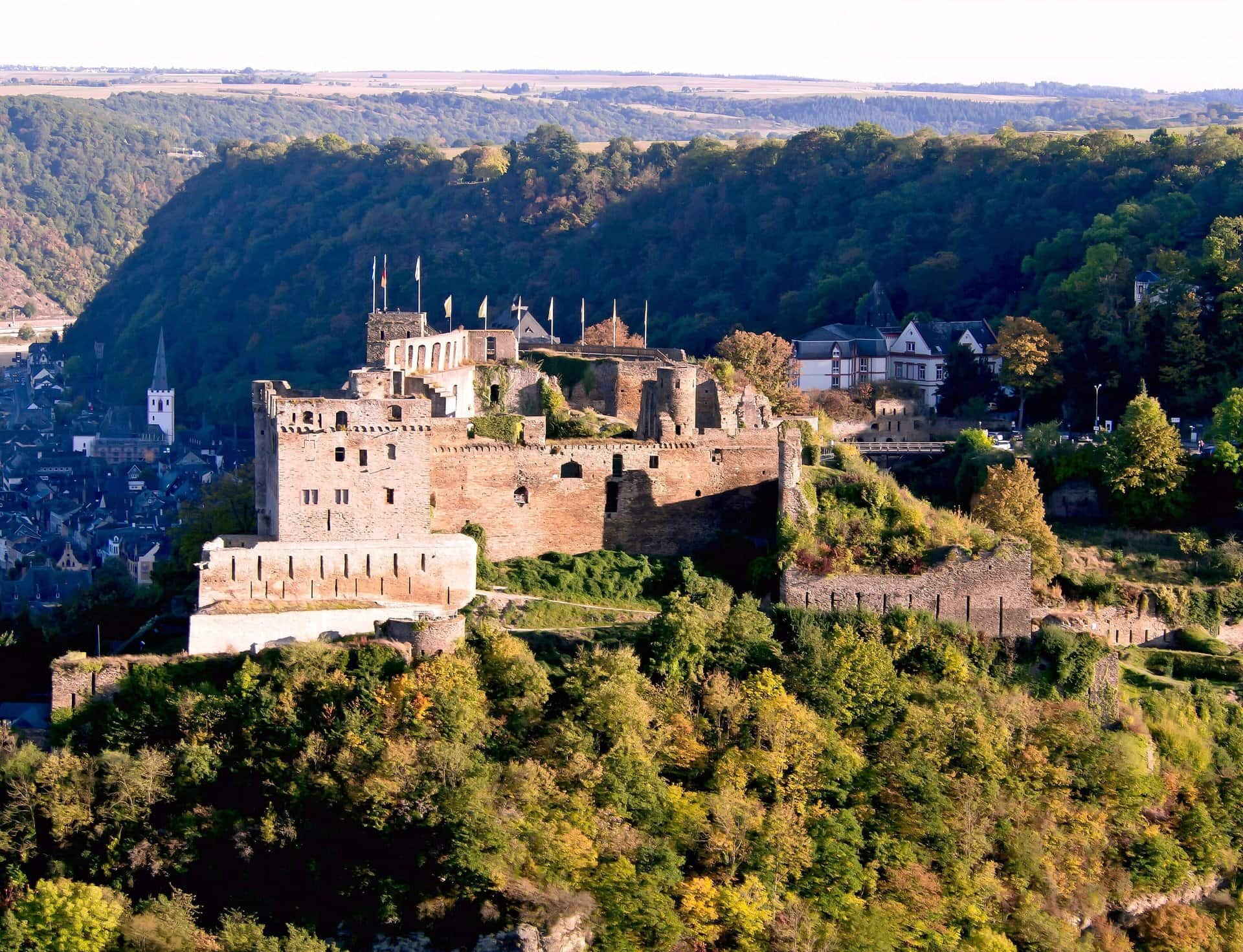
Quick Facts
| Name | Rheinfels Castle |
| German name | Burg Rheinfels |
| Location | St. Goar, Mittelrhein, Rhineland-Palatinate, Germany |
| Type | Hilltop fortress (originally Spornburg, later bastioned Festung) |
| First built | 1245, by Count Diether V of Katzenelnbogen |
| Significant rebuilding | Renaissance modernization 1521–1523; Renaissance Darmstädter Bau c. 1570–80; bastioned fortification 1657–1674 |
| Architectural period | Multiple periods (medieval, Renaissance, Early Modern bastioned) |
| Notable features | Hilltop, museum, ruined, open to visitors, UNESCO listed |
| Current use | Mixed — Burgmuseum and Romantik Hotel Schloss Rheinfels |
| Operator | Stadt St. Goar (museum); Privathotels Dr. Lohbeck (hotel) |
| UNESCO World Heritage | Yes — Upper Middle Rhine Valley (Ref. 1066, inscribed 2002) |
| Open to visitors | Main season March 9 – early November (winter closure) |
| Official site | burg-rheinfels.org |
Foundation and the Katzenelnbogen centuries (1245–1479)
The traditional founding date is 1245, when Count Diether V of Katzenelnbogen began work on the spur above St. Goar where the Rhine narrows past the Loreley. The earliest contemporary attestation of the name Rinefels dates from 1252, and the Wormser Annalen record under 1256 that Diether had broken the Landfriede against Mainz citizens, almost certainly over the toll he was now levying on shipping passing through one of the river’s natural chokepoints.
Imperial authority on the Mittelrhein had collapsed during the late-Staufer Interregnum. Katzenelnbogen counts converted that vacuum into income. In 1255–56 an army of the Rhenish League of Cities besieged Rheinfels in protest; the bare event is well documented, though the colorful figures from a 1493 Hessian chronicle (twenty-six cities, fourteen months, nine thousand attackers) are later embellishment. Around 1360–1371 the same dynasty built Burg Katz on the opposite right bank to enforce a downstream-bound toll as well, the so-called St. Goarer Doppelzoll.
The major late-medieval expansion came under Count Wilhelm II in the third quarter of the fourteenth century, who rebuilt the Frauenhaus (the structure that today houses the museum) and erected the great Schildmauer flanked by the Uhrturm and the Büchsenmeisterturm. His fifteenth-century successors raised the round Bergfried to a documented fifty-four meters with a Butterfass cap. With the death of Philipp the Elder in 1479 the male Katzenelnbogen line ended, and through his daughter Anna, Rheinfels passed to Landgrave Heinrich III of Hessen-Marburg.
Hesse-Kassel and the bastioned fortress (1479–1690)
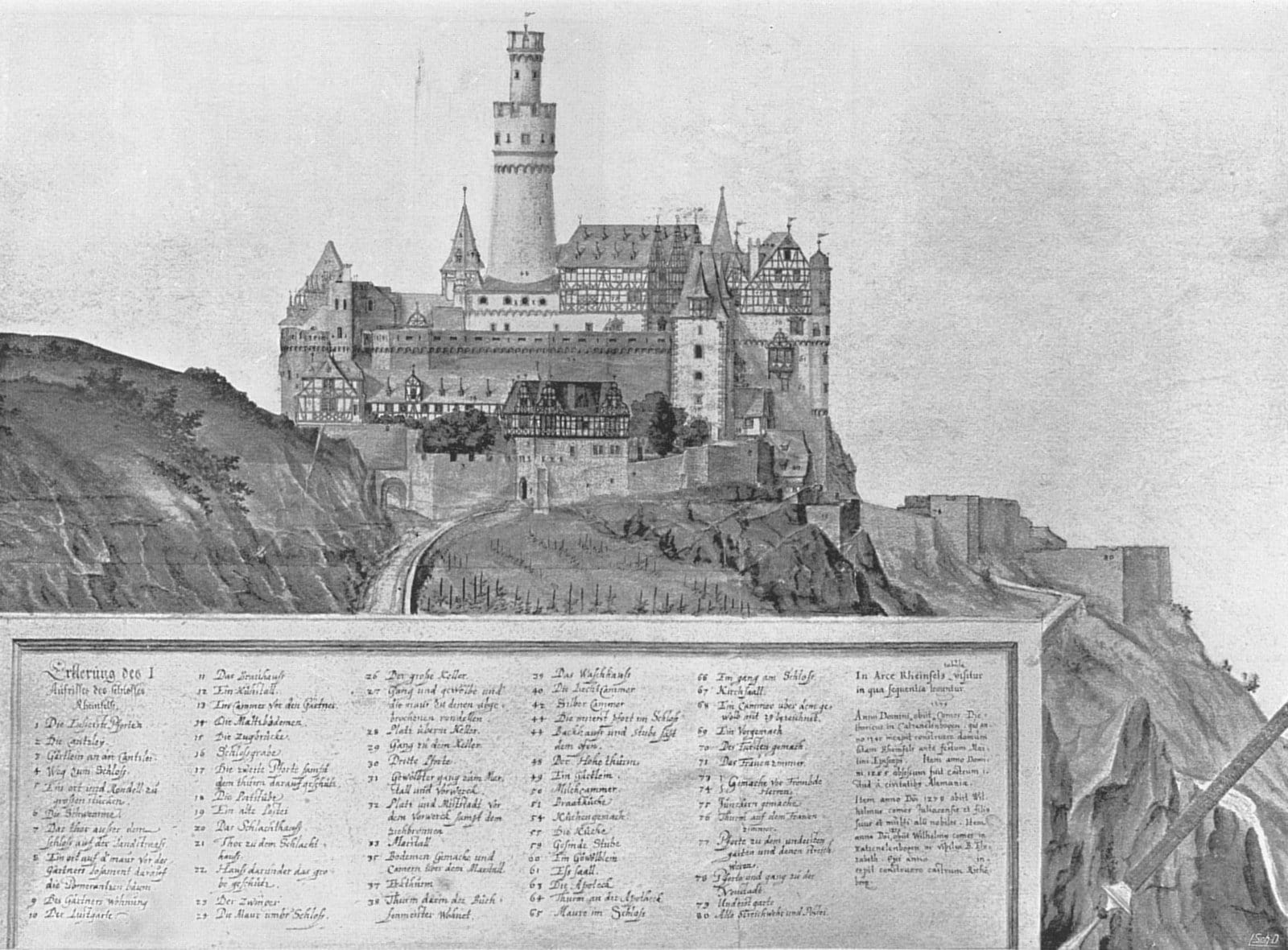
Hesse turned a medieval toll castle into a state-of-the-art artillery fortress facing France. Under Landgrave Philipp I “the Magnanimous,” Rheinfels was modernized between 1521 and 1523 into what contemporaries called the strongest fortress on the Mittelrhein. After Philipp’s death in 1567 his lands were partitioned among four sons, and his son Philipp II received the cadet Landgraviate of Hessen-Rheinfels with the castle as residence, rebuilding the Darmstädter Bau in Renaissance form around 1570–80. That Renaissance building, whose measured drawings were preserved in the hand of Wilhelm Dilich in 1607–08, is the most authoritative visual record of what the fortress looked like before the French.
The Marburger Erbfolgestreit and the broader Hessian War churned ownership through the seventeenth century. Imperial troops under Elector Ferdinand of Bavaria took the castle on September 2, 1626; Hesse-Kassel re-took it in 1647 and partitioned the surrounding Niedergrafschaft with Hesse-Darmstadt the following spring. In 1649 Landgrave Ernst founded a second cadet line, Hesse-Rheinfels-Rotenburg, and made Rheinfels his seat. Between 1657 and 1674 Ernst’s expansion campaign converted the castle into a bastioned fortress directed expressly against France, adding the named outworks Scharfeneck, Noli me tangere, the Neues Ravelin, and the Hohe-Ernst-Schanze.
The same period produced the system that would matter most in 1692: an extensive labyrinth of Minengänge and casemates running along the south-western flank, designed to be packed with powder and detonated under enemy sappers, a defensive logic Ernst’s engineers borrowed from the trace italienne tradition then dominant in Italy and the Low Countries. The Großer Gewölbekeller, vaulted between 1587 and 1589, would later be famous for once holding a stone wine vat of two hundred thousand liters.
December 1692: the fortress that did not fall
On December 16, 1692 a French detachment from Mont Royal, eighteen thousand fighting men with three thousand entrenchment workers and forty-two guns according to the contemporary Hessian broadside, invested Rheinfels and St. Goar under Lieutenant-Général Camille d’Hostun, comte de Tallard. He was not yet a marshal of France; that promotion came in 1703 after Speyerbach. Tallard’s wider Mittelrhein command numbered closer to twenty-eight thousand, the figure popular sources sometimes give for the siege itself, but the investing ring was the smaller force.
The Hesse-Kassel garrison consisted of roughly four thousand foot and dragoons plus a detachment of Trier miners under Generalmajor Georg Ludwig von Schlitz genannt von Görtz. A covering corps of three thousand under Karssenbruck held the right bank to prevent French river-crossing. According to local tradition, Tallard was wounded on the second day of the siege by a marksman firing a heavy Doppelhaken from the gallery of the Stiftskirche St. Goar, well-attested in German accounts though not corroborated in French biographical sources for Tallard. Command passed to Maréchal de camp Thomas de Choisy, the experienced governor of Saarlouis.
A Hessian sortie destroyed siege works and inflicted disproportionate French losses. The main assault on the counterscarp on the afternoon of December 27 was repulsed in close combat. A vanguard from the Lower Rhenish Imperial Circle reached Rheinfels on December 29; the French withdrew their guns on the night of December 31 and abandoned the lines on the night of 1/January 2, 1693. A full Imperial relief army under Landgraf Karl of Hesse-Kassel arrived on January 4, and a Te Deum was sung in the Stiftskirche the following day. Casualty figures from the 1693 broadside, four thousand French dead and six thousand five hundred wounded against five hundred sixty-four Hessian dead, were never independently verified against French muster rolls and are almost certainly inflated on the French side.
Why did Rheinfels hold where Heidelberg Castle had not? Palatinate cities (Mannheim, Worms, Speyer) had been razed by withdrawing French troops in 1689, not lost in pitched defense; Rheinfels was the inverse, a target the French actually attacked and were repulsed before they could mine. Ernst’s bastioned modernization had brought the castle up to current standard. Heidelberg was still in essence a Renaissance palace. Geography (a single practical approach axis up a Spornburg) and the speed of the Imperial relief did the rest. Upstream, Marksburg would survive the war by a different route, never tested because never approached.
1794–1797: surrender without battle, demolition without victory
Three days after Allerheiligen (All Saints’ Day, November 1, 1794), the elderly Hessian commandant of Rheinfels evacuated overnight at news of an approaching French force. Generalmajor Philipp Valentin von Resius was seventy-seven; he hastily bridged across to the right bank with what remained of his garrison. French troops of Général Jean René Moreaux’s Armée de la Moselle entered the empty fortress on November 2, 1794, and contemporary accounts record they sat down to half-eaten meals still on the garrison’s tables. There was no formal capitulation, only flight. Resius was court-martialed, sentenced to death, commuted to life imprisonment, and died at Schloss Spangenberg in March 1798.
What followed was not a battlefield victory but a deliberate demolition under the French Directory, the executive that had taken power in Paris on November 2, 1795. In 1796 the outer fortifications (Ernst’s bastioned ring) were blown up. In 1797 the Schloss and the fifty-four-meter Bergfried followed. The method was explosive mining, gesprengt in the German sources: French engineers packed the castle’s own pre-existing Minengänge with powder and detonated them inward, a darkly literal use of the system Ernst had built to detonate French sappers a century earlier.
The popular ascription “destroyed by Napoleon” is a myth that traces, in part, to Victor Hugo’s Le Rhin of 1842, which dated the destruction to 1807 and to the Empire. Bonaparte was campaigning in Italy in 1796–97 and became First Consul only on November 9, 1799. The republic that destroyed Rheinfels did so three years before he held any executive position.
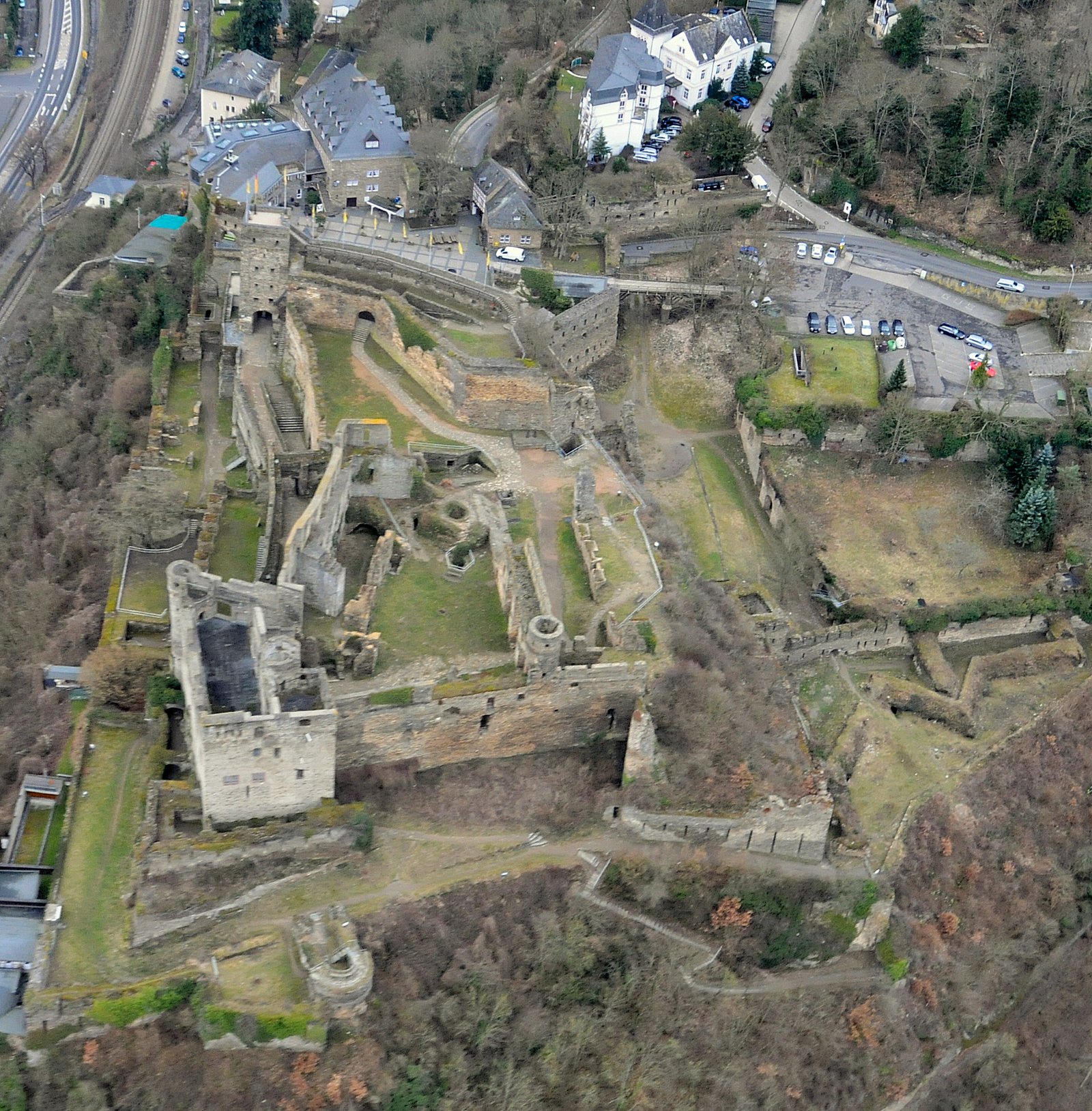
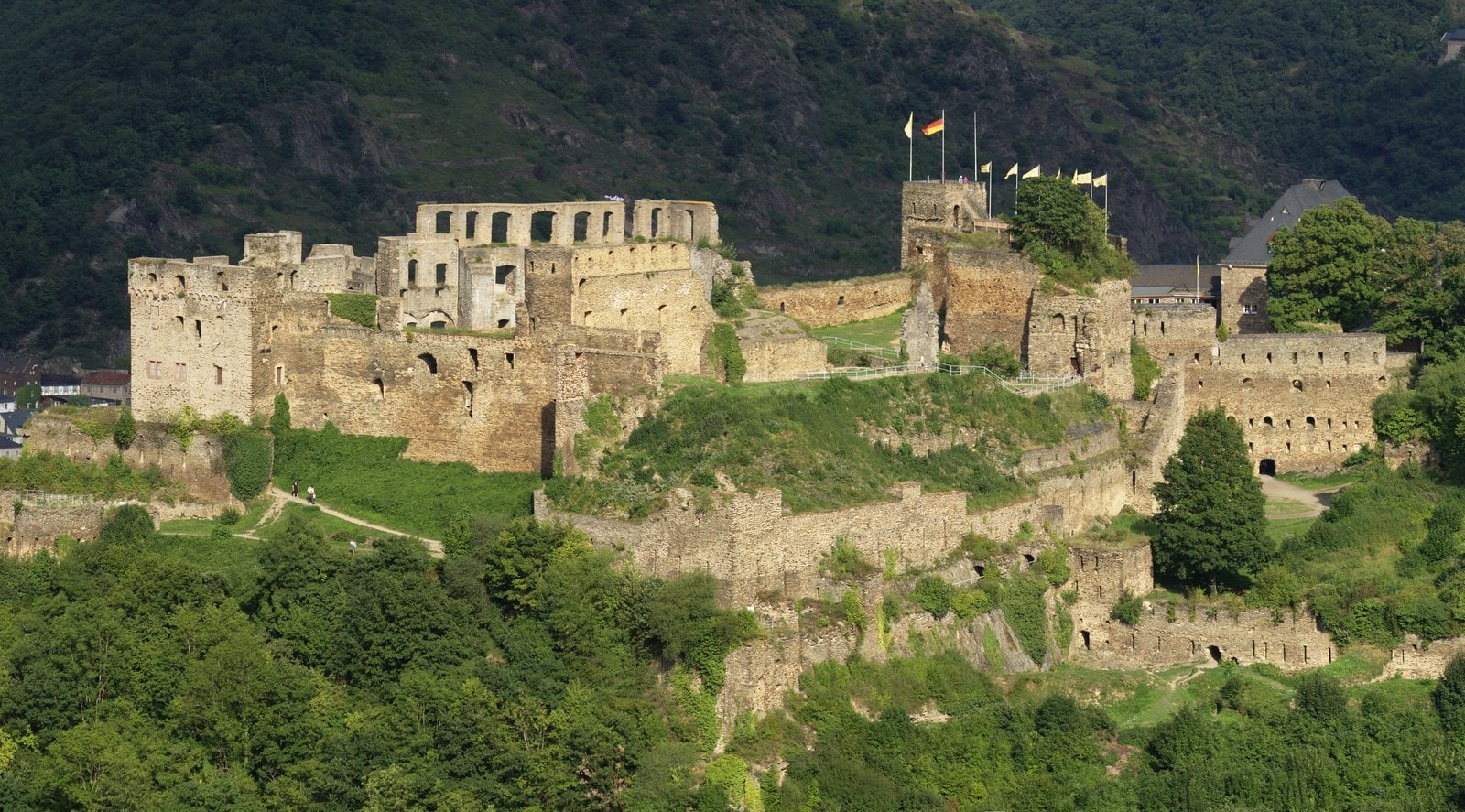
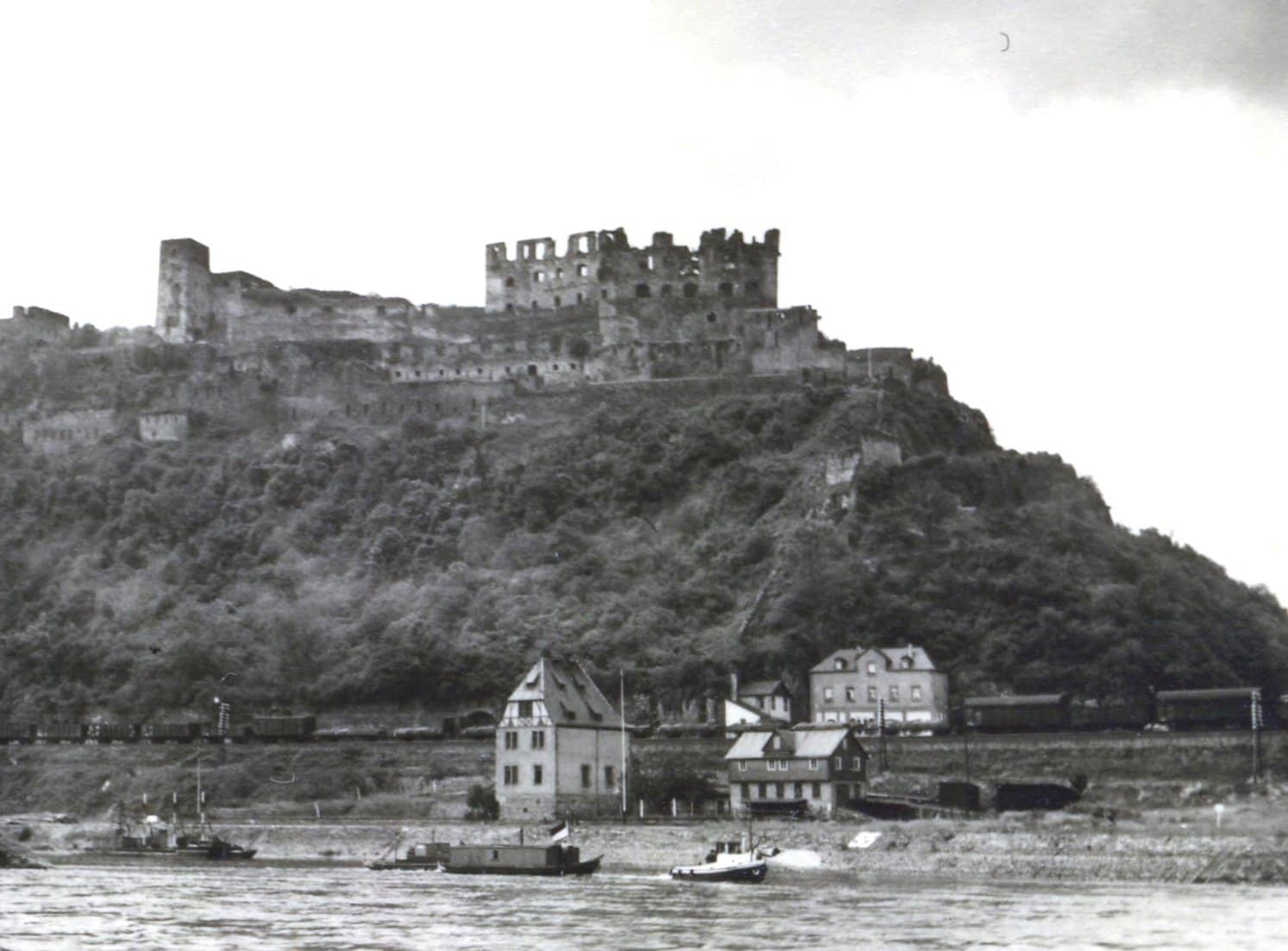
What survived the demolition were the four walls of the chapel (today’s Frauenhaus and Burgmuseum), the twenty-one-meter Uhrturm, the gutted shell of the Darmstädter Bau, and the great vaulted cellar of 1587–89. Accessible ruins now represent roughly one-third of the historic four-hectare footprint. The rest had been mined inward and shipped downriver, in the sequence chronicled by the next century of preservation.
From Prussian rescue to museum and hotel (1815–today)
Under the Treaty of Lunéville in 1801 the left bank of the Rhine passed formally to France; Blücher crossed at Kaub on New Year’s Eve 1813. The Congress of Vienna in 1815 assigned the Rhineland to Prussia, and the last Landgrave, Victor Amadeus of Hessen-Rotenburg, ceded his Rhine territories in exchange for the Principalities of Ratibor and Corvey. By then the ruin had already been auctioned as French state property, in 1812, to a St. Goar merchant named Peter Glas, who set about selling stones, doors, and fittings.
Large-scale quarrying for the Prussian rebuild of Festung Ehrenbreitstein at Koblenz, undertaken between 1817 and 1828, drew building material from Rheinfels among other sources. The often-repeated claim that the bulk of Ehrenbreitstein’s masonry came from Rheinfels stone, however, is unsupported by quantitative evidence; the volumetric arithmetic is implausible. What halted the demolition was the 1843 purchase of the medieval core by Prince Wilhelm of Prussia, then stationed at Koblenz and not yet King Wilhelm I, the same Hohenzollern moment that produced Friedrich Wilhelm IV’s Stolzenfels, Friedrich Ludwig’s Rheinstein, and the Crown Princes’ later acquisition of Sooneck.
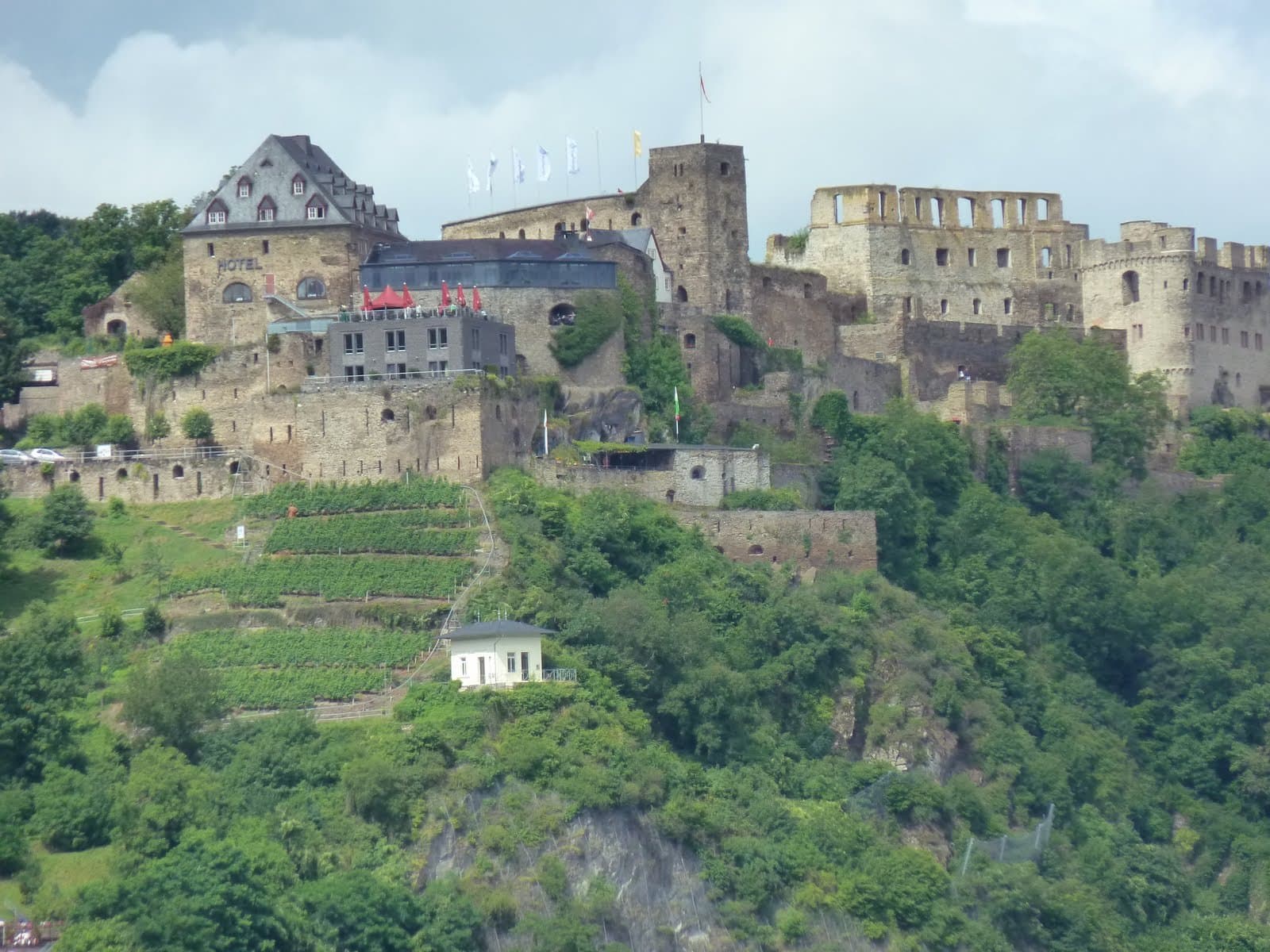
In 1924 the ruin was transferred from the Preußische Krongutsverwaltung (the post-1918 Hohenzollern crown-property administration) to the Stadt St. Goar with a Rückauflassungsvermerk and a clause forbidding the city to sell. The Burgmuseum reopened on May 14, 1991, and a comprehensive renovation reopened on Easter Sunday 2022. The Romantik Hotel Schloss Rheinfels opened in 1973 in the surviving lower-bailey buildings and the adjacent Art-Nouveau Villa Rheinfels; since February 1, 2020 it has been operated by Privathotels Dr. Lohbeck under the continuing Romantik Hotels brand. In 2002 the Upper Middle Rhine Valley was inscribed on the UNESCO World Heritage List, and Rheinfels was named in the dossier as one of its component fortress ruins.
Visiting in 2026
You can spend the night on the Schlossberg where the garrison turned back a French army in 1692. See our guide to Castle Hotels on the Rhine for the hotel inside the fortress complex.
The 2026 main season opens on March 9; the 2025–26 winter is a full closure. Standard hours are daily 10:00 to 18:00, with last admission at 17:00 and the museum closing at 17:30. Sturdy footwear is required throughout the site; the terrain is steep and uneven, and the museum is not wheelchair-accessible. Entry tickets and local tours can also be booked in advance through GetYourGuide.
St. Goar Bahnhof sits on the Linke Rheinstrecke and is served hourly year-round by RB 26 / MittelrheinBahn between Köln and Mainz. The walk from Marktplatz to the castle is around five hundred fifty meters of steep uphill, twenty minutes at a sane pace. From late April through October plus Easter weekend, the Rheinfels-Shuttle Bus 699 runs every thirty minutes between roughly 10:00 and 17:00. Year-round Fähre Loreley, operated by FRS since January 2025, connects to Burg Katz and St. Goarshausen across the river; KD Rhine cruises stop at the St. Goar landing stage opposite the hotel.
The Minengänge and lower bailey are accessible only on guided tours, summer only; closed in winter for bat protection. Standard one-hour tours run on weekends and holidays at 11:00, 13:00, and 15:00. Themed tours include the wine tour with Weingut Philipps-Mühle on four 2026 dates: April 30, May 22, June 19, and August 14.
The Romantik Hotel Schloss Rheinfels has sixty-seven rooms, suites, and apartments distributed across the historic Schloss building, the Art-Nouveau Villa Rheinfels, and the apartment houses. Entry-level doubles start around €145. The two main restaurants are Auf Scharffeneck (year-round) and the rustic Burgschänke Der Landgraf (summer terrace only). The Großer Gewölbekeller of 1587–89 functions as a banquet hall.
2026 admission to the castle and museum, drawn from the operator’s page at burg-rheinfels.org:
| Ticket | Price |
|---|---|
| Adult | €6.00 |
| Reduced | €4.00 |
| Pupils / students | €4.50 |
| Children 6–14 | €3.00 |
| Under 5 | Free |
| Family (2 adults + 2 children) | €13.00 |
| Group adult (10+) | €5.00 |
| Guided-tour supplement (adult) | +€1.00 |
The major event of the 2026 season is Rhein in Flammen — Die Nacht der Loreley on Saturday September 19, when fireworks launch from Burg Katz and Burg Maus while the illuminated convoy of cruise ships waits on the Rhine between Burg Maus and Rheinfels. Anyone staying overnight can compare hotels in and around St. Goar.
Some links on this page are affiliate links, which means StoneKeep Atlas may earn a small commission, at no extra cost to you, if you book through them.
Beyond Rheinfels
Rheinfels Castle joins four cluster siblings on the left bank of the Mittelrhein. Marksburg upstream is the never-destroyed counter-example, the only medieval castle in the Rhine Gorge to come through the centuries unbreached and unrazed. Rheinstein, rebuilt from ruin in 1825 by Prince Friedrich Ludwig of Prussia, is the intact-rebuild counterpoint to Rheinfels’ preserved-ruin treatment under the same dynastic moment. Sooneck, rescued by the four Prussian princes in 1834, is the parallel preservation case. Stolzenfels, Friedrich Wilhelm IV’s Romantic Schloss above Koblenz, is the rebuilt-as-residence variant of the same Hohenzollern impulse. Where Rheinfels never returned to habitation, Stolzenfels became a Royal summer palace.
Together the five form the core of the Castles of the Rhine Gorge as the UNESCO Welterbe presents them, and the wider catalog of German castles places Rheinfels among the destroyed-but-preserved type, a distinct category from the never-destroyed Marksburg, the Romantically rebuilt Stolzenfels, and the still-inhabited dynastic seats further up the Rhine.
Rheinfels also features in The Rhine as Contested Territory, where Diether V of Katzenelnbogen’s 1245 toll castle and its survival of the Rheinischer Bund’s fourteen-month siege of 1255–56 illustrate the princely toll-castle dynamic that defined the post-Hohenstaufen Mittelrhein.
Conclusion
Rheinfels Castle is, in the end, a fortress whose military reputation outlasted its walls, defended through the worst siege Louis XIV’s armies could mount on the Mittelrhein, dismantled a century later by a republic that never met it in battle. Today the surviving curtain walls hold a state museum and a four-star hotel under the same line of flags, and its lower bailey is the largest preserved fortress ruin in the Rhine Gorge. The Mausefalle still runs under the southern flank, opened to summer visitors and closed to winter bats; the great cellar of 1587 still vaults a hall built for wine. Few Rhine castles have been so completely defeated and so completely preserved.
Rheinfels was the only fortress on the left bank of the Rhine that Louis XIV’s armies failed to take, a stand we set among the great German castle sieges.
Principal Sources
- Tier 1 — Operator and heritage authority: Stadt St. Goar, “Burg Rheinfels,” burg-rheinfels.org and burg-rheinfels.com; GDKE Rheinland-Pfalz / Welterbe Mittelrheintal, welterbe-mittelrheintal.de; UNESCO World Heritage Centre, “Upper Middle Rhine Valley” (No. 1066, inscribed 2002), whc.unesco.org/en/list/1066.
- Tier 2 — Academic and scholarly: Demandt, Karl E. Rheinfels und andere Katzenelnbogener Burgen als Residenzen, Verwaltungszentren und Festungen 1350–1650. Darmstadt, 1990. Großmann, G. Ulrich. Burg und Festung Rheinfels. Schnell & Steiner / Wartburg-Gesellschaft, 2002. Fischer, Ludger. Burg und Festung Rheinfels über St. Goar. Rheinische Kunststätten H. 390. Köln, 1993. Thon, Alexander. “Städte gegen Burgen: Tatsächliche und mutmaßliche Belagerungen von Burgen am Mittelrhein durch den Rheinischen Bund 1254–1257.” Jahrbuch für westdeutsche Landesgeschichte 34 (2008): 17–43. Lynn, John A. The Wars of Louis XIV, 1667–1714. Longman, 1999. Blanning, T. C. W. The French Revolution in Germany: Occupation and Resistance in the Rhineland, 1792–1802. Clarendon Press, 1983.
- Tier 3 — Reputable secondary: Hugo, Victor. Le Rhin: Lettres à un ami. Paris: Delloye, 1842, Lettre XVII: Saint-Goar. EBIDAT, Burgendatenbank des Europäischen Burgeninstituts, entry id=648. Burgenwelt.org, “Burg Rheinfels — Deutschland.”
Operator pages: Stadt St. Goar tourism portal, stadt-st-goar.de; Romantik Hotel Schloss Rheinfels, schloss-rheinfels.de; FRS Loreley ferry, faehre-loreley.de; KD Rhine cruise schedules, k-d.com.
Image credits. Rolf Kranz, CC BY-SA 4.0; © MFSG; Wilhelm Dilich (1607/08), public domain; Johannes Robalotoff, CC BY-SA 3.0 DE; Heinz Meister (1912–2008), CC BY-SA 4.0; Ralf Houven, CC BY 3.0 — all via Wikimedia Commons. Freely licensed images are resized to fit; otherwise unaltered.