
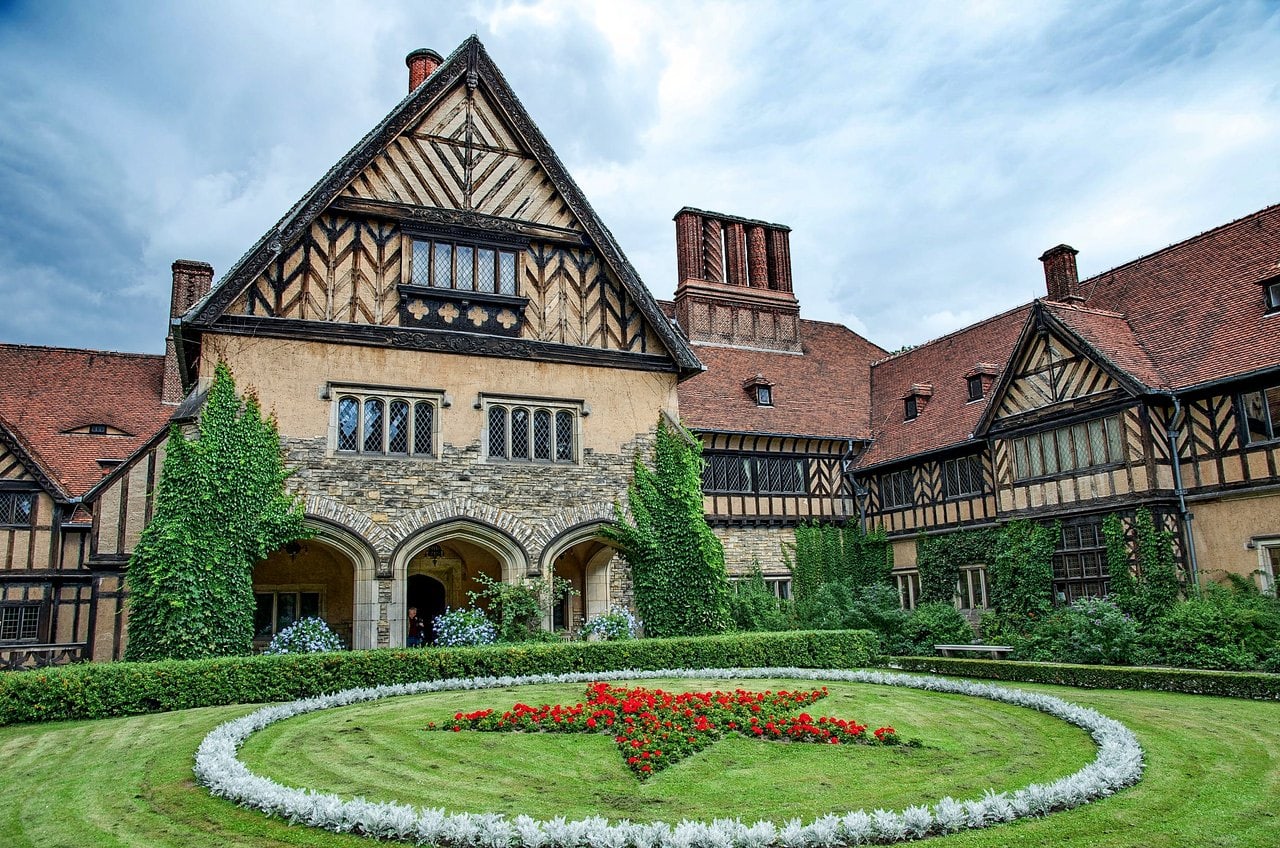
Cecilienhof Palace
Cecilienhof Palace is the strangest entry in the long architectural record of the Hohenzollerns. It was the last palace the dynasty ever built, begun in 1913 and finished in 1917 while the empire that commissioned it bled out on the battlefields of the First World War. It was also designed, deliberately, to look as though none of that was happening: a sprawling mock-Tudor English country house of brick and timber, cozy and backward-looking, tucked into a quiet park on the northern edge of Potsdam. Three decades later, in the summer of 1945, the leaders of the United States, the Soviet Union, and Britain sat down at a round table in its great hall and redrew the map of postwar Europe. Few buildings hold that contradiction so completely: an exercise in nostalgia that became one of the most consequential rooms of the twentieth century.
Quick Facts
A working summary of the essentials before the full history. Note that the palace is closed to visitors during a major renovation; the visiting details below describe the pre-closure museum and what to expect when it reopens.
| English name | Cecilienhof Palace |
| German name | Schloss Cecilienhof |
| Location | Neuer Garten, Potsdam, Brandenburg, Germany |
| Built | 1913–1917 (through the First World War) |
| Architect | Paul Schultze-Naumburg |
| Style | English Tudor Revival / country-house |
| Commissioned for | Crown Prince Wilhelm and Crown Princess Cecilie of Prussia |
| Rooms | 176, around five courtyards |
| Famous as | Site of the Potsdam Conference, July 17 – August 2, 1945 |
| Current use | Museum and memorial (SPSG); closed for renovation since November 1, 2024 |
| UNESCO | Within “Palaces and Parks of Potsdam and Berlin,” inscribed 1990 (Ref. 532) |
| Operator | Stiftung Preußische Schlösser und Gärten Berlin-Brandenburg (SPSG) |
| Official site | spsg.de |
The Last Palace of the Hohenzollerns
By the time work on Cecilienhof began in 1913, the German monarchy had been building palaces for the better part of four centuries. Sanssouci and Charlottenburg had announced Prussian ambition in marble and gilt; the Stadtschloss in Berlin had housed the dynasty at the heart of its capital. Cecilienhof would close that tradition, though no one knew it at the time. Kaiser Wilhelm II commissioned the house as a residence for his eldest son, Crown Prince Wilhelm, and the Crown Prince’s wife, Cecilie of Mecklenburg-Schwerin. A building contract signed in April 1914 set a budget near 1.5 million Reichsmark and a planned completion of October 1915.
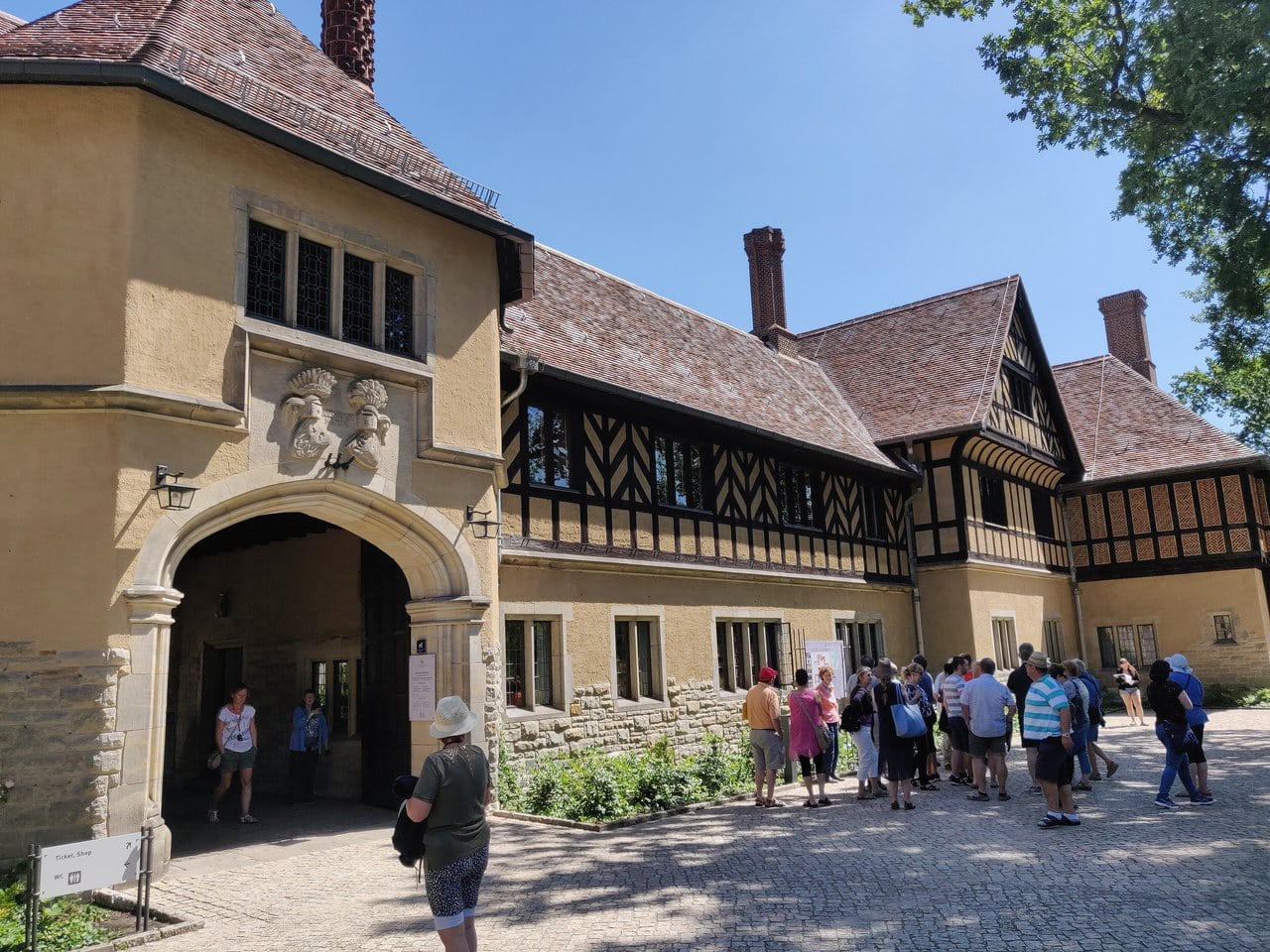
War intervened. Construction had barely advanced when the conflict broke out in August 1914, and the project stalled before resuming under wartime constraints. Not until the late summer of 1917 was the palace ready for the family, with the last interiors finished that autumn. There is a peculiar quality to a court ordering a country retreat while its armies are dying in Flanders and Galicia, and contemporaries noticed it. Building went ahead anyway, as a deliberate gesture of continuity and confidence, a statement that the dynasty would endure. Within a year of completion, that dynasty was gone. The November Revolution of 1918 swept away the German monarchy, and a family that had just moved into its new home found itself, almost overnight, a family of private citizens. No Hohenzollern palace would ever be built again.
Schultze-Naumburg and the English Country House
The architect chosen for the commission was Paul Schultze-Naumburg, a designer, painter, and cultural critic who had built his reputation arguing against industrial ugliness and in favor of a return to vernacular tradition. For Cecilienhof he reached not for Prussian baroque but for the English country house, a model the Crown Princess admired. The result is one of the largest mock-Tudor structures in Europe: half-timbered gables, tall brick chimneys, leaded windows, and steep tiled roofs arranged in long, low ranges that read more like a manor in the English shires than a royal palace near Berlin.
Its 176 rooms gather around five courtyards, the grandest of which is the three-sided Ehrenhof, the courtyard of honor, that frames the main entrance. A favorite piece of palace lore holds that no two of its chimneys are alike: the building carries 55 of them, each given its own brickwork pattern. Whether read as craftsmanship or as conspicuous expense, those chimneys announce the same theme as the timbering, a studied, almost theatrical archaism.
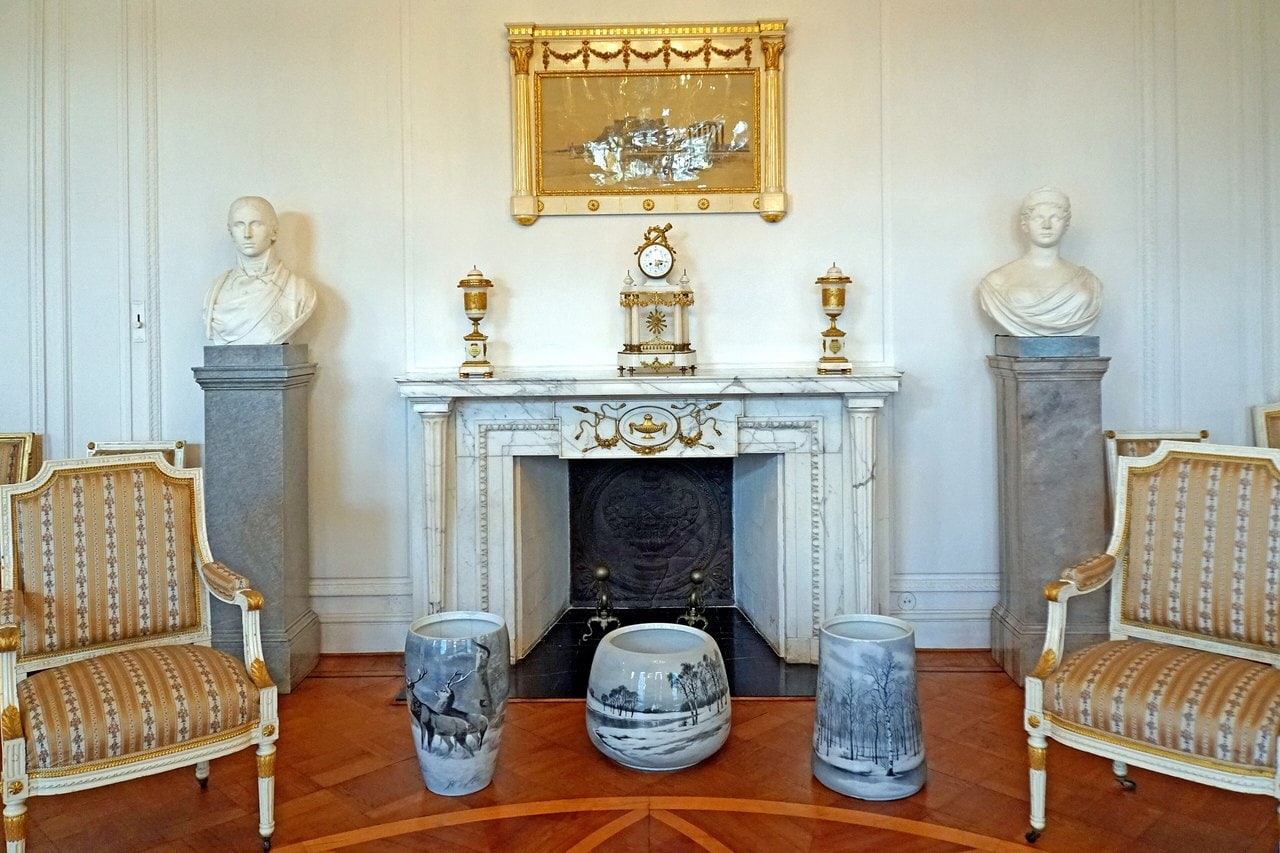
Inside, the house was thoroughly modern beneath its old-fashioned skin. Behind the leaded windows lay central heating, electric light, and even a private cinema, the comforts a wealthy early-twentieth-century household expected. One celebrated room, the Crown Prince’s study, was fitted out like the cabin of a ship, paneled in dark wood with a planked floor, a tribute to the family’s naval enthusiasms. Cecilie’s apartments upstairs were lighter and more intimate, furnished in the soft, chintz-laden English taste she favored. From the day it opened, the palace was meant to feel old, settled, and lived-in, a country seat with the manners of a much older house.
Crown Prince Wilhelm and Cecilie
The palace took its name from Crown Princess Cecilie, born a duchess of Mecklenburg-Schwerin in 1886, who married the Crown Prince in 1905 and became one of the most photographed and admired women in imperial Germany, a figure of fashion and public sympathy. “Cecilienhof” means, simply, Cecilie’s court. Her husband, Crown Prince Wilhelm, was heir to the throne of a Germany that would never be his to rule. Together they represented the future of the Hohenzollern line, and the house was conceived as the seat of that future: a place to raise their six children and, in time, to receive a court of their own.
History had other plans. The couple barely had two years in the finished palace before the monarchy fell. Cecilie remained at Cecilienhof into 1920 before the family relocated to Oels in Silesia, their fortunes entangled in the long negotiations over what the former royal house could keep. A settlement in 1926 transferred the building to the state while granting the couple a right of residence across three generations, and they went on using Cecilienhof through the interwar years. A palace built as the cradle of a dynasty became, instead, a comfortable retreat for a family that monarchy had left behind, its grand courtyards quieter than its architect had imagined.
After the Monarchy, 1918–1945
Faded grandeur defined the interwar decades at Cecilienhof. Crown Prince Wilhelm drifted through the politics of the Weimar Republic and, for a time, flirted with the Nazi movement in the hope that it might restore the monarchy, a hope it never had any intention of fulfilling. His house remained a family home rather than a center of power, its rooms holding the furniture and habits of a court that no longer existed.
The Second World War brought the reckoning. As the Red Army drove west toward Berlin in the opening weeks of 1945, the family abandoned the palace. Crown Prince Wilhelm left Potsdam for Bavaria in January, and Crown Princess Cecilie fled in early February, taking what little she could and leaving most of the house behind. After more than two decades, the last residents of the last Hohenzollern palace were gone. Within months, by one of the sharper ironies of the century, their cozy English country house would host the conference that sealed the fate of the Germany their family had once ruled. The family’s claims on the property would not be finally settled until 2023, when the Hohenzollerns relinquished a long-running restitution dispute, closing the legal chapter nearly eight decades after they walked out the door.
The Potsdam Conference, 1945
Cecilienhof is famous today for a single fortnight. From July 17 to August 2, 1945, the palace hosted the Potsdam Conference, officially the Berlin Conference and the last of the great wartime summits of the Allied powers. Germany had surrendered in May; the war against Japan was not yet won; and the three victors of Europe met to decide what would come next. Practical considerations dictated the choice of venue. Cecilienhof was large, intact, and set in a secluded park well away from the rubble of central Berlin, easy to seal off and to guard.
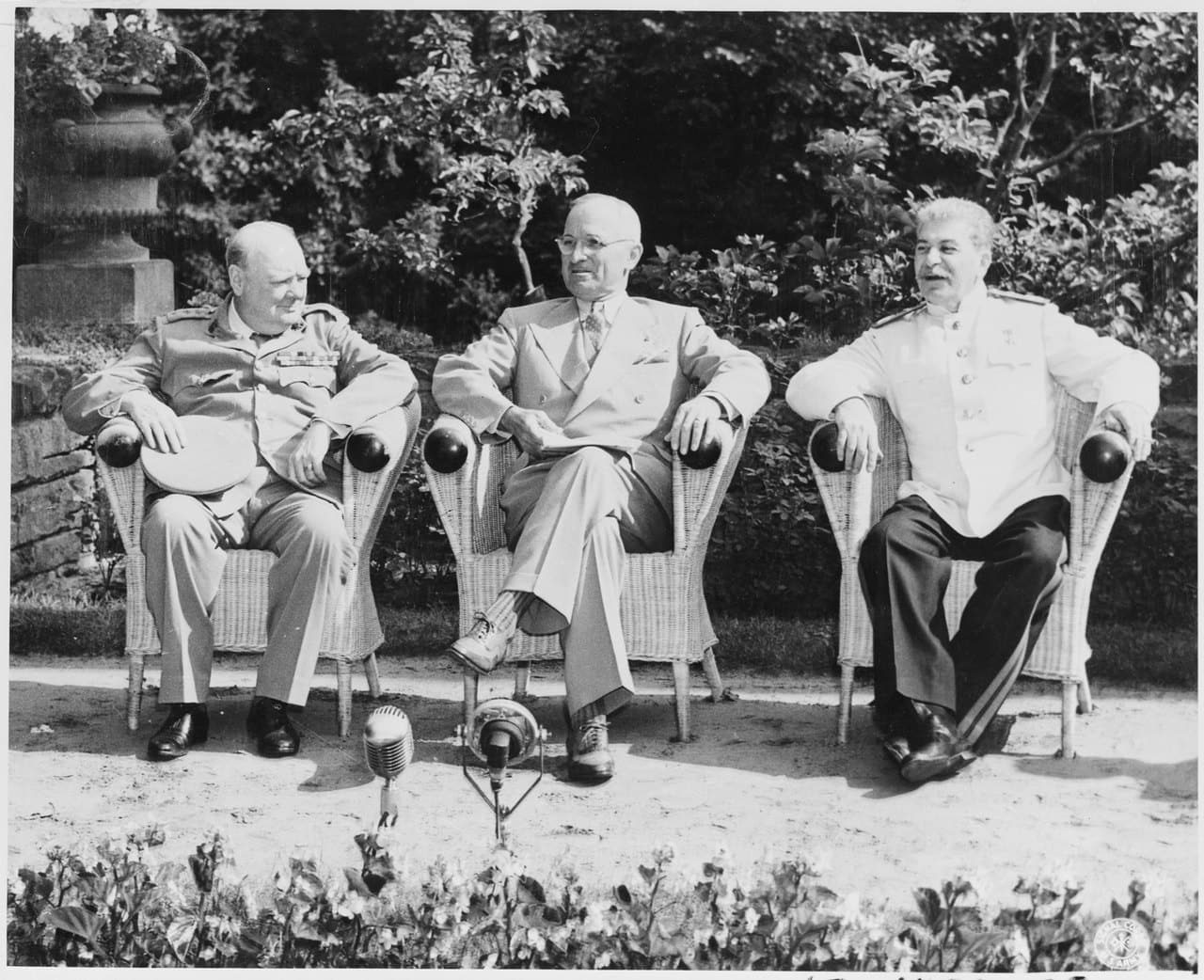
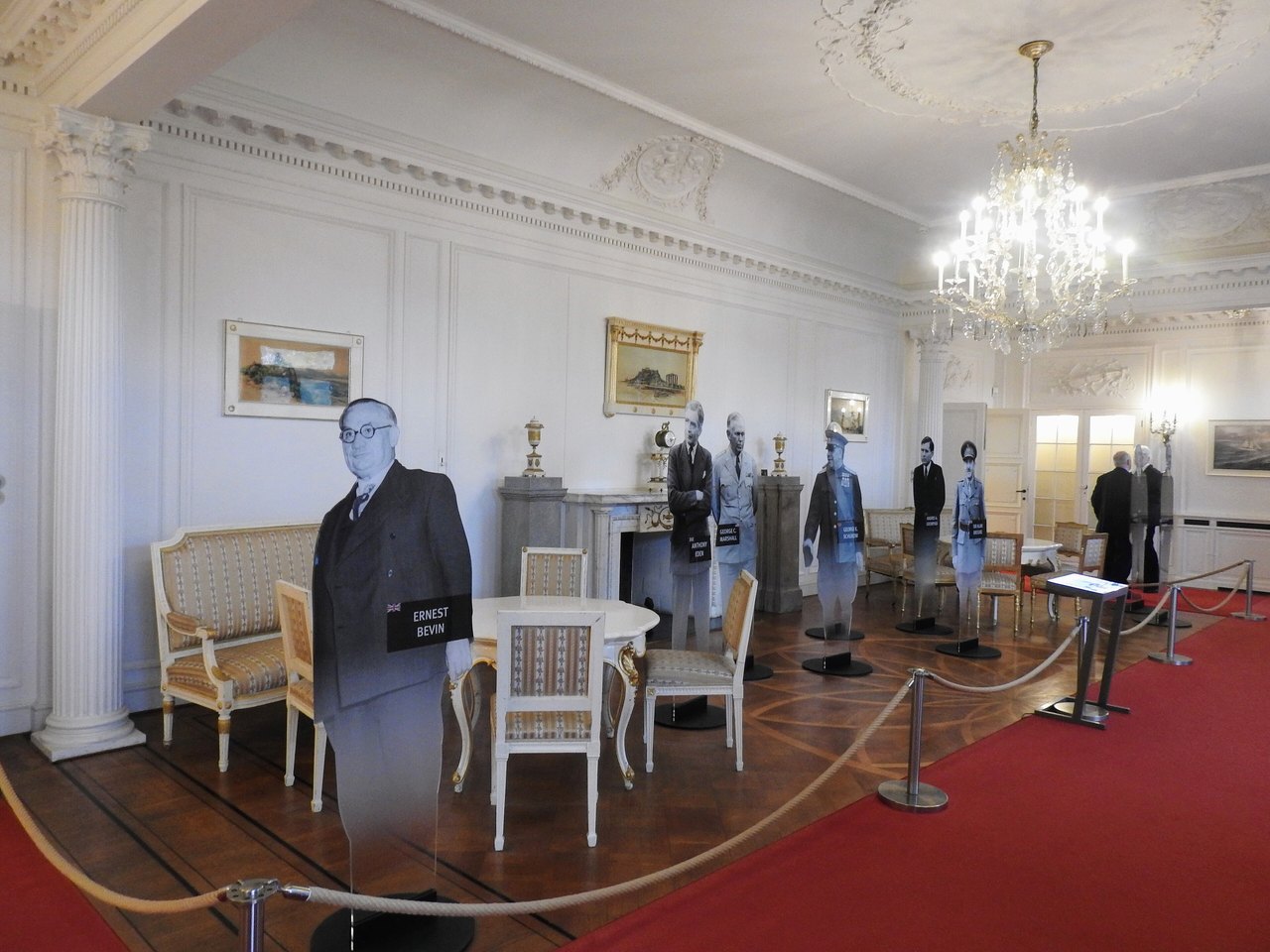
Three delegations gathered. The United States was led by President Harry Truman, newly in office after the death of Franklin Roosevelt. The Soviet Union was led by Joseph Stalin. Britain arrived under Winston Churchill, but the conference caught the British general election mid-stride: Churchill left Potsdam on July 25 to await the result, lost decisively, and was replaced by the incoming Labour prime minister, Clement Attlee, who returned to the table on July 28 alongside his new foreign secretary, Ernest Bevin. It remains one of the few summits in history at which a participating government changed hands while the meeting was still in session.
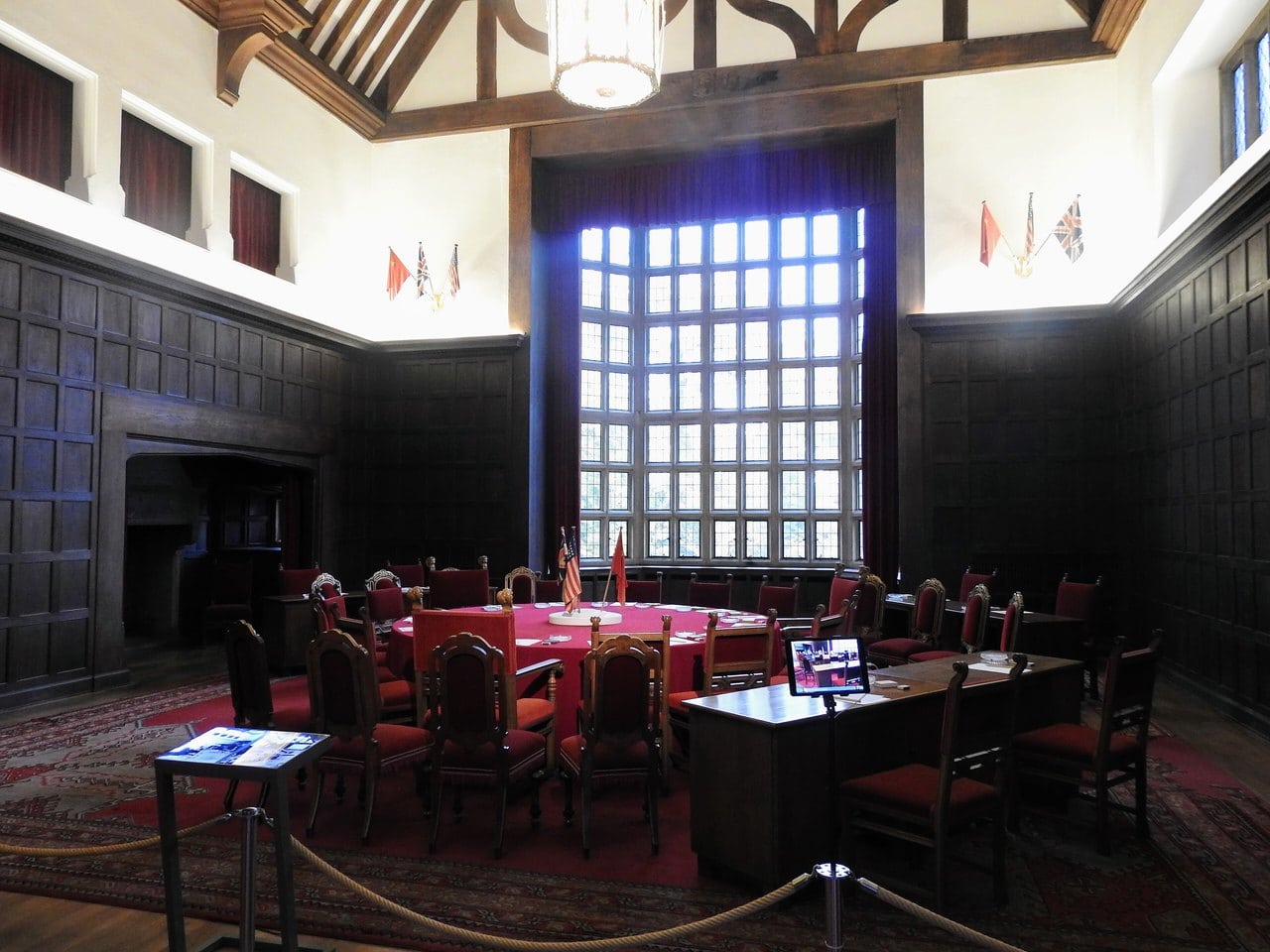
Soviet preparations gave the rooms their lasting character. Finding no suitable round table in war-damaged Berlin, the organizers had one built at a furniture works in Moscow and shipped to Potsdam; that table, roughly three meters across, still stands in the great hall where the delegations sat. Outside in the Ehrenhof, Soviet soldiers planted a vast flower bed in the shape of a red star, a detail recorded with some bemusement by the American party and replanted by the SPSG to this day. Each delegation worked from a separate study carved out of the family’s private rooms: the Crown Prince’s smoking room served the Americans, the Crown Princess’s salon served the Soviets, and the library served the British. The negotiations themselves were tense and often sour, the wartime alliance already fraying into rivalry.
A shadow hung over the table that only some at it understood. On the eve of the conference, on July 16, the United States had detonated the first atomic bomb in the New Mexico desert, and Truman received word of the successful test during the early sessions. Late in July he mentioned obliquely to Stalin that America possessed a powerful new weapon; the Soviet leader, already informed by his spies, affected indifference. Within weeks the weapon spoken of so quietly at Cecilienhof would fall on Hiroshima and Nagasaki.
What the conference settled has shaped the world ever since. The Allies confirmed the division of Germany into four occupation zones and committed to demilitarization, denazification, democratization, and the breaking up of industrial cartels. Reparations would be drawn chiefly by each power from its own zone, an arrangement that quietly anticipated the country’s coming split. The leaders accepted the Oder and Neisse rivers as Germany’s provisional eastern border, with the forced transfer of German populations that this implied, and they established a Council of Foreign Ministers to handle the peace settlements. From Potsdam, on July 26, they also issued the Potsdam Declaration, the ultimatum demanding Japan’s unconditional surrender under threat of “prompt and utter destruction.” A cozy country house had become the birthplace of the postwar order and, with it, of the Cold War.
From Soviet Clubhouse to Museum
When the delegations left, Cecilienhof passed into a long second life under socialism. Soviet forces used it for a time as an officers’ club before it came under the administration of the new state of Brandenburg in the Soviet zone. In 1952 the East German authorities opened a memorial in the conference rooms, preserving the round table and the studies much as the delegations had left them. Commemoration of the summit suited the politics of the German Democratic Republic, which presented Potsdam as a founding moment of the postwar settlement, and the site became a fixture of official remembrance and a stop for visiting delegations from across the Eastern bloc.
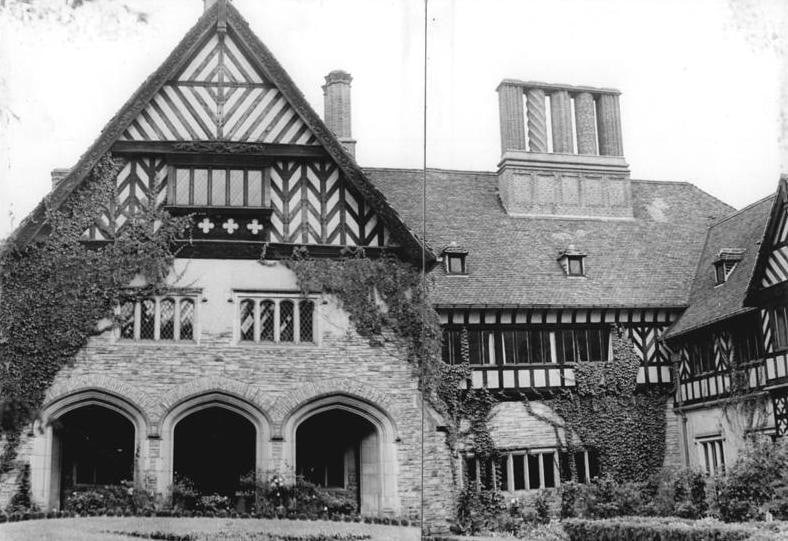
Part of the building took on a different role. From 1960 a hotel operated within the complex, and after German reunification it was modernized and run from January 2000 as the relexa Schlosshotel Cecilienhof, with 41 rooms in the west wing. That hotel closed in January 2014 and has not reopened. Throughout, the historic conference wing remained a museum, and today the whole palace is operated by the Stiftung Preußische Schlösser und Gärten Berlin-Brandenburg, the foundation responsible for the royal palaces and gardens across Berlin and Brandenburg, which presents it as the “Historic Site of the Potsdam Conference.” The upper-floor apartments of the crown-princely couple are shown alongside the conference rooms, so that the two stories the building carries, the lost dynasty and the postwar settlement, sit one above the other under the same roof.
Cecilienhof and the Potsdam World Heritage Site
Cecilienhof does not stand alone. It sits within the Neuer Garten, one park among the constellation of royal landscapes that ring Potsdam and reach into Berlin, and it shares in their collective recognition. That whole ensemble, “Palaces and Parks of Potsdam and Berlin,” was inscribed on the UNESCO World Heritage List on December 12, 1990 as property reference 532, only weeks after German reunification, in recognition of an artificial landscape of palaces, gardens, and engineered vistas developed over more than two centuries. Cecilienhof was inside that boundary from the start; the Neuer Garten belonged to the original 1990 inscription, not to the later enlargements that added Sacrow Castle and its Church of the Saviour in 1992 and a string of further sites in 1999.
This distinction matters for understanding the site’s character. Cecilienhof is the youngest major building in one of Europe’s great historic landscapes, a twentieth-century newcomer among the eighteenth-century works of Frederick the Great. Its inclusion reflects the way the listing values the continuity of the whole Potsdam landscape rather than any single style or period, a continuity that runs unbroken from Sanssouci’s vineyard terraces to the half-timbered gables on the Jungfernsee.
Visiting Cecilienhof
Before planning a visit, note the most important practical fact: Cecilienhof Palace has been closed for a major renovation since November 1, 2024. Current guidance from the SPSG projects a reopening around 2027, with construction work potentially continuing into 2028, and the operator’s published dates have shifted as the project has developed. Anyone hoping to see the conference rooms in person should confirm the status on the SPSG website, spsg.de, before traveling. In the meantime the palace can be explored through a detailed virtual tour hosted on Google Arts and Culture. Entry tickets and local tours can also be booked in advance through GetYourGuide.
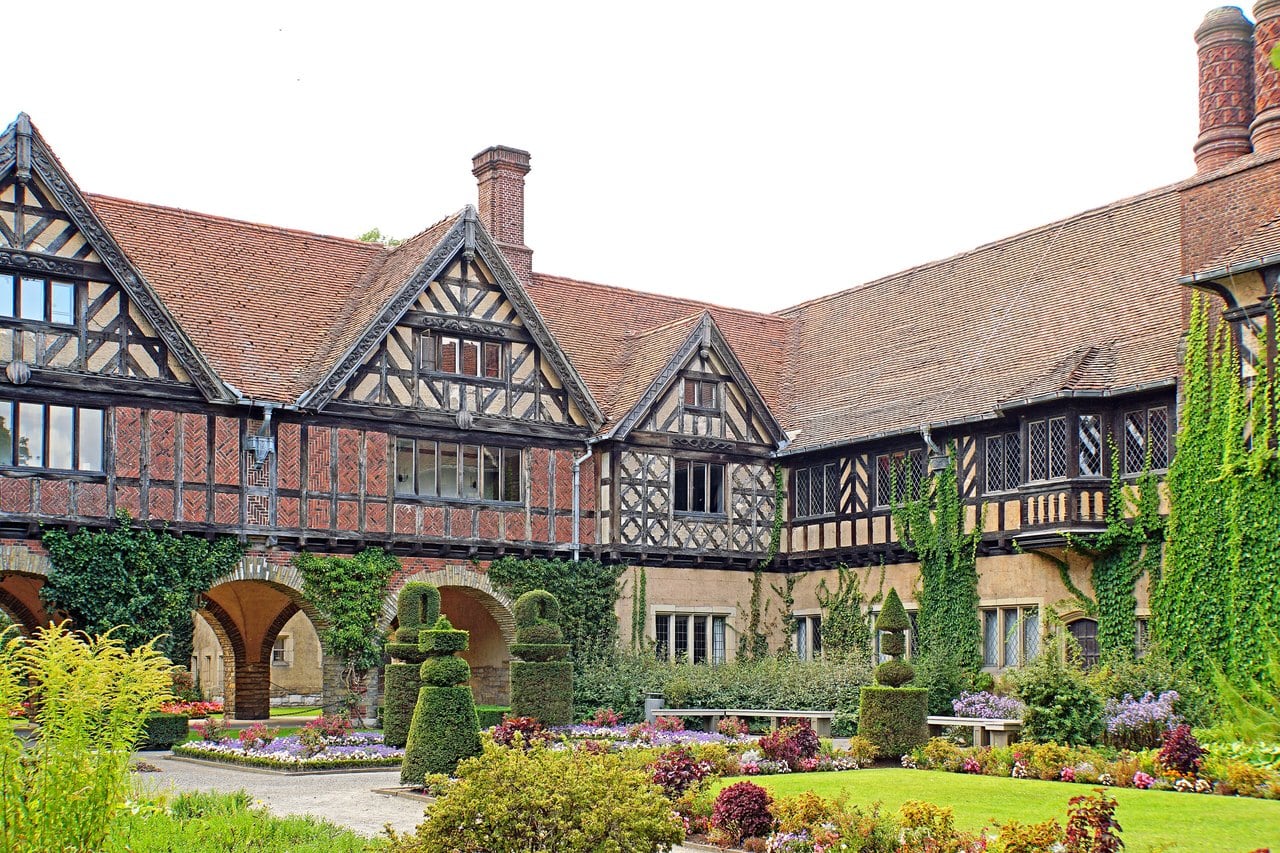
When the museum reopens, the visit rewards the journey. Cecilienhof stands in the Neuer Garten, a landscape park of about 100 hectares on the shore of the Jungfernsee in northern Potsdam, and the setting is a real part of the experience: lawns running down to the water, old trees, and the half-timbered ranges appearing through the greenery much as an English manor would. This is a separate park from Sanssouci, on the opposite side of the city, so the two cannot easily be combined in a single short walk. From the center of Potsdam the palace is roughly a half-hour walk through the garden, or a short ride on bus line 603 from Platz der Einheit toward the Höhenstraße stop near the park entrance; from Berlin, a regional train to Potsdam and a local connection put it within easy reach of a day trip.
Pre-closure, admission ran to about €6 for adults and €5 concession, including the multimedia guide, with the museum open Tuesday to Sunday and closed Mondays, on slightly shorter hours in the winter months. Treat these figures as a guide to what to expect rather than a promise; the reopened museum will set its own prices and hours, and the SPSG site remains the authority. What does not change is the reason to come: the chance to stand in the room where the round table still waits and the postwar world was argued into being. Anyone staying overnight can compare hotels in and around Potsdam.
Some links on this page are affiliate links, which means StoneKeep Atlas may earn a small commission, at no extra cost to you, if you book through them.
Beyond Cecilienhof
Cecilienhof completes a trio of Hohenzollern palaces around Potsdam and Berlin that together tell the story of the dynasty from its baroque height to its quiet end. Sanssouci Palace, Frederick the Great’s intimate summer retreat above its vineyard terraces, remains the most beloved of the Prussian royal houses and sits across Potsdam in its own grand park, facing the monumental Neues Palais that Frederick raised at the western end of the same park. Charlottenburg Palace, the largest surviving royal palace in Berlin, carries the line back another generation to the turn of the eighteenth century and the first Prussian kings. Set beside those two, Cecilienhof is the coda: the same family, the same region, but a different century and a wholly different idea of what a palace should be.
For the deeper roots of the family, the ancestral seat lies far to the south at Hohenzollern Castle, the dramatic Swabian stronghold from which the dynasty took its name. And for readers tracing the broader pattern of royal building in Prussia, these palaces form a natural cluster, the subject of a dedicated guide to the royal residences of Berlin and Brandenburg.
Conclusion
Cecilienhof Palace was built to look backward and ended up deciding the future. Its architect dressed a modern royal household in the borrowed clothes of an English manor; its patrons meant it to carry their dynasty forward and watched that dynasty vanish within a year of moving in; and a half-timbered hall they furnished for a quiet country life became, in a single fortnight of 1945, the room where the shape of the postwar world was settled. No other German palace folds quite so much history into so unassuming a building. To stand in the Neuer Garten and look at those gentle gables is to look at the last palace of the Hohenzollerns and at one of the hinges of the twentieth century, at the same time and in the same place.
Principal Sources
- Curl, James Stevens, and Susan Wilson. The Oxford Dictionary of Architecture. 3rd ed. Oxford University Press, 2015.
- Neiberg, Michael. Potsdam: The End of World War II and the Remaking of Europe. Basic Books, 2015.
- Stiftung Preußische Schlösser und Gärten Berlin-Brandenburg. “Cecilienhof Country House.” spsg.de.
- UNESCO World Heritage Centre. “Palaces and Parks of Potsdam and Berlin.” whc.unesco.org.
- U.S. Department of State, Office of the Historian. “The Potsdam Conference, 1945.” history.state.gov.
- Current visiting information, including renovation updates, admission, and opening hours, is published by the operator, the Stiftung Preußische Schlösser und Gärten Berlin-Brandenburg, at spsg.de.
Image credits. Featured image: ernstol, CC BY-SA 3.0. Front entrance: Kurt Kaiser, CC0. Garden façade and the round table: Reading Tom, CC BY 2.0. White Salon and the courtyard garden: Dennis G. Jarvis, CC BY-SA 2.0. Churchill, Truman and Stalin: U.S. National Archives and Records Administration, public domain. Mid-century courtyard: Bundesarchiv, Bild 183-49658-0002 / Mihatsch / CC BY-SA 3.0 DE. Images via Wikimedia Commons. Freely licensed images are resized to fit; otherwise unaltered.