
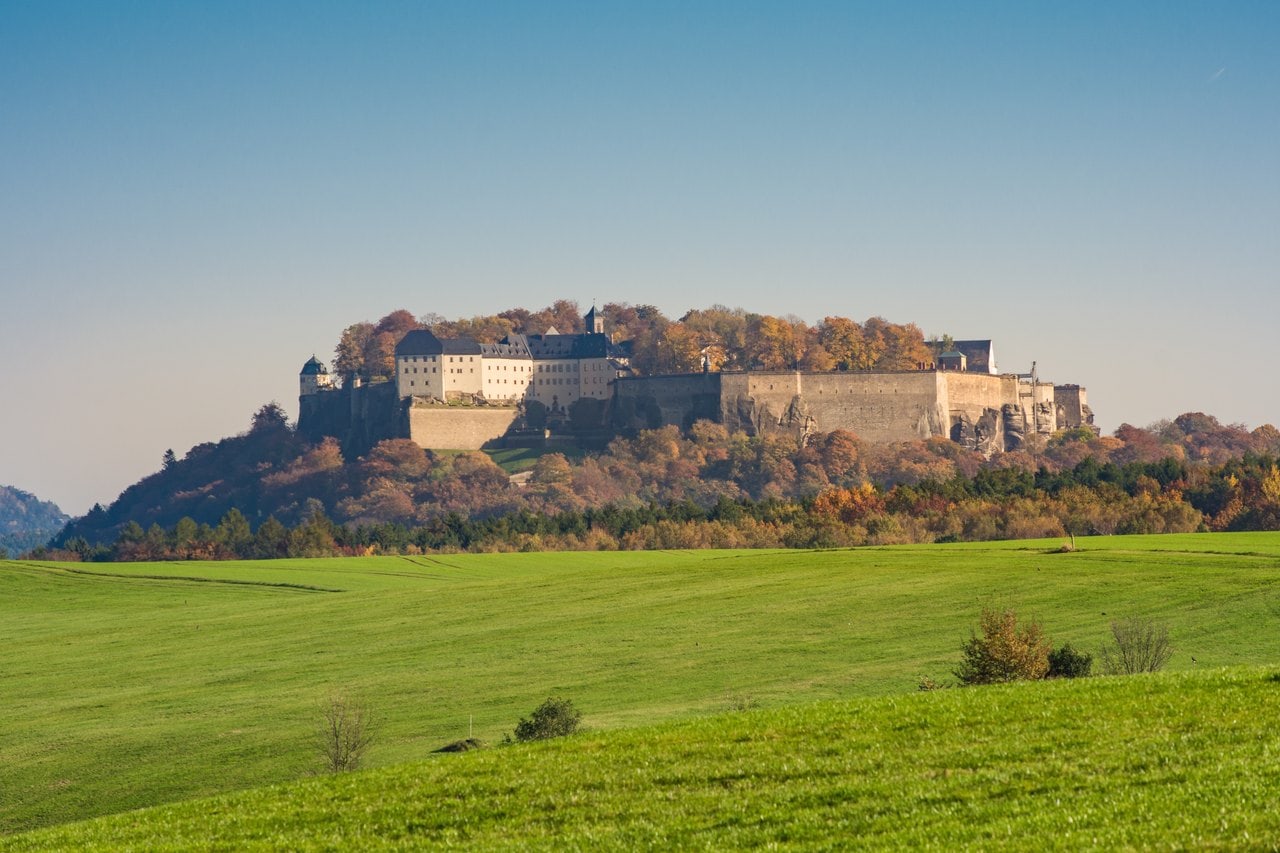
Königstein Fortress
Königstein Fortress crowns a flat-topped sandstone massif high above a bend in the Elbe, about thirty kilometers upriver from Dresden in the region known as Saxon Switzerland. For more than four centuries it ranked among the most formidable strongholds in the German lands, and across eight hundred years of recorded history no enemy ever took it by force. That single fact shaped almost everything the place became. Saxony’s rulers treated the rock as a vault. When war threatened Dresden, the electors sent their families, their gold, and eventually their greatest paintings up the long ramp to safety; when they needed a dangerous man to vanish from public life, they sent him here too.
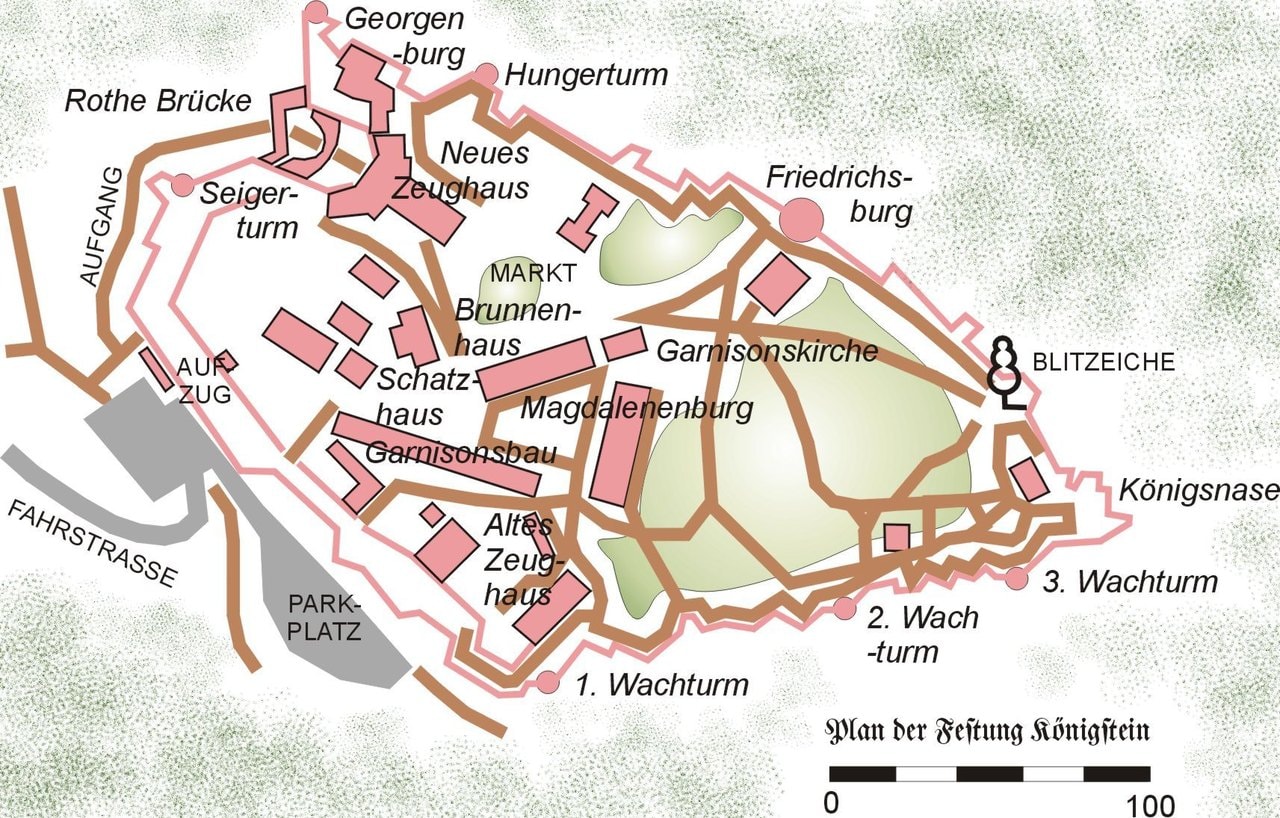
Today the plateau carries more than fifty buildings, a record of Gothic, Renaissance, and Baroque military architecture laid out across nearly ten hectares of cliff-girt rock. A garrison church first consecrated in the seventeenth century still holds Sunday concerts, and the deepest well in Saxony still descends into the sandstone beneath the courtyard. A glass panorama lift now carries visitors the final forty-odd meters that once defeated besieging armies. What follows traces how a Bohemian border castle on the King’s Stone became the Saxon state’s impregnable strongbox, and what remains to see on the rock in 2026.
Quick Facts
| Location | Königstein, Saxon Switzerland, Saxony, Germany |
| Nearest town | Königstein (3 km); Dresden 35 km |
| First documented | 1233; named in lapide regis in 1241 |
| Fortress built | Mainly from 1589 under Elector Christian I; expanded into the 19th century |
| Architectural style | Multiple periods: medieval core, Renaissance and Baroque military architecture |
| Type | Mountain fortress (Bergfestung) |
| Setting | Hilltop table mountain (Tafelberg) above the Elbe |
| Condition | Intact and substantially restored |
| Owner / operator | Free State of Saxony; Festung Königstein gGmbH |
| Current use | Open-air fortress and military-history museum |
| Open to public | Yes, year-round |
| Website | festung-koenigstein.de |
A table mountain above the Elbe
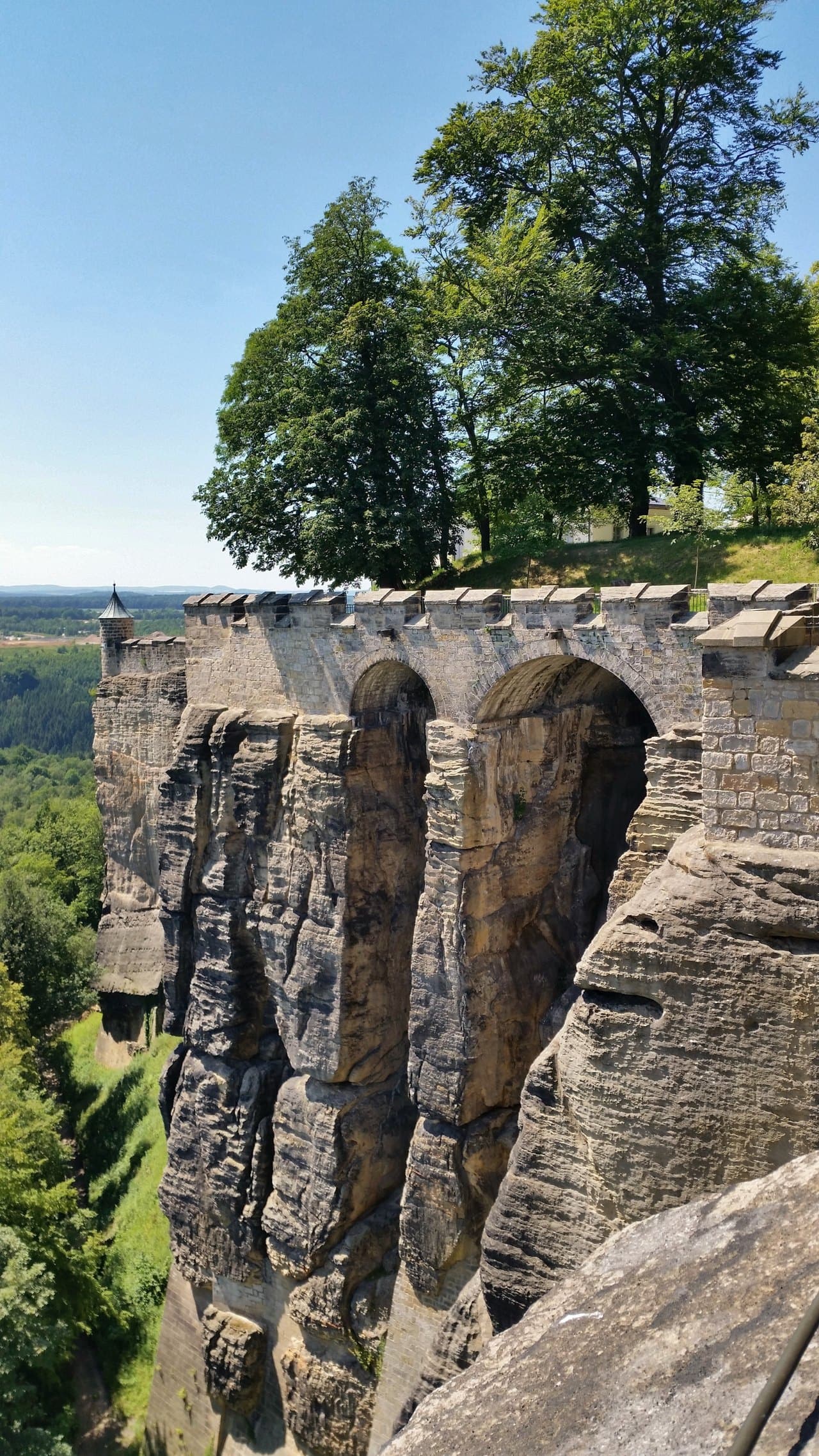
Königstein sits on one of the great table mountains of the Elbe Sandstone Mountains, the eroded sandstone country that Romantic-era painters christened Saxon Switzerland. Sheer rock walls ring the summit on every side, rising to around forty meters of bare cliff before any masonry begins. Generations of climbers have since treated those same walls as a proving ground, for this corner of Saxony is widely regarded as the cradle of free climbing as a sport. From the plateau the river curls below in a slow green arc, and the rival summits of the Lilienstein and the Pfaffenstein stand across the valley like sentinels. A visitor on the rampart walk, which runs roughly 1,800 meters around the edge, can see why no medieval engineer needed to add much to what the geology already provided.
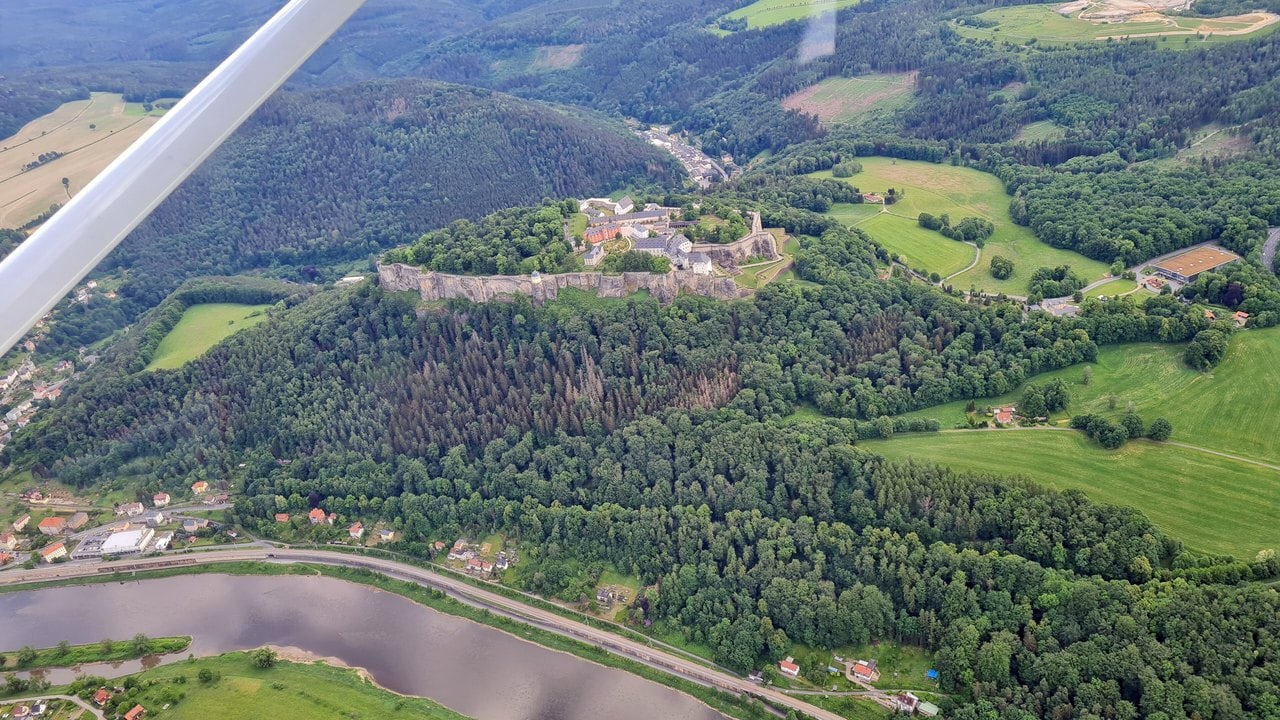
Geography did most of the defensive work. A single approach winds up the northern flank, and that road could be commanded from above at every turn. Everything a garrison required for a long blockade had to exist on top: water, grain, bread ovens, gunpowder, and the means to keep hundreds of soldiers fed through a winter. Over the centuries the electors of Saxony turned the natural advantage into a deliberate system, until the rock held more than fifty separate structures and counted as one of the largest hilltop fortresses in Europe. Measured across the top, the defenses enclose roughly 9.5 hectares, a plateau the garrison once likened to a small town and perched some 240 meters above the level of the river. The site never lost its strategic logic, which is why it kept being rebuilt and rearmed long after most medieval castles had fallen into picturesque ruin.
From Bohemian border castle to Saxon fortress
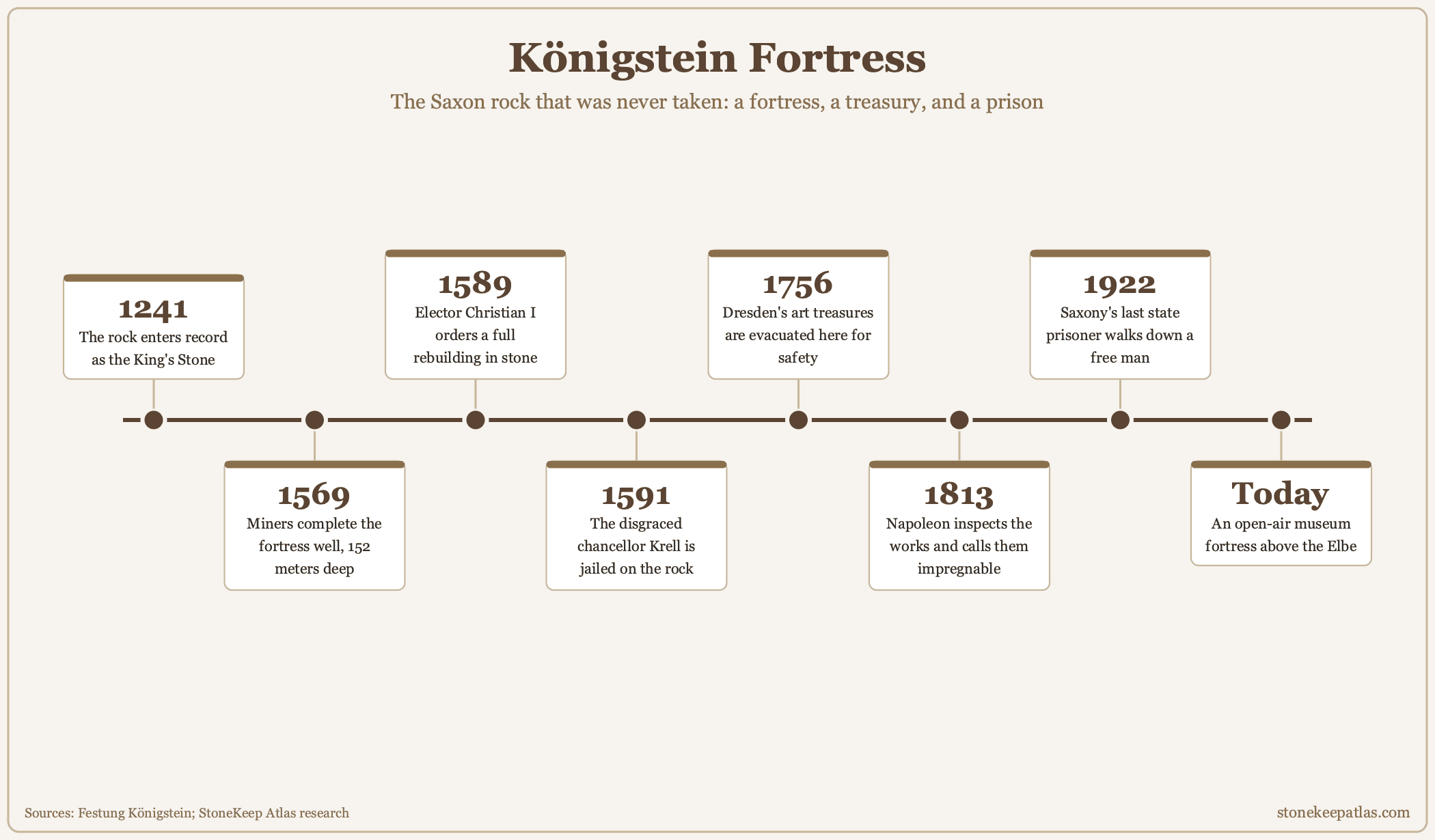
A castle on the rock first enters the written record in 1233, in a deed of King Wenceslaus I of Bohemia that names a witness, Burgrave Gebhard vom Stein. At that time the upper Elbe valley belonged to the Kingdom of Bohemia, not to Saxony, and the stronghold guarded a frontier. Its name first appears in 1241, when Wenceslaus I sealed the Upper Lusatian Border Charter on the summit and the document recorded the place as in lapide regis, the King’s Stone. Emperor Charles IV lodged here in 1359, an imperial visit that earned the castle the nickname Kaiserburg and confirmed its standing as a royal seat, not a mere watchtower.

Saxon control came gradually and then permanently. After a long territorial struggle along the Bohemian border, the castle passed to the Wettin margraves of Meissen in the first decade of the fifteenth century, and the Treaty of Eger settled the matter for good in 1459, fixing the boundary between Bohemia and Saxony close to where it runs today. A brief and unusual interlude followed in the early sixteenth century, when Duke George the Bearded installed a monastery of Celestine monks on the summit between 1516 and 1524, an attempt to plant a place of pilgrimage on the rock. That experiment did not last, and the Reformation soon swept the order away.
What turned the castle into a true fortress was gunpowder. Elector Christian I of Saxony ordered a comprehensive rebuilding from 1589, entrusting the work to his master of ordnance, Paul Buchner. Over the next decade Buchner’s crews raised the gatehouse, the flanking battery known as the Streichwehr, the old barracks, and the first great armory, converting a medieval refuge into a modern artillery fortress designed to hold cannon and withstand them. Successive electors kept building. Under Johann Georg I and his son, between roughly 1619 and 1681, the plateau gained the Magdalenenburg and the festive Johannissaal, while the era of Augustus the Strong and his son brought Baroque refinements and the bomb-proof well house completed by the architect Jean de Bodt in 1737. When the new German Empire folded Königstein into its national fortress system in 1871, engineers crowned the cliffs with heavy gun batteries built between 1870 and 1895, the last serious military investment in a site that had been fortified, in one form or another, for more than six centuries.
Not every building served the guns. Christian I also raised a pavilion on the southern rampart, the Christiansburg, later recast in Baroque taste and renamed the Friedrichsburg; it now hosts a registry office for couples who choose to marry on the rock. Older still is the small chapel near the center of the plateau, among the earliest surviving structures of all, which was consecrated in 1676 as the first garrison church in Saxony. Restored and reconsecrated in 2000, it keeps a Jehmlich organ whose Sunday concerts still draw listeners up the long approach.
The fortress that was never taken
Königstein owes its reputation to a negative: nothing ever conquered it. No besieging army stormed the walls, no garrison surrendered the keys, and no general found a way up that the defenders had not already covered. The fortress functioned less as a battlefield than as a deterrent so complete that battles never came. That distinction matters, because the rock was never subjected to the kind of prolonged, desperate siege that breaks other castles. Its strength was the strength of a threat that no one cared to test.
Each surviving episode bears this out. During the Thirty Years’ War the Swedes ranged across Saxony and in 1639 burned the town of Königstein at the foot of the rock, yet they left the fortress above untouched. In 1756, at the opening of the Seven Years’ War, Elector Friedrich August II watched from the safety of the summit as his own encircled army capitulated to Prussian forces on the Lilienstein, the flat-topped mountain directly across the Elbe. Napoleon inspected the works in 1813 and pronounced them impregnable; the fighting that year took place at Krietzschwitz, before the gates, never on the plateau itself. Only one man might be said to have taken the fortress uninvited: a journeyman chimney sweep named Sebastian Abratzky, who in 1848 free-climbed a chimney-like crevice in the cliff, reached the top, and was promptly arrested. His route still bears his name among the climbers who now treat these walls as sport.
That long immunity is exactly why the rock became so useful for everything other than fighting. A fortress that could not fall was the natural place to keep whatever a ruler could least afford to lose, whether treasure, archives, or prisoners. Both themes that dominate the rest of Königstein’s story, the strongbox and the state prison, flow directly from this one architectural fact.
Engineering a self-sufficient rock
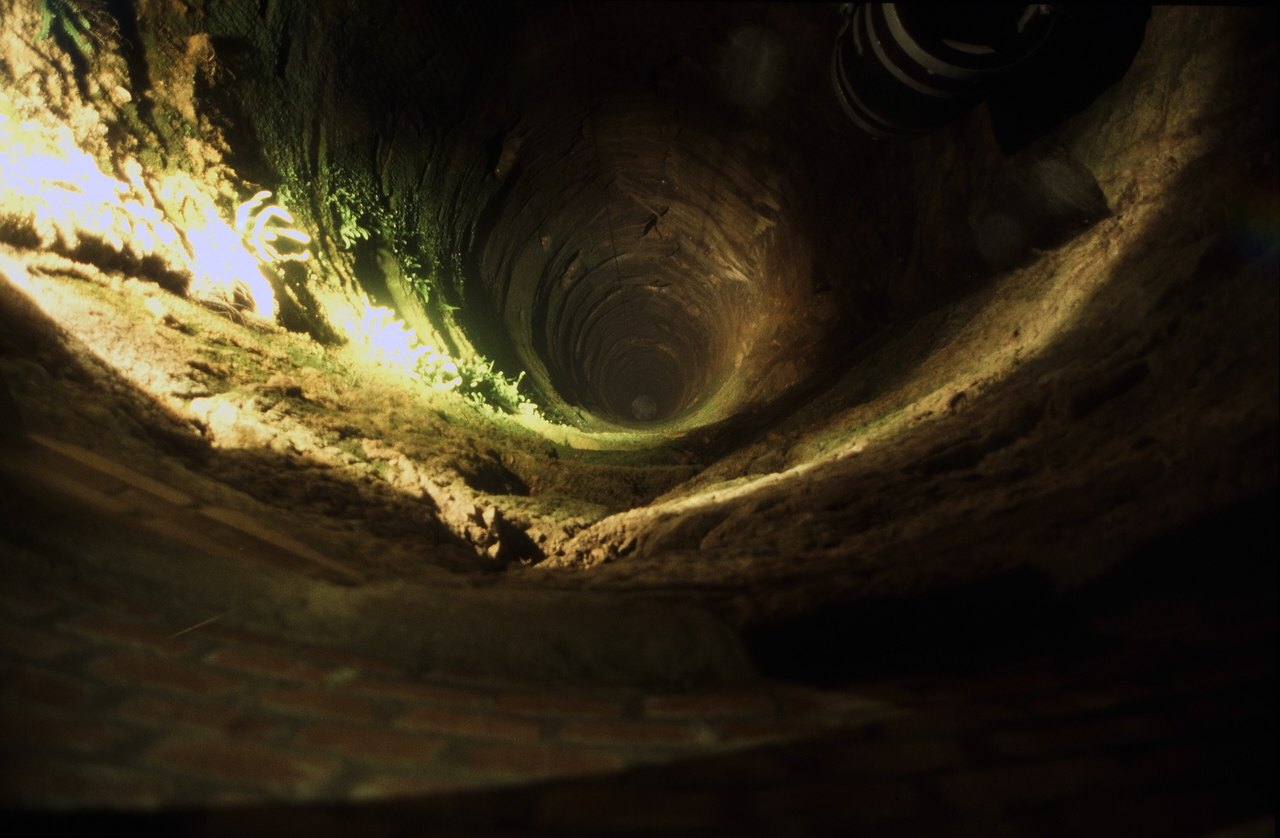
A fortress meant to outlast any blockade had to solve one problem above all others: water. The summit stands far above the river, and a garrison cut off from the Elbe would die of thirst long before it ran short of powder. Between 1563 and 1569, miners from the silver district of the Erzgebirge, working under the Freiberg mining master Martin Planer, sank a well 152.5 meters straight down through the sandstone to reach the water table near the level of the valley floor. It remains the deepest well in Saxony and the second-deepest historic well in Germany, surpassed only by the medieval shaft at the Kyffhäuser. (Some older accounts credit a master named Conrad König with the sinking; the operator’s own chronicle names Planer.) For most of its working life a horse-driven gin and a great treadmill hauled the water up in barrels; a steam engine took over the labor in 1871, an electric motor in 1911, and only in 1967 did a piped supply finally retire the historic machinery. The bomb-proof well house that Jean de Bodt built over the shaft in the 1730s still shelters demonstrations in which water is drawn the old way for visitors, a reminder of how completely the garrison’s survival once hung on that single shaft.
Self-sufficiency extended to the cellar as well as the courtyard. In the gardens of the Magdalenenburg, the Renaissance pleasure house on the western edge of the plateau, Augustus the Strong installed a wine cask of almost theatrical scale, finished in 1725 to outdo the famous tun at Heidelberg. The operator gives its capacity as 238,600 liters, while other accounts cite 249,838 liters; either way it ranked among the largest wine casks ever filled to the brim in Europe, and it survived until it was broken up in 1819. A modern multimedia replica now stands in the same vaulted cellar. Around these set pieces ran the ordinary apparatus of a fortress town in miniature: bakeries, magazines, a treasury building, and barracks. The oldest of those barracks, the Alte Kaserne of 1589, is described by the fortress administration as the oldest preserved barracks building in Germany, a quiet superlative among the more famous ones.
Defense and supply met underground as well. Galleries of bomb-proof casemates honeycomb the rock beneath the courtyards, sheltering powder and stores in earlier centuries and, in the nuclear age, a Cold-War civil-defense bunker; along the rim above them run the gun batteries of the imperial era. Even leisure borrowed the language of machinery. The Friedrichsburg pavilion once carried a mechanical lifting table that delivered fully laid meals straight up to the elector’s company on the rampart, sparing both the food and the servants the climb.
The Saxon Bastille
For more than three centuries Königstein doubled as Saxony’s most secure state prison, and the same isolation that protected the electors’ treasure also guaranteed that no prisoner walked free without leave. From the late sixteenth century until 1922 the cells held something over a thousand inmates, among them chancellors, generals, revolutionaries, and at least one alchemist whose secret would outshine all of them. Saxony’s last state prisoner walked down the ramp a free man in 1922, closing a chapter that had run for more than three hundred years.
Its roster of names reads like a sideways history of Saxony. One of the most prominent was the chancellor Nikolaus Krell, kept on the rock from 1591 to 1601 before his execution in Dresden. The Livonian diplomat Johann Reinhold von Patkul passed through on his way to a gruesome death in 1707. Karl Heinrich von Hoym, a disgraced minister, took his own life in his cell in the 1730s. The nineteenth century brought political prisoners of a new kind: the Russian anarchist Mikhail Bakunin spent 1849 and 1850 here after the Dresden uprising, the young Social Democrat August Bebel did time in 1874, and the satirist Frank Wedekind served a sentence for lèse-majesté at the turn of the century after his work in the magazine Simplicissimus offended the Kaiser.
Königstein’s most consequential prisoner arrived almost by accident. Johann Friedrich Böttger, the runaway alchemist whom Augustus the Strong had pressed into service to make gold, was held at Königstein for several months in 1702 and again from 1706, kept under guard precisely because the elector could not afford to let so valuable a captive escape. Böttger never produced gold. He did, with the scientist Ehrenfried Walther von Tschirnhaus, crack the secret of European hard-paste porcelain, the discovery that founded the Meissen manufactory a short distance down the Elbe. Meissen began turning out Europe’s first true porcelain in 1710, on the strength of a formula first guarded under lock and key. The fortress that held him now tells his story in an exhibition inside the old Georgenburg, under the wry title that the prison once carried among Saxons: a stay on the King’s Stone.
Strongbox of Saxony
If the prison was the rock’s grimmest function, its role as a strongbox was its grandest. Whenever danger closed on Dresden, the court’s most precious things traveled upriver to the one address that could not be taken. The state reserve and the secret archives sheltered here; for a stretch in the 1860s the treasury building held a cash reserve of two million thalers packed into some two hundred casks. The Saxon court’s secret state archive rode out more than one crisis in the same vaults, on the principle that any record the dynasty could not afford to lose belonged where nothing could reach it. Above all, the rock guarded art.
Dresden’s collections came to Königstein in 1756, again in 1813, and most dramatically during the Second World War. From 1942 the curators of the Staatliche Kunstsammlungen packed the entire contents of the Green Vault, the dazzling treasury of Augustus the Strong, into crates and hauled them up the ramp, soon joined by some 450 cases from the historical museum and selected masterpieces from the picture gallery. Among the paintings that waited out the war in the casemates were Jan van Eyck’s Dresden Triptych and Vermeer’s Girl Reading a Letter at an Open Window. The wisdom of the precaution became horribly clear on the night of February 13, 1945, when the firestorm that destroyed central Dresden gutted the Residenzschloss; the treasures stored on the rock survived intact. In May 1945 the repository passed to the Soviet Trophy Commission, and the collections went east, returning to Dresden only in 1958.
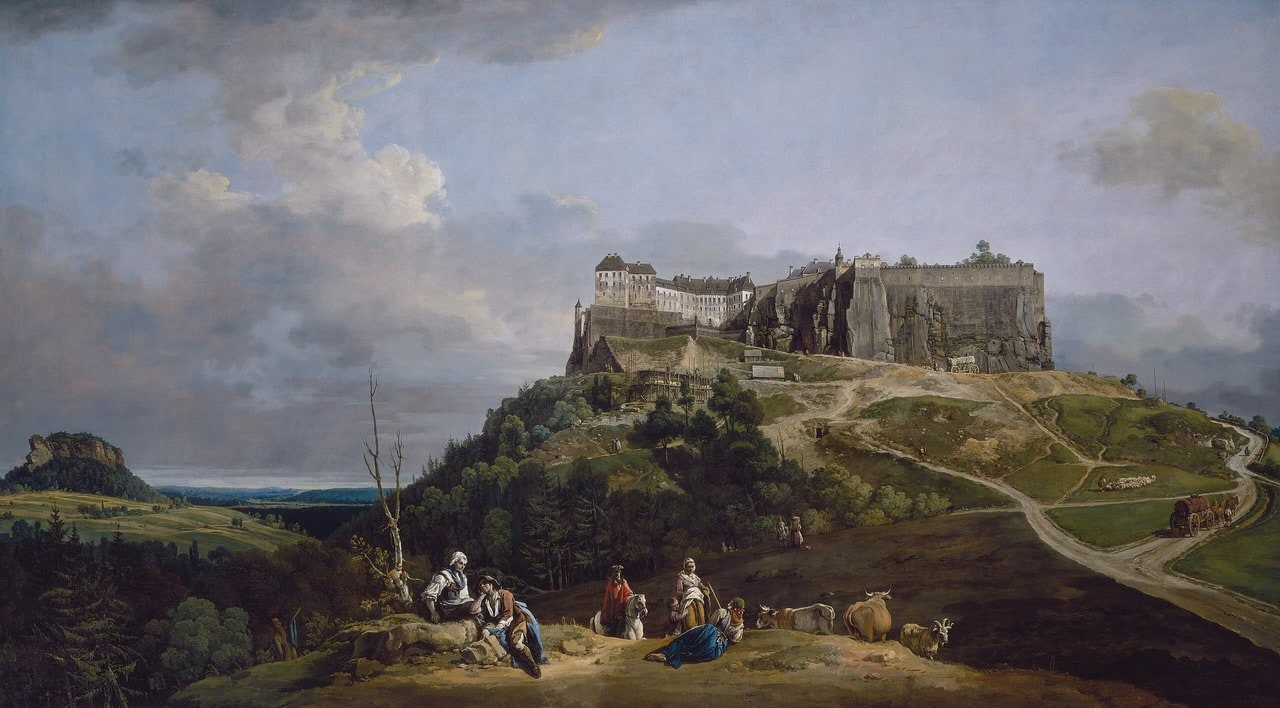
Königstein also drew artists in calmer moments. In 1756 Augustus III commissioned Bernardo Bellotto, the Venetian view-painter and nephew of Canaletto, to record the stronghold in a series of five monumental canvases. Those paintings now hang scattered across the world’s museums, with two interior views in Manchester, exterior views in the National Gallery in London and the National Gallery of Art in Washington, and a fifth in a private collection, a measure of how completely this Saxon rock entered the European imagination.
Visiting Königstein Fortress in 2026
Königstein Fortress is open every day of the year, and the experience rewards a half-day. During the summer season, which runs from March 28 to November 1, 2026, the gates are open from 9 a.m. to 6 p.m.; through the winter the hours shorten to 9 a.m. to 5 p.m., with extended evening hours on the Advent weekends, when a historic Christmas market fills the courtyards. Last admission falls one hour before closing, and the site closes on December 24. Entry tickets and local tours can also be booked in advance through GetYourGuide.
Admission in the 2026 summer season is 17 euros for adults and 13 euros for concessions, with a family ticket at 42 euros; winter rates drop to 15 and 11 euros. Children up to the age of six enter free, and a single ticket covers both the panorama lift and every exhibition on the plateau. Its operator sells timed online tickets, and combination tickets that bundle the shuttle can shave a few euros off the gate price.
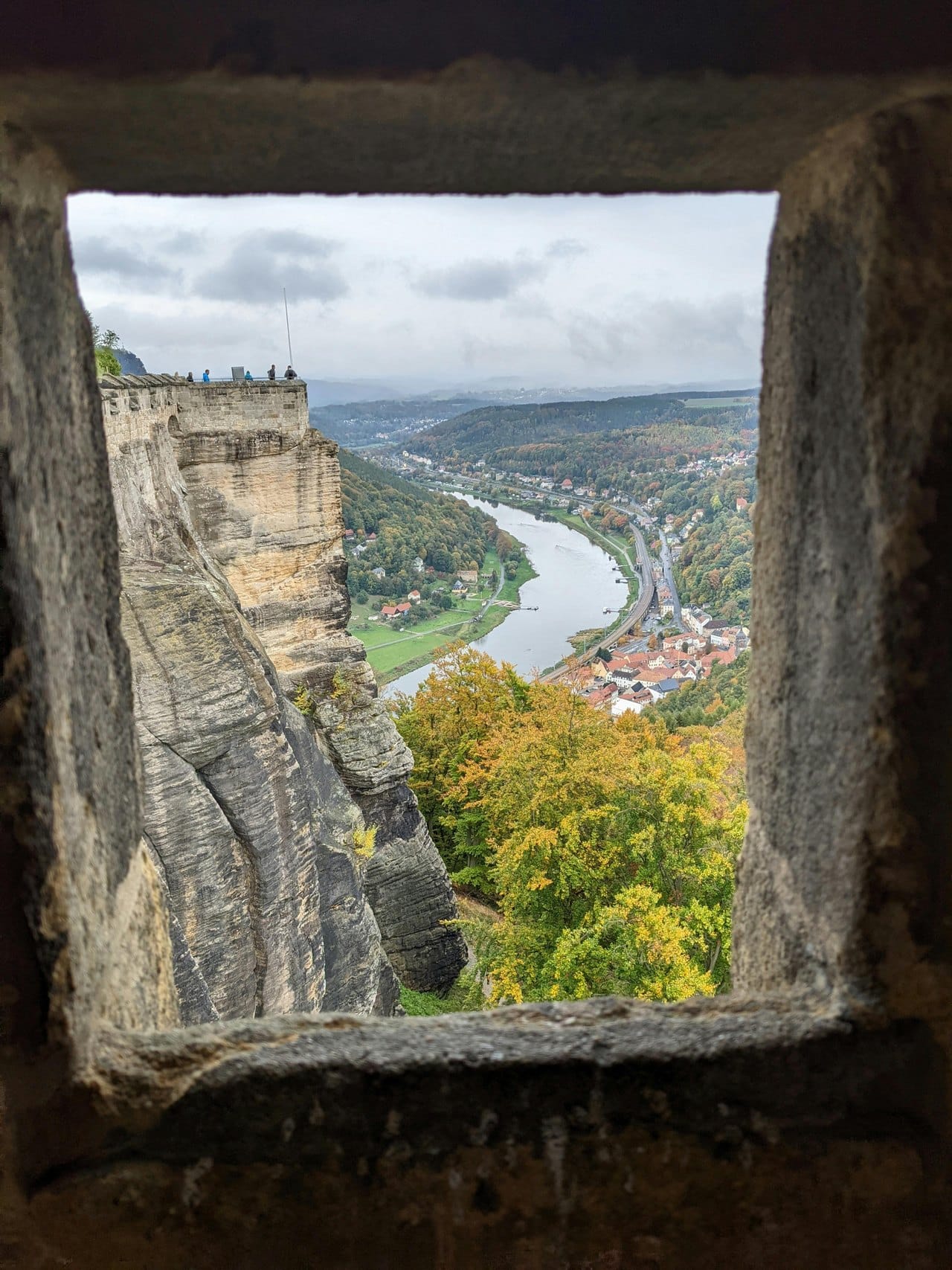
Reaching the rock is half the pleasure. A suburban train, the S1 from Dresden, stops at Königstein station beside the river, from which a steep twenty-five to forty-five minute walk or the Festungsexpress shuttle bus climbs to the entrance; in the warm months a Saxon paddle steamer makes the same journey by water. Drivers leave the A17 motorway for the B172 and park at the fortress car park, a 650-meter walk below the gate. Once on the access path, visitors can ride the historic freight elevator or the glass panorama lift, opened in 2006, which rises about forty meters against the cliff face and delivers a view down the Elbe that is worth the ticket on its own. Much of the plateau is barrier-reduced, with both lifts reaching the summit, marked disabled parking beside the ticket office, and a dedicated route map that steers wheelchair users around the steeper historic ramps. Plan on two to three hours to walk the ramparts, descend into the well house for a water-drawing demonstration, and tour the flagship exhibition, In Lapide Regis, which fills more than thirty rooms in the gatehouse complex. Restaurants, a bakery, and a museum shop occupy the historic buildings, while the calendar adds organ recitals in the garrison church and, in high summer, the open-air concerts of the Festung Königstein Open Air series. Anyone staying overnight can compare hotels in and around Königstein.
Some links on this page are affiliate links, which means StoneKeep Atlas may earn a small commission, at no extra cost to you, if you book through them.
Beyond Königstein
Königstein anchors one of the most rewarding corners of eastern Germany, and few visitors stop at a single rock. Directly across the Elbe rises the Lilienstein, the table mountain where the Saxon army surrendered in 1756 and now a classic half-day hike with a summit view back toward the fortress. A short way downstream the celebrated Bastei bridge spans a gorge of sandstone pinnacles, the postcard image of Saxon Switzerland. Walkers can link the whole landscape on the Malerweg, the painters’ way, whose seventh stage passes directly below the fortress. Upstream lie the spa town of Bad Schandau and the Bohemian border; downstream, the Baroque town of Pirna and, beyond it, Dresden itself, thirty-five kilometers away and full of the same collections that once sheltered on the rock. For a contrasting Saxon residence with no defensive pretensions at all, the moated hunting palace of Moritzburg, set among lakes northwest of Dresden, makes an easy day from the same base.
Common Questions
When is Konigstein Fortress open?
The fortress is open every day of the year. In the summer season (28 March to 1 November 2026) the gates are open 9 a.m. to 6 p.m.; through the winter the hours shorten to 9 a.m. to 5 p.m., with extended evening hours on the Advent weekends. Last admission falls one hour before closing, and the site closes on 24 December.
How much is admission?
In the 2026 summer season admission is 17 euros for adults and 13 euros for concessions, with a family ticket at 42 euros; winter rates drop to 15 and 11 euros. Children up to the age of six enter free, and a single ticket covers both the panorama lift and every exhibition on the plateau.
How do I get to Konigstein Fortress?
The S1 suburban train from Dresden stops at Konigstein station beside the river, from which a steep twenty-five to forty-five minute walk or the Festungsexpress shuttle bus climbs to the entrance. In the warm months a Saxon paddle steamer makes the same journey by water.
How long should I allow for a visit?
The fortress rewards a half-day, with the plateau, its exhibitions, and the panorama lift over the Elbe all worth time.
Conclusion
Königstein endures because it was never needed in the way its builders feared and always useful in ways they came to depend on. Cliffs that no army would assault made the rock the safest address in Saxony, and so the fortress filled, across the centuries, with the things a state guards most jealously: its treasure, its records, its enemies, and in the darkest year of the twentieth century, its art. Walk the ramparts today and the logic is still legible in the stone. A visitor stands where electors once stood to watch the river and count themselves untouchable, and the view explains, better than any chronicle, why they were right.
Königstein’s record of never being taken by force is a centerpiece of our history of the German castle sieges that defined a nation.
Principal Sources
- Dehio, Georg. Handbuch der Deutschen Kunstdenkmäler: Sachsen I. The standard German inventory of art and architecture supplied the structural chronology of the gatehouse, the armories, and the Baroque well house, and dated the principal building campaigns on the plateau.
- Deutsche Burgenvereinigung (EBIDAT). The European castle database of the German Castles Association provided the medieval ownership history, including the Bohemian origins, the transfer to the Wettin margraves of Meissen, and the 1459 Treaty of Eger.
- National Gallery of Art, Washington, and The National Gallery, London. The two museums’ catalog records for Bernardo Bellotto’s views of the fortress documented the 1756 commission and the present dispersal of the five canvases.
- Schlösserland Sachsen. The Saxon state palace administration’s portal supplied background on the fortress as a state monument, its conservation, and its place within the wider network of Saxon residences.
- Staatliche Kunstsammlungen Dresden. The Dresden state art collections’ accounts of the Green Vault recorded the wartime evacuation of the treasury and the picture gallery to Königstein from 1942 and the collections’ return in 1958.
- Current opening hours, ticket prices, transport, and historical detail were drawn from the fortress operator, Festung Königstein gGmbH, at its official site (festung-koenigstein.de), including its history pages and its 2026 visitor and admission information; figures for the well, the Magdalenenburg wine cask, and the In Lapide Regis exhibition follow the operator’s own published descriptions.
Image credits. Hero, seaq68 via Pixabay. Aerial view, Derbrauni, CC BY 4.0, via Wikimedia Commons. 1241 Border Charter, NobbiP, CC BY-SA 3.0, via Wikimedia Commons. Fortress plan, Hans-Joachim Fröde, CC BY-SA 3.0, via Wikimedia Commons. Approach bridge, beba via Pixabay. Well shaft, Rüdiger Stehn, CC BY-SA 2.0, via Wikimedia Commons. Bellotto’s view of Königstein, Bernardo Bellotto, Public domain, via Wikimedia Commons. View down the Elbe, Vindhya via Pexels. Freely licensed images are resized to fit; otherwise unaltered.