
The Garden Palaces of Potsdam
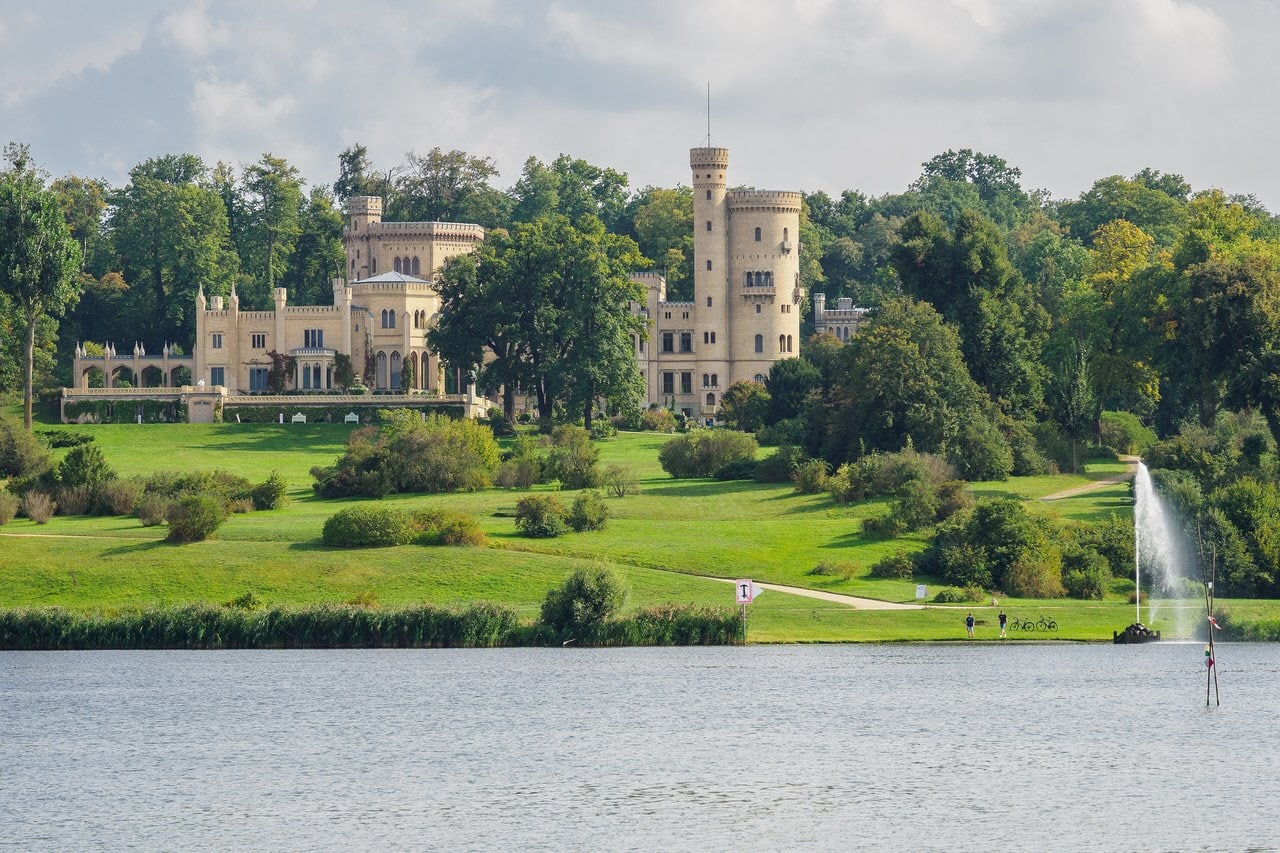
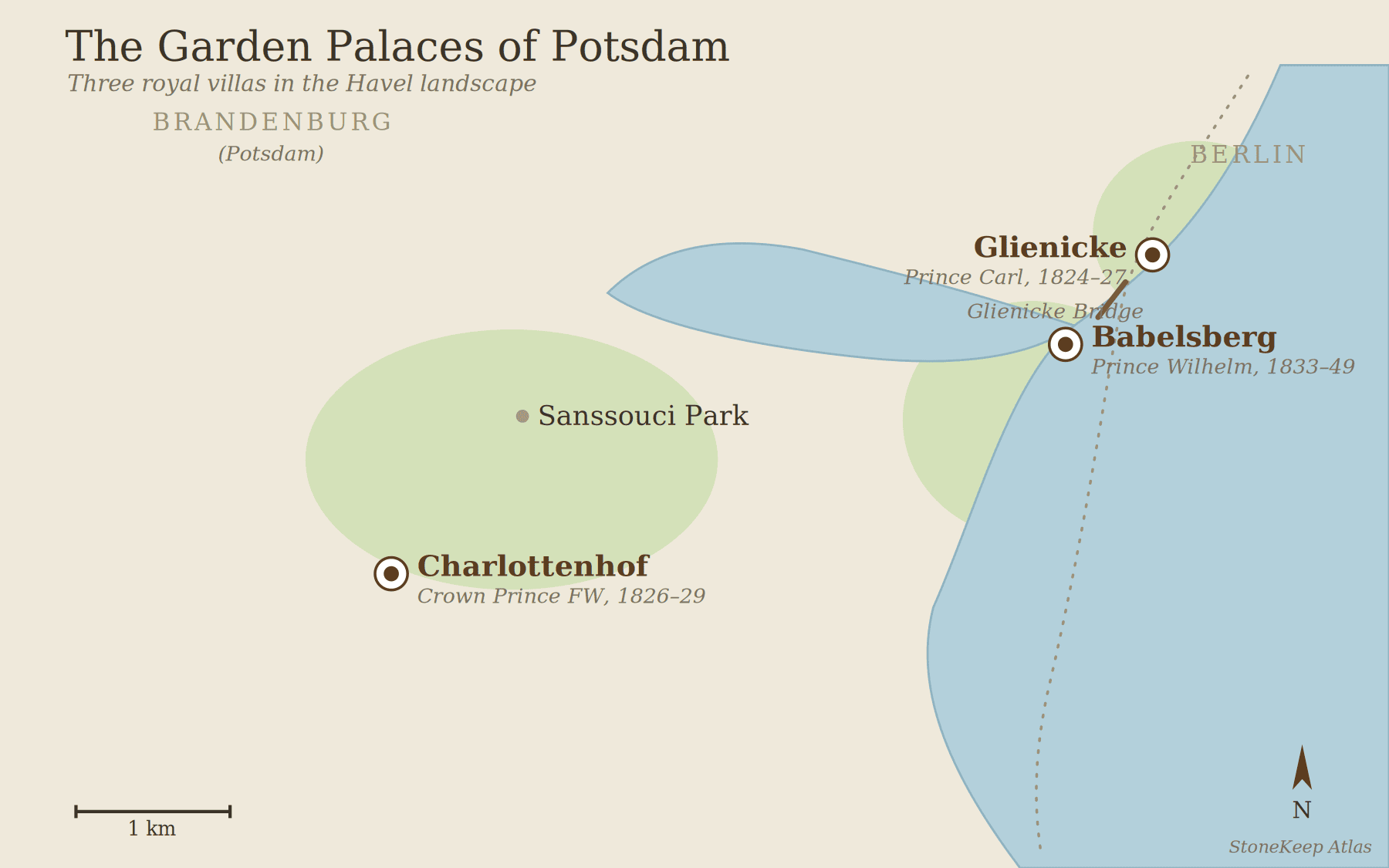
The garden palaces of Potsdam are not the great dynastic seats where Prussia was governed. They are something quieter: three princely villas set in landscaped parks along the River Havel, built within a single generation as summer retreats by three sons of King Friedrich Wilhelm III. Prince Carl raised an Italian dream at Glienicke; the future Friedrich Wilhelm IV shaped a Roman villa at Charlottenhof; the future Wilhelm I answered with a neo-Gothic castle at Babelsberg. Each was conceived as an escape rather than a throne, a house dissolved into its garden. Together they form the most concentrated expression of the Prussian royal family’s romantic turn, and all three belong today to the UNESCO World Heritage landscape of Potsdam and Berlin.
What binds them is a shared cast and a shared idea. Karl Friedrich Schinkel, the defining Prussian architect of the age, drew the first designs for all three, and where he could not finish, his pupils Ludwig Persius and Johann Heinrich Strack carried the work on. Peter Joseph Lenné, the royal garden director, shaped the parks so that building and planting read as one composition. The idea they served was the villa in a park: a modestly scaled house, open to its grounds, modeled on the country retreats of Italy or the picturesque manors of England. The three palaces trace that idea across a single arc, from the sunlit classicism of Glienicke and Charlottenhof to the towers and battlements of Babelsberg.
Glienicke: Prince Carl’s Italian Dream
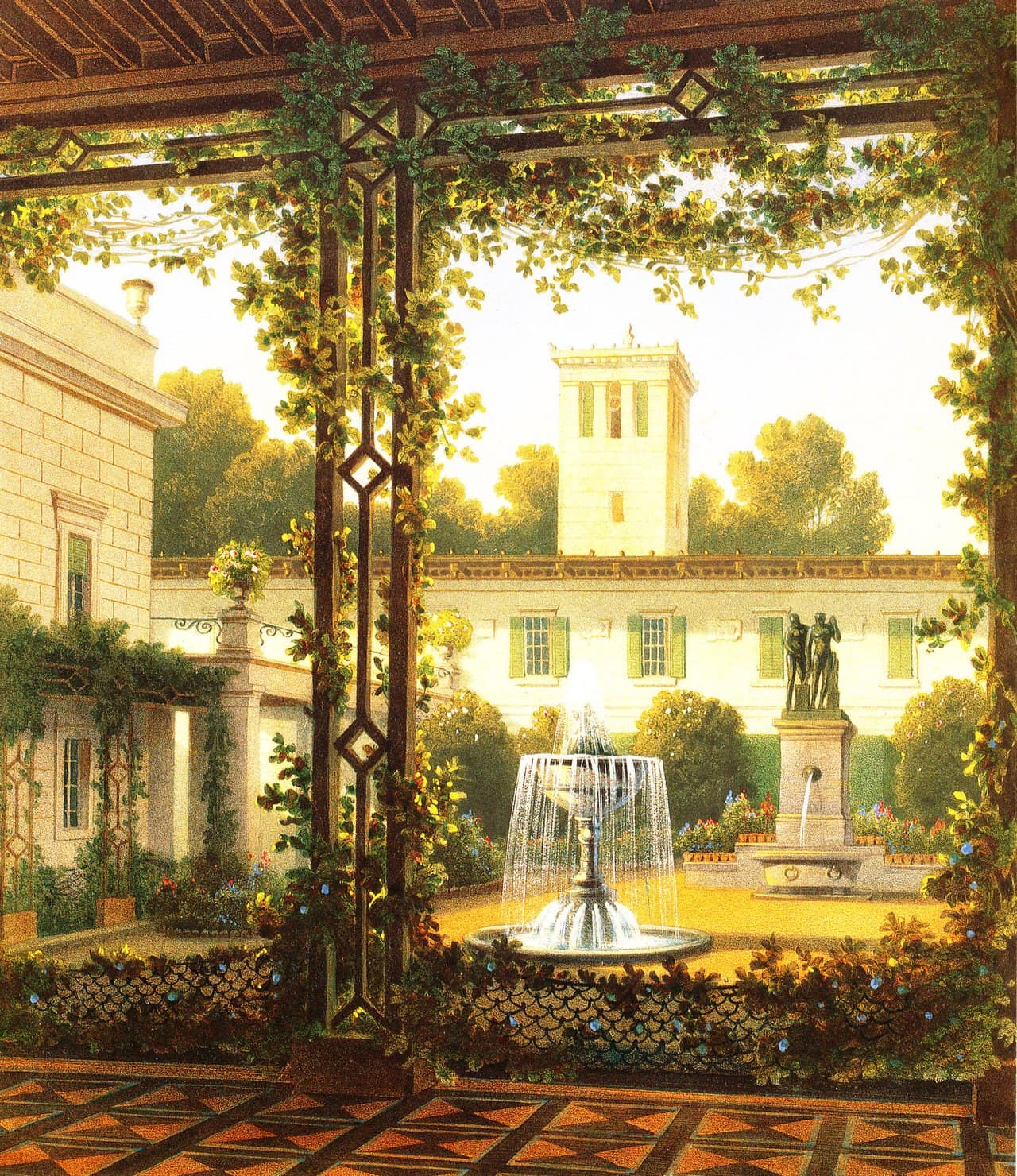
In 1823, twenty-one-year-old Prince Carl of Prussia came home from his first journey to Italy determined to build a piece of the Mediterranean on the sandy soil of Brandenburg. The estate he chose, Glienicke Palace, sits on the Havel where the river widens between Berlin and Potsdam, its meadows sloping to the water between wooded hills. Carl acquired it in 1824 and turned at once to Schinkel. The architect began with the old billiard house on the bank, converting it into a Casino, a garden pavilion named for the Italian word for a little house, with pergolas framing the view across the lake. Between 1825 and 1827 he reworked the manor itself into a low, classical villa.
Glienicke is the purest of the three Italian dreams. Schinkel set antique fragments into its walls, and Carl, a passionate collector, filled the rooms with ancient sculpture. Lenné, who had begun the pleasure ground for an earlier owner, completed an English-style park around the house, so that clipped lawns near the villa loosened into woodland beyond. Later touches deepened the southern illusion: a tower rose in 1832, and in 1838 a fountain flanked by gilded lions on columns marked the approach from the road. That result is less a palace than a setting for an imagined Italian life, the earliest and most single-minded of the Havel villas.
Charlottenhof: The Roman Villa
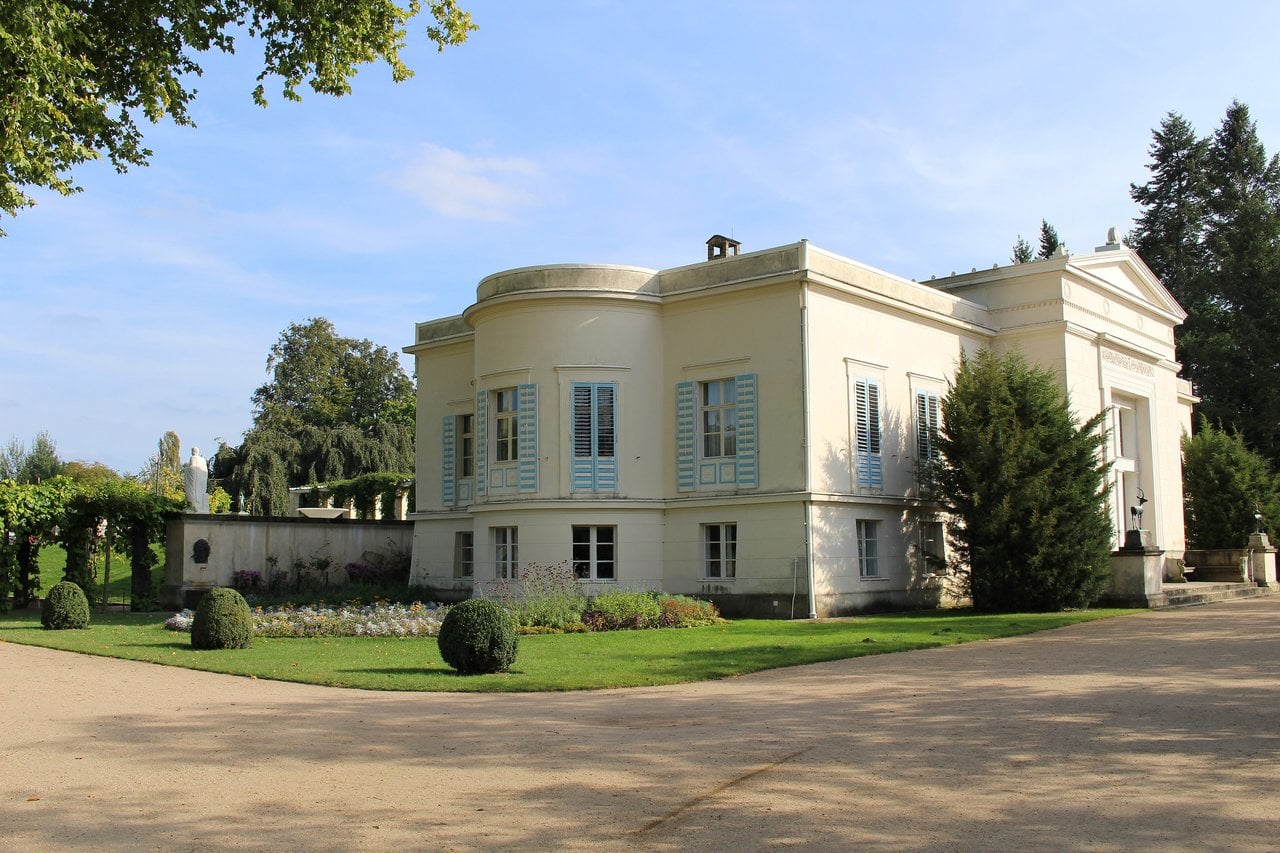
While Schinkel worked for Carl at Glienicke, he took on a second, closely related commission a short distance upriver. In 1825 King Friedrich Wilhelm III bought a former farm on the southern edge of Sanssouci Park and gave it as a Christmas present to his eldest son, the Crown Prince and future Friedrich Wilhelm IV, and the Crown Princess Elisabeth. The Crown Prince, an obsessive amateur architect who sketched constantly, set to work with Schinkel on Charlottenhof Palace, the building that became the manifesto of the type.
Between 1826 and 1829, with Persius managing construction, Schinkel raised a small neoclassical villa on the foundations of the old manor, itself built two generations earlier by the Sanssouci master builder Jan Bouman. He gave it the shape of a Roman country house: a flat profile, a portico, vine-hung pergolas, and rooms that open toward the garden, among them the celebrated blue-and-white striped tent room. Lenné turned the flat, partly marshy farmland into an English garden of lawn, water, and shaded walks, tying the new park to Frederick the Great’s older Sanssouci. Just to the northeast, beginning in 1829, Schinkel and Persius extended the same vision into the Roman Baths, a picturesque group of gardener’s houses and bath pavilions in the Italian country style, knit together by pergolas and courtyards and finished in 1840. The Crown Prince loved the place enough to nickname it Siam, after what he pictured as a land of the free. Where Glienicke was a collector’s Italy, Charlottenhof was a designed idyll, the clearest single statement of the garden-villa idea the three palaces share.
Babelsberg: The Gothic Counterpoint
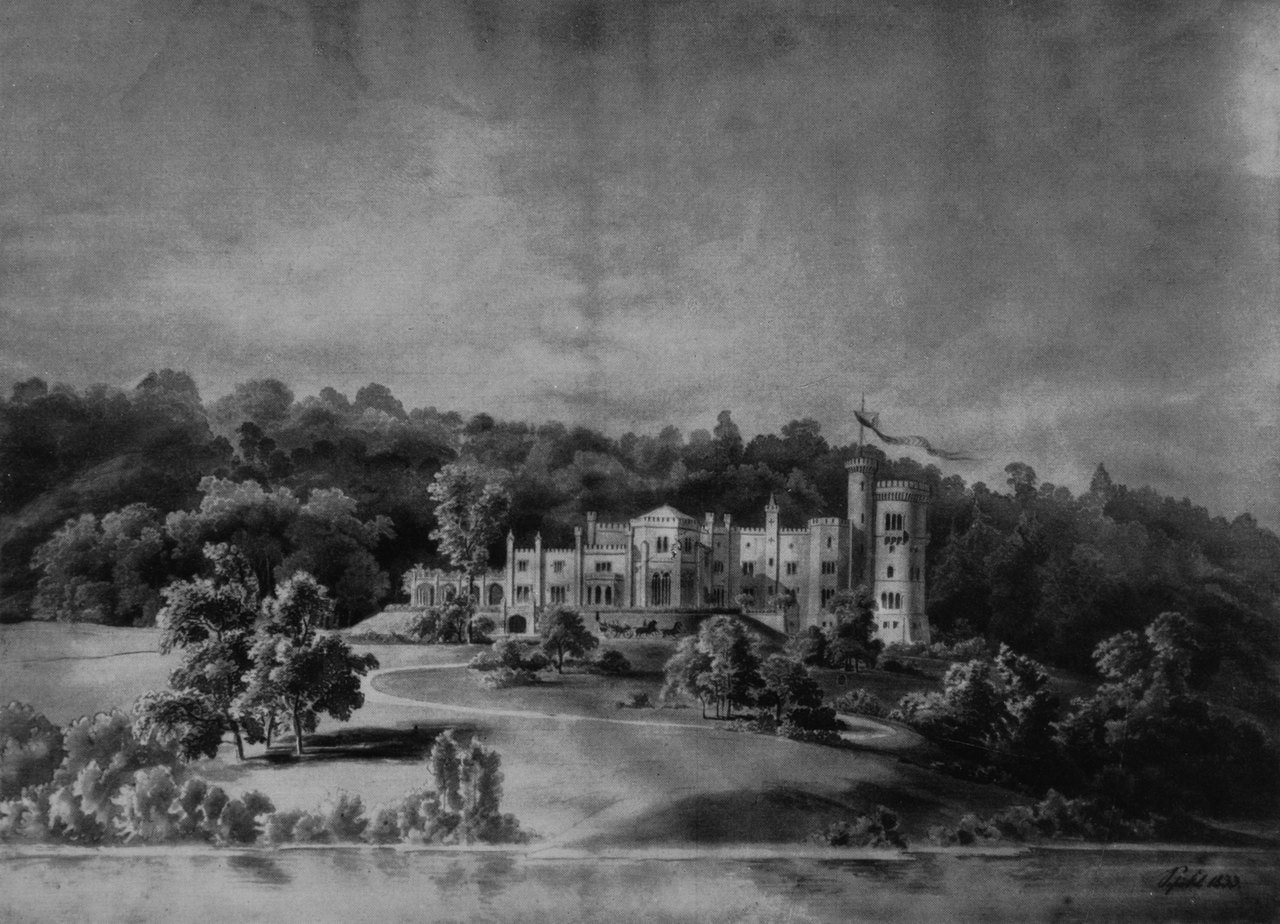
The third brother answered in a different key. Prince Wilhelm, the future Wilhelm I and first German Emperor, had to wait his turn: only in 1833 did his father grant him the wooded slope of Babelsberg, across the Havel from Glienicke, for a summer house of his own. Schinkel again drew the first designs, but this time in the neo-Gothic manner, all towers, battlements, and pointed arches, taken from English Tudor models rather than Italian villas. Babelsberg Palace shows the same villa-in-a-park idea wearing the opposite stylistic costume.
Progress was slow, held back by tight finances and by the taste of Wilhelm’s wife, Augusta, who pushed for a grander result. Schinkel completed only the first section before his death in 1841; his pupils Ludwig Persius and Johann Heinrich Strack enlarged the palace into its present silhouette between 1844 and 1849. Lenné laid out the park, then yielded it to Prince Hermann von Pückler-Muskau, who threaded the hillside with winding paths and framed views of the river and the Glienicke Bridge. An artificial water system fed streams, waterfalls, and fountains down the slope, and a slender lookout tower, the Flatowturm, rose among the trees. Wilhelm kept Babelsberg as his summer residence for half a century, and it was here, in 1862, that the constitutional crisis over the army budget moved him to summon Otto von Bismarck. The romantic retreat of a prince became, almost in passing, a setting for the founding of the German Empire.
What the Three Share
Seen together, the palaces describe one experiment carried out three ways. Each began with an existing building or a plain site rather than a grand new foundation, and each held to the scale of a villa, not a residence of state. Each softened the line between house and garden, with pergolas, terraces, and framed views drawing the eye outward, and each leaned on Lenné to make the surrounding park feel like an extension of the walls. The patrons were not distant clients but enthusiasts who sketched, collected, and argued over the details. Two of them were bound by marriage as well as blood: Carl and Wilhelm had wed sisters, Marie and Augusta of Saxe-Weimar-Eisenach, so the villas at Glienicke and Babelsberg, facing each other across the Havel by the Glienicke Bridge, became the summer homes of two brothers married to two sisters.
Their differences are just as telling. Glienicke and Charlottenhof look south to antiquity, Babelsberg north to the Gothic Middle Ages, and the distance between them measures how far the romantic imagination of the 1820s and 1830s could travel while serving one purpose. That all three survive within a single protected landscape is no accident. In 1990 UNESCO inscribed the Palaces and Parks of Potsdam and Berlin as a World Heritage Site, extended in 1992 and 1999, recognizing exactly this dense weave of building and designed nature along the Havel. The garden palaces are three of its quietest and most personal chapters.
Beyond the Three
These were the retreats. The seats of power stand a short distance away, and they have their own story. For the great dynastic palaces where the Hohenzollerns actually governed, from the Berlin residence at Charlottenburg to Frederick the Great’s Sanssouci and the immense Neues Palais, see our companion guide to the Royal Palaces of Berlin and Brandenburg. For the other face of nineteenth-century Prussian royal building, the deliberate medievalism of the family’s restored hilltop castles, see The Prussian Royal Castles. The garden villas of the Havel are best read beside both: the same dynasty, the same century, but here at its most private and most at ease.
The Three were not the first of their kind. A generation earlier, Friedrich Wilhelm II had already built two garden retreats of his own on the Havel lakes north of the town: the neoclassical Marble Palace on the Heiliger See, the first royal palace in Prussia in the antique taste, and the painted-timber palace on the Pfaueninsel on its wooded island downstream. Both belong to the same impulse the Three would later carry to its height, the wish for a private house set in a designed landscape rather than a seat of state.
This Italianate strain in particular did not end with the Three. A generation later, Friedrich Wilhelm IV carried it to its grandest pitch in the Orangery Palace, the largest building in Sanssouci Park, a 300-meter Renaissance fantasy of arcades and twin towers that gathers up the same borrowed-Italy impulse Charlottenhof and Glienicke had explored on an intimate scale.
Principal Sources
- Bergdoll, Barry. Karl Friedrich Schinkel: An Architecture for Prussia. Rizzoli, 1994.
- Snodin, Michael, ed. Karl Friedrich Schinkel: A Universal Man. Yale University Press, 1991.
- Sigel, Paul, Silke Dahmlow, Frank Seehausen, and Lucas Elmenhorst. Architekturfuhrer Potsdam. Dietrich Reimer Verlag, 2006.
- Stiftung Preussische Schlosser und Garten Berlin-Brandenburg (SPSG). Object descriptions for Glienicke Villa, Charlottenhof Villa, and Babelsberg Palace. spsg.de.
- UNESCO World Heritage Centre. “Palaces and Parks of Potsdam and Berlin.” whc.unesco.org/en/list/532/.
Image credits. Hero, Babelsberg above the Havel: JoachimKohler-HB, CC BY-SA 4.0, via Wikimedia Commons. Locator map: StoneKeep Atlas (own work). Glienicke garden court, 1837: Haun after Wilhelm Schirmer, public domain, via Wikimedia Commons. Charlottenhof villa: Angel Miklashevsky, CC BY-SA 4.0, via Wikimedia Commons. Babelsberg, Schinkel’s 1833 design: Karl Friedrich Schinkel, public domain, via Wikimedia Commons. Freely licensed images are resized to fit; otherwise unaltered.