
Castles of Provence: Four Great Strongholds of the South
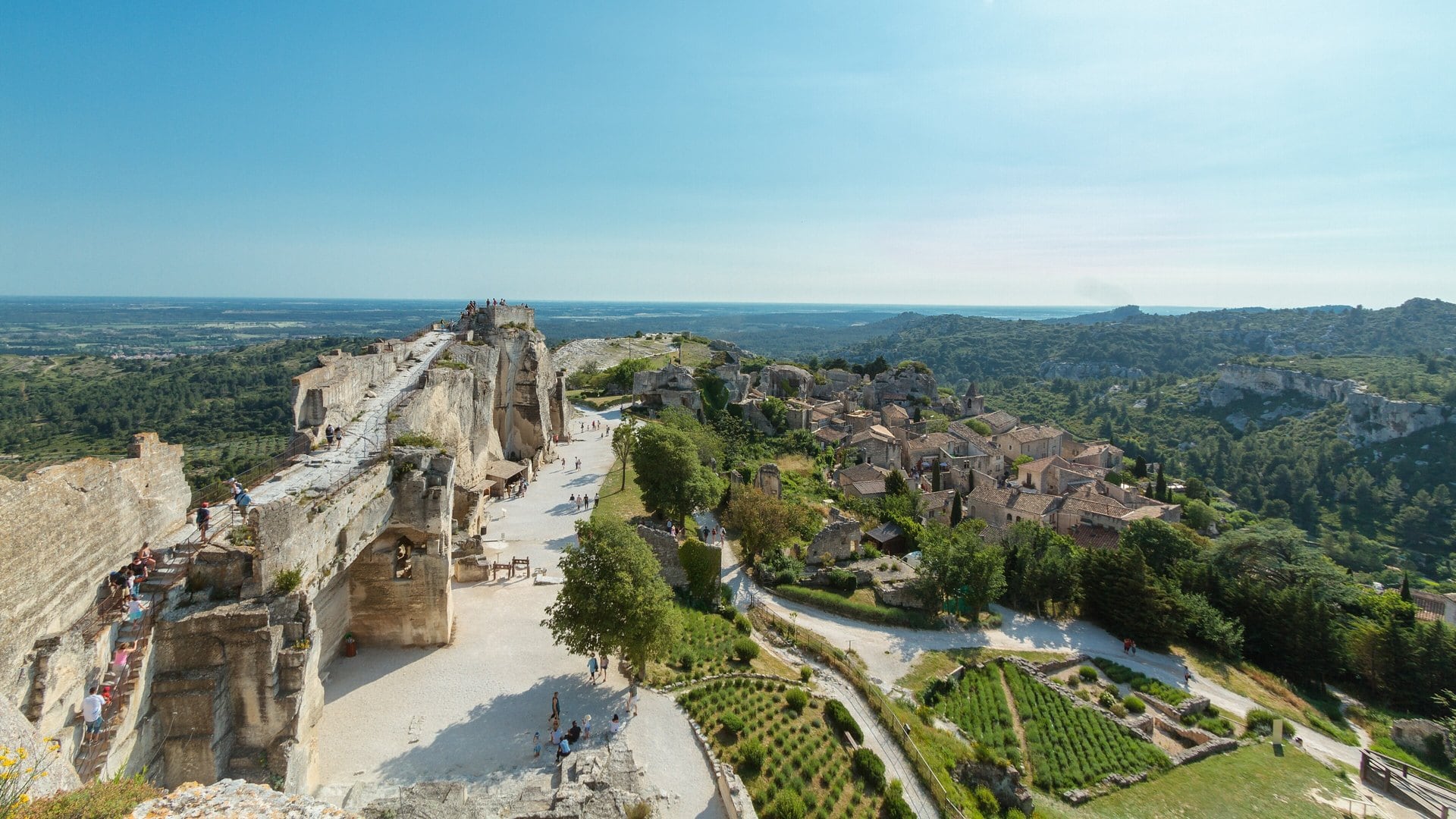
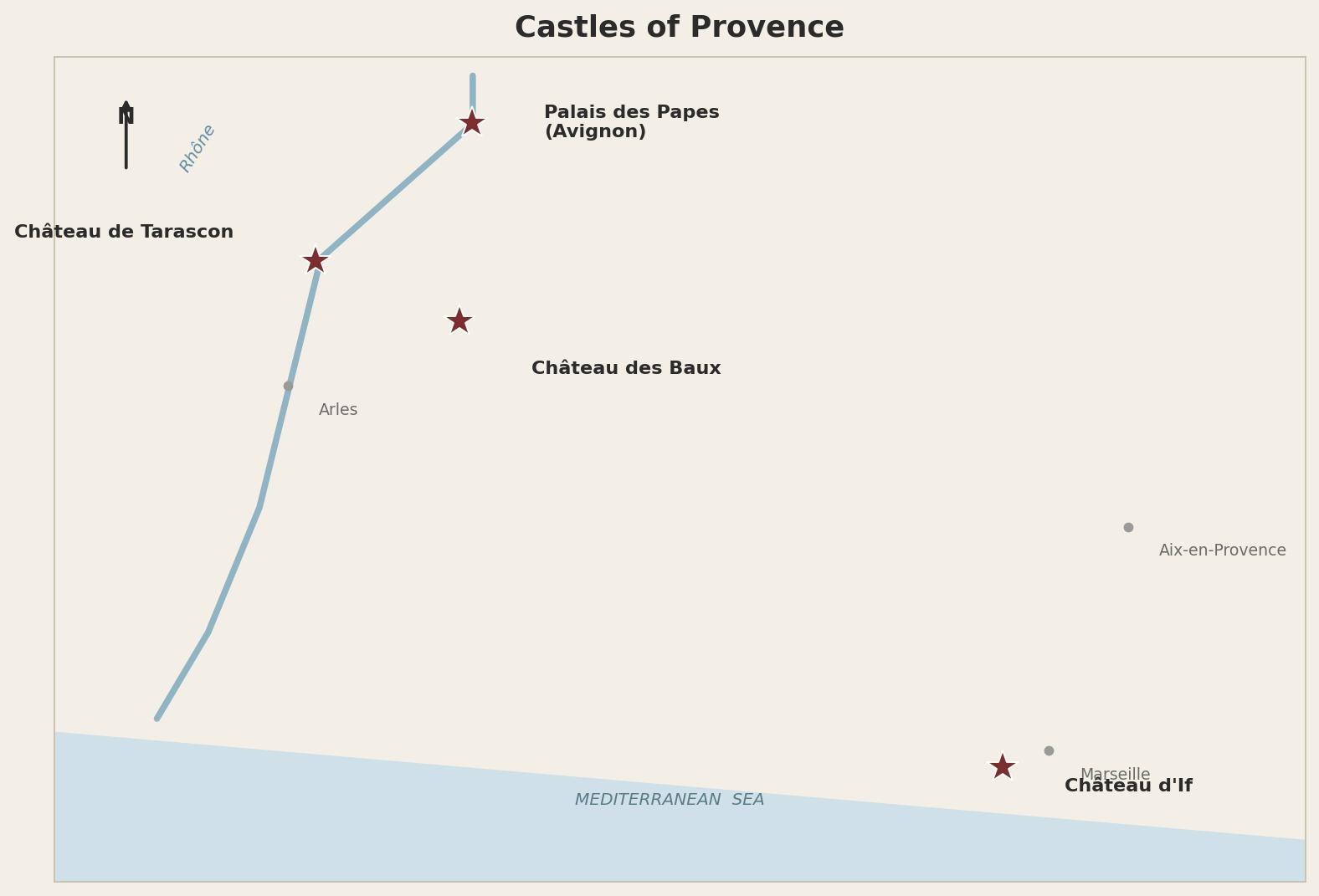
The castles of Provence are a lesson in how many different things a great building can be. Four of them stand within an hour or two of one another across the lower Rhône and the coast, and no two are alike: an island fortress set in the sea off Marseille, the largest Gothic palace in the world, a river château raised by a poet-king, and a ruined citadel carved from a cliff. Between them they were built to guard a port, to house a papacy, to hold a frontier, and to crown a dynasty, and each did its work in stone that still stands today.
This guide gathers the four, all in the modern region of Provence-Alpes-Côte d’Azur, and reads them not by age but by the kind of stronghold each became. One watched the sea. One ruled the Church. One faced a rival across a river. One looked down from a rock over the Alpilles. Every one of them has its own full StoneKeep Atlas guide; what follows is the thread that ties them together, and a starting point for a region with far more castles than these four.
The Castles of Provence at a Glance
| Castle | What it is | Where | Getting there | UNESCO |
|---|---|---|---|---|
| Château d’If | Island prison-fortress | Bay of Marseille (Bouches-du-Rhône) | Boat from Marseille (Vieux-Port) | No |
| Palais des Papes | Largest Gothic palace in the world | Avignon (Vaucluse) | Avignon TGV, then on foot | Yes |
| Château de Tarascon | Riverside Angevin château, later a prison | Tarascon, on the Rhône (Bouches-du-Rhône) | Train on the Avignon–Arles line | No |
| Château des Baux | Ruined clifftop citadel | Les Baux-de-Provence (Bouches-du-Rhône) | By road from Arles or Avignon | No |
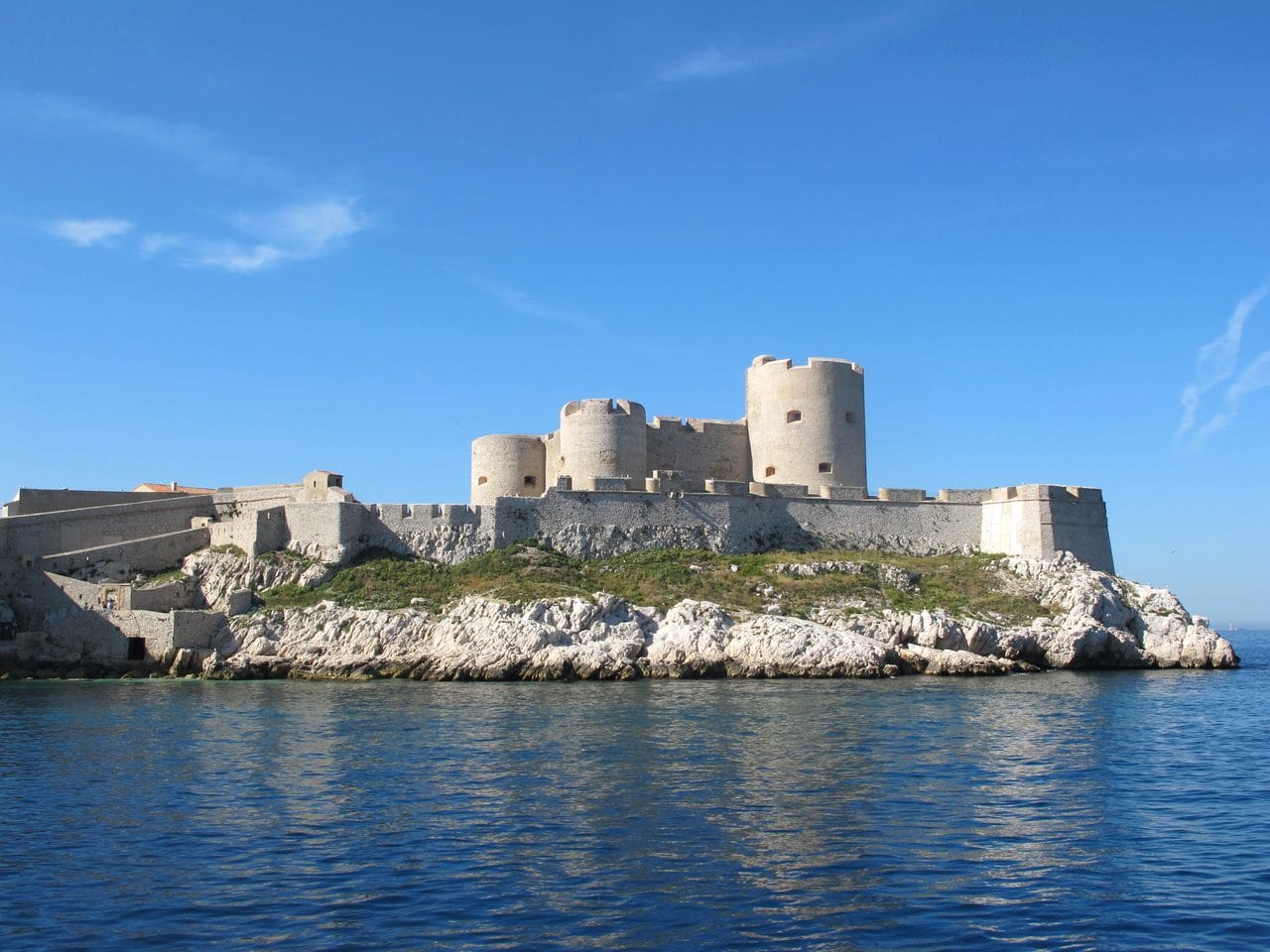
Château d’If: the Island Prison-Fortress
Château d’If rises from a bare limestone islet in the bay of Marseille, close enough to the waterfront that people ashore can pick out its pale walls, far enough that the surrounding water once made escape a fantasy. King François I had it built in the 1520s, completed in 1531, to guard France’s greatest Mediterranean port against the fleets of Charles V. As a fortress it was a quiet failure: in four centuries it never fired a shot in anger, and it soon found its real purpose as a prison.
It was as a prison that the island earned its history, holding Huguenots after the Revocation of the Edict of Nantes and, in 1871, Gaston Crémieux of the short-lived Marseille Commune, shot on the neighboring shore. Yet what carried the fort’s name around the world was fiction. Alexandre Dumas chose these vaults as the dungeon of Edmond Dantès in The Count of Monte Cristo, and visitors still cross by boat to see the cell that never held a man who never lived.
Read the full story in the StoneKeep Atlas guide to Château d’If.
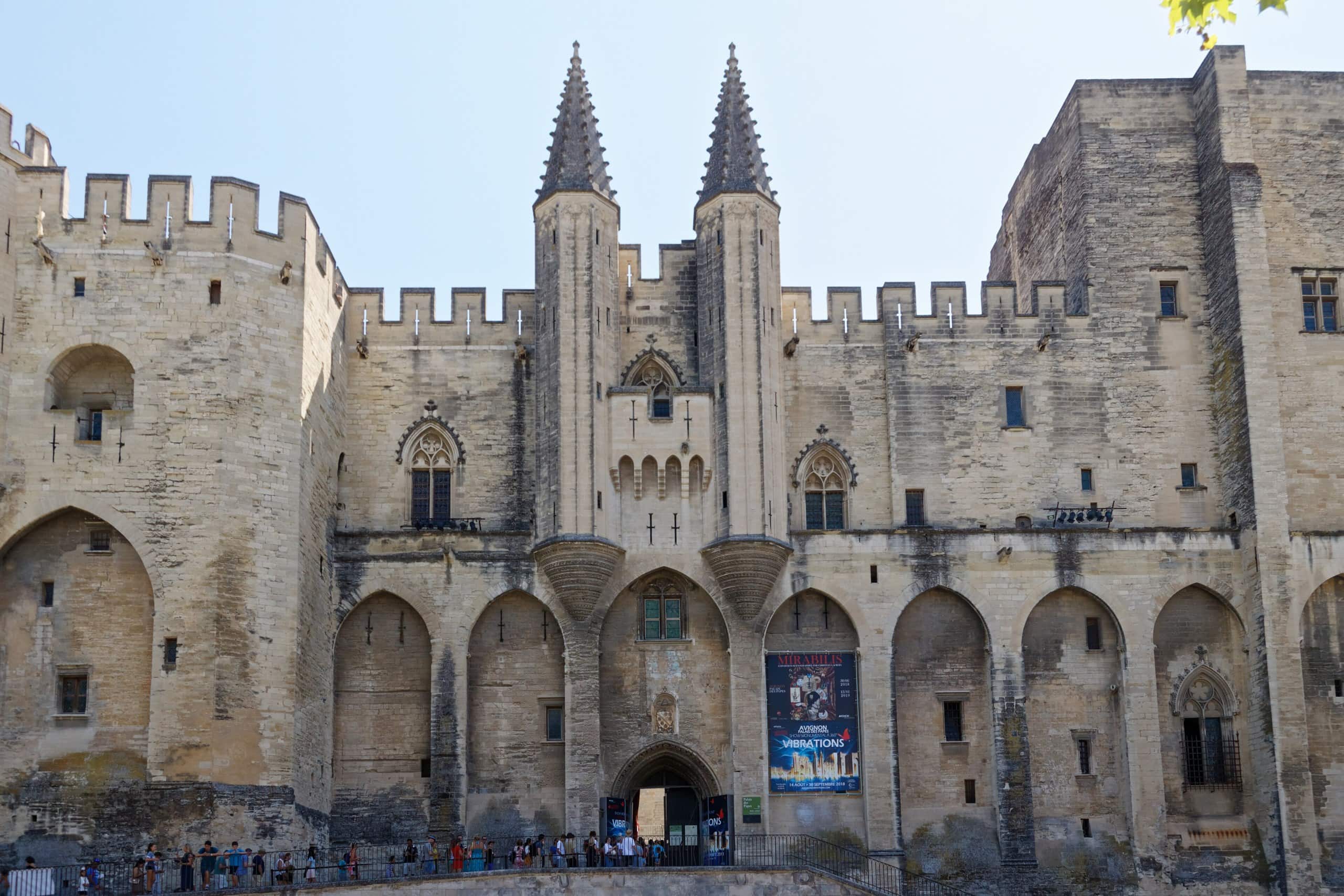
Palais des Papes: the Fortress of the Popes
The Palais des Papes at Avignon is the largest Gothic palace in the world, a fortress and a court fused into one block of pale stone roughly fifteen thousand square meters in extent. For most of the fourteenth century it was neither museum nor monument but the working capital of Western Christianity, the seat from which a line of popes governed the Church after the papacy left Rome for the south of France. A modest river town became a second Rome almost overnight.
Two popes made the building. Benedict XII raised the austere Old Palace from 1335, to designs by Pierre Poisson; his successor Clement VI added the lavish New Palace under Jean de Louvres, and hired the painter Matteo Giovannetti to fresco its chapels and studies. After the popes returned to Rome the palace served for a century as a barracks, its frescoes hacked and its halls lined with iron beds, before restoration returned it to its Gothic self. It anchors the World Heritage site of the historic centre of Avignon.
Read the full story in the StoneKeep Atlas guide to the Palais des Papes.
Château de Tarascon: Good King René’s River Fortress
Château de Tarascon stands on the left bank of the Rhône, the river fortress of Good King René and remarkably well preserved, a condition the town credits to sustained restoration and maintenance by the state’s monument architects. The Angevin princes who raised it between 1400 and 1449, Louis II, Louis III, and René of Anjou, built both a stronghold and a residence, a working castle on the frontier of Provence facing the rival fortress of Beaucaire across the water. Its sheer town-side walls and round machicolated towers still rise straight from the street.
What kept the castle so intact was the long second life that followed the Angevins. For close to five centuries it served as a place of detention, and the prisoners who passed through covered its walls with carved graffiti that survives to this day. Behind the war-like shell, the Cour d’Honneur opens into Gothic arcades and a flamboyant stair, the gracious half of a building that was always both fortress and palace. It is run today by the town of Tarascon as a museum and arts centre.
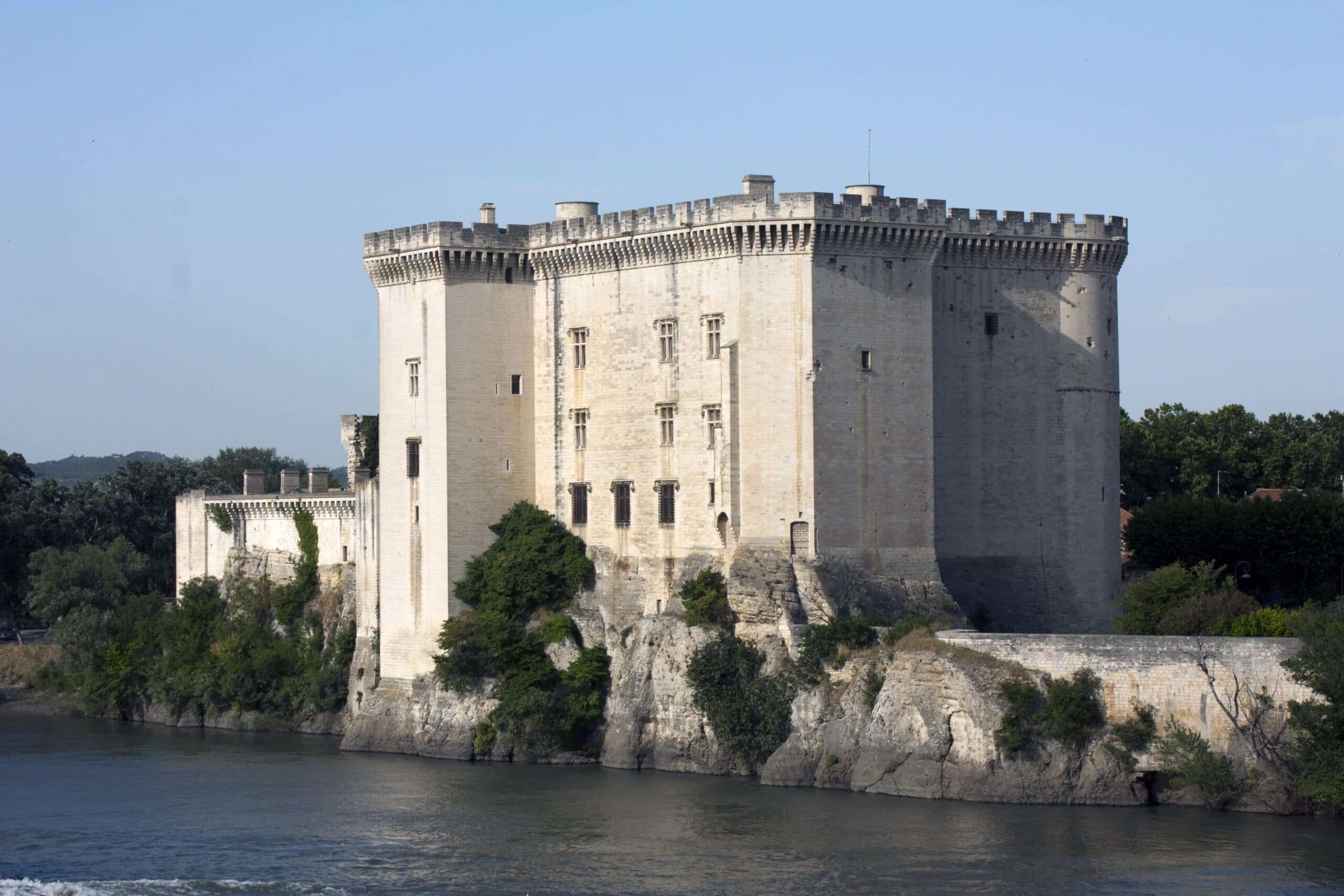
Read the full story in the StoneKeep Atlas guide to Château de Tarascon.
Château des Baux-de-Provence: the Citadel on the Rock
The Château des Baux-de-Provence crowns a bare limestone spur in the heart of the Alpilles, its ruined ramparts rising so seamlessly from the rock that fortress and cliff seem cut from a single mass. A castrum is recorded here as early as 975, and for five centuries the summit was the eyrie of the lords of Baux, a family so proud it claimed descent from one of the Three Magi and so troublesome to the crown that Cardinal Richelieu finally had the fortress pulled down in the 1630s.
What survives is a magnificent open-air ruin spread across the top of the rock, from the rectangular thirteenth-century keep to walls and chambers carved directly from the living stone. Reconstructed siege engines stand on the plateau below, and the views reach across the Alpilles to the plain of the Rhône. The site is run today by Culturespaces, which also stages the immersive Carrières des Lumières in the old quarries just below the village.
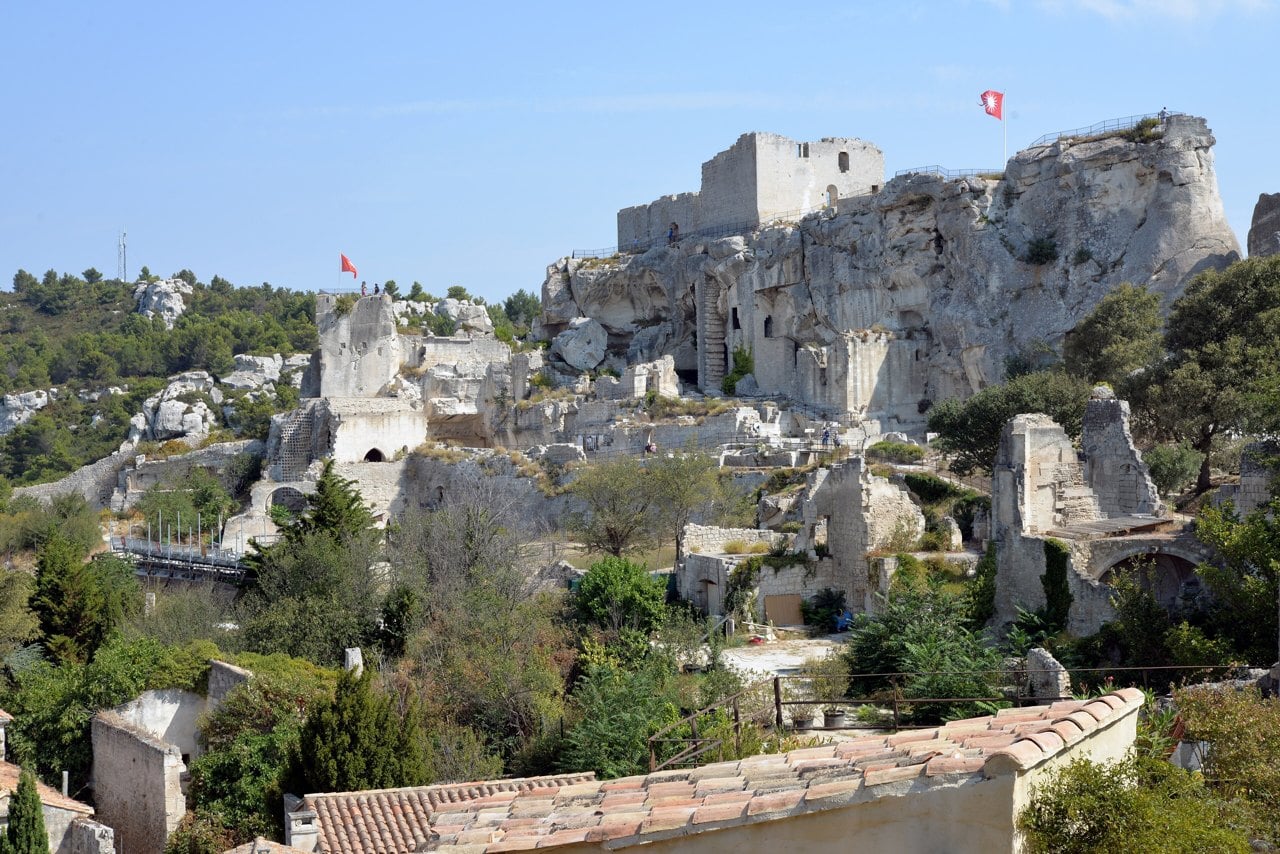
Read the full story in the StoneKeep Atlas guide to the Château des Baux-de-Provence.
Beyond These Four
These four are the castles of Provence that StoneKeep Atlas covers in full today, but the region holds many more. Marseille guards its harbor with two great forts, Saint-Jean and Saint-Nicolas, the latter raised by Louis XIV as much to overawe the rebellious city as to defend it. In the Luberon and the Alpilles, perched villages such as Ménerbes and Lacoste keep the broken castles of their medieval lords, the latter once the lair of the Marquis de Sade. More of these will join the collection as the atlas grows.
Two of these castles have also entered literature, Château d’If through Dumas and Tarascon through Alphonse Daudet’s comic hero Tartarin, and both belong to StoneKeep Atlas’s wider set of castles in literature.
Just across the Rhône from Avignon, in Villeneuve-lès-Avignon, the royal Fort Saint-André was built by the kings of France to watch the papal city from the far bank. It lies in Occitanie rather than Provence, so it is a neighbor to this group rather than a member of it, but it makes the natural companion to the Palais des Papes and has its own StoneKeep Atlas guide.
Provence is also one of five great French regions gathered on StoneKeep Atlas, and all of them, with the fortress country of the south, meet in our national guide to the Châteaux of France. Northward lie the royal residences of the Île-de-France and the châteaux of the Oise around Paris, and to the west the châteaux of the Loire Valley, the royal houses of the Renaissance. And on the eastern frontier, the castles of Alsace watch the Rhine from the Vosges.
Planning a Visit
Avignon makes the natural base for three of the four. Its TGV station puts the city within about two and a half hours of Paris, and from there Tarascon and Les Baux are short hops by train, bus, or car across the flat country of the lower Rhône. Tarascon has its own station on the Avignon–Arles line; Les Baux, with no railway, is reached by road from Arles or Avignon. Château d’If sits apart, an hour’s drive south at Marseille, and is reached only by the passenger boat that runs from the Vieux-Port out to the island.
All four are open to visitors and keep their own hours and closing days, so it is worth checking current times before you travel, especially for the d’If boat, which does not sail in rough weather. A comfortable plan pairs Avignon, Tarascon, and Les Baux over two unhurried days, with Marseille and the island as a separate coastal trip.
Guided day trips and skip-the-line tickets across Provence are easy to arrange in advance. You can compare tours and château tickets on GetYourGuide, and find a base in Avignon or Marseille on Booking.com.
Some links on this page are affiliate links, which means StoneKeep Atlas may earn a small commission, at no extra cost to you, if you book through them.
Provence keeps a handful of châteaux you can sleep in as well as tour. Our guide to castle hotels in Provence covers the best of them, from a rebuilt fortress above the Verdon to wine-estate châteaux within reach of the Palais des Papes.
Four Castles, One Province
Set side by side, the four castles of Provence read almost as a catalogue of the powers that shaped the region. The sea and its trade built Château d’If; the medieval Church built the Palais des Papes; the Angevin princes who ruled Provence built Tarascon; and one of the proudest of the old baronial families built Les Baux. A royal port-guard, a papal capital, a frontier fortress, and a seigneurial eyrie: each is a different answer to the same question of who held power here, and how they wanted it seen. Take them together and you have not four monuments but a portrait of Provence in stone, from the water’s edge to the top of the Alpilles.
Principal Sources
- Avignon Tourisme. Operator of the Palais des Papes; official history and visitor information.
- Centre des monuments nationaux. For the Château d’If.
- Culturespaces. For the Château des Baux-de-Provence.
- UNESCO World Heritage Centre. Historic Centre of Avignon: Papal Palace, Episcopal Ensemble and Avignon Bridge.
- Ville de Tarascon, centre d’art René d’Anjou. For the Château de Tarascon.
This guide also draws on the four full StoneKeep Atlas guides to which it links.
Image credits. The upper citadel of the Château des Baux (hero): PierreSelim, CC BY-SA 4.0, via Wikimedia Commons; Castles of Provence locator map: StoneKeep Atlas (own work); Château d’If from the sea: Acediscovery, CC BY 4.0, via Wikimedia Commons; the west range of the Palais des Papes: Bjs, CC BY-SA 4.0, via Wikimedia Commons; Château de Tarascon from the river: Daniel Villafruela, CC BY-SA 4.0, via Wikimedia Commons; the keep of the Château des Baux: Calips, CC BY-SA 3.0, via Wikimedia Commons. Freely licensed images are resized to fit; otherwise unaltered.