
The 19th-Century Romantic Revival of German Castles
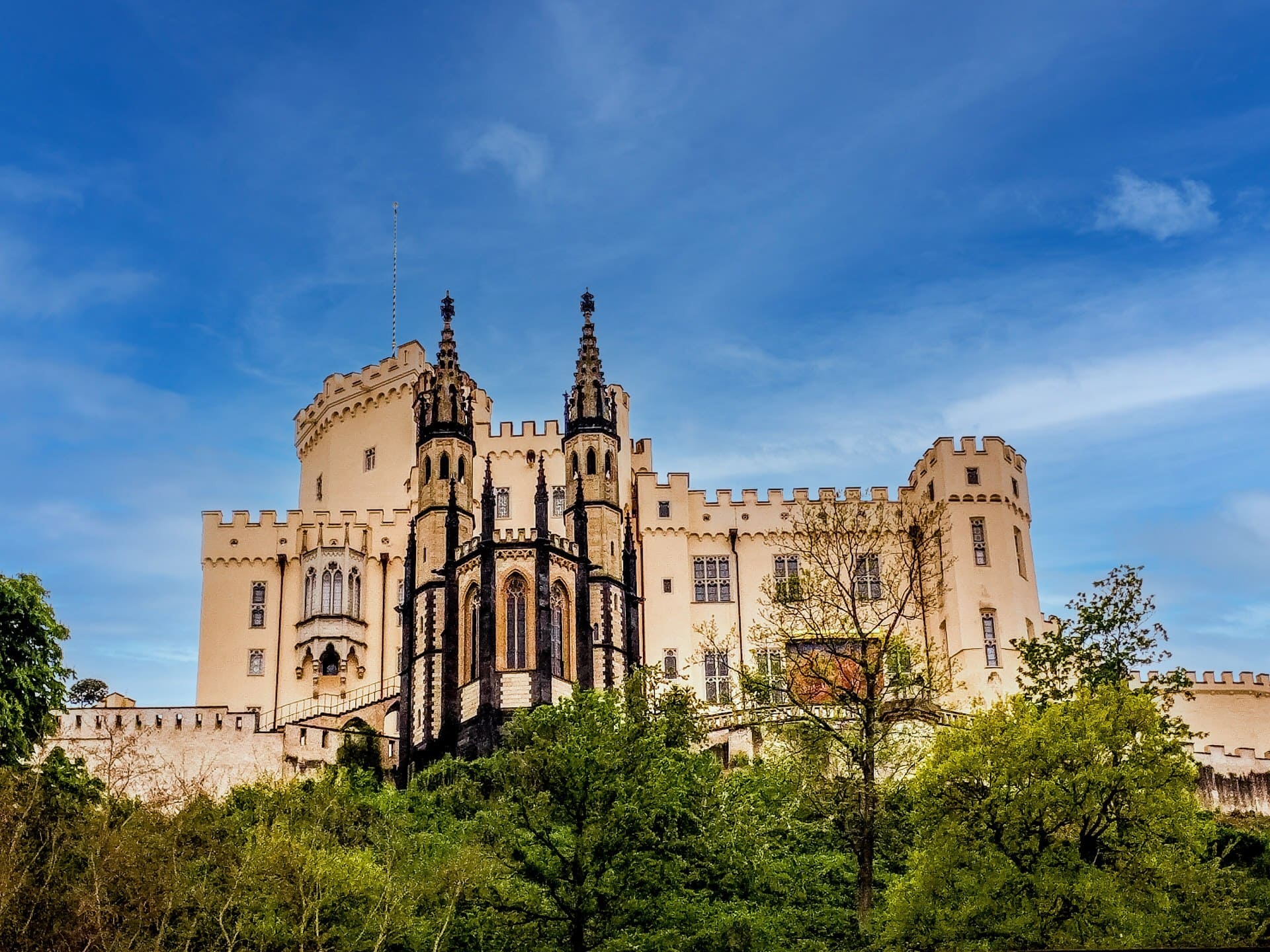
In the summer of 1823, the city of Koblenz handed a ruin to a Prussian crown prince. The walls of Schloss Stolzenfels had been a roofless shell since French troops burned it in 1689; the Hohenzollerns themselves had no medieval claim to the Rhine, which had only become Prussian eight years earlier at the Congress of Vienna. The gift was a piece of legitimation architecture before the building was even drawn: a request, in other words, that a dynasty without a Rhine past be given one.
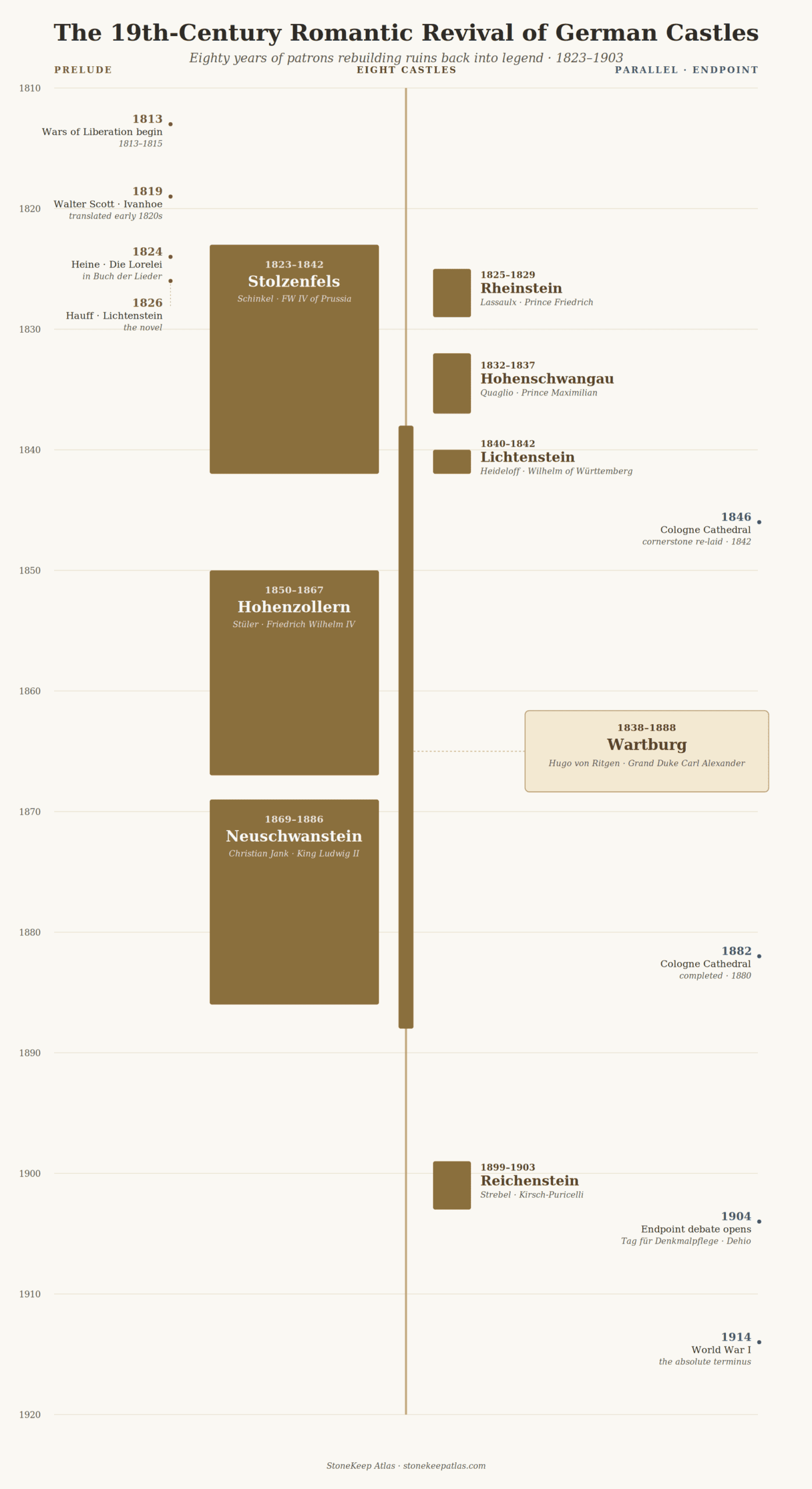
Over the next eighty years, eight castles answered that request. Patrons in Berlin, Munich, Stuttgart, Eisenach and the Mittelrhein commissioned a wave of reconstructions that did not preserve the Middle Ages so much as rewrite it: yellow towers replacing rubble, painted halls replacing absent halls, picturesque silhouettes designed to be read from rivers and hilltops by visitors who had been told, in a Walter Scott translation or a Wilhelm Hauff novel, what a castle was supposed to look like. By 1903, when an industrialist couple completed the last of these projects above the Rhine at Trechtingshausen, the rules had changed and the movement was over. This is the story of those eight buildings, and of the pasts they were built to invent.
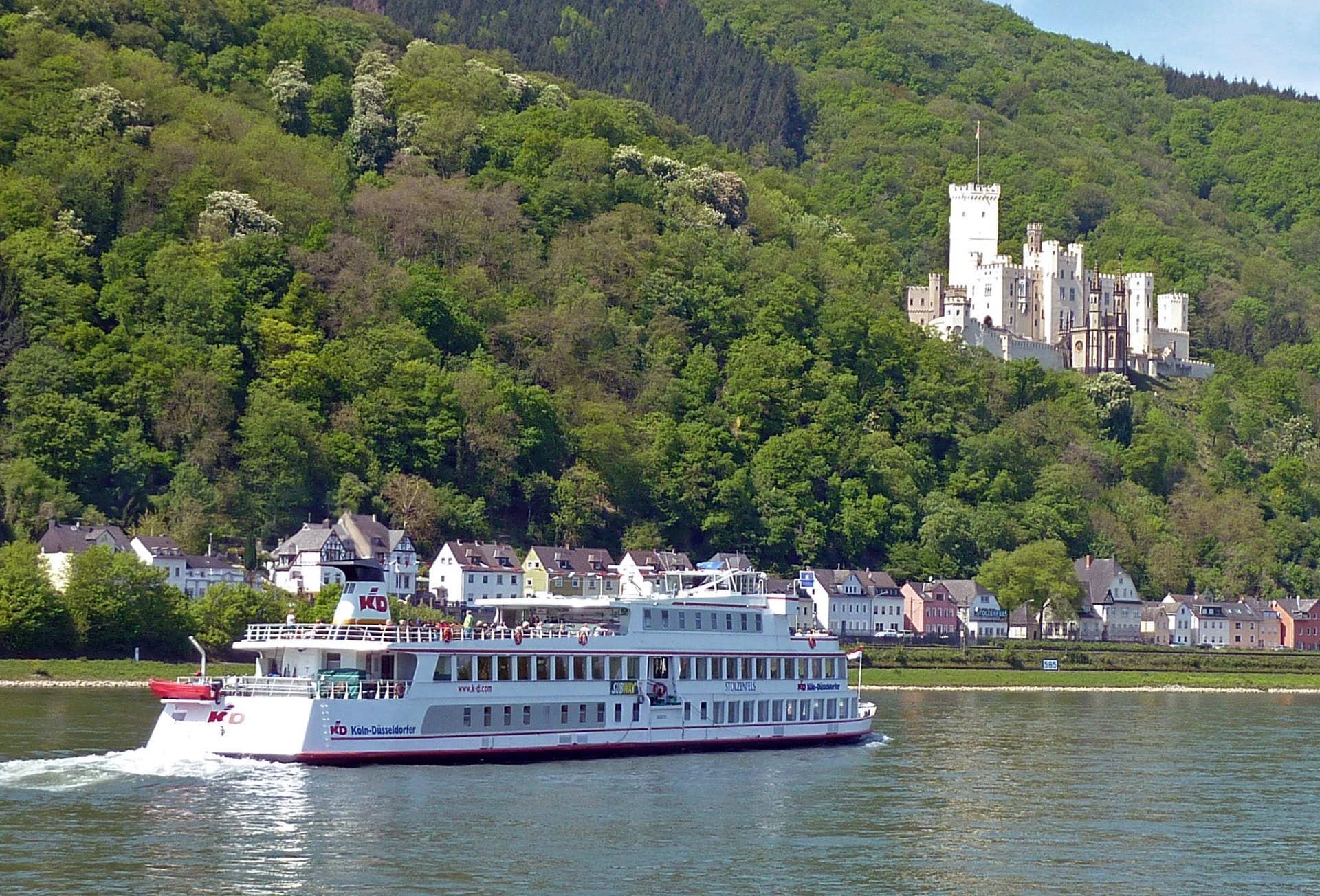
Stolzenfels: the foundational text
Karl Friedrich Schinkel was Prussia’s leading state architect, head of its Oberbaudeputation, when Crown Prince Friedrich Wilhelm asked him, around 1825, to turn the Stolzenfels ruin into a summer residence. Schinkel produced a design that almost no one would have recognized as faithful: a pale yellow Italianate-Gothic ensemble with battlements borrowed from English picturesque scenography, painted halls planned for a cycle by Hermann Stilke, and a courtyard arranged not for defense but for the view downstream toward Koblenz. Construction ran from 1836 to 1842; the final phase was supervised by Schinkel’s pupil Friedrich August Stüler after Schinkel’s death in October 1841, with contributions from the Rhenish architect Johann Claudius von Lassaulx and the interior decorator Ferdinand von Arnim.
The inauguration on September 14, 1842 staged the building’s argument as a ritual: torchlit cortège, costumed knights, the king and queen received in a hall freshly painted with scenes from a German chivalric past that had never quite existed in this corner of the Rhine. The image taught the next four decades how a Romantic-revival castle was supposed to behave. Schinkel had set the visual grammar; Stüler (through Stolzenfels and what would follow at Burg Hohenzollern) became the personnel bridge that turned a single commission into a program.
Rheinstein: from concept to precedent
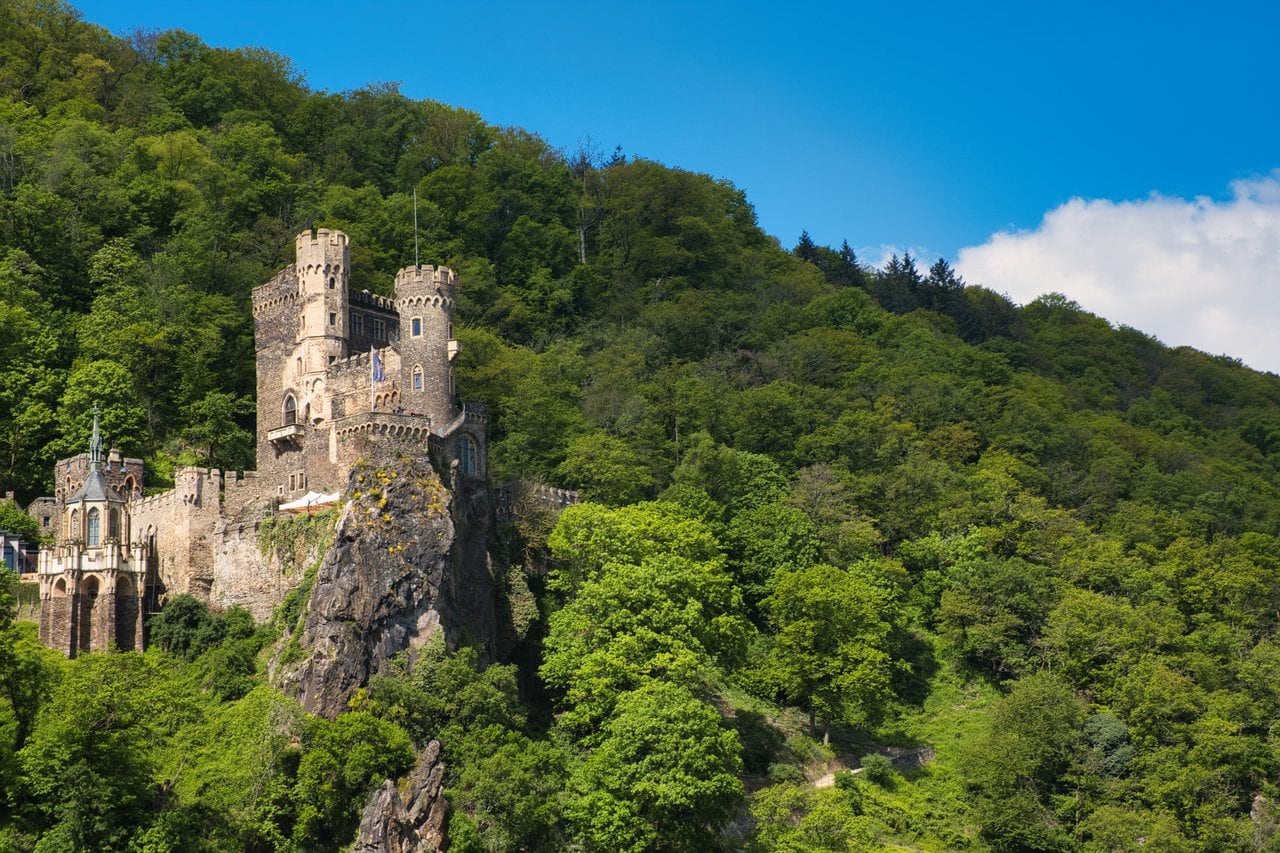
While Schinkel was still drawing Stolzenfels on paper, the king’s brother Prince Friedrich Ludwig of Prussia had already moved. In 1823 he bought the medieval ruin then known as Vautsberg above Trechtingshausen for 100 Taler; from 1825 to 1829, the Rhenish architect Johann Claudius von Lassaulx (succeeded by Wilhelm Kuhn for the interiors) rebuilt it into the first inhabited Rhine castle of the new era. The prince renamed it Rheinstein and lived there.
Rheinstein converted Stolzenfels’s Schinkel-school grammar into a precedent. The cliff-clinging massing, the slate roofs picking up the color of the rock, the small Burgkapelle added in 1844 to hold the prince’s tomb: these were physical possessions of a Rhine that the Hohenzollerns had owned, on paper, since 1815. By the time Stolzenfels was inaugurated in 1842, Rheinstein had already been doing the same political work for a dozen years. Lassaulx’s involvement also imported a Rhenish-Catholic architectural intelligence into a Prussian-Protestant project, the first hybrid the new revival produced, and a quiet warning that the movement would never be entirely Berlin’s to define.
Hohenschwangau: the Bavarian opening
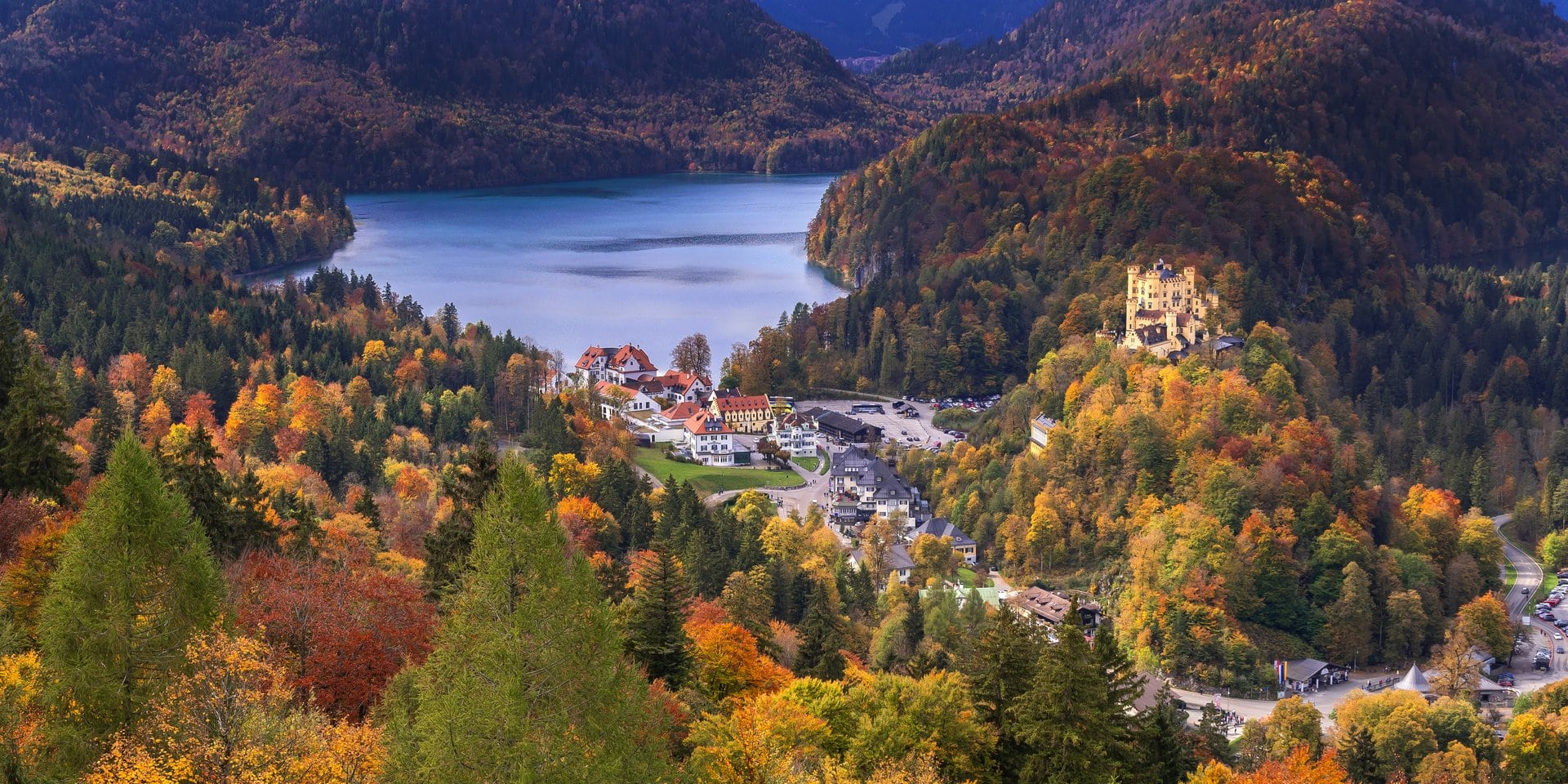
The Bavarian front of the revival opened with a different creative DNA. When Crown Prince Maximilian of Bavaria (the future King Maximilian II) bought the ruined castle then known as Schwanstein above the Alpsee in 1832, he chose as his architect not a Bauakademie graduate but the Munich theater painter Domenico Quaglio the Younger, fresh from a series of antiquarian-romantic Burgenbilder that had taught Bavaria how to look at its own medieval landscape. Quaglio worked from 1832 to his death in 1837; Joseph Daniel Ohlmüller and Georg Friedrich Ziebland completed the building in the years immediately following, in a yellow-stuccoed neo-Gothic that consciously echoed Stolzenfels while answering to a different geography.
What Hohenschwangau gave the movement was an Alpine frame that the Rhine castles could not. Painted scenes by Moritz von Schwind and Lorenzo Quaglio inside (the Lohengrin saga of the swan knight, the Wilkina saga of Dietrich von Bern in the Heldensaal, and high points of German history) folded the Wittelsbachs into a chivalric corpus that the family had no particular claim to but now visibly inhabited. Political timing matters. Maximilian was still a crown prince hedging against an unsettled Bavarian succession; thirty years later, his son would grow up in these rooms with their painted Tannhäuser and their views of the Alpsee, would learn to hear in them an instruction, and would build Neuschwanstein on the ridge directly opposite. Hohenschwangau is the only member of this group whose afterlife produced another member of the group.
Wartburg: legitimating substance
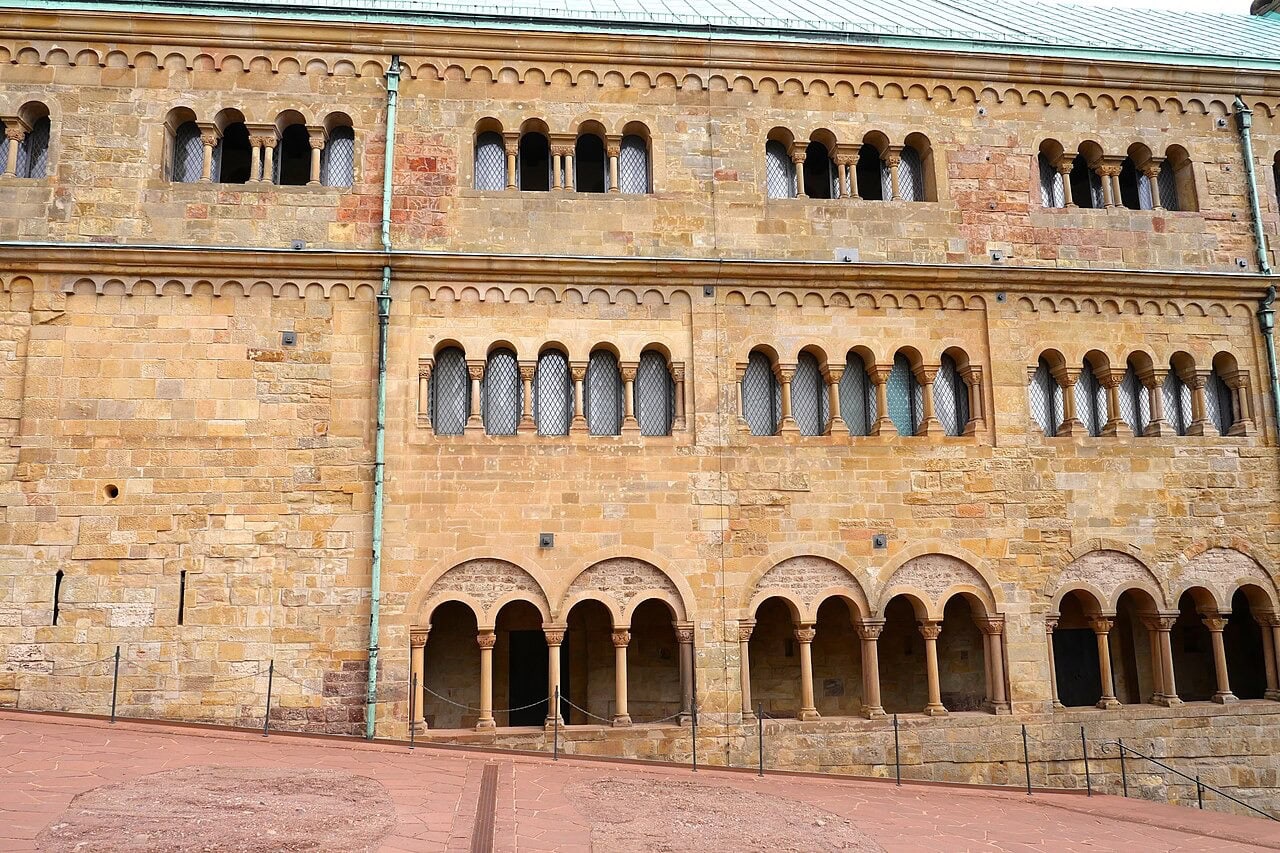
The Wartburg is the only one of the eight castles that the Middle Ages actually built. Above Eisenach since the 11th century, it had sheltered Saint Elisabeth of Thuringia in the 1220s, hosted (or so the Sängerkrieg tradition claimed) Walther von der Vogelweide and Wolfram von Eschenbach in 1206, and hidden Martin Luther under the alias Junker Jörg from May 1521 to March 1522 while he translated the New Testament into German. By the time Carl Alexander succeeded as Grand Duke of Saxe-Weimar-Eisenach in 1853, the medieval Palas was crumbling, but the historical pedigree (unlike that of any Rhineland or Bavarian member of this group) was unimpeachable.
Carl Alexander’s response was not to leave the substance alone. He had resolved on the renewal in 1838, fifteen years before he succeeded; after earlier schemes by other architects, the Giessen architect Hugo von Ritgen took charge from the late 1840s and directed the work until his death in 1889, and it was completed in 1890. Ritgen worked closer to documentary evidence than Schinkel or Quaglio had, with surviving drawings and excavation reports in front of him, but he also invented freely where evidence ran out, replacing lost portions of the Palas, inserting a Romanesque-revival Hauptzugang, commissioning a Sängersaal mural cycle from Moritz von Schwind in 1855 that retold the Sängerkrieg in the precise visual idiom Wagner would later set to music. The Wartburg became simultaneously a real medieval building and a curated, half-fictional version of itself.
That calibration is what UNESCO recognized in 1999 when it inscribed the Wartburg as a World Heritage Site, citing both the genuine medieval fabric and the 19th-century reconstruction as a testimonial of the 19th century’s relationship with its own past. Within this hub of eight commissions, Wartburg is the legitimating substance: the building whose scholarly reconstruction makes the wholly invented ones around it look more plausible than they are.
Lichtenstein: the novel-built castle
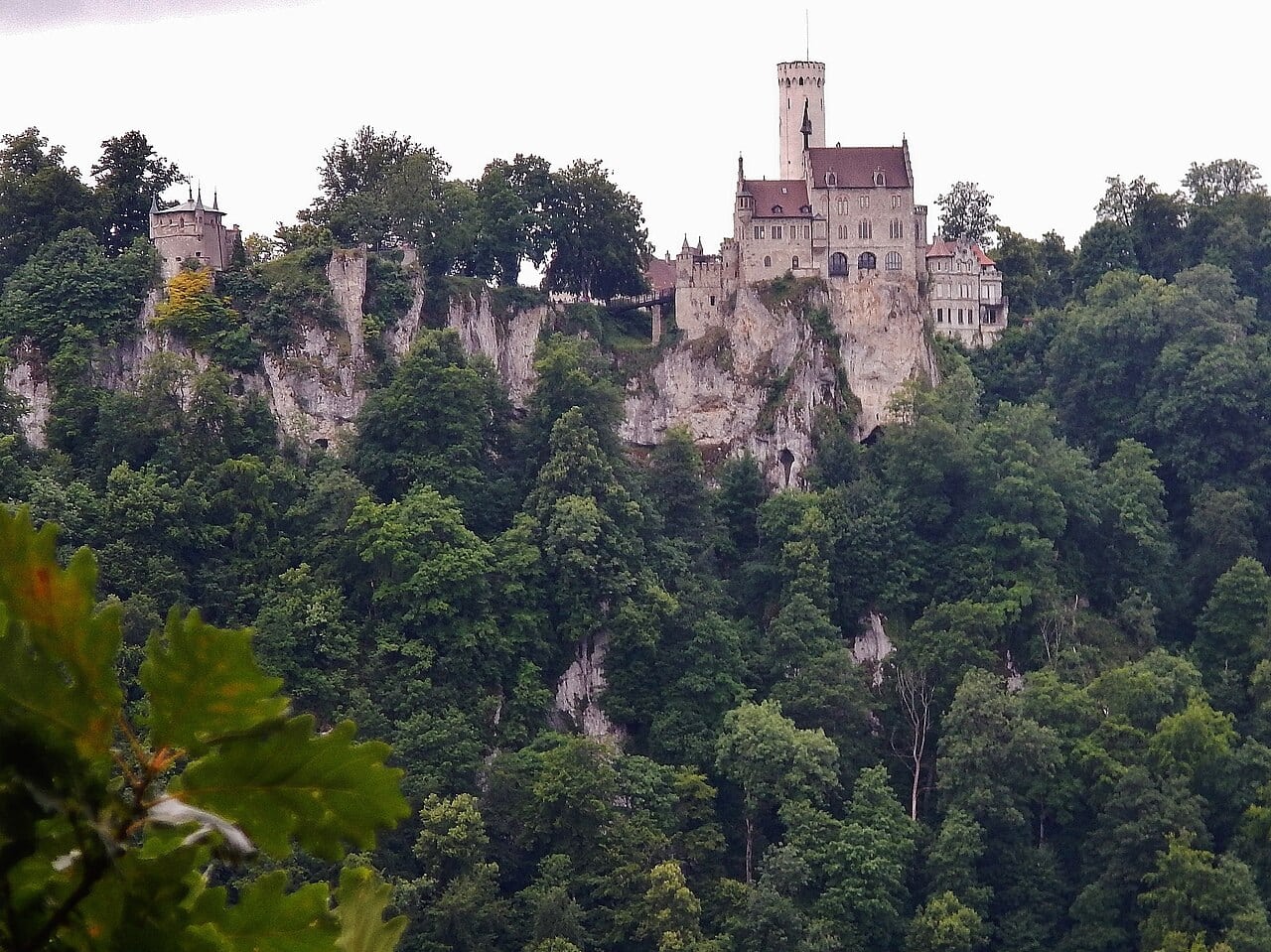
In 1826, the Stuttgart writer Wilhelm Hauff published Lichtenstein, a historical novel about a young Württemberg knight loyal to Duke Ulrich during the 1519 Swabian War. The book hit the German reading public at the height of Walter Scott fever; its central image (a ruined castle on a needle of rock above the Echaz valley) became the visual brief that, fourteen years later, an actual castle would be built to fulfil.
Wilhelm of Württemberg, count and later Duke of Urach, bought the medieval foundation walls of the Alt-Lichtenstein in 1837. From 1840 to 1842, his architect Carl Alexander Heideloff and the Reutlingen builder J. G. Rupp executed a small neo-Gothic deutsche Ritterburg on the existing footings, using the medieval fabric up to about the second story, and carrying the rest in invention. Several frescoes inside the new castle illustrated scenes from Hauff’s novel directly. The building was not a place anyone would have lived in for defense; it was a place a reader of the novel would have hoped existed, made real.
Wilhelm’s own surviving correspondence, preserved in the Hauptstaatsarchiv Stuttgart, cites mostly practical reasons for the project (proximity to his Urach holdings, modest scale, manageable cost), and the operator-side claim that the novel was the inspiration is more popular than archival. But the visual debt is unmistakable, and Lichtenstein remains the textbook case in this hub of literature programming stone. It is also the only commission here without a king behind it: the first non-royal patron in the eight-castle arc.
Schwerin: Demmler’s French register
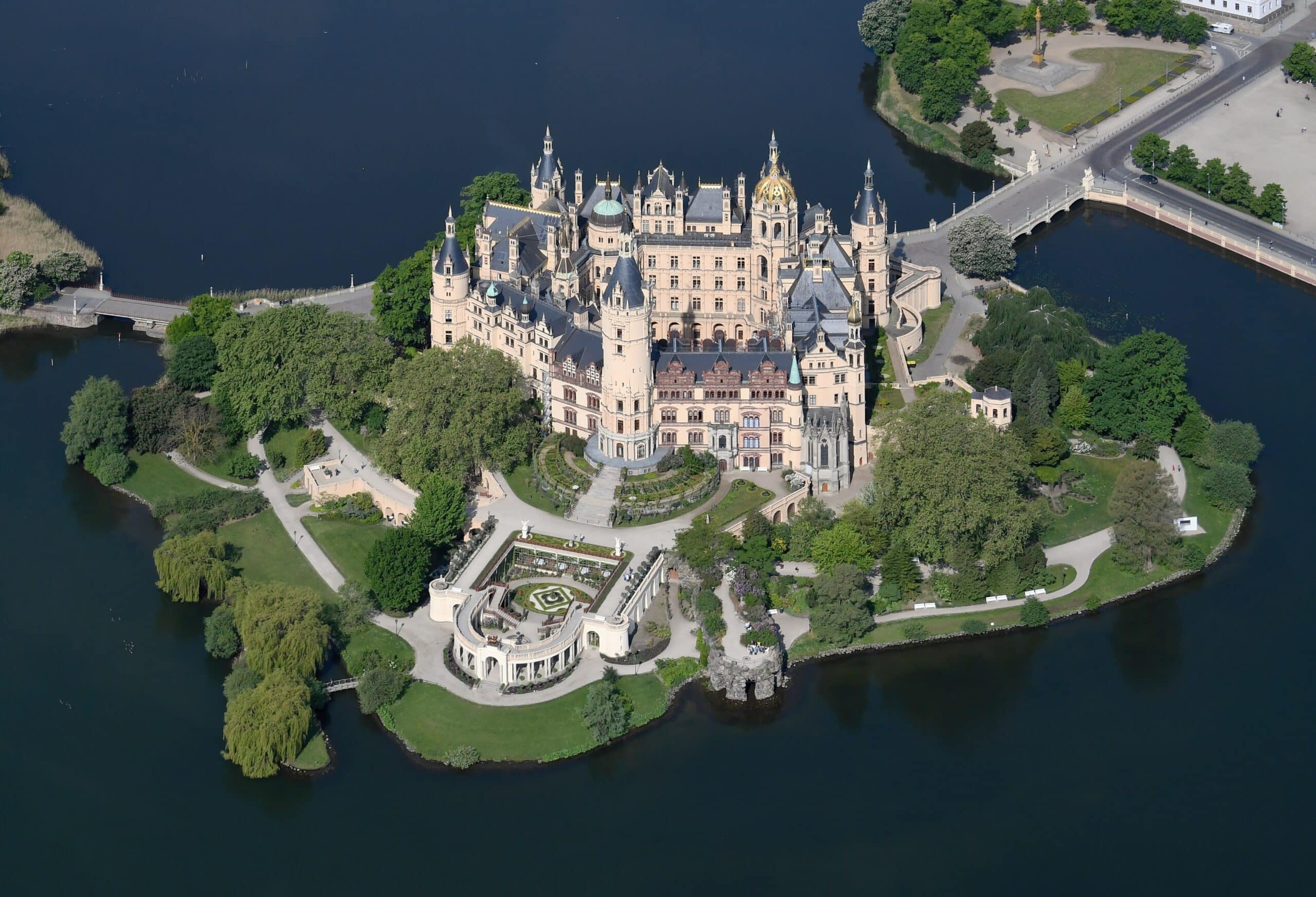
In 1840 Grand Duke Friedrich of Mecklenburg-Schwerin instructed his court architect Georg Adolf Demmler (a Berlin-trained Schinkel pupil) to remodel the duchy’s residence on its island in Lake Schwerin. Friedrich’s 1842 death and his successor Friedrich Franz II’s preference for complete reconstruction transformed the brief: Demmler synthesised competing schemes from Gottfried Semper and Friedrich August Stüler with his own design, and from 1845 to 1857 directed construction of what the building’s twentieth-century historians would call his masterpiece. The completed Schloss Schwerin is a Loire-French composition rather than a German one: fifteen towers, attic dormers in the manner of Chambord and Blois, a gilded central dome added under Stüler’s 1855 redesign, and a silhouette that fronts the Burgsee in deliberate citation of Chenonceau. Heinrich Strack of Berlin completed the interiors.
What Schwerin proves is that the Romantic-revival project never depended on a narrowly Gothic vocabulary. The dynastic-symbolic argument Schinkel advanced at Stolzenfels (that a princely family’s legitimacy could be constructed in stone) could just as readily reach for the Loire as for the Hohenstaufen Rhine. Schinkel pedagogy reached Mecklenburg through Demmler as it had reached the Rhine through Stüler; only the historical citation differed. The completed Schloss absorbed Schwerin’s island setting, its 1563 Schlosskirche (the first Protestant church in Mecklenburg, retained intact through the rebuild), and the surrounding court gardens into a French stylistic program rather than a German one. The chronology matters: the Mecklenburg 1845–57 construction substantially overlaps the Prussian 1850–67 Hohenzollern rebuild: two simultaneous Schinkel-pupil projects in two different historical languages.
Hohenzollern: the Prussian apotheosis
By 1850, the visual grammar Schinkel had drafted at Stolzenfels had been waiting two decades for a building large enough to declare itself. King Friedrich Wilhelm IV (the same patron, now grown into his throne) commissioned Friedrich August Stüler that year to entirely rebuild the dynastic ancestral seat on the Hohenzollern hill near Hechingen. The medieval Stammburg had been twice ruined and was, by the 1850s, little more than the chapel and a few foundation lines. Stüler’s project, executed 1850 to 1867, raised an operatic neo-Gothic silhouette on the cleared platform: towers, bartizans, drum-shaped chapel, gatehouse, all designed to read as a single profile from miles away across the Swabian plain.
What Stüler had built was not a residence. Friedrich Wilhelm IV never lived there; his successors visited only ceremonially. The building was a portrait of the Hohenzollern dynasty, executed in stone, composed for photography and engraving and to be glimpsed from passing trains on the new Hechingen line. Stüler’s Bauwerke Heft 3 of 1866 published the designs to a public that had already accepted the silhouette as belonging to a deeper past than the construction site itself.
This is the moment the movement stops imitating medieval castles and starts inventing, with full theatrical conviction, the visual idea of one. After Hohenzollern there is no longer any pretence that the buildings are recovering something lost; they are producing, deliberately, the image of what should have been there all along.
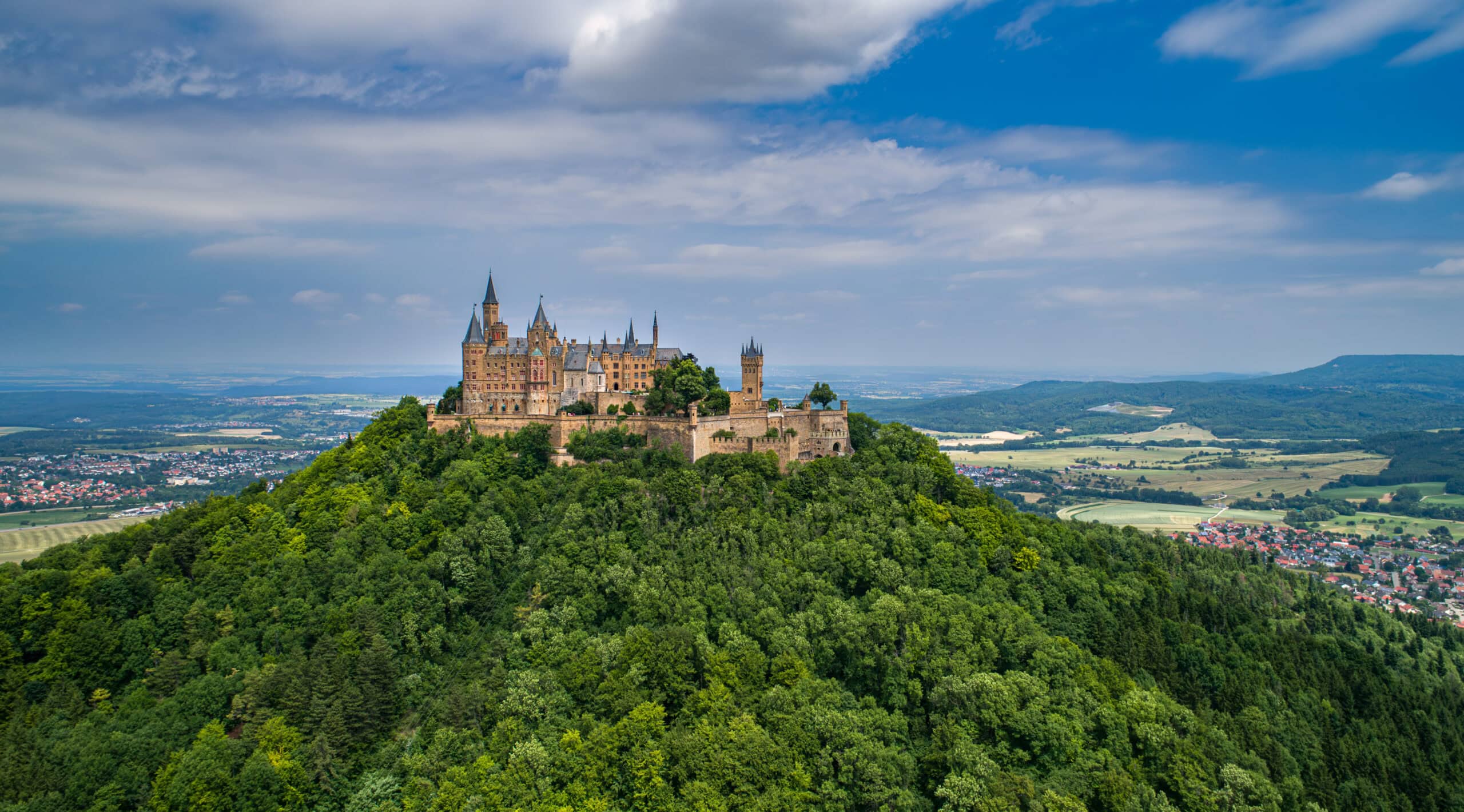
Wernigerode: the Vice-Chancellor’s Gesamtkunstwerk
By the time Count Otto zu Stolberg-Wernigerode commissioned the rebuilding of his Harz seat in 1862, the Romantic-revival vocabulary that Schinkel had set at Stolzenfels three decades earlier had matured into a portable template. Otto was no provincial nobleman: from 1878 to 1881 he served as Vice-Chancellor of Bismarck’s newly-founded German Empire and Vice-President of the Prussian House of Lords; from 1876 to 1878 he had been German ambassador in Vienna. An architect he chose, Carl Frühling of nearby Blankenburg (1839–1912), was a competent provincial talent with no Schinkel-pupil credentials. But by the 1860s the vocabulary had been established broadly enough that direct Schinkel succession was no longer necessary. Frühling worked at Wernigerode from 1862 to 1885, with the new Schlosskirche St. Pantaleon und Anna (designed by Vienna’s Friedrich von Schmidt, executed by Frühling) consecrated on Easter Sunday 1880.
What Wernigerode proves is the program’s maturity. The Schloss as completed is a Gesamtkunstwerk in the late-historicist sense: twelfth-century Romanesque core, late-Gothic curtain walls, sixteenth-century spiral staircase tower, and Baroque half-timber south wing all woven into a coherent neo-medieval silhouette read from the half-timbered town below. The dynastic-symbolic argument that Stolzenfels had inaugurated half a century earlier was now available to any wealthy comital house with the means to commission it, and Otto had unusual means: he was using castle architecture to consolidate family-dynastic legitimacy and, beyond that, the new Empire’s idea of itself. The Wernigerode visible today is the Romantic-Revival template applied at the moment of greatest German political confidence, by the second-ranking official of a state that had just come into being.
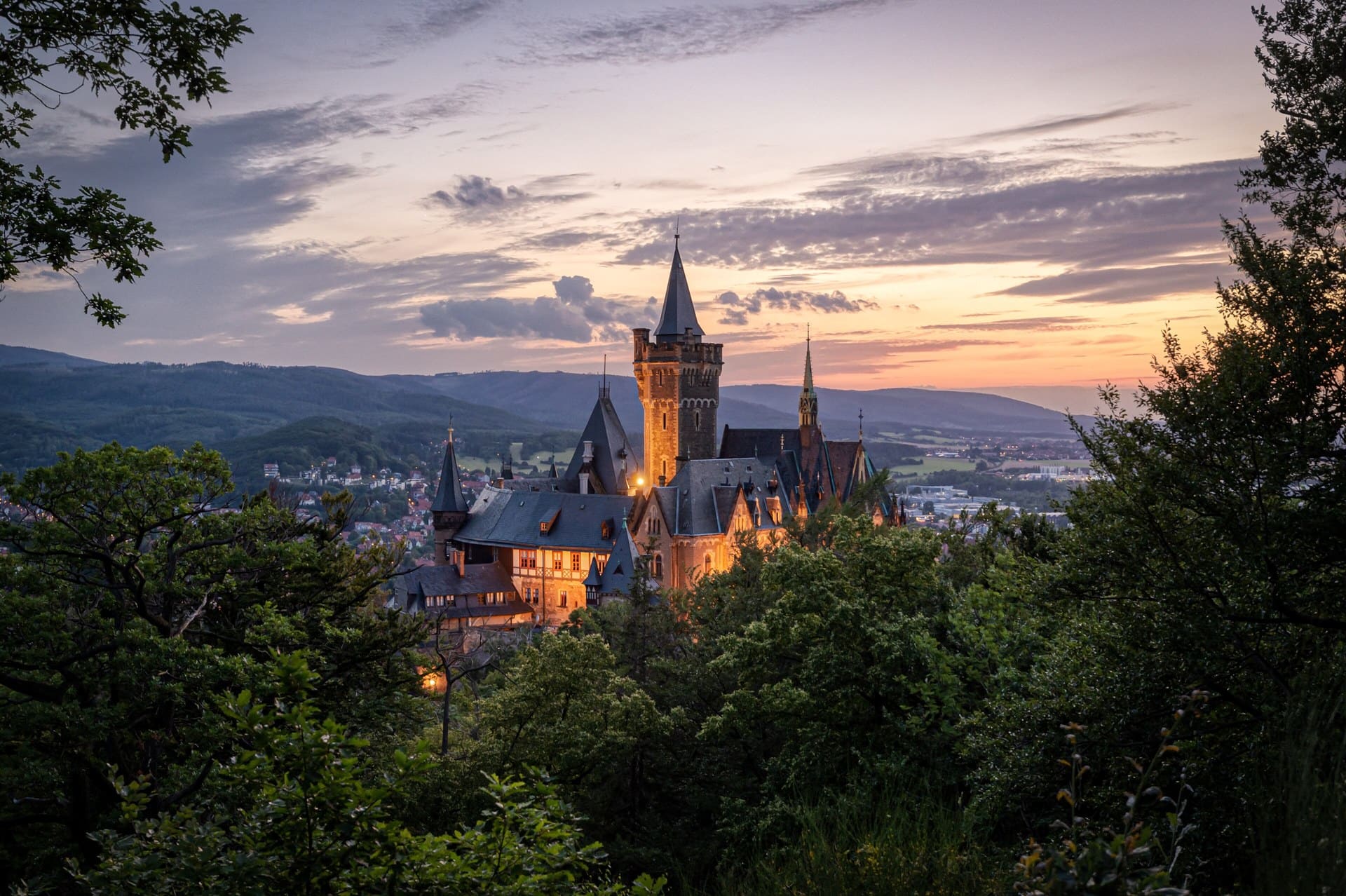
Neuschwanstein: the fantasy apotheosis
Ludwig II of Bavaria had grown up at Hohenschwangau looking out at the Tannhäuser frescoes his father had commissioned and across the Alpsee at the Hohenschwangau crag opposite. In 1867 he visited the Wartburg, which he had been told about since childhood, and the Château de Pierrefonds, which Viollet-le-Duc was then rebuilding for Napoleon III. Within a year he had hired the Munich theater-set designer Christian Jank to produce Idealentwürfe (concept drawings) for a new castle on the ridge above his childhood home. Construction began in 1869.
Three architects executed Jank’s designs in succession. Eduard Riedel handled the working drawings 1869 to about 1874; Georg von Dollmann took over to about 1886; Julius Hofmann completed the Throne Hall and the principal interiors after Ludwig’s death in 1886 and continued through 1892. The credits matter because Neuschwanstein, more than any other building in this hub, was a designer’s vision faithfully built: an opera set realized at architectural scale, with iron framing in the throne hall to support a vaulted Byzantine apse that no medieval mason had ever dreamed.
What Neuschwanstein abandoned was the historical referent. Stolzenfels had borrowed from English picturesque sources; Wartburg had had genuine fabric; Hohenzollern was at least standing on a Hohenzollern site. Neuschwanstein answered to Wagnerian opera and to Ludwig’s personal interior life. The cabinet treasury that funded it ran into 14 million marks of debt by 1885; foreign creditors threatening to seize the building helped trigger the deposition of June 9–10, 1886. The king was taken to Berg Castle on Lake Starnberg under guard on June 12; he drowned in the lake the next day. UNESCO inscribed Neuschwanstein, alongside Linderhof, Herrenchiemsee, and the Königshaus am Schachen, in July 2025, recognizing the late phase of the movement as itself a heritage stratum worth preserving.
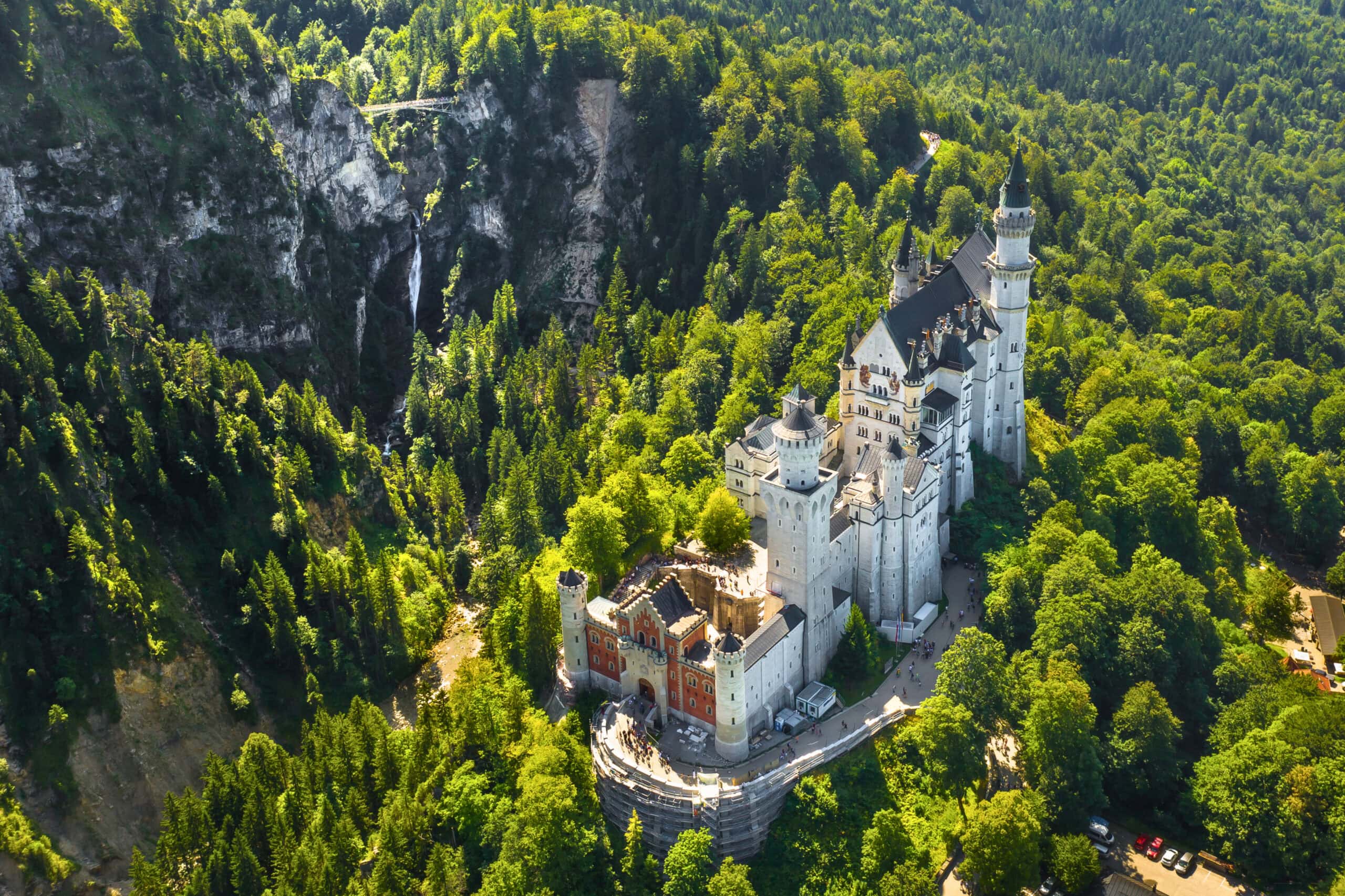
Reichenstein: the industrialist coda
When the Luxembourgish-Italian iron-works baron Dr. Nikolaus Kirsch-Puricelli bought Burg Reichenstein from the Prussian state in 1899, the visual vocabulary of the revival had been mature for thirty years. What had changed was the patron field. Royal commissions were drying up (Ludwig II had been dead for more than a decade), and the Prussian state had been quietly selling off Rhine-castle ruins to industrial buyers since the 1850s under conditions of preservation, plan approval, and public access. The 1868–77 reconstruction of Reichsburg Cochem on the Mosel by the Berlin merchant Louis Ravené, with Hermann Ende and Julius Carl Raschdorff, had set the template.
Kirsch-Puricelli’s architect, Georg Strebel of Regensburg, executed the work from 1899 to 1903 in a comfortable neo-Gothic English style that owes more to Burg Hohenzollern than to Stolzenfels: a silhouette designed for the Rhine cliff, but with rooms unmistakably planned for the family of an industrialist who wanted his children to grow up in a setting that royalty would have recognized. That same fabric later became the first castle-hotel on the Rhine.
Reichenstein closes the eighty-year arc by detaching the revival’s vocabulary from royal patronage entirely. By the time it was finished in 1903, the rules of monument preservation were already turning against the kind of free reconstruction Strebel had practiced. Two years later, when Georg Dehio repeated his argument in the 1905 Strasbourg Festrede Denkmalschutz und Denkmalpflege im neunzehnten Jahrhundert, Reichenstein became, almost overnight, a historical object: an example of how things had been done, before they stopped being done that way.
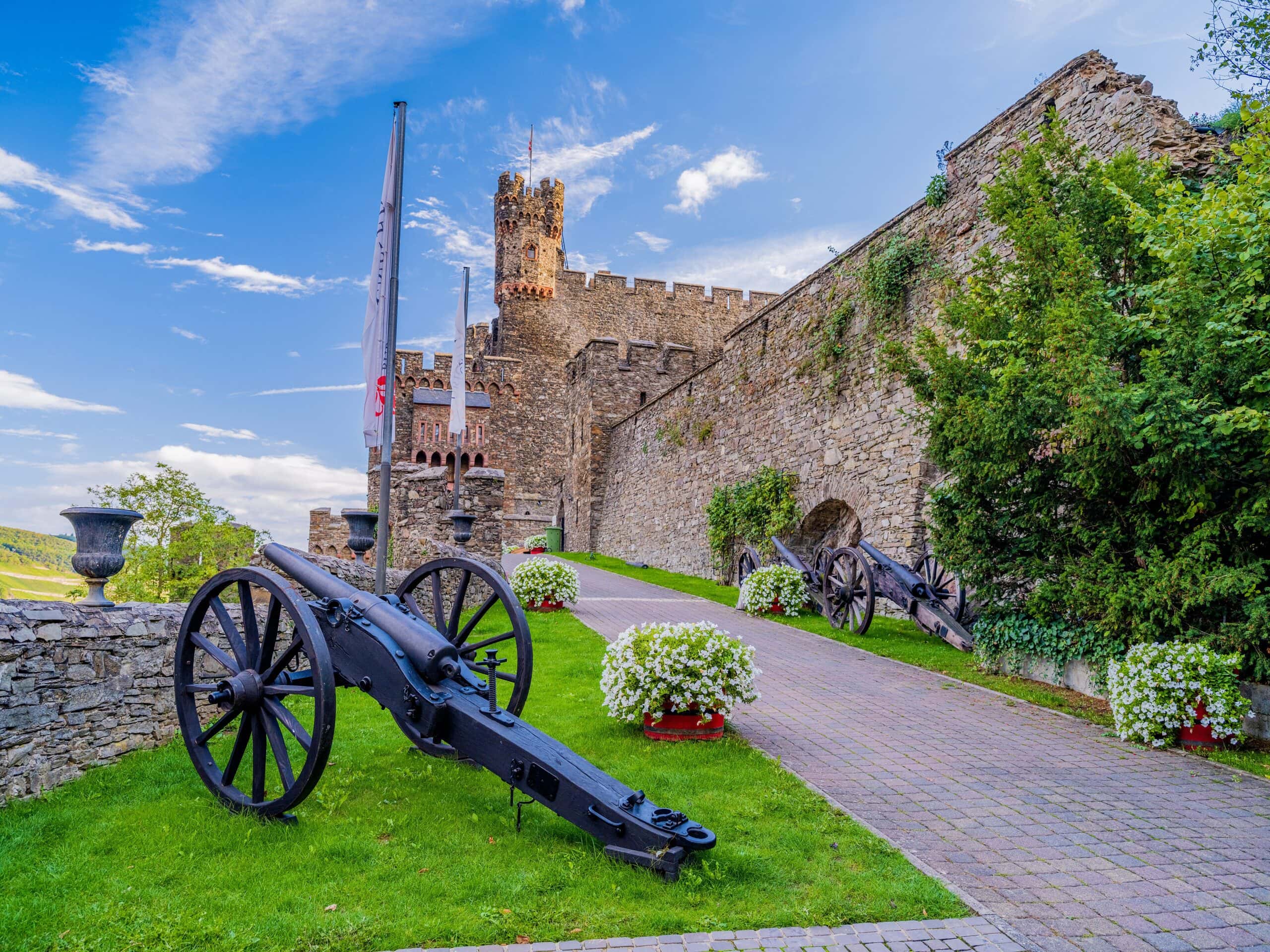
The road not taken: Heidelberg
Across the Neckar from the new university buildings, the ruins of Schloss Heidelberg had been the most painted, most engraved, most-visited German castle of the 19th century, and the only one that the Romantic revival did not put back together. By 1890 the great court of the Heidelberg ruin was in serious structural decline; the question of what to do with the Friedrichsbau and the Ottheinrichsbau had been debated for decades.
Karl Schäfer rebuilt the Friedrichsbau between 1897 and 1900 in a careful, archaeologically respectful free reconstruction, and proposed to do the same to the Ottheinrichsbau next. He did not get the chance. An interstate Schlossbaukonferenz convened in 1901 to consider the project, and the Strasbourg architectural historian Georg Dehio published a pamphlet, Was wird aus dem Heidelberger Schloß werden?, that named the question and answered it in three words: Konservieren, nicht restaurieren. Conserve, do not restore. The Ottheinrichsbau was left as Schäfer found it, and by the time Dehio repeated the argument in his 1905 Strasbourg Festrede Denkmalschutz und Denkmalpflege im neunzehnten Jahrhundert, the Heidelberg debate had become the moment German monument theory broke with the school of patrons that had built the eight castles in this hub.
Dates make the point sharper than any argument. Reichenstein’s reconstruction (1899–1903) and the first Tag für Denkmalpflege (Dresden, 1900) overlap by months; Dehio’s pamphlet appeared the year Reichenstein was finished. After Heidelberg, the kind of creative reconstruction Stolzenfels had pioneered and Neuschwanstein had perfected was no longer theoretically respectable. The ruins of Heidelberg are the road this movement did not take (preserved, not invented), and by the standards that prevailed after 1905, they were the only ones honestly preserved at all.
At a glance
| Castle | Patron | Reconstruction | Architect of record | Setting & signature move |
|---|---|---|---|---|
| Stolzenfels | Crown Prince Friedrich Wilhelm of Prussia (later FW IV) | 1823 (gift); built 1836–1842 | Schinkel (designed); executed by Stüler, Lassaulx, Arnim | Above Koblenz on the Rhine; the foundational Prussian text |
| Rheinstein | Prince Friedrich Ludwig of Prussia | 1825–1829 | Lassaulx, then Wilhelm Kuhn | Trechtingshausen, left bank Rhine; first inhabited Rhine reconstruction |
| Hohenschwangau | Crown Prince Maximilian (later Maximilian II of Bavaria) | 1832–1837 | Domenico Quaglio (†1837); completed Ohlmüller, Ziebland | Schwangau, Allgäu; Bavarian opening, Ludwig II’s childhood home |
| Wartburg | Carl Alexander of Saxe-Weimar-Eisenach (Grand Duke from 1853) | 1838–1890 | Hugo von Ritgen | Eisenach, Thuringia; Lutheran-Reformation legitimating substance (UNESCO 1999) |
| Lichtenstein | Wilhelm of Württemberg, later Duke of Urach | 1840–1842 | Carl Alexander Heideloff with J. G. Rupp | Honau, Swabian Jura; the novel-built castle, first non-royal commission |
| Hohenzollern | King Friedrich Wilhelm IV of Prussia | 1850–1867 | Friedrich August Stüler | Hechingen; Prussian dynastic apotheosis |
| Neuschwanstein | King Ludwig II of Bavaria | 1869–1886 | Christian Jank (designed); Riedel → Dollmann → Hofmann (executed) | Schwangau, Allgäu; fantasy apotheosis (UNESCO 2025) |
| Reichenstein | Baron Nikolaus Kirsch-Puricelli | 1899–1903 | Georg Strebel of Regensburg | Trechtingshausen; bourgeois-industrialist coda |
Beyond Burgenromantik
Two of these eight castles (Hohenschwangau and Neuschwanstein) are also covered in our hub on the Castles of King Ludwig II, where they sit alongside Linderhof and Herrenchiemsee in a different argument about a single patron. Two more (Rheinstein and Reichenstein) appear in our hub on the Castles of the Rhine Gorge, where the geography rather than the chronology does the framing work. There are German castles outside this eight-castle scope that the same impulse produced: Reichsburg Cochem (1868–77, the bourgeois-industrialist precursor to Reichenstein), Burg Hohkönigsburg in Alsace (1900–1908, Bodo Ebhardt for Wilhelm II, the late state-sponsored finale), Schloss Drachenburg, Schloss Marienburg in Lower Saxony, Schloss Wernigerode in the Harz. Cochem, Drachenburg, and Wernigerode now carry full guides of their own, and all three take their place in our tour of the fairytale castles in Germany. For now, the eight above sit as a coherent movement (bracketed by Stolzenfels in 1823 and Reichenstein in 1903) within our broader survey of Germany’s great castles.
Hero image: Stolzenfels Castle. Photo: Johnnytuch13, CC BY-SA 4.0, via Wikimedia Commons. Adobe Stock photographs in the body sections (Hohenschwangau, Hohenzollern, Neuschwanstein, Rheinstein) are licensed for editorial use without attribution.
The Bavarian apotheosis of the Romantic-revival vocabulary (Ludwig II’s three castles and the unbuilt Falkenstein as its architectural terminus) is read against the political collapse of 1864–1886 in the companion essay Ludwig II and the Architecture of Dreams.
Common Questions
What is Burgenromantik?
It is the nineteenth-century Romantic revival that rebuilt Germany’s ruined medieval castles as fantasies of the past. The guide dates its founding text to 1823, when the city of Koblenz handed the ruined Schloss Stolzenfels to a Prussian crown prince.
Which castles does this guide cover?
Ten revival castles, Stolzenfels, Rheinstein, Hohenschwangau, the Wartburg, Lichtenstein, Schwerin, Hohenzollern, Wernigerode, Neuschwanstein and Reichenstein, together with Heidelberg as the counter-example, the road not taken.
Is Neuschwanstein a revival castle?
Yes. The guide treats Neuschwanstein as the fantasy apotheosis of the movement, the endpoint of a tradition that had begun at Stolzenfels in 1823.
Principal Sources
- Bidlingmaier, Rolf. “Schloß Lichtenstein. Die Baugeschichte eines romantischen Symbols.” Reutlinger Geschichtsblätter NF 33 (1994).
- Börsch-Supan, Eva, and Dietrich Müller-Stüler. Friedrich August Stüler 1800–1865. Deutscher Kunstverlag, 1997.
- Großmann, G. Ulrich. Die Welt der Burgen. Munich: C. H. Beck, 2013.
- Jacobs, Grit. „Ein treues Bild aus früher Zeit.“ Hugo von Ritgens Wiederherstellung der Wartburg. Wartburg-Stiftung, 2007.
- Rathke, Ursula. Preußische Burgenromantik am Rhein. Munich: Prestel, 1979 (reprint 2017).
- Taylor, Robert R. The Castles of the Rhine: Recreating the Middle Ages in Modern Germany. Wilfrid Laurier University Press, 1998.
- Wartburg-Gesellschaft. Burgenrenaissance im Historismus. Forschungen zu Burgen und Schlössern 10. Munich: Deutscher Kunstverlag, 2007.
Operator and foundation websites for each castle: Wartburg-Stiftung (wartburg.de), Bayerische Schlösserverwaltung (schloesser.bayern.de), Wittelsbacher Ausgleichsfonds — Hohenschwangau (hohenschwangau.de), Generaldirektion Kulturelles Erbe Rheinland-Pfalz (burgen-rlp.de), Burg Hohenzollern GmbH (burg-hohenzollern.com), Schloss Lichtenstein (schloss-lichtenstein.de), Burg Rheinstein (burg-rheinstein.de), Burg Reichenstein (burg-reichenstein.com). 2026 reference.
Image credits. Stolzenfels from the Rhine: Wolfgang Fricke, CC BY 3.0; Wartburg Palas façade: Vera Belka, CC BY-SA 4.0; Lichtenstein and Alt-Lichtenstein from the Albsteig: qwesy qwesy, CC BY 3.0; Reichenstein approach with cannons: Poidabro, CC BY-SA 4.0 — all via Wikimedia Commons. Romantic Revival timeline: © StoneKeep Atlas, 2026 (own work). Royalty-free stock photos: Hohenschwangau autumn panorama via Envato Elements; Rheinstein on its slate spur via Envato Elements; Hohenzollern from the approach ridge; Neuschwanstein over the Pöllat Gorge. Freely licensed images are resized to fit; otherwise unaltered.