
Heldburg Fortress
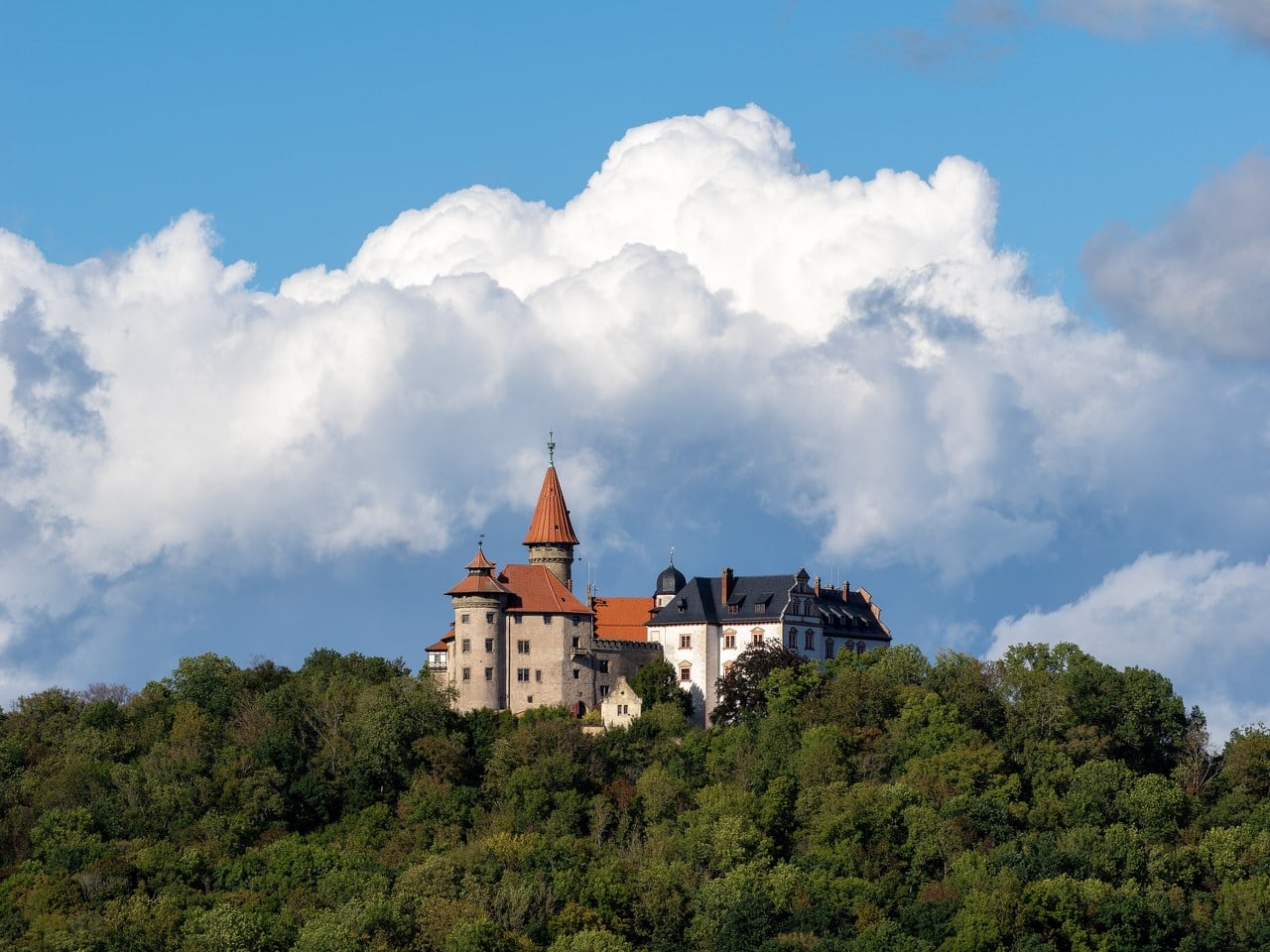
Heldburg Fortress crowns a steep volcanic cone in the far south of Thuringia, a pale silhouette of round towers and a Renaissance gable visible for miles across the rolling Heldburger Land. For six centuries it guarded the edge of Ernestine Saxony, then slid into a long decline, burned, and stood as a ruin within sight of the inner-German border. Today it carries an unusual second life: it is the home of the German Castle Museum, the only museum of its kind in Central Europe, which makes the building both the exhibit and the exhibition hall.
That doubling is the reason Heldburg Fortress rewards a visit beyond its considerable scenery. Its fabric records almost every phase of German castle history in one place, from a medieval hilltop stronghold to a princely Renaissance residence, a romantic ducal refuge, and finally a museum about the very thing it is.
Quick Facts
| Location | Heldburg, Landkreis Hildburghausen, southern Thuringia, Germany |
| German name | Veste Heldburg |
| Setting | A phonolite cone (403 to 405 m), about 113 m above the town, in the Heldburger Gangschar |
| Type | Hilltop fortress (Höhenburg) with a Renaissance residential wing |
| Origins | Probably 12th century; first recorded in 1317; to the Wettins in 1374 |
| Renaissance wing | The French Building (Französischer Bau), 1560 to 1564, by Nikolaus Gromann |
| Owner | Free State of Thuringia; administered by the Stiftung Thüringer Schlösser und Gärten |
| Current use | German Castle Museum (since 2016) |
| Nickname | The Fränkische Leuchte (Franconian Beacon) |
| Address | Burgstraße 1, 98663 Heldburg |
| Website | deutschesburgenmuseum.de |
A volcanic cone on the Franconian border
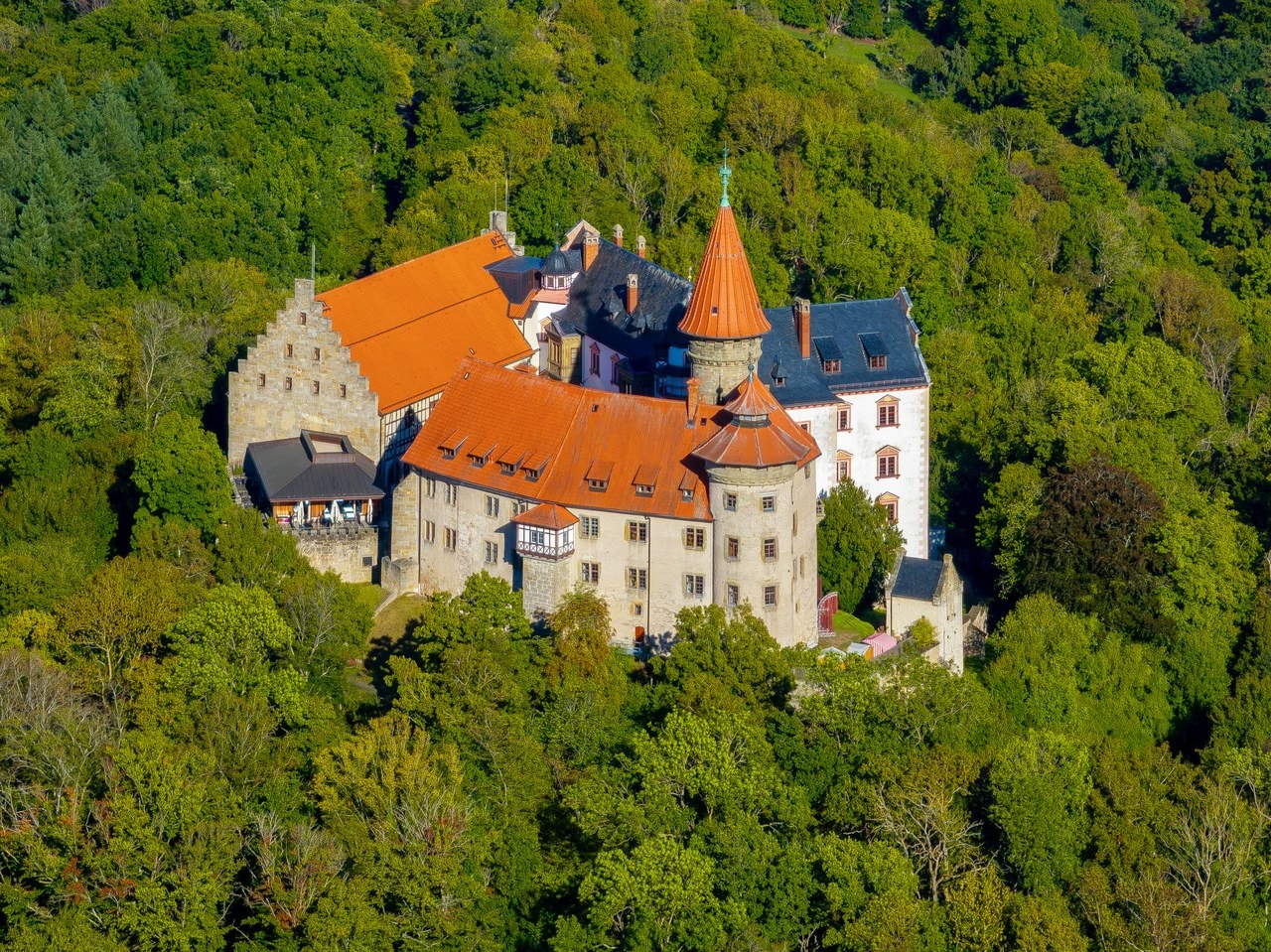
The hill came first. Heldburg Fortress sits on a phonolite cone of the Heldburger Gangschar, a swarm of volcanic intrusions that pushes a line of abrupt, conical hills out of an otherwise gentle landscape. The cone rises about 113 meters above the little town of Heldburg, which gives the fortress a commanding reach over the country where Thuringia meets Franconia.
A castle probably stood here by the 12th century, though the first secure record dates to 1317, when it appears as a castrum held by the Counts of Henneberg-Schleusingen. The Henneberg counts used it as an administrative and judicial seat after they gave up their older regional center at nearby Straufhain. In 1374 the hill passed to the Wettins, the dynasty that would shape it for the next five hundred years, and they kept it mainly as an administrative post and hunting seat on the southern edge of their lands.
The first major building campaign came around 1500, under the Saxon electors of the era of Frederick the Wise. The same dynasty that would soon shelter Martin Luther at the Wartburg invested in Heldburg as a Saxon stronghold, enlarging the medieval core that still defines the ground plan of the complex. The bones of that earlier fortress survived every later remodeling, which is part of what makes the site so legible: the older walls and towers were absorbed rather than erased.
The French Building: Gromann’s Renaissance masterpiece
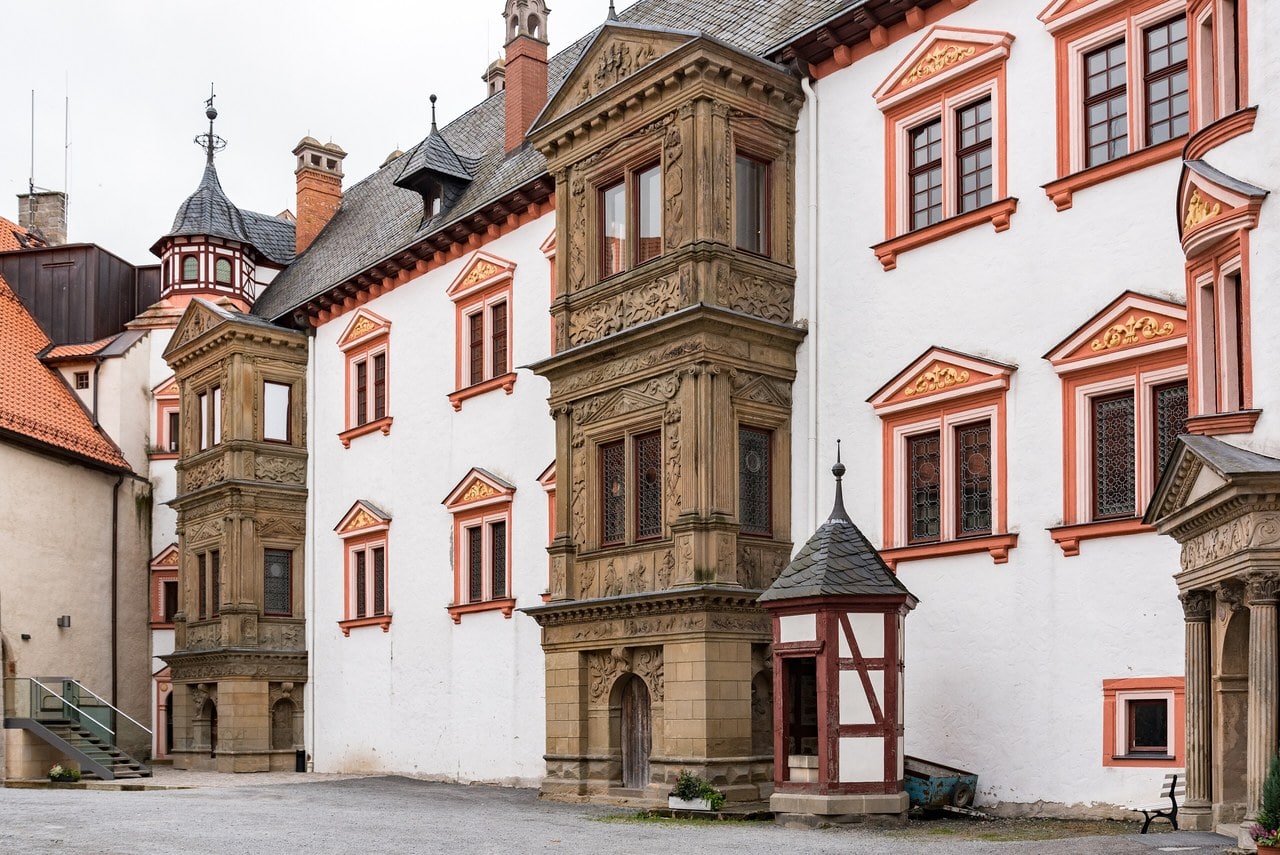
Heldburg’s transformation from fortress to residence belongs to one prince and one architect. Between 1560 and 1564, Duke Johann Friedrich II of Saxony, called Johann Friedrich the Middle, had his court master builder Nikolaus Gromann raise a grand new wing on the hilltop. Originally named simply the Neuer Bau, the New Building, it became known later as the Französischer Bau, the French Building, and it remains the architectural climax of the whole site. Historians of the period rank it as a masterpiece of Renaissance architecture in central Germany and as the only surviving new building by Gromann that earns attention beyond the region.
The wing was more than a comfortable apartment. Johann Friedrich was the son of the elector who had lost the Saxon electoral title to the rival Albertine line in 1547, and the family never accepted the loss. The lavish, palace-like front of the French Building, with its ornate reliefs and sculptural stair, has been read as a statement of Ernestine ambition, a claim in stone to a dignity the dynasty still believed was theirs. Gromann was the right man to make it. He served the Ernestine Wettins for more than three decades, and his other surviving works, the Französisches Schloss in Weimar that now houses the Duchess Anna Amalia Library and the town hall of Altenburg, place him among the leading Renaissance builders of central Germany.
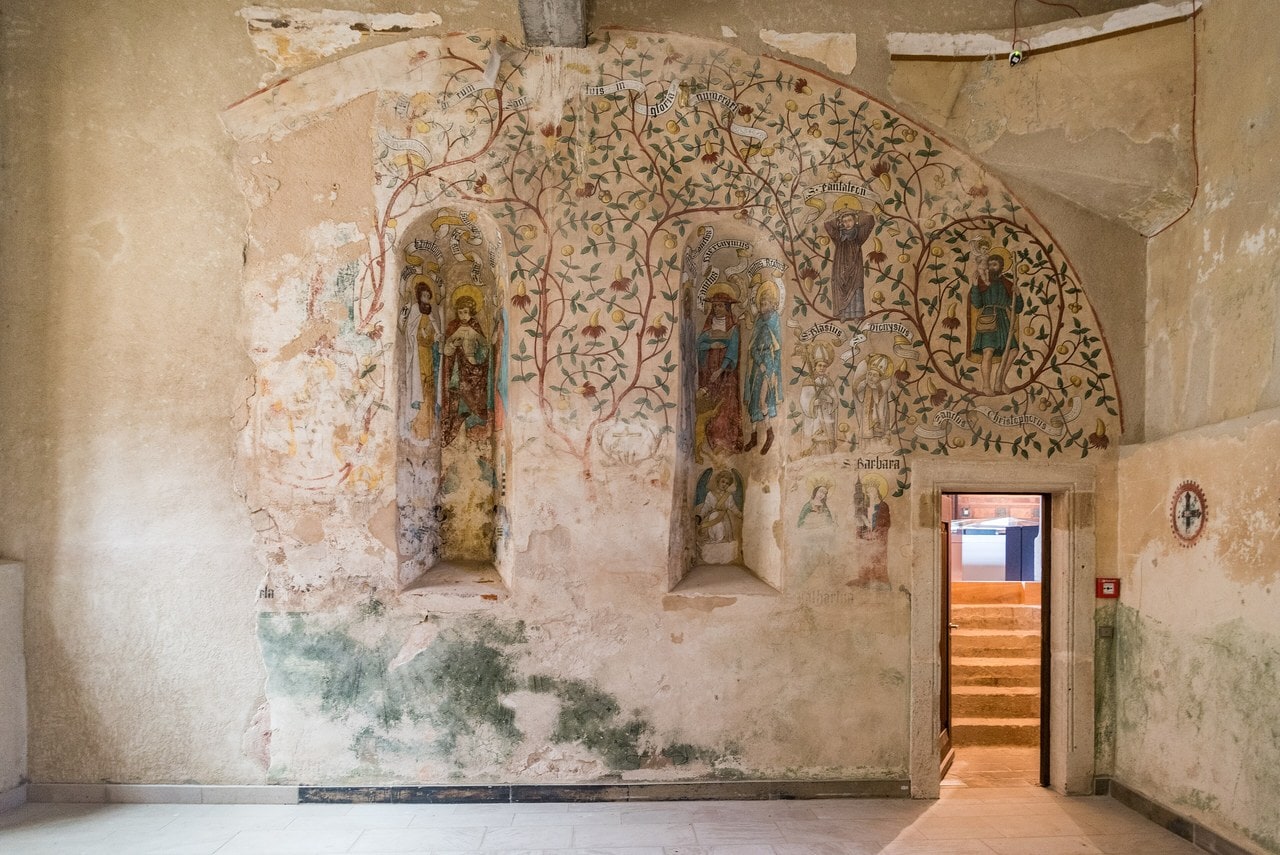
Older fabric survives alongside the Renaissance display. The castle chapel, in the Romanesque Jungfernbau, keeps wall paintings of the Fourteen Holy Helpers from about 1500 that are traditionally linked to the workshop of Lucas Cranach the Elder, though the attribution remains uncertain. The Renaissance heyday did not last in any case. A later cousin, Johann Casimir of Saxe-Coburg, used Heldburg as a hunting lodge and secondary seat, lodging a glittering wedding party here in 1599, and the fortress also hosted political talks during the upheavals of the Reformation. After the Thirty Years’ War, plans to convert the aging castle into a modern artillery fortress came to nothing, and from 1783 the place fell into a long, quiet decline.
The Theatre Duke’s refuge
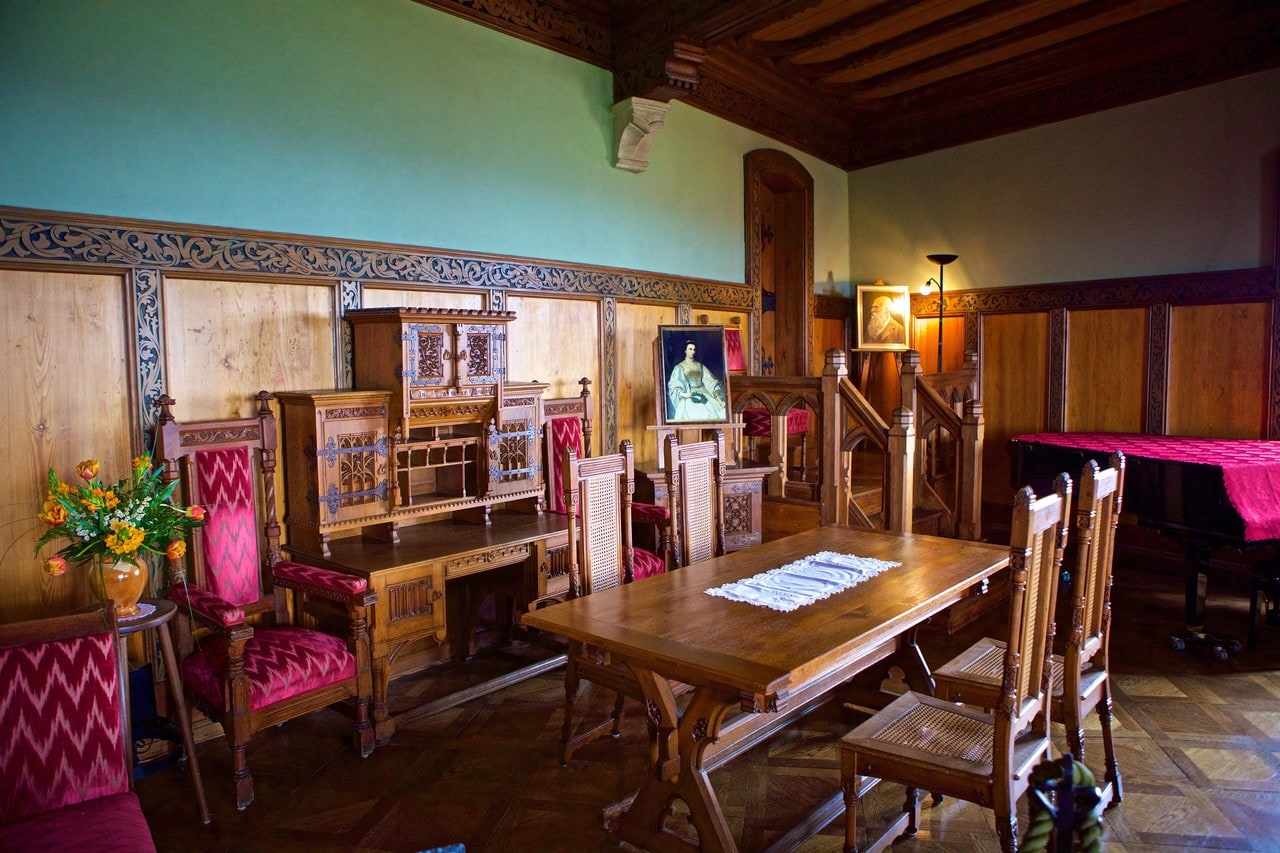
Nearly a century of neglect ended with an unlikely patron. Georg II of Saxe-Meiningen, remembered as the Theatre Duke for the pioneering Meiningen court theater that reshaped European stagecraft, took up the decaying castle and turned it into a quiet mountain retreat, his preferred private residence away from the duties of court.
From 1874 to 1898 Georg directed a historicist refit in the spirit of 19th-century castle romanticism. He heightened the Hexenturm and especially the Hausmannsturm, giving the fortress the tall, picturesque profile that still defines it from a distance, and he made the rooms of the French Building habitable again, reworking the grand hall and the state apartments. What sets his work apart from the heavier fantasy reconstructions of the period is its restraint. Georg proceeded carefully and with real knowledge of the building, preserving far more of the original than a less scrupulous romantic would have, which is why Heldburg today reads as an honest layering of centuries rather than a 19th-century invention.
Fire, division, and rescue
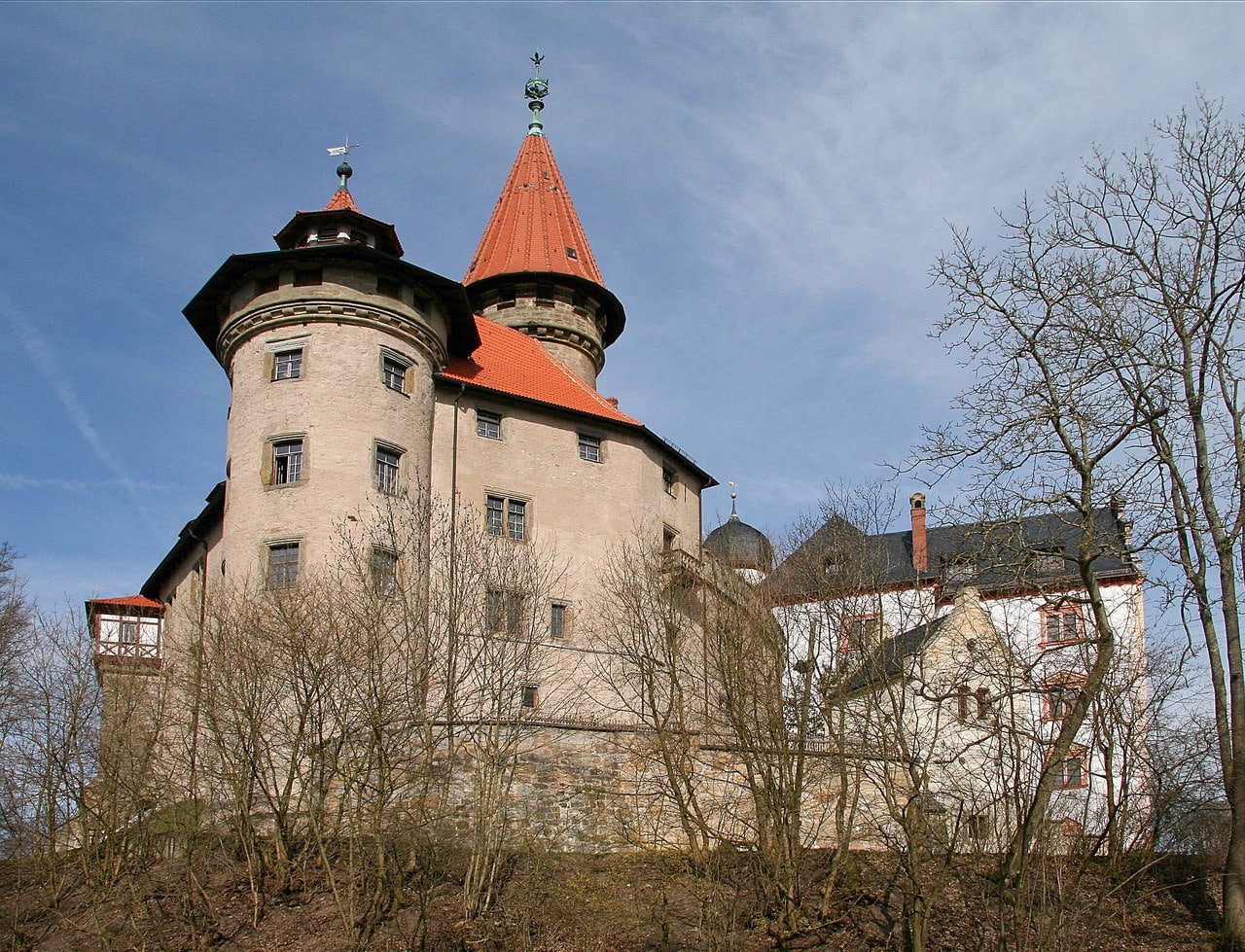
The 20th century nearly undid all of it. After the Second World War the fortress lay in the heavily controlled border zone of the German Democratic Republic, a few kilometers from the line that split the country. It served briefly as a local court, was cleared by Soviet troops, and from 1954 housed a children’s home.
On April 7, 1982 a fire tore through the French Building and destroyed the interiors that had survived since the Renaissance, including the woodwork of the state rooms and the great festival hall. With materials and labor scarce, no real repair was possible, and the gutted wing stood open to the weather for years. Rescue began only with reunification: from 1990 a Thuringian-Bavarian effort rebuilt the roof and floors and undertook a faithful reconstruction of the lost interiors. In 1994 the Free State of Thuringia took ownership and placed the fortress in the care of the Stiftung Thüringer Schlösser und Gärten, the foundation that administers the state’s palaces and gardens and still runs the site today.
The German Castle Museum
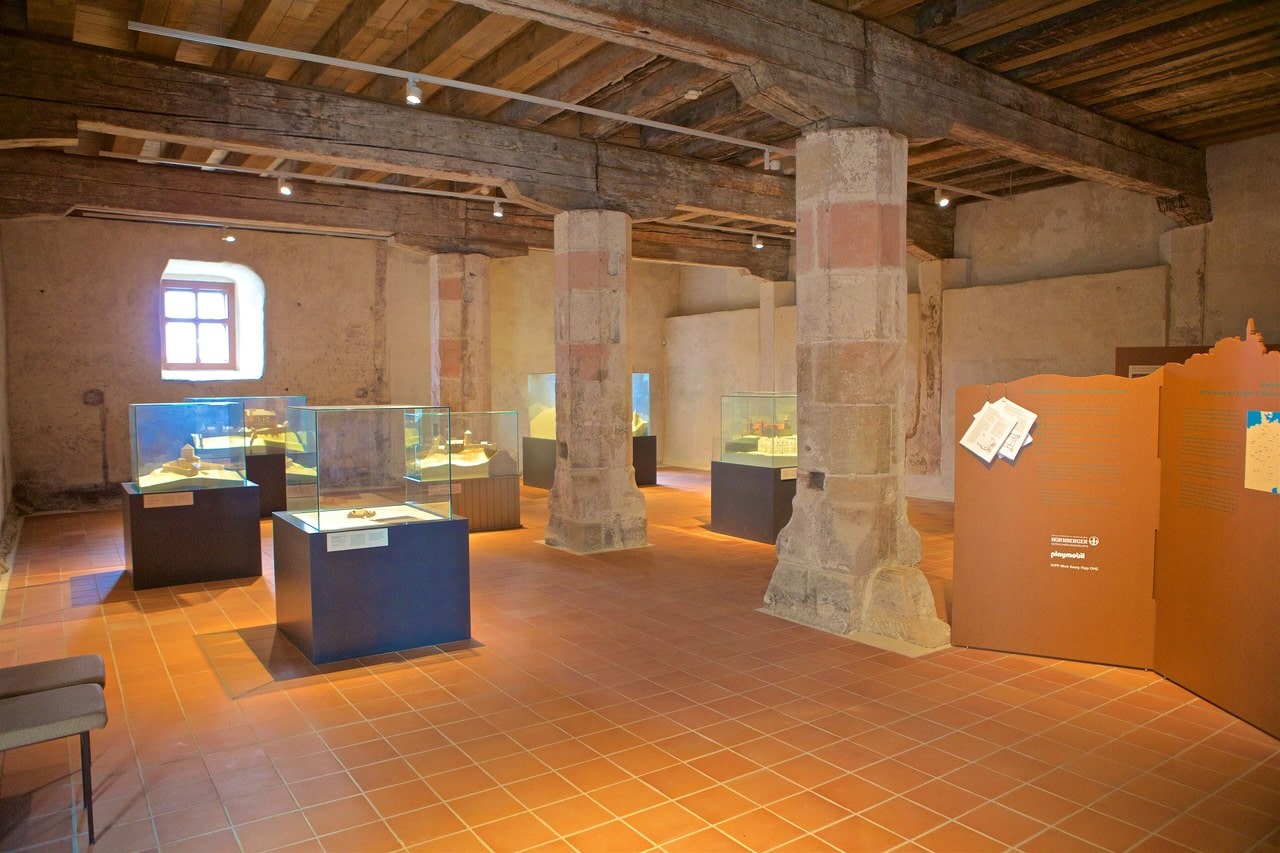
Reconstruction set up Heldburg’s third act. In 2005 a coalition that included the Germanisches Nationalmuseum, the Deutsches Historisches Museum, and the Thuringian palaces foundation formed to create a national museum about castles, and the restored French Building gave it a home. After years of delay, the German Castle Museum, the Deutsches Burgenmuseum, opened on September 8, 2016.
It is, by its own account, the only supra-regional museum devoted to the meaning and cultural history of castle-building in Central Europe. More than 350 original objects, displayed through the rooms of the French Building, trace how castles were built, who lived in them, what daily life and warfare were like behind the walls, and how castle myths still color popular culture. Building parts and tools sit beside weapons and armor, furniture, tableware, and even toys, and interactive and multimedia stations carry the story from the Middle Ages to the present. The cleverest part of the design needs no display case: the fortress is its own largest exhibit, so a visitor learns how a Höhenburg works while standing inside one.
Visiting Heldburg Fortress in 2026
Heldburg Fortress stands at Burgstraße 1 in the town of Heldburg, in the southern tip of the Hildburghausen district. It is the only Thuringian site on the Burgenstraße, the Castle Road tourist route, which since 2026 runs from Heidelberg and Schwetzingen to Bayreuth across roughly 840 kilometers, so the fortress sits naturally on a wider castle itinerary rather than off on its own. Entry tickets and local tours can also be booked in advance through GetYourGuide.
The museum opens from April through October, Tuesday to Sunday, with reduced hours in winter, and adult admission is modest, around seven euros; checking current times and prices on the museum’s site before traveling is wise, since the seasonal schedule shifts. A 2026 special exhibition marks the bicentenary of Georg II and runs into early 2027, a fitting moment to read the Theatre Duke’s mark on the place. The climb to the hilltop is rewarded twice over, by the exhibition inside the French Building and by the long views from the cone across the Heldburger Land. One pairing is almost obligatory. Coburg Fortress, the Franconian Crown to Heldburg’s Franconian Beacon, sits about 20 kilometers south across the old state line and is easily combined into a single trip, letting you read the two sister strongholds against each other in an afternoon. Anyone staying overnight can compare hotels in and around Heldburg.
Some links on this page are affiliate links, which means StoneKeep Atlas may earn a small commission, at no extra cost to you, if you book through them.
Beyond Heldburg Fortress
Heldburg sits inside two larger stories. Its earliest expansion under the electors of Frederick the Wise’s day ties it to the Wartburg, the great Thuringian fortress where that same dynasty hid Luther, and the two make a natural pair among the castles of Thuringia. Its truest sibling, though, lies just over the Bavarian border: Coburg Fortress, the Franconian Crown, whose silhouette answers Heldburg’s across the valley and whose own path from medieval stronghold to Renaissance seat runs closely parallel.
Conclusion
Few castles wear their whole biography as openly as this one. A medieval stronghold, a Renaissance manifesto in stone, a romantic duke’s retreat, a fire-scarred ruin, and finally a museum about castles themselves: Heldburg Fortress holds all of it on a single volcanic hill. For anyone trying to understand what a German castle actually was, and how its meaning kept changing, the Franconian Beacon is one of the most complete teachers in the country.
Now the Deutsches Burgenmuseum, the Veste Heldburg closes our history of the German castle sieges that shaped the country.
Principal Sources
- Dehio, Georg. Handbuch der deutschen Kunstdenkmäler: Thüringen. Deutscher Kunstverlag.
- Deutsches Burgenmuseum. “Geschichte der Veste.” deutschesburgenmuseum.de.
- Fleck, Niels, G. Ulrich Großmann, and Helmut-Eberhard Paulus. Veste Heldburg. Deutscher Kunstverlag, 2016.
- Hagenguth, Claudia. Veste Heldburg: Deutsches Burgenmuseum. Schnell & Steiner, 2024.
- Stiftung Thüringer Schlösser und Gärten. “Veste Heldburg.” thueringerschloesser.de.
- Institutional and visitor details in this guide draw on the Stiftung Thüringer Schlösser und Gärten and the Deutsches Burgenmuseum, the operators of the site; dates and architectural history follow the Deutscher Kunstverlag and Schnell & Steiner guides and the Dehio handbook for Thuringia.
Image credits. Banner: Reinhold Möller (Ermell), CC BY-SA 4.0. Aerial view: Reinhold Möller (Ermell), CC BY-SA 4.0. French Building: Tilman2007, CC BY-SA 4.0. Castle chapel murals: Tilman2007, CC BY-SA 4.0. Historicist interior: josef knecht, CC BY 3.0. Hexenturm: Krajo, CC BY-SA 3.0. German Castle Museum: josef knecht, CC BY 3.0. All via Wikimedia Commons. Freely licensed images are resized to fit; otherwise unaltered.