
Pillnitz Castle
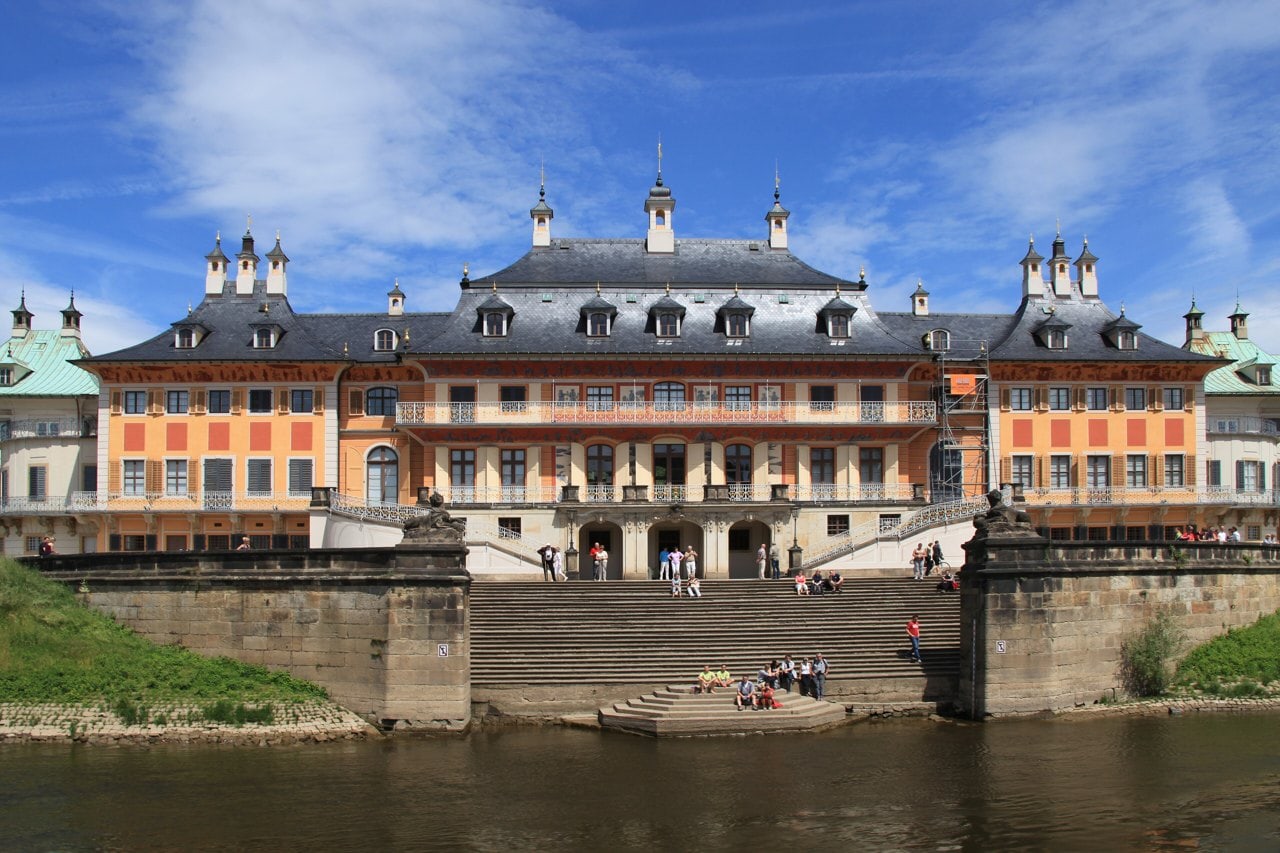
On the right bank of the Elbe, where the river curves below terraced vineyards at the south-eastern edge of Dresden, three palaces face one another across a Baroque flower garden. Pillnitz Castle, known in German as Schloss Pillnitz, was the summer pleasure house of Saxony’s electors and kings, and it is one of the most complete examples of chinoiserie palace architecture surviving anywhere in Europe. Its riverside and hillside pavilions wear curving, pagoda-like roofs and painted Asian scenes that announced, to a court arriving by gondola from the city, that they had entered a deliberately exotic world. Yet Pillnitz is more than a garden folly grown large. It gave its name to a 1791 declaration that helped push Revolutionary France toward war, it shelters one of the oldest camellias in Europe, and it once anchored a UNESCO World Heritage landscape that Dresden later lost. Few German palaces carry so many distinct stories on a single riverbank.
Quick Facts
| Location | Pillnitz quarter, south-eastern Dresden, Saxony, Germany (right bank of the Elbe) |
| German name | Schloss Pillnitz (Schloss & Park Pillnitz) |
| Type | Baroque summer palace ensemble of three palaces and a park |
| Built | Wasserpalais 1720–21; Bergpalais 1722–24; Neues Palais 1819–26 |
| Architects | Matthäus Daniel Pöppelmann and Zacharias Longuelune (Baroque palaces); Christian Friedrich Schuricht (Neues Palais) |
| Built for | Augustus the Strong, Elector of Saxony and King of Poland |
| Style | Late Baroque with chinoiserie; Neoclassical New Palace |
| Famous for | Chinoiserie architecture; the Declaration of Pillnitz (1791); the Pillnitz Camellia |
| Current use | Museums of the Dresden State Art Collections and Schlösserland Sachsen; public park |
| Operator | Staatliche Schlösser, Burgen und Gärten Sachsen (Schlösserland Sachsen) |
| UNESCO status | None today; anchored the Dresden Elbe Valley World Heritage Site, delisted 2009 |
| Official site | schlosspillnitz.de |
A manor on the Elbe: origins and the Cosel interlude
A settlement at Pillnitz appears in the records as early as 1335, when the site held a manor and knight’s estate. Over the sixteenth and seventeenth centuries the von Loß family enlarged it into a four-winged Renaissance Schloss, a substantial country seat within easy reach of the electoral capital. The property entered the orbit of the ruling House of Wettin in 1694, when Elector Johann Georg IV of Saxony acquired it in exchange for Lichtenwalde and presented it to his mistress, Magdalena Sibylla von Neidschütz. Both of them died soon afterward, and Pillnitz passed to the elector’s younger brother, the figure who would shape almost everything that visitors see today: Augustus the Strong.
Augustus, Elector Friedrich August I of Saxony and from 1697 also King Augustus II of Poland, gave Pillnitz in 1706 to Anna Constantia von Brockdorff, Countess of Cosel, the most famous and most powerful of his many mistresses. She took up residence around 1713 and set about reshaping the grounds, laying out the clipped hedge walks known as charmilles. Her fall was as dramatic as her rise. As she lost the king’s favor she refused to surrender his written promise of marriage, and in 1715 she fled to Berlin. Augustus reclaimed the estate, and the countess was eventually arrested and exiled in 1716 to Burg Stolpen, a fortress north-east of Dresden, where she remained in confinement for some forty-nine years until her death in 1765. With Cosel gone, Augustus turned his attention to the riverbank she had left behind, and conceived a very different use for it.
Augustus the Strong’s pleasure palace: Pöppelmann and the chinoiserie ensemble
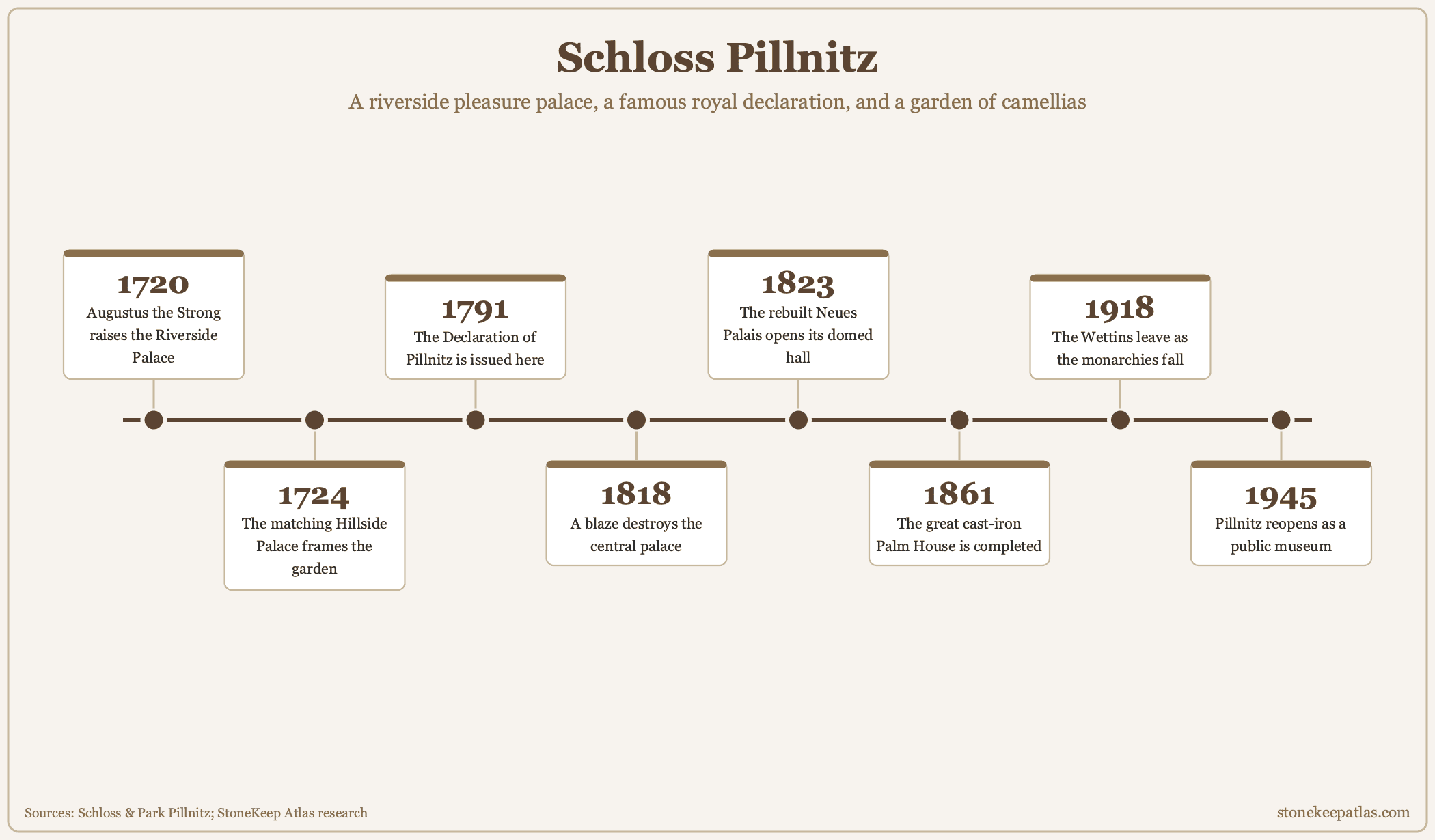
Beginning in 1720, Augustus ordered the old buildings replaced by a pleasure palace unlike anything else in Saxony. That commission went to Matthäus Daniel Pöppelmann, the architect of the Dresden Zwinger and the king’s most inventive builder, working with the French-trained designer Zacharias Longuelune. Their plan abandoned the conventional grammar of a German residence in favor of an “Indian” or East Asian fantasy, a court of festivities set directly on the water.
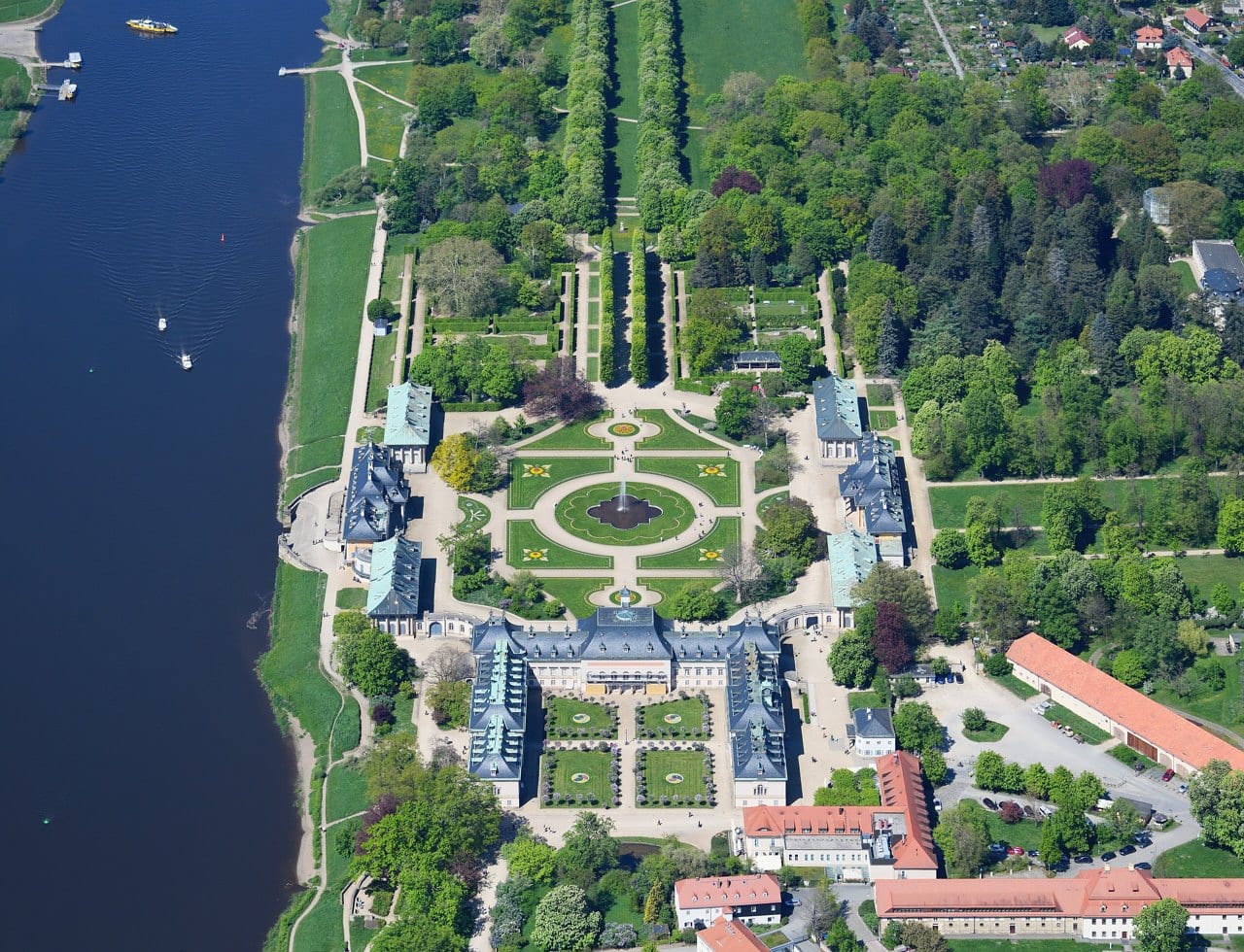
The Wasserpalais, or Riverside Palace, rose first in 1720 and 1721 along the Elbe. Its long, low front opens toward the river, and in 1725 Longuelune completed a broad flight of water stairs descending into the Elbe, a landing where the electoral gondolas arriving from Dresden could moor at the palace door. A near-identical counterpart, the Bergpalais or Hillside Palace, was built between 1722 and 1724 on rising ground opposite, framing a garden laid out between the two. Both buildings carry the curving, tent-like roofs and painted exterior panels that define the complex, a Saxon interpretation of chinoiserie that Pöppelmann is said to have drawn from images of the Chinese emperor’s palace in Beijing, blended with the villas of Andrea Palladio and the palaces of Venice. The result reads as theater as much as architecture, a backdrop for the masquerades and water festivals that Augustus staged here, in which courtiers dressed as peasants and vintners and play structures, swings, and carousels filled the grounds.
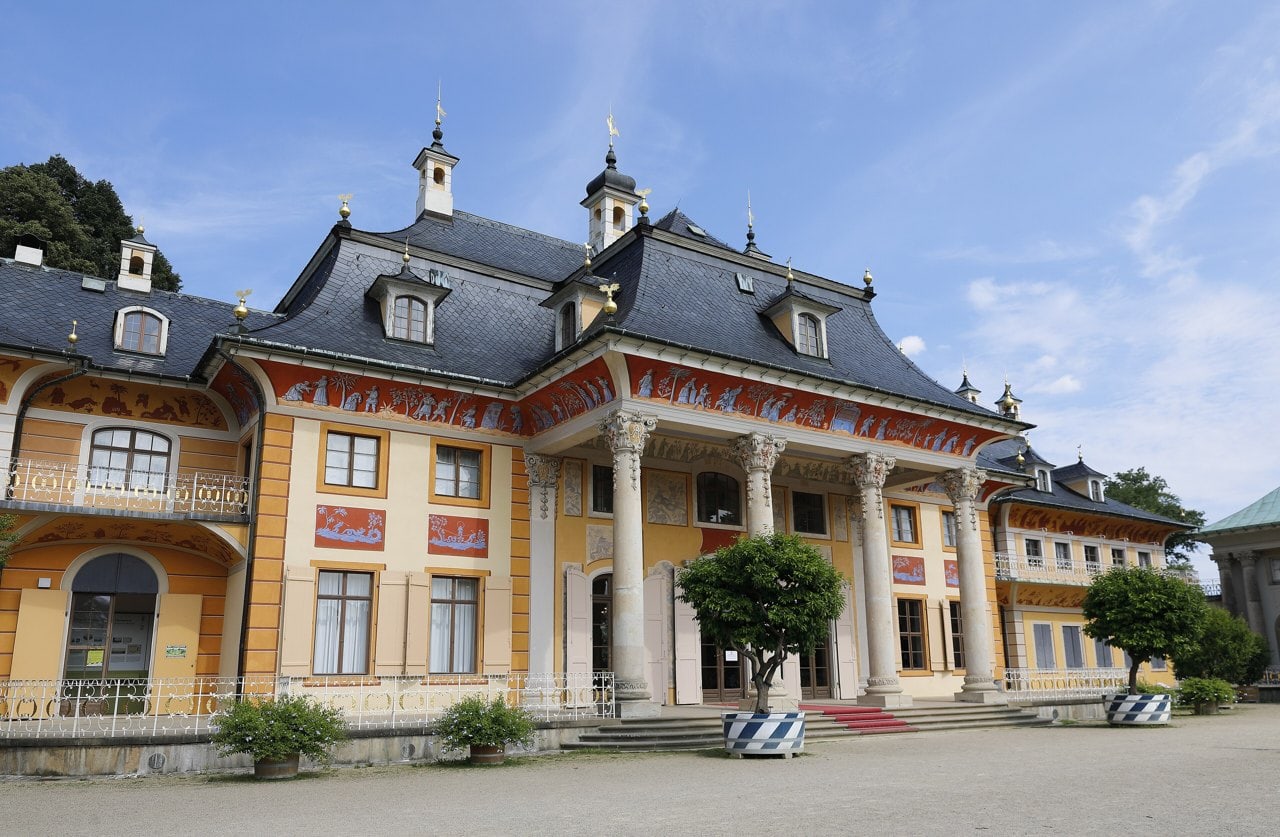
That same campaign produced two further works by Pöppelmann. The octagonal Venustempel, or Temple of Venus, gave the garden a focal pavilion, and the Weinbergkirche, the Vineyard Church dedicated to the Holy Spirit, was begun in 1723 among the slopes above the palace and consecrated on November 11, 1725. Construction wound down in 1725, and Augustus, ever restless, soon shifted his energies to other projects. The chinoiserie shell he left behind, however, would outlast him by three centuries.

Summer residence of the Saxon court: gardens and pavilions
Pillnitz acquired its lasting role under Augustus the Strong’s great-grandson. In the later eighteenth century, under Elector Friedrich August, later King Friedrich August I of Saxony, the estate was adopted as the official summer residence of the Saxon court, and the family would retreat here in the warm months until the monarchy ended in 1918. With residence came a new fashion in landscape. Alongside the formal Baroque parterres, the eighteenth century added an English garden in the sentimental taste of the period, complete with an English pavilion built in 1780 as a copy of Donato Bramante’s Tempietto in Rome. A nearby valley, the Friedrichsgrund, was landscaped around the same time for the elector’s walks, dotted with little stone bridges and ornamental structures, and in 1785 an artificial ruin in the Gothic Revival manner was raised on a northern hilltop, its staged decay meant to set the vanity of earthly life against the pleasures of the garden below.
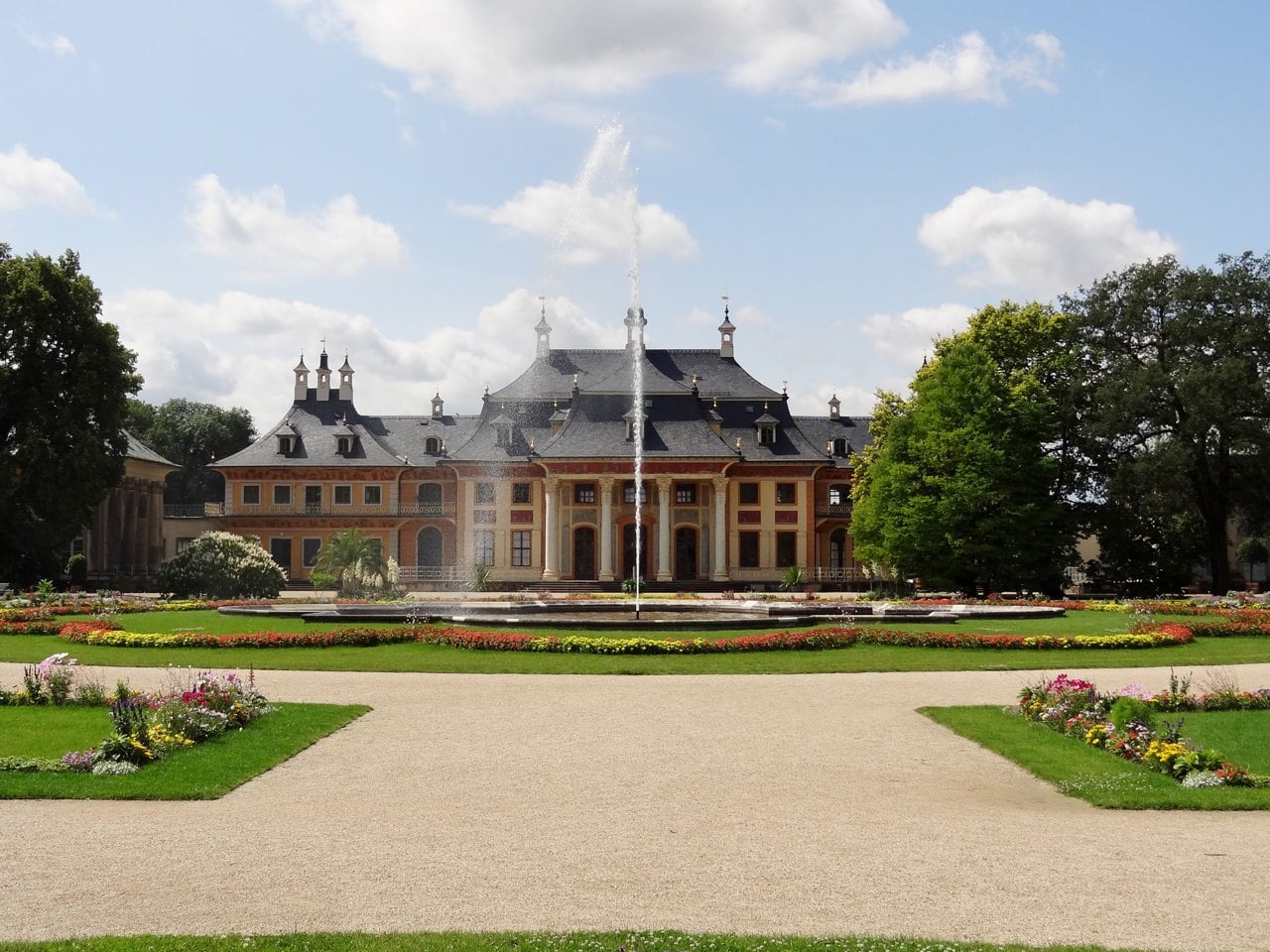
This exotic theme continued into the new century. In 1804 a Chinese Pavilion was erected on the northern edge of the park, and unlike the decorative chinoiserie of the palaces it was built in a more authentic Chinese style, with interior paintings depicting real Chinese landscapes. At the heart of the grounds, the buildings still enclose a Baroque flower garden whose centerpiece is a pond and a large fountain. From there a chestnut-lined avenue runs roughly five hundred meters parallel to the river, edged by small hedged parterres, holding the whole composition together between the water and the vineyard hills.
The river remained the palace’s natural front door. Around 1800 a pair of state gondolas, one red and one green, was built under the supervision of the architect Christian Friedrich Schuricht to carry Friedrich August I between his city residence in Dresden and his country seat at Pillnitz. A replica of the red royal gondola, assembled in 1954 from parts of both decayed originals, survives in the park as a reminder that the court arrived here by water, gliding up to the very steps of the Wasserpalais rather than through any gate.
The Declaration of Pillnitz, 1791
For all its garden delights, the name Pillnitz entered the history books for a single afternoon of diplomacy. In late August 1791, with the French Revolution two years old and King Louis XVI freshly humiliated by his failed flight to Varennes, two of Europe’s leading monarchs gathered at the palace. Holy Roman Emperor Leopold II, who was Queen Marie Antoinette’s brother, had already tested the diplomatic waters that summer with the Padua Circular of July 6, 1791, an appeal to fellow rulers to take notice of the French king’s plight, and the meeting at Pillnitz was its sequel. At Pillnitz he met King Frederick William II of Prussia, surrounded by French émigré nobles, among them the king’s own brothers, pressing hard for armed intervention. On August 27, 1791 the two rulers issued the brief joint statement that became known as the Declaration of Pillnitz.
The declaration announced that the situation of the French king was a matter of common interest to all the sovereigns of Europe, and called on them to act so that Louis XVI might be restored to a position of proper authority. Its apparent firmness, however, was carefully hollow. Leopold and Frederick William committed themselves to military action only on the condition that every other major European power joined them, an outcome both knew to be highly unlikely while Britain stood aside. That text was meant chiefly to reassure the émigrés and to look resolute without obliging its authors to fight. In Paris the nuance was lost. Revolutionary opinion read the declaration as a foreign threat to French sovereignty, and it strengthened the hand of those agitating for confrontation. Within months the calculation collapsed entirely, and in April 1792 France declared war on Austria, opening the French Revolutionary Wars that would consume the continent for a generation. A riverside palace built for masquerades had lent its name to a turning point in European history.
Fire and renewal: the 1818 blaze and the Neues Palais
The ensemble that Augustus had assembled was nearly complete, save for the old Renaissance Schloss that still stood between the two Baroque palaces. On May 1, 1818 a fire destroyed that central building together with the Temple of Venus, while the Wasserpalais and Bergpalais escaped unharmed. That disaster created an opportunity to finish the courtyard the eighteenth century had only implied. King Friedrich August I commissioned his architect, Christian Friedrich Schuricht, to design a replacement on the cleared site, and between 1819 and 1826 the Neues Palais, or New Palace, rose to link the older pavilions on the eastern side.
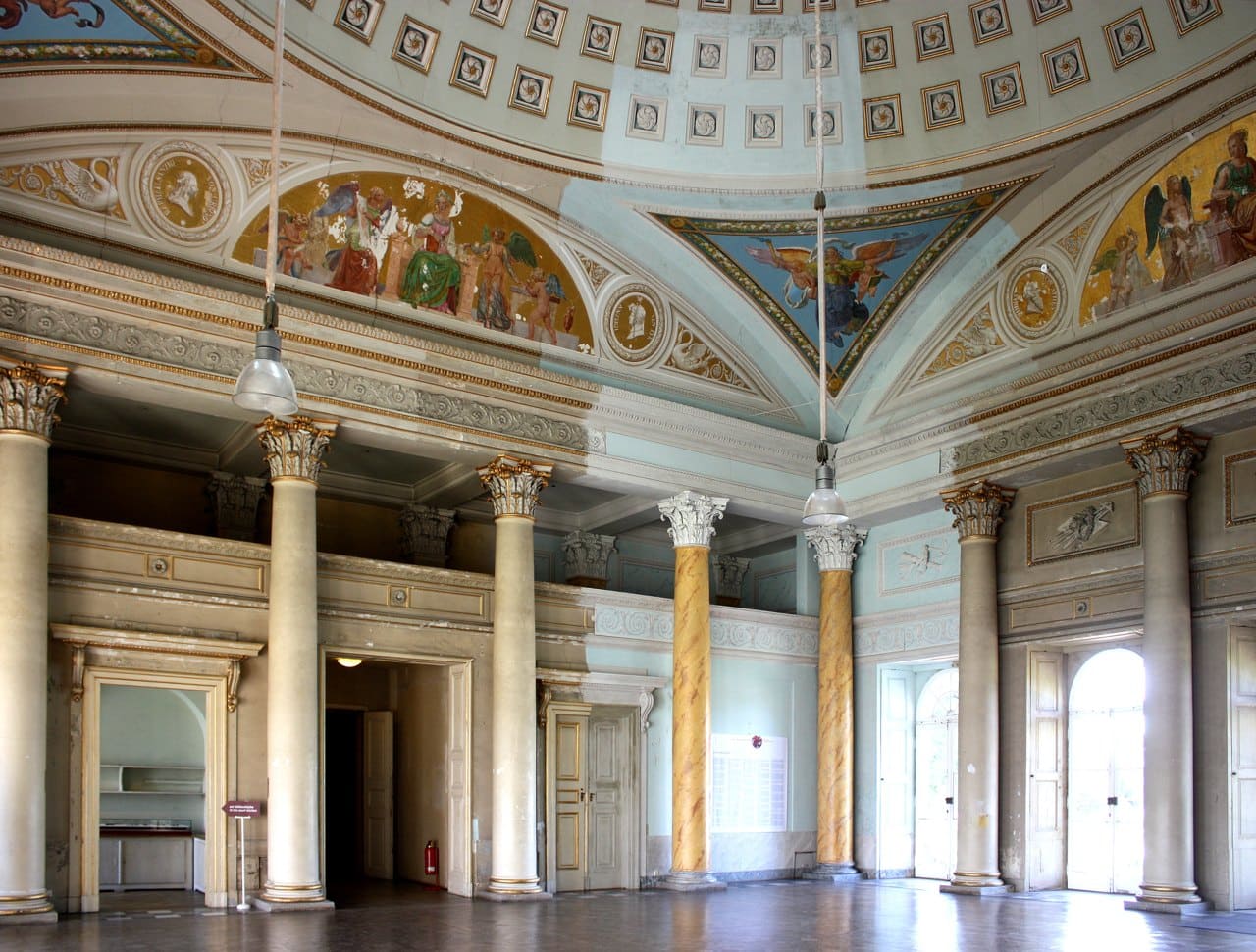
Schuricht worked in a restrained Neoclassical idiom, a cooler and more linear style than Pöppelmann’s exuberant Baroque, yet he made a careful concession to the spirit of the place. The roofs and moldings of the New Palace echo the oriental theme of its neighbors, so that the three buildings read as a single family despite the century that separates them. The New Palace gave the court its grandest interiors at Pillnitz: a central domed hall, opened in 1823 and the only Neoclassical domed hall in Dresden, a Catholic chapel in the eastern wing decorated with frescoes of the life of the Virgin by the court painter Carl Christian Vogel von Vogelstein, and a large royal kitchen whose copper batterie once fed the royal household. With the New Palace in place, Pillnitz at last formed the closed, three-sided composition that visitors walk through today.
The Pillnitz Camellia and the Palm House
If the palaces are the work of architects, the park’s most celebrated resident is a plant. The Pillnitz Camellia, a Camellia japonica, was planted in its present spot in 1801 by the court gardener Carl Adolph Terscheck, and it is now reckoned to be more than 230 years old, among the oldest camellias in Europe. It has grown to nearly nine meters tall with a crown some eleven to twelve meters across, and each year between mid-February and mid-April it opens as many as thirty-five thousand carmine flowers in a single sustained display. Legend traces it to the Swedish botanist Carl Peter Thunberg, who is said to have carried four camellias from Japan to Kew Gardens near London in the 1770s, with three passed on to Vienna, Hanover, and Pillnitz; by this telling the Pillnitz plant is the sole survivor. Modern genetic study has not been able to confirm the story, and the camellia’s true origin remains an open question, which only adds to its mystique.
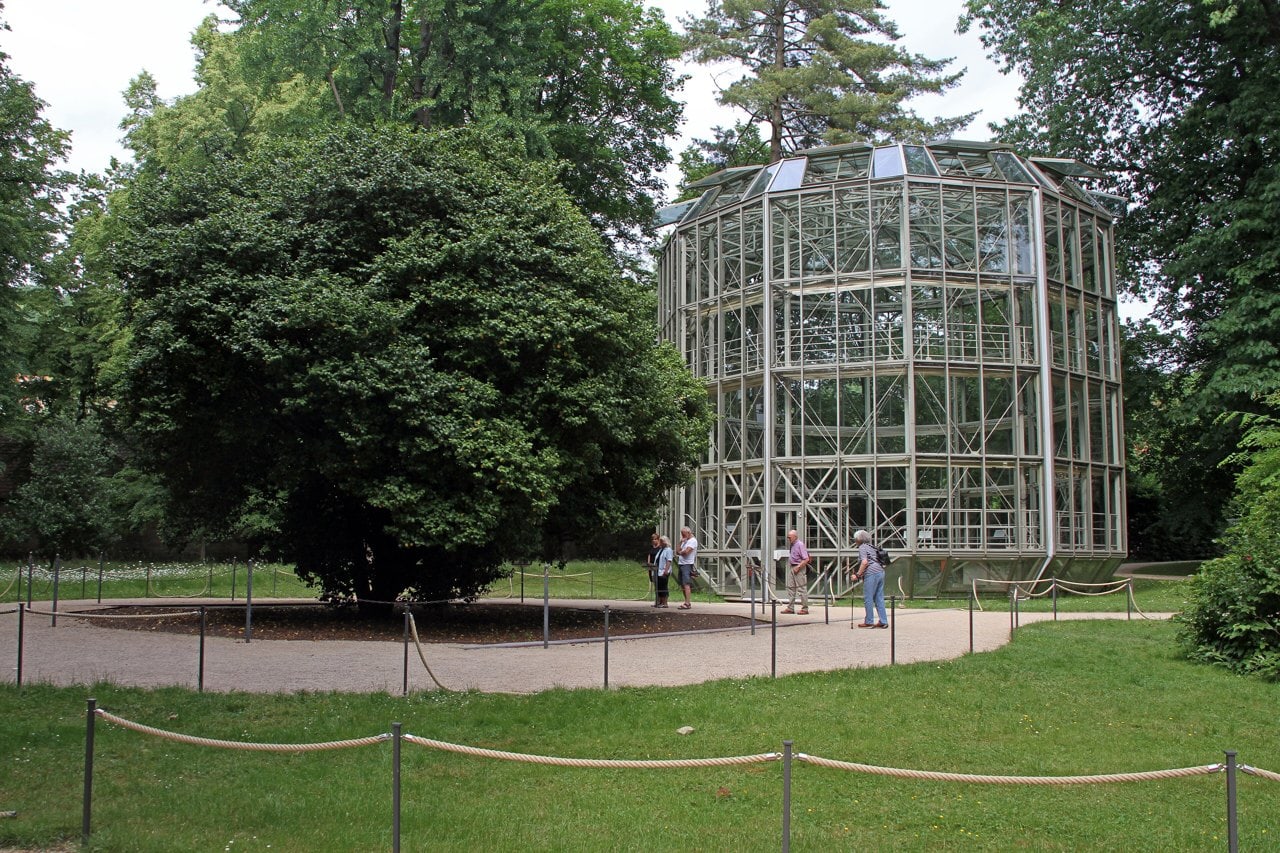
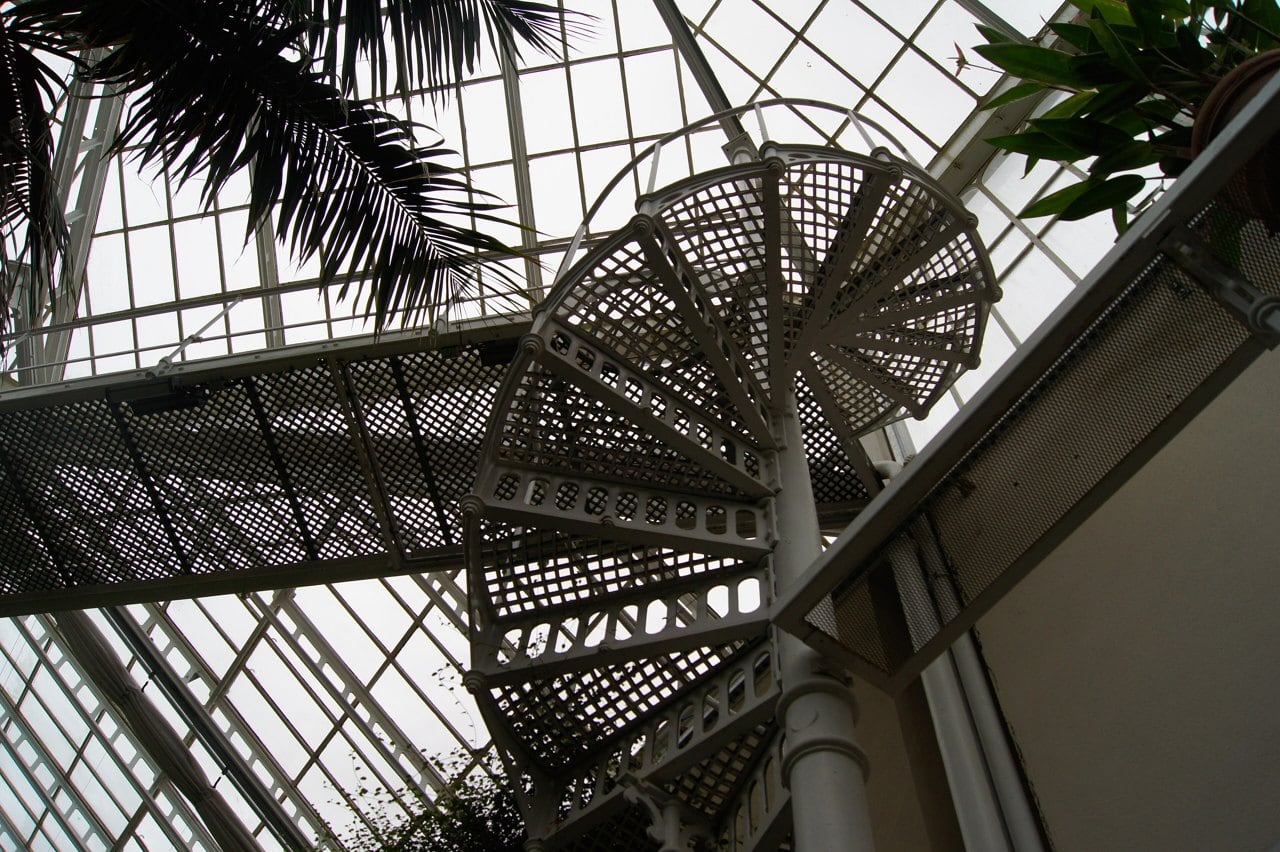
The tree is so valuable that it travels nowhere and instead is sheltered in place. Since 1992 a movable glass house on rails, more than thirteen meters high and weighing some fifty-four tons, rolls over the camellia each winter, regulating temperature, humidity, ventilation, and shade before retreating again in spring. The park’s botanical ambitions extend well beyond it. The Palm House, built between 1859 and 1861, stretched almost ninety-four meters in length and was at the time the largest cast-iron greenhouse in Germany; restored and reopened in 2009, it still grows exotic plants from South Africa, Australia, and New Zealand. Together the camellia, the Palm House, and the English, Chinese, and Dutch gardens make the twenty-eight-hectare park a destination in its own right, independent of the buildings it surrounds.
From royal residence to museum, and the lost UNESCO crown
The House of Wettin used Pillnitz as a summer residence until the German monarchies fell in 1918. Through the catastrophe of the Second World War the palace was fortunate: its position on the city’s rural fringe spared it the firestorm that gutted central Dresden in 1945, and the ensemble came through the war largely intact. After 1945 it began its new life as a museum. The Kunstgewerbemuseum, the Museum of Decorative Arts of the Dresden State Art Collections, moved into the Berg- and Wasserpalais in 1963 and displays furniture, ceramics, and other objects spanning centuries of European craft, including the throne of Augustus II. Founded in Dresden in 1876, the museum holds a collection of roughly sixty thousand objects of design and applied art, only a fraction of which can be shown at any one time, and several of its rooms at Pillnitz preserve their original historic decoration. The Palace Museum in the Neues Palais, telling the story of the residence itself with its royal kitchen, domed hall, and chapel, reopened in 2006 after long restoration, and the rebuilt Palm House followed in 2009. The grounds have not been entirely spared, however; the great Elbe flood of August 2002 inundated the ground floors of the Wasserpalais and the New Palace.
Pillnitz also played the lead in one of the most contentious episodes in modern heritage policy. In 2004 UNESCO inscribed the Dresden Elbe Valley on the World Heritage List, an eighteen-kilometer cultural landscape running along the river from Übigau in the north-west to, in the words of UNESCO’s own citation, a valley “crowned by the Pillnitz Palace” and the Elbe island in the south-east. The honor proved short-lived. When the city pressed ahead with the four-lane Waldschlößchen Bridge across the protected meadows, a project backed by a local referendum and German courts but opposed by conservationists as a wound to the cultural landscape, UNESCO placed the site on its List of World Heritage in Danger in 2006 and, after years of warnings went unheeded, voted on June 25, 2009 at its session in Seville to strike the Dresden Elbe Valley from the list entirely. The vote was fourteen to five with two abstentions. It became only the second place ever removed from World Heritage status, after Oman’s Arabian Oryx Sanctuary in 2007, and the bridge that cost Dresden the title opened to traffic in 2013. Pillnitz, the landscape’s south-eastern crown, thus carries the rare distinction of having been part of a World Heritage Site that no longer exists.
Visiting Pillnitz in 2026
Pillnitz lies in its own quarter on the right bank of the Elbe, roughly ten to fifteen kilometers upstream from Dresden’s old town in the Loschwitz borough. Many visitors still arrive much as the court did, by riverboat from the city, though the palace is also reached by bus and by car. The 2026 season runs from March 28 to November 1, with the grounds open daily from 09:00 to 17:00. Entry tickets and local tours can also be booked in advance through GetYourGuide.
One important point shapes a 2026 visit. The Kunstgewerbemuseum, the Museum of Decorative Arts in the Berg- and Wasserpalais, is closed for the whole of 2026 while the buildings are prepared for structural refurbishment, and Dresden State Art Collections season tickets are not valid at Pillnitz this year. The rest of the estate remains very much open. The Palace Museum in the Neues Palais welcomes visitors from 10:00, with last admission at 16:40, and shows the royal kitchen, the Neoclassical domed hall, and the Catholic chapel. The Palm House and the Camellia House are open through the season, the latter at its best during the flowering weeks of late winter and early spring. From June 6 to October 4, 2026 the Orangery hosts the exhibition “The Games of the King.” The park itself can be entered free of charge before 09:00 and after 17:00, and is ticketed in between during the season.
Admission to the palace and park in 2026 costs 8.00 euros for adults, 7.00 euros reduced, 1.00 euro for children aged six to sixteen, and 7.00 euros per person for groups of fifteen or more; a “Garden Friend” annual pass is available for 17 euros, or 12 reduced. Tickets and tours start from the Old Guard House visitor center east of the New Palace. The palace and park are operated by Staatliche Schlösser, Burgen und Gärten Sachsen, the Saxon state palaces administration also known as Schlösserland Sachsen. Anyone staying overnight can compare hotels in and around Dresden.
Some links on this page are affiliate links, which means StoneKeep Atlas may earn a small commission, at no extra cost to you, if you book through them.
Beyond Pillnitz
Pillnitz sits within a dense cluster of Saxon residences that reward a longer stay. The most direct companion is Moritzburg Castle, the moated Baroque hunting and pleasure palace north of Dresden that Augustus the Strong likewise enlarged with Pöppelmann’s help, a near-contemporary expression of the same court’s taste for theatrical building. Upstream of the city, the cliff-top Königstein Fortress guards the Elbe from a height, the military counterpoint to Pillnitz’s riverside leisure and, like it, a stage for the Saxon court in the age of Augustus. Further along the Elbe at Meissen, Albrechtsburg Castle holds a special tie to Pillnitz: it was here that Augustus the Strong founded Europe’s first porcelain manufactory, and Meissen porcelain furnished the very palaces he was building downstream. Taken together, these riverside seats trace the ambitions of one of Europe’s most flamboyant courts across hilltop, manufactory, and water garden.
Common Questions
How do I get to Pillnitz?
Pillnitz lies on the right bank of the Elbe, roughly ten to fifteen kilometers upstream from Dresden in the Loschwitz borough. Many visitors still arrive much as the court did, by riverboat from the city, though the palace is also reached by bus and by car.
When is Pillnitz open?
The 2026 season runs from 28 March to 1 November, with the grounds open daily from 09:00 to 17:00. The Palace Museum in the Neues Palais welcomes visitors from 10:00, with last admission at 16:40. The park can be entered free of charge before 09:00 and after 17:00, and is ticketed in between during the season.
Is anything closed at Pillnitz in 2026?
Yes. The Kunstgewerbemuseum, the Museum of Decorative Arts in the Berg- and Wasserpalais, is closed for the whole of 2026 while the buildings are prepared for structural refurbishment, and Dresden State Art Collections season tickets are not valid at Pillnitz this year. The rest of the estate remains very much open.
What should I see?
The Palace Museum shows the royal kitchen, the Neoclassical domed hall and the Catholic chapel, while the Palm House and the Camellia House are open through the season; the famous Pillnitz Camellia is at its best during the flowering weeks of late winter and early spring.
Conclusion
Pillnitz Castle is easy to enjoy and hard to exhaust. A first visit registers the surface, the pagoda roofs above the Elbe, the gondola stairs, the camellia under glass, the fountain in its garden. A second visit reveals how much weight that pretty surface carries. This is the palace where a discarded royal mistress redesigned a garden before her long imprisonment, where a court of masqueraders gave way to a declaration that nudged a continent toward war, where a fire opened the way for one of Dresden’s finest Neoclassical interiors, and where a single flowering tree has outlived kings, revolutions, and a world war. Pillnitz lost its UNESCO title, but it kept the thing that mattered, an ensemble of architecture and landscape so complete and so confident that it still feels, on the right spring morning with the camellia in bloom, like the most exotic address in Saxony.
Principal Sources
- Britannica, Declaration of Pillnitz.
- German History in Documents and Images (GHDI), Emperor Leopold II and King Frederick William II Meet in Pillnitz on August 25, 1791.
- Hartmann, Hans-Günther. Pillnitz: Schloss, Park und Dorf.
- Staatliche Kunstsammlungen Dresden (SKD), Schloss Pillnitz and Kunstgewerbemuseum.
- Staatliche Schlösser, Burgen und Gärten Sachsen (Schlösserland Sachsen), Schloss & Park Pillnitz (history, the camellia, the Palm House, guest service, opening hours, and ticket rates, 2026 season).
- UNESCO World Heritage Centre, Dresden Elbe Valley and Dresden is deleted from UNESCO’s World Heritage List (2009).
- World History Encyclopedia, Declaration of Pillnitz.
Image credits. Hero, the Wasserpalais from the Elbe: Gkphoto, CC BY-SA 3.0, via Wikimedia Commons. The Bergpalais facade: Myriam Thyes, CC BY-SA 4.0, via Wikimedia Commons. Chinoiserie cove painting: Myriam Thyes, CC BY-SA 4.0, via Wikimedia Commons. Flower garden and fountain: Olaf Tausch, CC BY 3.0, via Wikimedia Commons. The domed hall of the Neues Palais: Dguendel, CC BY 3.0, via Wikimedia Commons. The Pillnitz Camellia and its glass house: Gerd Eichmann, CC BY-SA 4.0, via Wikimedia Commons. Inside the Palm House: Barbara-Ingeborg, CC BY-SA 4.0, via Wikimedia Commons. Aerial of the ensemble: Carsten Steger, CC BY-SA 4.0, via Wikimedia Commons. Freely licensed images are resized to fit; otherwise unaltered.