
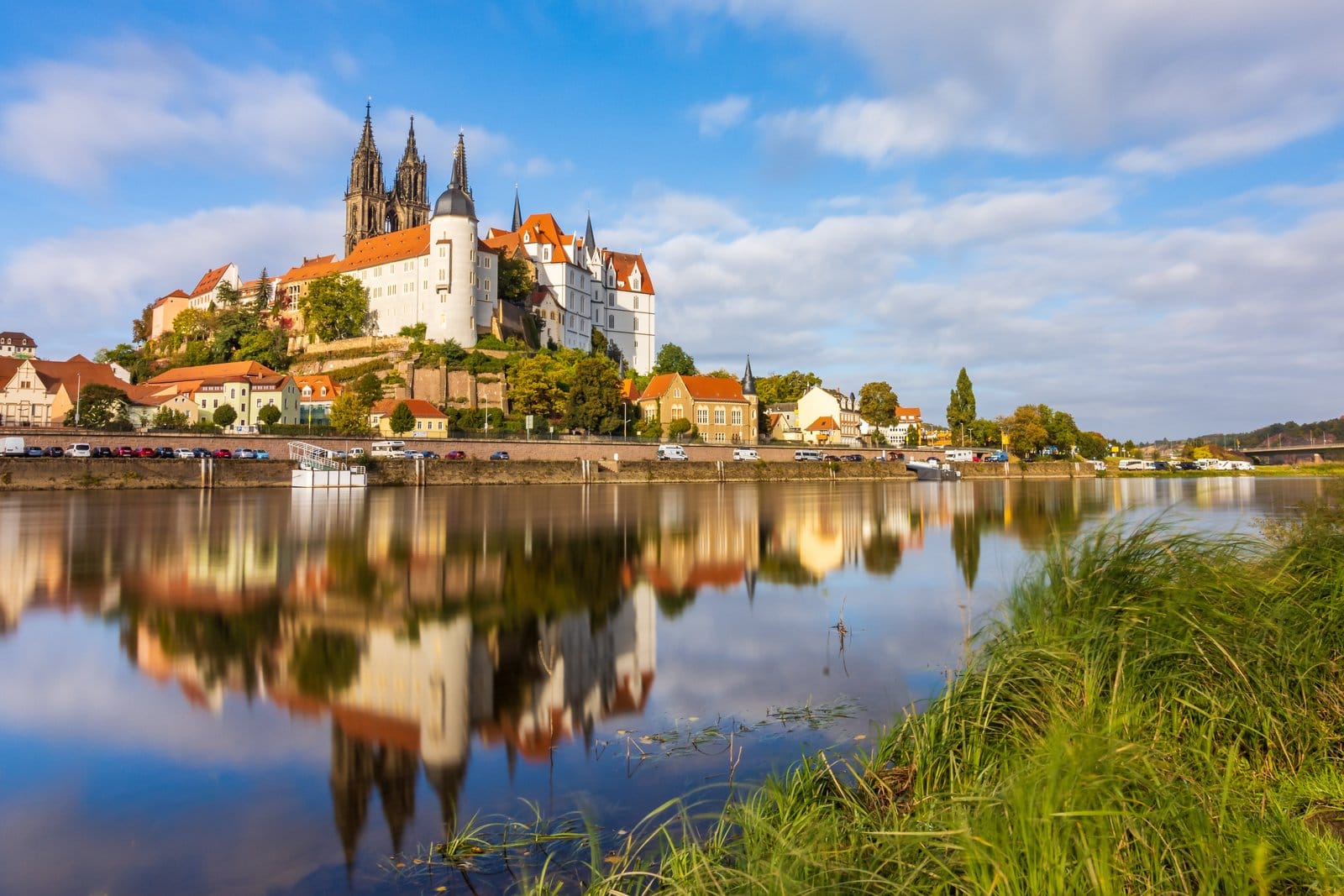
Albrechtsburg Castle
Albrechtsburg Castle rises on a rock above the Elbe in the heart of Meissen, Saxony, about twenty-five kilometers northwest of Dresden, its pale walls and steep roofs sharing the Burgberg with the towers of Meissen Cathedral. A fortress had stood on this spur since 929, but the building visitors see today belongs to a single sustained effort begun in 1471, when the Wettin brothers Ernst and Albrecht commissioned a residence unlike anything else in the German lands. What their master builder produced was not a stronghold dressed up for comfort. It was a palace conceived from the ground up for living and for show, and it is widely regarded as the first German Schloss, the moment the medieval Burg gave way to the Renaissance idea of a princely seat.
Two firsts meet under one roof here. The Albrechtsburg is the building where the German palace was, in effect, invented, and it is the place where Europe learned to make porcelain. The irony is that the palace was barely lived in. A dynastic split stranded it almost as soon as it was finished, and for two centuries it stood half-empty, until a king with a taste for “white gold” turned its grand halls into Europe’s first porcelain works. Later still, the Saxon state filled its rooms with painted history and opened them to the public, so that the empty palace became a museum of itself.
Quick Facts
| Location | Domplatz 1, 01662 Meißen, Saxony, Germany |
| Built | Begun 1471; exterior complete by about 1490; interior finished 1521–1524 |
| Builder | Arnold von Westfalen, Saxon state master builder |
| Commissioned by | Ernst, Elector of Saxony, and Albrecht, Duke of Saxony (House of Wettin) |
| Style | Late Gothic, with the first signs of the Renaissance |
| Type | Residential palace (the first German Schloss) |
| Named | After Albrecht the Bold, by Elector Johann Georg II in 1676 |
| Famous as | Site of Europe’s first hard-paste porcelain manufactory, 1710–1863 |
| Current use | Museum (permanent exhibition in five sections) |
| Operator | Staatliche Schlösser, Burgen und Gärten Sachsen (Schlösserland Sachsen) |
| Opening (2026) | Mar–Oct: Mon, Wed–Sun 10:00–18:00; closed Tue (except holidays) |
| Admission (2026) | €12 full / €10 reduced / €4.50 child (6–16) |
| Website | albrechtsburg-meissen.de |
The cradle of Saxony
Long before any palace, the rock above the Elbe carried a fortress. In 929 King Henry I, called Henry the Fowler, marched against the Slavic Daleminzier, stormed their hilltop settlement of Gana, and raised a German stronghold on the high spur where the Elbe, the Triebisch, and the Meisa meet. The garrison post he founded took the name Misnia, from a nearby brook, and grew into the town and the bishopric of Meissen. Emperor Otto I raised that bishopric in 968, and from then on church and crown shared the ridge, the cathedral rising at one end of the Burgberg and the ruler’s castle at the other. Both have stood side by side ever since, a thousand-year skyline above the river. Saxons have long called the place the “cradle of Saxony,” and the claim is more than civic pride: the margraves who ruled the lands east of the Saale governed from this hill, and from them descended the dynasty that would shape central German history for almost a thousand years.
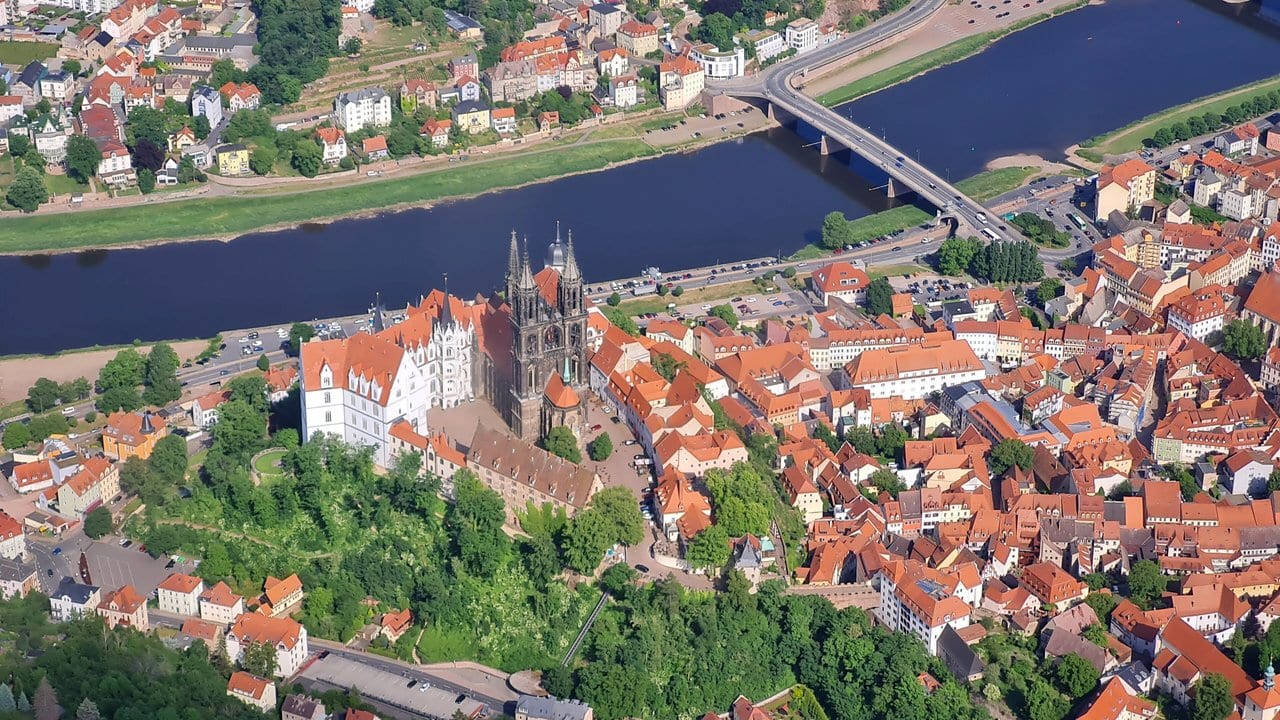
That dynasty was the House of Wettin. It held the Margraviate of Meissen from 1089, and in 1423 Friedrich the Belligerent secured the far greater prize of the Electorate of Saxony, one of the seven votes that chose the Holy Roman Emperor. By the middle of the fifteenth century the family had outgrown the cramped margravial castle on the Burgberg. When the brothers Ernst and Albrecht began to rule Saxony together in 1464, they wanted a seat that announced their new rank. The cathedral already crowned one end of the hill. The brothers resolved to build, at the other, a residence worthy of electors.
A palace, not a fortress
In 1470 the Wettins set the project in motion, and on June 4, 1471 they appointed Arnold von Westfalen as Saxon state master builder, the Landeswerkmeister, with a charge to design the whole. Tradition holds that the foundation stone was laid on June 24, 1471, though that date rests on the chronicle of a Pirna monk, Johannes Lindner, whose reliability historians have long questioned. What is not in question is the ambition. Arnold was instructed to raise a building that would serve as an administrative center and a residence at the same time, and that would defend, far more than any wall, the prestige of its owners.
This brief produced something new. Across the German-speaking lands, the great houses of the fifteenth century still lived in castles: fortified, inward-looking, built for a siege that might never come. Arnold’s design turned that logic inside out. Wide windows opened the walls to light. Halls were laid out for receptions rather than for last stands. Defense receded, and representation took its place. For this reason the Albrechtsburg is regarded as the first castle in the German lands conceived as a Schloss, a residential and ceremonial palace rather than a fortress, and as the hinge on which German princely architecture turned from the Middle Ages toward the Renaissance.
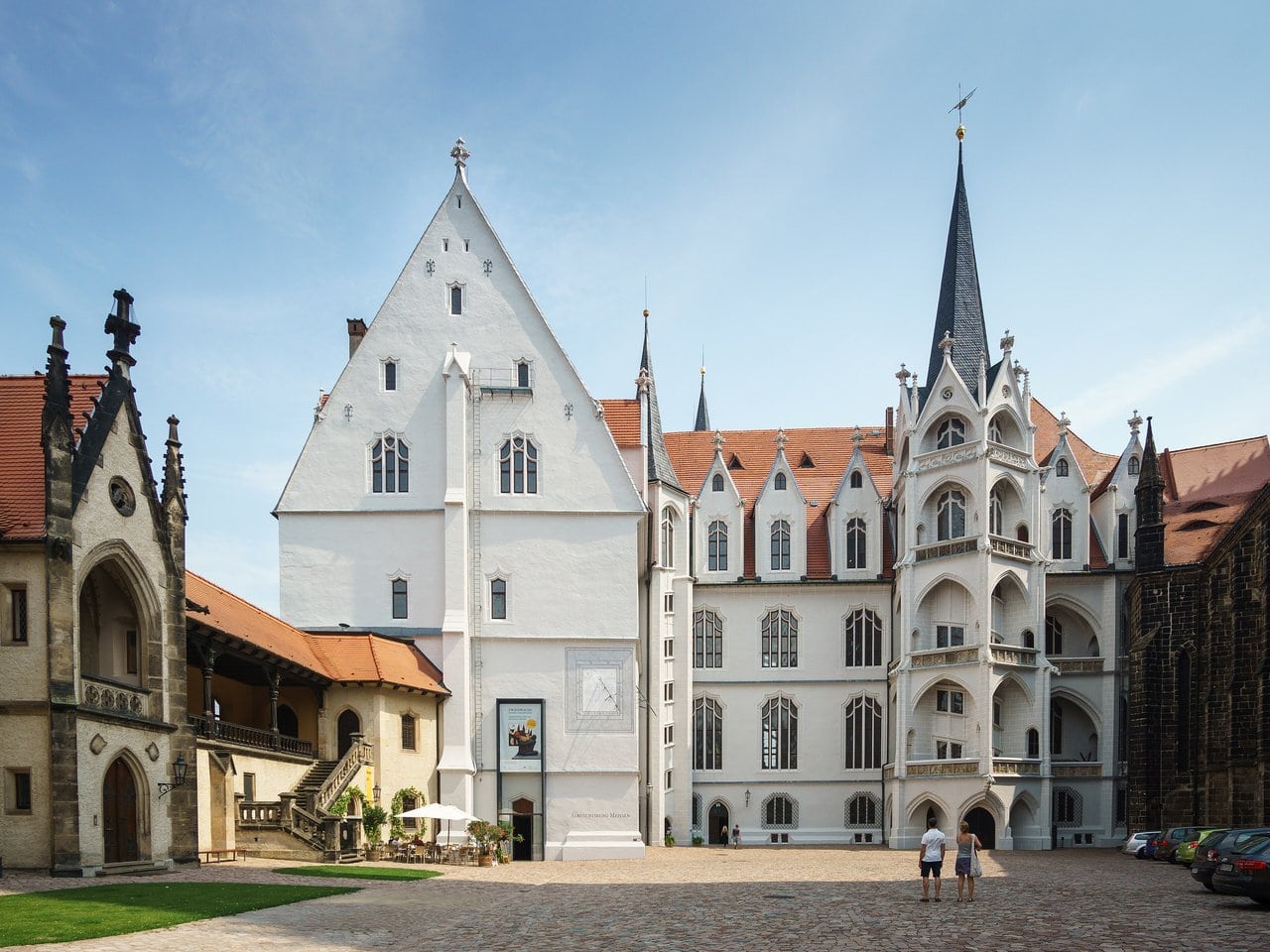
Work moved quickly for a building of its size. The old margravial Kemenate came down in 1472, vaulting began in 1476, and because the hillside fell away so sharply toward the river, the cellars had to be carried over two full stories before the ground floor and three upper floors could rise above them. Arnold did not live to see it finished; he died in 1481 or 1482, and his pupil Konrad Pflüger carried the work on. The central and south wings were complete by about 1485, the last roofs went up around 1490, and the great interiors were not fully fitted out until Duke Georg the Bearded brought in Jakob Heilmann of Schweinfurt to finish the upper floors between 1521 and 1524. From first stone to final vault, the Albrechtsburg took more than half a century, yet it reads as one idea rather than many, because one mind set it down at the start.
The architecture of innovation
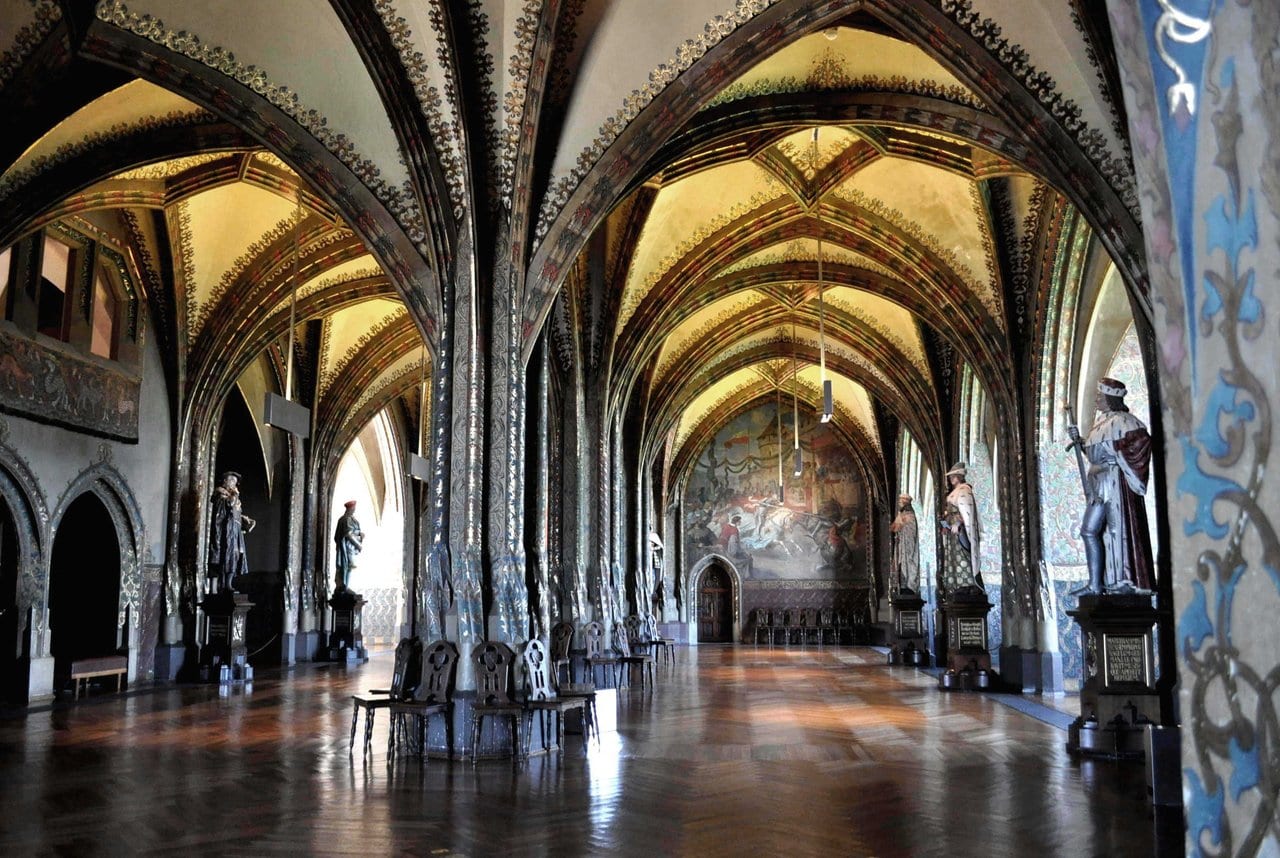
What makes the Albrechtsburg a landmark is not its size but its invention. Arnold von Westfalen filled it with ideas that were new to monumental building, and the most striking of them looks up from almost every room. These are the Zellengewölbe, or cell vaults: ceilings built of brick set on edge and folded into sharp, faceted concave cells, with no projecting ribs at all. They were cheaper to raise than a traditional ribbed vault and lighter on the walls, and they gave Arnold a reputation as a master of vaulting that outlived him. The Albrechtsburg is their first great showcase, and the technique spread from here across Saxony, Bohemia, and the Baltic.
The windows tell the same story of comfort over caution. In place of narrow Gothic openings, Arnold cut broad Vorhangbogenfenster, curtain-arch windows whose tops dip in a shallow double curve like a hung cloth. They flood the halls with daylight that no fortress would ever have risked, and they became a signature of late Gothic Saxony. Grandest of all is the Großer Wendelstein, the great spiral staircase set in its own polygonal tower on the courtyard side. Its steps wind around an open, filigree core rather than a solid newel post, so the whole stair seems to float, and it has often been called the most beautiful staircase of the German Gothic. That stair was not only handsome but useful: it linked the floors in one grand gesture and let a procession of guests ascend in full view, exactly the kind of theater a fortress had no use for.
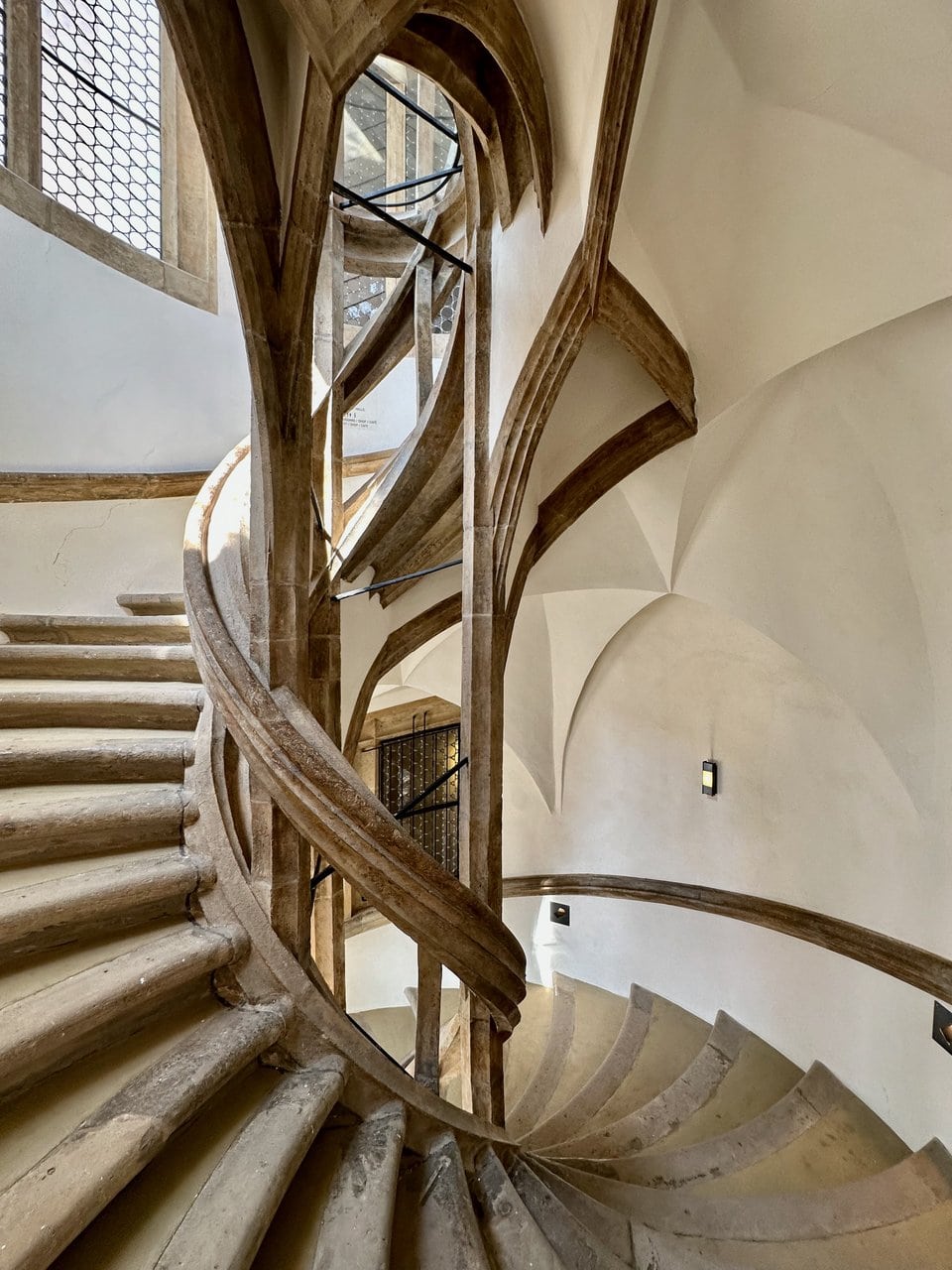
Behind these flourishes runs a quiet structural daring. Arnold braced the building with a system of wall piers that thicken as they climb, carrying the loads of the upper halls without the bulk of a defensive wall. Inside, the plan set great public rooms above the service floors, so that climbing the Wendelstein carried a visitor up toward the grandest spaces, among them the cavernous Große Hofstube. Laid up from brick set on edge, the cell vaults needed no timber centering to build and little upkeep once closed, which helps explain why so many survive intact after five centuries. The result is late Gothic in its detail, with traceried windows and pinnacled gables, yet already Renaissance in its instinct: a building organized around space, light, and display. When Georg the Bearded’s mason closed the last upper rooms with a looping net of Schlingrippen in the 1520s, he was finishing a palace whose vocabulary the rest of Germany would spend a century catching up to.
An empty throne
The palace that was meant to crown a shared reign was orphaned by the reign itself. In 1485, while the masons were still at work, Ernst and Albrecht divided their inheritance in the Leipzig Division, splitting the House of Wettin into two lines that would never fully reunite. Ernst took the electoral title and the western lands of Thuringia, the branch that later held the Wartburg and the fortress at Coburg. Albrecht took Meissen and the east. The new palace, conceived for two brothers ruling as one, suddenly belonged to a divided family, and its purpose dissolved with the partnership that had commissioned it.
Albrecht’s son, Duke Georg the Bearded, finished the interiors but never made the Albrechtsburg his home. He governed from Dresden, which from this point steadily eclipsed Meissen as the Saxon residence, and his successors followed him downriver. Georg is better remembered for another struggle: as the most determined Catholic prince of his generation, he spent his life opposing Martin Luther and the Reformation that was reshaping the lands around him, a fight traced in our history of the Reformation and the castle. In 1547, after the Schmalkaldic War, the electoral title itself passed from Ernst’s branch to Albrecht’s Albertine line, so the family left with the unused palace at last won the crown, only to wear it downriver in Dresden. Meissen’s palace, meanwhile, sat almost unused. It hosted the occasional reception or hunting party and otherwise stood empty, an expensive monument to a moment that had passed.
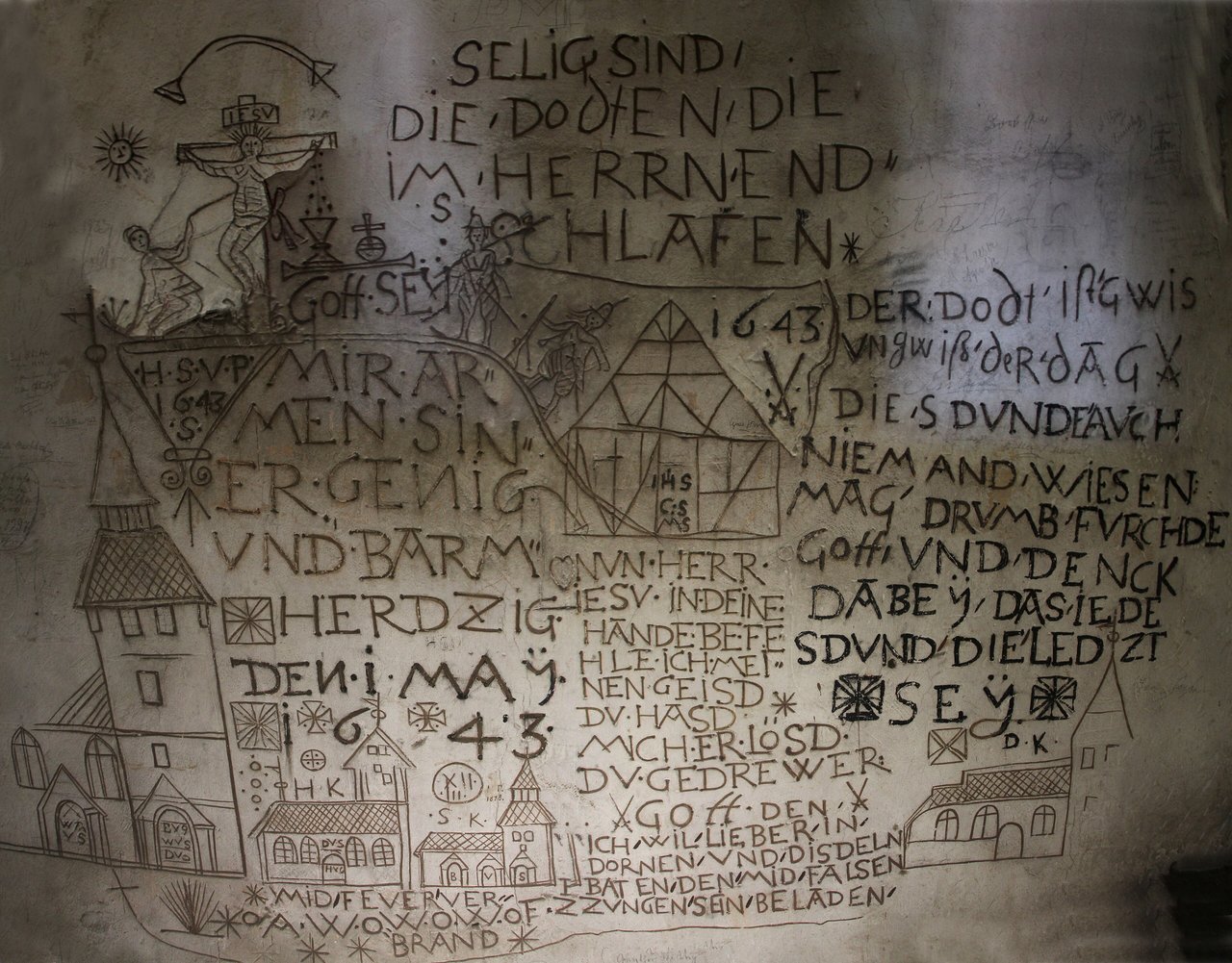
Neglect brought damage. During the Thirty Years’ War a Swedish garrison occupied the hill in 1645 and left the building battered. Repairs in the 1670s patched the worst of the damage, but no court returned, and the rooms Arnold had filled with light stood dim and idle. Even its name was an afterthought: only in 1676 did Elector Johann Georg II christen the palace the “Albrechtsburg,” in honor of Albrecht the Bold, more than two centuries after the first stone was laid. By then the most representative residence in Saxony had been, for most of its life, a beautiful and largely useless shell. It would take an alchemist, a king, and a secret to give it a second life.
White gold
Augustus the Strong, Elector of Saxony and King of Poland, wanted gold. What he got instead changed the palace forever. In his service was Johann Friedrich Böttger, a young apothecary’s assistant who had boasted that he could transmute base metal into gold, and whom Augustus held in protective custody to keep that promise within Saxon walls. When the Swedish army of Charles XII pressed into Saxony and the Treaty of Altranstädt of 1706 threatened to force Böttger’s surrender, Augustus had him spirited away for safekeeping to the fortress of Königstein, the great rock-top stronghold upriver that never fell to an enemy. Böttger had already tried to flee once and been recaptured in Bohemia; now, hidden at Königstein and then returned to work, he was a prisoner of his own talent.
That talent, redirected, made history. Working with the scientist Ehrenfried Walther von Tschirnhaus, Böttger abandoned the search for gold and pursued a different recipe: hard-paste porcelain, the translucent white ceramic that until then only China and Japan could make. A fine red stoneware came first, around 1707, and then, in 1708, the true white porcelain that Europe had failed for a century to reproduce. Tschirnhaus died that same year; Böttger refined the formula alone and, on January 23, 1710, Augustus founded the Royal-Polish and Electoral-Saxon Porcelain Manufactory to exploit it.
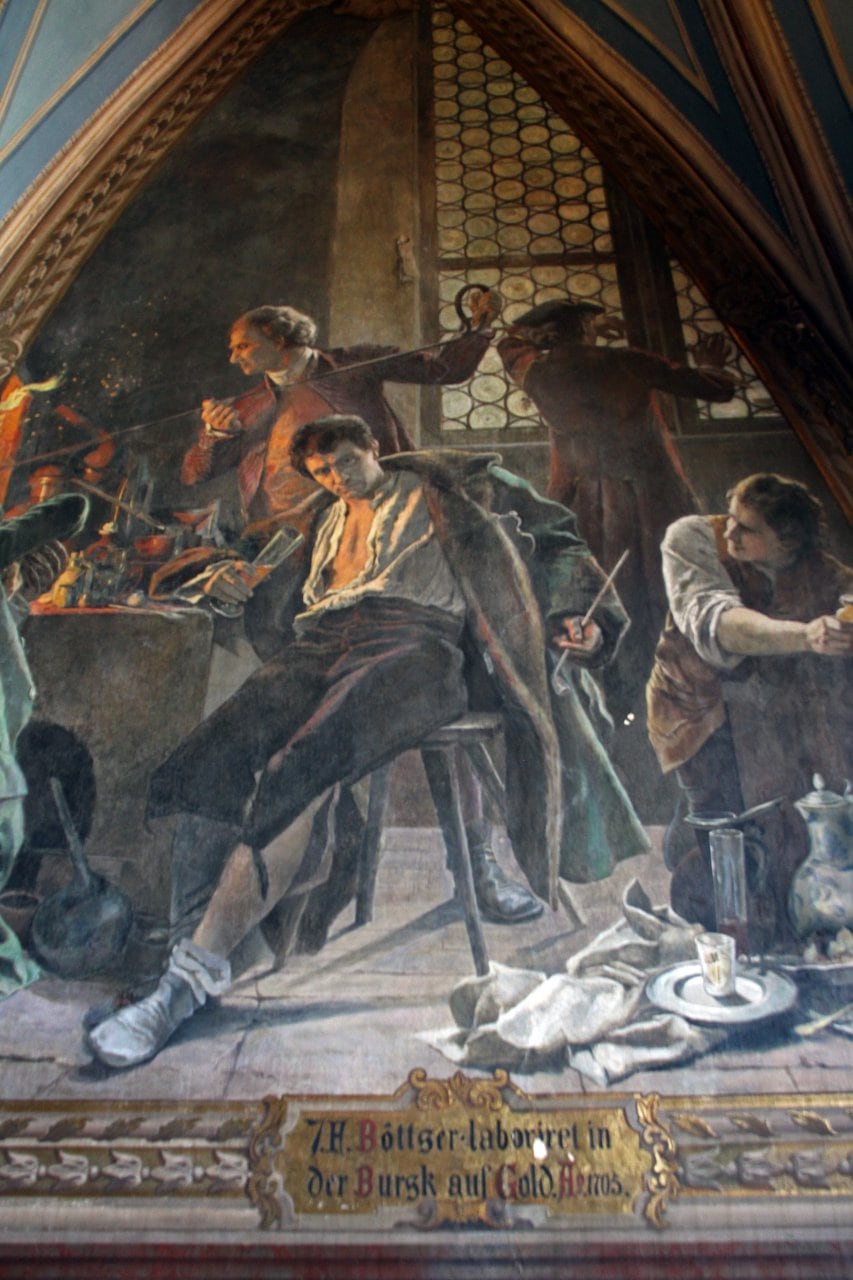
He needed somewhere to guard the secret, and the empty Albrechtsburg was ideal: large, defensible, and standing apart on its rock. Production began in the palace on June 6, 1710, and for the next century and a half the great halls built for electors served as kilns, workshops, and grinding rooms. Secrecy governed everything. Workers were sworn to silence, the formula for the arcanum was divided among trusted hands so that no single person held all of it, and the palace served as much as a strongroom as a factory. The crossed blue swords that the manufactory adopted around 1722 became the oldest trademark in continuous use in Europe, and Meissen porcelain carried the fame of Saxony across the world. Alongside the white services, the early works also produced Böttger’s hard red stoneware, cut and polished like a semiprecious stone, a luxury ware in its own right. The works grew to more than seven hundred employees by 1766. They survived a fire in 1773 that brought down one of Arnold’s vaults over the great hall, a sign of how hard the industrial tenants were on the medieval fabric. The works remained until 1863, when production moved to a purpose-built factory in the Triebisch valley below the town, where MEISSEN porcelain is still made today. Böttger himself never saw that triumph mature; released from his confinement in 1714, worn out by years of toxic experiment, he died in 1719 at the age of thirty-seven.
A painted picture book
When the porcelain workers left, they took with them the partitions, furnaces, and false floors that had filled the palace for one hundred and fifty-three years, and for the first time since the Wettins the Albrechtsburg stood as architecture again. The Saxon state restored it with unusual care, treating the building as a monument to be conserved rather than merely repaired, an early instance of the German preservation movement that was also rebuilding the Wartburg in these decades. Then came a bolder idea. Rather than refurnish the empty rooms, Saxony decided to paint its own history onto their walls.
The concept, devised by the court official Wilhelm Rossmann, was a “painted picture book” of the Wettin dynasty and the Saxon state, a sequence of monumental murals that would lead a visitor through the centuries from room to room. Funded in part by the French reparations that followed the war of 1870 to 1871, eleven painters set to work from 1875, most of them drawn from the Dresden academy, and over the following decade they covered the upper halls with more than fifty large scenes in a durable oil-and-wax technique. Julius Scholtz took the largest commission, nine paintings on the life of Albrecht the Bold; Anton Dietrich and Erwin Oehme were among the others, with interiors and furnishings supplied by Ernst Haendel of Weimar. Their subjects ran the length of Saxon history, from Henry the Fowler seizing the rock to the partition of the duchy and the founding of the porcelain works, so that the palace was made to narrate the very events that had shaped it. The cycle remains the most extensive historicist mural program in any German castle.
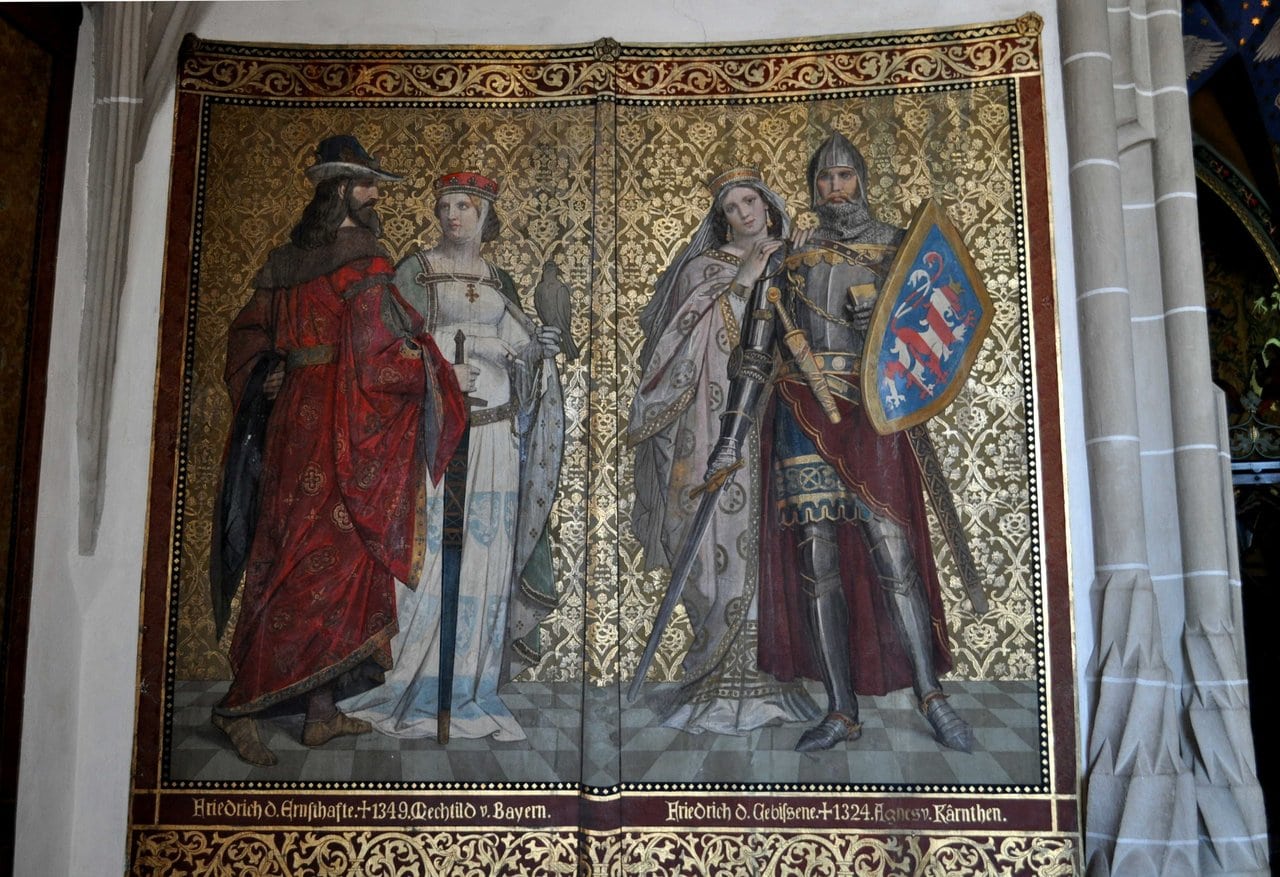
In 1881 the Albrechtsburg opened to the public as a memorial to Saxon history, and it has been a museum ever since. History gave the rooms one more scene of their own: on October 9, 1990, in the great hall once filled with porcelain kilns, the Free State of Saxony was formally re-established after German reunification. A thorough modern restoration, completed in 2011, opened every floor and installed a permanent exhibition that runs through the building’s many lives, from Arnold’s architecture to Böttger’s secret to Rossmann’s painted history.
Visiting the Albrechtsburg in 2026
The Albrechtsburg sits at the top of the Burgberg in the old town of Meissen, a short, steep walk up from the river and the marketplace. Meissen is an easy day trip from Dresden, around forty minutes on the S1 suburban line along the Elbe, and the castle shares its hill with Meissen Cathedral, so the two are naturally visited together. The MEISSEN porcelain works, the manufactory’s modern home and visitor center, lie a little farther on in the Triebisch valley, which makes a porcelain-themed combined ticket worth considering. Entry tickets and local tours can also be booked in advance through GetYourGuide.
The permanent exhibition fills all five floors and is organized in five themed sections covering the architecture, courtly life, Saxon state history, the porcelain era, and the nineteenth-century murals, with augmented-reality tablets and media stations included in the admission price. Most visitors spend one and a half to two hours inside. The upper halls are unheated in winter for conservation reasons, so a warm layer is wise between November and February.
In 2026 the castle is open from March through October on Mondays and Wednesdays to Sundays, 10:00 to 18:00, and closed on Tuesdays except public holidays; in the winter season it closes an hour earlier, at 17:00. It shuts on 24 and December 25 and opens late, from 11:00 to 16:00, on January 1. A short maintenance closure usually falls in January, so it is worth checking the operator’s site before a winter visit. Anyone staying overnight can compare hotels in and around Meissen.
Some links on this page are affiliate links, which means StoneKeep Atlas may earn a small commission, at no extra cost to you, if you book through them.
| Ticket (2026) | Price |
|---|---|
| Adult | €12.00 |
| Reduced | €10.00 |
| Child (6–16) | €4.50 |
| Group (15+ per person) | €10.00 |
| School group (15+ per person) | €4.50 |
| Combined with MEISSEN porcelain manufactory | €24.00 (reduced €18.00, family €45.00) |
| Combined with Meissen Cathedral | available; valid three days |
Beyond Albrechtsburg
The Albrechtsburg belongs to a small Saxon family of great houses worth seeing in one trip. Downriver toward Dresden stands Moritzburg, the Albertine Wettins’ baroque hunting palace set in its own lake, while upstream the cliff-top fortress of Königstein, where Böttger was once hidden, guards the gorge of Saxon Switzerland. Together they sketch three faces of the same dynasty: the palace, the pleasure seat, and the stronghold.
To follow the other half of the Wettin story, after the 1485 partition, look west to the Ernestine line and its monuments at the Wartburg above Eisenach and the Coburg Fortress. The residential idea that Arnold von Westfalen pioneered reached its full baroque flowering in the great prince-bishops’ palaces, above all the Würzburg Residence and the Munich Residenz. And the Albrechtsburg’s nineteenth-century rebirth as a painted memorial places it within the wider story of the 19th-century romantic revival of German castles, the same impulse that remade Schwerin and Wernigerode into dynastic showpieces in the same decades.
Conclusion
Few buildings carry as many beginnings as the Albrechtsburg. It is the first German palace, the prototype of the Schloss that every later prince would imitate; it is the cradle of European porcelain, where a captive alchemist’s white gold first left the kiln; and it is one of the earliest German monuments to be consciously preserved and turned into a museum of its own past. That it achieved all this while serving for barely a generation as the residence it was built to be is the central paradox of the place. The Albrechtsburg was a palace that hardly housed a prince, and it became immortal anyway.
Principal Sources
- Dehio, Georg. Handbuch der Deutschen Kunstdenkmäler. Sachsen I: Regierungsbezirk Dresden. Munich: Deutscher Kunstverlag, 1996.
- Donath, Matthias, and André Thieme. Albrechtsburg Meissen. Leipzig: Edition Leipzig, 2011.
- Lemper, Ernst-Heinz. Die Albrechtsburg zu Meißen. In Hans-Joachim Mrusek, ed., Die Albrechtsburg in Meißen. Leipzig, 1972.
- Rauda, Fritz. Die Albrechtsburg zu Meißen und ihr Meister. Dresden, 1925.
- Sächsische Biografie (Institut für Sächsische Geschichte und Volkskunde) and the Deutsche Biographie, entries on Arnold von Westfalen.
Current visitor information, the building chronology, and the porcelain history draw on the official operator, the Albrechtsburg Meissen (Staatliche Schlösser, Burgen und Gärten Sachsen), together with the official MEISSEN porcelain manufactory and the Sächsischer Museumsbund. Operator pages fetched June 2026.
Image credits. Hero, Albrechtsburg Castle and Meissen Cathedral above the Elbe: AdobeStock. Aerial of the Burgberg: Derbrauni, CC BY 4.0, via Wikimedia Commons. Courtyard with the Großer Wendelstein: Radler59, CC BY-SA 4.0, via Wikimedia Commons. Cell vaults of the Große Hofstube: Lydia, CC BY-SA 3.0, via Wikimedia Commons. The Großer Wendelstein staircase: Perigrinator, CC BY-SA 4.0, via Wikimedia Commons. The 1643 wall inscription: Gerd Eichmann, CC BY-SA 4.0, via Wikimedia Commons. Böttger mural: Gerd Eichmann, CC BY-SA 4.0, via Wikimedia Commons. Wettin dynastic mural: Lydia, CC BY-SA 3.0, via Wikimedia Commons. Freely licensed images are resized to fit; otherwise unaltered.