
Orangery Palace
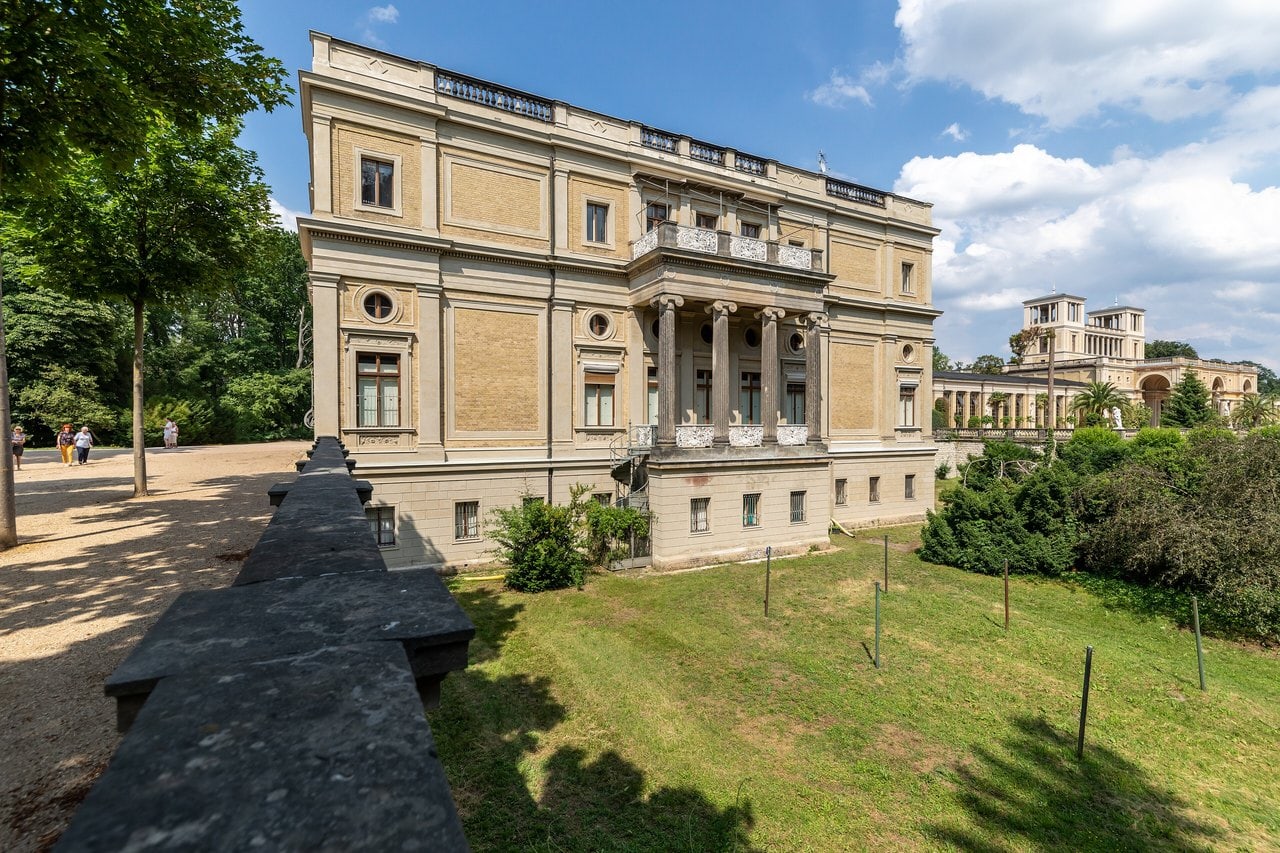
The Orangery Palace is the largest building in Potsdam’s Sanssouci Park, and the one that comes closest to showing what was going on inside the head of the king who built it. Friedrich Wilhelm IV of Prussia loved Italy with the ardor of a man who spent his life imagining a country he reached only late and briefly. On the wooded ridge above Sanssouci he set out to build a fragment of it: a Renaissance palace more than 300 meters long, all arcades, terraces, and twin towers, wrapped around two enormous glasshouses for the citrus trees that gave the building its name. Part royal guesthouse, part picture gallery, part working greenhouse, it was meant to crown a far grander composition, a processional avenue marching up the hillside in homage to ancient Rome. That avenue was never finished, and neither, in his lifetime, was the palace. What stands today is the surviving heart of the scheme, and one of the great Italianate set pieces of nineteenth-century Europe.
Quick Facts
| Location | Sanssouci Park, Potsdam, Brandenburg, Germany |
| Built | 1851–1864 |
| Patron | King Friedrich Wilhelm IV of Prussia |
| Architects | Friedrich August Stüler and Ludwig Ferdinand Hesse, working from the king’s own sketches |
| Style | Italian Renaissance Revival |
| Length | About 304 meters |
| Current use | Palace museum (closed for restoration); working plant halls; state archive |
| Operator | Stiftung Preußische Schlösser und Gärten Berlin-Brandenburg (SPSG) |
| UNESCO | Palaces and Parks of Potsdam and Berlin (inscribed 1990) |
| Official site | spsg.de |
A King in Love with Italy
Friedrich Wilhelm IV came to the Prussian throne in 1840 with a reputation already fixed in the minds of his court: the dreamer, the sketcher, the “romantic on the throne.” He drew constantly, filling pages with buildings he longed to raise, and his imagination ran south. Italy, and Rome above all, was the country against which he measured everything, even though his actual time there amounted to a handful of short journeys. Where his great-granduncle Frederick the Great had looked to France for his models, this king looked across the Alps, to the villas of the Renaissance and the ruins of antiquity.
An orangery was the natural vehicle for that longing. Since the Baroque, a heated hall full of orange and lemon trees had been a mark of princely standing across Europe, a way of keeping a piece of the Mediterranean alive through a northern winter. Sanssouci already owned such buildings, but by the 1840s they were aging and cramped, and a mere working greenhouse was never what this king had in mind. He wanted a palace and an orangery fused into one structure, a place where the plants of the south and the art of the south would share the same walls. Just downhill stood Sanssouci, the vineyard retreat Frederick had raised a century before, and the new building was conceived from the start as the crowning piece of that landscape rather than an outbuilding within it.
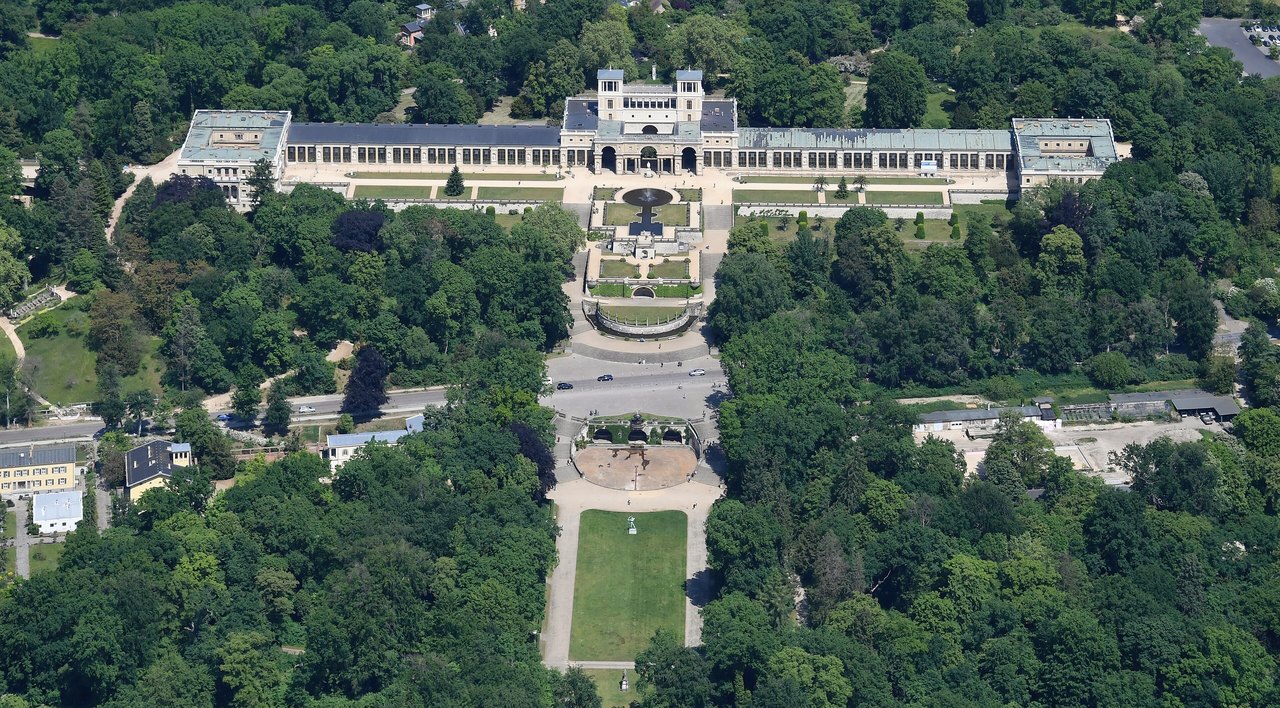
Siting it mattered as much as designing it. Friedrich Wilhelm IV chose the Bornstedt ridge along the northern edge of the park, high enough to command the whole of Sanssouci and to be seen from far across the surrounding plain. Below the building the landscape gardener Peter Joseph Lenné laid out terraces and parterres that stepped the eye down toward the older gardens, knitting the newcomer into a composition that had been growing for a hundred years. From the very first sketch, this was to be architecture as a view, a thing to be admired from a distance as much as entered.
The Triumphal Way That Was Never Built
From the beginning, the palace was only ever meant to be one element of something far larger. Friedrich Wilhelm IV planned a triumphal way, a via triumphalis nearly two kilometers long, climbing from a Triumph Gate at the foot of the hill to the Belvedere on the Klausberg at its summit. Classical buildings and terraced gardens were to line the route in a deliberate echo of imperial Rome, and the whole avenue carried a personal motive: it was conceived as a tribute to Frederick the Great, whose Sanssouci lay at its center. The Orangery was to be its grandest single monument, a hinge between the old garden and the new processional spine.
Grand plans of this kind needed land, money, and time, and the king struggled to secure any of the three. Buying the strips of farmland the avenue required meant years of negotiation with their owners. Prussia’s finances were stretched thin, and a monarch who preferred drawing to governing was not the man to force a costly scheme through a reluctant treasury.
Then came 1848. Revolutions across Europe shook thrones that spring, and the monarchy that steadied itself afterward had little appetite, and less money, for triumphal avenues. A decade later a series of strokes left the king incapacitated, and in 1858 he handed the regency to his brother, the future Kaiser Wilhelm I, who felt no obligation to finish his sibling’s Roman fantasy. In the end only two fragments of the great avenue ever rose from the ground: the Triumph Gate near the bottom of the hill, and the Orangery Palace at its heart. What survives is the magnificent piece of a boulevard that exists, complete, only on paper.
Stüler, Hesse, and a Borrowed Italy
Credit for the design tends to get scrambled in the retelling, so it is worth setting straight. Its earliest ideas reach back to Karl Friedrich Schinkel, the commanding figure of Prussian architecture, who sketched concepts for a new orangery on this spot as early as 1826. After his accession the king leaned on Schinkel’s gifted pupil Ludwig Persius, but Persius died in 1845, before a stone was laid. What actually rose between 1851 and 1864 is the work of Friedrich August Stüler and Ludwig Ferdinand Hesse, who developed the executed plans in close dialogue with the king’s own drawings. Persius shaped early layout ideas that survived into Stüler’s scheme, and Schinkel supplied the first spark, yet the structure on the hill is, properly speaking, a Stüler and Hesse design.
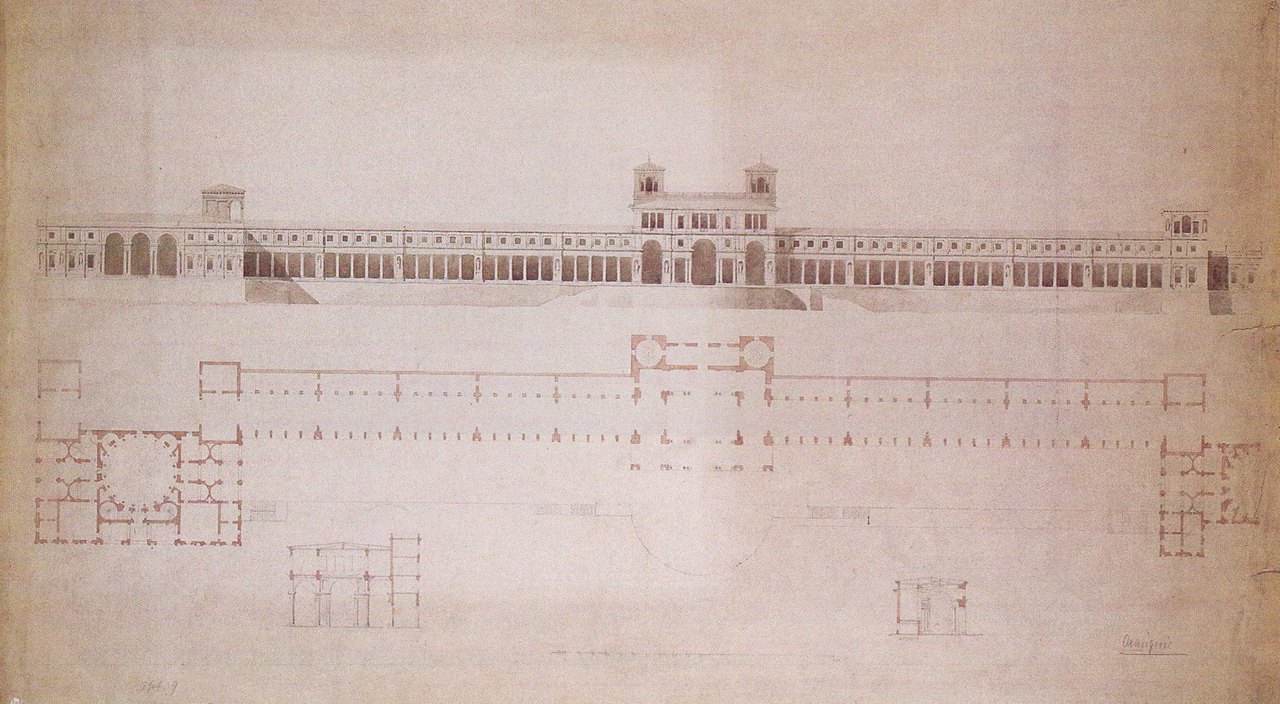
What they produced reads like a catalog of Italian quotations. Its twin-towered central block looks to the Villa Medici in Rome; the long, mezzanine-banded fronts of the plant halls echo the Arno façade of the Uffizi in Florence; further motifs were borrowed from the Villa Doria Pamphilj. Between the two wings opens a colonnaded court, the Säulenhof, framed by an arcade and looking out over the terraces below. At roughly 304 meters end to end, with towers about 27 meters high, the finished palace became the longest building in Sanssouci Park by a wide margin.
Stylistically it sits at the summit of a long Prussian experiment. For a generation the Schinkel circle had been translating the Italian villa into a northern idiom, and you can trace the line through earlier houses such as Charlottenhof and Glienicke, smaller and more intimate than the Orangery but built from the same vocabulary of low roofs, round arches, and warm stucco. Here that idiom is turned monumental, the most assertively Italian of all the Potsdam palaces. For the wider story of how the style took root along the Havel, see our history of Schinkel, Persius, and the Prussian romantic landscape.
The Raphael Hall
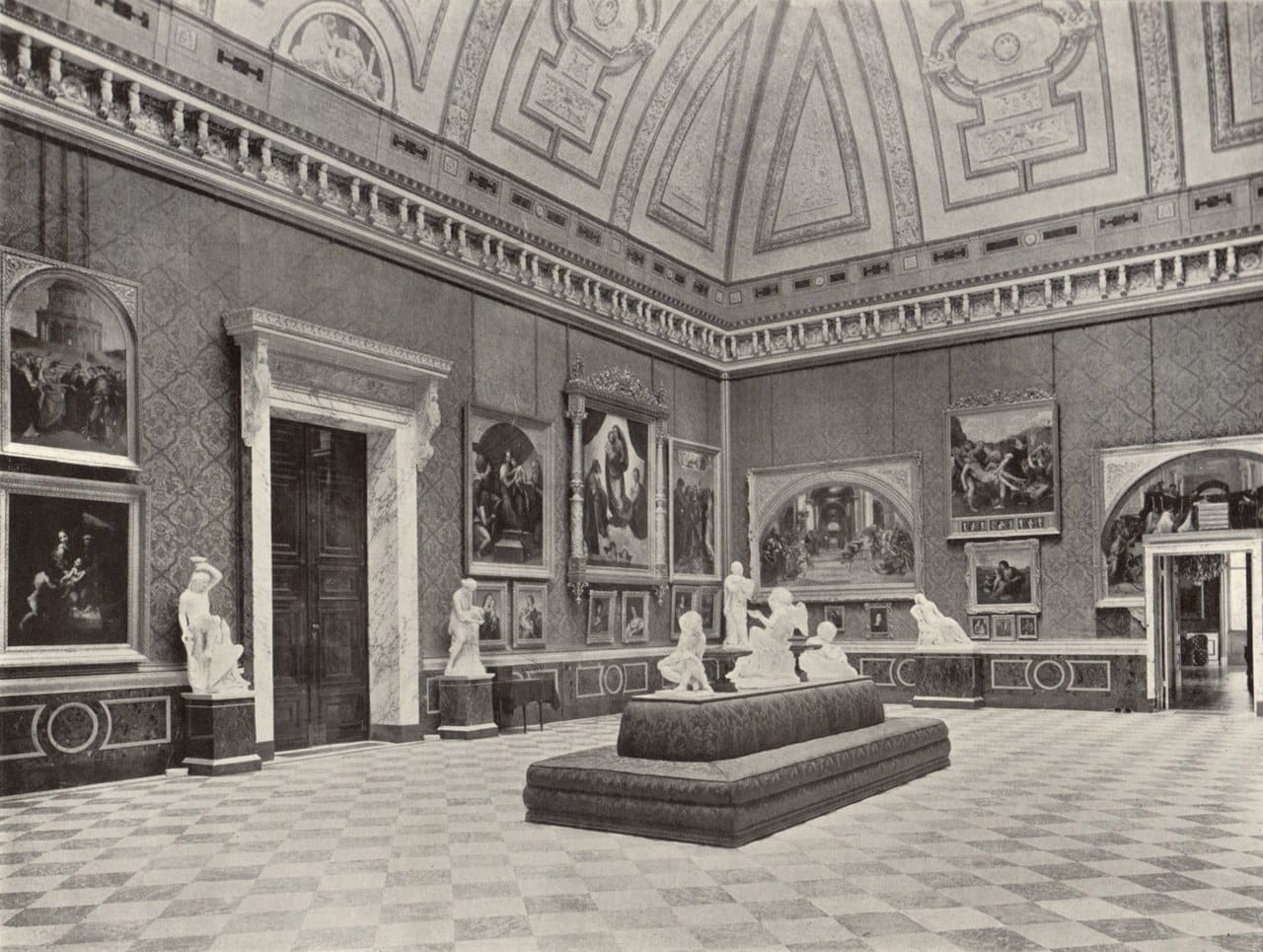
At the heart of the central block, beneath a glazed roof that floods it with even daylight, lies the Raphael Hall. This is the building’s showpiece interior, and it spares nothing: red silk on the walls, gilded frames, white marble sculpture, and more than fifty copies of paintings by Raphael, the Renaissance master Friedrich Wilhelm IV revered above all others. Reproduced here in oil are the works a nineteenth-century traveler would have crossed Europe to see, the Sistine Madonna and the Transfiguration among them, hung close together so that the whole of Raphael could be taken in at a glance.
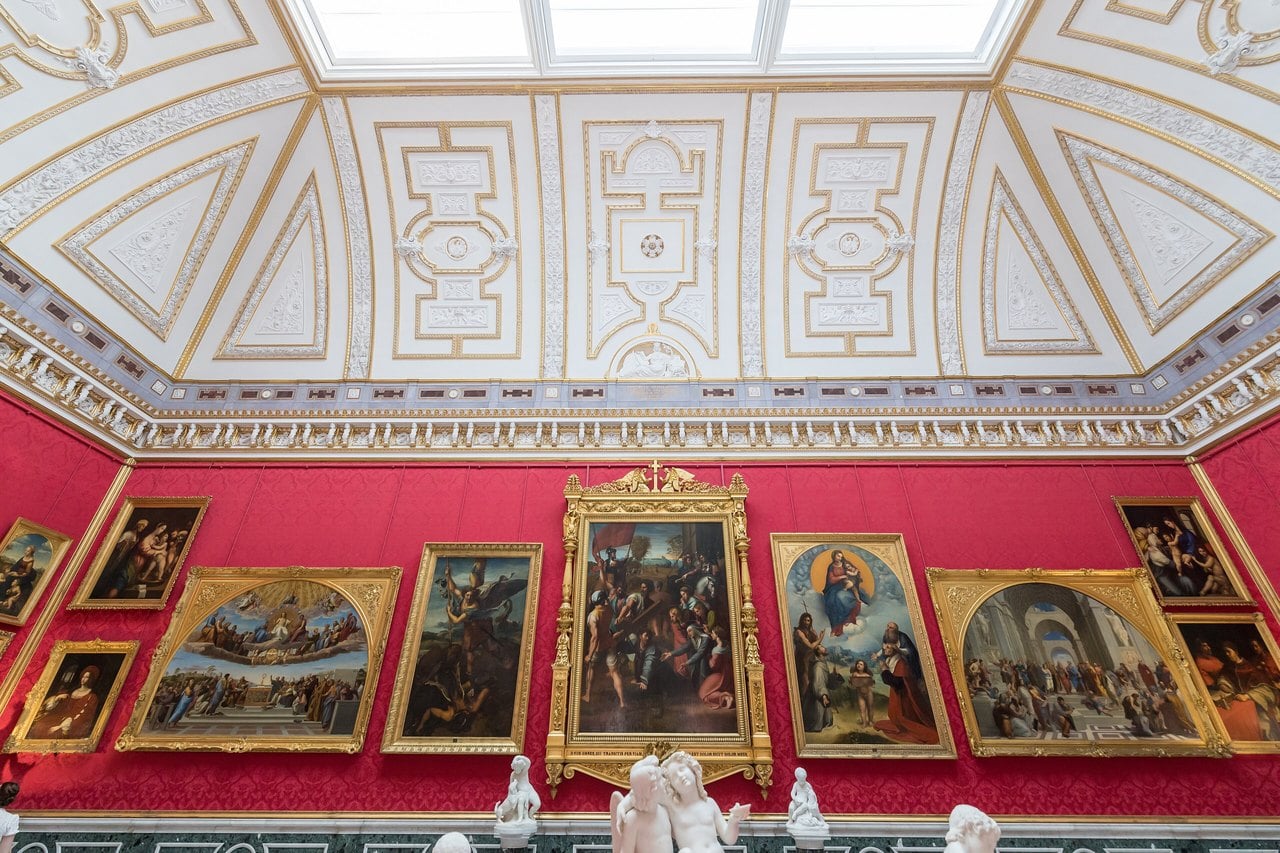
None of this began with Friedrich Wilhelm IV. His father, Friedrich Wilhelm III, had started the collection: its first piece was a full-size copy of the Sistine Madonna by Friedrich Bury, commissioned in 1804, and the elder king added more after seeing Napoleon’s looted originals in the Louvre in 1814. His son took up the idea and ran with it, enlarging the set to around forty-six paintings by the time of his death and roughly fifty within a few years more. A whole generation of Prussian painters supplied them, some traveling to Italy and Paris to copy the originals at their source.
Public access was part of the plan from the outset. Modeled on the Sala Regia of the Vatican, the hall was designed as a museum and meant to be open to ordinary visitors rather than reserved for the court. That ambition was characteristic of the age, when a ruler displayed great art as much for the instruction of his subjects as for his own pleasure. A complete Raphael gathered under one skylit roof would bring the highest achievement of the Italian Renaissance within reach of people who would never see Rome.
Photographs from around 1900 show the hall almost exactly as it stands now, the same dense hang of frames, the same sculptures ranged along the floor. For more than a century it has been one of the few interiors of its kind preserved intact in Germany, which is part of why its present closure for restoration carries such weight.
The Guest Apartments and the Tsarina’s Legend
Two royal apartments flank the Raphael Hall, one to the west and one to the east, furnished in the lavish Second Rococo style the court favored in the 1850s. Their rooms read like an inventory of nineteenth-century luxury: a green bedroom, an amber-and-ivory room with gilded seating and violet velvet, a chamber lined in lapis lazuli, a Boulle room of brass-and-tortoiseshell inlay, and, the standout, the Malachite Room. Russian gifts fill it, among them a great rhodonite vase, and its malachite-veneered surfaces lend the whole space an unmistakably Russian character.
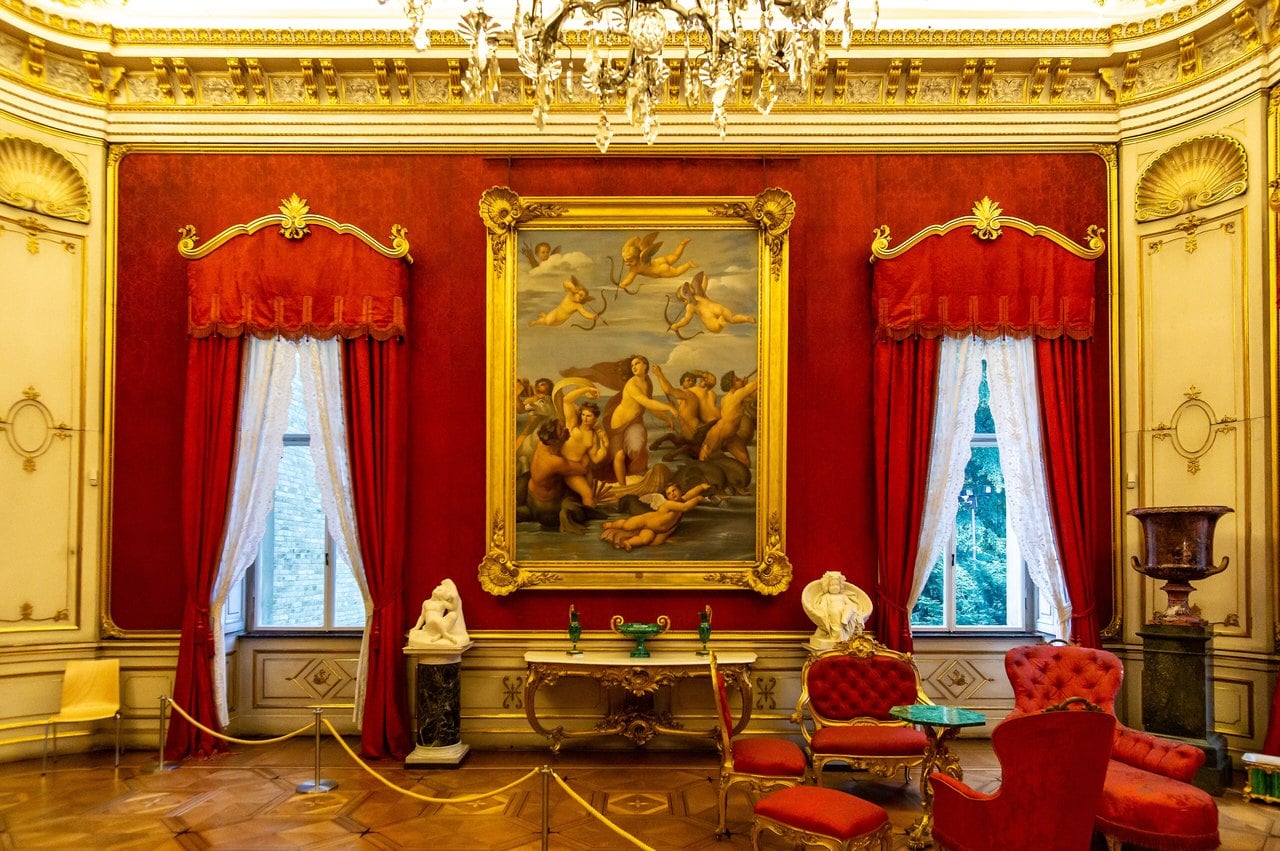
That character has a genuine basis. Friedrich Wilhelm IV’s sister, Charlotte of Prussia, had married the future Tsar Nicholas I and become the Empress Alexandra Feodorovna, and the ties between the Prussian and Russian courts ran deep in stone, ceremony, and marriage. Malachite was itself a Russian signature, quarried in the Urals and worked in St. Petersburg into the veneers and objects that dressed imperial interiors. So much of it at the Orangery was a courtesy between two royal houses bound by blood, a piece of diplomatic decoration as much as private taste.
From that grain of truth grew a far larger story. Guidebooks from the late 1950s onward began to claim that the Orangery had been built as a guest palace for the tsarina, raised by a loving brother for his sister the empress. It is an appealing tale, and it is not quite true. Neither the construction plans nor any contemporary account mentions an intention to build the palace for Alexandra Feodorovna, and she visited the finished apartment only once, in 1859. These were guest apartments in the ordinary sense, used by whichever royal visitor was in residence. A palace raised for a beloved sister turned empress makes a lovely legend, but it is a later embellishment rather than a documented fact.
A Working Orangery
For all its art and ceremony, the building exists because of its plants. Two great halls flank the central block, each about 103 meters long and 16 meters wide, together offering roughly 1,650 square meters of floor. These are no museum exhibits. Every autumn the potted trees of Sanssouci are wheeled inside to wait out the cold, more than a thousand tubbed plants of nearly thirty species, from citrus and palms to agaves, kept through the winter at a steady four to six degrees Celsius. Few overwintering operations in Europe match it for scale; it belongs in the same company as the great glasshouses of Vienna and Versailles.
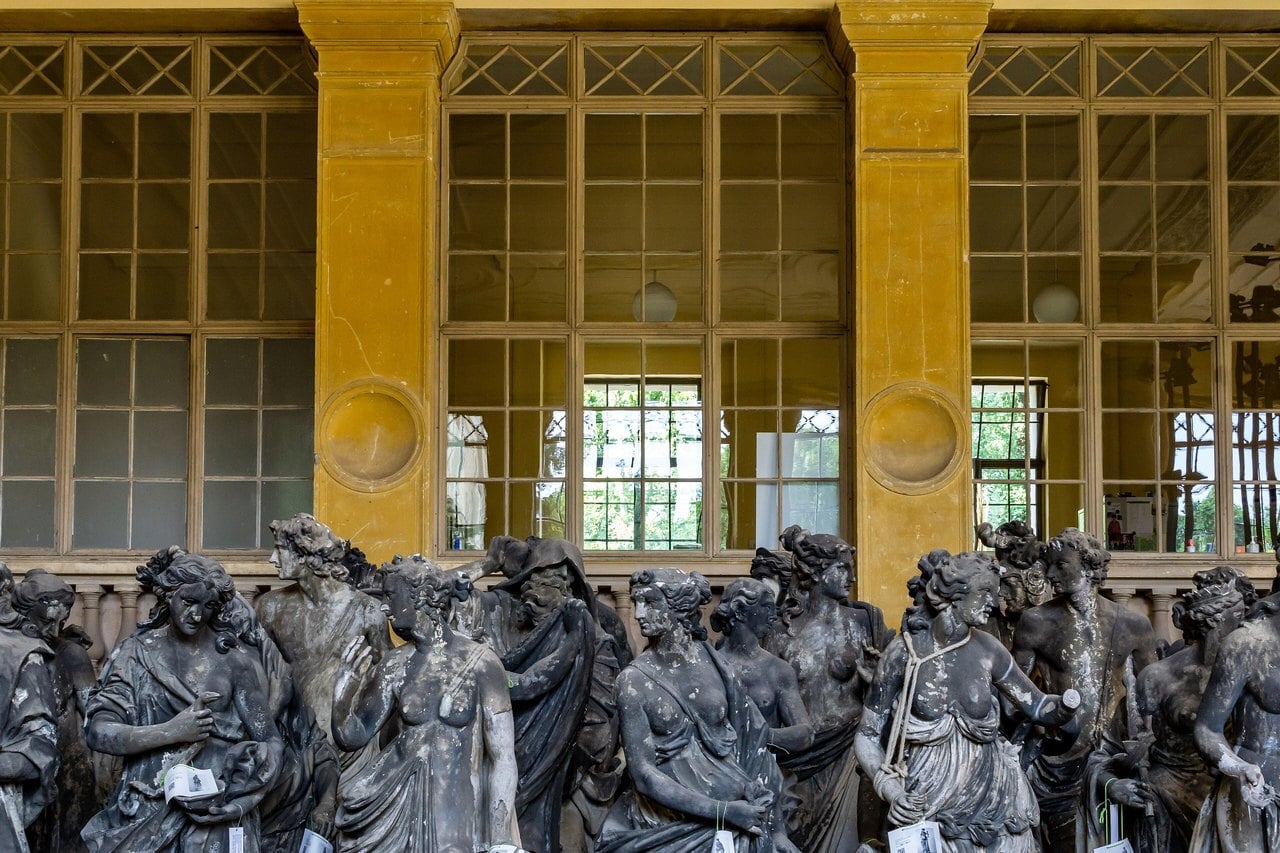
One detail sets the halls apart even from those rivals. Their heating system, installed when the building went up in the 1850s, still runs. According to the foundation’s own project leadership, it is the only original orangery heating of its kind still in operation anywhere in Germany, although its boiler has long since been converted from coal to gas. Keeping that system alive through the present restoration is a quiet feat of conservation, a working machine tended with the same care usually reserved for paintings.
In summer the halls change character completely. With the plants moved back outdoors, the long empty galleries become one of the largest indoor event spaces in the Berlin-Brandenburg region, each able to hold around a thousand people for concerts, dinners, and receptions. That double life, nursery in winter and grand hall in summer, is part of why the foundation is so determined to keep the structure sound, and part of what the current works are meant to secure.
The Towers and the View
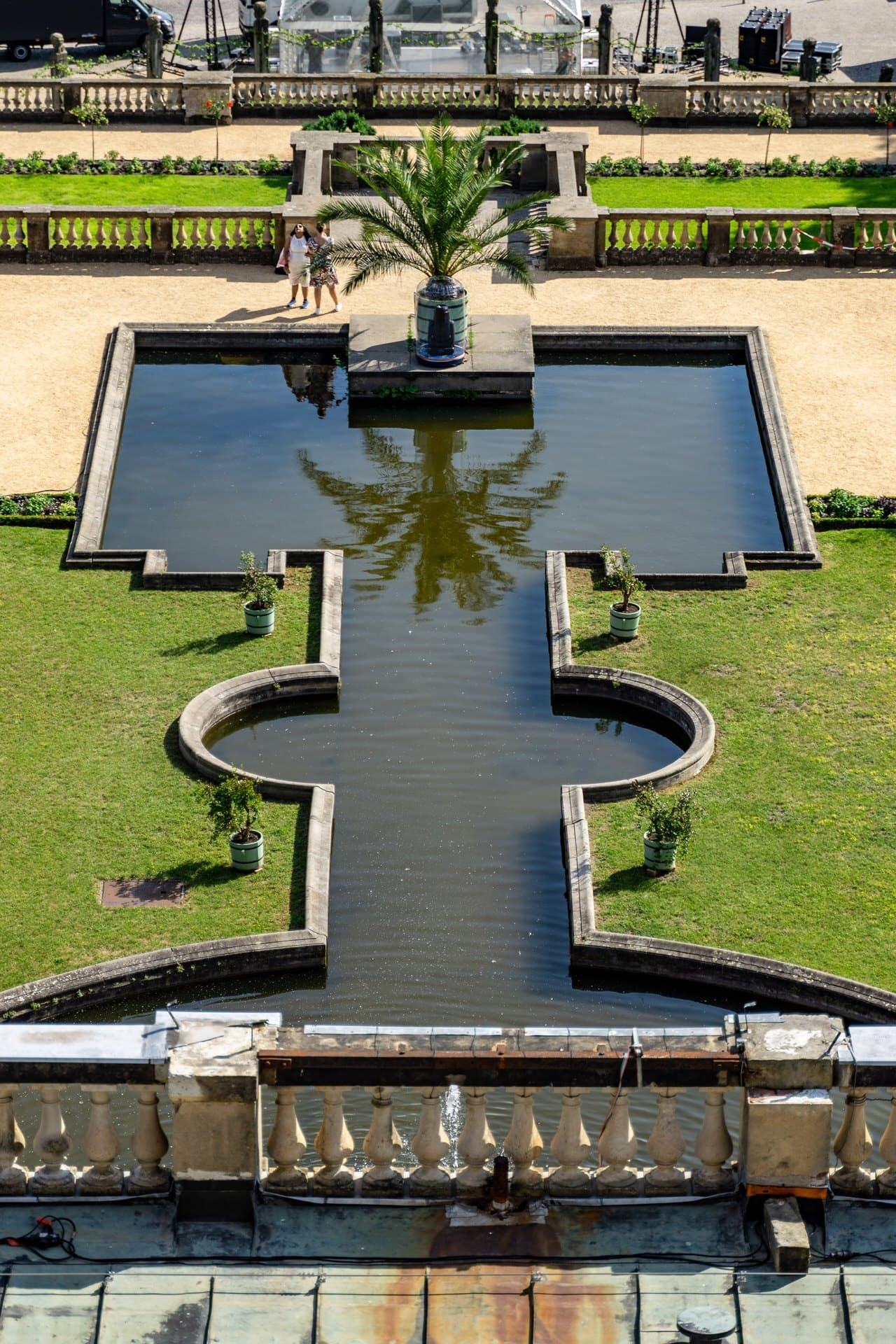
Crowning the central block are the two towers that give the Orangery its silhouette, and they amount to more than ornament. Each carries a belvedere at the top, and a walkable colonnade strung between them turns the roofline into a promenade. That makes the Orangery one of the very few points in Sanssouci Park where a visitor can climb for a panorama rather than simply look up at the architecture.
From up here the geography of the park resolves itself. To the south the ground falls away across terraces and parterres toward the older gardens; to the north the eye runs out to the village of Bornstedt and the royal crown estate beyond, with the Historic Windmill standing close at hand. Reaching the platform is a matter of stairs only, with no elevator, a practical point worth knowing for anyone who tires on steps, and one that is academic for the moment given the building’s closure.
From Showpiece to Restoration Site
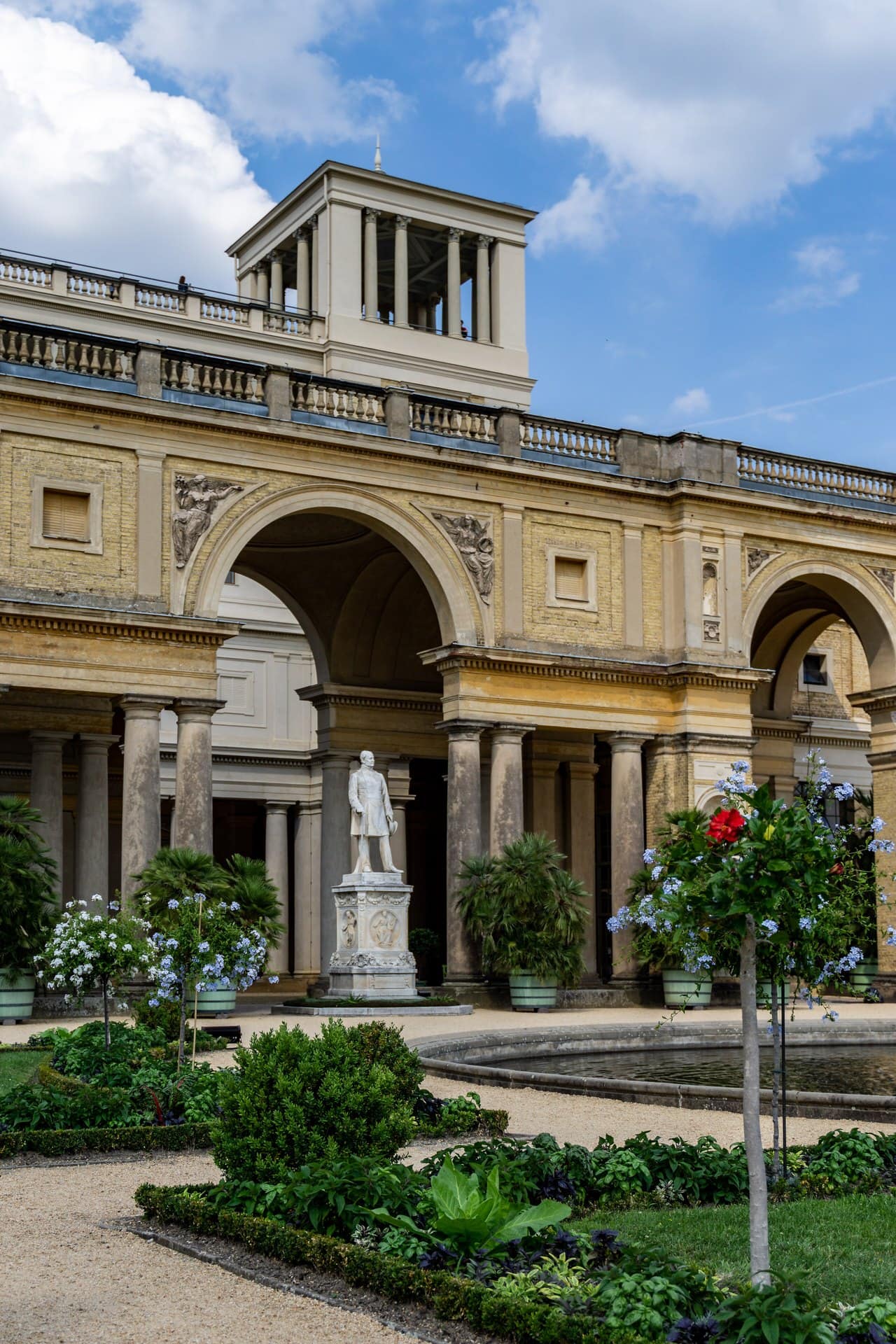
For decades after its completion the Orangery served its dynasty well. Until the monarchy fell, it lodged visiting heads of state, among them Carol I of Romania in 1883, Naser al-Din Shah of Persia in 1889, Umberto I of Italy in 1892, and the Chinese prince regent Zaifeng in 1901. Its builder saw none of this. Friedrich Wilhelm IV died at Sanssouci on January 2, 1861, three years before the palace was finished, and was laid to rest in the nearby Friedenskirche. Since 1873 a marble statue of him by Gustav Blaeser has stood before the central building, commissioned by his widow, Queen Elisabeth, and showing him not in royal state but as a private man, hat and walking stick in hand.
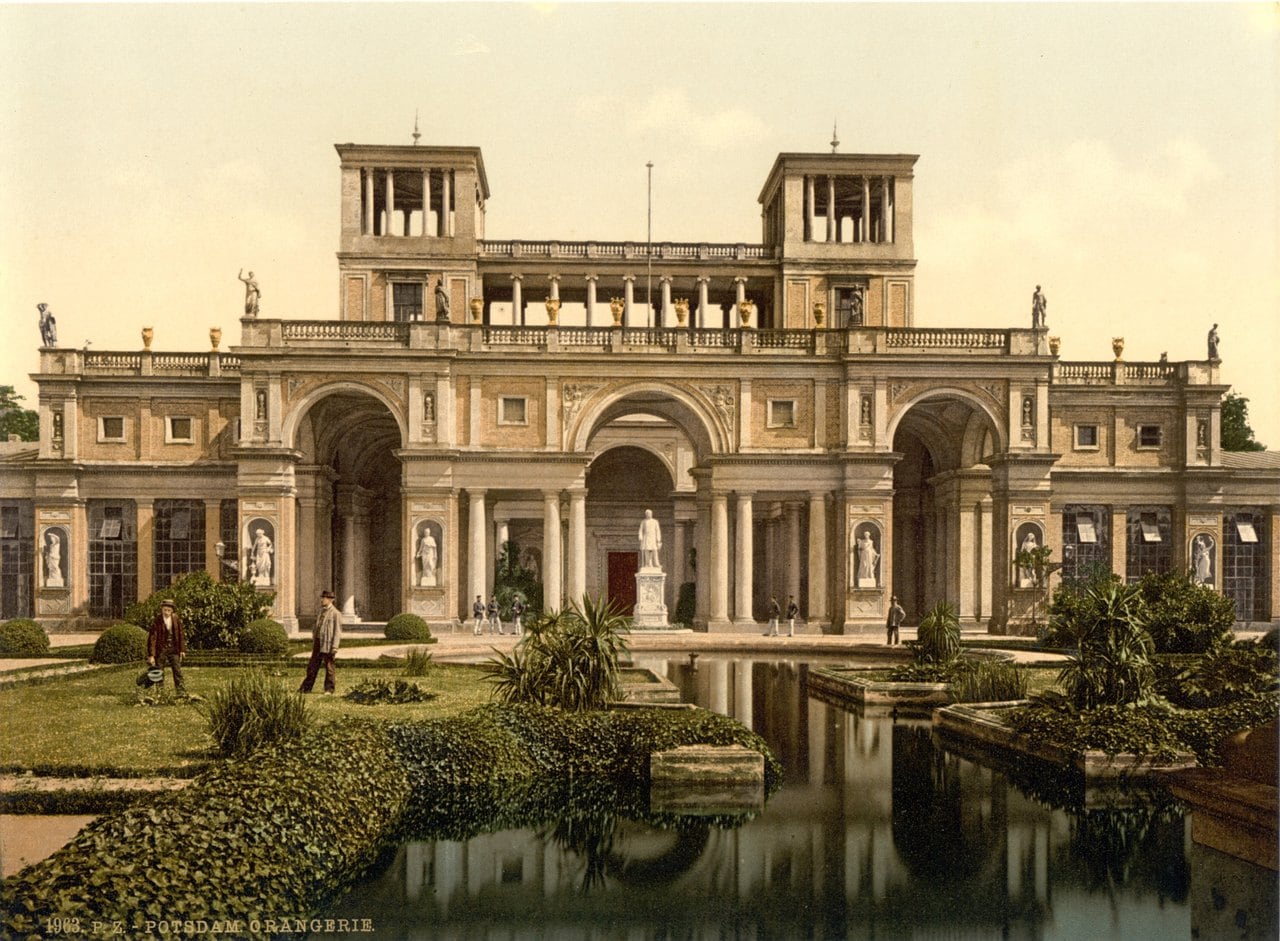
Politics changed the building’s owners but spared its fabric. After the First World War it passed to the Prussian state, and part of it has long housed the Brandenburg state archive, a function it still performs. It came through the Second World War intact, an unusual stroke of luck for so prominent a Potsdam monument, and after reunification the Stiftung Preußische Schlösser und Gärten took it in hand.
Restoration has come in waves. A first investment program ran from 2008 to 2018 and spent some nine million euros on the plant-hall façades, the central roof, and the towers. Substantial as that work was, it treated only part of the problem. Since 2019 a far larger campaign has been under way, aimed at the deeper structural and technical faults the earlier program could not reach, and it is this second push, carried out under the foundation’s long-term master plan, that has closed the palace museum and wrapped much of the building in scaffolding.
Visiting the Orangery Palace in 2026
Anyone planning a visit should start with the single most important fact: the palace museum is closed until further notice. The Orangery is in the middle of a major restoration under the foundation’s master plan, a roughly thirty-million-euro project that forms one part of a four-hundred-million-euro program to rescue the Prussian palaces and gardens by 2030. Work covers the façades and roofs, the technical systems, and the interiors of the plant halls, carried out in phases that run to the end of the decade. Off-limits while the works continue are the Raphael Hall, the apartments, and the tower, and the deepest interior rooms are not expected to follow until after 2030. Always check the SPSG website for the current status before planning any interior visit. Entry tickets and local tours can also be booked in advance through GetYourGuide.
Even so, the site repays the walk. Sanssouci Park is freely accessible, with only a voluntary contribution requested at the gates, and from the terraces you can take in the long Italianate façade, the Blaeser statue, and the colonnaded court, none of which depends on getting indoors. Close by lie the Sicilian Garden and the Nordic Garden that Lenné laid out in the 1850s and 1860s, two contrasting set pieces, one all southern exuberance and the other cool and evergreen, that reward a short detour.
Getting there is straightforward. The palace stands at An der Orangerie 3–5, on the Bornstedt ridge just north of the Maulbeerallee at the upper edge of the park; a bus to the “Orangerie/Botanischer Garten” stop drops you nearby, and there is parking by the Historic Windmill and the Neues Palais. Treat it as one stop on a full day in the park rather than a destination in itself, paired with Sanssouci Palace and the Neues Palais, both of which remain open and carry much of the same story. Anyone staying overnight can compare hotels in and around Potsdam.
Some links on this page are affiliate links, which means StoneKeep Atlas may earn a small commission, at no extra cost to you, if you book through them.
Beyond the Orangery Palace
As the last and largest of the Potsdam palaces, the Orangery is the closing chord of a building program that began with Frederick the Great’s vineyard retreat and ran for more than a century. Seen that way, it belongs to a whole family of nearby houses. Its stylistic ancestors are the Italianate villas of Charlottenhof and Glienicke; its romantic counterpoint, across the Havel, is the neo-Gothic Babelsberg. Earlier still are the neoclassical Marble Palace and the lakeside Pfaueninsel, which set the scene, while the twentieth-century Cecilienhof closes the dynasty’s long story. To trace the connections, our hubs on the garden palaces of Potsdam and the royal palaces of Berlin and Brandenburg gather the whole landscape in one place.
Conclusion
Few buildings wear their lost ambitions as openly as this one. The Orangery Palace is the grandest “what if” of royal Potsdam, the surviving piece of a Roman dream that ran out of money and time. It is also one of the rare palaces that still does the humble job it was built for. While its galleries wait behind scaffolding for their turn at restoration, its plant halls fill each winter with the orange trees of Sanssouci, just as they have since the 1850s. So the south is kept alive through the northern cold, exactly as a romantic king once imagined it.
Principal Sources
- Arbeitskreis Orangerien in Deutschland e.V. (orangeriekultur.de), “Die Große Orangerie im Park Sanssouci.”
- museum-digital Brandenburg, object records for the Raphael Hall copies (Stiftung Preußische Schlösser und Gärten Berlin-Brandenburg).
- Orangerieschloss (Potsdam), German Wikipedia, used for cross-checking the architect attribution, the Italian models, and the tsarina legend.
- Stiftung Preußische Schlösser und Gärten Berlin-Brandenburg (SPSG), Orangery Palace object page, press material, and the SIP 2 master-plan project pages.
- Tagesspiegel / Potsdamer Neueste Nachrichten, reporting on the Orangery restoration (2019–2029 program, phase scheduling, plant-hall heating).
- UNESCO World Heritage Centre, “Palaces and Parks of Potsdam and Berlin,” ref. 532 (inscribed 1990; boundary modifications 1992, 1999).
The Orangery Palace is operated by the Stiftung Preußische Schlösser und Gärten Berlin-Brandenburg (spsg.de); current opening status, restoration updates, and ticket information for the wider Sanssouci Park are published there.
Image credits. The Orangery from its terrace (featured image): Matti Blume, CC BY-SA 4.0. Aerial view from the south: Carsten Steger, CC BY-SA 4.0. The arcaded block and parterre, the Malachite Room, the west plant hall, and the view from the tower: Rainer Halama, CC BY-SA 4.0. The Raphael Hall: © Raimond Spekking, CC BY-SA 4.0. Friedrich August Stüler’s design drawing: Stüler, public domain. The palace and the Raphael Hall around 1900: unknown authors, public domain. All images via Wikimedia Commons. Freely licensed images are resized to fit; otherwise unaltered.