
Château d’Angers
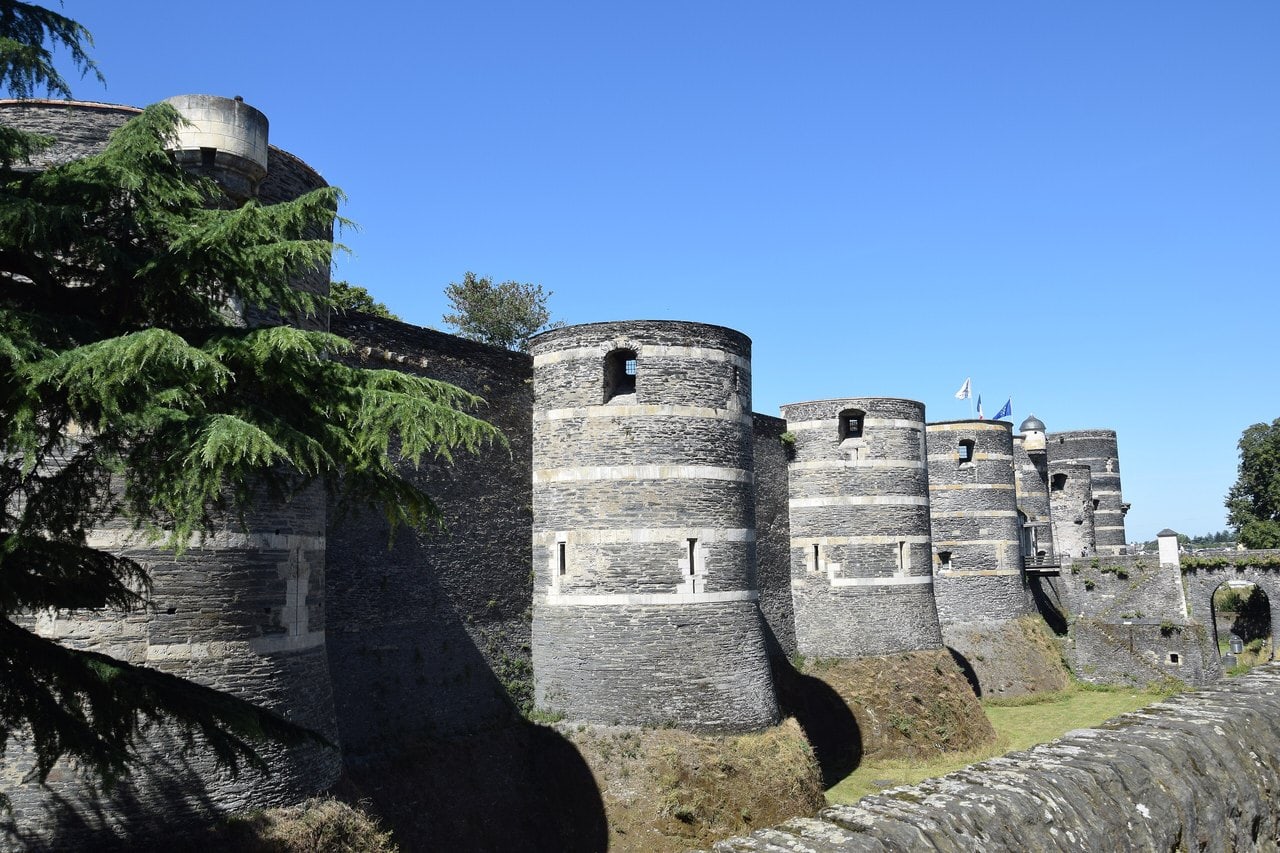
The Château d’Angers rises straight from the rock above the river Maine, a wall of seventeen round towers banded in dark schist and pale stone that has loomed over the old capital of Anjou for nearly eight centuries. It was built in the 1230s for the boy-king Louis IX by his mother and regent, Blanche of Castile, conceived as a Capetian war-machine on a freshly conquered border, and it still reads as one: low, blunt, and enormous, its battlements long since shorn away for cannon.
Behind that grim outer shell lies one of the richest princely courts of late-medieval France and the most extraordinary artistic survival of the age, the Apocalypse Tapestry, woven for a duke of Anjou and still unrolled here across a hundred meters of gallery wall. Fortress and treasure house at once, the castle layers six thousand years of occupation on its promontory, from a Neolithic camp and a Roman town to King René’s vanished menagerie of lions and leopards. This guide follows the long arc by which a border stronghold became the keeper of the Apocalypse.
Quick Facts
| Location | Angers, Maine-et-Loire, Pays de la Loire, France |
| Region | Anjou (lower Maine valley, downstream of the Loire Valley World Heritage perimeter) |
| Built | Curtain wall and towers in the 1230s; comital origins from the 9th century; royal apartments and chapel early 15th century |
| Built for | Louis IX of France, under the regency of Blanche of Castile |
| Architectural character | Capetian military architecture (13th c.) with Angevin Gothic residential ranges (15th c.) |
| Type | Fortress |
| Condition | Well preserved; towers lowered for artillery in the 16th century |
| Current use | Museum and monument; home of the Apocalypse Tapestry |
| Managed by | Centre des monuments nationaux (Domaine national du château d’Angers) |
| Open to visitors | Yes, year-round (closed January 1, May 1, December 25) |
| Coordinates | 47.4701° N, 0.5601° W |
| Official site | chateau-angers.fr |
From Fulk Nerra to the Plantagenets
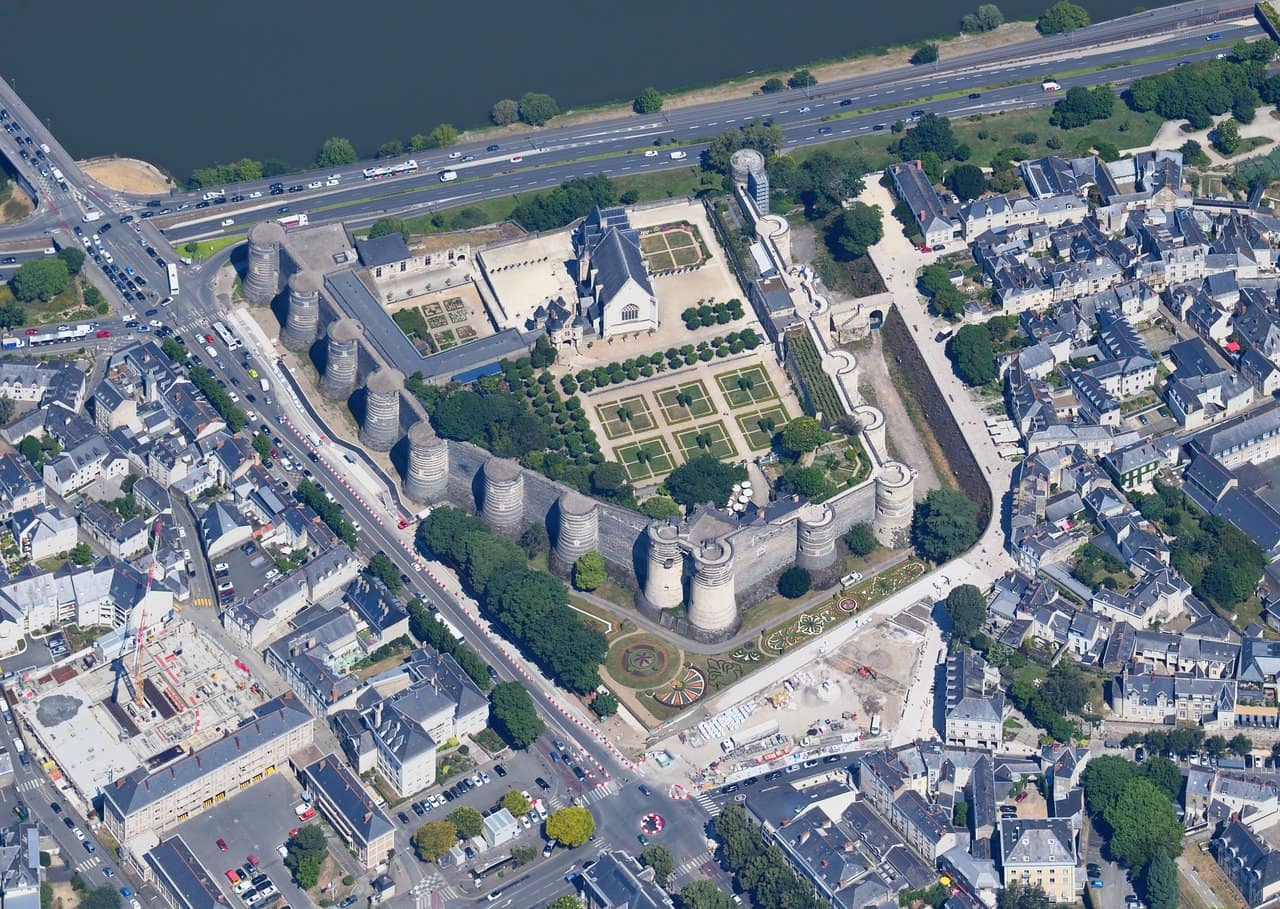
People have held this spur of rock for a long time. A Neolithic settlement, then the Roman town of Juliomagus, grew up on the heights above the Maine, the short, broad river formed where the Mayenne and the Sarthe meet just above the city before running down to join the Loire a few miles to the south. By the ninth century the site had a defensive role again, and the counts of Anjou raised a stronghold on it against the Viking raiders working up the valley. Whoever held the rock held the river road: the Maine carried traffic down to the Loire and on toward the sea, and a fort on this height watched the approaches to the whole of western Anjou.
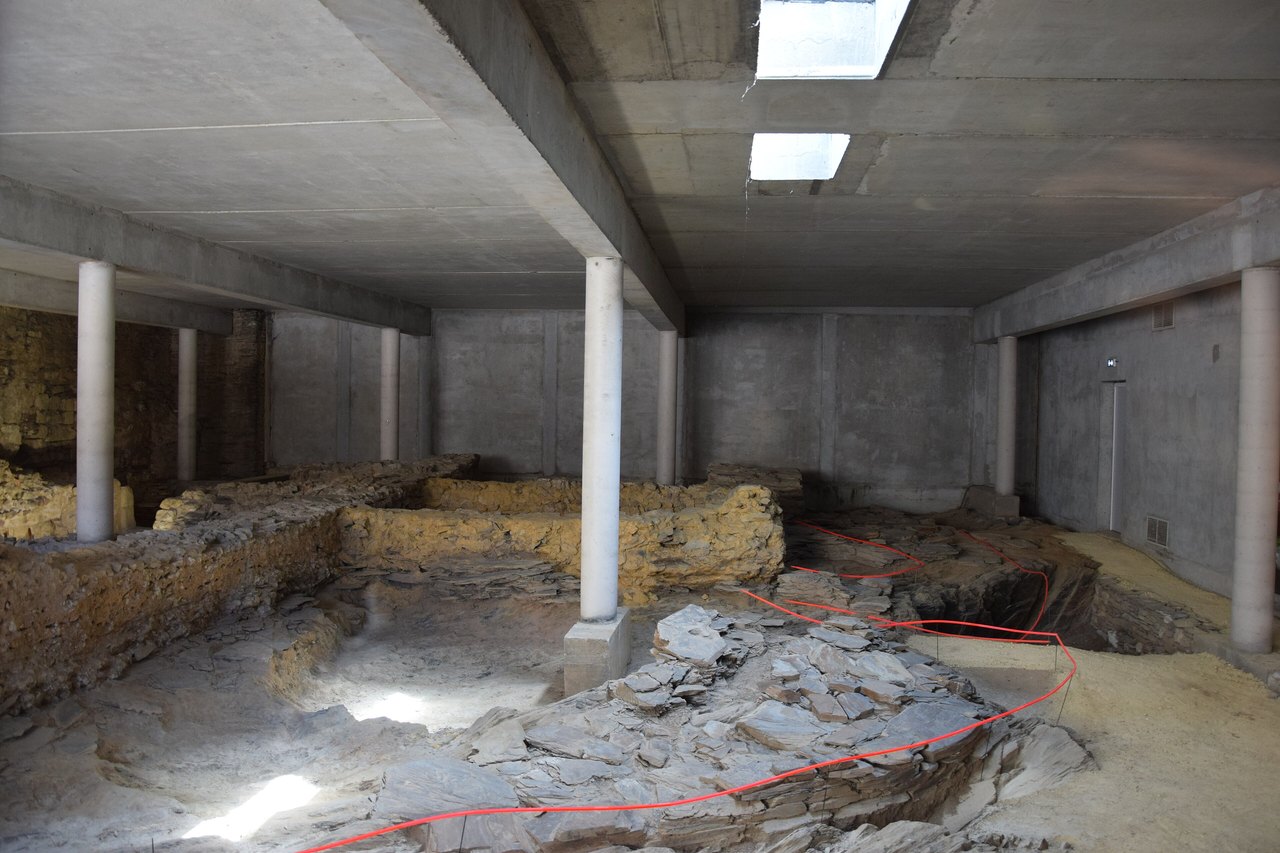
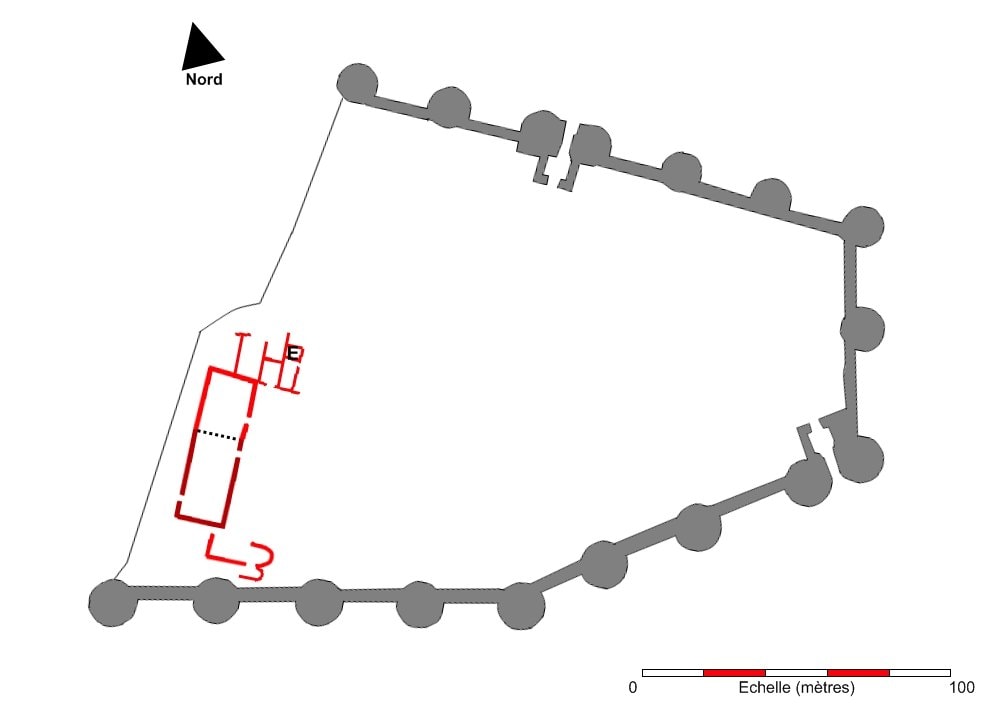
The first true stronghold here is bound up with Fulk III, called Fulk Nerra, count of Anjou from 987 to 1040 and one of the most relentless castle-builders of his age. Fulk and his successors made Angers the seat of a county that grew, through war and marriage, into something far larger. It was a twelfth-century count of Anjou, Geoffrey, who gave the line its name Plantagenet, supposedly from the sprig of broom he liked to wear; his marriage to the Empress Matilda carried the county toward the throne of England, and their son became Henry II. For several decades Angers sat near the heart of the sprawling Angevin domain that Henry ruled from the Channel to the Pyrenees, and the counts enlarged their palace here to match their fortunes. A ruined facade of that great hall still stands in the courtyard, the last visible trace of the comital and Plantagenet residence.
That empire did not hold. In 1204 Philip II of France wrested Anjou from King John of England, the luckless Plantagenet remembered as John Lackland, and within a decade the province was bound firmly to the French crown. Angers had changed from a dynastic capital into a frontier town, and a frontier facing Brittany and the lost Plantagenet lands needed a fortress worthy of the name.
Blanche of Castile’s Fortress
Louis IX came to the throne in 1226 as a boy of twelve, and for much of his minority the kingdom was governed by his formidable mother, Blanche of Castile. It was Blanche, as regent, who ordered the building of the fortress that visitors still walk through today. Work went forward through the 1230s, an enormous outlay for the crown, and it swallowed a whole quarter of the medieval town: an entire district was cleared so that the new walls could enclose and quadruple the old count’s palace.
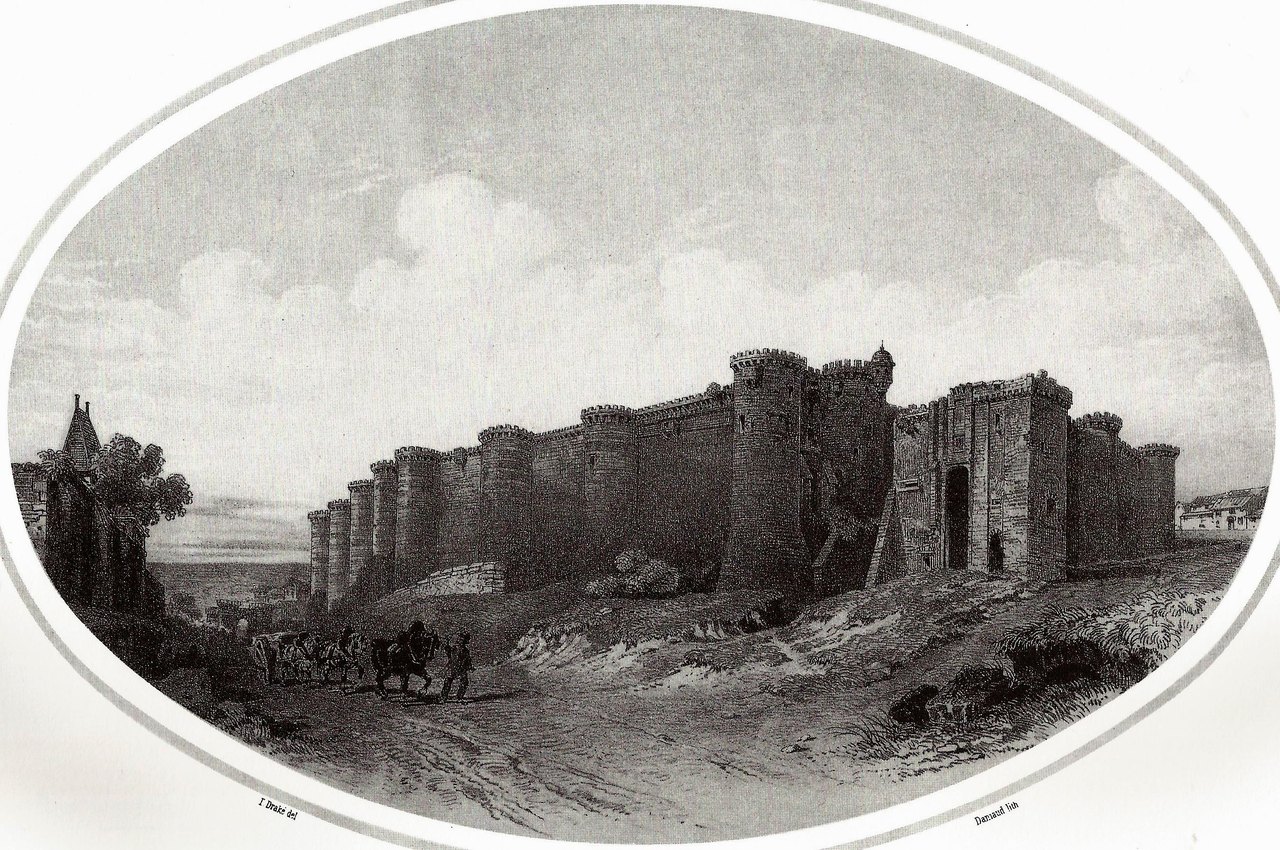
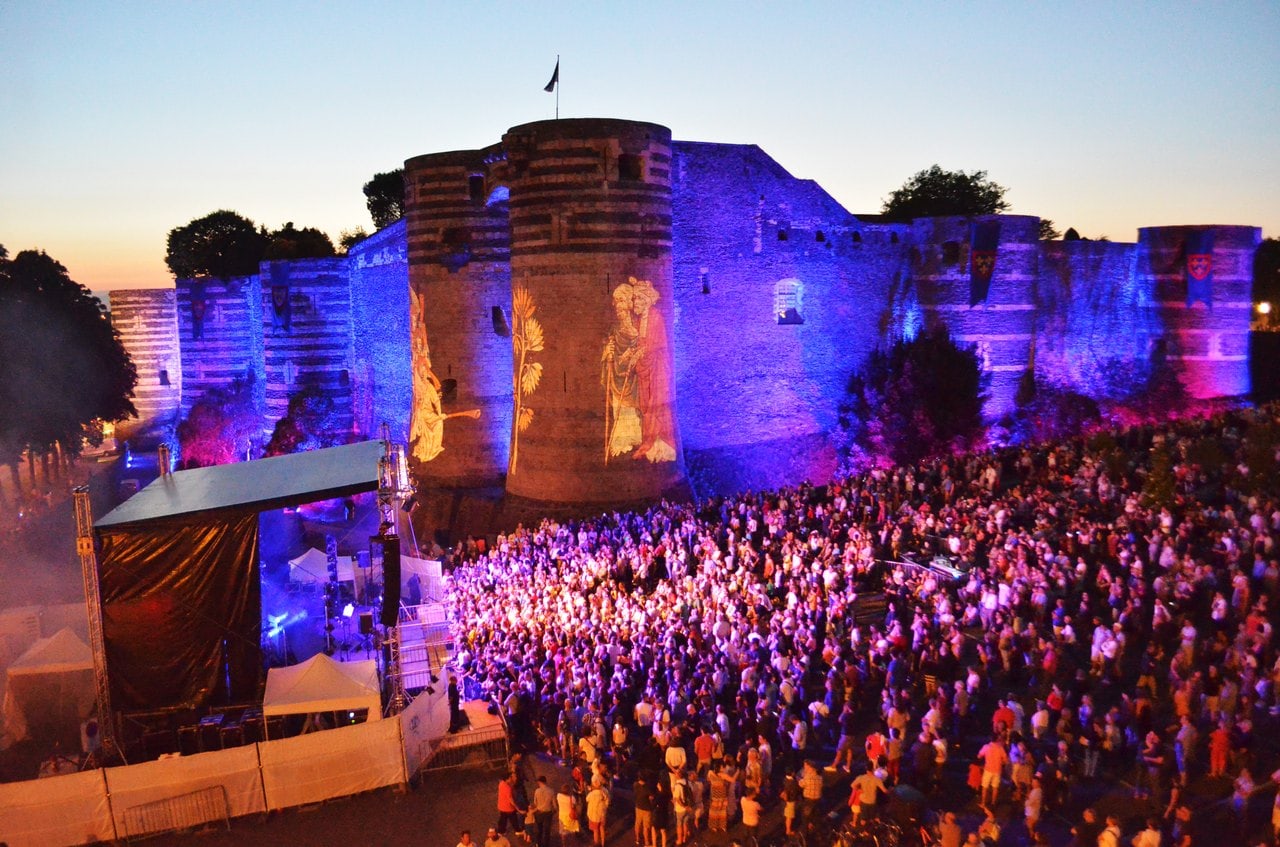
What rose was uncompromising. Seventeen great drum towers, each about twelve meters across, were strung along more than half a kilometer of curtain wall about three meters thick, ringing an enclosure of around two hectares. The towers climbed to about forty meters when new, stepping down the slope toward the river, and the whole circuit was set behind deep dry ditches. Crowned in their first state by conical roofs and timber hoarding, from which defenders could watch and strike at the foot of the wall, the towers made Angers one of the mightiest royal fortresses of its day. Two double-tower gatehouses controlled the entrances, and their names survive still — the Porte de la Ville facing the town and the Porte des Champs facing the open fields.
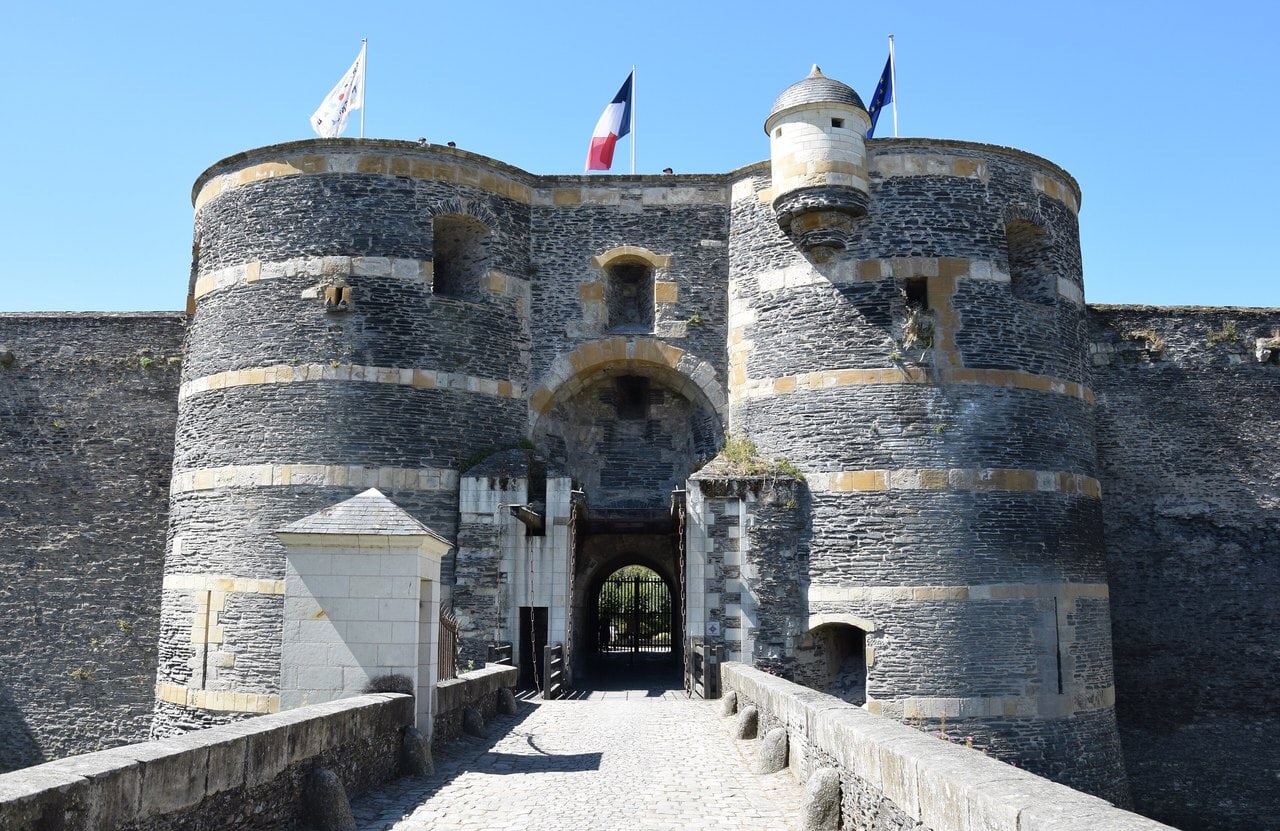
The fortress owes its striking appearance to the local geology. Builders laid alternating courses of dark Angevin schist and pale limestone, so that the walls read as broad horizontal bands of slate-gray and cream, a sober heraldry of stone repeated across every tower. That dark rock is the same schist that roofs Angers in blue-black slate and long gave the city its somber color. For all its bulk the castle was as much a statement as a defense, a blunt assertion that royal power now reached to the western edge of the kingdom. Its purpose was less to repel a great siege than to anchor the crown’s authority over a newly won and still uneasy province.
Within the walls the ground fell into two worlds. A broad lower court held the garrison, its stores, and its stables, while a smaller upper court, the seigneurial court, was kept for the lord’s hall, his lodgings, and his chapel. The gatehouse that a later duke would rebuild marked the boundary between them, between the working fortress and the princely residence it sheltered, and that division still shapes a visit today.
The House of Anjou and the Apocalypse Tapestry
In 1360 the French king John II raised Anjou to a duchy and gave it to his second son, Louis. Louis I of Anjou, brother of King Charles V, turned the border fortress into a princely residence, adding comfortable lodgings and a vast kitchen within the medieval shell. He was an ambitious man with a claim to the throne of Naples and a taste for magnificence, and around the mid-1370s he commissioned the work that has defined Angers ever since.
The Apocalypse Tapestry was woven in Paris between about 1377 and 1382. Its designs came from Jean Bondol, a Flemish painter from Bruges who served Charles V and drew on illuminated manuscripts of the Book of Revelation; the weaving was organized by the Parisian merchant Nicolas Bataille and carried out, most likely, in the workshop of Robert Poinçon. The finished hanging was colossal. Six sections, each close to six meters high, ran to something like a hundred and forty meters in total and carried around ninety scenes of Saint John’s vision: the woman clothed with the sun, the seven-headed beast, the horsemen, the fall of Babylon, the new Jerusalem. Panel after panel sets its figures against alternating grounds of deep red and deep blue, with the dreaming saint himself recurring at the edge of each scene, watching his own prophecy unfold. Woven without a true reverse, so that the design reads almost as crisply from the back as from the front, the hanging has held its colors far better than most work of its age. Each of the six pieces opened with an outsized seated figure reading from a book, a guide to the visions that followed, and a band of woven text once ran beneath the scenes to explain them; that text is long gone, yet the images carry the story on their own.
Louis meant the tapestry as more than devotion. Unrolled at the great feasts of the Angevin court, a wall of woven prophecy on this scale advertised the duke’s wealth, his piety, and his standing among the princes of a Europe then darkened by the Hundred Years’ War and recurring plague. Louis styled himself king of Naples, Sicily, and Jerusalem, and a cycle that ended in the triumph of the heavenly city set his earthly ambitions against the certainties of the world to come. Nothing else of its date and ambition survives intact, which makes it the oldest and largest set of medieval tapestries to come down to us, and the single object that draws most visitors through the castle gate.
Yolande of Aragon and King René
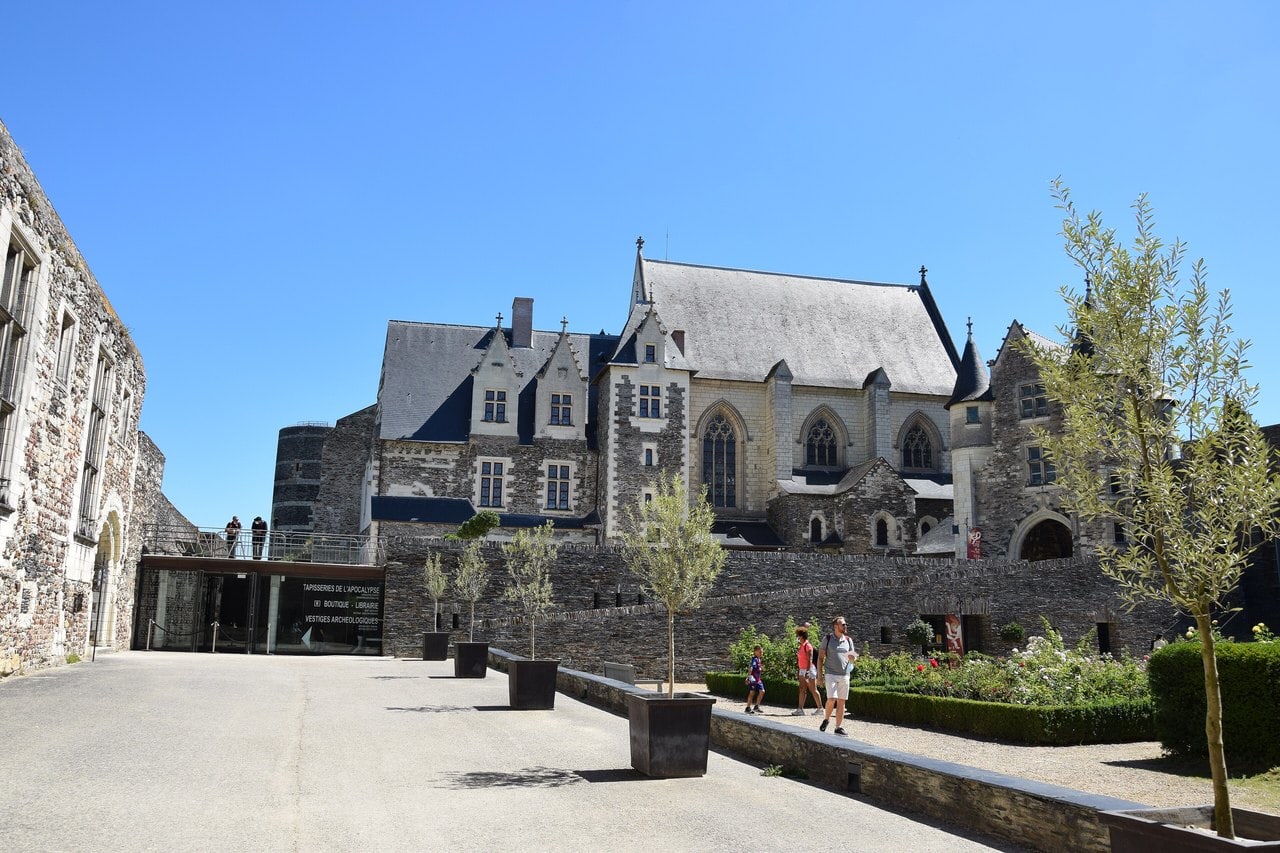
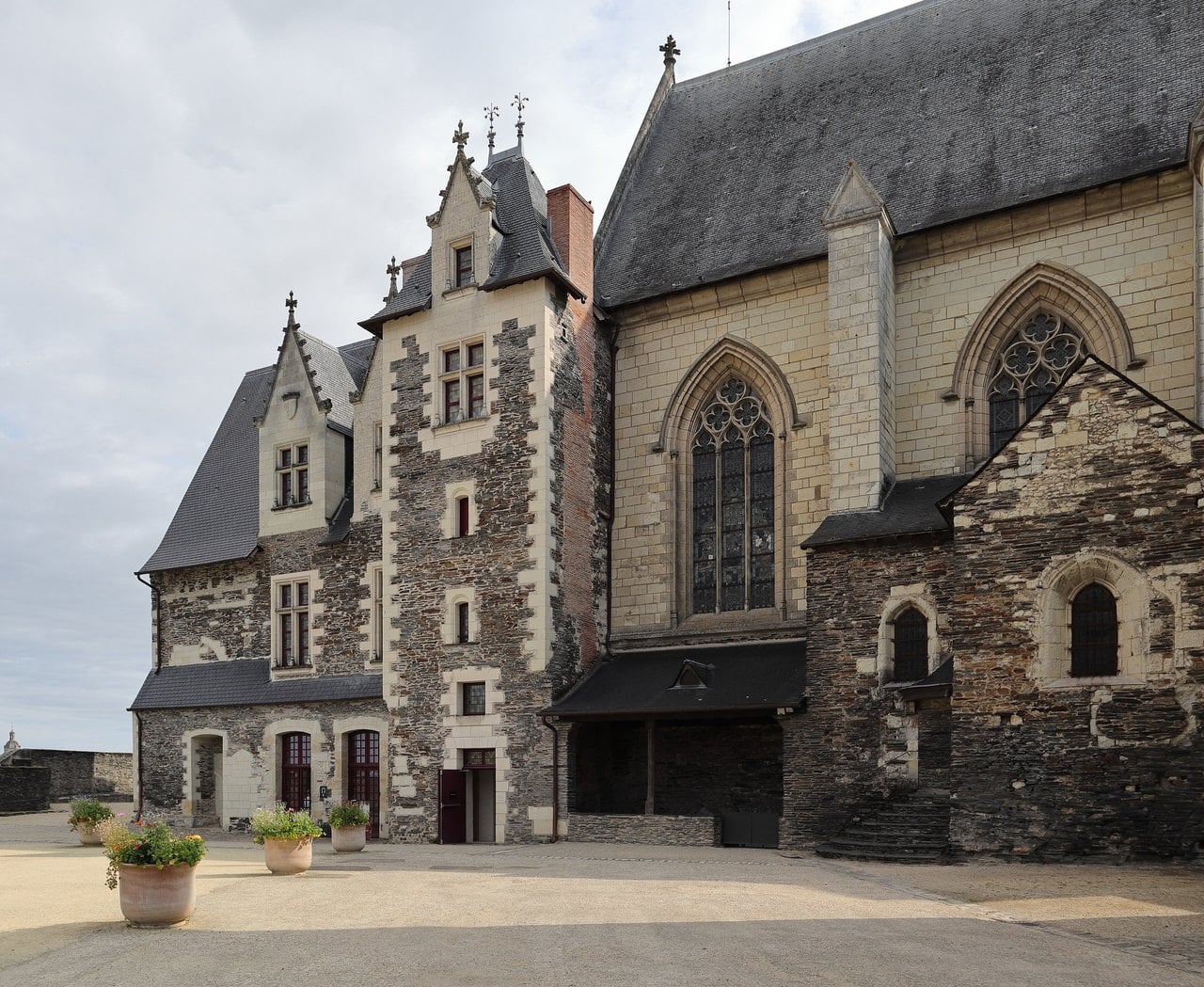
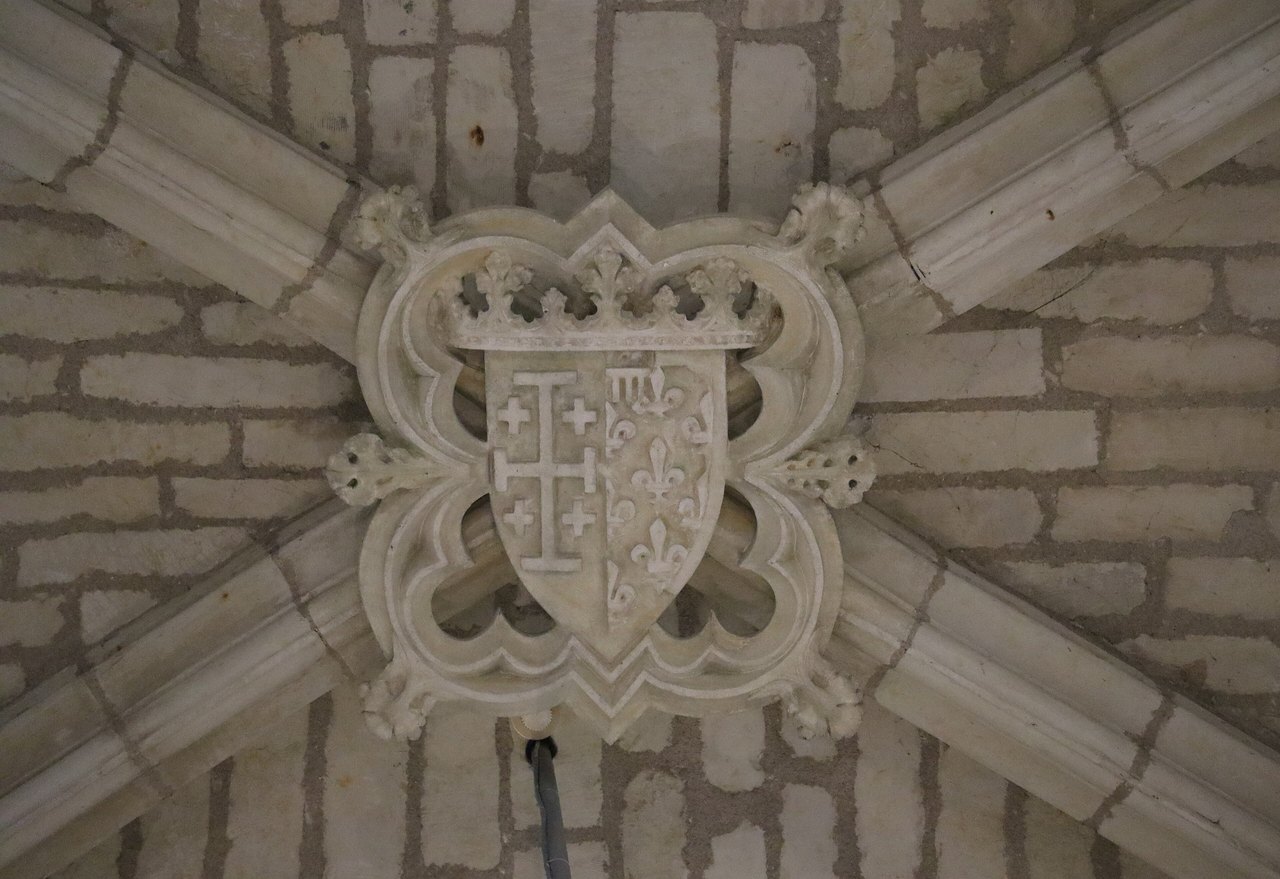
The ducal court reached its height under Louis I’s son and grandson. Louis II of Anjou and his wife, Yolande of Aragon, refashioned the residence in the early fifteenth century, building the royal lodgings, or Logis Royal, around 1410 and raising a chapel beside them between 1405 and 1413. That chapel is a sainte-chapelle, a church built to shelter a relic of Christ’s Passion, in this case a fragment of the True Cross that the family traced back to Louis IX himself; its single nave and ribbed Angevin vaults are among the finest interiors in the castle.
Yolande was one of the shrewdest political figures of her generation, and it was at Angers, on January 16, 1409, that she gave birth to her son René. As the long crisis of the Hundred Years’ War deepened, she sheltered the disinherited dauphin, the future Charles VII, and helped steer him toward the throne. Her son would carry the Angevin name to its last brilliant flowering.
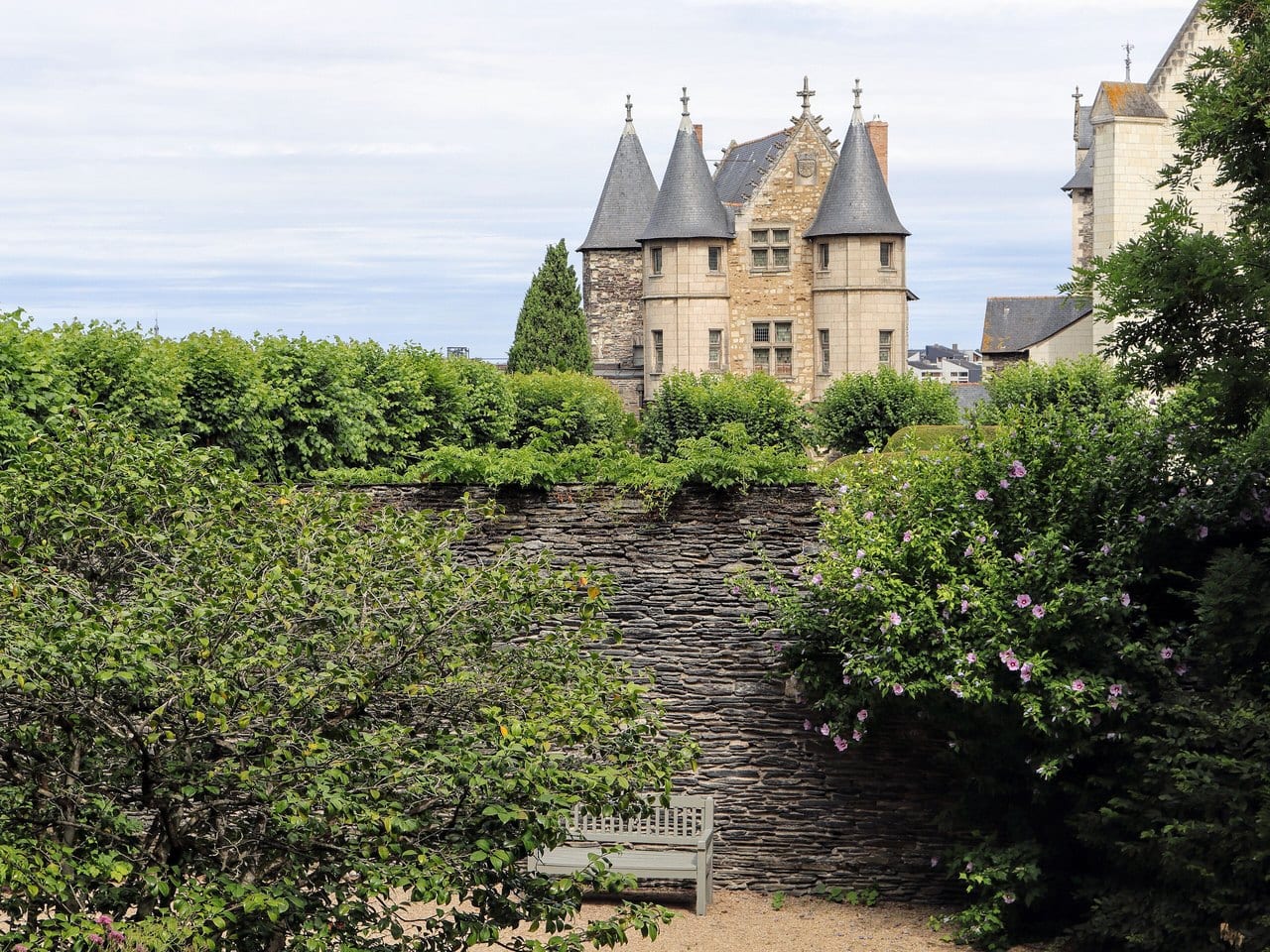
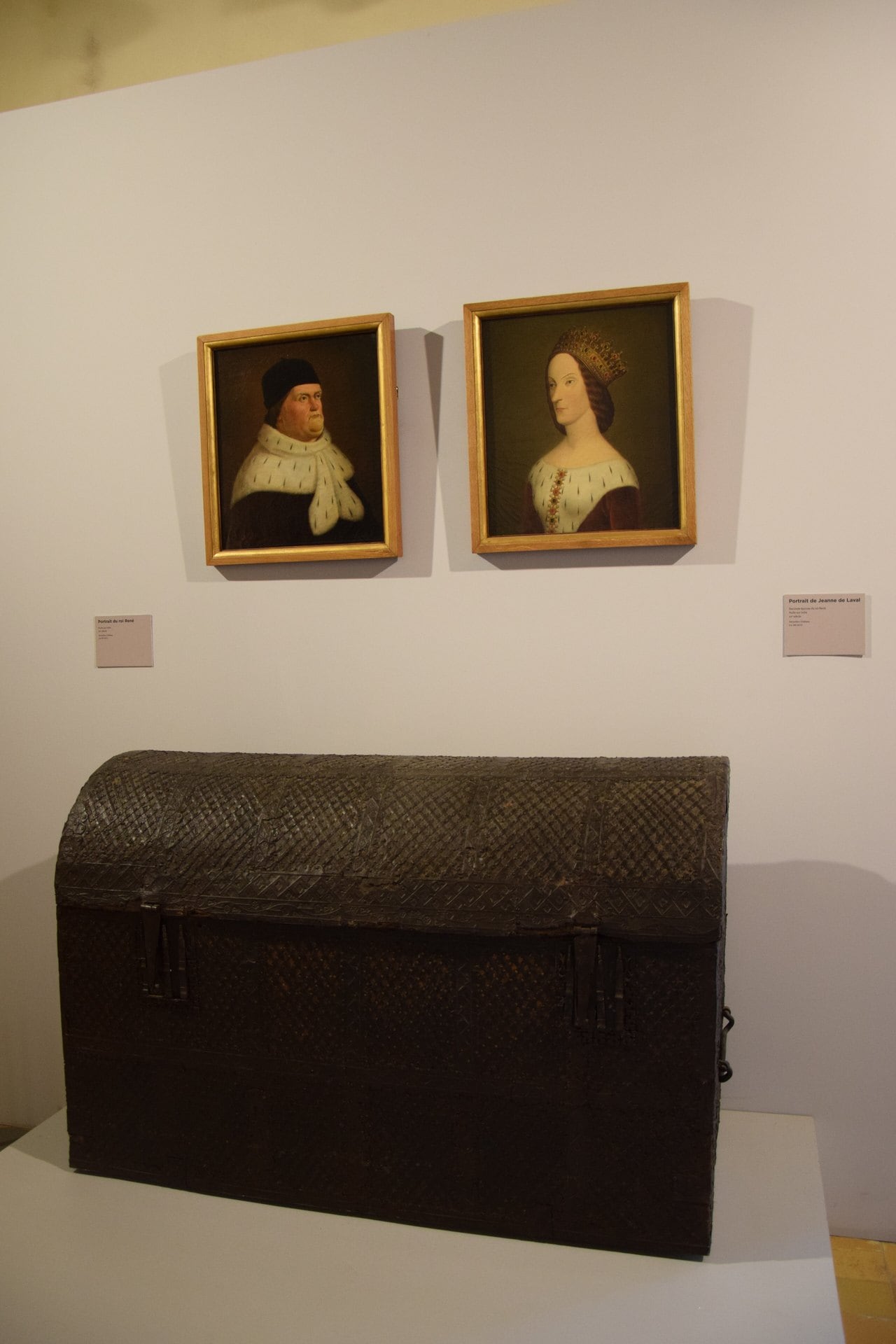
René of Anjou, who lived from 1409 to 1480, was duke of Anjou and count of Provence, duke of Bar and Lorraine, and titular king of Naples, Sicily, and Jerusalem; his daughter Margaret became queen of England as the wife of Henry VI, and her long struggle for the Lancastrian cause drew the Angevin name deep into England’s Wars of the Roses. Remembered as a poet and painter as much as a prince, René wrote allegories of love and devotion, staged elaborate tournaments, and gathered artists and writers into a court that became a byword for chivalric refinement; in his later years his second wife, Jeanne de Laval, shared its rule. He gave the castle its flamboyant Gothic gatehouse, the Châtelet, and laid out celebrated gardens where he is said to have kept lions, leopards, and ostriches. His reign was the golden age of the Angevin court, and also its end. In 1474 his nephew Louis XI moved to seize the duchy by force, and when René died, at Aix in Provence in 1480, Anjou passed for good to the French crown. Before the end the old king made a parting gift of the Apocalypse Tapestry to the cathedral of Angers, an act that would save it from worse fates to come.
Artillery, Prison, and Rescue
The fortress changed shape one last time during the Wars of Religion. Catherine de’ Medici had it repaired as a stronghold in 1562, but in 1585 her son Henry III, fearing the fortress would fall to the Catholic League, ordered it razed. The governor charged with carrying out the demolition, Donadieu de Puycharic, saved it instead: rather than pull down the walls, he cut the towers down to the height of the curtain wall, stripped the battlements, and widened the narrow medieval openings into mouths for cannon, turning the flattened tower tops into artillery platforms. That deliberate half-measure gave the castle the low, blunt silhouette it wears today. Only the Tour du Moulin, the mill tower at the northern corner, still stands close to its original height and hints at how the seventeen towers once pierced the sky.
Stripped of its tower crowns, the castle settled into a long and unglamorous afterlife. It served in turn as a garrison, a powder magazine, and a state prison that once held Louis XIV’s disgraced finance minister, Nicolas Fouquet; the army kept it well into the twentieth century, and German forces occupied it during the Second World War. The Apocalypse Tapestry, meanwhile, came close to vanishing altogether. During the French Revolution it was pulled down from the cathedral, cut into pieces, and put to humiliating uses: fragments were spread on the ground, used to cover plants against frost, and stuffed into gaps in walls and stables. Rescue came slowly in the nineteenth century, when a cathedral canon, Louis-François Joubert, set about tracking down the scattered fragments and overseeing their repair, a labor of decades that returned the mended hanging to the cathedral by the 1870s.
Roughly seventy of the original ninety scenes came through, amounting to about a hundred meters of tapestry, and the question of where to keep so fragile and unwieldy a treasure was settled only after the Second World War. A long, low-lit gallery designed by the architect Bernard Vitry was raised within the castle on the footings of the old kitchens, and the restored Apocalypse was installed there in 1954, where it remains under carefully controlled light. In 2023 the tapestry was inscribed on UNESCO’s Memory of the World register, the roll of documentary treasures of humanity, a recognition of the hanging itself and not of the fortress that now guards it.
Visiting the Château d’Angers
The castle stands in the center of Angers at 2 promenade du Bout-du-Monde, a ten- to fifteen-minute walk from the Angers-Saint-Laud railway station and reachable from Paris-Montparnasse by TGV in about an hour and a half. It is run by the Centre des monuments nationaux and open year-round, from ten in the morning until half past six in the high season, roughly early May to early September, and until half past five through the low season from early September to the end of April. The ticket office and last admission close forty-five minutes before the monument itself; the castle is shut on January 1, May 1, and December 25.
As of 2026 admission costs around fourteen euros in the high season and eleven in the low; it is free for visitors under eighteen and for European Union residents aged eighteen to twenty-five. A single ticket covers the whole site, and the Angers City Pass includes it.
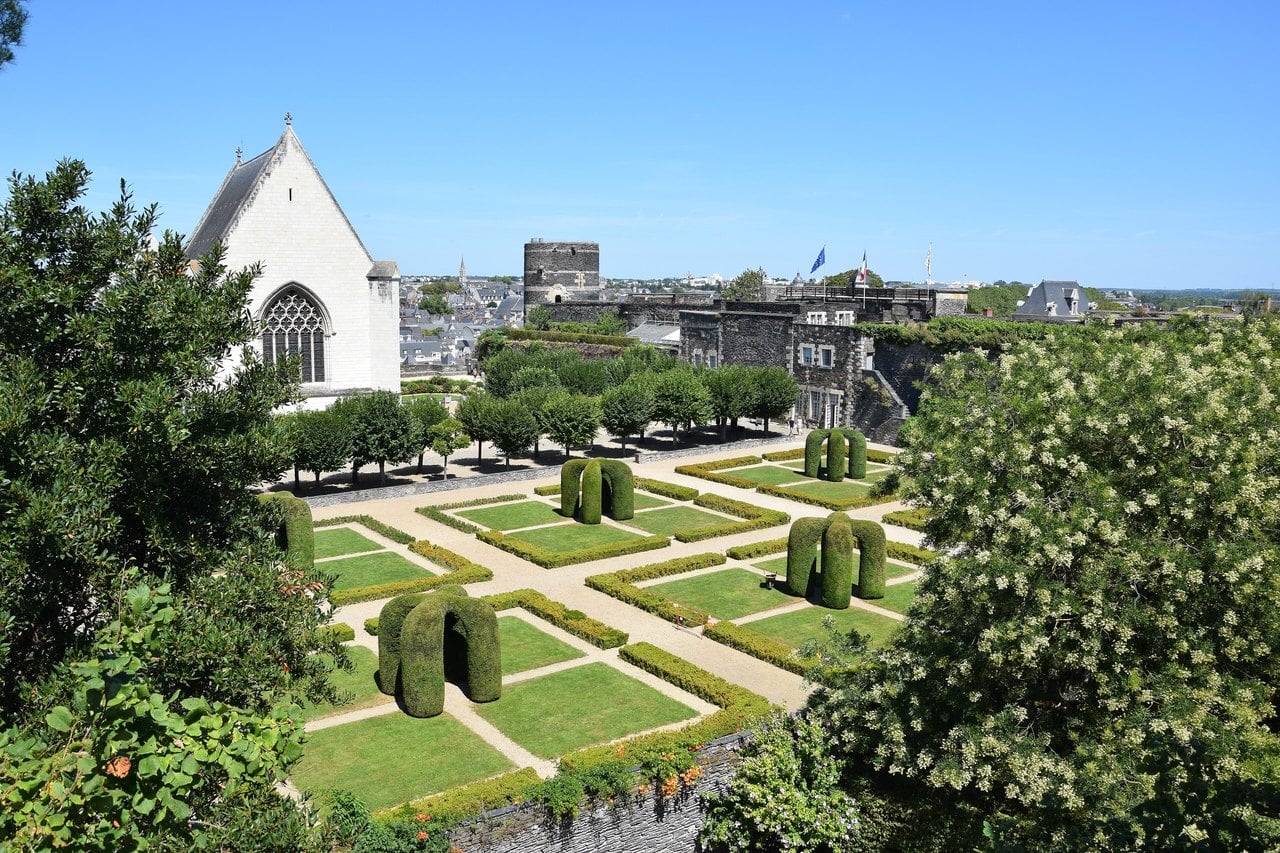
Allow a couple of hours. The rampart walk along the curtain wall is the great surprise of the visit, opening long views over the slate roofs of the old town and the Maine below. Inside the walls, the purpose-built gallery holds the Apocalypse Tapestry; the Logis Royal displays models tracing the castle’s growth from the ninth to the eighteenth century; and the Sainte-Chapelle and the Châtelet preserve the most refined of René’s court architecture. In the wide dry ditches, where defenders once watched for attackers, the Centre des monuments nationaux now maintains formal gardens, a hanging garden of medieval herbs, and even a small vineyard.
The castle also makes a good base for the wider city. The cathedral of Saint-Maurice, the half-timbered Maison d’Adam, and the gallery devoted to the local sculptor David d’Angers all lie within a short walk, and across the Maine the old hospital of Saint-Jean houses the Musée Jean-Lurçat, where a modern weaver’s answer to the Apocalypse hangs in reply. The first of the great Renaissance houses of the Loire begin less than an hour upstream.
For a place to stay, you can compare hotels in Angers on Booking.com. To go straight in without queuing at the gate, you can book château tickets and guided tours through GetYourGuide.
Some links on this page are affiliate links, which means StoneKeep Atlas may earn a small commission, at no extra cost to you, if you book through them.
More Views of the Château d’Angers
A closer look at the fortress, its court, and the treasures it guards.
Beyond Angers
Angers is the western anchor of the Angevin world, and its natural companion lies upstream. The fortress of Château de Chinon, on the Vienne near the Loire, was the other great stronghold of the counts of Anjou and the Plantagenet kings, the place from which Henry II governed his empire and where Joan of Arc found the future Charles VII. Together the two fortresses trace the medieval, military side of the Loire country, a counterweight to the graceful Renaissance houses downstream. From Chinon it is a short reach to the great pleasure palaces of the Châteaux of the Loire Valley, where defense gave way at last to delight. The Angevin story reaches south as well, to the river fortress of Château de Tarascon in Provence, the castle finished by the same King René who made Angers his own. Midway upstream, the white Château de Saumur crowns its promontory over the Loire, the Angevin ducal palace that the Très Riches Heures made famous. Deeper into the Saumurois, the Château de Brézé hides an underground fortress and the deepest dry moat in France beneath its château.
Conclusion
Few castles hold their contradictions as plainly as the Château d’Angers. Blanche of Castile’s seventeen towers were raised to overawe a conquered province, and three centuries later they were beheaded to make room for guns; yet within that battered military shell the dukes of Anjou built a court of rare refinement and commissioned a tapestry that has outlived the dynasty, the kingdom that absorbed it, and even the faith in apocalypse that inspired it. A visitor today walks the same ramparts as Blanche’s garrison and then steps into a hushed gallery to face Saint John’s vision unrolled across a hundred meters of wool and silk. Fortress and treasure house, the castle still earns the name its keepers have given it: the fortress of the Apocalypse.
Principal Sources
- Centre des monuments nationaux. “Château d’Angers.” chateau-angers.fr.
- Mesqui, Jean. Châteaux forts et fortifications en France. Flammarion, 1997.
- Muel, Francis. La Tenture de l’Apocalypse d’Angers. Éditions du patrimoine / Inventaire général, 1996.
- Ministère de la Culture. “Château d’Angers.” Base Mérimée / Plateforme ouverte du patrimoine (POP). pop.culture.gouv.fr.
- UNESCO. “The Apocalypse Tapestry.” Memory of the World Register, 2023. unesco.org.
- Destination Angers / Anjou Tourisme. “Domaine national du château d’Angers.” destination-angers.com.
Visitor information was verified against the operator’s official site, the Centre des monuments nationaux, in June 2026; opening hours and prices change seasonally and should be checked before travel.
Image credits. Curtain wall and towers, the Porte de la Ville, and the formal gardens: photographs by Chatsam, CC BY-SA 3.0. Comital-palace foundations, the courtyard, and the portraits of René and Jeanne de Laval: Chatsam, CC BY-SA 4.0. Aerial view from the southeast: Carsten Steger, CC BY-SA 4.0. Logis Royal and Sainte-Chapelle, and the Châtelet: JackyM59, CC BY-SA 4.0. Sainte-Chapelle interior: GO69, CC BY-SA 4.0. Castle plan: Romain Bréget, CC BY-SA 3.0. Floodlit castle with the Apocalypse projected on its walls: Angers Loire Tourisme / Elodie Lesourd, CC BY-SA 4.0. Nineteenth-century lithograph: after Thomas Drake (1818–1895), public domain. Freely licensed images are resized to fit; otherwise unaltered.