
Neuschwanstein Castle
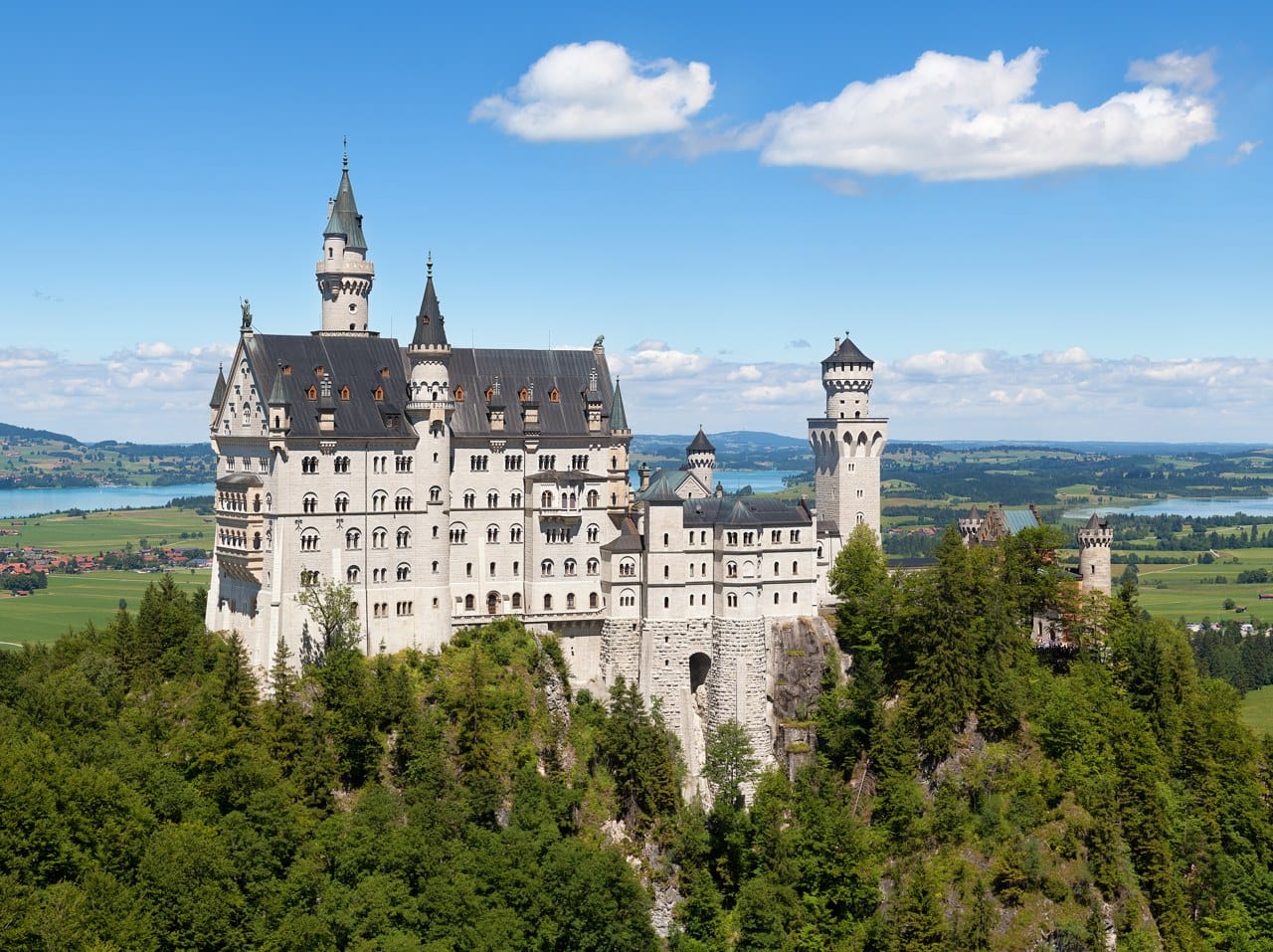
High on a crag above the village of Hohenschwangau, in the foothills of the Bavarian Alps, Neuschwanstein Castle (Schloss Neuschwanstein) rises against a backdrop of forested mountains and distant lakes with an improbability that looks designed rather than built, because it was. Commissioned in 1869 by King Ludwig II of Bavaria as a private retreat and a monument to his devotion to the composer Richard Wagner, Neuschwanstein was conceived not as a seat of court or government but as a living theatrical set. It is the most visited site in the Bavarian state palace portfolio, and its silhouette is widely reproduced in tourism and popular culture. In July 2025 it was inscribed as a UNESCO World Heritage Site, as part of the serial property “The Palaces of King Ludwig II of Bavaria.”
The castle stands in the municipality of Schwangau, about 120 kilometers by road southwest of Munich, on a narrow rocky spur above the gorge of the Pöllat stream; its entrance sits at roughly 965 meters above sea level, with the ridge running on above it. It was built over the remains of two small medieval castles, Vorder- and Hinterhohenschwangau, whose surviving wall fragments the Bavarian monument list still treats as a monument in their own right. Below lie the Alpsee and the Schwansee, and on the valley floor directly beneath sits Hohenschwangau Castle, the medieval-revival palace where Ludwig spent much of his childhood and which stays in view from Neuschwanstein’s upper windows. Ludwig chose this crag for that relationship as much as for the drama of the drop.
Quick Facts
| Location | Schwangau, Swabia, Bavaria, Germany |
|---|---|
| Built | 1869 to 1892 (unfinished at Ludwig’s death in 1886) |
| Built for | King Ludwig II of Bavaria |
| Architectural style | Historicist: Romanesque Revival, with a Byzantine throne hall and two Gothic rooms |
| Castle type | Palace on a rocky hilltop spur |
| Condition | Well preserved; partially unfinished |
| Owner / managed by | Free State of Bavaria, administered by the Bayerische Schlösserverwaltung (Bavarian Palace Administration) |
| UNESCO status | World Heritage Site, inscribed 2025 as part of “The Palaces of King Ludwig II of Bavaria” |
| Nearest town & station | Füssen, 4 km northwest; Füssen station, then bus 73 or 78 to Hohenschwangau |
| Open to public | Yes, by guided tour only; advance booking strongly recommended |
| Official website | neuschwanstein.de |
History
Ludwig II and the Decision to Build
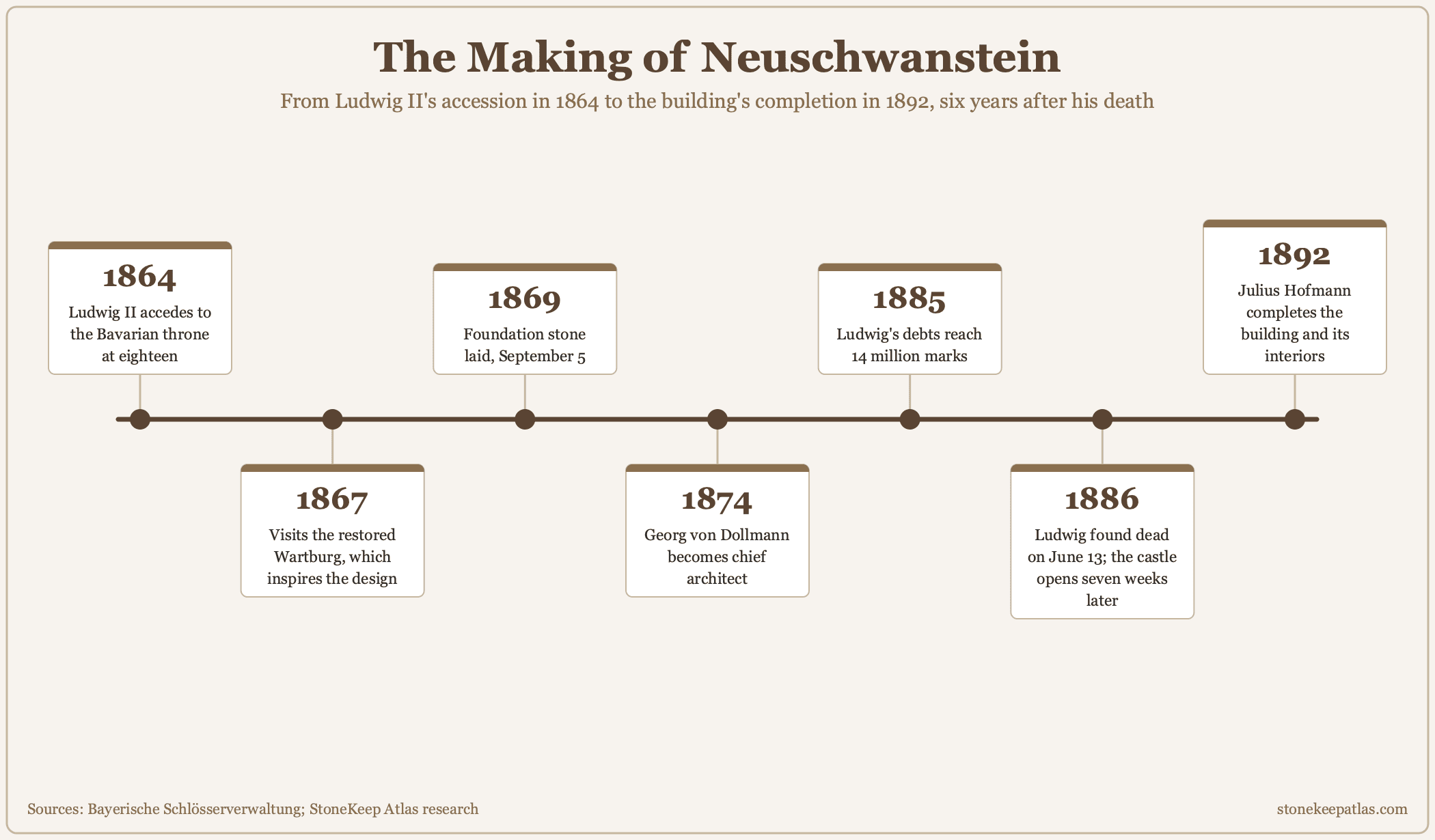
Ludwig II acceded to the Bavarian throne in 1864 at the age of eighteen. Looking back in 1873 he described it himself: “I became king much too early. I had not learned enough… Suddenly I was snatched away from my books and set on the throne.” Two years later, the defeat of Bavaria alongside Austria in the Austro-Prussian War forced on the kingdom a “defensive and offensive alliance” with Prussia, which removed the king’s right to dispose over his army in case of war. From 1866, in the palace administration’s own words, Ludwig II “was no longer a sovereign ruler,” and that limitation was “the biggest misfortune of his life.” For a ruler who saw his role in quasi-mystical terms, as a monarch ordained by God to embody and celebrate a heroic German past, the political humiliation was difficult to absorb. His response was to turn inward, investing in an idealized private world expressed through music, theater, and architecture.
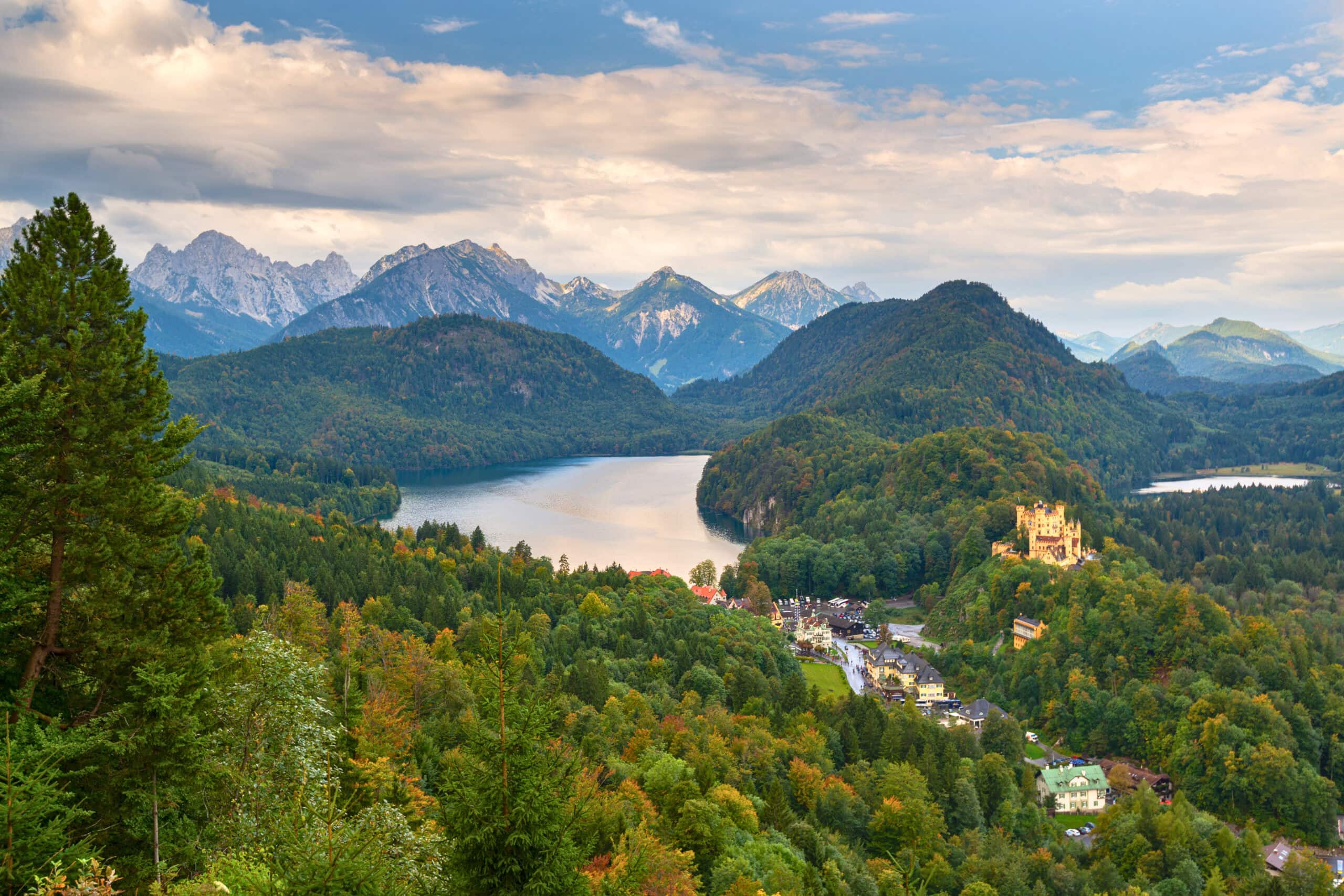
The idea of building on the rocky spur above Hohenschwangau took shape in the year after the war. In 1867 Ludwig visited the recently restored Wartburg Castle in Thuringia, where the Singers’ Hall, traditionally linked to the medieval poetry competition depicted in Wagner’s opera Tannhäuser, made a lasting impression. His vision for Neuschwanstein was shaped by the Wartburg, by Wagnerian opera in general, and by the legends of Lohengrin, the swan knight, which had deep personal resonance given that the heraldic animal of the Counts of Schwangau was the swan. He set out the purpose himself in a letter to Wagner, calling the site “one of the most beautiful to be found, holy and unapproachable, a worthy temple for the divine friend who has brought salvation and true blessing to the world.” That divine friend was Wagner, and the guest rooms were meant for him. Initially the project was described as a “New Hohenschwangau Castle,” a name it kept until after Ludwig’s death.
On September 5, 1869 the foundation stone was laid, with the building plan, portraits of Ludwig II and coins from his reign set inside it. Construction proceeded under the direction of architect Eduard Riedel, working from theatrical sketches by the Munich stage designer Christian Jank. The plans evolved constantly under Ludwig’s personal supervision; what had been conceived as a relatively modest building grew into an enormous complex, with each revision expanding the scale and ambition. Georg von Dollmann succeeded Riedel as chief architect in 1874, and Julius Hofmann, who finished the building and its interiors between 1886 and 1892, completed the work after the king’s death. The interior fittings were finished in mid-1884 and Ludwig began staying in the Palas apartments, though the palace administration is blunt that he only ever saw the castle as a building site; before that he had used the Gateway Building, ready for occupation at the end of 1873, as provisional accommodation for years. He stayed at Neuschwanstein for a total of roughly 172 days.
Ludwig’s Death and the Castle’s Opening
By 1885 Ludwig’s debts had reached 14 million marks. His cabinet refused further credit and, in June 1886, a commission of psychiatrists declared him incapacitated without having examined him directly. He was placed under custody at Berg, on the shores of Lake Starnberg. On June 13, 1886, the day after his internment there, Ludwig and Bernhard von Gudden, the psychiatrist who had certified him insane, were found dead in the shallows of the lake. The circumstances remain contested; suicide was recorded as the official cause of death, but the evidence is incomplete.
Seven weeks after his death, Neuschwanstein was opened to paying visitors. A castle Ludwig had built as a place of absolute private retreat became, almost immediately, a major public attraction.
During the Second World War the castle served a grimmer function: it was used as a storage facility for art looted from France by the Einsatzstab Reichsleiter Rosenberg, a Nazi Party organization tasked with seizing cultural property from occupied territories. The looted works were recovered by Allied forces at the end of the war.
Architectural Highlights
Exterior and Structure
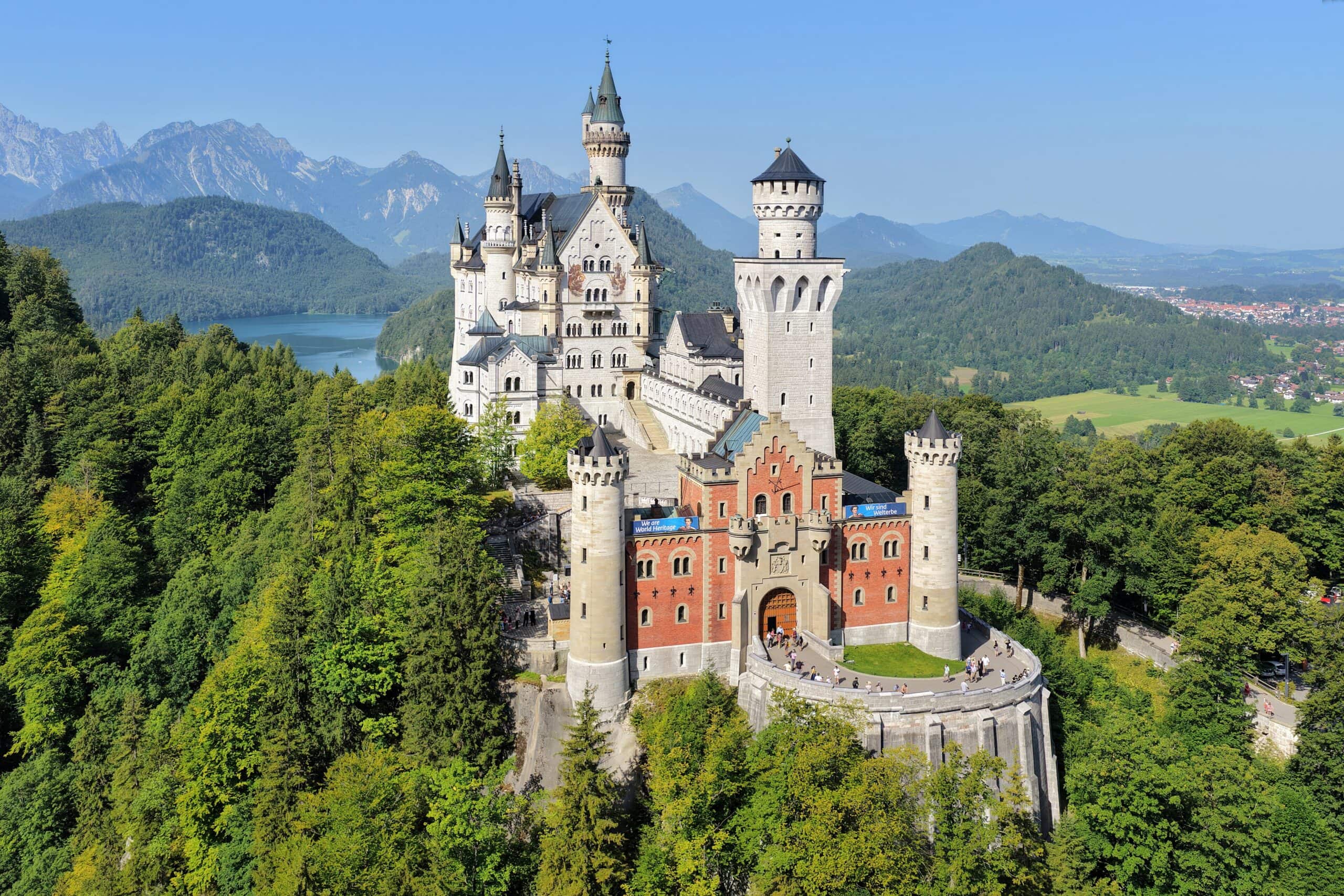
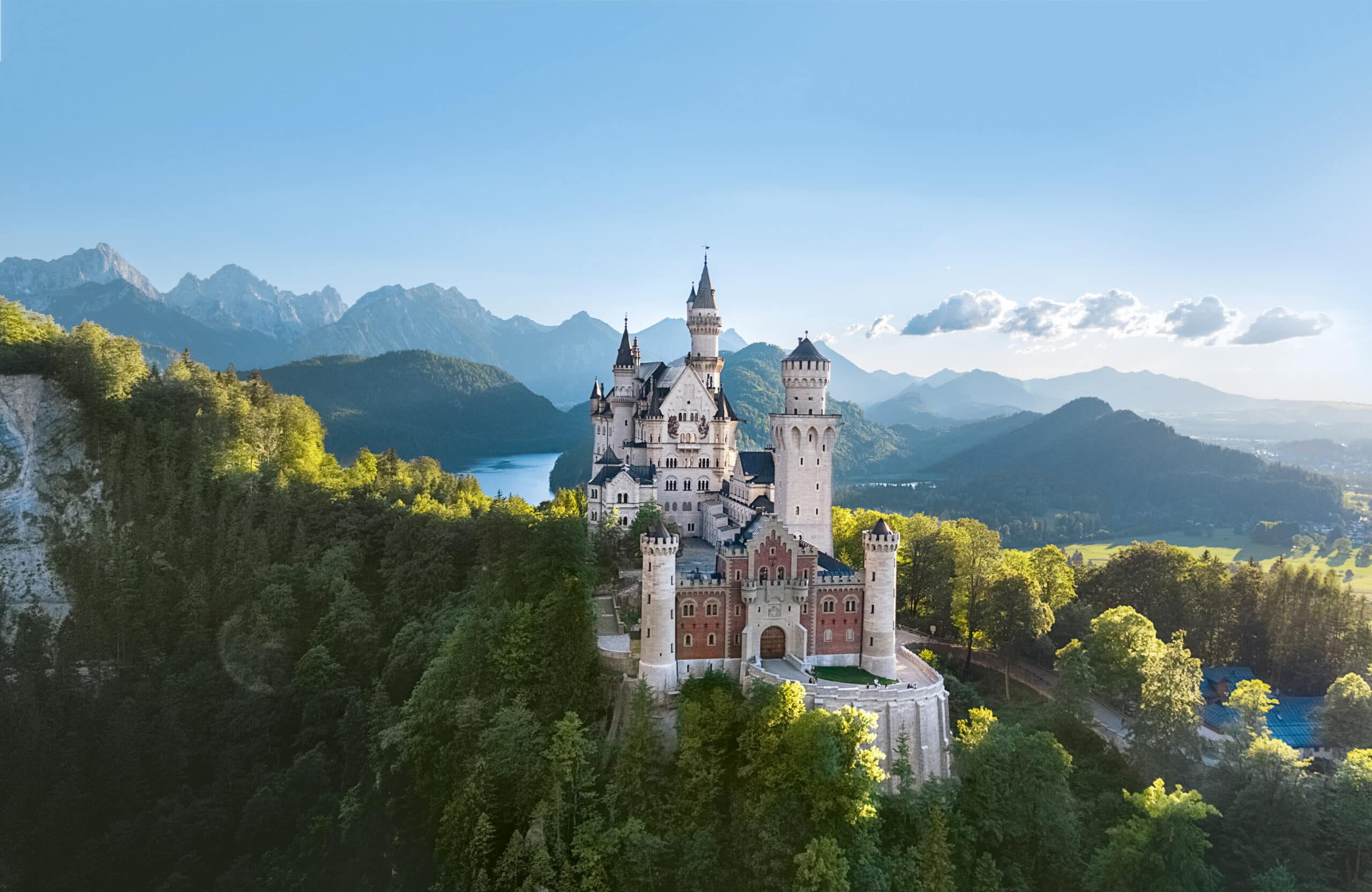
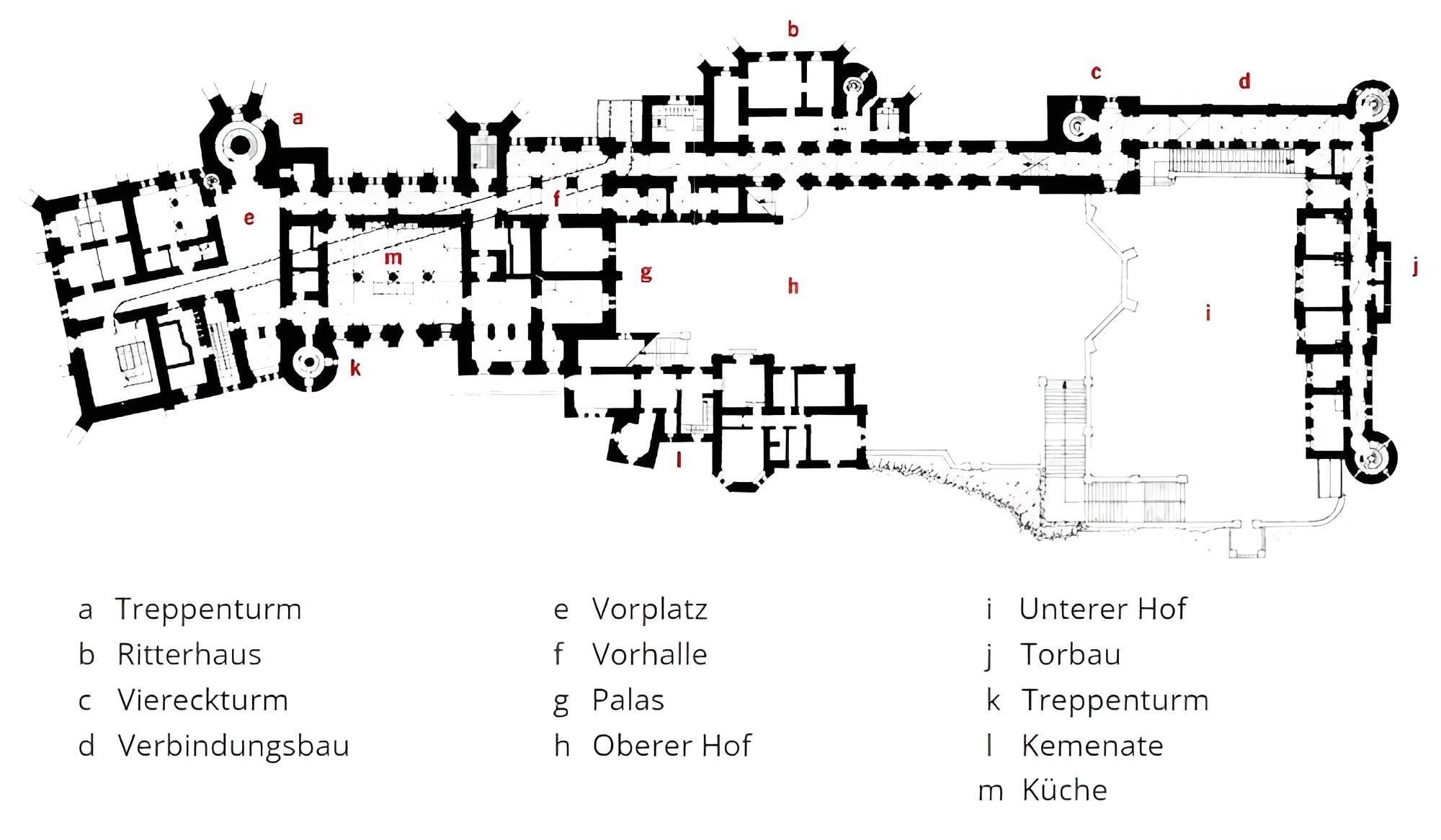
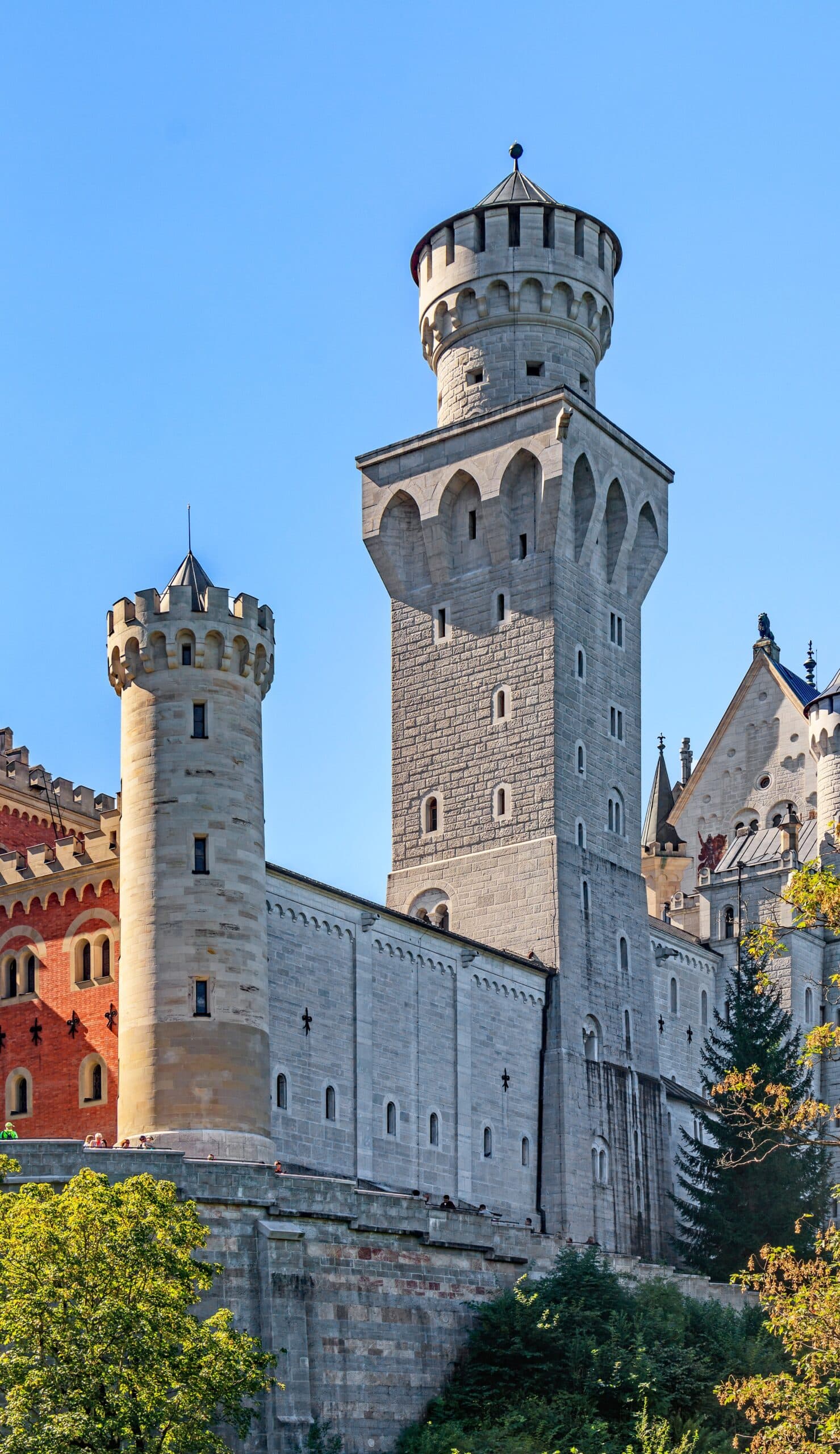
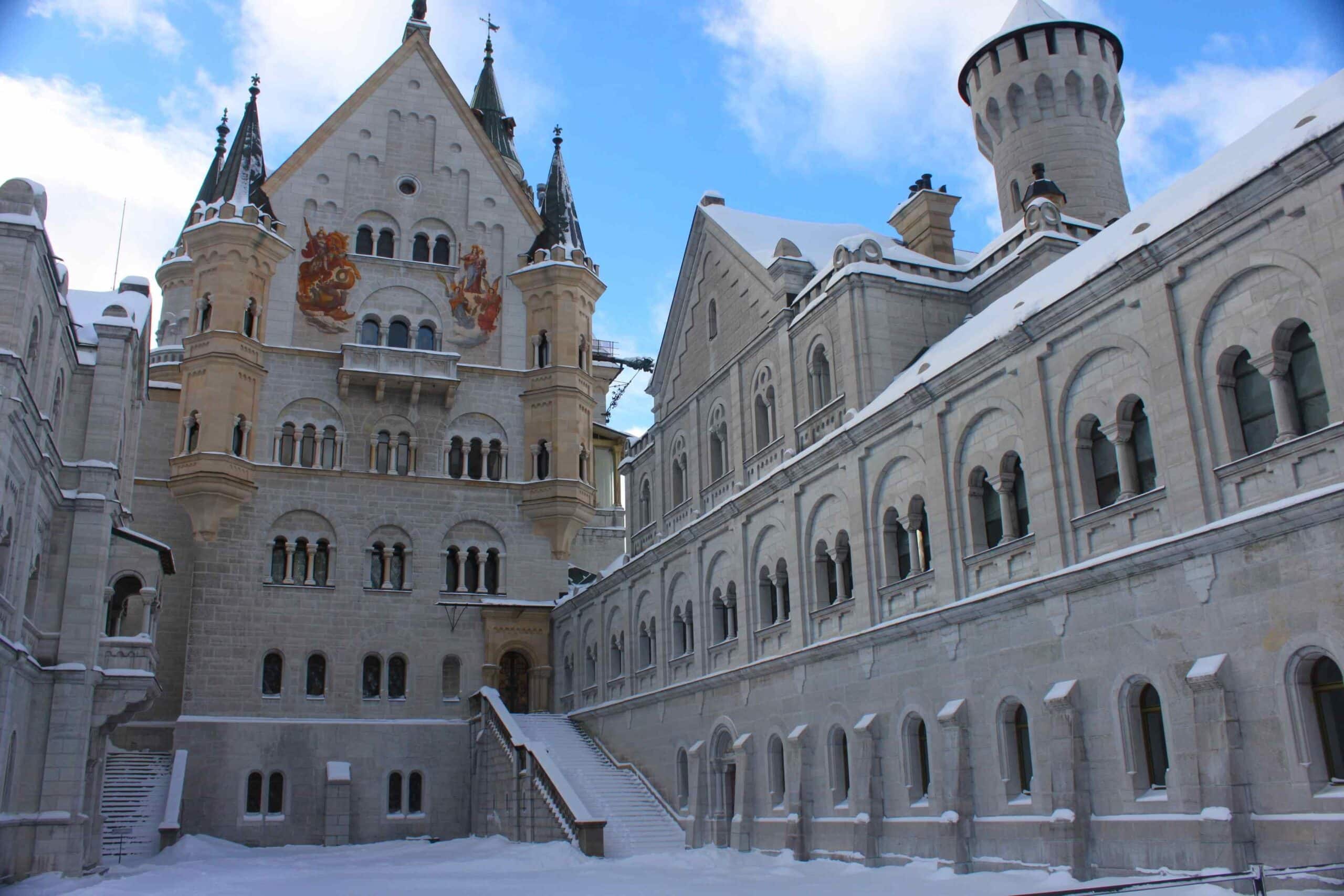
Neuschwanstein is not one building but a chain of them, strung along the ridge around a lower and an upper courtyard: the Gateway Building, the Knights’ House, the Bower, the Palas and the Square Tower, whose square shaft carries a battlemented cylindrical upper stage. Calling the whole thing neo-Romanesque, as the state heritage listing does, is worth taking literally. Every opening on the exterior is round-arched, set in coupled arcade windows under conical, pyramidal, hipped and steeply pitched roofs; the pointed arch and the traceried window are absent. Gothic at Neuschwanstein is an interior matter, confined by the operator’s own account to the King’s Bedroom and the chapel beside it.
The dominant element is the Palas, a five-storey range set over a kinked plan, with octagonal corner turrets and a monumental external stair down to the courtyard. Its walls are brick, faced with light-colored limestone ashlar – the operator’s word is that the stone was used “merely as cladding” – and the one exception is the Gateway Building, which was never faced in limestone at all. Its red brick is the first thing a visitor meets and the only place the construction shows itself. The building methods were as modern as the imagery was old. Steam engines drove the cranes, and the windows carry unusually large panes in industrial steel frames. The Throne Hall was demanded by the king after the Palas was already standing, so it could only be inserted on an encased metal frame, which was then clad in plaster. In English the administration calls that frame steel, in German a light iron construction. At 65 meters, the castle is recorded by Guinness World Records as the tallest castle in the world.
Neuschwanstein was never completed, and the tour makes that unusually easy to see. The king’s apartments and state rooms occupy the third and fourth floors alone; the rooms of the second floor were never fitted out and today hold the shop, the cafeteria and the multimedia room. A Moorish Hall with a fountain had been planned for that floor and was abandoned, though the fountain itself was built and stands in the Winter Garden. No keep was ever erected, though one carrying a chapel had been planned. Even the parts that were finished were finished cheaply: Georg von Dollmann had begun stripping picturesque detail out of Jank’s designs from 1874, and the Bower and the Square Tower were built as simplified versions of what had been designed, not finished until 1892; the state heritage listing dates the Bower’s simplified completion from 1888. The silhouette the whole world photographs is partly a posthumous economy, and the palace administration’s own word for the result is austere.
Principal Interior Rooms
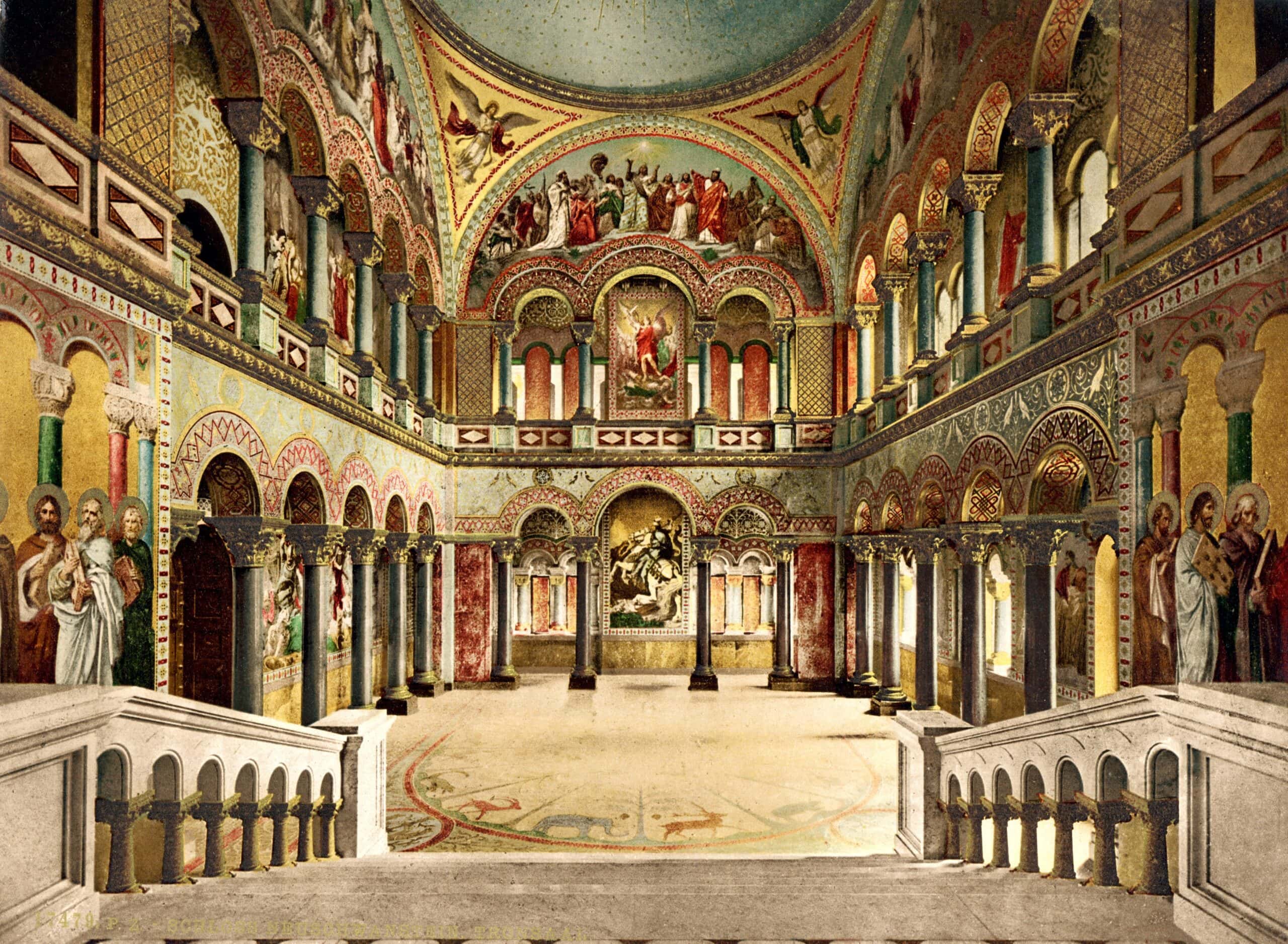
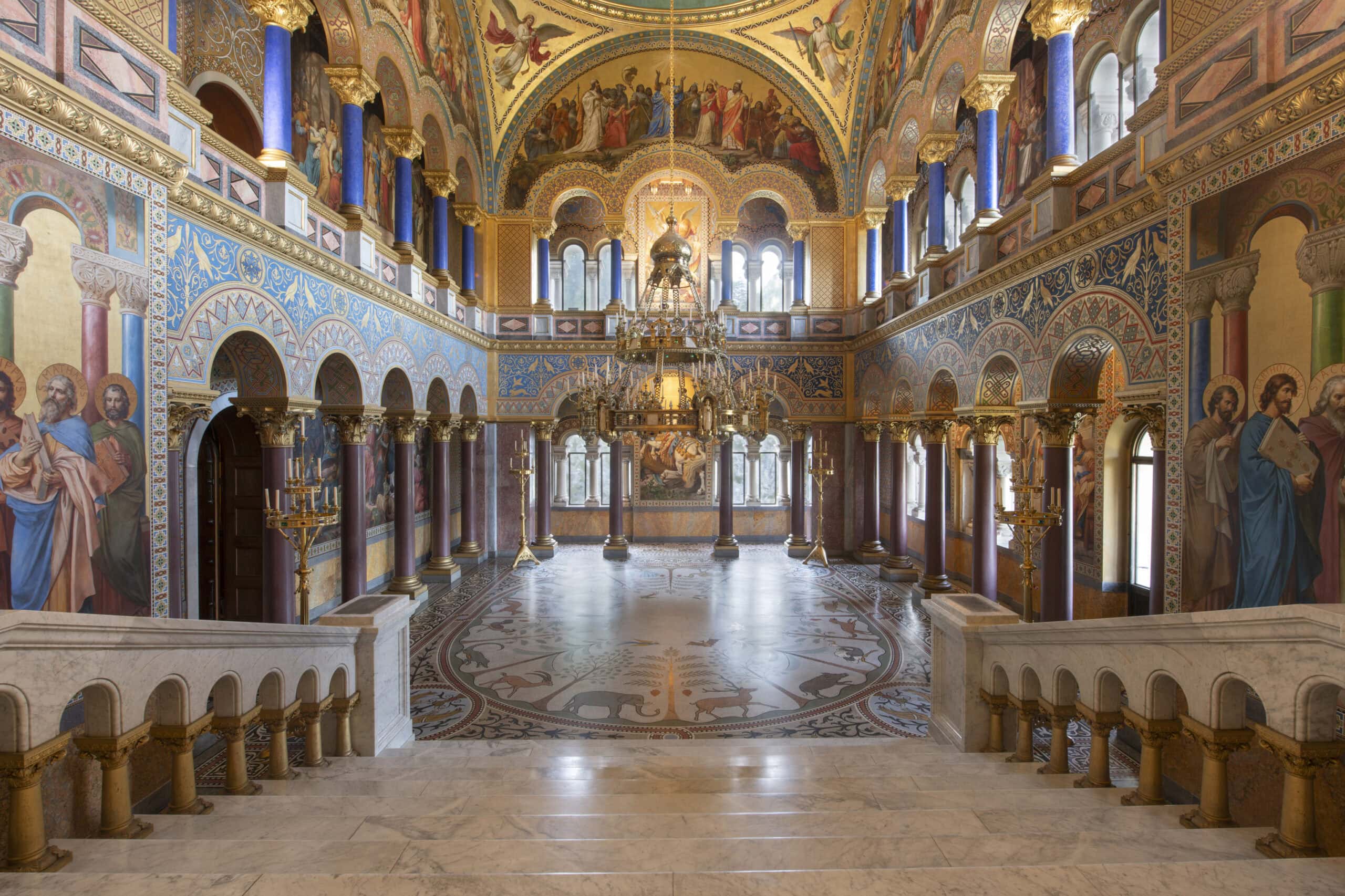
The Throne Hall is the most architecturally ambitious space in the castle. It runs through the third and fourth floors and takes up the whole western part of the Palas, modeled above all on the All Saints’ Court Church in Munich and beyond that on Byzantine church interiors. A church-like apse at the north end was meant to hold a throne, and the throne was never made. Beneath a star-strewn cupola the floor mosaic shows the earth with its plants and animals; in the apse zone are Christ, the twelve Apostles and six canonized kings, with representatives of the pre-Christian kingdoms below the dome and the deeds of kings and saints along the walls. A four-meter chandelier hangs in the middle of it. The whole room states what the palace administration calls Ludwig’s view of kingship “by the Grace of God”: a holy mission, carrying powers the Bavarian king had never actually possessed.
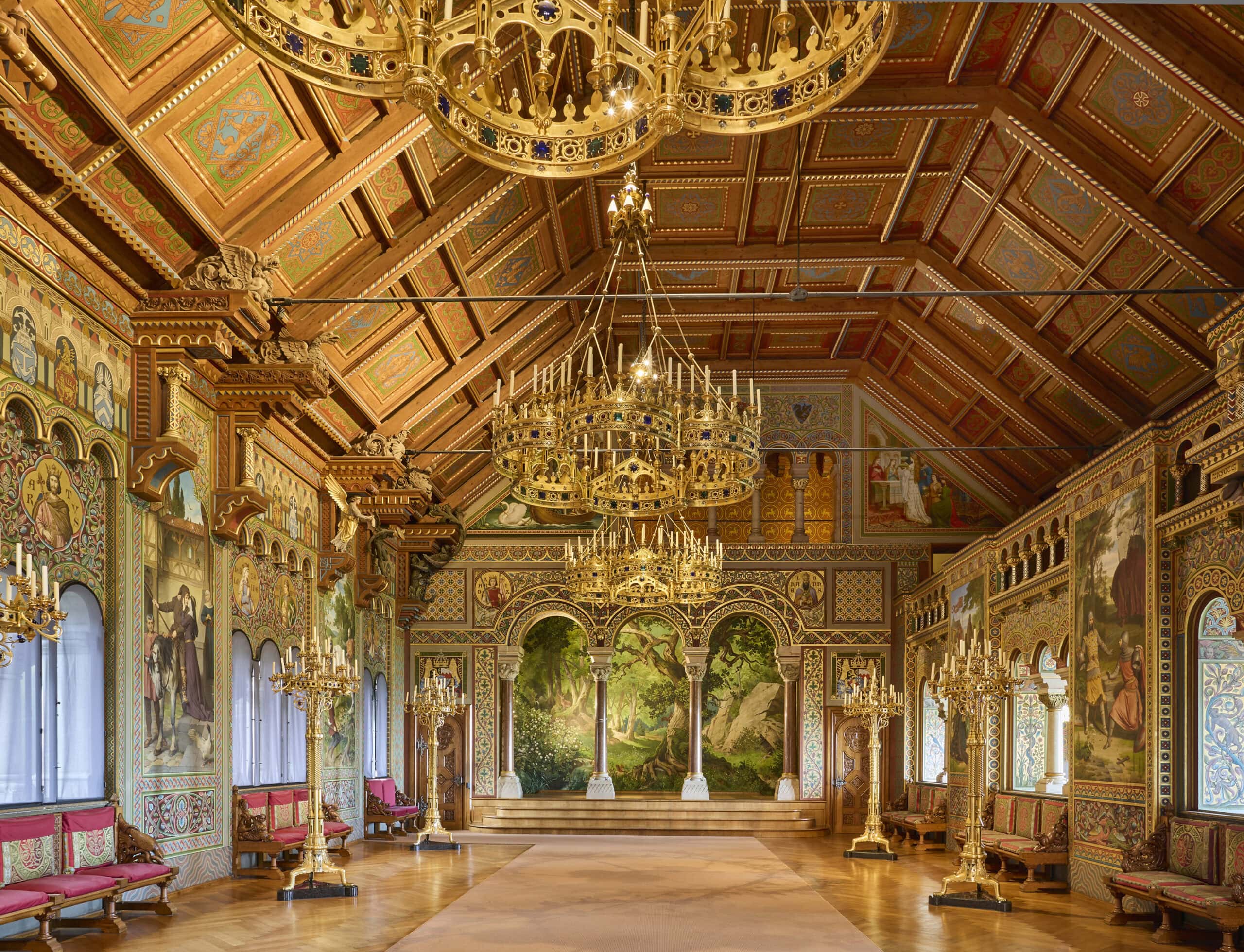
The Singers’ Hall runs the whole length of the Palas’s east range on the fourth floor. It is not a copy of the Wartburg’s Singers’ Hall, as it is often described, but a fusion of two Wartburg rooms into a new one: the bower quoted from the Wartburg’s Sängersaal, the gallery from its banqueting hall. Its picture program is predominantly not the Singers’ Contest but the saga of Parzival and the quest for the Holy Grail. That is a change of program rather than of taste: the palace administration records that Neuschwanstein, first conceived as a monument to the medieval minnesingers, was reinterpreted as the Castle of the Holy Grail, with the Throne Hall redesigned as the Grail hall. Wagner and his circle had by then taken to calling the king Parsifal in private.
At the west end a raised bower is divided off by steps and three columned arcades, with a small gallery above and a painted forest behind it, the sacred wood around the Grail castle. Ludwig did not build the room to be used: the palace administration states plainly that no great banquets or musical performances were held in it, and that it was not intended for performances or festivities at all. It is a monument to medieval chivalric culture, a room to be walked through rather than filled. That is the room Ludwig made and left.
Concerts did eventually come to it: from 1970 to 2015 the Ostallgäu district and the municipality of Schwangau staged an annual series in the hall, and the organizers put its end down to the restoration, the pandemic closures and their own withdrawal together. The Konzertgesellschaft Neuschwanstein revived the concerts in 2024 out in the castle courtyard, in the open air, and the Singers’ Hall is no longer the venue.
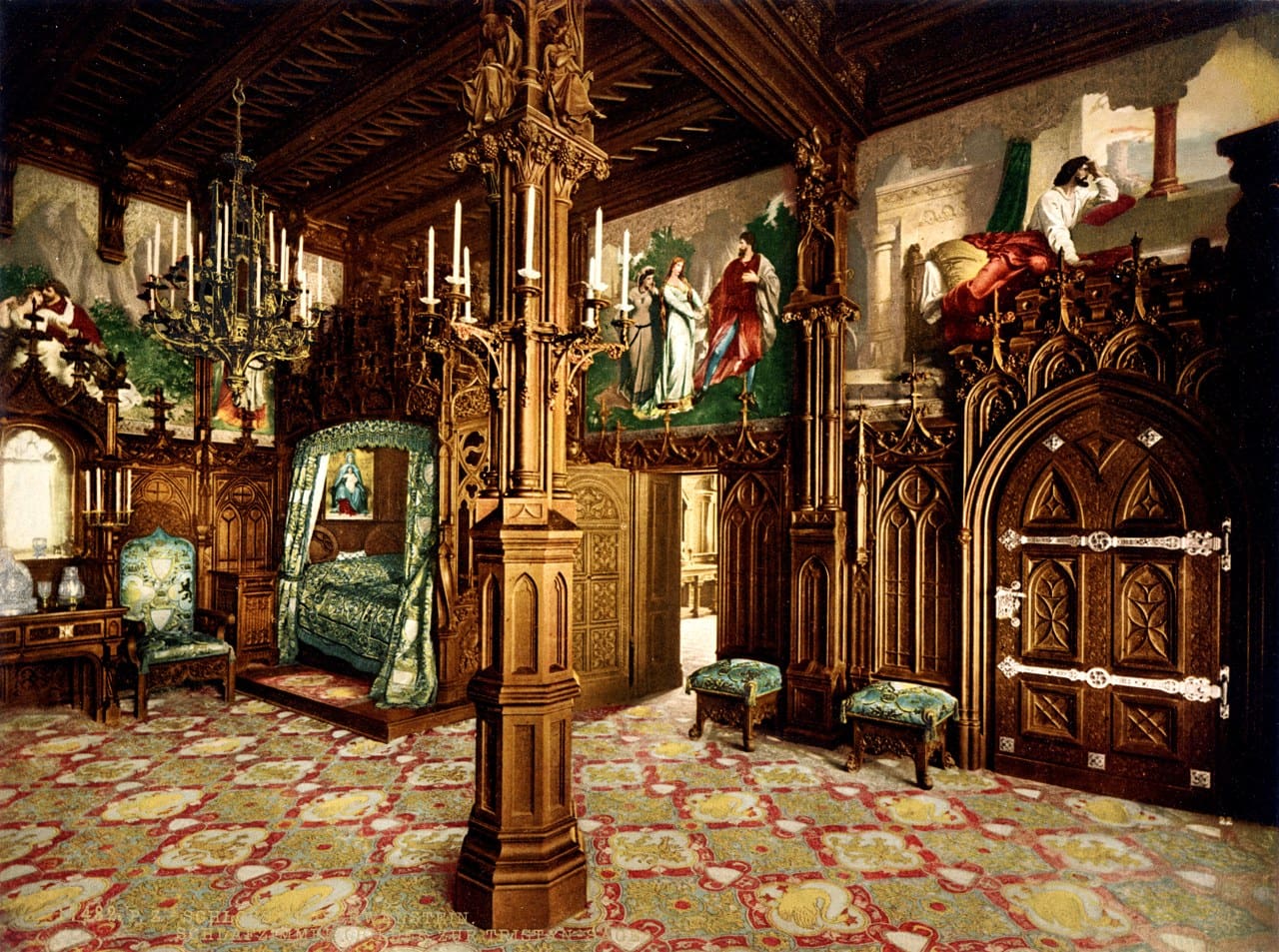
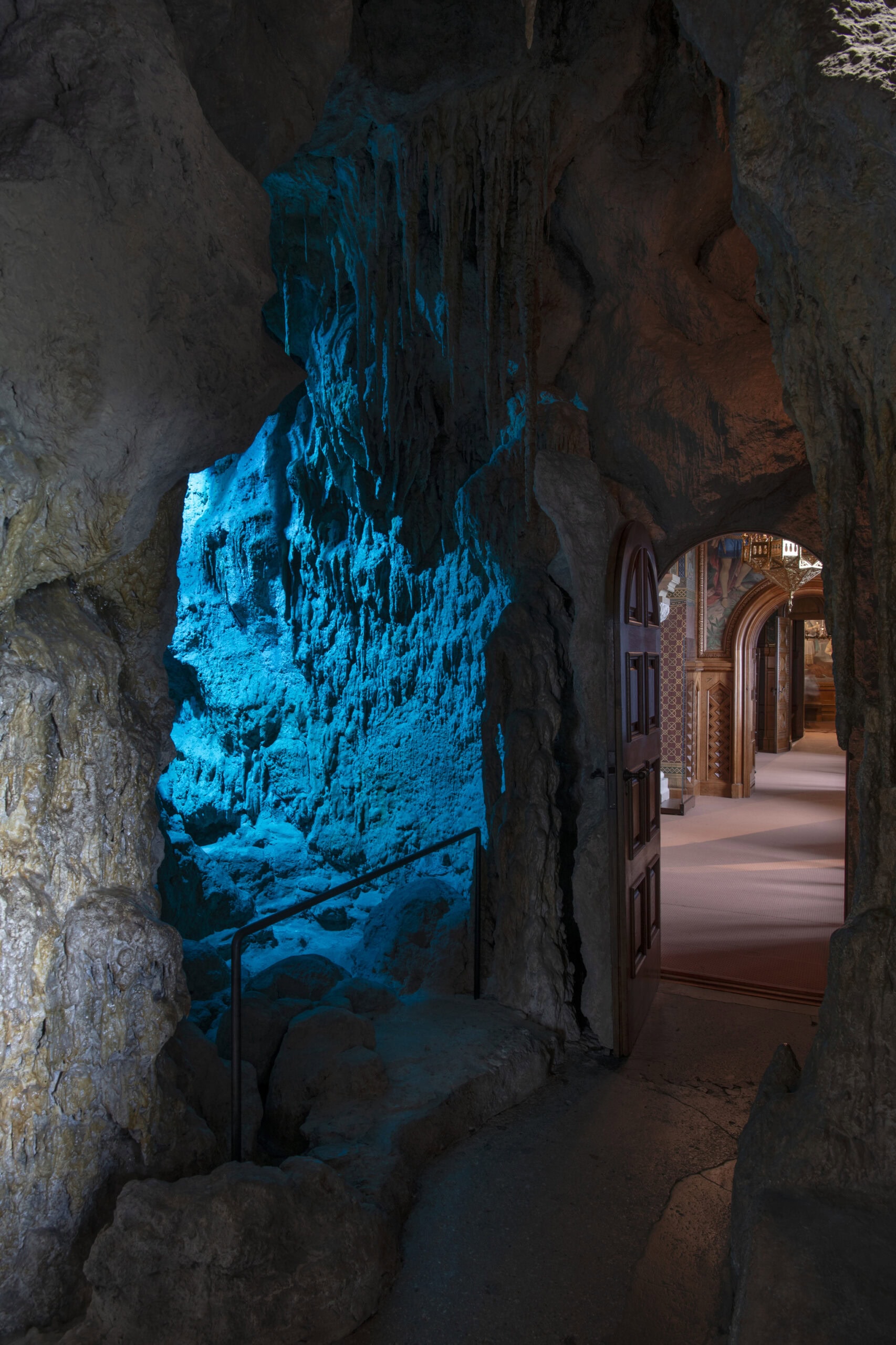
The King’s Bedroom shows the other register of the castle’s interior: more intimate than the state rooms, though still elaborately worked, and with the chapel beside it one of only two Gothic rooms in a Romanesque castle. Peter Herwegen drew the carved oak four-poster and the Munich craftsman Anton Pössenbacher cut it; the woodwork is dense with Gothic tracery, and the imagery throughout is devoted to Tristan and Isolde. Further along the same floor, the Study served as Ludwig’s private workroom, its walls painted with scenes from the Tannhäuser saga. Between the Study and the Salon, the stage designer August Dirigl built an artificial stalactite grotto from 1880, lit by colored electric light. It originally had a waterfall as well; the water no longer runs, though the colored light remains. It was meant to recall the Hörselberg of the Tannhäuser legend, the same Venusberg that Ludwig would later stage at full scale as the Venus Grotto at Linderhof Palace. A glass door that sinks into the rock leads on into the Winter Garden, where the fountain built for the Moorish Hall stands in a castle that never got one.
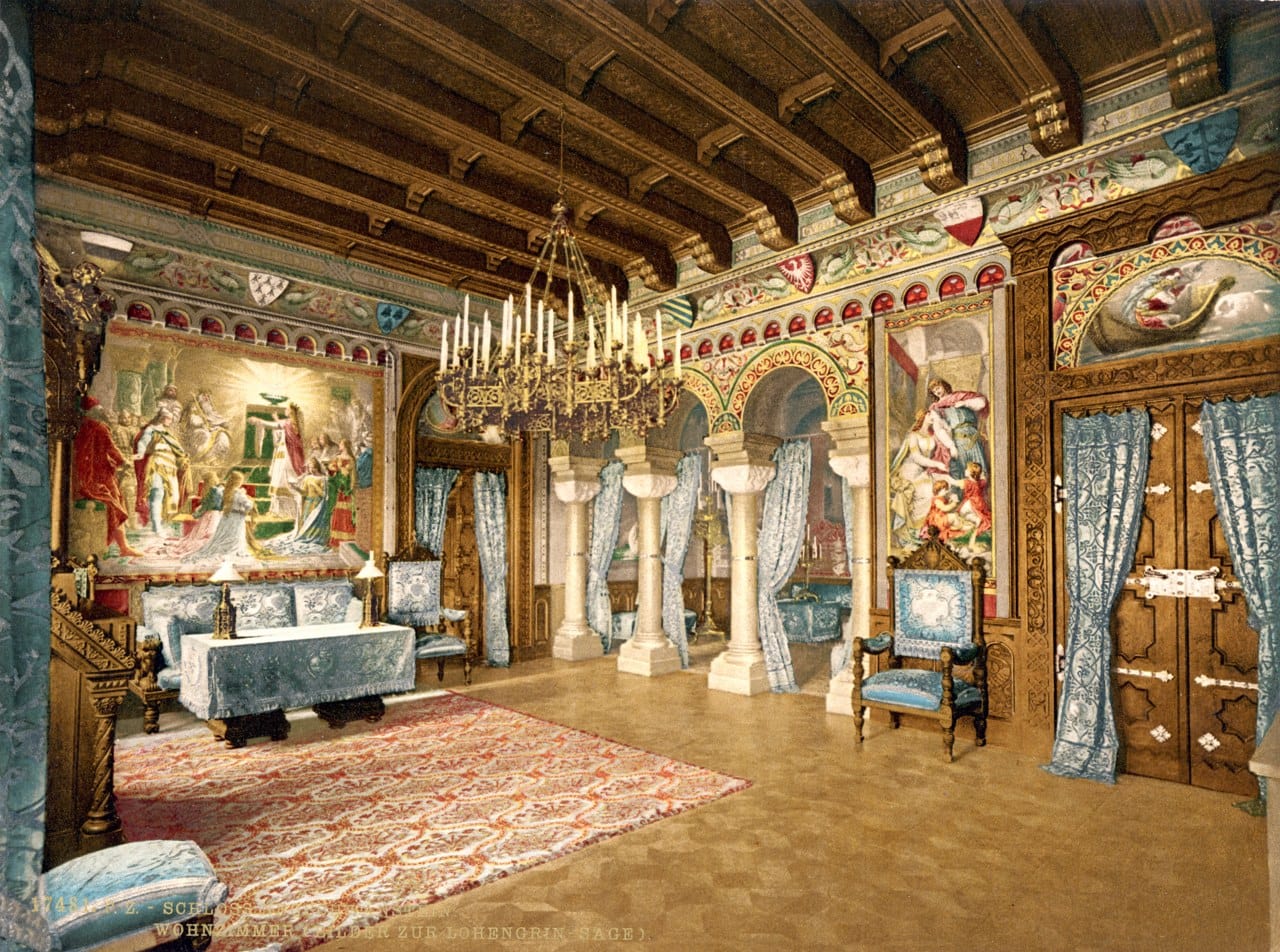
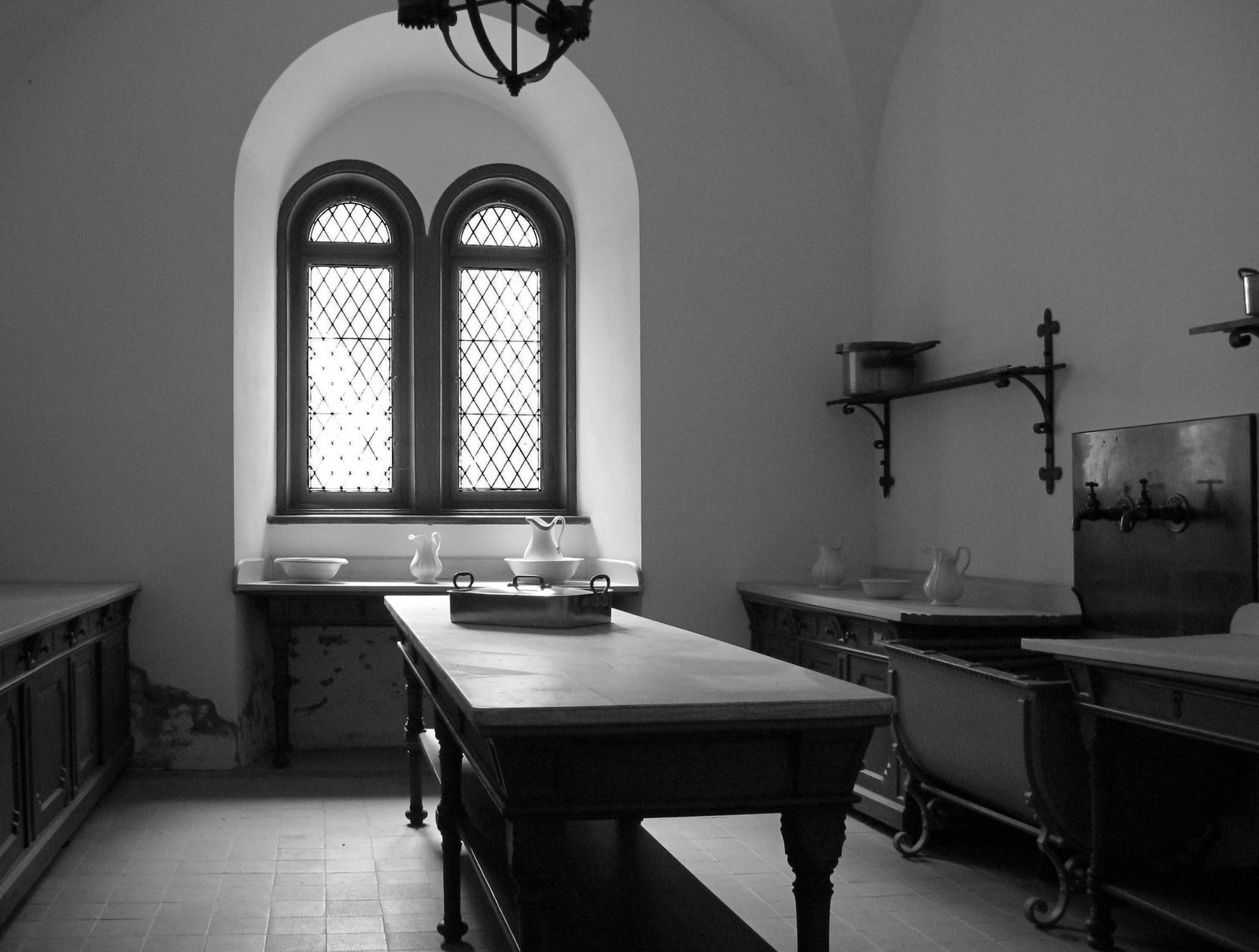
Throughout the castle, the iconographic program is drawn from the three Wagnerian heroes with whom Ludwig most identified: the poet Tannhäuser, the swan knight Lohengrin, and the Grail King Parzival. The swan appears as a recurring motif in all media, in carved wood, painted murals, woven fabrics, and ceramic tiles, simultaneously referencing Wagner’s Lohengrin, the heraldry of the Counts of Schwangau, and Ludwig’s own private symbolism of purity. The Salon, or living room, is given over entirely to the Lohengrin legend, its painted panels following the swan knight from his arrival to his parting. For all the medievalism, the castle was among the best-equipped buildings of its day. Hot-air central heating served the royal apartments, running water reached every floor with hot and cold in the kitchen, and the toilets had an automatic flushing system. A service lift meant meals did not have to be carried by hand from the kitchen on the ground floor to the dining room on the third. An electric bell system in the anteroom from 1885 reached the duty servant from any room, and telephones served the third and fourth floors.
Neuschwanstein as a Global Icon
The castle’s public meaning diverged sharply from what Ludwig intended for it. He conceived Neuschwanstein as a place of total seclusion, closed to all but a handful of servants; within weeks of his death it had become a public spectacle, and it has remained one ever since. The silhouette of white walls and slender towers against the Alps has become shorthand for the storybook castle. That reading has a documented origin: when Herb Ryman drew the concept sketch for Disneyland in 1953, he produced, in the Walt Disney Family Museum’s words, a central fairytale building “inspired by the Neuschwanstein castle in Germany” – or, as Ryman himself put it, one based “on King Ludwig’s Bavarian castle.” The form has been copied in theme parks, films, and corporate logos ever since.
That fame carries a cost. The palace administration counts around 6,000 visitors a day through the summer, filing through rooms built for a single occupant. Official annual counts have eased more recently, to about 1.08 million in 2025, essentially flat on the year before; at its late-2010s peak the castle drew close to 1.5 million a year, a level last reached in 2019. The state rooms stayed open right through their restoration, partly with reduced tour-group sizes. Strain on floors, textiles, and murals is one reason the building is held to short, tightly scheduled guided tours, and it is why the conservation campaign described below ran as long as it did. Neuschwanstein is at once a working museum, a tourism engine for the whole Allgäu region, and a fragile nineteenth-century interior that has to be protected from the very crowds its fame attracts.
A UNESCO World Heritage Site
On July 12, 2025, at the 47th session of the World Heritage Committee in Paris, Neuschwanstein was inscribed on the UNESCO World Heritage List. It was listed not on its own but as part of a serial property, “The Palaces of King Ludwig II of Bavaria: Neuschwanstein, Linderhof, Schachen and Herrenchiemsee,” which brought Germany’s total to 55 World Heritage Sites. The four palaces had stood on Germany’s tentative list since 2015.
The committee inscribed the four palaces under criterion (iv), as outstanding examples of the historicist and eclectic architecture of the later nineteenth century. UNESCO’s evaluation singled out the way Ludwig’s buildings fuse a romantic, theatrical vision with advanced engineering, and the care with which each was set into its mountain or lakeside landscape. Neuschwanstein’s own legal protection is German and predates the listing: it stands on the Bavarian monument register as a protected Baudenkmal, and under the Convention the duty of protecting a World Heritage property belongs primarily to the state on whose territory it sits. What inscription adds is international recognition, a reporting obligation on Germany for the measures it takes, and a formal place alongside Ludwig’s other retreats as a single, coherent body of work.
Inscription arrived five days after a much longer job ended. Between 2017 and 2025 the Bavarian Palace Administration worked systematically through the state rooms, stabilizing the furniture and textiles that the alpine climate, the light, and heavy footfall put under strain. More than 2,300 objects, wooden fittings, windows and doors were worked on, in roughly 250,000 working hours spread over more than fifty firms, at a cost of more than 22 million euros. That sits inside a far longer effort, since Bavaria has been restoring the complex continuously since 1994 and has put about 43 million euros into it altogether. The Singers’ Hall was the first room finished, in 2020; the Throne Hall followed in 2022; the bedroom, dressing room, salon and grotto closed for their turn in January 2023. On July 7, 2025 the administration declared the work complete down to the last detail, and the UNESCO vote came on the twelfth. The stated goal was never a polished reconstruction but the recovery of what the administration calls a well-tended aged appearance in the original furnishings, together with their permanent conservation.
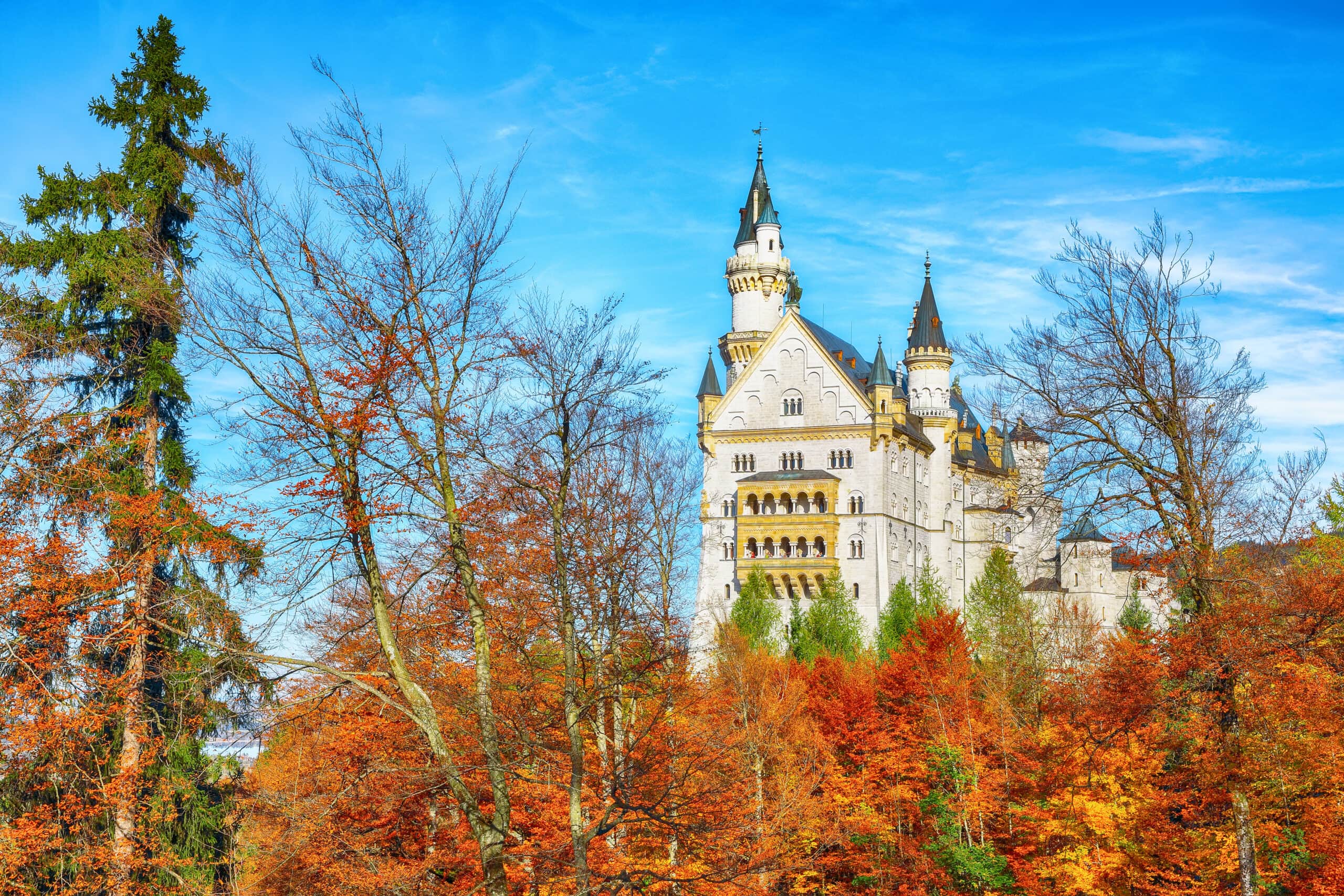
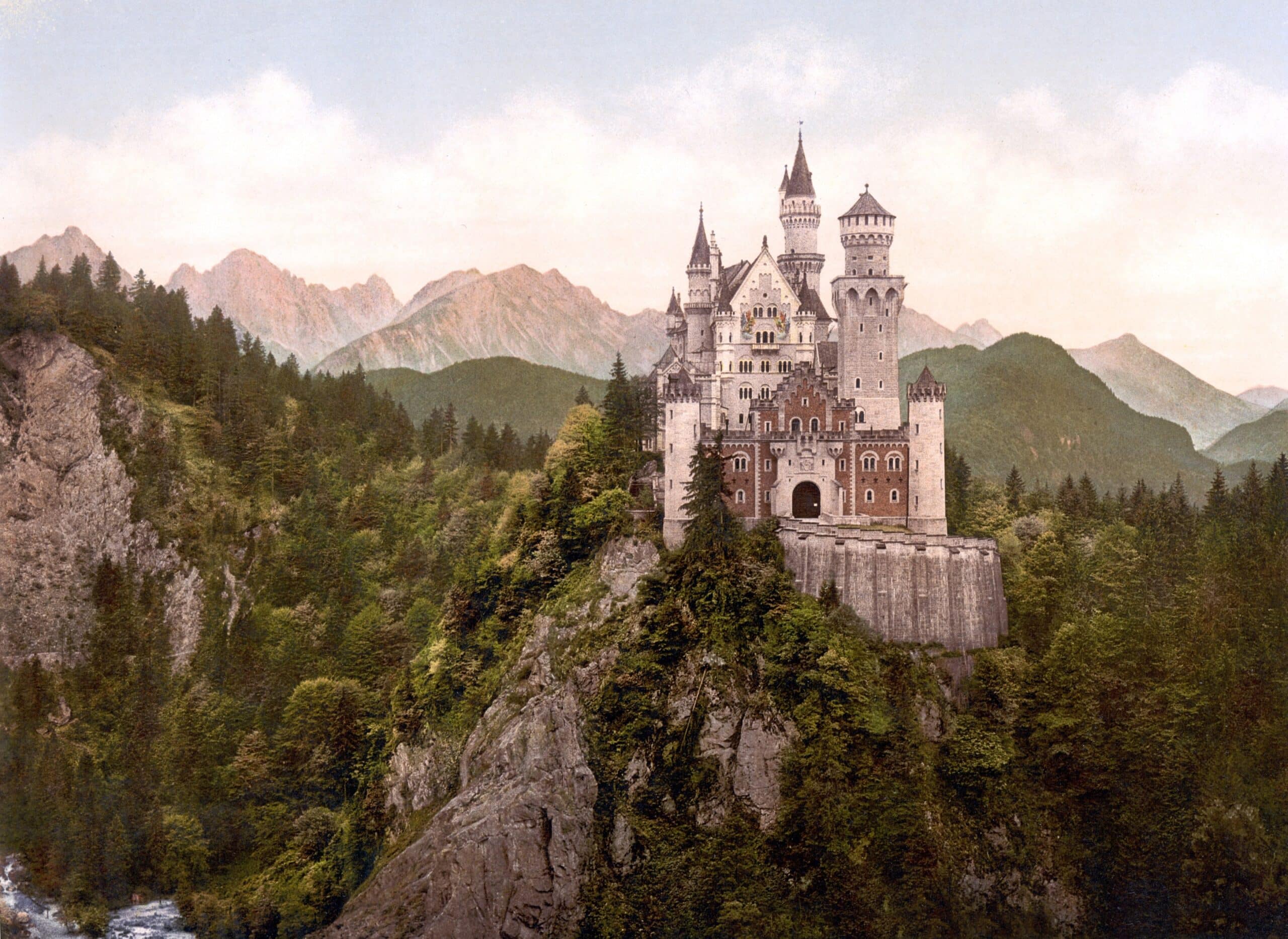
For a visitor today the scaffolds are down and the rooms are open, though it is still worth checking the operator’s current notices before you travel. An earlier campaign had renewed the limestone facades between 2000 and 2013, and the Gateway Building followed from 2016 to 2018; through all thirteen years of facade work the scaffolding was staged so that one main elevation was always left clear, which is why the castle went through it without ever losing its picture. Where this guide shows a room twice, the photochrom of about 1900 is the older view and the modern photograph is the state the room came out in.
Visiting Neuschwanstein Castle
List the 9 castles on this map
- Neuschwanstein Castle — Swabia, Bavaria, Germany
- Hohenschwangau Castle — Swabia, Bavaria, Germany
- Linderhof Palace — Bavaria (Oberbayern), Germany
- Herrenchiemsee New Palace — Chiemgau, Upper Bavaria, Germany
- Lichtenstein Castle — Baden-Württemberg, Germany
- Rheinstein Castle — Rhineland-Palatinate (Rheinland-Pfalz), Germany
- Wartburg Castle — Thuringia (Thüringen), Germany
- Wernigerode Castle — Saxony-Anhalt, Germany
- Drachenburg Castle — North Rhine-Westphalia, Germany
Getting there
Most visitors come from Munich, a little over two hours away by direct regional train to Füssen. From the station, the castle buses, lines 73 and 78, cover the last few kilometers to the Hohenschwangau stop and are timed to meet the trains. Drivers take the A7 to its end and then the B17 through Schwangau; the village has only private parking. However you arrive, the last stretch is the same: the ticket center sits in the village and the castle sits above it, and the operator puts the walk at 30 to 40 minutes up about 1.5 kilometers of steep asphalt road.
Two alternatives cover part of that climb, and neither reaches the gate. From car park P4 a shuttle bus climbs to the Jugend lookout above the castle, leaving a downhill walk of about 500 meters, ten to fifteen minutes, to the entrance; from the same stop it is about five minutes to the Marienbrücke. Horse-drawn carriages leave from the Hotel Müller and set down at a turning area roughly 450 meters below the castle, which then has to be walked uphill. In winter the walk is often the only way up, because the operator is explicit that the buses do not run when there is snow or ice on the roads.
Admission
Neuschwanstein can only be seen on a guided tour, booked in advance through the Ticket Center Hohenschwangau in the village below. A limited number of same-day tickets are sold on site when available, and telephone or email reservations are no longer offered. Every ticket carries a fixed tour time, and the palace administration is explicit: tours start punctually, and in the event of late arrival participation is no longer possible. Its own advice is to set out in good time and to allow for possible security checks on site. Prices below are the 2026 rates published by the Bavarian Palace Administration and the Ticket Center; both are reviewed annually, so confirm on the operator site before you travel.
| Ticket | Price |
|---|---|
| Adult | 21.00 euros |
| Reduced (65+, students, visitors with a disability, hotel guest card, Königscard) | 20.00 euros |
| Children and pupils under 18 | Free |
| Group, 15+ paying guests | 20.00 euros per person |
| Kings-Ticket (Neuschwanstein + Hohenschwangau) | 43.50 euros / 38.50 reduced |
| Swan-Ticket (both castles + Museum of the Bavarian Kings) | 56.00 euros / 50.00 reduced |
| Service fee, individual ticket (online or reserved) | 2.50 euros per person per ticket, including the free under-18 tickets; 5.00 for the Kings-Ticket, 7.50 for the Swan-Ticket |
| Booking fee, group reservation | 1.50 euros per person per ticket |
| Opening hours | 28 March to 15 October, 9am to 6pm; 16 October to 27 March, 10am to 4pm |
| Closed | 1 January and 24, 25 and 31 December |
The two castles are run by different bodies, which is why they are ticketed separately: Neuschwanstein belongs to the Bavarian state, while Hohenschwangau is administered by the Wittelsbach compensation fund. That split has practical consequences. Under-18s go free at Neuschwanstein but pay from the age of seven at Hohenschwangau, and the Bavarian Palace Administration’s annual pass, which covers more than forty state sights, explicitly does not admit you to Hohenschwangau. If you intend to see both on one day, the Kings-Ticket bundles them; the Swan-Ticket adds the Museum of the Bavarian Kings. Entry tickets and guided day tours can also be arranged through GetYourGuide, and anyone staying overnight nearby can compare hotels in and around Füssen, four kilometers to the northwest, which has the area’s main concentration of accommodation, restaurants, and rail connections to Munich.
Some links on this page are affiliate links, which means StoneKeep Atlas may earn a small commission, at no extra cost to you, if you book through them.
How long you need
The tour itself is short: about thirty minutes through the principal finished rooms, taking in the Throne Hall, the Singers’ Hall, the Bedroom, the Study, the Grotto, and the Dining Room. Independent wandering is not permitted, so the visit is exactly as long as the tour. What takes the time is everything around it. Allow an hour from the ticket center to the gate on foot, plus the wait for a timed slot, plus the detour to the Marienbrücke, and a visit to Neuschwanstein alone comfortably fills half a day. Pairing it with Hohenschwangau, which most visitors do and which is ticketed from the same center, makes a full one; the two tours are booked at fixed entry times far enough apart to walk between them.
Best time to visit
The castle opens daily except on 1 January and 24, 25 and 31 December, and it runs two seasons: a long summer from late March to mid-October with the doors open from nine, and a shorter winter day from mid-October to late March. Those are the fixed points; almost everything else about timing is a question of weather and crowds. Snow and ice stop the buses, which can leave the climb as the only way up, and they can close the Marienbrücke outright. The bridge is the one thing worth planning around, because it is where the classic view is, and because access to it in winter is decided day by day; the Ticket Center posts the current status daily on its homepage, and it is worth checking before you set out rather than on arrival.
Spring and autumn are the practical compromise, with the bridge normally open and the summer peak past. One thing no longer needs planning around: the long restoration of the state rooms ended in July 2025 and the facade campaign a decade before that, so unlike visitors of the past twenty years you will not find a major elevation or a principal room behind scaffolding.
Photography
Photography inside the castle is not permitted. The palace administration’s rule is that photographing or filming for private purposes is not allowed in the castle, and the Ticket Center puts it more bluntly still, calling it strictly forbidden inside all the sights. Photographing the exterior for private use needs no permit, though the administration’s stated condition is that this means the usual hand-held cameras, without light, tripod or selfie stick. Drones are a separate matter and are refused: the administration says it sees their operation as a serious potential risk to the castle and its visitors, and enforces that through its property rights. Bags are the one place the operator’s own pages disagree: the palace administration’s tour page says rucksacks, prams and similar bulky objects may not be taken into the palace at all, while the Ticket Center’s baggage rules admit ordinary backpacks and handbags and bar only large luggage and hiking or military packs. Travel light, and do not count on the more generous reading if you are arriving from Füssen with everything you own on your back.
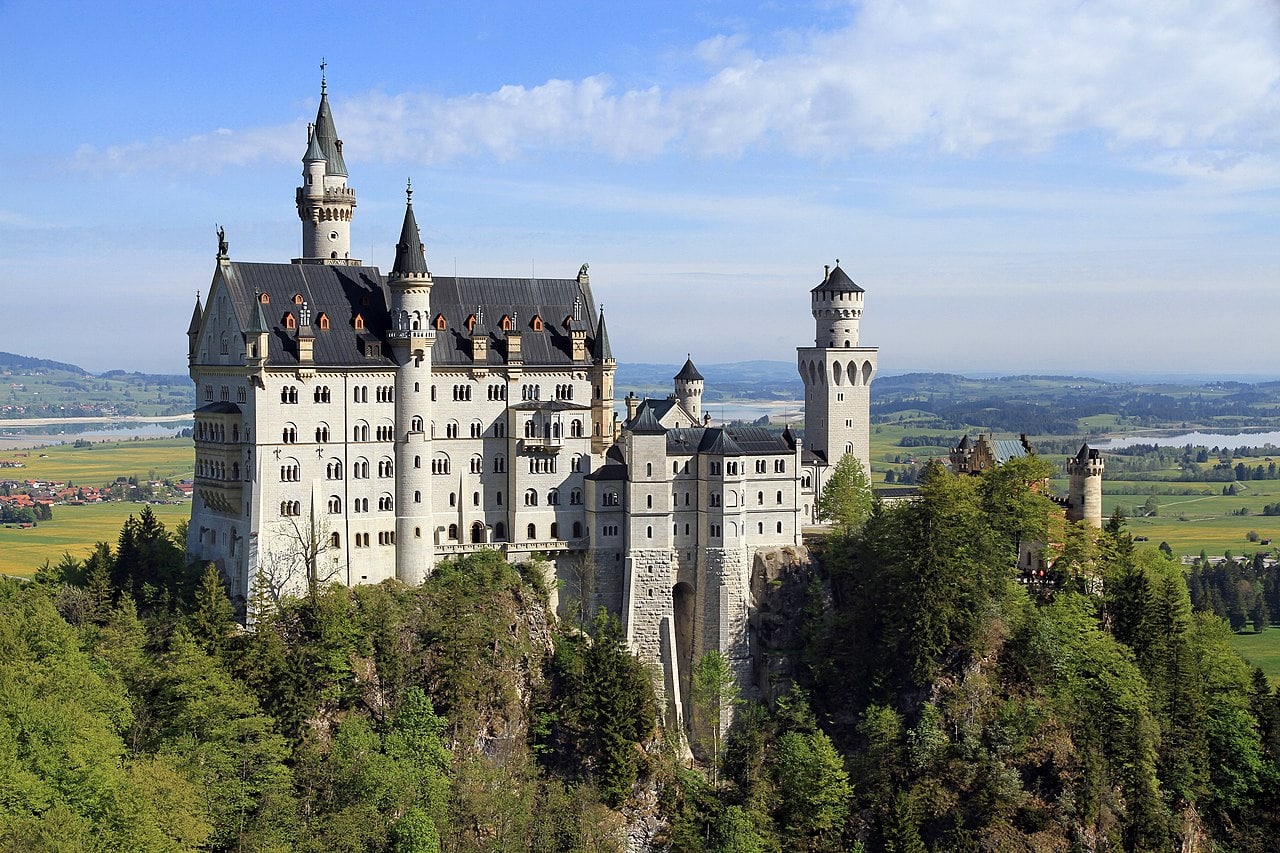
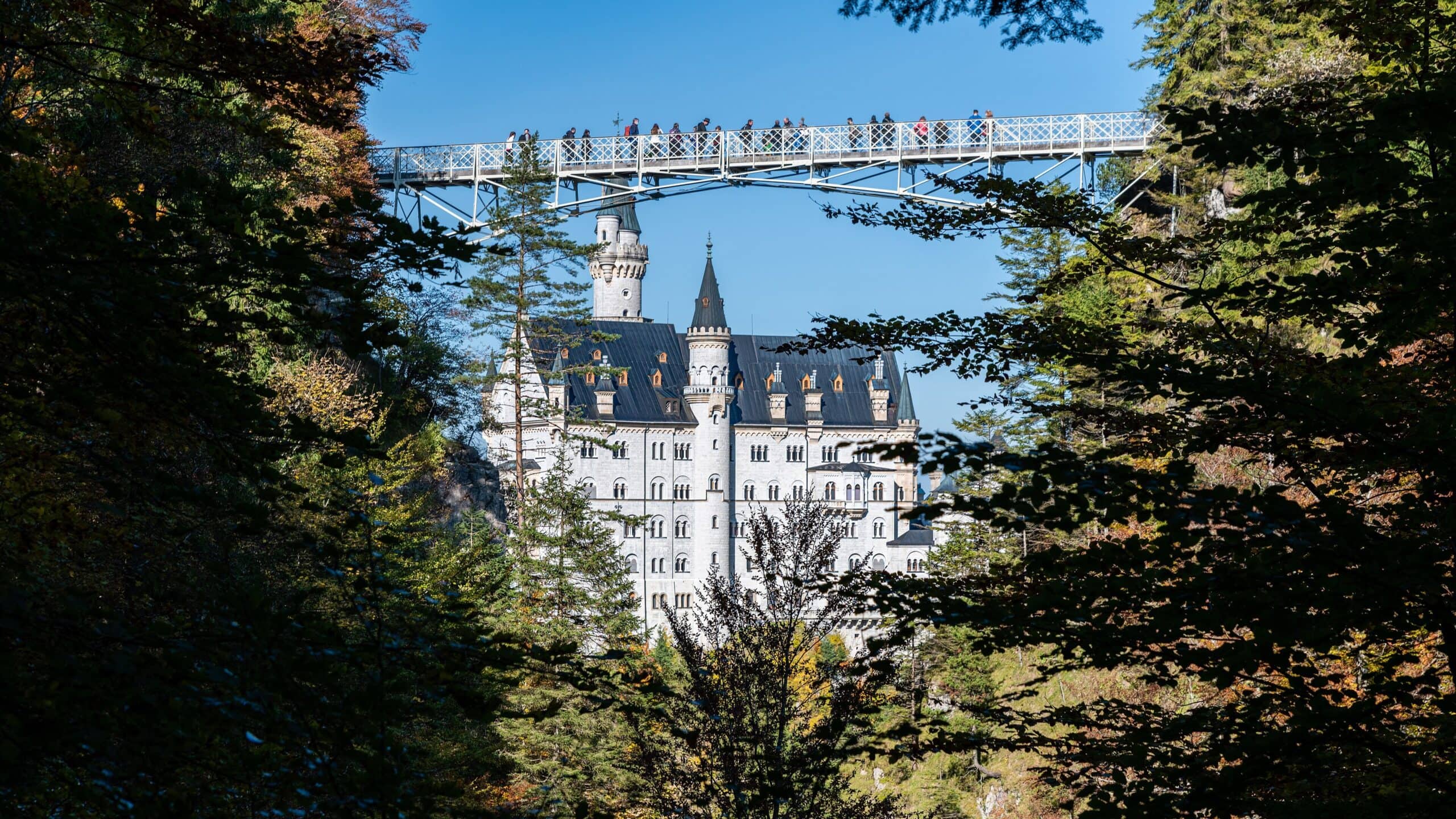
That leaves the exterior, and the exterior is the point. The show front is the south side: the state heritage listing describes the Palas’s south front with its tall round tower and conical roof, and the palace administration restored the south facades of the Palas and Bower as a single phase. The Marienbrücke, a slender iron footbridge across the Pöllat gorge a short uphill walk from the entrance, gives the view that front was composed for, rising sheer above the ravine with the lakes behind.
That has a practical consequence worth knowing. The bridge stands about 290 meters almost due south of the castle, so from it you are looking north at the south front, with the sun behind you rather than in your lens at any hour of the year. What changes through the day is the face itself: in high summer it stands in shade for the first hours of the morning and then carries the light from mid-morning onward, while nearer the equinoxes and through the winter it is lit from sunrise. Outside high summer, then, the light is no reason to prefer one half of the day over the other.
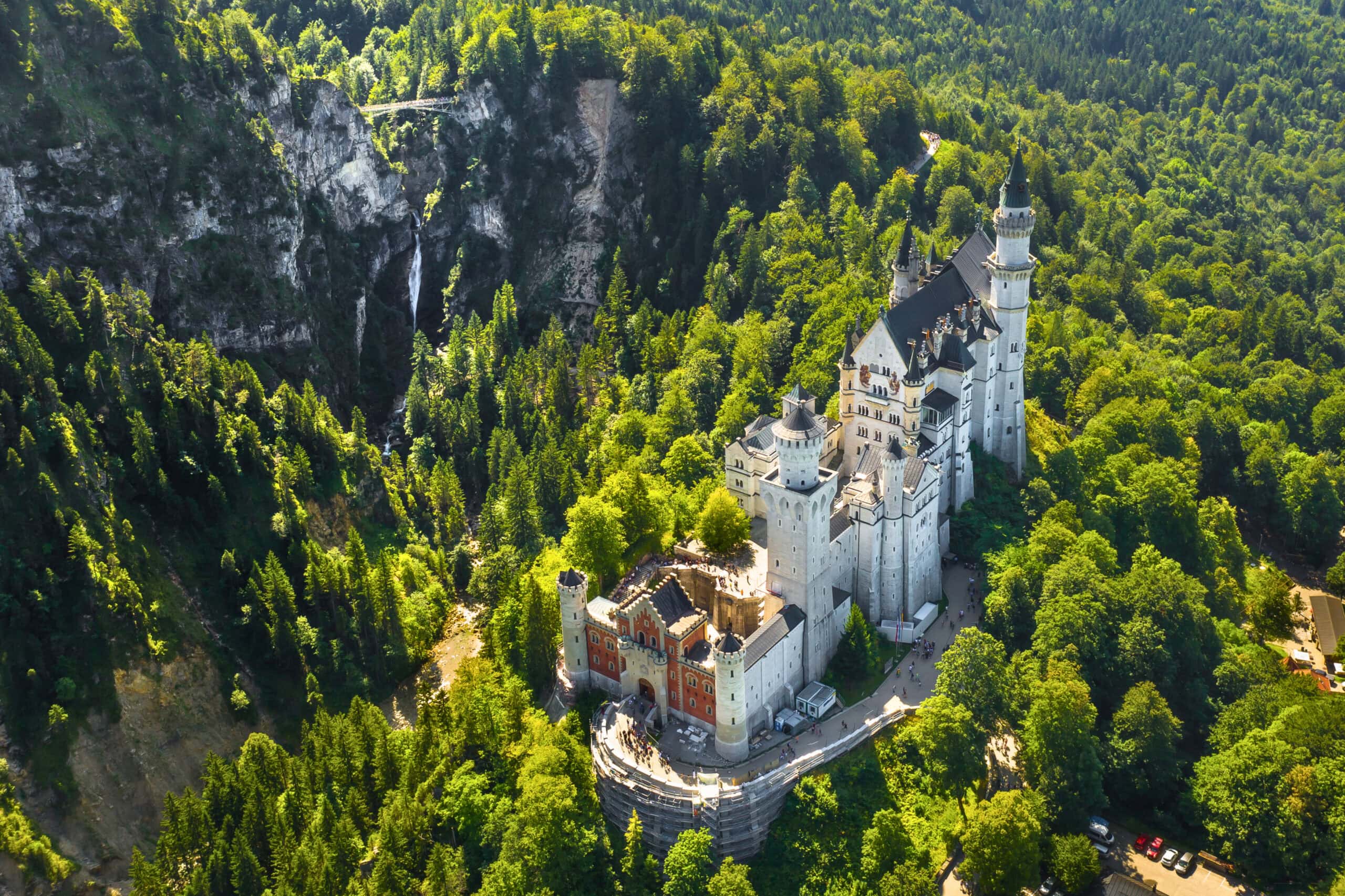
What can stop you outright is the weather, and ice shuts the bridge in winter. The Jugend stop where the shuttle bus terminates is the other vantage the operator names, about five minutes from the bridge and higher than the castle, which gives the reverse composition looking down onto the roofs.
Accessibility
Neuschwanstein is more accessible than its hilltop suggests, but the arrangements have to be made in advance. A lift inside the castle allows wheelchair users and visitors with reduced mobility to join the guided tours, and there are accessible toilets on level two by the cafe, with another at the kiosk opposite Zimmermannplatz. The binding constraint is capacity rather than access: only one wheelchair or walker user per hour can be taken on a tour, and the place has to be registered when the ticket is booked, so that the Ticket Center can arrange accompanying staff and coordinate the timing. Visitors with a disability pay the reduced rate on proof, and one helper is admitted free where the need for an escort has been registered.
Getting up the hill is the harder part, and the operator sets out the options frankly. Three disabled parking spaces sit in the chargeable P2 car park. The horse-drawn carriage takes folding wheelchairs and the drivers help with boarding, but it cannot carry electrically driven wheelchairs, and it stops 450 meters below the castle on a gradient reaching 15 percent. Higher up, a low-floor bus climbs to the Jugend stop above the castle, from which a path 2.5 to 3 meters wide descends 500 meters at a gradient of 12 to 19 percent with a slight camber; the palace administration’s own advice is that you must decide for yourself whether you are in a position to use it. The one route that reaches the entrance directly is a Red Cross vehicle for disabled visitors, and it runs only on Tuesdays and Thursdays between 10am and noon, which is worth knowing before choosing a date. No wheelchairs or walkers are available to hire in the castle. There is no guidance system for visually impaired visitors, though audio guides are offered in several languages, and no induction loop for hearing-impaired visitors, though written information is provided.
More Views of Neuschwanstein Castle
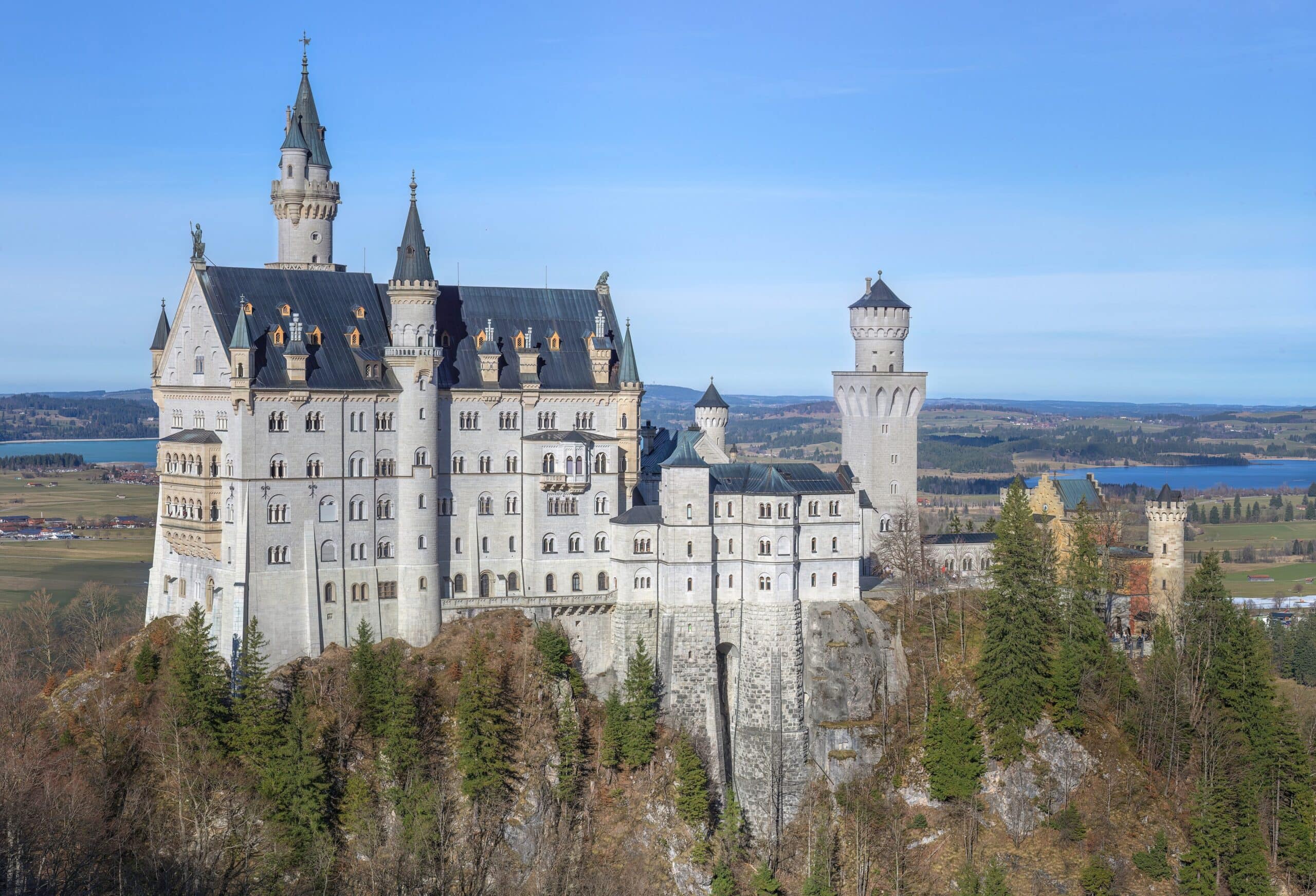
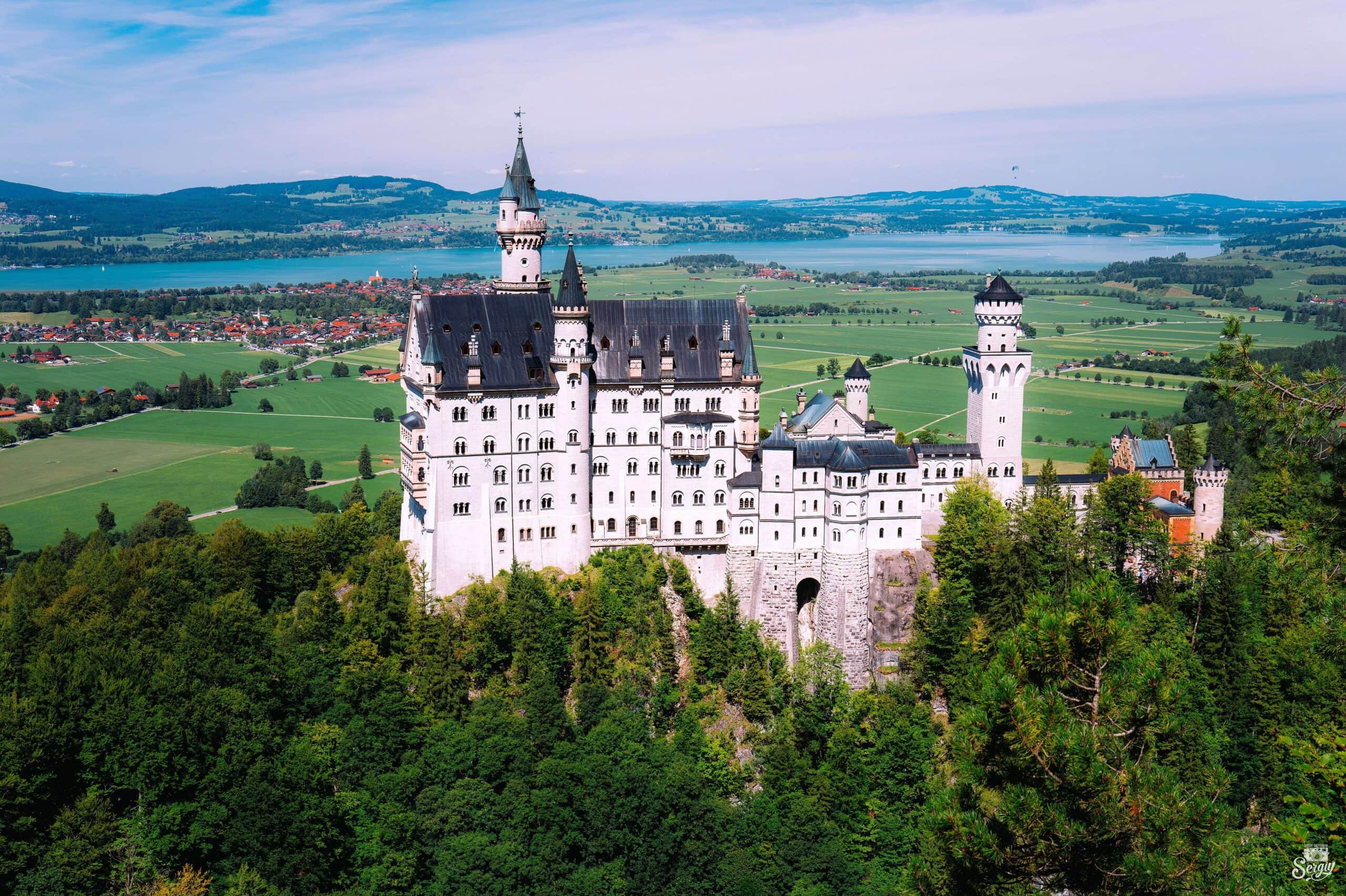
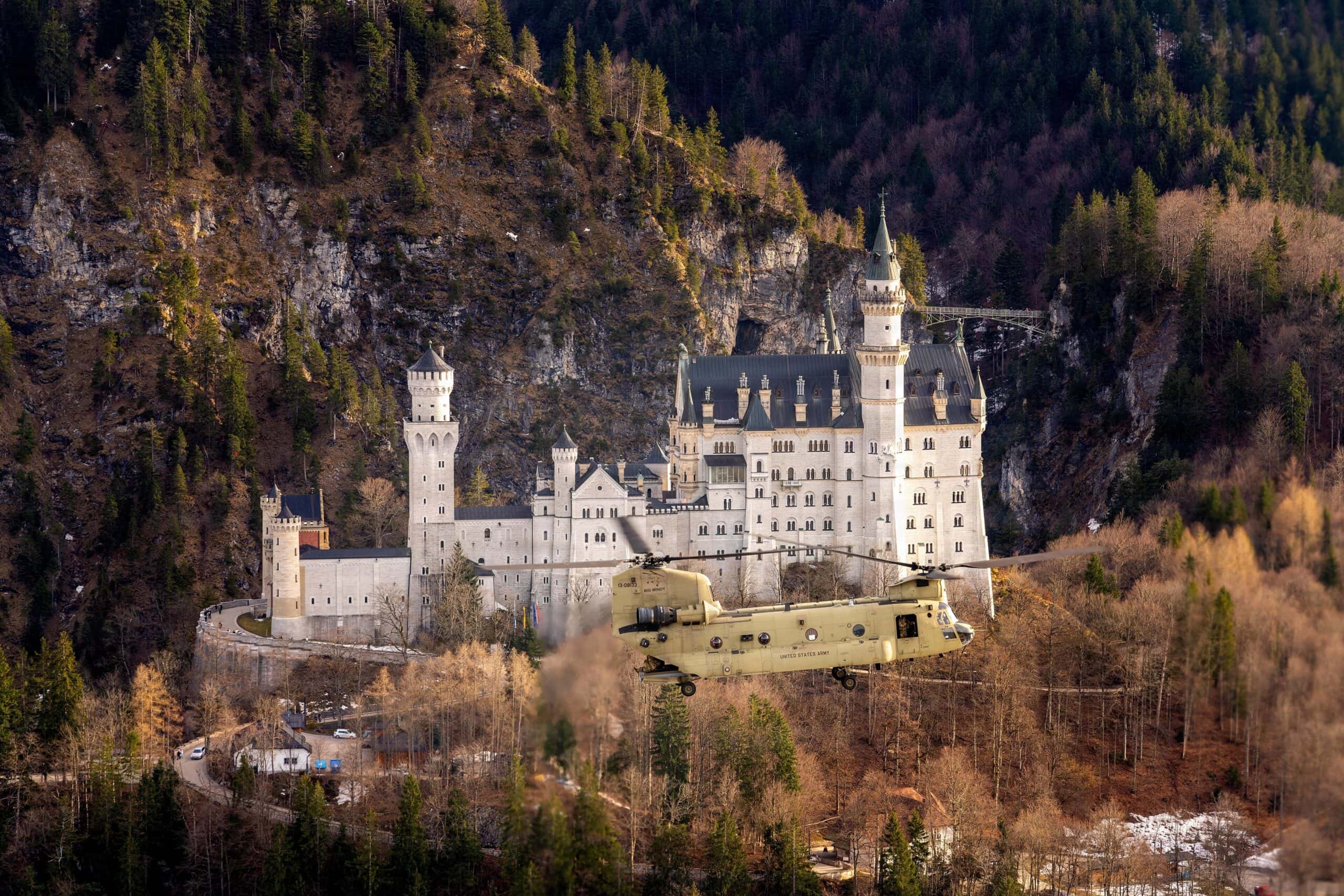
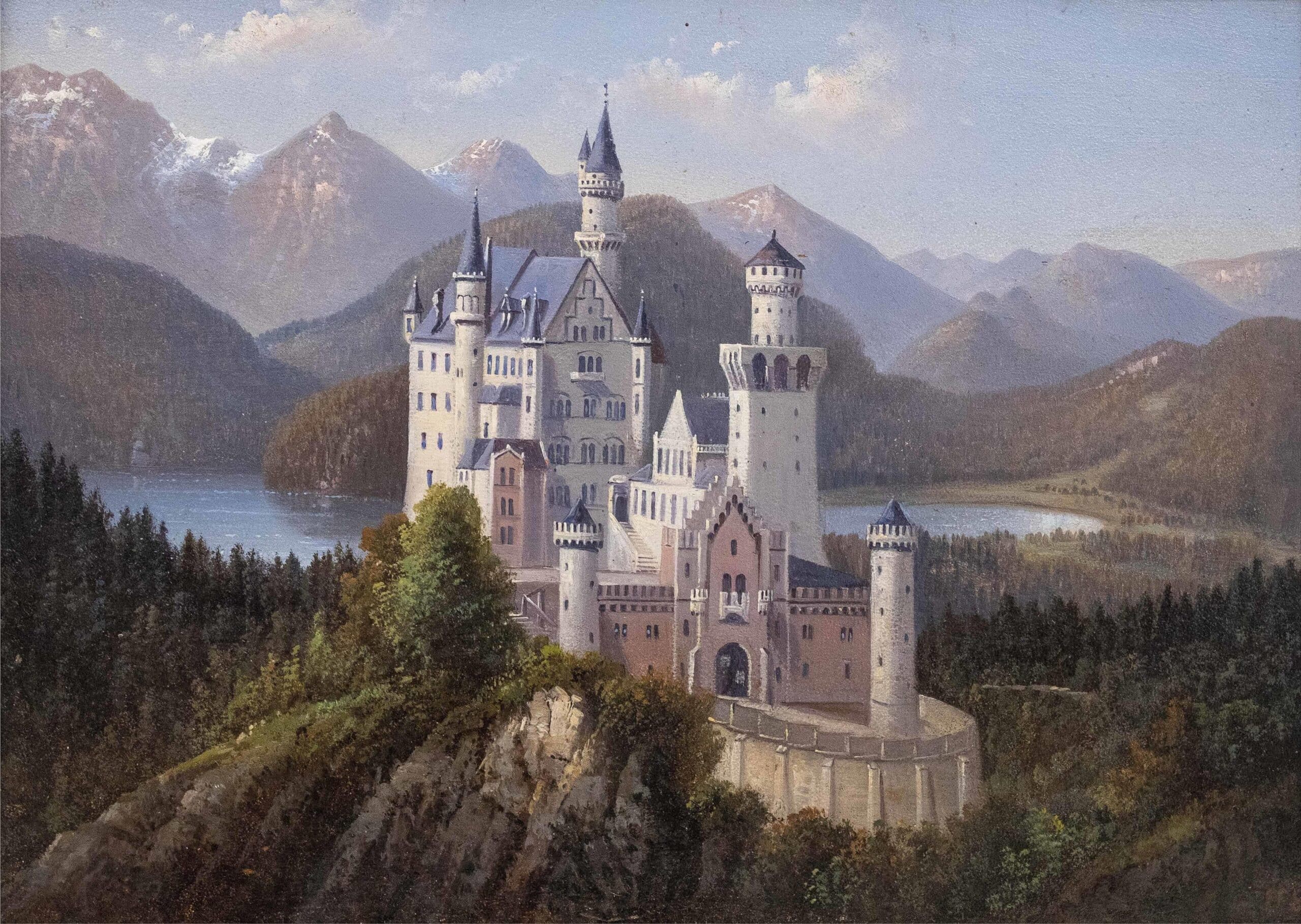
A closer look at the castle from every angle: its towers and courtyard, the bridge that frames the classic view, the building from the air and in autumn, the great halls as nineteenth-century visitors first saw them, and the working kitchen behind the royal apartments.
Common Questions
Why can’t you take photographs inside Neuschwanstein?
The Bavarian Palace Administration prohibits photographing or filming inside the castle even for private purposes, and the Ticket Center calls it strictly forbidden inside all sights. A reason is published, and it is not the one most visitors assume: in palaces run on continuous guided tours, the administration says, private photography cannot usually be permitted for organizational reasons. The rooms also hold light-sensitive nineteenth-century textiles and paintwork fresh from an eight-year conservation campaign. Photographing the outside for private use needs no permit.
How difficult is the walk up to the castle?
Harder than most visitors expect: neither the shuttle bus nor the carriage reaches the castle gate, so almost every visitor walks the last stretch whatever they have paid for. On foot it is about 1.5 kilometers of steep asphalt, which the operator times at 30 to 40 minutes. The carriage leaves the steepest part until last, finishing on a gradient reaching 15 percent, and the path down from the bus stop runs at 12 to 19 percent with a camber.
Why is Neuschwanstein Castle so famous?
Partly because it was never a fortress and was never required to work as one. It was built from 1869 as a private residence staged like a theater set for a single occupant, which is why it reads as a storybook castle rather than a defensive building. Its fame was then multiplied by Disneyland, whose concept artist Herb Ryman based his 1953 sketch on Ludwig’s Bavarian castle. The palace administration’s own assessment is that Neuschwanstein now ranks among the most popular palaces and castles in all of Europe.
What fairytale is Neuschwanstein Castle based on?
None, despite the nickname. Its imagery comes from Richard Wagner’s operas and the medieval German poems behind them: Tannhäuser in the Study, Lohengrin the swan knight in the Salon, and Parzival and the Grail quest in the Singers’ Hall. The swan that recurs in the carving, murals and textiles is heraldic rather than fanciful, taken from the arms of the Counts of Schwangau, whose lands Ludwig’s family had acquired. That fairytale reading was applied later, from outside.
Should I visit Hohenschwangau as well, and is it one ticket?
Most visitors see both, but they are two separate tickets from two separate administrations: Neuschwanstein belongs to the Bavarian state, Hohenschwangau to the Wittelsbach compensation fund. The Kings-Ticket bundles the pair and the Swan-Ticket adds the Museum of the Bavarian Kings. Note the age rules differ, with under-18s free at Neuschwanstein but charged from age seven at Hohenschwangau, and the state annual pass does not cover Hohenschwangau at all.
Can you visit Neuschwanstein in winter?
Yes. The castle opens daily through the winter on shorter hours, with only four closure days in the whole year. What winter changes is the approach rather than the tour. Snow or ice stops the buses, which can leave the 1.5-kilometer climb on foot, and it can close the Marienbrücke, the classic viewpoint. Access to the bridge is decided on the weather and the Ticket Center posts daily whether it is open, though a closed bridge does not restrict the castle tours themselves.
Beyond Neuschwanstein Castle
Hohenschwangau Castle, directly below on the valley floor, is the neo-Gothic palace where Ludwig spent much of his childhood. Its rooms are decorated with murals of medieval legend, including the Lohengrin cycle that shaped his imagination, and most travelers visit the two castles on the same day. Neuschwanstein is one of the two castles Google’s own answer names when asked which country has the most castles, a question whose honest answer is a question back. The pair also opens our south-to-north tour of the fairytale castles in Germany, the eleven buildings that carry the storybook silhouette most completely.
Ludwig’s other two major projects complete the picture of his architectural ambitions. Linderhof Palace, an hour east by road, is the only palace he ever saw completed: an intimate, jewel-like building in an ornate neo-Rococo style, with formal gardens and the famous Venus Grotto lit by electric arc lamps. Herrenchiemsee Palace, on an island in the Chiemsee, was his most extravagant: a deliberate recreation of the central wing of Versailles, also unfinished at his death. Together with Neuschwanstein itself and the King’s House on Schachen, these four buildings form the UNESCO serial property inscribed in 2025.
Neuschwanstein’s place in the nineteenth-century revival of medieval forms, Ludwig’s Romantic medievalism as the culminating expression of a decades-long movement, is treated comparatively in The 19th-Century Romantic Revival of German Castles. The political reading of the castle, as the architectural expression of Ludwig’s withdrawal of personal sovereignty into private mythology, is developed at length in Ludwig II and the Architecture of Dreams. Closer to home, two of Neuschwanstein’s German cousins pursue the same storybook idea: the cliff-top Schloss Lichtenstein in Württemberg and the Rhine-side Schloss Drachenburg above Königswinter, both neo-Gothic fantasies of a medieval past. The same Romantic impulse reshaped a real medieval ruin in France at the Château de Pierrefonds, which Eugène Viollet-le-Duc rebuilt for Napoleon III into a storybook fortress, a French cousin to Ludwig’s dream. A generation on, the same idea took German form at the Château du Haut-Kœnigsbourg in Alsace, rebuilt from a genuine medieval ruin for Kaiser Wilhelm II.
For the broader regional context, see Best Castles in Bavaria, a survey of the four Wittelsbach palaces of the south and the three Franconian prince-bishop seats of the north. Neuschwanstein also leads our roundup of the best castles in Germany. We have also filmed the castle; the documentary and the rest of the series are collected in our castle documentaries.
Conclusion
Ludwig built Neuschwanstein to escape the world, and within weeks of his death the world was filing through it. He funded it as an act of private devotion to Wagner’s art, yet Wagner died in 1883 without ever seeing the finished rooms. Designed as a living medieval fantasy, it was fitted with technology more advanced than most public buildings of its day. Its silhouette has become shorthand for the storybook castle, but that reading stops at the walls: inside, the painted cycles of Tannhäuser, Lohengrin and Parzival set out a serious argument about kingship as a sacred office, made by a king whose own century had already abandoned the idea.
The 2025 inscription places Neuschwanstein formally alongside Linderhof, Herrenchiemsee and the King’s House on Schachen as a single body of work, and our guides to the first two follow the same king from this crag to a villa in the Graswang valley and an island Versailles. Our hub, The Castles of King Ludwig II, gathers the whole group.
Principal Sources
- Bayerische Schlösserverwaltung. “Neuschwanstein Castle: Admission Prices.” neuschwanstein.de.
- Bayerische Schlösserverwaltung. “Neuschwanstein Castle: Idea and History.” neuschwanstein.de.
- Bayerische Schlösserverwaltung. “Neuschwanstein Castle: History of the Origins.” neuschwanstein.de.
- Bayerische Schlösserverwaltung. “Neuschwanstein Castle: Neuschwanstein Today.” neuschwanstein.de.
- Bayerische Schlösserverwaltung. “King Ludwig II of Bavaria: Biography.” neuschwanstein.de.
- Bayerische Schlösserverwaltung. “Neuschwanstein Castle: Tourist Information.” neuschwanstein.de.
- Bayerische Schlösserverwaltung. “Photography Permits.” schloesser.bayern.de.
- Bayerische Schlösserverwaltung. “Neuschwanstein Castle: Historicism.” neuschwanstein.de.
- Bayerische Schlösserverwaltung. “Neuschwanstein Castle: Information for People with a Handicap.” neuschwanstein.de.
- Bayerische Schlösserverwaltung. “Neuschwanstein Castle: Interior and Modern Technology.” neuschwanstein.de.
- Bayerische Schlösserverwaltung. “Neuschwanstein Castle: Opening Hours and Guided Tours.” neuschwanstein.de.
- Bayerische Schlösserverwaltung. “Neuschwanstein Castle: How to Get There.” neuschwanstein.de.
- Bayerische Schlösserverwaltung. “14-Day Ticket and Annual Season Ticket.” schloesser.bayern.de.
- Bayerisches Landesamt für Denkmalpflege. Denkmalliste Schwangau, Baudenkmäler, Aktennummer D-7-77-169-33. geodaten.bayern.de.
- Bayerisches Staatsministerium der Finanzen und für Heimat. “Restaurierung von Schloss Neuschwanstein abgeschlossen.” Pressemitteilung 198/25, July 7, 2025. schloesser.bayern.de.
- Bayerisches Staatsministerium der Finanzen und für Heimat. “Schlösserbilanz 2025.” Pressemitteilung 029/26, February 11, 2026. schloesser.bayern.de.
- Federal Foreign Office of Germany. “Inscription of the castles of King Ludwig II of Bavaria to the list of UNESCO World Heritage Sites.” July 12, 2025. unesco.diplo.de.
- Guinness World Records. “Tallest Castle.” guinnessworldrecords.com.
- Konzertgesellschaft Neuschwanstein e.V. “Tradition.” neuschwansteinkonzerte.eu.
- National Archives and Records Administration (United States). “Nazi-Looted Art: The Holocaust Records Preservation Project.” archives.gov.
- Steinberg, Reinhard, and Peter Falkai. “Was King Ludwig II of Bavaria misdiagnosed by Gudden and his colleagues?” European Archives of Psychiatry and Clinical Neuroscience 271, no. 4 (2021): 799-807. pmc.ncbi.nlm.nih.gov.
- Ticket Center Hohenschwangau. “Admission Fees.” hohenschwangau.de.
- Ticket Center Hohenschwangau. “Combi-Tickets.” hohenschwangau.de.
- Ticket Center Hohenschwangau. “Mary’s Bridge.” hohenschwangau.de.
- UNESCO World Heritage Centre. “The Palaces of King Ludwig II of Bavaria: Neuschwanstein, Linderhof, Schachen and Herrenchiemsee.” World Heritage List no. 1726. whc.unesco.org. 2025.
- Walt Disney Family Museum. “Once Upon a Dream: The History of Sleeping Beauty Castle.” waltdisney.org.
Image credits. Hero, Neuschwanstein on its wooded crag, the foreland lakes beyond: Thomas Wolf, www.foto-tw.de, CC BY-SA 3.0 DE, via Wikimedia Commons. Source: Schloss Neuschwanstein 2013, Wikimedia Commons; The Palas above the autumn woods: via Adobe Stock; Hohenschwangau Castle and the Alpsee from the Neuschwanstein hillside: via Adobe Stock; Neuschwanstein above the Alpsee: C.Stadler/Bwag, CC BY-SA 4.0, via Wikimedia Commons; Neuschwanstein in a photochrom of about 1900: Public domain, via Wikimedia Commons; construction timeline: StoneKeep Atlas; the complex from the east: © Bayerische Schlösserverwaltung, www.kreativ-instinkt.de; ground plan of the complex: Public domain, via Wikimedia Commons; the Throne Hall in a photochrom of about 1900: Josef Albert, Public domain, via Wikimedia Commons; the Throne Hall after restoration: © Bayerische Schlösserverwaltung, Veronika Freudling; the Singers’ Hall after restoration: © Bayerische Schlösserverwaltung, Maria Scherf; the King’s Bedroom in a photochrom of about 1900: Detroit Publishing Co., Library of Congress, public domain; the grotto: © Bayerische Schlösserverwaltung, Veronika Freudling; the Salon in a photochrom of about 1900: Detroit Publishing Co., Library of Congress, public domain; the south facade from the Marienbrücke: Ximonic, Simo Räsänen and Tauno Räsänen, CC BY-SA 3.0, via Wikimedia Commons; the castle above the Pöllat gorge: via Adobe Stock; Neuschwanstein from the southwest: Wilfredor, CC0, via Wikimedia Commons. Source: Neuschwanstein Castle 5656, Wikimedia Commons; the towers of Neuschwanstein: Llez, CC BY-SA 3.0, via Wikimedia Commons. Source: Neuschwanstein Castle 16, Wikimedia Commons; aerial view of Neuschwanstein: Sergiy Galyonkin, CC BY-SA 4.0, via Wikimedia Commons. Source: Neuschwanstein Castle 2025, Wikimedia Commons; Neuschwanstein and the Marienbrücke: Christoph Strässler, CC BY-SA 2.0, via Wikimedia Commons. Source: Schloss Neuschwanstein und Marienbrücke, Wikimedia Commons; the upper courtyard: Benreis, CC BY-SA 3.0, via Wikimedia Commons. Source: Neuschwanstein Innenhof, Wikimedia Commons; Neuschwanstein in autumn: U.S. Army (Sgt. Terrell Mason), Public domain, via Wikimedia Commons; Neuschwanstein in a painting by Hubert Sattler: Hubert Sattler, Public domain, via Wikimedia Commons; the castle kitchen: Lokilech, CC BY-SA 3.0, via Wikimedia Commons. Source: Neuschwanstein Kueche, Wikimedia Commons. Freely licensed images are resized to fit; otherwise unaltered.