
The Cathar Castles: Faith, Refuge, and the Fall of Languedoc
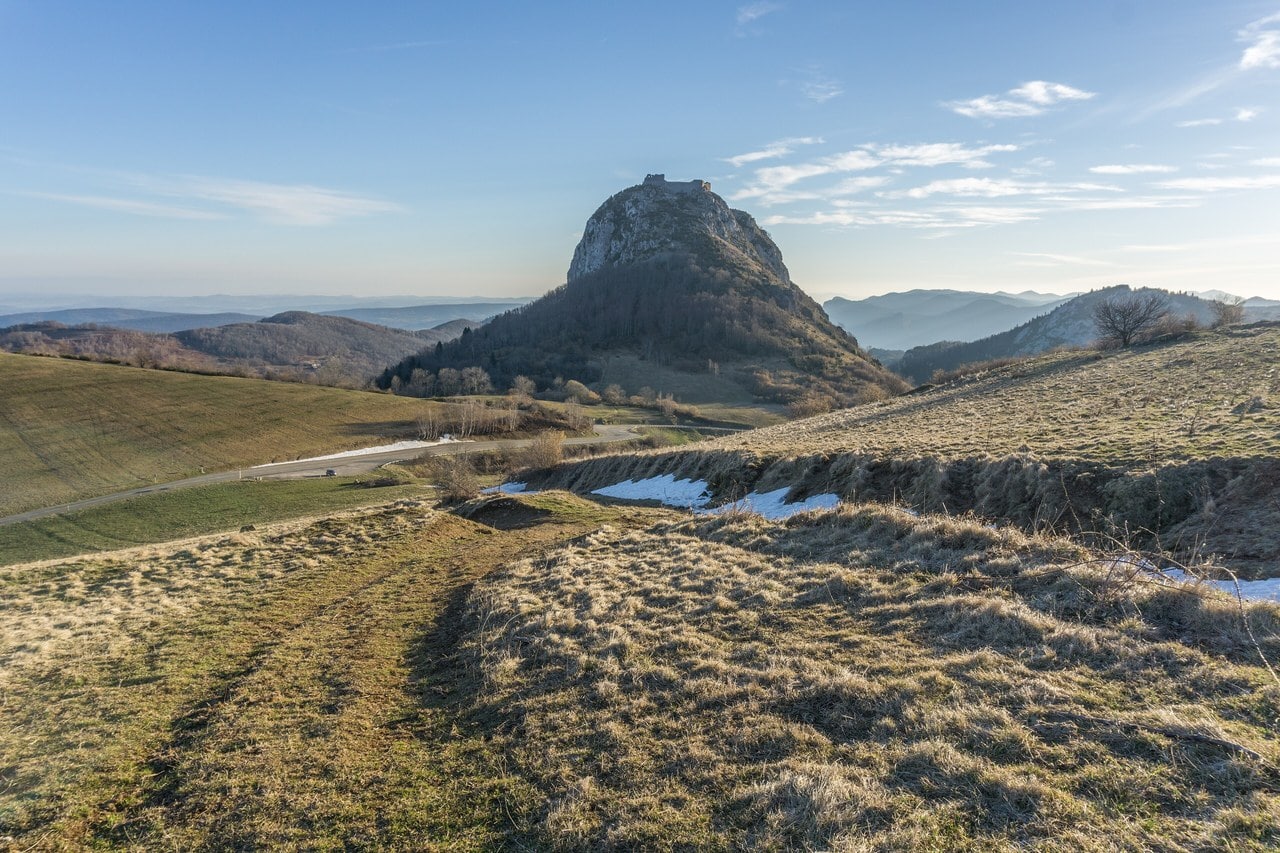
The Cathar castles of southern France are among the most atmospheric ruins in Europe, and among the most misremembered. They stand on limestone crags across the old county of Carcassonne, in the Aude and the Ariège, and travel writing has bound them to a single word: Cathar, the name of a Christian faith that Rome branded as heresy and set out, in 1209, to destroy. The word promises a lost religion’s mountain strongholds. The stones mostly tell a different story.
Almost every fortress a visitor climbs to today was built or rebuilt by the French crown after the crusade, on ground the Cathars had already lost. The refuges of the persecuted largely vanished; what remains is, for the most part, the architecture of the side that won. That gap between the label and the ruin is not a disappointment. It is the story. To walk these castles is to stand inside a defeat, on the summit of the victors’ work, looking for the people whose faith gave the place its name. This hub follows them, castle by castle, from the day the crusade reached Carcassonne to the pyre at Montségur and the last surrender at Quéribus, eleven years later.
A Faith, and the War Against It
The Cathars followed a dualist Christianity that had spread widely through Languedoc by the late twelfth century. They taught that the visible world was the work of an evil power and that the soul’s task was to renounce it; their holy men and women, the Perfects or bonshommes, the “Good Men and Good Women,” lived in austere poverty and were respected even by neighbors who never joined them. To Rome this was not reform but a mortal heresy. A note of caution belongs here: much of what survives comes from the churchmen and inquisitors who hunted the faith, and modern historians disagree about how organized, or even how unified, a “Cathar Church” really was. What is not in doubt is that people in the south were burned for it.
In 1208 Pope Innocent III called a crusade against the heresy, the first the Church launched against fellow Christians on European soil. The next year an army came down from the north, and the war it fought was brutal from the outset. At Béziers, the first great town in its path, the crusaders killed on a scale that appalled even their own century; the massacre is remembered by an order a Cistercian monk reported a decade later, and that historians now think apocryphal, to kill everyone and let God recognize his own. Minerve and Lavaur followed, their surrendered Perfects burned by the hundred. The fighting ground on for twenty years under the northern baron Simon de Montfort and his successors, and ended in 1229 with the Treaty of Meaux-Paris, which folded almost all of Occitania into the kingdom of France. The faith itself was not yet dead, and the war’s last acts were played out at the castles that follow.
| Year | The Cathar story | Castle |
|---|---|---|
| 1209 | The crusade takes Carcassonne; Viscount Trencavel dies a prisoner | Carcassonne |
| 1209–1229 | Twenty years of resistance, submission, and reconquest | Cabaret / Lastours |
| 1210 | Montfort’s hardest early siege; Raymond de Termes dies a prisoner | Termes |
| 1210s | Simon de Montfort fails to take the counts of Foix’s rock | Foix |
| 1229 | Meaux-Paris ends the crusade; the Inquisition begins its work | Languedoc |
| 1240s | The faith goes to ground in the Corbières and Fenouillèdes | Puilaurens |
| 16 Mar 1244 | About 220 Perfects burned after a ten-month siege | Montségur |
| May 1255 | The last stronghold surrenders to the crown | Quéribus |
| 1321 | The last known Perfect, Bélibaste, is burned | Villerouge-Termenès |
Carcassonne, 1209: The Crusade Arrives
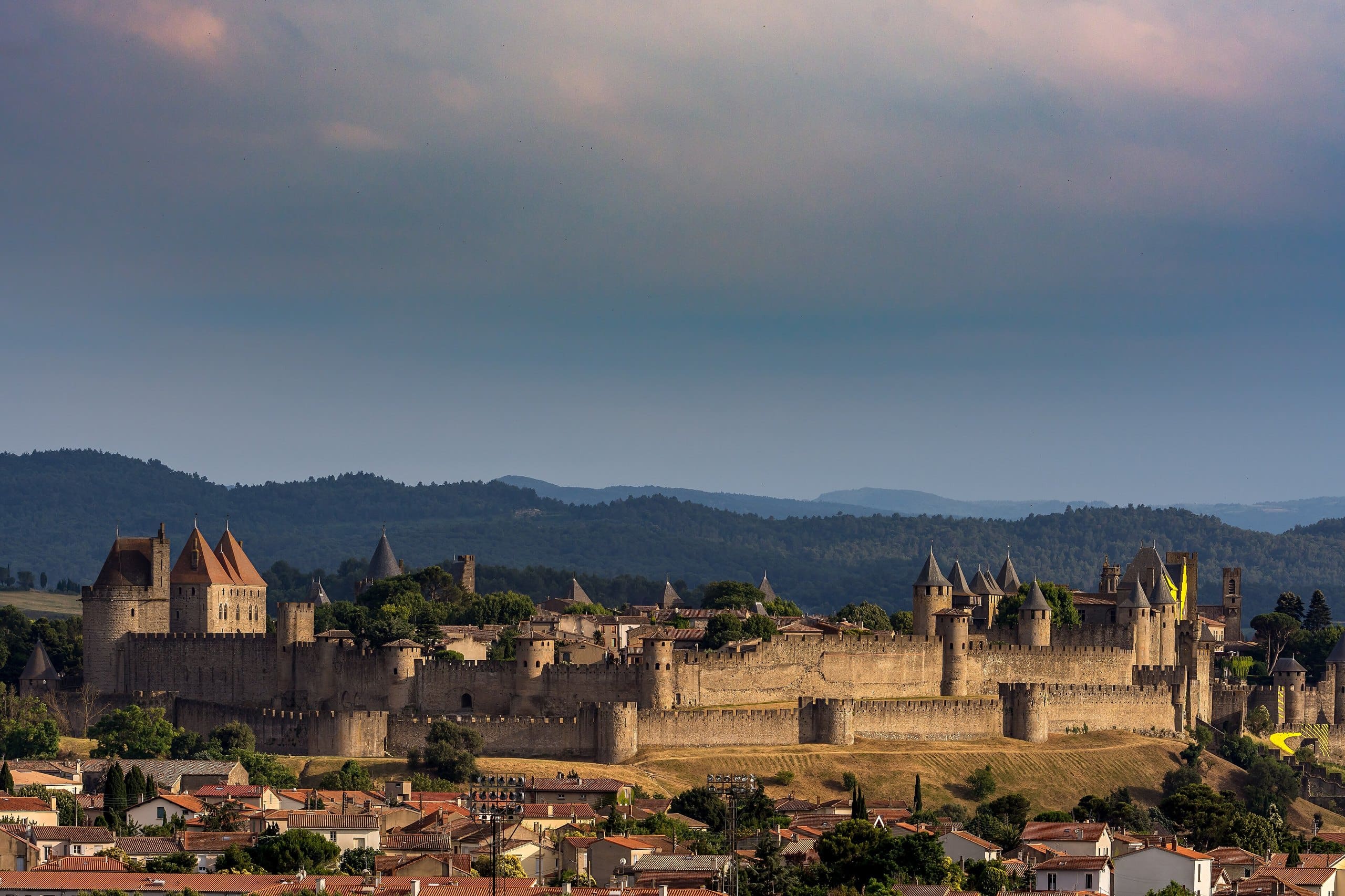
After Béziers, the crusade turned on Carcassonne, seat of Raymond-Roger Trencavel, the young viscount whose family had held the city for generations. The Trencavels were not Cathars, but they had tolerated their Cathar subjects, and in the logic of the crusade tolerance was guilt enough. The city fell after a short siege in August 1209. Trencavel, barely into his twenties, was seized while under a safe-conduct and died in his own prison before the year was out; his lands passed to Simon de Montfort, and the crusade had its base.
What a visitor walks today is spectacular and largely later work: the double walls and much of the outer ring are royal, and the whole cité was famously restored by Eugène Viollet-le-Duc from 1853. Yet inside, the Château Comtal keeps its Trencavel core, which makes Carcassonne one of the very few Cathar-era great houses on this whole route that can still be entered. It is where the story begins, and the easiest place to forget how it ended. Read the full story of Carcassonne Castle.
Cabaret: The Lords Who Would Not Yield
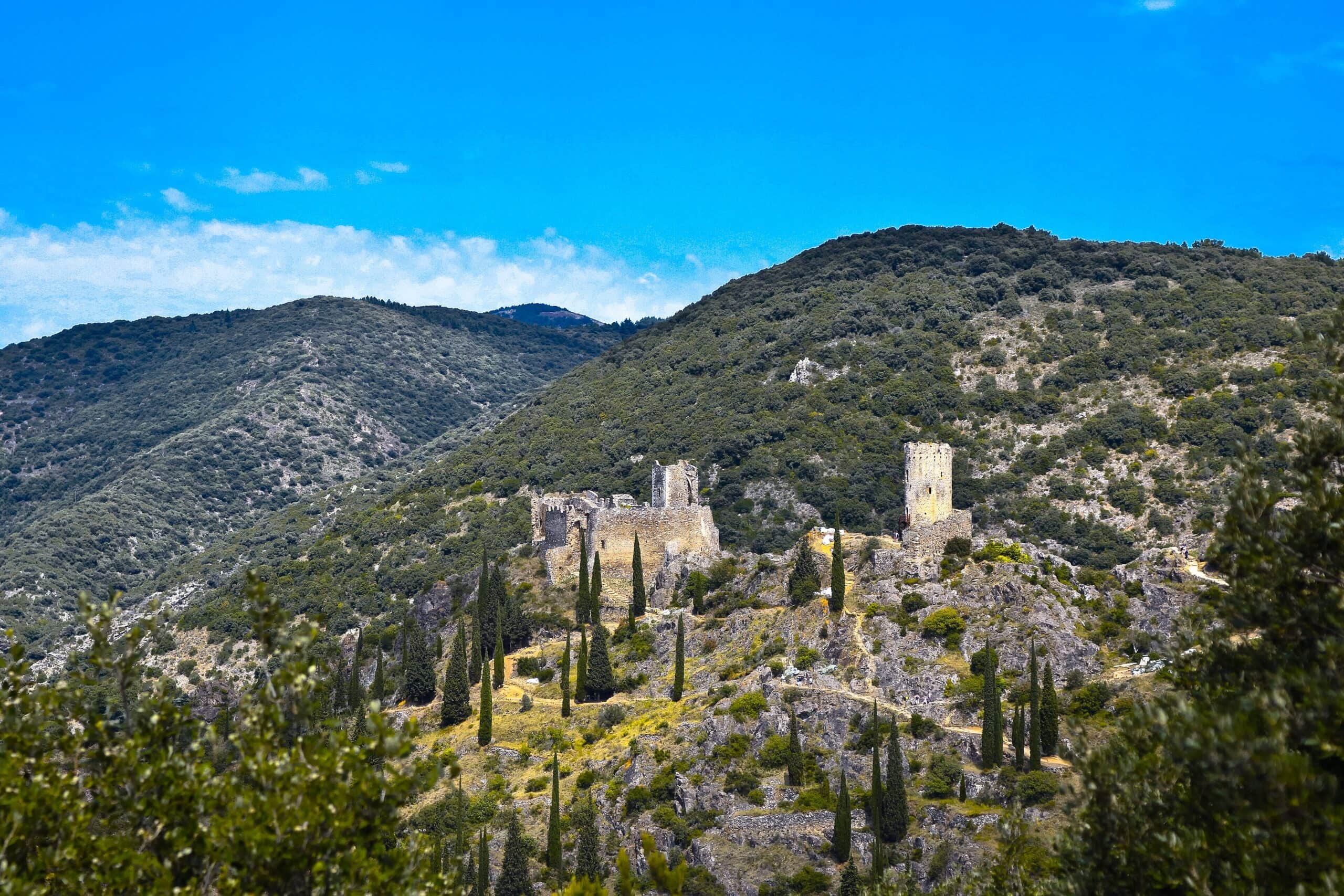
If any site on this route earns the word Cathar honestly, it is the four castles of Lastours, known in the crusade as Cabaret. This was no mere sympathizer’s fortress. The villages below the towers sheltered the households of Cathar Perfects, Cathar bishops lodged here, and for a time Cabaret held a bishop’s seat. Its lord, Pierre-Roger de Cabaret, became one of the most stubborn figures of the whole resistance, holding out after Carcassonne had already fallen.
The story of Cabaret is a long refusal. The lordship submitted only in 1211, was retaken by the resistance in 1223, and did not finally capitulate to the crown until 1229. The towers that crown the ridge today, the round Tour Régine among them, are the crown’s own rebuilding, raised on ground it had taken by force; the real Cathar Cabaret survives in the excavated village on the slope below. Of all these castles, Lastours is where the genuine faith and the victors’ masonry sit closest together. Read the full story of the Châteaux de Lastours.
Termes: A Father’s Defiance, a Son’s Return
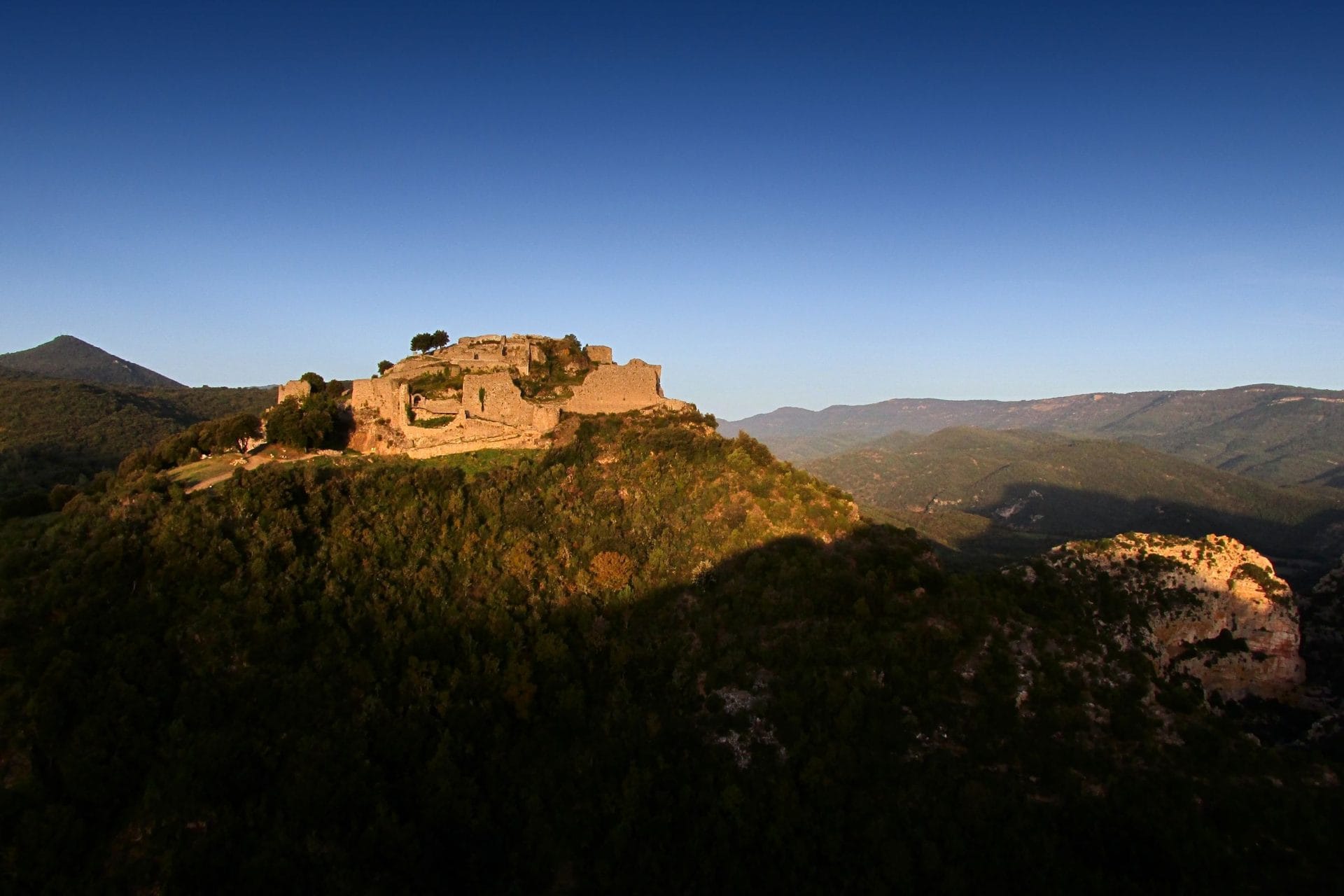
East of Cabaret, in the folded limestone of the Corbières, stood the strongest castle in the mountains, and its lord held it for the Cathar faith. Raymond de Termes was a believer whose own family had given the movement a leader, Benoît de Termes, a deacon who rose to be the Cathar bishop of the Razès. When Simon de Montfort came in the late summer of 1210, Termes refused to fold as the towns of the plain had folded. It held for four months, the hardest single fight of the crusade’s early years. Thirst almost forced its surrender; then an overnight storm refilled the empty cisterns, and the standing water loosed dysentery through the crowded fortress. When the defenders tried to slip away in the dark, the escape failed, and Termes fell.
Raymond was carried off to Carcassonne and died in its prison. His son Olivier grew up disinherited, a faidit with every reason to hate the crown, which makes his later life the strangest turn in the whole Cathar story: he took the cross, served Louis IX in the Holy Land, and in 1255 helped take Quéribus, the last castle holding out for the cause his father had died defending. The stones you climb today are largely the royal fortress raised after the family’s fall. Read the full story of the Château de Termes.
Foix: A Count Between Two Loyalties
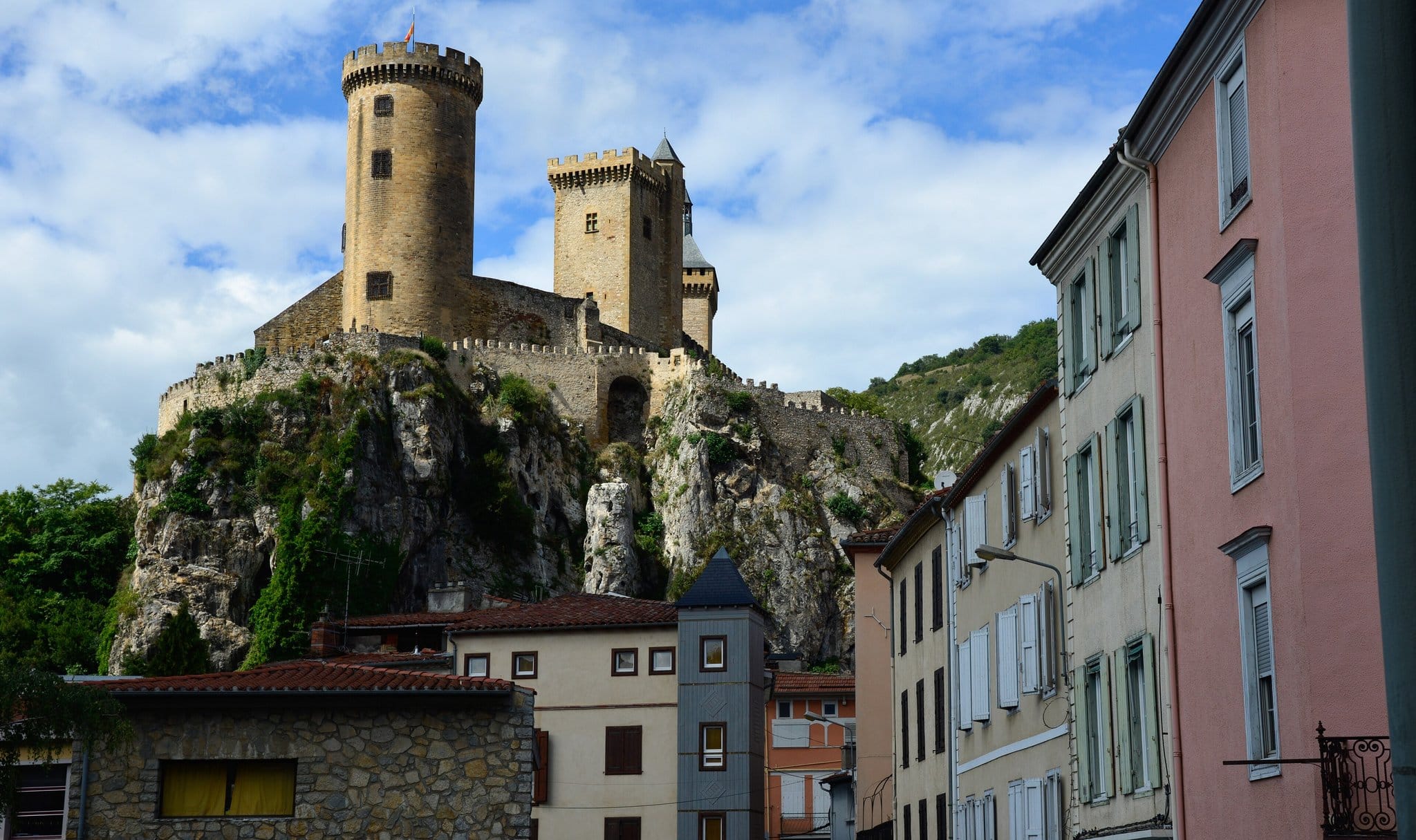
The counts of Foix were the great Cathar-sympathizing lords of the Pyrenees, and their castle, three towers on a rock above the Ariège, is the one place here that was never a refuge and never a last stand. Count Raymond-Roger de Foix fought the crusade in the open field; his sister Esclarmonde de Foix was a noted patroness whose name still clings to the memory of the faith; their wives, sisters, and administrators numbered among the known heretics, and the counts themselves fell under suspicion.
Yet the site itself insists, fairly, that it was “not a Cathar castle.” The counts grasped early that the crusade was as much a land grab by northern lords as a war of belief. They sheltered sympathizers across their county while keeping declared heretics out of the fortress, and so kept both. When Simon de Montfort tried to take the rock in the 1210s it beat him off; surrendered twice as a pledge of peace, it was handed back to Raymond-Roger in 1218. Foix is the chapter of the lords who chose their people over Rome, and lived to keep their castle. Read the full story of Château de Foix.
Puilaurens: Faith in Retreat
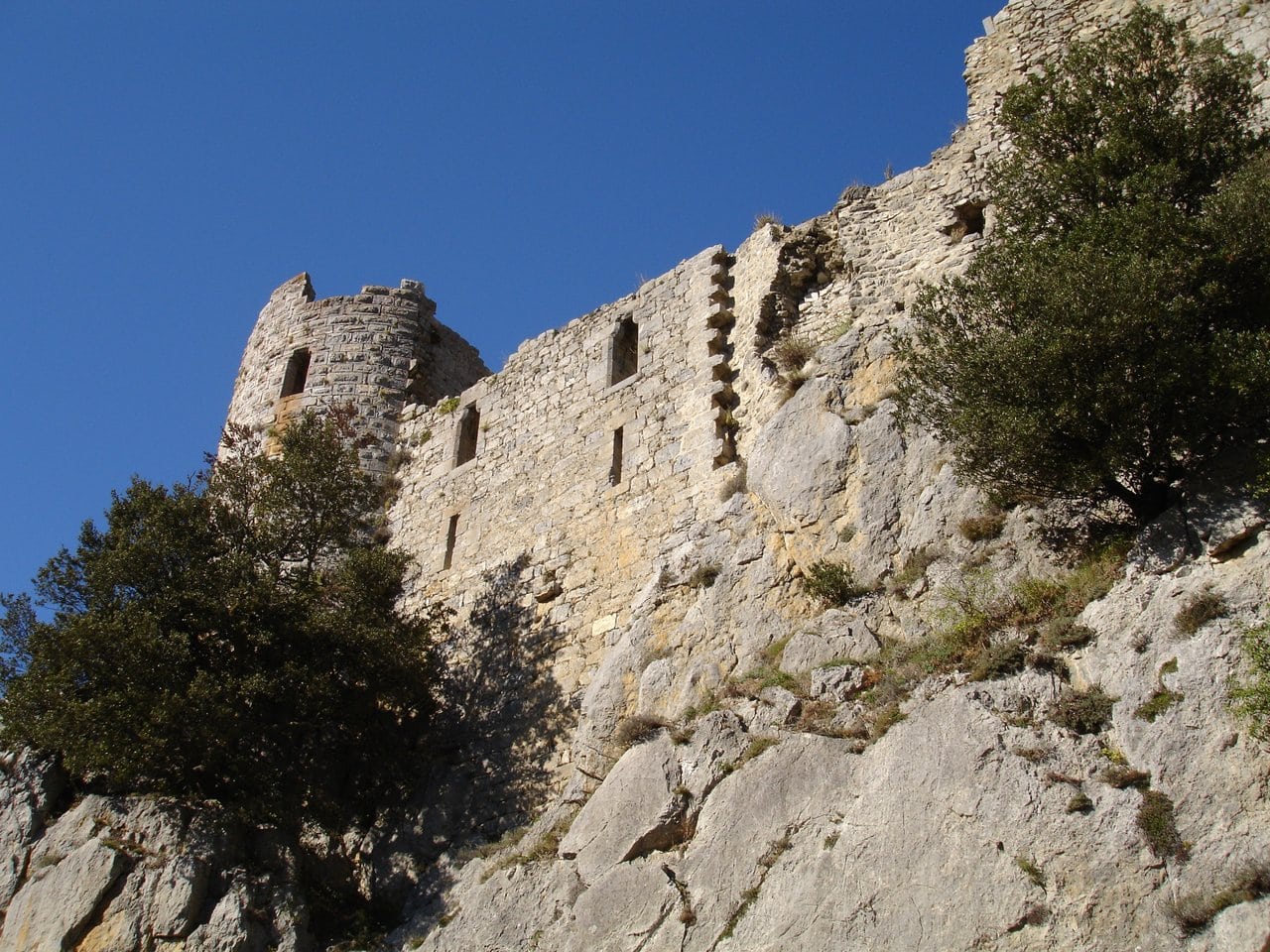
By the 1240s the open war was over and the faith had gone underground. In the Fenouillèdes, on a crag near modern Lapradelle-Puilaurens, a modest castle became one of many Corbières refuges where Cathars sheltered in the years after the crusade. The Cathar deacon of the Fenouillèdes, Pierre Paraire, stayed here in the early 1240s; Perfects were lodged in 1245 and 1246; a believer named Saurine Rigaud found refuge in 1240. Their names survive only because the Inquisition later wrote them down.
This is the true Cathar chapter of Puilaurens: a place of shelter, not a heretic citadel. Almost every stone standing today belongs to the royal fortress Louis IX ordered raised after 1255, once the frontier had closed and the refuge had become a border post. Through those years the castle sat within the orbit of Chabert de Barbaira, a dispossessed lord who also held Quéribus and protected heretics across the Corbières, a name that returns at the very end of the story. Read the full story of Château de Puilaurens.
Montségur, 1244: The Pyre
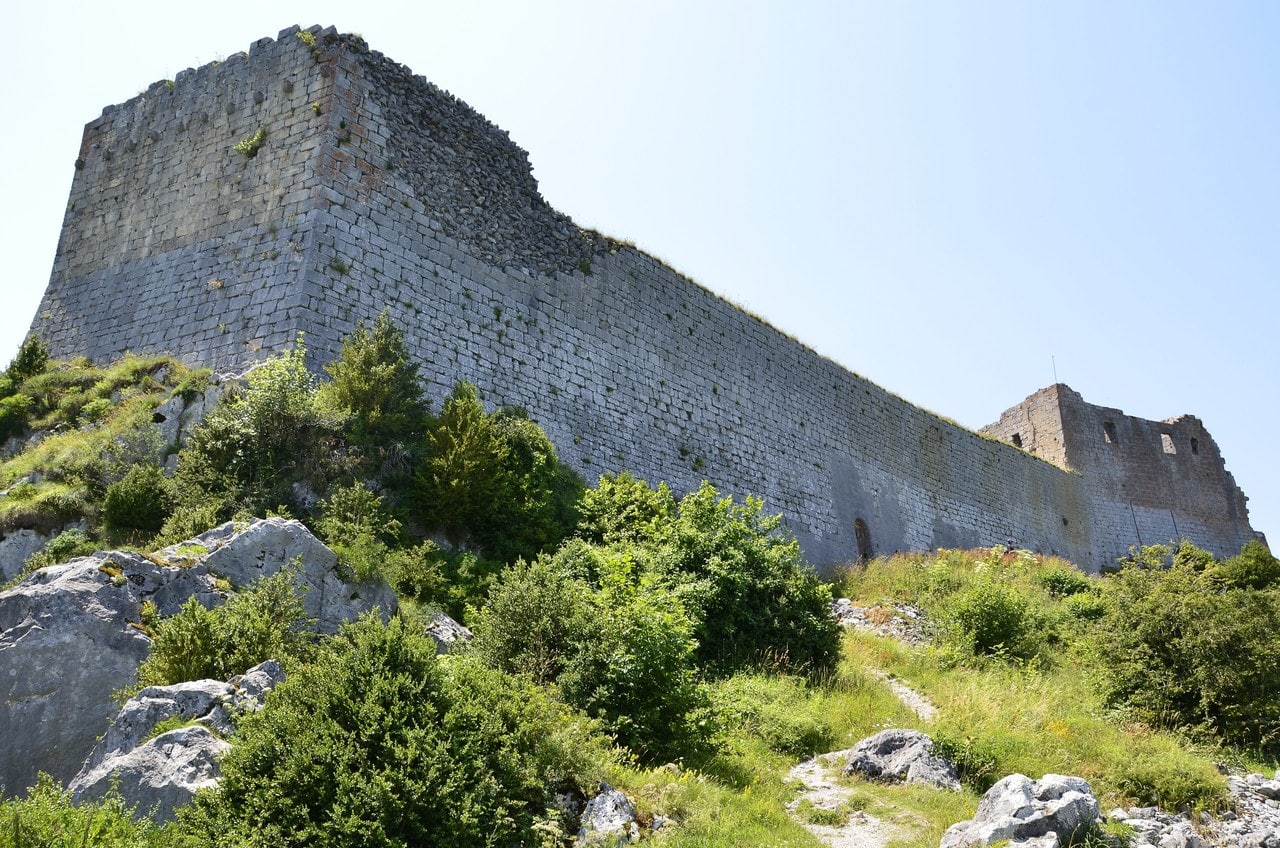
Montségur is the heart of the Cathar story and the reason the whole route still lives in memory. On a limestone tooth of rock in the Ariège, rebuilt around 1204 as a refuge for the faith, it had become by the 1240s the last true gathering place of the Cathar Church, home to its bishop and to hundreds of believers. In 1243 a royal army under the seneschal of Carcassonne laid siege, and the defenders held the summit for roughly ten months.
When the fortress surrendered, the ordinary garrison was allowed to leave. About 220 Cathar Perfects were not. On 16 March 1244 they walked down from the summit and were burned together in a palisade at the foot of the mountain, in the field still called the prat dels cremats, the field of the burned; none is recorded as having recanted to save themselves. The ruin above that meadow is not their castle. It is the fortress the crown built on the same summit afterward, reworked for centuries. The legends that cling to it, of a Cathar treasure carried out before the end, of a hidden “grail,” belong to Montségur’s romantic afterlife, not to 1244. Our reference on haunted castles traces that afterlife downstream to a single nineteenth-century history and keeps it clear of the record. What is certain is grim enough. Read the full story of Château de Montségur.
The Last Strongholds: Quéribus and Peyrepertuse
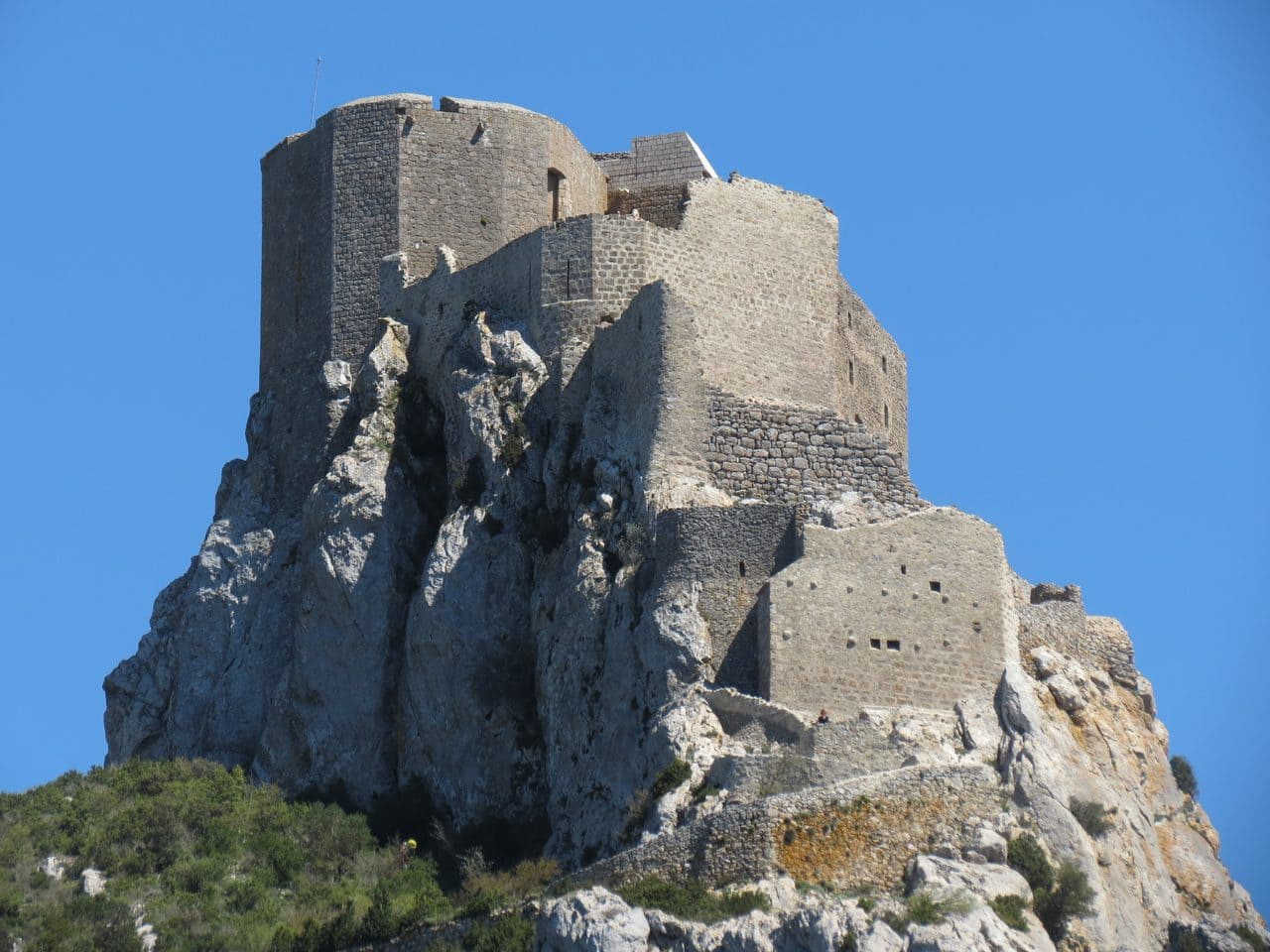
The fall of Montségur did not quite end it. Survivors who could still flee gathered at the remotest crags of the Corbières, and for eleven more years the faith kept a foothold at Quéribus, a keep balanced on a needle of rock near Cucugnan. It was held by that same Chabert de Barbaira, protector of heretics, shielded as much by his alliance with the lord of Roussillon as by the cliffs. In May 1255 a royal force under Olivier de Termes, himself a former Cathar knight, came for it; Chabert surrendered in exchange for his own liberty, and Quéribus, the last stronghold to fall, passed to the crown.
Its sister citadel a short drive west, Peyrepertuse, strung along some three hundred meters of narrow crest, had chosen a different path a generation earlier: its lord Guillaume de Peyrepertuse, whose family had sheltered Cathars on the rock, read the odds and submitted to Simon de Montfort in 1217 without a fight. Both castles were then rebuilt as royal frontier fortresses guarding the new border with Aragon, the great Sant Jòrdi keep at Peyrepertuse raised under Louis IX around 1250. The faith outlasted its castles by two generations, hunted from village to village, until the last known Perfect, Guilhem Bélibaste, was burned at Villerouge-Termenès in 1321. Read the full story of Château de Quéribus, or of Château de Peyrepertuse.
Beyond These Castles
These eight are the anchors, but the Pays Cathare holds more. The Cathar Castles theme archive gathers every StoneKeep Atlas entry tied to the story, and Aguilar and Puivert, other Corbières strongholds bound up in the same war, reward a detour for anyone following it on the ground. Above all, the same stones can be read a second way. Our companion hub, Royal Fortresses of Languedoc, walks Carcassonne and its mountain sentinels as what they physically became: the crown’s frontier defense against Aragon. This hub is the human story that came first; that one is the military story that replaced it. Read together, they are the two halves of the same rock. Both, in turn, are chapters of the wider map drawn in our national guide to the Châteaux of France.
Planning a Cathar Castles Trip
The natural base is Carcassonne itself, a walled city on the main rail line and within an hour or so of every castle here except Foix, which pairs better with a day in the Ariège. These are perched, seasonal ruins: wear real shoes, check opening times, and expect several to close in January. A rented car turns the Corbières castles, Quéribus, Peyrepertuse, Puilaurens and Lastours, into an easy two- or three-day loop; without one, guided day trips reach the best of them. Walkers can follow the long-distance Sentier Cathare (GR 367), which threads several of these sites together on foot. The Cité de Carcassonne has been a UNESCO World Heritage Site since 1997, and on 26 July 2026 several of these mountain fortresses were inscribed in their own right, as components of the serial property Forteresses royales capétiennes du Languedoc, the Royal Capetian Fortresses of Languedoc.
For a base, Booking.com lists hotels and guesthouses across Carcassonne and the surrounding villages, and GetYourGuide runs guided Cathar-castle day trips from Carcassonne that fold several of these sites into a single drive.
Some links on this page are affiliate links, which means StoneKeep Atlas may earn a small commission, at no extra cost to you, if you book through them.
Conclusion
The Cathar castles keep drawing people for the same reason they mislead them. We climb expecting a lost faith’s fortresses and find, instead, the clean strong walls of the power that erased it, and somewhere in that gap the Cathars themselves, who left behind almost nothing but a field with a grim name and a handful of dates. That absence is the point. Stand on the pog at Montségur, or on the needle at Quéribus, and the view is the one the last of them had: mountains, sky, and no way down that did not lead through their enemies. Eight centuries on, the rock still tells you exactly how the story ended.
Principal Sources
- Malcolm Barber, The Cathars: Dualist Heretics in Languedoc in the High Middle Ages
- Mark Gregory Pegg, A Most Holy War: The Albigensian Crusade and the Battle for Christendom
- Michel Roquebert, L’Épopée cathare
- Emmanuel Le Roy Ladurie, Montaillou: The Promised Land of Error
- R. I. Moore, The War on Heresy
- Centre des monuments nationaux, Cité de Carcassonne
- UNESCO World Heritage List, Forteresses royales capétiennes du Languedoc (serial property, inscribed 2026)
Image credits. Château de Montségur on its pog (hero): Michal Klajban, CC BY-SA 4.0, via Wikimedia Commons; Cité de Carcassonne: Lesueur André, CC BY-SA 4.0, via Wikimedia Commons; Tour Régine and Cabaret, Lastours: Meria z Geoian, CC BY-SA 3.0, via Wikimedia Commons; Château de Termes on its spur: OlivierDeTermes, CC BY-SA 4.0, via Wikimedia Commons; Château de Foix: Frédéric Scalliet, CC BY-SA 3.0, via Wikimedia Commons; Château de Puilaurens: Guillaume Paumier, CC BY 2.5, via Wikimedia Commons; Montségur curtain wall: Aloïs LIEN, CC BY-SA 4.0, via Wikimedia Commons; Keep of Quéribus: Romain Bréget, CC BY-SA 3.0, via Wikimedia Commons. Freely licensed images are resized to fit; otherwise unaltered.