
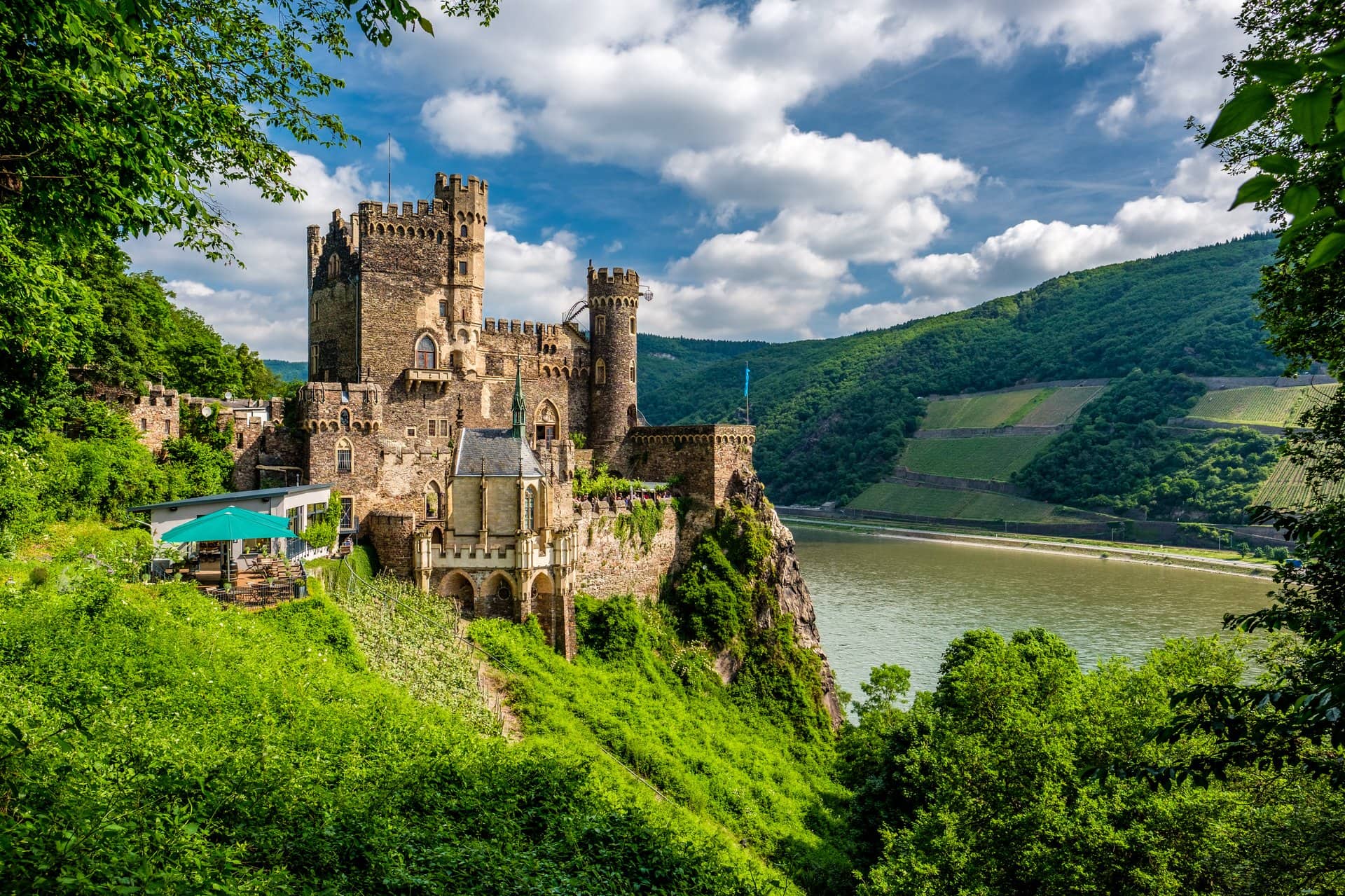
Rheinstein Castle
Burg Rheinstein (Rheinstein Castle) stands roughly 90 meters above the Rhine on a slate spur near Trechtingshausen, at the southern end of the UNESCO Upper Middle Rhine Valley. Built around 1316–1317 as a Mainz toll castle and known until the nineteenth century as Vautsberg, it was already a ruin when Prince Friedrich Wilhelm Ludwig of Prussia bought the empty shell in 1823 and turned it into the first major Rhine castle ever rebuilt in the romantic spirit. Carried out between 1825 and 1844 by Karl Friedrich Schinkel, Johann Claudius von Lassaulx, Wilhelm Kuhn, and Philipp Hoffmann, the work set the template for Stolzenfels, Sooneck, the Wartburg, Cochem, and ultimately Neuschwanstein. Castle today is a private museum operated by the Hecher family, who rescued it from a second decline in 1975, and remains the founding site of the nineteenth-century Burgenromantik movement that defined the modern image of the German castle.
Quick Facts
| Country | Germany |
| Region / State | Rhineland-Palatinate (Rheinland-Pfalz), western Germany |
| Nearest Town | Trechtingshausen (Bingen am Rhein) |
| Construction Period | Medieval core c. 1316–1317 (as Vautsberg, under the Archbishopric of Mainz); romantic restoration 1825–1844 (chapel and crypt 1839–1844) |
| Founder | Archbishop Peter von Aspelt of Mainz (medieval); Prince Frederick of Prussia (romantic restoration, from 1823) |
| Architectural Style | Medieval Spornburg core (14th century); Neo-Gothic Romantic restoration in the Burgenromantik tradition (1825–1844) |
| Building Type | Burg — medieval toll castle on a slate spur, transformed in the 19th century into a private royal residence |
| Current Condition | Restored; original 14th-century residential tower and Schildmauer embedded within the 19th-century reconstruction |
| Open to Visitors | Yes — main season March 21 to November 8, plus Weihnachtsburg programs in November–December |
| UNESCO Status | Within the Upper Middle Rhine Valley World Heritage Site (inscribed 2002, criteria ii, iv, v) |
| Official website | burg-rheinstein.de |
Overview
When Victor Hugo traveled the Rhine in 1842, he looked up at a steep slate cliff above Trechtingshausen and saw three castles “arranged from mountain to mountain”: Reichenstein, Rheinstein, and one he called Vaugtsberg, “restored today by Prince Frederick of Prussia.” Hugo did not realize that two of his three castles were the same building. Medieval Vautsberg and romantic Rheinstein occupied the same crag, but the prince’s reconstruction had so transformed the ruin that even one of the most attentive observers of the Rhine could not connect them. That confusion is, in a sense, the point. Burg Rheinstein is the first major Rhine castle ever rebuilt in the romantic spirit, the site where the modern image of the German castle (turreted, atmospheric, defiantly medieval) was largely invented. Its restoration in the 1820s set the template that Stolzenfels, Sooneck, Reichenstein, Lichtenstein, the Wartburg, Cochem, and ultimately Neuschwanstein would all follow over the next half-century.
Location and Setting
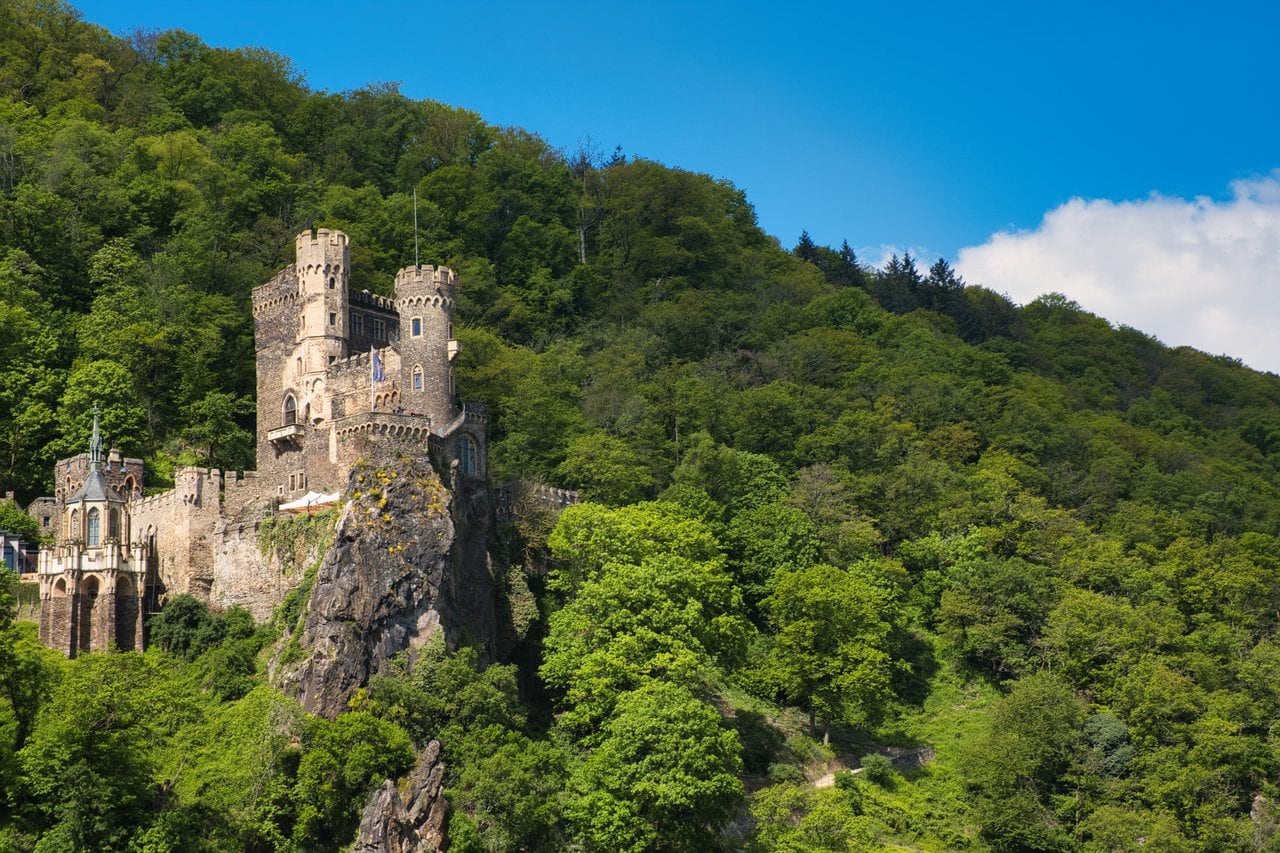
Rheinstein stands roughly 90 meters above the Rhine on a slate spur near Trechtingshausen, at the southern end of the Rhine Gorge, the 65-kilometer stretch between Bingen and Koblenz inscribed by UNESCO in 2002 as the Upper Middle Rhine Valley. Site marks the gateway to the gorge: just upstream lie Bingen and the Mäuseturm in midstream, and the ruined Burg Ehrenfels stands directly opposite on the right bank above Rüdesheim. Downstream, the river bends north between vineyards, slate cliffs, and a chain of castles that includes Reichenstein, Sooneck, and the never-destroyed Marksburg. The castle faces northwest across the river to Assmannshausen and is approached on foot by a 380-meter uphill path from two parking lots on the B9 highway, climbing through a designed romantic landscape with an artificial brook, small waterfalls, and a vast boulder secured to the slope by chain and steel cables. The whole arrangement reads, deliberately, as a gradual approach to the medieval past.
Historical Background
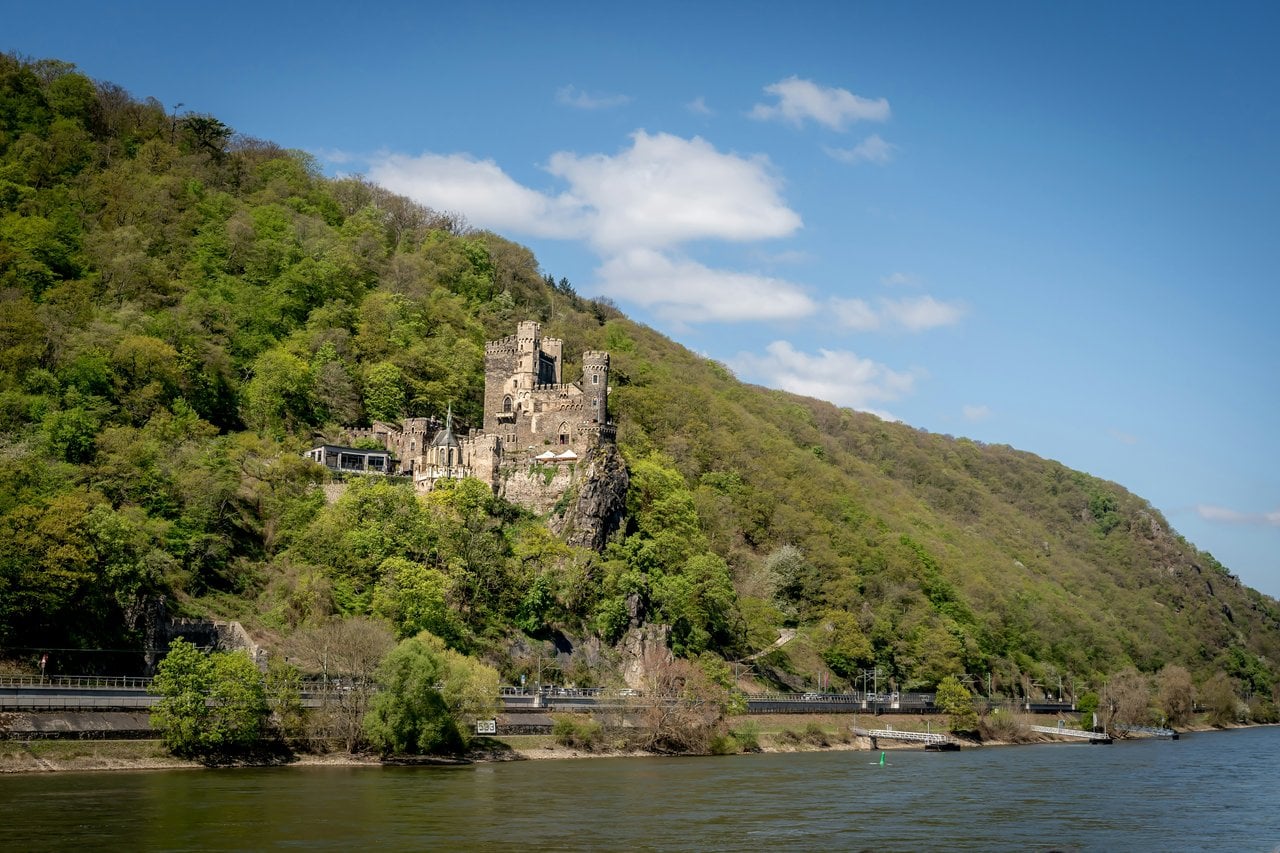
A Mainz toll castle, 1316–1500
Built in approximately 1316–1317 by the Archbishopric of Mainz, the castle now called Rheinstein was under Archbishop Peter von Aspelt. Its dating rests on dendrochronological analysis of timbers in the southern wall and on the first documentary reference in 1323, when Archbishop Matthias of Bucheck transferred the castle to the Mainz Cathedral Chapter. Through the late medieval period it carried a series of names (Voutsperg, Vautesberg, Voitzberg, Vautsberg), variant spellings of a single Middle High German form. Older claims of a ninth-century or 1282 founding belong to folklore.
Its purpose was administrative, not military. Rheinstein was a Zollburg, a toll castle, built to enforce Mainz authority over Rhine traffic and, specifically, to enforce the rebuilding ban on neighboring Reichenstein, which Rudolf of Habsburg had razed in 1282–1286 as a robber-baron stronghold. Together with the castles Klopp at Bingen, Ehrenfels at Rüdesheim, and Heimburg at Niederheimbach, Rheinstein formed a chain securing the Mainz electorate at the Binger Loch, the southern gate to the gorge.
Decline without a war
Most ruined Rhine castles were destroyed by armies. Rheinstein was not. By 1344, when the Palatinate ceded its claim to Reichenstein to Mainz, Rheinstein’s strategic role had ended. By 1524 it was already documented as baufällig, dilapidated. When French troops under Louis XIV swept up the Rhine during the Nine Years’ War in 1689, blowing up castle after castle, they passed Rheinstein by; it was already too ruined to bother demolishing. Through the eighteenth century the structure decayed quietly. In 1822 the Hessian official Freiherr von Coll bought the empty shell for four talers.
Prince Frederick’s purchase, 1823
On March 31, 1823, Prince Friedrich Wilhelm Ludwig of Prussia (1794–1863), nephew of King Frederick William III and son of Prince Louis Charles of Prussia, purchased the ruin. He was twenty-eight, a serving Prussian officer, and a passionate antiquarian. Karl Friedrich Schinkel, the great Berlin architect, had drawn conceptual plans for a Rhine castle restoration as early as 1816, and these had captured the prince’s imagination. The acquisition gave him the site to realize them. Restoration began in 1825 under Johann Claudius von Lassaulx, the Koblenz district building inspector, working from the Schinkel design vocabulary. From 1827 the project passed to Lassaulx’s pupil Wilhelm Kuhn, who completed the main works in 1829. The chapel and royal crypt, designed by the Wiesbaden Baurat Philipp Hoffmann, were added between 1839 and 1844. Frederick renamed the castle Rheinstein, after the cliff on which it stood.
A Hohenzollern summer residence, 1844–1975
By 1842 Rheinstein was Prince Frederick’s favorite residence, hosting Queen Victoria and Empress Alexandra Feodorovna of Russia. On his death in 1863 the castle passed to his son Prince Georg of Prussia, then in 1902 to Prince Heinrich, the brother of Kaiser Wilhelm II, and in 1929 to Heinrich’s widow Princess Irene of Hesse and by Rhine. By 1953 it had reached Princess Barbara Irene of Prussia, Duchess of Mecklenburg, the last Hohenzollern owner. In 1973 the castle was put up for sale; an English buyer defrauded the family, removing much of the inventory.
The Hecher family rescue, 1975 to today
On November 7, 1975 the Austrian opera tenor Hermann Hecher (d. 2021) bought Rheinstein for 360,000 Deutschmarks, narrowly outbidding a Hare Krishna sect with the help of the state of Rhineland-Palatinate. He spent nearly two decades restoring the castle a second time: repairing structural damage, reinstating the inventory, and opening the rooms as a museum. Hecher family still owns and operates Rheinstein. Three generations are now involved: Hermann’s son Markus and his wife Conny, who served as castle keepers from 1999, are in an advisory role; their son Marco and his wife Cora run the castle today and live in the residential apartments above the museum, with their two children. Marco and Cora also lease and operate Burg Sooneck, five kilometers downstream, the castle Frederick’s nephew Frederick William IV had purchased a decade after Rheinstein.
Architectural Highlights
Lassaulx, Kuhn, and Schinkel — who actually rebuilt Rheinstein?
English-language guides routinely credit the restoration to “the famous architect Lassaulx.” German scholarship tells a more layered story. Schinkel supplied the conceptual drawings in 1816, his framing of the medieval ruin as a site for selective preservation rather than wholesale rebuilding shaped everything that followed. Lassaulx led the rebuild from 1825, applying that philosophy in stone. His pupil Kuhn finished the main castle by 1829. Hoffmann’s chapel and crypt belong to a second campaign more than a decade later. The result is a building stitched together by four hands across nearly two decades, not the work of a single master.
Medieval residential tower and integrated Schildmauer (the original 1316–1317 core) survive embedded within the nineteenth-century fabric. The Palas visible today is essentially a new building; the medieval one, recorded in a 1636 drawing by Wenzel Hollar, had collapsed into the valley by Frederick’s time. The drawbridge, portcullis, outer gate, and Torzwinger are romantic reconstructions, faithful to medieval principles but built fresh.
The Rittersaal and the stained-glass spolia
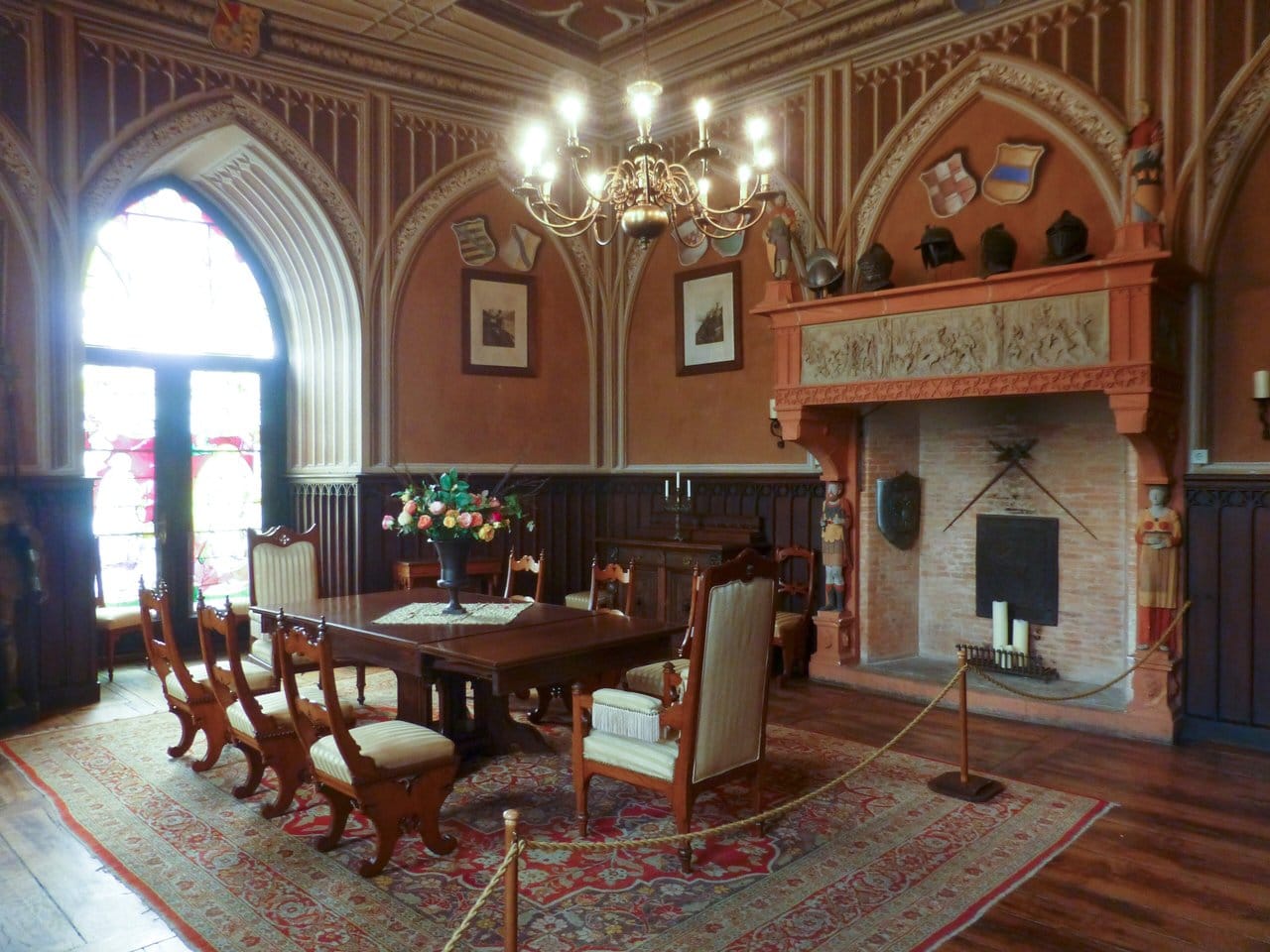
Knights’ Hall is the largest room in the castle and the most consequential. Its walls and ceilings carry illusionistic painted tracery by the Düsseldorf-school artist Ludwig Pose (flat surfaces made to seem ribbed and vaulted) and the windows hold panels of authentic fourteenth- to seventeenth-century stained glass, brought as spolia from dissolved monasteries in Cologne and Düsseldorf. The principle was not novelty but assemblage: Frederick wanted his castle to feel inhabited by the medieval past, and the simplest way to achieve this was to install genuine medieval objects within an invented frame. Rittersaal is a monument to that strategy. Antique seventeenth- and nineteenth-century furniture, a small armory of fifteenth-century weapons and armor, and historicising tilework, doorways, and panelling fill the surrounding rooms.
The Burgundergarten and the chapel
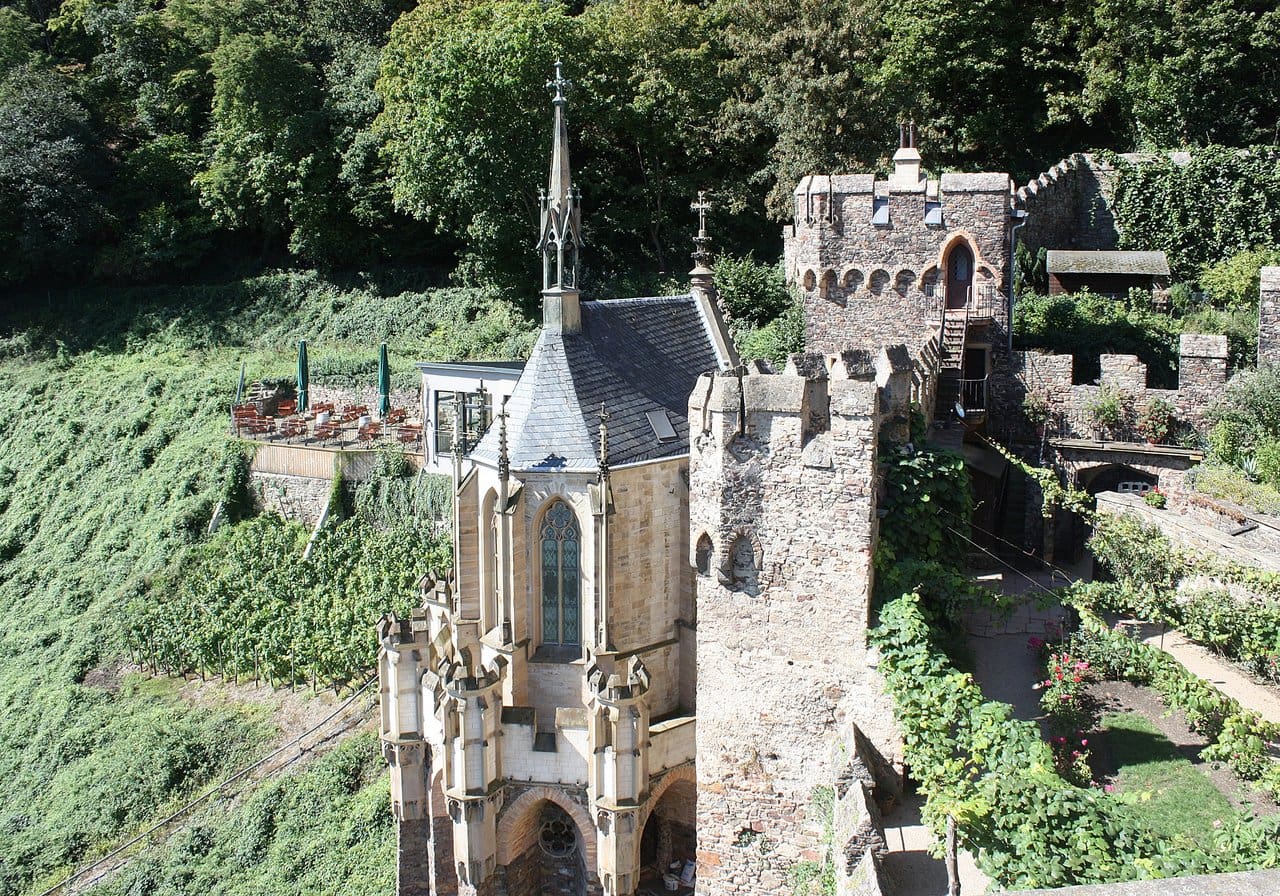
Rheinstein has two distinct gardens. The Burgundergarten, laid out between 1825 and 1829 in the former gateway Zwinger, is the courtyard garden, described in regional scholarship as the first romantic castle garden on the Middle Rhine. Its centerpiece is a single Burgundy grape vine more than three centuries old that still produces fruit each autumn. Roses, a small fountain, and terraced beds surround it; the Hecher family has replanted a small Riesling vineyard on the lower terrace. The garden is now part of the Upper Middle Rhine World Heritage Garden Route.
The chapel, built by Hoffmann between 1839 and 1844 just south of the medieval ring wall, holds the royal crypt, what regional scholarship calls “the only Prussian crypt on the Middle Rhine.” Three Hohenzollern coffins rest beneath the altar: Prince Frederick (1863), his wife Princess Luise (1882), and their son Prince Georg (1902). Crypt is visible only through a window opening reached by an exterior staircase, a deliberately reverent piece of staging. Above the chapel gable, dragon-shaped gargoyles flank a copper-clad ridge turret topped by a Kreuzblume finial, small details of the prince’s romantic program that would soon be imitated up and down the Rhine.
Rheinstein and the Birth of Burgenromantik
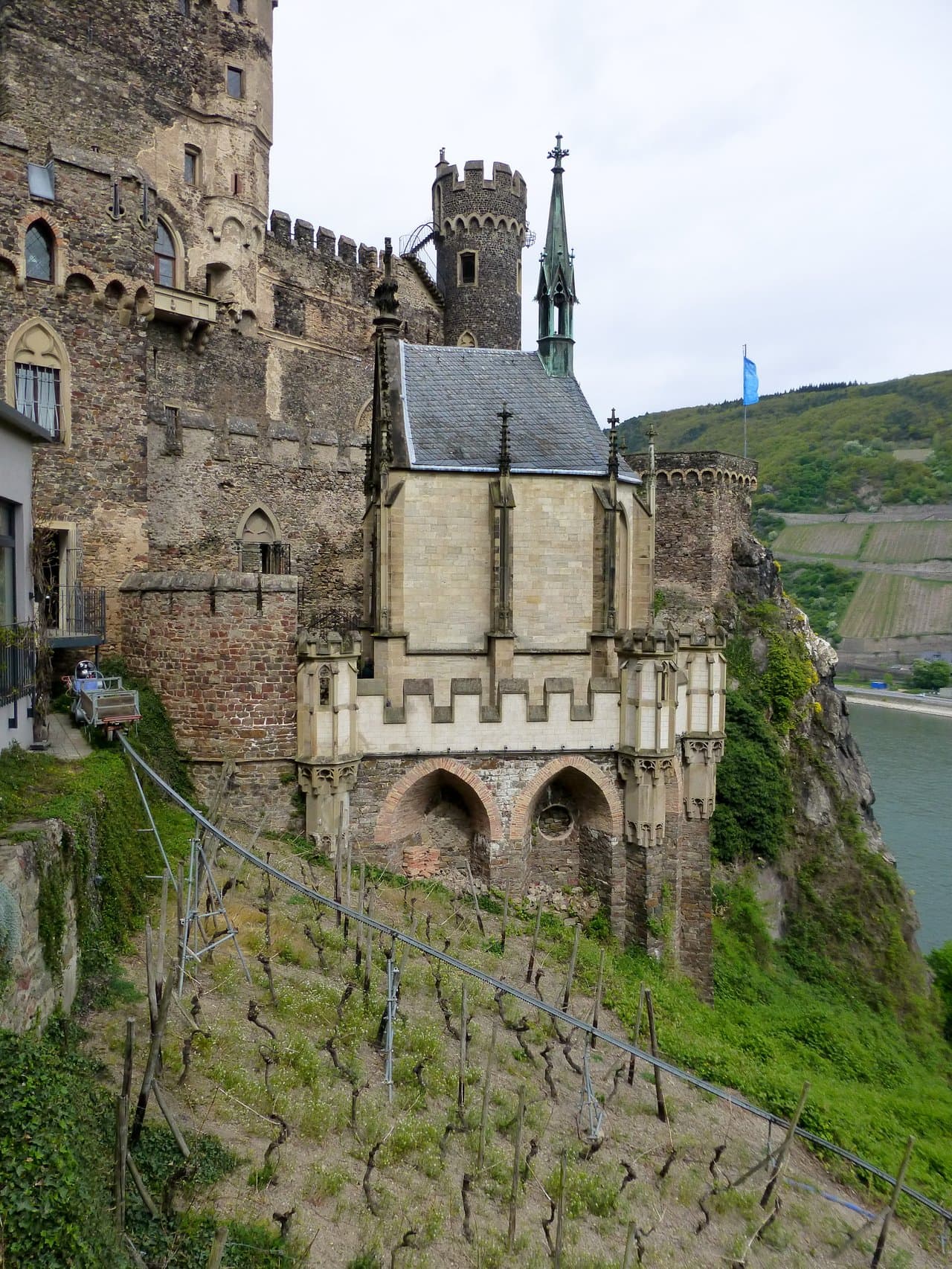
Image of the German castle that dominates global imagination today (turreted, atmospheric, set above a wooded river) was largely invented in the nineteenth century. Until then, most castles were ruins, and ruins were what the Romantic imagination prized. Heidelberg, the great ruined castle on the Neckar, was the aesthetic benchmark; its roofless silhouette had become a fixture of poetry, painting, and Grand Tour itineraries. The question Rheinstein answered was different. What if the ruin could be resurrected, not as a museum, but as a habitable building still legibly medieval? This was a new idea, and Frederick was the first to attempt it on a major Rhine castle.
The downstream consequences were immediate. Frederick’s cousin Crown Prince Frederick William IV (the future king of Prussia) visited Rheinstein in the 1820s and began his own Rhine project at Stolzenfels, restored from 1836 to 1842 under Schinkel’s direct supervision. The Crown Prince’s brothers acquired the ruined Burg Sooneck in 1834 and rebuilt it as a hunting lodge through the 1840s. The same impulse expressed itself across the broader German lands: at Hohenschwangau, where Maximilian II of Bavaria began his restoration in 1832; at Schloss Lichtenstein in Württemberg, rebuilt 1840–1842 in direct response to Wilhelm Hauff’s 1826 novel; at the Wartburg, where Carl Alexander of Saxe-Weimar-Eisenach, Grand Duke from 1853, oversaw a national-scale restoration from 1838 to 1890; and a generation later at Cochem, rebuilt 1868–1877 by the Berlin businessman Louis Ravené using the same template Frederick had pioneered. Ludwig II of Bavaria, who built Neuschwanstein from 1869, grew up at Hohenschwangau and inherited the Burgenromantik vision Rheinstein had launched four decades earlier.
Contrast with Burg Eltz (never destroyed, never restored, continuously inhabited by the same family for nine centuries) clarifies what Rheinstein represents. Eltz is the survival; Rheinstein is the resurrection. Two castles bracket the German castle imagination between authenticity and reinvention. Marksburg, further down the Rhine, occupies the same intact end of the spectrum. Together they tell the full story of the Middle Rhine: the never-lost, the lost-and-restored, and the still-ruined.
The connection between Rheinstein and the Burg Hohenzollern project of 1850–1867 is dynastic as well as aesthetic. Frederick William IV, who funded the Hohenzollern reconstruction in the Swabian Alps, was the same cousin who had taken Rheinstein’s example to Stolzenfels two decades earlier. Burgenromantik was, for the Prussian royal family, a program as much as a fashion.
Visiting the Castle
You can take one of three rooms inside the castle that launched the Rhine’s romantic revival. See our guide to Castle Hotels on the Rhine for this rare, book-direct stay.
Through 2026 the main season runs from March 21 to November 8, daily from 10:00 to 18:00, with last admission at 17:30. Every ticket includes a printed Begleitheft (companion booklet) in German and English; there are no formal guided tours, and the castle is explored at the visitor’s own pace. Entry tickets and local tours can also be booked in advance through GetYourGuide.
| Ticket | Price |
|---|---|
| Adult (includes Begleitheft) | €11.00 |
| Child, 5–14 | €7.00 |
| Family, 1 adult + 1 child | €15.00 |
| Family, 2 adults + 2 children | €30.00 |
| Group adult, 20+ persons | €9.50 |
A combination ticket with Burg Sooneck (operated by the same family) offers approximately twenty per cent off both castles, sold only at the on-site Burgladen.
The November-and-December Märchenhafte Weihnachtsburg turns the castle into an immersive Christmas experience on Saturdays and Sundays, November 21 to December 20, 2026, with a fairytale narrator in the Rittersaal, mulled wine, and elaborate decoration. The newer Weihnachtsburg LIGHT runs Thursdays and Fridays, November 19 to December 18, offering the festive illumination at a reduced ticket but without program or food.
The on-site restaurant Kleiner Weinprinz serves stone-baked Flammkuchen, fresh salads with wild herbs, homemade cake, and Rhine sparkling wine, with around fifty seats indoors and a panorama terrace over the river. It is open daily except Tuesdays during the season, 11:30 to 17:30, accessible only to ticketed museum visitors. Three double rooms in the castle towers are available for overnight stays, with a two-night minimum. The chapel, Rittersaal, courtyard, and Burgundergarten host weddings, with reception capacity for fifty in the restaurant. Anyone staying overnight can compare hotels in and around Bingen am Rhein.
Some links on this page are affiliate links, which means StoneKeep Atlas may earn a small commission, at no extra cost to you, if you book through them.
Nearby Attractions
The most natural pairing is Burg Reichenstein, ten to fifteen minutes’ walk along the riverside path, the castle whose reconstruction ban Rheinstein was originally built to enforce. Burg Sooneck, five kilometers downstream and operated by the same family, is the obvious combo-ticket partner; its own restoration as a Prussian royal hunting lodge in the 1840s makes it Rheinstein’s direct sibling in the Burgenromantik story. East of Rheinstein, Bingen am Rhein offers Burg Klopp and the Mäuseturm in midstream; across the river, Rüdesheim, the Drosselgasse, and the Niederwalddenkmal are reachable via the Assmannshausen ferry. For a longer day, Marksburg lies fifty to sixty kilometers downstream and is accessible via the KD Burgenfahrt river cruise.
Travel Tips
- The castle is reached by a 380-meter uphill footpath from two free parking lots on the B9 highway between Trechtingshausen and Bingen; allow seven to ten minutes for the climb. Some signage notes a two-hour parking limit during peak season.
- By train, Trechtingshausen station is roughly thirty minutes on foot from the castle. Bingen Hauptbahnhof, on the main Mainz–Koblenz line, is about an hour’s walk; a taxi rank at the station makes the connection straightforward, and direct trains from Frankfurt or Mainz take about an hour.
- Two local Rhine ferries (the Bingen-Rüdesheimer line and the smaller Rösslerlinie) operate landings directly below the castle. The KD Köln-Düsseldorfer Burgenfahrt passes Rheinstein but does not have a dedicated stop here; for direct boat access, use the local services or board at Bingen or Assmannshausen.
- The castle is not wheelchair-accessible: the interior involves multiple flights of stairs, and the approach climbs roughly seventy meters of elevation. Visitors with limited mobility may prefer to admire the castle from across the Rhine at Assmannshausen.
- Plan a late-afternoon visit for the best photography light, since the castle faces northwest and catches golden hour beautifully from the river. Drones are strictly prohibited, and photography is permitted for private use only.
- Allow ninety minutes to two hours for the castle itself, longer if combining with a Burg Sooneck visit or a meal at the Kleiner Weinprinz.
Rheinstein’s medieval origins as the Mainz Landesburg Vautsberg (built around 1316–17 by Archbishop Peter von Aspelt to police the imperial Wiederaufbauverbot on the nearby Reichenstein site) are explored as a central case study in The Rhine as Contested Territory, which traces the imperial collapse and territorial-princely settlement that defined the corridor between 1150 and 1300.
Rheinstein’s 1825–1829 rebuilding by Prince Friedrich Ludwig of Prussia (the first major Romantic-era reconstruction on the Rhine and the typological model for what followed) is set in comparative context in The 19th-Century Romantic Revival of German Castles.
Rheinstein’s reconstruction was the first move in a wider dynastic effort; that program as a whole is the subject of the Prussian Royal Castles hub.
Conclusion
Burg Rheinstein is small. The visit takes ninety minutes to two hours. There are no battlements to walk, no vast halls to traverse, no interior to compete with the Wartburg or Heidelberg in scale. What it offers instead is something more particular: the place where the modern German castle was first imagined back into existence. Every other castle on this list (Stolzenfels, Sooneck, Hohenschwangau, Lichtenstein, Cochem, the Wartburg, even Neuschwanstein) owes some measure of its visual language to what Frederick of Prussia and his architects did on this slate cliff between 1825 and 1844. Hugo’s confusion was, in retrospect, an accurate reading. The medieval Vautsberg and the romantic Rheinstein are the same building, and they are also two different ones. Both still stand, ninety meters above the river, in the gorge that gave the German Romantic imagination its definitive landscape.
Principal Sources
- Burg Rheinstein. “Geschichte und Chronik.” burg-rheinstein.de.
- UNESCO World Heritage Center. “Upper Middle Rhine Valley.” whc.unesco.org/en/list/1066. 2002.
- Badstübner-Gröger, Sibylle, et al. Preussische Burgenromantik am Rhein: Studien zum Wiederaufbau von Rheinstein, Stolzenfels und Sooneck. Gebr. Mann Verlag, Berlin.
- Regionalgeschichte.net. “Die Burg Rheinstein in Trechtingshausen.” regionalgeschichte.net.
- EBIDAT — Burgendatenbank des Europäischen Burgeninstitutes. “Burg Rheinstein.”
- Romantischer Rhein Tourismus. “Burg Rheinstein.” romantischer-rhein.de.
- Hugo, Victor. Le Rhin, Lettres à un ami. Letter XX, “De Lorch à Bingen.” 1842.
Image credits. Featured image — Rheinstein Castle on its slate spur above the Rhine, with the chapel visible at lower right: via Envato Elements. Rheinstein occupies the slate spur where the Rhine bends north into its gorge: via Envato Elements. Rheinstein in autumn — the centuries-deep silhouette that Prince Frederick of Prussia chose as his romantic project in 1823: Tamal Mukhopadhyay on Unsplash. The Rittersaal at Rheinstein Castle: Muck, CC BY-SA 4.0, via Wikimedia Commons. Hoffmann’s chapel and crypt, built between 1839 and 1844, the most fully realized piece of Burgenromantik at Rheinstein: Muck, CC BY-SA 4.0, via Wikimedia Commons. The Burgundergarten and inner courtyard at Rheinstein, viewed toward the chapel: Dguendel, CC BY 3.0, via Wikimedia Commons. Freely licensed images are resized to fit; otherwise unaltered.