
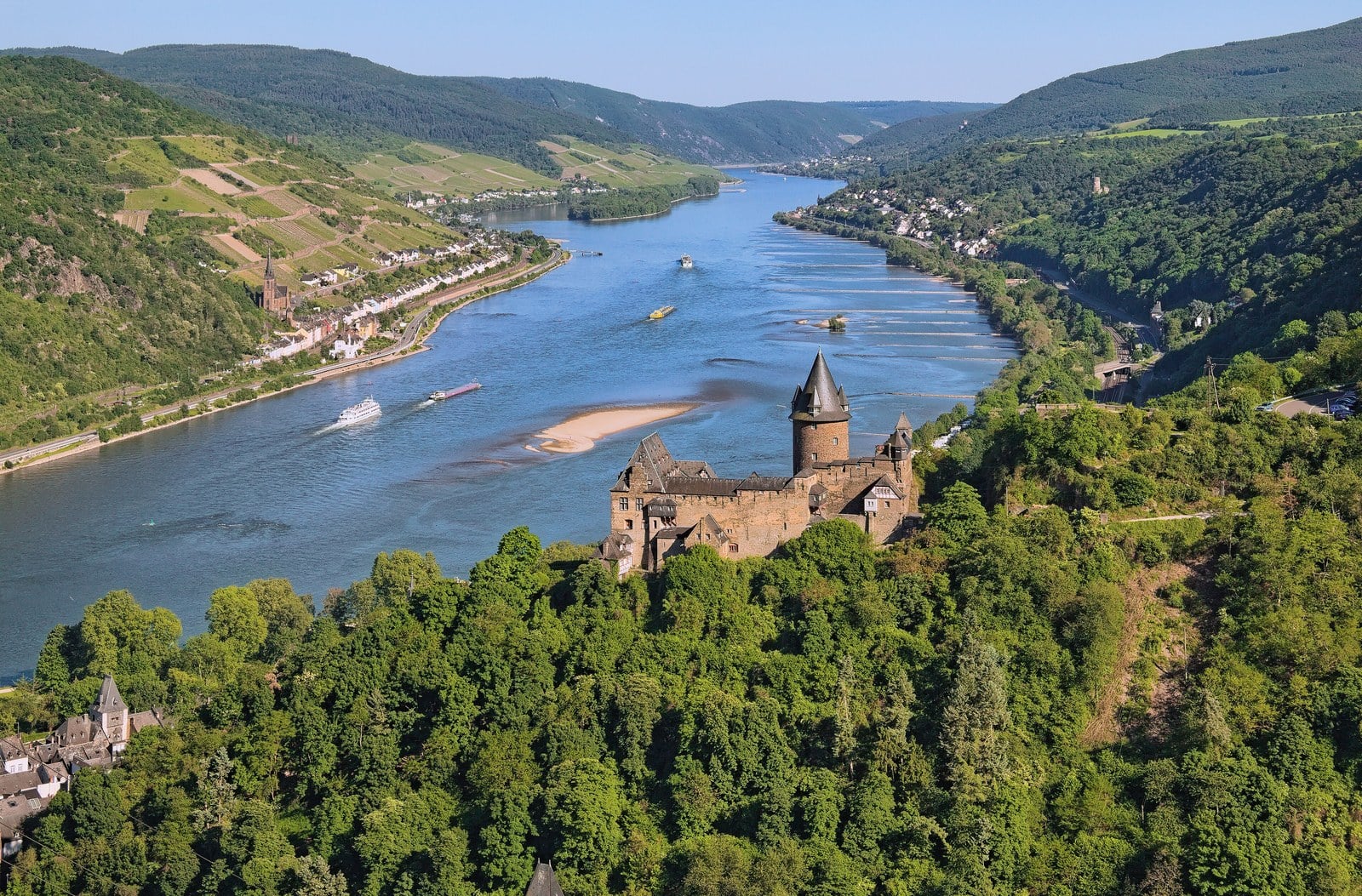
Stahleck Castle
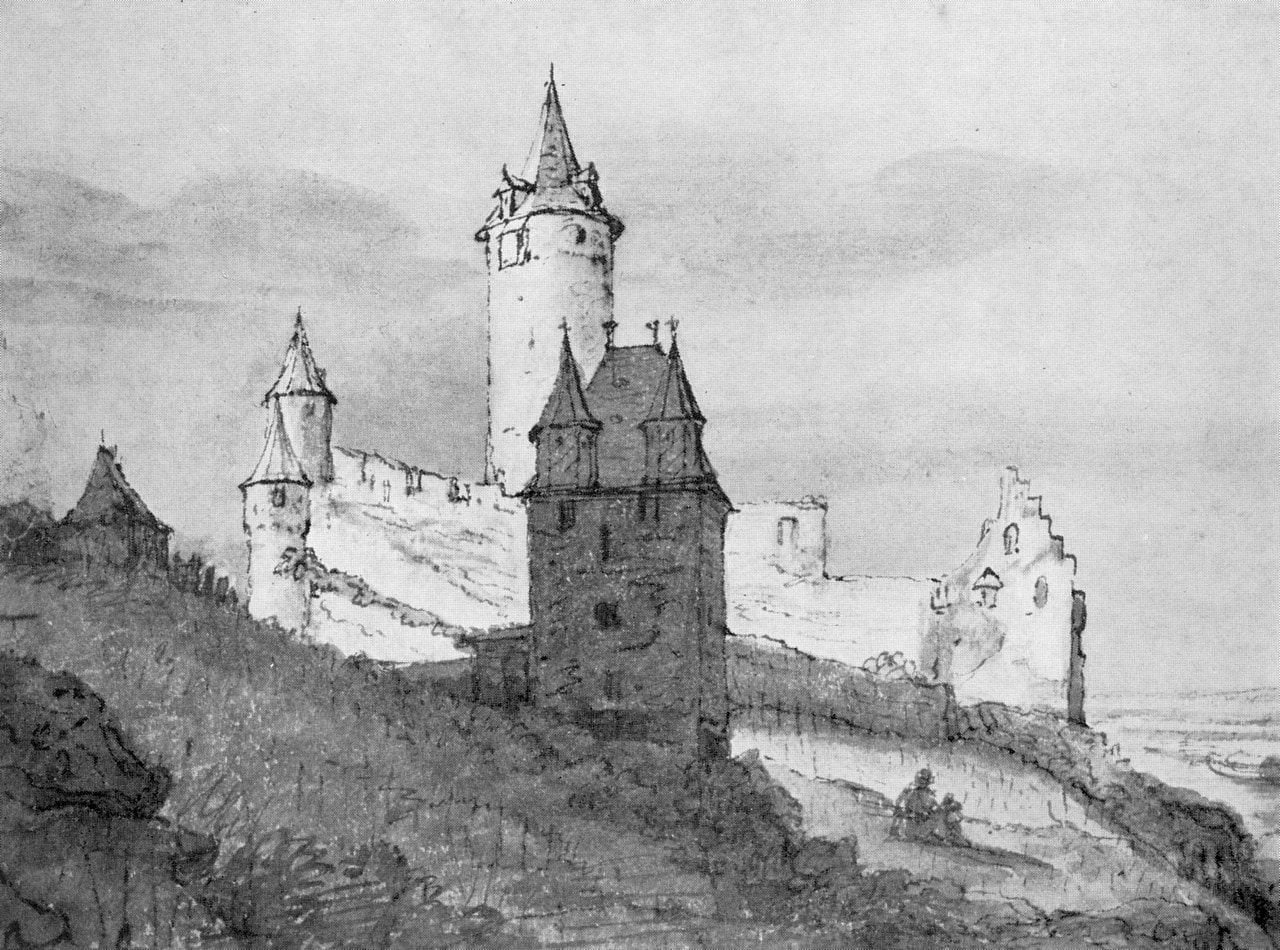
Stahleck Castle crowns a vine-covered spur high above Bacharach, on the left bank of the Rhine where the river bends through its most dramatic gorge. Few German castles carry a deeper story for their size. From this crag the Counts Palatine of the Rhine first built their power, turning a Cologne outpost into the seat of a territory that would one day help choose emperors. War reduced it to rubble in 1689, and for two centuries the shell stood as a Romantic ruin that painters loved and travelers sketched.
Then, in the twentieth century, it came back. Rebuilt over decades and handed to ordinary travelers as a youth hostel, Stahleck now lets anyone sleep inside the walls where a dynasty began. You can watch barges slide along the Rhine from a courtyard that costs nothing to enter, and read nine centuries of German history in a single hilltop. It is, in every sense, a castle that rents its view by the night.
Quick Facts
| Name | Stahleck Castle (Burg Stahleck) |
| Location | Above Bacharach, left bank of the Rhine, Rhine Gorge, Rhineland-Palatinate, Germany |
| Type | Spur castle (Spornburg), a hilltop castle on a rock crag about 160 m above sea level |
| First documented | Goswin von Stahleck named c. 1120/21; castle securely attested 1135 |
| Seat of | The Counts Palatine of the Rhine, from Hermann von Stahleck (County Palatine, 1142) |
| Destroyed | March 15, 1689 by French troops (powder magazine ignited), during the War of the Palatine Succession |
| Rebuilt | From 1909 by the Rhenish Association for Monument Preservation; hostel 1926–1927; keep 1965–1967 |
| Architect of the rebuild | Ernst Stahl (1925 onward); keep completed under Heinrich Grimm |
| Current owner / use | Youth hostel (Jugendherberge Burg Stahleck), operated by DJH; courtyard open to the public |
| UNESCO | Upper Middle Rhine Valley World Heritage Site, since 2002 |
| Coordinates | 50.0584, 7.7658 |
| Official site | jugendherberge.de |
Cradle of the Palatinate
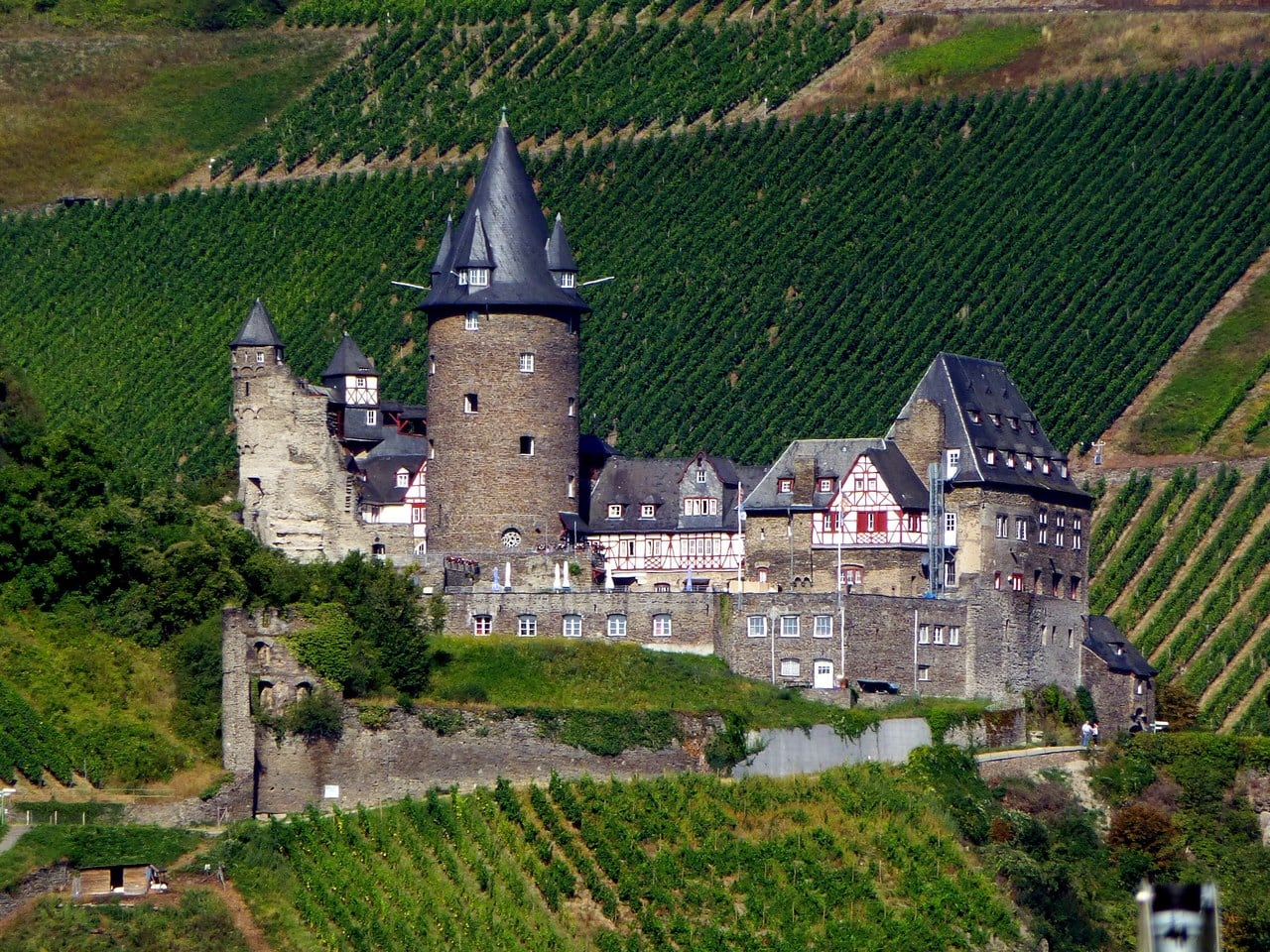
A castle’s name often hides its purpose, but Stahleck wears its meaning plainly. The word joins the Middle High German stahel, steel, to ecke, a rocky spur, and reads as something close to “impregnable castle on a crag.” Bacharach belonged to the Archbishops of Cologne from around the year 1000, and it was probably they who raised a fortification here as a far southern outpost, watched over by their Vogt, or steward. A man named Goswin appears in the charters from about 1120 and again in 1135, the first holder we can name with confidence. He had come into the castle through marriage and took its name as his own.
Goswin’s son Hermann married Gertrud of Swabia, sister of the future king Conrad III, and that match changed everything. Conrad enfeoffed Hermann with Stahleck in 1140 and then, around 1142, granted him the County Palatine of the Rhine. At a stroke the family rose to the front rank of the empire. When Conrad left on the Second Crusade, he trusted Hermann to govern the realm in his absence, between roughly 1147 and 1149. Hermann ran the Palatinate from this spur, and Bacharach grew into a trading town on the strength of the Rhine wine traffic that passed below. The castle existed in large part to make that traffic pay its dues.
Stahleck anchored a small but rich domain known as the Four Valleys, the Viertälergebiet: the settlements of Bacharach, Steeg, Diebach, and Manubach, together with the castles of Stahleck, Fürstenberg, and Stahlberg. Historians call Stahleck the cradle of the Electoral Palatinate, and the label fits. Everything that the Palatinate later became, a power that cast its vote in the election of German kings, can be traced back to this hilltop. After Hermann died in 1156, the emperor Frederick Barbarossa passed the title to his own half-brother, Conrad of Hohenstaufen, keeping the prize within the imperial dynasty.
A Secret Wedding and the Wittelsbach Inheritance
Conrad of Hohenstaufen had no surviving son, only a daughter, Agnes, and the question of whom she would marry carried the weight of a realm. Her father had all but promised her to King Philip II of France. Agnes had other ideas. While Conrad was away from the castle in the winter of 1193 to 1194, she secretly married Henry of Brunswick, son of the Welf duke Henry the Lion and a sworn rival of her father’s house. Her own mother helped arrange the secret match. Known ever since as the Stahleck Marriage, this quiet act of defiance helped knit together the feuding Hohenstaufen and Welf families, two of the greatest powers in Germany, and it remains the castle’s most romantic episode.
Henry succeeded as Count Palatine and held the castle until 1212, when he handed the title to his son, Henry the Younger. That young man died childless in 1214, and with him the direct line failed. Stahleck itself, held as private property, passed to his sister Agnes, while the County Palatine lapsed back to the crown as a vacant imperial fief. The king bestowed it on Duke Ludwig I of Bavaria, of the House of Wittelsbach. To secure the castle along with the title, Ludwig arranged a marriage in 1222 between his son Otto and the heiress Agnes, folding Stahleck firmly into Wittelsbach hands. The Wittelsbachs increasingly governed from Heidelberg, and from this point the spur above Bacharach served as an occasional seat rather than the center of power.
Royal Stage, Then Pawn
Even in semi-retirement Stahleck kept hosting the great. On March 4, 1349, the Emperor Charles IV celebrated his wedding to Anna of the Palatinate within these walls. Half a century later, around the end of 1400, Ruprecht of the Palatinate marked his own election as German king at the castle, and he returned for festivities again in 1408. As late as 1442 a Count Palatine staged a reception here for a king bound to his coronation at Aachen. For a fortress that had ceased to be a capital, Stahleck saw a remarkable parade of crowns.
Prestige did not always pay the bills. In December 1314, to cover the costs of his contested royal election, Ludwig the Bavarian pawned Stahleck, together with the castles of Stahlberg and Braunshorn, for 58,300 pounds of Heller to John of Bohemia and Archbishop Baldwin of Trier. (A local tradition that German princes met at nearby Bacharach in 1314 to back Ludwig’s candidacy is sometimes attached to the castle, but the formal double election took place that fall at Frankfurt, not on this spur.) The Palatinate was divided in 1353, sending Stahleck to a junior branch, and by the middle of the fourteenth century the castle had been woven into Bacharach’s town wall as its highest point. Through the fifteenth and sixteenth centuries it slipped quietly into the background of empire.
Eight Sieges and the Powder Blast
The Thirty Years’ War found the old stronghold and used it hard. An artillery platform had been added on the northeast side once cannon entered European warfare, yet that upgrade could not keep Stahleck out of the fighting. Between 1620 and 1644 the castle was besieged, taken, and sacked eight times as control of the Rhine passed from one army to the next. Spanish troops under Spinola came first, in 1620. Swedes followed in 1632, imperial forces under Gallas in 1635, Weimar troops at the decade’s end, then Bavarians and Spanish again around 1640. The French arrived in 1644. In one episode that year, Cologne troops drove the French back inside the walls, and their commander, Colonel Constantin von Nievenheim, had the castle bombarded rather than try to storm it.
Peace in 1648 brought a brief recovery. Elector Karl Ludwig of the Palatinate repaired the war damage in 1666, and a sandstone tablet recording his work in that year survives at the castle still. The reprieve did not last. During the War of the Palatine Succession, the commandant surrendered Stahleck to French forces on October 11, 1688. The following spring, on March 15, 1689, French soldiers set fire to the powder stored in the vaults. The explosion tore apart the ring wall and the keep, gutted the residence by fire, and wrecked the little Werner Chapel on the slope below. What the war began, the blast finished. Stahleck became a ruin, and a ruin it would remain for more than two hundred years.
From Ruin to Youth Hostel
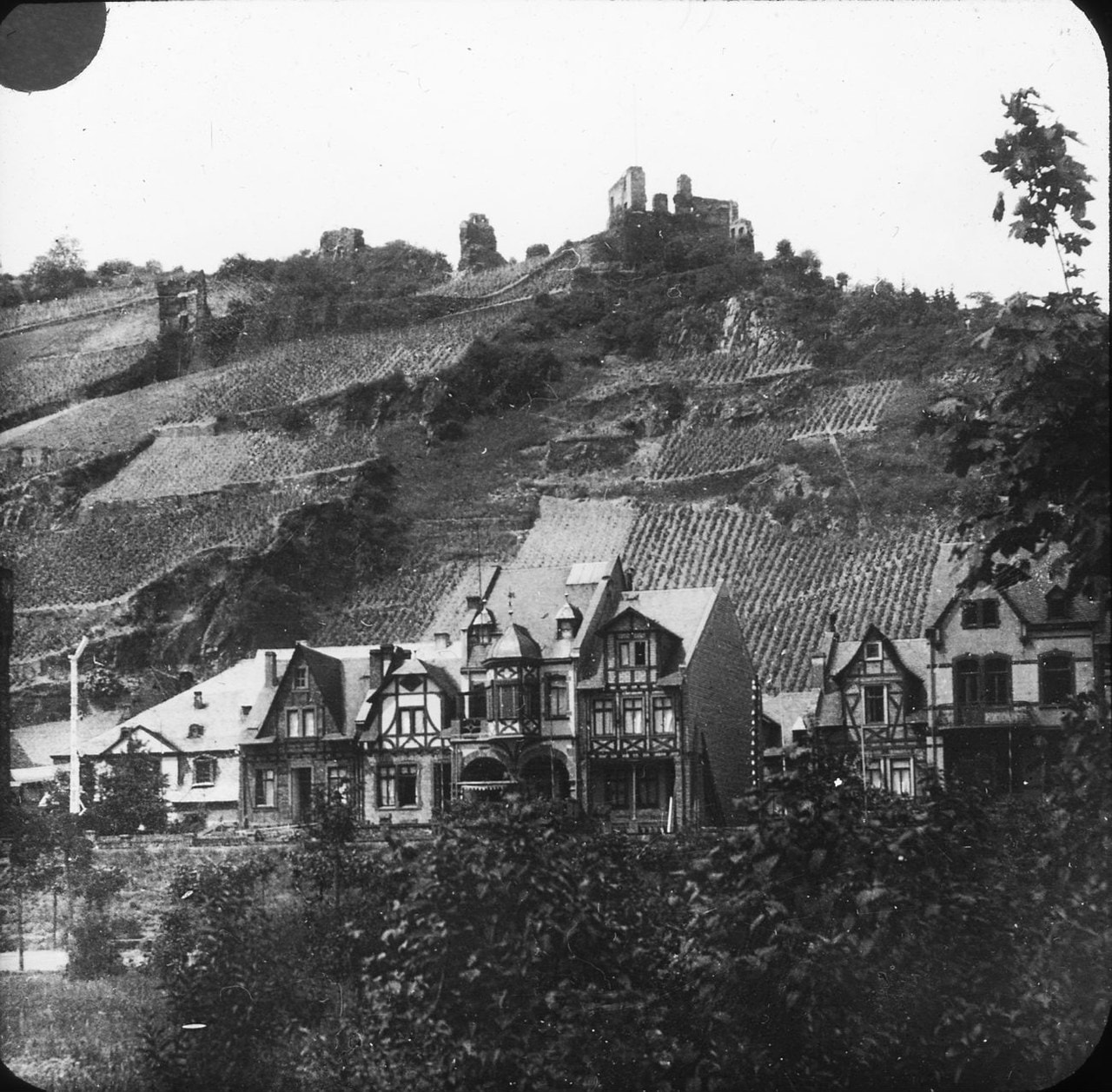
A wrecked castle on a Rhine crag was exactly the kind of thing the nineteenth century learned to love. As Rhine Romanticism swept artists and travelers up the river, Stahleck’s broken silhouette became a favorite subject. Ownership followed the politics of the age: French state property after the Revolutionary Wars, then Prussian after the Congress of Vienna in 1815. Around 1828 the Prussian crown prince, the future Frederick William IV, bought the ruin, an echo of the royal castle-rescuing that also rebuilt nearby Sooneck and Stolzenfels.
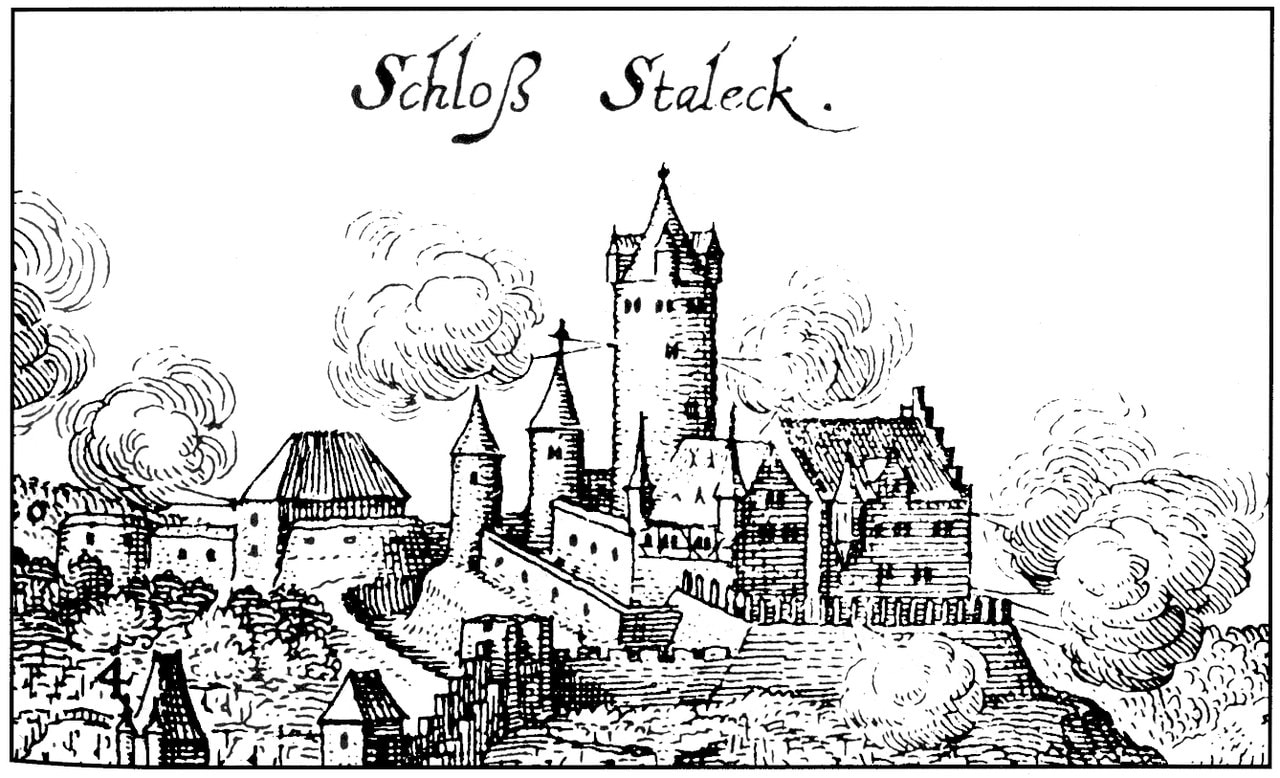
The real revival came later, and from a different impulse. In 1909 the Rhenish Association for Monument Preservation and Landscape Protection acquired the site, and after the First World War it chose a striking purpose for the rebuilt castle: a youth hostel, part of a German movement then turning historic buildings into lodging for young hikers. The Düsseldorf architect Ernst Stahl directed the reconstruction, working from Matthäus Merian’s 1646 engraving and from what the excavations turned up. The first hostel building opened in 1926, a second followed by 1927, and the shield and ring walls rose again in the same years. The great hall was rebuilt in the mid-1930s. War interrupted the work once more when the castle served as a military hospital from 1940 to 1942, and it did not reopen as a hostel until November 1947. A final campaign from 1965 to 1967, completed under the engineer Heinrich Grimm, raised the round keep and crowned it with the conical roof that defines the skyline today.
For all that history, much of what a visitor sees is twentieth-century work. The oldest surviving fabric amounts to the foundations of the keep, parts of the great hall’s cellar, and stretches of the ring wall. The rest is careful reconstruction, faithful to the silhouette Merian recorded but new stone for the most part. That makes Stahleck a particular kind of monument: not a preserved medieval shell like Marksburg, nor a Romantic fantasy like Stolzenfels, but a thoughtful rebuild that put a living use back inside an old shape.
Architecture: Shield Wall, Keep, and a Watery Moat
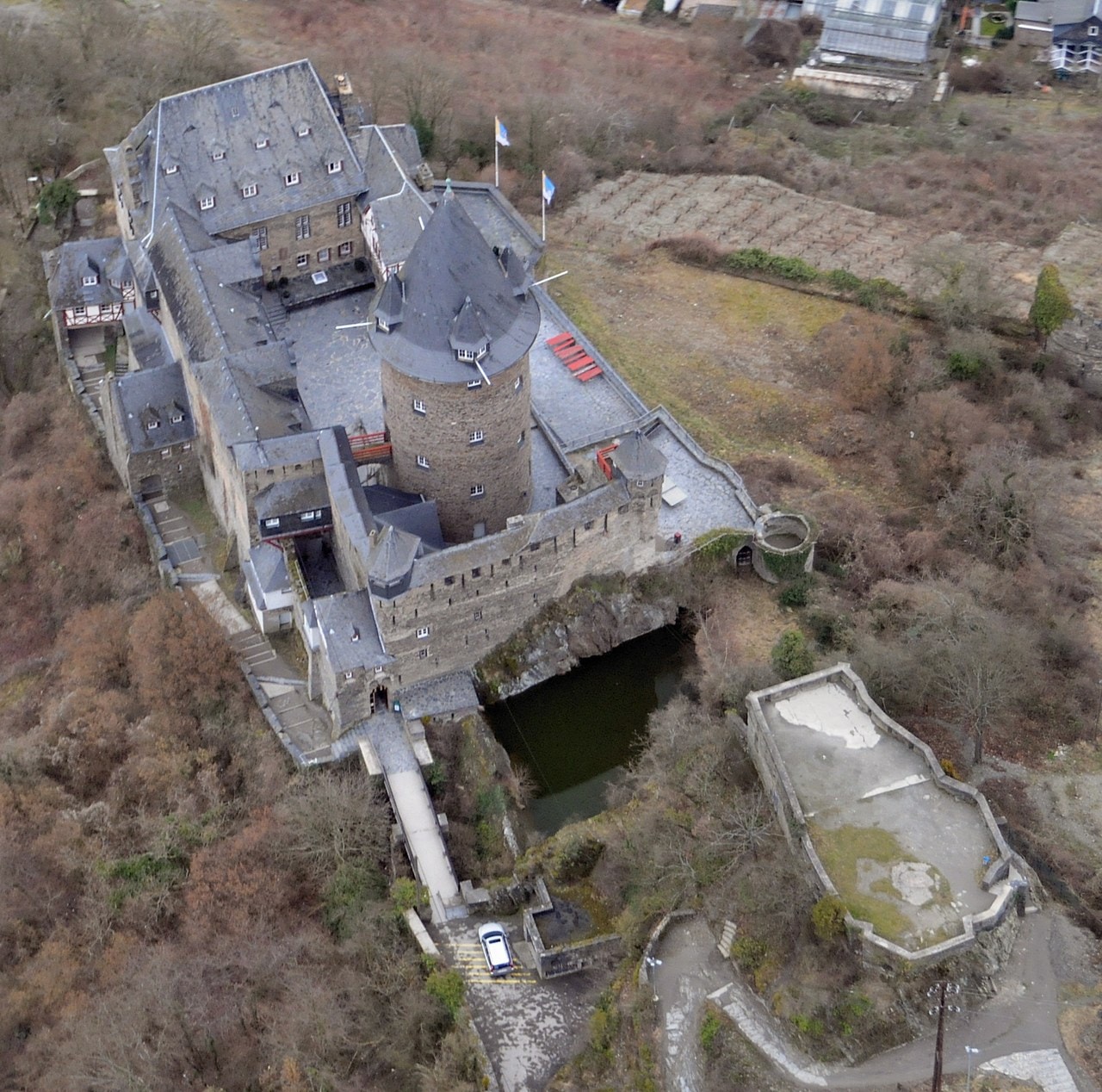
Stahleck sits at the mouth of the Steeg valley on a rock spur roughly 160 meters above sea level, which makes it a textbook hilltop spur castle. Its most unusual feature is the one most people notice first on the way in: a water-filled neck ditch, or Halsgraben, carved from the rock and fed by springs. A wet moat is a genuine rarity among German hill castles, where the height usually rules out standing water, and at Stahleck it lends the approach across the drawbridge a moated, almost storybook character.
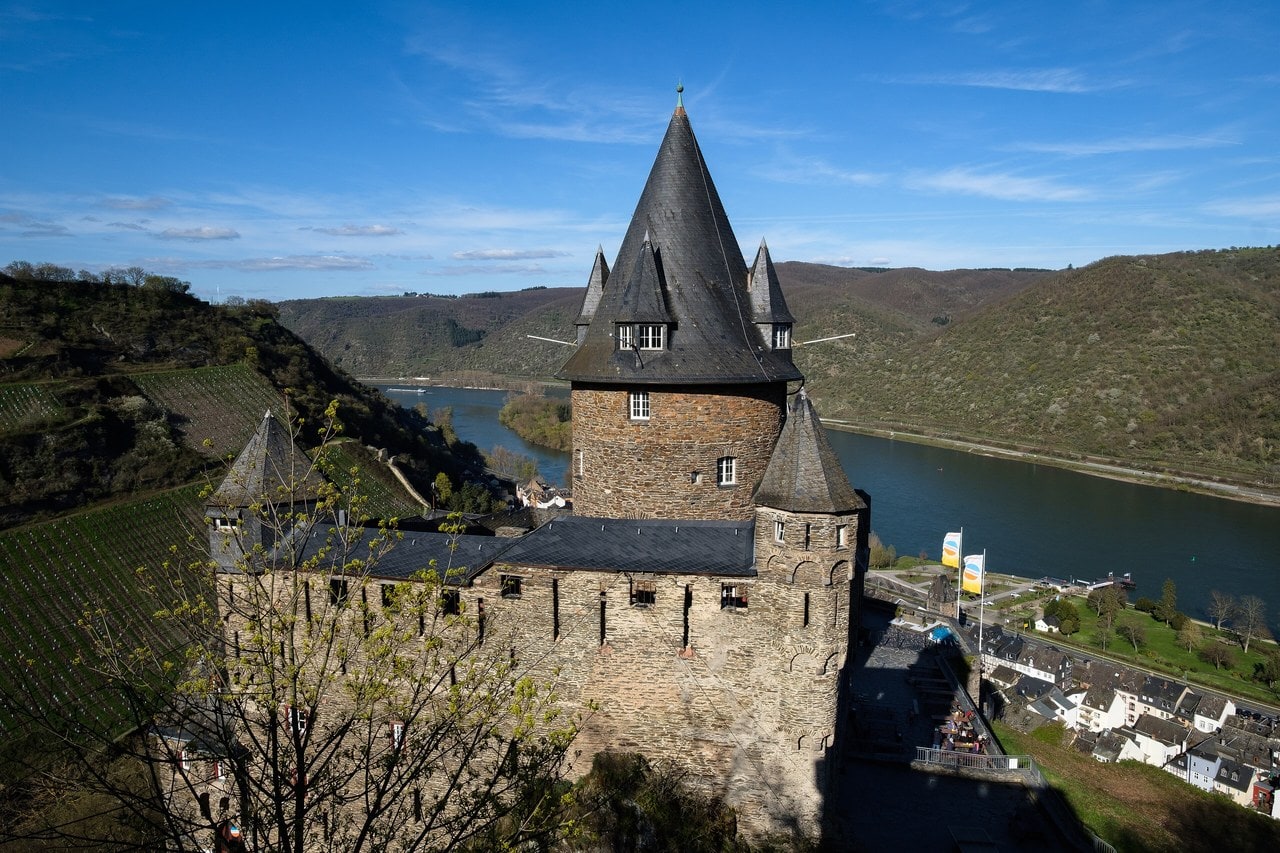
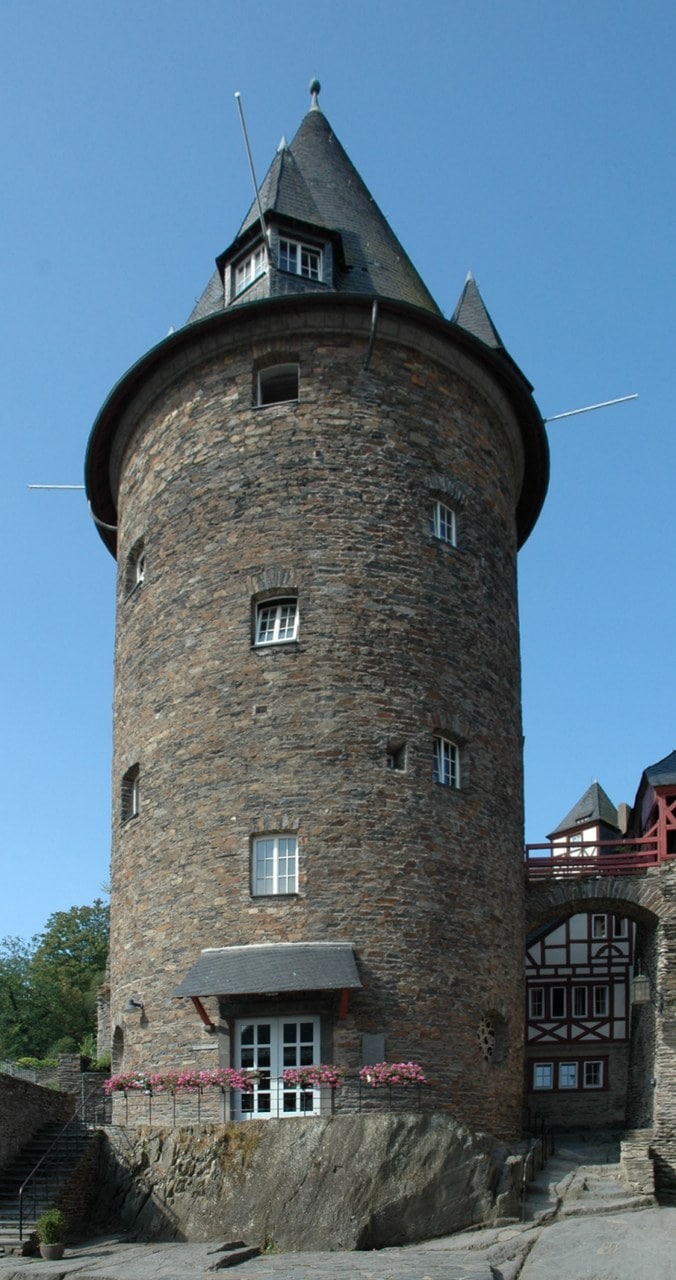
Facing the landward side stands the great shield wall, a heavy curtain in the form first raised in the fourteenth century, finished at each end with a polygonal corner turret and a covered wall walk along the top. Behind it rises the round keep, the Bergfried, rebuilt to a diameter of about 7.5 meters and capped by a tall conical roof. The great hall, or palas, occupies the narrow river side of the courtyard, looking east over the gorge. The plan is compact and defensive, the way a spur castle has to be, with the strongest wall turned toward the only easy line of attack and the softer residential range tucked safely behind it above the cliff.
Visiting Stahleck Castle
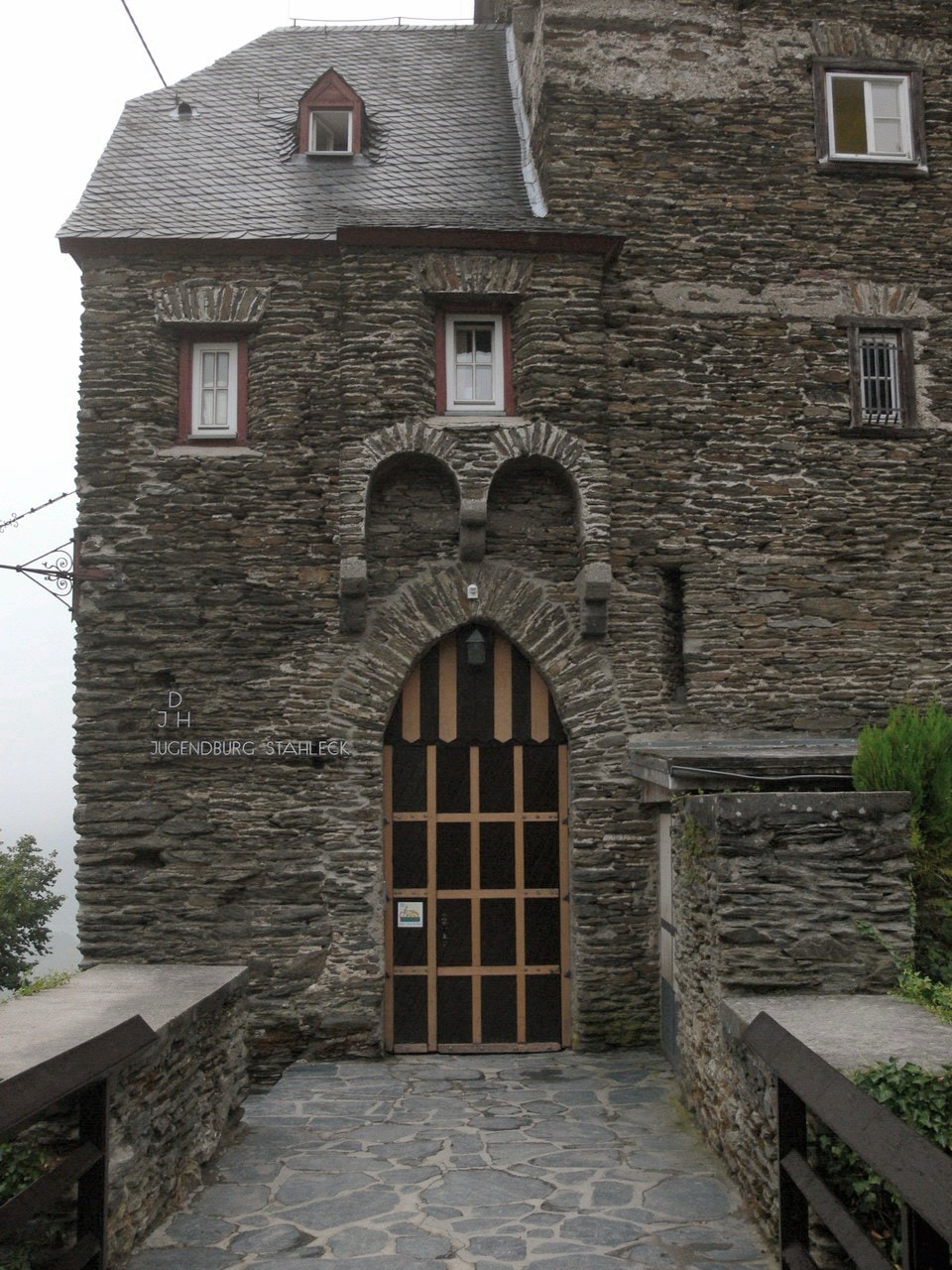
Stahleck Castle is unusual among Rhine castles in that you do not tour it, you stay in it. The castle houses the Jugendherberge Burg Stahleck, one of Germany’s best-known youth hostels, run by the German Youth Hostel Association (DJH) with around 178 beds in rooms from singles to family dormitories. The house is open all year except over Christmas. Guests sleep inside the medieval shape, eat in a dining hall within the walls, and wake to a view straight down the gorge.
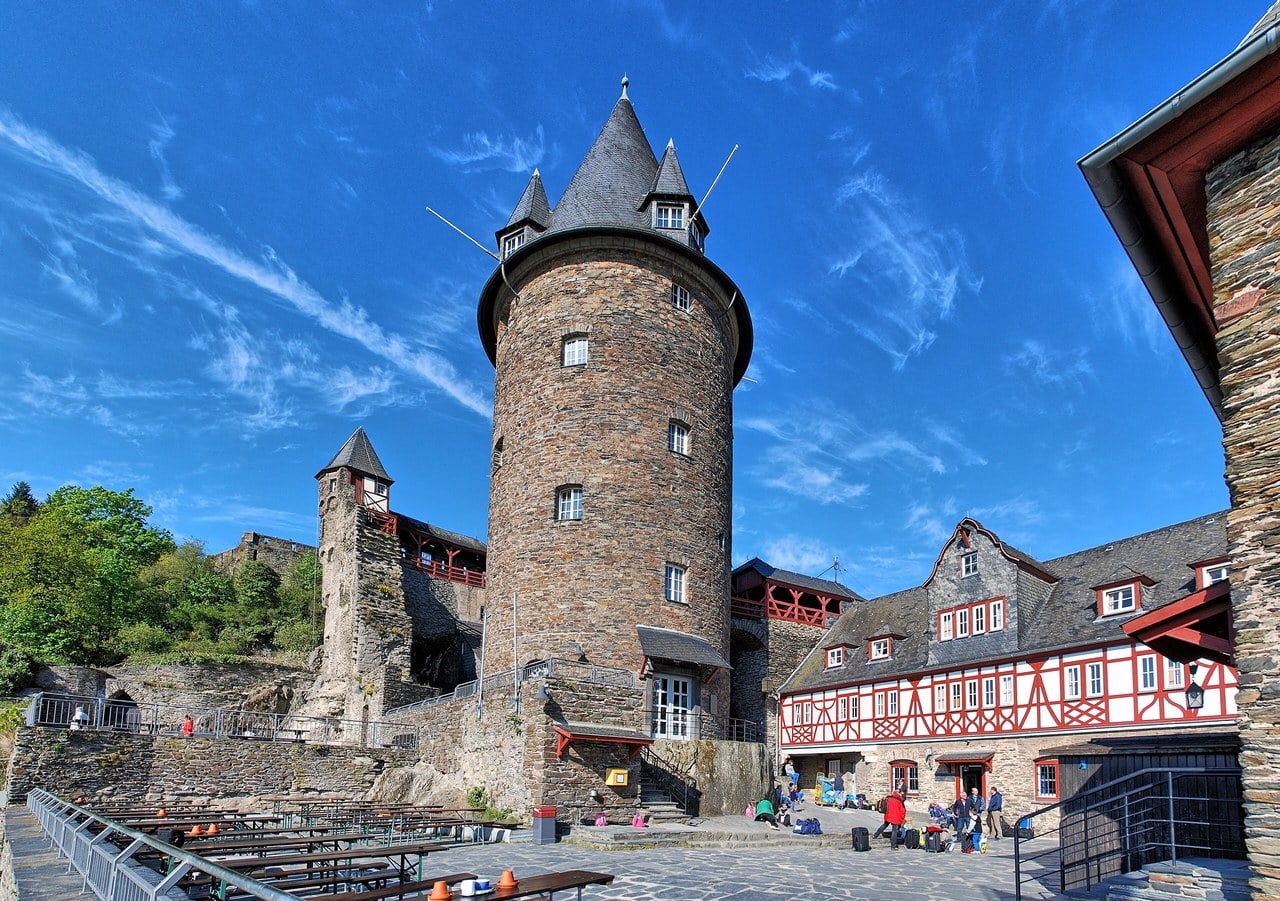
You do not have to book a bed to enjoy the place, though. The inner courtyard is freely open to the public, and a small biergarten and café there serve drinks, coffee, and cake to anyone who makes the climb, with the Rhine valley spread out to the south. Reaching the castle is half the pleasure: a footpath of steps climbs from the old town past St. Peter’s church in roughly fifteen to twenty minutes, and drivers can wind up above the castle to park nearby. Bacharach’s railway station, on the Mainz to Koblenz line, sits in the town directly below.
You can spend the night inside Stahleck, the old seat of the Counts Palatine, now a castle youth hostel. See our guide to Castle Hotels on the Rhine for the cheapest castle night on the river.
Stahleck books direct through the German Youth Hostel Association rather than the usual booking sites, so reserve a bed straight from the DJH Bacharach page. It is also our budget, book-direct pick in the guide to castle hotels in Germany. For other places to stay in the wine town below the walls, compare hotels and guesthouses in Bacharach on Booking.com. And to see Stahleck the way the toll-keepers once watched the river, a Rhine Valley castles boat cruise glides past the gorge’s great strongholds.
Some links on this page are affiliate links, which means StoneKeep Atlas may earn a small commission, at no extra cost to you, if you book through them.
More Views of Stahleck Castle
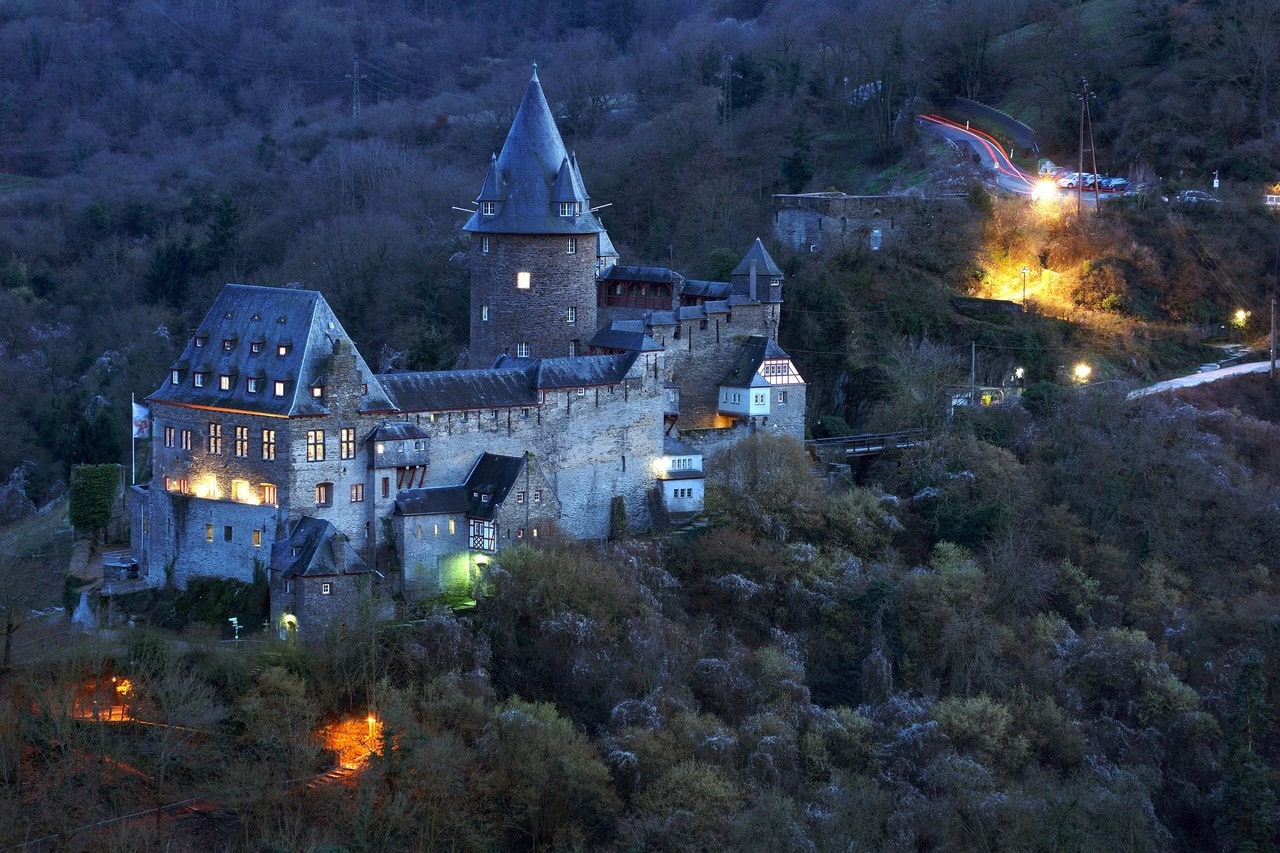
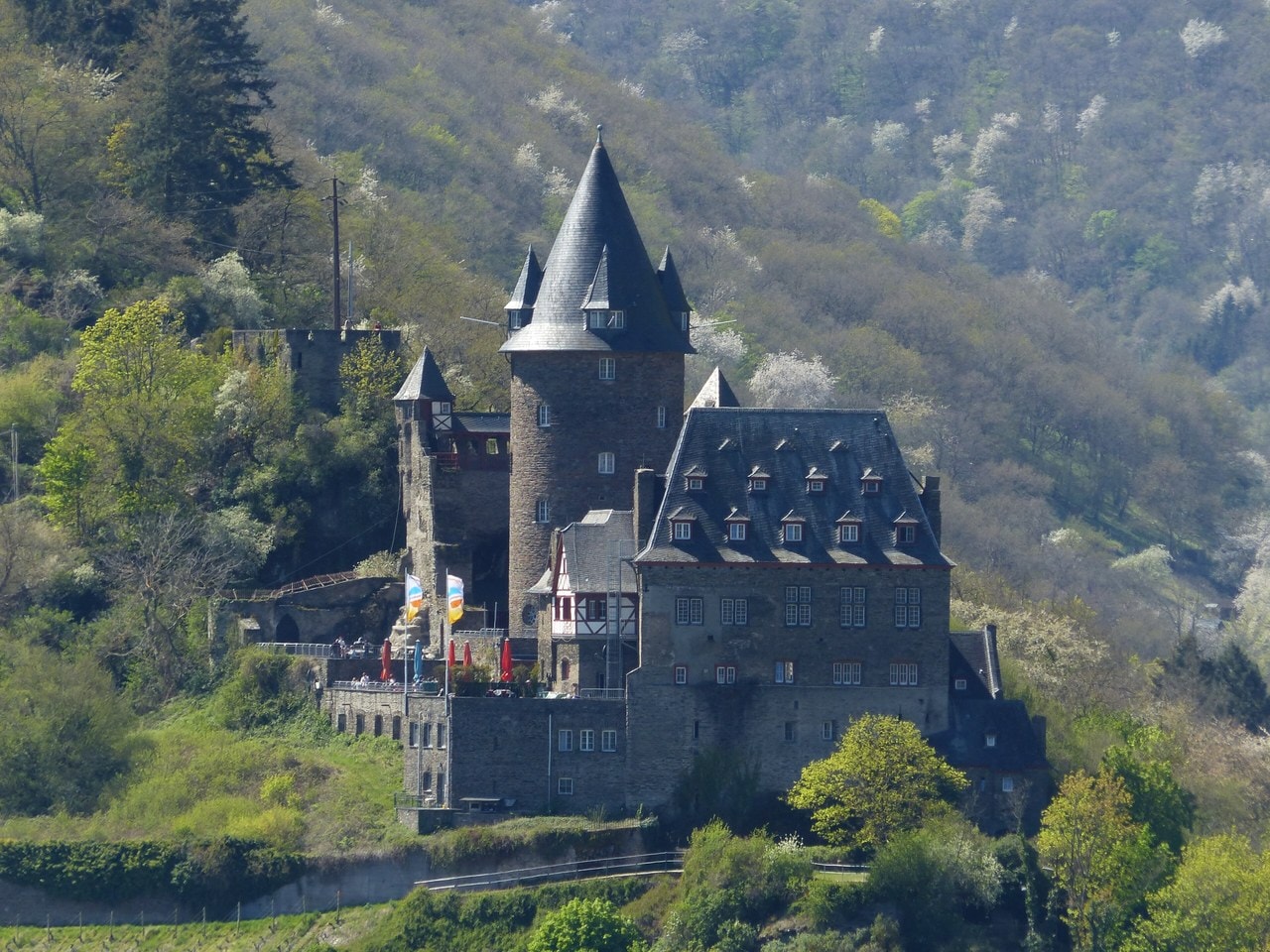
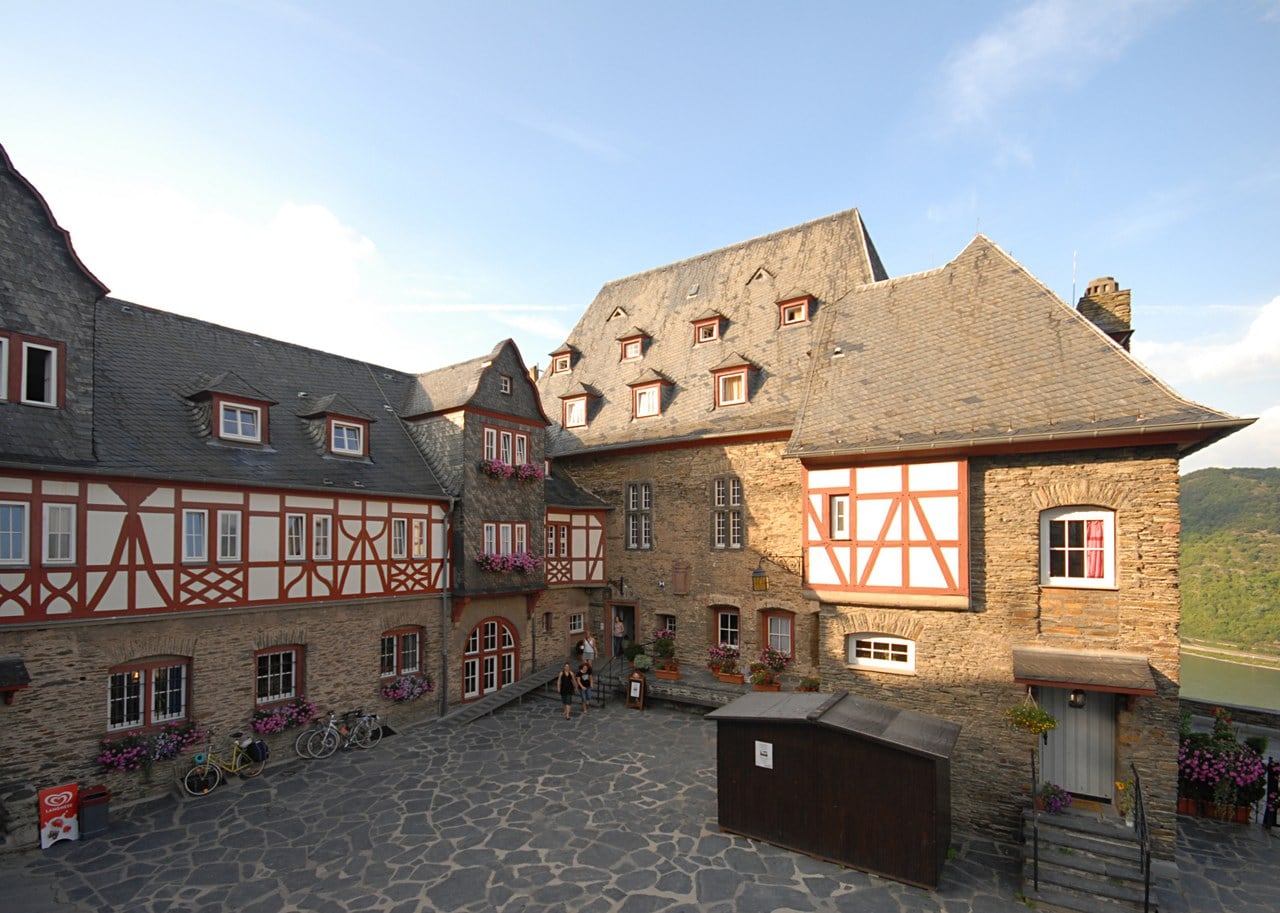
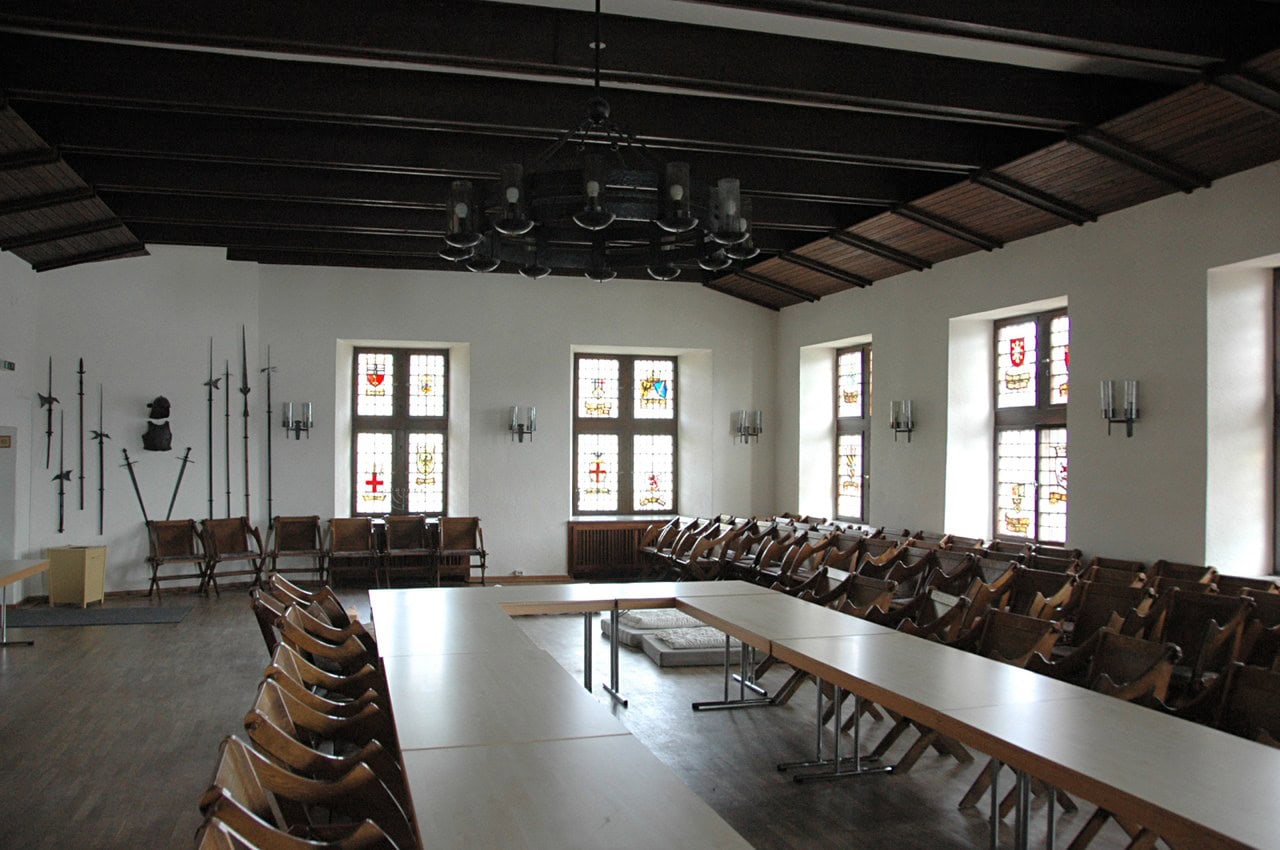
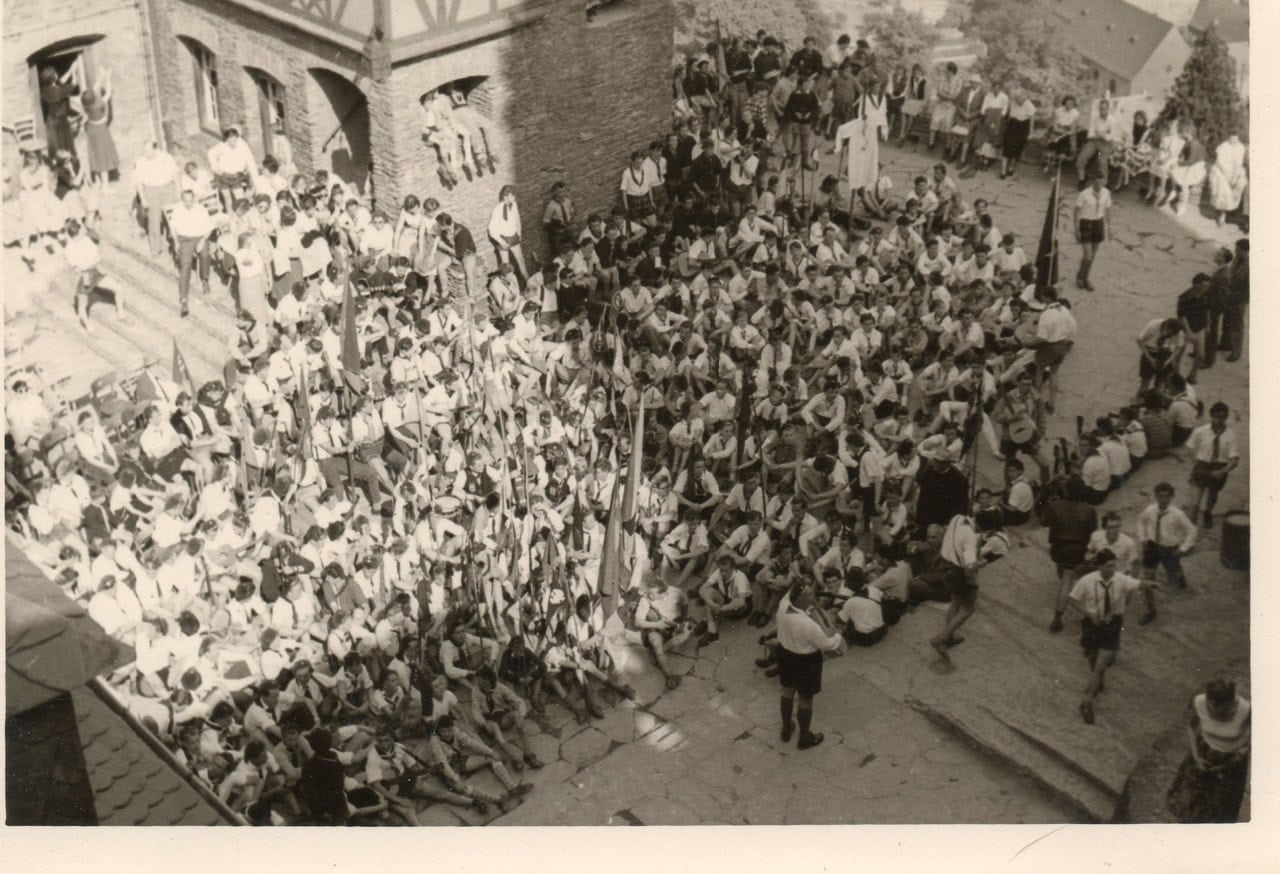
A closer look at the castle through the seasons, from the round keep and gatehouse to the courtyard and the knights’ hall within.
Beyond Stahleck Castle
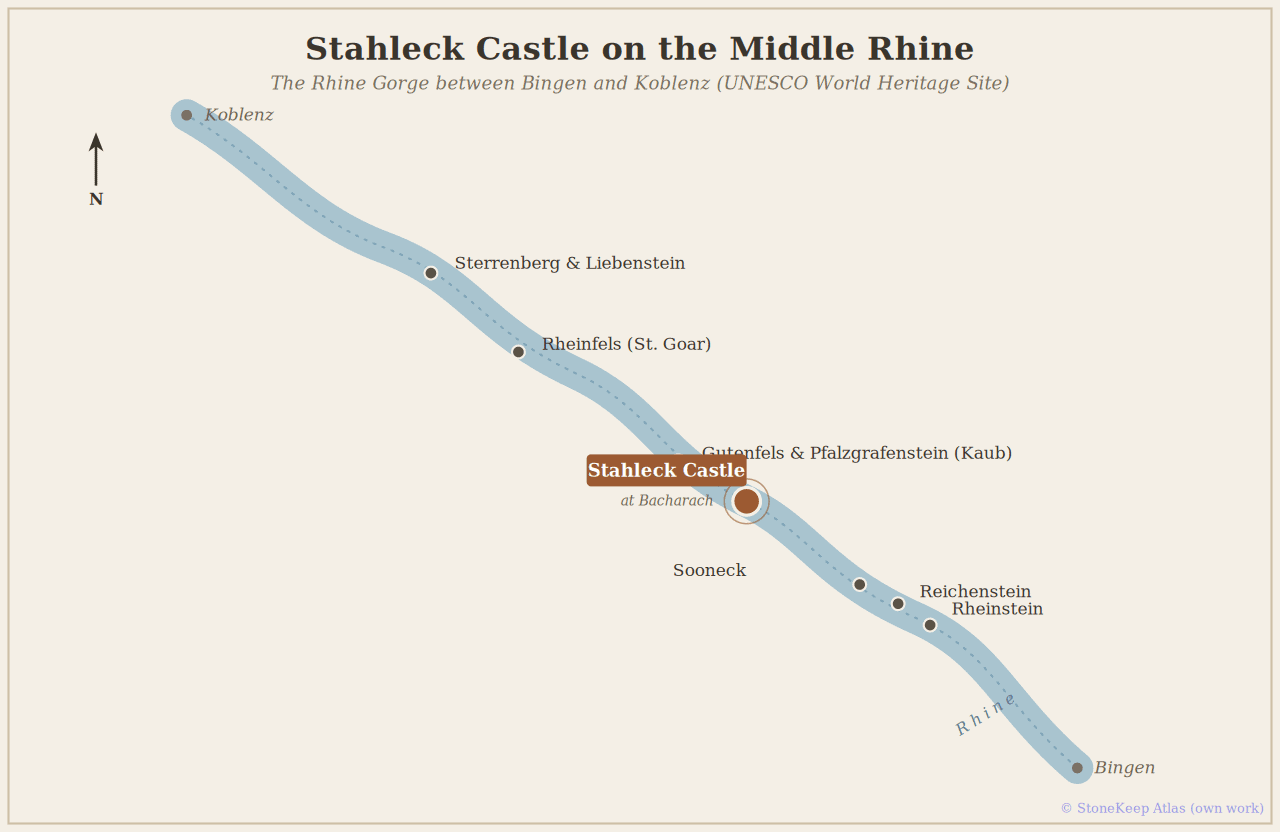
Stahleck stands in the thick of the Rhine Gorge’s great run of castles, and it pairs naturally with its neighbors. Just upstream toward Bingen lie Sooneck, Reichenstein, and Rheinstein, three castles the Prussian royal house and private owners brought back from ruin in the same Romantic century that rediscovered Stahleck. Downstream at Kaub sit the toll pair of Gutenfels and the river-island customs post of Pfalzgrafenstein, where the Palatinate squeezed the Rhine trade much as it did from Bacharach. Just below at Oberwesel, Schönburg Castle was the prison tower where Hermann von Stahleck had his rival Otto of Rheineck strangled in 1149. Farther down, the feuding “Hostile Brothers” of Sterrenberg and Liebenstein and the great fortress ruin of Rheinfels at St. Goar round out a day or two on the river. For the wider picture, see our overview of the Castles of the Middle Rhine.
Conclusion
Most castles ask you to imagine the life that once filled them. Stahleck invites you to join it. This is where the Electoral Palatinate took its first breath, where a defiant bride knit two warring dynasties together, and where eight sieges and a powder blast finally brought the walls down. That the castle rose again at all owes everything to a heritage society and an architect who chose to make it useful rather than merely picturesque. The result is a layered, honest place: medieval bones, a careful modern rebuild, and a courtyard where anyone with a few euros can sit above the Rhine. On a river crowded with castles you can only photograph, Stahleck is the rare one you can wake up inside.
Principal Sources
- Generaldirektion Kulturelles Erbe Rheinland-Pfalz. “Bacharach und seine Burgen.” gdke.rlp.de.
- Institut für Geschichtliche Landeskunde, Mainz. “Die Burg Stahleck in Bacharach.” regionalgeschichte.net.
- Generaldirektion Kulturelles Erbe Rheinland-Pfalz. Burgen, Schlösser, Altertümer Rheinland-Pfalz. Schnell & Steiner, Regensburg.
- Thon, Alexander, ed. Wie Schwalbennester an den Felsen geklebt: Burgen am unteren Mittelrhein. Schnell & Steiner, Regensburg, 2010.
- Dehio-Handbuch der deutschen Kunstdenkmäler: Rheinland-Pfalz, Saarland. Deutscher Kunstverlag, Munich, 1984.
- Deutsches Jugendherbergswerk. “Jugendherberge Bacharach – Burg Stahleck.” jugendherberge.de; UNESCO World Heritage List, Upper Middle Rhine Valley (ref. 1066).
Image credits. Featured image, Stahleck Castle above the Rhine gorge: Johannes Robalotoff, CC BY-SA 3.0 DE, via Wikimedia Commons; the castle above Bacharach’s vineyards: Edgar El, CC BY 3.0, via Wikimedia Commons; Merian’s 1646 engraving: Matthäus Merian, public domain, via Wikimedia Commons; Lambert Doomer’s 1663 drawing: Lambert Doomer, public domain, via Wikimedia Commons; Bacharach and the ruined castle around 1904: Tekniska museet, CC BY 2.0, via Wikimedia Commons; the water moat from the air: © MFSG, via Wikimedia Commons; the courtyard and biergarten: Welt-der-Form, CC BY-SA 3.0, via Wikimedia Commons; the castle at dusk: Bertram Nudelbach, CC BY-SA 2.0, via Wikimedia Commons; in fall: abbilder, CC BY 4.0, via Wikimedia Commons; in spring: Whgler, CC BY-SA 4.0, via Wikimedia Commons; the round keep: Sir Gawain, CC BY-SA 3.0, via Wikimedia Commons; the gatehouse: Harald Nachtigall, CC BY-SA 3.0, via Wikimedia Commons; the courtyard at evening: Harald Nachtigall, CC BY-SA 3.0, via Wikimedia Commons; the knights’ hall: Sir Gawain, CC BY-SA 3.0, via Wikimedia Commons; the 1958 youth rally: CTHOE, CC BY-SA 3.0, via Wikimedia Commons; locator map: © StoneKeep Atlas (own work). Freely licensed images are resized to fit; otherwise unaltered.