
Neues Palais
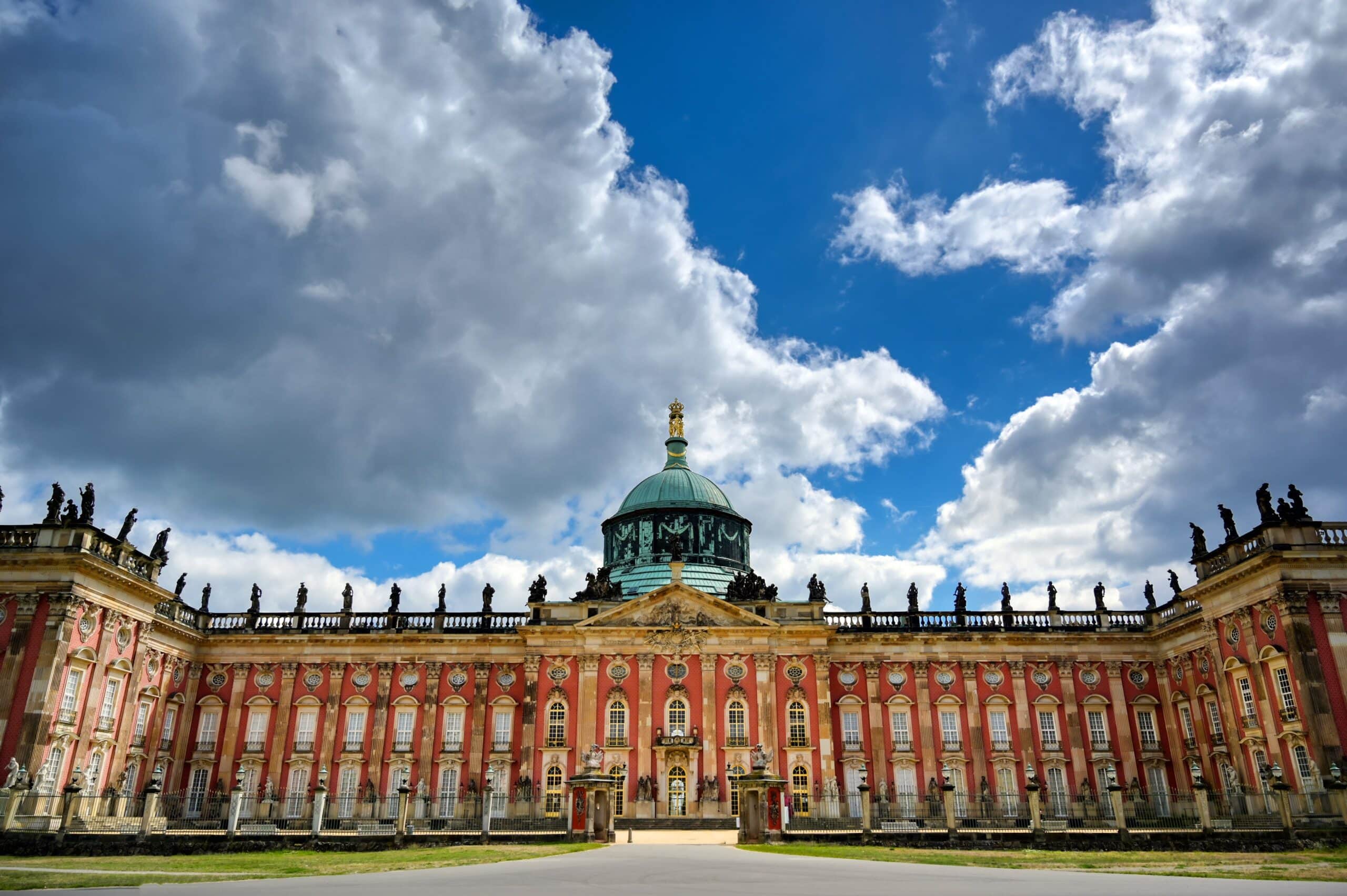
At the western end of Sanssouci Park stands the largest building Frederick the Great ever raised: the Neues Palais, a sweeping Baroque palace of more than two hundred rooms beneath a towering dome. He built it between 1763 and 1769, in the years right after the Seven Years’ War, and he meant every visitor to take note. Where his beloved Sanssouci was a small vineyard retreat for private hours, the Neues Palais was its opposite, a deliberate display of Prussian wealth and nerve at a moment when both had been tested to the breaking point. Frederick himself called the result a “fanfaronade,” a piece of pure showing-off. A century and a half later the same palace became the favorite home of Germany’s last emperor, and the place where the monarchy quietly packed its bags.
Quick Facts
A summary of the essentials before the full story.
| Location | Sanssouci Park, Potsdam, Brandenburg, Germany |
| Built | 1763–1769 |
| Built for | Frederick the Great (Frederick II of Prussia) |
| Architects | Johann Gottfried Büring, Heinrich Ludwig Manger, Carl von Gontard |
| Style | Late Baroque / Frederician Rococo |
| Size | About 200 rooms; roughly 60 open to visitors |
| Later resident | Kaiser Wilhelm II (principal residence until 1918) |
| Current use | Palace museum |
| Owner / operator | Stiftung Preußische Schlösser und Gärten Berlin-Brandenburg (SPSG) |
| UNESCO | Part of World Heritage Site No. 532, inscribed 1990 |
| Address | Am Neuen Palais, 14469 Potsdam |
| Official site | spsg.de |
The Last Great Prussian Baroque
For seven years Prussia had fought for its life. Ranged against Austria, France, and Russia at once, Frederick’s kingdom came close to annihilation more than once, saved as much by luck and the collapse of the enemy coalition as by its own battered armies. When the Treaty of Hubertusburg finally ended the war in 1763, it confirmed something close to a miracle: Prussia emerged without losing an acre, Silesia still in Frederick’s hands, its standing as a great power no longer in doubt. Almost at once, the king ordered a palace to say so.
Construction began that same year. Frederick had entertained the idea of a grand new residence before the war, but only survival made it real, and he wanted it built fast. The pace shows in the record. A three-wing complex with a front 220 meters long rose in just six years, and contemporaries noted that the builders worked at speed, cutting a corner here and there to meet the king’s impatience.
Plans came first from Johann Gottfried Büring and Heinrich Ludwig Manger, both working from Frederick’s own sketches and both already proven in the park, where Büring had built the Chinese House and the Picture Gallery. Within a year the two had fallen out with the king over the design. In 1764 Carl von Gontard took charge, carrying the project through its interiors while the elaborate façade was already climbing toward the roofline. A fourth name, the French designer Jean-Laurent Legeay, belongs chiefly to the service buildings behind the palace, where Gontard reworked his ideas.
What they produced was the last building of its kind. After the Neues Palais, no further Baroque palace was raised in Prussia, and historians treat it as the symbolic close of an era. Its keepers today call it the final great flourish of a style that had defined royal Prussia for a hundred years. The choice of so backward-looking a style was itself deliberate, a confident salute to the Baroque of Prussia’s rise at the very moment that rise reached its summit.
A Boast in Stone
Comfort was never the point. Frederick built the Neues Palais as a statement addressed to the courts of Europe that had spent seven years trying to break Prussia and failed. Its sheer scale was the argument: a treasury that could raise this, so soon after a ruinous war and despite the debts it left behind, was a treasury still to be reckoned with. The cost ran high, and the war debts made it higher, yet Frederick pressed ahead precisely because the expense was the point. The king described the palace as a “fanfaronade,” a brag, and the foundation that cares for it now keeps that judgment in its own subtitle for the building, “A Royal Boast.”
Tellingly, he had little intention of living there. Frederick kept to Sanssouci, his intimate single-story retreat a kilometer to the east, and reserved the Neues Palais for guests, celebrations, and the public theater of monarchy. He did keep a modest set of apartments for himself in the southeast wing and stayed there on occasion, but the building was meant to dazzle visitors rather than to shelter the king. Its two halves of the same park still face each other along one long avenue, a study in opposites: modesty for the man, grandeur for the state. Understanding one means standing in front of the other, which is why the Neues Palais is best read as the answer to a question Sanssouci had already posed.
Inside: Grotto, Marble, and Theater
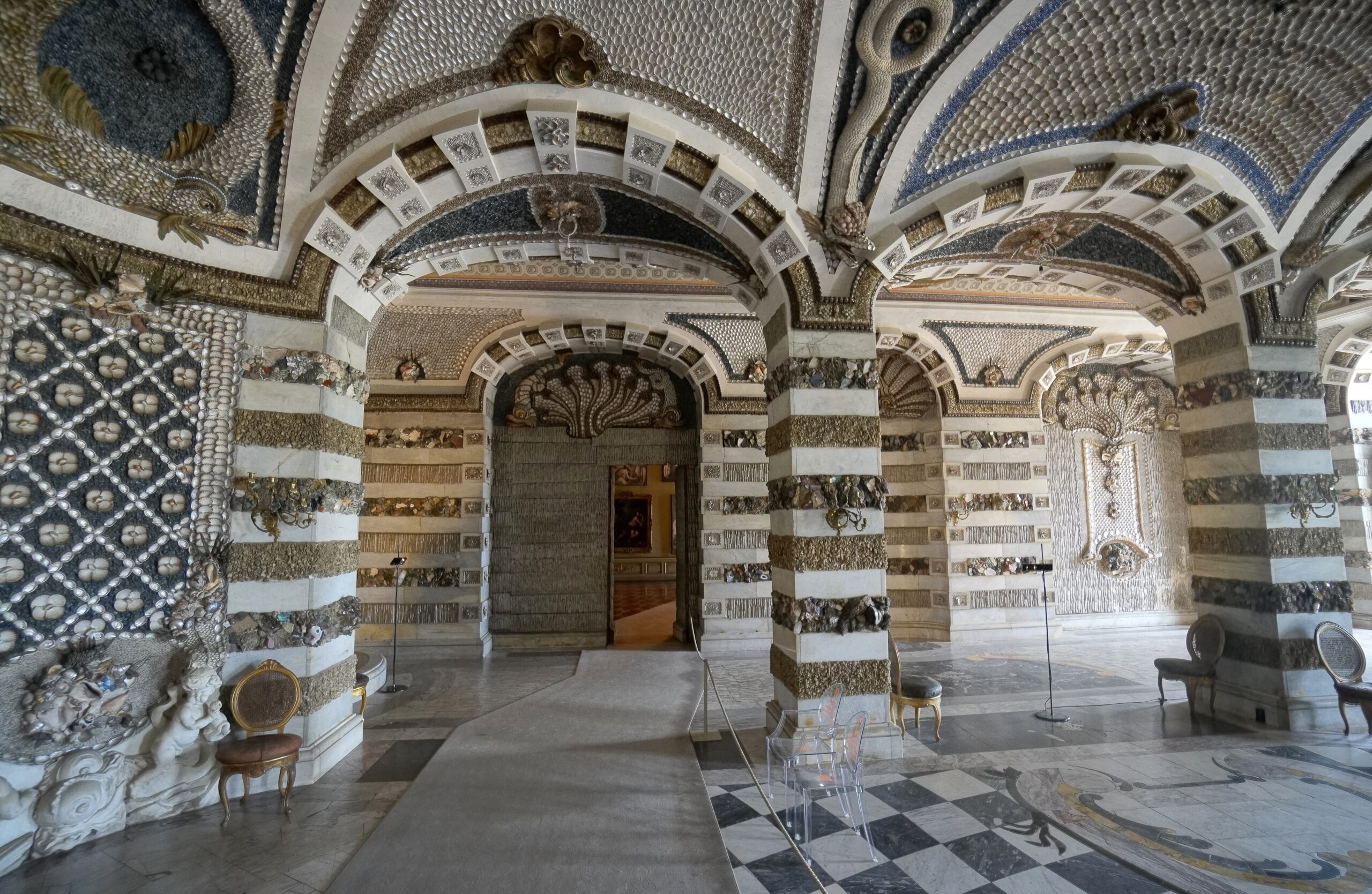
Of the roughly two hundred rooms, about sixty are open to visitors, and the showpieces sit at the building’s heart. Beneath the dome, on the ground floor, lies the Grotto Hall (Grottensaal), its walls and pillars encrusted with more than 23,000 minerals, shells, fossils, and semi-precious stones gathered from around the world, a great many of them added during the nineteenth century. A marble floor underfoot depicts sea creatures, and one curiosity set into the decoration is a fragment labeled as the tip of Mount Kilimanjaro, presented to Wilhelm II in 1890. By candlelight the whole room glitters like the inside of a jewel, a man-made cavern dressed for a king.
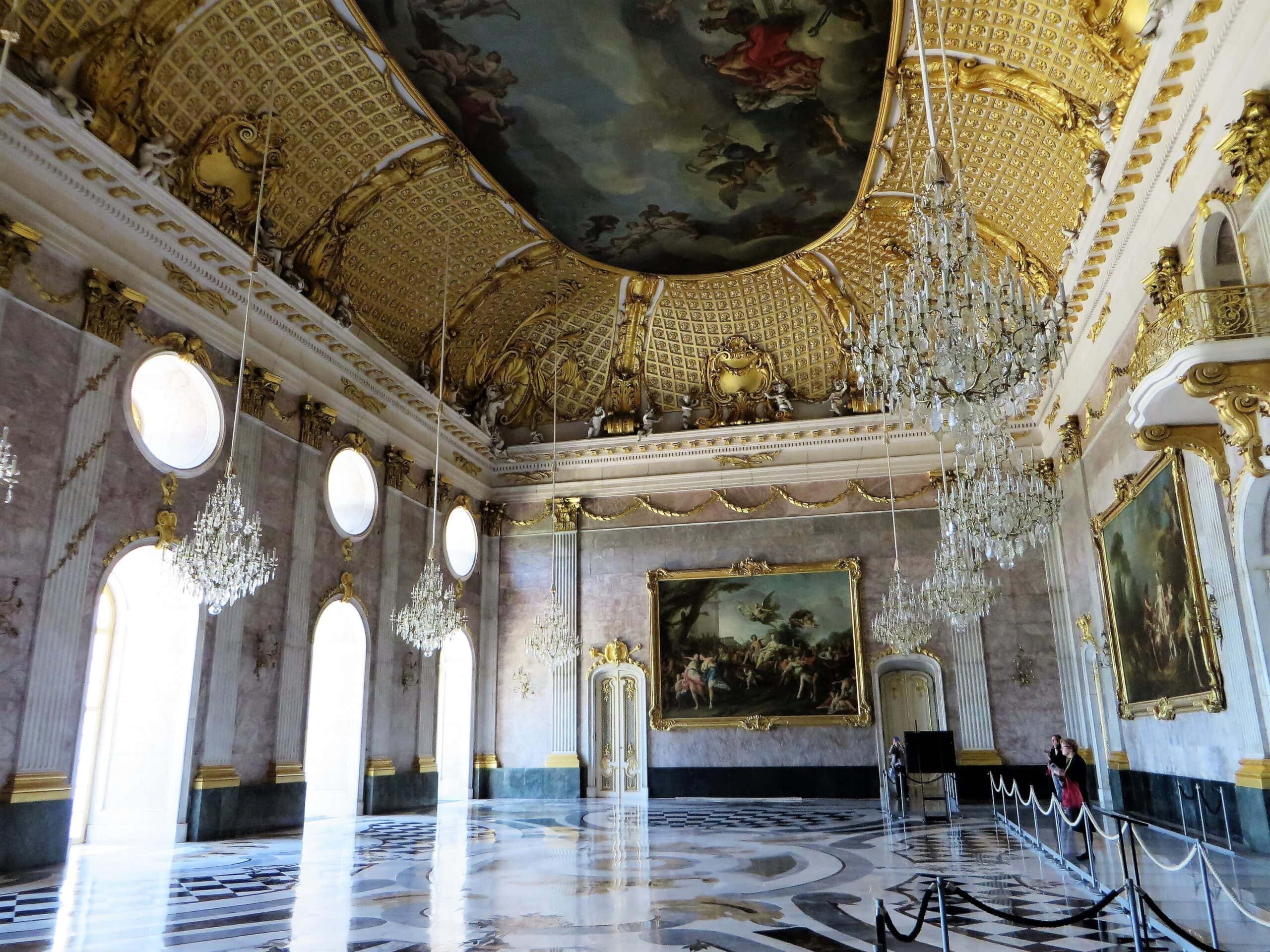
Two rooms carry “marble” in their names, and visitors confuse them easily, though they are quite distinct. Adjoining the Grotto Hall on the ground floor is the Marble Gallery (Marmorgalerie), lined in red jasper and white Carrara marble, with mirrors set opposite the windows to double the daylight. Directly above the Grotto Hall rises the Marble Hall (Marmorsaal), the principal festival hall and the ceremonial climax of the building. Two stories tall, it carries on its ceiling Charles-Amédée-Philippe van Loo’s painting of Ganymede being received into Olympus, completed in 1768 and 1769. At 240 square meters that canvas is reckoned the largest ceiling painting of its kind north of the Alps.
Beyond the great halls, the palace unfolds as a sequence of state apartments and guest suites, an Upper Gallery hung with paintings, and a Concert Room where Frederick, an accomplished flautist, could hear music performed. Frederick also gave the palace a jewel-box Rococo theater, the Schlosstheater, tucked into the south wing and still in use today for concerts and performances during the season.
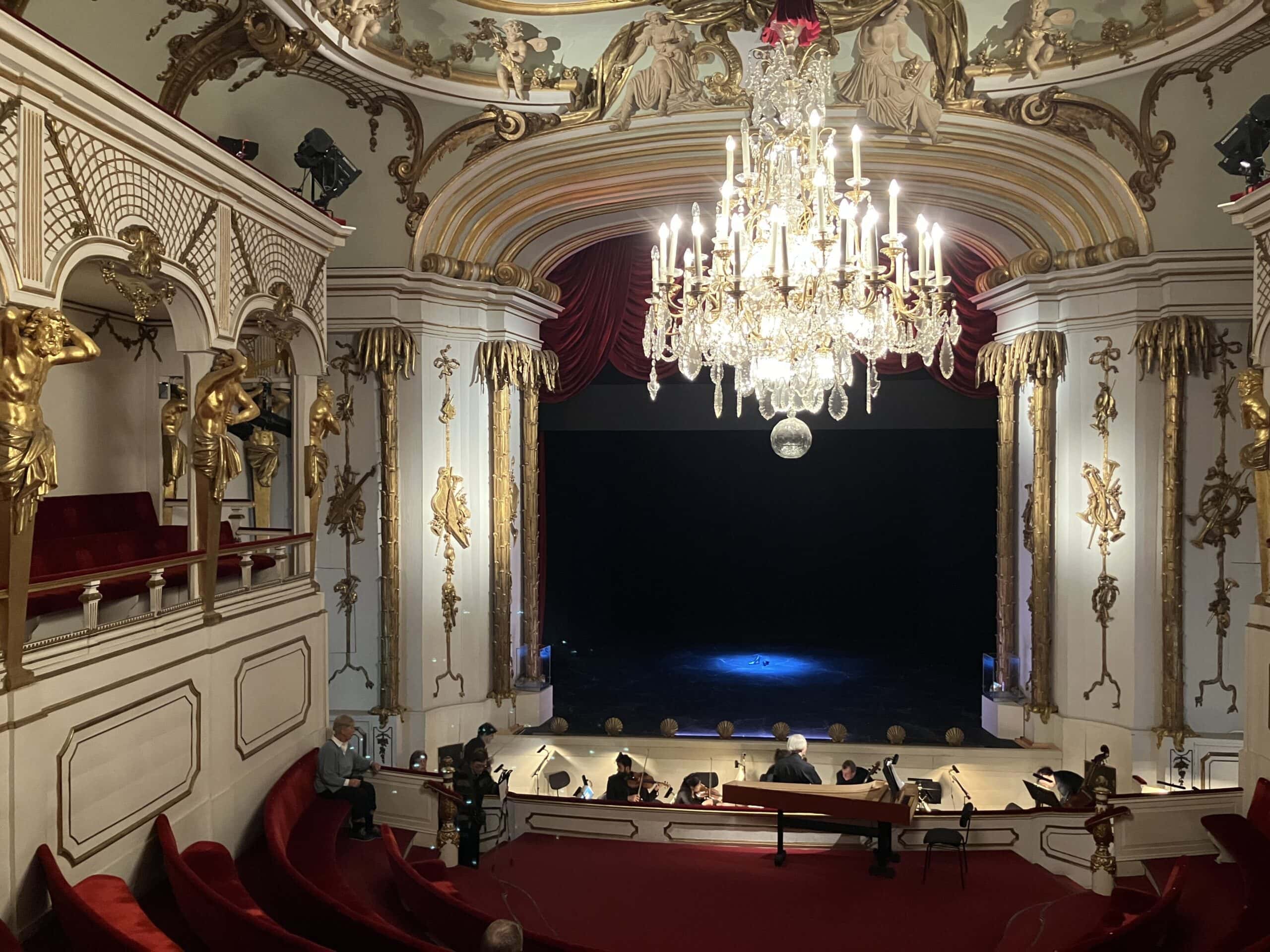
The upper floor held lavish guest apartments, and one suite, shown to visitors today as a separate summer tour, preserves the rooms of a princely household down to their furnishings. The decoration throughout mixed German, French, and Italian hands, with paintings, gilded stucco, inlaid floors, and silk hangings competing for attention room after room. The festival halls were made for use as well as display, staging the banquets, balls, and receptions through which Frederick conducted the business of impressing his guests.
Outside, the building wears its ambition openly. More than four hundred sculpted figures crowd the façade and roofline, the work of a small army of court sculptors. Crowning it all, the 55-meter dome lifts three Graces who hold the Prussian royal crown aloft on a cushion. That dome is theater in another sense, since it covers no grand hall below; it exists chiefly to be admired from the avenue, the exclamation point on Frederick’s argument.
The Communs and the Triumphal Gate
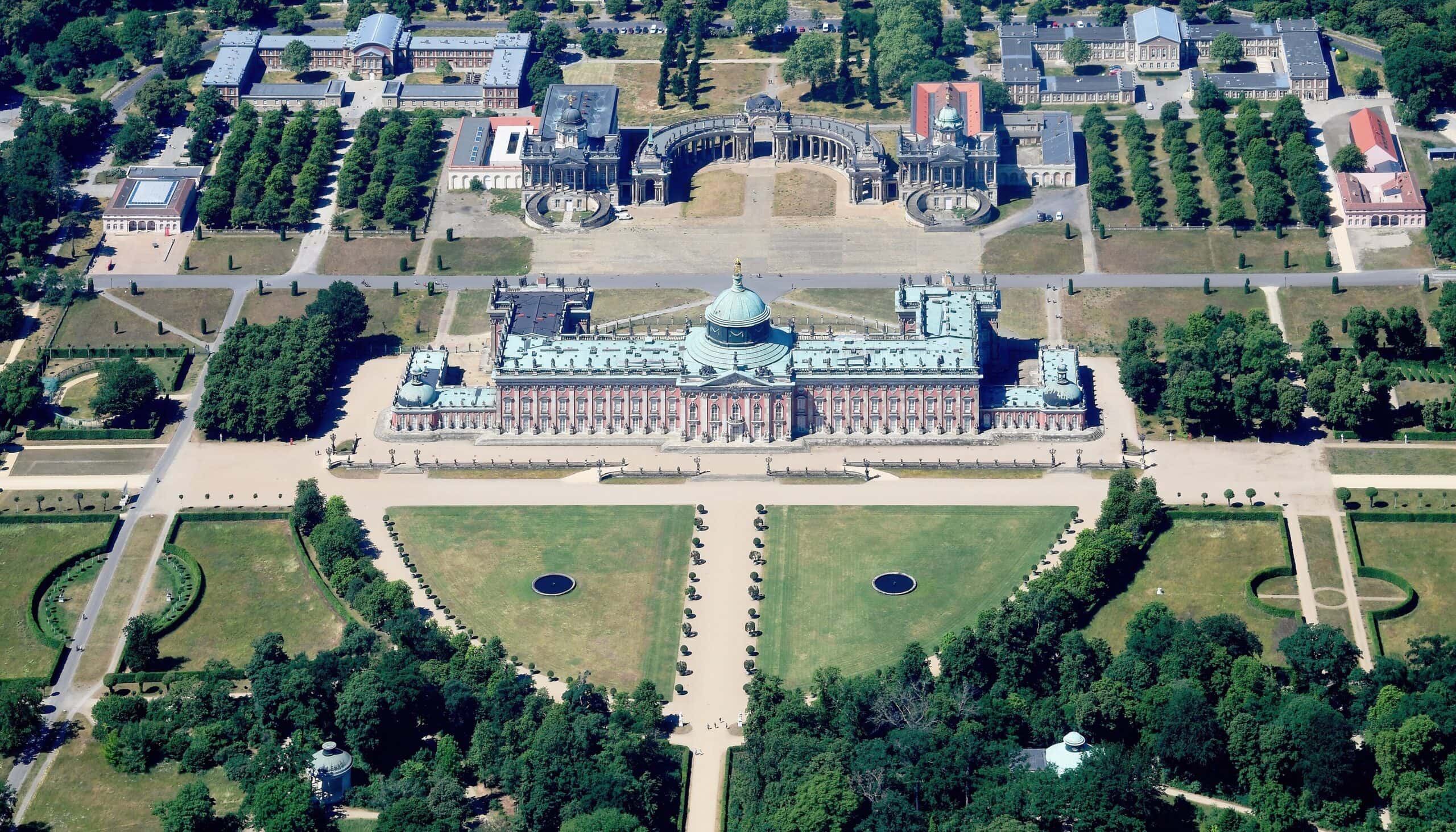
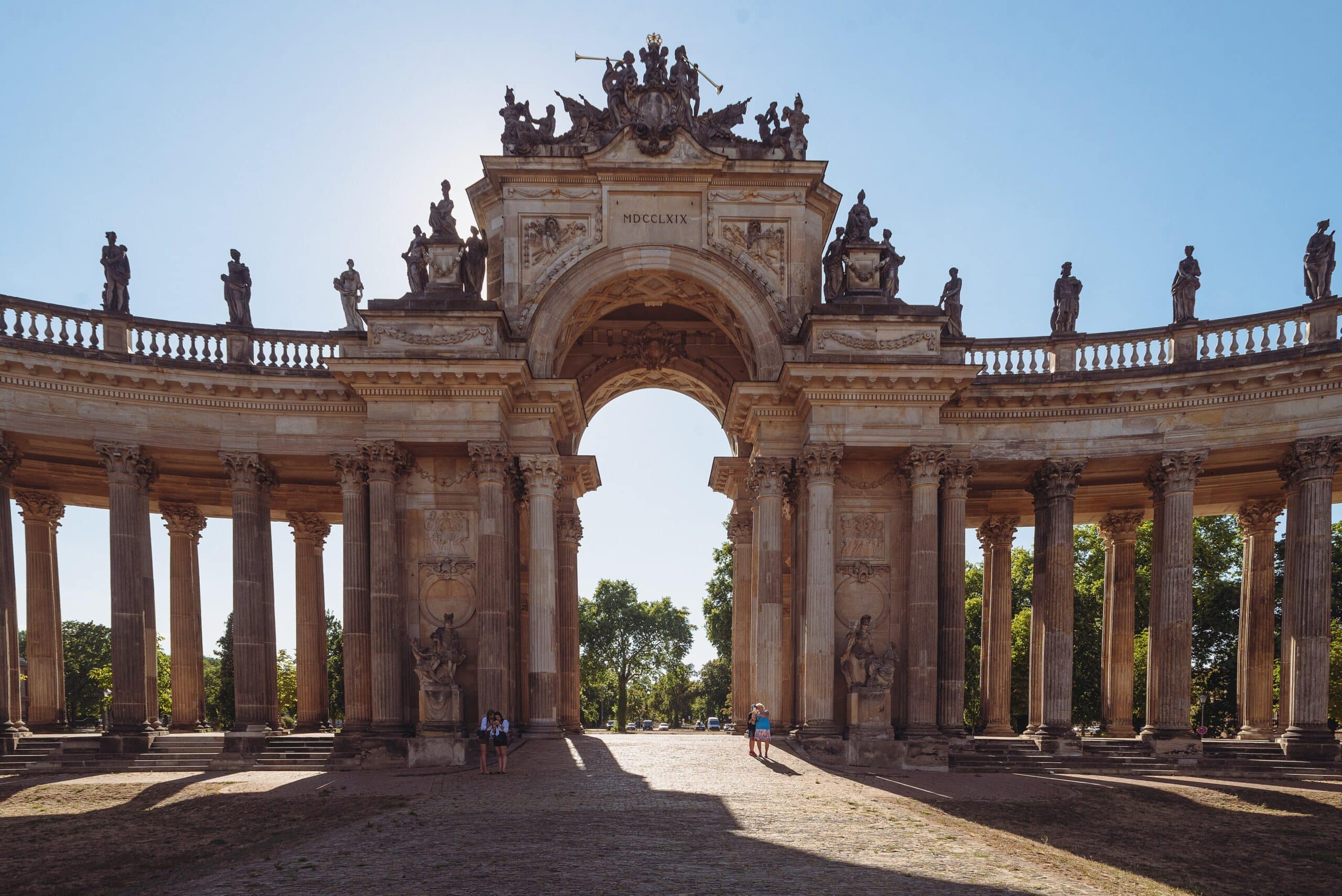
A palace built to impress could not let its kitchens and servants spoil the view, so Frederick hid them in plain sight. Closing the western edge of the park behind the Neues Palais stand the two Communs, raised between 1766 and 1769 by Gontard after Legeay’s designs and named, like their model, for the Grand Commun at Versailles. They held the court kitchens, the household staff, and spare guest lodging, the unglamorous machinery of a great house. The southern block contained the great court kitchen, while the northern one lodged staff and lesser guests in plain rooms behind the grand exteriors.
What makes them remarkable is how little they look the part. Gontard dressed the service blocks in domes and grand staircases so that, seen from the avenue, they read as palaces in their own right. Between them sweeps a curved colonnade of 158 columns, broken at its center by a 24-meter Triumphal Gate, the Triumphtor. All of it served the same boast: even Frederick’s pantries were monumental, and a visitor approaching from the west met grandeur before ever reaching the palace door.
Their later life is its own story. Since the founding of the University of Potsdam in 1991, the Communs have served the university, with administration housed in the southern building and the Faculty of Philosophy in the northern one. The colonnade and Triumphal Gate reopened in 2014 after a long restoration. A structure built to flatter a king now frames the daily traffic of students crossing the old forecourt to class.
A Palace Half-Used
Frederick died in 1786, and with him went much of the palace’s purpose. His successors preferred other houses. Frederick William II turned to the new Marble Palace he raised on the shore of the Heiliger See, and through the nineteenth century the Neues Palais settled into a long quiet, opened for the occasional state visit and otherwise left to its caretakers. The great halls were aired for the rare ceremonial occasion and then shuttered again, their candles unlit and their galleries silent for years at a stretch. A building meant for spectacle waited, mostly empty, for a master who wanted spectacle again.
That master arrived at the end of the century, and he had known the palace all his life.
Wilhelm II’s Favorite Residence
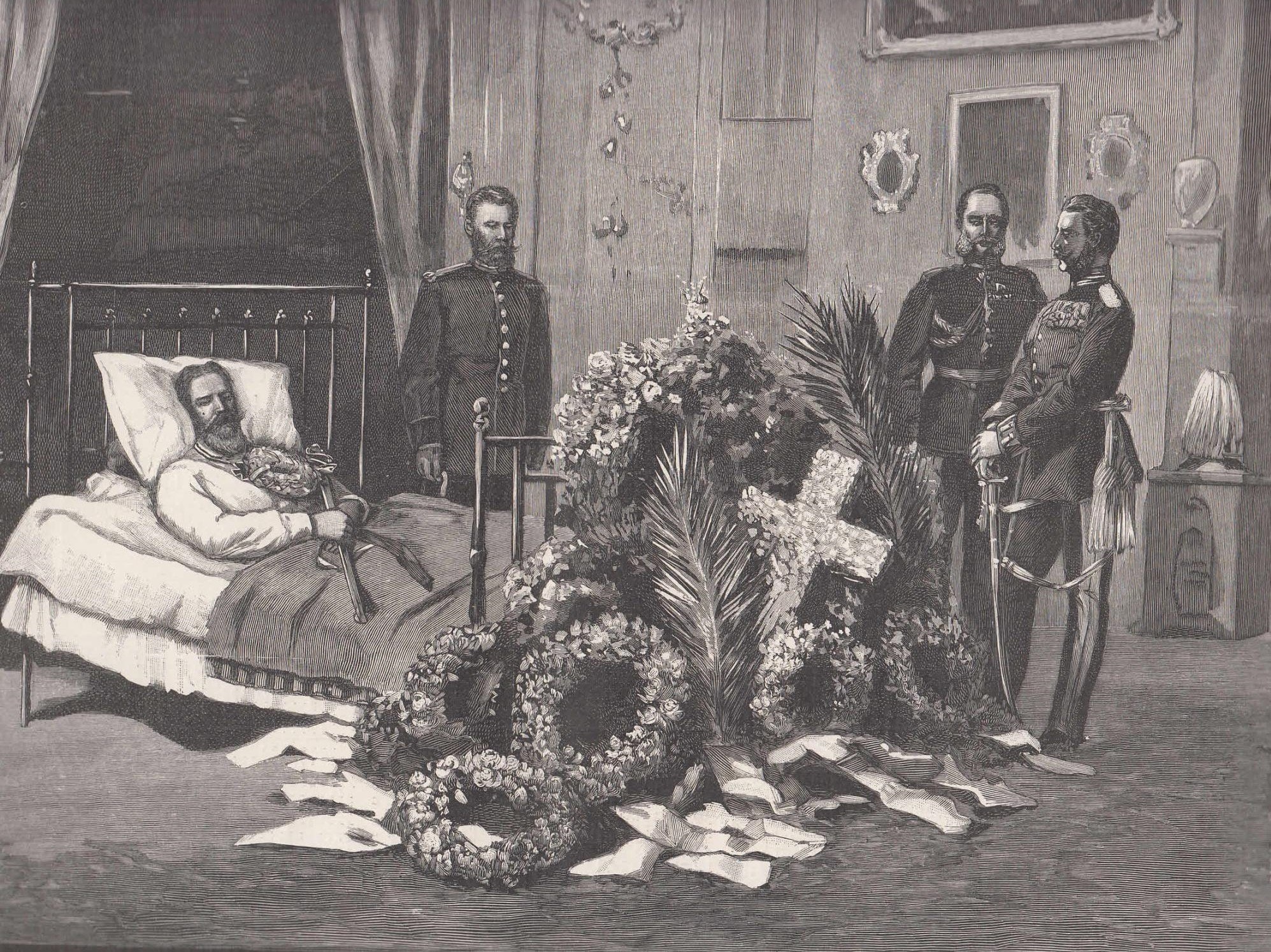
Wilhelm II grew up in the Neues Palais, and after he came to the throne in 1888 he made it his principal home alongside the Berlin Palace. The grandeur that had embarrassed some of his ancestors suited him exactly. He set about fitting the old shell for a comfort Frederick never knew. Bathrooms, central heating, electric light, and a telephone were installed from 1888 onward, and a passenger elevator was added soon after for his wife, the empress Auguste Viktoria. An underground corridor ran from the court kitchen so that meals could reach the imperial table, in the phrase of the day, invisibly. Even so, the vast rooms were hard to heat, and the family knew the building as a cold and drafty place in winter for all its splendor.
The emperor’s bond with the palace ran deep. He had spent his childhood in these rooms as the eldest grandson of the reigning house, and on taking the throne he restored the building to the center of court life, holding receptions and family Christmases beneath Frederick’s ceilings. The result is that the Neues Palais preserves the texture of daily imperial life more fully than any other Hohenzollern residence, a home as much as a showpiece.
For thirty years it sat at the center of the imperial family’s private world, the house the last German Emperor returned to even through the First World War. By contrast, the older Hohenzollern showpiece in Charlottenburg, out in Berlin, had long since passed out of daily royal use. The Neues Palais, with its switchboard and its lift, was a living home rather than a monument. It would also become the stage for the dynasty’s last act.
November 1918: The Last Dinner
By the autumn of 1918 the war was lost and Germany was unraveling. Sailors mutinied at Kiel, workers’ and soldiers’ councils sprang up in city after city, and the demand for the Kaiser to go grew impossible to ignore. On the evening of October 29, with revolution gathering, Wilhelm II dined for the last time at the Neues Palais, joined by Auguste Viktoria and their son Prince Oskar. He left that night for army headquarters at Spa and never saw Potsdam again.
Events then moved faster than the Kaiser. On November 9, Chancellor Max von Baden announced the abdication in Berlin on his own initiative, before Wilhelm had agreed to it, and a republic was proclaimed the same day. The next morning the Kaiser crossed into the neutral Netherlands. There, at Amerongen, he signed the formal instrument of abdication on November 28 and settled into an exile that lasted until his death in 1941.
The palace he left behind did not stay full for long. Under the settlement that followed, the new republic allowed the imperial couple to keep their possessions, and the inventory of the Neues Palais went with them. Some 63 railway wagons of furniture, art, porcelain, and silver traveled to the family’s new home in the Netherlands across 1919 and 1920, and an even larger shipment followed in 1925. Whole apartments were stripped nearly bare. The division of the old royal property between the exiled family and the new state would be argued over for years, a long quarrel that the empty rooms of the Neues Palais quietly embodied.
Emptied of its furnishings, the Neues Palais opened as a museum during the Weimar Republic, giving ordinary Germans their first look inside the home of the rulers who had just vanished. Meanwhile the dynasty’s story moved on without it, to the family’s last new house at Cecilienhof on the far side of Potsdam, where the crown prince and princess had settled and where, within a generation, a very different chapter of German history would be written.
War, Division, and Survival
That emptying turned out to be a stroke of luck. When the Second World War came, the Neues Palais escaped the bombing that gutted central Potsdam on the night of April 14, 1945, and because so much had already gone to the Netherlands, there was less left to lose. The palace survived close to the state Wilhelm II had abandoned it in, though the theater wing and the southern Commun took damage, and Soviet troops carried off some of what remained.
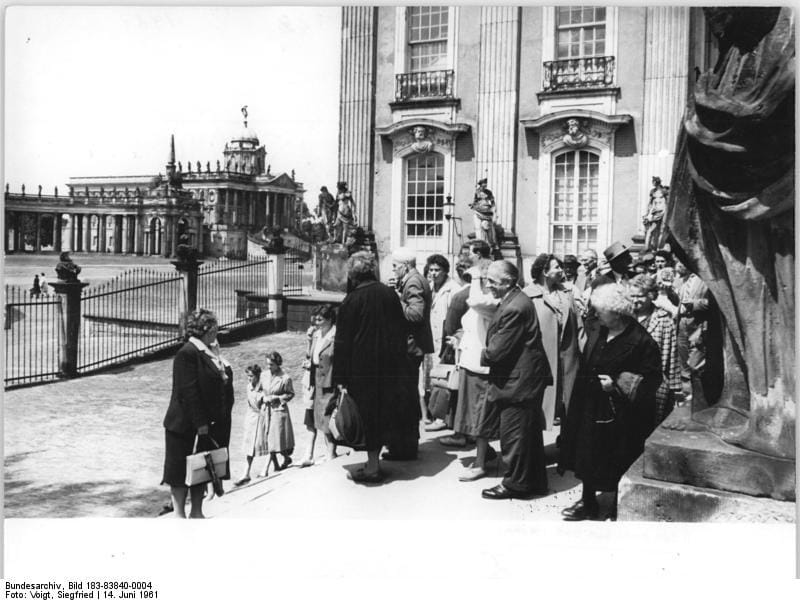
Restoration began under the East German state in the 1950s and continued through the 1970s. Cut off from the kings it had glorified, the building was reframed as a monument to Prussian art and architecture, a museum the workers’ state could justify keeping. Then came an unexpected homecoming. During the 1970s, much of the furniture shipped to the Netherlands half a century earlier was rediscovered, a good deal of it still in its original crates, and sent back to Potsdam to be reunited with the rooms it had left.
The palace had reopened to the public under the East German state, and visitors filed through halls the regime presented as the work of ordinary Prussian craftsmen rather than the glory of their kings. The returning furnishings arrived piecemeal across years, and the task of matching them to their original places is still not finished, with pieces continuing to surface from the long imperial exile. That slow reassembly has given curators a rare advantage: a chance to restore the palace not as a guesswork reconstruction but from its own scattered contents.
The result is one of the best-preserved Prussian royal residences anywhere, a palace that reads almost continuously from Frederick’s century to the last Kaiser’s. Today it belongs to the Stiftung Preußische Schlösser und Gärten Berlin-Brandenburg, the foundation that also cares for Sanssouci and its sister sites, and it stands within the same UNESCO World Heritage Site, No. 532, “Palaces and Parks of Potsdam and Berlin.” That listing was inscribed in 1990 under three cultural criteria and enlarged by later additions in 1992 and 1999, recognizing a landscape so harmonious that admirers have long called it Prussia’s Arcadia.
Visiting the Neues Palais
Visitors can tour the Neues Palais year-round, Wednesday through Monday, with the palace closed on Tuesdays. From April to October it welcomes guests from 10:00 to 17:30; from November to March the hours shorten to 10:00 to 16:30, and during those winter months the interior can be seen only on a guided tour, given in German with printed material available in other languages. Last admission falls half an hour before closing. Entry tickets and local tours can also be booked in advance through GetYourGuide.
Tickets carry a fixed entry time, and because the daily number is capped, booking online in advance is the safe course. A single “Grand Tour” ticket runs about 14 euros, with a reduced rate near 10 euros at the time of writing. Better value for most travelers is the sanssouci+ combined day ticket, about 22 euros and 17 reduced, which covers all the open SPSG palaces in Potsdam on a single day and includes an optional timed slot for the Neues Palais. Access is partly barrier-free: the ground floor can be reached by wheelchair via a ramp, and a wheelchair is available inside, though strollers are not permitted in the exhibition rooms.
Prices and hours shift from season to season, so confirm the current details on the SPSG website before you set out. You will find the palace at Am Neuen Palais, 14469 Potsdam, at the western end of the park’s main avenue, an easy walk or short ride from Sanssouci itself, with paid parking nearby. Anyone staying overnight can compare hotels in and around Potsdam.
Some links on this page are affiliate links, which means StoneKeep Atlas may earn a small commission, at no extra cost to you, if you book through them.
Beyond the Neues Palais
The Neues Palais is one corner of a wider Hohenzollern landscape best explored as a set. Its closest companion is Sanssouci, the retreat at the other end of the same park that the Neues Palais was built to answer. Out in the capital, Charlottenburg was the great electoral and royal palace of Berlin, while Cecilienhof marks the dynasty’s final building and its strangest afterlife as the site of the 1945 Potsdam Conference. Far to the south, the rebuilt Hohenzollern Castle rises as the family’s ancestral seat and the source of the name carried by every Prussian king and German emperor. For the wider story of the dynasty’s strongholds, our guide to the Prussian royal castles draws the threads together, and a dedicated guide to the royal residences of Berlin and Brandenburg gathers these four palaces in one place.
Conclusion
Frederick the Great built two palaces in a single park to opposite ends, and the contrast still shapes a visit. Sanssouci was where he chose to live; the Neues Palais was where he chose to be seen. His boast outlasted both the man who made it and the monarchy it was meant to glorify, sheltering a child who would grow up to be an emperor and standing nearly intact when that emperor’s world collapsed around it. To walk through the glittering Grotto Hall and beneath that enormous painted ceiling is to feel the exact weight of a state determined to prove it had survived, and to sense, in the emptied apartments above, how completely such confidence could one day fail.
Principal Sources
- Art & Object. “The Kaiser Who Abdicated and Took the Porcelain.” artandobject.com.
- Landeshauptstadt Potsdam. “New Palace.” potsdam.de.
- UNESCO World Heritage Centre. “Palaces and Parks of Potsdam and Berlin.” whc.unesco.org.
- Universität Potsdam. “New Palace: Locations.” uni-potsdam.de.
Visitor information, opening hours, and admission prices are drawn from the official site of the Stiftung Preußische Schlösser und Gärten Berlin-Brandenburg (SPSG), the palace’s owner and operator, and were current at the time of writing.
Image credits. Featured image: licensed via Envato. Aerial view from the east: Carsten Steger, CC BY-SA 4.0. Grotto Hall: Allie_Caulfield, CC BY 2.0. Marble Hall: Klaus Bärwinkel, CC BY 3.0. Schlosstheater: Oursana, CC0. Colonnade and Triumphal Gate: Flocci Nivis, CC BY 4.0. Kaiser Friedrich III lying in state at Schloss Friedrichskron (1888): woodcut after G. Krickel, public domain. Visitors at the Neues Palais, 1961: Bundesarchiv, Bild 183-83840-0004 / Voigt, Siegfried, CC BY-SA 3.0 DE. Wikimedia Commons images under their respective licenses. Freely licensed images are resized to fit; otherwise unaltered.