
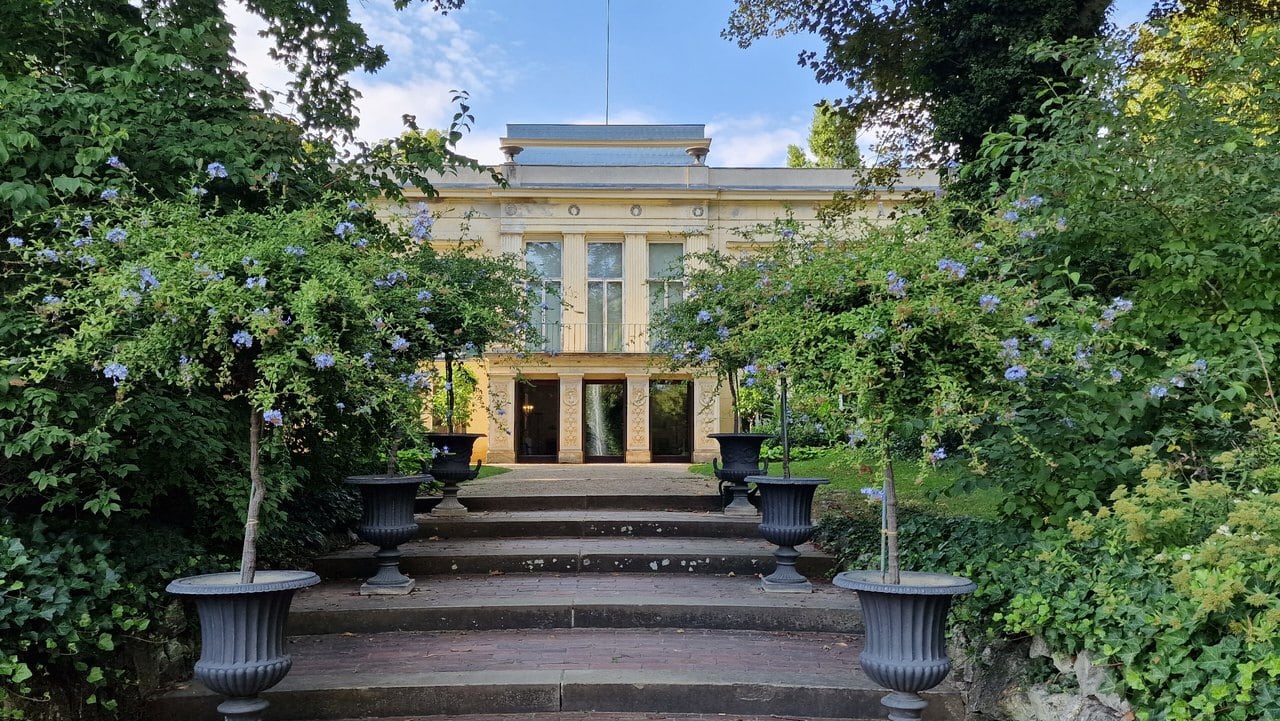
Glienicke Palace
Glienicke Palace (German: Schloss Glienicke) is a neoclassical villa on the bank of the Havel in the far southwest of Berlin, set just above the Glienicke Bridge where the capital meets Potsdam. Built for Prince Carl of Prussia and shaped by the architect Karl Friedrich Schinkel between 1824 and 1827, it was the prince’s attempt to plant a piece of Italy in the sandy soil of Brandenburg. Today the palace and its park form part of the UNESCO World Heritage landscape known as the Palaces and Parks of Potsdam and Berlin, a Mediterranean idyll preserved at the edge of a modern city.
Quick Facts
| Location | Berlin-Wannsee, Germany (Havel riverside, at the Potsdam border) |
| Built | 1824 to 1827, rebuilt by Karl Friedrich Schinkel from an earlier manor |
| Style | Neoclassical Italianate villa |
| Patron | Prince Carl of Prussia (1801 to 1883) |
| Architects | Karl Friedrich Schinkel, with Ludwig Persius and Ferdinand von Arnim |
| Landscape | Peter Joseph Lenné |
| Owner | Stiftung Preußische Schlösser und Gärten Berlin-Brandenburg (SPSG) |
| UNESCO | Part of the World Heritage Site “Palaces and Parks of Potsdam and Berlin” (inscribed 1990) |
| Visiting | Palace by guided tour; park open daily, free |
| Official site | spsg.de |
A Prince’s Dream of Italy
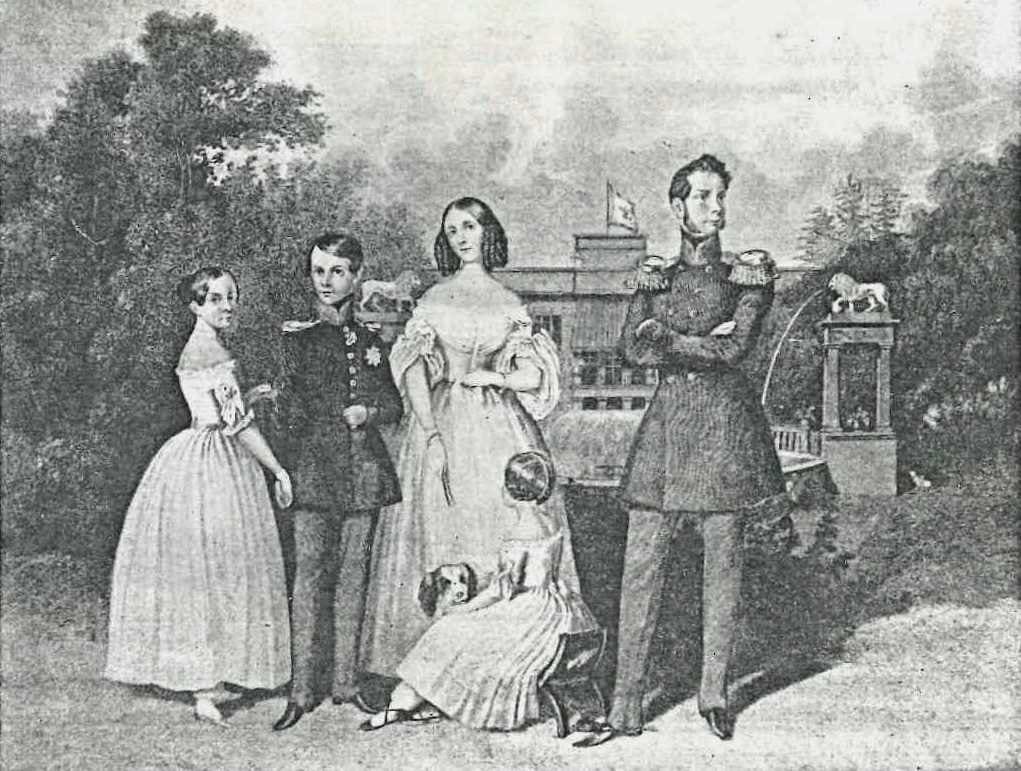
Prince Carl of Prussia, the third son of King Friedrich Wilhelm III and Queen Luise, returned from his first journey to Italy in 1823 a changed young man of about twenty-one. Captivated by how southern light, architecture, and classical sculpture belonged to one another, he resolved to recreate that harmony at home. His chance came in 1824, when he bought the Glienicke estate from the heirs of the late Prussian state chancellor Karl August von Hardenberg, who had acquired it in 1814; older still was a working manor that Count Lindenau had built on the site in 1796.
The setting was ideal. Meadows sloped to the Havel, which widens here into broad lakes, while wooded hills closed the view like a stage set. With his wife, Marie of Saxe-Weimar-Eisenach, Carl set about turning a modest country house into a villa worthy of the Roman campagna.
Schinkel’s Villa and Casino
To realize the vision, Carl turned to Karl Friedrich Schinkel, Prussia’s foremost architect of the age. Schinkel began in 1824 not with the main house but with an old billiard pavilion on the high riverbank, which he enlarged into a garden Casino facing the water and hung with antique sculpture. The manor itself followed between 1825 and 1827, recast as a two-story Italian villa with a low, wide-eaved roof. Inside, the architecture was kept plain so vivid wall colors and the prince’s antiques could speak: a Red Hall anchors the upper floor, joined by a green salon, a turquoise bedroom, and a deep-blue library. A tower followed in 1832.
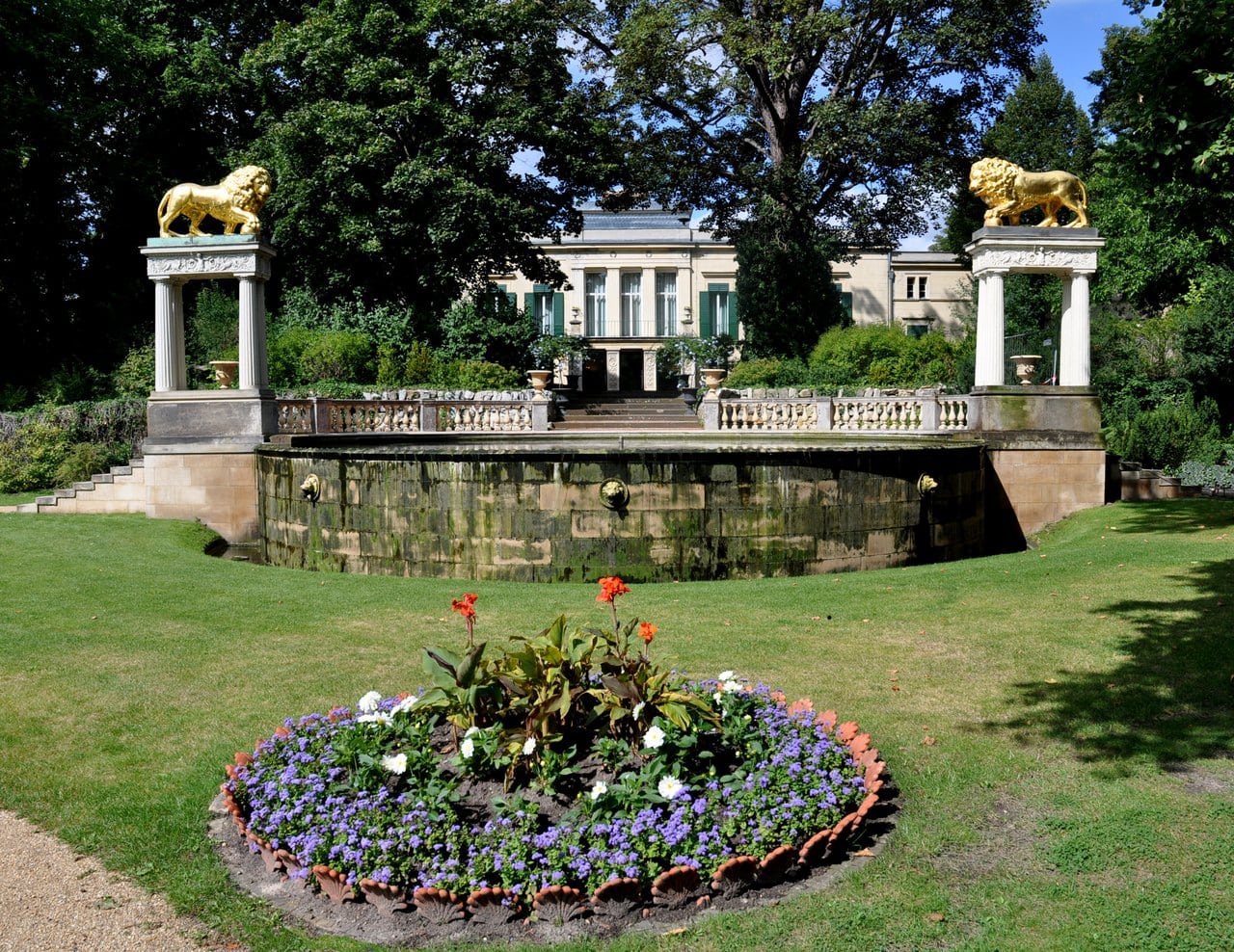
The grounds gained their own landmarks. The Great Curiosity (Große Neugierde), a slender rotunda of 1835 modeled on the Choragic Monument of Lysicrates in Athens, was set beside the bridge as a belvedere over the river, with the smaller Little Curiosity dressed in antique fragments nearby. On the street front, the Lion Fountain, designed after a model at the Villa Medici in Rome and completed in 1837 and 1838, played between two gilded bronze lions, a gift to Carl from his sister, the Russian tsarina.
Lenné’s Park and the Cult of Antiquity
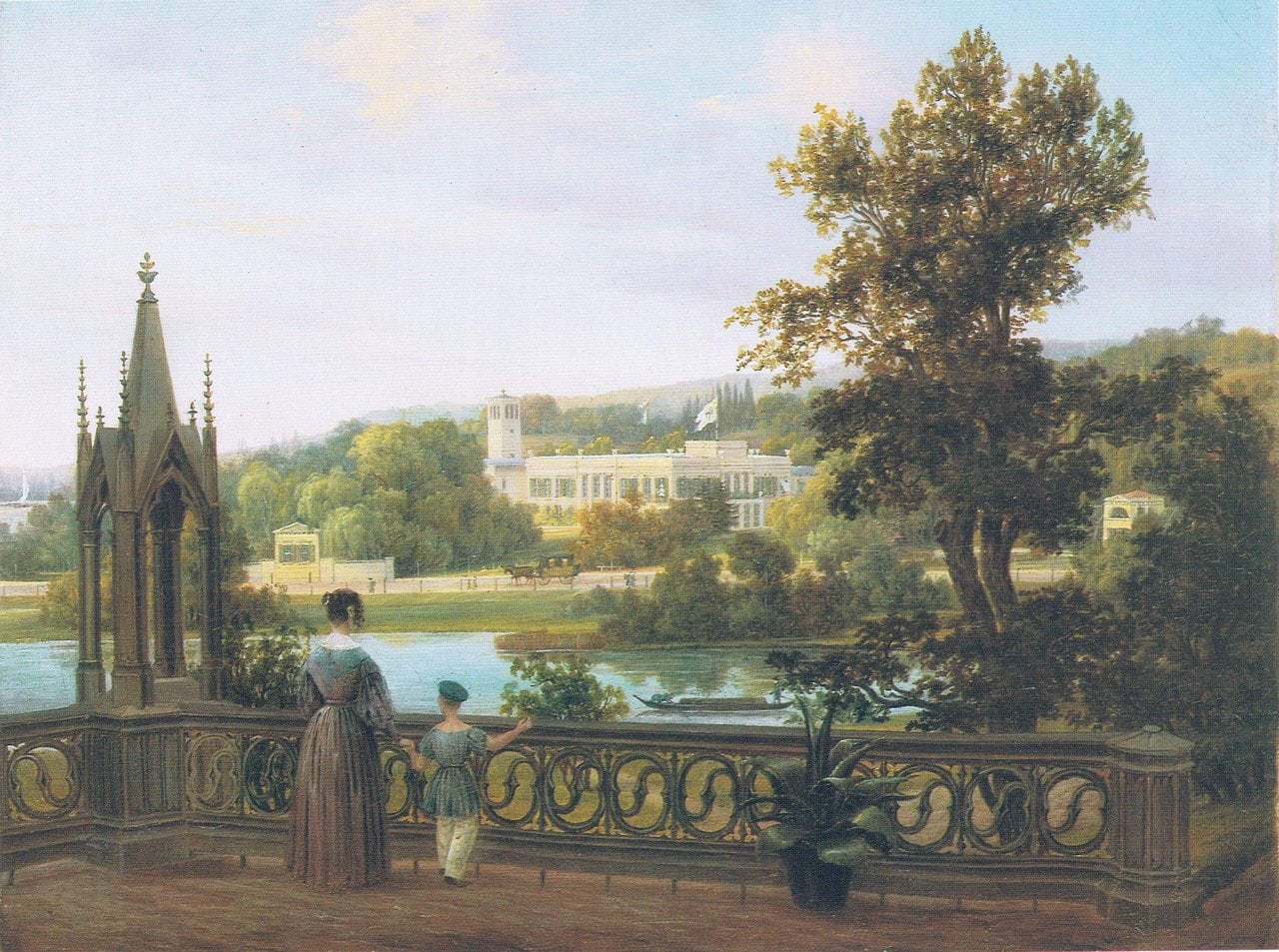
The architecture was only half of the composition. The landscape fell to Peter Joseph Lenné, Prussia’s leading garden designer, who had begun a pleasure ground here in 1816 for Hardenberg, the first of its kind in the kingdom. Under Carl he completed his plans, weaving meadows, groves, and streams into a picture that framed long views toward Potsdam, the hilltop silhouette of Babelsberg, the church at Sacrow, and the Peacock Island. One aim ran through the estate: the union of nature and art that contemporaries called Prussia’s Arcadia.
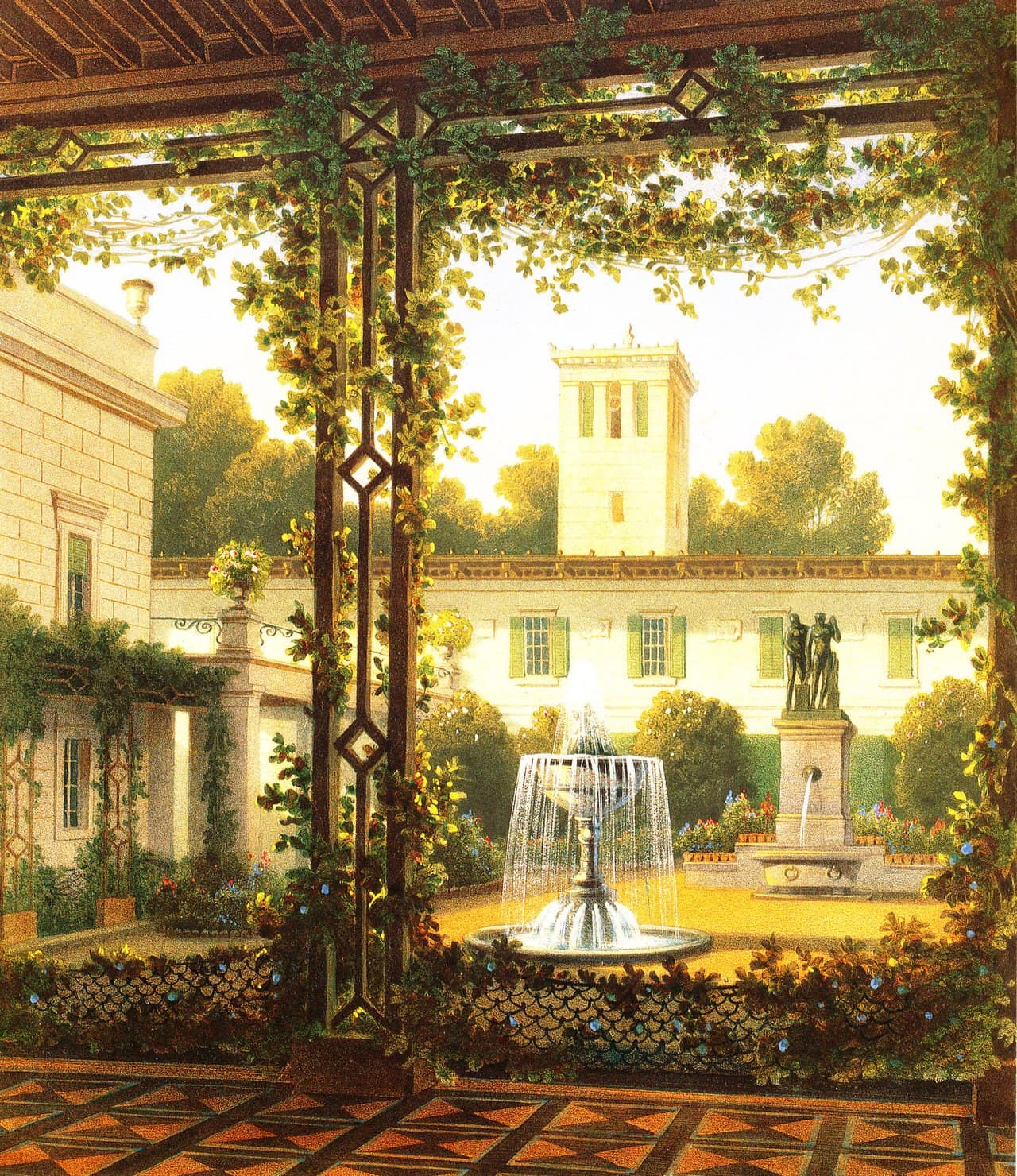
Carl was, above all, a collector. He assembled one of the richest private collections of classical antiquities in nineteenth-century Germany and, rather than hide it away, built it into the estate. Genuine marble fragments and casts line the pergola and garden court, arranged under the eye of the sculptor Christian Daniel Rauch, while a bronze cast of the antique Ildefonso Group presides over the courtyard fountain. Antiquity here was not an exhibit but the living air of a summer home.
Persius, Arnim, and the Turn to Historicism
Much of Schinkel’s design was carried out by his gifted pupil Ludwig Persius, who gave the estate a romantic range of service buildings: a machine house and gardener’s house of 1838 and 1839, an orangery, a Swiss-style sailors’ house, a ruined wooden cascade bridge, and the curved Stibadium bench of 1840. The Cavalier Wing, remodeled around 1828, joined these quarters to the villa by a vine-clad pergola.
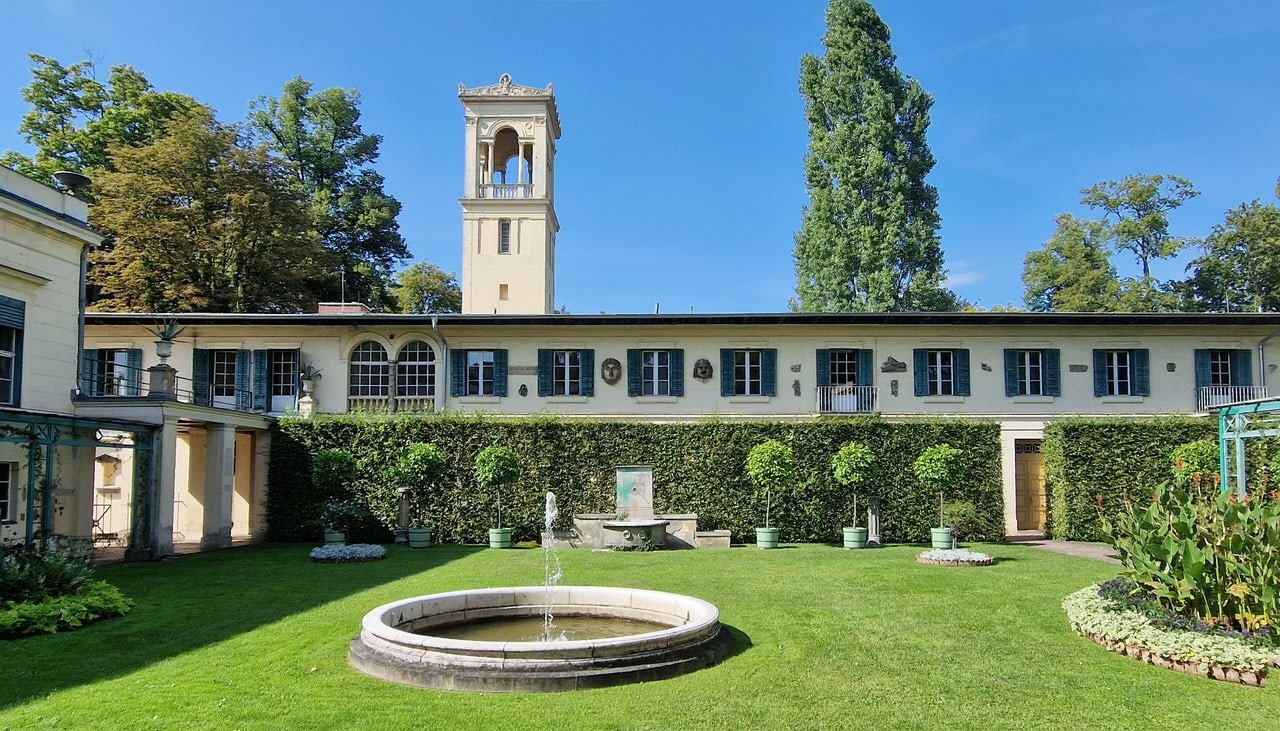
After Persius died in 1845, the court architect Ferdinand von Arnim took over and the mood turned toward the historicism then in fashion. Arnim added the gatekeeper’s house and, around 1861, the griffin-crowned Johanniter Gate onto the Königstraße. His most evocative work was the Monastery Court (Klosterhof) of 1850, a cloister built around genuine medieval and Byzantine columns and reliefs that Carl had collected. Carl’s heyday ended with his death in 1883; his grandson Friedrich Leopold preferred the hunting lodge across the road, the estate slid into neglect, and by the 1920s many of its antiquities had been scattered across the world.
From War to World Heritage
The twentieth century treated Glienicke roughly. The city of Berlin took over the park in 1935 and the remaining grounds in 1939. During the Second World War the palace served as a military hospital, and in 1945 it briefly became an officers’ mess for the Red Army. A spell as a sports hotel followed in 1950, and from 1966 the buildings passed to West Berlin’s palace administration. Serious conservation began only after the city’s 1977 monument law, with restorers taking the estate’s appearance around 1850 as their guide and interior work starting in 1987.
Since 1995 the palace has belonged to the Stiftung Preußische Schlösser und Gärten Berlin-Brandenburg, the foundation that cares for the Prussian palaces. The main house is now a museum furnished in the spirit of Prince Carl’s day, and in 2006 the west wing opened as Europe’s first Court Gardeners’ Museum. Recognition had come in 1990, when Glienicke was inscribed with the Palaces and Parks of Potsdam and Berlin as a UNESCO World Heritage Site, honored for the way its architecture and landscape were composed into a single work of art.
Visiting Glienicke Palace
The palace interior can be seen only on a guided tour. From April to October the museum opens Tuesday to Sunday, 10:00 to 17:30, closing on Mondays; from November to March it opens at weekends only, with tours at set times between 10:00 and 16:00. A single ticket costs 8 euros, reduced to 6 euros, and a family ticket is available, while the surrounding park is open free every day from 8:00 until dusk. The historic rooms are not wheelchair accessible. The address is Königstraße 36 in Berlin-Wannsee, and the former coach house now holds the Remise restaurant. Entry tickets and local tours can also be booked in advance through GetYourGuide.
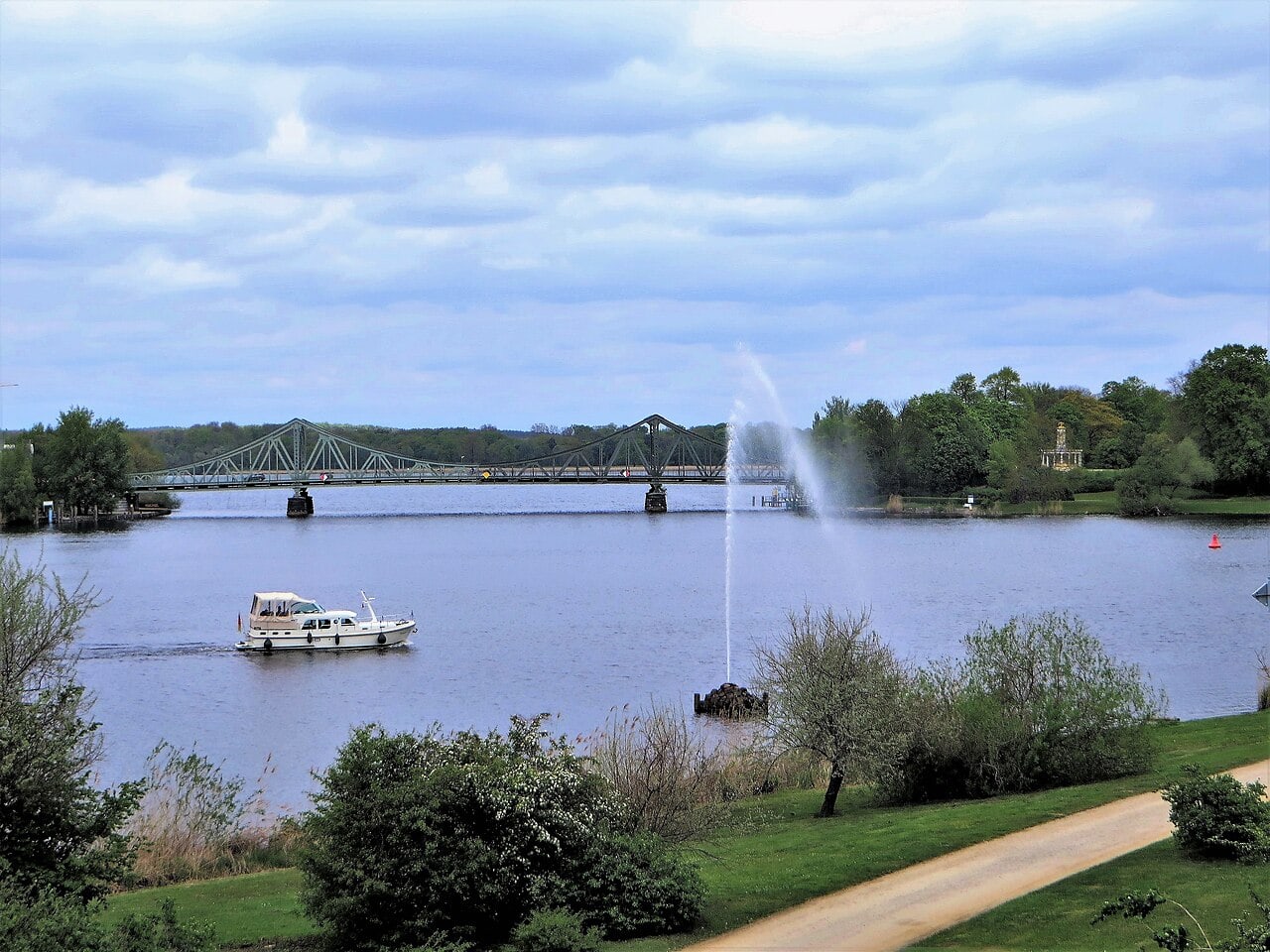
Lingering in the grounds rewards the visitor. From the Great Curiosity the eye travels straight to the famous Glienicke Bridge, the Cold War “Bridge of Spies” where East and West exchanged captured agents, including the pilot Francis Gary Powers in 1962 and the dissident Natan Sharansky in 1986. Across the Königstraße stands the separate Glienicke hunting lodge, now a training institute. Anyone staying overnight can compare hotels in and around Potsdam.
Some links on this page are affiliate links, which means StoneKeep Atlas may earn a small commission, at no extra cost to you, if you book through them.
Beyond Glienicke
Glienicke is the most intimate of the great Prussian residences around the capital, and it gains from being read alongside its grander neighbors. Across the water lie the royal palaces of Potsdam, from Frederick the Great’s Sanssouci Palace and the monumental Neues Palais to the twentieth-century Cecilienhof Palace; on the Berlin side stands the baroque Charlottenburg Palace. Together they tell the story traced in our guides to the royal palaces of Berlin and Brandenburg and the wider Prussian royal castles. With the nearby Charlottenhof and Babelsberg, Glienicke represents a quieter, more romantic strand of that landscape, the garden palaces of Potsdam: the princely villa rather than the seat of state. Glienicke is also the Italian pole of the wider design program explored in Schinkel, Persius, and the Prussian Romantic landscape.
Conclusion
Glienicke Palace endures as one prince’s remarkably complete vision: a corner of Italy conjured beside a Brandenburg river through the combined art of Schinkel, Persius, Arnim, and Lenné. War, neglect, and a divided city all left their mark, yet the villa, its curiosities, and its luminous park survived to rank among the finest achievements of Prussian landscape design. For the visitor today, it offers the rare pleasure of stepping into a Mediterranean daydream without ever leaving Berlin.
Principal Sources
- Stiftung Preußische Schlösser und Gärten Berlin-Brandenburg. “Glienicke Villa” and “Glienicke Garden.” spsg.de.
- UNESCO World Heritage Centre. “Palaces and Parks of Potsdam and Berlin.” whc.unesco.org.
- Landesdenkmalamt Berlin. “Schloß Klein-Glienicke und Schlosspark.” berlin.de.
- Museumsportal Berlin. “Schloss und Park Glienicke.” museumsportal-berlin.de.
- visitBerlin. “Glienicke Villa and Casino.” visitberlin.de.
Image credits. Hero, garden front: Rigorius (CC BY-SA 4.0). Prince Carl and family: after Theodor Hosemann, around 1845 (public domain). Lion Fountain: Andreas F. E. Bernhard (CC BY-SA 4.0). Garden court, 1837: Haun after Wilhelm Schirmer (public domain). Cavalier Wing: Rigorius (CC BY-SA 4.0). View from Babelsberg: Carl Daniel Freydanck (public domain). Glienicke Bridge: Klaus Bärwinkel (CC BY 3.0). All via Wikimedia Commons. Freely licensed images are resized to fit; otherwise unaltered.