
Pfaueninsel Palace
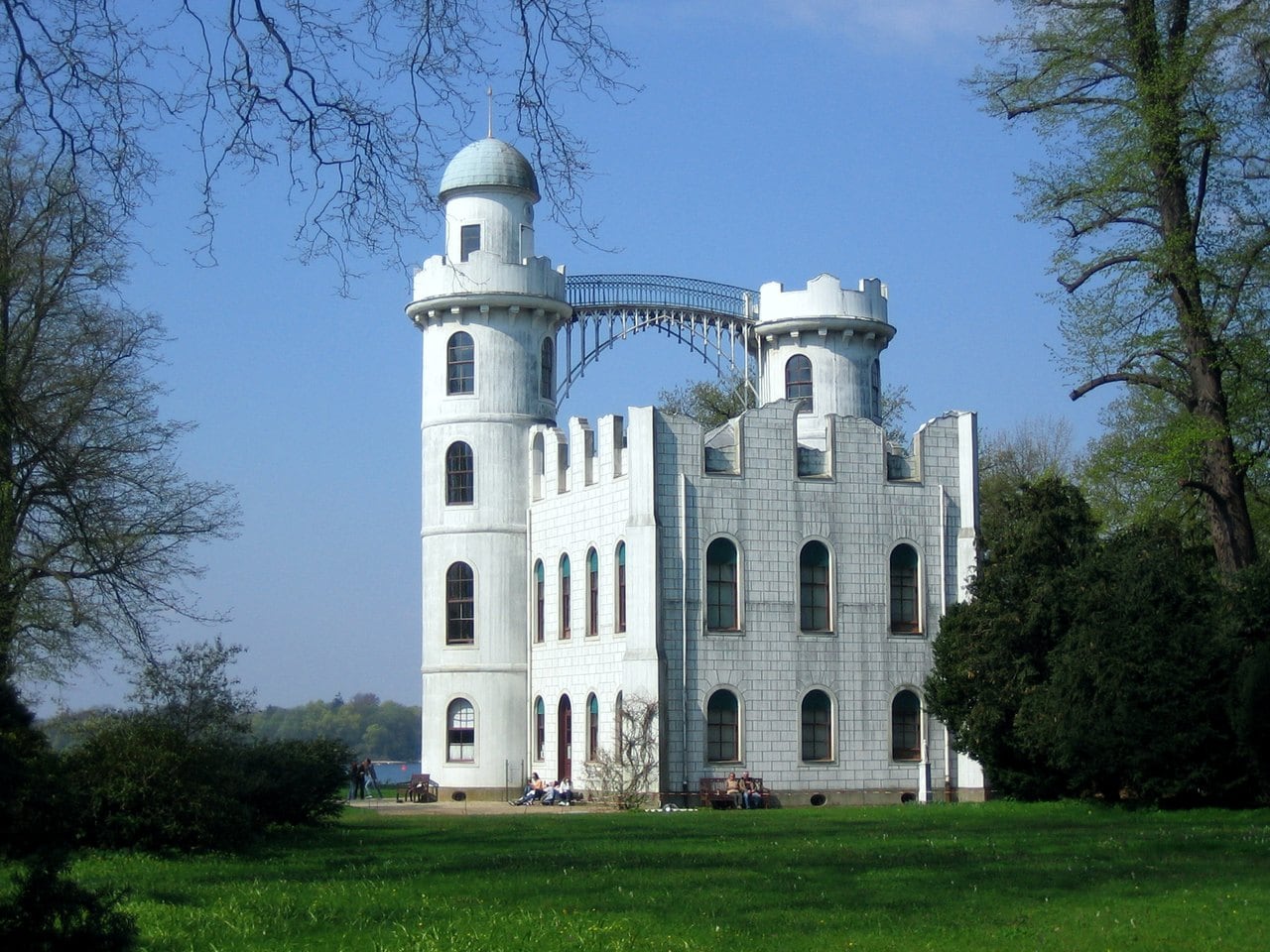
On a wooded island in the River Havel, where Berlin’s southwestern edge dissolves into the lakes around Potsdam, a small white building pretends to be a ruin. Pfaueninsel Palace was never meant to look new. King Friedrich Wilhelm II had it built in the mid-1790s as a sentimental folly, a make-believe Roman country house for himself and his companion Wilhelmine Encke, and its timber walls were painted to imitate weathered stone. Visitors still cross to it the way the court once did, by ferry, onto an island known in English as Peacock Island.
Among the earliest of the romantic follies in the Prussian royal landscape, the palace opens a story that runs through Queen Luise’s summer retreats, Peter Joseph Lenné’s gardens, and an exotic menagerie that helped seed the Berlin Zoo. After a seven-year closure for restoration, the white folly reopened to visitors in 2025. It anchors one corner of the UNESCO World Heritage site that binds the palaces and parks of Potsdam and Berlin into a single Romantic landscape.
Quick Facts
| Location | Pfaueninsel (Peacock Island), Berlin-Wannsee, Germany |
| Built | 1794–1795 (building campaign to 1797) |
| Patron | King Friedrich Wilhelm II of Prussia |
| Builder | Johann Gottlieb Brendel, under Countess Lichtenau |
| Style | Sentimental folly (early Romantic) |
| Type | Lustschloss (pleasure palace / folly) |
| Current use | Museum; guided tours |
| UNESCO | Palaces and Parks of Potsdam and Berlin (1990) |
| Access | Ferry only; car-free island |
| Operator | Prussian Palaces and Gardens Foundation (SPSG) |
| Official site | spsg.de |
A King’s Painted Ruin
In 1793 Friedrich Wilhelm II bought a small Havel island that earlier Hohenzollerns had kept as a rabbit warren, which had given it the old name Kaninchenwerder. From his nearby Marble Palace on the Heiliger See, the King had laid a long sight-line across the water, and the island was meant to close that view with an eye-catching ornament. A folly would do the work: somewhere to rest after a boat trip and, more discreetly, somewhere to withdraw with Wilhelmine Encke, his clever and cultivated companion, ennobled in 1796 as Countess Lichtenau. That conceit suited the age, when princes across Europe were raising hermitages, grottoes and sham ruins to stage moods of melancholy and retreat.
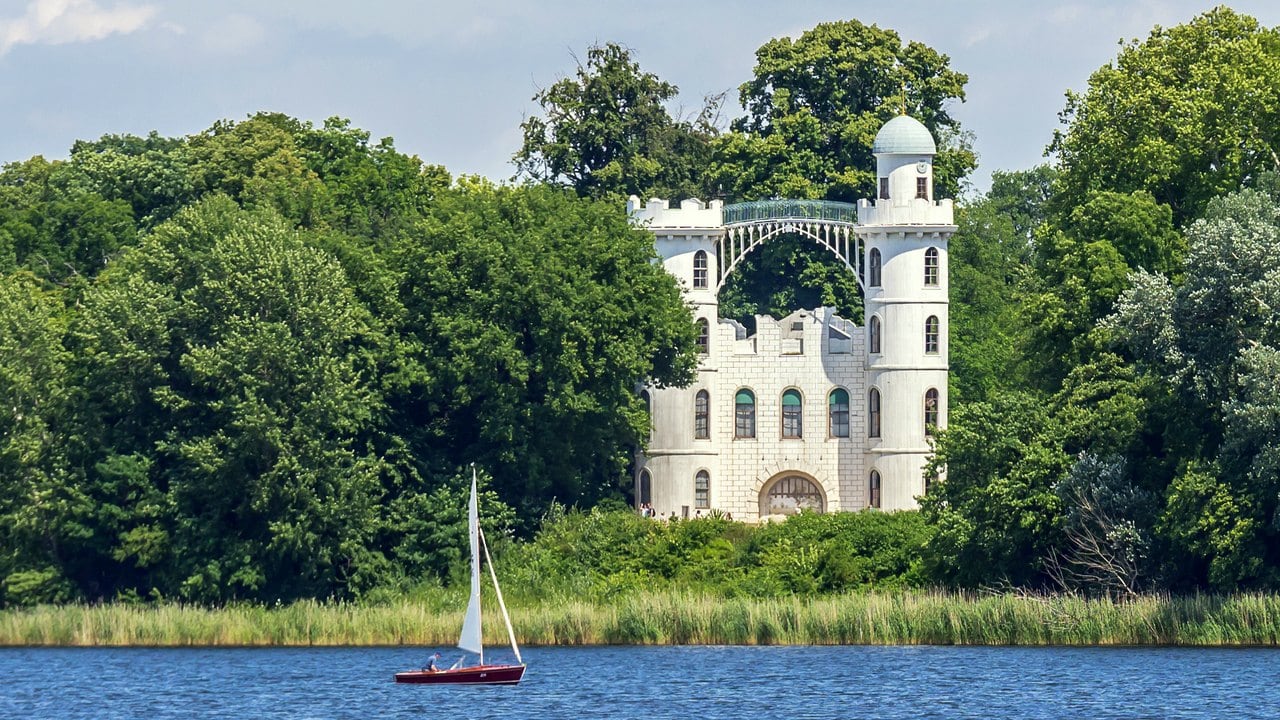
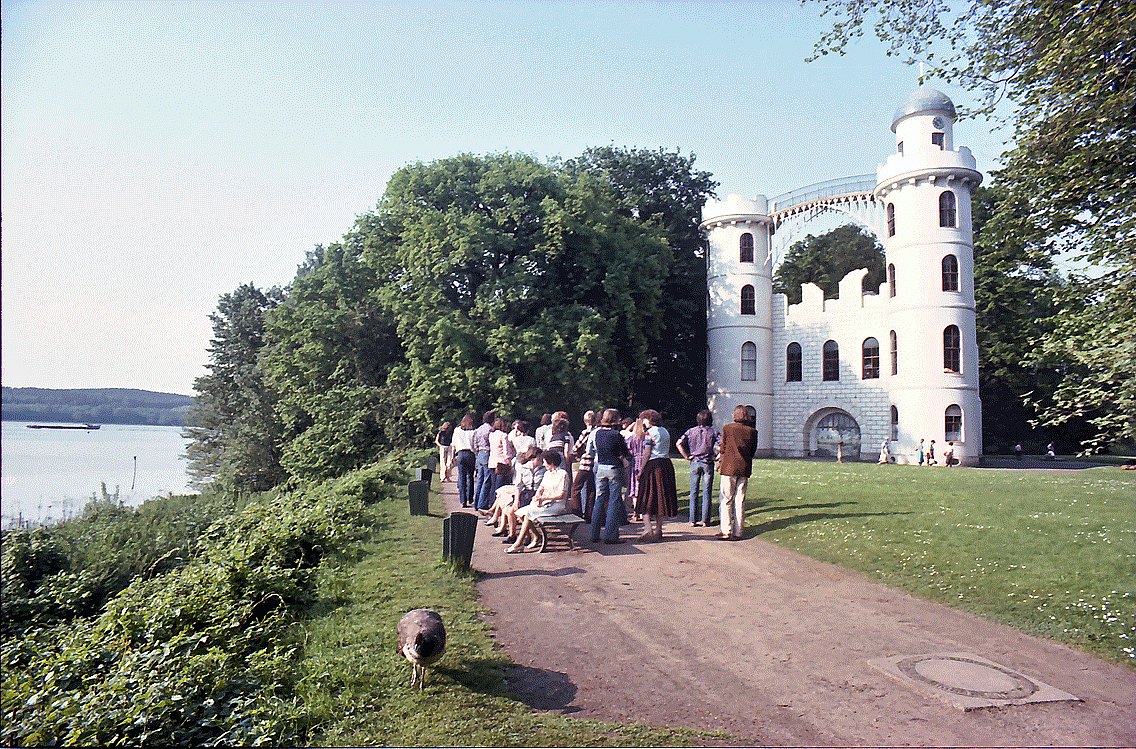
Building began in 1794. The Potsdam court carpenter Johann Gottlieb Brendel carried out the work under the Countess’s guidance, and within a year the shell and its intimate interiors were largely complete; the wider scheme continued until the King’s death in 1797. What rose on the island was a deliberate fiction, a white “Roman country house” dressed as a picturesque ruin, its two slender towers framing a low central block as though an upper story had long since fallen away. Peacocks arrived from 1795, and it was they, not the King, who eventually renamed the island.
Timber, Plaster, and a Bridge Between Towers
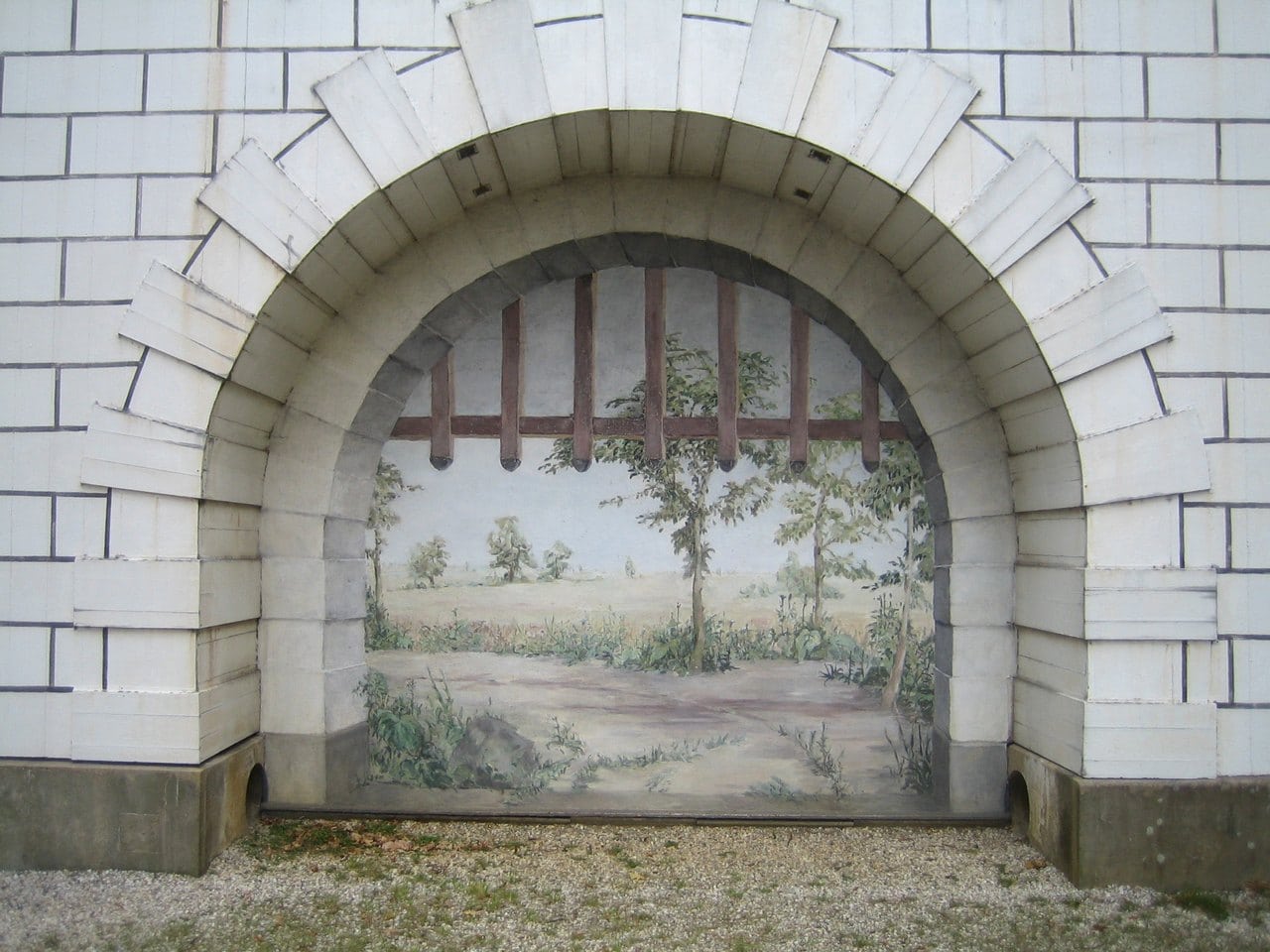
For all its palatial name, the building is essentially a stage set. Brendel raised it as a timber half-timbered structure, clad in oak boards and painted with sand-textured oil colors so the walls would read as weathered white ashlar; only the foundations and cellar were built in stone. That illusion was the whole point. A king who already owned marble palaces wanted, on this island, the studied melancholy of a Roman ruin rather than another display of wealth. Brendel built the island’s other follies to match, among them a dairy, the Meierei, disguised as a crumbling Gothic chapel, so the whole island would read as a landscape strewn with picturesque ruins.
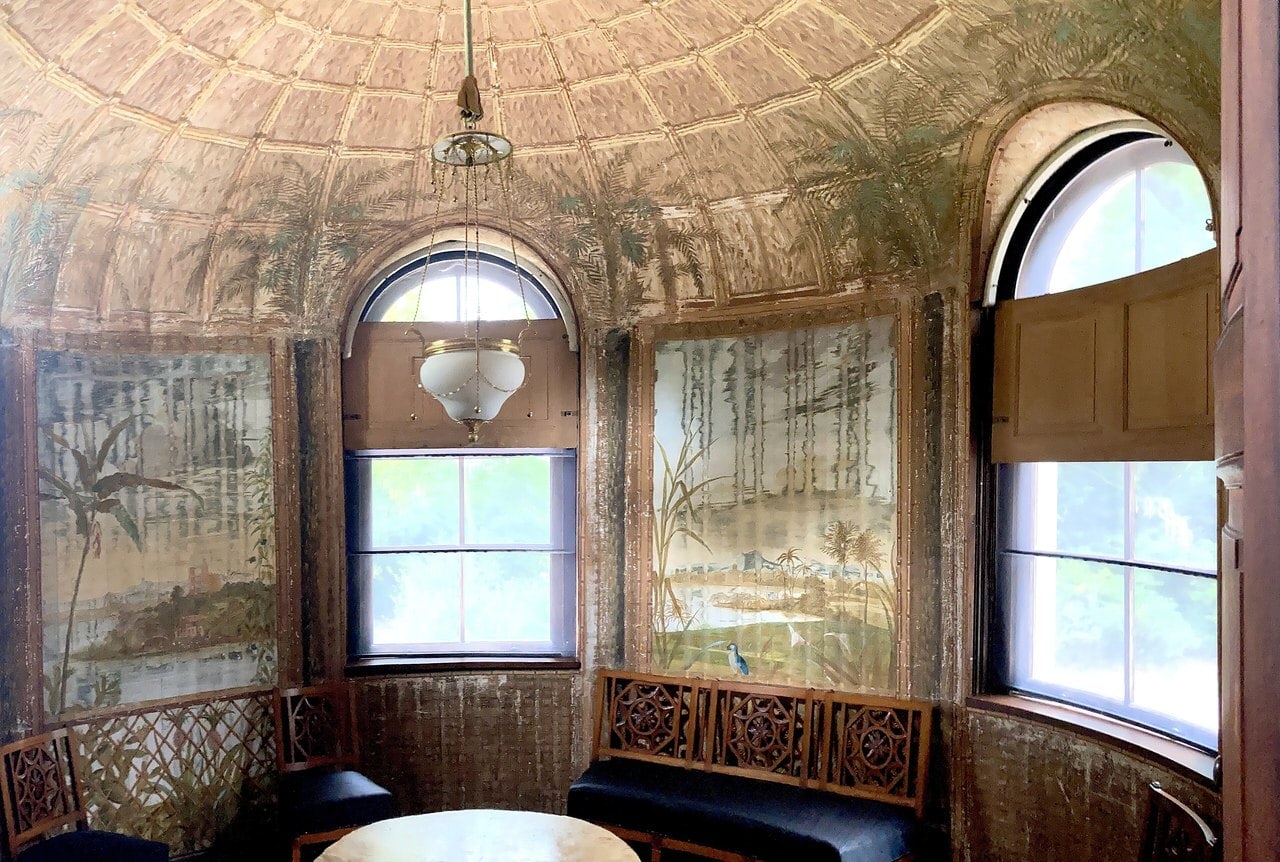
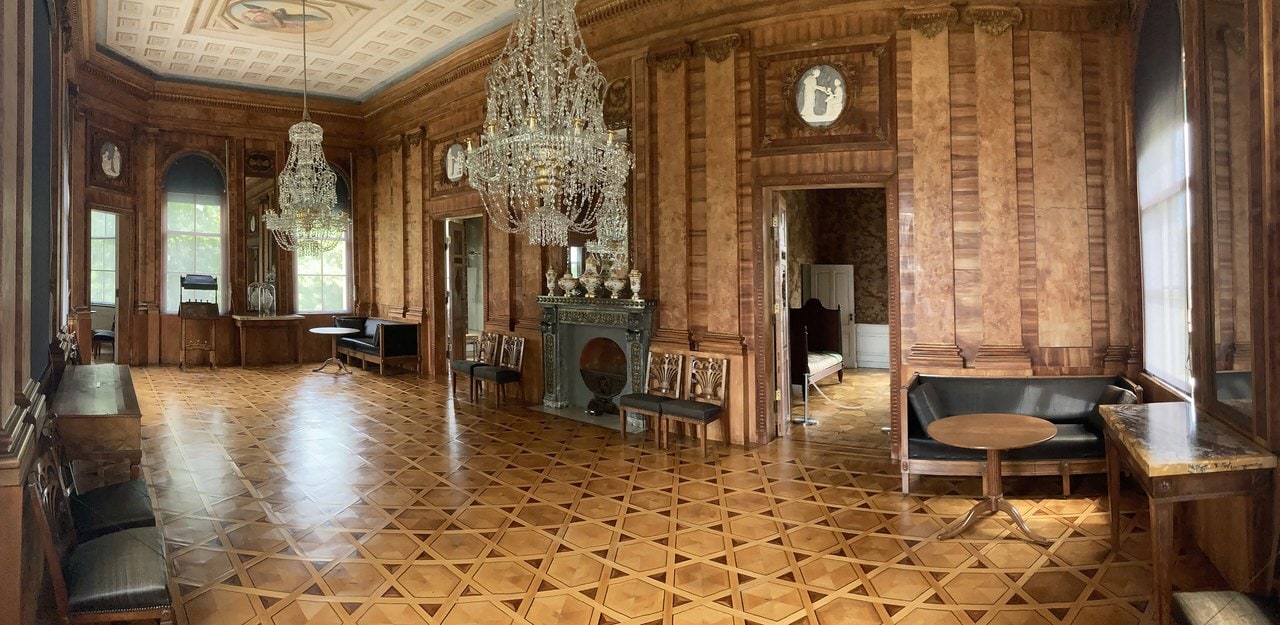
The two western towers carry the composition. A walkway joins them at the top, first a wooden footbridge and, from 1806 to 1807, an iron one cast in delicate Gothic tracery. Inside, the rooms keep their late-eighteenth-century character, among them a tower cabinet painted as a South Seas bamboo hut, a nod to the Pacific voyages then gripping the European imagination. Because the palace was never modernized for permanent living, much of that original interior survives, which is precisely what the recent restoration set out to conserve.
Lenné’s Island and the Cult of the Exotic
Friedrich Wilhelm III inherited the island in 1797 and, with Queen Luise, made it a cherished summer retreat and a working ornamental farm. After Luise’s early death in 1810 her memory lingered here; in 1829 the columned sandstone portico of her first mausoleum was carried over from the Charlottenburg park and re-erected near the dairy as a quiet temple to her. A gift from Britain, a miniature frigate named the Royal Louise, rode at anchor off the island from 1832, a toy navy for the royal children.
From the early 1820s Peter Joseph Lenné reshaped the whole island into a landscape garden, laying out in 1821 the first rose garden in Prussia. His buildings went to Karl Friedrich Schinkel and Albert Dietrich Schadow, the partnership that shaped so much of the Havel’s Romantic landscape. Schinkel rebuilt the Cavalier House and, in 1829, fronted it with a genuine late-Gothic house facade shipped from Danzig, stone by numbered stone.
The island’s strangest chapter was its zoo. Friedrich Wilhelm III kept a menagerie modeled on the famous one in Paris, and by 1832 some 847 exotic animals lived among the lawns, from bears to reindeer. To shelter the King’s palm collection, bought in Paris on Alexander von Humboldt’s advice, Schinkel built a glittering Palm House in 1830 and 1831, its interior dressed in Indian fantasy and later immortalized in two paintings by Carl Blechen. The animals left in 1842 to help stock the new Berlin Zoo, which opened in 1844; the Palm House burned to the ground one night in May 1880, the blaze lighting the sky as far as Potsdam, and was never rebuilt. Four sandstone bases still mark where it stood.
From Royal Retreat to Public Island
Curiosity about the royal island spread quickly. From around 1821 the court opened it to the public for a few days each week, and Berliners crowded the ferries to see the palms and the bears. Crowds grew so large that the special trains from the city ran hopelessly overfull, and what had been a private idyll was turning into a destination.
The darkest moment came in 1936. To close the Berlin Olympics, the Nazi regime staged an extravagant reception here on the night of August 15, hosted by the propaganda minister Joseph Goebbels for some 2,700 guests who crossed on a pontoon bridge thrown over the Havel for the occasion. A setting built for sentiment and seclusion was pressed into service as a stage for spectacle. In 1990 the island entered calmer history when it joined the World Heritage site covering the palaces and parks of Potsdam and Berlin, its meadows long since protected as a nature reserve.
Restoration and Reopening
By the early twenty-first century the white folly was failing. Damp and decay had worked deep into the timber frame, and the palace closed to visitors in August 2018. A thorough restoration, begun in September 2021, repaired the roof, the facades, the towers and the bridge and conserved the fragile painted rooms inside. Conservators stabilized the illusionistic boards, mended the half-timber frame from cellar to roof and re-secured the towers, at a cost of around 7.5 million euros met largely by the German federal government.
The palace reopened on May 25, 2025, after nearly seven years dark. A new mural on the southwest facade, commissioned from the artist duo VIDEO.SCKRE, reinterprets the illusionistic painting that once decorated the wall, carrying the building’s old game of make-believe into the present.
Visiting Pfaueninsel Palace in 2026
Reaching Pfaueninsel Palace is part of the pleasure. The island is car-free and accessible only by a short ferry crossing from the Berlin-Wannsee shore, with boats running roughly every fifteen minutes in season, and dogs and bicycles are not allowed. For conservation reasons the palace interior can be seen only on a guided tour, given in German, with printed information in other languages. Entry tickets and local tours can also be booked in advance through GetYourGuide.
The park is open daily and free to enter; the palace is open for tours from April to October, Tuesday to Sunday, 10:00 to 17:30, with last admission thirty minutes before closing, and closed on Mondays and through the winter. Palace tickets are sold on the day at the ferry house, so arriving early is wise, since tours often sell out by the afternoon. Prices below were current in 2026; confirm them on the SPSG website before visiting. Anyone staying overnight can compare hotels in and around Berlin.
Some links on this page are affiliate links, which means StoneKeep Atlas may earn a small commission, at no extra cost to you, if you book through them.
| Ticket | Price (2026) |
| Palace guided tour — adult | €8 |
| Palace guided tour — reduced | €6 |
| Ferry, single — adult | €6 |
| Ferry, single — reduced | €5 |
| Ferry, family | €12 |
Beyond Pfaueninsel
Pfaueninsel sits within easy reach of the other Prussian pleasure grounds along the Havel. Directly across the water lies Glienicke Palace, Prince Carl’s Italian villa, while upstream the neo-Gothic towers of Babelsberg Palace crown the far bank and Frederick the Great’s Sanssouci presides over Potsdam. For the wider picture, see our guides to the Garden Palaces of Potsdam and the Royal Palaces of Berlin and Brandenburg.
Conclusion
Pfaueninsel Palace endures as one of the most engaging follies of the Prussian Enlightenment, a building that chose the pathos of a ruin over the pomp of a palace. Its painted timber, its island quiet and its peacocks still carry the sensibility of the 1790s, when a king and his companion went looking for a private Arcadia within rowing distance of the court. Two centuries on, the white house on the water keeps its old illusion intact.
Principal Sources
- Berlin Denkmaldatenbank. “Pfaueninsel” (object 09075495).
- Landesdenkmalamt Berlin. “Pfaueninsel.”
- Seiler, Michael. Landschaftsgarten Pfaueninsel: Geschichte seiner Gestaltung und Erhaltung von 1793 bis 1993. Weimar: arts + science, 2019.
- UNESCO World Heritage Centre. “Palaces and Parks of Potsdam and Berlin.”
- Zoologischer Garten Berlin. “Historie.”
- Stiftung Preußische Schlösser und Gärten Berlin-Brandenburg. “Schloss Pfaueninsel” and the Gesamtsanierung (SIP 2) project page. Operator; canonical for visitor information.
Image credits. Hero: Bautsch, Public domain, via Wikimedia Commons. Havel view: NoRud, CC BY-SA 3.0 DE. Painted archway and the Otaheitisches Kabinett detail: Manfred Brückels (CC BY-SA 3.0) and HubertSt (CC BY-SA 4.0) respectively. Great hall: HubertSt, CC BY-SA 4.0. Peacock and visitors: Landesarchiv Baden-Württemberg, Staatsarchiv Freiburg / Willy Pragher, CC BY 4.0. All via Wikimedia Commons. Freely licensed images are resized to fit; otherwise unaltered.