
Marble Palace
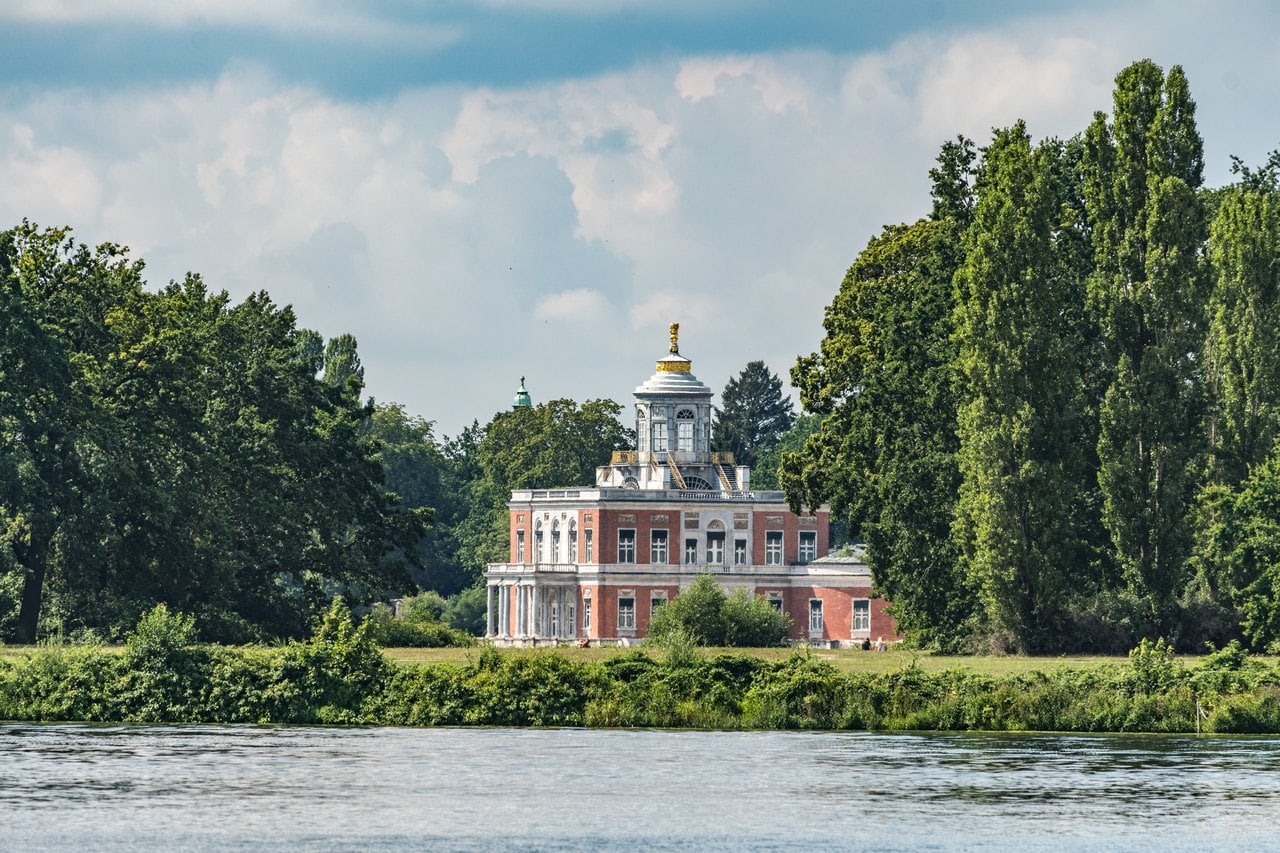
On the eastern shore of the Heiliger See in Potsdam, a compact brick pavilion faced in gray-blue marble stands on a terrace above the water. This is the Marble Palace, the lakeside summer residence that King Friedrich Wilhelm II of Prussia built for himself between 1787 and 1793. It was the first royal palace in Prussia raised in the new neoclassical taste, and its patron meant it as a deliberate answer to the Rococo of his great-uncle Frederick the Great. Where Frederick had built the light, vine-wreathed Sanssouci, Friedrich Wilhelm wanted something graver, more antique, and more private. He called the result his own Sanssouci, lived there as a retreat from the Berlin court, and died inside it in 1797 with the side wings still bare shells. His grandson finished those wings half a century later, so that one small footprint now holds two chapters of Prussian taste at once. The Marble Palace is where Prussian neoclassicism began, the house a king chose for his last years, and the quietest of the great Potsdam residences to find.
Quick Facts
| Location | Neuer Garten, Potsdam, Brandenburg, Germany (on the Heiliger See) |
| Built | 1787–1793 (main block); side wings completed 1843–1848 |
| Patron | King Friedrich Wilhelm II of Prussia |
| Architects | Carl von Gontard and Carl Gotthard Langhans (main block); Michael Philipp Boumann and Ludwig Ferdinand Hesse (wings) |
| Style | Early Neoclassicism (Frühklassizismus) |
| Material | Brick dressed with Silesian marble |
| Current use | Palace museum |
| Operator | Stiftung Preußische Schlösser und Gärten Berlin-Brandenburg (SPSG) |
| UNESCO | Part of “Palaces and Parks of Potsdam and Berlin” (World Heritage, inscribed 1990) |
| Official site | spsg.de |
“His Sanssouci”: A King’s Marble Residence
Friedrich Wilhelm II came to the Prussian throne in 1786, succeeding his uncle Frederick the Great. He was a cultivated and pleasure-loving man, a capable cellist who drew dedications from Mozart and Beethoven, and a believer in Rosicrucian mysticism whose private life kept the Berlin court well supplied with gossip. Almost at once he set about making a landscape of his own. From 1787 he bought up vineyards and gardens on the western shore of the Heiliger See, just north of the old town, and laid out the Neuer Garten, the New Garden, named to set it apart from the formal Frederician park around Sanssouci. Where the older park marched in straight Baroque avenues, the New Garden wandered in the loose, naturalistic manner of an English landscape garden, the first of its scale in Prussia. Its designer, Johann August Eyserbeck, came from Wörlitz, the German cradle of the English style. Across more than a hundred hectares of meadow, wood, and water, the new park offered a deliberately unbuttoned counterpart to the clipped geometry his uncle had favored.
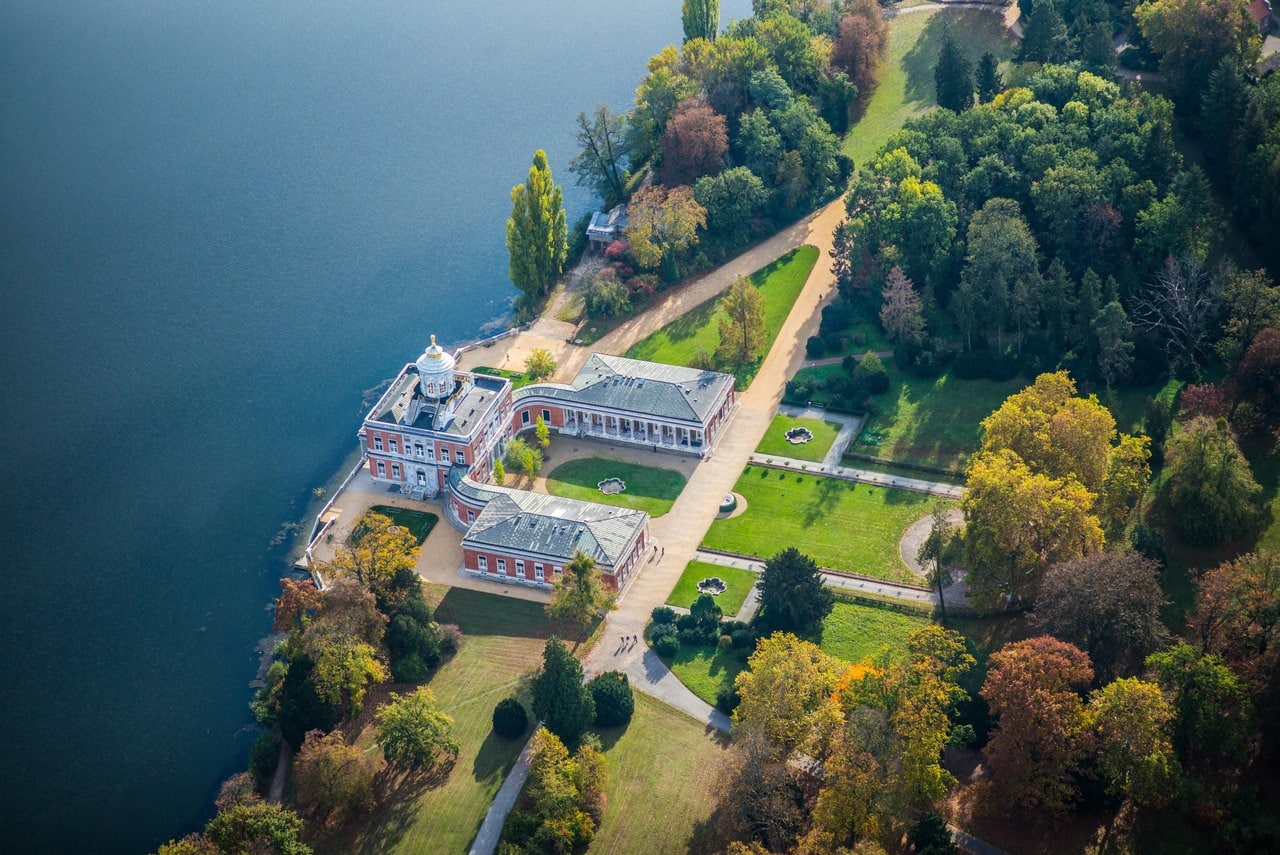
Among the lawns and irregular plantings the king scattered the buildings of a private imagination: a Gothic library, an ice house disguised as an Egyptian pyramid, and, on the lakeshore terrace, the house that would carry his name into the guidebooks. These were not idle fancies; the pyramid and the Gothic library answered to the king’s Rosicrucian and Masonic enthusiasms, turning the garden into a private landscape of signs. He gave the commission for the main block to Carl von Gontard, an experienced court architect, and asked for something the dynasty had never built, a royal palace in the plain, columnar language of antiquity rather than the curling ornament of Rococo. It was to be, in the king’s own phrase, his Sanssouci, a place to withdraw from the ceremony of Berlin and to be himself. The choice was as much a statement as a preference. By turning from his great-uncle’s Rococo to a sober classicism, Friedrich Wilhelm was quietly announcing a new reign with a new taste. Building the house cost the crown some 448,000 Taler before it was done, a large sum for a private retreat and a measure of how seriously the king took a place that was wholly his own.
Brick Dressed in Silesian Marble
The palace Gontard drew is deceptively simple: a square, two-story block of red brick, crowned by a low circular belvedere like a small round temple set on the roof. From the lake it reads as a cube under a drum, balanced and still, with none of the movement of a Baroque facade. That rooftop belvedere was no mere ornament; from its windows the king could take in the New Garden, the lake, and the Havel beyond, the whole designed prospect the house was built to command. Marble, the material that gives the building its name, is not its structure but its dress. Brick carries the walls; panels, pilasters, window surrounds, and cornices of gray-blue and white Silesian marble are laid over and into that brick to articulate it, much of the stone drawn from quarries and stockpiles Frederick the Great had gathered for his own projects.
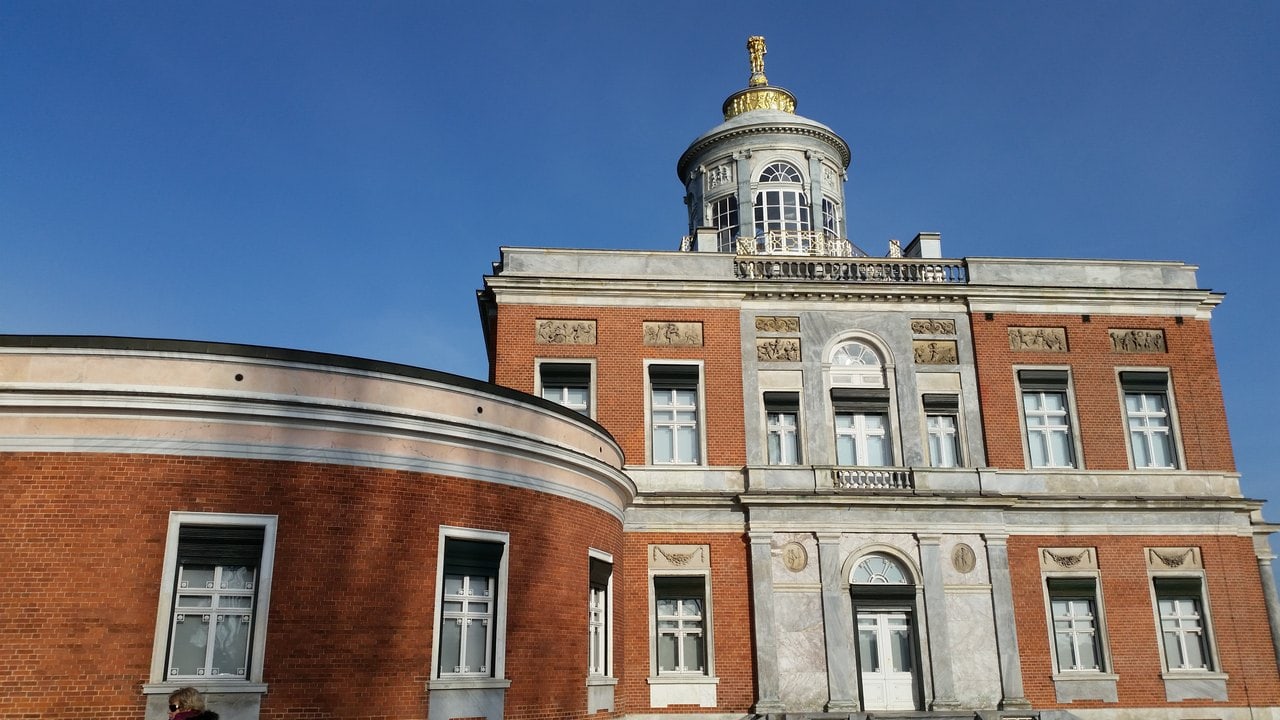
Visitors who expect a palace carved from solid marble are always a little surprised, and that contrast is the point: a sober northern material made to speak a southern, classical language. Gontard set the house on a terrace that drops straight to the water, so the lake laps almost at the foundations and the ground-floor rooms open onto the Heiliger See. Service was kept out of sight in a separate building a short walk away, a kitchen that Langhans disguised as a half-sunk antique temple in picturesque ruin, its dishes carried to the palace through an underground passage. A king who wanted the illusion of a quiet villa would not have his dinner appear from a working kitchen, but emerge from a buried tunnel beneath a sham Roman ruin. The whole design is an exercise in keeping the practical world hidden so that the idea of the place, calm, antique, and apart, could hold.
The Rooms Langhans Made
Gontard led the early building, but the king grew dissatisfied, and from about 1789 the work passed to Carl Gotthard Langhans, the architect then finishing the Brandenburg Gate in Berlin. Gontard died in 1791; Langhans carried the palace forward and, from 1790, took charge of the interiors that are its real glory. He gave the ground floor a vestibule sheathed entirely in colored marble and, on the lake side, the Grottensaal, a grotto hall crusted with shells, minerals, and bluish marble that served as the summer dining room at the water’s edge. Upstairs he built a concert hall shaped like the inside of an antique temple, a fitting room for a musician-king, and the small, strange Oriental Cabinet, fitted out as the interior of a Turkish tent, its walls hung with painted poles and draped silk. Its original blue-and-white silks, leopard patterns, and ostrich feathers were lost in the Second World War and have since been recreated from old records, so the room a visitor meets today is a careful reconstruction of Langhans’s conceit. The king’s bedchamber he paneled in native woods worked into fine marquetry, a deliberate echo of the gardens outside the window.
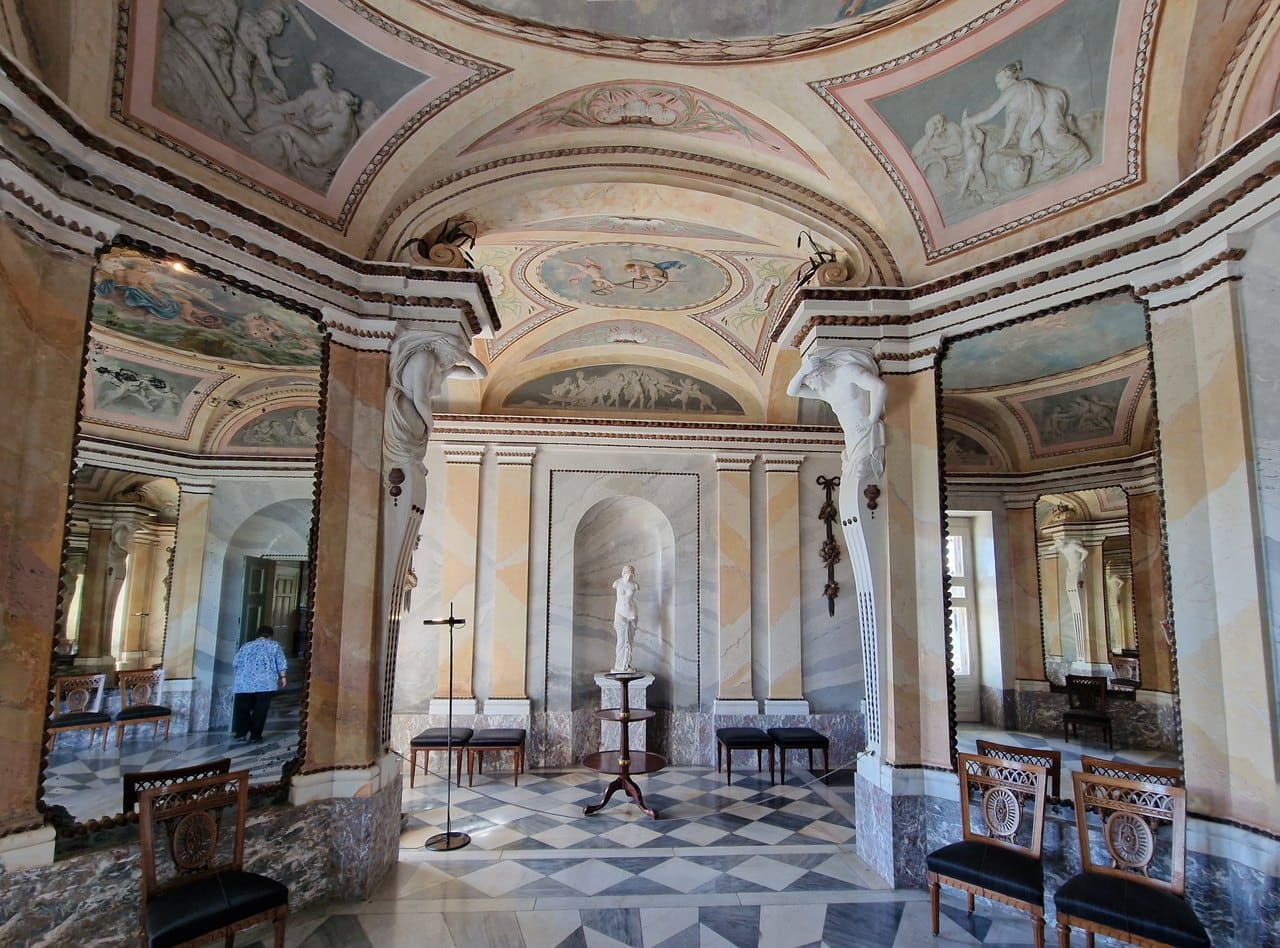
Into these rooms went furnishings of a quality few German palaces could match. Friedrich Wilhelm von Erdmannsdorff, the connoisseur who had built the early classical houses at Wörlitz, bought antique sculpture for the palace and ordered ten marble chimneypieces in Rome in 1789. The king and his close companion Wilhelmine Enke, later Countess Lichtenau, gathered clocks, vases, and paintings on their own account, among them two longcase clocks said to come from the estate of Madame de Pompadour. The palace also holds an exceptional set of Wedgwood ceramics, which the king acquired between 1792 and 1796 and which the foundation today ranks as the second-largest historic Wedgwood collection outside England, matched in Germany only by Schloss Wörlitz. Taken together, the interiors are among the most complete early-neoclassical rooms anywhere in Germany, and because so much survived the wars and the museum years, they still read as a single, coherent decorative idea rather than a reconstruction.
The Unfinished Wings
Within a few years the king found his retreat too small for the household that gathered around him. In 1797 work began on two single-story side wings, low rectangular blocks set to the left and right of the entrance front and joined to the main house by curved, colonnaded galleries on a quarter-circle plan. The design came from Michael Philipp Boumann. Columns for those galleries posed a problem of supply, solved by a piece of royal recycling: the old marble colonnade that Knobelsdorff had built for Frederick the Great, standing on the avenue between Sanssouci and the Neues Palais, was taken down and its shafts carried across Potsdam to the New Garden.
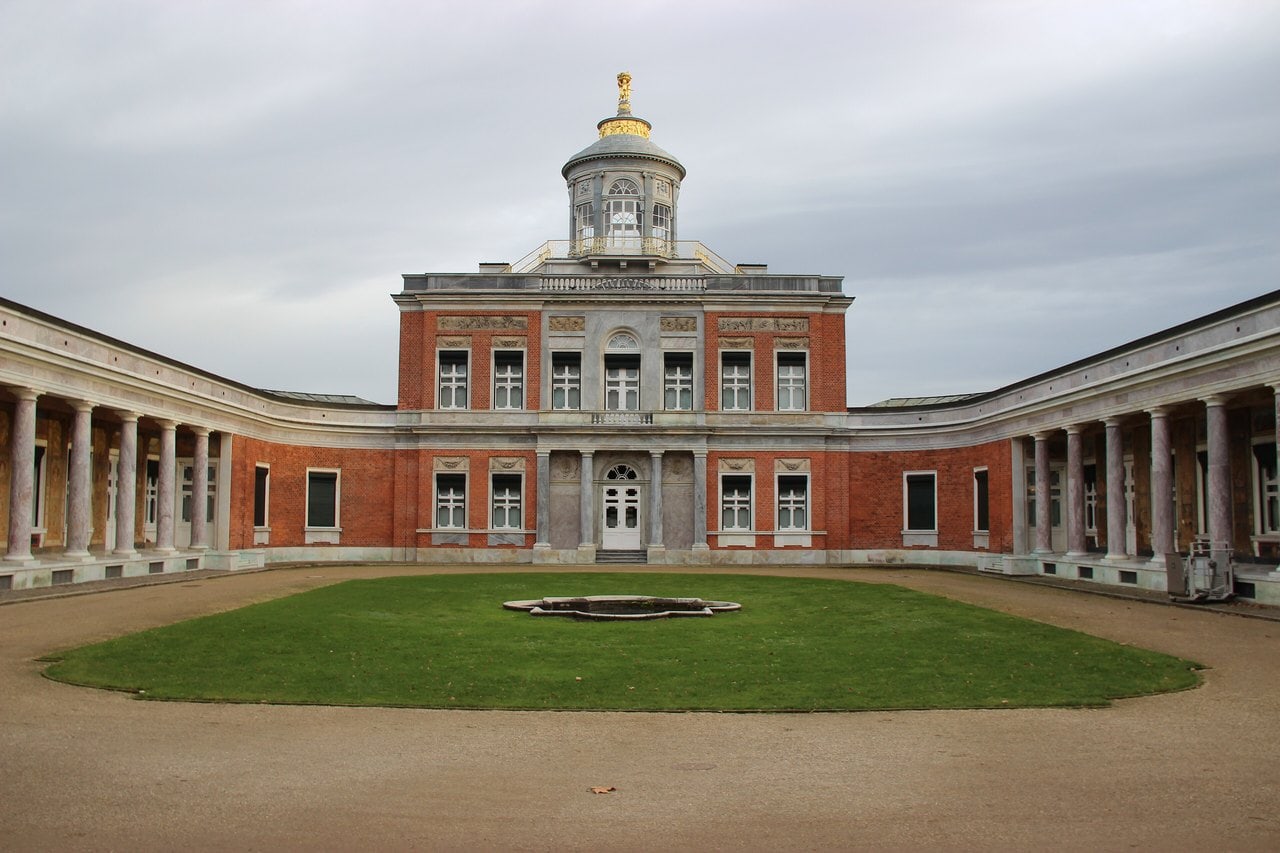
The plan was ambitious, but time ran out. When Friedrich Wilhelm II died in November 1797 the wings stood as bare shells, and his son, Friedrich Wilhelm III, who had little patience for his father’s world, did no more than close in the exteriors. For nearly fifty years the wings waited, empty behind their finished walls. Only in the 1840s did the king’s grandson, Friedrich Wilhelm IV, the most history-minded of the Hohenzollerns, take the project up again. Between 1843 and 1848 he had the architect Ludwig Ferdinand Hesse fit out the interiors, including the oval hall of the south wing, and had the outer walls of the colonnades painted with frescoes drawn from the Nibelungen saga, the medieval German epic then at the height of its romantic revival. That subject was a pointed choice. Friedrich Wilhelm IV, nicknamed the romantic on the throne, was steeping his Potsdam in medieval and Italian fancy, and the Nibelungen cycle gave the old neoclassical shell a thoroughly nineteenth-century gloss. From 1850 the finished north-wing rooms passed to the king’s nephews and nieces as a summer lodging, so the wings began their life, at last, as the family quarters their builder had first imagined.
One point is worth setting straight. The wings are sometimes credited to Ludwig Persius, the celebrated Potsdam architect of the same generation. The documented hand, however, is Hesse’s. Persius designed the nearby dairy in the New Garden, and the two commissions have been muddled in popular accounts ever since.
A View Across the Water
The Marble Palace was the last home Friedrich Wilhelm II knew. In the autumn of 1797, ill and short of breath, he withdrew to the New Garden and did not leave it again. On November 9 he handed the business of government to his son, and a week later, on November 16, 1797, he died in the paneled writing cabinet of his own palace, attended by Countess Lichtenau and a small circle of confidants. His body was carried to Berlin and laid in the cathedral vault.
By the king’s own design, the house he died in was bound to the water in front of it and to the islands beyond. From the belvedere on the roof he had arranged long views down the Havel, and the small palace he was raising at the same time on the Pfaueninsel, the Peacock Island downstream toward Berlin, was placed in part as an eye-catcher to be seen from here. When Peter Joseph Lenné reworked the garden from 1816, he hardened these glimpses into a system, cutting sight-lines across the water toward Glienicke, Sacrow, and the wooded hill of Babelsberg, so the New Garden became one viewing station in a landscape stitched together by line of sight. Those two buildings make a revealing pair. On the island, Friedrich Wilhelm put up a romantic sham, a country house of painted timber dressed to look like a crumbling Roman ruin. On the lakeshore he built its opposite, a real and permanent residence of brick and marble, the serious answer to the island’s joke.
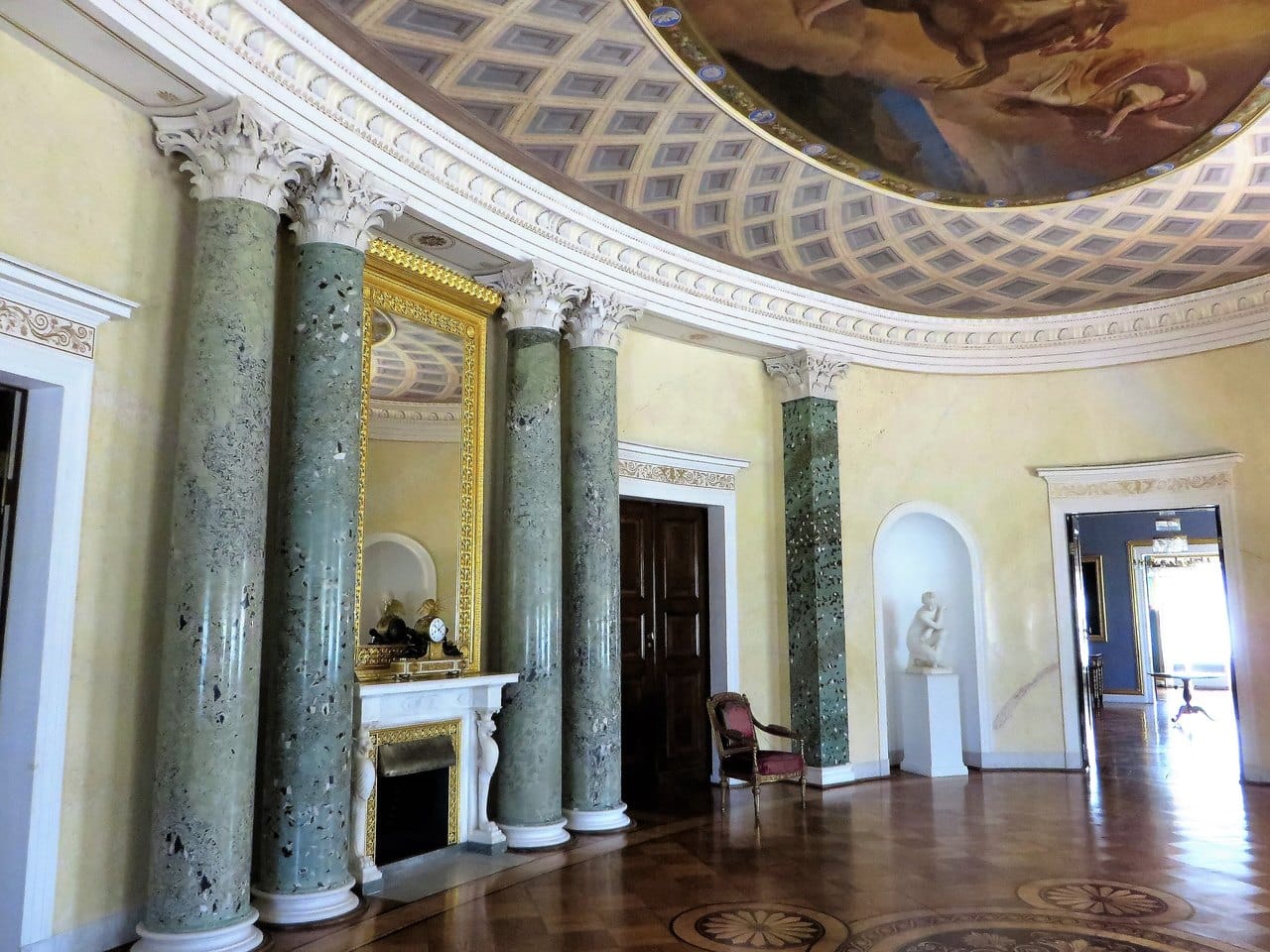
That pairing reaches even into the decoration. On the ceiling of the oval hall, an Apollo and Aurora after Guido Reni, painted by Heinrich Lengerich, presides over the room, and the same dawn-god motif appears in the festival hall of the Pfaueninsel palace, painted there by Johann Christoph Frisch. One king, one lake, two faces of a single imagination, the grave and the fanciful, set deliberately within sight of each other.
From Royal Residence to Army Museum
After 1797 the Marble Palace stayed in the family but lost its central place; it became a house the Hohenzollerns lived in between other things. In the 1830s the future Kaiser Wilhelm I and his wife Augusta made it their Potsdam home while they waited for Schloss Babelsberg, their Gothic villa on the hill across the Havel, to be finished. Half a century on, another Prince Wilhelm, the future Wilhelm II, lived here from 1881 until he came to the throne in 1888. The last royal residents were Crown Prince Wilhelm and Crown Princess Cecilie, who moved in around 1904 and stayed until 1917, when they crossed the garden to the brand-new, half-timbered Cecilienhof. With the monarchy’s fall in 1918, the family’s long use of the New Garden ended.
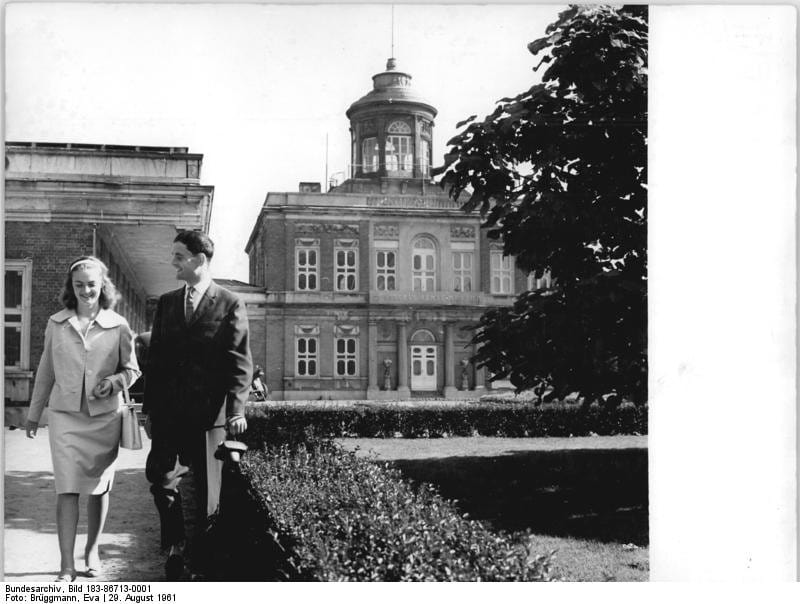
The twentieth century treated the palace roughly. Bombing in the Second World War sent an incendiary through the north wing and a shell into the main house, and after 1945 the Soviet army took the building over, first as an officers’ club. From 1961 the German Democratic Republic turned it into the Army Museum, the Deutsches Armeemuseum, and parked tanks, a torpedo boat, a fighter jet, and field guns on the lawns where the king had once arranged his views across the water. Those weapons were cleared away as the regime ended in 1989, and in 1990 the palace returned to the care of the Prussian palaces foundation.
A long restoration, begun in 1988 and carried on by the foundation once the palace returned to it, brought the house slowly back to life. Work on the rooms was patient and costly: the interior alone ran to some 4.6 million euros, part of a wider program of around 11.5 million in federal and state money, and it stretched on for years. The main block reopened to visitors in 1997. Its north wing followed in 2004. On April 14, 2006, after more than six decades out of full use, the whole palace, all forty rooms and both side wings, opened complete for the first time since the king’s death. As part of the Palaces and Parks of Potsdam and Berlin, the Marble Palace had by then joined the UNESCO World Heritage List, inscribed in 1990 and steadily extended through the 1990s.
Visiting the Marble Palace in 2026
The New Garden is open to anyone, free of charge, every day from morning until dusk, and reaching it asks nothing more than a short walk, ride, or drive from the center of Potsdam. Unlike the Pfaueninsel palace, no ferry is involved. The park alone rewards a visit, with its lakeside paths, its pyramid ice house, and its long sightlines across the Havel toward Glienicke and the Peacock Island. Entry tickets and local tours can also be booked in advance through GetYourGuide.
The palace interior is open by ticket from May to October, Tuesday through Sunday, from 10 in the morning until half past five in the afternoon, and closed on Mondays. A single adult ticket costs 8 euros, with a reduced rate of 6 euros at the time of writing; the foundation’s day pass and annual pass both include it. The main royal rooms are shown on a guided tour conducted in German, but visitors who prefer another language can follow the free SANSSOUCI app, which carries the tour in English, French, Italian, Spanish, Polish, and Russian. Since July 2025 the south wing has held a self-guided multimedia exhibition, in German, English, and Polish, that introduces Friedrich Wilhelm II and Wilhelmine Enke and sets the palace against the wider history of its age, from the French Revolution to the partitions of Poland. Access is partly barrier-free, with a lift to the ground floor and a wheelchair available on site, and visitors slip felt overshoes over their own to protect the historic floors.
One practical note for 2026: Schloss Cecilienhof, at the north end of the same garden, has been closed for restoration since November 2024, so the combined ticket that once paired the two palaces is not currently on sale. Opening times and prices shift from season to season, so it is sensible to confirm the current details with the foundation before setting out. Anyone staying overnight can compare hotels in and around Potsdam.
Some links on this page are affiliate links, which means StoneKeep Atlas may earn a small commission, at no extra cost to you, if you book through them.
| Ticket | Price (2026) |
|---|---|
| Adult, single palace | 8 € |
| Reduced | 6 € |
| sanssouci+ day pass (all SPSG palaces, one day) | 22 € / 17 € reduced |
Beyond the Marble Palace
A visit to the Marble Palace sits naturally inside a larger day. At the north end of the New Garden stands Cecilienhof, the last palace the Hohenzollerns built and the house where Stalin, Truman, and Churchill redrew the postwar map at the Potsdam Conference of 1945. The two buildings share one garden and two very different centuries. Together they bracket the dynasty’s life in the New Garden: the neoclassical retreat where a king died in 1797 at one end, the half-timbered house where his descendants watched the old order signed away in 1945 at the other.
The Marble Palace is also the elder of the garden palaces of Potsdam, the loose family of villas and residences that later kings set down in the parks around the town. The most celebrated of them rose a generation afterward, under Friedrich Wilhelm II’s grandson and the circle of Karl Friedrich Schinkel: the Italianate Charlottenhof, Prince Carl’s villa at Glienicke, and the Gothic Babelsberg, gathered in our guide to the garden palaces of Potsdam. Set beside the dynasty’s grander seats, the confident Charlottenburg in Berlin, Frederick’s Sanssouci, and the boastful Neues Palais at the far end of its park, the Marble Palace keeps to a smaller and more personal key, which is much of its appeal. Our overview of the royal palaces of Berlin and Brandenburg places it within that whole company. All of them belong to the sweep of palaces and gardens that UNESCO inscribed as a single World Heritage landscape in 1990, and within that famous ensemble the Marble Palace remains one of the earliest built and one of the quieter corners to visit.
Conclusion
Few of the Potsdam palaces tell their builder’s character as plainly as this one. Friedrich Wilhelm II wanted a private house in the modern, classical taste, set on his own lake, within sight of the romantic island toy he was raising across the water, and he got it, down to the buried tunnel that kept the kitchen out of view. He also got something he had not planned: a tomb. He died in the unfinished house, and the wings he left as shells were not completed until his grandson took them up two generations later. That long interruption is written into the fabric, early neoclassicism without and 1840s historicism within the wings, a single small palace carrying two ages of Prussian taste. Stand on the lake terrace where the grotto hall opens to the water, look across to the wooded island the same king dressed as a ruin, and his whole temperament sits in one view, the wish to be modern and the wish to play, set a few hundred meters apart. It remains the first of its kind in Prussia and, for many who find their way to the quiet shore of the Heiliger See, the most affecting of the Potsdam houses.
Principal Sources
- Dehio, Georg. Handbuch der Deutschen Kunstdenkmäler: Brandenburg. Deutscher Kunstverlag, 2012.
- Hagemann, Alfred. Wilhelmine von Lichtenau (1753–1820): Von der Mätresse zur Mäzenin. Böhlau, 2007.
- Otte, Wilma. Das Marmorpalais: Ein Refugium am Heiligen See. Prestel, 2003.
- Schmitz, Hermann. Das Marmorpalais bei Potsdam und das Schlösschen auf der Pfaueninsel. Verlag für Kunstwissenschaft, 1921.
- Stiftung Preußische Schlösser und Gärten Berlin-Brandenburg. Das Marmorpalais im Neuen Garten (official guide). Deutscher Kunstverlag, 2015.
Institutional and web sources: the Stiftung Preußische Schlösser und Gärten object page for the Marble Palace; the Landeshauptstadt Potsdam city portal; museum-digital Brandenburg; and the UNESCO World Heritage Centre entry for the Palaces and Parks of Potsdam and Berlin (ref. 532).
Image credits. Hero, aerial, and façade photographs by sinousxl, mariohagen, and bettin27 via Pixabay. Grotto hall by Rigorius (CC BY-SA 4.0); Oval Hall by Klaus Bärwinkel (CC BY 3.0); forecourt and colonnade by Kaeffchen heinz (CC BY-SA 3.0 DE), all via Wikimedia Commons. Historic view of the palace as the Deutsches Armeemuseum, 1961: Bundesarchiv, Bild 183-86713-0001 / Eva Brüggmann / CC BY-SA 3.0 DE. Freely licensed images are resized to fit; otherwise unaltered.