
Rochlitz Castle
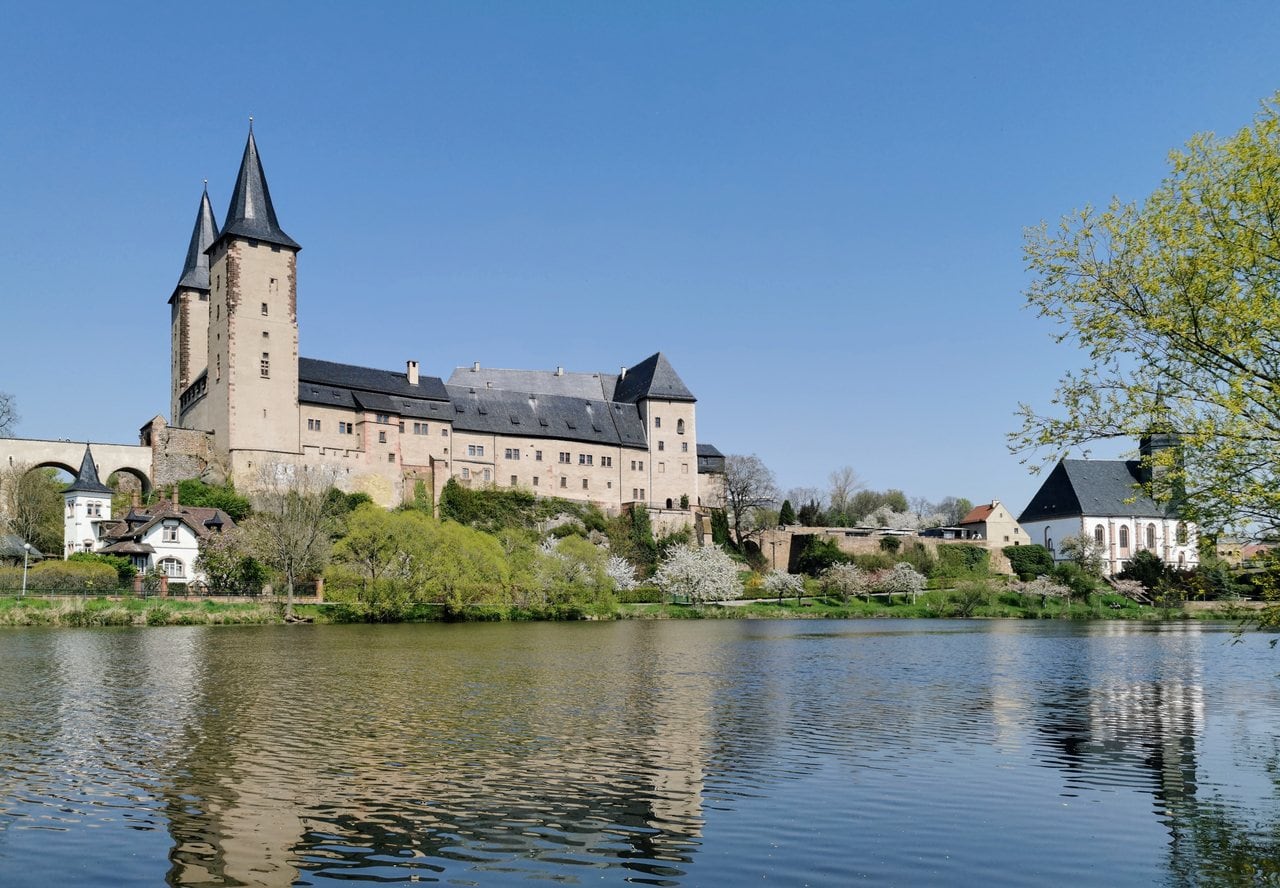
Rochlitz Castle stands on a narrow spur of red porphyry above the Zwickauer Mulde in central Saxony, two tall Gothic towers rising over the river like a pair of stone sentries that have not moved in more than six hundred years. The townspeople named those towers long ago: the Lichte Jupe, the light one, and the Finstere Jupe, the dark one, the second of which still hides a dungeon and a torture chamber in its base. They are the first thing a visitor sees and the last thing the photographs forget, and they belong to one of the oldest castle sites in Saxony.
What the towers conceal is a thousand-year argument about what this place was for. Rochlitz Castle began as an imperial border fortress, became a margravial residence, served eight times as a seat of the Saxon ruling house, and spent long stretches as the dower house of widowed duchesses. One of those widows ran the Reformation in her territory against the fury of her own father-in-law. Later the building was a courthouse, a state prison, and, in 1945, a cellar jail for the Soviet secret police. It has been almost everything a structure can be, and it kept its towers through all of it.
Quick Facts
| Location | Rochlitz, Landkreis Mittelsachsen, Saxony, Germany |
| Setting | A rock spur above the Zwickauer Mulde, between the river and the Hellerbach |
| Origin | 10th century as an imperial castle; first documented in 1009 |
| Wettin ownership | From 1143 until the end of the monarchy in 1918 |
| Type | Medieval castle and margravial Schloss |
| Defining build | Gothic residence, c. 1375–1400, under Margrave Wilhelm I |
| Landmark towers | Lichte Jupe and Finstere Jupe, c. 1390 |
| Current use | Museum |
| Operator | Staatliche Schlösser, Burgen und Gärten Sachsen |
| Address | Sörnziger Weg 1, 09306 Rochlitz |
| Website | schloss-rochlitz.de |
A fortress on the Slavic frontier
The castle that became Rochlitz Castle was raised in the tenth century as a Reichsburg, an imperial castle, part of the chain of strongholds that the German kings threw across the conquered Slavic lands east of the Saale. Sources place its origin a little differently, some saying the middle of the century and some the second half, but the purpose is clear enough. After King Henry I drove into the West Slavic settlements of the region, the new fortresses secured what the army had taken, and Rochlitz served as a military base within the castle system that radiated out from Meissen.
Written traces gather around the year 1000. A Burgward, the administrative district centered on the castle, took shape in the second half of the tenth century, and the mission church of St. Peter, St.-Petri, was founded in the eastern outer bailey before 981 to carry Christianity into the newly subdued countryside. A charter of Emperor Otto III first names the region in 995. Around the turn of the millennium the castle and its lands passed as allodial property to Margrave Ekkehard of Meissen and his family, the Ekkehardingers, then the most powerful magnates of the eastern march. Their stronghold sat where it still sits, on a long rock ridge cut off from the higher ground to the west by a deep neck-ditch, with the river on one flank and the Hellerbach stream on the other.
Rochlitz Castle enters the documentary record in 1009, and it does so in flames. During a violent inheritance quarrel among Ekkehard’s heirs, Margrave Gunzelin set fire to the urbs Rochelenzi, an act that Bishop Thietmar of Merseburg recorded in his chronicle. That burning is both the earliest direct mention of the castle and a fair preview of the next thousand years.
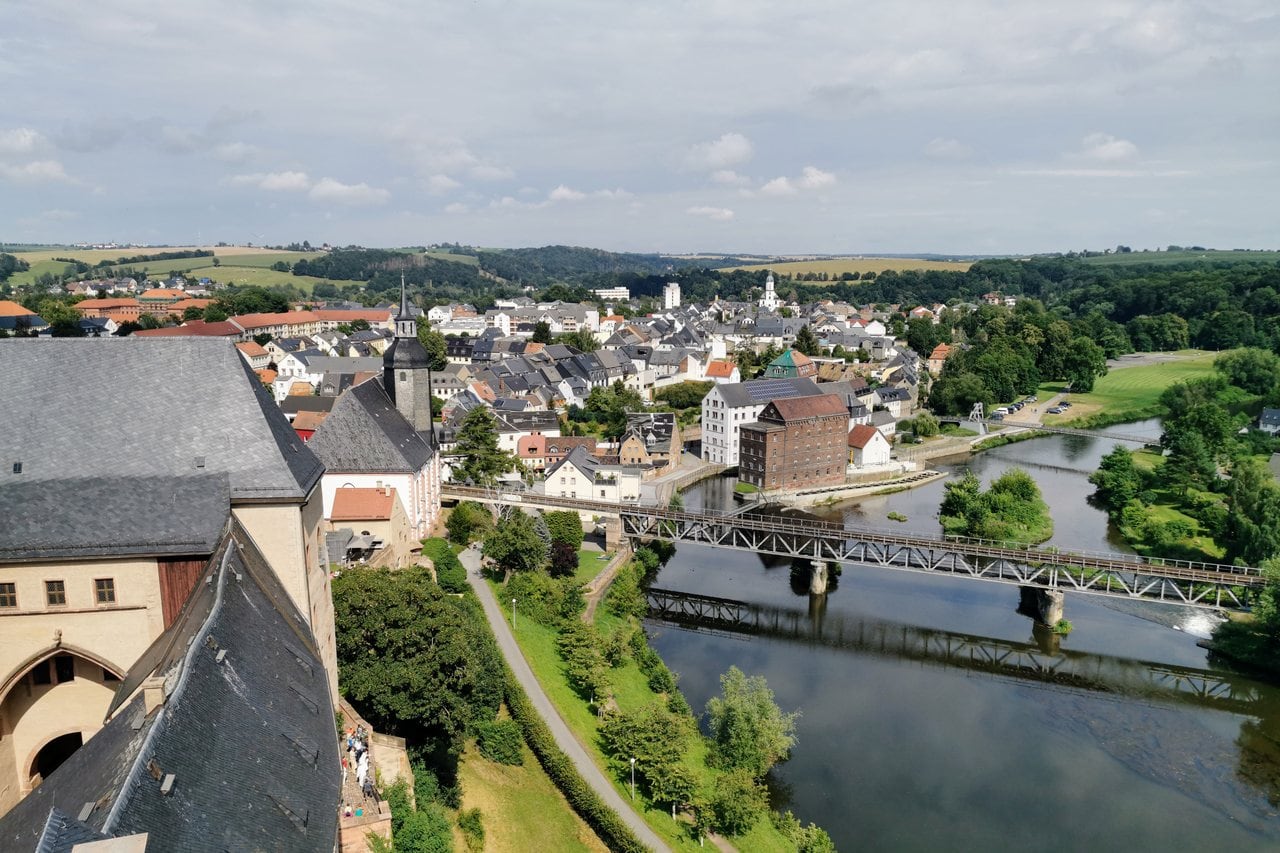
Rochlitz left imperial hands for good in 1143, when King Conrad III granted the castle and territory to Margrave Konrad I of Meissen, founder of the line that would hold it for the next eight centuries. The House of Wettin kept Rochlitz until the German monarchy fell in 1918. When Konrad abdicated in 1156 and withdrew to a monastery, the county of Rochlitz passed to his son Dedo, remembered as Dedo the Fat, who pushed the settlement of the surrounding land, founded a monastery at nearby Zschillen, and stands at the head of the town’s recorded history. Under his rule and that of his successors the place below the castle grew into a town on the trade road that carried salt across the region, and the castle settled into a long career as the administrative heart of a margravial district.
Wilhelm the One-Eyed and the turn to a residence
For three centuries Rochlitz was a working stronghold and a center of margravial administration. Its transformation into something a prince might actually want to live in came in the last quarter of the fourteenth century, and it was largely the work of one man, Margrave Wilhelm I, known to history as Wilhelm the One-Eyed. Together with his co-ruling brothers Friedrich the Strict and Balthasar, Wilhelm rebuilt the defensive complex into a Wohnschloss, a residential castle, and gave Rochlitz most of the Gothic form it still wears. The building is recorded as a sloß, a Schloss, from around 1370.
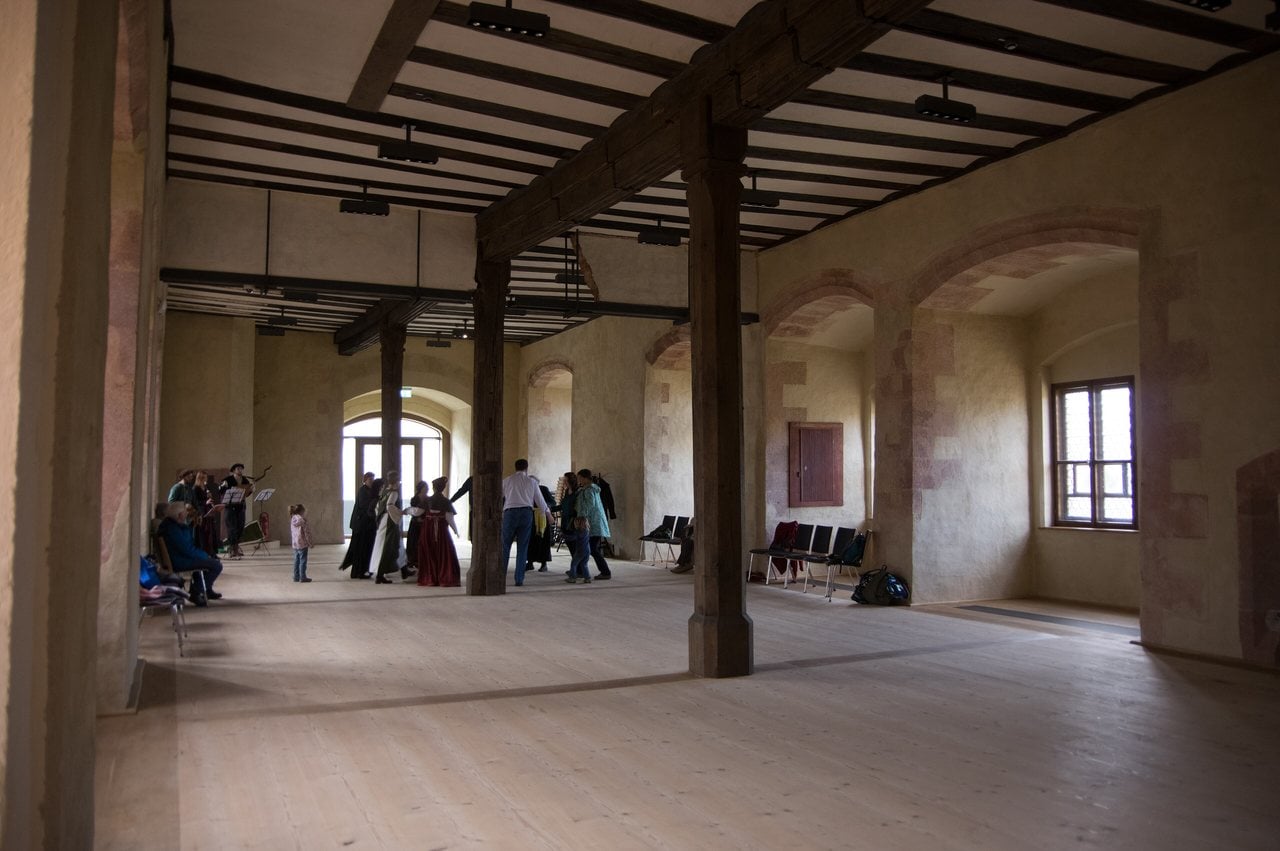
At the centerpiece of that campaign stood the Fürstenhaus, the princely house, built between about 1375 and 1380. Dendrochronology has since confirmed those dates from the timbers themselves, and shown that the residence was fitted with hot-air underfloor heating in 1375 or 1376, a striking comfort for a fourteenth-century castle. Inside, the long Tafelsaal, the banqueting hall, gave the margraves a stage for the ceremonial life of a court. The restored princely rooms remain the architectural heart of any visit.
Saxony’s heritage administration packages Wilhelm into a memorable trio for its permanent exhibition, “Fett, Einäugig, Revolutionär,” that is, “Fat, One-Eyed, Revolutionary,” for Dedo the Fat, Wilhelm the One-Eyed, and a duchess we will come to shortly. Those names are a marketing flourish, yet they are honest about the cast. Rochlitz was never a glittering palace in the manner of the later Saxon residences. It was a fortress that learned to be comfortable, and it kept the fortress in plain sight.
Lichte Jupe, Finstere Jupe
Nothing keeps the fortress in plainer sight than the two great west towers, raised around 1390 as part of the same Gothic campaign. Refined dendrochronology sharpens the picture, with the northern Finstere Jupe timberwork falling around 1389 and 1390 and the southern Lichte Jupe spread across the 1380s and early 1390s, yet the lower stages of the north tower are older still and survive from the founding age of the castle. Both towers were planned as residential towers; both ended up holding prisoners. A visitor today can climb well over a hundred steps for the view from the Lichte Jupe, while the Finstere Jupe drops the other way, into a bottle-shaped dungeon reached only through a hole in the vault overhead.
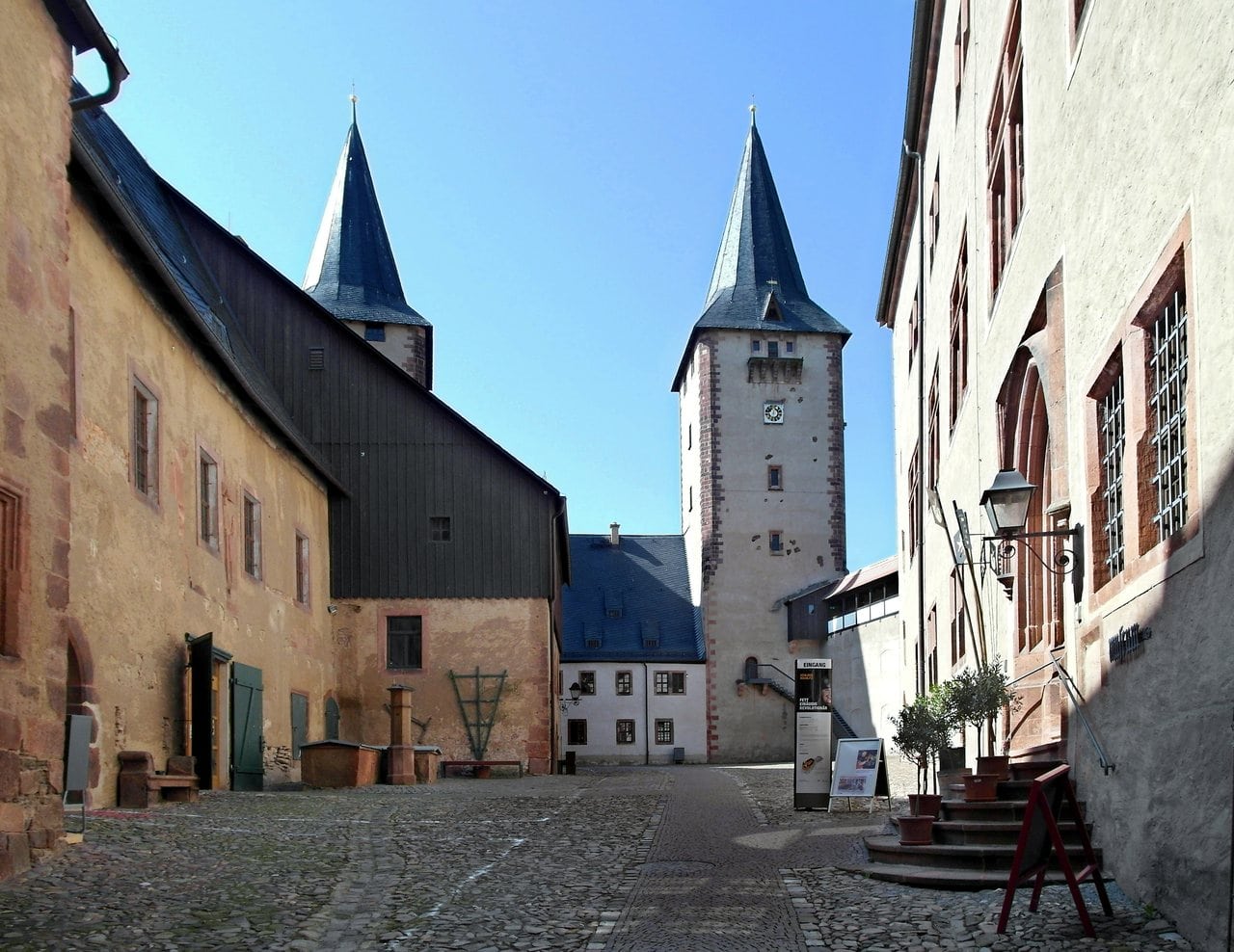
The names are the puzzle. Lichte Jupe means roughly the light Jupe, Finstere Jupe the dark Jupe, but the word “Jupe” itself has no settled explanation. Its custodians say plainly that the origin is not documented and that no direct clue survives in the historical record. A reference once existed in a lost sixteenth-century town chronicle attributed to the burgomaster Melchior Mathesius, who wrote that the towers were well known to the gentry of Meissen and that whoever wore the “Rochlitz Jupe” neither froze nor was eaten by wolves, a grim joke about imprisonment. A common folk derivation links “Jupe” to Joppe, a heavy jacket, on the same dark logic, that the cell wrapped its occupant as a coat wraps a body.
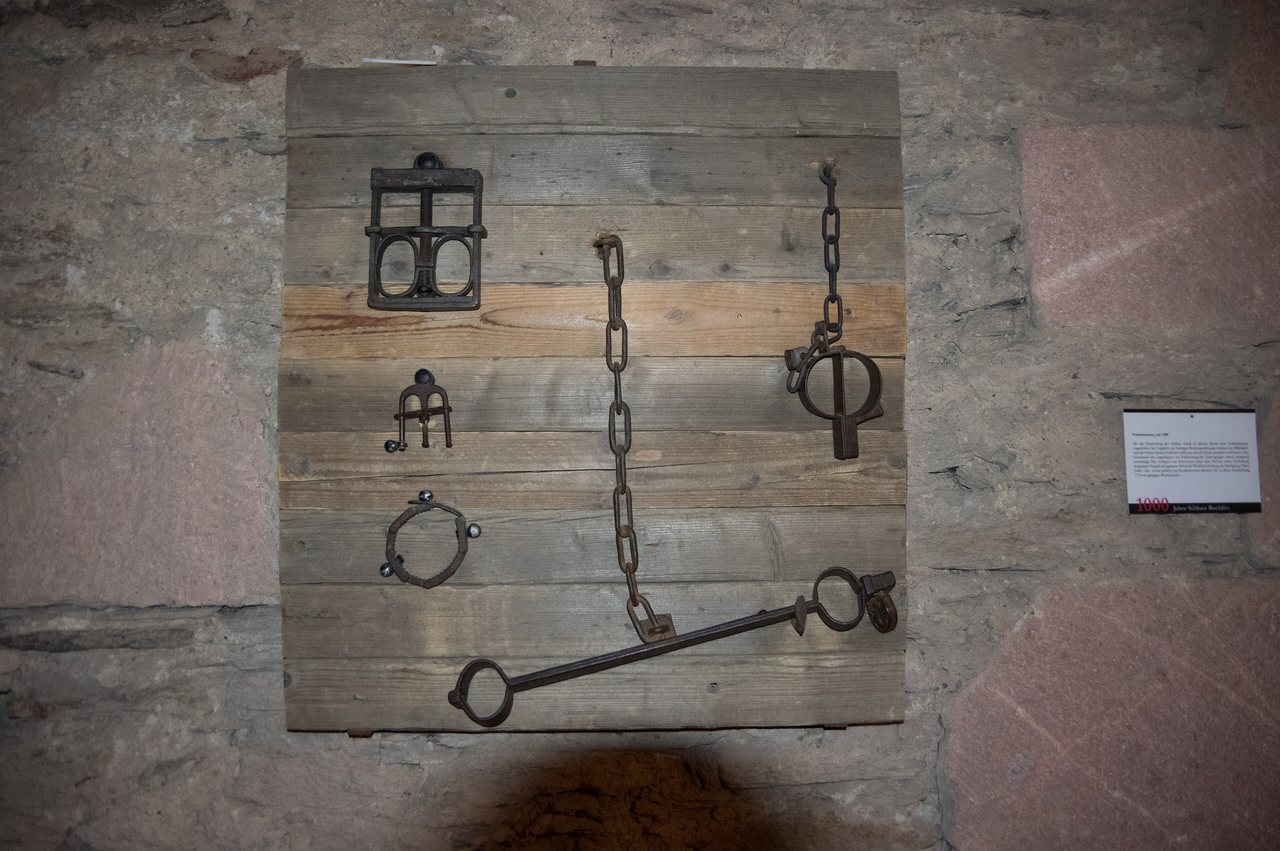
Below the towers the logic turns literal. The Finstere Jupe holds the castle’s Folterkammer, its torture chamber, and one cell has been reconstructed for visitors, while other tower rooms now shelter the far gentler contents of the castle library. Both extremes, the bright climb and the black pit, sit in towers built for the same family in the same decade. The exterior carries its own scars. During the Thirty Years’ War, Swedish troops took the castle and Saxon forces stormed it back through a breach in the north wall, and the cannonball impacts on the north tower were deliberately left in place when the building was later restored.
The widows’ castle
Rochlitz earned its strangest distinction not as a fortress but as a Witwensitz, a dower house, the residence granted to a princely widow for her lifetime. The castle administration counts it as the seat of members of the Saxon ruling house eight separate times, and several of those occupants were formidable women left in command of a castle and an income after their husbands died.
That pattern set in at the end of the fifteenth century, when the Wettin brothers Ernst and Albrecht rebuilt Rochlitz as a widow’s seat for their sister Amalia, the widowed Duchess of Bavaria-Landshut, who held it until her death around 1501. Her years brought a refit of the castle chapel. The most consequential widow, though, arrived a generation later and turned a quiet dower house into a command post of the German Reformation.
Elisabeth of Hesse, remembered ever after as Elisabeth of Rochlitz, was a daughter of the landgraves of Hesse and a sister of Philip the Magnanimous, the great Protestant prince. She married Duke Johann of Saxony, son of the staunchly Catholic Duke Georg the Bearded, and when Johann died in 1537 she received Rochlitz, together with Kriebstein, as her Wittum. From that seat the young widow did something her father-in-law had forbidden in his lands: she introduced the Lutheran Reformation in her territory, over his open rage. She joined the Schmalkaldic League in 1538 as its only female member, ran a correspondence network that fed intelligence to the evangelical princes, and used a cipher of her own to do it. The heritage administration puts it without ornament, that from Rochlitz the duchess spied on the enemies of the Reformation. When imperial armies overran her lands during the Schmalkaldic War in early 1547, Elisabeth was besieged here until the Elector Johann Friedrich retook the castle and freed her on the second of March. She fled to Hesse and died at Schmalkalden ten years later. Her decade in the widow’s rooms turned Rochlitz into a genuine site of the Reformation, the place from which a single determined woman forced confessional change on her own corner of Saxony, and it ties the castle directly to the wider religious upheaval of the German lands and to the great Luther stronghold of the Wartburg. The heritage administration casts her, fairly, as the “Revolutionär” of its three-Wettin story.
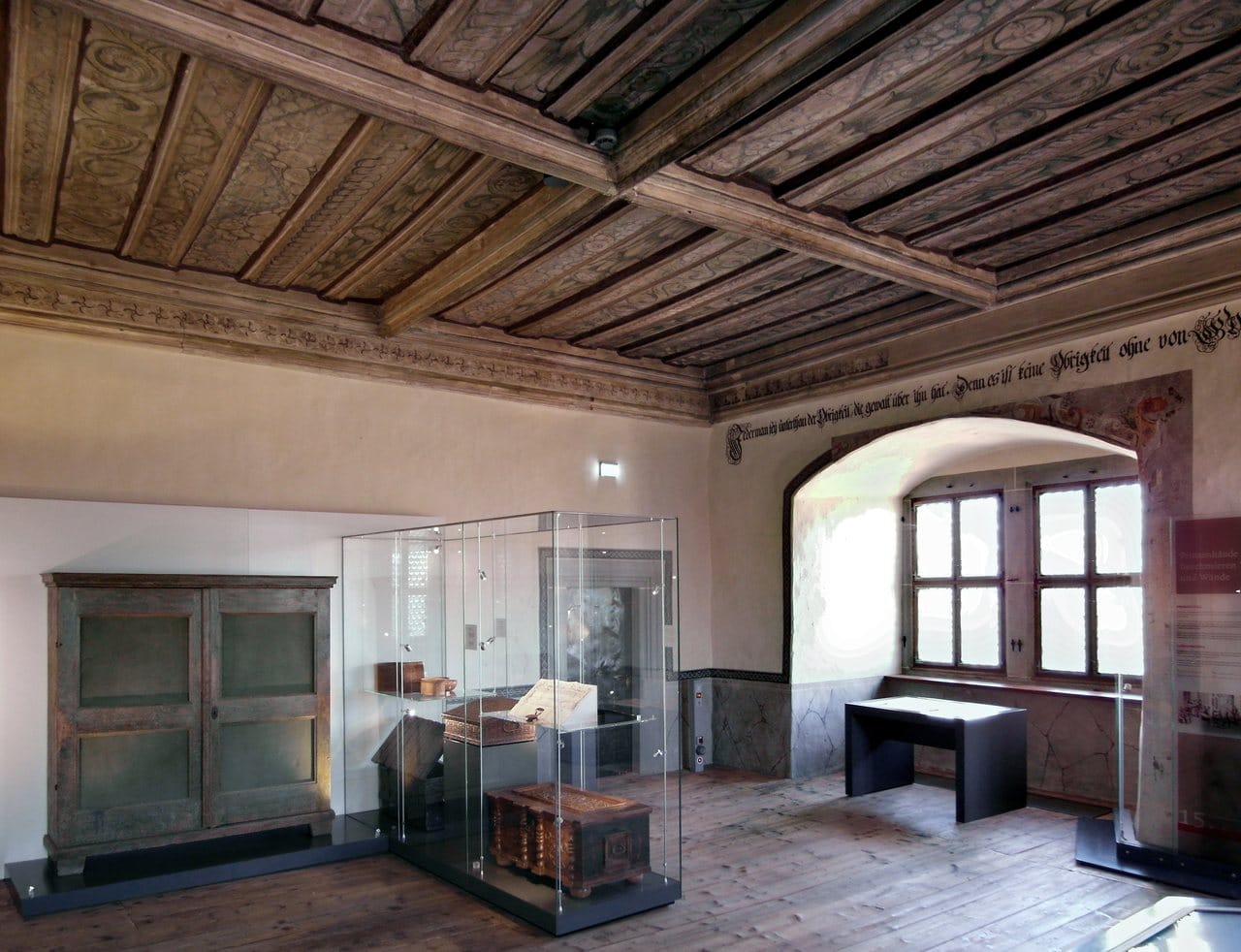
A second electoral widow followed. Sophie of Brandenburg, widow of Elector Christian I, came to Rochlitz from 1591. Sources disagree on how long she stayed, some keeping her here until around 1602 before a move to Colditz, others to 1611, but her tenure closed the castle’s long career as a refuge for the women of the dynasty.
Hunting lodge, pleasure garden, and the black kitchen
Between the widows the castle also served the dynasty’s pleasures. Elector Christian I and Sophie had Rochlitz reworked toward a Jagdschloss, a hunting lodge, at the end of the sixteenth century, and a smaller residential wing, the Kleines Haus, went up in the late 1580s. A Renaissance pleasure garden, a Lustgarten with a garden pavilion and a vineyard, was laid out on the forehill before 1548, giving the hard old fortress a softer face turned toward leisure.
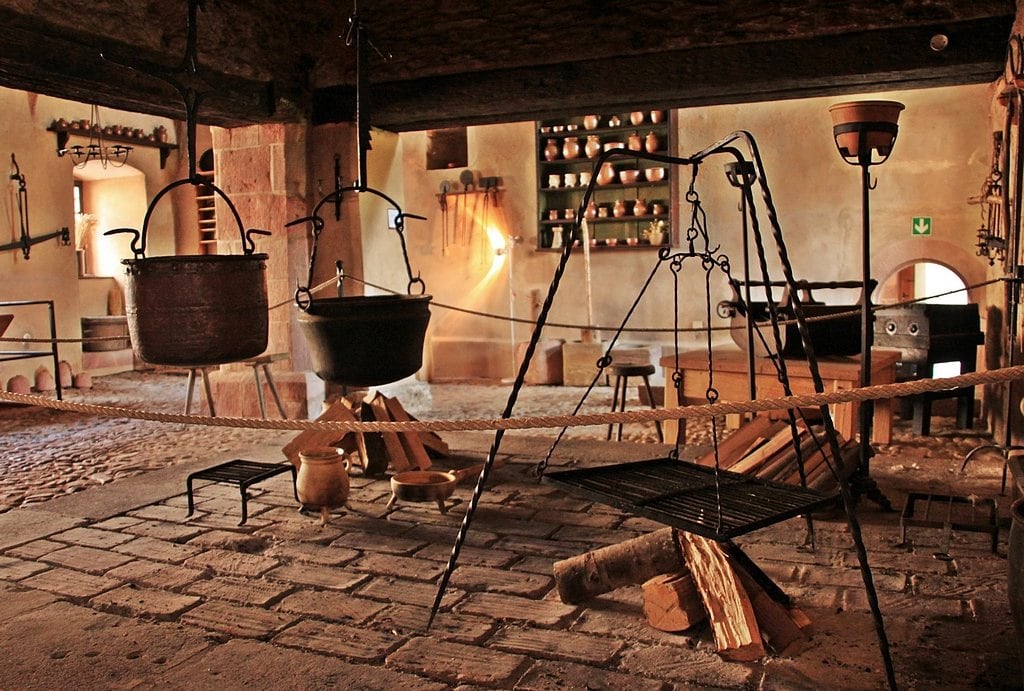
Down below the state rooms lies the most remarkable survival from the castle’s domestic life, the Schwarzküche, the black kitchen. Built in the fourteenth century and counted among the largest and oldest castle kitchens in Saxony, it spreads across about a hundred square meters around a great ground-level hearth, and its enormous smoke-hood, the Rauchfang, was restored to working order in 2007. The kitchen is not a static exhibit. Visitors can still learn medieval cookery over its open fire, an unusually tangible way into the daily world of a late-medieval court.
Rochlitz hides one more domestic secret in plain sight. Scratched into the plaster of a room now used as an office are drawings more than four and a half centuries old, Putzritzzeichnungen left, by tradition, by young Wettin princes schooled at the castle. They were rediscovered under later coats of plaster, and the favorite motif among them is a small naked king, the doodle of a bored royal child that somehow outlasted the dynasty that made it.
Prison, exile, and the dark cellars
Its afterlives read like a catalog of everything a castle can be reduced to once the court moves on. It had served as a place of dignified exile as early as 1436, when Duke Sigismund of Saxony, a deposed bishop of Würzburg, was confined here, and as a princes’ school for the boys of the ruling house, including the future Elector Frederick the Wise. From the eighteenth century it became the seat of the local administration and justice office.
War and time stripped the lower castle away. The Unterschloss, the eastern outer ward that held St. Peter’s church and the working buildings, burned during the Thirty Years’ War in 1645 and was demolished for good in 1717, leaving the upper castle standing alone on its spur. What survived slid steadily toward confinement. A district court arrived around 1850, and in 1852 the princely house and the transverse wing were gutted and rebuilt as a cell block, so that the rooms where margraves had once dined now held prisoners.
Saxony’s worst twentieth-century history reached the castle at the end of the Second World War. For a few weeks in 1945 the American army ran a reception camp here, and from that summer until 1947 the Soviet secret police, the NKVD, occupied the castle and used its dark cellars as a prison. Only after that did Rochlitz settle into its present and gentlest role. A local schoolteacher, William Clemens Pfau, who lived from 1862 to 1946, had founded a historical society in 1892 and installed his collection in the castle chapel in 1893, seeding what is reckoned the fourth-oldest castle museum in Saxony. The Free State of Saxony took the castle over in the mid-1990s and poured close to twenty million euros into its restoration between 1991 and 2015, rescuing one of the oldest castle sites in Saxony for the visitors who climb to it today.
Visiting Rochlitz Castle in 2026
Rochlitz Castle is open for the 2026 season from March 28 to November 1. Doors are open Tuesday through Friday from 10:00 to 17:00, and on Saturdays, Sundays, and public holidays from 10:00 to 18:00, with last admission an hour before closing; the museum is closed on Mondays and dogs are not admitted to the exhibition rooms. Standard admission is €8.00, with a reduced rate of €7.00 and a token €1.00 for children aged six to sixteen; groups of fifteen or more pay €7.00 per person. Entry tickets and local tours can also be booked in advance through GetYourGuide.
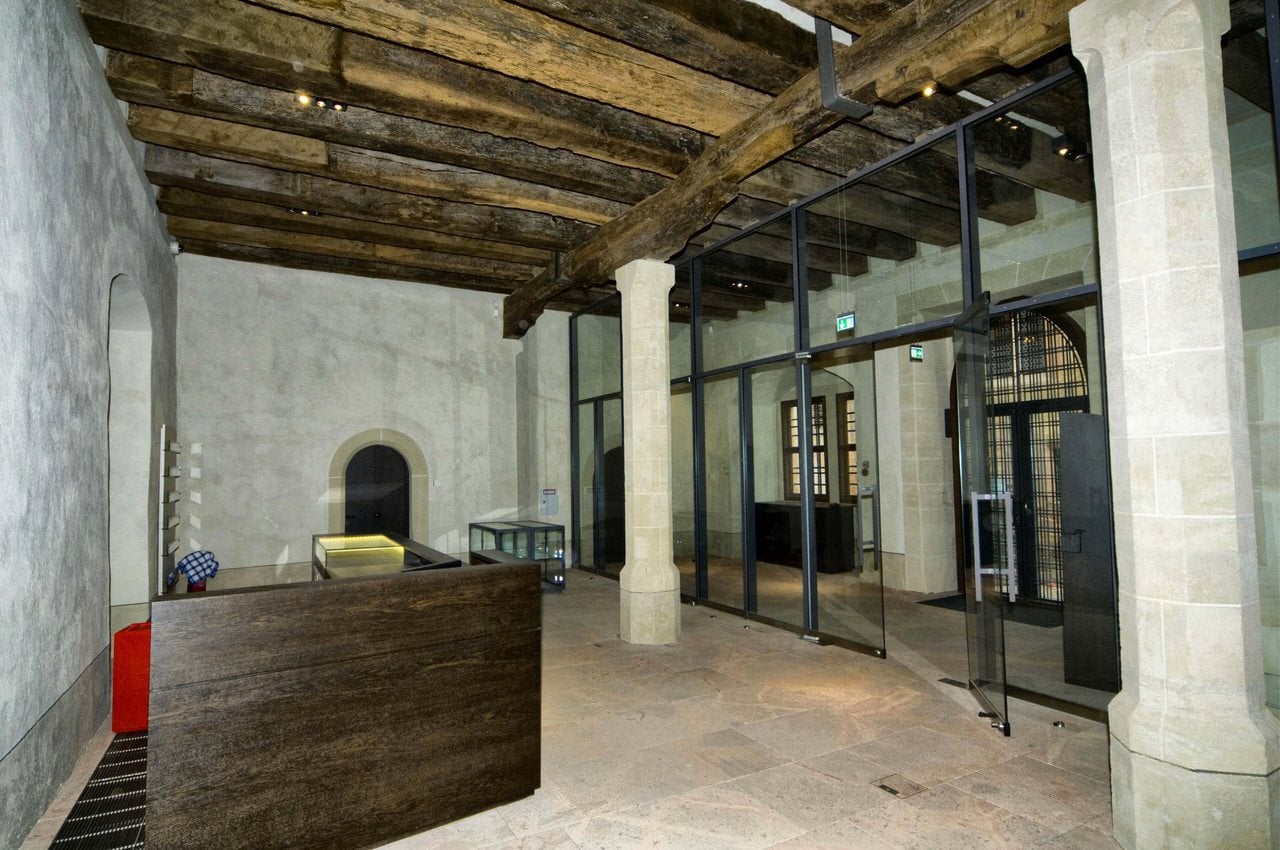
Holders of the schlösserlandKARTE, the regional pass for the Saxon castles, enter the permanent and special exhibitions free, and two children under sixteen accompany the cardholder at no charge. Combination tickets reward a wider tour of the region, pairing Rochlitz with the well-preserved Romanesque Burg Gnandstein for €11.00 or with Schloss Colditz for €17.00, the latter better known abroad as the wartime prison castle of Allied officers.
A permanent exhibition, “Fett, Einäugig, Revolutionär,” builds the visit around Dedo the Fat, Wilhelm the One-Eyed, and Elisabeth of Rochlitz, the three Wettins who shaped the castle most. The “Schlösserland erleben” app adds an interactive multimedia tour in which Elisabeth herself appears in augmented reality and reveals a hidden recess, and the Schwarzküche hosts hands-on medieval cooking. The whole castle is built from the local Rochlitzer Porphyr, the deep-red volcanic stone of the surrounding hills, which was honored in 2022 as the first German rock named an international heritage stone.
Rochlitz lies in the Mittelsachsen district, set between Leipzig, Chemnitz, and Dresden. By public transport, the S6 train from Leipzig runs to Geithain, from where buses 628 and 629 reach the Bismarckstraße stop about ten minutes’ walk from the castle; by car, the A72 motorway and then the B175 bring you to a free car park beside the river. Opening hours and prices can change from season to season, so it is worth confirming the current details on the official site before a visit. Anyone staying overnight can compare hotels in and around Rochlitz.
Some links on this page are affiliate links, which means StoneKeep Atlas may earn a small commission, at no extra cost to you, if you book through them.
Beyond Rochlitz
Rochlitz sits at the heart of a dense cluster of Saxon castles, each holding a different piece of the same dynastic story. Its most direct kin is Kriebstein Castle on the Zschopau, a late-Gothic Burg that Elisabeth of Rochlitz held alongside Rochlitz as part of the same Wittum, and which the same state administration runs today. A short way west stands Albrechtsburg in Meissen, often called the first true German Schloss, the residential palace that Rochlitz, with its towers and dungeons, never quite became.
The contrast sharpens further afield. Königstein Fortress, the great rock-top stronghold above the Elbe, was a fortress that the dynasty built outward rather than soften, while Moritzburg, the Baroque hunting palace on its island lake, and Pillnitz, the chinoiserie summer residence on the river, show what the Wettins built once comfort and display, rather than defense, set the terms. Our guide to the castles of Saxony draws the through-line across all of them, from the fortress to the garden palace.
Rochlitz is the one that refuses to settle on a single point along that line. It is fortress and residence and dower house and prison at once, the whole sweep of Saxon history pressed into one spur of red stone, which is exactly what makes it worth the climb.
Conclusion
Few castles carry their history as openly as Rochlitz Castle. The twin towers that announce it from the river were raised by a one-eyed margrave six hundred years ago, on foundations a thousand years old, and beneath them lie the dungeons that gave the towers their dark nicknames. Between those extremes sits everything the castle has been, an imperial outpost on a contested frontier, the residence of a ruling house, the seat of a duchess who ran a reformation from her widow’s rooms, and, in its worst years, a jail. The Free State of Saxony has spent decades and a fortune putting the building back together, not to freeze it at a single grand moment, because it never had one, but to let all of those moments stand at once. The result is a castle that rewards slow reading: a dungeon and a torture chamber in one tower, a princely banqueting hall a few steps away, a black kitchen still warm with the work of a vanished court, and a duchess’s quiet defiance written into the very confession of the land around it. To climb the spur at Rochlitz is to read a thousand years of Saxon history in a single, stubborn silhouette.
Principal Sources
- Dehio, Georg. Handbuch der Deutschen Kunstdenkmäler: Sachsen II. Deutscher Kunstverlag, 1998.
- Reuther, Stefan. “Der Um- und Neubau des Schlosses Rochlitz von 1375 bis 1400.” Jahrbuch der Staatlichen Schlösser, Burgen und Gärten Sachsen 11 (2003).
- Thieme, André. “Burg, Herrschaft und Amt Rochlitz im Mittelalter.” In Witwenschaft in der Frühen Neuzeit, ed. Martina Schattkowsky. Leipzig University Press, 2003.
- Deutsche Biographie. ‘Elisabeth, Herzogin zu Sachsen (von Rochlitz).’ deutsche-biographie.de
- Deutsche Biographie. ‘Sophie, Kurfürstin von Sachsen.’ deutsche-biographie.de
- Staatliche Schlösser, Burgen und Gärten Sachsen. ‘Schloss Rochlitz.’ schloss-rochlitz.de
- Staatliche Schlösser, Burgen und Gärten Sachsen. ‘Schloss Rochlitz.’ wissen.schloesserland-sachsen.de
Image credits. Banner, Rochlitz Castle above the Zwickauer Mulde, Pixabay. Aerial view over the town, Pixabay. Great hall with dancers, Clemensfranz, CC BY-SA 4.0. North tower from the courtyard, Jörg Blobelt, CC BY-SA 4.0. Margravial living room, Jörg Blobelt, CC BY-SA 4.0. Black kitchen, Norbert Kaiser, CC BY-SA 3.0. Torture chamber instruments, Clemensfranz, CC BY-SA 4.0. Museum entrance, Stephan Komp, CC BY-SA 3.0. Creative Commons images via Wikimedia Commons, reusable under the stated licenses. Freely licensed images are resized to fit; otherwise unaltered.