
Castles of Alsace: Five Strongholds Between the Vosges and the Rhine
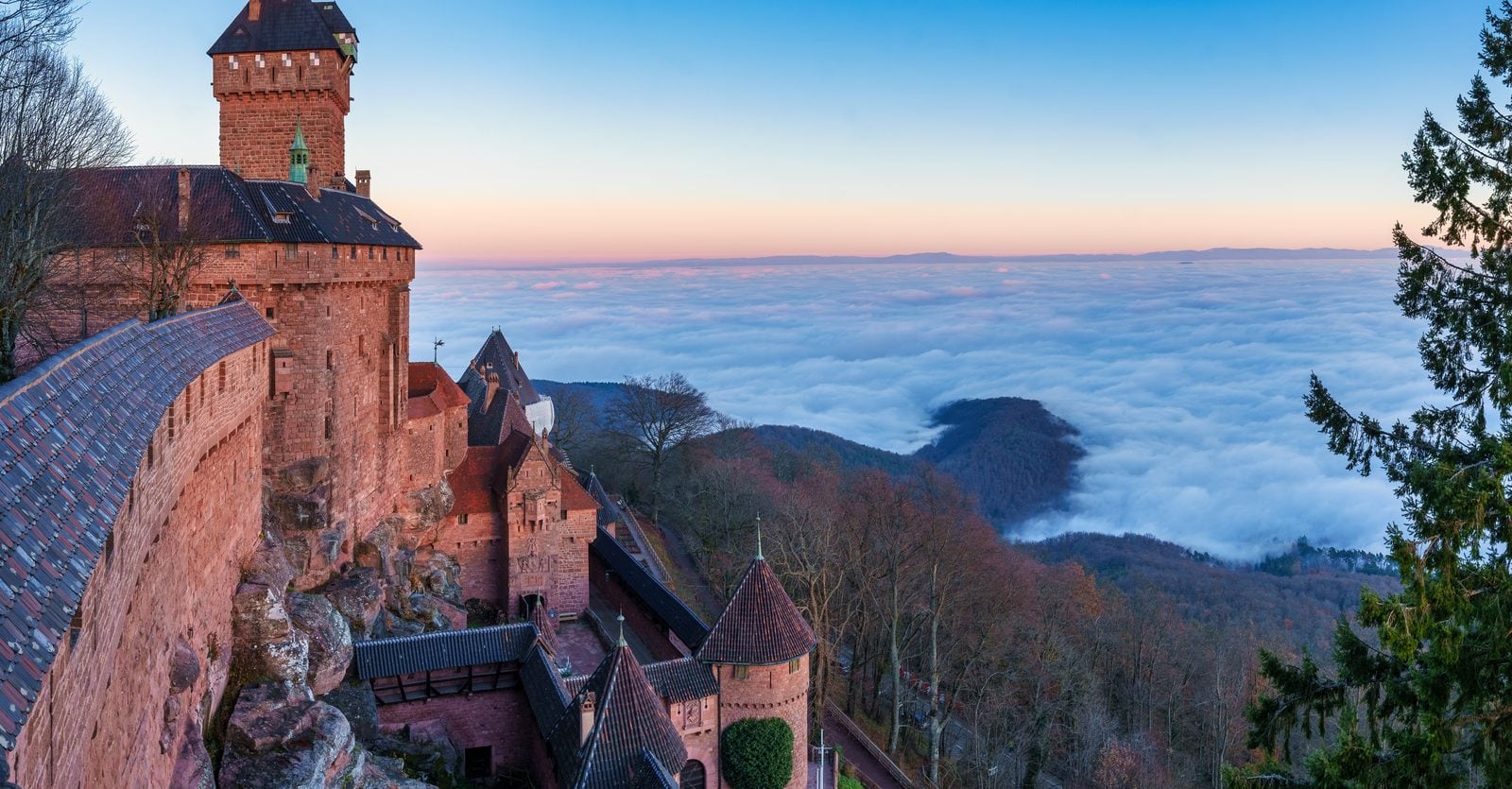
The castles of Alsace crowd the eastern face of the Vosges like watchtowers on a single long wall, and in a sense that is what they were. The Alsace tourism agency calls the region one of the European regions with the most castles, counting close to five hundred by the end of the Middle Ages; some eighty surviving hill-castle sites remain today, scattered across the whole of Alsace, and a waymarked 450-kilometer walking route, the chemin des châteaux forts d’Alsace, runs the length of the range from Wissembourg to Thann, with the Club Vosgien maintaining the waymarking. No other French region carries its Middle Ages so visibly on the skyline.
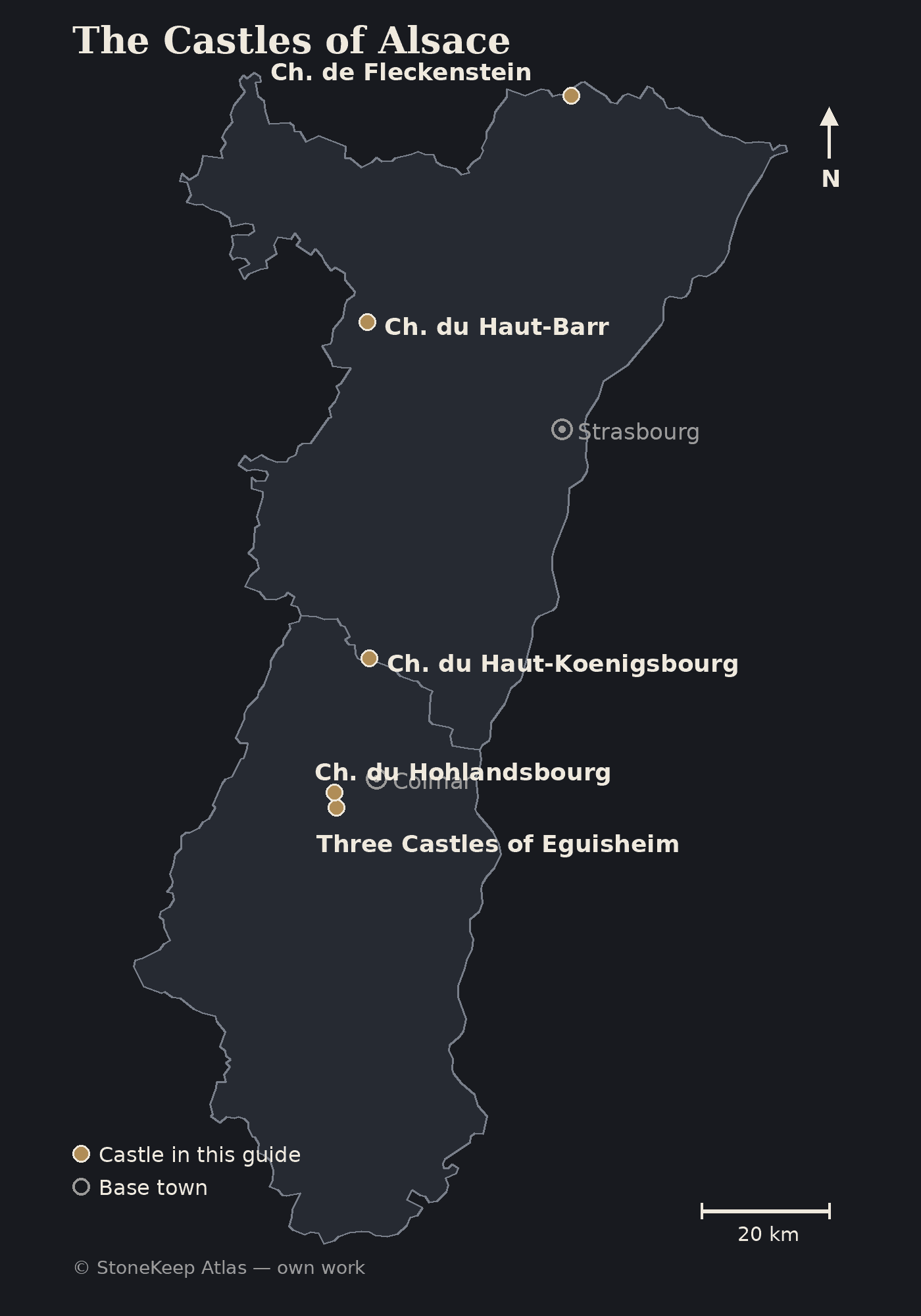
This guide gathers the five castles of Alsace covered in depth on StoneKeep Atlas, and reads them in order as one story. A dynasty that gave the Church a pope, a bishop who watched a city from a rock, a baronial family on the northern frontier, a Habsburg garrison above Colmar, and finally a German emperor who rebuilt a ruin to claim the whole region: five castles, most of them raised in the pink sandstone of the Vosges, that together tell the history of who held Alsace, and who lost it.
The Castles of Alsace at a Glance
| Castle | Near | Character | Getting there |
|---|---|---|---|
| Three Castles of Eguisheim | Eguisheim / Husseren-les-Châteaux | Three ruined keeps of the counts of Eguisheim | On foot from Husseren; access road closed to cars November 15 to March 15 |
| Château du Haut-Barr | Saverne | The bishops of Strasbourg’s Eye of Alsace | 2.5 km up the D171 from Saverne; free, open year-round |
| Château de Fleckenstein | Lembach | Semi-troglodytic rock castle of the northern Vosges | About 7 km north of Lembach by forest road |
| Château du Hohlandsbourg | Colmar | Habsburg garrison fortress, partly rebuilt | Route des Cinq Châteaux above Wintzenheim; open roughly April to early November |
| Château du Haut-Kœnigsbourg | Sélestat | Medieval castle rebuilt whole, 1900–1908 | About 12 km west of Sélestat; open daily except January 1 and December 25–26 |
Three Castles of Eguisheim: the Dynasty That Made a Pope
The story starts on a single ridge above the wine village of Eguisheim, where three square keeps stand in a row: the Dagsbourg to the north, the Wahlenbourg in the middle, the Weckmund to the south. This was the seat of the counts of Eguisheim, one of the great families of early Alsace, and it enters written history around 1016 in the biography of the family’s most famous son. Bruno of Eguisheim, born in 1002, grew up inside these walls and was elected pope in 1049 as Leo IX, one of the great reforming popes of the Middle Ages and the only one raised in an Alsatian castle.
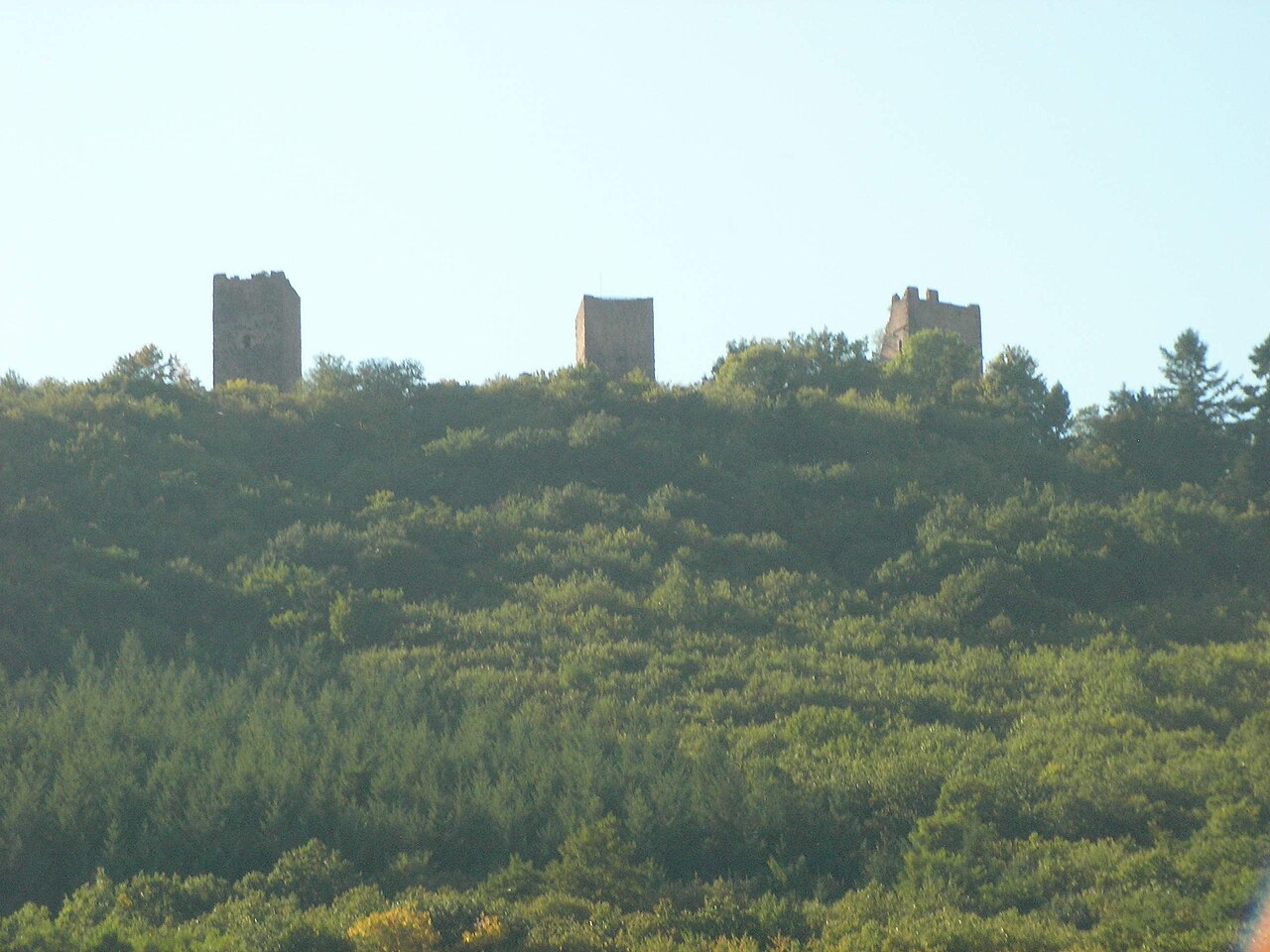
The dynasty died out in 1144, and the divided hilltop became a prize. The counts of Dabo raised the great north keep around the middle of the twelfth century, the counts of Ferrette held the south, and the bishop of Strasbourg bought his way in; on June 8, 1228, at Blodelsheim, Bishop Berthold de Teck defeated the count of Ferrette in battle to secure the claim, and by 1251 the count’s heir did homage to the bishop, making the ridge one lordship again. The end came in a single day. On June 4, 1466, during the Six Deniers War, contingents from the towns of the region took the castles and burned them, and nobody ever rebuilt. The three towers were classified as Monuments Historiques on the first French list of 1840 and stand today as free, open ruins about 500 meters above sea level. Read the full story in the full guide to the Three Castles of Eguisheim.
Château du Haut-Barr: the Eye of Alsace
If the Eguisheim towers belong to a dynasty, the Haut-Barr belongs to an office. First mentioned in 1112, the castle stretched along a 250-meter sandstone bar above Saverne was for centuries the stronghold of the bishops of Strasbourg, who kept it precisely because of what could be seen from it: the whole plain below, the road through the Vosges at their feet, and the city they claimed on the horizon. Its old Latin name, Oculus Alsatiae, the Eye of Alsace, is a job description.
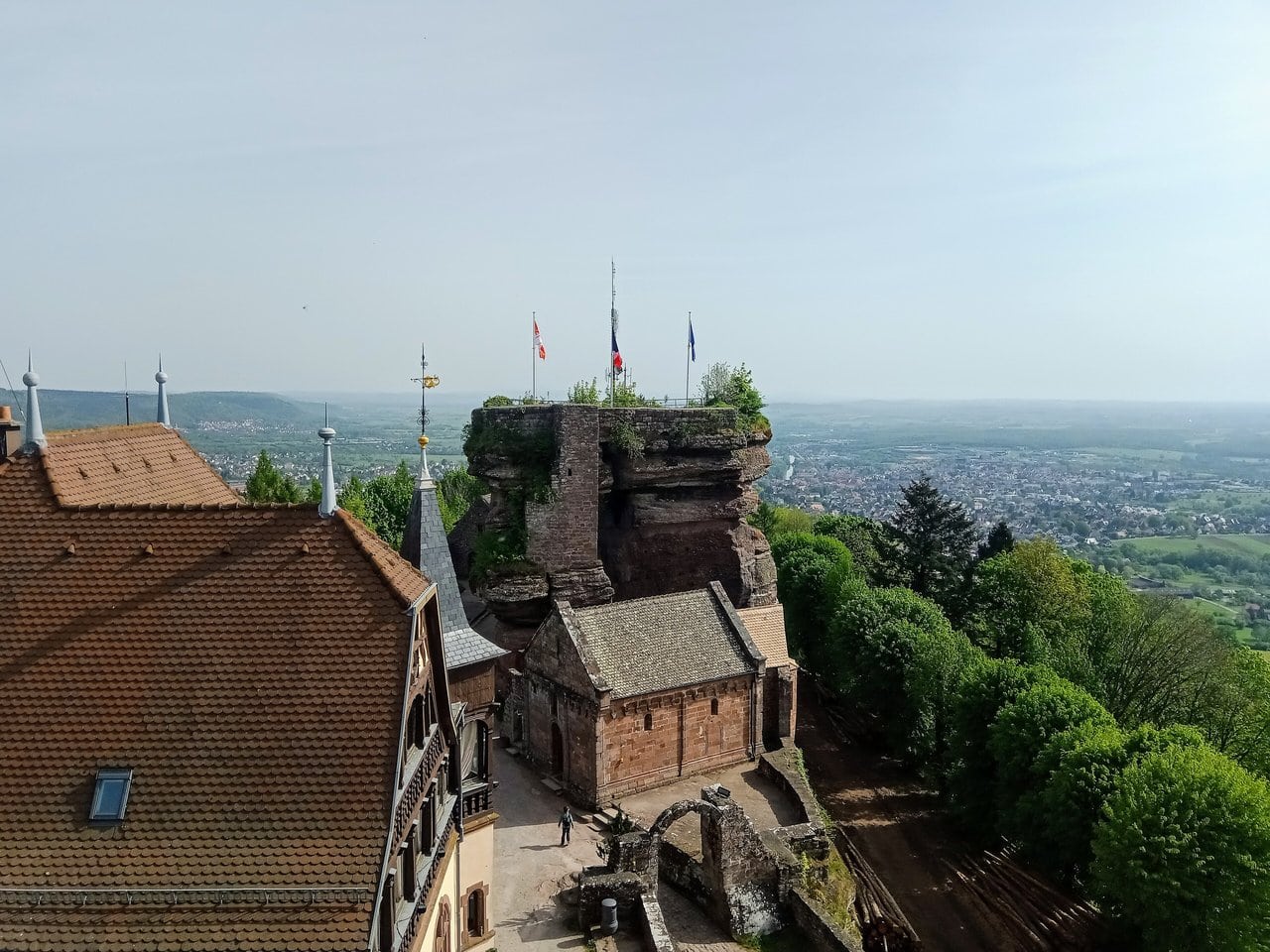
The castle’s great builder came late. Jean de Manderscheid, prince-bishop of Strasbourg from 1569 to 1592, rebuilt the Haut-Barr between 1583 and 1586 and left his Renaissance portal, dated 1583, as the ruin’s finest doorway. The refit bought less than a lifetime: the Thirty Years’ War finished the castle’s importance, and in the war’s aftermath, as Alsace passed into the French kingdom, demolition crews brought down its tall defenses between November 1649 and October 1650. The rock never lost its usefulness, though. A Chappe optical telegraph relay went up on the castle rock in 1798, and the city of Saverne built a restaurant among the ruins in 1901 that still serves visitors today. What survives is remarkable: walls and rock stairs across three linked summits, an intact Romanesque chapel, and the little footbridge visitors know as the Devil’s Bridge, all of it free to see. Read the full story in the full guide to the Château du Haut-Barr.
Château de Fleckenstein: the Rock That Was Never Taken in Battle
Far to the north, where the Vosges run up against what is now the German border, the Château de Fleckenstein is less a building on a rock than a building made of one. The barons of Fleckenstein, first documented in 1174, carved their castle directly into a sandstone bar about 100 meters long: staircases, chambers, and cellars hewn from the stone itself, with the masonry works riding on top. The fortress engineer Daniel Specklin, surveying it in the 1580s, thought it an ideal castle, and for four centuries its position on a near-unclimbable rock gave it a name for impregnability that went untested through the whole of the Middle Ages.
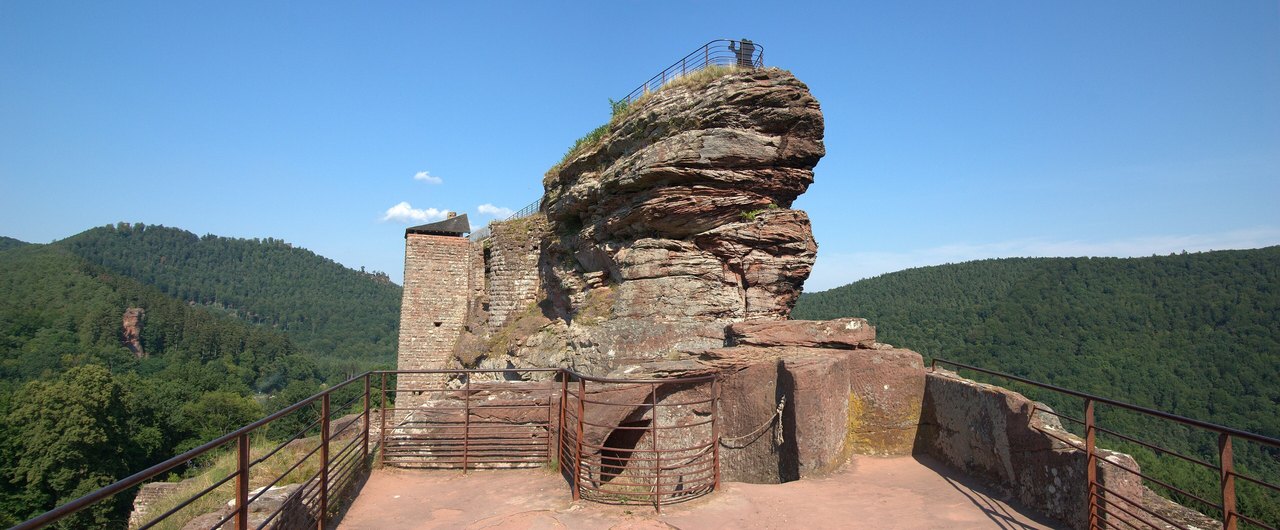
Louis XIV’s armies ended the argument without testing it either: when they pressed into Alsace in the later seventeenth century, the castle was taken without a fight and then blown apart. Even the date is a puzzle. The French heritage register places the demolition in 1689 under General Mélac; the castle’s own historians and the German record put it in 1680, on General Montclar’s orders. The sources genuinely disagree, and the castle keeps the mystery. What is certain is that the rock castle never rose again, was classified a Monument Historique in 1898, and is today one of the most rewarding ruins in Alsace to climb through, with a family challenge trail at its feet. Read the full story in the full guide to the Château de Fleckenstein.
Château du Hohlandsbourg: the Habsburg Fortress Above Colmar
The Château du Hohlandsbourg is the odd one out in the pink-sandstone family: it rises on a flat granite summit above Wintzenheim, a short drive west of Colmar, at 620 meters above sea level. It was built for control, founded in 1279 by Siegfried de Gundolsheim, provost of Colmar, on behalf of the Habsburgs, who wanted a fortress watching the free imperial city below. By 1410 it had passed to the counts of Lupfen, and in 1466 the count rode with the noble league against Mulhouse in the same Six Deniers War that burned the three keeps of Eguisheim, two castles of this guide caught up in one small, vicious conflict.
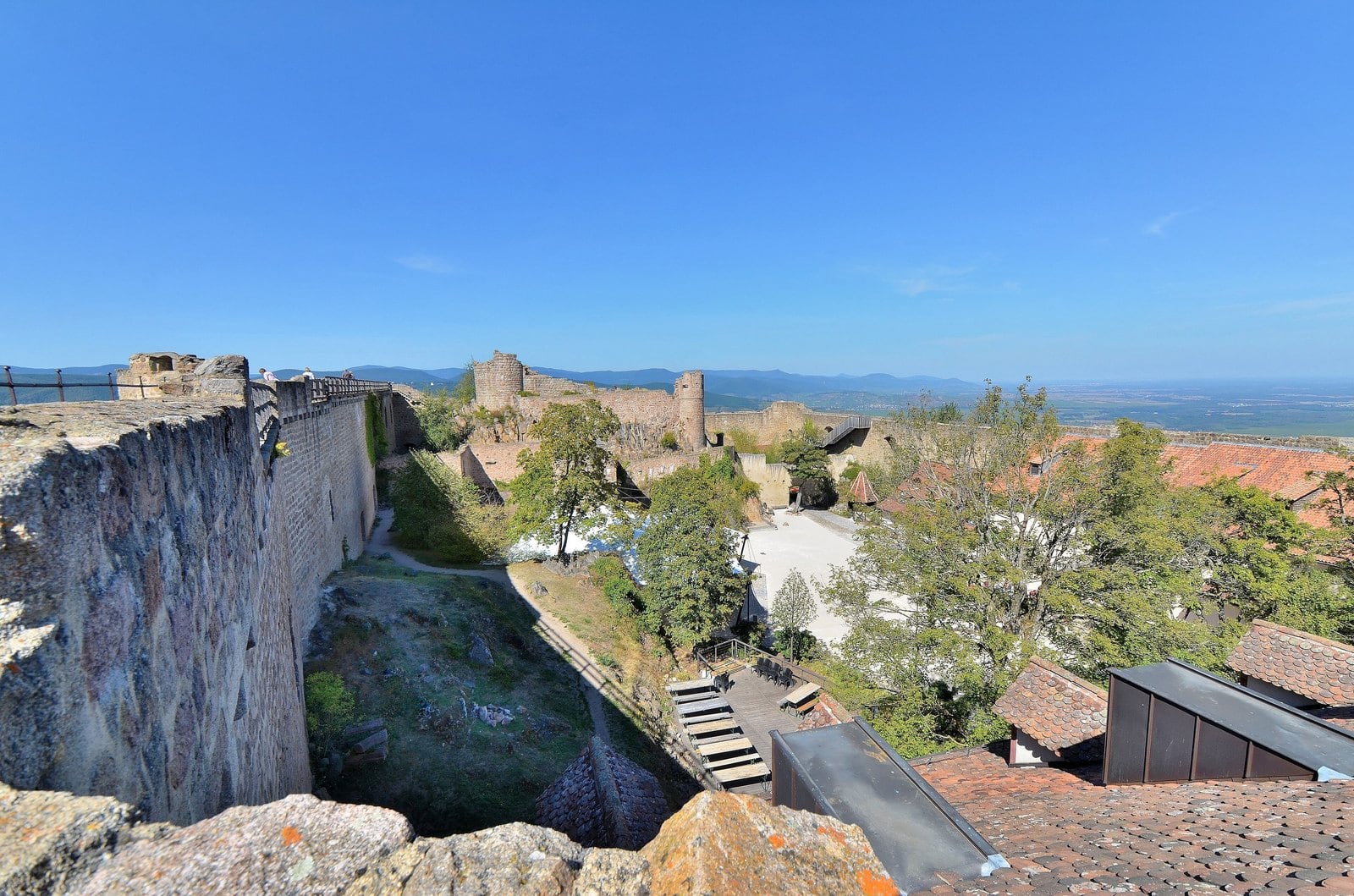
In the sixteenth century Lazarus von Schwendi, imperial soldier and lord of the castle, refitted it for artillery, but the Thirty Years’ War caught it anyway: French troops destroyed the Hohlandsbourg in 1637. A major reconstruction campaign in the 1990s gave the ruin back its living quarters and a covered wall-walk with an uninterrupted 360-degree view over the plain of Alsace, the Vosges, and the Black Forest, and its promoters describe it as the largest surviving Habsburg monument in Upper Alsace, a claim worth noting as their framing. The Collectivité européenne d’Alsace runs it today as a cultural and events venue. Read the full story in the full guide to the Château du Hohlandsbourg.
Château du Haut-Kœnigsbourg: the Castle Rebuilt Whole
Every thread in this story runs through the Château du Haut-Kœnigsbourg. A medieval fortress on a 757-meter spur, it was besieged by a Swedish force in 1633, plundered, and burned, and for more than two centuries it stood as a roofless shell like its neighbors. Then, in 1899, the town of Sélestat made a calculated gift of the ruin to Emperor Wilhelm II, and Alsace’s German ruler saw his chance. Between 1900 and 1908 the Berlin architect Bodo Ebhardt rebuilt the castle whole, as research and as propaganda: a complete medieval fortress, resurrected to declare that Alsace’s past, and therefore Alsace, was German. Ebhardt marked every new stone he set, and the marks form an eight-year calendar in the walls, so a visitor who knows to look can still read which stones are old and which are his.
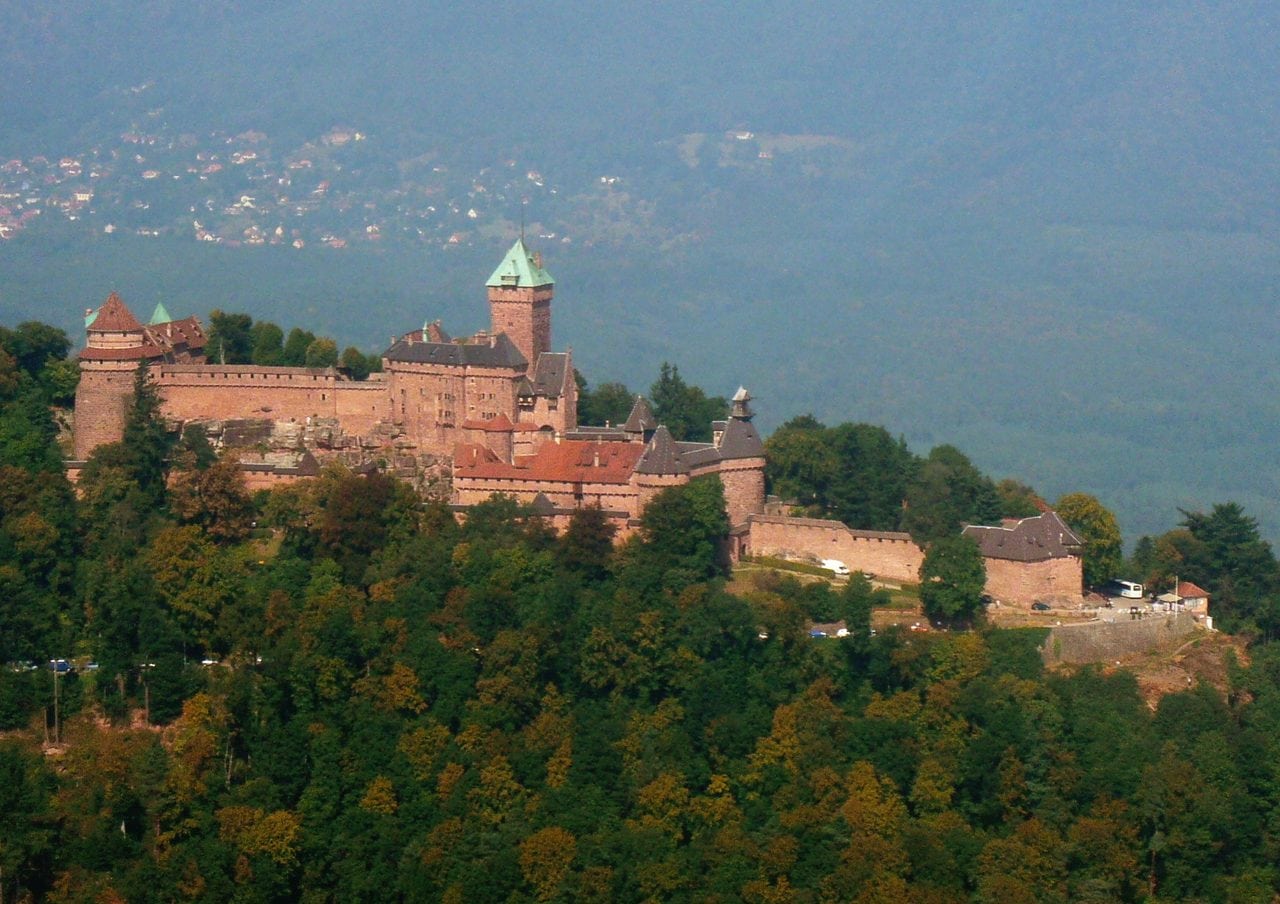
History answered. The Treaty of Versailles returned Alsace to France in 1919, and the Kaiser’s monument became a French national one, the grandest expression of the nineteenth-century Romantic castle revival on what is now French soil, and a stone summary of the long contest over the Rhine. Today the Collectivité européenne d’Alsace runs it as one of the most visited monuments in France and the most visited castle in Alsace, drawing close to six hundred thousand visitors in 2023. Whatever one thinks of Wilhelm’s politics, the visit is extraordinary: the one place in the region where you can walk a complete Alsatian castle, roofs, kitchens, keep, and all. Read the full story in the full guide to the Château du Haut-Kœnigsbourg.
Beyond These Five
Five castles are a beginning, not an inventory. The Route des Cinq Châteaux, the ridge road between Wintzenheim and Husseren-les-Châteaux, links the Hohlandsbourg and the three Eguisheim keeps with the watch-post of Pflixbourg, and hides little Hagueneck in a side valley for good measure. Below the Haut-Kœnigsbourg sit the quiet ruins of the Oedenbourg, a reminder of what the great castle would have remained without an emperor’s money. From Fleckenstein, a walker’s circuit reaches three more border ruins, Hohenbourg, Löwenstein, and Wegelnburg, the last of them across the line in the German Palatinate. Farther south, names like Ortenbourg, Bernstein, and the three castles of Ribeauvillé wait on the same mountain front, stops on the long castle trail that threads the ruins of Alsace together from north to south.
Alsace is also one of five great French regions gathered on StoneKeep Atlas, and the whole map, from the Loire to the Pyrenees, comes together in our national guide to the Châteaux of France. Westward lie the châteaux of the Loire Valley, the royal houses of the Renaissance; around the capital, the royal residences of the Île-de-France and the châteaux of the Oise; and in the far south, the castles of Provence.
Planning a Visit
The five castles split naturally into two trips. In the south, Colmar makes an ideal base: the Hohlandsbourg and the Eguisheim towers stand on the same ridge a short drive west of town, and the Château du Haut-Kœnigsbourg rises about 12 kilometers west of Sélestat, an easy outing north along the wine road. In the north, Saverne puts the Haut-Barr on its doorstep, and Fleckenstein rewards the drive into the forest beyond Lembach. Mind the seasons: the Hohlandsbourg opens roughly April to early November, the road up to the Eguisheim castles closes to cars from November 15 to March 15, and the Haut-Kœnigsbourg alone stays open essentially year-round. The Haut-Barr and the Eguisheim towers are free; the three managed castles charge admission and are worth it.
If you are planning a castle trip through Alsace, Colmar and Saverne make the natural bases. You can compare hotels in Colmar on Booking.com, and book castle tickets and regional tours in advance through GetYourGuide, which is worth doing in high season for the Haut-Kœnigsbourg especially.
Some links on this page are affiliate links, which means StoneKeep Atlas may earn a small commission, at no extra cost to you, if you book through them.
Five Castles, One Region
Read together, the five castles of Alsace are the region’s history in stone. A great dynasty rose and vanished on the ridge at Eguisheim; the bishops of Strasbourg watched their unruly city from the Haut-Barr; the barons of Fleckenstein held the northern frontier from a rock nobody could climb; the Habsburgs garrisoned the Hohlandsbourg to keep Colmar honest. And when all of them had burned or fallen, in the town wars, the Thirty Years’ War, and Louis XIV’s demolitions, a German emperor rebuilt the Haut-Kœnigsbourg to argue about what it all meant. The argument is over; the castles remain; and there is no better place in France for walking from one century to the next along a single mountain wall.
Principal Sources
- Visit Alsace (official regional destination site), “Castles in Alsace,” visit.alsace.
- Alsace Destination Tourisme, “Châteaux et cités fortifiées,” alsace-destination-tourisme.com.
- Collectivité européenne d’Alsace, castle heritage pages, alsace.eu.
- Official castle sites: haut-koenigsbourg.fr; chateau-hohlandsbourg.com; fleckenstein.fr; tourisme-saverne.fr; tourisme-eguisheim-rouffach.com.
- Thomas Biller and Bernhard Metz, Die Burgen des Elsass, studies on the architecture and building history of Alsatian castles.
- Nicolas Mengus and Jean-Michel Rudrauf, Châteaux forts et fortifications médiévales d’Alsace (2013).
- The five StoneKeep Atlas castle guides linked above, each with its own full source apparatus.
Image credits. Hero (Château du Haut-Kœnigsbourg above a sea of cloud at dawn): Adobe Stock, royalty-free; Locator map: © StoneKeep Atlas (own work); The Three Castles above Husseren-les-Châteaux: Gzen92, CC BY-SA 4.0, via Wikimedia Commons; View from the Haut-Barr over Saverne: Rémih, CC BY-SA 4.0, via Wikimedia Commons; Fleckenstein panorama: Ambroise1415, CC BY-SA 3.0, via Wikimedia Commons; Hohlandsbourg curtain walls and round tower: Patrick from Compiègne, CC BY-SA 2.0, via Wikimedia Commons; Haut-Kœnigsbourg on its ridge: Wrtalya, CC BY-SA 4.0, via Wikimedia Commons. Freely licensed images are resized to fit; otherwise unaltered.