
Charlottenhof Palace
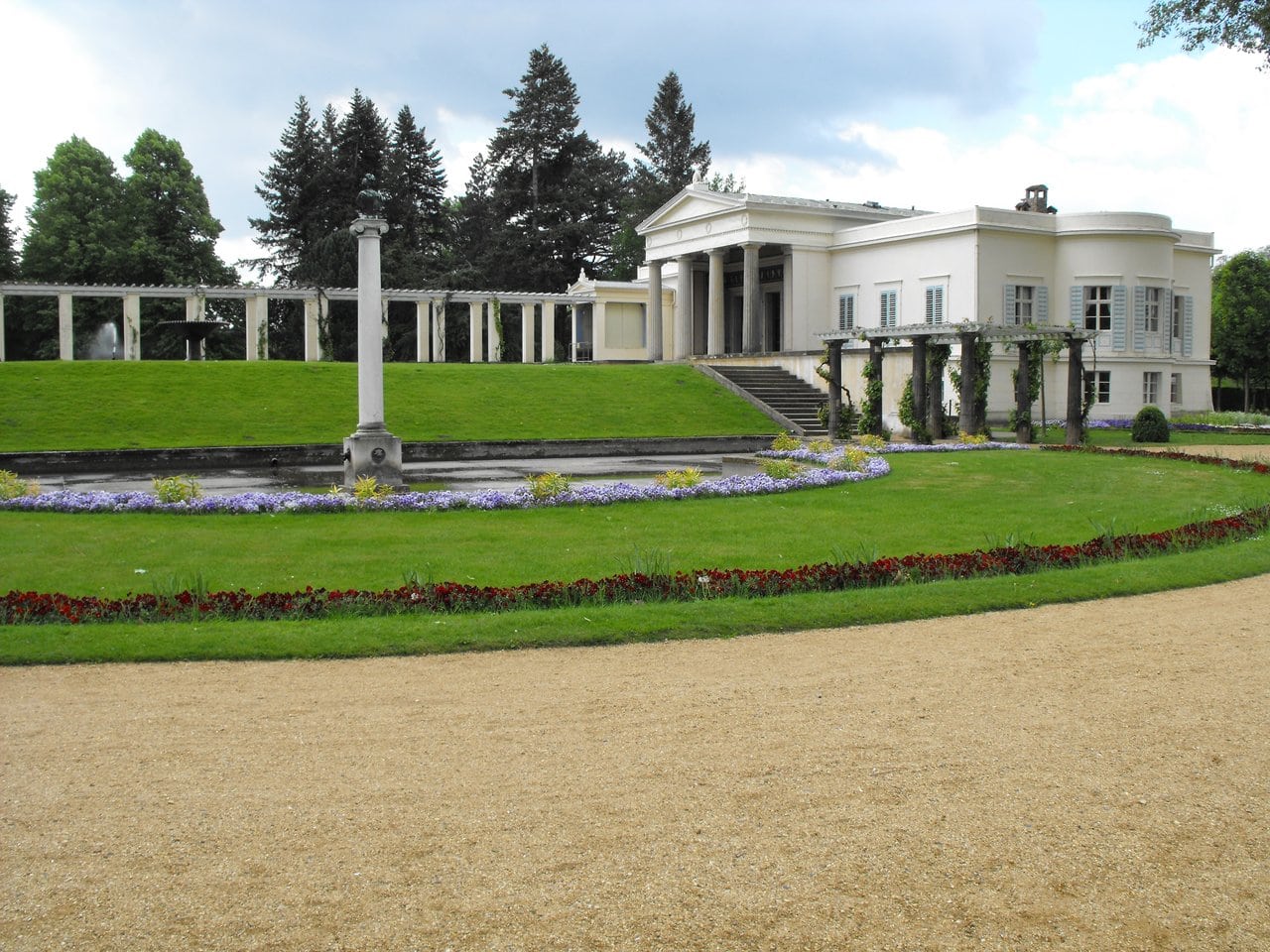
In the quiet southwestern corner of Sanssouci Park, well away from the crowds that gather at Frederick the Great’s vineyard terraces, sits a small single-story villa that looks as though it has been lifted from the Roman Campagna. This is Charlottenhof Palace, the summer retreat that Crown Prince Frederick William of Prussia, the future King Frederick William IV, built for himself and his young wife between 1826 and 1829. It is the smallest of the royal residences in the park, and the most personal. Travelers sometimes confuse it with Charlottenburg, the grand Baroque palace in Berlin, yet the two share little beyond a similar name and a common steward.
What makes the place remarkable is not its scale but its idea. The crown prince, an obsessive amateur architect, worked alongside Karl Friedrich Schinkel and the landscape gardener Peter Joseph Lenné to turn a patch of damp farmland into a complete vision of an idealized antiquity. He called his creation “Siam,” a private name for the land of the free, and treated it as a refuge from the rituals of court. Built in stone, water, and planting, the result is one of the purest expressions of the Schinkel school in Germany, and the quiet heart of the Prussian Arcadia that earned Charlottenhof Palace its place within the Potsdam world heritage landscape.
Quick Facts
| Location | Potsdam, Germany (southern Sanssouci Park) |
| Built | 1826 to 1829, on the foundations of an older manor house |
| Style | Neoclassical, in the manner of a Roman villa |
| Patron | Crown Prince Frederick William, later King Frederick William IV (1795 to 1861), with Princess Elisabeth |
| Architect | Karl Friedrich Schinkel, assisted by Ludwig Persius |
| Landscape | Peter Joseph Lenné |
| Owner | Stiftung Preußische Schlösser und Gärten Berlin-Brandenburg (SPSG) |
| UNESCO | Part of the Palaces and Parks of Potsdam and Berlin (World Heritage Site 532) |
| Open to public | May to October, Tuesday to Sunday (guided tour only) |
| Official site | spsg.de |
A Christmas Gift at the Edge of Sanssouci
The land had a modest history. A manor house and farmstead known as the Büringsches Vorwerk had stood on the low ground south of Sanssouci since the previous century, raised by Jan Bouman, the Dutch master builder who had also constructed Sanssouci itself for Frederick II. Ownership passed through several families. One owner, Maria Charlotte von Gentzkow, the wife of a chamberlain who held it in the early 1790s, left behind the name it still carries: Charlottenhof, Charlotte’s court.
In 1825, King Frederick William III bought the property and gave it to his eldest son as a Christmas present. The crown prince was thirty, recently married to Elisabeth Ludovika of Bavaria, and eager for a project of his own. His allowance was modest and the budget stayed tight, but he had Schinkel, the most gifted architect in the kingdom, and a head full of images of Italy, where he had traveled as a younger man. A tired farmhouse on damp soil was, to his eye, a blank canvas.
Schinkel’s Roman Villa
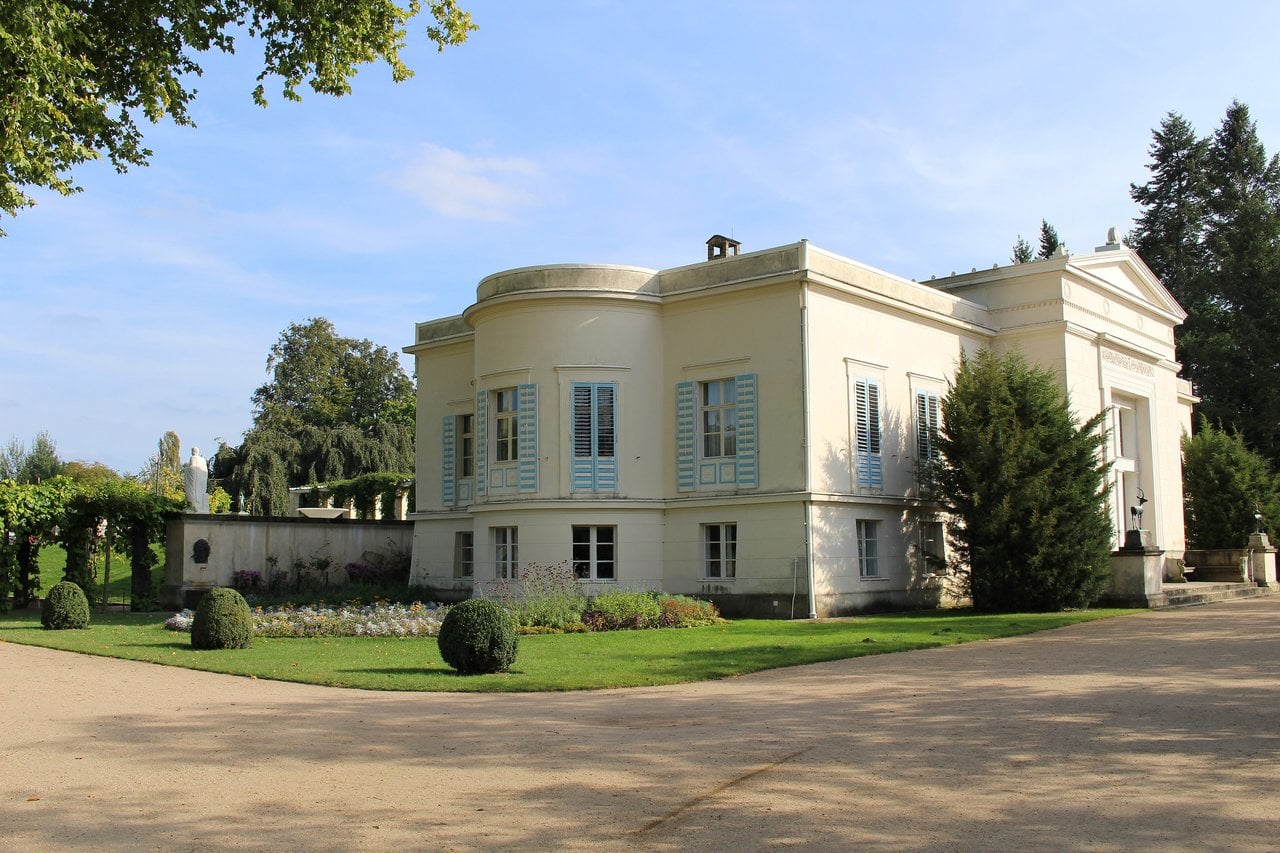
Rather than tear down the old house, Schinkel set the new villa on its foundations, a thrifty decision that shaped everything above it. Between 1826 and 1829 he raised a low, white, single-story building with the calm proportions of antiquity, its garden front opening through a Doric portico onto a terrace and a small pool. His model was explicitly Roman. The crown prince and his architect drew on the letters of Pliny the Younger, who had described his own country villas at Laurentinum near the sea and Tusci in the Tuscan hills, and turned those word-pictures into a real house in Brandenburg.
Schinkel laced the design with archaeological quotation. Its entablature borrowed from the Choragic Monument of Thrasyllus on the Athenian Acropolis, a motif he had already used at his royal theater in Berlin. None of it felt like a museum piece, though. The villa reads as a place to live in, scaled to a couple rather than a court. The crown prince was no passive client: he covered sheet after sheet with his own sketches, and few of his many projects absorbed him so completely.
“Siam”: A Crown Prince’s Arcadia
That official name honored an obscure eighteenth-century chatelaine; the prince’s private name for the place revealed far more. He called it “Siam,” after the distant kingdom then imagined in Europe as a land of freedom beyond the reach of duty and politics. To him the villa was an Arcadia, a deliberate counter-world to the stiff machinery of the Berlin court. He signed many of his drawings “Fritz-Siam-Butt,” folding in his own nickname, der Butt, the flounder. This same flatfish later surfaced in stone at the neighboring Roman Baths, where water pours from its mouth into a basin shaped like a sarcophagus, a quiet joke about the master of the house.
His fantasy was earnest as well as playful. Charlottenhof was where a future king worked out, in plaster and planting, a private philosophy of retreat and beauty. None of the romantic, medievalizing taste that would later drive his Gothic projects, the Rhine castle at Stolzenfels and the family’s summer palace at Babelsberg, appears here. At Charlottenhof he chose the south rather than the Middle Ages, sunlight rather than shadow, and the result is the most serene thing he ever helped to build.
Inside the Villa
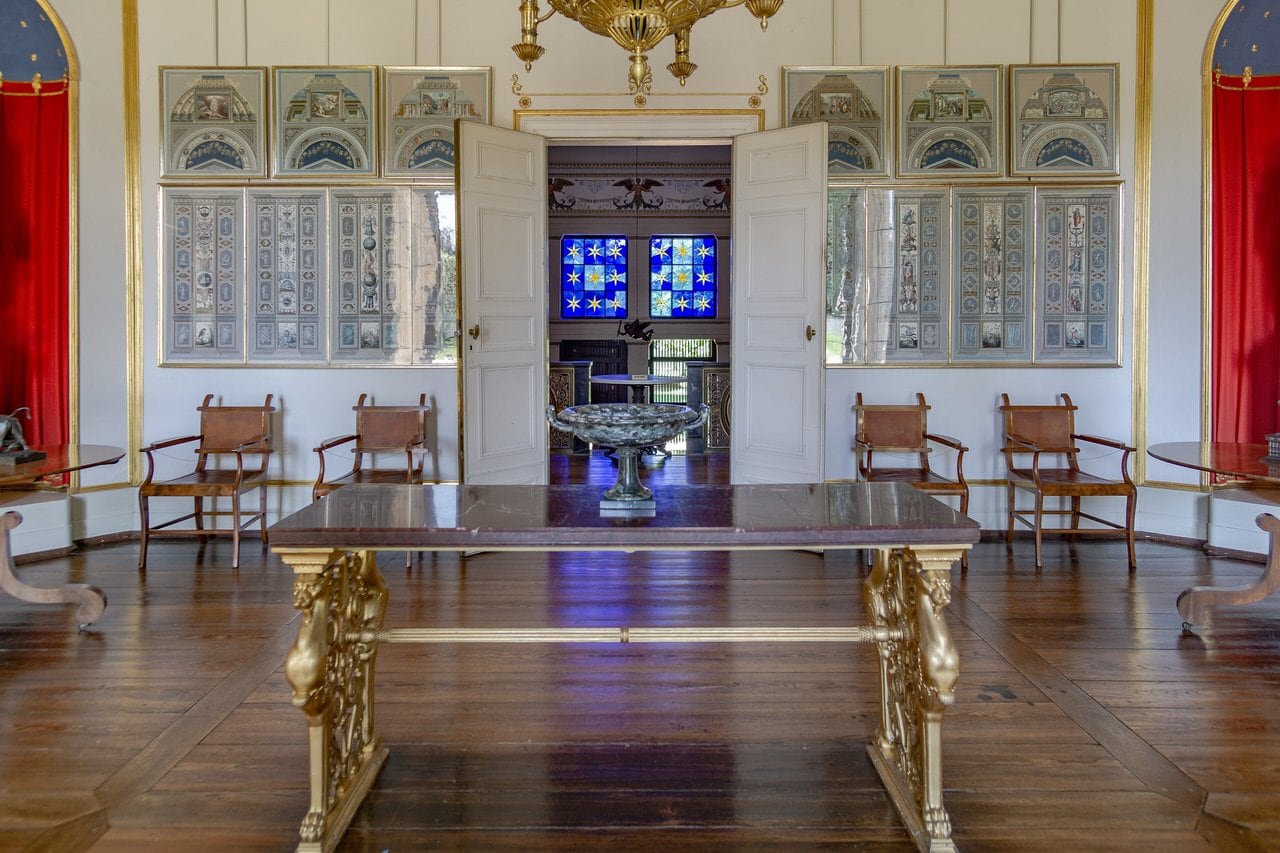
The interior holds about ten rooms, most of them still furnished with pieces Schinkel designed himself. A blue-and-white scheme runs through the shutters and fabrics, a nod to Elisabeth’s Bavarian homeland. Her writing cabinet glints with silvered furniture, the dining room centers on a gilded table, and the entrance hall is lined with crimson cloth fixed by gilt-headed pins.
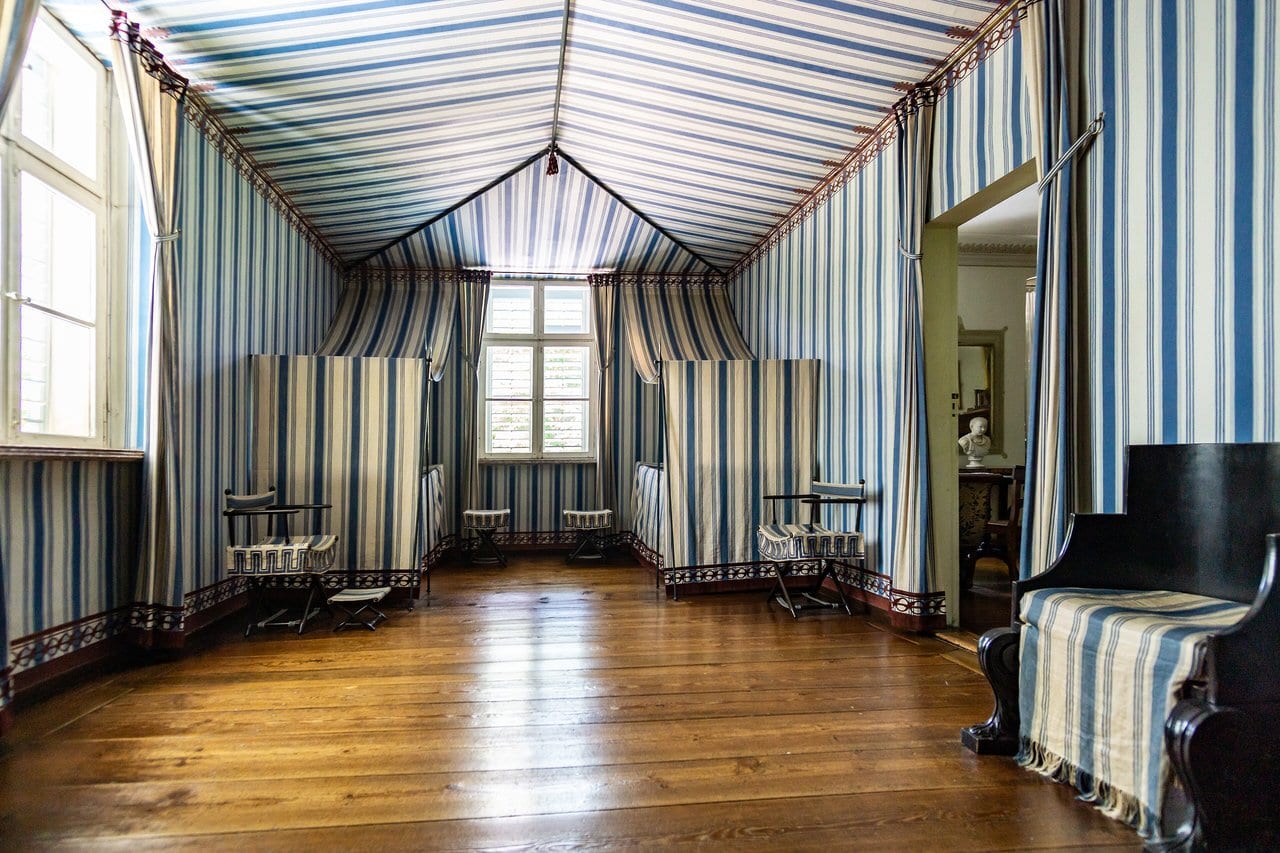
The most famous room is the smallest. A corner of the villa holds the Tent Room, wrapped floor to ceiling in blue-and-white striped fabric as if a Roman general’s campaign tent had been pitched indoors. It served as a guest bedroom, usually for the princess’s ladies-in-waiting. Alexander von Humboldt, the great naturalist and family friend, slept here during summers in the late 1830s, which has linked the room to his name ever since, though it was never built as his quarters. Theatrical and intimate at once, it captures the whole spirit of the house: serious craft in the service of a daydream.
Lenné’s Garden and the Water Idyll
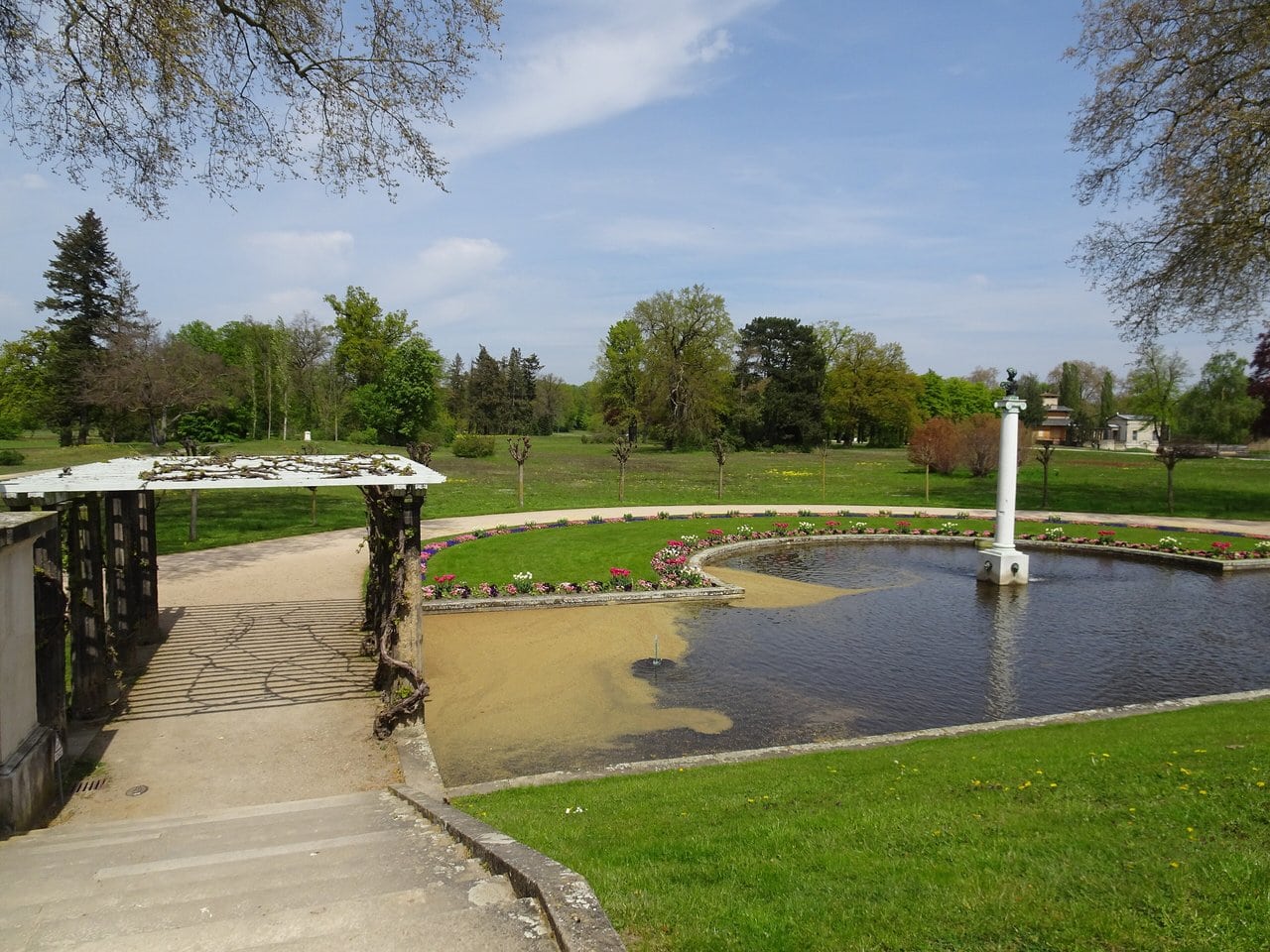
A villa in the Roman manner needed a landscape to match, and that task fell to Peter Joseph Lenné. He drained the marshy farmland and shaped it into an English garden tuned to the movement of the sun. A rose garden to the east catches the morning light; the terrace along the house takes the midday sun; and to the west lie a poets’ grove and a copy of the Ildefonso group of sculpture for the evening hours. An artificial lake completed the scene, and long sight-lines threaded the new grounds back into old Sanssouci so the two read as one.
Water was the connecting thread of the whole design. Charlottenhof’s fountain first played on New Year’s Day in 1828, making it the oldest working water feature in Sanssouci Park, and the palace foundation restored its historic machinery in 2014. From the villa, the water scheme runs on toward the Roman Baths, binding house, garden, and bathhouse into a single composition of architecture and nature.
Visiting Charlottenhof Palace
Charlottenhof opens for the warm season, from May to October, Tuesday through Sunday, with the building closed on Mondays. The interior can be seen only on a guided tour, given in German, with printed information available in other languages; the last admission falls thirty minutes before closing. A single ticket costs around 8 euros, or 6 reduced. The Prussian palace foundation’s combined “sanssouci+” day ticket, at roughly 22 euros (17 reduced) or 49 for a family, covers Charlottenhof along with the other Potsdam palaces open that day and is the better value if you plan to see several. Entry tickets and local tours can also be booked in advance through GetYourGuide.
The villa stands at Geschwister-Scholl-Straße 34a in Potsdam, in the southwestern reaches of Sanssouci Park. It is about a thirty-minute walk from Sanssouci Palace itself, and the approach through Lenné’s grounds is part of the pleasure. Hours and prices shift from season to season, so it is worth checking the foundation’s site before a visit. Anyone staying overnight can compare hotels in and around Potsdam.
Some links on this page are affiliate links, which means StoneKeep Atlas may earn a small commission, at no extra cost to you, if you book through them.
Beyond the Palace
A few steps from the villa lie the Roman Baths, a cluster of buildings that Schinkel and Persius added between 1829 and 1840: a court gardener’s house with an Italian tower, a pergola, arcades, and the bath rooms around a pool. This cluster forms a separate ensemble rather than part of the palace, and it is currently closed for a full restoration expected to run into the late 2020s. It remains the perfect companion to Charlottenhof, the same dream carried a little further. It is the clearest single statement of the design idea traced in our history of Schinkel, Persius, and the Prussian Romantic landscape.
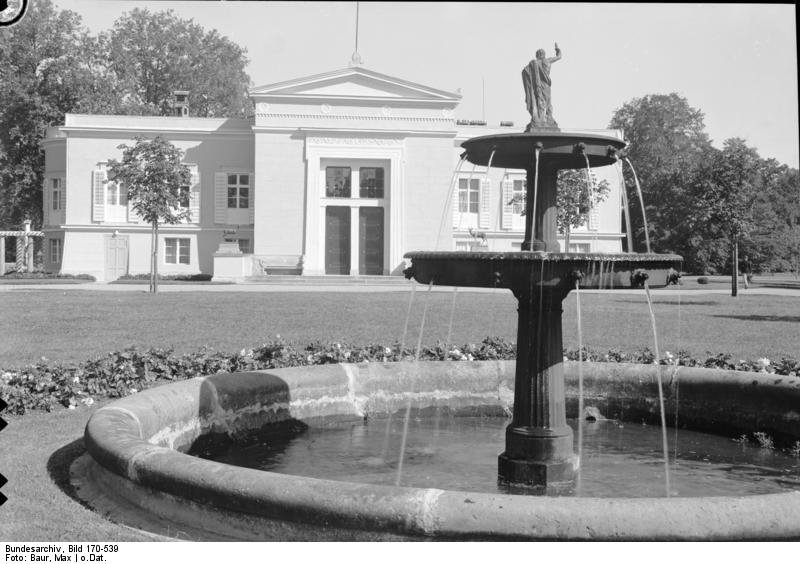
Charlottenhof also belongs to a small family of villa-and-park residences that Prussia’s royal house built along the Havel in the same generation. Its near-contemporaries at Glienicke and Babelsberg, a garden palace and a summer castle, share its scale, its landscape thinking, and in part its designers. Together with the great showpieces of Sanssouci and the New Palace nearby, they make the Potsdam park one of the densest concentrations of nineteenth-century landscape art in Europe.
Conclusion
Charlottenhof is easy to walk past. It is low, plain, and half-hidden in greenery, and it asks for none of the awe that a baroque facade demands. Linger, though, and it rewards attention more than almost anything else in the park. Here a young prince, an inspired architect, and a visionary gardener built a complete world out of very little money and a great deal of imagination, an Italian daydream made solid in the Brandenburg sand. As a piece of the World Heritage landscape of Potsdam and Berlin, it preserves the rare moment when Prussian power chose, for once, to dream of Arcadia rather than empire.
Principal Sources
- Hoffmann, Hans, and Renate Möller. Schloss Charlottenhof und die Römischen Bäder. Generaldirektion der Staatlichen Schlösser und Gärten Potsdam-Sanssouci, 1985.
- Schönemann, Heinz. Karl Friedrich Schinkel, Charlottenhof, Potsdam-Sanssouci. Stuttgart, 1997.
- Stiftung Preußische Schlösser und Gärten Berlin-Brandenburg. “Charlottenhof Villa.” spsg.de.
- UNESCO World Heritage Centre. “Palaces and Parks of Potsdam and Berlin.” whc.unesco.org.
- Whyte, Iain Boyd. “Charlottenhof: The Prince, the Gardener, the Architect and the Writer.” Architectural History 43 (2000): 1 to 23.
Image credits. Hero image: Krückstock, public domain, via Wikimedia Commons. Neoclassical villa and bronze gazelle: Angel Miklashevsky, CC BY-SA 4.0, via Wikimedia Commons. Tent Room and hall: Rainer Halama, CC BY-SA 4.0, via Wikimedia Commons. Garden pergola: Palickap, CC BY-SA 4.0, via Wikimedia Commons. Historic view: Bundesarchiv, Bild 170-539 / Max Baur / CC-BY-SA 3.0 (DE), via Wikimedia Commons. Freely licensed images are resized to fit; otherwise unaltered.