
Castles of Saxony
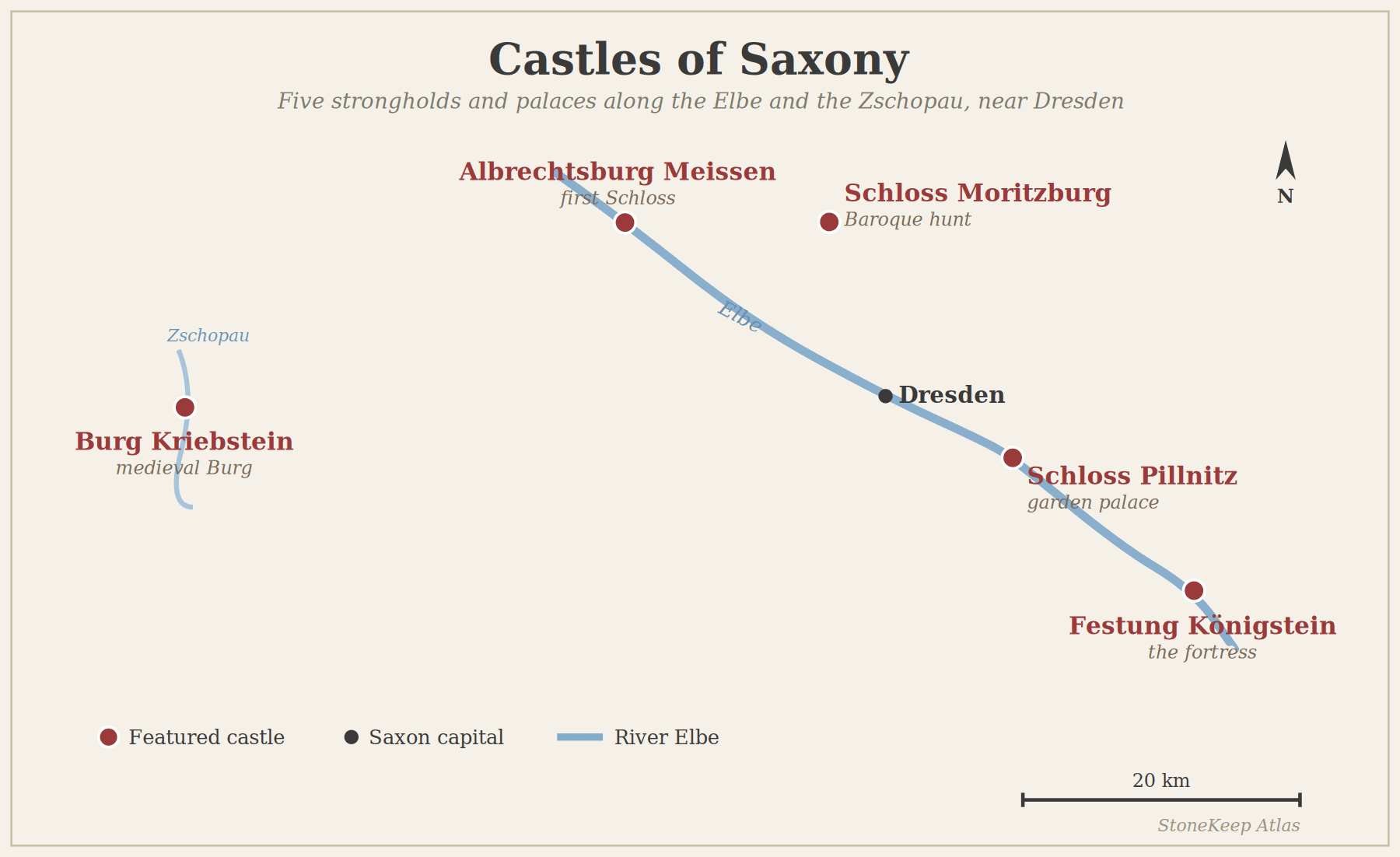
The castles of Saxony are not a single kind of building. Strung along the Elbe and its tributaries within an hour or two of Dresden, they range from a fortress that fills the top of a sandstone mountain to a summer palace painted with Chinese figures, and reading them in sequence is the closest thing Saxony offers to a guided tour through the changing idea of what a castle was for.
That sequence has a shape. The five gathered here trace a single arc, from defense to pleasure: the rock that was pure stronghold, the fortified noble household kept whole through six centuries, the building that first set out to be a residence rather than a fortress, and the two Baroque seats raised for the hunt and the garden. The connective thread is dynastic. Nearly all of them passed through the hands of the House of Wettin, the family that ruled Saxony as electors and later as kings from Dresden, and three of them carry the fingerprints of one man, Augustus the Strong, whose appetite for building and display reshaped the Saxon court in the early eighteenth century. Taken together the castles of Saxony are less a checklist of attractions than a chronicle in stone of how power in Saxony learned to stop defending itself and start enjoying itself.
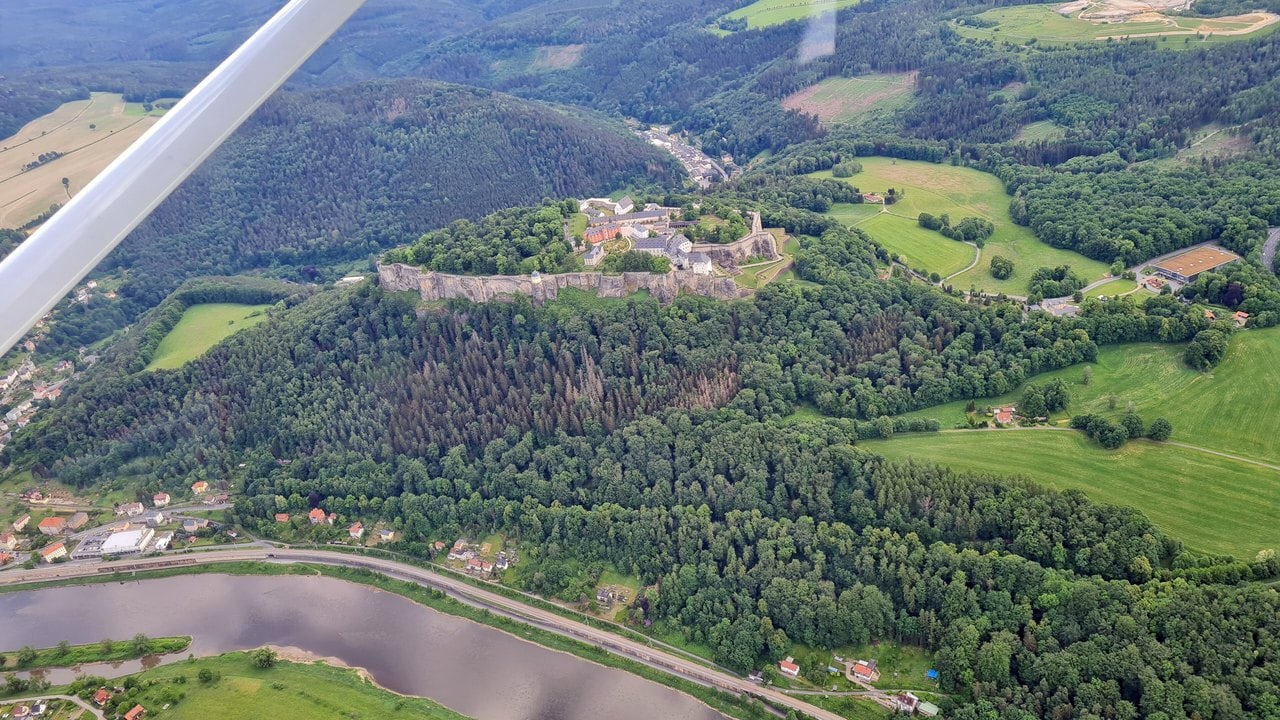
Königstein Fortress: the rock that was never stormed
Königstein is the castle as geology. A Festung, or fortress, rather than a residence, it occupies the entire flat summit of a sandstone table mountain that rises some 240 meters above the left bank of the Elbe in the hills of Saxon Switzerland, southeast of Dresden. Its rock appears in the written record in 1241, in a border charter sealed on the summit while the height still belonged to the Kingdom of Bohemia. Saxony’s rulers later recognized what the Bohemians had: a plateau ringed by near-vertical walls of rock needs very little help to be impregnable.
From 1589, Elector Christian I set about turning that natural advantage into Saxony’s strongest fortress, with the electoral master builder Paul Buchner directing the work, and the building continued into the nineteenth century. The result is a stone town in the sky, with barracks, magazines, a garrison church, and a well sunk on the orders of Elector August between 1563 and 1569 that drops 152.5 meters through the rock, the deepest in Saxony and among the deepest castle wells in Europe. It is often called the one that was never taken, and in the strict sense of an assault it never was; what the phrase leaves out is that Saxony usually capitulated before any siege, and that Prussian, French, Russian, and Soviet troops all occupied the rock peacefully at one time or another.
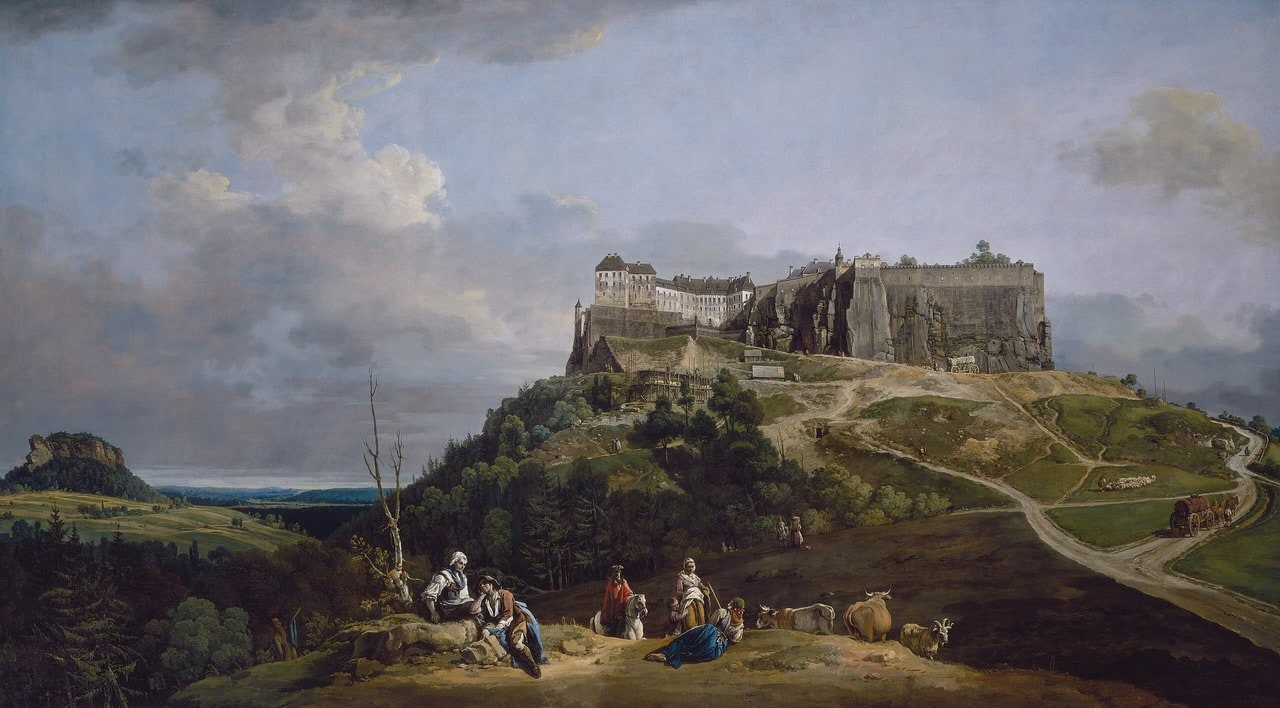
What Königstein did instead of fighting was hold things. It was the kingdom’s strongroom and its state prison, the place where the treasury and even the Meissen porcelain secret could be sent for safekeeping and where inconvenient men were locked away. Johann Friedrich Böttger, the alchemist who would help invent European porcelain, was held here for safety in 1706 and 1707 during the Swedish invasion. The Venetian painter Bernardo Bellotto recorded the fortress in five enormous canvases commissioned by the Saxon court around 1756, the grandest portrait any German fortress ever received.
Kriebstein Castle: the household that survived
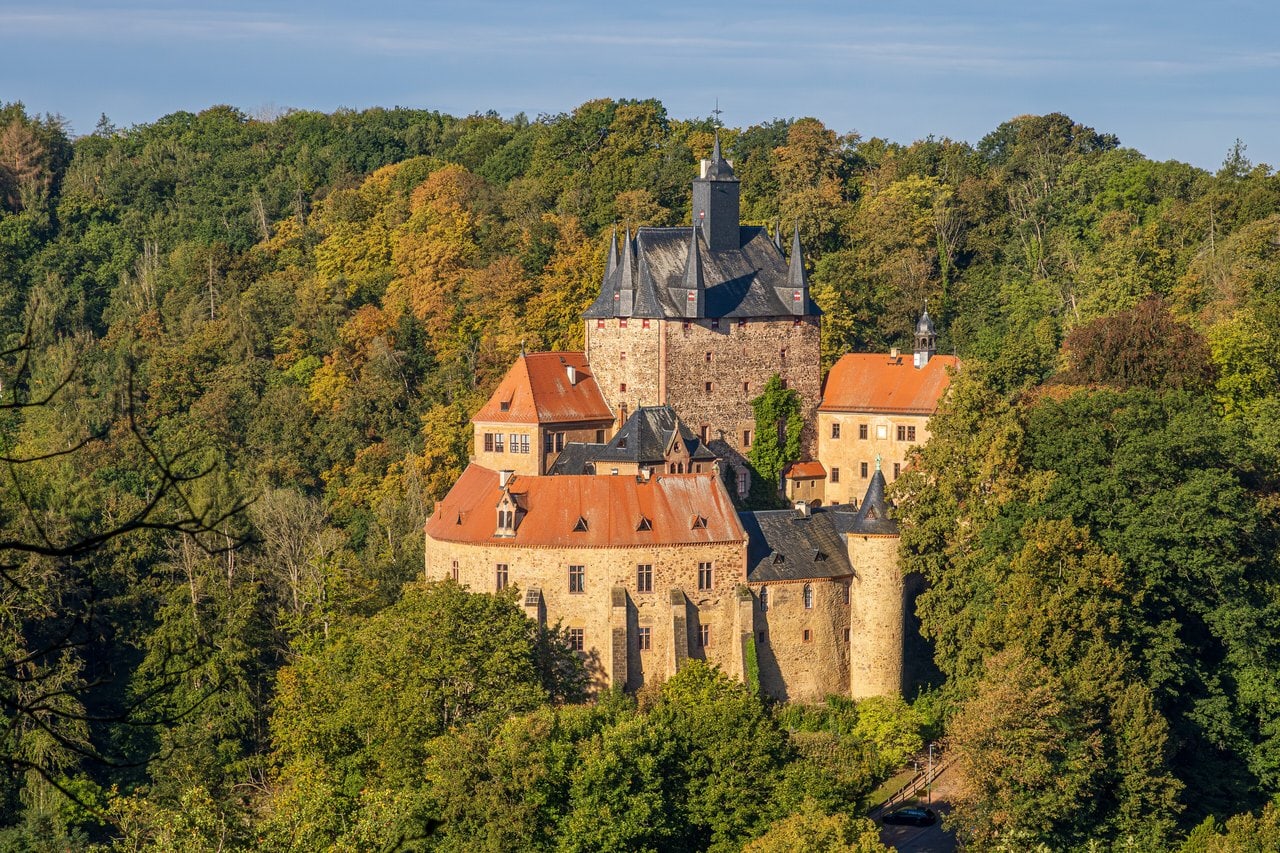
If Königstein is defense without domesticity, Burg Kriebstein is the opposite, a fortified household kept complete and intact on a scale a single noble family could actually live in. The castle began about 1384, when Dietrich von Beerwalde raised it on a steep rock spur in a tight bend of the Zschopau river, west of the Elbe. Its defining feature is vertical. Rather than spread a hall and outbuildings across a courtyard, Kriebstein stacks the household into a single residential tower roughly 45 meters tall, its great roof timbers felled, dendrochronology shows, around 1399.
What makes Kriebstein remarkable is that almost nothing was ever swept away. From 1465 the castle passed to Hugold von Schleinitz, who in 1471 brought in Arnold von Westfalen, the same master builder then at work in Meissen, to add a new wing, a kitchen house, and the rooms that gave the cramped rock its comforts. A neo-Gothic refit of 1866 to 1868 by the Dresden court architect Carl Moritz Haenel romanticized the silhouette without gutting it. Inside, a near-complete program of wall paintings from about 1410 still fills the chapel, among the best preserved of their kind in the German-speaking lands, and a wall of painted shields records the families who held the rock across six centuries. Saxony’s tourism authority cheerfully calls Kriebstein the most beautiful knight’s castle in Saxony; what is not in dispute is that it was never destroyed, kept whole for generations by owners who paid for its upkeep out of their own pockets. Even the approach is a curiosity, an access road that the Landesdirektion Sachsen officially rates as the steepest in the state, at a gradient near twenty-four percent.
Albrechtsburg Meissen: the first house built to be lived in
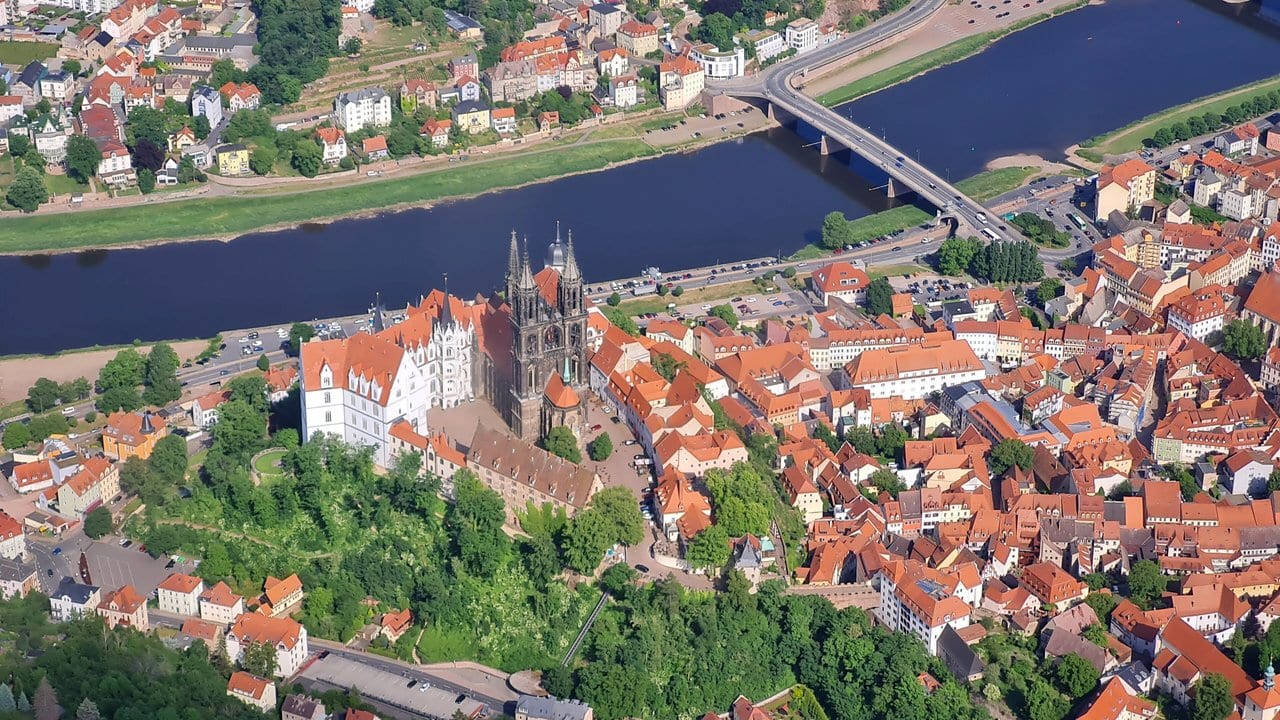
The hinge of the whole story stands on the Burgberg at Meissen, sharing its rock with the cathedral. The Albrechtsburg was begun in 1471 for the two Wettin brothers who then ruled Saxony jointly, Elector Ernst and Duke Albrecht, and its architect was Arnold von Westfalen. What makes it the hinge is intention. Earlier castles were fortifications that happened to be lived in; the Albrechtsburg, as the Saxon palace administration likes to put it, was conceived from the start as a Schloss, a residence, and is routinely described as the first German castle built to be a palace rather than a stronghold. Its windows are large, its rooms generous, and its ceilings carry the rippling cell vaults, the Zellengewölbe, that Arnold pioneered here and that spread from Meissen across central Europe. Its great open spiral, the Grosser Wendelstein staircase, makes the same point: a defensive building has no reason to turn a stair into a sculpture.
History then played a joke on the architecture. Those brothers divided their inheritance in 1485, splitting the Wettins into the Ernestine and Albertine lines, and the magnificent new residence was barely used as one; its interiors were only completed and decorated under Albrecht’s son, Duke Georg the Bearded, in the early sixteenth century. Its second life proved more famous than its first. In 1710 Augustus the Strong installed the newly founded Meissen porcelain manufactory inside the castle, the first producer of true hard-paste porcelain in Europe, and the secret was kept on the rock for more than a century and a half, until the works finally moved out in 1863. For most of its existence Germany’s first palace was, in effect, Europe’s first porcelain factory.
Moritzburg Castle: a palace for the hunt
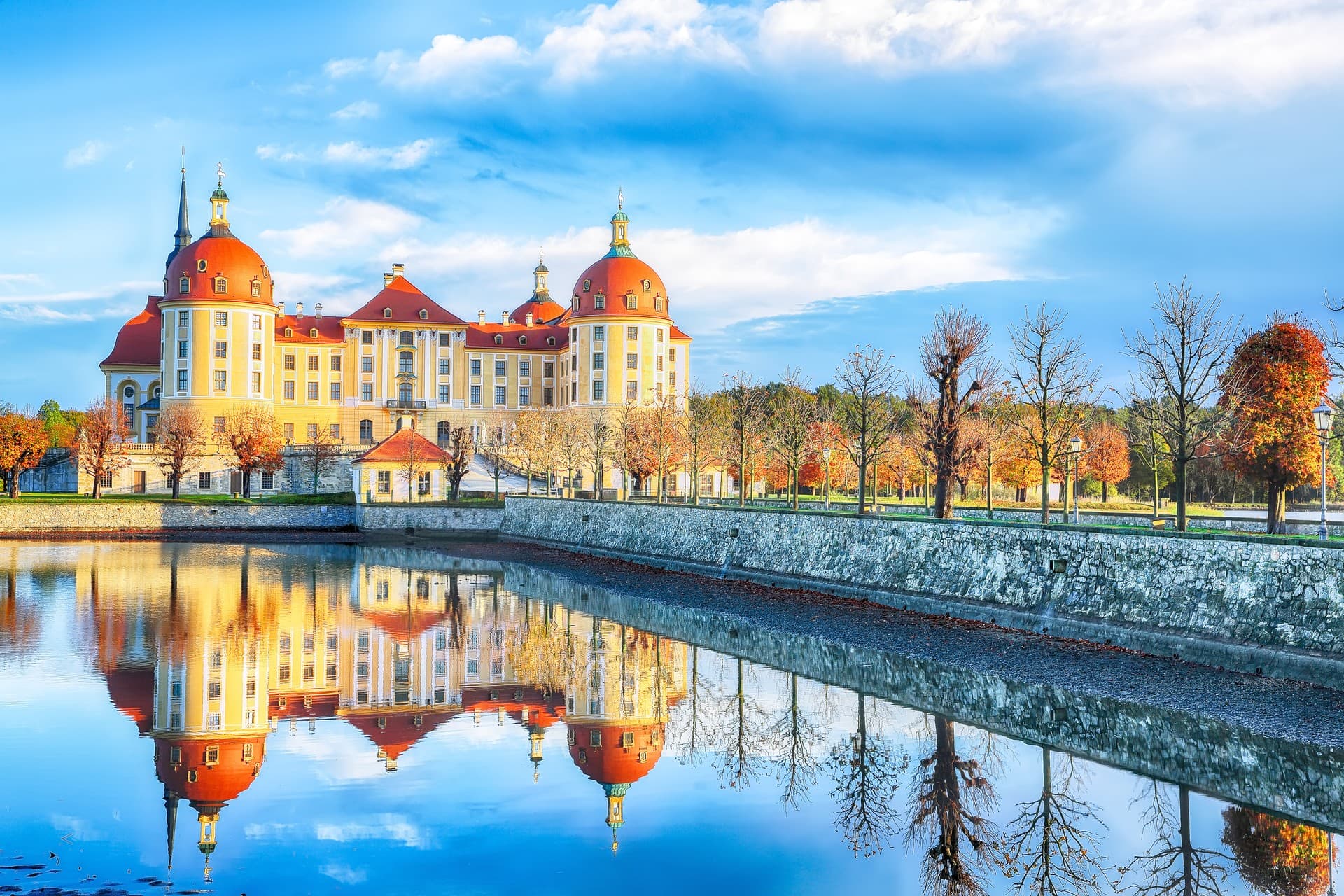
With Moritzburg the Saxon castle stops defending anything at all and becomes pure theater. It started modestly, as a Renaissance hunting lodge built between 1542 and 1546 for Duke Moritz of Saxony by Hans Dehn-Rothfelser and Caspar Voigt von Wierandt, already with four round corner towers set among the woods and lakes north of Dresden. A chapel followed from 1661 to 1672, the work of Wolf Caspar von Klengel, and after Augustus the Strong’s conversion to Catholicism it was re-consecrated to the Roman rite at Christmas 1699 as, by the court’s reckoning, the first Catholic court chapel in Saxony since the Reformation.
It was Augustus who made Moritzburg what it is. Between 1722 and 1733 his architect Matthäus Daniel Pöppelmann recast the lodge as a Baroque Wasserschloss, a four-tower palace set on an artificial island in its own lake, with the state interiors laid out from 1726 by Zacharias Longuelune. The point of the place was the hunt and the court entertainments around it, and the building still announces as much: the dining hall is hung with seventy-one red-deer antlers, an ensemble the palace administration counts among the most important of its kind, and it includes a freakish twenty-four-point set the museum bills as the strongest red-deer antler in the world, nearly two meters across and close to twenty kilograms. A little pheasant palace, the Fasanenschlösschen, was added in the woods from 1769 by Johann Daniel Schade and finished in the following decade, the last interior in Saxony still dressed entirely in Dresden Rococo. The Wettins lost it all in the expropriations of 1945, after which the island palace became a museum. To later generations it is best known as a face rather than a history: its exteriors stood in for the prince’s castle in the 1973 film Three Hazelnuts for Cinderella, and its staircase still draws visitors looking for the lost slipper.
Pillnitz Castle: the garden on the Elbe
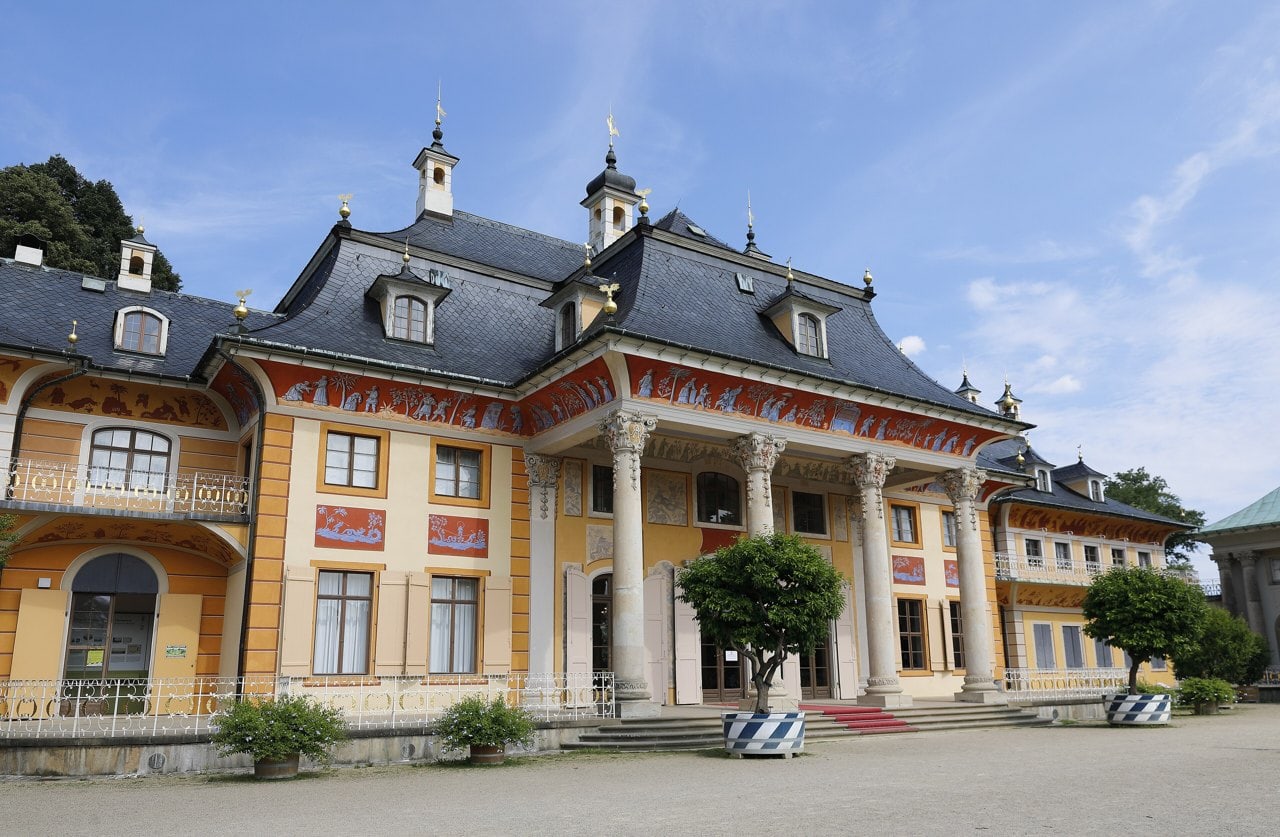
The arc ends in a garden. Schloss Pillnitz sits on the right bank of the Elbe upstream of Dresden, and it is the most purely pleasurable of the five, a summer residence designed to be arrived at by boat. Augustus the Strong again set the tone. From 1720 Pöppelmann and Longuelune built him two garden pavilions facing each other across a parterre, the riverside Wasserpalais and the hillside Bergpalais, with a grand water stair down to the Elbe added in 1725. Their roofs sweep up at the corners and their walls carry painted Chinese figures, a deliberate exercise in chinoiserie that made Pillnitz a fashionable fantasy of the East rather than a copy of it.
Between the two pavilions the old Renaissance core burned on the first of May 1818, and the Neues Palais that replaced it, built from 1819 to 1826 by Christian Friedrich Schuricht, gave Pillnitz a sober Neoclassical counterweight, including a domed hall opened in 1823 that is the only interior of its kind in Dresden. Two living things in the park have outlasted every fashion. One is a Camellia japonica planted in 1801, reckoned among the oldest camellias north of the Alps, sheltered each winter by a glass house on rails that rolls over the whole tree; the romantic tradition that it is one of four brought from Japan by Carl Peter Thunberg is now doubted by botanists, but the tree itself is real and astonishing. The other is the cast-iron and glass Palm House of 1859 to 1861, among the oldest surviving structures of its type in Europe. Pillnitz also gave its name to a document that briefly made it the most quoted place on the continent. The Declaration of Pillnitz of August 1791, issued here by the Holy Roman Emperor Leopold II and King Frederick William II of Prussia, warned revolutionary France that Europe’s monarchs were watching, and helped tip the continent toward war.
The five at a glance
| Castle | Setting | Type | Built | Its face |
|---|---|---|---|---|
| Königstein Fortress | Saxon Switzerland, on the Elbe | Festung (fortress) | medieval rock; fortress from 1589 | The stronghold that never fell |
| Kriebstein Castle | Zschopau valley, near Waldheim | Burg (medieval castle) | from about 1384 | The intact fortified household |
| Albrechtsburg Meissen | Meissen, on the Elbe | Schloss (palace) | begun 1471 | The first house built as a residence |
| Moritzburg Castle | woods and lakes north of Dresden | Schloss (palace) | lodge 1542; Baroque 1720s | The Baroque hunting palace |
| Pillnitz Castle | Dresden, on the Elbe | Schloss (palace) | from 1720 | The chinoiserie garden palace |
Beyond the five
Five castles do not exhaust Saxony, and a longer stay rewards a wider net. In Dresden itself the Residenzschloss, the Wettins’ own city palace, and Pöppelmann’s Zwinger carry the same Augustan story into the capital. Up in the Erzgebirge, Schloss Augustusburg is the great Renaissance hunting palace that Elector August built between 1568 and 1572, a generation before Königstein became a fortress. Schloss Weesenstein climbs its rock in the Müglitz valley in a tangle of centuries. And Burg Stolpen carries the darkest footnote to the Augustan court: it was there that Countess Cosel, Anna Constantia von Brockdorff, the mistress Augustus the Strong eventually tired of, was imprisoned from 1716 until her death in 1765, a reminder that the same king who built the pleasure palaces also knew how to use a fortress as a cage. One Saxon castle beyond the five already has its own full account here: Rochlitz Castle, the twin-towered Wettin stronghold on the Zwickauer Mulde that was an imperial fortress, a margravial residence, and eight times a dower house, including for the Reformation duchess Elisabeth of Rochlitz. We will likely give some of the others their own treatment in time.
A Saxon arc, from frontier to riverbank
What holds these five together is not a style but a state. All of them lie within an hour or two of Dresden, most administered today by the Staatliche Schlösser, Burgen und Gärten Sachsen, and all shaped by the House of Wettin and, in the eighteenth century, by the single outsized figure of Augustus the Strong, Elector of Saxony from 1694 and King of Poland besides. Read in order, they tell the story of a ruling house that began by defending a frontier and ended by decorating a riverbank.
It is worth saying plainly that none of the five currently holds World Heritage status. Pillnitz once lay inside the Dresden Elbe Valley, inscribed by UNESCO in 2004, but the valley was struck from the list in 2009 after the city built a bridge across it, one of only a handful of places ever delisted. The castles are no less worth seeing for it; the loss says more about a modern planning dispute than about the buildings themselves.
For travelers building a route, the cluster divides naturally. Meissen and Moritzburg make an easy day northwest of Dresden, Pillnitz and Königstein another upstream to the southeast, and Kriebstein a third out to the west toward Chemnitz. Saxony is far from the only German region worth a tour of this kind: readers planning further afield may want our guides to the castles of Franconia and the castles of the Middle Rhine, two regions whose castles tell very different stories from these. Those three guides will eventually sit beneath a broader survey of Germany’s finest castles.
Principal Sources
- Albrechtsburg Meissen. ‘Geschichte.’ albrechtsburg-meissen.de
- Festung Königstein gGmbH. ‘Die Geschichte der Festung Königstein.’ festung-koenigstein.de
- National Gallery, London. ‘Bellotto: The Königstein Views Reunited.’ nationalgallery.org.uk
- Schloss & Park Pillnitz. ‘Geschichte.’ schlosspillnitz.de
- Schloss Moritzburg. ‘Schloss und Geschichte.’ schloss-moritzburg.de
- Staatliche Schlösser, Burgen und Gärten Sachsen. ‘Burg Kriebstein.’ schloesserland-sachsen.de
- UNESCO World Heritage Centre. ‘Dresden Elbe Valley.’ whc.unesco.org
- Visiting details for all five are published by their operators, the Staatliche Schlösser, Burgen und Gärten Sachsen and Festung Königstein gGmbH; opening times and prices vary by season and are best checked before a visit.
Image credits. Königstein Fortress from the air: Derbrauni, CC BY 4.0, via Wikimedia Commons. Saxony locator map: StoneKeep Atlas (own work). Bellotto’s view of Königstein: Bernardo Bellotto, public domain, via Wikimedia Commons. Kriebstein above the Zschopau: Code, CC BY 4.0, via Wikimedia Commons. Albrechtsburg and Meissen Cathedral from the air: Derbrauni, CC BY 4.0, via Wikimedia Commons. Schloss Moritzburg across the Schlossteich: Adobe Stock. Pillnitz Bergpalais: Myriam Thyes, CC BY-SA 4.0, via Wikimedia Commons. Freely licensed images are resized to fit; otherwise unaltered.