
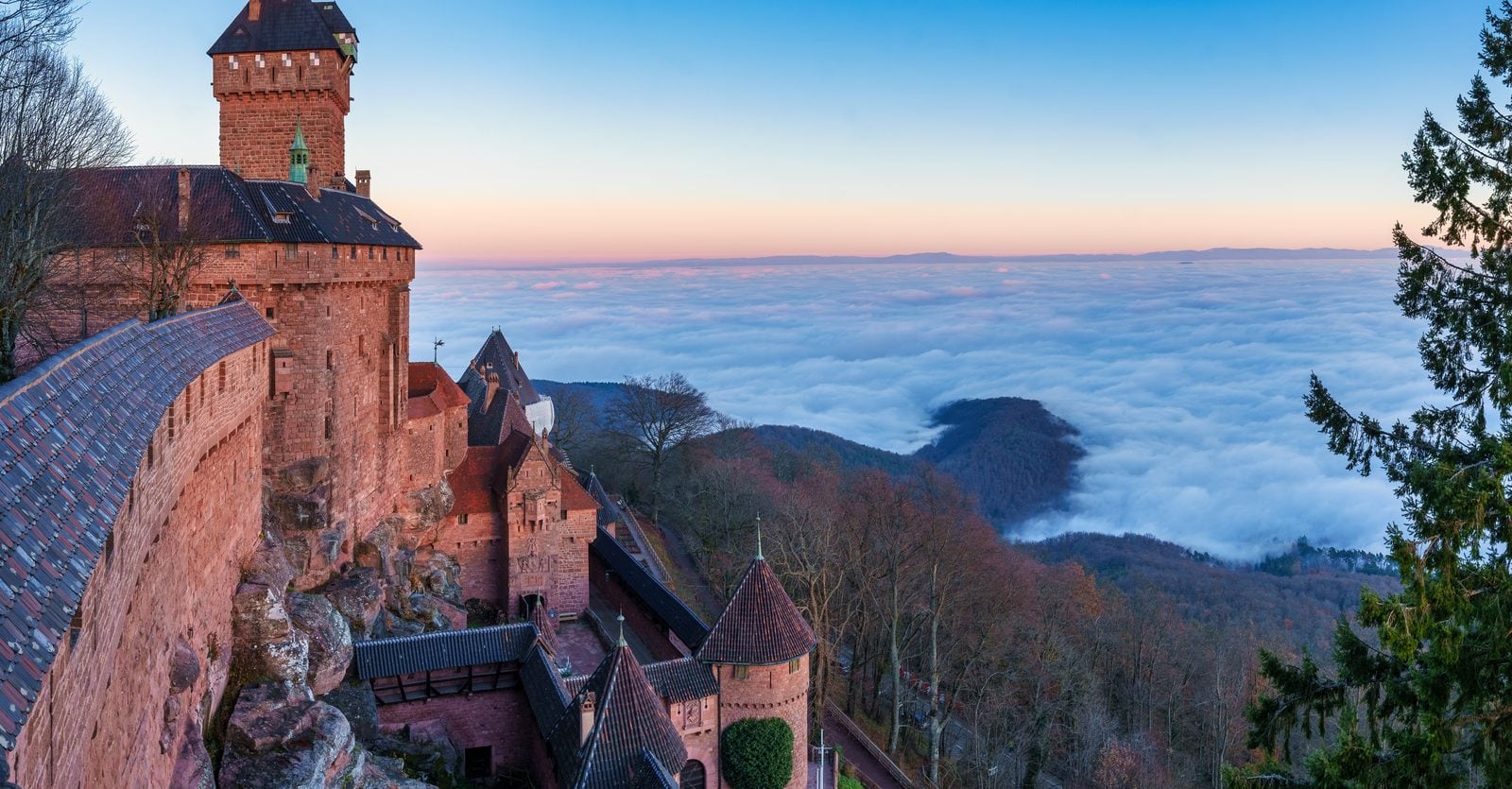
Château du Haut-Kœnigsbourg
The Château du Haut-Kœnigsbourg stands on a sandstone spur 757 meters above sea level, in the Vosges foothills above Orschwiller, with the whole Alsace plain falling away toward the Rhine below it. Few castles in France carry their history so openly on the surface. The pink walls a visitor walks through today were raised between 1900 and 1908, on the genuine ruins of a medieval fortress, for a German emperor who wanted a monument to mark the western edge of his realm.
That double identity is the key to the place. Haut-Kœnigsbourg is at once an authentic late-medieval Alsatian stronghold and an early twentieth-century reconstruction of one, built at the exact moment when the rest of Europe was deciding that ruins should be left as ruins. It is a French national monument that began as a German imperial gesture, on land that has changed flags four times in a hundred and fifty years. Reading the castle means reading both the fortress and the argument it set off.
Quick Facts
| Location | Orschwiller, Bas-Rhin |
| Region | Alsace, France |
| Built | Medieval; rebuilt 1900–1908 |
| Reconstruction architect | Bodo Ebhardt |
| Type | Hilltop spur fortress |
| Material | Pink Vosges sandstone |
| Condition | Restored (reconstruction) |
| Elevation | 757 m above sea level |
| Owner | Collectivité européenne d’Alsace |
| Nearest town | Sélestat (about 12 km) |
| Open to visitors | Daily, except January 1 and December 25–26 |
| Official site | haut-koenigsbourg.fr |
A Stronghold on the Edge of the Empire
This rock was a strongpoint long before anyone wrote down a castle on it. A deed issued by Charlemagne in 774 names the hill, the Stophanberch or Staufenberg, in a grant of land to a priory in the valley below. What sat on the summit then is unknown. The first documentary mention of an actual castle comes in 1147, when monks complained to the French king that a Hohenstaufen lord was fortifying the ridge above their lands. By the end of the century the stronghold had acquired the name that stuck: Koenigsbourg, the king’s castle.
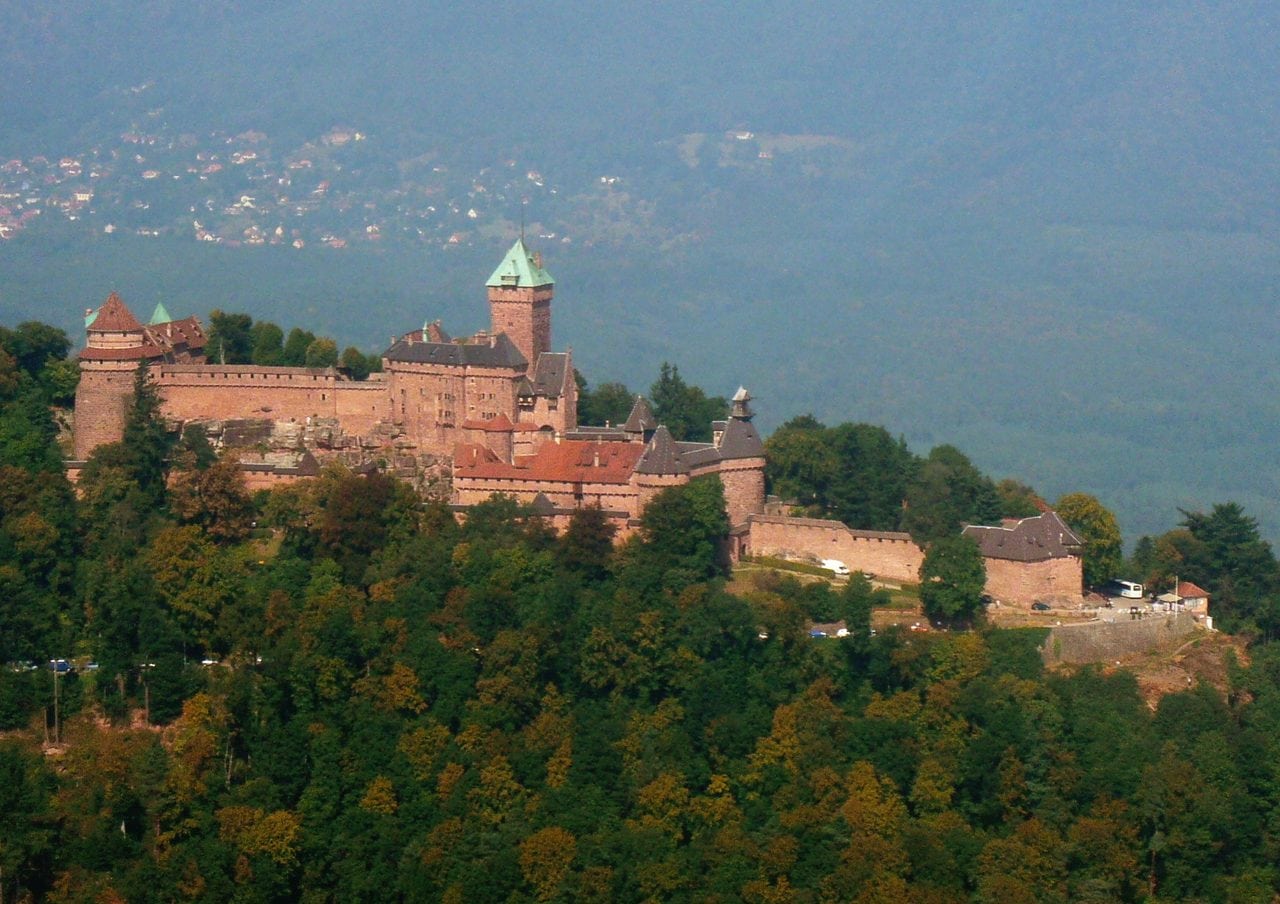
Geography explains the rest. From this spur a garrison could watch the roads that carried wine, salt and silver between Lorraine, the Rhineland and the Italian passes, and could see an approaching army hours before it arrived. On a clear day the view reaches from the Black Forest across the Rhine to the crests of the Vosges, with the vineyards and villages of the plain spread out far below. Possession of the height meant a hand on the trade of Lower Alsace, which is why the castle passed through so many hands. Dukes of Lorraine held it and enfeoffed it to vassal families such as the Rathsamhausen and the Hohenstein; the bishops of Strasbourg and the counts of Werd appear in the chain; the precise order of those medieval owners is argued over by historians and recorded only in fragments. What is clear is that the castle was always worth fighting for, and always changing hands.
Heyday and Ruin
By the fifteenth century the castle had slid into disrepute as a base for robber knights preying on the rich towns of the plain. In 1462 a league of regional towns, Colmar, Strasbourg and Basel among them, marched on the spur and burned the place out. The wreck passed under Habsburg authority, and in 1479 it was entrusted to the counts of Tierstein, who rebuilt it on a new plan. They added a defensive system designed for the gunpowder age: thick artillery walls, two stout cannon towers, and a great bastion thrust out to the west to keep an enemy’s guns at a distance and to mount the garrison’s own. This was Haut-Kœnigsbourg at its height, a modern fortress rather than a medieval keep, and the layout the Tiersteins gave it is essentially the one a visitor walks today.
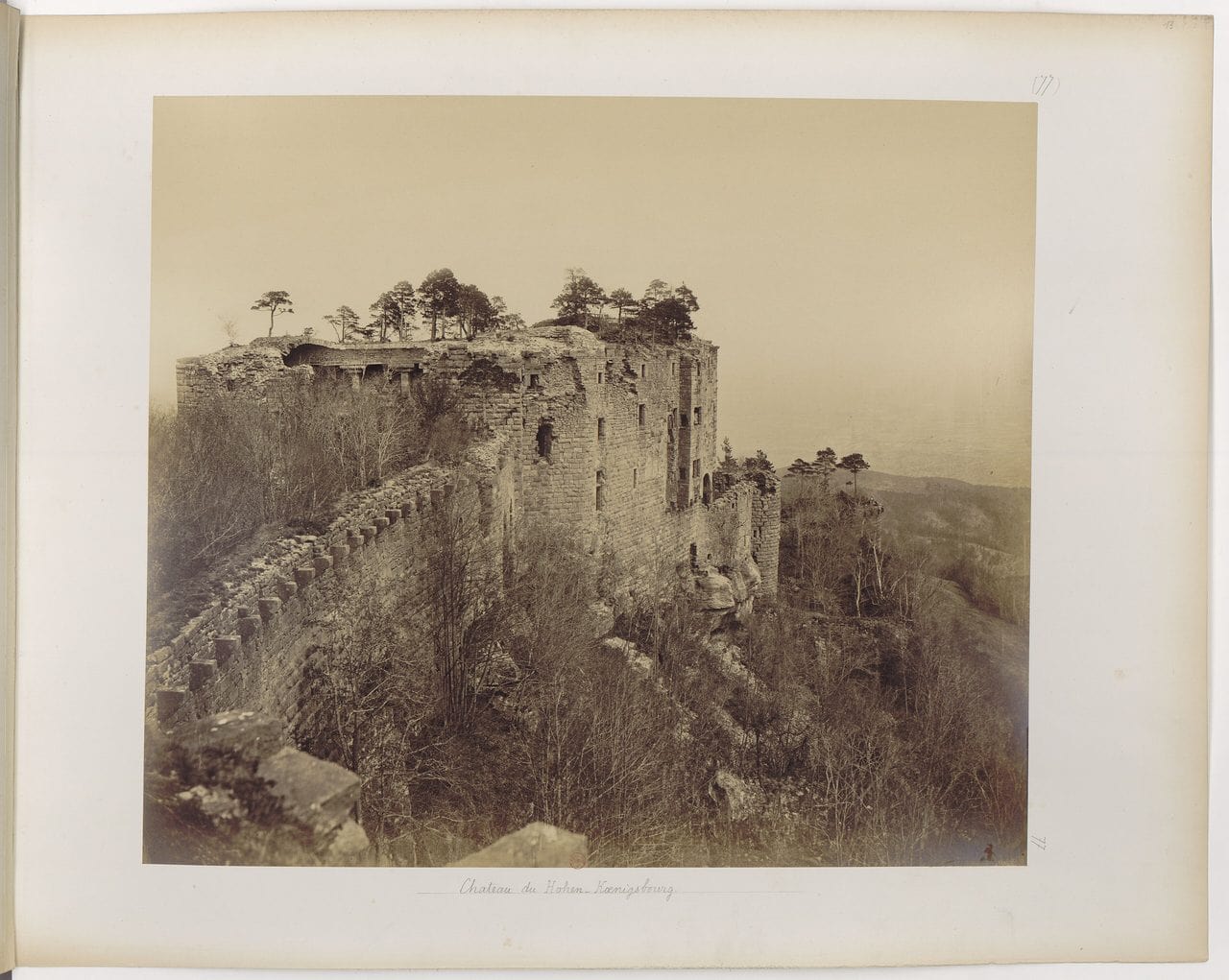
It was not modern enough. When the Thirty Years’ War reached Alsace, a Swedish force laid siege to the castle in 1633 and ground down its defenders over roughly fifty days before the garrison surrendered that September. The Swedes plundered it and set it alight. After that nobody rebuilt. For more than two centuries the Château du Haut-Kœnigsbourg was a roofless shell on its hilltop, quarried by locals for building stone, climbed by the occasional Romantic traveler, and slowly swallowed by the forest. In 1862 the French state, recognizing what survived, listed the ruins as a historic monument. Three years later the nearby town of Sélestat bought them, with no clear idea yet of what to do with a mountain of broken sandstone.
The Emperor’s Gift
History then turned the castle into a pawn of a much larger game. France lost the Franco-Prussian War of 1870 to 1871, and with it Alsace and part of Lorraine, which were annexed to the new German Empire as the Reichsland Elsass-Lothringen and governed directly in the Kaiser’s name. The ruin on the Staufenberg now sat inside Germany. In 1899 the town of Sélestat made a calculated gift of it to Emperor Wilhelm II.
Wilhelm understood exactly what he had been handed. He did not want a residence; he wanted a symbol. A rebuilt Haut-Kœnigsbourg would let him claim descent from the Hohenstaufen and the Habsburgs who had held the rock, would advertise German civilization on the western frontier, and would, he hoped, bind the recently annexed Alsatians more firmly to the Reich. He spoke of the castle as a marker of German culture in the west to set against the restored Marienburg in the east, the two fortresses bracketing his empire. That intent was eventually written into the building itself. A great copper imperial eagle was set on the keep as a deliberate emblem of imperial power over the rebuilt castle and the borderland around it. The gift, in other words, was an invitation to build propaganda in stone, and the Kaiser accepted it on those terms. Sélestat, for its part, had made a shrewd bargain, handing a costly ruin to the one man certain to pour a fortune into it.
Bodo Ebhardt and the Argument Over Ruins
The man Wilhelm chose was Bodo Ebhardt, a Berlin architect who had founded the German Castles Association in 1899 and was building a reputation as the leading scholar of medieval fortification in the German lands. Ebhardt approached the commission as research before it was construction. He photographed and measured the standing ruin, dug through Tierstein-era archives, catalogued the thousands of fragments his workers pulled from the rubble, and compared the remains against other castles of the same region and period. From this he produced a reconstruction meant to show, as far as the evidence allowed, what the fortress had looked like in its fifteenth-century prime.
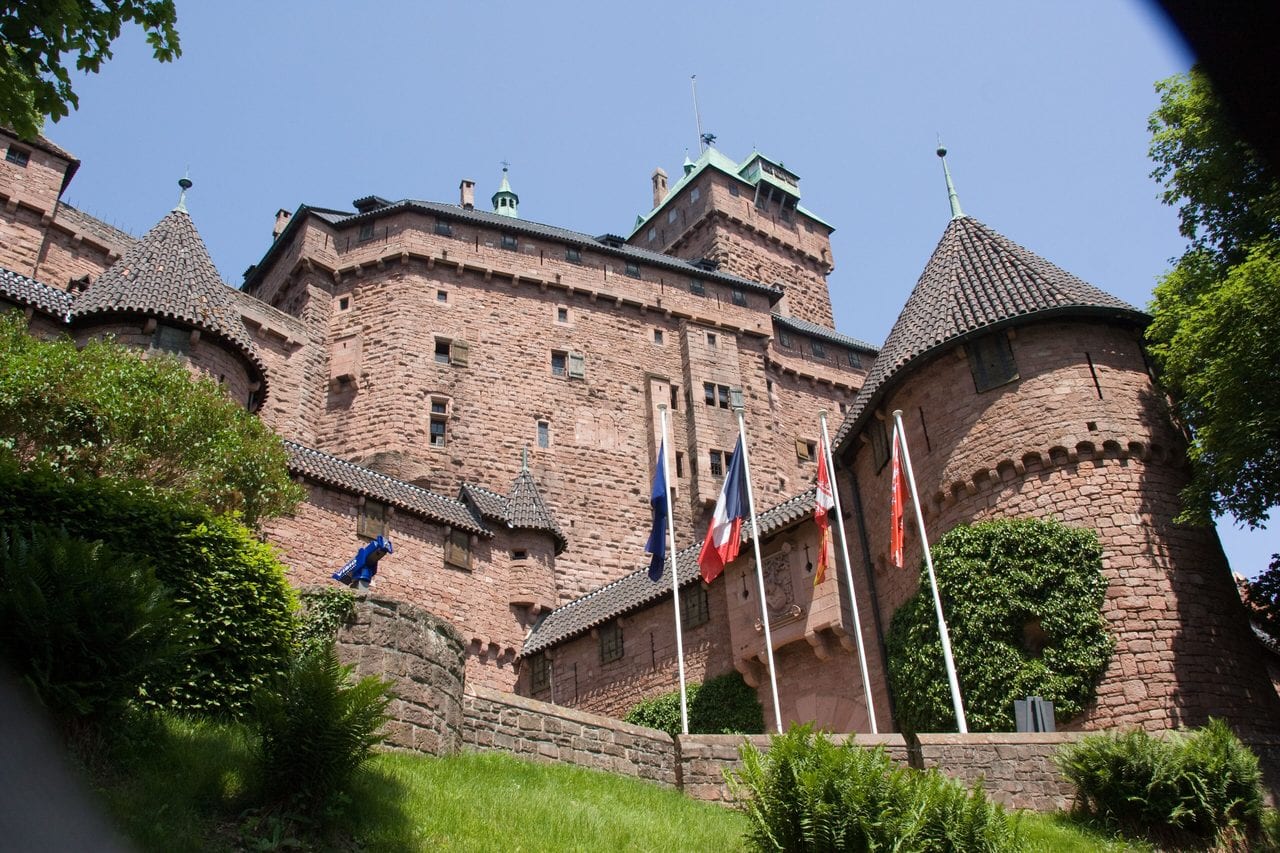
He was honest about the limits of that evidence, and so were the authorities who later assessed his work. The official heritage record credits him with a scrupulous restitution of the medieval castle while noting that he more than once had to fall back on invention, founded on solid knowledge but invention all the same. Ebhardt left a way to tell the two apart. Every replacement block carries a mason’s mark cut into the stone, and the marks form an eight-year calendar running from 1901 to 1908, so that a visitor who knows to look can still read which stones are old and which are his. Where his judgment was contested, it was contested hard: critics then and since have questioned the height and square plan of the keep, which Ebhardt defended from the surviving foundations against those who argued the original tower had been round.
That dispute was part of a far larger one. Around 1900 the German-speaking world was arguing about what to do with old buildings, and Haut-Kœnigsbourg landed in the middle of it. At Heidelberg Castle, at almost the same moment, the art historian Georg Dehio won a national verdict for the opposite principle: Konservieren, nicht restaurieren, conserve, do not restore. Conserving a ruin as a ruin became a founding rule of modern monument care, and Heidelberg’s ruin was only secured as it stood, the Friedrichsbau excepted. Haut-Kœnigsbourg was the loud exception to that rule, a ruin chosen instead for complete reconstruction. That clash was personal as well as theoretical. Otto Piper, author of the standard scientific work on German castles, savaged the project, his case for conserving the ruin rather than rebuilding it having been passed over in favor of Ebhardt’s plan.
None of this makes Haut-Kœnigsbourg a fantasy. It belongs to a different family from the Romantic dream-castles of the nineteenth century. Neuschwanstein, raised for Ludwig II of Bavaria, was a stage set with no real medieval building beneath it; the same is broadly true of Lichtenstein and of Hohenzollern, picturesque inventions on cleared or token foundations. Ebhardt was reconstructing a documented ruin from its own remains, which places his work closer to the scientific restorations of his generation, the rebuilding of Milan’s Castello Sforzesco or the Marienburg in the east, than to pure Burgenromantik. The nearest French parallel was already standing: at Pierrefonds, the architect Viollet-le-Duc had rebuilt a genuine medieval ruin for Napoleon III a generation earlier, and contemporaries noticed how closely the German worksite echoed the French one.
The reconstruction was also a social enterprise. A supporting society, the Hohkönigsburgverein, was founded in 1904 and drew some four hundred members, professors, architects and archaeologists from Alsace, Lorraine, Switzerland and as far as the Tyrol. It assembled the castle’s collection of late-medieval Rhenish arms and furniture, promoted the half-finished site to tourists, and introduced an admission charge that same year, so that visitors were paying to walk through the castle while the masons were still at work. It was, by any measure, a colossal undertaking. A quarry opened a hundred meters away at Oedenburg; a small steam locomotive the workers nicknamed Hilda hauled stone up from Sélestat; a gasoline-powered pumping station, in service until 2013, supplied water to men and machines; mechanical cranes lifted the blocks into place. Roughly ten thousand cubic meters of rubble were cleared and some thirty-five thousand fragments recovered and studied. The keep went up first, in 1901, both because it anchored the whole composition and because raising it announced from a distance that the emperor’s castle was rising again. Cracks in the walls and the need for fresh funding slowed the finish, and the cost, drawn from imperial and regional budgets, was large enough that contemporaries and historians have never quite agreed on the figure.
What the Reconstruction Made
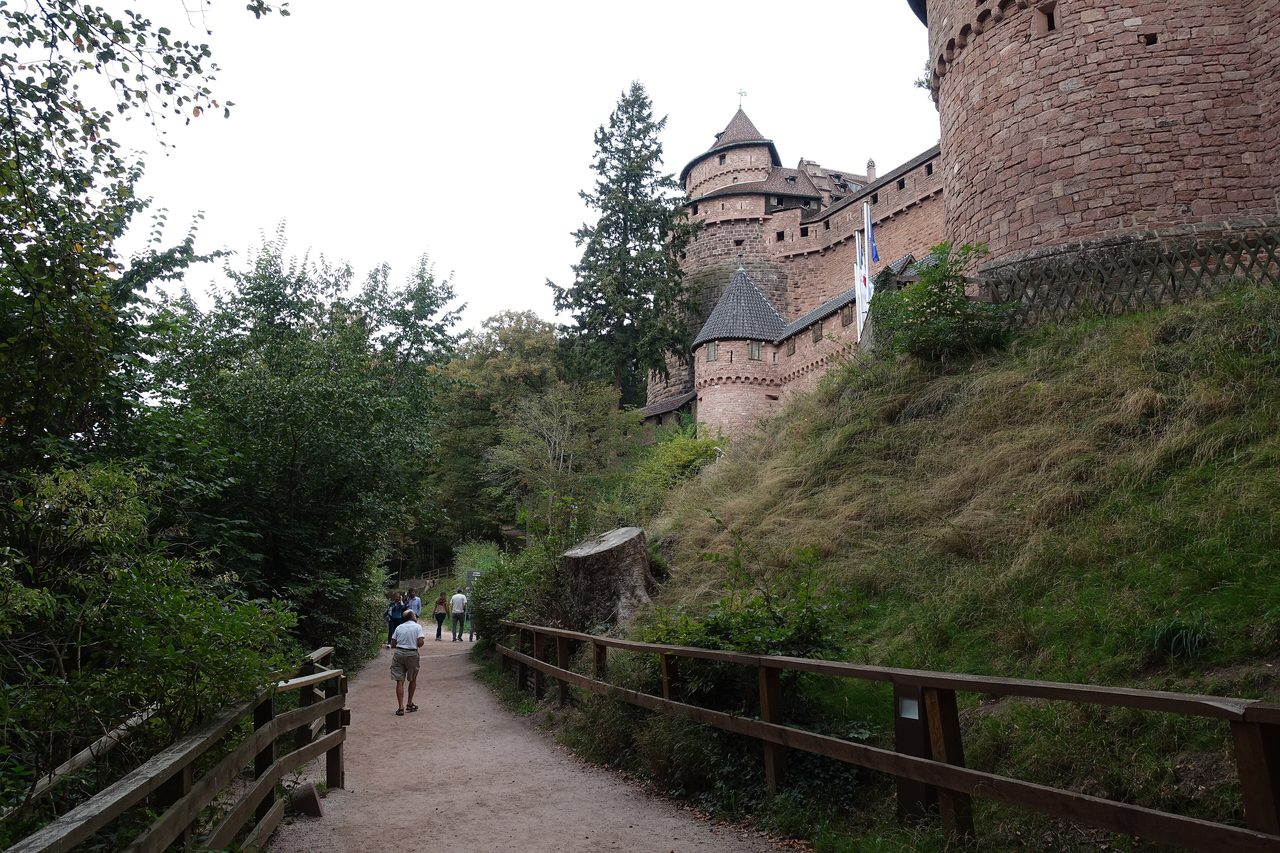
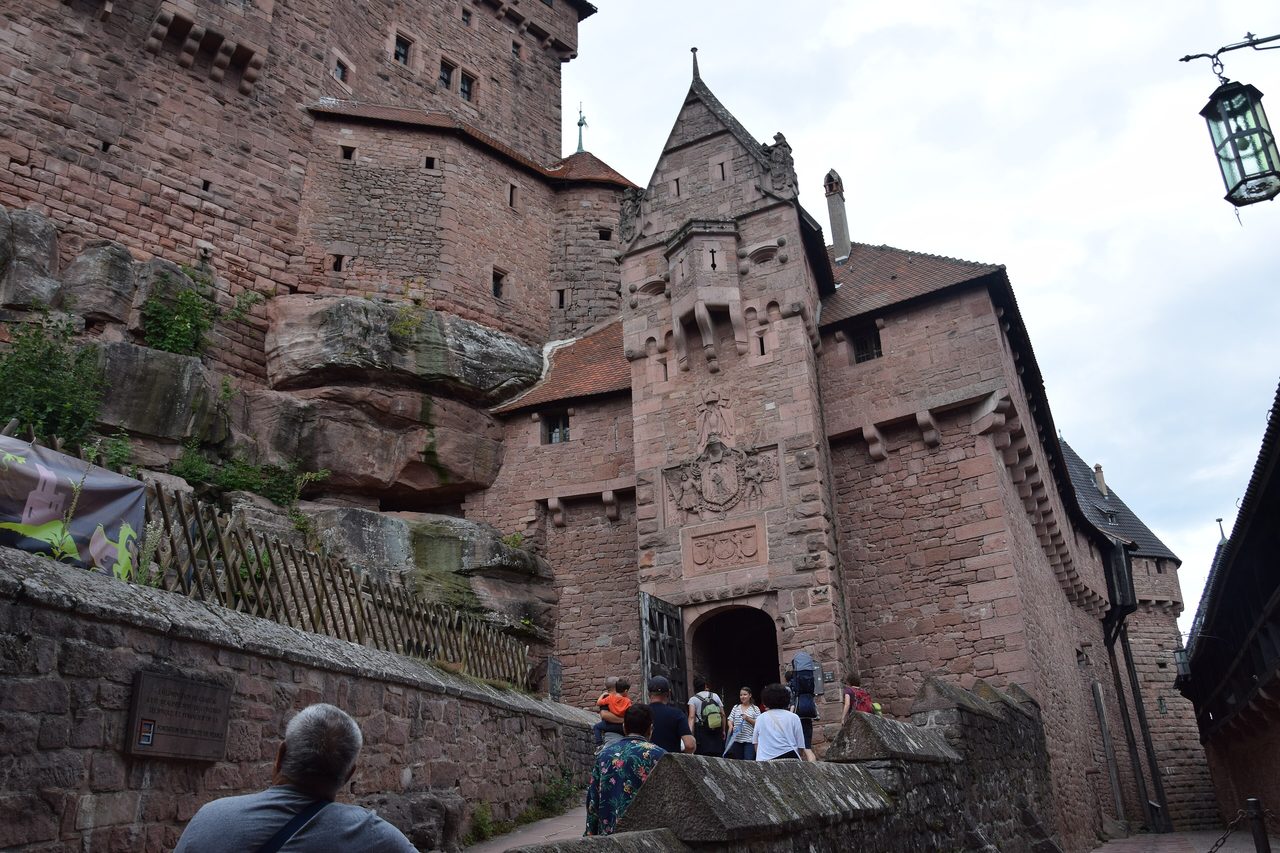
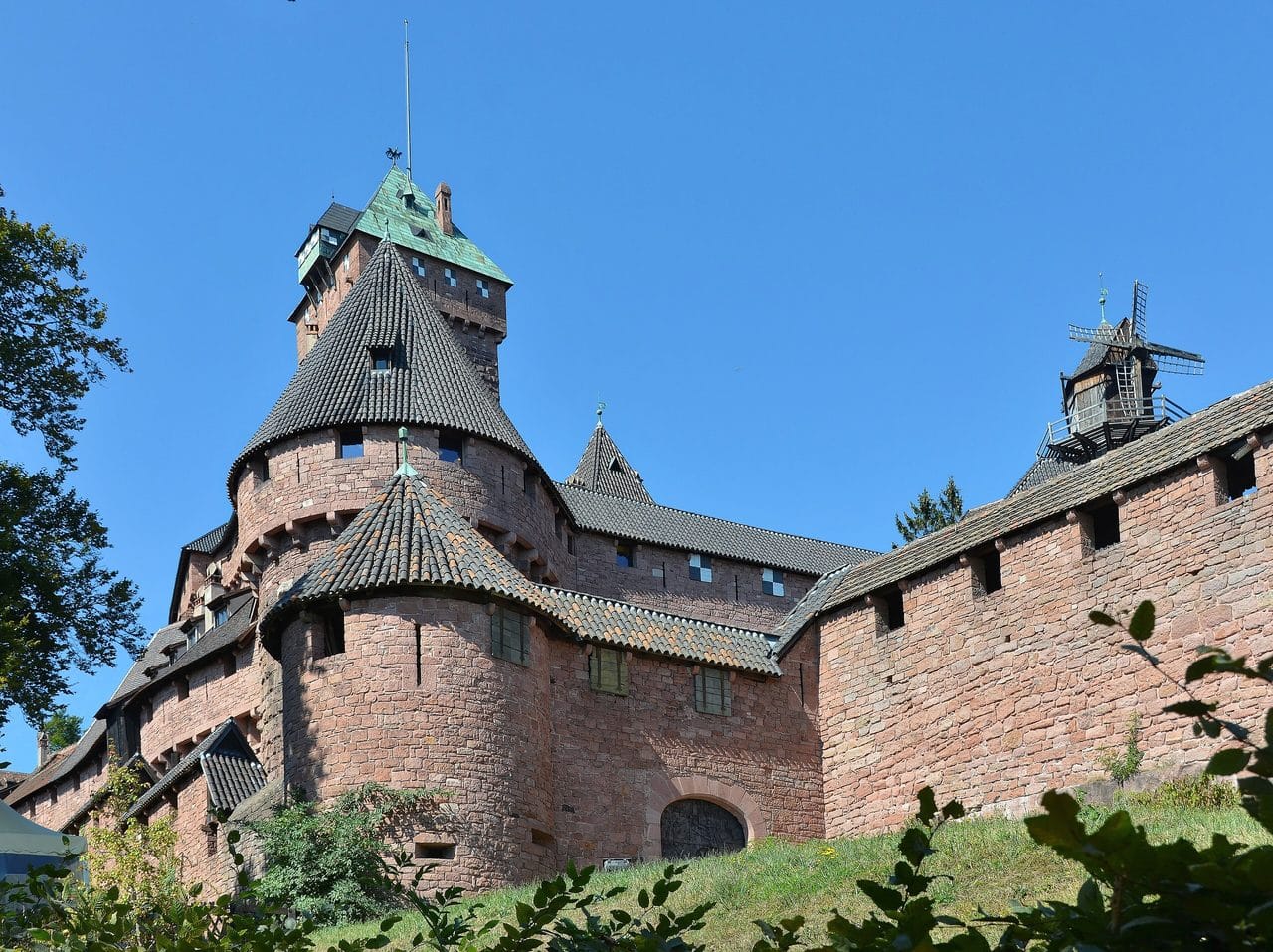
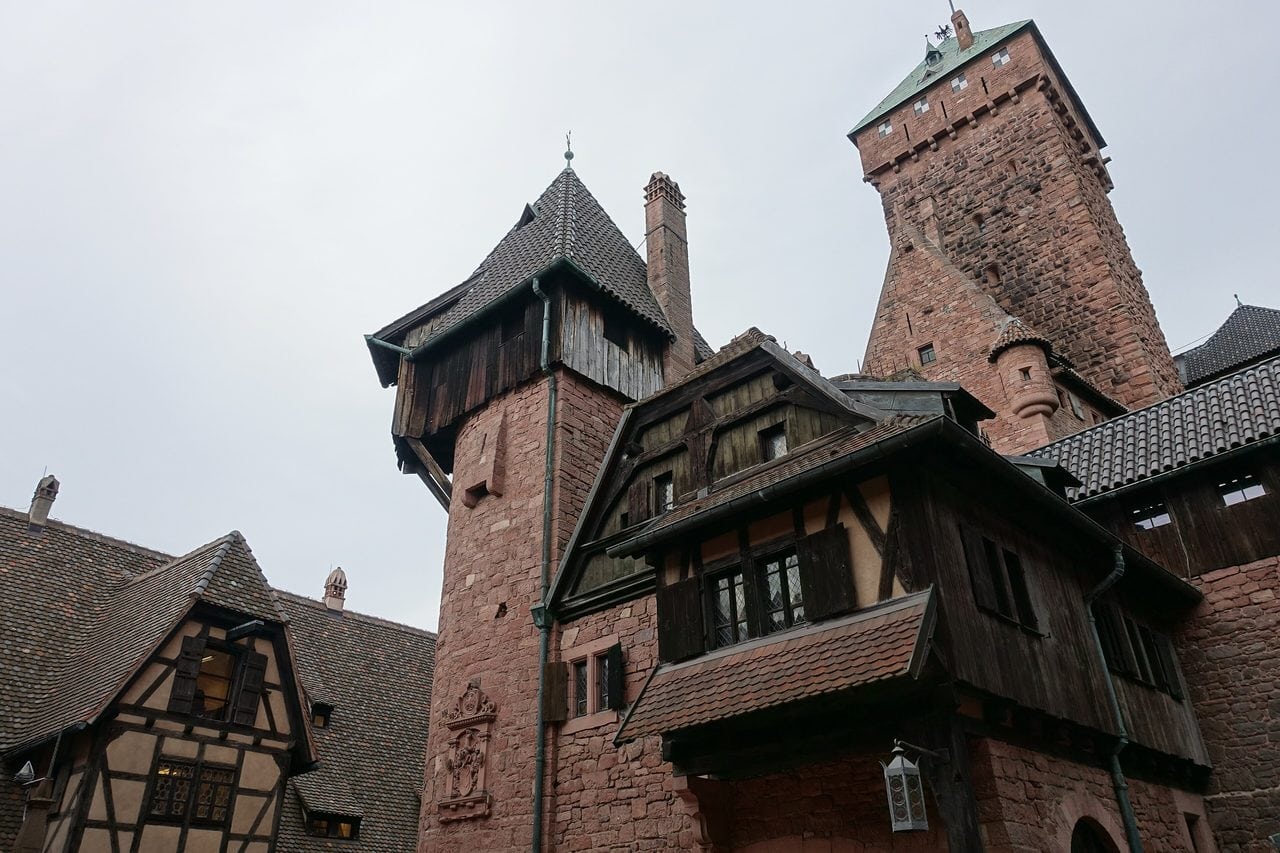
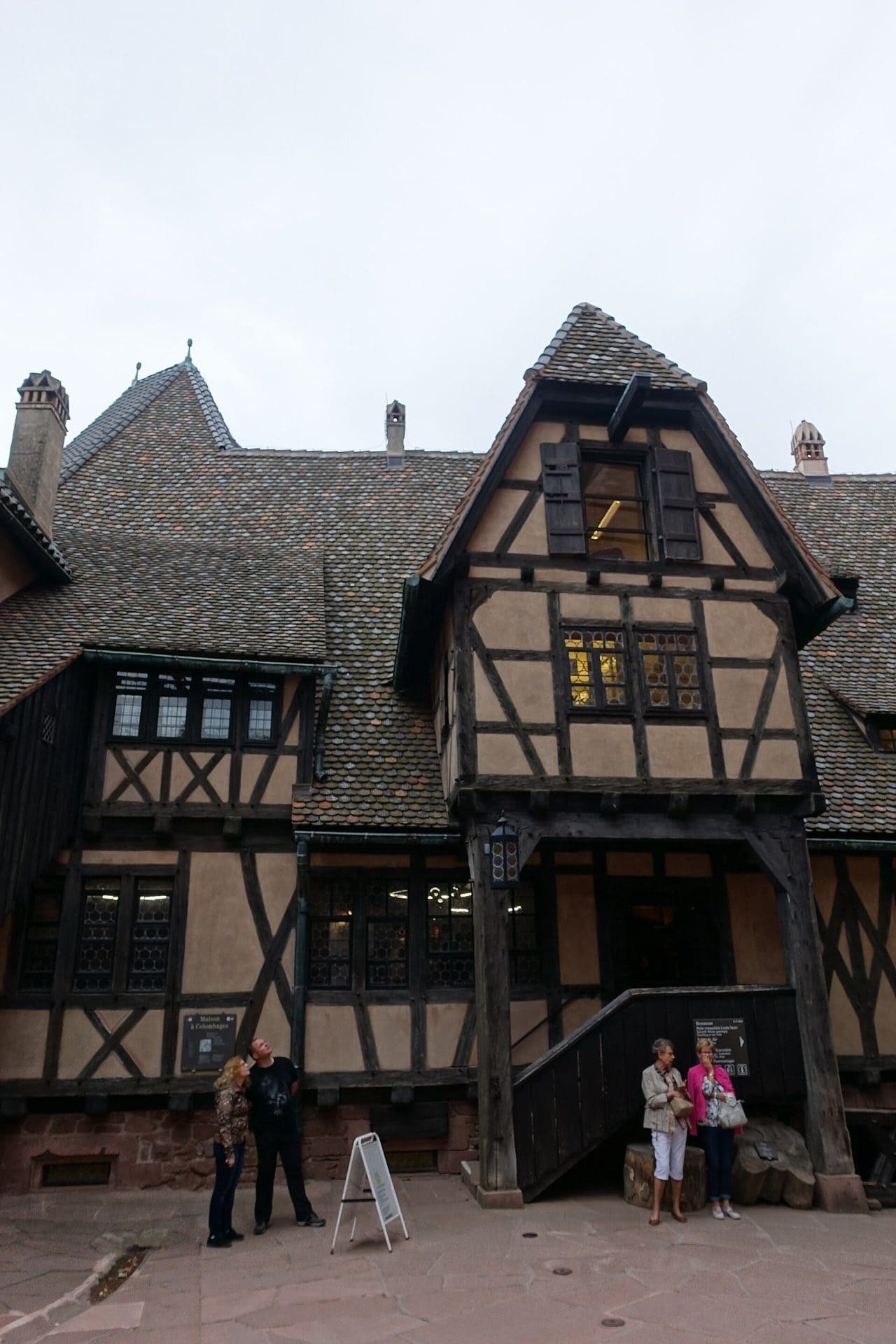
The castle the worksite produced is an elongated spur fortress of pink Vosges sandstone, the same stone as Strasbourg’s cathedral, its ramparts enclosing a site about 270 meters long and 40 meters wide. Its approach is theatrical by design. A path climbs through forest and opens suddenly on the lower ward, a walled enclosure laid out like a small village, with a half-timbered Alsatian inn, a forge, a mill and a well, everything a garrison would need to survive a long siege. Beyond it the gate sequence tightens: a drawbridge over a rock-cut ditch, a portcullis, and an honor gate that carries the arms of Wilhelm II set above those of Charles V, the emperor’s heraldry literally crowning his Habsburg predecessor’s.
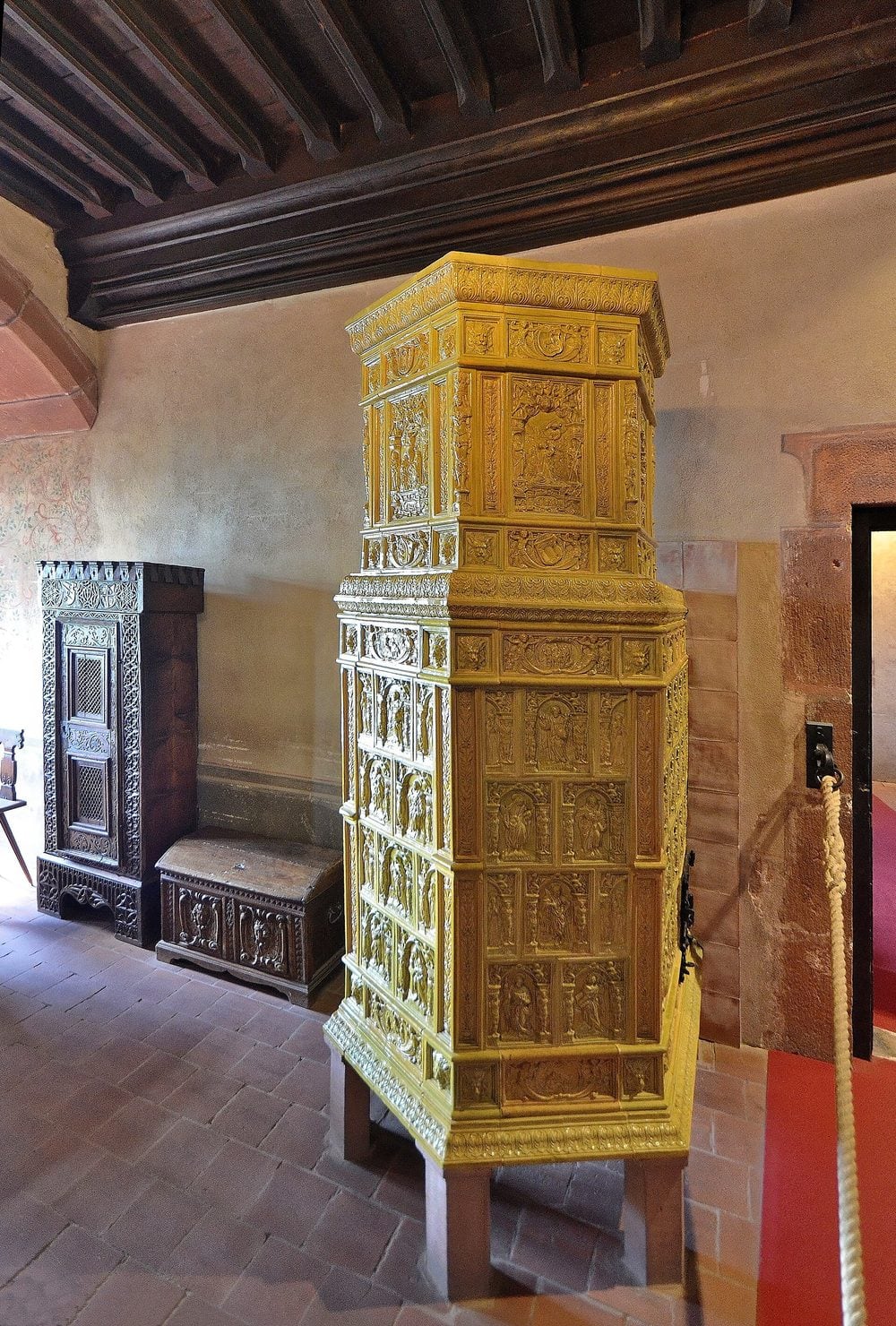
Inside the upper castle the rooms divide between medieval reconstruction and frank early twentieth-century display. A square keep dominates the silhouette, capped with a verdigris copper roof and visible for miles across the plain. Off the courtyard a chapel, a deep well and a hexagonal stair give the upper ward the texture of a working residence. The great hall, known as the Kaiser’s hall, was decorated in the years after the inauguration by the Alsatian painter Léo Schnug, whose ceiling sets an imperial eagle bearing the arms of the Holy Roman electors, with the Hohenzollern at its heart, and whose wall frescoes stage the 1462 siege, jousting knights and Saint George at the dragon. Schnug painted a second room of hunting trophies, designed the costumes for the castle’s opening pageant, and was decorated by the emperor for his pains. The recurring arms of the Tierstein counts, a doe on a field, run through the heraldry as a reminder of the family who gave the castle its surviving shape.
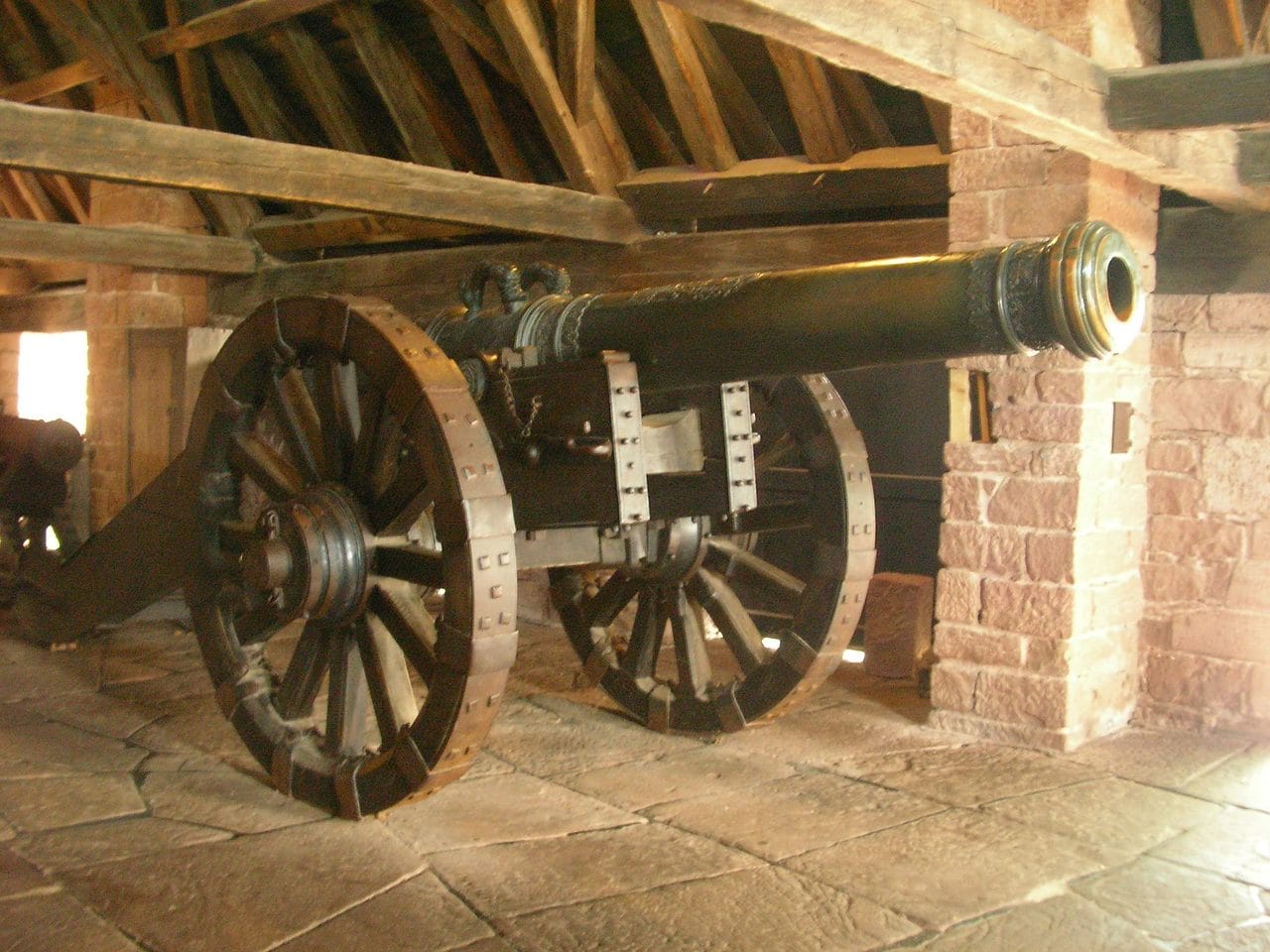
Its defensive works are the part a military eye lingers on. The great western bastion, with its pair of artillery towers, was built to hold cannon and to keep a besieger’s guns beyond effective range, and it still commands the longest views from the castle. The weapon hall holds the late-medieval arms the project assembled in the same years: pole-arms and halberds, windlass crossbows, rampart guns and blades, arranged to evoke a fifteenth-century arsenal. Outside the walls a high garden and a lower garden grow the culinary, medicinal and dye plants a medieval household would have raised, completing the picture of a fortress built to feed and defend itself through a long siege.
From Kaiser’s Folly to French Monument
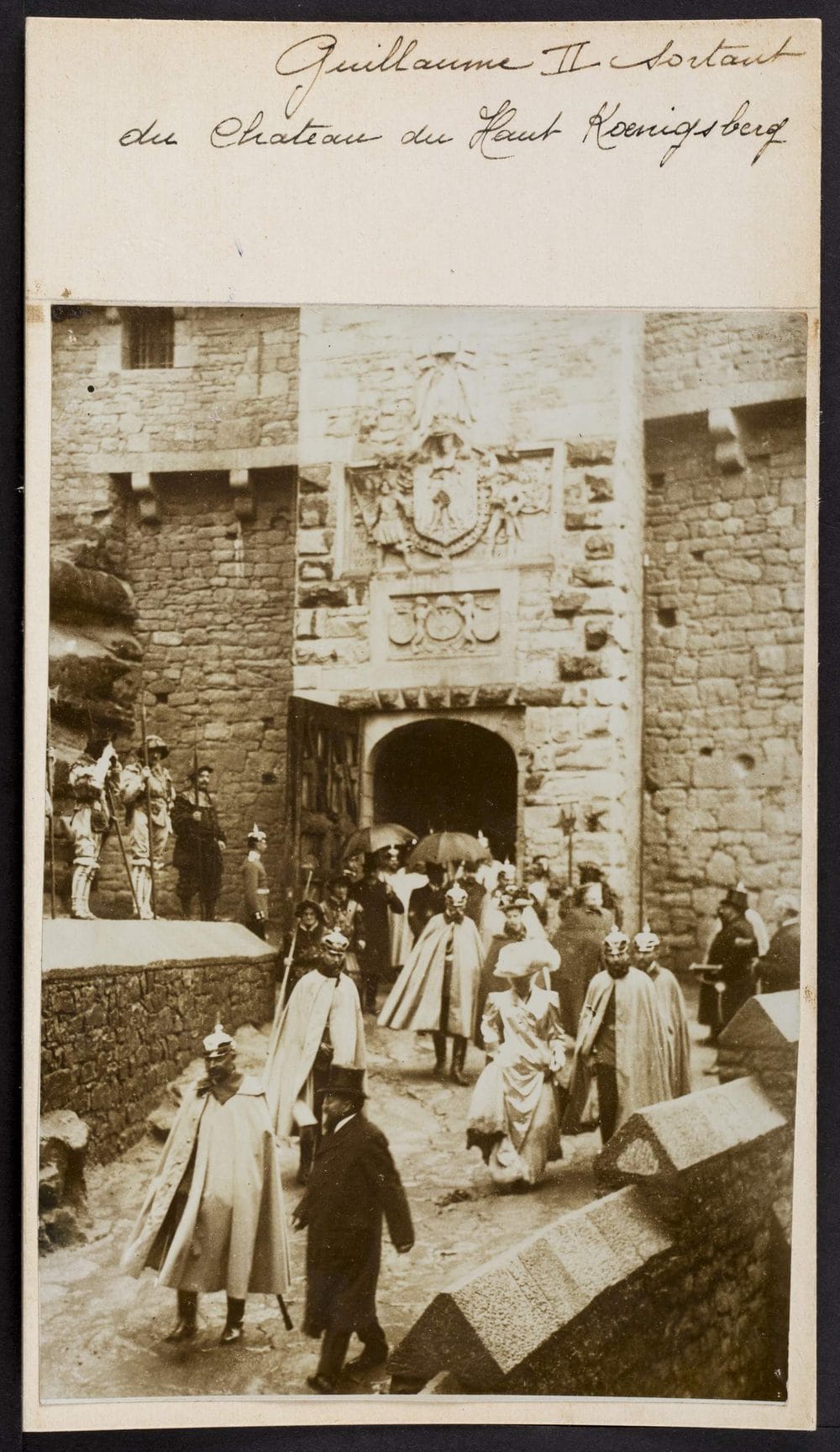
Wilhelm inaugurated his castle on May 13, 1908, in a downpour, before five hundred costumed extras re-enacting a sixteenth-century episode from the castle’s past, a pageant staged with Schnug’s help to present the rebuilt fortress to the world. The Alsatian and international press, unimpressed by the rain and the theater, treated the ceremony as faintly ridiculous. Eleven years later the joke turned on its maker. Defeat in the First World War returned Alsace to France, and under the Treaty of Versailles in 1919 the former crown property became a French national monument. The imperial eagle that had crowned the keep was eventually taken down, a discarded emblem of an empire that no longer existed.
For decades the French did not know what to do with the place. To many it was simply the Kaiser’s folly, a German fake in the manner of Neuschwanstein, embarrassing precisely because of who had built it and why. One sign of the slow thaw came in 1937, when Jean Renoir chose the castle as a setting for La Grande Illusion, his great film about the futility of war and the brotherhood that crosses enemy lines, a fitting use for a fortress that had so recently changed sides. Only gradually, as Franco-German relations healed and historians looked again, did a fairer judgment take hold. Recent building research, including a major scholarly volume published in 2020 and excavations carried out between 2008 and 2016, has shown that more genuine medieval fabric survives inside Ebhardt’s walls than the dismissive view allowed, and that his reconstruction was a more careful reading of the evidence than its critics granted. In 1993 the state classed the restored castle in its entirety as a historic monument, reconstruction and all. Ownership passed from the French state to the Département du Bas-Rhin in 2007, and then, when the two Alsatian départements merged on January 1, 2021, to the Collectivité européenne d’Alsace, which runs the castle today. A propaganda piece for a vanished empire had become one of the most visited monuments in France and the most visited castle in Alsace, drawing close to six hundred thousand visitors in 2023.
Visiting the Château du Haut-Kœnigsbourg
The Château du Haut-Kœnigsbourg is open every day of the year except January 1 and December 25 and 26. Hours run shorter in the depths of winter, when the castle closes over the middle of the day, and longest in July and August, when it stays open into the early evening; on Mondays it opens an hour later than on other days, and the last admission is always an hour before closing. A full adult ticket costs 12 euros, with reduced rates for young visitors and concessions and free entry for children under six, and admission is free for everyone on the first Sunday of each month from November through March. Entry tickets and guided tours can also be booked in advance through GetYourGuide. Allow about an hour and a half for the self-guided circuit, which climbs some three hundred steps of varying height and is not suitable for strollers.
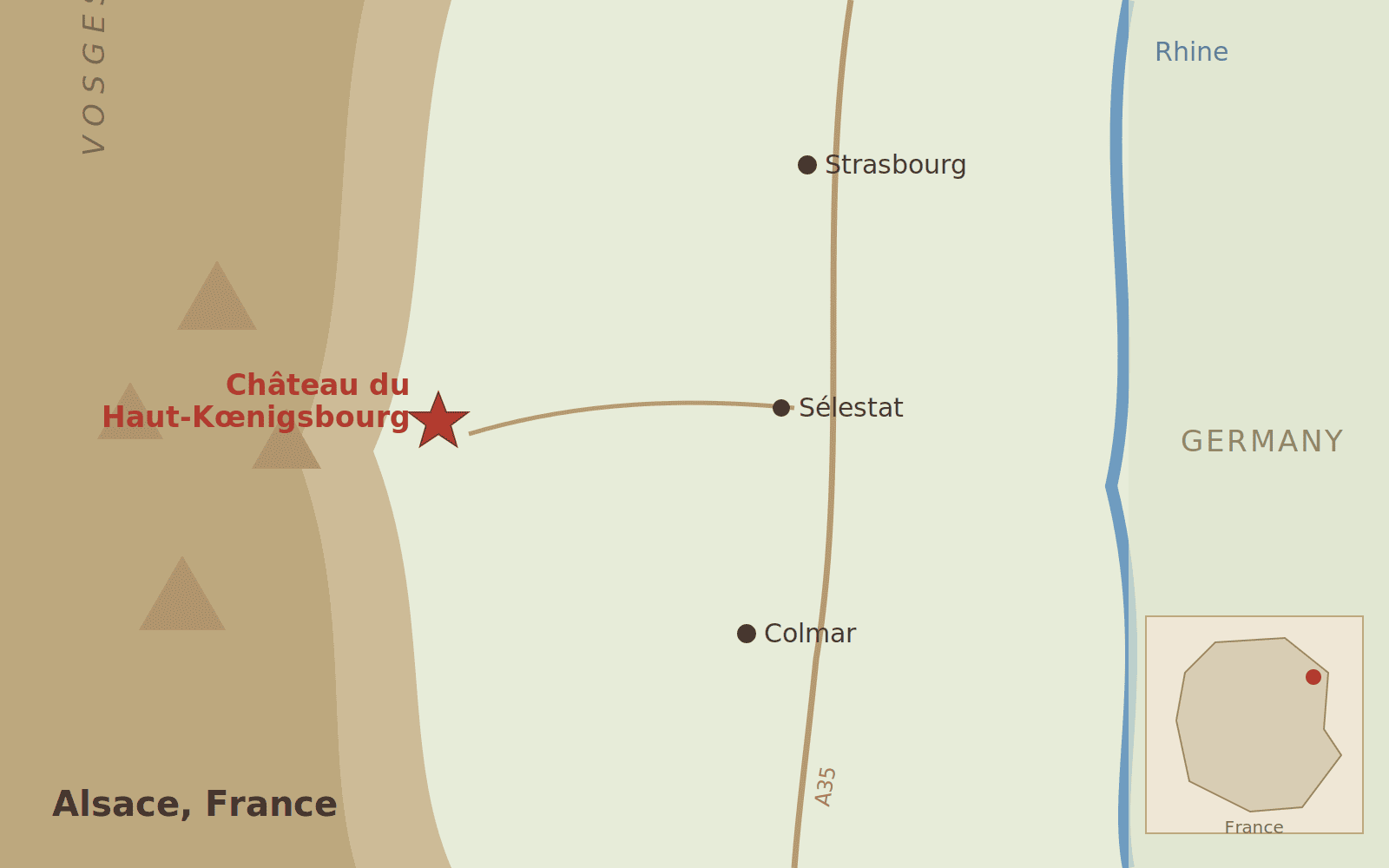
The castle sits roughly 12 kilometers west of Sélestat, 26 north of Colmar and 55 south of Strasbourg. Drivers leave the A35 at Kintzheim or Saint-Hippolyte and climb the wooded D-road to a free car park with 150 spaces, from which a short uphill track leads to the gate. From March to December a shuttle bus runs up from Sélestat railway station on a seasonal timetable, with reduced castle admission for those who arrive on it. The site is exposed on its summit, so it is worth checking the weather and the operator’s notices before setting out; work on the great bastion is under way through the middle of the decade, with new visitor facilities expected by 2027. Anyone staying overnight can compare hotels in and around Sélestat.
Some links on this page are affiliate links, which means StoneKeep Atlas may earn a small commission, at no extra cost to you, if you book through them.
More Views of the Château du Haut-Kœnigsbourg
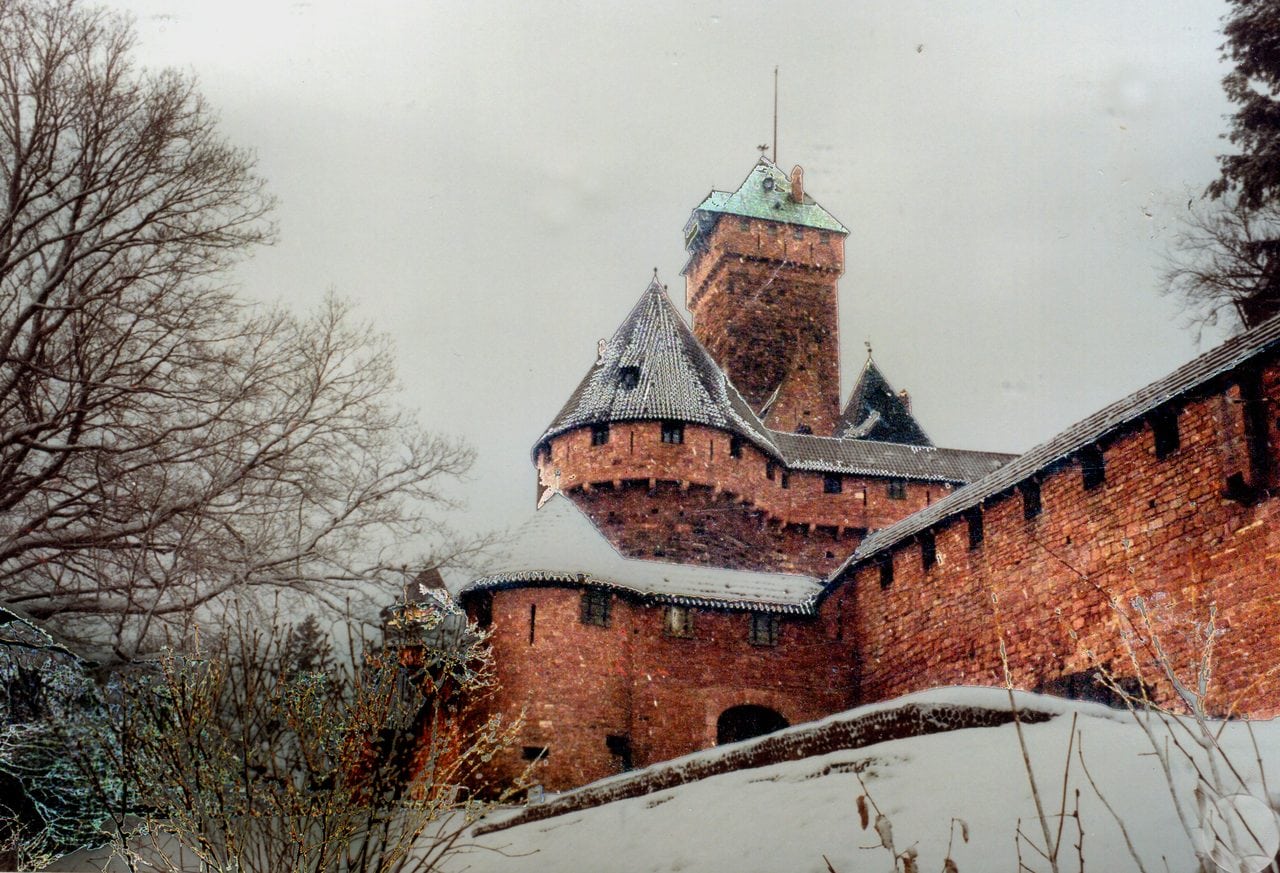
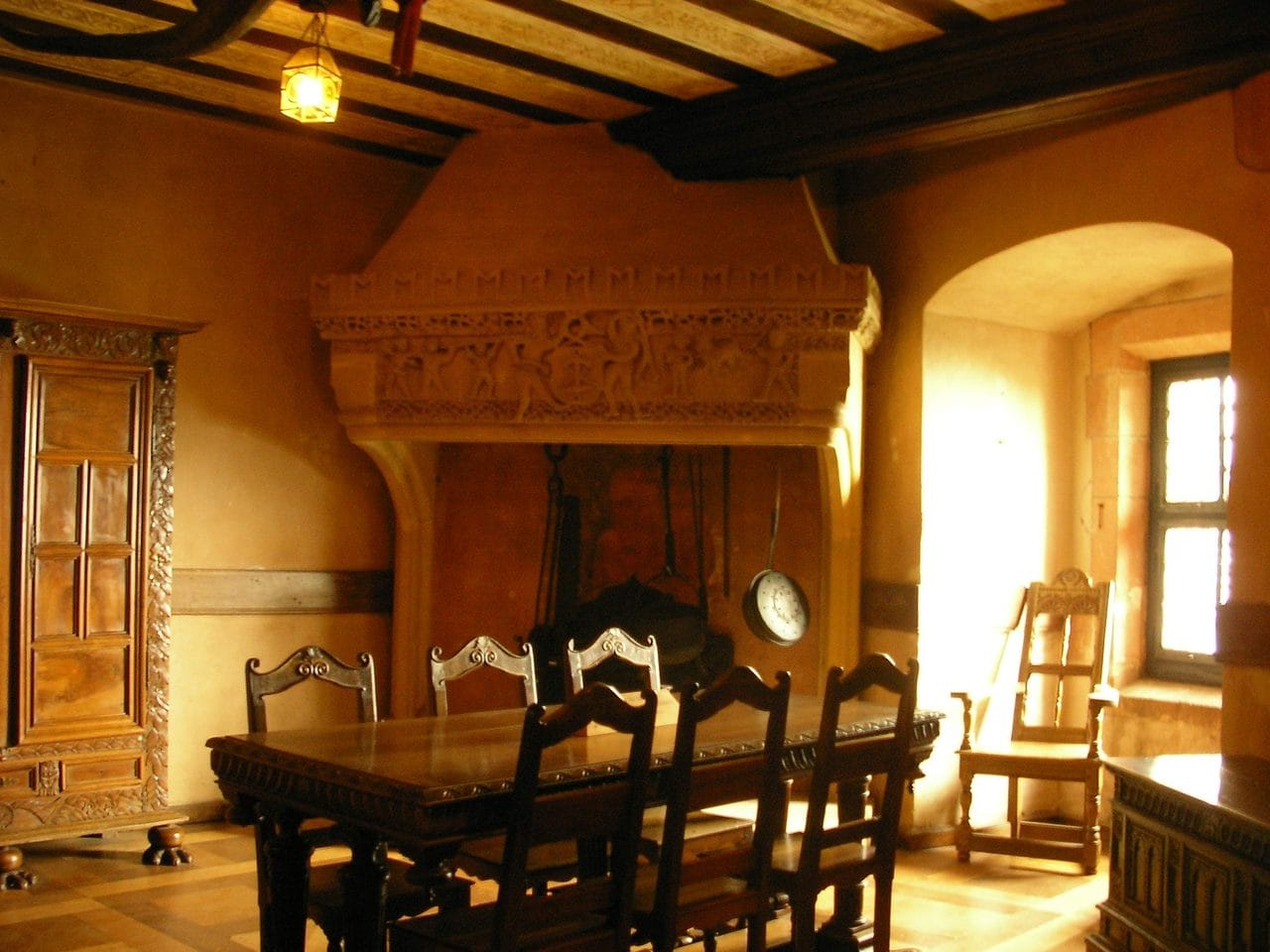
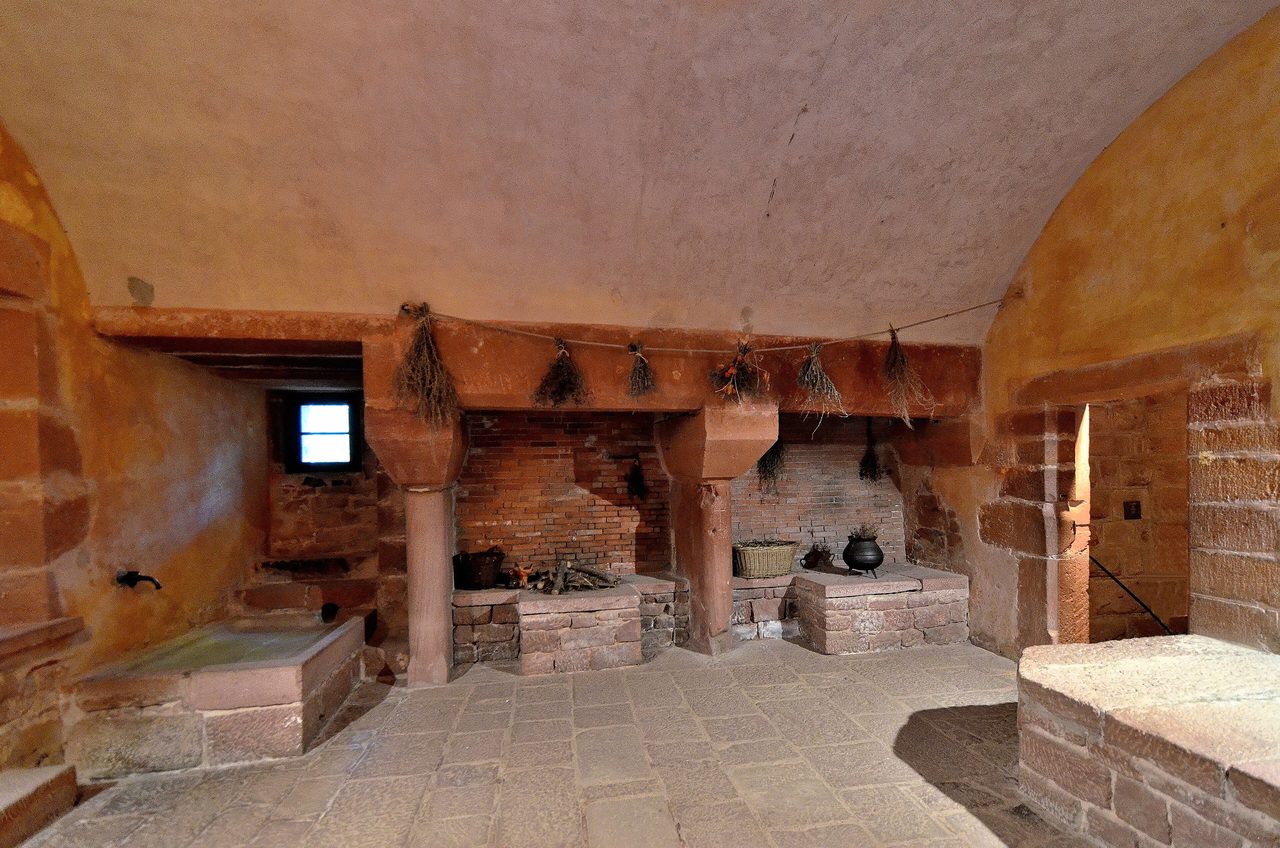
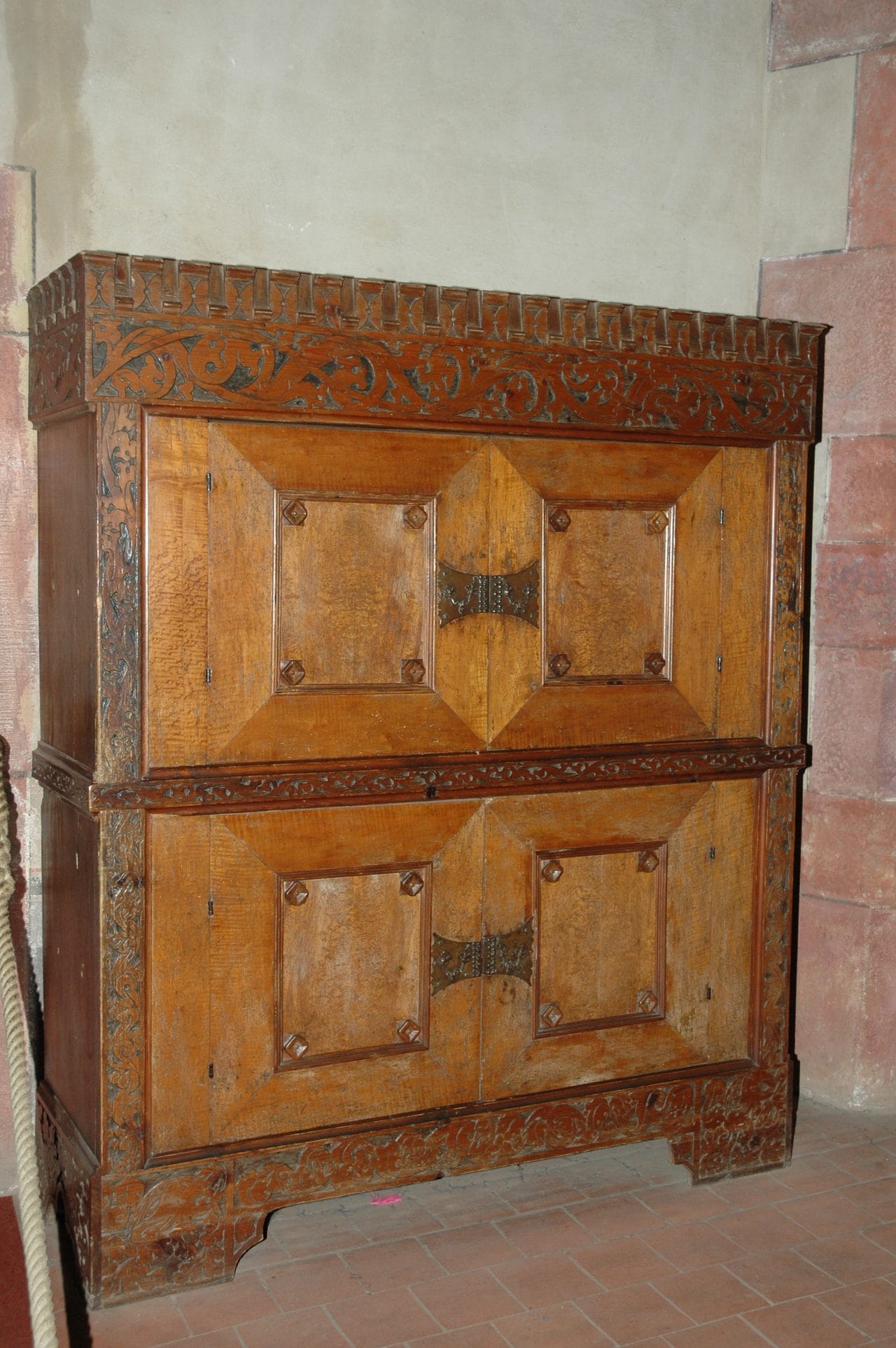
From the ramparts and the keep the castle shows its many faces across the seasons, from the great bastion and the painted Kaiser’s hall to the long view over the vineyards of the Alsace plain.
Beyond the Château du Haut-Kœnigsbourg
The Staufenberg has more than one castle on it. A short walk below Haut-Kœnigsbourg lie the modest ruins of the Oedenbourg, known as the Petit-Koenigsbourg, a smaller medieval fortress that was never rebuilt and that makes a quiet counterpoint to its restored neighbor, a reminder of what the great castle would have remained without an emperor’s money. The Château du Haut-Barr above Saverne offers the ruined counterpoint: the prince-bishops’ rock castle, its towers gone since 1650, its view intact. For the opposite fate, the Three Castles of Eguisheim above the Wine Route were never rebuilt at all, three honest ruins that show what this mountain looked like before Bodo Ebhardt arrived.
Haut-Kœnigsbourg is best understood in company. Read alongside Heidelberg, it frames the central question of monument care around 1900, whether to conserve a ruin or rebuild it, with the two castles giving opposite answers within a few years of each other. Read alongside the Romantic creations of the nineteenth century, it sharpens the difference between reconstructing a real ruin and inventing a picturesque one. And read against Pierrefonds, it shows that France and Germany were doing the same thing on either side of a contested border, each rebuilding a medieval fortress to serve a modern empire. The same imperial rivalry runs north along the river, through the castles of the Middle Rhine, the German heartland this Alsatian outlier looks across to. Closer to home, the reconstructed château has an honest foil in the nearby Château du Hohlandsbourg, a Habsburg fortress of the same region that was consolidated as a ruin rather than rebuilt whole. Farther north, in the Vosges du Nord, the ruined Château de Fleckenstein carries the same lesson into stranger territory, a great semi-troglodytic rock castle that shows what Haut-Kœnigsbourg itself might have remained. The whole Alsatian set, Haut-Kœnigsbourg included, is gathered in our guide to the castles of Alsace. Rebuilt on its crag into a vision of the Middle Ages, Haut-Kœnigsbourg also stands among the fairytale castles in France, the châteaux that look straight out of a storybook.
Conclusion
Haut-Kœnigsbourg unsettles the categories we bring to old buildings. It is neither a pure medieval survival nor a pure nineteenth-century fantasy, but a careful, contested reconstruction that wears its own history in the marks on its stones. Its builder meant it to declare that Alsace was German and would stay so; within a generation the border had moved, the empire was gone, and his castle belonged to France. What remains is a monument that is honest about being two things at once, and more interesting for it than either a ruin or a replica would have been. The eight-year calendar of marks cut into its stones, old work and new set plainly side by side, is in the end the truest thing about it. For travelers it offers one of the great views in Alsace and one of the clearest lessons anywhere in how a society chooses to remember its past.
Principal Sources
- Château du Haut-Kœnigsbourg, official site of the monument, Collectivité européenne d’Alsace.
- Base Mérimée, French Ministry of Culture, monument reference PA00084875.
- Thomas Biller and Bernhard Metz, studies on the castles of Alsace and the building history of Haut-Kœnigsbourg.
- Bodo Ebhardt, published accounts of the reconstruction, 1900 to 1908.
- Georg Dehio and the 1905 Tag für Denkmalpflege, on the conservation of monuments, for the “conserve, not restore” debate.
Image credits. Distant view of the castle on its ridge: Wrtalya, CC BY-SA 4.0, via Wikimedia Commons; the castle as a ruin before reconstruction, photographed by Adolphe Braun: public domain, via the Bibliothèque nationale de France; Wilhelm II leaving the castle: Université de Caen Normandie, no known copyright restrictions, via Wikimedia Commons; the rebuilt keep: Poudou99, CC BY-SA 4.0, via Wikimedia Commons; the glazed-tile stove: Patrick, CC BY-SA 2.0, via Wikimedia Commons; the approach to the gate: Guilhem Vellut, CC BY 2.0, via Wikimedia Commons; the main gate beneath Wilhelm II’s arms: Chatsam, CC BY-SA 3.0, via Wikimedia Commons; keep and curtain wall: Patrick, CC BY-SA 2.0, via Wikimedia Commons; the inner ward: Guilhem Vellut, CC BY 2.0, via Wikimedia Commons; the half-timbered logis: Guilhem Vellut, CC BY 2.0, via Wikimedia Commons; the castle in winter: Vitold Muratov, CC BY-SA 4.0, via Wikimedia Commons; the dining hall: Gzen92, CC BY-SA 4.0, via Wikimedia Commons; a bombard in the artillery loft: Gzen92, CC BY-SA 4.0, via Wikimedia Commons; the castle kitchen: Patrick, CC BY-SA 2.0, via Wikimedia Commons; a Renaissance cupboard: Philippe Sosson, CC BY 2.0, via Wikimedia Commons. Location map: StoneKeep Atlas. Freely licensed images are resized to fit; otherwise unaltered.