
Versailles and the Architecture of Absolutism
On March 9, 1661, Cardinal Mazarin died at the château of Vincennes, and a twenty-two-year-old king who had spent his whole life waiting decided not to replace him. The next morning Louis XIV told his startled ministers that he would govern France himself. He would seal no order and sign no document, not even a passport, except by his own hand. Kings of France had leaned on a chief minister for two generations, and everyone at court assumed the young man would do the same. Instead he announced that the waiting was over.
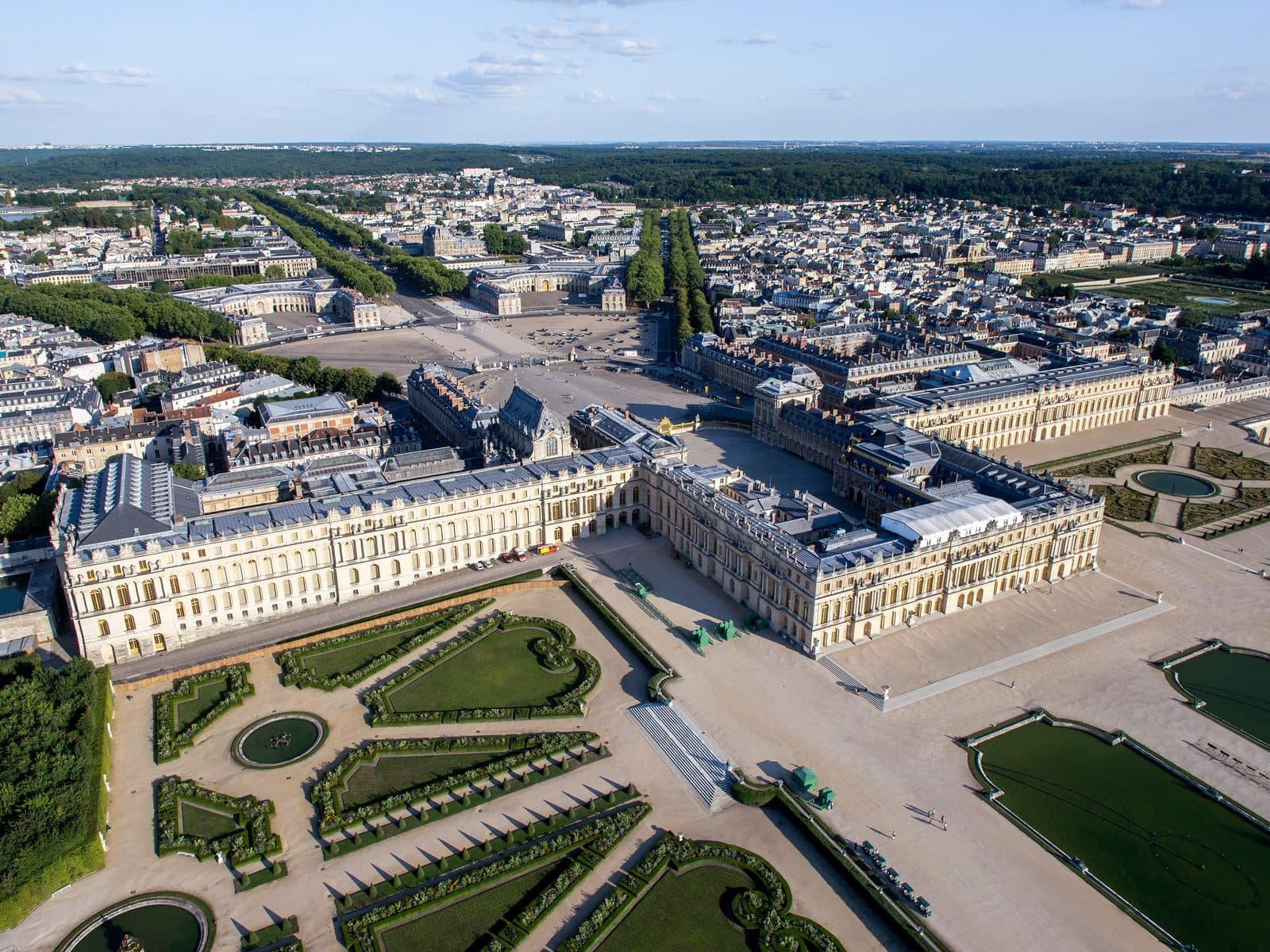
What followed was a way of ruling and, inseparable from it, a way of building. Louis grasped something most rulers only half sense: that authority has to be seen before it is believed. Over the next half century he turned stone, water, and ceremony into the working machinery of absolute monarchy, and he did it most completely at one address. The Palace of Versailles was never just a royal house. It was an argument about power made in marble and box hedge, the very architecture of absolutism, and it worked so well that half of Europe spent the next hundred years trying to copy it. Two centuries on, a Bavarian king would copy it most literally of all, and in doing so would prove how completely the world Louis built had vanished.
The lesson of Vaux-le-Vicomte
The first thing Louis did with his new power was destroy the man who held the purse. Nicolas Fouquet, superintendent of finances, was the richest and most cultivated official in France, and in the late 1650s he had built himself a country house that had no equal in the kingdom. At Vaux-le-Vicomte, an hour southeast of Paris, Fouquet hired three men of rare talent and told them to work as one: the architect Louis Le Vau, the painter and decorator Charles Le Brun, and the garden designer André Le Nôtre. Together they produced something new in France, a house in which building, interiors, and gardens were conceived as a single composition.
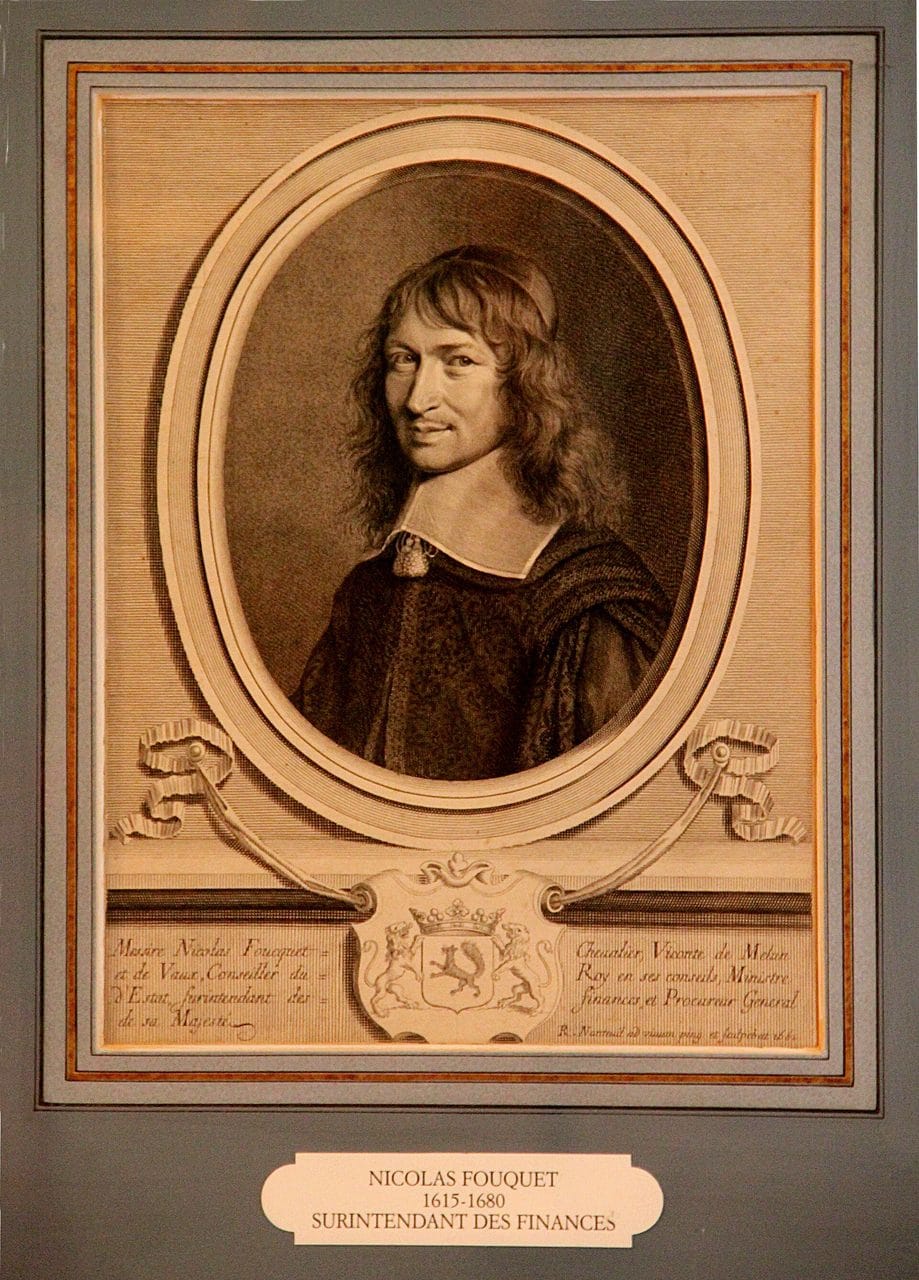
On the warm evening of August 17, 1661, Fouquet unveiled it with a party meant to dazzle the king. There was a play by Molière written for the occasion, a feast served on silver-gilt finer than the crown’s own, and fireworks over the canals. Louis watched it all and drew the wrong lesson from Fouquet’s point of view and exactly the right one from his own. No subject, he concluded, should be permitted to live so magnificently. Within three weeks the trap closed. On September 5, 1661, the king had Fouquet arrested at Nantes and began the long process that would end in a life sentence. The superintendent died in prison in 1680, his fortune scattered, his island fortress at Belle-Île confiscated.
The deeper point is what Louis did next. He did not tear down what Fouquet had made. He took the idea, and he took the men. Le Vau, Le Brun, and Le Nôtre passed almost at once into royal service, where the experiment first run at Vaux would be repeated at a scale designed to leave no rival standing. Fouquet had built a perfect private machine for displaying one man’s magnificence. Louis saw that the same machine, enlarged and turned toward the crown, could display the magnificence of the state itself. Vaux taught him both halves of the lesson: that splendor was power, and that splendor in any hands but the king’s was a threat.
From hunting lodge to seat of power
Versailles began as almost nothing. Louis XIII had built a modest brick-and-stone hunting lodge there in 1623, on marshy ground twelve miles southwest of Paris, and one courtier later remembered it as the most thankless of places, without view, without water, without decent soil. That was much of its appeal to his son. Paris had humiliated the boy king during the civil wars of the Fronde, when crowds forced the royal family to flee the capital in the night. Louis never forgave the city, and he wanted a seat of power he could design from the ground up, on open land he controlled completely, far from the unruly streets.
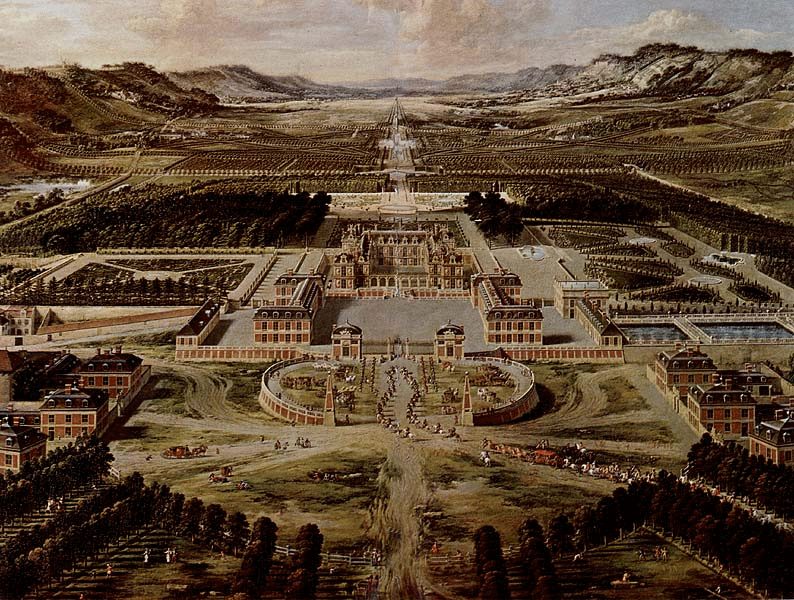
He refused to demolish his father’s lodge. Instead, beginning in the late 1660s, Le Vau wrapped it in a new stone shell on the garden side, a structure that contemporaries called the Envelope. The old red-brick château survived inside the grander one, visible still around the Marble Courtyard, a small act of dynastic piety folded into a vast act of self-assertion. The choice was characteristic. Louis did not erase the past so much as enclose it, set it at the center, and build outward until it became the heart of something his father could never have imagined.
For two decades the work went on in stages. Le Vau died in 1670, and his assistant François d’Orbay carried the designs forward. Gardens, fountains, and a growing palace took shape around the old core, paid for out of a treasury that Colbert was painstakingly refilling. By the late 1670s the building was ready for the architect who would give it the scale the world remembers.
Hardouin-Mansart and the scale of majesty
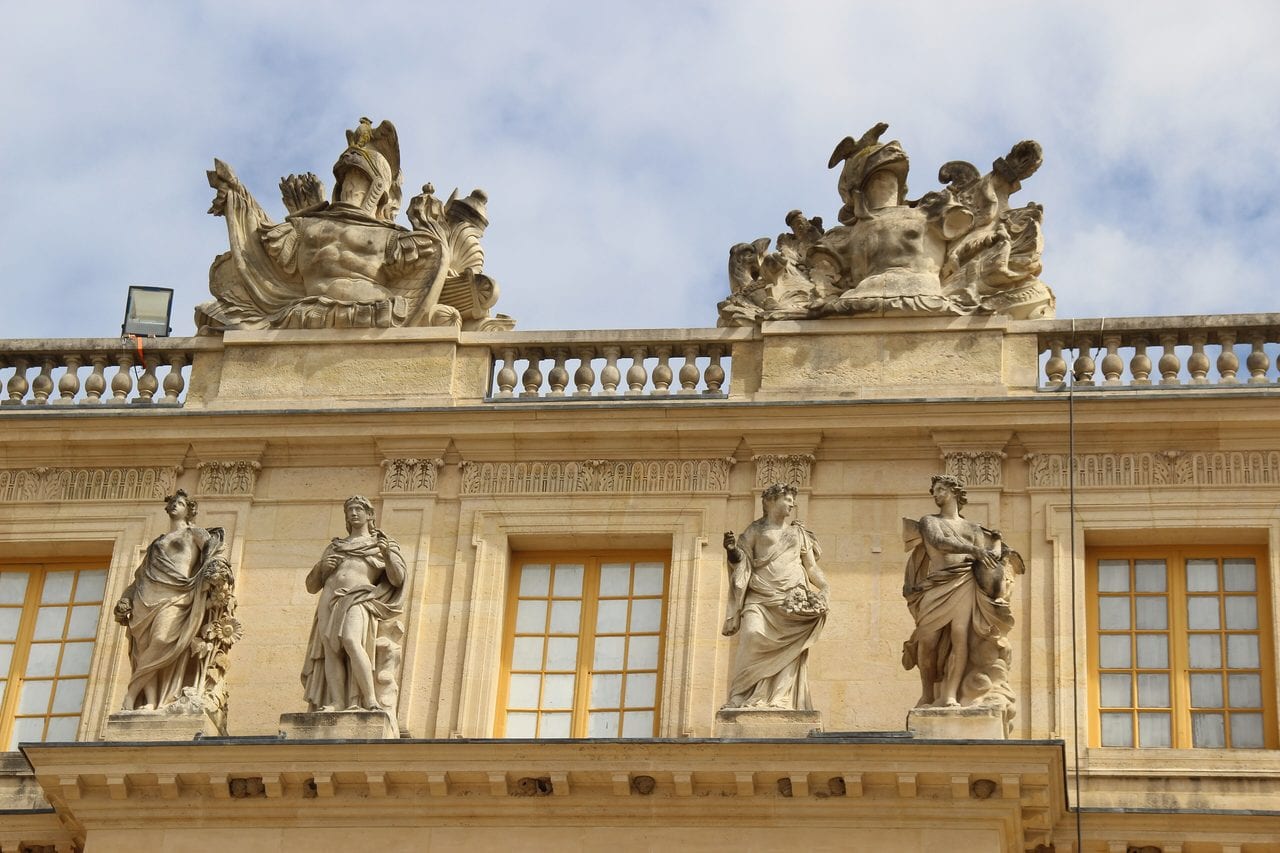
When the Franco-Dutch War ended in French victory in 1678, Louis appointed Jules Hardouin-Mansart as his First Architect and handed him a restored budget and an army of idle soldiers to put to work. Over the next decade Hardouin-Mansart gave Versailles its final, enormous silhouette. He raised the long North and South Wings to house the court, built the Grande and Petite Écuries to stable a small cavalry, threw up the Grand Commun to feed and lodge the servants, and later designed the Royal Chapel that crowns the eastern approach. The palace grew until it could hold a government and a society inside one building.
Scale was the point, not a side effect. A château whose garden front ran for the better part of half a mile was a physical claim about the reach of the king who owned it. Every visiting ambassador had to walk that distance, past wing after wing, courtyard after courtyard, before reaching the man at the center. The architecture did the arguing before a single word was spoken. By the time it was finished, Versailles was less a residence than a stage built to a single specification: that France radiated outward from one body, and that body lived here.
The Hall of Mirrors: an argument in glass
Nowhere is the argument clearer than in the room that became the palace’s signature. Le Vau had built an open Italian terrace on the first floor, facing west across the gardens, and it proved useless, exposed to wind and rain. Hardouin-Mansart enclosed it. Between 1678 and 1684 he turned it into the Galerie des Glaces, the Hall of Mirrors, a gallery running about seventy-three meters along the garden front, where seventeen tall windows face seventeen arcades set with 357 mirrors.
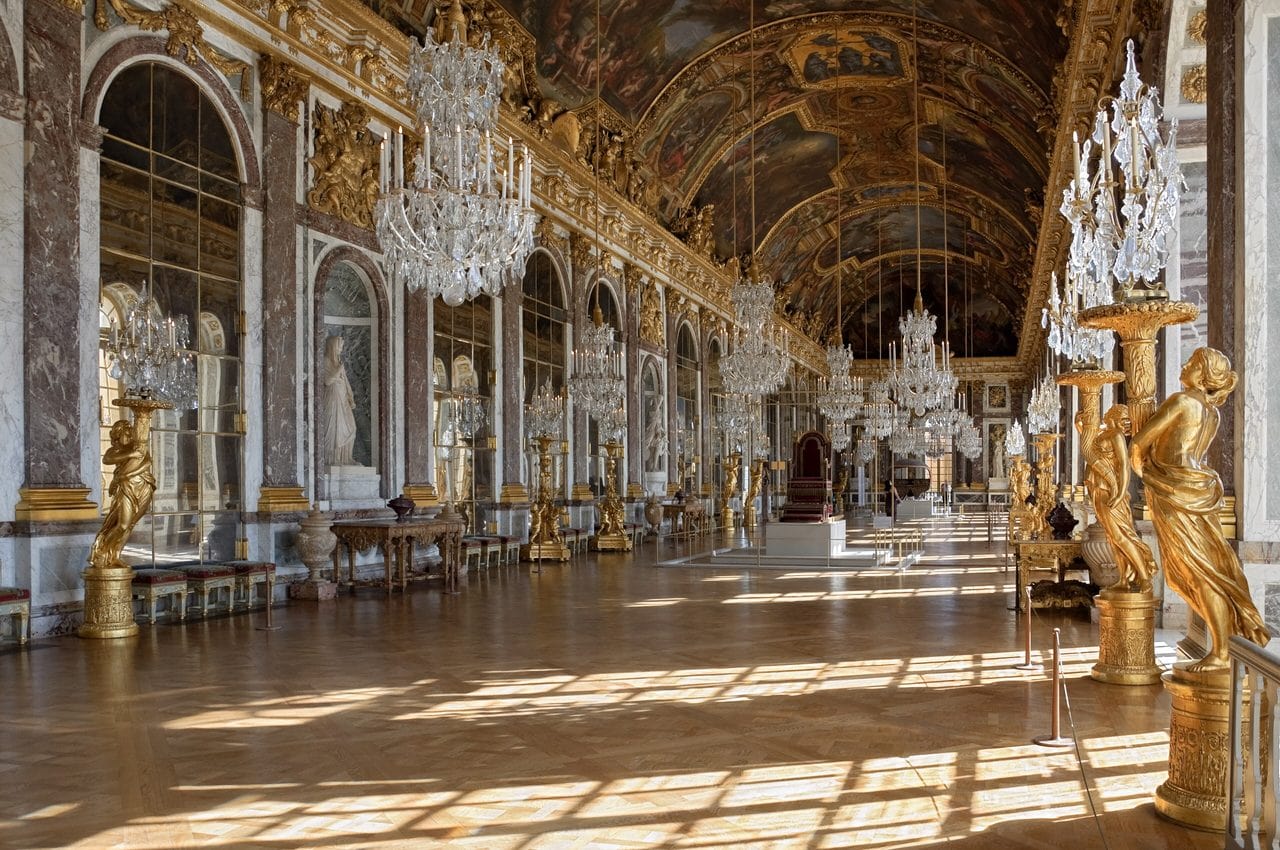
The mirrors were more than beautiful. They were policy. Venice had held a near monopoly on the manufacture of large mirror glass, an expensive luxury, and Colbert had founded a royal manufactory to break it. The glass that lined the gallery was among its first great orders, the same works that would one day become Saint-Gobain. A room meant to display the king’s magnificence was also a quiet advertisement for French industry beating its foreign rivals, which was exactly the kind of victory Louis prized.
The gallery was a working stage as much as a showpiece. On ordinary days courtiers crowded it on their way to the king’s apartments, and on great occasions it became the route along which foreign ambassadors were marched toward the throne, the mirrors multiplying the candlelight and the crowd into something overwhelming. Even the furniture made an argument. The original tables and stands were solid silver, a display so conspicuous that when war drained the treasury in 1689, Louis had them melted down and coined to pay his armies. He lost a famous splendor and gained a point: that everything in the palace, down to the silver, existed to serve the power of the crown.
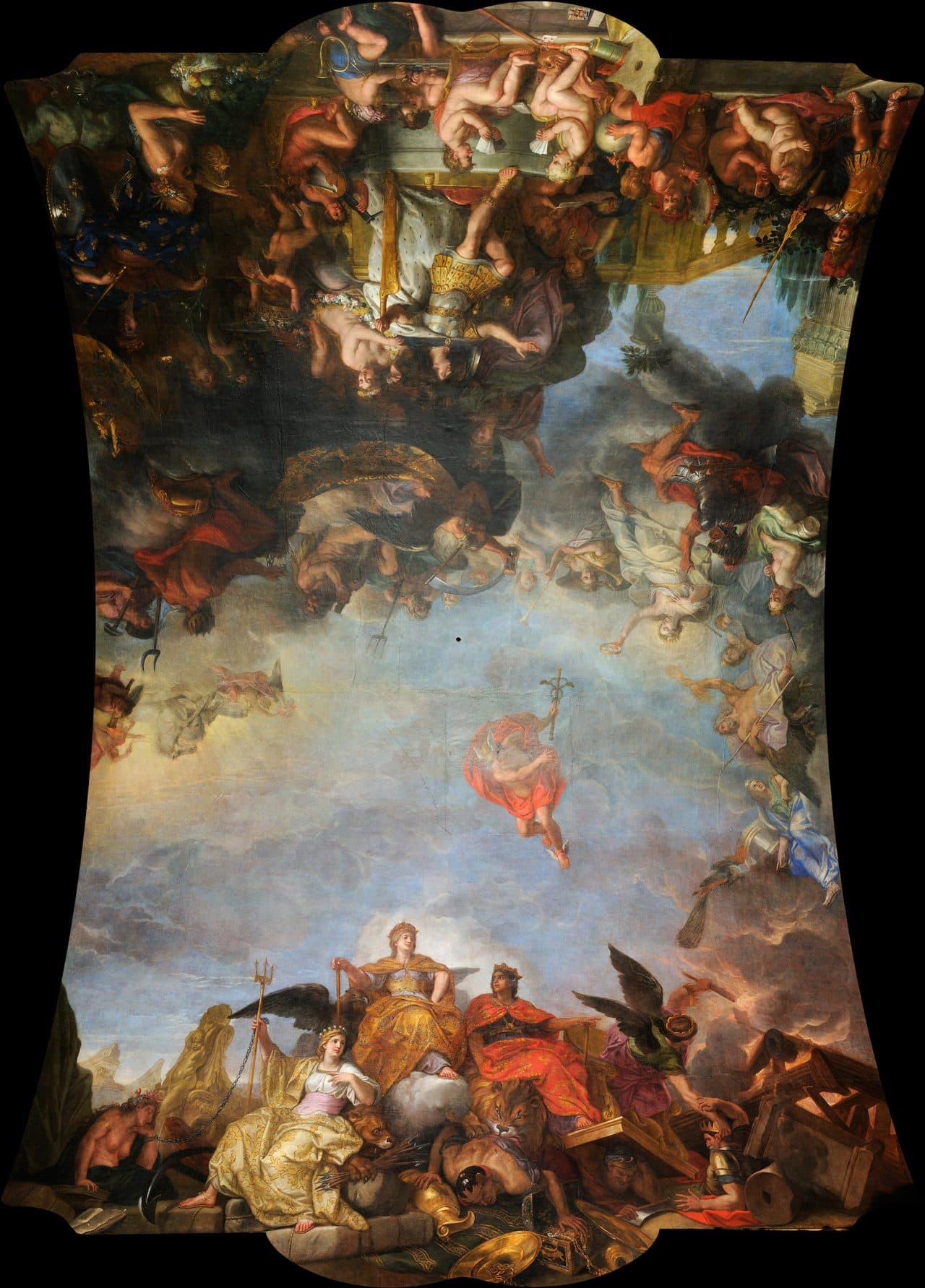
Above the mirrors, Le Brun painted the ceiling between 1680 and 1684, and here the propaganda turns explicit. His thirty compositions narrate the first eighteen years of the king’s personal rule, from 1661 to the Peace of Nijmegen, with Louis cast as a Roman hero among allegories and vanquished enemies. The original plan would have shown Apollo, then Hercules, but the king made a startling choice: he would be shown not as a god in disguise but as himself, Louis XIV in person, taking up the helm of state. The central panel carries the title Le roi gouverne par lui-même, “The King Governs by Himself,” and dates the whole reign to that morning in 1661 when he told his ministers he needed no one. To walk the gallery was to read the official history of the regime, written on the ceiling in the régime’s own hand.
Le Nôtre’s gardens: geometry as statecraft
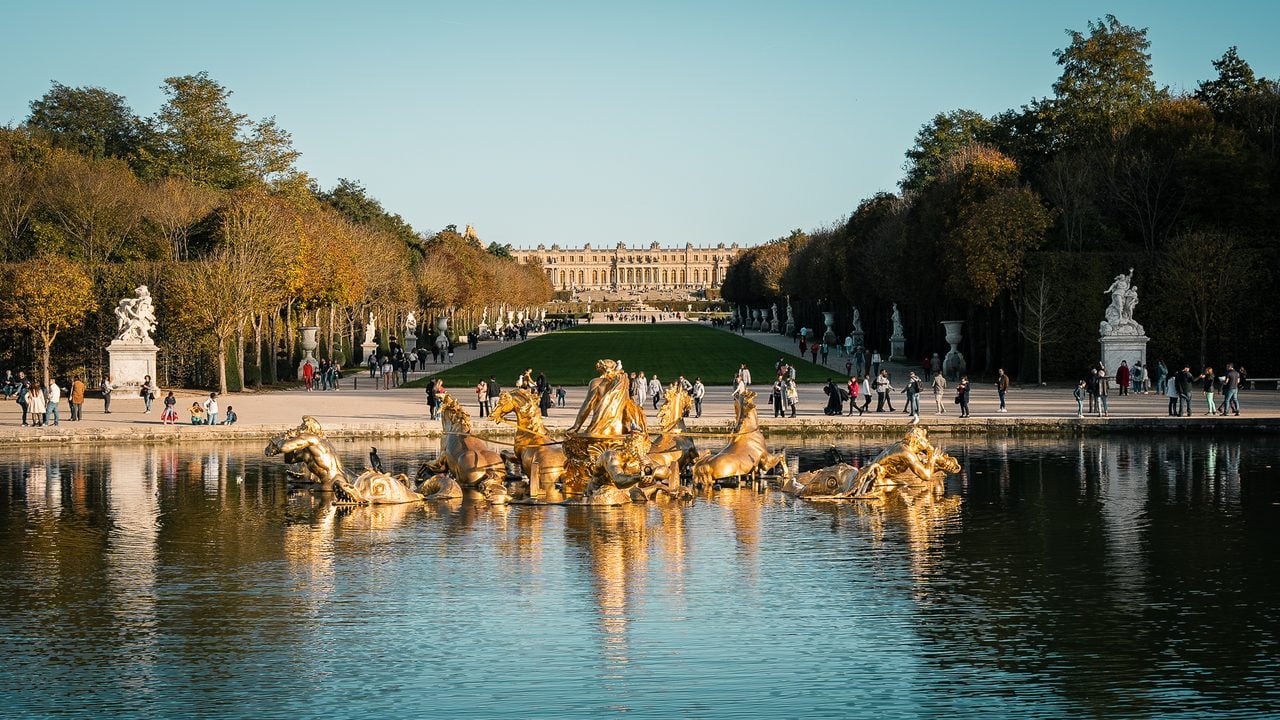
If the palace argued for the king’s command over men, the gardens argued for his command over nature. Le Nôtre took the rolling, swampy site and imposed on it a vast scheme of straight axes, clipped hedges, and geometric basins, all organized around one perspective that runs westward from the palace to the horizon. Standing at the center of the terrace, the king looked down a single ordered line: the Latona Fountain, the green carpet of the Tapis Vert, the Apollo Fountain, and the Grand Canal beyond, dug between 1668 and 1679 and stretching some seventeen hundred meters into the distance. Water, stone, and living wood were bent to a geometry that began and ended at the royal eye.
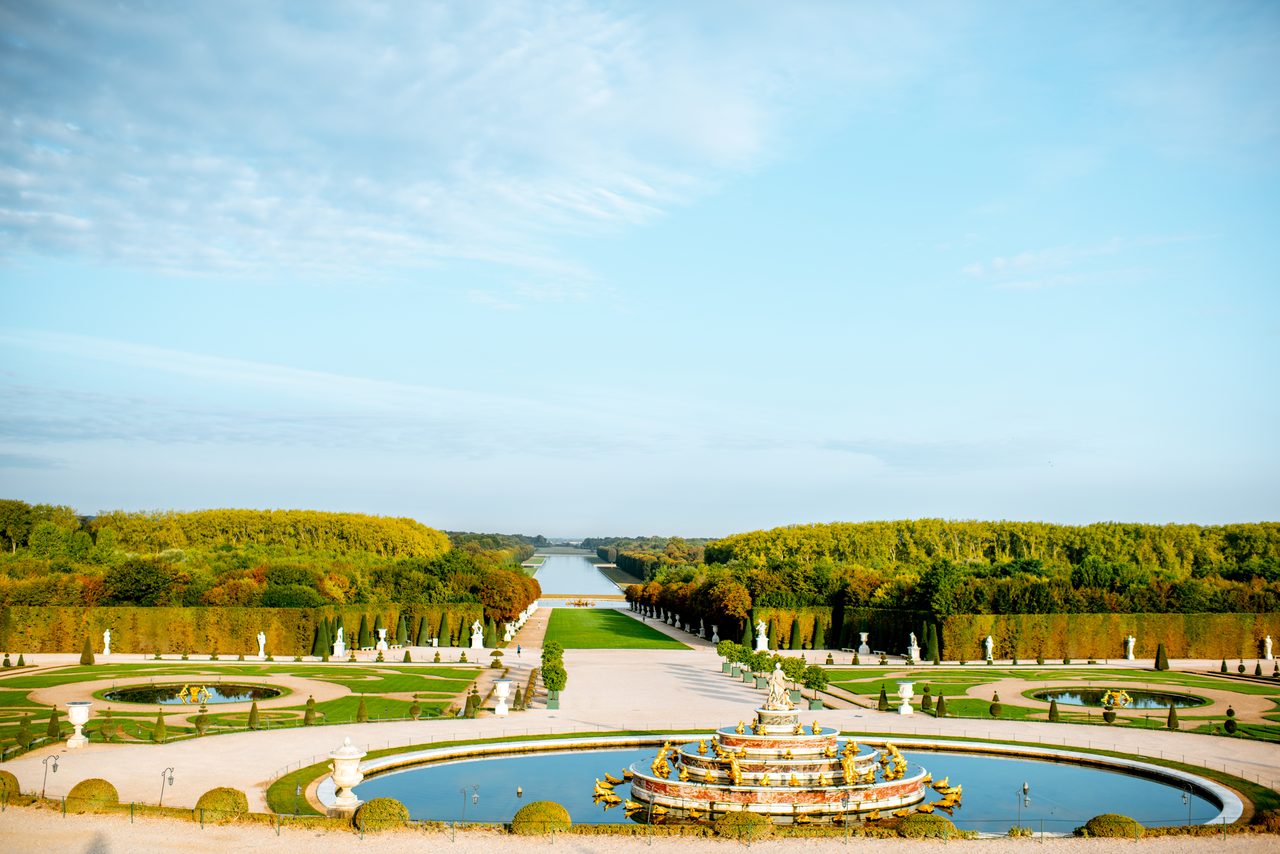
The symbolism was not subtle, and it was not meant to be. Louis had taken the sun as his emblem since boyhood, ever since he danced the role of the rising Apollo in the Ballet Royal de la Nuit in 1653, a teenager appearing at dawn to banish the chaos of the night. At Versailles the whole landscape was tuned to that myth. The Apollo and Latona fountains, drawn from the legend of the sun god and his mother, anchor the central walk, and the palace stands at the still center of a scheme that seems to turn around it. A formal garden of this kind is an assertion that the world itself can be reasoned, ranked, and ruled. Le Nôtre gave the Sun King a landscape that obeyed him as completely as his court did.
Before the court ever moved in, the gardens were already doing political work. Louis staged a series of vast festivals there in 1664, 1668, and 1674, days of theater, music, and fireworks recorded in engravings and sent across Europe, so that princes who would never set foot in France still learned what its king could command. Making the place required force on an industrial scale. Workers drained the marshes, leveled hills, and diverted rivers to feed the fountains, and in 1685, at the height of the building, some thirty-six thousand of them labored on the palace and its annexes at once. The serene geometry a visitor admires today was wrung from the land by an effort only an absolute state could organize.
1682: the court becomes a machine
For all its splendor, the most consequential thing Louis did at Versailles was move into it. On May 6, 1682, he formally installed the court and the seat of government at the palace, and the act transformed a building into an instrument. Colbert had argued the king should stay in Paris. Louis disagreed, and once the court arrived it never truly left until the Revolution dragged it back to the capital in 1789.
The genius of the move lay in what it did to the nobility. For centuries the great aristocratic families had been a standing danger to the crown, with their own lands, their own followers, and a long habit of rebellion that the Fronde had shown in full. Louis solved the problem by inviting them in. He required the high nobility to attend him at Versailles, and at Versailles he tied their entire world to proximity to his person. A vast etiquette governed every hour. To hand the king his shirt at the morning lever, to hold a candle at the evening coucher, to be granted a stool in the queen’s presence, these were the new currencies of status, and they could be earned only by being there, in the palace, under the royal eye.
The move fit a larger design. While the masons worked, Colbert was rebuilding the machinery of the state, turning a treasury that verged on bankruptcy in 1661 into a surplus by 1666, regulating manufactures, and funding the very industries whose products lined the palace. Louis pushed royal officials called intendants into every province to govern in his name, and he was careful never to let any one minister grow into a new Mazarin, dividing his favor and feeding rivalries so that every thread of power ran back to a single hand. Versailles was the visible center of this centralizing project, the place to which the threads were gathered.
A nobleman who stayed home on his estates plotting was no longer dangerous. He was merely absent, and absence was ruin. Ambition that had once raised private armies was redirected into a competition for the king’s glance, and the men who might have led revolts spent their days instead waiting in antechambers. The palace had been built to overawe foreigners, but its subtler work was done on Frenchmen. By gathering the nobility under one roof and making their honor depend on his favor, Louis converted the architecture of magnificence into an architecture of control. The phrase tradition puts in his mouth, l’État, c’est moi, “I am the State,” is almost certainly something he never said. He did not need to. The building said it for him, every morning, as the most powerful men in France competed for the privilege of watching him wake.
The architecture of absolutism, imitated
It is the nature of a successful display to invite imitation, and Versailles was the most successful display in Europe. For the next century, princes who wished to look like real monarchs built their own versions of it. The scheme appeared, with local variations, at Schönbrunn outside Vienna, at La Granja in Spain, at Caserta near Naples, and at a dozen German residences whose rulers borrowed the long axes and the mirrored galleries and the gardens that ran to the horizon. To build in the Versailles manner was to announce that one governed in the Versailles manner, or at least wished to be thought to.
The strangest and most revealing echo came last, and it came from a king who had no real power left to display. In Bavaria, two centuries after Louis took personal rule, Ludwig II bought an island in the Chiemsee in 1873 for the express purpose of building a copy of the Sun King’s palace. His Herrenchiemsee reproduces the western garden front of Versailles almost to scale, and its Hall of Mirrors was built even longer than the original it imitates. Ludwig was a passionate admirer of Louis XIV, and he meant the homage seriously. Yet the gesture was hollow in a way Louis’s never was. Herrenchiemsee invoked an absolutist French monarchy that had ended on the scaffold in 1789 and could no longer be claimed by anyone. Louis built Versailles to run a state. Ludwig built his Versailles to escape one, retreating into a private dream of kingship while a constitutional government ran Bavaria around him, and he occupied the finished palace for only nine days before his death.
The contrast is the whole point. The two palaces look alike, and they could hardly be more different. One was the engine of a working absolutism, the central machine through which a real king governed some twenty million people. The other was a monument to an idea of kingship that the modern world had already buried, paid for out of a private purse it bankrupted. Louis XIV’s architecture was the expression of power he actually held. Ludwig’s was the expression of power he only wished he held, and the difference is written in the stones.
Anchors of the Argument
Vaux-le-Vicomte (1661). Fouquet’s house gave Louis both the team and the template, and Fouquet’s fall taught the king that magnificence in a subject was intolerable. The same artists, turned toward the crown, would build Versailles.
The Le Vau Envelope (from the late 1660s). Louis enclosed his father’s hunting lodge rather than destroy it, setting the old château at the center of a far grander one and making continuity itself a statement of authority.
The Hall of Mirrors (1678–1684). Hardouin-Mansart’s gallery and Le Brun’s ceiling fused luxury, industry, and propaganda into one room: French mirror glass beating Venice, and a painted history that dated the reign to the king’s seizure of personal rule in 1661.
Le Nôtre’s gardens. A landscape ordered into pure geometry around a single western axis, tuned to the myth of the Sun King, asserting royal command over nature itself.
The move of 1682. By installing the court at Versailles and binding noble status to attendance and ritual, Louis turned a palace into a cage of velvet, neutralizing the aristocracy that had nearly toppled the crown a generation earlier.
Conclusion
Versailles is often described as the most beautiful palace in Europe, and it is easy to stop there, to treat it as a triumph of decoration and leave the matter alone. That misses what Louis XIV actually built. He built a system. The architecture, the gardens, the mirrored gallery, and the elaborate theater of the court were not ornaments laid over absolute monarchy. They were the means by which it functioned, the visible body of an invisible claim. A king who governed by himself needed the world to see that he did, and so he made a place where the seeing never stopped.
On his deathbed in 1715, Louis is recorded to have told the men around him, “I depart, but the State shall always remain.” He had spent half a century making that conviction visible in stone, and the stone outlasted him exactly as he meant it to.
That is why the Bavarian echo two centuries later is so poignant and so instructive. Ludwig II copied the form down to the dimensions of the gallery, and he could not copy the thing the form had once contained, because that thing was gone. Versailles worked because behind its splendor stood a real and ruthless concentration of power. Strip the power away and what remains is a very expensive picture of it. The Sun King understood the difference, and built accordingly. To stand in the Hall of Mirrors today is to stand inside an argument that once governed France, and to remember that the most lasting architecture is rarely the most innocent.
Principal Sources
- Château de Versailles, official history and “key dates” pages, for the chronology of construction, the move of 1682, and the Hall of Mirrors.
- Encyclopædia Britannica and the Encyclopedia of the Early Modern World, for Mazarin’s death, Louis XIV’s declaration of personal rule, and the structure of his government.
- T. C. W. Blanning and Peter Burke, The Fabrication of Louis XIV, for the use of art, ceremony, and image as instruments of royal power.
- Norbert Elias, The Court Society, for the reading of court ritual and etiquette as the means by which the nobility was bound to the king and drained of independent power.
- Nicolas Milovanovic and the curatorial scholarship of the Château de Versailles, for Le Brun’s ceiling program and the iconography of the Galerie des Glaces.
Our own studies of the Palace of Versailles, the Château de Vaux-le-Vicomte, the Château de Vincennes, and the Château de Fontainebleau supply the architectural and biographical detail drawn on throughout, and the companion piece Ludwig II and the Architecture of Dreams traces the contrasting case at length.
Image credits. Aerial view of the palace and gardens: ToucanWings, CC BY-SA 3.0, via Wikimedia Commons; Nicolas Fouquet (1662 engraving): Robert Nanteuil, public domain, via Wikimedia Commons; Pierre Patel’s 1668 view of Versailles: Pierre Patel, public domain, via Wikimedia Commons; garden front of Versailles: Gary Todd, CC0, via Wikimedia Commons; Hall of Mirrors: Myrabella, CC BY-SA 3.0, via Wikimedia Commons; Charles Le Brun, “The King Governs by Himself” (1661): Charles Le Brun, public domain, via Wikimedia Commons; the central axis from the Latona Fountain to the Grand Canal: via Envato Elements; Apollo Fountain: Frédéric Picard 28, CC BY-SA 4.0, via Wikimedia Commons. Freely licensed images are resized to fit; otherwise unaltered.