
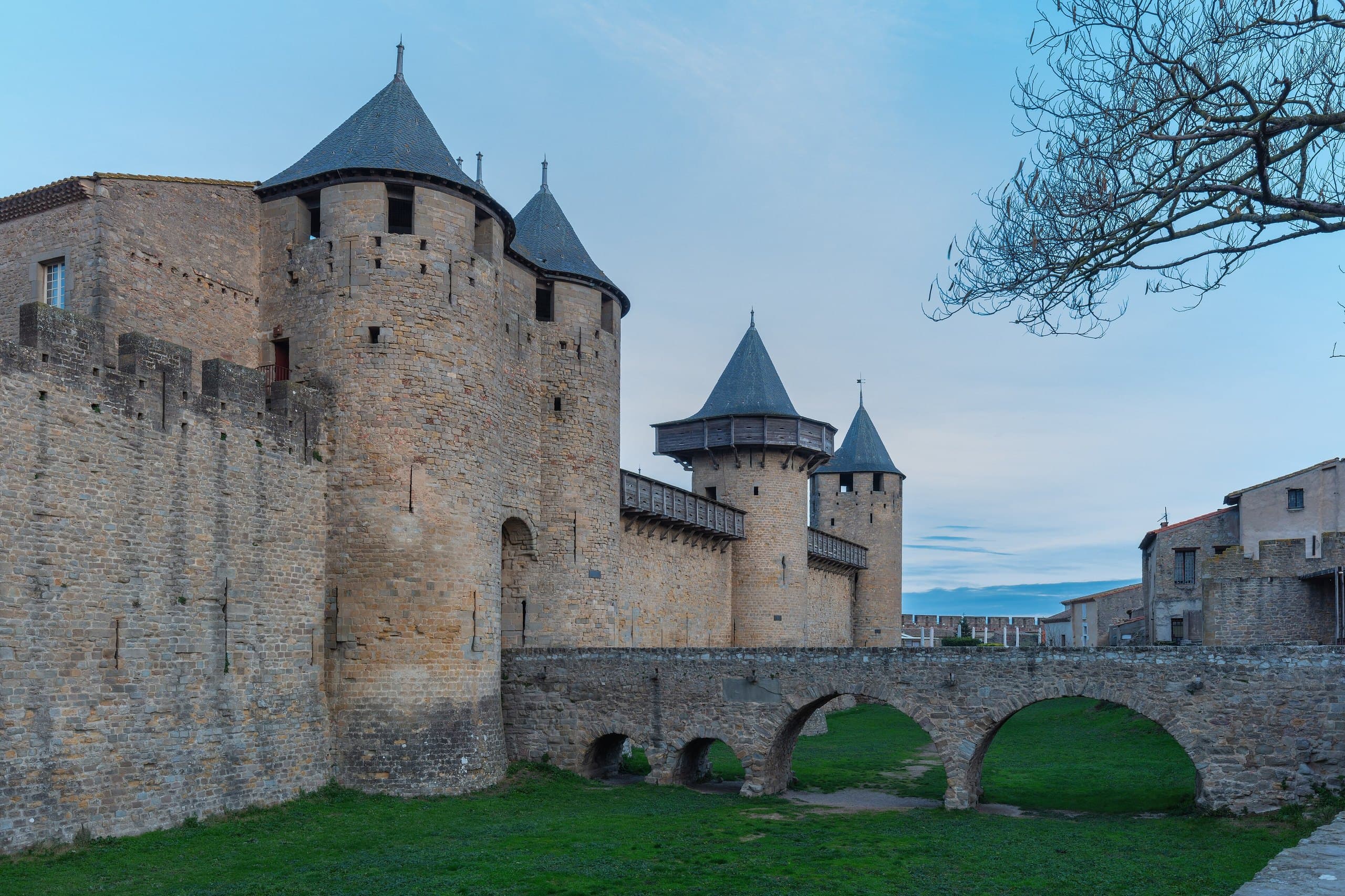
Carcassonne Castle
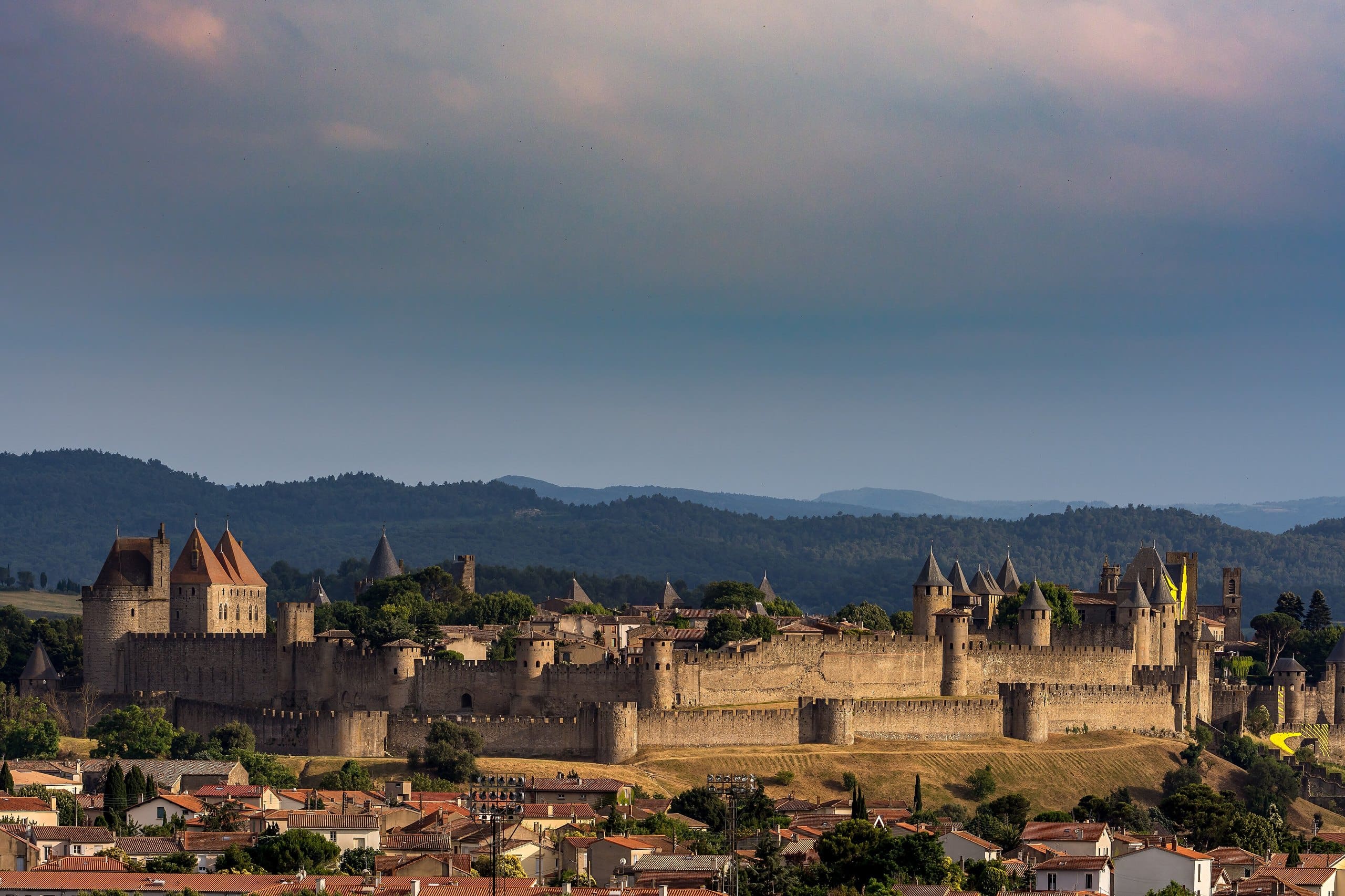
When people picture a medieval fortress, they are often picturing Carcassonne without knowing it: a double ring of honey-colored walls, dozens of round towers under pointed slate roofs, climbing a hill above a river in southern France. At its core stands the Château Comtal, the count’s castle, a stronghold within the walled city the French know simply as la Cité. The two cannot really be separated. This castle was the keep of a fortified town, and the town was the castle’s outer defense, so a visit to Carcassonne Castle is a walk through both.
Quick Facts
| Location | Carcassonne, Aude, Occitanie, France |
| Type | Fortified medieval city (la Cité) and inner castle, the Château Comtal |
| Built | Gallo-Roman walls 3rd–4th c.; comital castle c. 1130; outer ramparts 13th c. |
| Builders | Trencavel viscounts; Louis IX and Philip III the Bold; restored by Eugène Viollet-le-Duc from 1853 |
| Condition | Restored; open to visitors |
| UNESCO | Historic Fortified City of Carcassonne (inscribed 1997); component of the Royal Capetian Fortresses of Languedoc (inscribed 2026) |
| Manager | Centre des monuments nationaux |
| Official website | remparts-carcassonne.fr |
What makes Carcassonne unusual is not only its completeness. It is the strange reason for that completeness. The Cité survives in such full medieval dress precisely because history made it useless. When a 17th-century treaty moved France’s border far to the south, this great frontier fortress lost its purpose, was left to rot, and very nearly came down. What stands today is therefore two things at once: a genuine medieval citadel, and a 19th-century vision of one. Telling those two apart is the most interesting thing about the place.
 CC BY-SA 4.0" srcset="https://stonekeepatlas.com/wp-content/uploads/2026/06/carcassonne-cite-panorama.jpg 2560w, https://stonekeepatlas.com/wp-content/uploads/2026/06/carcassonne-cite-panorama-300x200.jpg 300w, https://stonekeepatlas.com/wp-content/uploads/2026/06/carcassonne-cite-panorama-1024x682.jpg 1024w, https://stonekeepatlas.com/wp-content/uploads/2026/06/carcassonne-cite-panorama-768x512.jpg 768w, https://stonekeepatlas.com/wp-content/uploads/2026/06/carcassonne-cite-panorama-1536x1024.jpg 1536w, https://stonekeepatlas.com/wp-content/uploads/2026/06/carcassonne-cite-panorama-2048x1365.jpg 2048w" sizes="auto, (max-width: 2560px) 100vw, 2560px" />
Roman Walls and the Trencavel Castle
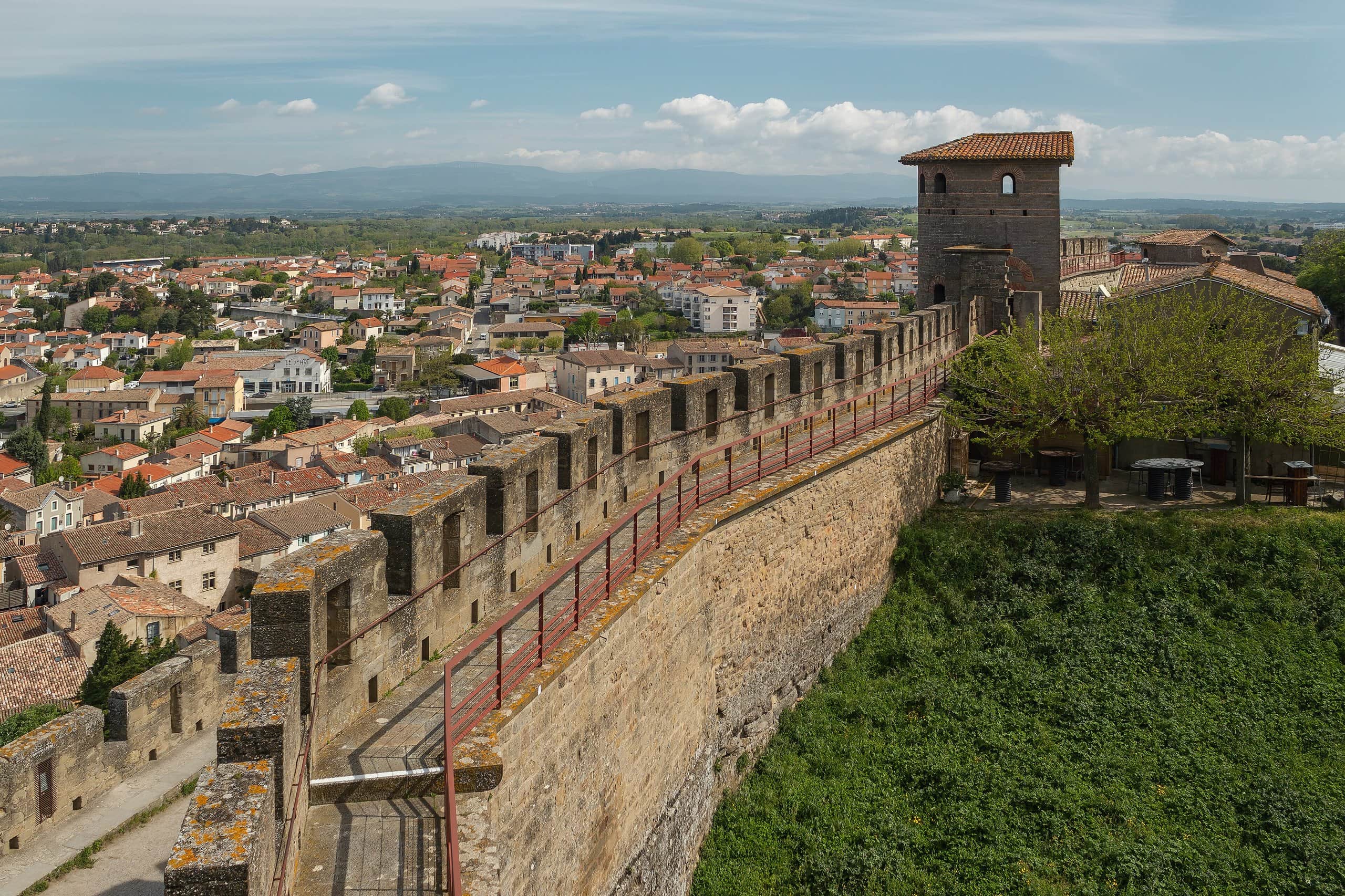
The hill above the Aude has been fortified for roughly 2,500 years. A Gaulish settlement came first, then a Roman town. In the late Empire, during the 3rd and 4th centuries, the Romans wrapped the summit in a stone wall studded with horseshoe-shaped towers. That inner ring still stands. Along much of the inner wall, the masonry a visitor sees today rests on, or reuses, Roman work, which is why Carcassonne reads as a single continuous lesson in fortification rather than the product of any one century. After Rome came the Visigoths, who held the city for some three centuries and reinforced its defenses; a brief Saracen and then Frankish presence followed before the place settled into the medieval county of Carcassonne.
 CC BY-SA 4.0" srcset="https://stonekeepatlas.com/wp-content/uploads/2026/06/carcassonne-tour-charpenterie-roman-tower.jpg 2560w, https://stonekeepatlas.com/wp-content/uploads/2026/06/carcassonne-tour-charpenterie-roman-tower-300x200.jpg 300w, https://stonekeepatlas.com/wp-content/uploads/2026/06/carcassonne-tour-charpenterie-roman-tower-1024x682.jpg 1024w, https://stonekeepatlas.com/wp-content/uploads/2026/06/carcassonne-tour-charpenterie-roman-tower-768x512.jpg 768w, https://stonekeepatlas.com/wp-content/uploads/2026/06/carcassonne-tour-charpenterie-roman-tower-1536x1024.jpg 1536w, https://stonekeepatlas.com/wp-content/uploads/2026/06/carcassonne-tour-charpenterie-roman-tower-2048x1365.jpg 2048w" sizes="auto, (max-width: 2560px) 100vw, 2560px" />
A famous legend belongs to this early stretch, and it explains the city’s name. According to the tale, a Saracen lady called Dame Carcas held the citadel against a siege by Charlemagne. With food almost gone, she fed the last of the grain to a pig and threw it over the wall; the besiegers, concluding the city had supplies to waste, gave up and withdrew. As they left, the bells were rung in triumph, and “Carcas sonne,” Carcas rings, supposedly gave Carcassonne its name. The etymology is invented, the siege never happened, and Dame Carcas is folklore, but a stone bust of her still greets visitors at the main gate.
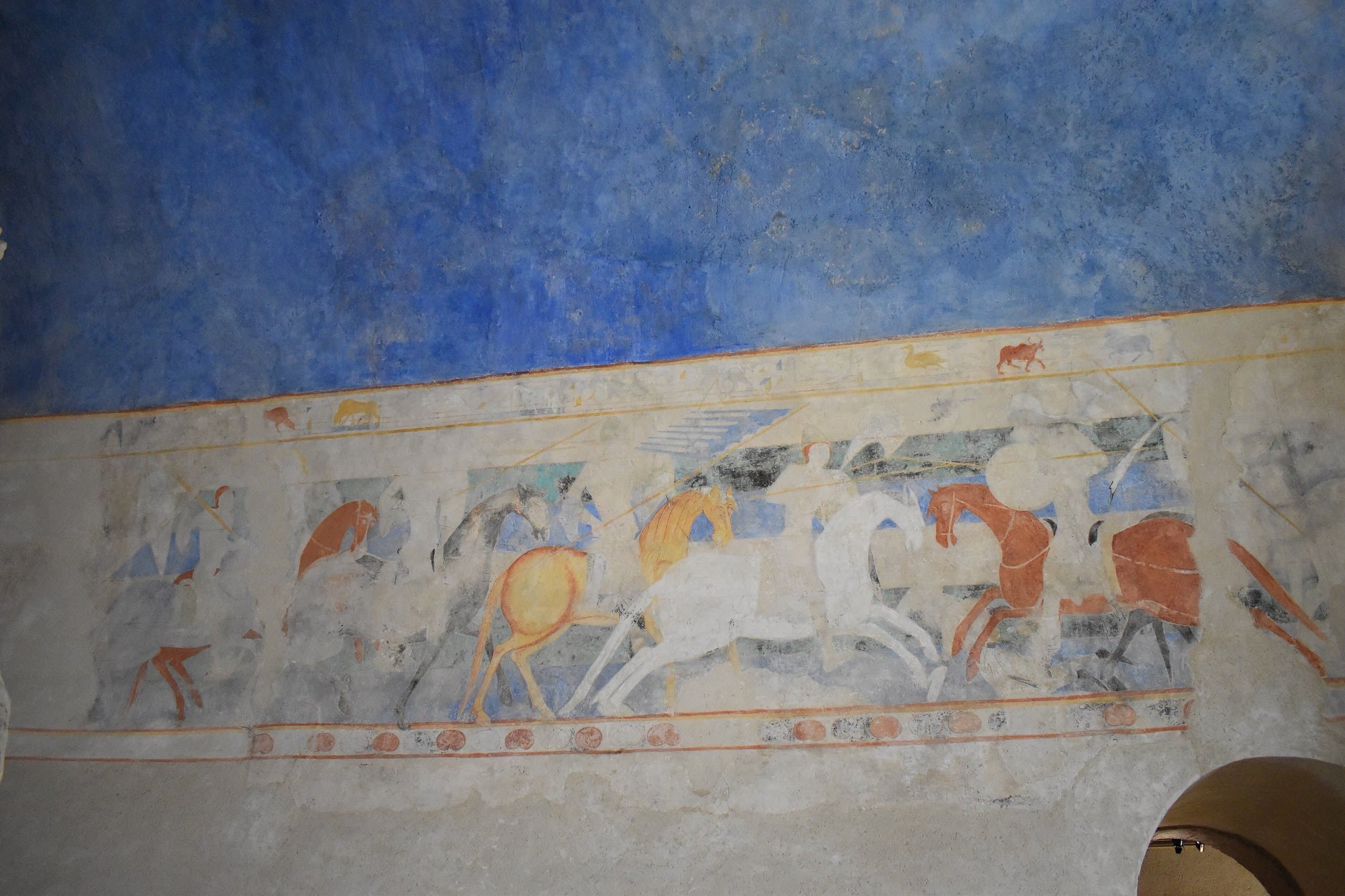
The reliable medieval story begins in 1067, when the viscounty passed to the Trencavel family, ambitious lords of Lower Languedoc who played the powerful counts of Toulouse and of Barcelona against each other to keep their independence. They built to match their ambitions. Work on the basilica of Saint-Nazaire began in 1096, blessed by Pope Urban II. Around 1130 the Trencavels raised a palatium, a lordly residence set directly on the old Roman rampart. Enlarged through the 12th century with a new wing and the chapel of Sainte-Marie, that palace became the Château Comtal: at once a home and a seat of power, a castle built into the wall of a city its family meant to dominate. The Cité prospered under them. Suburbs spread below the walls, the population climbed toward several thousand, and the troubadours’ songs of courtly love found a welcome at the viscounts’ court. So did something the Church found far less welcome.
The Albigensian Crusade
By the late 12th century, Languedoc had become the heartland of the Cathars, a Christian movement that rejected the Roman Church and that Rome branded as heresy. The Trencavels were not Cathars, but they tolerated their Cathar subjects, and tolerance was enough. In 1208 Pope Innocent III called for a crusade against the so-called Albigensians, named for the nearby town of Albi. It was the first time a holy war had been preached against fellow Christians in the heart of Europe.
 CC BY-SA 4.0" srcset="https://stonekeepatlas.com/wp-content/uploads/2026/06/carcassonne-chateau-comtal-medieval-mural.jpg 2560w, https://stonekeepatlas.com/wp-content/uploads/2026/06/carcassonne-chateau-comtal-medieval-mural-300x200.jpg 300w, https://stonekeepatlas.com/wp-content/uploads/2026/06/carcassonne-chateau-comtal-medieval-mural-1024x682.jpg 1024w, https://stonekeepatlas.com/wp-content/uploads/2026/06/carcassonne-chateau-comtal-medieval-mural-768x512.jpg 768w, https://stonekeepatlas.com/wp-content/uploads/2026/06/carcassonne-chateau-comtal-medieval-mural-1536x1024.jpg 1536w, https://stonekeepatlas.com/wp-content/uploads/2026/06/carcassonne-chateau-comtal-medieval-mural-2048x1365.jpg 2048w" sizes="auto, (max-width: 2560px) 100vw, 2560px" />
A crusading army marched south in the summer of 1209 under the papal legate Arnaud Amalric, abbot of Cîteaux. Béziers fell first, in July, and its people were massacred. The young viscount, Raymond-Roger Trencavel, raced back to fortify Carcassonne and crammed it with refugees. The crusaders reached the walls on August 1, 1209 and laid siege. They did not need long. Within a week they had cut the town off from the river and its water.
Raymond-Roger accepted a safe-conduct to negotiate terms, and there the story turns dark. While still under that protection he was seized and locked in a tower of his own castle. Carcassonne surrendered on August 15; its inhabitants were spared but driven out, stripped of almost everything. The viscount never left captivity. He died on November 10, 1209, a prisoner in the Château Comtal. Crusader chroniclers blamed dysentery in the foul conditions of his cell. Many at the time, and many since, suspected he had been quietly killed, and the seizure of a lord under safe-conduct was long remembered as a scandal. Either way the outcome was the same. The Trencavel line was broken, and the crusade’s military commander, Simon de Montfort, took the viscounty in his place.
A Royal Frontier Fortress
Montfort died at the siege of Toulouse in 1218, and his son could not hold the conquest. The claim passed to the French crown, and in 1226 Carcassonne was absorbed into the royal domain under King Louis VIII. When the long crusade formally ended in 1229, the Château Comtal had a new master: not a viscount but a royal seneschal, the king’s officer in a freshly conquered land.
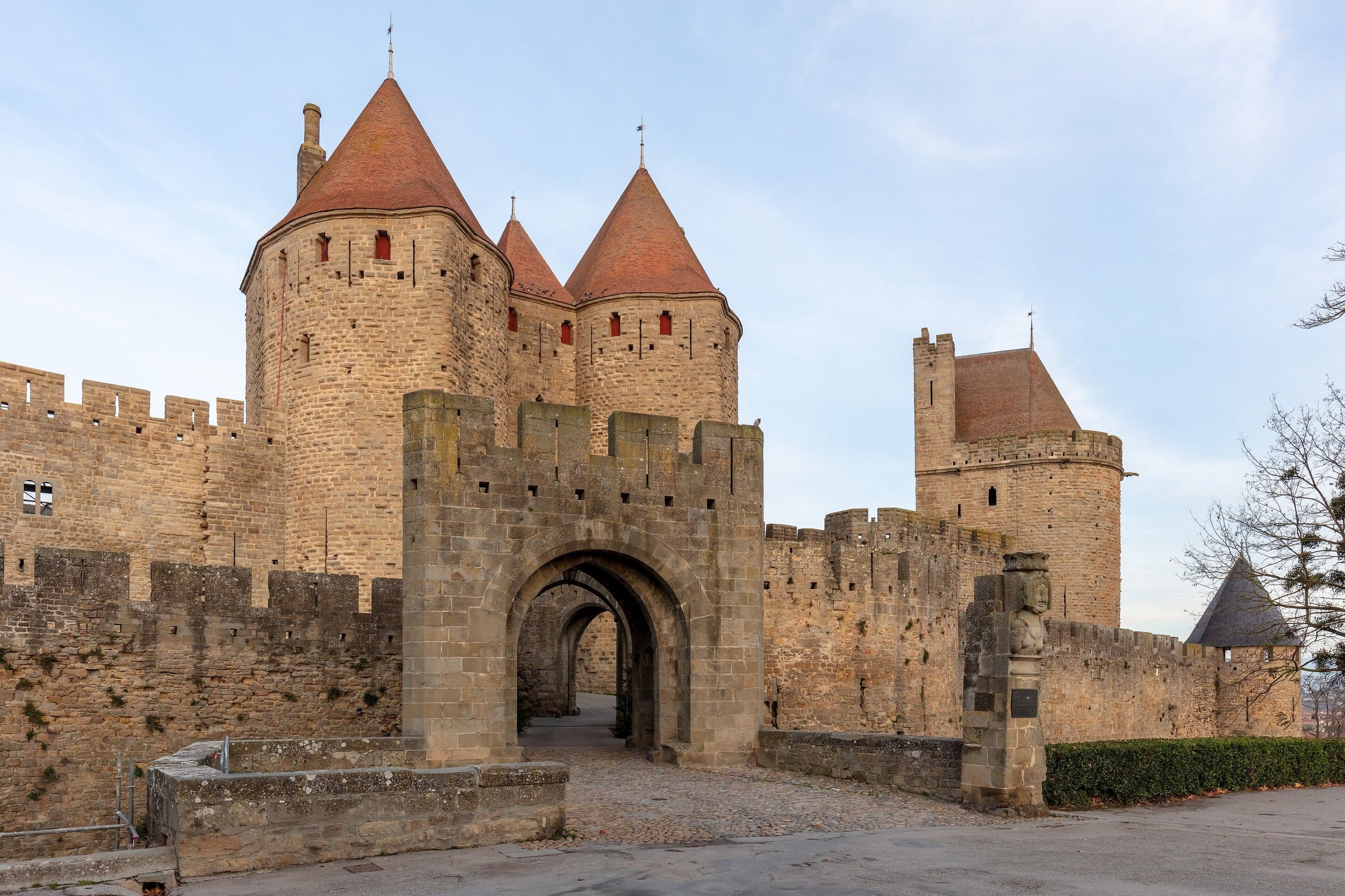 CC BY-SA 4.0" srcset="https://stonekeepatlas.com/wp-content/uploads/2026/06/carcassonne-porte-narbonnaise.jpg 2560w, https://stonekeepatlas.com/wp-content/uploads/2026/06/carcassonne-porte-narbonnaise-300x200.jpg 300w, https://stonekeepatlas.com/wp-content/uploads/2026/06/carcassonne-porte-narbonnaise-1024x682.jpg 1024w, https://stonekeepatlas.com/wp-content/uploads/2026/06/carcassonne-porte-narbonnaise-768x512.jpg 768w, https://stonekeepatlas.com/wp-content/uploads/2026/06/carcassonne-porte-narbonnaise-1536x1024.jpg 1536w, https://stonekeepatlas.com/wp-content/uploads/2026/06/carcassonne-porte-narbonnaise-2048x1365.jpg 2048w" sizes="auto, (max-width: 2560px) 100vw, 2560px" />
The locals were not yet trusted, and with reason. In 1240 the dispossessed Trencavel heir returned with the help of sympathetic townsfolk and tried to retake the Cité. He failed. Royal retaliation reshaped the city for good. Louis IX razed the rebels’ houses, expelled the population from the slopes, and pushed them across the Aude, where in 1247 he laid out a planned new town, the grid-patterned bastide Saint-Louis that is still Carcassonne’s working center today. With the hill cleared, the king turned the Cité into a weapon. He began a second, outer wall that doubled the Roman ring and left a broad killing ground, the lices, between the two lines of defense. The principle was concentric: an attacker who breached the outer wall found himself trapped in a narrow corridor, exposed on both sides to defenders on the higher inner rampart. There was no single decisive wall to storm, only layers. Those layers were pierced as carefully as they were laid out: Viollet-le-Duc measured the arrow slits of the Château Comtal at six centimeters on the outer face, splaying inward to a niche with a stone bench for the archer and commanding a field of thirty-five degrees.
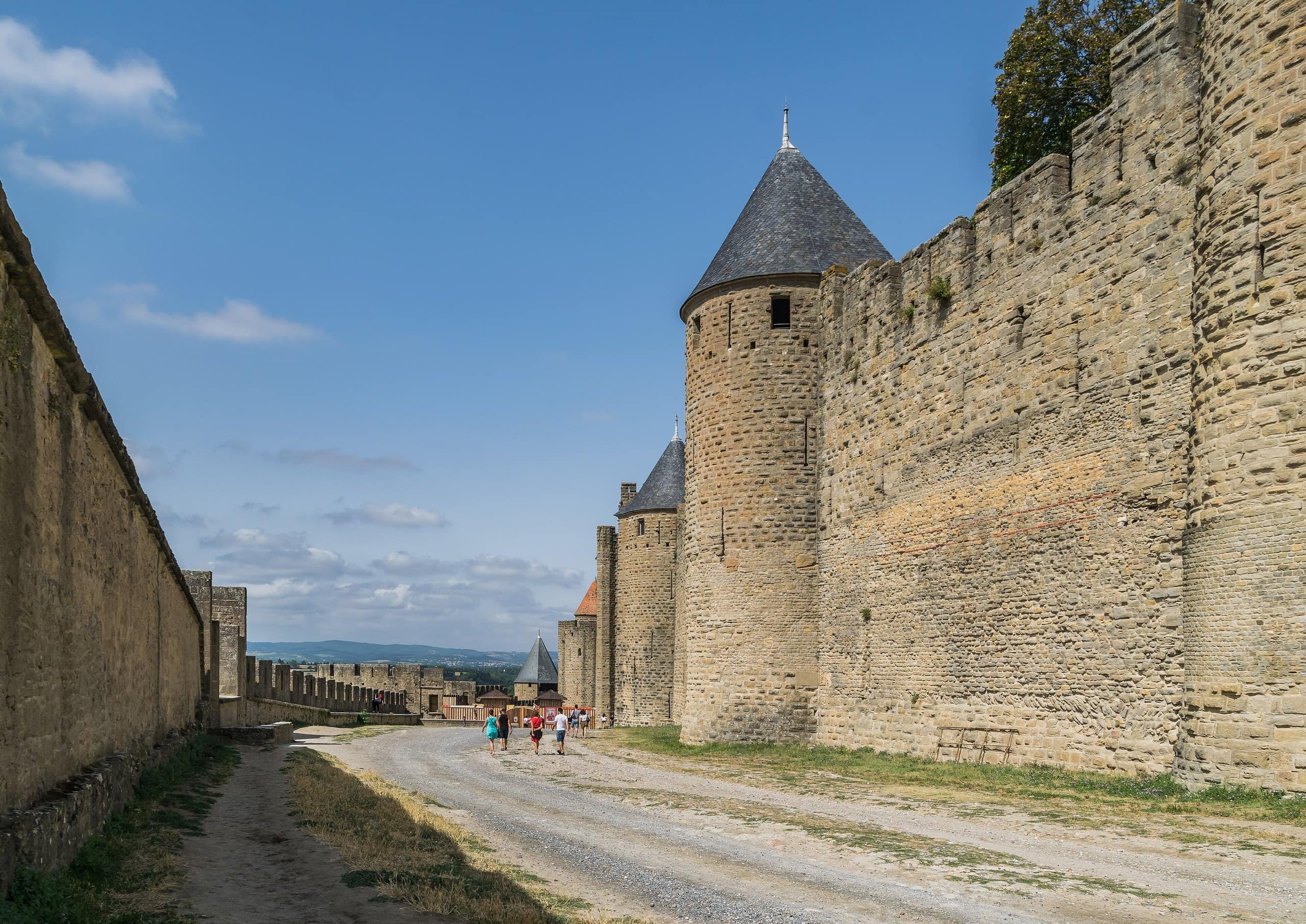 CC BY-SA 4.0" srcset="https://stonekeepatlas.com/wp-content/uploads/2026/06/carcassonne-lices-double-walls.jpg 2560w, https://stonekeepatlas.com/wp-content/uploads/2026/06/carcassonne-lices-double-walls-300x212.jpg 300w, https://stonekeepatlas.com/wp-content/uploads/2026/06/carcassonne-lices-double-walls-1024x724.jpg 1024w, https://stonekeepatlas.com/wp-content/uploads/2026/06/carcassonne-lices-double-walls-768x543.jpg 768w, https://stonekeepatlas.com/wp-content/uploads/2026/06/carcassonne-lices-double-walls-1536x1087.jpg 1536w, https://stonekeepatlas.com/wp-content/uploads/2026/06/carcassonne-lices-double-walls-2048x1449.jpg 2048w" sizes="auto, (max-width: 2560px) 100vw, 2560px" />
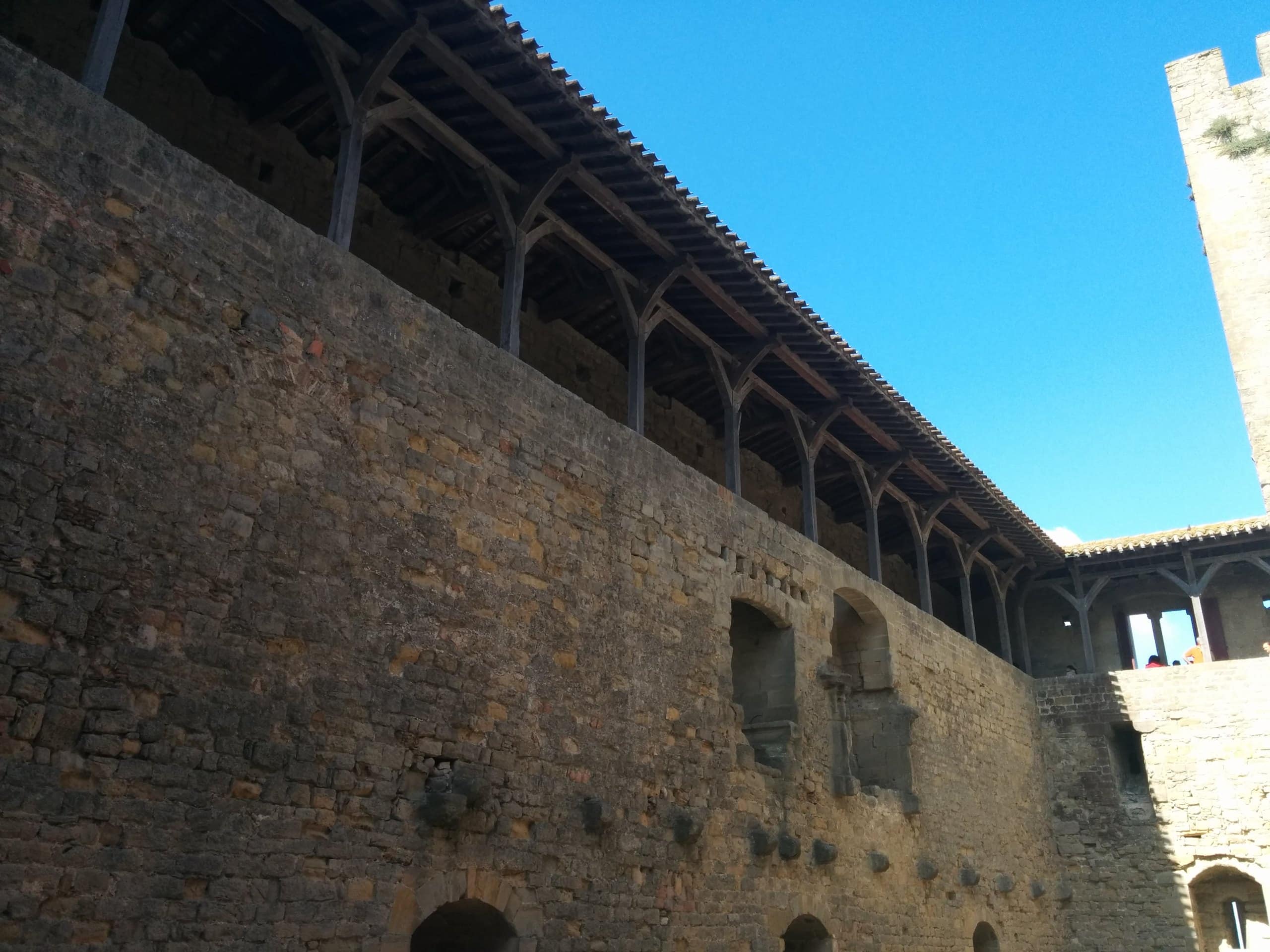
Louis IX’s son, Philip III the Bold, finished the work and gave it its showpiece, the monumental twin-towered Porte Narbonnaise, the great eastern gate; later modernization under Philip IV the Fair added crossbow loops and refined the defenses. The completed double enceinte ran roughly three kilometers and bristled with towers. The standard figure is 52 towers, though counts vary with what is included; UNESCO records 26 on the inner wall and 19 on the outer, three of them barbicans. The Château Comtal itself became a fortress within the fortress, ringed by its own moat and reached across a barbican and bridge, with a tall keep and ranges of hall and chamber where the seneschal governed. Along the wall tops ran hourds, the covered wooden galleries that let defenders drop missiles straight down onto anyone at the base of the stone; their reconstruction would later become one of the most studied features of the whole site.
All of this served a single strategic purpose. The 1258 Treaty of Corbeil fixed the border between France and the Crown of Aragon close to Carcassonne, and the Cité became the anchor of that frontier, backed by a chain of mountain strongholds, the castles of Aguilar, Termes, Peyrepertuse, Quéribus, and Puilaurens, nicknamed the “five sons of Carcassonne.” The fortress earned its reputation. During the Hundred Years’ War, in 1355, Edward the Black Prince swept through the region and burned the lower town, yet he took one look at the walled Cité and did not even attempt an assault. Contemporaries judged it impregnable, and for a long time they were right.
Redundancy and Ruin
Strength is only ever relative to a threat, and in 1659 the threat moved. The Treaty of the Pyrenees, which ended a war with Spain that had begun in 1635, handed the province of Roussillon to France and pushed the border deep into the mountains. Overnight, Carcassonne was no longer a frontier post. It was a fortress in the interior, guarding nothing.
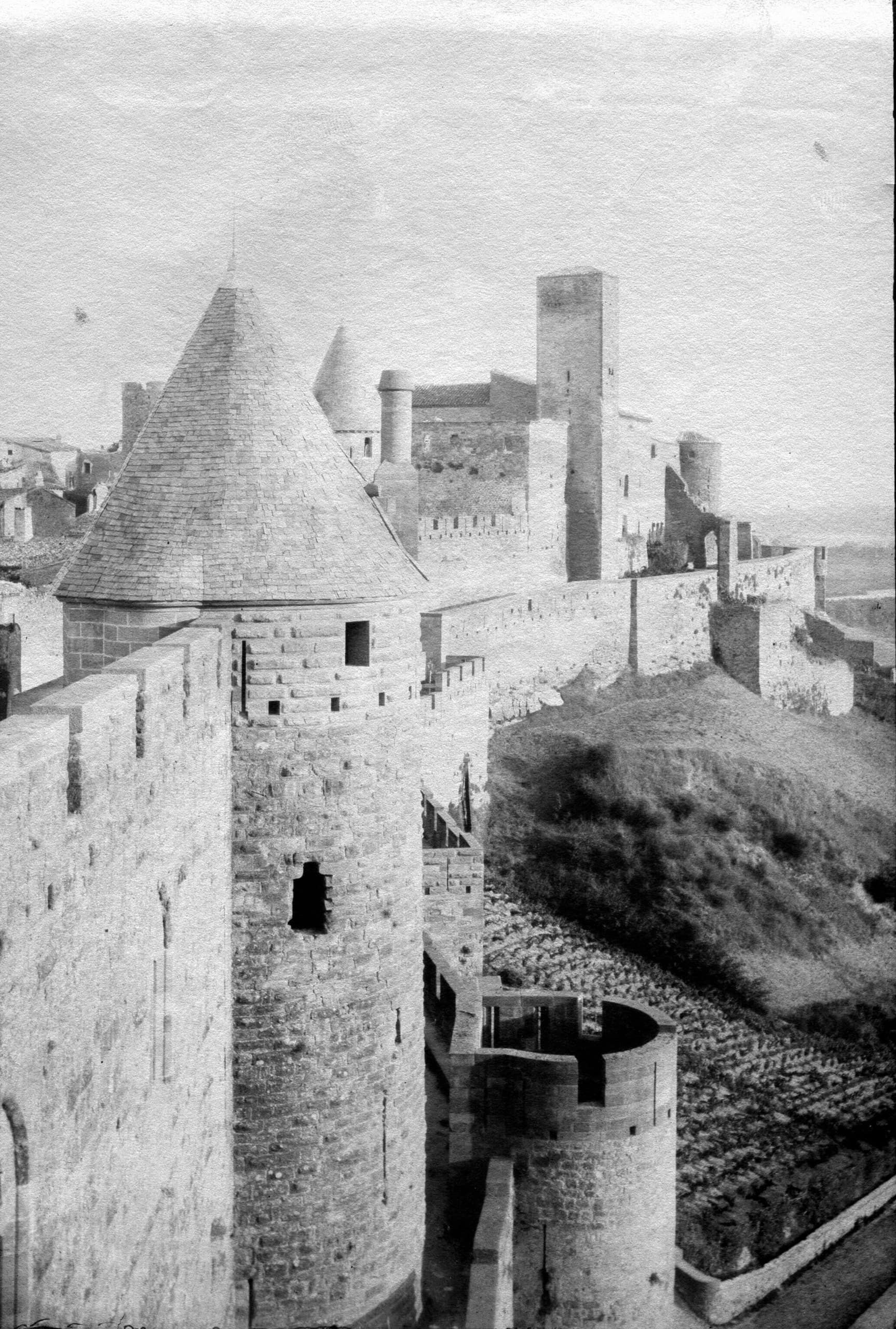
What followed was a slow, undramatic decline, which is often how great buildings actually die. A token garrison lingered in the château, reducing the count’s castle to a barracks. The city’s real life drained down the hill to the bastide, where the woolen-cloth trade made the lower town one of the busiest manufacturing centers in Languedoc. Up in the Cité, the abandoned ramparts became a quarry. Masons helped themselves to dressed stone, and the lices filled with the shacks of weavers and the poor, who lived crowded against the medieval walls in conditions that 19th-century reformers would describe with alarm. By the early 1800s the most complete fortified city in Europe was a crumbling slum that the state saw mainly as a liability, and demolition was a live possibility.
Rescue and Reinvention
That the Cité survived at all is owed first to a stubborn local scholar. From the 1830s, the Carcassonne antiquary Jean-Pierre Cros-Mayrevieille argued, lobbied, and published to convince the authorities that the decaying walls were a national treasure rather than a hazard to be cleared. His campaign won the first victory in 1840, when the old cathedral of Saint-Nazaire was classified as a historic monument. The wider fortifications would not gain full protection until 1862, but the tide had turned.
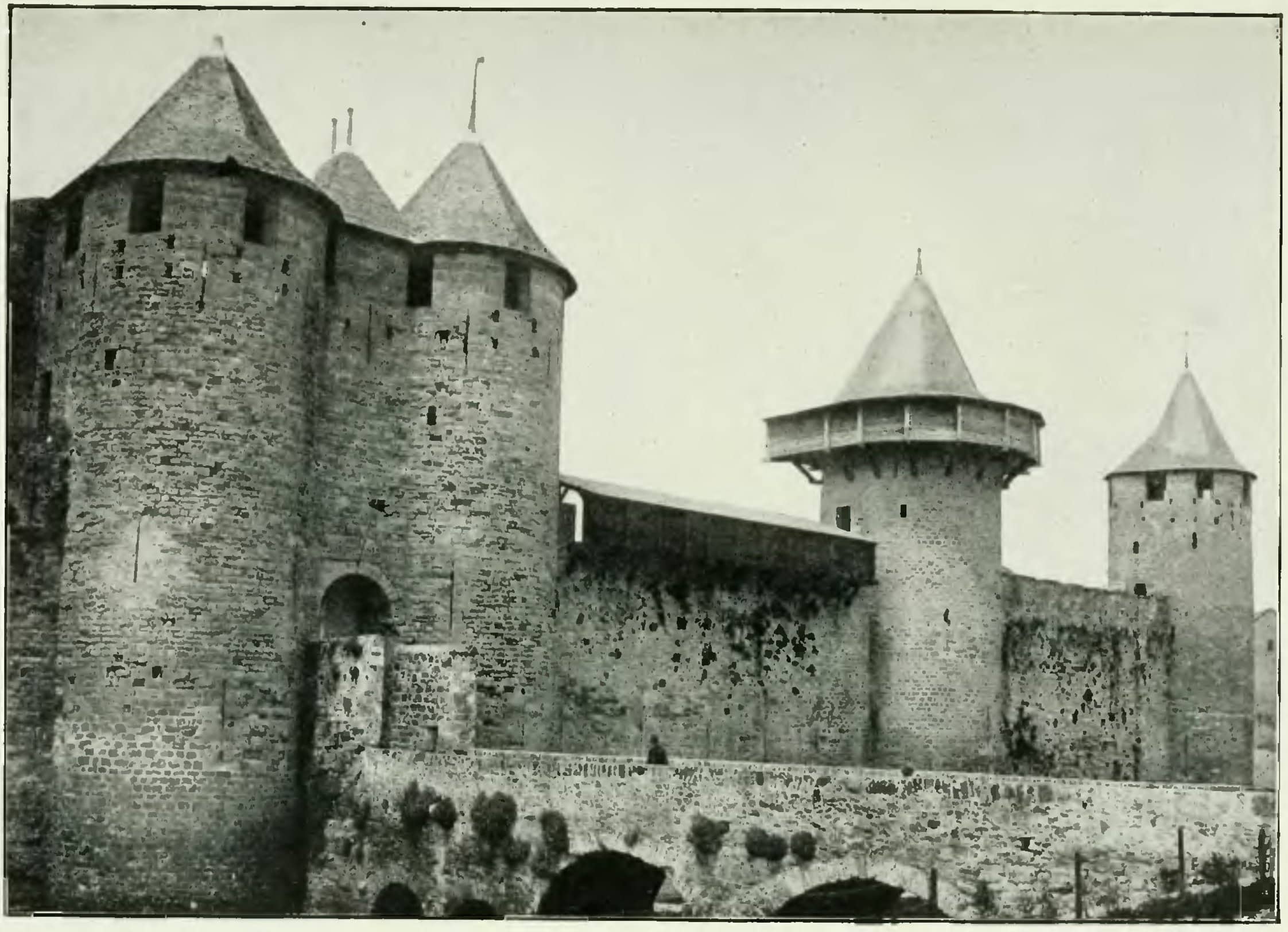
His decisive ally was Prosper Mérimée, the writer who served as France’s inspector general of historic monuments. In 1843 Mérimée brought in a young, intensely learned architect to study Saint-Nazaire: Eugène Viollet-le-Duc. Beginning on the basilica in 1844, Viollet-le-Duc fell in love with the ruined Cité above it and spent the rest of his life on it. Work on the fortifications themselves began in 1853. Over the following decades he and his crews cleared the slum dwellings from the lices, consolidated the leaning curtain walls, and rebuilt the ravaged tops of the towers, where centuries of decay had done the most damage. He used the 13th century, the age of Saint Louis, as his reference point, and from his Carcassonne drawings he reconstructed the timber hourds that almost no other medieval fortress still showed.
 CC BY-SA 4.0" srcset="https://stonekeepatlas.com/wp-content/uploads/2026/06/carcassonne-reconstructed-hoarding.jpg 2560w, https://stonekeepatlas.com/wp-content/uploads/2026/06/carcassonne-reconstructed-hoarding-300x225.jpg 300w, https://stonekeepatlas.com/wp-content/uploads/2026/06/carcassonne-reconstructed-hoarding-1024x768.jpg 1024w, https://stonekeepatlas.com/wp-content/uploads/2026/06/carcassonne-reconstructed-hoarding-768x576.jpg 768w, https://stonekeepatlas.com/wp-content/uploads/2026/06/carcassonne-reconstructed-hoarding-1536x1152.jpg 1536w, https://stonekeepatlas.com/wp-content/uploads/2026/06/carcassonne-reconstructed-hoarding-2048x1536.jpg 2048w" sizes="auto, (max-width: 2560px) 100vw, 2560px" />
It is the roofs that made Carcassonne famous and Viollet-le-Duc controversial. He capped the towers with steep, pointed roofs of slate, the material and silhouette of northern France, where he had trained, rather than the low terracotta tiles of the Mediterranean south. Critics in his own day called the choice wrong for the region’s climate and traditions, and the argument over whether his Carcassonne is a faithful restoration or a romantic invention ran on into the 1960s. He never saw the work finished. Viollet-le-Duc died in 1879, and the project passed to his pupil Paul Boeswillwald and then to the architect Henri Nodet, who carried it to completion around 1911. Boeswillwald would later bring the same restorer’s eye to the Château de Foix, the comtal seat of the counts of Foix in the Ariège.
The verdict came full circle. Viollet-le-Duc had poured his theories of medieval building into his great Dictionnaire raisonné de l’architecture, and Carcassonne became their three-dimensional manifesto. The same restoration that drew scorn is now celebrated as a founding episode in the science of conservation, with its author counted among that discipline’s fathers. When UNESCO considered the Cité, the committee actually hesitated, deferring the nomination in 1985 in part because the monument was so heavily restored. It reconsidered, and in 1997 inscribed the Historic Fortified City of Carcassonne on the World Heritage List, citing both the medieval defenses and the restoration that saved them. That hesitation, in the end, was part of the point. Carcassonne is honest about being a medieval city and a 19th-century idea of one at the same time.
Visiting Carcassonne Castle
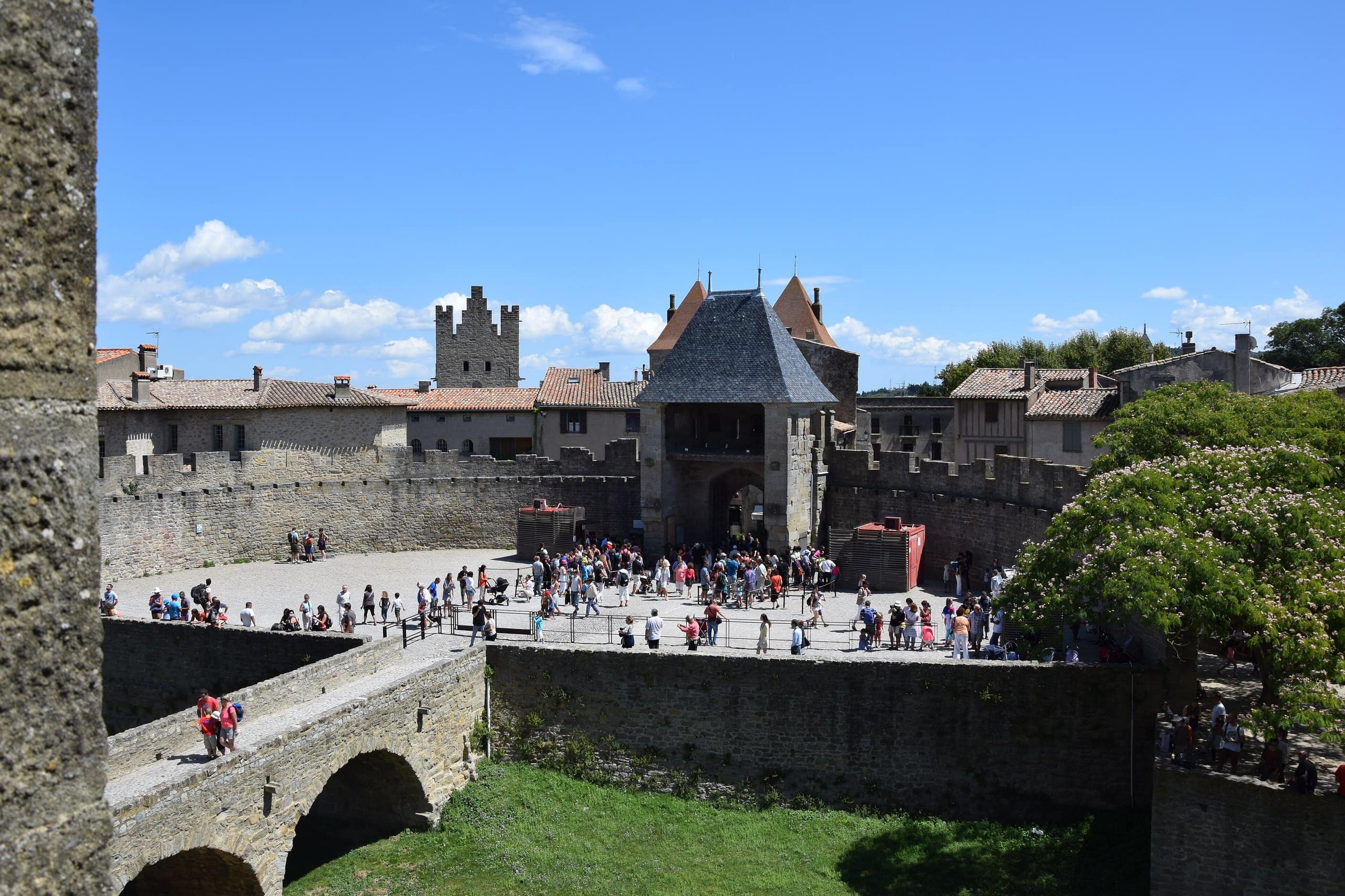
The Cité is free to enter and is a living quarter, with houses, shops, and the Basilica of Saint-Nazaire open to anyone who climbs the hill. The ticketed monument, run by the Centre des monuments nationaux, is the Château Comtal and the ramparts. A ticket buys the count’s castle, its bridge and barbican, the lapidary collection of carved medieval stonework, and the wall walk: the long circuit along the inner battlements, with views down into the lices and out over the bastide, the vineyards, and the distant Pyrenees.
 CC BY-SA 3.0" srcset="https://stonekeepatlas.com/wp-content/uploads/2026/06/carcassonne-chateau-comtal-visitors.jpg 2560w, https://stonekeepatlas.com/wp-content/uploads/2026/06/carcassonne-chateau-comtal-visitors-300x200.jpg 300w, https://stonekeepatlas.com/wp-content/uploads/2026/06/carcassonne-chateau-comtal-visitors-1024x682.jpg 1024w, https://stonekeepatlas.com/wp-content/uploads/2026/06/carcassonne-chateau-comtal-visitors-768x512.jpg 768w, https://stonekeepatlas.com/wp-content/uploads/2026/06/carcassonne-chateau-comtal-visitors-1536x1024.jpg 1536w, https://stonekeepatlas.com/wp-content/uploads/2026/06/carcassonne-chateau-comtal-visitors-2048x1365.jpg 2048w" sizes="auto, (max-width: 2560px) 100vw, 2560px" />
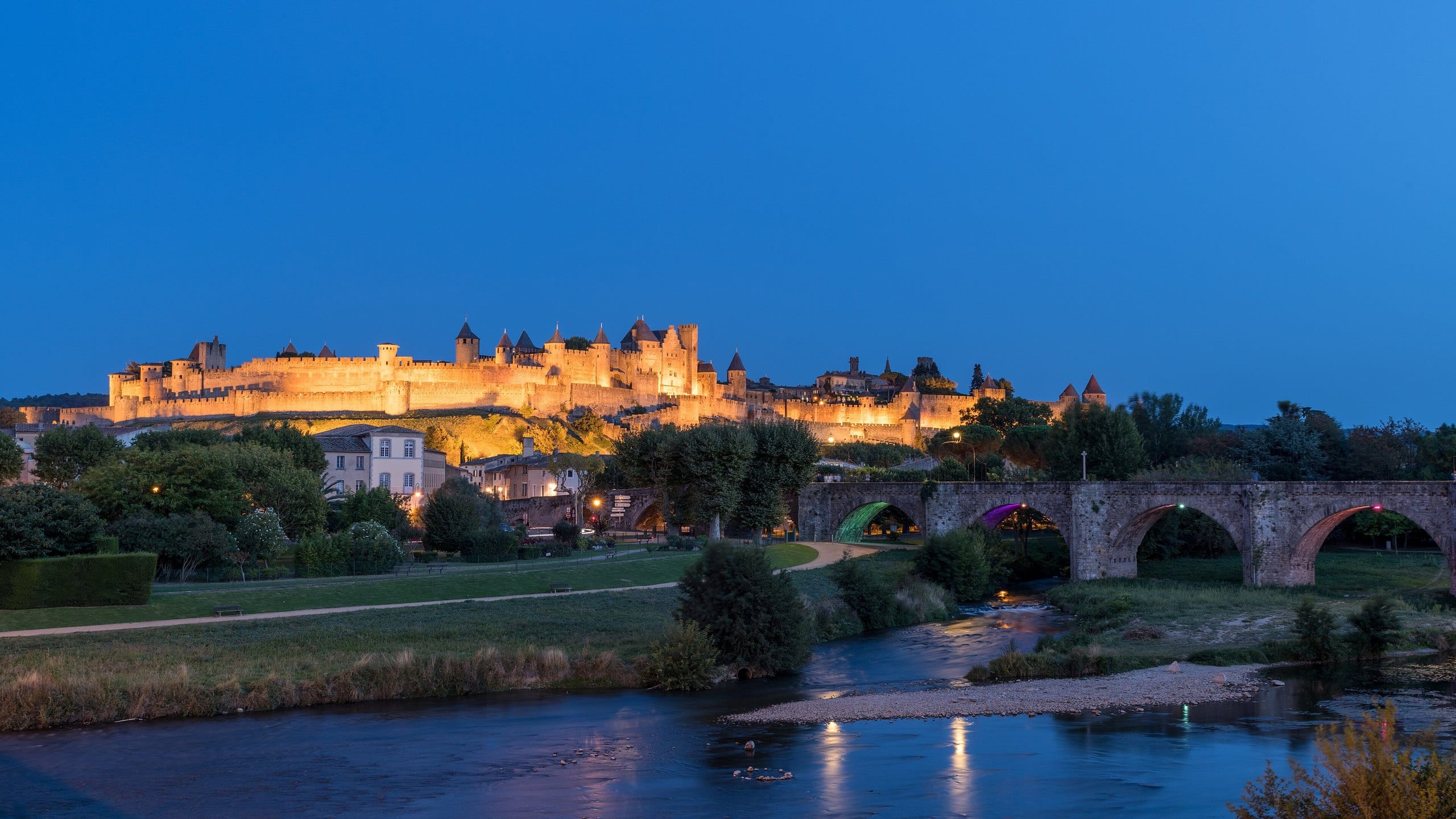
Allow two to three hours. Cobbles and rampart stairs are uneven, so sturdy shoes help, and early morning or late afternoon avoids both the crowds and the summer heat. Spring and early fall are the most comfortable seasons, and the floodlit walls after dark, seen from the Pont Vieux across the river, are worth staying for.
To sleep inside the walls, a handful of hotels occupy the Cité itself, and many more line the lower town a short walk across the bridge. You can compare options and book a stay near Carcassonne or reserve a guided tour of the Cité and the Château Comtal in advance.
Some links on this page are affiliate links, which means StoneKeep Atlas may earn a small commission, at no extra cost to you, if you book through them.
More Views of Carcassonne Castle
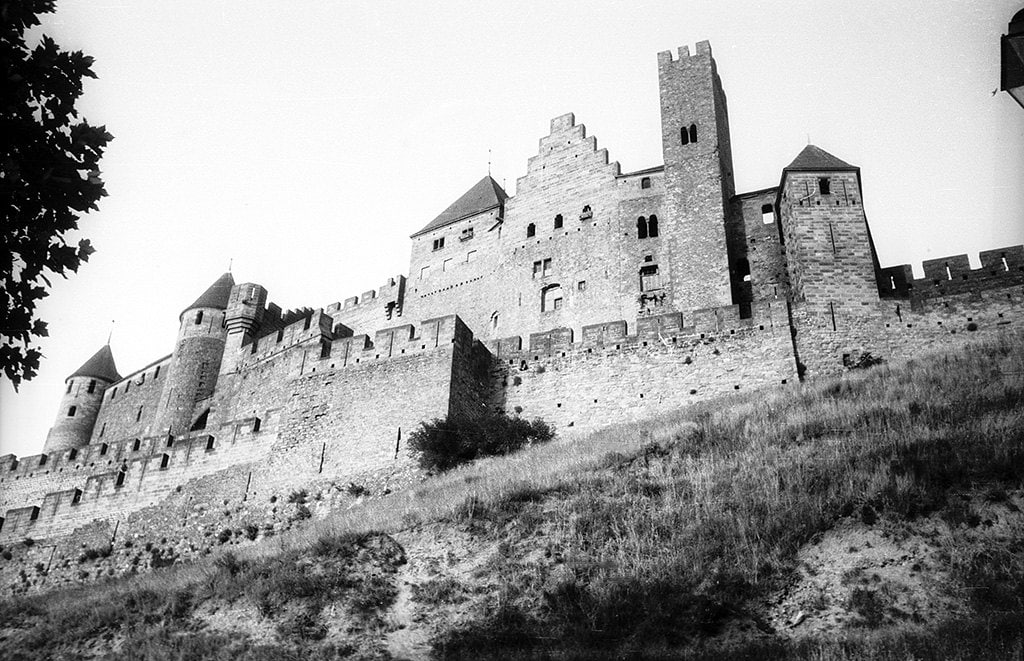
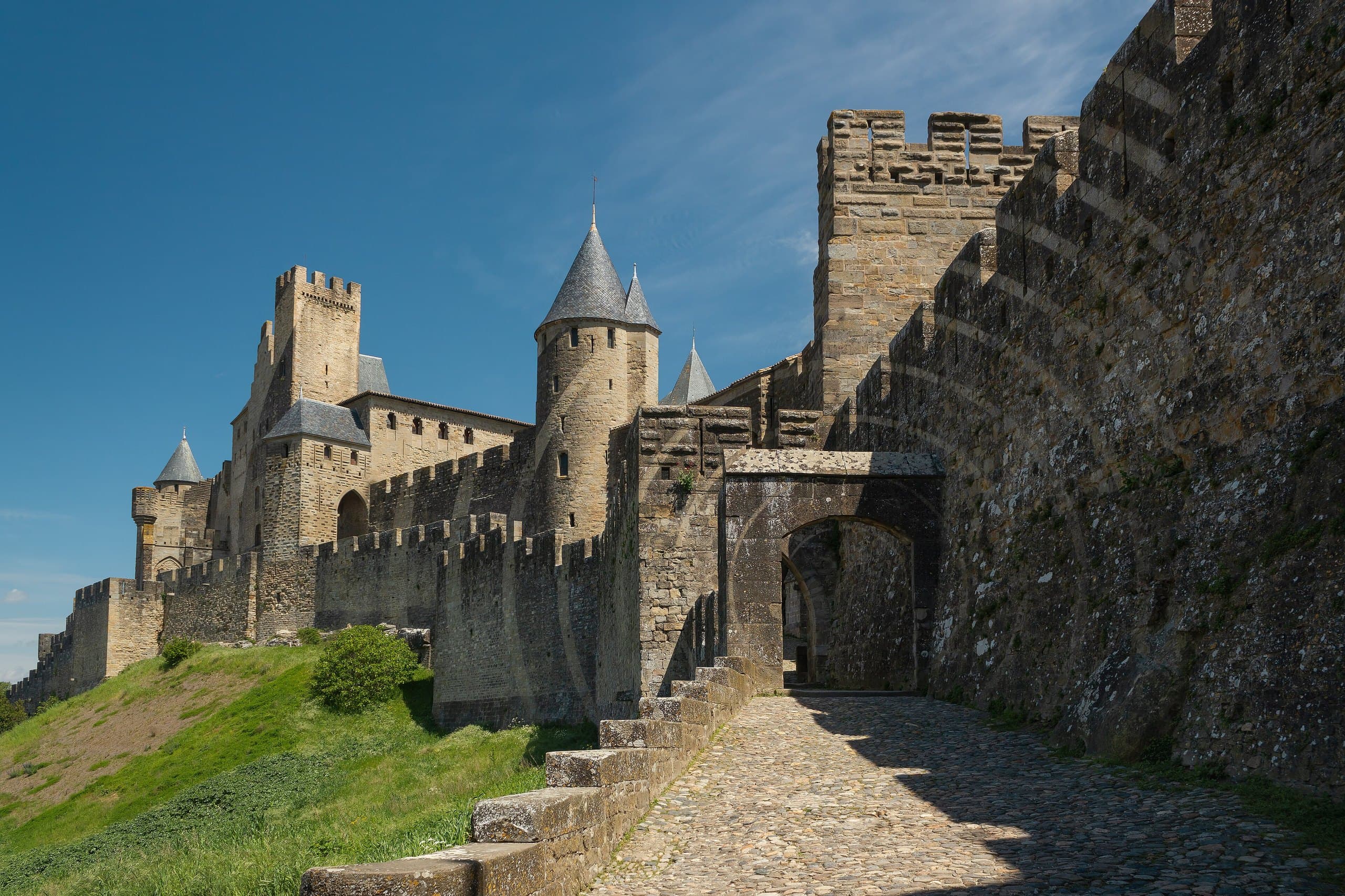
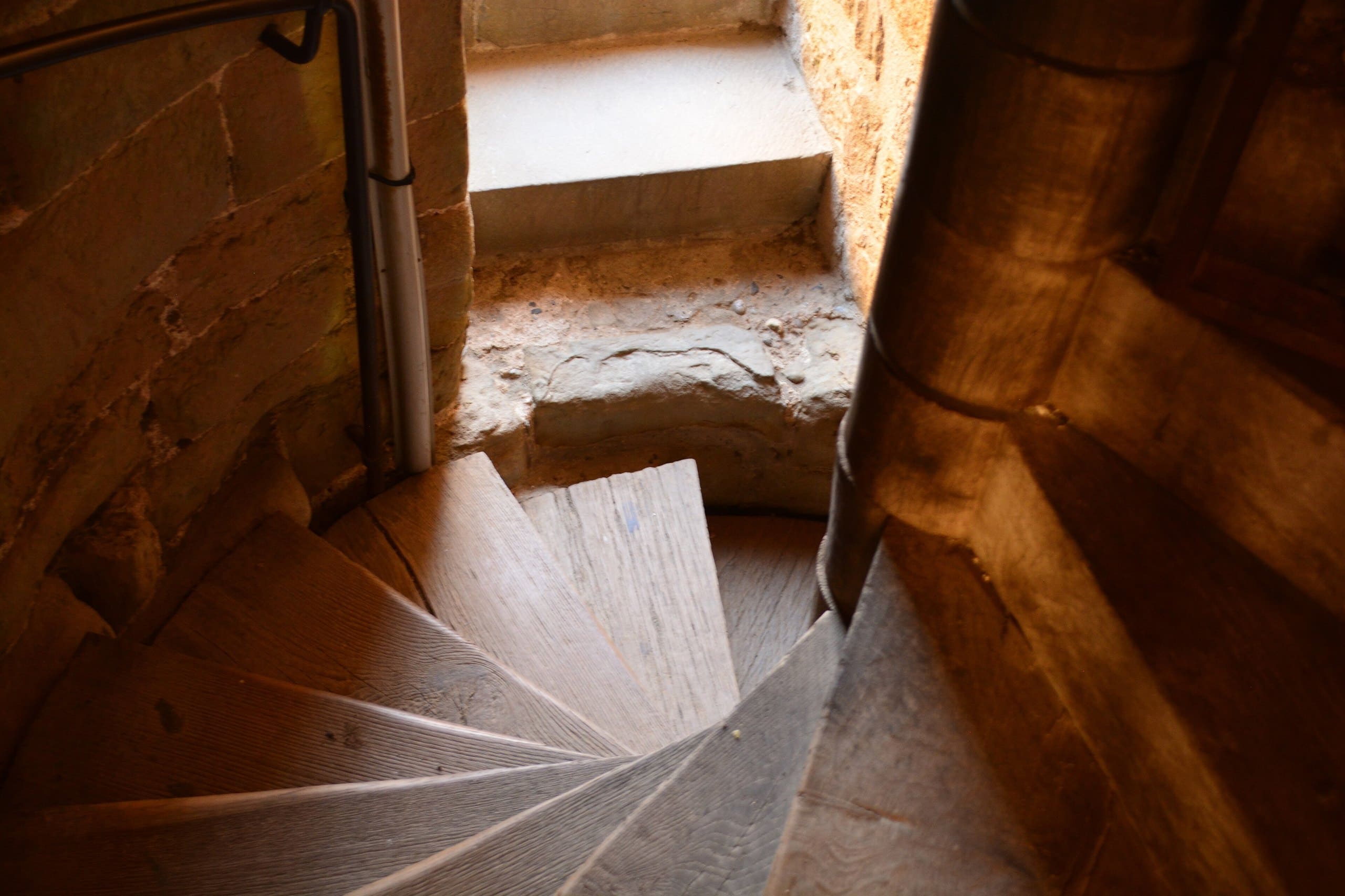
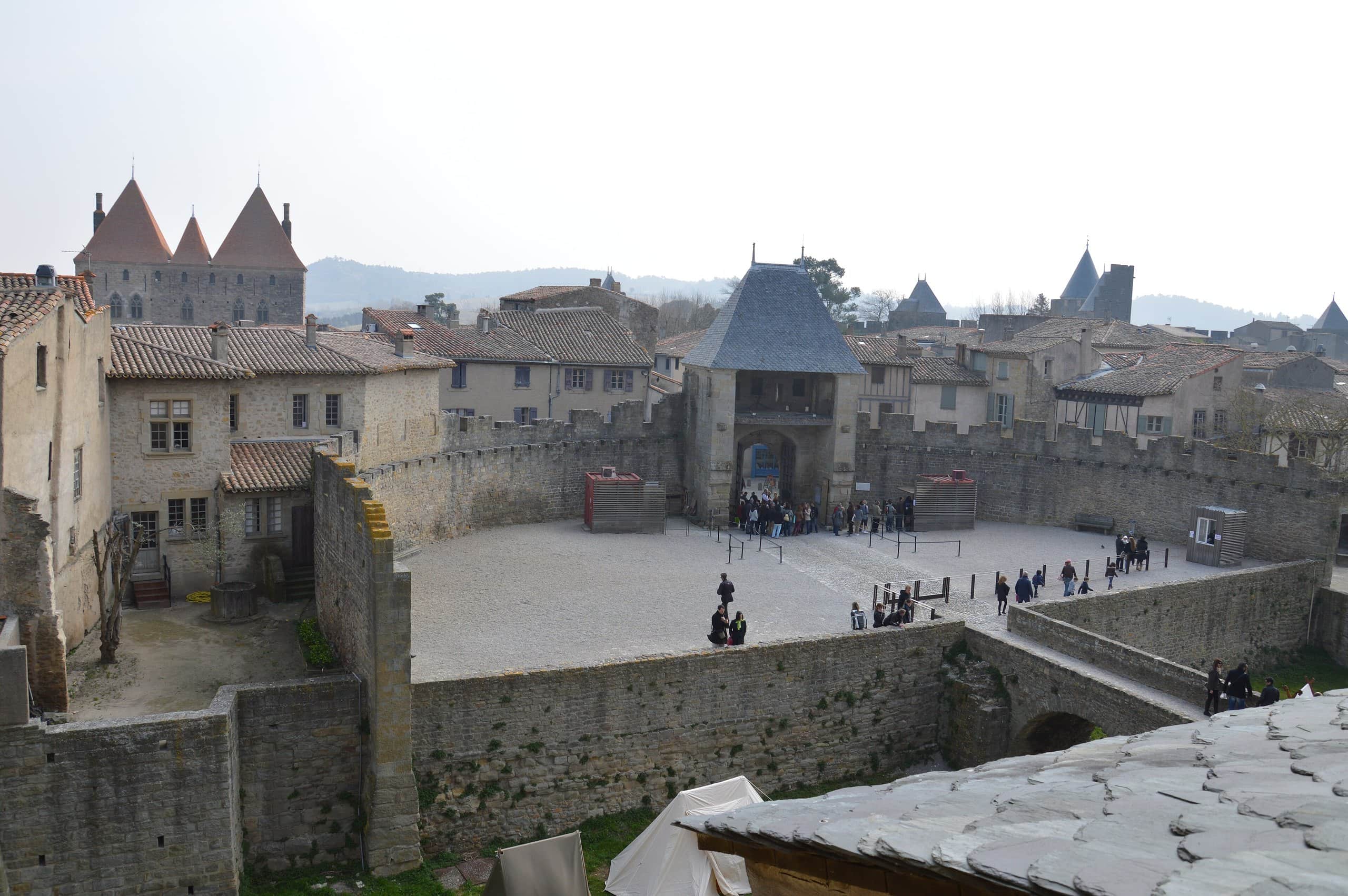
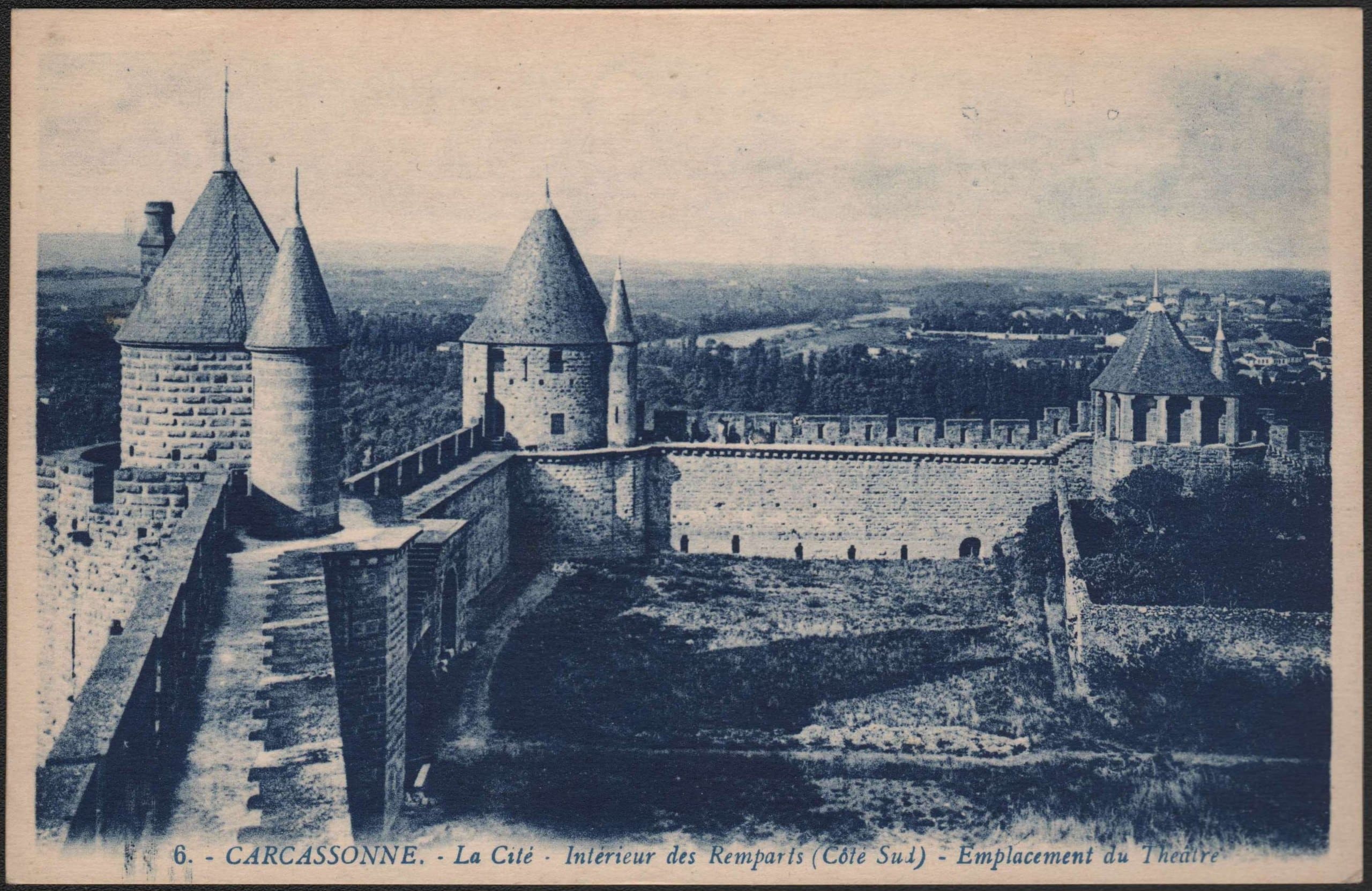
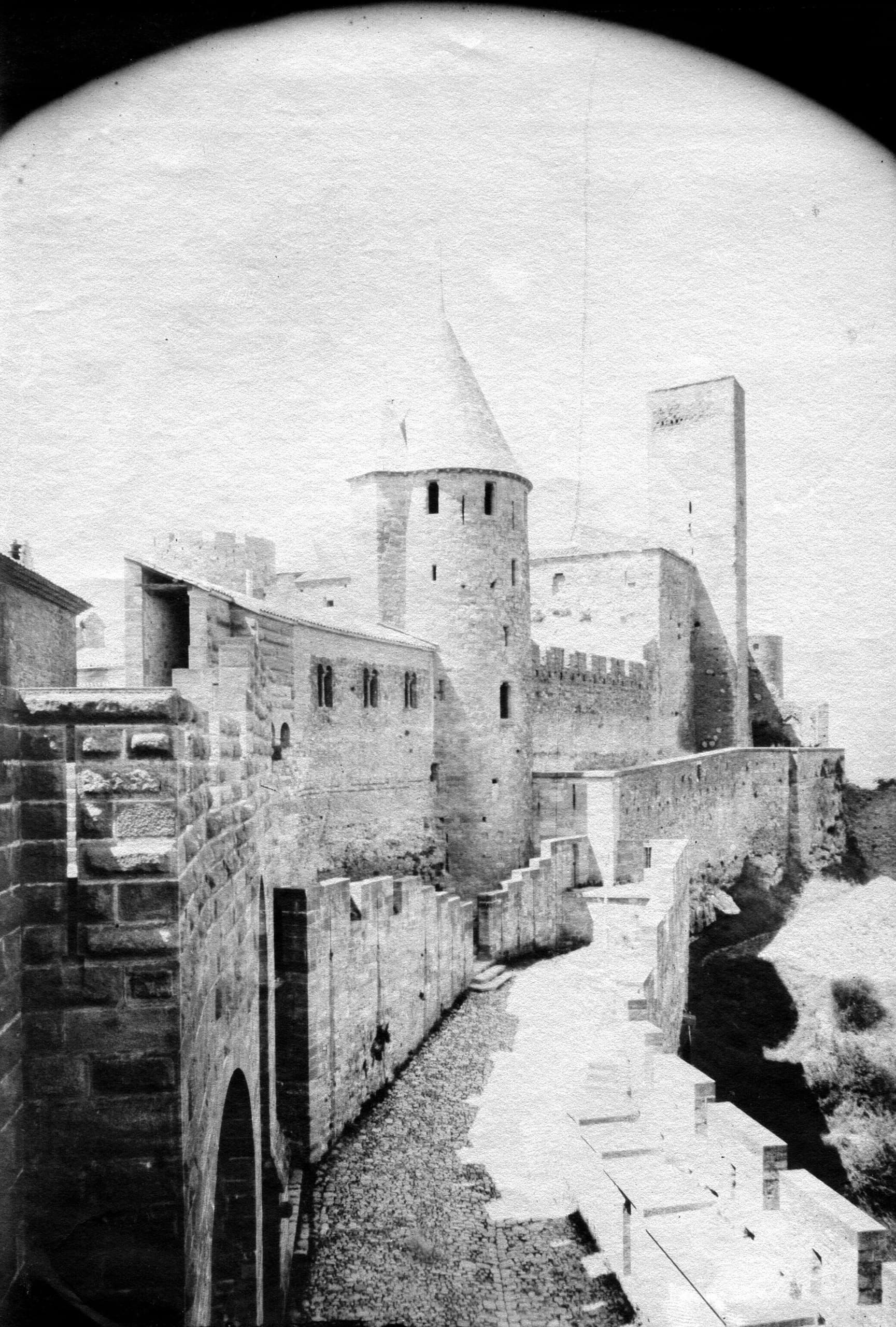
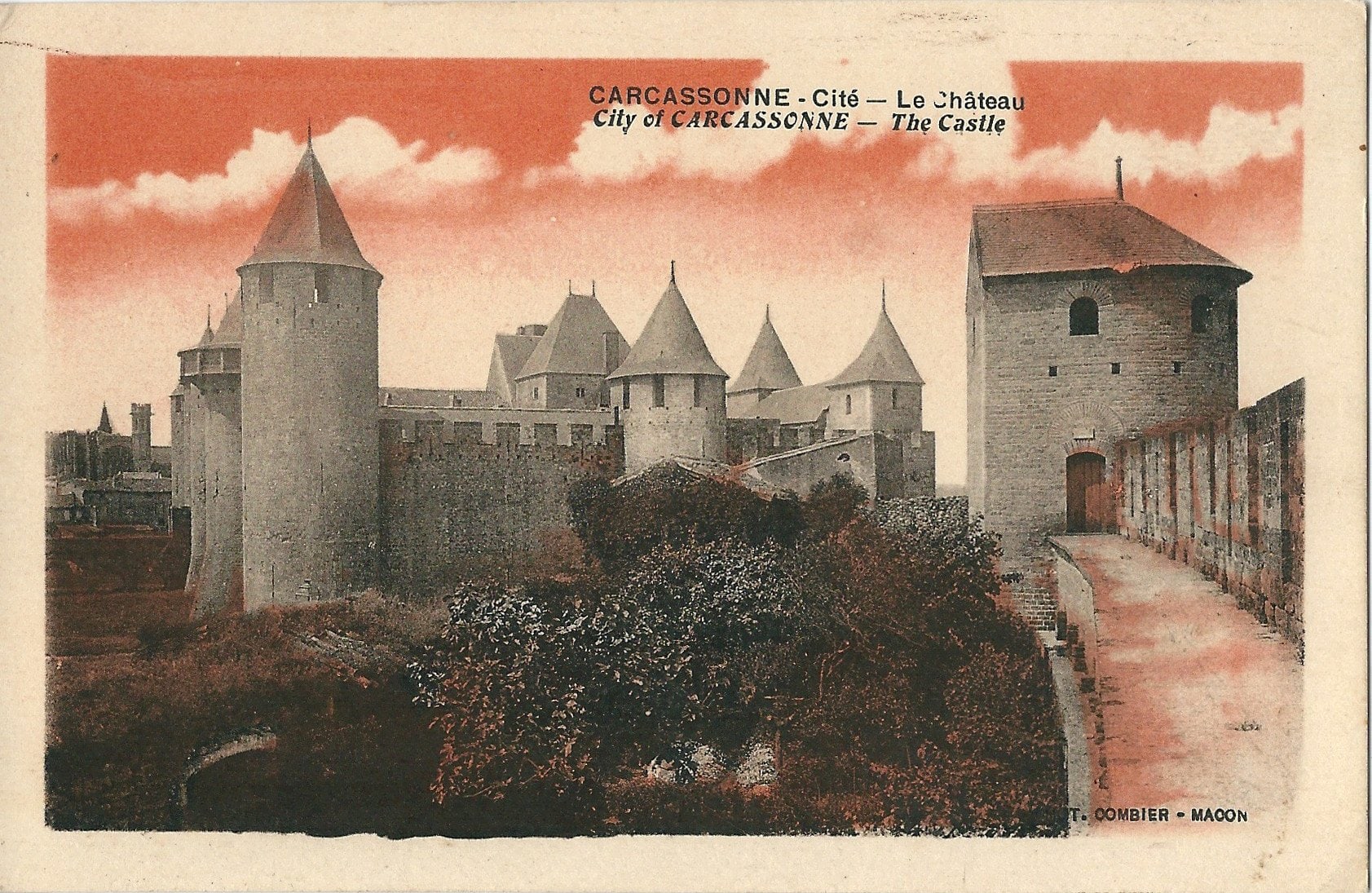
A closer look at the double walls, the towers, and the Château Comtal, in modern color and in archival views from a century ago.
Beyond Carcassonne Castle
Carcassonne is the fullest survivor of a medieval art that France once practiced everywhere, and its threads run far. For the man who remade it, the natural companion is the Château de Pierrefonds in the north, the great fortress Viollet-le-Duc rebuilt for Napoleon III almost from the ground up. Set beside Carcassonne, the two define the spectrum of 19th-century medievalism, from careful consolidation to outright reconstruction.
Carcassonne also commands the fortified south. The frontier it once anchored was studded with the dramatic ruined fortresses of the Corbières, the “Five Sons of Carcassonne” that the crown rebuilt to watch the Aragonese border. Two now have full guides in our catalog: the Château de Peyrepertuse, the largest, a whole ridge turned into a stronghold; and the Château de Quéribus, the southernmost, remembered as the last refuge of Cathar resistance, a label the Aude departmental tourism board says is applied à tort, wrongly. Carcassonne anchors the eight-site serial property that UNESCO inscribed on 26 July 2026 as the Royal Capetian Fortresses of Languedoc, better known as the Royal Fortresses of Languedoc, which joins the Cité and those two sons with Aguilar, Puilaurens, Termes, Lastours, and Montségur.
Carcassonne is also where the crusade began; our guide to the Cathar Castles follows that human story from here to the pyre at Montségur.
Conclusion
It is tempting to treat Carcassonne as a fairy tale, and the conical roofs invite it. The truer story is sterner and more interesting. This was a working machine of war, raised by viscounts, perfected by kings, and tested by crusade and chevauchée, that outlived the only job it was built to do. Left for dead, quarried for its stone, and crowded with the poor, it owed its second life to a scholar who would not give up and an architect who could not resist it. Walk the walls today and you walk Roman foundations, medieval towers, and a nineteenth-century architect’s confident guesses about what the Middle Ages should look like, all at once. Carcassonne does not hide that layering. It is the most honest imitation medieval city in the world, and also one of the most real.
Principal Sources
- Centre des monuments nationaux. remparts-carcassonne.fr and its visitor materials.
- Ministère de la Culture. Cité de Carcassonne resources, including the chronology of the Viollet-le-Duc and Boeswillwald restoration campaigns.
- UNESCO World Heritage Centre. Inscription file for the Historic Fortified City of Carcassonne.
- Ville de Carcassonne. Account of the restoration.
The narrative also draws on standard reference accounts of the Albigensian Crusade and the Trencavel viscounts. Where sources differ, notably the year rampart work began (given variously as 1852, 1853, or 1855) and the total tower count, the article follows the inscription authority and notes the range.
Image credits. Hero, the Château Comtal and its bridge: Diego Delso, CC BY-SA 4.0, via Wikimedia Commons; the Cité in panorama: Lesueur André, CC BY-SA 4.0, via Wikimedia Commons; the Tour de la Charpenterie: Lynx1211, CC BY-SA 4.0, via Wikimedia Commons; the medieval mural in the Château Comtal: Tylwyth Eldar, CC BY-SA 4.0, via Wikimedia Commons; the Porte Narbonnaise: Diego Delso, CC BY-SA 4.0, via Wikimedia Commons; the lices: Krzysztof Golik, CC BY-SA 4.0, via Wikimedia Commons; the ramparts in 1881: Bibliothèque de Toulouse, no restrictions, via Wikimedia Commons; the Château Comtal around 1890: Eugène Viollet-le-Duc, public domain, via Wikimedia Commons; a reconstructed hoarding: Inferno986return, CC BY-SA 4.0, via Wikimedia Commons; visitors at the Château Comtal: Tournasol7, CC BY-SA 3.0, via Wikimedia Commons; Carcassonne from the Pont Neuf (gallery): Lesueur André, CC BY-SA 4.0, via Wikimedia Commons; the walled Cité from the fields (gallery): Swedish National Heritage Board, no restrictions, via Wikimedia Commons; the Porte d’Aude (gallery): Lynx1211, CC BY-SA 4.0, via Wikimedia Commons; a tower spiral stair (gallery): Joe Mabel, CC BY-SA 4.0, via Wikimedia Commons; the Château Comtal courtyard (gallery): CharlèneChtl, CC BY-SA 3.0, via Wikimedia Commons; the Plan général engraving (gallery): public domain, via Wikimedia Commons; the lices in 1883 (gallery): Bibliothèque de Toulouse, no restrictions, via Wikimedia Commons; the château on a vintage postcard (gallery): Combier, public domain, via Wikimedia Commons. Freely licensed images are resized to fit; otherwise unaltered.