
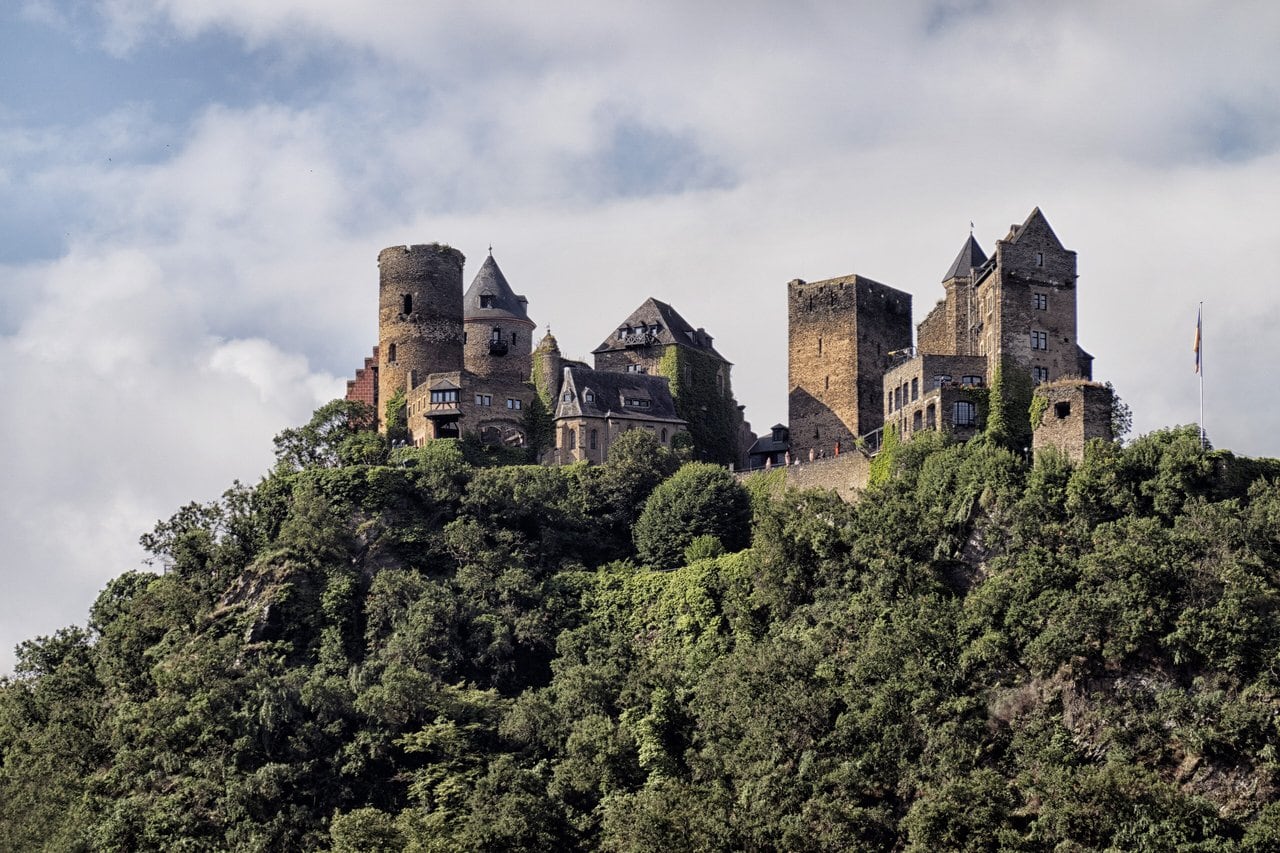
Schönburg Castle
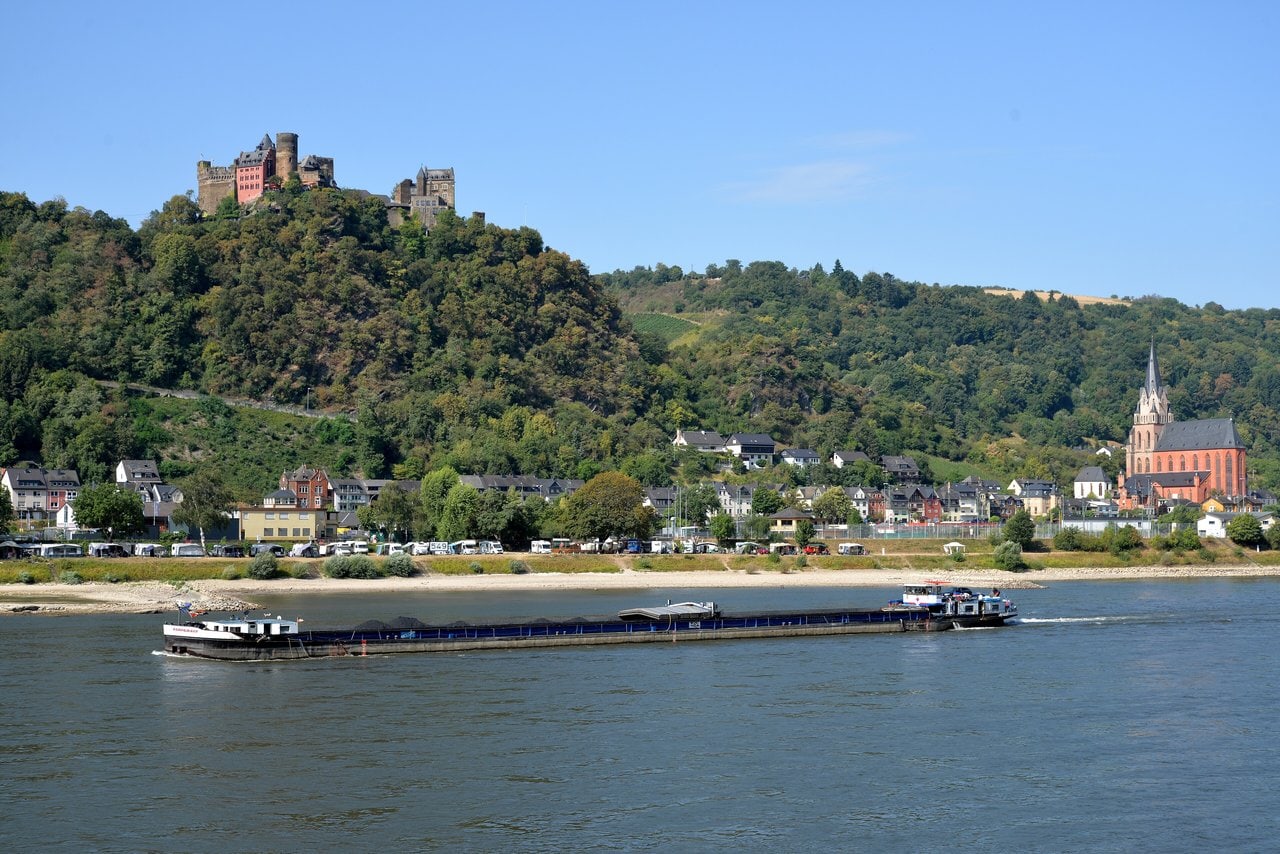
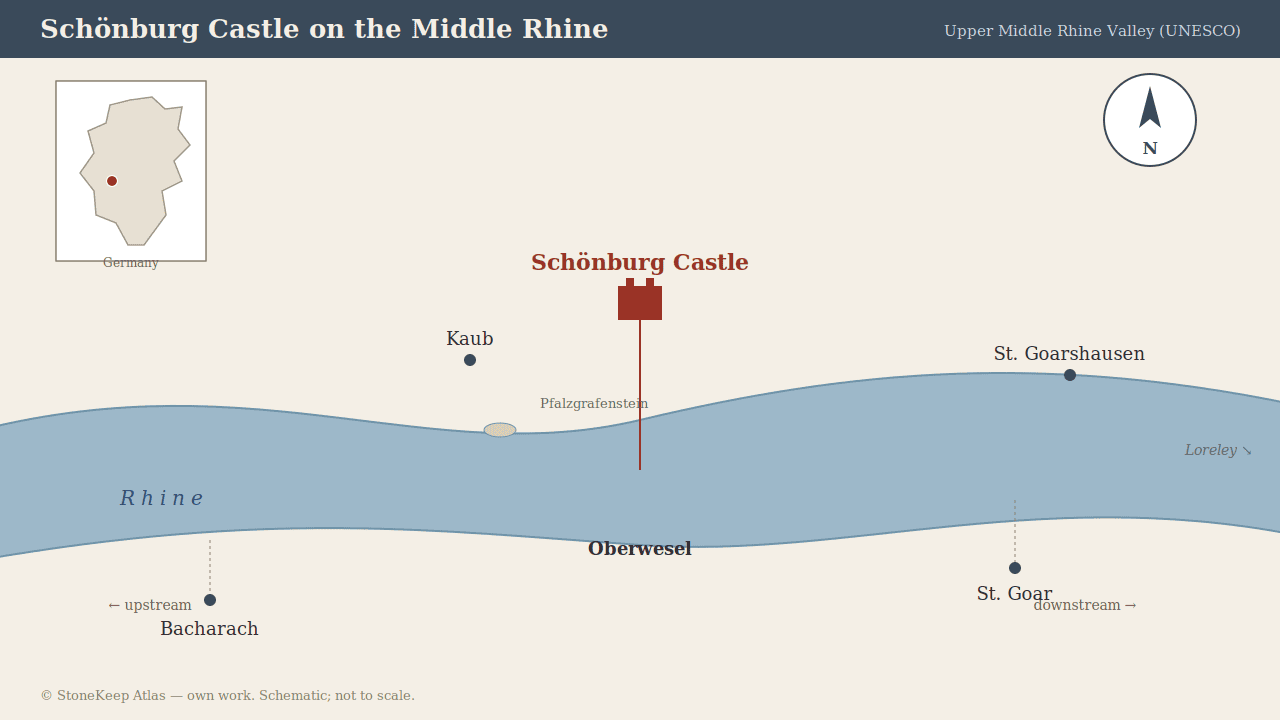
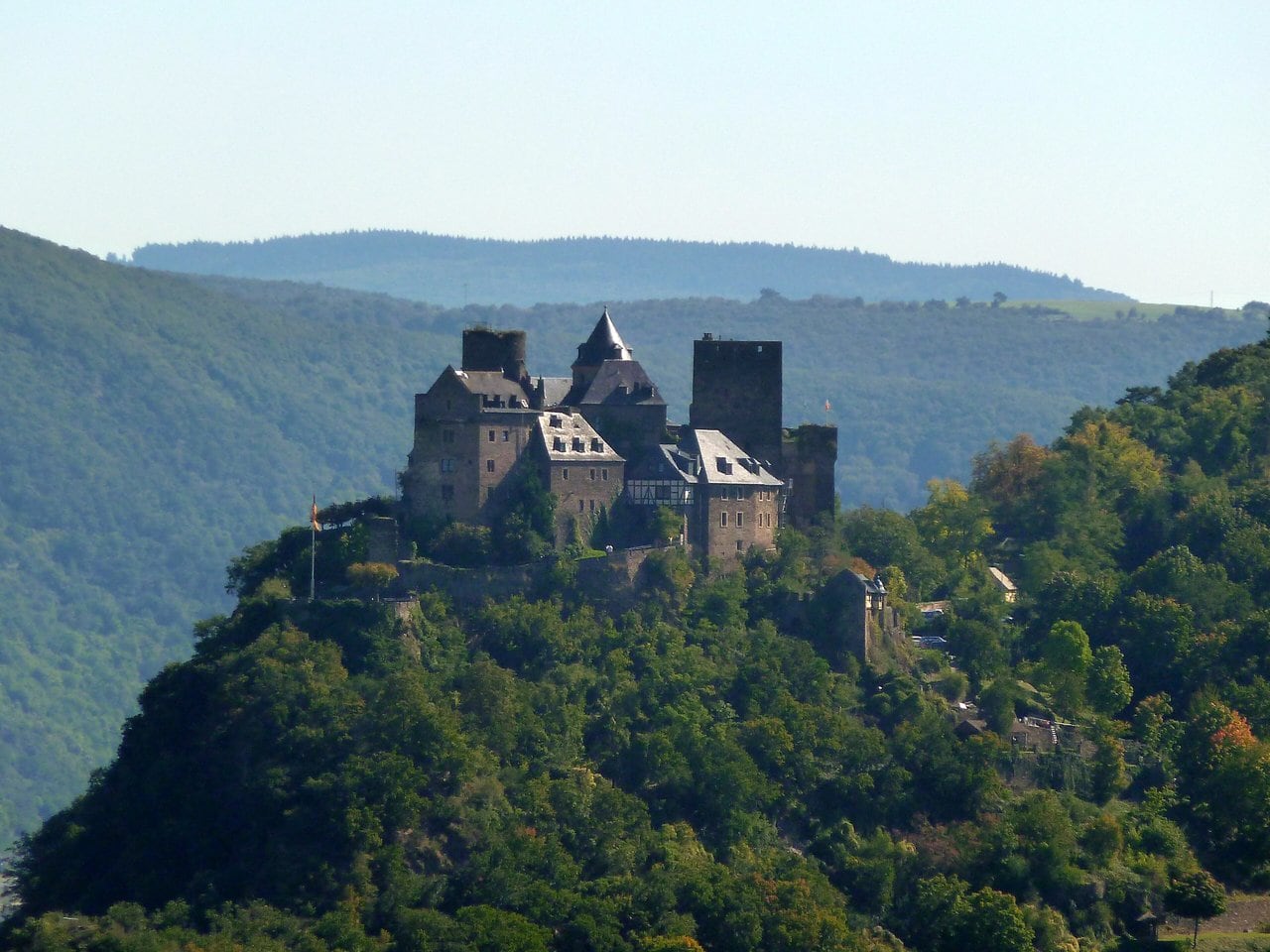
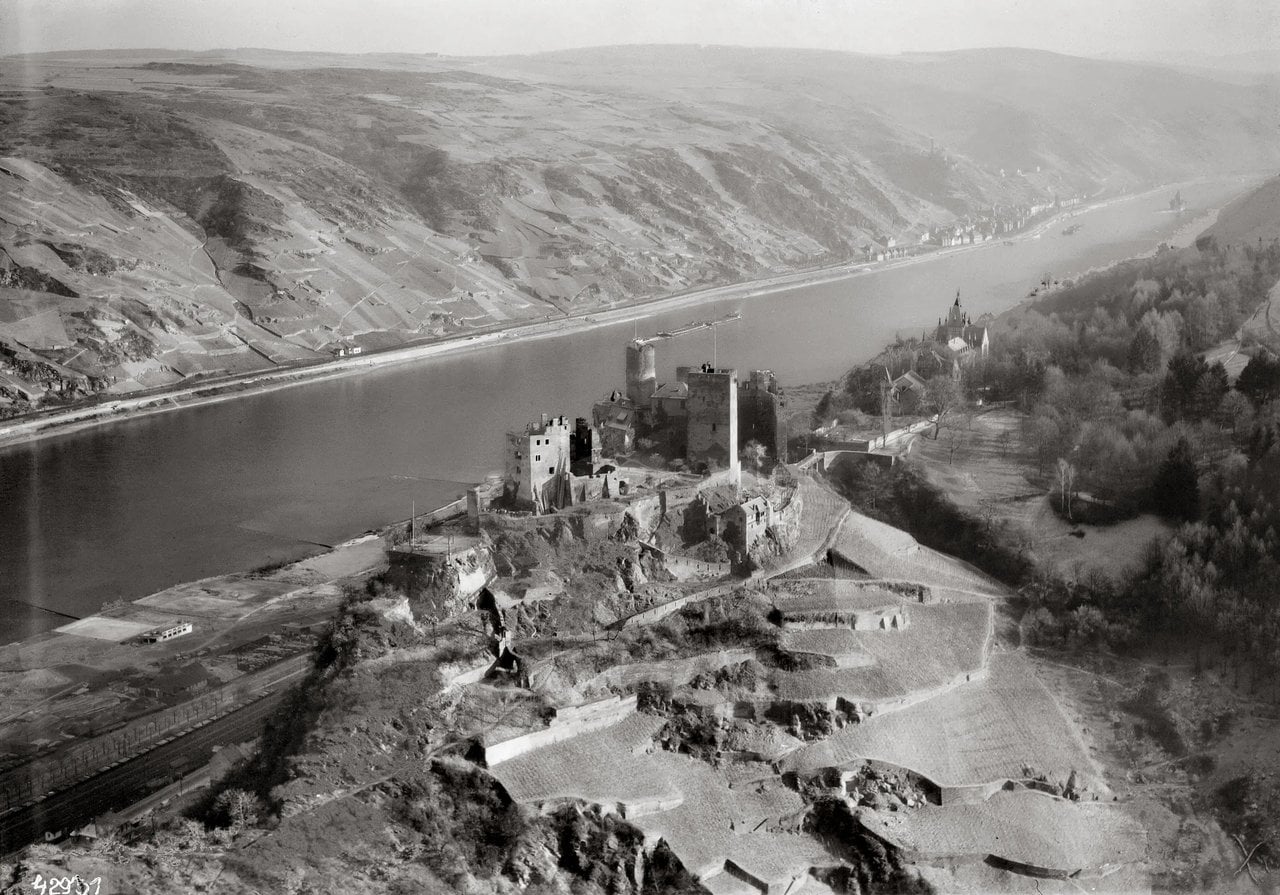
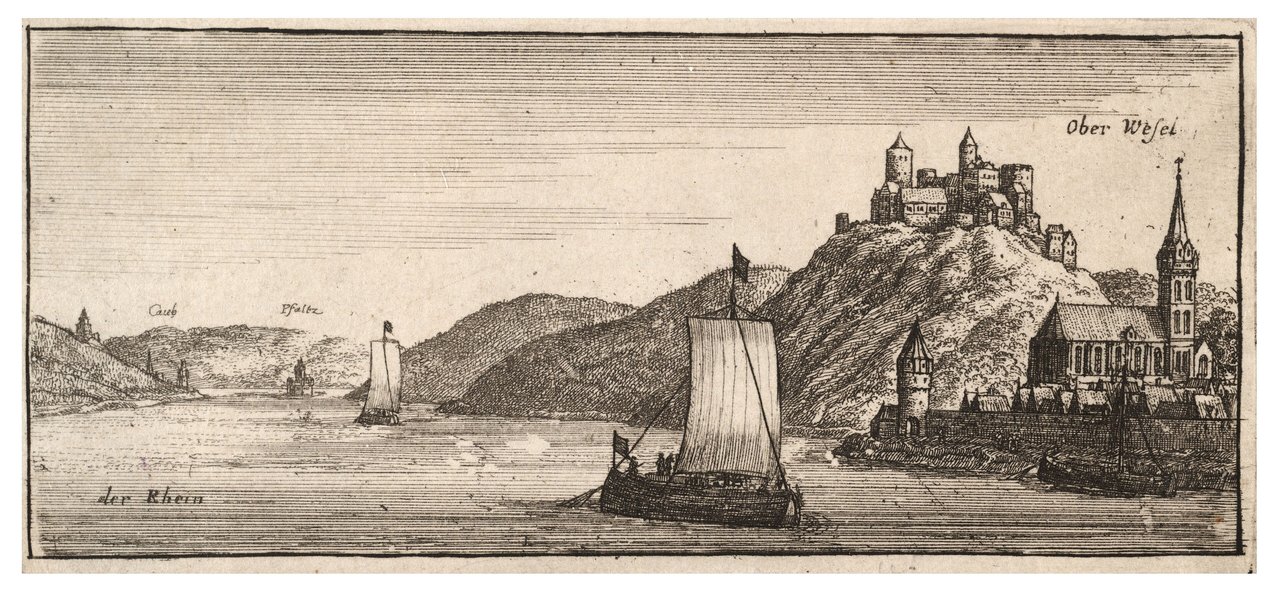
Schönburg Castle stands on a slate spur above the medieval town of Oberwesel, on the left bank of the Middle Rhine in Rhineland-Palatinate, roughly midway between Bacharach upstream and St. Goar downstream. Ground drops away almost vertically on three sides, which is why the castle counts among the oldest hilltop strongholds on this stretch of river. It belongs to the UNESCO-listed Upper Middle Rhine Valley, and from its towers the view runs north toward Oberwesel and its famous wall of towers and south toward Kaub.
What sets the place apart is not its perch but its ownership. Schönburg Castle was a Ganerbenburg, a fortress held jointly by the branches of a single family, each with its own tower and its own quarters inside one set of walls. That arrangement shaped how the castle was built, how it was governed, and how it eventually fell. The story runs from a twelfth-century murder, through three crowded centuries of shared tenancy, to a French torch in 1689, an American banker’s fortune in the 1880s, and the luxury hotel that fills the south range today.
Quick Facts
| Location | Oberwesel, Rhineland-Palatinate, Germany |
| Type | Hilltop castle (Höhenburg), Ganerbenburg |
| Built | First half of the 12th century; first recorded 1149 |
| Elevation | About 130 meters above the Rhine |
| Condition | Restored; in use |
| Owner | Town of Oberwesel |
| Use | Hotel, restaurant, and tower museum |
| Region | Upper Middle Rhine Valley (UNESCO World Heritage) |
| Coordinates | 50.1010° N, 7.7321° E |
| Official site | hotel-schoenburg.com |
A Murder Enters the Record
No charter records the day the first wall went up. Builders began the castle in the first half of the twelfth century, either for the archbishops of Magdeburg, who held property in the area, or as an imperial stronghold guarding the river; the sources do not settle the question. A few accounts push the origin much earlier, to a tenth-century grant by Emperor Otto I or even a Roman lookout on the rock, but neither claim rests on firm evidence, and the cautious reading keeps the founding in the 1100s. What is certain is the site’s logic. The hill commands a narrowing of the gorge where the river bends, the slate falls away in cliffs, and whoever held the height held Oberwesel and its traffic.
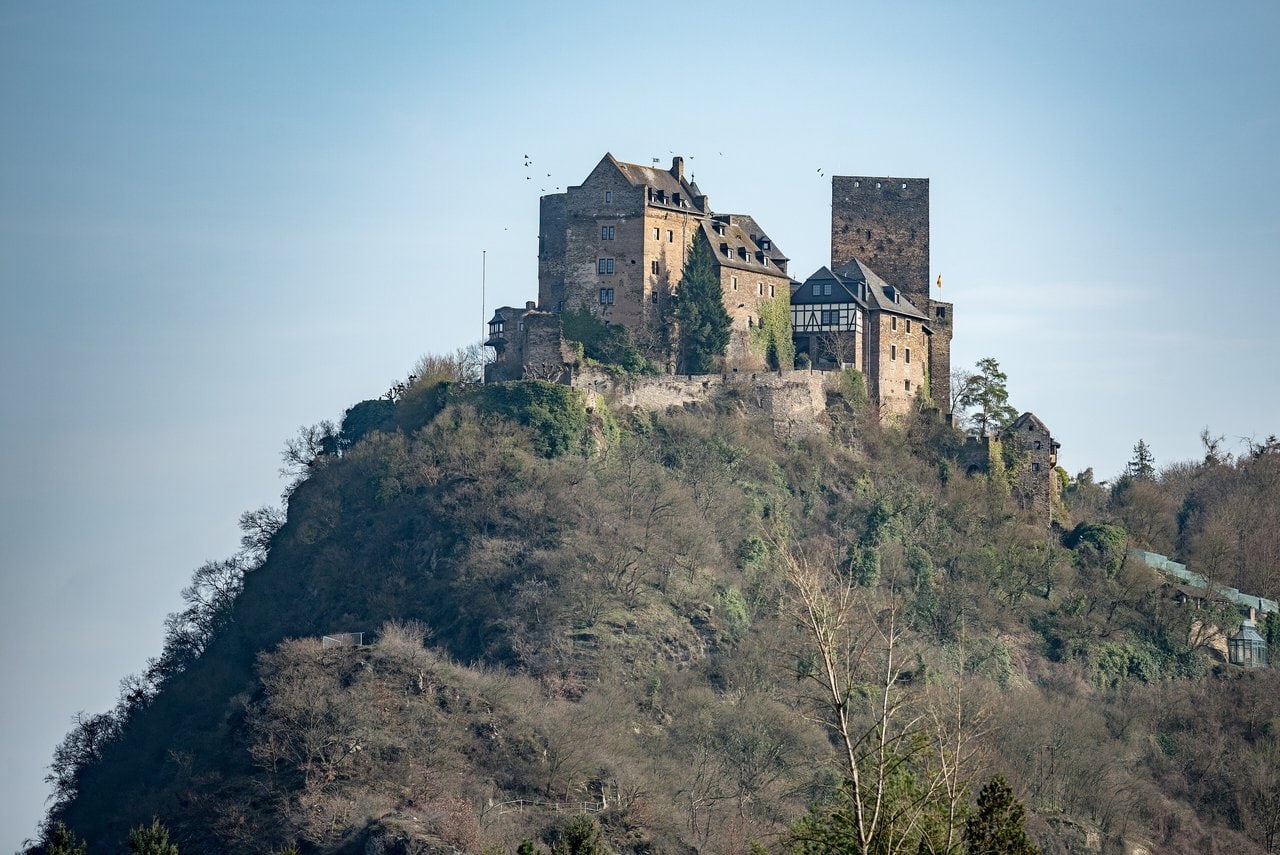
The name surfaces clearly only in 1149, and it does so in the worst possible company. In that year the castle was a fief of Hermann von Stahleck, count palatine of the Rhine, who had his rival for the palatinate, Otto II of Rheineck, strangled inside its prison tower. The same Hermann gives his name to nearby Stahleck Castle above Bacharach, and Schönburg’s debut in the historical record is, in effect, a footnote to his ambition.
For a generation the fortress passed between great powers. It served as a fief of the church of Magdeburg until 1166, when Emperor Frederick Barbarossa pulled it back into direct imperial control and made it answerable to the crown alone. Guarding it on the emperor’s behalf were the lords of Schönburg, a ministerial family who took their name from their post. By 1237 one Otto von Schönburg appears as castellan for the Hohenstaufen emperor Frederick II. These were not great nobles but professional administrators, and their rise tracks the way imperial power on the Rhine was farmed out to capable local men. The family drew its wealth from Oberwesel: they held the town as imperial bailiffs, absorbed its formerly royal churches into their own holdings, and claimed the right to levy tolls on river traffic, the lucrative privilege that built so many of these Rhine toll castles. For the better part of two centuries the lords on the hill and the burghers in the town below lived in the same uneasy partnership, the castle drawing its income from a port it both protected and taxed.
The Castle Built to Be Shared
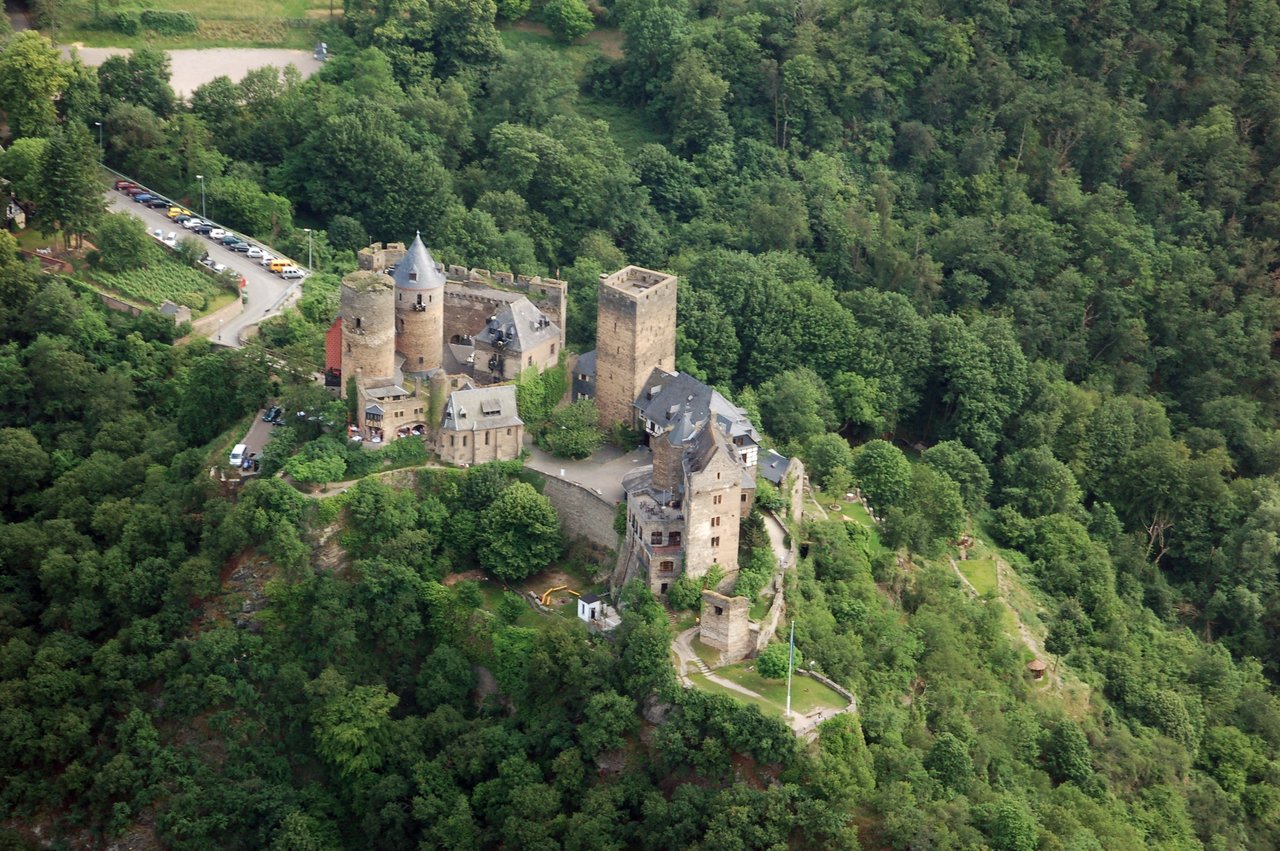
From the middle of the thirteenth century the Schönburg family did something most noble houses avoided: it divided its inheritance among all the sons rather than passing the whole estate to the eldest. Each generation multiplied the heirs, and all of them clung to the ancestral rock. The result was a Ganerbenburg, a castle owned and occupied in common by several lines of one family, a model rare enough on the Rhine that contemporaries treated Schönburg as a notable example. The branches split into three groups, and that division is still legible in the stonework: the castle carries three keeps, each the strongpoint of a separate family seat, clustered behind a single defensive front. Each group held its own keep and hall with their attendant outbuildings, so that within one circuit of walls stood what amounted to three small castles, sharing a gate, a water supply, and a common enemy. At its height the place must have been less a single lordly household than a fortified village of cousins.
Shared ownership produced a crowded hill. A register drawn up in 1340 names roughly ninety-five co-heirs with a claim to the place, though by no means all of them lived on it at once. Governing such a community meant written compacts among the lines, a castle-peace that set out rights and duties, and disputes among co-heirs were a normal hazard of the arrangement. By their coats of arms, heralds could distinguish two branches of the family, one bearing six small shields and the other a central escutcheon; the six-shield line died out in the sixteenth century, and its property passed to the other. The surviving line rose in the world. By the early seventeenth century it had been raised to the rank of imperial counts, and German genealogies connect a branch to the soldier Friedrich Hermann von Schomberg, who became a Marshal of France in 1675 and died fighting for William III at the Boyne in 1690. The motif of fortress-sharing kin recurs along this river, most famously at the twin castles of Sterrenberg Castle and Liebenstein Castle downstream, the so-called hostile brothers, where one family’s two seats stood glaring at each other across a dividing wall.
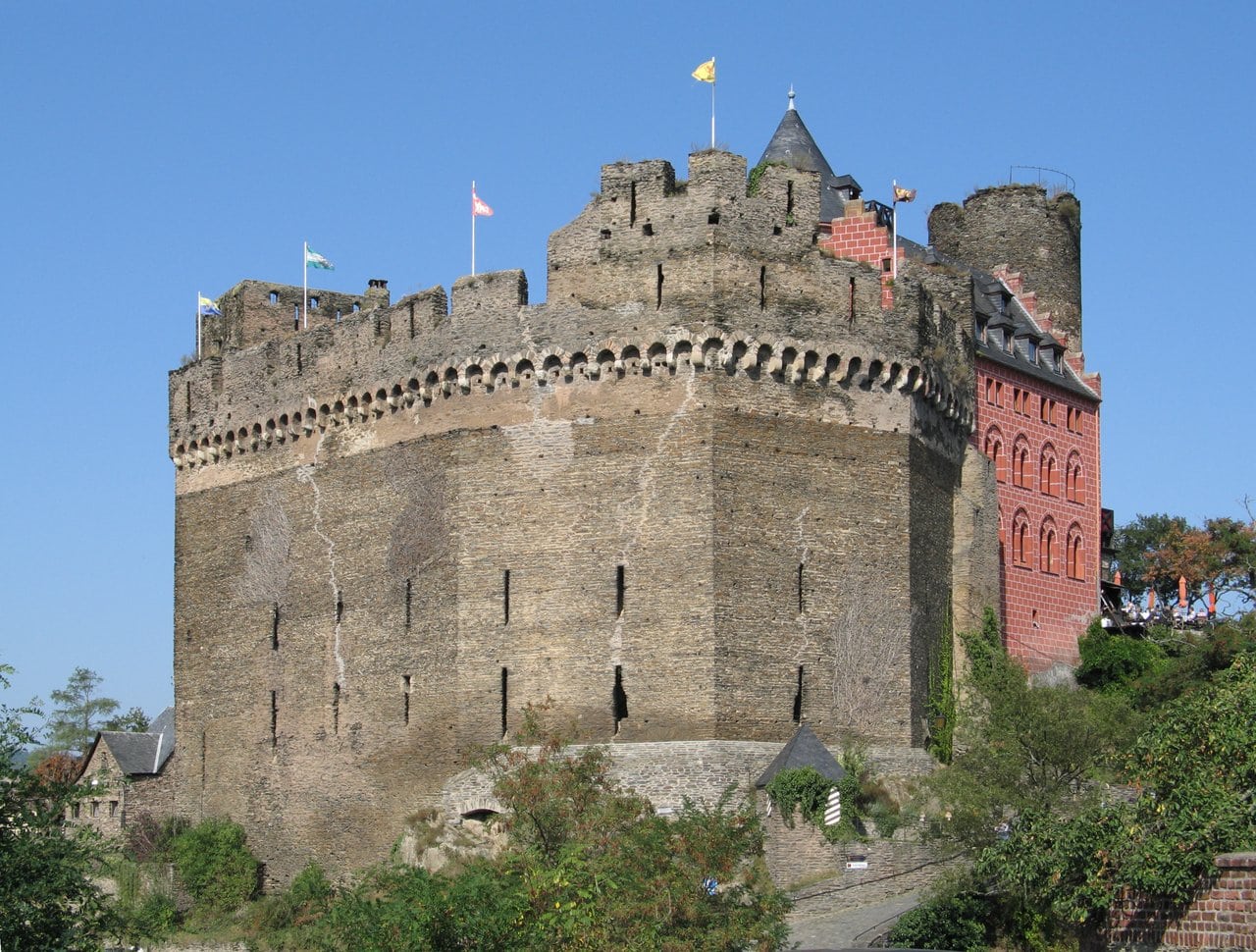
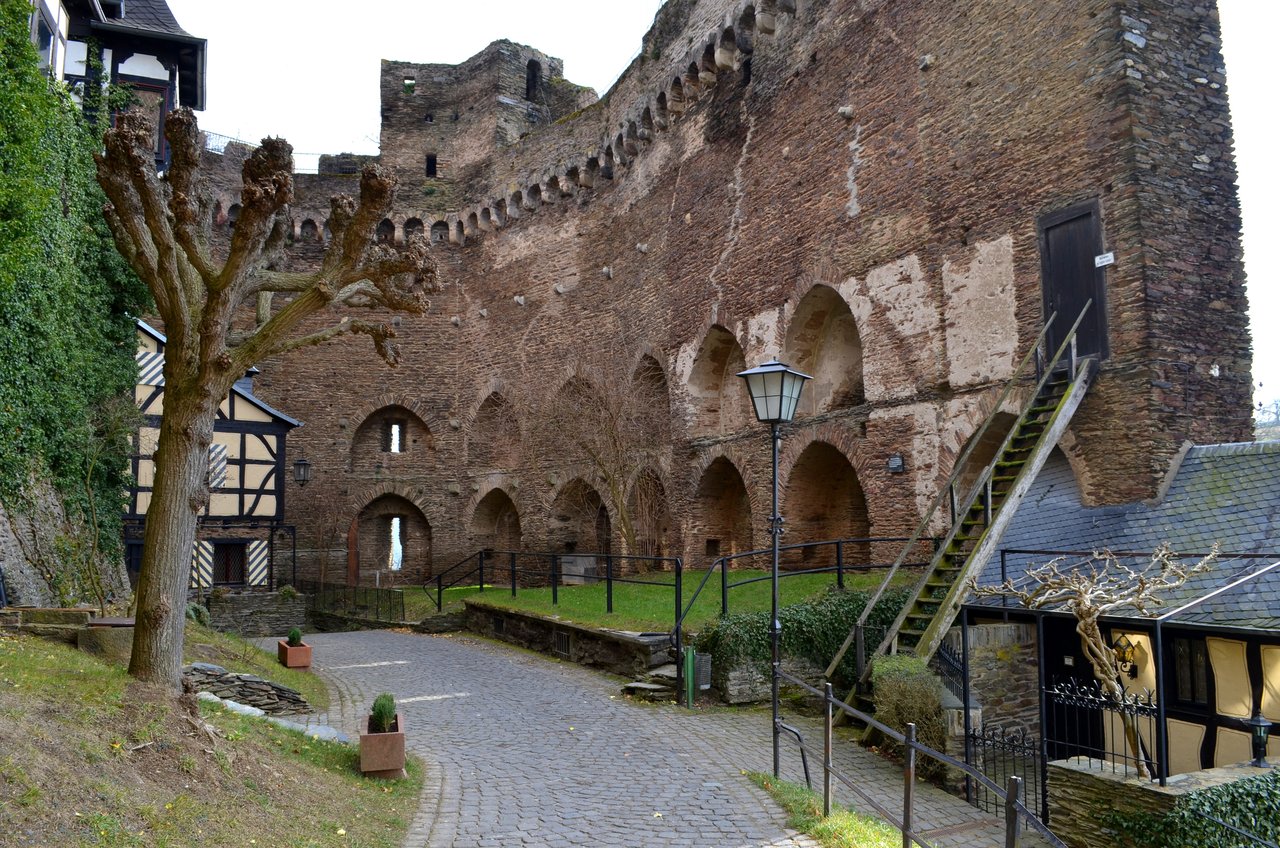
Overlordship shifted decisively in the fourteenth century. In 1318 King Louis the Bavarian granted the castle to Archbishop Baldwin of Trier, one of the most effective territorial princes of his age, and Trier kept the fief from then on. Baldwin probably paid for the castle’s most impressive surviving feature: the Hoher Mantel, a colossal shield wall that screens the vulnerable southern approach behind the neck ditch. It bends twice at obtuse angles to enclose the forecastle on its south and east flanks, rises a good twenty meters, and carries a battlemented wall-walk on a corbelled, round-arched frieze. Pierced by only two rows of tall, narrow loopholes, it remains one of the great pieces of military masonry on the Middle Rhine.
War and Ruin
Schönburg’s decline matched the long crisis of the seventeenth century. During the Thirty Years’ War the castle changed hands repeatedly, occupied in turn by Spanish, Swedish, Bavarian, and French troops, and it was already slipping into disrepair before that war ended. Each garrison took what it needed and left the fabric a little weaker. The final blow came in 1689. As French armies swept the region during the War of the Palatine Succession, the troops of Louis XIV plundered Oberwesel and burned the castle, the same scorched-earth campaign that gutted strongholds up and down this reach of river and that we trace in our account of the sieges that defined Germany. Schönburg was not rebuilt. Its male line died out in 1719, and the ruin reverted to Electoral Trier. In 1796, with the entire left bank under French revolutionary occupation, the property was declared national land.
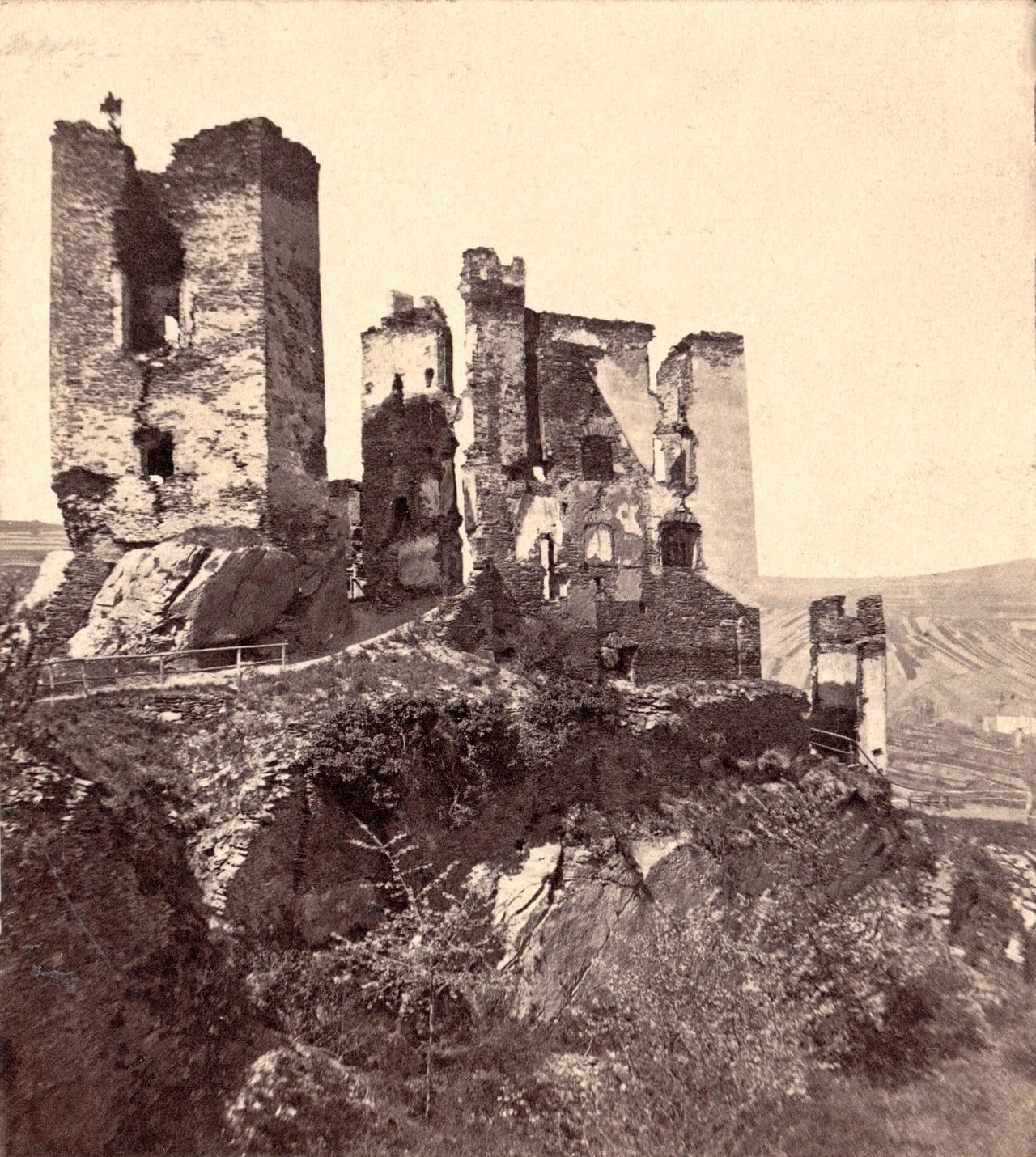
For roughly two centuries the castle sat as a quarry and a romantic relic. Townspeople carried off its dressed stone for new building in Oberwesel, so that the town below grew partly out of the fortress above it. Travelers, meanwhile, came to admire the decay rather than mourn it. On his Rhine journey of 1840 the writer Victor Hugo counted Schönburg among the most admirable ruins in Europe, and the poet Ferdinand Freiligrath, visiting the same lonely corner of what was then the Prussian Rhine Province, called Oberwesel with its castle the loveliest refuge of Romanticism on the river. That double life, useful rubble and picturesque ghost, was the common fate of Rhine castles in the century before anyone thought to save them.
The American Who Rebuilt a Ruin
Rescue came in two waves, and both belonged to the wider Romantic revival of German castles. The first was Prussian and royal. When King Frederick William IV took Stolzenfels Castle as a summer residence in 1842, his brother Prince Albert of Prussia acquired Schönburg, while a third Hohenzollern, the future Emperor William I, bought Rheinfels Castle at St. Goar in 1843. Prince Albert dreamed of rebuilding Schönburg in a Byzantine style. The plans were never carried out, and in 1866 he sold the ruin to his own castellan, but the very fact that three princes of the ruling house collected Rhine ruins in the same decade shows how fashionable the romantic past had become.
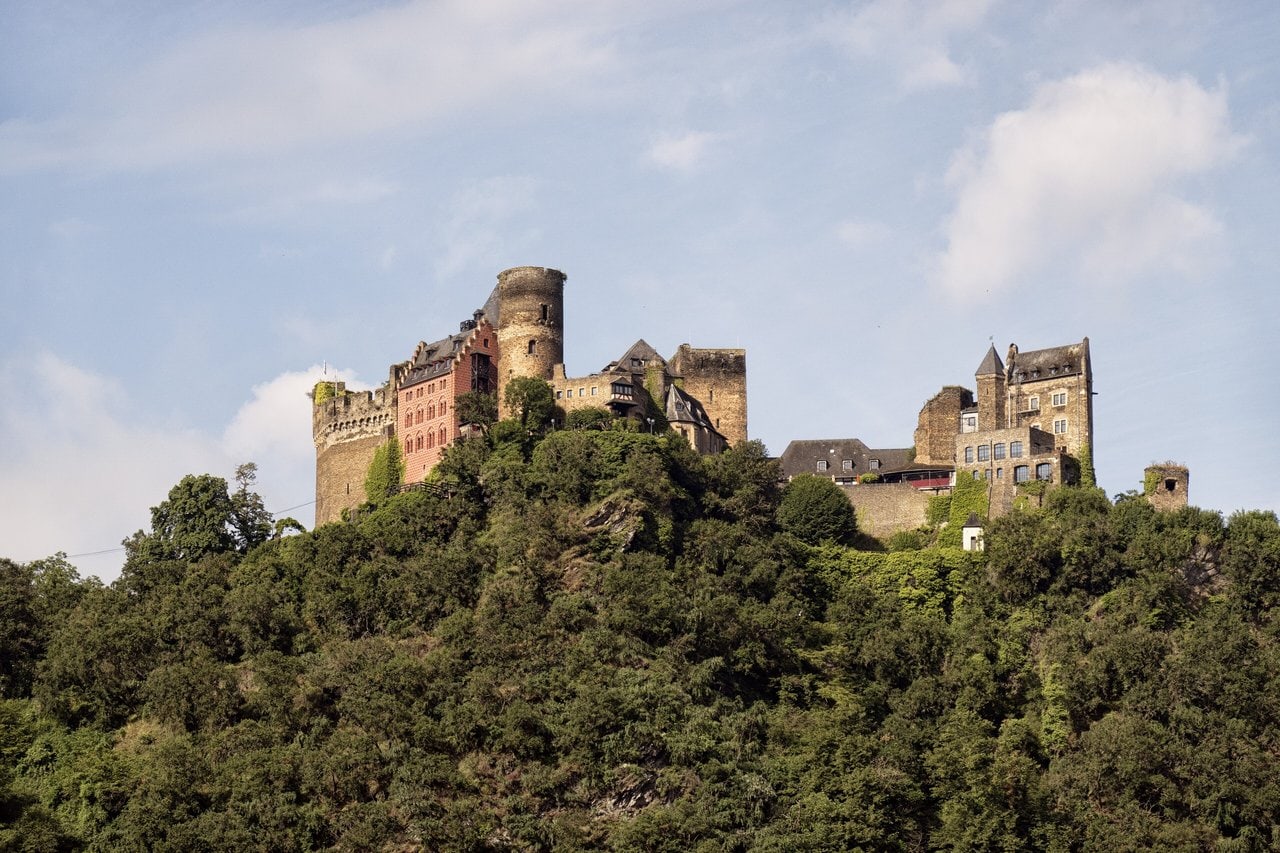
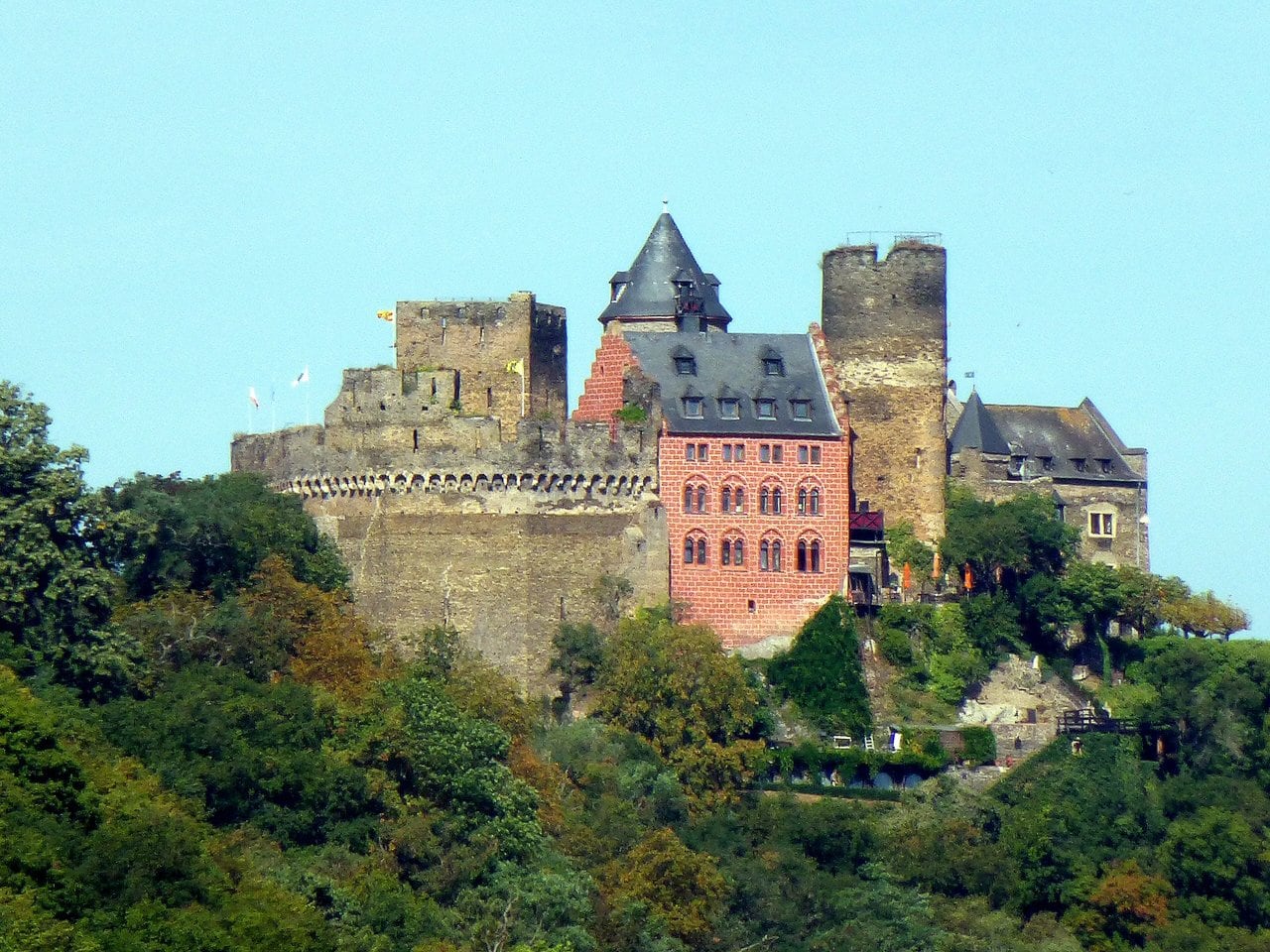
The second wave was American. In 1885 the German-American banker T. J. Oakley Rhinelander of New York toured the Rhine, fell for the ruin above Oberwesel, and bought it. Over the next three decades he rebuilt the castle to old plans, pouring more than two million gold marks into the work up to 1914. The south range, the part that holds the hotel today, still carries his name as the Rheinländer-Bau, and the building’s distinctive red plaster with white-painted joints was restored from traces found on the west gable. Rhinelander’s project sits in a transatlantic moment when American money chased European romance, and a banker’s fairy-tale castle on the Rhine was one of its more literal results. It also raises a question that hangs over half the castles in this gorge. Critics have long noted that only a few parts of Schönburg are truly medieval, and that much of what a visitor sees is a confident nineteenth- and twentieth-century reconstruction built to old plans rather than surviving fabric. That is fair, but it is also the point: the Rhine’s castle landscape is to a striking degree a Romantic creation, rebuilt by princes and millionaires who wanted the Middle Ages to look the way the paintings did.
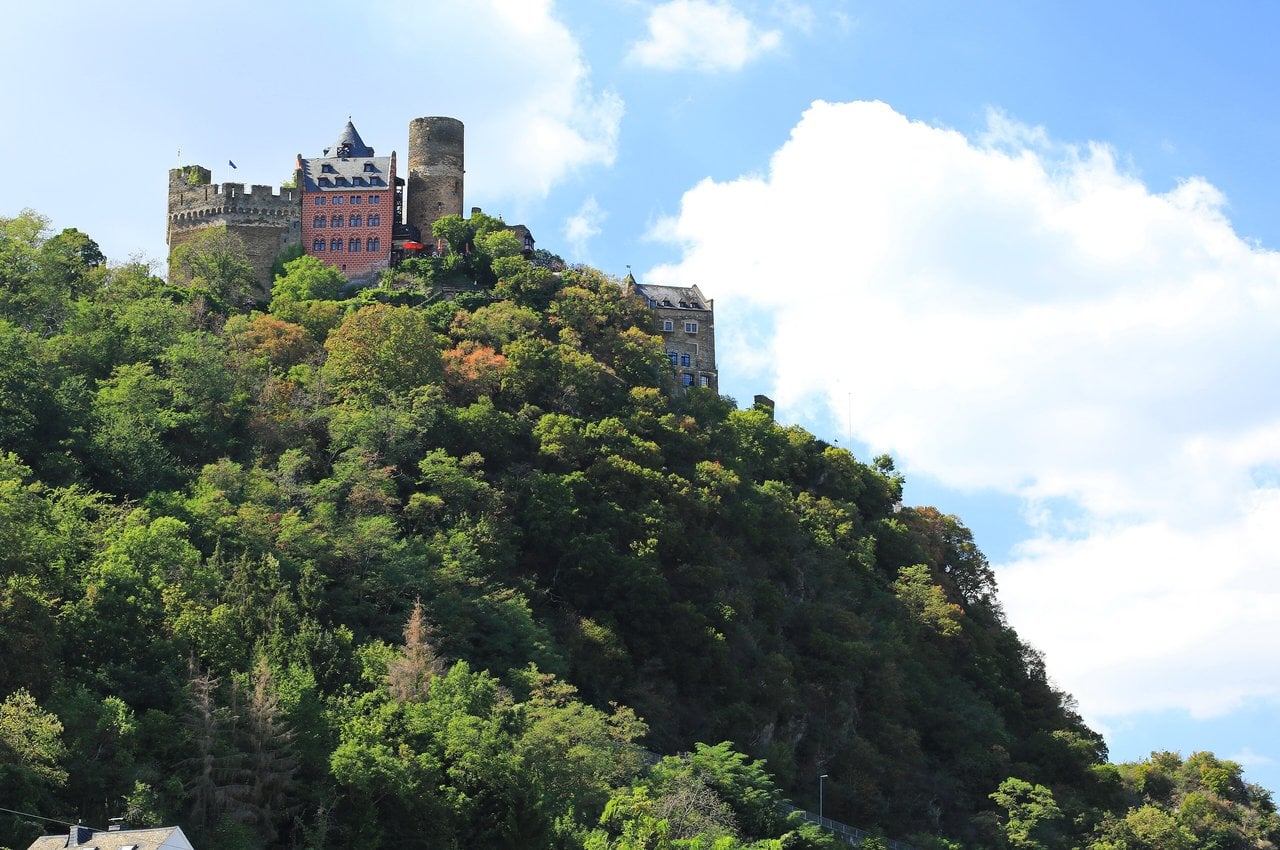
After Rhinelander’s death the castle passed to the town. In 1950 Oberwesel bought it from his heirs for a token sum, on the condition that part of the complex become an international meeting place for young people, the Kolpinghaus, which was built out in the north range between 1951 and 1953. The south range took a different path. Since 1957 it has been leased to the Hüttl family, who have run it as a hotel for three generations and hold the lease in hereditary tenure. The castle that was built to be shared among many heirs is, fittingly, still run as a shared concern: a town landlord, a youth center, and a family hotel under one set of walls.
Three Keeps and a Shield Wall
What survives rewards a slow look, even though restoration and hotel use have softened the medieval fabric. The defining structure is the Hoher Mantel shield wall on the south, the work begun under Baldwin of Trier, which still rises to its full height and gives the castle its silhouette from the river. Behind it the ground climbs through a forecastle and a ring of outer defenses to the upper ward, reached by a stair set between the chapel and the living range. The whole complex sits on bare slate, the same blue-gray stone that builds the gorge, quarried straight from the spur it stands on.
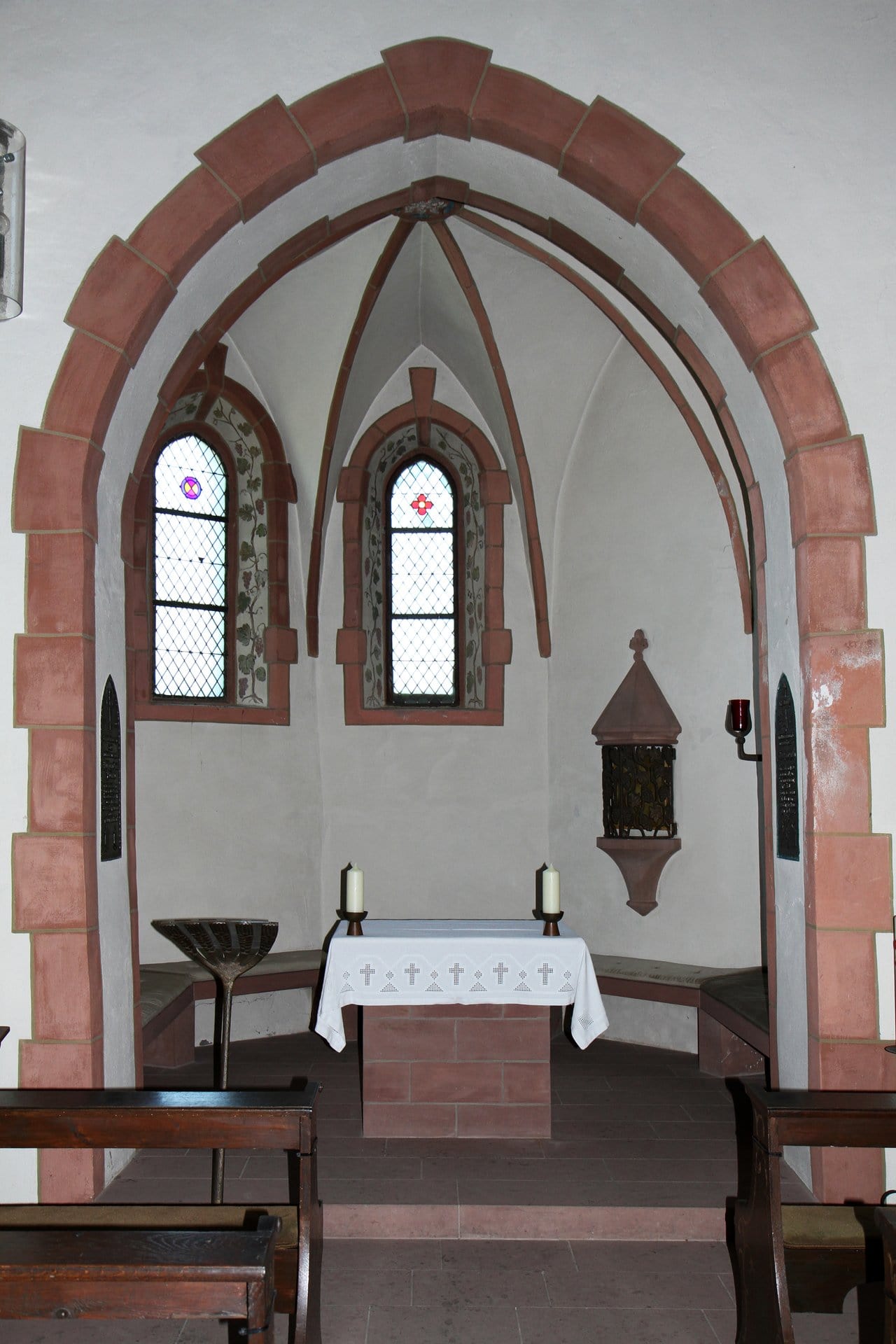
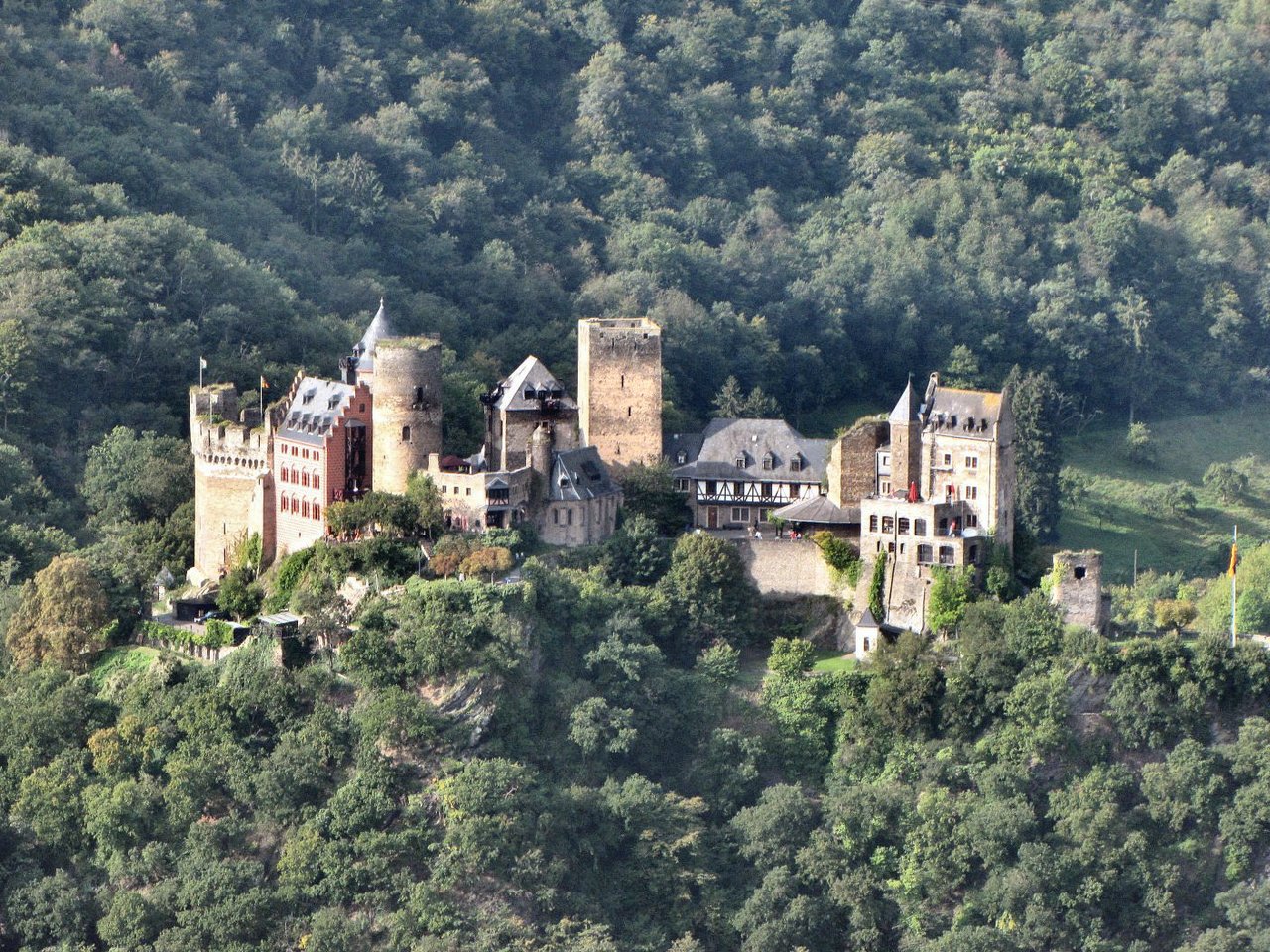
The three keeps that mark the old family divisions tell the Ganerbenburg story in stone. Two are round towers of unequal height, the eastern prison tower and the western Barbarossaturm, named for the emperor said to have visited more than once, a tradition rather than a documented fact. The west tower received a new roof around 1980. A third keep, seven-sided and the oldest of the three, partly collapsed in 1880 and survives only in fragments. Between the towers stands the Palas, the residential hall, which now contains the hotel’s rooms; its valley-side wall of Gothic windows and much of the south range were reroofed and rebuilt in 1979 to 1981. The late-Gothic chapel in the middle ward was the one space all three branches shared, a single sanctuary for the whole Ganerbenburg; Rhinelander rebuilt it on its old foundations, and it still hosts weddings today. Half-timbered service buildings, including a porter’s lodge at the gate, fill out the courtyard.
A visitor’s first encounter is the gate tower, a double-portcullis structure about twenty-five meters tall that once let defenders trap attackers between two iron grilles. Schönburg was, by the standards of its neighbors, a castle that could genuinely defend itself, and the gate tower made the point. Since 2011 it has housed an interactive museum on castle-building, siege warfare, and conservation, complete with a working model of a trebuchet that shows how a medieval crew tried to batter a stronghold like this one into rubble. A climb of 122 steps reaches a viewing platform with a sweep of the Rhine valley below, the same prospect that persuaded a Prussian prince and an American banker, in turn, that the rock was worth the trouble.
The Seven Maidens
No Rhine castle of any standing is without a legend, and Schönburg’s is among the river’s best known. The tale holds that seven sisters once lived on the castle, beautiful and famous across the region and utterly cold to every suitor. Knights came from near and far, held tournaments, and sang their hearts out, and the sisters refused them all. In the popular telling, pressed at last to choose, the seven slipped away downriver by boat, waving back at their disappointed admirers. A sudden wave overturned the craft where the Roßstein juts into the current below Oberwesel, and where the maidens drowned, seven rocks rose from the water. That is a petrification story rather than a haunting, since nothing walks and nothing returns, which is why our reference on castle ghost stories and their first written records files it apart from the ghosts.
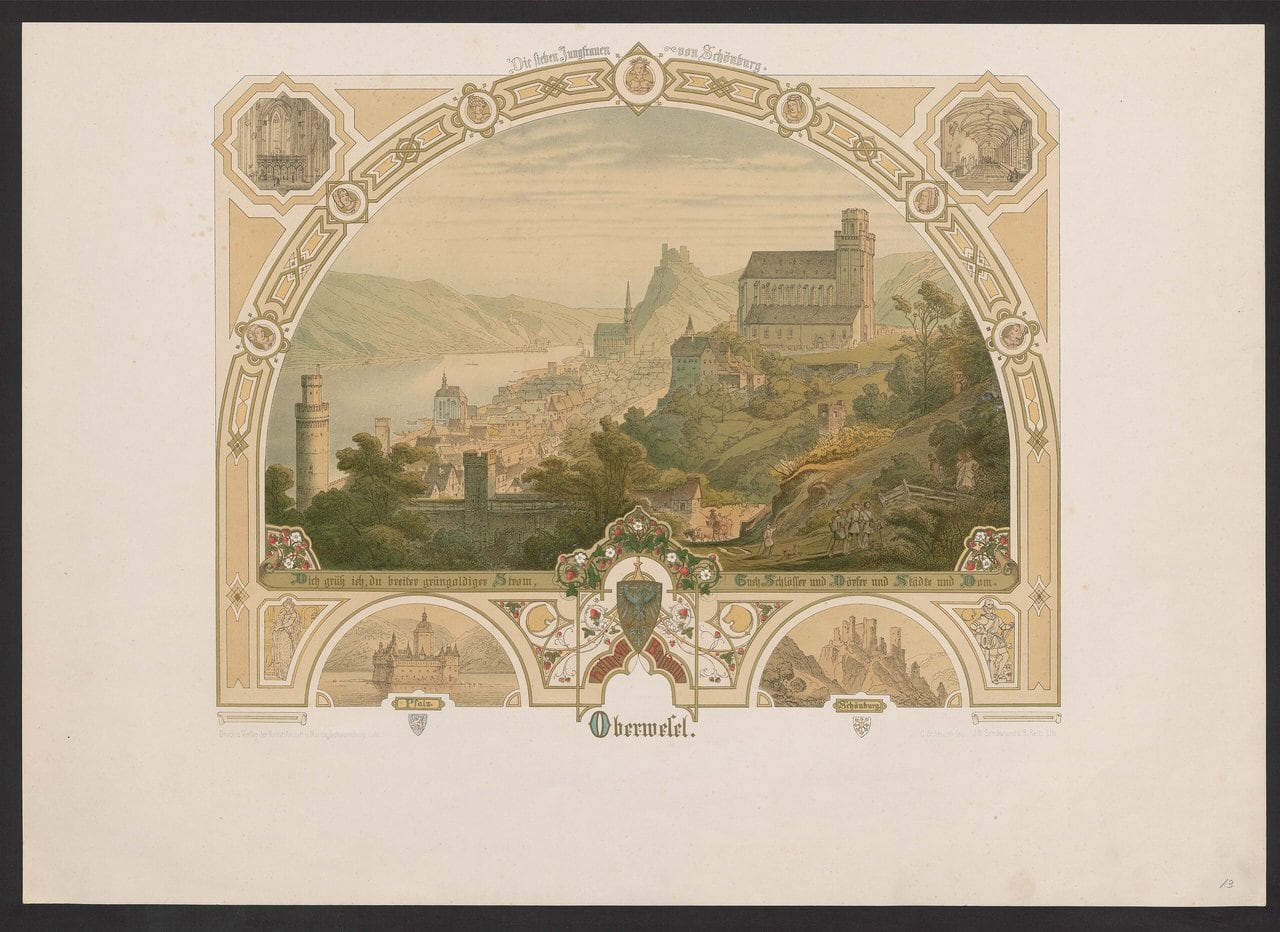
Those rocks, the Sieben Jungfrauen, still break the surface of the Rhine at low water, and folklore makes them a warning against pride. A gentler version, recorded in Wilhelm Ruland’s collection of Rhine legends, says the petrified sisters can be freed only when a prince builds a riverside church from their stone, which is why, on quiet evenings, you can supposedly still hear them lament. The legend predates the river’s tourist trade, and it gives Oberwesel’s stretch of water a story to rival the Lorelei, whose rock looms only a few bends downstream past St. Goar.
Visiting Schönburg Castle in 2026
Schönburg works on two levels for a visitor. The exterior, the courtyard, and the terraces are freely accessible and open at all hours, so anyone can climb up for the view and a look at the shield wall and towers. The interiors, by contrast, are not open for general sightseeing, because the south range is a private hotel and the north range a residential youth center.
The one paid attraction is the Tower Museum (Turmmuseum) inside the gate tower, an interactive display on castle life and siege warfare, with the viewing platform at the top. Admission is modest: around 3 euros for adults, 1.50 for children, and 7 euros for a family, with free entry for hotel guests and Oberwesel residents. Opening times are seasonal, broadly daily except Monday from April through October and weekends only in the shoulder months, with a winter closure; because the town adjusts the hours each year, confirm them on the operator’s site before a special trip.
Getting there is half the experience. From Oberwesel a steep, switchbacking footpath on the RheinBurgenWeg trail climbs the west side of the hill in about thirty minutes, passing two marked viewpoints: the Elfenley, which looks downriver to Oberwesel and across to Kaub, and the Flaggenwiese on a terrace just short of the gate, where the town suddenly lies far below. Drivers can also reach a parking area in front of the shield wall, a short walk from the gate. A youth hostel sits just below the castle for walkers on a budget, and Oberwesel’s station puts the whole gorge within easy reach by regional train or river ferry. The town itself repays the time. Oberwesel calls itself the city of towers and wine, and its medieval wall still carries sixteen of an original twenty-two towers, much of it walkable. Two churches anchor the skyline: the red Gothic church of Our Lady, the Liebfrauenkirche, with one of Germany’s oldest carved altarpieces, and the white church of St. Martin on its fortified tower. A small piece of trivia rounds it out: the Schönburger grape variety is named for the castle.
For travelers who want to stay rather than just visit, the Hotel auf Schönburg is the obvious draw and the reason the castle features in our guide to castle hotels in Germany. It offers a small number of rooms and suites inside the historic walls, some with balconies over the Rhine, and a restaurant in the old hall. Rates sit in the upper-midrange for a heritage property and shift with season and view, so it pays to check current availability directly.
You can stay inside the Schönburg today, in the castle the Schönburg family ruled and the French burned in 1689. See our guide to Castle Hotels on the Rhine for the rooms and how to book.
To stay inside the walls, check current availability and rates for the Burghotel auf Schönburg on Booking.com. To see the castle and the gorge from the water, browse Rhine cruises through the Oberwesel reach on GetYourGuide.
Some links on this page are affiliate links, which means StoneKeep Atlas may earn a small commission, at no extra cost to you, if you book through them.
More Views of Schönburg Castle
Beyond Schönburg Castle
Schönburg sits in one of the densest concentrations of castles anywhere, and it reads best alongside its neighbors. Our regional overview, Castles of the Middle Rhine, places it in the full sweep of the gorge, while Castles of the Rhine Gorge gathers the strongholds packed into the World Heritage stretch.
Upstream toward Kaub stand the toll partners Gutenfels Castle on the slope and Pfalzgrafenstein Castle midstream on its island, the most theatrical demonstration of how the Rhine lords turned a river into a revenue stream. Just above Oberwesel, Stahleck Castle belonged to the very Hermann von Stahleck whose 1149 murder gave Schönburg its first headline. Downstream the vast ruin of Rheinfels Castle shows what a Rhine castle could become at full scale, and the quarreling brothers of Sterrenberg Castle and Liebenstein offer the closest parallel to Schönburg’s shared-family tenancy. Further upstream, the nineteenth-century rebuilds of Sooneck Castle, Reichenstein Castle, and Rheinstein Castle trace the same Romantic impulse that brought Rhinelander to Oberwesel.
Common Questions
Can I go inside Schönburg Castle?
The exterior, the courtyard and the terraces are freely accessible and open at all hours, so anyone can climb up for the view and a look at the shield wall and towers. The interiors are not open for general sightseeing, because the south range is a private hotel and the north range a residential youth center.
What is the Tower Museum?
The one paid attraction is the Tower Museum (Turmmuseum) inside the gate tower, an interactive display on castle life and siege warfare, with a viewing platform at the top. Admission is modest: around 3 euros for adults, 1.50 for children, and 7 euros for a family, with free entry for hotel guests and Oberwesel residents.
When is Schönburg open?
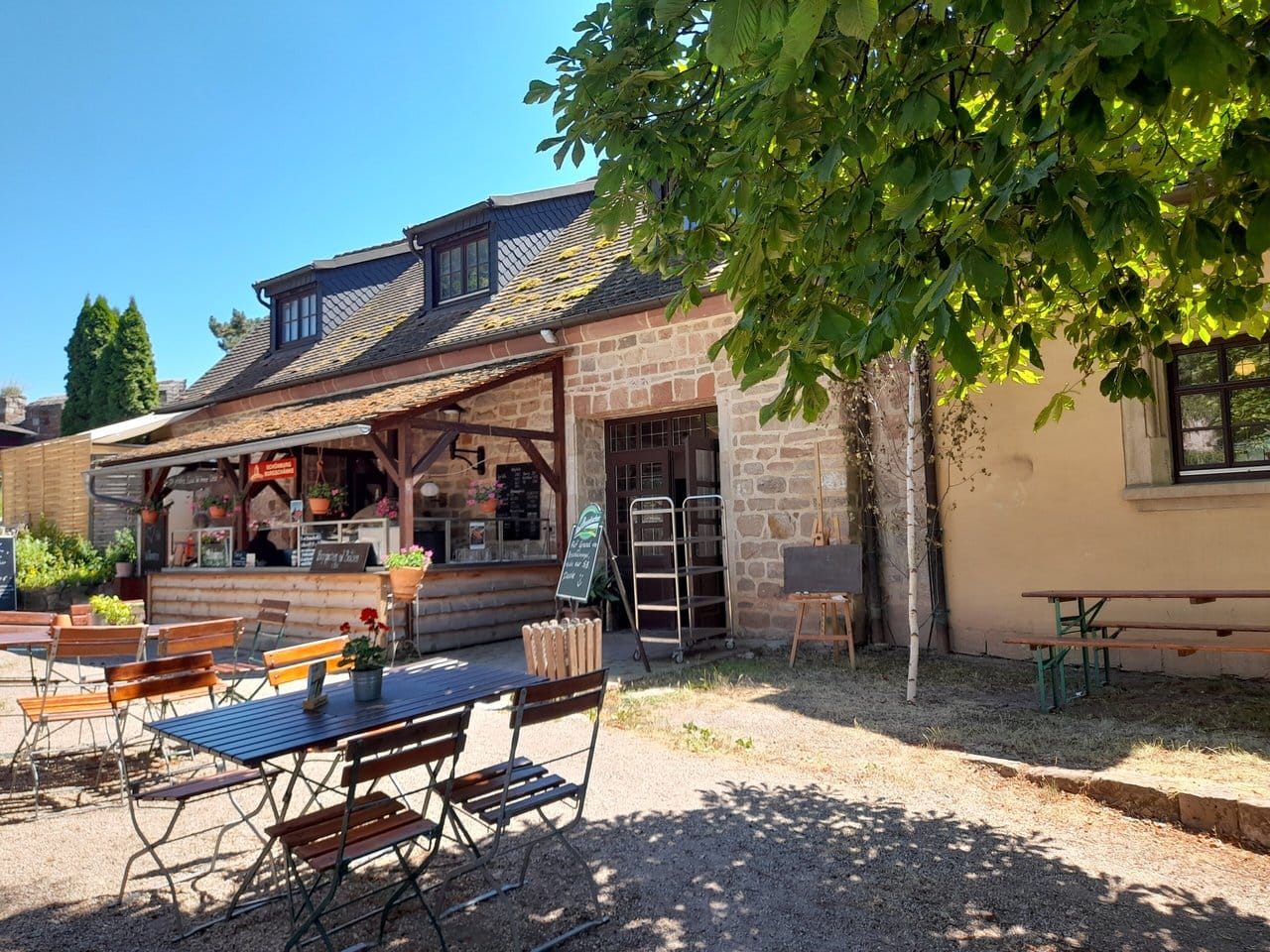
The courtyard and its Burgschanke are open at all hours. The Tower Museum keeps seasonal times, broadly daily except Monday from April through October and weekends only in the shoulder months, with a winter closure. Because the town adjusts the hours each year, confirm them on the operator’s site before a special trip.
Is Schönburg a hotel?
Yes. The south range houses a private hotel and the north range a residential youth center, while the courtyard, the terraces and the Burgschanke remain open to all who climb up.
Conclusion
Schönburg Castle earns its place on the Rhine not by being the largest or the oldest but by being the most communal. Its three keeps, its crowded register of co-heirs, and its long afterlife as town property, youth center, and family hotel all return to the same idea: a stronghold designed for many hands. The murder that opened its record and the legend that haunts the river below give it drama, and the American fortune that raised it from a quarry gives it a second act few ruins were granted. Standing on the gate-tower platform, with Oberwesel’s towers below and the gorge running off in both directions, it is easy to see why a banker from New York decided this particular ruin was worth a fortune.
Principal Sources
- Stadt Oberwesel. “Turmmuseum.” oberwesel.de.
- Generaldirektion Kulturelles Erbe Rheinland-Pfalz / regionalgeschichte.net. “Schloss Schönburg in Oberwesel.” regionalgeschichte.net.
- Bublies, Kira (Universität Koblenz-Landau). “Schönburg Oberwesel.” KuLaDig, Kultur.Landschaft.Digital. kuladig.de.
- Ruland, Wilhelm. Rheinisches Sagenbuch. (Seven Maidens legend.)
Operator and visitor information was checked against the official town and hotel sites; opening times and prices are reviewed annually and should be confirmed before travel.
Image credits. Schönburg Castle from the south (hero): Gillfoto, CC BY-SA 4.0, via Wikimedia Commons; the castle above Oberwesel across the Rhine: Calips, CC BY-SA 3.0, via Wikimedia Commons; the castle on its spur in winter: Tilman2007, CC BY-SA 4.0, via Wikimedia Commons; aerial view: Fritz Geller-Grimm, CC BY-SA 3.0, via Wikimedia Commons; the ruin before restoration: Adolphe Braun, public domain, via Wikimedia Commons; the Rheinländer-Bau: Kora27, CC BY-SA 4.0, via Wikimedia Commons; the Hoher Mantel shield wall: Johannes Robalotoff, CC BY-SA 3.0 DE, via Wikimedia Commons; the Seven Maidens lithograph: Caspar Scheuren, lithograph by J. B. Sonderland, CC BY 4.0, via Wikimedia Commons; the Burgschänke courtyard: Catatine, CC0, via Wikimedia Commons; inner face of the shield wall: RomkeHoekstra, CC BY-SA 4.0, via Wikimedia Commons; the castle chapel choir: HOWI – Willy Horsch, CC BY 3.0, via Wikimedia Commons; the castle from the Günderodehaus: Edgar El, CC BY 3.0, via Wikimedia Commons; the castle on its hill: Gillfoto, CC BY-SA 4.0, via Wikimedia Commons; aerial view, 1929: Hansa-Luftbild (Landesarchiv NRW), CC BY-SA 4.0, via Wikimedia Commons; Oberwesel etched by Wenceslaus Hollar: public domain, via Wikimedia Commons; the castle from above: Traveler100, CC BY-SA 3.0, via Wikimedia Commons; the castle from Kaub: Edgar El, CC BY 3.0, via Wikimedia Commons; location map: © StoneKeep Atlas (own work). Freely licensed images are resized to fit; otherwise unaltered.