
Châteaux of the Loire Valley: Nine Royal Houses
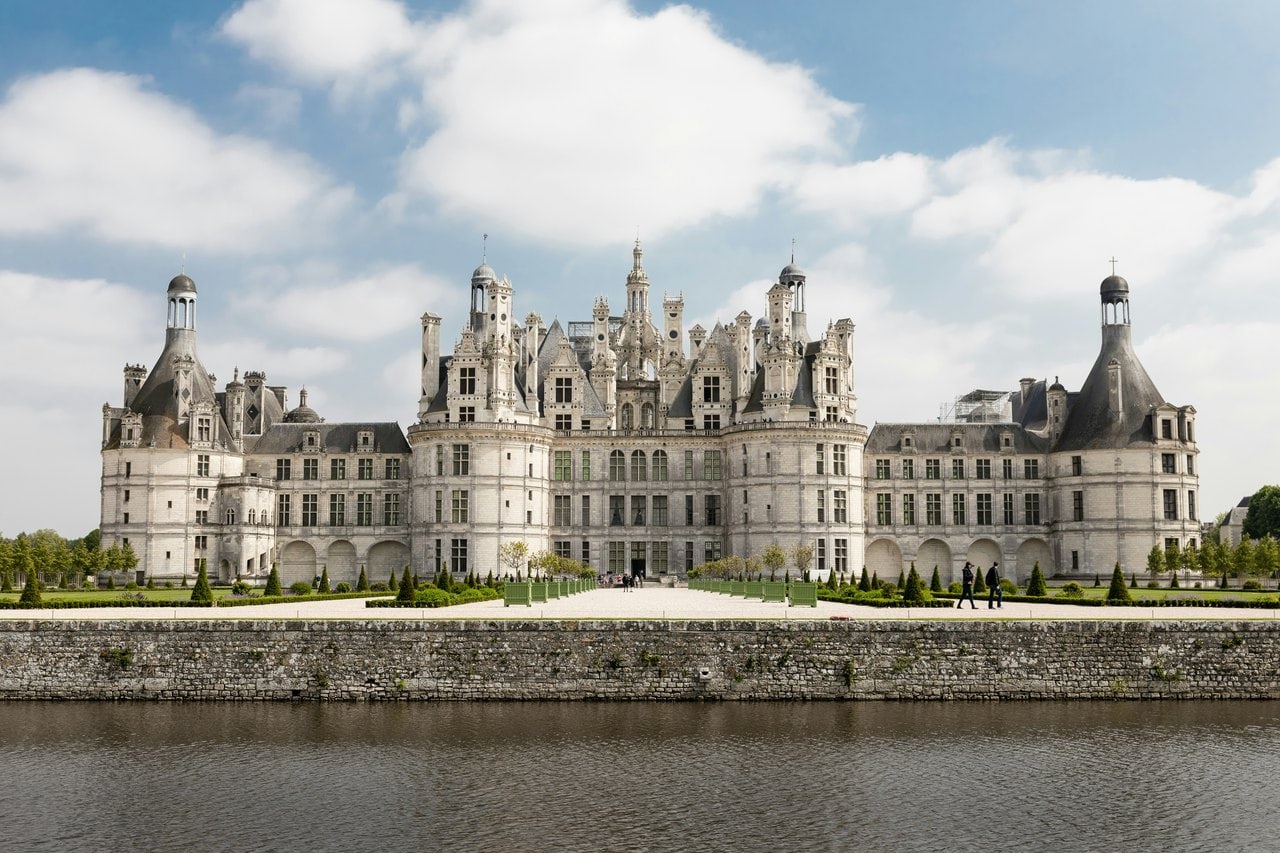
Along a short stretch of river country between Blois and Azay-le-Rideau, the kings of France built the houses that taught Europe what the French Renaissance looked like. English speakers know them as the châteaux of the Loire Valley; the French say les châteaux de la Loire. Nine of those houses now have full StoneKeep Atlas guides, and this page gathers them into one story. It runs from Chambord, a hunting retreat scaled to astonish a continent, to Clos Lucé, the brick manor where Leonardo da Vinci spent his last three years, and it explains why nine buildings within an afternoon’s drive of one another can carry so much of a nation’s history.
Read in sequence, the nine trace an arc. Royal power opens it: Chambord as the statement, Blois as the seat, Amboise as the cradle of the court. Women carry the middle chapters, at Chenonceau and Chaumont, where Diane de Poitiers and Catherine de’ Medici traded houses the way other rivals traded blows. Money and gardens follow, at Azay-le-Rideau and Villandry, both raised by financiers of François I and both perfected long after them. Cheverny shows what a château looks like when its family never leaves, and Clos Lucé closes the arc at human scale, in the rooms where the Renaissance arrived in France in person.
Each entry below distills its full guide and links to it. A comparison table comes first for orientation, and a planning section at the end covers bases, trains, and ticket pairings for a 2026 visit.
The Nine at a Glance
| Château | Claim to fame | Don’t miss | Town |
|---|---|---|---|
| Chambord | François I’s Renaissance colossus | The double-helix staircase | Chambord |
| Blois | Four centuries of architecture in one courtyard | François I’s open spiral staircase | Blois |
| Amboise | The court’s cradle above the Loire | Leonardo’s presumed tomb | Amboise |
| Chenonceau | The ladies’ château spanning the Cher | The gallery over the river | Chenonceaux |
| Chaumont-sur-Loire | The hill of reinventions | The International Garden Festival | Chaumont-sur-Loire |
| Azay-le-Rideau | The financier’s island jewel | The staircase with the king’s salamander | Azay-le-Rideau |
| Villandry | The re-created Renaissance gardens | The decorative potager from the terrace | Villandry |
| Cheverny | The lived-in, furnished house | The hundred hounds of the kennel | Cheverny |
| Clos Lucé | Leonardo da Vinci’s last home | The workshop rooms and park of machines | Amboise |
Château de Chambord: the King’s Statement in Stone
Every tour of the Loire begins, sooner or later, at the Château de Chambord, the largest of the valley’s châteaux and the boldest. François I ordered work to begin in 1519 on flat Sologne parkland beside the river Cosson, conceiving a hunting retreat scaled to the ambition of a young monarch who meant to astonish all of Europe. He never saw it finished. What rose instead became the defining architectural statement of the French Renaissance, its rooftop crowded with towers, chimneys, and slate turrets like a small town lifted into the sky.
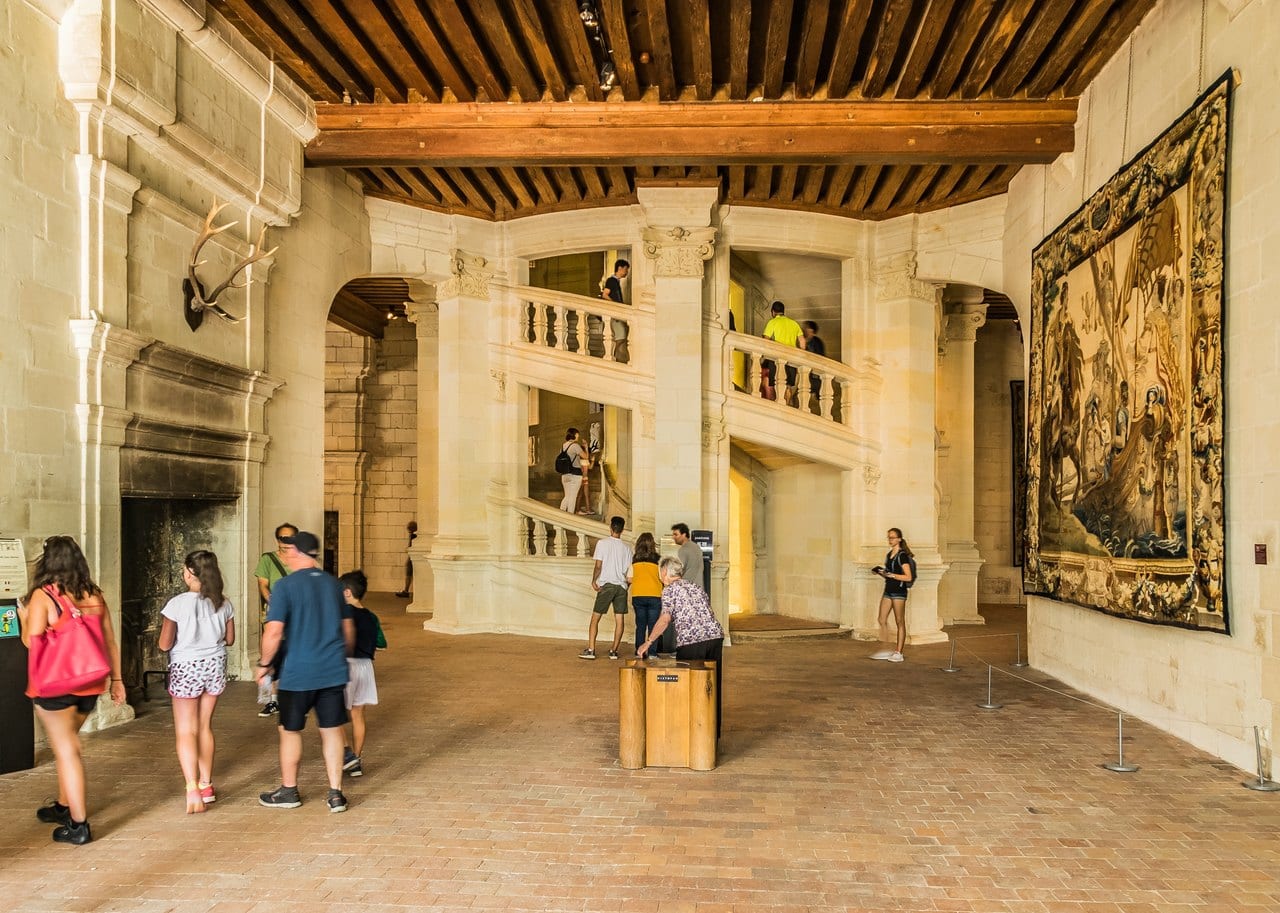
At the building’s core climbs a double-helix staircase whose two intertwined flights never meet. No document of the period names an architect; a wooden model is attributed to Domenico da Cortona, and Leonardo da Vinci, who died in May 1519, months before construction began, left notebook sketches close enough to the design that scholars allow his thinking may have shaped it. Around the château stretches an enclosed estate of about 5,440 hectares, ringed by a 32-kilometer wall.
Chambord’s afterlife matches its scale. Molière premiered two comedy-ballets here for Louis XIV, who substantially finished the building in the 1680s, and Maurice de Saxe, marshal of France, later quartered his personal cavalry regiment in the surrounding park, drilling his horsemen across the open ground until his death at the château in 1750. Listed in 1840 on the first French register of historic monuments, Chambord was inscribed individually as World Heritage in 1981, two decades before the valley-wide listing of 2000 took it in.
Its strangest chapter came with the Second World War, when it served as the hub of France’s art evacuation. After the Louvre closed on August 25, 1939, the Mona Lisa left Paris for Chambord three days later, traveling in a padded van among dozens of other masterpieces, and the château became the largest sorting depot in the operation that kept the national collections out of harm’s way.
Château de Blois: Four Centuries in One Courtyard
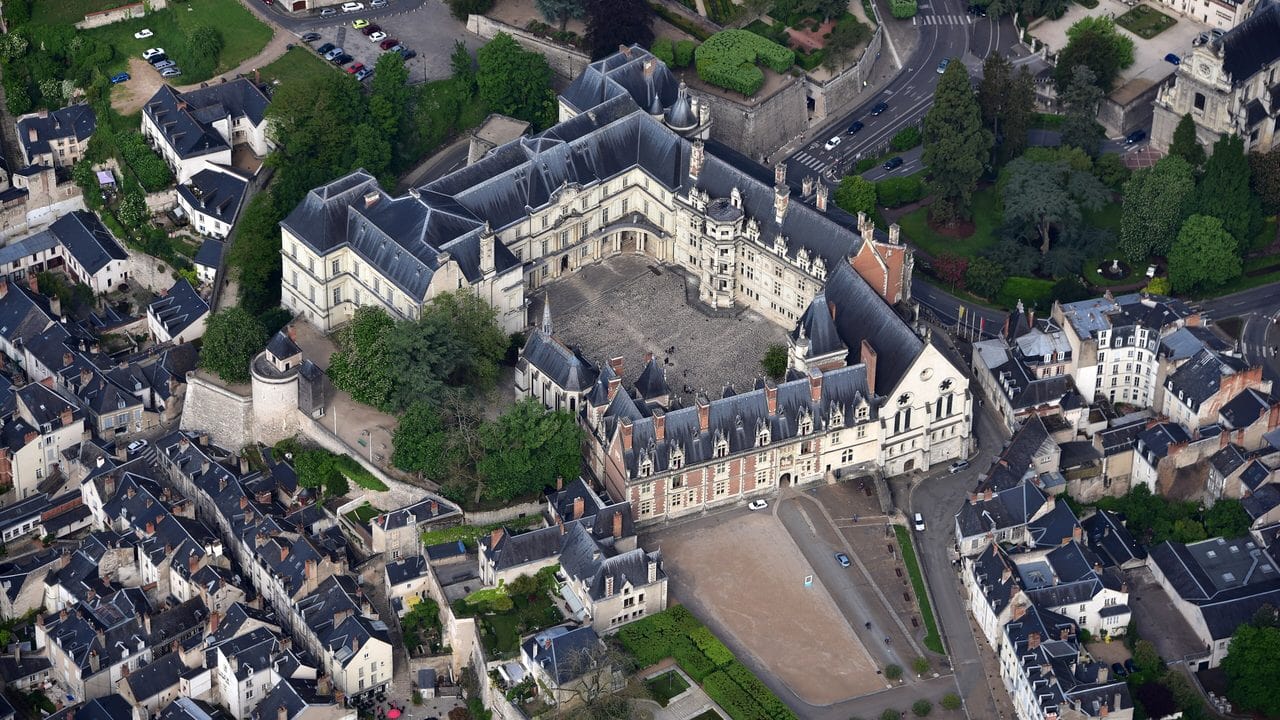
Stand in the courtyard of the Château de Blois and turn slowly in a circle: a Gothic hall raised by feudal counts in the early 1200s, a brick-and-stone wing built for Louis XII between 1498 and 1501, the Renaissance facade where François I hung his open spiral staircase between 1515 and 1524, and a Classical palace front designed by François Mansart for Gaston d’Orléans in the 1630s. No other castle in France compresses four centuries of national architecture into one enclosed square.
No other Loire château hosted so much raw politics either. Louis XII was born in the castle and brought the court back to it as king, making Blois a capital on the Loire. Seven kings and ten queens lived here in all, Joan of Arc passed through on her way to Orléans, and the Estates-General convened twice in the great hall. Two days before Christmas 1588, the king’s guards cut down the Duke of Guise, then the most powerful man in France, a few steps from the royal bed.
Mansart’s wing for Gaston d’Orléans, a rehearsal for French Classicism, halted in 1638 with the palace unfinished, and the château later sank to barracks duty before the nineteenth century rescued it as a monument. A son et lumière still replays the Guise drama on the courtyard walls on summer nights.
Blois sits in the middle of its town rather than apart from it, eight minutes on foot from the train station and under two hours from Paris by rail. It houses the Musée des Beaux-Arts de Blois, and as a first stop it works like a key: once you have read its courtyard, every other château in the valley falls into place.
Château d’Amboise: the Court’s Cradle
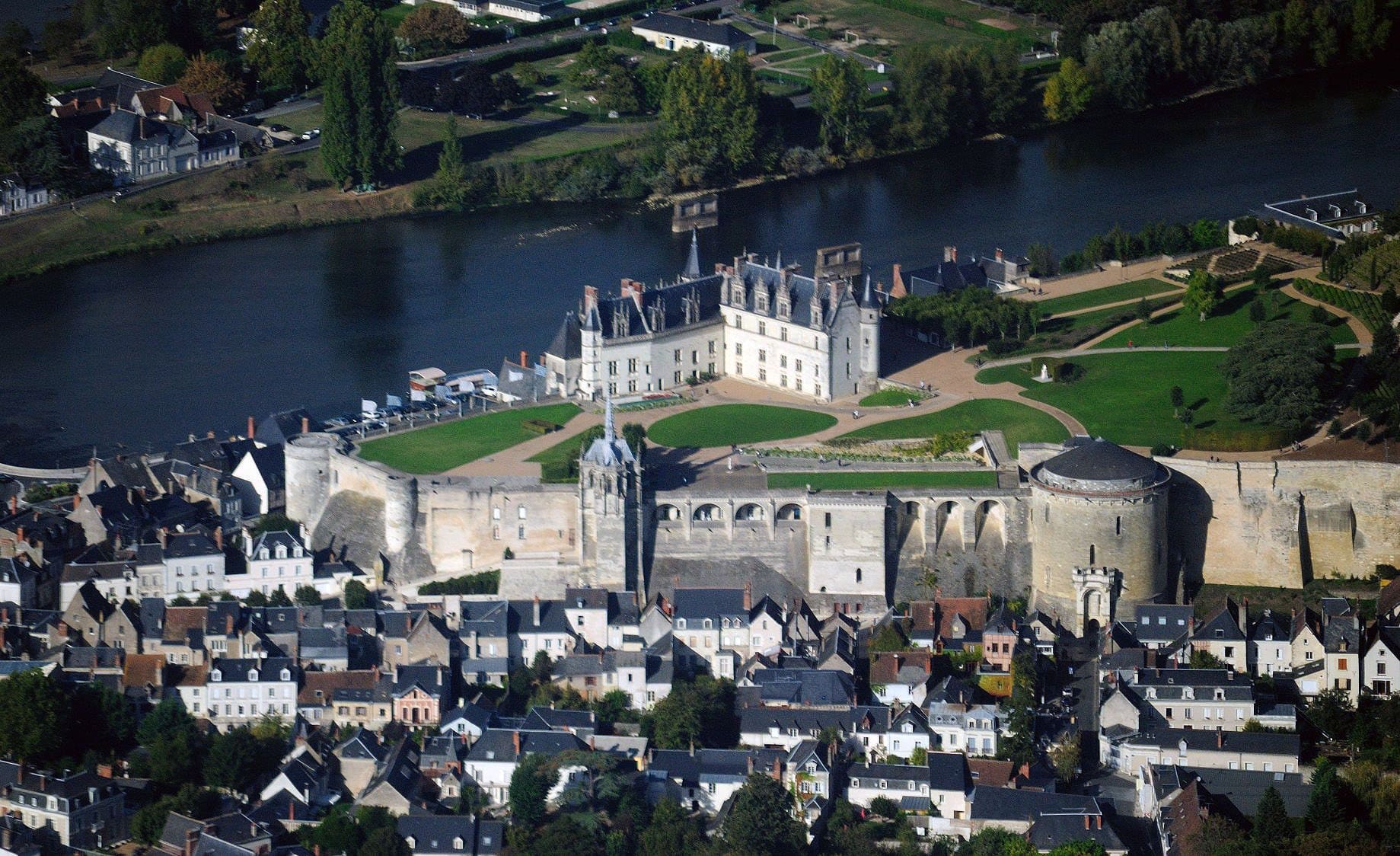
The Château d’Amboise rises on a limestone spur in the heart of its town, terraces standing some forty meters above the Loire. A royal stronghold since the crown seized it in 1434, it was rebuilt by Charles VIII in the 1490s into the first great palace of the French Renaissance, after his Italian wars sent artists, gardeners, and a new visual language north across the Alps.
Amboise repaid its builder cruelly. On April 7, 1498, hurrying to watch a game of jeu de paume, Charles VIII struck his head on a stone lintel in one of the château’s galleries and died the same evening, still in his twenties, ending the senior line of the house of Valois. Amboise then became the cradle of François I, and it holds the presumed tomb of Leonardo da Vinci in the chapel of Saint-Hubert; the plaque above the grave is honest about that word “presumed,” and visitors come from across the world to stand before it anyway. Darker history followed: the Tumult of Amboise in 1560, when a failed conspiracy against the young François II ended in a notorious massacre.
Later demolitions left only a portion of the once-enormous palace standing, now in the care of the Fondation Saint-Louis. A full visit takes about ninety minutes to two hours, and the Pass Léonard combined ticket pairs Amboise with Clos Lucé and Chambord at a meaningful saving.
Château de Chenonceau: the Ladies’ Château
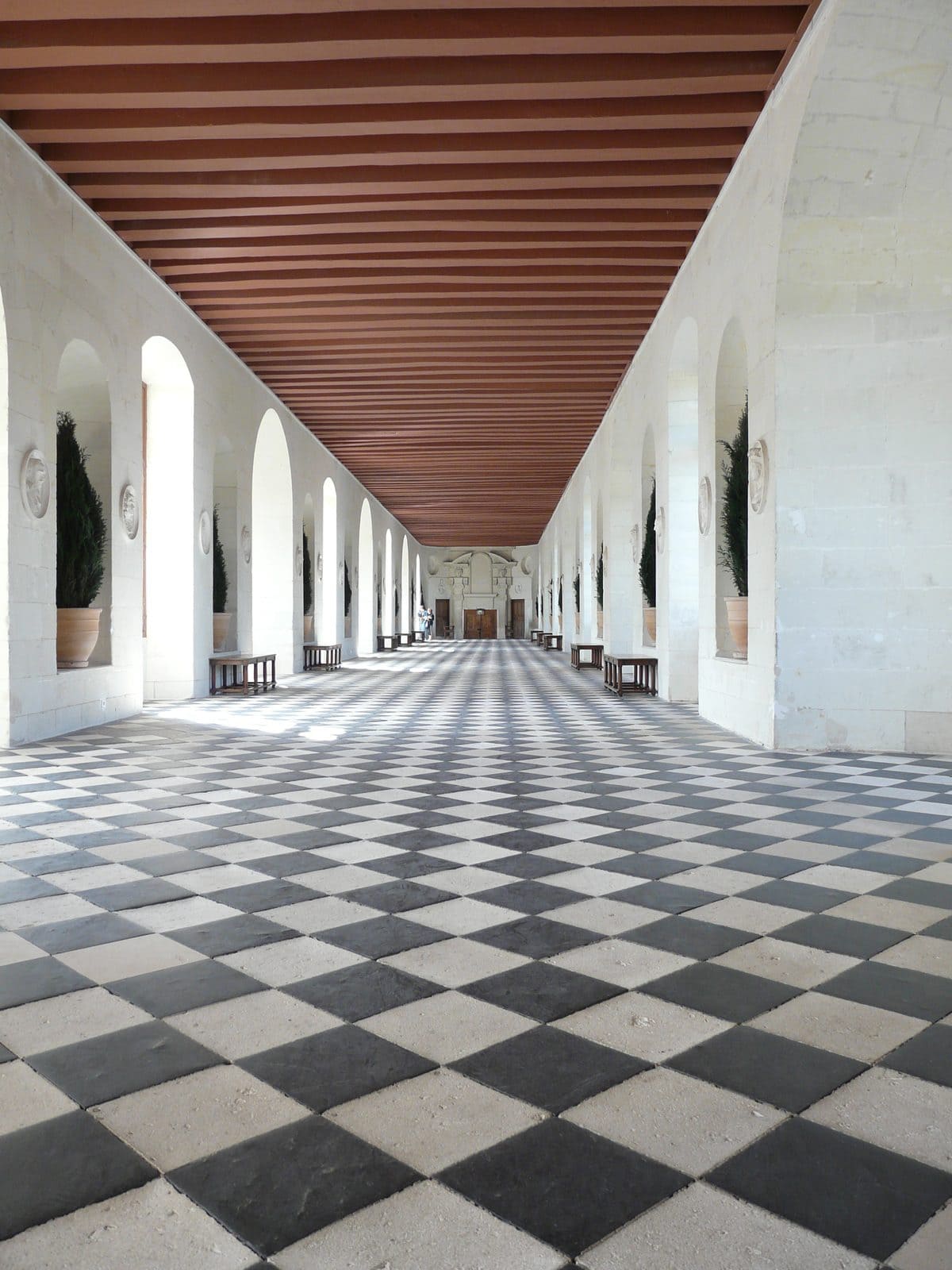
The Château de Chenonceau does not sit beside the river Cher so much as stride across it on five piers of pale tuffeau stone. Completed in 1521 for the royal official Thomas Bohier and his wife Katherine Briçonnet, it earned the nickname Château des Dames, the ladies’ château, and that name is the most accurate one-line history the place has: for five centuries the great decisions here were taken by women.
Diane de Poitiers embellished it as a king’s gift. Catherine de’ Medici, having reclaimed it from her, built the great two-story gallery along the full length of the bridge: working from plans associated with Philibert de l’Orme and executed by the architect Jean Bullant, she raised sixty meters of checkerboard floor over moving water, completed in 1576 and inaugurated the next year. Louise de Lorraine mourned a murdered king here in white, and in the eighteenth century Louise Dupin kept an Enlightenment salon in these rooms; the château survived the Revolution in her time.
The river that made Chenonceau beautiful also made it useful. In the First World War, Gaston Menier turned the gallery into a military hospital of some 120 beds at the family’s own expense, with Simone Menier as matron; in the Second, the demarcation line between occupied France and the Vichy free zone ran straight down the middle of the Cher, and the château straddled it, its main entrance in the occupied north while the gallery’s far door opened onto the free south bank. Owned by the Menier family since 1913, it deserves at least half a day.
Château de Chaumont-sur-Loire: the Hill of Reinventions
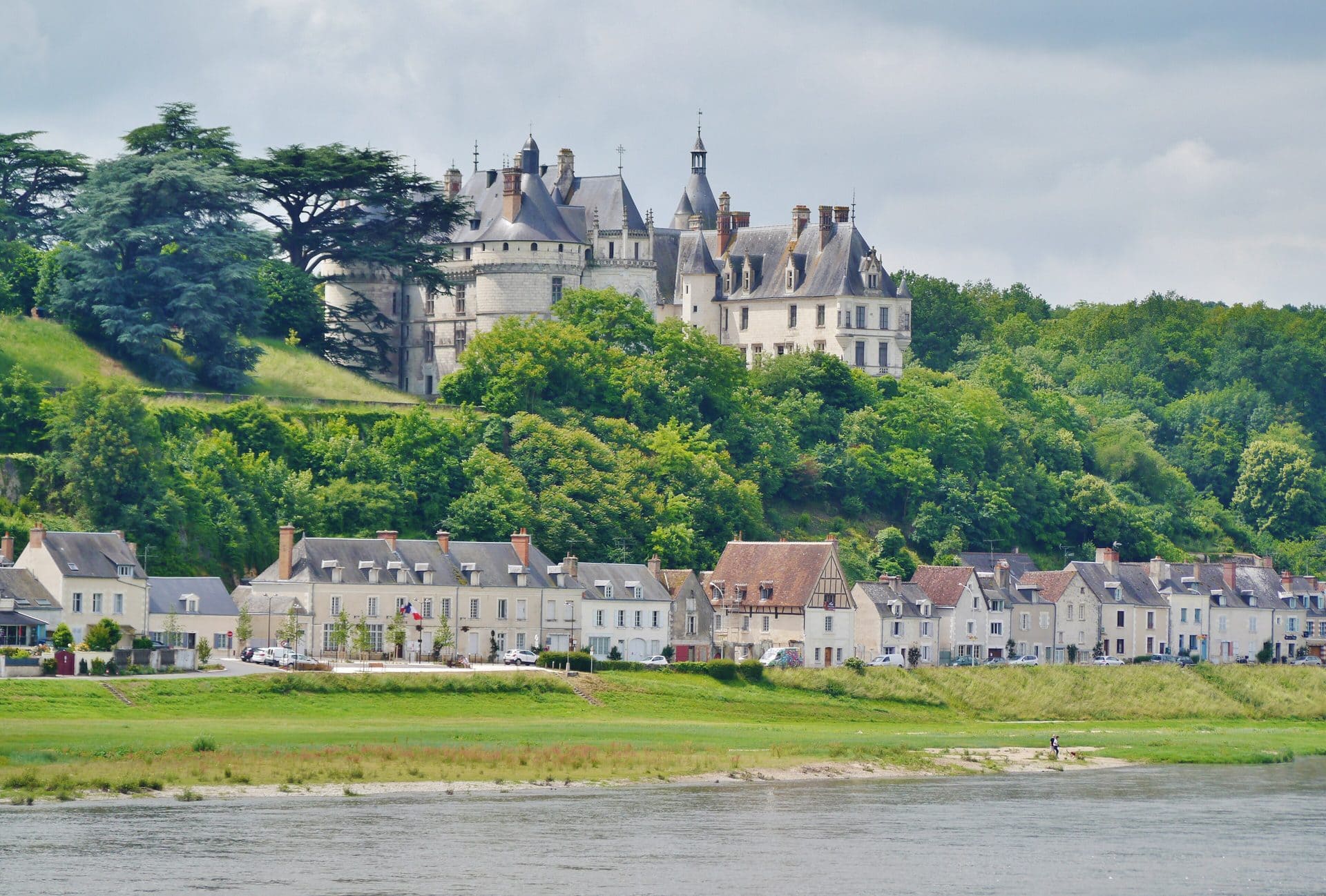
Midway between Blois and Amboise, the Château de Chaumont-sur-Loire looks every inch the feudal stronghold from its wooded bluff: round towers, a working drawbridge, pepper-pot roofs forty meters over the river. That martial silhouette misleads. A count raised the first fort here around the year 1000, Louis XI burned it to the ground in 1465, and the d’Amboise family rebuilt it over the decades that followed, at the precise moment the Loire was turning from a land of fortresses into a land of pleasure houses.
Catherine de’ Medici bought Chaumont in 1550 for 120,000 livres, and after Henri II’s death she pressed his mistress Diane de Poitiers to give up Chenonceau and accept Chaumont in exchange. Tradition tells it as a humiliation; the ledgers say otherwise, since the lands attached to Chaumont produced revenues close to three times those of Chenonceau.
Quieter centuries followed, among them the exile of Madame de Staël, before a sugar heiress, Marie-Charlotte Say, bought the estate in 1875 and made it a Belle Époque pleasure palace, complete with an elephant; her Belle Époque stables remain one of the estate’s signature features. Since 2007 it has belonged to the Région Centre-Val de Loire, and it now draws hundreds of thousands of visitors a year, most of them for the International Garden Festival, an event that did not exist before 1992.
Château d’Azay-le-Rideau: the Financier’s Diamond
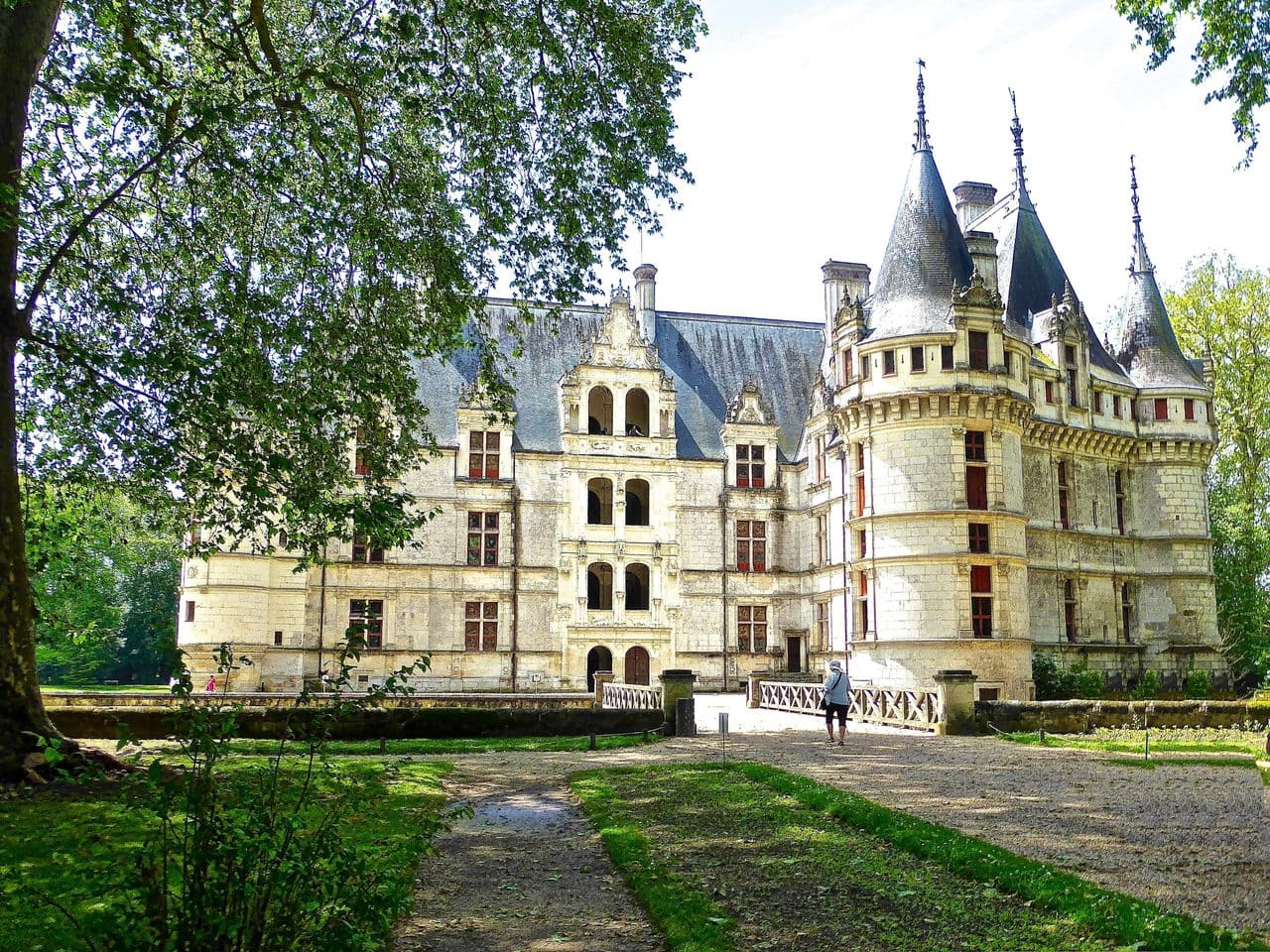
On a low island in the Indre stands the house Honoré de Balzac called “a faceted diamond set by the Indre river, mounted on pillars covered with flowers.” The Château d’Azay-le-Rideau is the smallest of the great Renaissance châteaux of the Loire Valley, for many the most perfect, and among the few raised by a royal financier rather than for the crown itself.
Gilles Berthelot, a financier in the service of François I, raised it with his wife Philippe Lesbahy between 1518 and the late 1520s. Inside, a straight ramp-on-ramp staircase climbs flight over flight through the center of the main block, a design so new to France that the Centre des monuments nationaux calls it among the oldest of its kind preserved anywhere, and on its frontispiece Berthelot carved the salamander of François I beside the ermine of Queen Claude.
Loyalty in stone bought him nothing. After the disaster at Pavia, the king ordered his financiers’ accounts investigated, and the affair that destroyed Berthelot’s cousin by marriage, the baron de Semblançay, swept Azay away with it: Berthelot lost everything before the roof was finished, and the crown confiscated the château.
The nineteenth century completed the silhouette under the marquises de Biencourt, and the Centre des monuments nationaux presents it today, fresh from an eight-million-euro restoration. Azay sits 26 kilometers southwest of Tours and pairs naturally with Villandry, fifteen minutes away.
Château de Villandry: the Gardens Imagined Back
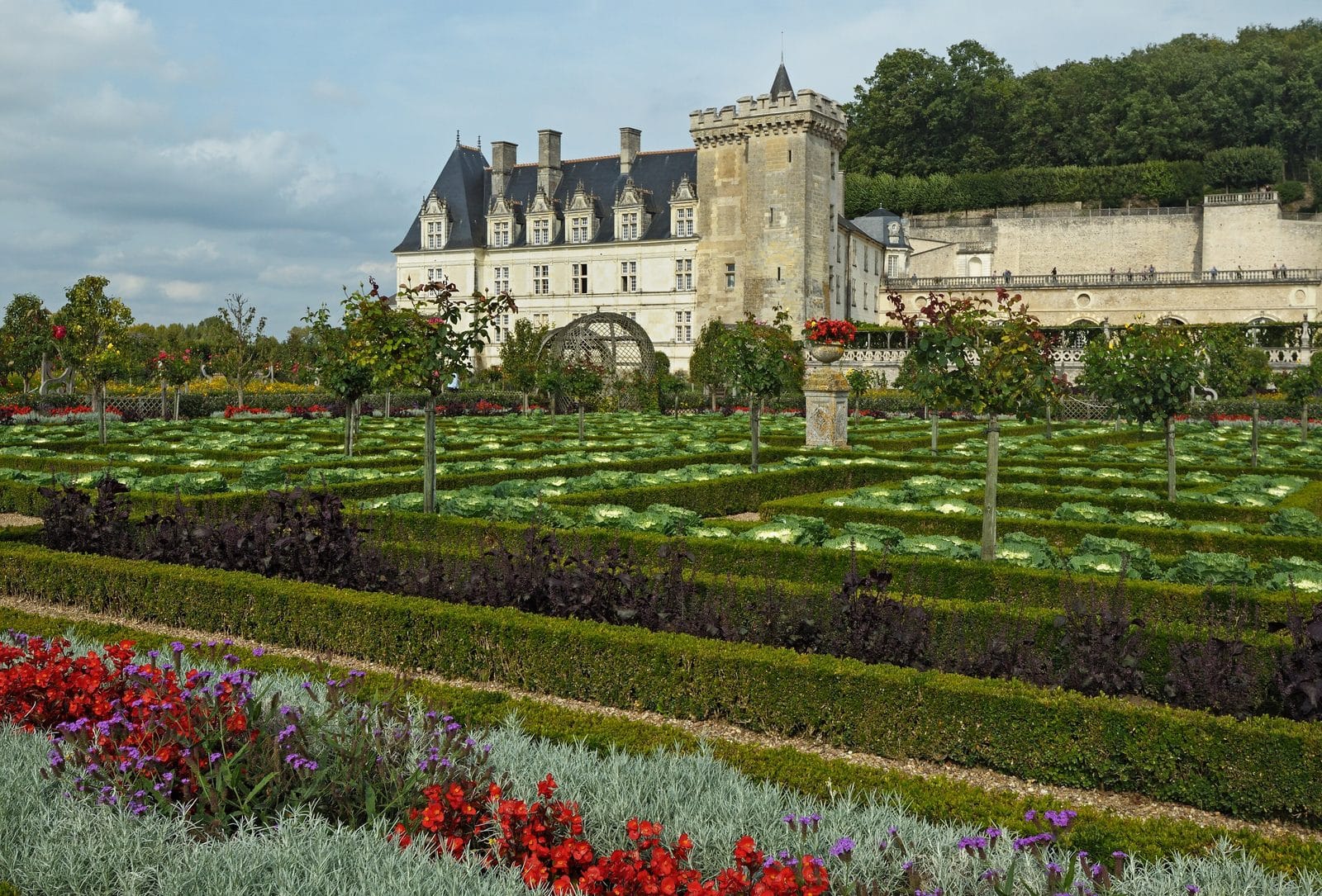
Where the Cher slips toward its meeting with the Loire, 15 kilometers west of Tours, the Château de Villandry rests low on the valley floor, three pale wings of tuffeau set in a horseshoe plan open to the valley. Jean Le Breton, finance secretary to François I, built it from 1532 to about 1536, making it the last of the great Renaissance châteaux raised along the Loire, and among the most restrained.
A paradox sits at its center. Close to a million visitors a year come for gardens that are not a sixteenth-century survival at all but a careful twentieth-century re-creation, conjured back into being by Joachim Carvallo, a Spanish doctor who abandoned medicine to do it and whose family has owned the château since 1906. From the terrace, the decorative kitchen garden reads like a canvas; clipped box parterres diagram the moods of love; a still water garden mirrors the sky on its upper level.
The site’s history runs deeper than its planting beds. A medieval fortress named Colombiers stood here first, where a peace was sealed in 1189, and the château’s later centuries carried it from the Castellane family to a Bonaparte before the Carvallo rescue. Classified a Monument Historique in 1934 and a Jardin Remarquable in 2004, it keeps its gardens open year-round while the château follows a seasonal calendar. Villandry is loved less for what lasted than for what was imagined back into existence.
Château de Cheverny: the House That Never Emptied
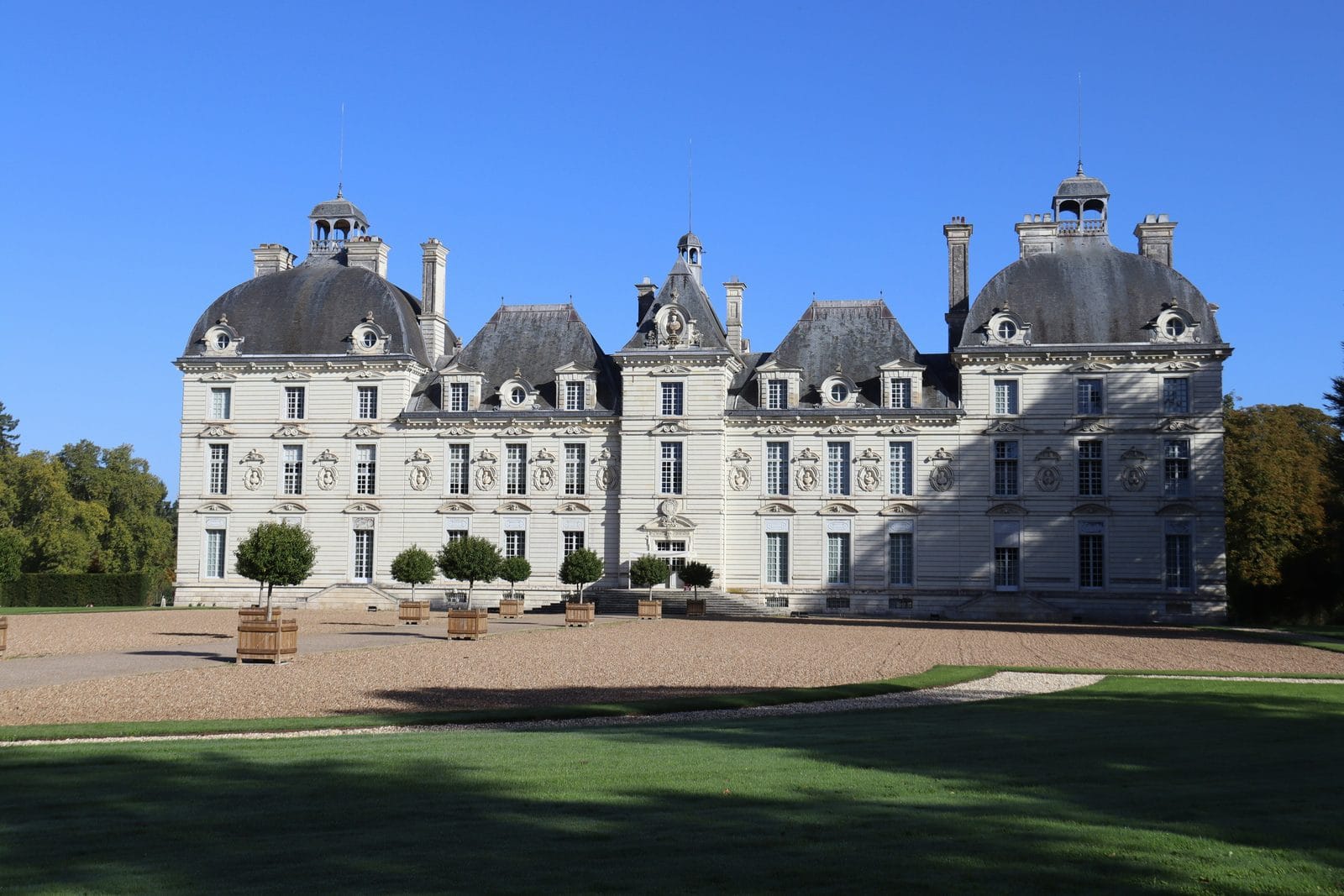
At the end of a long lawn in the wooded Sologne south of Blois, the Château de Cheverny rose in a single building campaign in the 1620s and has scarcely changed since. Its white, rigorously symmetrical facade is a textbook of Louis XIII classicism, but architecture is not what sets it apart from its Loire siblings — people still live here.
A family that first bought land on this spot in 1392 occupies one wing today, and that continuity explains the interiors: while revolution and auction emptied the royal châteaux of the valley, Cheverny kept its furniture, its tapestries, and its painted ceilings in place. Visitors have shared the house with its owners since 1922, when Cheverny became, by its own account, the first private château in France to open its doors to the public.
September 1939 drew the house into the same great art evacuation that filled Chambord. Cheverny became one of the depots fed from that hub, receiving roughly 870 crates of antiquities and objets d’art from the Louvre and other national collections, and the war passed without costing the house its treasures, old or borrowed.
Around 350,000 people a year now come for those furnished rooms, for the hundred hounds in the kennel, for more than half a million spring tulips, and for the silhouette Hergé borrowed when he drew Marlinspike Hall. Cheverny is the valley’s best answer to a simple question: what does a château look like when its story never stops?
Château du Clos Lucé: Leonardo’s Manor
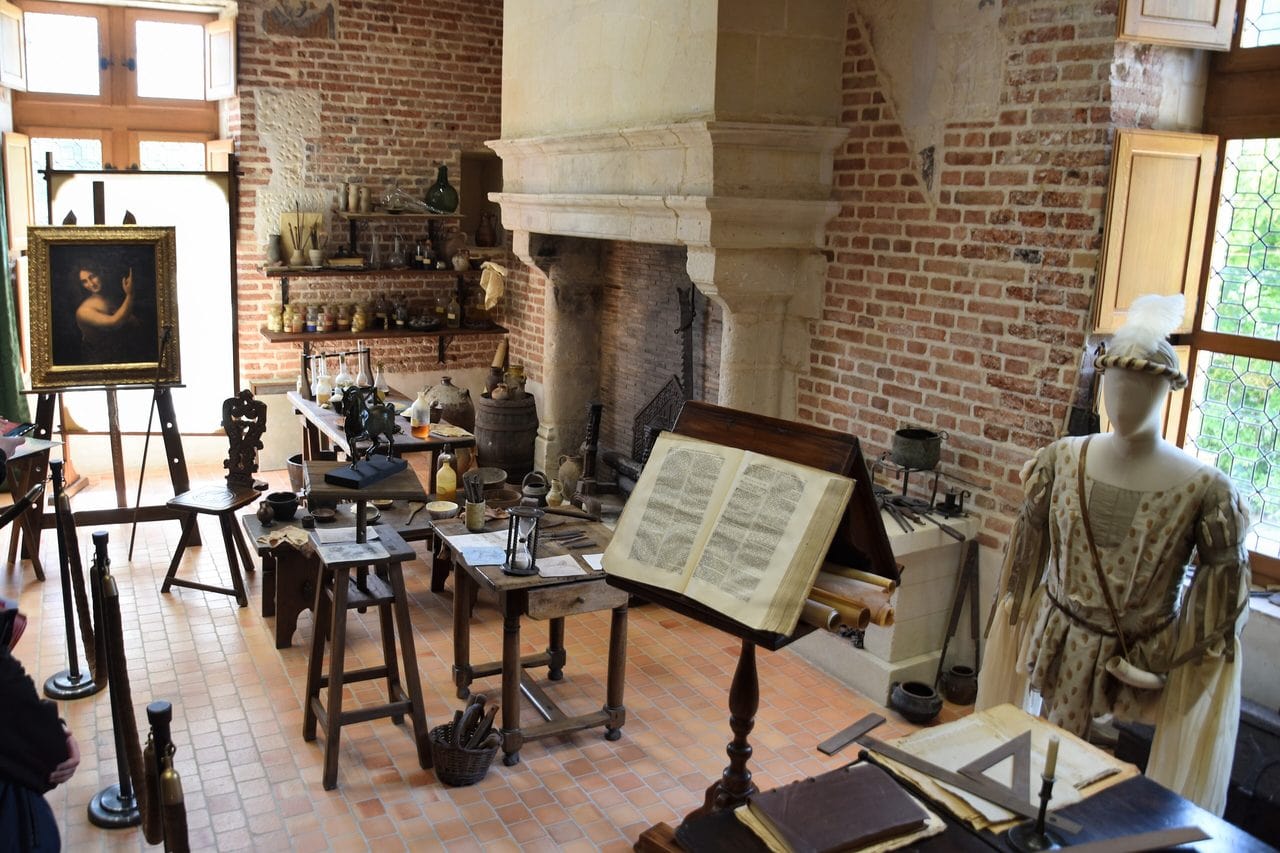
The arc ends 400 meters from where Amboise’s terraces meet the sky, on a quiet street at the edge of the old town. The Château du Clos Lucé, built of pink brick and white tuffeau around 1471 for a counselor of Louis XI and bought by Charles VIII in 1490 as a summer house for the kings of France, with a chapel added in the 1490s, would rate a pleasant footnote among the valley’s residences — if not for the guest who moved in during the autumn of 1516.
Leonardo da Vinci, sixty-four years old, crossed the Alps at the invitation of François I with three paintings in his baggage, the Mona Lisa among them. He spent the last three years of his life in this house, drawing, designing, and staging festivals for the court, and he died in one of its rooms on May 2, 1519.
A single family has been telling that story since 1854, and the manor was classified a monument historique as early as the 1862 list. What survives is less a palace than a home: a workshop, a kitchen, a bedroom with a view of the king’s château, and a seven-hectare park filled with machines lifted from its most famous resident’s notebooks. Plan on two and a half to three hours. After the colossi upstream, the human scale lands hardest.
Planning a Loire Valley Visit
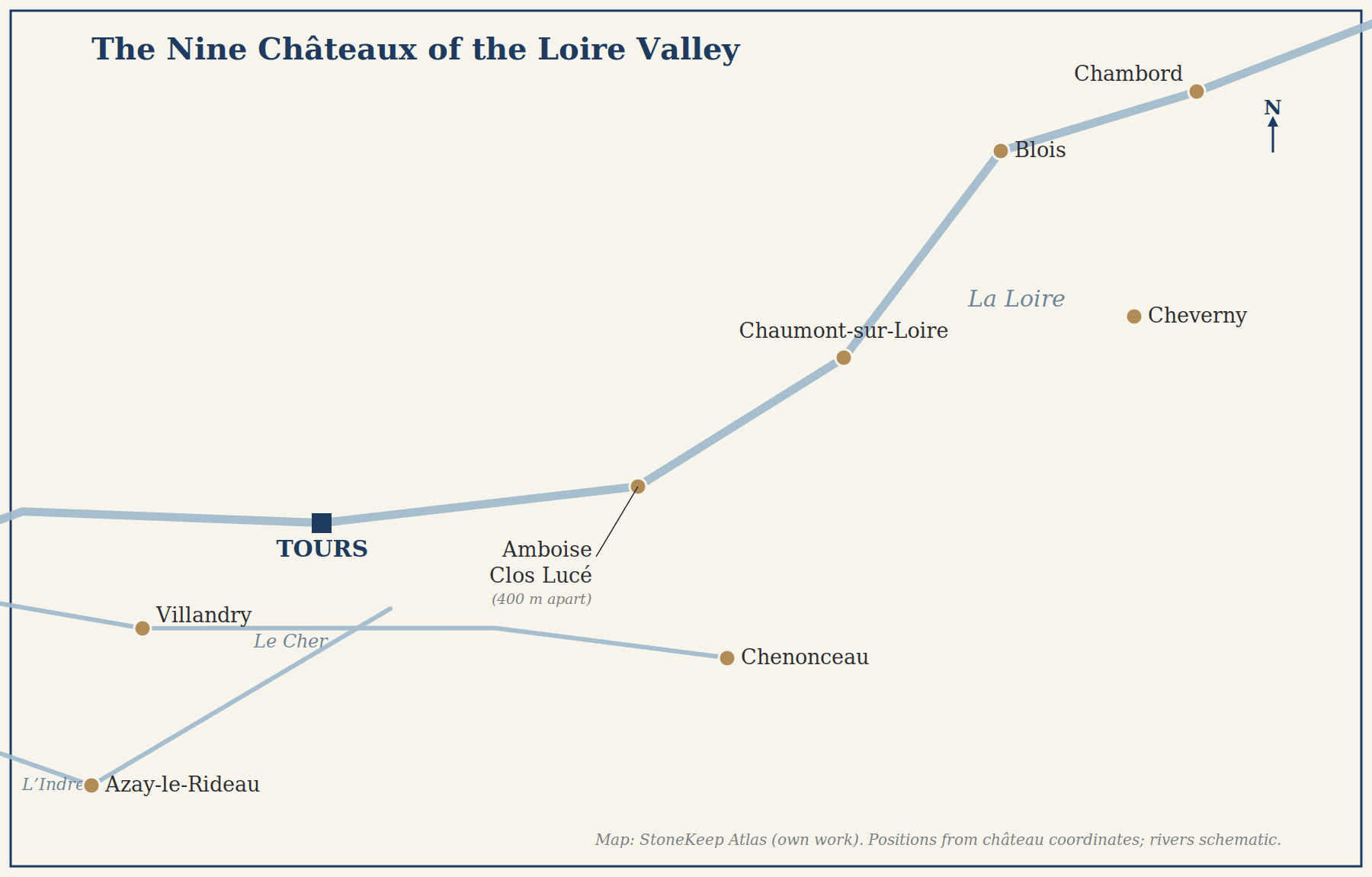
The nine houses cluster along one compact reach of river country. Blois anchors the east, with Chambord on its parkland nearby and Cheverny 15 kilometers south; Chaumont waits midway between Blois and Amboise; Amboise holds Clos Lucé in its own streets, with Chenonceaux about half an hour east of Tours; and the west belongs to Tours, with Villandry 15 kilometers out and Azay-le-Rideau 26 kilometers southwest. Two or three days is enough for the headline houses without rushing; a full week sees all nine at an unhurried pace. Chaumont’s Garden Festival runs from spring into autumn each year, the kind of fixed point worth planning a route around; its exact dates are published on the domaine’s site.
Rail access is genuinely good by castle-country standards. Blois is under two hours from Paris, and its château stands eight minutes on foot from the station, with a seasonal shuttle linking Blois-Chambord station to Chambord itself; on the western side, the TER from Tours stops at Azay-le-Rideau. A car remains the simplest way to string several houses into one day, and most visitors mix the two.
Pairings save both money and time. Amboise and Clos Lucé sit 400 meters apart and fill one unhurried day together, with the Pass Léonard combined ticket covering both plus Chambord at a saving of up to about 20 percent; Azay-le-Rideau and Villandry, fifteen minutes apart, make the classic western half-day. Loire Valley day tours and skip-the-line château tickets can also be booked in advance on GetYourGuide.
Tours is the practical base, a rail hub with the largest hotel inventory in the region and quick spokes to the western châteaux; Amboise makes the cozier alternative, with Clos Lucé a short walk away and Chaumont just upstream. Anyone staying overnight can compare hotels in and around Tours.
Some links on this page are affiliate links, which means StoneKeep Atlas may earn a small commission, at no extra cost to you, if you book through them.
One River, Nine Answers
Ask why the Loire matters and the valley gives nine different answers. Power built Chambord, Blois, and Amboise; women remade Chenonceau and Chaumont; money raised Azay and Villandry, and gardens redeemed them; one family’s stubbornness kept Cheverny whole; and genius spent its last three years at Clos Lucé. No single château tells the whole story — which is exactly why they reward being read together.
Start anywhere. Start with the colossus if scale moves you, with Blois if you want the key to the architecture, with Chenonceau if you want the people, or with the manor at the end of the arc if you want to stand in the room where the Renaissance came to France to die, and found a home instead. The river connects them all, and it has been doing so for five hundred years.
The Loire is one of several great French regions gathered on StoneKeep Atlas, and all of them meet in our national guide to the Châteaux of France. Around Paris lie the royal residences of the Île-de-France and the châteaux of the Oise; far to the south, the castles of Provence gather the great fortresses and palaces of the Mediterranean; and in the far east, the castles of Alsace stand watch between the Vosges and the Rhine.
Principal Sources
- Centre des monuments nationaux. “Château d’Azay-le-Rideau.” azay-le-rideau.fr.
- Château de Cheverny. “Le château.” chateau-cheverny.fr.
- Château de Villandry. “Histoire.” chateauvillandry.fr.
- Château du Clos Lucé, Parc Leonardo da Vinci. vinci-closluce.com.
- Château et Domaine de Chenonceau. chenonceau.com.
- Château Royal de Blois. chateaudeblois.fr.
- Domaine de Chaumont-sur-Loire. domaine-chaumont.fr.
- Domaine national de Chambord. chambord.org.
- Fondation Saint-Louis. “Château Royal d’Amboise.” chateau-amboise.com.
- UNESCO World Heritage Centre. “The Loire Valley between Sully-sur-Loire and Chalonnes” (property 933). whc.unesco.org.
- Visiting details for all nine houses are published by their operators; opening times and prices vary by season and are best checked on the official sites before a visit. Each château’s full StoneKeep Atlas guide carries its complete source apparatus.
Image credits. Château de Chambord: Krzysztof Golik, CC BY-SA 4.0, via Wikimedia Commons; Château de Blois: Wolkenkratzer, CC BY-SA 4.0, via Wikimedia Commons; Château d'Amboise: Lieven Smits, CC BY-SA 3.0, via Wikimedia Commons; Château de Chenonceau: Sébastien Hosy, CC BY-SA 3.0, via Wikimedia Commons; Château de Chaumont-sur-Loire: Zairon, CC BY-SA 4.0, via Wikimedia Commons; Château d'Azay-le-Rideau: memorycatcher, via Pixabay; Château de Villandry: Ввласенко, CC BY-SA 3.0, via Wikimedia Commons; Château de Cheverny: Shalev Cohen, via Unsplash; Château du Clos Lucé: Pieter van Everdingen, CC BY-SA 4.0, via Wikimedia Commons; Loire Valley locator map: StoneKeep Atlas (own work). Freely licensed images are resized to fit; otherwise unaltered.